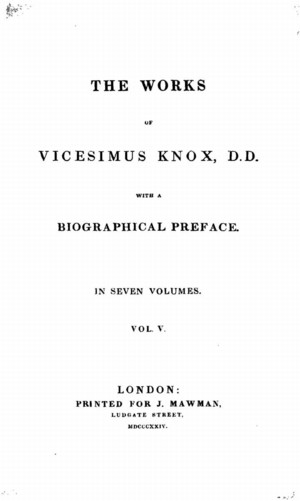
The Works of Vicesimus Knox, vol. 5
- Desiderius Erasmus (author)
- Vicesimus Knox (author)
This volume contains Knox’s letters written to a lord on “Personal Nobility” and his criticism of the British state during its war against the French, “The Spirit of Despotism” (1795), and his translation of a work of Erasmus “Antipolemus”. The fuller table of contents of “The Spirit of Despotism” (1795) is as follows:
- SECTION I.: Introductory.
- SECTION II. Oriental Manners, and the Ideas imbibed in Youth, both in the West and East Indies, favourable to the Spirit of Despotism.
- SECTION III. Certain Circumstances in Education which promote the Spirit of Despotism.
- SECTION IV. Corruption of Manners has a natural Tendency to promote the Spirit of Despotism.
- SECTION V. An Abhorrence of Despotism and an ardent Love of Liberty perfectly consistent with Order and Tranquillity; and the natural Consequence of well-informed Understandings and benevolent Dispositions.
- SECTION VI. On the Venality of the Press under the Influence of the despotic Spirit, and its Effects in diffusing that Spirit.
- SECTION VII. The fashionable Invectives against Philosophy and Reason, a Proof of the Spirit of Despotism.
- SECTION VIII. Of Loyalty, and certain mistaken Ideas of it.
- SECTION IX. On taking Advantage of popular Commotions, accidental Excesses, and foreign Revolutions, to extend Prerogative and Power, and encroach on the Liberties of the People.
- SECTION X. When Human Life is held cheap, it is a Symptom of a prevailing Spirit of Despotism.
- SECTION XI. Indifference of the middle and lower Classes of the People to public Affairs, highly favourable to the Encroachments of the Tory Principle, and therefore to the Spirit of Despotism.
- SECTION XII. The despotic Spirit is inclined to discourage Commerce, as unfavourable to its Purposes.
- SECTION XIII. The Spirit of Despotism displaying itself in private Life, and proceeding thence to avail itself of the Church and the Military.
- SECTION XIV. The despotic Spirit inclined to avail itself of Spies, Informers, false Witnesses, pretended Conspiracies, and self-interested Associations affecting Patriotism.
- SECTION XV. The Manners of Tory Courtiers, and of those who ape them, as People of Fashion, inconsistent with Manliness, Truth, and Honesty; and their Prevalence injurious to a free Constitution, and the Happiness of Human Nature.
- SECTION XVI. The Spirit of Truth, Liberty, and Virtue, public as well as private, chiefly to be found in the Middle Ranks of the People.- SECTION XVII. On debauching the Minds of the rising Generation and a whole People, by giving them Military Notions in a frée and commercial Country.
- SECTION XVII. Levity, Effeminacy, Ignorance, and Want of Principle in private Life, inimical to all public Virtue, and favourable to the Spirit of Despotism.
- SECTION XIX. Certain Passages in Dr. Brown’s “Estimate” which deserve the serious Consideration of all who would oppose the Subversion of a free Constitution by Corruption of Manners and Principles, and by undue Influence.
- SECTION XX. On several Subjects suggested by Lord Melcombe’s Diary; particularly the Practice of bartering the Cure of Souls for the Corruption of Parliament.
- SECTION XXI. On choosing rich Men, without Parts, Spirit, or Liberality, as Representatives in the National Council.
- SECTION XXII. Of the despotic Influence of great Merchants over their Subalterns, of Customers over their Tradesmen, and rich trading Companies over their various Dependents, in compelling them to vote for Court Candidates for Seats in Parliment, merely to serve private interest, without the smallest regard for public Liberty and Happiness, or the Fitness or Unfitness of the Candidate.
- SECTION XXIII. Of the Pageantry of Life; that it originates in the Spirit of Despotism; and contributes to it, without advancing private any more than public Felicity.
- SECTION XXIV. Insolence of the higher Orders to the Middle Ranks and the Poor; with their affected Condescension, in certain Circumstances, to the lowest of the People.
- SECTION XXV. Of a Natural Aristocracy.
- SECTION XXVI. The excessive Love of Distinction and Power which prevails wherever the Spirit of Despotism exists, deadens some of the finest Feelings of the Heart, and counteracts the Laws of Nature.
- SECTION XXVII. On the Opinion that the People are annihilated or absorbed in Parliament; that the Voice of the People is no where to be heard but in Parliament; and on similar Doctrines, tending to depreciate the People.
- SECTION XXVIII. The fashionable Contempt thrown on Mr. Locke, and his Writings in Favour of Liberty; and on other Authors and Books espousing the same Cause.
- SECTION XXIX. Of the Despotism of Influence; while the Forms of a free Constitution are preserved.
- SECTION XXX. The Spirit of Despotism delights in War or systematic Murder.
- SECTION XXXI. On the Idea that we have arrived at Perfection in Politics, though all other Sciences are in a Progressive State.
- SECTION XXXII. On Political Ethics; their chief Object is to throw Power into the Hands of the worst Part of Mankind, and to render Government an Institution calculated to enrich and aggrandize a few, at the expense of the Liberty, Property, and Lives of the many.
- SECTION XXXIII. On trafficking with the Cure of Souls, (Cura Animarum,) for the Purposes of Political, i. e. Moral, Corruption.
- SECTION XXXIV. Of Mr. Hume’s Idea, That absolute Monarchy is the easiest Death, the true Euthanasia of the British Constitution.
- SECTION XXXV. The Permission of Lawyers by Profession, aspiring to Honours in the Gift of the Crown, to have the greatest Influence in the Legislature, a Circumstance unfavourable to Liberty.
- SECTION XXXVI. Poverty, when not extreme, favourable to all Virtue, public and private, and consequently to the Happiness of human Nature; and enormous Riches, without Virtue, the general Bane.
- SECTION XXXVII. On the natural Tendency of making Judges and Crown Lawyers, Peers; of translating Bishops and annexing Preferments to Bishoprics, in, what is called Commendam.
- SECTION XXXVIII. That all Opposition to the Spirit of Despotism should be conducted with the most scrupulous Regard to the existing Laws, and to the Preservation of public Peace and good Order.
- SECTION XXXIX. The Christian Religion favourable to Civil Liberty, and likewise to Equality rightly understood.
- SECTION XL. The Pride which produces the Spirit of Despotism conspicuous even on the Tombstone. It might be treated with total Neglect, if it did not tend to the Oppression of the Poor, and to Bloodshed and Plunder.
- SECTION XLI.: Conclusion.
Key Quotes
Presidents, Kings, Tyrants, & Despots
If zeal in a good cause has led to any ardour of expression, I trust I shall need no pardon. I have no sordid interest to serve in what I have done. I have not been obsequious to power. I have nothing to ask of it, nothing to expect from it, and from the candid judgment of the public I have nothing…
War & Peace
But both pride and folly should be permitted for me to enjoy their baubles unmolested, if they did not lead to cruelty. But pride and folly are the causes of war; therefore I hate them from my soul. They glory in destruction; and among the most frequent ornaments, even of our churches, (the very…
Taxation
But such is the effect of political artifice, under the management of court sycophants, that the middle ranks of people are taught to believe, that they ought not to trouble themselves with affairs of state. They are taught to think that a certain set of men come into the world like demigods,…
War & Peace
If there is in the affairs of mortal men any one thing which it is proper uniformly to explode; which it is incumbent on every man, by every lawful means, to avoid, to deprecate, to oppose, that one thing is doubtless war. There is nothing more unnaturally wicked, more productive of misery, more…