Econlib

The Library

Other Sites

Front Page arrow Titles (by Subject) arrow FRAGMENTS. - Treatise on the Commonwealth

Return to Title Page for Treatise on the Commonwealth

Search this Title:

Also in the Library:

Subject Area: Political Theory
Collection: Classics of Liberty

FRAGMENTS. - Marcus Tullius Cicero, Treatise on the Commonwealth [54 BC]

Edition used:

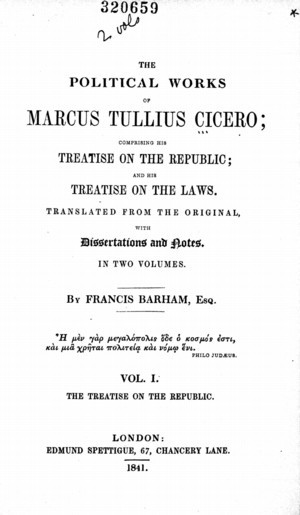
The Political Works of Marcus Tullius Cicero: Comprising his Treatise on the Commonwealth; and his Treatise on the Laws. Translated from the original, with Dissertations and Notes in Two Volumes. By Francis Barham, Esq. (London: Edmund Spettigue, 1841-42). Vol. 1.

Part of: The Political Works of Marcus Tullius Cicero, 2 vols.

About Liberty Fund:

Liberty Fund, Inc. is a private, educational foundation established to encourage the study of the ideal of a society of free and responsible individuals.


FRAGMENTS.

Scipio.

—To the wise, the consciousness of good deeds is the noblest reward of virtue. This divine virtue desires not statues with leaden supporters, (statuas plumbo inhærentes), nor triumphs, with their fading laurels; but a far more enduring recompence of ever verdant glories.

Lœlius.

—What glories do you mean?

Scipio.

—Allow me, since it is the third day of our vacation, to relate to you a remarkable dream, which is connected with the history of our family. (Note I.)

When I arrived in Africa, where I was, as you are aware, tribune in the fourth legion under the Consul Manilius, my most earnest desire was to see King Masinissa, who, for very just reasons, had been always the especial friend of the Scipios. When I was introduced to him, the old man embraced me, shed tears, and then looking up to heaven, exclaimed—“I thank thee, O supreme Sun, and ye other celestials, that before I depart from this life I behold in my kingdom and my palace, Publius Cornelius Scipio. His very name seems to re–animate me; for, from my soul, never escapes the memorial of that best and bravest of men, Africanus, your ancestor.

After this, I inquired of him concerning the affairs of his kingdom. He, on the other hand, questioned me about the condition of our Commonwealth, and in this kind of conversation we past the whole day. Towards evening, being entertained in a manner worthy the magnificence of a king, we carried on our discourse for a considerable part of the night. All this time, the good old monarch spoke of nothing but Scipio Africanus, whose actions, and even remarkable sayings, he remembered distinctly. At last, when we retired to bed, I fell into a more profound sleep than usual, both on account of my journey and because I had sat up the greatest part of the night.

Here I had the following dream, occasioned, as I verily believe, by our preceding conversation—for it commonly happens that the meditation and discourse which employ us in the day time, produce in our sleep an effect somewhat similar to that which Ennius writes happened to him about Homer, of whom in his waking hours he used frequently to think and speak.

My ancestor Africanus, I thought, appeared to me in a shape, with which I was better acquainted from his picture, than from any personal knowledge of him. When I perceived it was he, I confess I trembled with consternation—but he addressed me, saying, take courage, my Scipio, be not afraid, and carefully remember what I shall say to you.

Do you see that city Carthage, which though brought under the Roman yoke by me, is now renewing former wars, and cannot live in peace? He pointed to Carthage, from a lofty region of the firmament, where I conceived myself transported with him into a sphere, all glittering with refulgent constellations.

It is to attack that city (continued he,) that you are this day arrived in a station not much superior to that of a private soldier. Before two years however are elapsed, you shall be consul, and complete its overthrow; whence you shall obtain by your own merit the surname of Africanus, which, as yet, belongs to you no otherwise than as derived from me.

After the destruction of Carthage, you shall receive the honour of a triumph; be advanced to the censorship, and in quality of ambassador, visit Egypt, Syria, Asia, and Greece. You shall be elected second time consul in your absence, and by utterly destroying Numantia, put an end to a most dangerous war.

But in entering the Capitol in your triumphal car, you shall find the Roman Commonwealth all in a ferment, through the intrigues of my grandson Tiberius Gracchus. ’Tis on this occasion, my dear Africanus, that you must show your country the greatness of your understanding, capacity, and prudence.

The destiny however, of that time appears uncertain, which way it shall turn. For when your age shall have accomplished seven times eight revolutions of the sun, and your fatal hours shall be marked out by the natural product of these two numbers, each of which is esteemed a perfect one, but for different reasons,—then shall the whole city have recourse to you alone, and place its hopes in your auspicious name. On you the senate, all good citizens, the allies, the people of Latium, shall cast their eyes; on you the preservation of the state shall entirely depend. In a word, if you escape the impious machinations of your relatives, you will, in quality of dictator, establish order and tranquillity in the Commonwealth. (Note II.)

Here Lælius wept bitterly, and the rest of the company gave vent to their sorrow by deep groans. On which Scipio, with a gentle smile, said, “Pray, gentleman, don’t wake me out of my dream, have patience, and hear the rest.”

Now in order to encourage you, my dear Africanus (continued the shade of my ancestor), to defend the state with the greater cheerfulness,—be assured that for all those who have any way conduced to the preservation, defence, and enlargement of their native country, there is a certain place in heaven, where they shall enjoy an eternity of happiness. For nothing on earth is more agreeable to God, the Supreme Governor of the Universe, than the assemblies and societies of men united together by laws, which are called States. It is from heaven their rulers and preservers came, and thither they return.

Though at these words I was extremely troubled, not so much at the fear of death, as at the perfidy of my own relations,—yet I recollected myself enough to enquire, whether he himself, my father Paulus, and others whom are looked upon as dead, really enjoyed life.

Yes, truly, (replied he), they all enjoy life, who have escaped from the body as from a prison. But as to what you call life on earth, ’tis no more than one form of death. But see, here comes your father Paulus toward you!

As soon as I observed him, my eyes burst out into a flood of tears, but he took me in his arms, embraced me, and bade me not weep. When my first transports subsided, and I regained the liberty of speech, I addressed my father thus:—“Thou best and most venerable of parents, since this, as I am informed by Africanus, is the only substantial life, why do I linger on earth, and not rather haste to come hither where you are?

That (replied he) is impossible: for unless the God whose Temple is all that vast expanse you behold, shall free you from the fetters of the body, you can have no admission into this place. Mankind have received their being on this very condition, that they should labour for the preservation of that globe, which is situated as you see, in the midst of this temple, and is called earth.

Men are likewise endowed with a soul, which is a portion of the eternal fires, which you call stars and constellations; and which being round spherical bodies, animated by divine intelligences, perform their revolutions with amazing rapidity. ’Tis therefore your duty, my Publius, and that of all who have any veneration for the gods, to preserve this wonderful union of soul and body; nor without the express command of him who gave you a soul, should the least thought be entertained of quitting human life, lest you seem to desert the post assigned you by God himself. (Note III.)

Follow the examples of your grandfather here, and of me, your father, in paying a strict regard to justice and piety; the influence of which, towards parents and relations is great indeed, but that to our country greatest of all. Such a life as this is the true way to heaven, and to the company of those, who, after having lived on earth and escaped from the body, inhabit the place you now behold.

This was the shining circle or zone whose remarkable brightness distinguishes it among the constellations, and which after the Greeks you call the Milky Way.

From thence, as I took a view of the universe, every thing appeared beautiful and admirable,—For there, not only those stars are to be seen that are never visible from our globe; but all of them appear of such magnitude as we could not have imagined. The least of all the stars was that removed farthest from heaven, and situate next to the earth; I mean our moon, which shines with a borrowed light. Now the globes of the stars far surpass the magnitude of our earth, which at that distance, appeared so exceedingly small, that I could not but be sensibly affected on seeing our whole empire no larger than if we touched the earth as it were at a single point.

As I continued to observe the earth with still greater attention, how long, I pray you, (said Africanus) will your mind be fixed on that object—why don’t you rather take a view of the magnificent temples whither you have arrived? The universe is composed of nine circles or rather spheres, one of which is the most elevated, and is exterior to all the rest which it embraces; and where the Supreme God resides, who bounds and contains the whole. In it are fixed those stars which revolve with never–varying courses. Below this are seven other spheres, which revolve in a contrary direction to that in the heavens. One of these is occupied by the globe, which on earth they call Saturn. Next to that, is the star of Jupiter, so benign and salutary to mankind. The third in order, is that fiery and terrible planet called Mars. Below this again, almost in the middle region, is the Sun,—the leader, governor, and prince of the other luminaries; the soul of the world, which it regulates and illumines, filling all things with its rays. Then follow Venus and Mercury, which attend as it were on the Sun. Lastly, the Moon, which shines only in the reflected beams of the Sun, moves in the lowest sphere of all. Below this, if we except that gift of the gods, human souls, every thing is mortal, and tends to dissolution, but above it all is eternal. For the Earth, which is the ninth globe, and occupies the centre, is immoveable, and being the lowest, all others gravitate towards it. (Note IV.)

When I had recovered myself from the astonishment occasioned by such a wonderful prospect, I thus bespoke Africanus:—Pray what is this sound that strikes my ears in so loud and agreeable a manner? To which he replied—It is that which is called the music of the spheres, being produced by their motion and impulse; and being formed by unequal intervals, but such as are divided according to the justest proportion, it produces, by duly tempering acute with grave sounds, various concerts of harmony. For it is impossible that motions so great should be performed without any noise; and it is agreeable to nature that the extremes on one side should produce sharp, and on the other, flat sounds. For which reason the sphere of the fixed stars, being the highest, and carried with a more rapid velocity, moves with a shrill and acute sound; whereas that of the moon, being the lowest, moves with a very flat one. As to the Earth, which makes the ninth sphere, it remains immoveably fixed in the middle or lowest part of the universe. But those eight revolutionary circles, in which both Mercury and Venus are moved with the same celerity, give out sounds that are divided by seven distinct intervals, which is generally the regulating number of all things.

“This celestial harmony has been imitated by learned musicians, both on stringed instruments and with the voice, whereby they have opened to themselves a way to return to the celestial regions, as have likewise many others who have employed their sublime genius while on earth in cultivating the divine sciences. (Note V.)

“By the amazing noise of this sound, the ears of mankind have been in some degree deafened, and indeed hearing is the dullest of all the human senses. Thus the people who dwell near the Cataracts of the Nile, are by the excessive roar which that river makes in precipitating itself from those lofty mountains, entirely deprived of the sense of hearing. Now, so inconceivably great is the sound produced by the rapid motion of the whole universe that the human ear is no more capable of receiving it, than the eye is able to look stedfastly and directly on the sun, whose beams easily dazzle the strongest sight.

“While I was busied in admiring this scene of wonders, I could not help casting my eyes every now and then on the earth. On which, says Africanus, I perceive you are still employed in contemplating the seat and residence of mankind. Now if it appears to you so small, as in fact it really is, despise its vanities, and fix your attention for ever on these heavenly objects. Is it possible that you should attain any human applause or glory that are worth the contending for? The earth, you see, is peopled but in a very few places, and those too of small extent; and they appear like so many little spots of green, scattered through vast uncultivated deserts. Its inhabitants are not only so remote from each other as to cut off all mutual correspondence; but their situation being in oblique or contrary parts of the globe, or perhaps in those diametrically opposite to yours, all expectations of universal fame must fall to the ground. You may likewise observe that the same globe of the earth is girt and surrounded with certain zones, whereof those two that are most remote from each other, and lie under the opposite poles of heaven, are congealed with frost; but that one in the middle, which is far the largest, is scorched with the intense heat of the sun. The other two are habitable, one towards the south,—the inhabitants of which are your Antipodes, with whom you have no connection;—the other, towards the north, is that you inhabit, whereof a very small part, as you may see, falls to your share. For the whole extent of what you see, is as it were but a little island, narrow at both ends and wide towards the middle, which is surrounded by the sea, which on earth you call the great Atlantic Ocean, and which, notwithstanding this magnificent name, you see is very insignificant. And even in these cultivated and well–known countries, has yours, or any of our names, ever past the heights of the Caucasus, or the currents of the Ganges? In what other parts to the north or the south, or where the sun rises and sets, will your names ever be heard? And excluding these, how small a space is there left for your glory to spread itself abroad? and how long will it remain in the memory of those whose minds are now full of it?

“Besides all this, if the progeny of any future generation should wish to transmit to their posterity the praises of any one of us which they have heard from their forefathers; yet the deluges and combustions of the earth which must necessarily happenat their destined periods, will prevent our obtaining not only an eternal, but even a durable glory. And after all, what does it signify whether those who shall hereafter be born talk of you, when many of your cotemporaries whose number was not perhaps less, and whose merit certainly greater, were not so much as acquainted with your name?

“And the more, since not one of those who shall hear of us, is able to retain in his memory the transactions of a single year. The bulk of mankind indeed measure their year by the return of the sun, which is only one star. But the Annus Magnus, the true and complete year, is when all the stars shall have returned to the place whence they set out; and after long periods shall again exhibit the same aspect of the whole heavens. Indeed, I scarcely dare attempt to enumerate the vast multitude of ages contained in it. For as the sun was eclipsed and seemed to be extinguished at the time when the soul of Romulus penetrated into these eternal mansions—so when all the constellations and stars shall revert to their primary position, and the sun shall at the same point and time be again eclipsed—the grand year shall be completed. Be assured, however, that the twentieth part of it is not yet elapsed.

“Now, had you no hopes of returning to this place, where great and good men enjoy all that their souls can wish for, of what, pray, would be the signification of all human glory, which can hardly endure for a small portion of one year?

“If, then, you wish to elevate your views to the contemplation of this eternal seat of splendour, you will not be satisfied with the praises of your fellow–mortals, nor with any human rewards that your exploits can obtain; but Virtue herself will point out to you the true and only object worthy of your pursuit. Leave to others to speak of you as they may, for speak they will. Their discourses will be confined to the narrow limits of the countries you see, nor will their duration be very extensive, for they will perish like those who utter them, and will be no more remembered by their posterity.

“When he ceased to speak, I said, “Oh, Africanus, if indeed the door of heaven is open to those who have deserved well of their country, whatever progress I may have made since my childhood in following your’s and my father’s steps, I will from henceforth strive to follow them more closely.”

“Follow them, then (said he), and consider your body only, not yourself, as mortal. For it is not your outward form which constitutes your being, but your mind; not that substance which is palpable to the senses, but your spiritual nature. Know, then, that you are a god—for a god it must be that vivifies, and gives sensation, memory, and foresight to the body to which it is attached, and which it governs and regulates, as the Supreme Ruler does the world which is subject to him. As that Eternal Being moves whatever is mortal in this world, so the immortal mind of man moves the frail body with which it is connected; for what always moves must be eternal, but what derives its motion from a power which is foreign to itself, when that motion ceases, must itself lose its animation.

“That alone, then, which moves itself, can never cease to be moved, because it can never desert itself. It must be the source and origin of motion in all the rest. There can be nothing prior to this origin, for all things must originate from it—itself cannot derive its existence from any other source; for if it did, it would no longer be primary. And if it had no beginning, it can have no end; for a beginning that is put an end to, will neither be renewed by any other cause, nor will it produce any thing else of itself. All things, therefore, must originate from one source. Thus it follows, that motion must have its source in what is moved by itself, and which can neither have a beginning nor an end. Otherwise all the heavens and all nature must perish; for it is impossible that they can of themselves acquire any power of producing motion in themselves.

“As, therefore, it is plain that what is moved by itself must be eternal, who will deny that this is the general condition of minds? For, as every thing is inanimate which is moved by an impulse exterior to itself, so what is animated is moved by an interior impulse of its own; for this is the peculiar nature and power of mind. And if that alone has the power of self–motion, it can neither have had a beginning, nor can it have an end.

“Do you, therefore, exercise this mind of yours in the best pursuits, which consist in promoting the good of your country. Such employments will speed the flight of your mind to this its proper abode; and its flight will be still more rapid, if it will look abroad and disengage itself from its bodily dwelling, in the contemplation of things which are external to itself.

“This it should do to the utmost of its power. For the minds of those who have given themselves up to the pleasures of the body, paying as it were a servile obedience to their lustful impulses, have violated the laws of God and man; and therefore when they are separated from their bodies, flutter continually round the earth on which they lived, and are not allowed to return to this celestial region, till they have been purified by the revolution of many ages.” (Corporibus elapsi circum terram ipsam volutantur, nec hunc in locum nisi multis exagitati sœculis revertuntur.) (Note VI.)

Thus saying he vanished, and I awoke from my dream.

It is more desirable that fortune should be constant than brilliant; but the equability of life excites less interest than those changeable conditions, wherein prosperity suddenly revives out of the most desperate and ruinous circumstances.

end of the sixth book.

NOTES to the FIRST BOOK OF CICERO’S COMMONWEALTH.

NOTE I.

NOTE II.

NOTE III.

NOTE IV.

NOTES TO THE SECOND BOOK.

NOTE I.

NOTE II.

NOTE III.

NOTES TO THE THIRD BOOK.

NOTE I.

NOTE II.

NOTE III.

NOTES TO THE FOURTH BOOK.

NOTE I.

NOTE II.

NOTES TO THE FIFTH BOOK.

NOTE I.

NOTE II.

NOTES TO THE SIXTH BOOK.

NOTE I.

NOTE II.

NOTE III.

NOTE IV.

NOTE V.

NOTE VI.

Cicero opens his Treatise on the Commonwealth with a splendid panegyric on patriotism. The biblical and clasical writers concur in extolling patriotism as a virtue. They alike state that, next to the devotion we direct to the Deity, and the philanthropy which attaches itself to the whole human race, comes that glorious and enobling patriotism, which urges us to the service of our country. The elevation which this virtue assumes in the scale of ethics, is proved by its immense inclusiveness: for this virtue of patriotism which impels us to encourage and promote the interests of our nation, necessarily comprises all those minuter offices of civic fellowship, and social obligingness, and family affection, which constitute so much of the charm and beauty of life. All the most venerable fathers and divines of the Christian Church have, therefore, wisely insisted on the cultivation of patriotism, as one of the most resplendent and important developements of Christian morals. Nor have they hesitated to recommend that syncretic and coalitionary scheme of politics, which, as it is the only means of establishing peace and charity among contending parties, is pre–eminently qualified to forward patriotic measures So far, therefore, as syncretic and coalitionary policy goes, all pious senators are bound in conscience to advance it. They are bound to promote the unity of the Spirit in the bond of peace. The unionistic policy, which Cicero so earnestly recommends, is also the policy of the Scriptures; we are therefore bound to assume the position of syncretic politicians, and encourage concilation and concession between hostile parties. By professing themselves syncretic politicians, the senators perform the greatest offices of patriotism, rescue our country from her worst peril, and win the applause of all good men. It is only when senators degenerate into party politicians, that they incur censure; for Christianity and political philosophy never mention party, unless to censure it. The views here mentioned respecting Christian policy and patriotism, have been supported by a host of distinguished scholars, at home and abroad. But notwithstanding all that has been said or written on the subject of patriotism among Christians, we cannot help thinking, that in this glorious and expansive virtue, the sons of classic antiquity generally excelled us. In their code of morals, patriotism assumed an intense and destinctive potency, which we seek in vain among those who extenuate the grander virtues of our religion, in order to magnify its minuter obligations.

This phenomenon of the parhelium parhelion, or mock sun, which so puzzled Cicero’s interlocutors, has been very satisfactorily explained by modern science. The parhelia are formed by the reflection of the sun–beams on a cloud properly situated. They usually accompany the coronæ or luminous circles, and are placed in the same circumference, and at the same height. Their colours resemble that of the rainbow; the red and yellow are towards the side of the sun, and the blue and violet on the other. There are, however, coronæ sometimes seen without parhelia, and vice versâ Parhelia are double, triple, &c., and in 1629, a parhelion of five suns was seen at Rome, and another of six suns at Arles, 1666.

Cicero here gives a very exact and correct account of the ancient planetarium of Archimedes, which is so often noticed by the ancient astronomers. It no doubt corresponded in a great measure to our modern Planetarium or Orrery, invented by the earl of that name. This elaborate machine, whose manufacture requires the most exact and critical science, is of the greatest service to those who study the revolutions of the stars, for astronomic, astrologic, or meteorologic purposes.

The French Translator, M. Villemain, bursts out into a Gallic rhapsody in this point of the argument. “Cicero, translating Plato,” says he, “what an object of study!” We may remark the literal exactness of the father of Roman eloquence, and his care to emulate the Platonic style of expression. Though Cicero incessantly imitates Plato, we find in no other part of his works the translation of a passage so extended and so celebrated. This vivid and energetic translation appears to us to equal the beauty of the original. As to us,” continues Villemain, “translators at second hand, we must apply to our versions what Plato said of the dramatic compositions, which being mere representations of human actions, which are themselves but representations of eternal ideas, appear to him no better than copies of copies.”

This digression on the advantages that result from situating the chief cities of states a considerable way up their chief rivers, is very ingenious, and, we presume very correct. The method proposed, has been carefully adopted in most of the chief cities in the world. Paris and London are excellent examples in proof of Cicero’s argument.

It is very difficult to translate some of the terms which designate the political institutions of the Romans, by any analogous terms which shall convey a graphic conception of them to the English reader. On the whole, it may be stated, that the senate of the Romans answered pretty nearly to our House of Lords. This senate of the patricians, was bound to correspond in its legislative enactments with the Comitium, which we have ventured to translate House of Commons, as the nearest analogous term in our language. There, were the Comitia, or assembled delegates of the people, convened. These Comitia, or “assemblies of the people,” which figure so much in the history of Greek and Roman politics, were threefofd; they were either made up by wards or Curiæ, and then they were called Comitia Curiata, or by tribes, Comitia Tributa, or by hundreds, Comitia Centuriata, according to the divisions of the Roman people. In the first assembly, they were to choose the inferior magistrates, and no man was allowed to vote but the citizens of Rome. In the two other assemblies, not only the citizens of Rome had a right to vote, but also the inhabitants of the colonies and the municipal towns. In these great assemblies, they chose the great magistrates, and took into consideration the most important affairs of the Commonwealth.

This beautiful passage, in which Cicero unfolds his syncretic and unionistic policy, and recommends coalition and harmony to statesmen, as the grandest object of national jurisprudence, has been beautifully illustrated by Montesquieu. “True political union (says he) is the harmony or coalition of all parties, which, however opposite they may appear to us, concur to the general welfare, as dissonances in music, which blend into an entire concord.”

This speech of Lælius does equal credit to his probity and his sagacity. He shews that the very love of justice and truth will often induce the barrister to take up the pleadings for the false and unjust side. He proves that truth never glitters so brilliantly as when her secret fires are struck out from the collision of conflicting arguments, and that her light becomes most refulgent by the force of contrast, when it is reflected back from the dark foil of error. Our best and ablest lawyers still adopt precisely the same plea. It is exactly their desire to illustrate the truth, which induces them to plead for error; it is exactly their desire to protect the innocent, that induces them to defend the guilty.

We have been obliged so insert two or three of these sentences in italics, which are not found in the original, for the sake of shewing the drift of the arguments of Philus. He himself was fully convinced, that justice and morality were of eternal and immutable obligation, and that the best interests of all beings lie in their perpetual development and application. This eternity of Justice is beautifully illustrated by Montesquieu. “Long,” says he, “before positive laws were instituted, the moral relations of justice were absolute and universal. To say that there were no justice or injustice, but that which depends on the injunctions or prohibitions of positive laws, is to say that the radii which spring from a centre, are not equal, till we have formed a circle to illustrate the proposition. We must, therefore, acknowledge that the relations of equity were antecedent to the positive laws which corroborated them.” But though Philus was fully convinced of this, in order to give his friends Scipio and Lælius an opportunity of proving it, he frankly brings forward every argument for injustice, that sophistry had ever cast in the teeth of reason.

Such” says Villemain, “is the sad series of sophisms, which the English Mandeville and other writers have revived with less force and less subtilty. These sophistries consisted of a confusion of certain truths with a multitude of erroneous deductions. No doubt, philozoia, zoophilism, or kindness to animals, is a duty of nature. No doubt, the reply of the pirate to Alexander, was well merited. But what for that? Is it less true, that God hath put into man’s heart the instinct of justice? This principle is a demonstration of his understanding, which nothing can shake. As to the singularities of local manners, those deviations from the general conscience of mankind, exhibited by some peoples, we are aware with what deplorable sedulity Montaigne collected such paradoxical anecdotes, and with what force of eloquence Rousseau refuted them. ‘O Montaigne,’ says the enthusiastic Genevan, ‘you, who prided yourself on truth and freedom, let me suppose you sincere and ingenuous, if a philosopher can be so, and tell me, is there any country on earth where to keep faith is criminal, and where clemency, beneficence, and generosity are detested, and perfidy and ingratitude are honoured?’ Rousseau has here put the question in a right point of view. He takes a distinction between the essence of justice and the form of justice. Its essential principles will be found identical, or at least, homogeneous in every country on earth; but the peculiar forms of their exhibition may be considerably inflected by the circumstances of the time, the place, and the fashion of society. For want of taking this important distinction between the essence and the form of justice, writers, no less grave than Augustine and Pascal, have fallen into a curious hallucination. The latter, in one of his moments of sceptical misanthropy, from which he was hardly rescued by religion, has denied this universal sense of justice, and reasoned like Carneades. “Three degrees of elevation of the pole” says he, “overturn the whole system of jurisprudence; a line of meridian decides between truth and falsehood; and a brief possession, between rights and no rights. The fundamental laws are changed; equity has its revolutions. A comical justice enough, which a river or a mountain can determine, so that a decision is correct on this side of the Pyrannees, which, on the other would be scouted as infamous.” Pascal, however, adds, “we cannot, indeed deny the existence of natural laws: but artifice and chicanery have corrupted all things.”

The fragments of this important book are unhappily very few. Those that remain, treat of the proper subordination of ranks, the benefits of national education, and the use and abuse of dramatic entertainments.

Cicero appears to view the question of the drama and the stage in its right light. He takes the proper distinction between its use and abuse. He acknowledges, that in its original and proper institution, the drama is the handmaid of religion, and the public teacher of morals, by exhibiting the benefits of virtue and the evils of vice, in the vivid representations of the stage. He shews, that so far as dramatic censorship keeps the stage up to this high and enobling task, so far is it useful and honourable. At the same time, he does not spare his keenest satire against those abominable abuses and corruptions that sometimes infect dramatic entertainments. Thus, we learn from his experience, that the true policy of the pious and prudent statesman is to seek to reform the stage, rather than abolish it, and to promote its good influences by removing the evils that have gradually impaired them.

Of this book nothing remains but a few fragments. But these are not without their importance, as they are employed in recommending conservative policy and practical experience to statesmen. Syncretist, as Cicero was, and standing as he did, a mighty unionist and coalitionist above all sects whatever (for he was too great a man for party) he did not the less recommend the conservative policy in general, and boldly proclaimed its superiority over the empirical liberalism that introduces changes in haste, and repents at leisure.

It is no wonder that Cicero insists so powerfully on political experience, as well as political science. Science is only useful so far as it is associated with skill, and skill can be only acquired in the actual practice of public business. Cicero’s remarks are the more important, as they serve to refute a grand mistake on this subject, too prevalent among contemporary politicians.

Of this book we retain a larger portion than of the two preceding. Macrobius has preserved us the magnificent Dream of Scipio, which has no rival in all the compositions of antiquity, unless it be Plato’s Phædon, in which he expresses the views of Socrateos on the immortality of the soul.

The veil which the ghost of the elder Africanus throws over the future destinies of Scipio is very delicate. Scipio actually died at the age of fifty–six, for he did not escape the impious machinations of his relatives, and many supposed that he was poisoned by his wife, who was the sister of Tiberius Gracchus, who raised such disturbances at Rome.

This is perhaps the finest plea against suicide that has yet been written. In the course of it, Cicero assumes the fact, which all the ancients took for granted, that the stars were animated with divine intelligences. Philo, Origen, Erigena, Bodinus, Riccius, and Fludd, have all largely defended this ancient theory, on which the main part of astrology is directly founded. If we were to reason from the analogy of nature, we might probably arrive at the same conclusion. But as Bayle wittily, though rather dirtily observes, “we have no better means of determining whether the earth on which we crawl is animated by a spirit, than a louse on a man’s head can determine whether he possesses a distinct intelligence.”

This is a clear exposition of the Ptolemaic theory, which is now fortunately exploded from philosophy. It is probable that Cicero himself preferred the Pythagorean or Platonic system of the universe, now called the Copernican. The dream, however, gave him an opportunity of shewing his acquaintance with these erroneous dogmas.

On this passage, Mr. Danby has the following note. “Cicero here speaks of the harmony or music of the spheres, which most men now explode as a fable. But how are we to limit preceptions, or the possibility of what may relate to them? &c.”

This idea of Cicero, respecting many ages of purgatory or purgation, reserved for all guilty souls, was common to all the ancients. They took a very brilliant view respecting the final recovery, restoration, and restitution of all lapsed intelligences, and did what they could to refute the arguments of those who adopted a gloomier doctrine with respect to the future destinies of fallen beings.