Econlib

The Library

Other Sites

Front Page arrow Titles (by Subject) arrow II.: THE PRINCIPLES OF POLITICAL RIGHT considered in connection with THE RELATION OF THEORY TO PRACTICE IN THE RIGHT OF THE STATE. - Kant's Principles of Politics, including his essay on Perpetual Peace. A Contribution to Political Science

Return to Title Page for Kant’s Principles of Politics, including his essay on Perpetual Peace. A Contribution to Political Science

Search this Title:

Also in the Library:

Subject Area: Political Theory
Subject Area: History
Subject Area: War and Peace
Collection: Classics of Liberty

II.: THE PRINCIPLES OF POLITICAL RIGHT considered in connection with THE RELATION OF THEORY TO PRACTICE IN THE RIGHT OF THE STATE. - Immanuel Kant, Kant’s Principles of Politics, including his essay on Perpetual Peace. A Contribution to Political Science [1784]

Edition used:

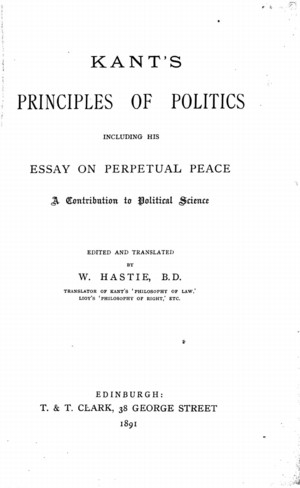
Kant’s Principles of Politics, including his essay on Perpetual Peace. A Contribution to Political Science, trans. W. Hastie (Edinburgh: Clark, 1891).

About Liberty Fund:

Liberty Fund, Inc. is a private, educational foundation established to encourage the study of the ideal of a society of free and responsible individuals.


II.

THE PRINCIPLES OF POLITICAL RIGHT
considered in connection with THE RELATION OF THEORY TO PRACTICE IN THE RIGHT OF THE STATE.

THE PRINCIPLES OF POLITICAL RIGHT.

The establishment of a Civil Constitution in society is one of the most important facts in human history. In the principle on which it is founded this institution differs from all the other forms of social union among mankind. Viewed as a compact,* and compared with other modes of compact by which numbers of men are united into one Society, the formation of a Civil Constitution has much in common with all other forms of Social Union in respect of the mode in which it is carried out in practice. But while all such compacts are established for the purpose of promoting in common some chosen End, the Civil Union is essentially distinguished from all others, by the principle on which it is based. In all social contracts we find a union of a number of persons for the purpose of carrying out some one End which they all have in common. But a Union of a multitude of men, viewed as an end in itself that every person ought to carry out, and which consequently is a primary and unconditional duty amid all the external relations of men who cannot help exercising a mutual influence on one another,—is at once peculiar and unique of its kind. Such a Union is only to be found in a Society which, by being formed into a Civil State, constitutes a Commonwealth. Now the End which in such external relations is itself a duty and even the highest formal condition—the conditio sine quâ non—of all other external duties, is the realisation of the Rights of Menunder public compulsory Laws, by which every individual can have what is his own assigned to him, and secured against the encroachments or assaults of others.

The idea of an external Right, however, arises wholly out of the idea of human Freedom or Liberty, in the external relations of men to one another. As such, it has nothing specially to do with the realisation of Happiness as a purpose which all men naturally have, or with prescription of the means of attaining it; and it is absolutely necessary that this End shall not be mixed up with the Laws of Right as their motive. Right in general, may be defined as the limitation of the Freedom of any individual to the extent of its agreement with the freedom of all other individuals, in so far as this is possible by a universal Law. Public Right, again, is the sum of the external Laws which make such a complete agreement of freedom in Society possible. Now as all limitation of freedom by external acts of the will of another, is a mode of coercion or compulsion, it follows that the Civil Constitution is a relation of free men who live under coercive Laws, without prejudicing their liberty otherwise in the whole of their connection with others. For, Reason itself wills this. By ‘Reason’ is here meant the pure innate law-giving, Reason which gives no regard to any End that is derived from experience, such as are all comprehended under the general name of Happiness. In respect of any such End or in what any individual may place it, men may think quite differently, so that their wills could not be brought under any common principle, nor, consequently, under any External Laws that would be compatible with the liberty of all.

The Civil State, then, regarded merely as a social state that is regulated by laws of right, is founded upon the following rational principles:—

1. The Liberty of every Member of the Society as a Man;

2. The Equality of every Member of the Society with every other, as a Subject;

3. The Self-dependency of every Member of the Commonwealth, as a Citizen.

These Principles are not so much Laws given by the State when it is established, as rather fundamental conditions according to which alone the institution of a State is possible, in conformity with the pure rational Principles of external Human Right generally.

1. The Liberty of every Member of the State as a Man, is the first Principle in the constitution of a rational Commonwealth. I would express this Principle in the following form:—‘No one has a right to compel me to be happy in the peculiar way in which he may think of the well-being of other men; but everyone is entitled to seek his own happiness in the way that seems to him best, if it does not infringe the liberty of others in striving after a similar end for themselves when their Liberty is capable of consisting with the Right of Liberty in all others according to possible universal laws.’—A Government founded upon the principle of Benevolence towards the people—after the analogy of a father to his children, and therefore called a paternal Government—would be one in which the Subjects would be regarded as children or minors unable to distinguish what is beneficial or injurious to them. These subjects would be thus compelled to act in a merely passive way; and they would be trained to expect solely from the Judgment of the Sovereign and just as he might will it, merely out of his goodness, all that ought to make them happy. Such a Government would be the greatest conceivable Despotism; for it would present a Constitution that would abolish all Liberty in the Subjects and leave them no Rights. It is not a paternal Government, but only a patriotic Government that is adapted for men who are capable of Rights, and at the same time fitted to give scope to the good-will of the ruler. By ‘patriotic’ is meant that condition of mind in which everyone in the State—the Head of it not excepted—regards the Commonwealth as the maternal bosom, and the country as the paternal soil out of and on which he himself has sprung into being, and which he also must leave to others as a dear inheritance. Thus, and thus only, can he hold himself entitled to protect the Rights of his fatherland by laws of the common will, but not to subject it to an unconditional purpose of his own at pleasure.—This Right of Liberty thus belongs to him as a man, while he is a Member of the Commonwealth; or, in point of fact, so far as he is a being capable of rights generally.

2. The Equality of every member of the State as a subject, is the second Principle in the Constitution of a rational Commonwealth. The formula of this Principle may be put thus:—‘Every Member of the Commonwealth has rights against every other that may be enforced by compulsory Laws, from which only the Sovereign or Supreme Ruler of the State is excepted, because he is regarded not as a mere Member of the Commonwealth, but as its Creator or Maintainer; and he alone has the Right to compel without being himself subject to compulsory Law.’ All, however, who live under Laws in a State, are its subjects; and, consequently, they are subjected to the compulsory Law, like all other members of the Commonwealth, one only, whether an individual Sovereign or a collective body, constituting the Supreme Head of the State, and as such being accepted as the medium through which alone all rightful coercion or compulsion can be exercised. For, should the Head of the State also be subject to compulsion, there would no longer be a Supreme Head, and the series of members subordinate and superordinate would go on upwards ad infinitum. Again, were there in the State two such powers as persons exempt from legal compulsion, neither of them would be subject to compulsory Laws, and as such the one could do no wrong to the other; which is impossible.

This thoroughgoing Equality of the individual men in a State as its subjects, is, however, quite compatible with the greatest Inequality in the extent and degrees of their possessions, whether consisting in corporeal or spiritual superiority over others, or in the external gifts of fortune, or in rights generally—of which there may be many—in relation to others. Thus the prosperity of the one may greatly depend on the will of another, as in the case of the poor in relation to the rich. One may even have of necessity to obey and another to command, as in the relation of children to parents, and of wife to husband. Again, one may have to work and another to pay, as in the case of a day labourer; and so on. But in relation to the involved law of Right, which as the expression of the universal Will of the State can be only one, and which regards the form of the Right, and not the matter or object to which the Right refers: in all cases, the persons as Subjects, are to be regarded as all equal to one another. For no one has a right to compel or coerce anyone whomsoever in the State, otherwise than by the public Law and through the Sovereign or Ruler executing it; and anyone may resist another thus far, and through the same medium. On the other hand, no one can lose this right, as a title to proceed by legal compulsion against others, except by his own fault or a criminal act. Nor can anyone divest himself of it voluntarily, or by a compact, so as to bring it about by a supposed act of Right, that he should have no rights but only duties towards others; for in so doing he would be depriving himself of the right of making a compact, and consequently the act would annual itself.

Out of this idea of the Equality of men as Subjects in the Commonwealth, there arises the following formula:—‘Every Member of the State should have it made possible for him to attain to any position or rank that may belong to any subject, to which his talent, his industry or his fortune may be capable of raising him; and his fellow-subjects are not entitled to stand in the way by any hereditary prerogative, forming the exclusive privilege of a certain class, in order to keep him and his posterity for ever below them.’

For, all Right just consists in restriction of the Liberty of another to the condition that is consistent with my Liberty according to a universal Law; and Public Right in a Commonwealth is only the product of actual legislation conformable to this principle and conjoined with power, in virtue of which all who belong to a nation as its subjects find themselves in a rightful state—status juridicus—constituted and regulated by law. And, as such, this state is in fact a condition of Equality, inasmuch as it is determined by the action and reaction of free-wills limiting one another, according to the universal law of Freedom; and it thus constitutes the Civil State of human Society. Hence the inborn Right of all individuals in this sphere (that is considered as being prior to their having actually entered upon juridical action) to bring compulsion to bear upon any others, is entirely identical and equal throughout, on the assumption that they are always to remain within the bounds of unanimity and concord in the mutual use of their Liberty. Now birth is not an act on the part of him who is born, and consequently it does not entail upon him any inequality in the state of Right, nor any subjection under laws of compulsion other than what is common to him, with all others, as a subject of the one supreme legislative Power; and, therefore, there can be no inborn privilege by way of Right in any member of the Commonwealth as a subject, before another fellow-subject. Nor, consequently has anyone a right to transmit the privilege or prerogative of the Rank which he holds in the Commonwealth to his posterity so that they should be, as it were, qualified by birth for the rank of nobility; nor should they be prevented from attaining to the higher stages in the gradations of social rank, by their own merit. Everything else that partakes of the nature of a thing and does not relate to personality, may be bequeathed; and, since such things may be acquired as property, they may also be alienated or disponed. Hence after a number of generations a considerable inequality in external circumstances may arise among the members of a Commonwealth, producing such relations as those of Master and Servant, Landlord and Tenant, etc. These circumstances and relations, however, ought not to hinder any of the subjects of the State from rising to such positions as their talent, their industry, and their fortune may make it possible for them to fill. For, otherwise such a one would be qualified to coerce without being liable to be coerced by the counter action of others in return; and he would rise above the stage of being a fellow-subject. Further, no man who lives under the legalised conditions of a Commonwealth, can fall out of this equality otherwise than by his own crime, and never either by compact or through any military occupancy.* For he cannot by any legal act, whether of himself or of another, cease to be the owner of himself, or enter into the class of domestic cattle, which are used for all sorts of services at will and are maintained in this condition without their consent as long as there is a will to do it, although under the limitation—which is sometimes sanctioned even by religion, as among the Hindoos—that they are not to be mutilated or slain. Under any conditions, he is to be regarded as happy who is conscious that it depends only on himself—that is on his faculty or earnest will—or on circumstances which he cannot impute to any other, and not on the irresistible will of others, that he does not rise to a stage of Equality with others who as his fellow-subjects have no advantage over him as far as Right is concerned.

3. The Self-dependency* of a member of the Commonwealth as a citizen, or fellow-legislator, is the third principle or condition of Right in the State. In the matter of the legislation itself, all are to be regarded as free and equal under the already existing public Laws; but they are not to be all regarded as equal in relation to the right to give or enact these laws. Those who are not capable of this right are, notwithstanding, subjected to the observance of the laws as members of the Commonwealth, and thereby they participate in the protection which is in accordance therewith; they are, however, not to be regarded as Citizens but as protected fellow-subjects.—All right, in fact, depends on the laws. A public law, however, which determines for all what is to be legally allowed or not allowed in their regard, is the act of a public Will, from which all right proceeds and which therefore itself can do no wrong to anyone. For this, however, there is no other Will competent than that of the whole people, as it is only when all determine about all that each one in consequence determines about himself. For it is only to himself that one can do no wrong. But if it be another will that is in question, then the mere will of anyone different from it, could determine nothing for it which might not be wrong; and consequently the law of such a will would require another law to limit its legislation. And thus no particular will can be legislative for a Commonwealth.—Properly speaking, in order to make out this, the ideas of the external Liberty, Equality, and Unity of the will of all, are to be taken into account; and for the last of these Self-dependency is the condition, since the exercising of a vote is required when the former two ideas are taken along with it. The fundamental law thus indicated, which can only arise out of the universal united will of the people, is what is called the ‘Original Contract.

Now anyone who has the right of voting in this system of Legislation, is a Citizen as distinguished from a Burgess; he is a citoyen as distinguished from a bourgeois. The quality requisite for this status, in addition to the natural one of not being a child or a woman,—is solely this, that the individual is his own master by right (sui juris); and, consequently, that he has some property that supports him,—under which may be reckoned any art or handicraft, or any fine art or science. Otherwise put, the condition in those cases in which the citizen must acquire from others in order to live, is that he only acquires it by alienation of what is his own, and not by a consent given to others to make use of his powers; and consequently that he serves no one but the Commonwealth, in the proper sense of the term. In this relation those who are skilled in the arts, and large or small proprietors, are all equal to one another; as in fact each one is entitled only to one vote. As regards Proprietors, the question might be considered as to how it may have happened by right that anyone has got as his own more land than he can himself use with his own hands (for acquisition by military occupation is not primary acquisition); and how it has happened that many men, who otherwise might have altogether been able to acquire an independent possession, have been brought to the position of merely serving such a one in order to be able to live. But without entering here upon the consideration of this question, it is manifest that it would at once be contrary to the previous principle of Equality, if a law were to invest such persons with the privilege of a class, so that their descendants should either always continue to be great proprietors of land—in the manner of fiefs—without such being able to be sold or divided by inheritance, and thus coming to be applied for the use of more of the people; or if, even in carrying out such divisions, that no one but he who belonged to a certain class, arbitrarily regulated in this connection, could acquire any part of such land. The great possessor of an estate, does in fact annihilate as many smaller owners and their voices as might occupy the place he takes up; he does not vote in their name, and he has consequently only one vote. It thus must be left to depend merely on the means, the industry, and the fortune of each member of the Commonwealth, that each one may acquire a part of it, and all of its members the whole. But these distinctions cannot be brought into consideration in connection with a universal Legislation; and hence the number of those qualified to have a voice in the legislation, must be reckoned by the heads of those who are in possession and not according to the extent of their possessions.

Furthermore, all who have this right of voting must agree in order to realise the Laws of public justice, for otherwise there would arise a conflict of right between those who were not in agreement with it, and the others who were; and this would give rise to the need of a higher principle of right that the conflict might be decided. A universal agreement cannot be expected from a whole people; and consequently it is only a plurality of voices, and not even of those who immediately vote in a large nation, but only of their delegates as representative of the people that can alone be foreseen as practically attainable. And hence, even the principle of making the majority of votes suffice as representing the general consent, will have to be taken as by compact; and it must thus be regarded as the ultimate basis of the establishment of any Civil Constitution.

We have next to consider what follows by way of Corollary from the principles thus enunciated. We have before us the idea of an ‘Original Contract’ as the only condition upon which a civil and, therefore, wholly rightful, constitution can be founded among men, and as the only basis upon which a State can be established. But this fundamental condition—whether called an ‘original contract’ or a ‘social compact’—may be viewed as the coalition of all the private and particular wills of a people into one common and public Will, having a purely juridical legislation as its end. But it is not necessary to presuppose this contract or compact, to have been actually a fact; nor indeed is it possible as a fact. We have not to deal with it as if it had first to be proved from history that a people into whose rights and obligations we have entered as their descendants, did actually on a certain occasion execute such a contract, and that a certain evidence or instrument regarding it of an oral or written kind, must have been transmitted so as to constitute an obligation that shall be binding in any existing civil constitution. In short, this idea is merely an idea of Reason; but it has undoubtedly a practical reality. For it ought to bind every legislator by the condition that he shall enact such laws as might have arisen from the united will of a whole people; and it will likewise be binding upon every subject, in so far as he will be a citizen, so that he shall regard the Law as if he had consented to it of his own will. This is the test of the rightfulness of every public law. If the law be of such a nature that it is impossible that the whole people could give their assent to it, it is not a just law. An instance of this kind would be a law, enacting that a certain class of subjects should have all the privileges of hereditary rank by mere birth. But if it be merely possible that a people could consent to a law, it is a duty to regard it as just, even supposing that the people were at the moment in such a position or mood, that if it were referred to them, their consent to it would probably be refused.*

This limitation, however, manifestly applies only to the judgment of the Legislator and not to that of the Subject. If, then, under a certain actual state of the law, a people should conclude that the continuance of that law would probably take away their happiness, what would they have to do? Would it not be a duty to resist the law? The answer can only be that the people should do nothing but obey. For the question here does not turn upon the happiness which the subject may expect from some special institution or mode of administering the Commonwealth, but the primary concern is purely that of the Right which has thus to be secured to every individual. This is the supreme principle from which all the maxims relating to the Commonwealth must proceed; and it cannot be limited by anything else. In regard to the interest of happiness, no principle that could be universally applicable, can be laid down for the guidance of legislation; for not only the circumstances of the time, but the very contradictory and ever-changing opinions which men have of what will constitute happiness, make it impossible to lay down fixed principles regarding it; and so the idea of Happiness, taken by itself, is not available as a principle of legislation. No one can prescribe for another as to what he shall find happiness in. The principle, salus publica suprema civitatis lex est, remains undiminished in value and authority; and the public weal, which has first of all to be taken into consideration, is just the maintenance of that legal constitution by which the liberty of all is secured through the laws. Along with this, the individual is left undisturbed in his right to seek his happiness in whatever way may seem to him best, if only he does not infringe the universal liberty secured through the law, by violating the rights of other fellow subjects. When the sovereign Power enacts laws which are directed primarily towards the happiness of the citizens, out of regard to their well-being, the state of the population and such like, this is not done from its being the end for which the civil constitution is established, but merely as a means of securing the state of Right, especially against the external enemies of the people. The Government must be capable of judging, and has alone to judge, whether such legislation belongs to the constitution of the Commonwealth, and whether it is requisite in order to secure its strength and steadfastness, both within itself and against foreign enemies; but this is not to be done as if the aim were to make the people happy even against their will, but only to bring it about that they shall exist as a Commonwealth.* In thus judging whether any such measure can be taken prudently or not, the legislator may indeed err. But he does not err in so far as he considers whether the law does or does not agree with a principle of Right.

And in doing so he has an infallible criterion in the idea of the ‘original contract,’ viewed as an essential idea of reason; and hence he does not require—as would be the case with the principle of happiness—to wait for experience to instruct him about the utility rather than the rightness of his proposed measure. For if it is only not contradictory in itself that a whole people should agree to such a law, however unpleasant may be its results in fact, it would as such be conformable to Right. If a public law be thus conformable to Right, it is irreprehensible, and hence it will give the right to coerce; and, on the other hand, it would involve the prohibition of active resistance to the will of the legislator. The power in the State which gives effect to the law, is likewise irresistible; and no rightful commonwealth exists without such a power to suppress all internal resistance to it. For, such resistance would proceed according to a rule which if made universal would destroy all civil constitutionalism, and would annihilate the only state in which men can live in the actual possession of rights.

Hence it follows that all resistance to the Sovereign Legislative Power, every kind of instigation to bring the discontent of the subjects into active form, and rebellion or insurrection of every degree and kind, constitute the highest and most punishable crimes in the commonwealth; for they would destroy its very foundations. The prohibition of them is therefore absolute; so that even if the Supreme Power, or the Sovereign as its agent, were to violate the original contract, and thereby in the judgment of the subject to lose the right of making the laws, yet as the Government has been empowered to proceed even thus tyrannically, no right of resistance can be allowed to the subject as a power antagonistic to the State. The reason of this is that in the actually existing Civil Constitution the people have no longer the right to determine by their judgment how it is to be administered. For suppose they had such a right, and that it was directly opposed to the judgment of the actual Head of the State, who would there be to decide with which of them the right lay? Evidently neither of them could do this, as it makes them judges in their own cause. There would therefore have to be another sovereign Head above the sovereign Head to decide between it and the people, but this is a contradiction. Nor can some supposed right of necessity—which is at best a spurious thing, such as is the fancied right to do wrong in an extreme physical necessity—come in here as a lever for the removal of the barrier thus limiting the voluntary power of the people. For the Head of the State may just as well think to justify his hard procedure against the subjects by the fact of their obstinacy and intractability, as they to justify their revolt by complaining against him about their undue suffering. Who shall decide between them? It is only he who is in possession of the supreme public administration of right, or who is otherwise the Head of the State, who can do this; and no one in the commonwealth can have the right to contest his possession of the power to do it. Nevertheless I find excellent men asserting such a right on the part of the Subject to resist the higher authority under certain circumstances. Among these I shall only now refer to Achenwall, a very cautious, distinct, and careful writer. In his doctrine of Natural Right he says: ‘If the danger which threatens the commonwealth from longer toleration of the injustice of the sovereign, is greater than what may be anticipated from taking up arms, then the people may resist such a sovereign; and in order to maintain their rights they may break their compact of submission and dethrone him as a tyrant.’ And hence he infers that in this way the people return to the state of Nature in relation to their previous Head.

I am willing to believe that neither Achenwall nor any of the worthy men who agree with him in this sort of reasoning, would have ever given their advice or consent in any case to enterprises of so dangerous a nature. Nor can it well be doubted that if the revolutions by which Switzerland, the United Netherlands, and even Great Britain acquired the political Constitutions now so celebrated, had failed, the readers of history would have seen in the execution of the leaders now so highly lauded, only the punishment deserved by great political criminals. The result thus usually becomes intermingled with our judgment of the principles of right in question, although the former is always uncertain in fact, whereas the latter are always certain in themselves. It is, however, clear that as regards these principles the people by their mode of seeking to assert their rights commit the greatest wrong, even if it be admitted that the rebellion might do no wrong to the ruling sovereign who had violated the actual compact upon which his relation to the people was founded in a sort of joyeuse entrée. For if this mode of conduct were adopted as a maxim, all rightful political Constitution would be made uncertain and a natural state of utter lawlessness would be introduced, in which all right at least would cease to have effect.—With regard to this tendency in so many thoughtful writers to encourage the people to their own detriment, I will only observe that there are two influences commonly at work in determining it. It is partly caused by the common illusion which substitutes the principle of Happiness as the criterion of judgment, when the principle of Right is really in question. And again, where there is no record of anything like a compact actually proposed to the Commonwealth, or accepted by the Sovereign, or sanctioned by both, these thinkers have assumed the idea of an ‘original Contract’ which is always involved in reason, as a thing which must have actually happened; and thus they supposed that the right was always reserved to the people in the case of any gross violation of it in their judgment, to resile from it at pleasure.*

It thus becomes evident that the principle of Happiness, which is properly incapable of any definite determination as a principle, may be the occasion of much evil in the sphere of political Right, just as it is in the sphere of morals. And this will hold good even with the best intentions on the part of those who teach and inculcate it. The sovereign acting on this principle determines to make the people happy according to his notions, and he becomes a despot. The people will not give up their common human claim to what they consider their own happiness, and they become rebels. Now if at the outset it had been asked what is right and just by regard to the established principles of reason, without regard to the notions of the empiric, the idea underlying the theory of the social compact would always have incontestable authority. But it would not be correct to treat it as an empirical fact, as Danton would have it; for he thought that apart from this fact all rights found in any existing civil constitution and all property, would have to be declared null and void. The idea in question is only to be taken as a rational principle for the estimation and judgment of all the public rights existing under a political constitution. And so regarded, it then becomes evident that, prior to the existence of a common Will, the people possess no right of coercion in relation to their ruler, because they can only bring such coercion to bear as a matter of right through him. And when this Will does exist, no coercion can be exercised by the people against him, because this would make them to be themselves the supreme ruler. Hence a right of compulsion or coercion in the form of a resistance in word or deed against the sovereign Head of the State, can never belong of right to the people.

Further, we see this theory sufficiently confirmed in practice. In the constitution of Great Britain the people form such an important element that it is represented as a model for the whole world, and yet we find that it is entirely silent about any right pertaining to the people in case the monarch should transgress the contract of 1688; and, consequently, since there is no law upon the subject, if there is any right of rebellion against him should he violate the constitution, it can only be there by secret reservation. For, it would be a manifest contradiction that the constitution should contain a law providing for such a case. That would be to justify the overthrow of the subsisting constitution from which all particular laws arise; which would be absurd, even on the supposition that the contract was violated. Such a constitution would be contradictory for this reason that it would necessarily have to include a publicly constituted counter power, which consequently would be a second sovereign in the State, and its function would be to protect the rights of the people against the other sovereign.* But the existence of this second Sovereign would likewise require a third whose function would be to decide between these two and to determine on which side right and justice lay.—Hence such guides, or rather, let us say, guardians of the people, perplexed by the possibility of such an accusation should their enterprise fail in any way, have rather contrived, for the behoof of a monarch who might be scared away by them, a voluntary power of demitting the government than claimed a presumptuous right of deposition. But this view manifestly puts the constitution into contradiction with itself. Now if, in presence of these assertions, the objection is not raised against me, as it certainly should not, that I flatter the monarch too much by this view of his inviolability, I may hope to be also spared another objection from the opposite side. In a word, I hope to be spared the contrary objection that I assert too much in favour of the people, when I say that they have also their own inalienable rights as against the sovereign of the State, although these cannot be justly regarded as rights of coercion or constraint.

Hobbes is of the opposite opinion. In his view the sovereign as Head of the State is bound in nothing to the people by compact and can do no wrong to the citizens, however he act towards them. This proposition would be quite correct, if by ‘wrong’ we understand that kind of lesion which allows to the injured party a right of coercion against the one who does the wrong. So it is in the special relation, but taken generally the proposition is repulsive and appalling. Any Subject who is not utterly intractable, must be able to suppose that his Sovereign does not really wish to do him wrong. Moreover, every man must be held to have his own inalienable rights which he cannot give up though he wish to do it, and about which he is himself entitled to judge. But the wrong in question which in his opinion is done to him, occurs according to that view only from error or ignorance of certain consequences that will ensue from the laws laid down by the sovereign power. Consequently the right must be conceded to the citizen, and with the direct consent of the sovereign, that he shall be able to make his opinion publicly known regarding what appears to him to be a wrong committed against the Commonwealth by the enactments and administration of the Sovereign. For to assume that the Sovereign Power can never err, or never be ignorant of anything, would amount to regarding that Power as favoured with heavenly inspiration and as exalted above the reach of mankind, which is absurd. Hence the Liberty of the Press, is the sole palladium of the rights of the people. But it must be exercised within the limits of reverence and love for the constitution as it exists, while it must be sustained by the liberal spirit of the subjects, which the constitution itself tends to inspire; and it must be so limited by the wise precautions of those who exercise it that their freedom be not lost. To refuse this Liberty to the people amounts to taking from them all claim to right in relation to the supreme Power; and this is the view of Hobbes. But more than this is involved. As the will of the Sovereign only commands the subjects as citizens on the ground that he represents the general will of the people, to deprive the people of this liberty would be to withdraw from the Sovereign power all knowledge of what he would himself alter if he only knew it; and it would thus put him into contradiction with himself. Moreover to instil an anxiety into the sovereign that independent thinking and public utterance of it, would of themselves excite trouble in the State, would amount to exciting distrust against his own power or even awakening hatred against the people. There is then a general principle according to which the people may assert their rights negatively, so far as merely to judge that a certain thing is to be regarded as not ordained by the supreme legislation in accordance with their best will. This principle may be expressed in the following proposition: What a People could not ordain over itself, ought not to be ordained by the Legislator over the People.

For example, the question may be raised as to whether a Law, enacting that a certain regulated ecclesiastical constitution shall exist permanently and for all time, can be regarded as issuing from the proper will of the Lawgiver according to his real intention. In dealing with it, the position which first arises, is whether a people may make a law to itself to the effect that certain dogmas and external forms of religion, when once adopted, shall continue to be adopted for all time; and, therefore, whether it may prevent itself in its own descendants from advancing further in religious insight, or from altering any old errors when they have become recognised as such? It will thus become clear, that an ‘original contract’ of the people which made such a position a law, would be in itself null and void, because it is inconsistent with the essential destination and purposes of mankind. Consequently, a law enacted to such an effect, is not to be regarded as the proper will of the monarch; and counter representations may therefore be made to him against it. In all cases, however, even when such things have been ordained by the supreme legislation, resistance is not to be offered to them in word or in deed, but they are only to be opposed by the influence of general and public judgments.

In every Commonwealth there must be obedience to coercive laws relating to the whole people and regulated by the mechanism of the political constitution. But at the same time there must be a Spirit of Liberty among the people; for every one needs to be convinced by reason in things relating to universal human duty, that such coercion is in accordance with Right. Without this he would be in contradiction with his own nature. Obedience without the Spirit of Liberty, is the cause and occasion of all Secret Societies. For there is a natural tendency implanted in mankind to communicate to one another what is in them, especially in what bears upon man generally. Such Societies would therefore fall away if such liberty were more favoured. And how can governments obtain the knowledge which is necessary for furthering their own essential object otherwise than by giving scope in its origin and in its effects, to this estimable spirit of human Liberty?

There is a certain practical spirit that professes to disregard all principles of pure Reason; and it expresses itself nowhere with more presumption regarding theoretical truth than in reference to the question as to the requisites of a good political constitution. The cause of this is that where there has been a legal constitution long in existence the people have been gradually accustomed to take that state in which everything has hitherto advanced in a quiet course, as the rule by which to judge of their happiness as well as their rights. On this account they have not been accustomed to judge of their condition in these respects according to the conceptions which are furnished by reason regarding them. And thus they come rather to prefer continuance of their passive state to the dangerous position of seeking for a better; for here too the maxim which Hippocrates lays down for the physician finds application ‘judgment is uncertain, experiment is dangerous.* Thus it is that all constitutions that have subsisted for some length of time—whatever may be their defects—agree, amid all their differences in one result, namely, in producing a certain contentment with every one’s own. Hence, when regard is given merely to the prosperity of the people, theory has properly no place but everything rests upon the practice that follows experience. But the question arises whether there is anything in Reason that can find expression in the term ‘Political Right,’ and whether this conception is of binding force in the case of men who stand in antagonism to each other in virtue of their individual liberty? This involves the question as to the objective and practical reality of such a principle of Right, and whether it can be applied without regard to the mere well-being or ill-being which may arise from it, the knowledge of which can only rest upon experience. If there be such a basis of political Right, as has now been maintained, it must be founded upon the principles of pure Reason; for experience cannot teach what is right and just in itself. And, if it be so, there is a Theory of Political Right, and no Practice is valid which is not in conformity with it.

Against this position objection could only be taken in the following way. It might be alleged that, although men have in their minds the idea of rights as belonging to them, they are still, on account of their obtuseness and refractoriness, incapable and unworthy of being treated in accordance with it. And hence it might be maintained that a supreme Power proceeding merely in accordance with rules of expediency, should and must keep them in order. This is a leap of despair, a salto mortale; and it is of such a kind that since Might only, and not Right, comes into consideration, the people may then also be justified in trying their best by force; and all legal constitution is thus made uncertain. If there be no human Right which compels respect directly by its rationality, then all influences put forth to control the arbitrary will and liberty of men, will be found unavailing. But if along with the sentiment of Benevolence, the principle of Right speaks aloud, Human Nature will show itself not to be so degenerate that its voice will not be heard with reverence. We may say of it in the words of Virgil:

  • ‘Tum pietate gravem meritisque si forte virum quem
  • Conspexere, silent arrectisque auribus adstant.’

[*]Pactum unionis civilis.

[]Pactum Sociale.

[*]Occupatio bellica.

[*][The term Selbständigkeit, here rendered by Self-dependency,’ is represented by Kant in his text by the Latin equivalent Sibisufficientia. The word ‘self-sufficiency,’ however, would be apt to mislead English readers. The term is commonly translated by ‘Independence,’ but ‘Self-dependency’ has been preferred as more closely indicative of the form and connotation of the German word.—Tr.]

[*]If, for example, a proportioned war-tax were imposed on all the subjects, they are not entitled, because it is burdensome, to say that it is unjust because somehow, according to their opinion, the war was unnecessary. For they are not entitled to judge of this; whereas because it is at least always possible that the war was inevitable and the tax indispensable, it must be regarded as rightful in the judgment of the subject. If, however, in such a war certain owners of property were to be burdened by imposts, from which others of the same class were spared, it is easily seen that a whole people could not concur in such a law, and it is entitled at the least to make protestation against it, because it could not regard this unequal distribution of the public burdens as just.

[*]Here belong certain prohibitions of imports in order that the means of acquisition may be promoted in the best interests of the subjects, and not for the advantage of strangers and the encouragement of the industry of others; because the State without the prosperity of the people, would not possess sufficient power to resist external enemies or to maintain itself as a Commonwealth.

[*]However the actual compact of the People with the Ruler may be violated, the People cannot in fact directly offer opposition as a Commonwealth, but only by mutiny and rebellion. For the hitherto existing Constitution is then broken through by the People; whereas the organisation of a new Commonwealth has still to find place. In these circumstances the state of Anarchy arises with all the abominations, which are thereby at least made possible; and the wrong which thus ensues is what is inflicted by one party upon another in the People. Thus from the example referred to above, it is seen how the rebellious subjects of that State strove at last to force on each other a Constitution which would have been far more oppressive than the one they abandoned; as it would have led to their being consumed by Clergy and Aristocrats instead of their waiting for more equality in the distribution of the burdens of the State under an all-controlling Head.

[*]No Law or Right in the State can be, as it were maliciously concealed by a secret reservation; least of all the Rights which the people claim as belonging to the Constitution, because all its laws must be conceived as having sprung from a public will. If the Constitution allowed insurrection, it would therefore publicly have to define the right to it as well as the way in which it was to be put in practice.

[*]‘Judicium anceps, experimentum periculosum.’