EconlibThe LibraryOther Sites |
Front Page Titles (by Subject) CHAPTER TWENTY–THREE. - Magna Carta: A Commentary on the Great Charter of King John, with an Historical Introduction
Return to Title Page for Magna Carta: A Commentary on the Great Charter of King John, with an Historical IntroductionThe Online Library of LibertyA project of Liberty Fund, Inc.Search this Title:Also in the Library:
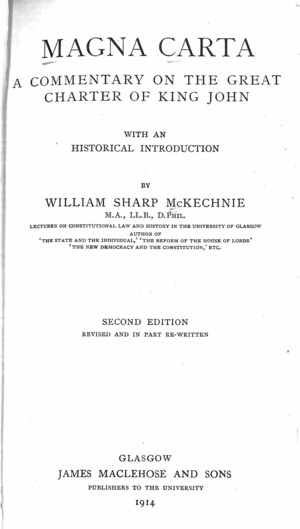
CHAPTER TWENTY–THREE. - Misc (Magna Carta), Magna Carta: A Commentary on the Great Charter of King John, with an Historical Introduction [1215]Edition used:Magna Carta: A Commentary on the Great Charter of King John, with an Historical Introduction, by William Sharp McKechnie (Glasgow: Maclehose, 1914).
About Liberty Fund:Liberty Fund, Inc. is a private, educational foundation established to encourage the study of the ideal of a society of free and responsible individuals. Copyright information:The text is in the public domain. Fair use statement:This material is put online to further the educational goals of Liberty Fund, Inc. Unless otherwise stated in the Copyright Information section above, this material may be used freely for educational and academic purposes. It may not be used in any way for profit.
CHAPTER TWENTY–THREE.Nec villa nec homo distringatur facere pontes ad riparias, nisi qui ab antiquo et de jure facere debent. No village or individual2 shall be compelled to make bridges at river banks, except those who from of old were legally bound to do so. The object of this chapter is obvious; to compel the King to desist from his practice of illegally increasing the burden of the obligation to keep in repair all bridges over rivers. John might continue to exact what his ancestors had exacted; but nothing more. So much lies on the surface of the Charter, which explains, however, neither the origin of the obligation nor the reasons that made John keen to enforce it. I.Origin of Obligation to make Bridges.The Norman kings seem to have based their claim to compel their subjects to maintain bridges upon the ancient tripartite obligation1 (known as the trinoda necessitas). Three duties were required of all the men of England in the interests of the commonweal: attendance on the fyrd or local militia; the making of roads, so necessary for military purposes; and the repairing of bridges and fortifications. Gradually, as feudal tendencies prevailed, the obligation to construct bridges ceased to be a personal burden upon all freemen, and became a territorial burden.2 The present chapter seems to be a particular application of the general principle enunciated in chapter 16. “Brigbot” required special treatment because of the prominence into which it had been forced by John. II.The King’s interest in the Repair of Bridges.Part at least of John’s motives for making an oppressive use of this prerogative must be sought in his rights of falconry. Whenever John proposed to ride a–fowling, with his hawk upon his wrist, he issued letters compelling the whole country–side to bestir themselves in the repair of bridges. Several such writs of Henry III. are extant. The exact words vary somewhat, but comparison leaves no room for doubt either as to the nature of the commands conveyed or the reasons for issuing them. Addressed to sheriffs of such counties as the King was likely to visit, these letters gave instructions for repair of bridges, and a prohibition against the taking of birds before the King had enjoyed his sport. Both points are well brought out in a Letter Close of Henry III., dated 26th December, 1234, which directed “all bridges on the rivers Avon, Test, and Itchen to be repaired as was wont in the time of King John, so that when the lord King may come to these parts, free transit shall lie open to him for ‘revaying’ (ad riviandum) upon the said rivers.” The sheriff is to issue a general prohibition against any one attempting to “revaye” along the river banks, previous to the coming of the King.1 The Latin verb, for which the Old English word “revaye” or “ryvaye” is an exact equivalent, has been the subject of misconception; but conclusive evidence has recently been adduced to prove that it referred to the medieval sport of fowling, that is to the taking of wild birds in sport by means of hawks and falcons.2 These writs prove that the Crown claimed a preferential right to this form of sport along the banks of certain rivers; and these “preserved” rivers were said to be “in defence” (in defenso), a phrase which occurs also in a later chapter of Magna Carta.3 Two distinct hardships were thus imposed by the King’s exercise of his rights of falconry, one negative and the other positive. Between the King’s intimation and his arrival at the indicated rivers, the sport of other people was forbidden, while whole villages had to forsake their ploughs to reconstruct otherwise useless bridges. A wise king would be careful to use such rights so as to inflict a minimum of hardship. John knew no moderation, placing “in defence” not merely a few banks at a time, but many rivers indiscriminately, including those which had never been so treated in his father’s day, and demanding that all bridges everywhere should be repaired, with the object, not so much of indulging a genuine love of sport, as of inflicting heavy amercements on those who neglected prompt obedience to his commands. Great consternation was aroused when John at Bristol in 1209 prohibited the taking of birds throughout the entire realm of England.1 Both grievances were redressed by Magna Carta. The present chapter promised not to impose the burden on those from whom it was not legally due.2 Chapter 47, in which he agreed to withdraw his interdict from all rivers which had not been previously “in defence,” and to disafforest all forests of his own creation, was entirely omitted in the Charter of 1216;3 but in 1217 it reappeared in a new position and expressed in different words. The provision in the original chapter 47 that related to forests was relegated to the Carta de Foresta, and the other part of that chapter, relating to falconry, was joined to a clause which redressed another grievance growing from the same root. Chapter 19 of Henry III.’s Charter, in its final form, repeats word for word the terms of the present chapter of John, while in chapter 20 Henry proceeds to declare “that no river shall in future be placed in defence except such as were in defence in the time of King Henry, our grandfather, throughout the same places and during the same periods as they were wont in his day.” This express prohibition seems to have prevented the Crown from extending its prerogatives further in this direction. Yet Henry III. had ample opportunities of harassing his subjects by an inconsiderate use of the rights still left to him. In many cases dubiety existed as to what banks had actually been ”preserved” by Henry II., and a vague general command left in cruel uncertainty the district to be visited. Henry III. made important concessions: after the year 1241, he specified the particular river along whose banks he intended to sport, and sometimes announced the exact date at which he expected to arrive. As no writs appear subsequent to 1247, it is possible that he was induced to abstain from the exercise of a right which inflicted hardships out of all proportion to the benefits conferred on the King.1 The Crown, however, had not renounced its prerogatives, and several writs still exist to show that Edward I. occasionally allowed his great nobles to share in the royal sport. Licences were granted in 1283 to the Earl of Hereford and to Reginald fitz Peter, and in the following year to the Earl of Lincoln. On 6th October, 1373, Edward III. commanded the sheriff of Oxfordshire to declare that all bridges must be repaired and all fords marked out with stakes, for the crossing of the King “with his falcons” during the approaching winter.2 III.Erroneous Interpretations.It is not surprising that a pastime so passionately followed as falconry, should have left its traces on two chapters of Magna Carta, the full import of which has not been appreciated by commentators, partly from failure to read them together, but chiefly through the assumption that the words ad riviandum and in defenso referred to fishing rather than to fowling.3 It has been confidently inferred that the framers of Magna Carta, when forbidding additional banks to be put “in defence,” equally as when demanding the removal of “weirs” from non–tidal waters,4 intended to preserve public rights of fishing against encroachment. This is an error: in the Middle Ages, fishing was a means of procuring food, not a popular form of sport: to depict John and his action–loving courtiers as exponents of the gentle art of Isaac Walton is a ridiculous anachronism. It is true that the value of fish as an article of diet led in time to legislation directed primarily to their protection; but apparently no statute with such a motive was passed previous to 1285.1 It is further true that in the reign of Edward I. it became usual to describe rivers, over which exclusive rights of fishing had been established by riparian owners, as being in defenso;2 but rivers might be “preserved” for more purposes than one. From Edward’s reign onwards, however, rights of fishing steadily became more valuable, while falconry was superseded by other pastimes. Accordingly a new meaning was sought for provisions of Magna Carta, whose original motive had been forgotten. So early as the year 1283 the words of a petition to the King in Parliament show that “fishing” had been substituted for “hawking,” in interpreting the prohibition referred to in chapter 47 of John’s Charter. The men of York complained that Earl Richard had interfered with their rights of fishing by placing in defenso the rivers Ouse and Yore “against the tenor of Magna Carta.”3 This error, which thus dates from 1283, has been accepted for upwards of five hundred years by all commentators on Magna Carta. The credit for dispelling it is due to Mr. Stuart A. Moore and Mr. H. S. Moore in their History and Law of Fisheries, published in 1903.4 [2 ]The word “villa,” used at first as synonymous with “manor,” came to be freely applied not only to all villages, but also to chartered towns. Even London was described as a villa in formal writs. “Homo,” though often loosely used, was the word naturally applied to a feudal tenant. The version given by Coke (Second Institute, p. 30) reads “liber homo,” which is also the reading of one MS. of the Inspeximus of 1297 (25 Edward I.). See Statutes of the Realm, I. 114. [1 ]See Rot. Claus., 19 Henry III., cited by Moore, History and Law of Fisheries, p. 8. [2 ]The Hundred Rolls illustrate the manner of its incidence; e.g. Omnes tenentes de Spaldinge debent ad reparacionem pontis illius, quilibet pro rata porcionis terrae suae contribuere, ita quod quaelibet acra erit par alterius. Rot. Hund., I. 468. [1 ]See Rot. Claus., 19 Henry III., cited in Moore, History and Law of Fisheries, p. 8. [2 ]See Moore, ibid., 8–16. Two links in the chain of evidence are worthy of emphasis: (a) Writs of 13th November and 1st December, 1234, order repair of bridges for the transit of the King “along with his birds.” (b) A writ of 28th October, 1283, contains a licence to the Earl of Hereford “during the present winter season to ‘revaye’ and take river–fowl throughout the rivers Lowe and Frome which are in defence.” [3 ]I.e. c. 47 (q.v.). [1 ]R. Wendover, II. 49 (R.S.), “Ibi capturam avium per totam Angliam interdixit.” [2 ]Article 11 of the Barons had demanded that no villa should be amerced for failure to make illegal repairs, thus illustrating at once John’s policy, and the point of connection between this provision and the immediately preceding chapters which dealt with amercements. [3 ]It was, however, included among the subjects reserved for further consideration in “the respiting clause” (c. 42 of 1216) under the words “de ripariis et earum custodibus.” Cf. supra, 143. [1 ]Moore, ibid., 9. [2 ]Moore, ibid., 12. [3 ]The Mirror of Justices is cited as first suggesting this. See Moore, ibid., 12–16. Coke, Second Institute, 30, misled by the Mirror, has misled others. [4 ]Cf. infra, under c. 33. [1 ]This was 13 Edward I., stat. 1, c. 47, cited Moore, ibid., 173. [2 ]Ibid., p. 6. [3 ]Ibid., p. 16. [4 ]Lord Hale (Hargreaves, Law Tracts, p. 7) partly anticipated their conclusions, and he seems to have been followed by decisions of the New York Courts. See Law Notes (New York) for August, 1905. |

Titles (by Subject)