EconlibThe LibraryOther Sites |
Front Page Titles (by Subject) PART V.: MAGNA CARTA: ORIGINAL VERSIONS, PRINTED EDITIONS AND COMMENTARIES. - Magna Carta: A Commentary on the Great Charter of King John, with an Historical Introduction
Return to Title Page for Magna Carta: A Commentary on the Great Charter of King John, with an Historical IntroductionThe Online Library of LibertyA project of Liberty Fund, Inc.Search this Title:Also in the Library:
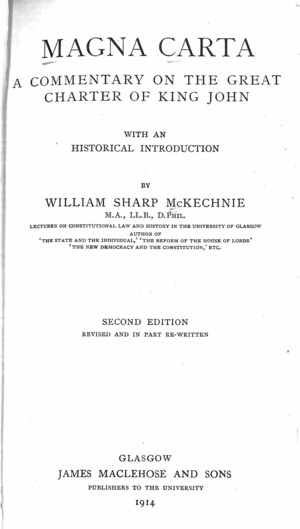
PART V.: MAGNA CARTA: ORIGINAL VERSIONS, PRINTED EDITIONS AND COMMENTARIES. - Misc (Magna Carta), Magna Carta: A Commentary on the Great Charter of King John, with an Historical Introduction [1215]Edition used:Magna Carta: A Commentary on the Great Charter of King John, with an Historical Introduction, by William Sharp McKechnie (Glasgow: Maclehose, 1914).
About Liberty Fund:Liberty Fund, Inc. is a private, educational foundation established to encourage the study of the ideal of a society of free and responsible individuals. Copyright information:The text is in the public domain. Fair use statement:This material is put online to further the educational goals of Liberty Fund, Inc. Unless otherwise stated in the Copyright Information section above, this material may be used freely for educational and academic purposes. It may not be used in any way for profit.
PART V.MAGNA CARTA: ORIGINAL VERSIONS, PRINTED EDITIONS AND COMMENTARIES.I.Manuscripts of Magna Carta and Relative Documents.The barons who had forced the Great Charter on King John were determined that its contents should be widely known and permanently preserved. It was not sufficient that the great seal should be formally impressed upon one parchment. Those who compelled John to submit were not content even with the execution of its terms in duplicate or in triplicate: copies were to be distributed throughout the land, to be preserved in important strongholds and among the archives of the chapters of cathedral churches.1 I. The extant original versions. Of the many sealed copies, four have escaped the destroying hand of time: (1) The British Museum Magna Carta, number one—formally cited as “Cotton, Charters XIII. 31a.” The recent history of this document, which is possibly the original copy delivered to the barons of the Cinque Portes, is well known. It was discovered in the seventeenth century, among the archives of Dover Castle, by the Warden, Sir Edward Dering, and by him presented to Sir Robert Cotton.2 In the fire of 23rd October, 1731, this Charter was rendered in parts illegible, while the yellow wax of the seal was melted. It is possible that the accident has added to the prestige of this particular copy of Magna Carta. Like the three others still extant, it is written continuously, though with many contractions, in a neat, running, Norman hand. Some omissions seem to have been made in the body of this version and to have been supplied at the foot. These are five in number.1 It is possible to regard them as corrections of clerical omissions due to carelessness or hurry in engrossing the deed; but the fact that one of the additions is distinctly in the King’s favour raises a presumption that they embodied additions made as afterthoughts to what had been originally dictated to the engrossing clerk, and that they were inserted at the King’s suggestion before he would adhibit the great seal. The importance of this document was recognized, and a facsimile was prepared by John Pine, a well–known engraver, some eighteen months after the great fire. The engraving bears a certificate, dated 9th May, 1733, that the copy is founded on the original, which had been shrivelled up by the heat; but that, where two holes had been burned, the words obliterated had been replaced from the other version (to be immediately described) preserved in the Cottonian collection. (2) The British Museum Magna Carta, number two—cited as “Cotton, Augustus, II. 106.”2 The early history of this document is unknown, but it came into the possession of Mr. Humphrey Wyems, and by him was presented to Sir Robert Cotton on 1st January, 1628–9. Unlike the other Cottonian copy, this one is happily in an excellent state of preservation; but there is no trace left of any seal.1 Three of the five addenda inserted at the foot of the copy previously described are found in a similar position here; but the substance of the two others is included in the body of the deed. On the left–hand margin, titles intended to be descriptive of several chapters occur in a later hand. Thus for the preservation of two original copies of the national charter of liberties the nation is indebted to Sir Robert Cotton. Several authors2 gravely record how Sir Robert discovered “the palladium of English liberties” in the hands of his tailor at the critical moment when scissors were about to transform it into shapes for a suit of clothes. This detail is a fable, since both manuscripts of Magna Carta in the Cottonian collection are otherwise accounted for. (3) The Lincoln Magna Carta. This copy is under the custody of the Dean and Chapter of Lincoln Cathedral, where it has lain for many centuries. The word “Lincolnia” is endorsed in a later hand in two places on folds of the parchment. It has no corrections or additions inserted at the foot, but embodies in their proper places all those which occurred in the versions already discussed. Further, it is executed with flourishes and in a more finished manner: the inference is that it took longer to engross. The Record Commissioners, in preparing the Statutes of the Realm, considered this version of superior authority to the others and have chosen it for their engraving published in 1810 in that valuable work, and also in the first volume of their edition of Rymer’s Foedera in 1816.3 (4) The Salisbury Magna Carta—preserved in the archives of the Cathedral there. The early history of this manuscript has not been traced, but its existence was known at the close of the seventeenth century.1 Sir William Blackstone, in April, 1759,2 instituted a search for it, but without success—his inquiries being met with the statement that it had been lost some thirty years before, during the execution of repairs in the Cathedral library. As its disappearance had taken place during the tenure of the see by Gilbert Burnet, his political adversaries accused him of appropriating it—an undoubted calumny, as will be hereafter explained. The document had not been re–discovered in 1800 when the royal commission published a report of its inquiries for national records.3 Two sub–commissioners visited Salisbury in 1806 in search of it, but obtained no satisfaction. It seems, however, to have been re–discovered within the next few years, since it is mentioned in a book published in 1814,4 and it is now exhibited to the public by order of the Dean and Chapter of Salisbury Cathedral. It resembles the Lincoln copy both in its fine, leisurely penmanship and also in the absence of additions at the bottom of the parchment.5 II. Comparison of the Originals. Prior to Sir William Blackstone’s work, extraordinary confusion seems to have prevailed concerning the various Charters of Liberties. Not only was John’s Magna Carta confused with reissues by Henry; but these latter were known only from an official copy of the Charter of 1225 contained in the Inspeximus of the twenty–eighth year of Edward I. Neither Madox1 nor Brady2 was aware of the existence of any one of the four originals; and no mention is made of them in the first edition of Rymer’s Foedera, which appeared in 1704. Mr. Tyrrell, indeed, seems to have known of the second original in the British Museum and also of the Salisbury version.3 Mr. Care4 showed no clear knowledge of the various manuscripts, though he mentioned the existence of several. Even Blackstone in 1759 collated only the two Cottonian copies, since he failed to find that of Salisbury, and was unaware of the existence of the Lincoln manuscript.5 As these four versions are practically identical in their substance, no important question seems to be involved in the discussion as to whether any one of them has greater authority than the others. The Record Commissioners considered that the Lincoln copy was the first to be completed (and therefore that it possessed special authority), because it contained no insertions at the foot of the instrument. Yet it seems more plausible to argue that this very immunity from clerical errors, or from additions made after engrossment, proves that it was of later and less hurried execution than the others, and therefore of less authority, if any distinction is permissible. Mr. Thomson has much ground for his contention, in speaking of the fire–marked version, that “the same circumstances may probably be a proof of its superior antiquity, as having been the first which was actually drawn into form and sealed on Runnymede, the original whence all the most perfect copies were taken.”1 In all printed texts of Magna Carta, the contents are divided into a preamble and sixty–three chapters. There is no warrant for this in any one of the four originals: the “chapters” are a modern invention, made for convenience of reference. III. Articles of the Barons. Of hardly inferior interest is the parchment which contains the heads of agreement made between John and the rebels on 15th June, 1215. This is now in the British Museum, cited officially as “Additional MSS. 4838.” The seven centuries that have passed over it have left surprisingly few traces; it is legible throughout, and still bears the impression of John’s seal in brown wax. It was apparently deposited in Lambeth Palace, where it remained until the middle of the seventeenth century. Archbishop Laud, when threatened with impeachment, thought it prudent to set his papers in order; and on 18th December, 1640, he dispatched for that purpose to his episcopal palace, his friend Dr. John Warner, Bishop of Rochester. A few hours later, Laud was committed to custody of Black–Rod, and an official messenger was sent by the House of Lords to seal up his papers. Bishop Warner had, meanwhile, escaped with the Articles of the Barons. He kept this till he died, and at his death it passed to one of his executors named Lee, and from him to his son Colonel Lee, who presented it to Gilbert Burnet. When the Salisbury Magna Carta disappeared, Burnet was suspected of appropriating it. What gave apparent weight to these misrepresentations of his political opponents was that special facilities had been granted him to search public records in the prosecution of his historical labours, and that he actually had in his possession—quite lawfully, as we know—the Articles of the Barons, which was confused by the carelessness of early historians with Magna Carta itself. The calumny was so widely spread that Burnet thought it necessary formally to refute it, explaining that he had received the Articles as a gift from Colonel Lee:—“So it is now in my hands, and it came very fairly to me.”1 Bishop Burnet left it as a legacy to his son Sir Thomas Burnet; and on his death it passed to his executor David Mitchell, whose permission to print it Blackstone obtained in 1759. It was purchased from Mr. Mitchell’s daughter by another historian, Philip, second Earl of Stanhope, who presented it to the British Museum in 1769. It is now exhibited along with the two Cottonian copies of Magna Carta. The Record Commissioners have reproduced it in Statutes of the Realm in 1810, and also in the New Rymer in 1816.2 The document begins with this headline: “Ista sunt Capitula quae Barones petunt et dominus Rex concedit.” Then the articles follow in 49 paragraphs of varying length, separate, but unnumbered, each new chapter (unlike the chapters of Magna Carta, which run straight on) beginning a new line. The numbers, which appear in all printed editions, have no warrant in the original.3 IV. The so–called “unknown Charter of Liberties.” At Paris is preserved a copy of what looks like a charter granted by John, but irregular in its form. This document is preserved among the Archives du Royaume in the Section Historique and numbered J. 655.4 A copy of this copy was discovered at the Record Office in London by Dr. Horace Round in 1893. Before that date it seems to have been practically unknown to English historians, although it had been printed by a French writer thirty years earlier.5 As the interpretation of this document has proved a puzzle attracting many to attempt its solution, it may be well to give a brief analysis of its tenor.1 The text of the supposed Charter is preceded, in the manuscript (which is in a French hand of the early quarter of the thirteenth century), by a copy of the Charter of Liberties of Henry I., from which it is separated by this sentence, in Latin: “This is the Charter of King Henry, by which the barons seek their liberties, and these following are granted by King John,” words which invite comparison with the heading of the Articuli Baronum, and suggest that the document under description may have formed a link between Henry I.’s charter and these Articuli. The first clause runs in the third person (concedit rex Johannes) and grants that he will arrest no man without judgment, nor accept anything for justice, nor commit injustice. The remaining eleven clauses are all in the first person singular (whereas regular charters run in the plural). The second clause restricts relief; the third regulates wardship; the fourth, marriage; the fifth, testate and intestate succession; the sixth, the rights of widows. The seventh, opening with the word “adhuc” (as though later additions were now made to provisions previously written), concedes that Crown vassals need not go on military service outside of England except in Normandy and Brittany; and seems further to suggest, in certain circumstances, a diminution of the servitium debitum. Clause 8 limits scutage to one mark unless by counsel of the barons. Clause 9, again beginning with adhuc, agrees to give up the forests made by Henry II. and Richard. Clause 10 (also with its adhuc) grants remission, in several particulars, of the strictness of the forest laws. Clause 11 prohibits Jews from taking interest during a debtor’s minority; and clause 12 concedes that no one shall lose life or limbs for the killing of a deer. At least seven solutions have been attempted of the problems raised by this manuscript. (1) Dr. Round, in communicating his discovery to the English Historical Review, maintained that the document was a copy, in a mangled form perhaps, of a charter actually granted in the year 1213 by King John to the northern barons, containing concessions which they had agreed to accept in satisfaction of their claims.1 (2) Mr. Prothero preferred to view it as an abortive proposal made by the King early in 1215 and rejected by the barons.2 (3) Mr. Hubert Hall dismissed the document as a forgery, describing it as “a coronation charter attributed to John by a French scribe in the second decade of the thirteenth century”—probably between November, 1216, and March, 1217, when King Philip desired to prove that John had committed perjury by breaking his promises, and had thereby forfeited his right to the Crown of England.3 (4) In the first edition of this work, published in 1905, the tentative suggestion was made that the document might be a copy of the actual “schedule” which we know from Roger of Wendover4 to have been drawn up by the barons prior to 27th April, 1215, and at that date forwarded to John with the demand, under threat of civil war, that he should forthwith set his seal to it. In this view the schedule would be merely a precursor of the Articles of the Barons, with which it had been previously identified. The fact that this “schedule” was hurriedly drawn up by unskilful hands was suggested as an explanation of the peculiar features of the “unknown charter” emphasized by Mr. Hall; its archaisms, its erroneous royal style running in the singular, and its transition from the third to the first person. (5) Mr. Davis,5 in rejecting this theory, maintained that the document contained the jottings made by some one present while negotiations were actually in progress between the barons and John’s representatives at some date between the drawing up of the Articuli Baronum and the sealing of the Great Charter, presumably, therefore, between 15th and 19th June, 1215. (6) Mr. Petit–Dutaillis6 modifies Mr. Davis’s theory materially. The conference, at which the unofficial note–taker was present, must have taken place shortly before the framing of the Articuli Baronum, and the note–taker himself may have been an emissary of Philip Augustus, possibly a spy of humble origin, collecting information in furtherance of Philip’s designs on England. (7) The most recent, detailed, and ingenious theory is that of Dr. Ludwig Riess of Berlin,1 who thinks that a copy of the first Henry’s Charter was sent to John for convenience of reference when the latter, amid the misfortunes of the ill–starred campaign of 1214, was trying to make terms with the rebellious northern barons, and that jottings subsequently made on the blank space at the foot of the parchment, as to concessions granted by John, constitute the so–called “unknown charter.” Successive clauses of the document tell the story of its genesis—and a romantic story it is. When the northern barons met the demand of 26th May, 1214, for a scutage, by the counter demand for a confirmation of Henry Beauclerk’s Charter, John’s Regent, Peter des Roches, wrote to the King, then in Poitou, for instructions, enclosing a transcript of Henry’s Charter, to which he had appended a jotting to remind John of the promise already made on 28th August, 1213, through Stephen Langton. This note forms, in Dr. Riess’s theory, clause one of the much discussed document. Thereafter a period of haggling ensued between John and the distant rebels, with Peter and perhaps also the archbishop as intermediaries, the King making a careful memorandum from time to time of each concession wrung from him by the obduracy of the barons. The King is thus the author of clauses 2 to 12 inclusive, couched in the informal first person singular, each new group opening with the word “adhuc.” The original document, which thus represented the stages of unsuccessful negotiations extending over several months, was captured, so it is inferred, by the French. After a copy had been made for preservation at Paris, the original was sent by Philip to the barons that they might embarrass John by confronting him with concessions in his own handwriting which he now desired to repudiate. When Henry’s Charter was produced by Stephen Langton at Bury St. Edmunds on 4th November, 1214, it was the royal jottings appended to it, not the familiar, century–old charter itself, that produced the sensation which modern writers have found so hard to explain. Such is Dr. Riess’s brilliant effort at historical reconstruction: the main difficulties to its acceptance are that it involves too many unproved assumptions; that John, before the failure of his schemes, was unlikely to authorize substantial concessions, or to make careful memoranda of them as though he meant to keep his promises; and that five months, between May and October, would not suffice for the conduct of protracted negotiations between John in Poitou and the malcontents scattered through the north of England. It is beyond doubt, however, that offers and counteroffers, of which the schedule of Easter was only one, passed to and fro, between March and June of the year 1215. The negotiations of which our document contains a record may have taken place between the respective dates of the “schedule” and the Articuli. It would be easy to explain the presence of a copy in the French archives on the assumption that the original was among “the charters of liberties” surrendered by Louis in 1217. This trifling amendment would meet some of the objections to Dr. Riess’s theory, which in all essentials seems to be the most convincing yet suggested. In any view, the “unknown charter” would appear to be a link between the Charter of 1100 and the Articuli. It would clearly be inadvisable to found conclusions upon a document, the nature and authenticity of which form the subject of so many rival theories; but even if further investigation proves it to be a forgery, a forgery of contemporary date may still throw light on otherwise obscure passages in genuine charters. Instances of this will be found in the sequel. II.Previous Editions and Commentaries.I. Printed Editions of the Text. Prior to 1759, even the best informed writers on English history laboured under much confusion in regard to the various charters of liberties. Few seem to have been aware that fundamental differences existed between the charter granted by John and the reissues of Henry. Much of the blame must be borne by Roger of Wendover, who, in his account of the transactions at Runnymede, incorporated, in place of John’s Charter, the text of the two charters granted by Henry.1 Early editions of “Magna Carta,” then, are not of John’s Charter at all, but give the text of Edward’s Inspeximus of Henry’s reissue of 1225. The very earliest of these to be printed was apparently that published on 9th October, 1499, by Richard Pynson, the King’s printer.2 The same document was followed in numerous editions by Pynson, Redman, Berthelet, Tottel, Marshe and Wight, from 1499 to 1618. It was not until Blackstone’s day, however, that John’s Charter appeared in print. Of the numerous editions that have since appeared, only four call for separate notice. (1) In 1759 appeared Sir William Blackstone’s scholarly work entitled The Great Charter and the Charter of the Forest, containing accurate texts of all the important issues of the Charters of Liberties carefully prepared from the original manuscripts so far as these were known to him.3 (2) In some respects the Record Commissioners have improved even on Blackstone’s work, in their edition of the Statutes of the Realm, published in 1810. A special section of the volume is devoted to Charters of Liberties, where not only the grants of John and Henry III., but also the charters which led up to them, and their subsequent confirmations, have received exhaustive treatment. (3) A carefully revised text, Magna Carta regis Johannis, was published by Dr. Stubbs in 1868; and the various charters are also to be found, arranged in chronological order, in his well–known Select Charters, first published in 1870. (4) In 1892, M. Charles Bémont published carefully edited texts of the charters of 1215 and 1225, printing as footnotes to the latter the variants of 1216 and 1217. II. Commentaries and Treatises. Within five years of the peace made at Runnymede, a minstrel attached to Robert of Béthune, one of John’s familiars, included an incomplete but not inaccurate summary of the Charter in his Histoire des ducs de Normandie et des rois d’Angleterre, supposed to have been composed in 1220.1 This first rude commentary has already been alluded to.2 Posterity would gladly have bartered it, such as it is, for a few words of explanation from one who was well able to speak but preferred to keep silence. The discreet biographer of William the Marshal excuses himself from drawing upon his intimate sources of information: he must pass over, he says, the war which was in England between the King and his barons, for there were too many incidents which it would not be honourable to recount.3 Later in the century, comes the mysterious medieval lawbook known as the Mirror of Justices, complaining of “the damnable disregard” of Magna Carta and containing a chapter on that document with some claims to rank as a commentary, although it represents the opinions of a political pamphleteer rather than those of an unbiassed judge. The date of this treatise is still the subject of dispute. It has been usual to place it not earlier than the years 1307–27, mainly because it makes mention of “Edward II.” Prof. Maitland, however, dates it earlier, maintaining on general grounds that it was “written very soon after 1285, and probably before 1290.”4 He explains the reference to “Edward II.” as applying to the monarch now generally known in England as Edward I., but sometimes in his own reign known as Edward II., to distinguish him from an earlier Edward still enshrined in the popular imagination, namely, Edward Confessor. Mr. Maitland is not disposed to treat this work of an unknown author too seriously, and warns students against “his ignorance, political bias, and deliberate lies.”1 Reference has already been made to the comparative neglect of Magna Carta in the fifteenth and sixteenth centuries, and to the influence of Coke in reviving interest in its provisions. Of the commentaries that have subsequently appeared, it is not, perhaps, necessary to mention more than the following thirteen. (1) The elaborate treatise of Sir Edward Coke, King James’s deposed Chief Justice, comprising the second of his four Institutes, was published in 1642 under direction of the Long Parliament, the House of Commons having given the order on 12th May, 1641.2 Although this commentary, like everything written by Coke, was long accepted as a work of great value, its method is in reality uncritical and unhistorical. The great lawyer reads into Magna Carta the entire body of the common law of the seventeenth century, of which he was admittedly a master. He seems almost unconscious of the changes wrought by the experience and vicissitudes of four eventful centuries. The clauses of Magna Carta are merely occasions for expounding the law as it stood, not at the beginning of the thirteenth century, but in Coke’s own day. In the skilful hands of Sir Edward, the Great Charter is made to attack abuses of James or Charles, rather than those of John or Henry. In expounding the judicium parium, for example, he explains minute details of procedure before the Court of the Lord High Steward, and the nature of the warrants to be issued prior to arrest of any one by the Crown; while in the clause of Henry’s Charter which secures an open door to foreign merchants in England “unless publicly prohibited,” he discovers a declaration that Parliament shall have the sole power to issue such prohibitions, forgetful that “Parliament” did not exist in 1215, and that the regulation of trade was then an exclusive prerogative of the Crown. (2) In 1680 Edward Cooke, barrister, published a small volume entitled Magna Charta made in the ninth year of King Henry III. and confirmed by King Edward I. in the twenty–eighth year of his reign. This contained a translation of Henry’s Magna Carta with short explanatory notes founded mainly on the commentary of Sir Edward Coke. Mr. Cooke declared that his object was to make the Great Charter more accessible to the public at large, since, as he said, “I am confident, scarce one of a hundred of the common people, know what it is.” (3) Sir William Blackstone’s Introduction to his edition of the charters, published in 1759, as already mentioned, contains valuable information as to the documents he edits; but he explicitly disclaims all intention of writing a Commentary. He is careful to state “that it is not in his present intention, nor (he fears) within the reach of his abilities, to give a full and explanatory comment on the matters contained in these charters.”1 (4) Daines Barrington published in 1766 his Observations upon the Statutes from Magna Charta to 21 James I. This book contains some notes on the Charter also founded chiefly upon Coke’s Second Institute; his original contributions are not of outstanding value. (6) In 1772 Prof. F. S. Sullivan issued a course of lectures under the title An Historical Treatise on the Feudal Law, with a Commentary on Magna Charta: “I shall therefore proceed briefly to speak to Magna Charta, and in so doing shall omit almost all that relates to the feudal tenures, which makes the greatest part of it, and confine myself to that which is now law.”2 (7) John Reeves’ invaluable History of English Law, which appeared in 1783–84, marked the commencement of a new epoch in the scientific study of the genesis of English law. Treating incidentally of Magna Carta, he shows wonderful insight into the real purport of many of its provisions, but the state of historical knowledge when he wrote rendered serious errors inevitable. (8) In 1829 Richard Thomson published an elaborate edition of the charters, combined with a commentary which makes no serious attempt to supplement the unhistorical explanations of Coke by the results of more recent investigations. His work is a storehouse of information which must, however, be used with caution. (9) In many respects, the most valuable contribution yet made to the elucidation of the Great Charter is that contained in M. Charles Bémont’s preface to his Chartes des Libertés Anglaises, published in 1892. Although he has subjected himself to the severe restraints imposed by the slender size of his volume and by a rigid desire to state only facts of an undisputed nature, leaving theories strictly alone; he has done much to help forward the study of the charters, insisting upon the close mutual connection between the various Charters of Liberties. It is doubtful, however, whether by this very insistence upon the continuity of this one series of documents, he does not lay himself open to the misconception that he takes too narrow a view of the scope and relations of the Charter. Magna Carta’s antecedents must not be looked for exclusively among documents couched in the form of charters, nor its results merely in their subsequent confirmations. It is impossible to understand it aright, except in close relation to all the varied aspects of the national life and development. Every Act appearing on the Statute Rolls is, in a sense, an Act amending Magna Carta; while such enactments as the Statutes of Marlborough and Westminster I. have as intimate a connection with John’s Great Charter as the Confirmatio Cartarum or the Articuli super Cartas have. This is a truth which M. Bémont recognizes, though the scheme of his book led him to emphasize another aspect of his subject. His object was not to explain the numerous ways in which the Charters of Liberties are entwined with the whole of English history, but merely to furnish a basis for the accurate study of one of their most important features. His book is indispensable, but is not intended to form, in any sense, a commentary on Magna Carta. (10) A brilliant article by Mr. Edward Jenks appeared in The Independent Review for November, 1904, whose title, The Myth of Magna Carta, indicates the iconoclastic lines on which it proceeds. He argues that the Charter was the product of the selfish action of the barons pressing their own interests, and not of any disinterested or national movement; that it was not, by any means, “a great landmark in history”; and that, instead of proving a material help in England’s advance towards constitutional freedom, it was rather “a stumbling block in the path of progress,” being feudal and reactionary in its intention and effects. Finally, for most of the popular misapprehensions concerning it, he holds Coke responsible. (11) In The Magna Carta of the English and of the Hungarian Constitution (1904), Mr. Elemér Hantos ably analyzes the numerous and interesting parallels between John’s Charter and the Bulla Aurea of Andreas II., dating from 1222, and furnishes a brief commentary on both. (12) M. Charles Petit–Dutaillis, in his Étude sur la vie et le règne de Louis VIII. (1894), was one of the first of modern historians to deprecate exaggerated estimates of the value of Magna Carta, insisting that “the barons had no suspicion that they would one day be called the founders of English liberty.”1 More recently, in his Studies and Notes supplementary to Stubbs’ Constitutional History2 he has included a brief but valuable discussion of the Great Charter. (13) The whole of Prof. G. B. Adams’ The Origin of the English Constitution (1912) is virtually a discussion of the Great Charter, and abounds in valuable suggestions for estimating its tenor and value, and for elucidating its various clauses. It does not aim at being an exhaustive treatise, but is intended to supplement rather than supersede existing commentaries.1 EndnotesTEXT, TRANSLATION, AND COMMENTARY[1 ]For methods of publishing Great Charters see R. L. Poole, Eng. Hist. Rev. XXVIII. 444 (July, 1913); and infra under c. 62. [2 ]The accompanying letter, dated 10th May, 1630, is also preserved in the British Museum, as “Cotton, Julius, C. III. Fol. 191.” [1 ]These are carefully noted among the variations described by the editors of the Charters of Liberties forming Part I. of the first volume of the Statutes of the Realm. These addenda are (1) at the end of c. 48, “per eosdem, ita quod nos hoc sciamus prius, vel justiciarius noster, si in Anglia non fuerimus,” providing that the King should receive intimation of all forest practices branded as “evil” before they are abrogated; (2); two small additions, near the beginning of c. 53, (a), “et eodem modo de justicia exhibenda,” and (b) “vel remansuris forestis”; (3) in c. 56, these four words, “in Anglia vel in Wallia”; and (4) in c. 61 the words “in perpetuum” after “gaudere.” In the 2nd British Museum MS. three of these addenda appear at the foot, viz. (1), (2a) and (2b); but the words of (3) and (4) are incorporated in the body of that MS. [2 ]Reproductions of this are sold at the British Museum for 2s. 6d. [1 ]“The fold and label are now cut off, though it is said once to have had slits in it for two seals, for which it is almost impossible to account; but Dr. Thomas Smith, in his Preface to the Cottonian Catalogue, Oxford, 1695, folio, states that they were those of the barons” (Thomson, Magna Carta, 425). The facsimile published by the Trustees of the British Museum shows slits for three seals. [2 ]See Isaac D’Israeli, Curiosities of Literature, I. 18, and Thomson, Magna Carta, 424. [3 ]The engraving was executed to their order by James Basire. [1 ]See James Tyrrell, History of England, Vol. II. 821 (1697–1704). [2 ]Blackstone, Great Charter, p. xvii. [3 ]See Report (1800), p. 341. [4 ]Dodsworth, Historical Account of the Cathedral, 202. [5 ]It is unnecessary to treat in detail of the copies of the charter not authenticated by John’s Great Seal, though some of these are of value as secondary authorities. The four most important are (a) a copy appearing in the Register of Gloucester Abbey, (b) the Harleian MS., British Museum No. 746 (which also contains the names of the twenty–five Executors in a hand probably of the reign of Edward I.). (c) in the Red Book of the Exchequer. There is also (d) an early French version, printed in D’Achery, Spicilegium, Vol. XII. p. 573, together with the writ of 27th September addressed to the Sheriff of Hampshire. See Blackstone, Great Charter, p. xviii., and Thomson, Magna Carta, pp. 428–430. [1 ]Thomas Madox, Firma Burgi (1726). On p. 45, Madox refers only to the Inspeximus of Edward I. [2 ]Robert Brady, Complete History of England, p. 126 of Appendix to Vol. I. (1685), takes his text of the Charter from Matthew Paris “compared with the manuscript found in Bennet College Library,” i.e. Corpus Christi, Cambridge. [3 ]James Tyrrell, History of England (1697–1704). In p. 9 of Appendix to Vol. II. p. 821, Tyrrell prints a text of John’s Charter founded on that of M. Paris, collated with those two originals. [4 ]Henry Care, English Liberties in the Freeborn subjects’ inheritance; containing Magna Charta, etc. (1719), p. 5. The first edition, with a somewhat different title, is dated 1691. [5 ]Strangely enough, Sir Thomas Duffus Hardy, so recently as 1837, in publishing his Rotuli Chartarum (Introduction, p. ii. note 5) declared that no original of John’s Charter existed; “notwithstanding all the care taken by multiplication of copies, it is singular that no contemporary copy of King John’s Magna Carta has yet been found.” The Lincoln MS. he dismissed as “certainly not of so early a date.” He further reasserts the fallacy, exposed by Blackstone eighty years earlier, that John had issued a separate Carta de Foresta. [1 ]Thomson, Magna Carta, 422. [1 ]See Burnet’s Own Time, I. 32 (edition of 1724). [2 ]Reproductions are sold by the British Museum at 2s. 6d. [3 ]Cf. supra, p. 39, and Blackstone, Great Charter, xvii. [4 ]See the account by Mr. Hubert Hall, Eng. Hist. Rev., IX. 326. [5 ]Teulet, Layettes du Trésor des Chartes, I. p. 423 (1863). [1 ]See text in Appendix. [1 ]Eng. Hist. Rev., VIII. 288–294. [2 ]Ibid., IX. 117–121. [3 ]Ibid., IX. 326–335. [4 ]Wendover, III. 298, and cf. supra, 33. [5 ]Eng. Hist. Rev., XX. 719 ff. [6 ]Studies Supplementary, 120 ff. [1 ]Historische Vierteljahrschrift, 1910, 449–458. [1 ]R. Wendover, III. 302–318. [2 ]This date is given by Bémont, Chartes, lxxi., but Robert Watt in his Bibliotheca Britannica, Thomson, Magna Carta, 450, and Lowndes, Bibliographer’s Manual, 1449, all give the date of the earliest edition as 1514. [3 ]The substance of this admirable edition, now unhappily scarce, has been reproduced in the same author’s Tracts (1762). [1 ]Published in 1840 (edited by F. Michel). [2 ]Supra, p. 123. [3 ]G. le Maréchal, 15031 ft. [4 ]See The Mirror of Justices (edited for the Selden Society by W. J. Whittaker), Introduction (by Maitland), xxiii. to xxiv. [1 ]See The Mirror of Justices, xxxvii. Cf. xlviii. [2 ]See Dictionary of National Biography, XI. 243. [1 ]Introduction, p. ii. [2 ]P. 375 of work cited. [1 ]P. 57 of work cited. [2 ]This is the title of the English translation by Mr. W. E. Rhodes (1908) of the Appendices to the first volume of a French version of Stubbs’ Const. Hist., published in 1907. [1 ]Of the books and articles containing incidental references to Magna Carta, it is unnecessary to speak; those containing comments on isolated chapters or particular aspects are mentioned infra in their appropriate places. The late Mr. Harcourt’s His Grace the Steward and Trial of Peers contains a vigorous commentary on chapter 39, and his article “The Amercement of Barons by their Peers” (Eng. Hist. Rev., XXII. 732), on chapter 21. The first edition of the present work (published, 1905) evoked a number of valuable contributions to various aspects of the subject; among these may be mentioned Vinogradoff, Law Quart. Rev., XXI. 250–7; Liebermann, Historische Vierteljahrschrift, 1907, 231–5; Bémont, Revue Historique, 1907, 122–4; Petit–Dutaillis, Le Moyen Age, 1906, 277–282; H. W. C. Davis, Eng. Hist. Rev. (1905), XX. 719–726; Neilson, Juridical Review, June, 1905, 128–144. See also Jurid. Rev., March, 1905, 61; and Law Notes (New York), August, 1905, 94–6 for some legal decisions, Scotch and American respectively. |

Titles (by Subject)