Econlib

The Library

Other Sites

Front Page arrow Titles (by Subject) arrow Economics and Catallactics - The Economic Point of View

Return to Title Page for The Economic Point of View

Search this Title:

Also in the Library:

Collection: IHS Studies in Economic Theory
Subject Area: Economics

Economics and Catallactics - Israel M. Kirzner, The Economic Point of View [1960]

Edition used:

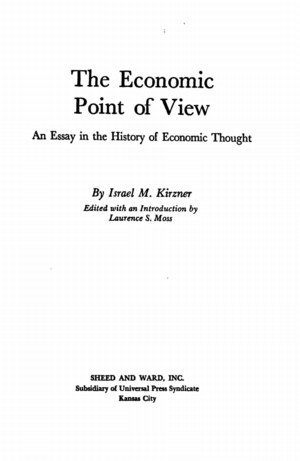
The Economic Point of View: An Essay in the History of Economic Thought, ed. with an Introduction by Laurence S. Moss (Kansas City: Sheed Andrews McMeel, 1976).

About Liberty Fund:

Liberty Fund, Inc. is a private, educational foundation established to encourage the study of the ideal of a society of free and responsible individuals.


Economics and Catallactics

The importance of exchange to economics was recognized very early in the development of the science. In France the physiocrats had stressed exchange and had required ability to be exchanged as a condition for the wealth with which political economy is concerned. Among the classical economists there was some debate as to whether the possibility of exchange was either a sufficient or a necessary condition for wealth. James Mill and McCulloch were among those requiring exchangeability as a condition. But Malthus pointed out that many things outside the scope of political economy may be the objects of exchange. “It has been said...that the liberties of England were chiefly obtained by successive purchases from the crown.”1 A number of the classical defination of economics in term of wealth included the exchange of wealth as a department of the subject together with its production, distribution, and consumption. One French writer had even written: “Society is purely and solely a continual series of exchanges...commerce is the whole of society.2

But during the early classical period there was no attempt to take this phenomenon of exchange and make it the very core of economics. Political economy was the science of wealth. The fact that wealth is exchanged may have been recognized as of the first importance for a science of wealth, but this recognition did not of itself convert political economy into the science of exchanges.

The first attempt to reconsider the scope of political economy in favor of the exchange criterion was the basis for Archbishop Whately’s suggestion in 1831 to rename the entire subject. “The name I should have preferred as the most descriptive...is that of CATALLACTICS, or the ‘Science of Exchanges.’” Whatley’s outlook is perhaps best seen in his definition of man as “an animal that makes exchanges.”3 Whately joined Senior in denying the applicability of political economy to the activities of isolated man. “Robinson Crusoe is in a position of which Political Economy takes no cognizance.”4 It was no longer sufficient to characterize political economy as concerned with the phenomena of wealth or even with the wealth that is involved in exchanges. The catallactic view of economic affairs saw their unity solely in the act of exchange and conceived of political economy as expounding the principles governing these interpersonal exchanges.

Whately’s opinions on the scope of the subject seem to have aroused some interest at the time. At Dublin Whately had endowed a chair in political economy.5 At least two of the holders of the Whately professorship followed the catallactic view of their subject. But besides the enthusiasm of these followers and acceptance by several minor writers,6 Whately’s proposal, where noticed, was rejected as unjustifiably narrowing the scope of the subject.7 It was not until several decades after the publication of Whately’s book that Macleod seized on the view of economics as the science of exchanges and enthusiastically launched the idea in his crusade to revolutionize the entire subject.8 However, Macleod’s unfortunate propensity for expressing his often good ideas in an apparently bombastic fashion prevented his work from making any appreciable impression on the general economic thought of his time.

The substitution, in definitions of political economy, of a verbal noun (“exchange”) instead of the classical noun (“wealth”) was, of course, of considerable significance. The subject matter of the science was now uniquely characterized, not by the objective nature of the goods-phenomena that it investigates, but by the character of the operations involved in the appearance of these phenomena. Nevertheless, the break from the classical conception of economics as a science of wealth that was involved in Whately’s proposal was not so complete as might at first glance be imagined. That which is exchanged in Whately’s Catallactics is still the same “wealth” with which the political economy of a McCulloch is concerned. The views of those who held that economics is a science of exchanges, in fact, provide another interesting example of definitions that, while themselves closely related to the older wealth-bound formulations, point to a complete emancipation from these bonds. An arresting illustration of this is furnished in the writings of Lawson.

Lawson, one of the Dublin professors, devoted his first lecture in 1844 to problems of the scope and methodology of his subject. The object of political economy is “to investigate and trace to general laws the different phenomena of the commercial or exchanging system...” This is clearly in the Whately tradition. But even more noteworthy is Lawson’s declaration that political economy is a science that has man as its subject matter and “views him in connexion with his fellow-man, having reference solely to those relations which are the consequences of a particular act, to which his nature leads him, namely, the act of making exchange.”9 What Lawson has put before us is no less than a completely original “economic man,” fully capable of bearing comparison with his more familiar cousin, the economic man created by J. S. Mill. Mill’s creature was a being bereft of all passions other than avarice. Mill’s economics was a body of principles governing the consequences of avaricious behavior. Lawson’s economic man, on the other hand, is a far less repulsive caricature. His obsession is merely to engage in the act of exchange “to which his nature leads him,” and the task of Lawson’s political economy is to investigate the consequences of this human urge—an impulse that Adam Smith had long ago made famous as the “propensity to truck, barter, and exchange one thing for another.”10

The separation of acts of exchange and their identification with a distinct human urge made the division between economic and other human affairs a far less painful operation for Lawson than it had been for Mill. The consequences of the propensity to truck may be isolated simply by considering only the results of acts of exchange. There is no need to call upon controversial operations of “abstraction” and “hypothesis” as is necessary when one attempts to segregate the consequences of human pecuniary self-interest. Clearly the catallactic view could facilitate the conversion of political economy from a science of wealth into a science of man.

And yet Lawson himself in his second lecture gave a definition of his subject almost identical with the earlier formulations in terms of wealth.11 The contradiction between the first and the second lectures seems capable of resolution only on the assumption that Lawson himself was willing enough to follow Whately in terminology but was not prepared to admit that this difference meant any substantive alteration in outlook.

Several decades later the American Perry warmly endorsed the catallactic view of Whately and Macleod precisely because it offered an escape from the idea of wealth. In order to avoid the difficulty involved in giving an adequate definition of the concept of wealth as the core of political economy, Perry turned to the conception of that discipline as a science of exchanges.12 We have already noticed a trend in economic thought, towards the latter part of the nineteenth century, that favored the abandonment of wealth as the focus of economics and its replacement by such ideas as welfare and the maximization-pattern of behavior. This trend was now reinforced by Perry’s proposal to reject the concept of wealth altogether in favor of the idea of exchange, thus taking the catallactic idea a step beyond Lawson. It may be remarked that Perry’s suggestion was not generally accepted by American economists of his time. Walker pointed out that until one knows precisely what is being exchanged, little meaning is conveyed by defining economics as the science of exchanges. If, on the other hand, one admits that it is wealth that is being exchanged, then, of course, one immediately renounces any claim to the excision of that troublesome concept.13 The definition of economics in terms of exchange has not gotten rid of the notion of wealth; it has simply swept it under the rug. Henry George wrote of Perry’s discarding the noun wealth: “Without the clog of an object-noun political economy...has plunged out of existence...” It is true that one American writer asserted that economists yielded the definition of economics as the science of exchanges “a more general assent than to any other.”14 But more typical of general opinion was probably the blunt declaration made to the American Economic Association in 1887 that “that definition of Political Economy which calls it the science of exchanges, is absurd.”15

Despite the alleged absurdity of this definition, it has always retained some measure of popularity. Several twentieth-century economists who devoted careful attention to the problem of defin- ing their subject and weighed the merits of several more sophisticated formulations still preferred the exchange criterion.16 But the selection of exchange to serve as the core of economics may yet reflect any one of a number of points of view. This is so because the exchange concept itself reflects several related, but distinct, aspects of economic activity, each of which deserves to be kept in clear focus.

[[1]]T. Malthus, Definitions in Political Economy, pp. 70 f. Mill's position is in his Commerce Defended (1808), p. 22; McCulloch's, in his Principles of Political Economy (1825), part I, p. 5. Parallel to the exchangeability condition required for wealth by these writers is the requirement that items of wealth be capable of appropriation and alienation. (See, e.g., S. Read, Political Economy [Edinburgh, 1929], p. 1.] Sismondi explicitly denied that exchangeability is a prerequisite for wealth (Nouveaux principesd'économie politique [Geneva, 1951], p. 71).

[[2]]Count DeStutt de Tracy, A Treatise on Political Economy (English ed., Georgetown, 1817), “Of Action,” pp. 6, 15.

[[3]]R. Whately, Introductory Lectures on Political Economy (4th ed.; London, 1855), p. 4.

[[4]]Ibid., p. 5. See N. Senior, Outline of the Science of Political Economy, p. 25. Torrens, apparently, was in disagreement (ibid.), See also E. Cannan, Theories of Production and Distribution, 1776–1848, p. 7.

[[5]]On the existence of a Dublin “school” in economics during this period, see R. D. Black, “Trinity College, Dublin, and the Theory of Value, 1832–1863,” Economica, New Series, XII (1945), 140–148.

[[6]]The Whately professors who endorsed the catallactic view were J. A. Lawson, Five Lectures on Political Economy, delivered before the University of Dublin, 1843 (London and Dublin, 1844), pp. 12 f.; and W. N. Hancock, An Introductory Lecture on Political Economy (Dublin, 1849), p. 7. The writer who wrote under the pseudonym Patrick Plough (and was noticed by Seligman in his “On Some Neglected British Economists,” Economic Journal, 1903), bestowed on his book (London, 1842) the following title: Letters on the Rudiments of a Science, called formerly, improperly, Political Economy, recently more pertinently, Catallactics.

[[7]]Among writers who condemned the narrowness of the catallactic view were F. W. Newman, Lectures on Political Economy (London, 1851), p. 19; J. Cazenove, Thoughts on a Few Subjects of Political Economy (London, 1859), p. 70. See also W. E. Hearn, Plutology (London and Melbourne, 1864), p. 6. For later criticism of the narrowness of Whately's position, see W. Roscher, Geschichte der National-Oekonomik in Deutschland (Munich, 1874), pp. 844, 1072; P. Cauwèes, Précis du coursd'économie politique (Paris, 1881), p. 7; P. Leroy-Beaulieu, Traité théorique et pratiqued'économie politique (Paris, 1896), I, 16.

[[8]]H. D. Macleod, The Elements of Political Economy (London, 1858), p. 5. Macleod stresses his independent arrival at the catallactic position. In his notion of exchange Macleod is narrower than some of his precursors. Thus he dismisses taxation from political economy on the grounds that it is not the subject of exchange. Whately expressly considered taxation as exchange (Introductory Lectures, p. 7 n.). Senior too (Outline of the Science of Political Economy, p. 87) viewed “all that is received by the officers of Government as given in Exchange for Services. ... ” In his History of Economics, published some forty years later, Macleod carefully collected favorable references to his own work by later writers and cites the American Perry, about whom more below.

[[9]]J. A. Lawson, Five Lectures on Political Economy, pp. 12–13.

[[10]]A. Smith, Wealth of Nations, ed. Cannan (Modern Library edition), p. 13.

[[11]]See J. A. Lawson, op. cit., p. 26. (A similar ambivalence seems visible also in Plough's work cited above, n. 6.)

[[12]]A. L. Perry, Elements of Political Economy (14th ed.; New York, 1877), pp. 1, 54.

[[13]]F. A. Walker, Political Economy (New York, 1883), p. 3. Henry George's criticism is in his The Science of Political Economy (New York, 1898), p. 130.

[[14]]Albert S. Bolles, Political Economy (New York, 1878), p. 3.

[[15]]Franklin H. Giddings, “The Sociological Character of Political Economy,” read at the second annual meeting of the association; published in the association's Publications, III (1889), 43. It is of some interest that Giddings, who here castigates the “absurdity” of the Perry position, has elsewhere (Essays in Honor of J. B. Clark, 1927) gratefully cited Perry's book as having been his own first textbook in economics.

[[16]]See, e.g., A. Amonn, Objekt und Grundbegriffe der theoretische Nationalökonomie (2nd ed.), pp. 160 f., for Max Weber's position; Felix Kaufmann, “On the Subject Matter and Method of Economic Science,” Economica, November, 1933, pp. 384 f; H. Halberstaedter, Die Problematik des wirtschaftlichen Prinzips (1925), p. 76. Schumpeter's position is discussed later in this chapter.