EconlibThe LibraryOther Sites |
Front Page Titles (by Subject) F. A. Harper, Ludwig Von Mises - Toward Liberty: Essays in Honor of Ludwig von Mises, vol. 1
Return to Title Page for Toward Liberty: Essays in Honor of Ludwig von Mises, vol. 1The Online Library of LibertyA project of Liberty Fund, Inc.Search this Title:Also in the Library:
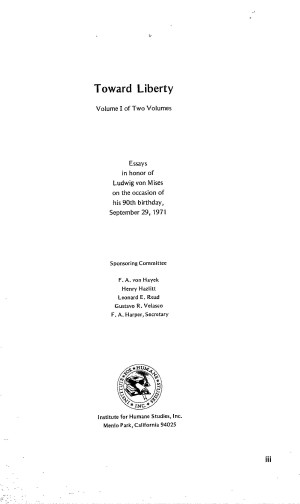
F. A. Harper, Ludwig Von Mises - Friedrich August von Hayek, Toward Liberty: Essays in Honor of Ludwig von Mises, vol. 1 [1971]Edition used:Toward Liberty: Essays in Honor of Ludwig von Mises on the Occasion of his 90th Birthday, September 29, 1971, vol. 1, ed. F.A. Hayek, Henry Hazlitt, Leonrad R. Read, Gustavo Velasco, and F.A. Harper (Menlo Park: Institute for Humane Studies, 1971).
About Liberty Fund:Liberty Fund, Inc. is a private, educational foundation established to encourage the study of the ideal of a society of free and responsible individuals. Copyright information:This work is copyrighted by the Institute for Humane Studies, George Mason University, Fairfax, Virginia, and is put online with their permission. Fair use statement:This material is put online to further the educational goals of Liberty Fund, Inc. Unless otherwise stated in the Copyright Information section above, this material may be used freely for educational and academic purposes. It may not be used in any way for profit.
Ludwig Von MisesLudwig Edler von Mises was born on September 29, 1881, at Lemberg, Austria, the son of Arthur Edler and Adele (Landau) von Mises. He graduated from the University of Vienna in 1906 as Doctor of Law and Social Science; served as economic advisor to the Austrian Chamber of Commerce from 1909 to 1934, taught economics at the University of Vienna from 1913 to 1938; was founder and Acting Vice President of the Austrian Institute for Business Cycle Research from 1926 to 1938; was Professor of International Economic Relations at the Graduate Institute of International Studies, Geneva, from 1934 to 1940. On July 6, 1938, Professor Mises married Margit Sereny-Herzfeld in Geneva. In 1940 he emigrated to the United States, and from here his influence spread over many nations through his lectures and writings. From 1945 to 1969 he was Visiting Professor at the Graduate School of Business Administration, New York University. He also served as Visiting Professor at the National University of Mexico in 1942, and, since 1965, at the University of Plano, Texas. He has been a consultant and advisor to numerous business and research organizations. Honors awarded him include an Honorary Doctor of Laws at Grove City College (1957), Honorary Doctorate of Law at New York University (1963), Honorary Doctorate of Political Science at the University of Freiburg (1964), and the Distinguished Fellow award of the American Economic Association (1969): A library possessing all the books by Ludwig von Mises would have nineteen volumes if it confined itself to first editions, forty-six volumes if it included all revised editions and foreign translations, and still more if it possessed the Festschriften and other volumes containing contributions by him. This stream of publications began in 1902…. The stream of students that has come out of his seminars is no less remarkable than his literary output. His published work ranges from economic history and history of thought to methodology and political philosophy, with special emphasis on monetary theory, international finance, business fluctuations, price and wage theory, industrial organization, and economic systems. It would not be possible to enumerate the ideas which Mises has originated and disseminated over the years, but some of the most fruitful may be mentioned: in monetary theory, the application of marginal utility theory to the explanation of the demand for money; in business cycle theory, certain amendments to the Wicksellian theory of the cumulative process and a demonstration that a monetary policy stabilizing certain price indices would not at the same time stabilize business activity; in the theory of socialist economic planning, the discovery that the type of economic calculation required for an efficient allocation of resources cannot be carried out without a system of competitive market prices. The recent movements toward decentralized planning in several Soviet-type economies add the endorsement of history to the insights at which Mises arrived almost fifty years ago. September, 1969 As a unique tribute to Professor Mises, Oskar Lange of the Polish Politburo once proposed that the socialists erect a statue to him, “For it was his powerful challenge that forced the socialists to recognize the importance of an adequate system of economic accounting to guide the allocation of resources in a socialist economy.” They never did, of course, but Professor Mises has erected his own statue of a material that is even stronger than marble, in the form of his monumental writings.∗ No less than 219 articles have been authored by Professor Mises. Others are lost, perhaps forever, due to his early files and records having been ransacked shortly after Hitler's army invaded Austria in 1938. This remarkable man has appropriately been called a scholar's scholar and a champion of the potential of humans. His rare degree of philosophic conscience and scientific integrity not only has contributed the powerful force of his ideas themselves, but also has inspired untold numbers of persons to heights of intellectual attainment otherwise hardly conceivable. Some of these fruits are on the pages which follow, from a few of his friends and admirers.
June, 1971 [∗]Bettina Bien, The Works of Ludwig Von Mises (Irvington-on-Hudson, New York: The Foundation for Economic Education, 1969) |

Titles (by Subject)