Econlib

The Library

Other Sites

Front Page arrow Titles (by Subject) arrow Foreword - The Collected Works of James M. Buchanan. Vol. 2 Public Principles of Public Debt: A Defense and Restatement

Return to Title Page for The Collected Works of James M. Buchanan. Vol. 2 Public Principles of Public Debt: A Defense and Restatement

Search this Title:

Foreword - James M. Buchanan, The Collected Works of James M. Buchanan. Vol. 2 Public Principles of Public Debt: A Defense and Restatement [1958]

Edition used:

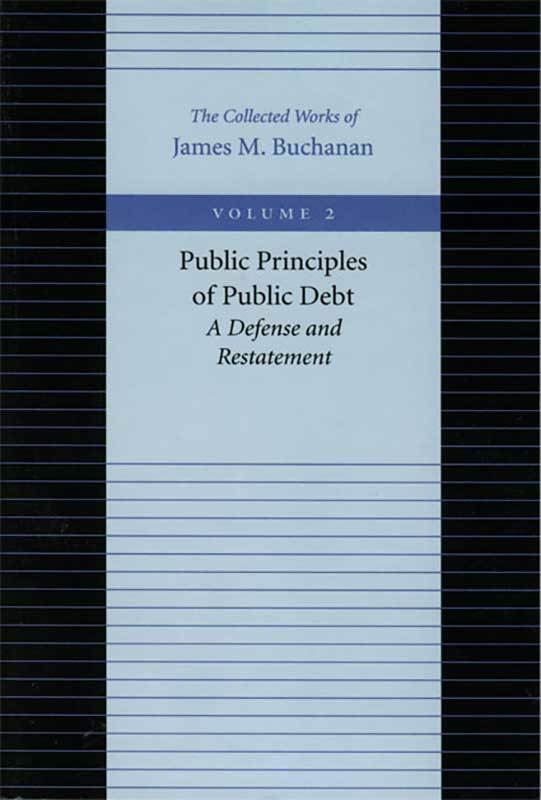
The Collected Works of James M. Buchanan, vol. 2. Public Principles of Public Debt: A Defense and Restatement, Foreword by Geoffrey Brennan (Indianapolis: Liberty Fund, 1999).

Part of: The Collected Works of James M. Buchanan in 20 vols.

About Liberty Fund:

Liberty Fund, Inc. is a private, educational foundation established to encourage the study of the ideal of a society of free and responsible individuals.


“I find little use for the hypothesis that error becomes truth merely by long or consistent practice.“

—Henry Simons, “On Debt Policy”

“I must confess, that there is a strange supineness, from long custom, creeped into all ranks of men, with regard to public debts, not unlike what divines so vehemently complain of with regard to their religious doctrines.”

—David Hume, “Of Public Credit”

“I find little use for the hypothesis that error becomes truth merely by long or consistent practice.”

—Henry Simons, “On Debt Policy”

“I must confess, that there is a strange supineness, from long custom, creeped into all ranks of men, with regard to public debts, not unlike what divines so vehemently complain of with regard to their religious doctrines.”

—David Hume, “Of Public Credit”

Foreword

Begin with a picture. Here is the young Jim Buchanan, strolling down the stairs of the Hotel d’Inghilterra in Rome after breakfast in early 1957. He is preoccupied. His brow is slightly furrowed. Suddenly, he looks up, and his head tilts back. A slightly incredulous look comes over his face. Apparently, something puzzling had in an instant become clear. He races down the remaining steps and hurries over to a small writing room that graces the foyer of the hotel. Grabbing some pieces of hotel stationery, he proceeds feverishly to jot down the crucial points. Public Principles of Public Debt1 is born.

It is, for Buchanan, the only book that will come about in this way—as a flash of inspiration. Other works may be no less inspired in an intellectual sense—and no less inspiring to readers. But Public Principles of Public Debt is the only work that will begin with an experience of quite this Road-to-Damascus quality. And the feverishness does not end here. The central point of the argument, once seen, is so obvious to Buchanan—the prevailing orthodoxy on public debt incidence (which he had previously thoroughly imbibed) so clearly wrong—that he cannot wait to get the book written and into print. As he presses forward with the writing, he anxiously examines the journals, fearful that with so obvious a point he might well be scooped. The natural impulse of intellectual excitement works together here with considerations of professional prudence to drive him on.

Was he right to be anxious? To judge by the book’s puzzled reception and the confused literature about it that emerged over the ensuing decade, probably not. What was obvious to Buchanan was clearly not so obvious to everyone else. Indeed, there remained a constituency, particularly within macroeconomics, that was staunchly resistant to and suspicious of the Buchanan insights. Nonetheless, Buchanan was right to feel that much was at stake, both professionally and academically; Public Principles of Public Debt was, after all, Buchanan’s first monograph. And in this sense, it added a depth and substance to his vita to set alongside the impressive array of important journal articles he had already produced. Moreover, the line of argument had important influences on his subsequent work. For example, the subjective cost theme in Cost and Choice2 owes much to the reflections about cost that are developed in Public Principles of Public Debt, and the important public choice implications of the Public Principles of Public Debt argument surface explicitly in Democracy in Deficit.3

To elaborate, part of the concern of the “new orthodoxy” in claiming that the burden of debt (at least, internal debt) is borne currently, in the period that the expenditure is undertaken and precisely not passed forward to future generations as (allegedly mistaken) popular view might have it, was to offset ethical inhibitions about deficit financing. If Buchanan’s claim was right, and the burden of debt financing was indeed borne by “future generations,” then debt financing might well encourage both excessive reliance on debt and excessive levels of spending. To the extent that the future generations in question were indeed different persons, not alive (or not enfranchised) at the time the expenditure operation was undertaken, then the fiscal operation would not (and by definition could not) fulfill the Wicksellian contractarian requirement that virtually all affected parties should be free to reject the expenditure. In the absence of a restriction on debt financing, ordinary democratic processes could not prevent the current generation of voters-taxpayers from passing forward the cost of as much current expenditure as they were inclined to and—if the cost was to be borne by others—voting for themselves projects whose total benefits, though positive, did not exceed total costs. These aspects remain entirely in the background in Public Principles of Public Debt. The object in this first book by Buchanan is to establish a set of analytic claims about debt incidence. But the public choice aspects do provide some of the (possibly unconscious) subtext in Public Principles of Public Debt that Buchanan and Wagner, in Democracy in Deficit and elsewhere, make explicit and develop in a more complete way.

These public choice anxieties are, of course, very much in play in the more recent debate over implicit social security debt. This latter debate has, in fact, proceeded somewhat independently of the Buchanan book and has focused on slightly different aspects of the whole issue. In particular, it has been mainly concerned with the question of the effects of debt financing on the capital stock. The classic papers here revolve around the rival claims of Martin S. Feldstein and Robert J. Barro—the former claiming to establish econometrically the empirical magnitude of the effects of social security arrangements on the United States capital stock, the latter purporting to show (through a reinvention of the so-called Ricardian equivalence theorem) that, for fully rational individuals, public debt will have virtually the same effect as taxation.4 It is an interesting twist here that Barro’s agenda is in part an anti-Keynesian one. In 1958, the Keynesian position was that (internal) debt and tax financing were more or less equivalent—at least in the intertemporal allocation of burdens. By 1974, however, the Keynesian position seemed entirely reversed. It was, by 1974, recognized that if taxes and debt were essentially equivalent, then standard macroeconomic policy measures based on deficit management could have no effect on the economy—macroeconomic or otherwise. In fact, the Barro-Feldstein debate—or the debate that might have been—got somewhat sidetracked because of problems with the replicability of Feldstein’s data. However, it should be clear that neither Barro’s conclusions nor his approach would be particularly congenial to Buchanan. It is essential to Buchanan’s argument that debt financing has an effect: the difference between Buchanan and the Keynesians was rather whether such effects were desirable or not. More to the point, perhaps, Barro’s central question (and the title of his influential paper)—“are government bonds net wealth?”—is set at a more aggregative level than Buchanan’s analysis in Public Principles of Public Debt. Indeed, in an important sense, the basic contribution in Public Principles of Public Debt is Buchanan’s insistence on an appropriately disaggregated, individuated mode of analysis. To the standard new orthodox claim that we owe internal debt to ourselves, Buchanan’s response is effectively: What’s this “we” business? Once it is recognized that incidence analysis depends on isolating which individuals in which capacities face a liability as a result of a fiscal operation, claims about the community as a whole are seen to be essentially irrelevant and potentially misleading.

It is, of course, not necessary here to repeat Buchanan’s argument. That is elegantly and clearly set out in the ensuing text. But, it is worth noting that there is a kind of intellectual divide between those who conceive social phenomena in a disaggregated way and those of a more holistic, organic cast of mind. Arguably, it is this intellectual divide that most distinguishes micro- from macroeconomists and a fortiori economists as a group from sociologists and many traditional political theorists. Within this divide, in Public Principles of Public Debt, Buchanan establishes himself firmly as an arch exponent of the individualist method.

The years immediately following the publication of Buchanan’s book gave rise to an extensive literature, the most important elements of which are reproduced in James M. Ferguson’s book, Public Debt and Future Generations.5 Unsurprisingly, public debt has been a recurrent theme in Buchanan’s writings over his entire career. And in the more recent resurgence of interest in the topic surrounding the analysis of social security policy, Buchanan has had occasion to revisit earlier themes. What is perhaps surprising, given the change in intellectual climate since the heyday of the new orthodoxy and the overwhelming predominance of Keynesian thinking throughout the fifties and sixties, is how fresh and relevant Public Principles of Public Debt remains. To be sure, some minor pieces of the book (most notably the appendix) are somewhat dated and have been included in the present version largely for reasons of completeness. But these aspects are minor and do not detract (or distract) from the power and sweep of the central argument. In fact, Public Principles of Public Debt remains one of Buchanan’s most important and influential books. The force of this observation is hardly diminished by the observation that some of this influence is revealed in Buchanan’s own subsequent writings.

Geoffrey Brennan

  • Australian National University

[1. ] James M. Buchanan, Public Principles of Public Debt: A Defense and Restatement (Homewood, Ill.: Richard D. Irwin, 1958), volume 2 in the series.

[2. ] James M. Buchanan, Cost and Choice: An Inquiry in Economic Theory (Chicago: Markham Publishing Co., 1969), volume 6 in the series.

[3. ] James M. Buchanan and Richard E. Wagner, Democracy in Deficit: The Political Legacy of Lord Keynes (New York: Academic Press, 1977), volume 8 in the series.

[4. ] Martin S. Feldstein, “Social Security, Induced Retirement, and Aggregate Capital Accumulation,” Journal of Political Economy 5 (September-October 1974): 905-26; Robert J. Barro, “Are Government Bonds Net Wealth?” Journal of Political Economy 6 (November-December 1974): 1095-117.

[5. ] James M. Ferguson, ed., Public Debt and Future Generations (Chapel Hill: University of North Carolina Press, 1964). The Buchanan contribution written specifically for the Ferguson collection, “Public Debt, Cost Theory, and the Fiscal Illusion,” 150-63, is reproduced in the Collected Works in volume 1, The Logical Foundations of Constitutional Liberty. Another Buchanan paper reprinted in the Ferguson volume, “ ’La Scienza delle finanze’: The Italian Tradition in Fiscal Theory,” in Fiscal Theory and Political Economy: Selected Essays (Chapel Hill: University of North Carolina Press, 1960), 47-54, is reproduced in the series in volume 15, Externalities and Public Expenditure Theory, along with Buchanan’s other articles on public debt.