Econlib

The Library

Other Sites

Front Page arrow Titles (by Subject) arrow CHAPTER XVII.: the rights of children. - Social Statics

Return to Title Page for Social Statics

Search this Title:

Also in the Library:

Topic: Spontaneous Order
Subject Area: Political Theory
Collection: Classics of Liberty
Topic: Natural Law and Natural Rights
Topic: Property
Topic: Freedom of Speech
Collection: ePub Pilot Project

CHAPTER XVII.: the rights of children. - Herbert Spencer, Social Statics [1851]

Edition used:

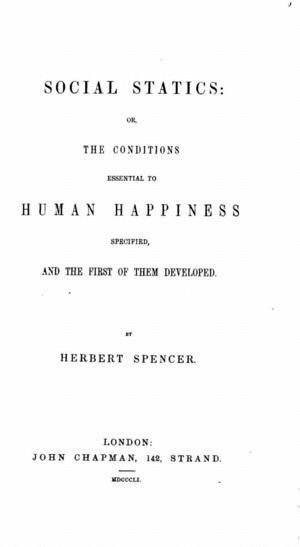
Social Statics: or, The Conditions essential to Happiness specified, and the First of them Developed, (London: John Chapman, 1851).

About Liberty Fund:

Liberty Fund, Inc. is a private, educational foundation established to encourage the study of the ideal of a society of free and responsible individuals.


CHAPTER XVII.

the rights of children.

§ 1.

If we are once sure of our law—sure that it is a Divine ordination—sure that it is rooted in the nature of things, then whithersoever it leads we may safely follow. As elsewhere pointed out (Lemma II.), a true rule has no exceptions. When therefore that first principle from which the rights of adults are derived, turns out to be a source from which we may derive the rights of children, and when the two processes of deduction prove to be identical, we have no choice but to abide by the result, and to assume that the one inference is equally authoritative with the other.

That the law—Every man has freedom to do all that he wills, provided he infringes not the equal freedom of any other man—applies as much to the young as to the mature, becomes manifest on referring back to its origin. God wills human happiness; that happiness is attainable only through the medium of faculties; for the production of happiness those faculties must be exercised; the exercise of them pre-supposes liberty of action: these are the steps by which we find our way from the Divine will to the law of equal freedom. But the demonstration is fully as complete when used on behalf of the child, as when used on behalf of the man. The child’s happiness, too, is willed by the Deity; the child, too, has faculties to be exercised; the child, too, needs scope for the exercise of those faculties; the child therefore has claims to freedom—rights, as we call them—co-extensive with those of the adult. We cannot avoid this conclusion, if we would. Either we must reject the law altogether, or we must include under it both sexes and all ages.

The candid thinker will find himself obliged to concede this, when he considers the many perplexities which follow in the train of any other theory. For, if it be asserted that the law of equal freedom applies only to adults; that is, if it be asserted that men have rights, but that children have none, we are immediately met by the question—When does the child become a man? at what period does the human being pass out of the condition of having no rights, into the condition of having rights? None will have the folly to quote the arbitrary dictum of the statute-book as an answer. The appeal is to an authority above that of legislative enactments—demands on what these are to be founded—on what attribute of manhood recognition by the law of equal freedom depends. Shall the youth be entitled to the rights of humanity when the pitch of his voice sinks an octave? or when he begins to shave? or when he ceases growing? or when he can lift a hundred weight? Are we to adopt the test of age, of stature, of weight, of strength, of virility, or of intelligence? Much may no doubt be said in favour of each of these; but who can select the true one? And who can answer the objection, that whichever qualification is chosen, will class many as men who are not at present considered such; whilst it will reject from the list, others who are now by universal consent included in it?

Nor is this all. For even supposing that, by some undiscovered species of logic, it has been determined on what particular day of his life the human being may equitably claim his freedom, it still remains to define the position he holds previously to this period. Has the minor absolutely no rights at all? If so, there is nothing wrong in infanticide. If so, robbery is justifiable, provided the party robbed be under age. If so, a child may equitably be enslaved. For, as already shown (pp. 112, 134), murder, theft, and the holding of others in bondage are wrong, simply because they are violations of human rights; and if children have no rights, they cannot become the subjects of these crimes. But if, on the other hand, it be held, as it is held, that children have some rights; if it be held that the youth has an equal claim to life with the adult; if it be held that he has something like the same title to liberty; and if it be held (though not by law, yet by public opinion) that he is similarly capable of owning property, then it becomes needful to show why these primary rights must be conceded, but no others. They who assert that children are wholly without rights, and that, like the inferior animals, they exist only by permission of grown men, take up a precise, unmistakable position. But they who suppose children to occupy a place morally above that of brutes, and yet maintain that whilst children have certain rights, their rights are not equal with those of men, are called upon to draw the line, to explain, to define. They must say what rights are common to children and adults, and why. They must say where the rights of adults exceed those of children, and why. And their answers to these queries must be drawn, not from considerations of expediency, but from the original constitution of things.

Should it be argued, that the relationship in which a parent stands to his child, as supplying it with the necessaries of life, is a different one from that subsisting between man and man, and that consequently the law of equal freedom does not apply, the answer is, that though by so maintaining it a parent establishes a certain claim upon his child—a claim which he may fairly expect to have discharged by a like kindness towards himself should he ever need it, yet he establishes no title to dominion. For if the conferring an obligation establishes a title to dominion in this case, then must it do so in others; whence it will follow that if one man becomes a benefactor to another, he thereby obtains the right to play the master over that other; a conclusion which we do not admit. Moreover, if in virtue of his position a parent may trench upon the liberties of his child, there necessarily arises the question—To what extent may he do this? may he destroy them entirely, as by committing murder? If not, it is required to ascertain the limit up to which he may go, but which he must not exceed; a problem equally insoluble with the similar one just noticed.

Unless, therefore, the reader can show that the train of reasoning by which the law of equal freedom is deduced from the Divine will, does not recognise children, which he cannot; unless he can show exactly at what time the child becomes a man, which he cannot; unless he can show why a certain share of liberty naturally attaches to both childhood and manhood, and another share to only one, which he cannot; he must admit that the rights of the youth and the adult are co-extensive.

There is indeed one plausible-looking way of meeting these arguments. It may be urged that in the child many of the faculties of the future man are undeveloped, and that as rights are primarily dependent on faculties, the rights of children cannot be co-extensive with those of adults, because their faculties are not so. A fatal objection this, did it touch the question; but it happens to be wholly beside it. The fullest endowment of rights that any being can possess, is perfect freedom to exercise all his faculties. And if each of two beings possesses perfect freedom to exercise all his faculties, each possesses complete rights; that is, the rights of the two are equal; no matter whether their faculties are equal or not. For, to say that the rights of the one are less than those of the other, because his faculties are fewer, is to say that he has no right to exercise the faculties he has not got!—a curious compound of truism and absurdity.

§ 2.

Due warning was given (p. 51) that our first principle carried in it the germs of sundry unlocked-for conclusions. We have now met with one of these. We have just found ourselves committed to a proposition at war with the convictions of almost all. Truth, however, must of necessity be consistent. We have therefore no alternative but to re-examine our preconceived opinions, in the expectation of finding them erroneous.

That we may enter upon this task in a philosophical spirit, it will be well, at the risk even of something like repetition, to glance at the influences by which our beliefs are in danger of being warped. We need constantly reminding of these. As an abstract truth, we all admit that passion distorts judgment; yet never inquire whether our passions are influencing us. We all decry prejudice, yet are all prejudiced. We see how habits, and interests, and likings, mould the theories of those around us; yet forget that our own theories are similarly moulded. Nevertheless, the instances in which our feelings bias us in spite of ourselves are of hourly recurrence. That proprietary passion, which a man has for his ideas, veils their defects to him as effectually as maternal fondness blinds a mother to the imperfections of her offspring. An author cannot, for the life of him, judge correctly of what he has just written; he has to wait until lapse of time enables him to read it as though it were a stranger’s, and he then discerns flaws where all had seemed perfect. It is only when his enthusiasm on its behalf has grown cold, that the artist is able to see the faults of his picture. Whilst they are transpiring, we do not perceive the ultimate bearing of our own acts or the acts of others towards us; only in after years are we able to philosophize upon them. Just so, too, is it with successive generations. Men of the past quite misunderstood the institutions they lived under; they pertinaciously adhered to the most vicious principles, and were bitter in their opposition to right ones, at the dictates of their attachments and antipathies. So difficult is it for man to emancipate himself from the invisible fetters which habit and education cast over his intellect; and so palpable is the consequent incompetency of a people to judge rightly of itself and its deeds or opinions, that the fact has been embodied in the current aphorism——No age can write its own history:—an aphorism sufficiently expressive of the universality of prejudice.

If we act wisely, we shall assume that the reasonings of modern society are subject to the like disturbing influences. We shall conclude that, even now, as in times gone by, opinion is but the counterpart of condition—merely expresses the degree of civilisation to which we have attained. We shall suspect that many of those convictions which seem the results of dispassionate thinking, have been nurtured in us by circumstances. We shall confess that as, heretofore, fanatical opposition to this doctrine, and bigoted adhesion to that, have been no tests of the truth or falsity of the said doctrines; so neither is the strength of attachment, or dislike which a nation now exhibits towards certain principles, any proof of their correctness or their fallacy. Nay more—we shall not only admit that public opinion may be wrong, but that it must be so. Without a general equilibrium between institutions and ideas society cannot subsist; and hence, if error pervades our institutions, it must similarly pervade our ideas. Just as much as a people falls short of perfection in its state, will it lack of truth in its beliefs.

Thus much by way of bespeaking a calm hearing. As lately said, the proposition about to be maintained conflicts with the habits, associations, and most cherished convictions of the great majority. That the law of equal freedom applies to children as much as to adults; that consequently the rights of children are co-extensive with those of adults; that, as violating those rights, the use of coercion is wrong; and that the relationship now commonly existing between parents and children is therefore a vicious one—these are assertions which perhaps few will listen to with equanimity. Nevertheless, if there be any weight in the foregoing considerations, we shall do well to disregard all protests of feeling, and place implicit faith in the conclusions of abstract equity.

§ 3.

We say that a man’s character may be told by the company he keeps. We might similarly say that the truth of a belief may be judged by the morality with which it is associated. Given a theory universally current amongst the most degraded sections of our race—a theory received only with considerable abatements by civilized nations—a theory in which men’s confidence diminishes as fast as society advances—and we may safely pronounce that theory to be a false one. On such, along with other evidence, the subordination of sex was lately condemned. Those commonly-observed facts, that the enslavement of woman is invariably associated with a low type of social life, and that conversely, her elevation towards an equality with man uniformly accompanies progress, were cited in part proof that the subjection of female to male is essentially wrong. If now, instead of women we read children, similar facts may be cited, and a similar deduction may be drawn. If it be true that the dominion of man over woman has been oppressive in proportion to the badness of the age or the people, it is also true that parental authority has been stringent and unlimited in a like proportion. If it be a fact that the emancipation of women has kept pace with the emancipation of society, it is likewise a fact that the once despotic rule of the old over the young has been ameliorated at the same rate. And if in our own day, we find the fast-spreading recognition of popular rights accompanied by a silently-growing perception of the rights of women, we also find it accompanied by a tendency towards systems of non-coercive education—that is, towards a practical admission of the rights of children.

Whoever wants illustrations of this alleged harmony between the political, connubial, and filial relationships, may discover them anywhere and everywhere. Scanning that aboriginal state of existence during which the aggressive conduct of man to man renders society scarcely possible, he will see not only that wives are slaves and exist by sufferance, but that children hold their lives by the same tenure, and are sacrificed to the gods when fathers so will. He may observe how during classic times, the thraldom of five-sixths of the population was accompanied both by a theory that the child is the property and slave of its male parent, and by a legal fiction which regarded wives, as children similarly owned. That political degradation of the present East-Indian races for whom absolute monarchy seems still the only possible form of rule, he will find accompanied alike by suttees and by infanticide. The same connection of facts will be seen by him in China, where under a government, purely autocratic, there exists a public opinion which deems it an unpardonable offence for a wife to accuse her husband to the magistrate, and which ranks filial disobedience as a crime next in atrocity to murder. Nor is our own history barren of illustrations. On reviewing those times when constitutional liberty was but a name, when men were denied freedom of speech and belief, when the people’s representatives were openly bribed and justice was bought—the times, too, with which the laws enacting the servitude of women were in complete harmony—the observer cannot fail to be struck with the harshness of parental behaviour, and the attitude of humble subjection which sons and daughters had to assume. Between the close of the last century, when our domestic condition was marked by the use of Sir and Madam in addressing parents, and by the doctrine that a child ought unhesitatingly to marry whomsoever a father appointed; and when our political condition was marked by aristocratic supremacy, by the occurrence of church-and-king riots, and by the persecution of reformers—between that day and ours, the decline in the rigour of paternal authority and in the severity of political oppression, has been simultaneous. And, as already remarked, the like companionship of facts is seen in the present rapid growth of democratic feeling, and the equally rapid spread of a milder system of juvenile training.

Thus, the biography of the race affords ample illustration of the alleged law. That uniformity of moral tone, which it was asserted must necessarily pervade a nation’s arrangements—social, marital, and parental, we see exemplified alike under all phases of civilisation. Indeed this position hardly needed proof, being, as it is, a direct corollary from self-evident truths. As surely as a man’s character shines through all his deeds, so surely does the character of a people shine through all its laws and customs. Having a common root in human nature, cotemporary institutions cannot fail to be equally affected by the imperfection of that nature. They must all be right or wrong together. The evil which taints one must taint all. The change which reforms one must at the same time reform all. The progress which perfects one must eventually perfect all.

Consequently, whoever admits that injustice is still visible in the dealings of class with class—whoever admits that it similarly exhibits itself in the behaviour of one sex to the other, cannot but admit that it necessarily exists in the conduct of the old to the young. And he must further admit that being most implicitly received amongst the most barbarous nations, and waning as its influence does with the advance of civilisation, the doctrine of filial subjection is entirely condemned by its associations.

§ 4.

If coercive education be right, it must be productive of good, and if wrong, of evil. By an analysis of its results, therefore, we shall obtain so much evidence for or against the doctrine that the liberties of children are co-extensive with those of adults.

That coercive education is impolitic, may be strongly suspected from the fact lately adverted to—the evident disposition towards the abandonment of it which modern systems of training evince. Considering what universal attention the culture of the young has lately received—the books written about it, the lectures delivered on it, the experiments made to elucidate it—there is reason for concluding that as the use of brute force for educational purposes has greatly declined, something radically wrong must be involved in it. But without dwelling upon this, which, like all inferences drawn from expediency, is liable to have its premises called in question, let us judge of coercive education not by the effects it is believed to produce, but by those it must produce.

Education has for its object the formation of character. To curb restive propensities, to awaken dormant sentiments, to strengthen the perceptions, and cultivate the tastes, to encourage this feeling and repress that, so as finally to develop the child into a man of well proportioned and harmonious nature—this is alike the aim of parent and teacher. Those, therefore, who advocate the use of authority, and if need be—force in the management of children, must do so because they think these the best means of compassing the desired object—formation of character. Paternity has to devise some kind of rule for the nursery. Impelled partly by creed, partly by custom, partly by inclination, paternity decides in favour of a pure despotism, proclaims its word the supreme law, anathematizes disobedience, and exhibits the rod as the final arbiter in all disputes. And of course this system of discipline is defended as the one best calculated to curb restive propensities, awaken dormant sentiments, &c., &c., as aforesaid. Suppose, now, we inquire how the plan works. An unamiable little urchin is pursuing his own gratification regardless of the comfort of others—is perhaps annoyingly vociferous in his play; or is amusing himself by teasing a companion; or is trying to monopolize the toys intended for others in common with himself. Well; some kind of interposition is manifestly called for. Paternity with knit brows, and in a severe tone, commands desistance—visits anything like reluctant submission with a sharp—Do as I bid you——if need be, hints at a whipping or the black hole—in short carries coercion, or the threat of coercion, far enough to produce obedience. After sundry exhibitions of perverse feeling, the child gives in; showing, however, by its sullenness the animosity it entertains. Meanwhile paternity pokes the fire and complacently resumes the newspaper under the impression that all is as it should be: most unfortunate mistake!

If the thing wanted had been the mere repression of noise, or the mechanical transfer of a plaything, perhaps no better course could have been pursued. Had it been of no consequence under what impulse the child acted, so long as it fulfilled a given mandate, nothing would remain to be said. But something else was needed. Character was the thing to be changed rather than conduct. It was not the deeds, but the feeling from which the deeds sprung that required dealing with. Here were palpable manifestations of selfishness—an indifference to the wishes of others, a marked desire to tyrannise, an endeavour to engross benefits intended for all—in short, here were exhibitions on a small scale of that unsympathetic nature to which our social evils are mainly attributable. What, then, was the thing wanted? Evidently an alteration in the child’s disposition. What was the problem to be solved? Clearly to generate a state of mind which had it previously existed would have prevented the offending actions. What was the final end to be achieved? Unquestionably the formation of a character which should spontaneously produce greater generosity of conduct. Or, speaking definitely, it was necessary to strengthen that sympathy to the weakness of which this ill behaviour was traceable.

But sympathy can be strengthened only by exercise. No faculty whatever will grow, save by the performance of its special function—a muscle by contraction; the intellect by perceiving and thinking; a moral sentiment by feeling. Sympathy, therefore, can be increased only by exciting sympathetic emotions. A selfish child is to be rendered less selfish, only by arousing in it a fellow-feeling with the desires of others. If this is not done, nothing is done.

Observe, then, how the case stands. A grasping hard-natured boy is to be humanized—is to have whatever germ of better spirit may be in him developed; and to this end it is proposed to use frowns, threats, and the stick! To stimulate that faculty which originates our regard for the happiness of others, we are told to inflict pain, or the fear of pain! The problem is—to generate in a child’s mind a sympathetic feeling; and the answer is—beat it, or send it supperless to bed!

Thus we have but to reduce the subjection-theory to a definite form to render its absurdity self-evident. Contrasting the means to be employed with the work to be done, we are at once struck with their utter unfitness. Instead of creating a new internal state which shall exhibit itself in better deeds, coercion can manifestly do nothing but forcibly mould externals into a coarse semblance of such a state. In the family, as in society, it can simply restrain; it cannot educate. Just as the recollection of Bridewell, and the dread of a policeman, whilst they serve to check the thief’s depredations, effect no change in his morals, so, although a father’s threats may produce in a child a certain outside conformity with rectitude, they cannot generate any real attachment to it. As some one has well said, the utmost that severity can do is to make hypocrites; it can never make converts.

§ 5.

Let those who have no faith in any instrumentalities for the rule of human beings, save the stern will and the strong hand, visit the Hanwell Asylum for the insane. Let all self-styled practical men, who, in the pride of their semi-savage theories, shower sarcasms upon the movements for peace, for the abolition of capital punishments and the like, go and witness to their confusion how a thousand lunatics can be managed without the use of force. Let these sneerers at—sentimentalisms—reflect on the horrors of madhouses as they used to be; where was weeping and wailing and gnashing of teeth, where chains clanked dismally, and where the silence of the night was rent by shrieks that made the belated passer-by hurry on shudderingly; let them contrast with these horrors, the calmness, the contentment, the tractability, the improved health of mind and body, and the not unfrequent recoveries, that have followed the abandonment of the strait-jacket regimea : and then let them blush for their creed.

And shall the poor maniac, with diseased feelings and a warped intellect, persecuted as he constantly is by the suggestions of a morbid imagination, shall a being with a mind so hopelessly chaotic that even the most earnest pleader for human rights would make his case an exception, shall he be amenable to a non-coercive treatment, and shall a child not be amenable to it? Will any one maintain that madmen can be managed by suasion, but not children? that moral-force methods are best for those deprived of reason, but physical-force methods for those possessing it? Hardly. The boldest defender of domestic despotism will not assert so much. If by judicious conduct the confidence even of the insane may be obtained—if even to the beclouded intelligence of a lunatic, kind attentions and a sympathetic manner will carry the conviction that he is surrounded by friends and not by demons—and if, under that conviction, even he, though a slave to every disordered impulse, becomes comparatively docile, how much more under the same influence will a child become so. Do but gain a boy’s trust; convince him by your behaviour that you have his happiness at heart; let him discover that you are the wiser of the two; let him experience the benefits of following your advice, and the evils that arise from disregarding it; and fear not you will readily enough guide him. Not by authority is your sway to be obtained; neither by reasoning; but by inducement. Show in all your conduct that you are thoroughly your child’s friend, and there is nothing that you may not lead him to. The faintest sign of your approval or dissent will be his law. You have won from him the key of all his feelings; and, instead of the vindictive passions that severe treatment would have aroused, you may by a word call forth tears, or blushes, or the thrill of sympathy—may excite any emotion you please—may, in short, effect something worth calling education.

§ 6.

If we wish a boy to become a good mechanic, we ensure his expertness by an early apprenticeship. The young musician that is to be, passes several hours a day at his instrument. Initiatory courses of outline drawing and shading are gone through by the intended artist. For the future accountant, a through drilling in arithmetic is prescribed. The reflective powers are sought to be developed by the study of mathematics. Thus, all training is founded on the principle that culture must precede proficiency. In such proverbs as——Habit is second nature,—and—Practice makes perfect,—men have expressed those net products of universal observation on which every educational system is ostensibly based. The maxims of a village schoolmistress and the speculations of a Pestalozzi are alike pervaded by the thory that the child should be accustomed to those exertions of body and mind which will in future life be required of it. Education means this or nothing.

What now is the most important attribute of man as a moral being? What faculty above all others should we be solicitous to cultivate? May we not answer—the faculty of self-control? This it is which forms a chief distinction between the human being and the brute. It is in virtue of this that man is defined as a creature—looking before and after.—It is in their larger endowment of this that the civilized races are superior to the savage. In supremacy of this consists one of the perfections of the ideal man. Not to be impulsive—not to be spurred hither and thither by each desire that in turn comes uppermost; but to be self-restrained, self-balanced, governed by the joint decision of the feelings in council assembled, before whom every action shall have been fully debated and calmly determined—this it is which education—moral education at least—strives to produce.

But the power of self-government, like all other powers, can be developed only by exercise. Whoso is to rule over his passions in maturity, must be practised in ruling over his passions during youth. Observe, then, the absurdity of the coercive system. Instead of habituating a boy to be a law to himself as he is required in after-life to be, it administers the law for him. Instead of preparing him against the day when he shall leave the paternal roof, by inducing him to fix the boundaries of his actions and voluntarily confine himself within them, it marks out these boundaries for him, and says——cross them at your peril.—Here we have a being who, in a few years, is to become his own master, and, by way of fitting him for such a condition, he is allowed to be his own master as little as possible. Whilst in every other particular it is thought desirable that what the man will have to do, the child should be well drilled in doing, in this most important of all particulars—the controlling of himself—it is thought that the less practice he has the better. No wonder that those who have been brought up under the severest discipline should so frequently turn out the wildest of the wild. Such a result is just what might have been looked for.

Indeed, not only does the physical-force system fail to fit the youth for his future position; it absolutely tends to unfit him. Were slavery to be his lot—if his after-life had to be passed under the rule of a Russian autocrat, or of an American cotton planter, no better method of training could be devised than one which accustomed him to that attitude of complete subordination he would subsequently have to assume. But just to the degree in which such treatment would fit him for servitude, must it unfit him for being a free man amongst free men.

§ 7.

But why is education needed at all? Why does not the child grow spontaneously into a normal human being? Why should it be requisite to curb this propensity, to stimulate the other sentiment, and thus by artificial aids to mould the mind into something different from what it would of itself become? Is not there here an anomaly in nature? Throughout the rest of creation we find the seed and the embryo attaining to perfect maturity without external aid. Drop an acorn into the ground, and it will in due time become a healthy oak without either pruning or training. The insect passes through its several transformations unhelped, and arrives at its final form possessed of every needful capacity and instinct. No coercion is needed to make the young bird or quadruped adopt the habits proper to its future life. Its character like its body, spontaneously assumes complete fitness for the part it has to play in the world. How happens it, then, that the human mind alone tends to develop itself wrongly? Must there not be some exceptional cause for this? Manifestly: and if so a true theory of education must recognise this cause.

It is an indisputable fact that the moral constitution which fitted man for his original predatory state, differs from the one needed to fit him for this social state to which multiplication of the race has led. In a foregoing part of our inquiry (Chap. II.), it was shown that the law of adaptation is effecting a transition from the one constitution to the other. Living then, as we do, in the midst of this transition, we must expect to find sundry phenomena which are explicable only upon the hypothesis that humanity is at present partially adapted to both these states, and not completely to either—has only in a degree lost the dispositions needed for savage life, and has but imperfectly acquired those needed for social life. The anomaly just specified is one of these. The tendency of each new generation to develop itself wrongly, indicates the degree of modification that has yet to take place. Those respects in which a child requires restraint, are just the respects in which he is taking after the aboriginal man. The selfish squabbles of the nursery, the persecution of the play-ground, the lyings and petty thefts, the rough treatment of inferior creatures, the propensity to destroy—all these imply that tendency to pursue gratification at the expense of other beings, which qualified man for the wilderness, and which disqualifies him for civilized life.

We have seen, however, that this incongruity between man’s attributes and his conditions is in course of being remedied. We have seen that the instincts of the savage must die of inanition—that the sentiments called forth by the social state must grow by exercise, and that if the laws of life remain constant, this modification will continue until our desires are brought into perfect conformity with our circumstances. When now that ultimate state in which morality shall have become organic is arrived at, this anomaly in the development of the child’s character will have disappeared. The young human being will no longer be an exception in nature—will not as now tend to grow into unfitness for the requirements of after-life; but will spontaneously unfold itself into that ideal manhood, whose every impulse coincides with the dictates of the moral law.

Education therefore, in so far as it seeks to form character, serves only a temporary purpose, and, like other institutions resulting from the non-adaptation of man to the social state, must in the end die out. Hence we see how doubly in congruous with the moral law, is the system of training by coercion. Not only does it necessitate direct violations of that law, but the very work which it so futilely attempts to perform, will not need performing when that law has attained to its final supremacy. Force in the domestic circle, like magisterial force, is merely the complement of immorality: immorality we have found to be resolvable into non-adaptation: non-adaptation must in time cease: and thus the postulate with which this old theory of education starts will eventually become false. Rods and ferules, equally with the staffs and handcuffs of the constable; the gaoler’s keys; the swords, bayonets and cannon, with which nations restrain each other, are the offspring of iniquity—can exist only whilst supported by it, and necessarily share in the badness of their parentage. Born therefore as it is of man’s imperfections—governing as it does by means of those imperfections—and abdicating as it must when Equity begins to reign, Coercion in all its forms—educational or other—is essentially vicious.

§ 8.

And here we are naturally led to remark once more the necessary incongruity between the perfect law and the imperfect man. Whatsoever of Utopianism there may seem to be in the foregoing doctrines, is due not to any error in them but to faults in ourselves. A partial impracticability must not perplex us; must, on the contrary, be expected. Just in proportion to our distance below the purely moral state, must be our difficulty in acting up to the moral law, either in the treatment of children or in anything else. It is not for us, however, to magnify and ponder over this difficulty. Our course is simple. We have just to fulfil the law as far as in us lies, resting satisfied that the limitations necessitated by our present condition will quite soon enough assert themselves.

Meanwhile let it be remarked that the main obstacle to the right conduct of education lies rather in the parent than in the child. It is not that the child is insensible to influences higher than that of force, but that the parent is not virtuous enough to use them. Fathers and mothers who enlarge upon the trouble which filial misbehaviour entails upon them, strangely assume that all the blame is due to the evil propensities of their offspring and none to their own. Though on their knees they confess to being miserable sinners, yet to hear their complaints of undutiful sons and daughters you might suppose that they were themselves immaculate. They forget that the depravity of their children is a reproduction of their own depravity. They do not recognise in these much-scolded, often-beaten little ones so many looking-glasses wherein they may see reflected their own selfishness. It would astonish them to assert that they behave as improperly to their children as their children do to them. Yet a little candid self-analysis would show them that half their commands are issued more for their own convenience or gratification than for corrective purposes.—I won’t have that noise!—exclaims a disturbed father to some group of vociferous juveniles: and the noise ceasing, he claims to have done something towards making his family orderly. Perhaps he has; but how? By exhibiting that same evil disposition which he seeks to check in his children—a determination to sacrifice to his own happiness the happiness of others. Observe, too, the impulse under which a refractory child is punished. Instead of anxiety for the delinquent’s welfare, that severe eye and compressed lip denote rather the ire of an offended ruler—express some such inward thought as—You little wretch, we’ll soon see who is to be master.—Uncover its roots, and the theory of parental authority will be found to grow not out of man’s love for his offspring but out of his love of dominion. Let any one who doubts this listen to that common reprimand—How dare you disobey me?—and then consider what the emphasis means. No no, moral-force education is widely practicable even now, if parents were civilized enough to use it.

But of course the obstacle is in a measure reciprocal. Even the best samples of childhood as we now know it will be occasionally unmanageable by suasion: and when inferior natures have to be dealt with, the difficulty of doing without coercion must be proportionably great. Nevertheless patience, self-denial, a sufficient insight into youthful emotions, and a due sympathy with them, added to a little ingenuity in the choice of means, will usually accomplish all that can be wished. Only let a parent’s actions and words and manner show that his own feeling is a thoroughly right one, and he will rarely fail to awaken a responsive feeling in the breast of his child.

§ 9.

One further objection remains to be noticed. It will probably be said that if the rights of children are co-extensive with those of adults, it must follow that children are equally entitled with adults to citizenship, and ought to be similarly endowed with political power. This inference looks somewhat alarming; and it is easy to imagine the triumphant air of those who draw it, and the smiles with which they meditate upon the absurdities it suggests. Nevertheless the answer is simple and decisive. There must go two things to originate an incongruity; and, before passing censure, it is needful to say which of the two incongruous things is in fault. In the present case the incongruity is between the institution of government on the one side, and a certain consequence of the law of equal freedom on the other. Which of the two is to be condemned for this? In the above objection it is tacitly assumed that the blame lies with this consequence of the law of equal freedom: whereas the fact is just the other way. It is with the institution of government that the blame lies. Were the institution of government an essentially right one, there would be reason to suppose that our conclusion was fallacious; but being as it is the offspring of immorality, it must be condemned for conflicting with the moral law, and not the moral law for conflicting with it. Were the moral law universally obeyed, government would not exist; and did government not exist, the moral law could not dictate the political enfranchisement of children. Hence the alleged absurdity is traceable to the present evil constitution of society, and not to some defect in our conclusion.

§ 10.

Concerning the extension of the law of equal freedom to children, we must therefore say, that equity commands it, and that expediency recommends it. We find the rights of children to be deducible from the same axiom, and by the same argument as the rights of adults; whilst denial of them involves us in perplexities out of which there seems to be no escape. The association between filial subservience and barbarism—the evident kinship of filial subservience to social and marital slavery—and the fact that filial subservience declines with the advance of civilization, suggest that such subservience is bad. The viciousness of a coercive treatment of children is further proved by its utter failure to accomplish the chief end of moral education—the culture of the sympathies; by its tendency to excite feelings of antagonism and hate; and by the check which it necessarily puts upon the development of the all-important faculty of self-control. Whilst, on the other hand, a non-coercive treatment being favourable to, and almost necessitating, constant appeals to the higher feelings, must, by exercising those feelings, improve the character; and must, at the same time, accustom the child to that condition of freedom in which its after-life is to be passed. It turns out, too, that the very need for a moral training of children is but temporary, and that, consequently, a true theory of the filial relationship must not presuppose like the command-and-obedience theory that such a need is permanent. Lastly, we find reason to attribute whatever of incompatibility there may be between these conclusions and our daily experience, not to any error in them, but to the necessary incongruity between the perfect law and an imperfect humanity.

PART III.

[a]See Dr. Conolly on Lunatic Asylums.