EconlibThe LibraryOther Sites |
Front Page Titles (by Subject) CHAPTER XVI.: the rights of women. - Social Statics
Return to Title Page for Social StaticsThe Online Library of LibertyA project of Liberty Fund, Inc.Search this Title:Also in the Library:
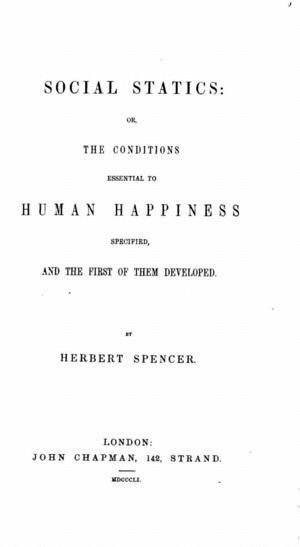
CHAPTER XVI.: the rights of women. - Herbert Spencer, Social Statics [1851]Edition used:Social Statics: or, The Conditions essential to Happiness specified, and the First of them Developed, (London: John Chapman, 1851).
About Liberty Fund:Liberty Fund, Inc. is a private, educational foundation established to encourage the study of the ideal of a society of free and responsible individuals. Copyright information:The text is in the public domain. Fair use statement:This material is put online to further the educational goals of Liberty Fund, Inc. Unless otherwise stated in the Copyright Information section above, this material may be used freely for educational and academic purposes. It may not be used in any way for profit.
CHAPTER XVI.the rights of women.§ 1.Equity knows no difference of sex. In its vocabulary the word man must be understood in a generic, and not in a specific sense. The law of equal freedom manifestly applies to the whole race—female as well as male. The same à priori reasoning which establishes that law for men (Chaps. III. and IV.), may be used with equal cogency on behalf of women. The Moral Sense, by virtue of which the masculine mind responds to that law, exists in the feminine mind as well. Hence the several rights deducible from that law must appertain equally to both sexes. This might have been thought a self-evident truth, needing only to be stated to meet with universal acceptation. There are many, however, who either tacitly, or in so many words, express their dissent from it. For what reasons they do so, does not appear. They admit the axiom, that human happiness is the Divine will; from which axiom, what we call rights are primarily derived. And why the differences of bodily organization, and those trifling mental variations which distinguish female from male, should exclude one half of the race from the benefits of this ordination, remains to be shown. The onus of proof lies on those who affirm that such is the fact; and it would be perfectly in order to assume that the law of equal freedom comprehends both sexes, until the contrary has been demonstrated. But without taking advantage of this, suppose we go at once into the controversy. Three positions only are open to us. It may be said that women have no rights at all—that their rights are not so great as those of men—or that they are equal to those of men. Whoever maintains the first of these dogmas, that women have no rights at all, must show that the Creator intended women to be wholly at the mercy of men—their happiness, their liberties, their lives, at men’s disposal; or, in other words, that they were meant to be treated as creatures of an inferior order. Few will have the hardihood to assert this. From the second proposition, that the rights of women are not so great as those of men, there immediately arise such queries as—If they are not so great, by how much are they less? What is the exact ratio between the legitimate claims of the two sexes? How shall we tell which rights are common to both, and where those of the male exceed those of the female? Who can show us a scale that will serve for the apportionment? Or, putting the question practically, it is required to determine by some logical method, whether the Turk is justified in plunging an offending Circassian into the Bosphorus? whether the rights of women were violated by that Athenian law, which allowed a citizen under certain circumstances to sell his daughter or sister? whether our own statute, which permits a man to beat his wife in moderation, and to imprison her in any room in his house, is morally defensible? whether it is equitable that a married woman should be incapable of holding property? whether a husband may justly take possession of his wife’s earnings against her will, as our law allows him to do?—and so forth. These, and a multitude of similar problems, present themselves for solution. Some principle rooted in the nature of things has to be found, by which they may be scientifically decided—decided, not on grounds of expediency, but in some definite, philosophical way. Does any one holding the doctrine that women’s rights are not so great as men’s, think he can find such a principle? If not, there remains no alternative but to take up the third position—that the rights of women are equal with those of men. § 2.Whoso urges the mental inferiority of women in bar of their claim to equal rights with men, may be met in various ways. In the first place, the alleged fact may be disputed. A defender of her sex might name many whose achievements in government, in science, in literature, and in art, have obtained no small share of renown. Powerful and sagacious queens the world has seen in plenty, from Zenobia, down to the empresses Catherine and Maria Theresa. In the exact sciences, Mrs. Somerville, Miss Herschel, and Miss Zornlin, have gained applause; in political economy, Miss Martineau; in general philosophy, Madame de Staël; in politics, Madame Roland. Poetry has its Tighes, its Hemanses, its Landons, its Brownings; the drama its Joanna Baillie; and fiction its Austens, Bremers, Gores, Dudevants, &c., without end. In sculpture, fame has been acquired by a princess; a picture like—The Momentons Question—is tolerable proof of female capacity for painting; and on the stage, it is certain that women are on a level with men, if they do not even bear away the palm. Joining to such facts the important consideration, that women have always been, and are still, placed at a disadvantage in every department of learning, thought, or skill—seeing that they are not admissible to the academies and universities in which men get their training; that the kind of life they have to look forward to, does not present so great a range of ambitions; that they are rarely exposed to that most powerful of all stimuli—necessity; that the education custom dictates for them is one that leaves uncultivated many of the higher faculties; and that the prejudice against blue-stockings, hitherto so prevalent amongst men, has greatly tended to deter women from the pursuit of literary honours;—adding these considerations to the above facts, we shall see good reason for thinking that the alleged inferiority of the feminine mind, is by no means self-evident. But, waiving this point, let us contend with the proposition on its own premises. Let it be granted that the intellect of woman is less profound than that of man—that she is more uniformly ruled by feeling, more impulsive, and less reflective, than man is—let all this be granted; and let us now see what basis such an admission affords to the doctrine, that the rights of women are not co-extensive with those of men.
Not only, however, does the theory thus fall to pieces under the mere process of inspection; it is absurd on the very face of it, when freed from the disguise of hackneyed phraseology. For what is it that we mean by rights? Nothing else than freedom to exercise the faculties. And what is the meaning of the assertion that woman is mentally inferior to man? Simply that her faculties are less powerful. What then does the dogma, that because woman is mentally inferior to man she has less extensive rights, amount to? Just this,—that because woman has weaker faculties than man, she ought not to have like liberty with him, to exercise the faculties she has! § 3.Belief always bears the impress of character—is, in fact, its product. Anthropomorphism sufficiently proves this. Men’s wishes eventually get expressed in their faiths—their real faiths, that is; not their nominal ones. Pull to pieces a man’s Theory of Things, and you will find it based upon facts collected at the suggestion of his desires. A fiery passion consumes all evidences opposed to its gratification, and fusing together those that serve its purpose, casts them into weapons by which to achieve its end. There is no deed so vicious but what the actor makes for himself an excuse to justify; and if the deed is often repeated, such excuse becomes a creed. The vilest transactions on record—Bartholomew massacres and the like—have had defenders; nay, have been inculcated as fulfilments of the Divine will. There is wisdom in the fable which represents the wolf as raising accusations against the lamb before devouring it. It is always thus amongst men. No invader ever raised standard, but persuaded himself that he had a just cause. Sacrifices and prayers have preceded every military expedition, from one of Cæsar’s campaigns, down to a border foray. God is on our side, is the universal cry. Each of two conflicting nations consecrates its flags; and whichever conquers sings a Te Deum. Attila conceived himself to have a—divine claim to the dominion of the earth:—the Spaniards subdued the Indians under plea of converting them to Christianity; hanging thirteen refractory ones in honour of Jesus Christ and his apostles: and we English justify our colonial aggressions by saying that the Creator intends the Anglo-Saxon race to people the world! An insatiate lust of conquest transmutes manslaying into a virtue; and, amongst more races than one, implacable revenge has made assassination a duty. A clever theft was praiseworthy amongst the Spartans; and it is equally so amongst Christians, provided it be on a sufficiently large scale. Piracy was heroism with Jason and his followers; was so also with the Norsemen; is so still with the Malays; and there is never wanting some golden fleece for a pretext. Amongst money-hunting people a man is commended in proportion to the number of hours he spends in business; in our day the rage for accumulation has apotheosized work; and even the miser is not without a code of morals by which to defend his parsimony. The ruling classes argue themselves into the belief that property should be represented rather than person—that the landed interest should preponderate. The pauper is thoroughly persuaded that he has a right to relief. The monks held printing to be an invention of the devil; and some of our modern sectaries regard their refractory brethren as under demoniacal possessiona . To the clergy nothing is more obvious than that a state-church is just, and essential to the maintenance of religion. The sinecurist thinks himself rightly indignant at any disregard of his vested interests. And so on throughout society. Perhaps the slave-owner’s assertion that negroes are not human beings, and the kindred dogma of the Mahometans, that women have no souls,b , are the strangest samples of convictions so formed. In these, as in the foregoing cases, selfishness finds out a satisfactory reason why it may do what it wills—collects and distorts, exaggerates and suppresses, so as ultimately to cheat itself into the desired conclusion. Does any one doubt that men can really believe things thus palpably opposed to the plainest facts? Does any one assert that those who profess opinions so manifestly absurd must be hypocrites? Let him beware. Let him consider whether selfishness has not deluded him into absurdities almost as gross. The laws of England, and the public opinion of England, countenance doctrines nearly as preposterous as these that look to us inconceivable; nay, the very same doctrines somewhat softened down. For what, when closely examined, is this notion that the rights of women are not equal with those of men? Simply an evanescent form of the theory that women have no souls. § 4.That a people’s condition may be judged by the treatment which women receive under it, is a remark that has become almost trite. The facts, of which this remark is a generalization, are abundant enough. Look where we will, we find that just as far as the law of the strongest regulates the relationships between man and man, does it regulate the relationships between man and woman. To the same extent that the triumph of might over right is seen in a nation’s political institutions, it is seen in its domestic ones. Despotism in the state is necessarily associated with despotism in the family. The two being alike moral in their origin, cannot fail to co-exist. Turkey, Egypt, India, China, Russia, the feudal states of Europe—it needs but to name these to suggest hosts of facts illustrative of such an accordance. Yet, strangely enough, almost all of us who let fall this observation, overlook its application to ourselves. Here we sit over our tea-tables, and pass criticisms upon national character, or philosophize upon the development of civilized institutions, quietly taking it for granted that we are civilized—that the state of things we live under is the right one, or thereabouts. Although the people of every past age have thought the like and have been uniformly mistaken, there are still many to whom it never occurs that we may be mistaken too. Amidst their strictures upon the ill-treatment of women in the East, and the unhealthy social arrangements implied by it, most persons do not see that the same connection between political and domestic oppression exists in this England of ours at the present hour, and that in as far as our laws and customs violate the rights of humanity by giving the richer classes power over the poorer, in so far do they similarly violate those rights by giving the stronger sex power over the weaker. Yet, looking at the matter spart from prejudice, and considering all institutions to be, as they are, products of the popular character, we cannot avoid confessing that such must be the ease. To the same extent that the old leaven of tyranny shows itself in the transactions of the senate, it will creep out in the doings of the household. If injustice sways men’s public acts, it will inevitably sway their private ones also. The mere fact, therefore, that oppression marks the relationships of out-door life, is ample proof that it exists in the relationships of the fireside. § 5.The desire to command is essentially a barbarous desire. Whether seen in the ukase of a Czar, or in the order of an Eton bully to his fag, it is alike significant of brutality. Command cannot be otherwise than savage, for it implies an appeal to force, should force be needful. Behind its—You shall,—there lies the scarcely hidden—If you won’t, I’ll make you.—Command is the growl of coercion crouching in ambush. Or we might aptly term it—violence in a latent state. All its accessories—its frown, its voice, its gestures, prove it akin to the ferocity of the uncivilized man. Command is the foe of peace, for it breeds war of words and feelings—sometimes of deeds. It is inconsistent with the first law of morality. It is radically wrong. All the barbarisms of the past have their types in the present. All the barbarisms of the past grew out of certain dispositions: those dispositions may be weakened, but they are not extinct; and so long as they exist there must be manifestations of them. What we commonly understand by command and obedience, are the modern forms of bygone despotism and slavery. Philosophically considered, they are indentical with these. Despotism may be defined as the making of another’s will bend to the fulfilment of our own: and its counterpart—slavery—as the having our own will subordinated to the will of another. True, we apply the terms only when the rule of one will over another is extreme—when the one wholly, or almost wholly extinguishes the other. But if the subjection of man to man is bad when carried to its full extent, it is bad in any degree. If every man has freedom to exercise his faculties within specified limits; and if, as we have seen (Chap. VIII.), slavery is wrong because it transgresses that freedom, and makes one man use his powers, to satisfy not his own wants, but the wants of another; then, whatsoever involves command, or whatsoever implies obedience, is wrong also; seeing that it too, necessitates the subserviency of one man’s actions to the gratifications of another.—You must do not as you will, but as I will,—is the basis of every mandate, whether used by a planter to his negro, or by a husband to his wife. Not satisfied with being sole ruler over his own doings, the petty autocrat oversteps the boundary dividing his sphere of action from his neighbour’s, and takes upon himself to direct his or her doings also. It matters not, in point of principle, whether such domination is entire or partial. To whatever extent the will of the one is overborne by the will of the other, to that extent the parties are tyrant and slave. There are, without doubt, many who will rebel against this doctrine. There are many who hold that the obedience of one human being to another is proper, virtuous, praiseworthy. There are many to whose moral sense command is not repugnant. There are many who think the subjection of the weaker sex to the stronger legitimate and beneficial. Let them not be deceived. Let them remember that a nation’s institutions and beliefs are determined by its character. Let them remember that men’s perceptions are warped by their passions. Let them remember that our social state proves our superior feelings to be very imperfectly developed. And let them remember that, as many customs deemed right by our ancestors, appear detestable to us, so, many customs which we think proper, our more civilized descendants may regard with aversion—even as we loathe those barbarian manners which forbid a woman to sit at table with her lord and master, so may mankind one day loathe that subserviency of wife to husband, which existing laws enjoin. As elsewhere shown (page 29), moral sense becomes a trustworthy guide only when it has logic for an interpreter. Nothing but its primary intuition is authoritative. From the fundamental law to which it gives utterance, reason has to deduce the consequences; and from these, when correctly drawn, there is no appeal. It proves nothing, therefore, that there are some who do not feel command to be improper. It is for such to inquire whether command is or is not consistent with that first principle expressive of the Divine will—that axiom to which the Moral Sense responds. And they will find that, thus judged by the law of equal freedom, command is at once pronounced wrong; for whoso commands, manifestly claims more freedom than whoso is commanded. § 6.A future belief that subordination of sex is inequitable, is clearly prophesied by the change civilization is working in men’s sentiments. The arbitrary rule of one human being over another, no matter in what form it may appear, is fast getting recognised as essentially rude and brutal. In our day, the man of refined feeling does not like to play the despot over his fellow. He is disgusted if one in humble circumstances cringes to him. So far from wishing to elevate himself by depressing his poor and ignorant neighbours, he strives to put them at their ease in his presence—encourages them to behave in a less submissive and more self-respecting manner. He feels that a fellow-man may be enslaved by imperious words and manners as well as by tyrannical deeds; and hence he avoids a dictatorial style of speech to those below him. Even paid domestics, to whose services he has obtained a right by contract, he does not like to address in a tone of authority. He seeks rather to disguise his character of master: to this end wraps up his commands in the shape of requests; and continually employs the phrases,—If you please,—and—Thank you.— In the conduct of the modern gentleman to his friend, we have additional signs of this growing respect for another’s dignity. Every one must have observed the carefulness with which those who are on terms of affectionate intimacy, shun anything in the form of supremacy on either side, or endeavour to banish from remembrance, by their behaviour to each other, whatever of supremacy there may exist. Who is there that has not witnessed the dilemma in which the wealthier of two such is sometimes placed, between the wish to confer a benefit on the other, and the fear that in so doing he may offend by assuming the attitude of a patron? And who is there that does not feel how destructive it would be of the sentiment subsisting between himself and his friend, were he to play the master over his friend, or his friend to play the master over him? A further increase of this same refinement will show men that there is a fatal incongruity between the matrimonial servitude which our law recognises, and the relationship that ought to exist between husband and wife. Surely if he who possesses any generosity of nature dislikes speaking to a hired domestic in a tone of authority—if he cannot bear assuming towards his friend the behaviour of a superior—how utterly repugnant to him should it be, to make himself ruler over one on whose behalf all his kindly sentiments are specially enlisted; one to whom he is bound by the strongest attachment that his nature is capable of; and for whose rights and dignity he ought to have the most active sympathy! § 7.Command is a blight to the affections. Whatsoever of refinement—whatsoever of beauty—whatsoever of poetry, there is in the passion that unites the sexes, withers up and dies in the cold atmosphere of authority. Native as they are to such widely-separated regions of our nature, Love and Coercion cannot possibly flourish together. The one grows out of our best feelings: the other has its root in our worst. Love is sympathetic: Coercion is callous. Love is gentle: Coercion is harsh. Love is self-sacrificing: Coercion is selfish. How then can they co-exist? It is the property of the first to attract; whilst it is that of the last to repel: and, conflicting as they thus do, it is the constant tendency of each to destroy the other. Let whoever thinks the two compatible imagine himself acting the master over his betrothed. Does he believe that he could do this without any injury to the subsisting relationship? Does he not know rather that a bad effect would be produced upon the feelings of both parties by the assumption of such an attitude? And confessing this, as he must, is he superstitious enough to suppose that the going through a form of words will render harmless that use of command which was previously hurtful? Of all the causes which conspire to produce the disappointment of those glowing hopes with which married life is usually entered upon, none is so potent as this supremacy of sex—this degradation of what should be a free and equal relationship into one of ruler and subject—this supplanting of the sway of affection by the sway of authority. Only as that condition of slavery to which women are condemned amongst barbarous nations is ameliorated, does ideal love become possible; and only when that condition of slavery shall have been wholly abolished, will ideal love attain fulness and permanence. The facts around us plainly indicate this. Where-ever anything worth calling connubial happiness at present exists, we shall find that the subjugation of wife to husband is not enforced; though perhaps still held in theory, it is practically repudiated. § 8.There are many who think that authority, and its ally compulsion, are the sole agencies by which human beings can be controlled. Anarchy or government are, with them, the only conceivable alternatives. Believing in nothing but what they see, they cannot realize the possibility of a condition of things in which peace and order shall be maintained without force, or the fear of force. By such as these, the doctrine that the reign of man over woman is wrong, will no doubt be combated on the ground that the domestic relationship can only exist by the help of such supremacy. The impracticability of an equality of rights between the sexes will be urged by them in disproof of its rectitude. It will be argued, that were they put upon a level husband and wife would be for ever in antagonism—that as, when their wishes clashed, each would possess a like claim to have his or her way, the matrimonial bond would daily be endangered by the jar of opposing wills, and that, involving as it would a perpetual conflict, such an arrangement of married life must necessarily be an erroneous one. A very superficial conclusion this. It has been already pointed out (p. 37), that there must be an inconsistency between the perfect law and an imperfect state. The worse the condition of society, the more visionary must a true code of morality appear. The fact that any proposed principle of conduct is at once fully practicable—requires no reformation of human nature for its complete realization—is not a proof of its truth: is proof rather of its error. And, conversely, a certain degree of incongruity between such a principle and humanity as we know it, though no proof of the correctness of that principle, is at any rate a fact in its favour. Hence the allegation that mankind are not good enough to admit of the sexes living together harmoniously under the law of equal freedom, in no way militates against the validity or sacredness of that law. But the never-ceasing process of adaptation will gradually remove this obstacle to domestic rectitude. Recognition of the moral law, and an impulse to act up to it, going hand in hand, as we have seen that they must do (p. 26), equality of rights in the married state will become possible as fast as there arises a perception of its justness. That selfish conflict of claims which, according to the foregoing objection, would reduce a union, founded on the law of equal freedom, to a condition of anarchy, presupposes a deficiency in those feelings with which a belief in the law of equal freedom originates, and would decrease with the growth of those feelings. As elsewhere shown (p. 97), the same sentiment which leads us to maintain our own rights, leads us, by its sympathetic excitement, to respect the rights of our neighbours. Other things equal, the sense of justice to ourselves, and the sense of justice to our fellow-creatures, bear a constant ratio to each other. A state in which every one is jealous of his natural claims, is not therefore a litigious state, because it is one in which there is of necessity a diminished tendency to aggression. Experience proves this. For, as it cannot be denied that there is now a greater disposition amongst men towards the assertion of individual liberty than existed during the feudal ages, so neither can it be denied that there is now a less disposition amongst men to trespass against each other than was then exhibited. The two changes are co-ordinate, and must continue to be so. Hence, whenever society shall have become civilized enough to recognise the equality of rights between the sexes—when women shall have attained to a clear perception of what is due to them, and men to a nobility of feeling which shall make them concede to women the freedom which they themselves claim—humanity will have undergone such a modification as to render an equality of rights practicable. Married life under this ultimate state of things will not be characterised by perpetual squabbles, but by mutual concessions. Instead of a desire on the part of the husband to assert his claims to the uttermost, regardless of those of his wife, or on the part of the wife to do the like, there will be a watchful desire on both sides not to transgress. Neither will have to stand on the defensive, because each will be solicitous for the rights of the other. Not encroachment, but self-sacrifice, will be the ruling principle. The struggle will not be which shall gain the mastery, but which shall give way. Committing a trespass will be the thing feared, and not the being trespassed against. And thus, instead of domestic discord, will come a higher harmony than any we yet know. There is nothing Utopian in this. We may already trace the beginnings of it. An attitude like that described is not uncommonly maintained in the dealings of honourable men with each other; and if so, why should it not exist between the sexes? Here and there, indeed, may be found, even now, a wedded pair who preserve such a relationship. And what is at present the exception may one day be the rule. § 9.The extension of the law of equal freedom to both sexes will doubtless be objected to, on the ground that the political privileges exercised by men must thereby be ceded to women also. Of course they must; and why not? Is it that women are ignorant of state affairs? Why then their opinions would be those of their husbands and brothers; and the practical effect would be merely that of giving each male elector two votes instead of one. Is it that they might by-and-by become better informed, and might then begin to act independently? Why, in such case, they would be pretty much as competent to use their power with intelligence as the members of our present constituencies. We are told, however, that—woman’s mission—is a domestic one—that her character and position do not admit of her taking a part in the decision of public questions—that politics are beyond her sphere. But this raises the question—Who shall say what her sphere is? Amongst the Pawnees and Sioux it is that of a beast of burden; she has to carry the baggage, to drag home fuel from the woods, and to do everything that is menial and laborious. In slave-countries it is within woman’s sphere to work side by side with men, under the lash of the taskmaster. Clerkships, cashierships, and other responsible business situations, are comprised in her sphere in modern France. Whilst, on the other hand, the sphere of a Turkish or Egyptian lady extends scarcely an inch beyond the walls of the harem. Who now will tell us what woman’s sphere really is? As the usages of mankind vary so much, let us hear how it is to be shown that the sphere we assign her is the true one—that the limits we have set to female activity are just the proper limits. Let us hear why on this one point of our social polity we are exactly right, whilst we are wrong on so many others. It is indeed said, that the exercise of political power by women is repugnant to our sense of propriety—conflicts with our ideas of the feminine character—is altogether condemned by our feelings. Granted; but what then? The same plea has been urged in defence of a thousand absurdities, and if valid in one case is equally so in all others. Should a traveller in the East inquire of a Turk why women in his country conceal their faces, he would be told that for them to go unveiled would be considered indecent; would offend the feelings of the spectators. In Russia female voices are never heard in church: women not being thought worthy—to sing the praises of God in the presence of men;—and the disregard of this regulation would be censured as an outrage upon public feeling. There was a time in France when men were so enamoured of ignorance, that a lady who pronounced any but the commonest words correctly, was blushed for by her companions; a tolerable proof that people’s feelings then blamed in a woman that literateness which it is now thought a disgrace for her to be without. In China cramped feet are essential to female refinement; and so strong is the feeling in this matter, that a Chinese will not believe that an Englishwoman who walks naturally, can be one of a superior class. It was once held unfeminine for a lady to write a book; and no doubt those who thought it so, would have quoted feelings in support of their opinion. Yet, with facts like these on every hand, people assume that the enfranchisement of women cannot be right, because it is repugnant to their feelings! We have some feelings that are necessary and eternal; we have others that, being the results of custom, are changeable and evanescent. And there is no way of distinguishing those feelings which are natural from those which are conventional, except by an appeal to first principles. If a sentiment responds to some necessity of our condition, its dictates must be respected. If otherwise—if opposed to a necessity, instead of in harmony with one, we must regard that sentiment as the product of circumstances, of education, of habit, and consequently without weight. However much, therefore, the giving of political power to women may disagree with our notions of propriety, we must conclude that, being required by that first pre-requisite to greatest happiness—the law of equal freedom—such a concession is unquestionably right and good. § 10.Thus it has been shown that the rights of women must stand or fall with those of men; derived as they are from the same authority; involved in the same axiom; demonstrated by the same argument. That the law of equal freedom applies alike to both sexes, has been further proved by the fact that any other hypothesis involves us in inextricable difficulties. The idea that the rights of women are not equal to those of men, has been condemned as akin to the Eastern dogma, that women have no souls. It has been argued that the position at present held by the weaker sex is of necessity a wrong one, seeing that the same selfishness which vitiates our political institutions, must inevitably vitiate our domestic ones also. Subordination of females to males has been also repudiated, because it implies the use of command, and thereby reveals its descent from barbarism. Proof has been given that the attitudes of mastery on the one side, and submission on the other, are essentially at variance with that refined sentiment which should subsist between husband and wife. The argument that married life would be impracticable under any other arrangement, has been met by pointing out how the relationship of equality must become possible as fast as its justness is recognised. And lastly, it has been shown that the objections commonly raised against giving political power to women, are founded on notions and prejudices that will not bear examination. [a]Speech of Mr. Garland, one of the Conference Methodists. [b]Though Washington Irving has pointed out that the Koran does not teach this, he has not shown that Mahomet’s followers do not hold it. Most likely the Mahometan faith has undergone corruptions similar to those suffered by Christianity. |

Titles (by Subject)