|
|
Front Page Titles (by Subject) CHARLES THE FIRST. FRAGMENTS. - Posthumous Poems
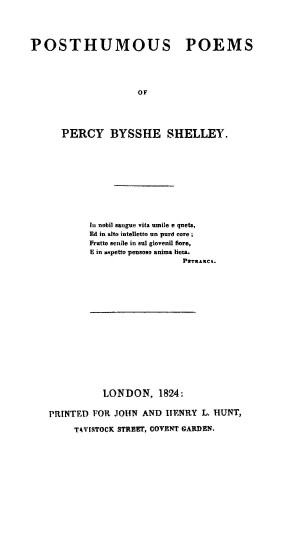
CHARLES THE FIRST. FRAGMENTS. - Percy Bysshe Shelley, Posthumous Poems [1824]Edition used:Posthumous Poems (London: John and Henry L. Hunt, 1824).
About Liberty Fund:Liberty Fund, Inc. is a private, educational foundation established to encourage the study of the ideal of a society of free and responsible individuals. Copyright information:The text is in the public domain.
Fair use statement:
This material is put online to further the educational goals of Liberty Fund, Inc. Unless otherwise stated in the Copyright Information section above, this material may be used freely for educational and academic purposes. It may not be used in any way for profit.
CHARLES THE FIRST.
FRAGMENTS.
ACT I. SCENE I.
The Pageant to [celebrate] the arrival of the Queen.
a pursuivant.- Place, for the Marshal of the Masque!
first speaker.- What thinkest thou of this quaint masque, which turns,
- Like morning from the shadow of the night,
- The night to day, and London to a place
- Of peace and joy?
second speaker.- And Hell to Heaven.
- Eight years are gone,
- And they seem hours, since in this populous street
- I trod on grass made green by summer’s rain,
- For the red plague kept state within that palace
- Where now reigns vanity—in nine years more
- The roots will be refreshed with civil blood;
- And thank the mercy of insulted Heaven
- That sin and wrongs wound as an orphan’s cry,
- The patience of the great avenger’s ear.
third speaker.(a youth).- Yet, father, tis a happy sight to see,
- Beautiful, innocent, and unforbidden
- By God or man;—’tis like the bright procession
- Of skiey visions in a solemn dream
- From which men wake as from a paradise,
- And draw new strength to tread the thorns of life.
- If God be good, wherefore should this be evil?
- And if this be not evil, dost thou not draw
- Unseasonable poison from the flowers
- Which bloom so rarely in this barren world?
- O, kill these bitter thoughts which make the present
- Dark as the future!—
- * * * * * * *
- When avarice and tyranny, vigilant fear,
- And open-eyed conspiracy lie sleeping
- As on Hell’s threshold; and all gentle thoughts
- Waken to worship him who giveth joys
- With his own gift.
second speaker.- How young art thou in this old age of time!
- How green in this grey world! Canst thou not think
- Of change in that low scene, in which thou art
- Not a spectator but an actor? []
- The day that dawns in fire will die in storms,
- Even though the noon be calm. My travel’s done;
- Before the whirlwind wakes I shall have found
- My inn of lasting rest, but thou must still
- Be journeying on in this inclement air.
- * * * * * * *
first speaker.
second speaker.- Rather say the Pope.
- London will be soon his Rome: he walks
- As if he trod upon the heads of men.
- He looks elate, drunken with blood and gold;—
- Beside him moves the Babylonian woman
- Invisibly, and with her as with his shadow,
- Mitred adulterer! he is joined in sin,
- Which turns Heaven’s milk of mercy to revenge.
another citizen(lifting up his eyes).- Good Lord! rain it down upon him. [[ ]]
- Amid her ladies walks the papist queen,
- As if her nice feet scorned our English earth.
- There’s old Sir Henry Vane, the Earl of Pembroke,
- Lord Essex, and Lord Keeper Coventry,
- And others who make base their English breed
- By vile participation of their honours
- With papists, atheists, tyrants, and apostates.
- When lawyers mask ’tis time for honest men
- To strip the vizor from their purposes.
- * * * * * * *
fourth speaker(a pursuirant)- Give place, give place!—
- You torch-bearers advance to the great gate,
- And then attend the Marshal of the Masque
- Into the Royal presence.
fifth speaker(a law student).- What thinkest thou
- Of this quaint show of ours, my aged friend?
first speaker.- I will not think but that our country’s wounds
- May yet be healed—The king is just and gracious,
- Though wicked counsels now pervert his will:
- These once cast off—
second speaker.- As adders cast their skins
- And keep their venom, so kings often change;
- Councils and counsellors hang on one another,
- Hiding the loathsome []
- Like the base patchwork of a leper’s rags.
third speaker.- O, still those dissonant thoughts—List! loud music
- Grows on the enchanted air! And see, the torches
- Restlessly flashing, and the crowd divided
- Like waves before an Admiral’s prow.
- * * * * * *
another speaker.- Give place—
- To the Marshal of the Masque!
third speaker.- How glorious! See those thronging chariots
- Rolling like painted clouds before the wind:
- Some are
- Like curved shells dyed by the azure depths
- Of Indian seas; some like the new-born moon;
- And some like cars in which the Romans climbed
- (Canopied by Victory’s eagle wings outspread)
- The Capitolian—See how gloriously
- The mettled horses in the torchlight stir
- Their gallant riders, while they check their pride,
- Like shapes of some diviner element!
second speaker.- Aye, there they are—
- Nobles, and sons of nobles, patentees,
- Monopolists, and stewards of this poor farm,
- On whose lean sheep sit the prophetic crows.
- Here is the pomp that strips the houseless orphan,
- Here is the pride that breaks the desolate heart.
- These are the lilies glorious as Solomon,
- Who toil not, neither do they spin,—unless
- It be the webs they catch poor rogues withal.
- Here is the surfeit which to them who earn
- The niggard wages of the earth, scarce leaves
- The tithe that will support them till they crawl
- Back to its cold hard bosom. Here is health
- Followed by grim disease, glory by shame,
- Waste by lame famine, wealth by squalid want,
- And England’s sin by England’s punishment.
- And, as the effect pursues the cause foregone,
- Lo, giving substance to my words, behold
- At once the sign and the thing signified—
- A troop of cripples, beggars, and lean outcasts,
- Horsed upon stumbling shapes, carted with dung,
- Dragged for a day from cellars and low cabins
- And rotten hiding-holes to point the moral
- Of this presentiment, and bring up the rear
- Of painted pomp with misery!
speaker.- ’Tis but
- The anti-masque, and serves as discords do
- In sweetest music. Who would love May flowers
- If they succeeded not to Winter’s flaw;
- Or day unchanged by night; or joy itself
- Without the touch of sorrow?
- * * * * * *
SCENE II.
A Chamber in Whitehall.
Enter theKing, Queen, Laud, Wentworth,andArchy.
king.- Thanks, gentlemen, I heartily accept
- This token of your service: your gay masque
- Was performed gallantly.
queen.- And, gentlemen,
- Call your poor Queen your debtor. Your quaint pageant
- Rose on me like the figures of past years,
- Treading their still path back to infancy,
- More beautiful and mild as they draw nearer
- The quiet cradle. I could have almost wept
- To think I was in Paris, where these shows
- Are well devised—such as I was ere yet
- My young heart shared with [[ ]] the task,
- The careful weight of this great monarchy.
- There, gentlemen, between the sovereign’s pleasure
- And that which it regards, no clamour lifts
- Its proud interposition.
- * * * * * *
king.
archy.
laud.- I crave permission of your Majesty
- To order that this insolent fellow be
- Chastised, he mocks the sacred character,
- Scoffs at the stake, and—
king.- What, my Archy!
- He mocks and mimics all he sees and hears,
- Yet with a quaint and graceful license—Prithee
- For this once do not as Prynne would, were he
- Primate of England.
- He lives in his own world; and, like a parrot,
- Hung in his gilded prison from the window
- Of a queen’s bower over the public way,
- Blasphemes with a bird’s mind:—his words, like arrows
- Which know no aim beyond the archer’s wit,
- Strike sometimes what eludes philosophy.
queen.- Go, sirrah, and repent of your offence
- Ten minutes in the rain: be it your penance
- To bring news how the world goes there. Poor Archy!
- He weaves about himself a world of mirth
- Out of this wreck of ours.
laud.- I take with patience, as my master did,
- All scoffs permitted from above.
king.- My Lord,
- Pray overlook these papers. Archy’s words
- Had wings, but these have talons.
queen.- And the lion
- That wears them must be tamed. My dearest lord,
- I see the new-born courage in your eye
- Armed to strike dead the spirit of the time.
- * * * * *
- Do thou persist: for, faint but in resolve,
- And it were better thou hadst still remained
- The slave of thine own slaves, who tear like curs
- The fugitive, and flee from the pursuer;
- And Opportunity, that empty wolf,
- Flies at his throat who falls. Subdue thy actions
- Even to the disposition of thy purpose,
- And be that tempered as the Ebro’s steel;
- And banish weak-eyed Mercy to the weak
- Whence she will greet thee with a gift of peace,
- And not betray thee with a traitor’s kiss,
- As when she keeps the company of rebels,
- Who think that she is fear. This do, lest we
- Should fall as from a glorious pinnacle
- In a bright dream, and wake as from a dream
- Out of our worshipped state.
- * * * * *
laud.- * * And if this suffice not,
- Unleash the sword and fire, that in their thirst
- They may lick up that scum of schismatics.
- I laugh at those weak rebels who, desiring
- What we possess, still prate of christian peace,
- As if those dreadful messengers of wrath,
- Which play the part of God ’twixt right and wrong,
- Should be let loose against innocent sleep
- Of templed cities and the smiling fields,
- For some poor argument of policy
- Which touches our own profit or our pride,
- Where it indeed were christian charity
- To turn the cheek even to the smiter’s hand:
- And when our great Redeemer, when our God
- Is scorned in his immediate ministers,
- They talk of peace!
- Such peace as Canaan found, let Scotland now.
- * * * * *
queen.- My beloved lord,
- Have you not noted that the fool of late
- Has lost his careless mirth, and that his words
- Sound like the echoes of our saddest fears?
- What can it mean? I should be loth to think
- Some factious slave had tutored him.
king.- It partly is,
- That our minds piece the vacant intervals
- Of his wild words with their own fashioning;
- As in the imagery of summer clouds,
- Or coals in the winter fire, idlers find
- The perfect shadows of their teeming thoughts:
- And partly, that the terrors of the time
- Are sown by wandering Rumour in all spirits;
- And in the lightest and the least, may best
- Be seen the current of the coming wind.
queen.- Your brain is overwrought with these deep thoughts;
- Come, I will sing to you; let us go try
- These airs from Italy,—and you shall see
- A cradled miniature of yourself asleep,
- Stamped on the heart by never-erring love;
- Liker than any Vandyke ever made,
- A pattern to the unborn age of thee,
- Over whose sweet beauty I have wept for joy
- A thousand times, and now should weep for sorrow,
- Did I not think that after we were dead
- Our fortunes would spring high in him, and that
- The cares we waste upon our heavy crown
- Would make it light and glorious as a wreath
- Of heaven’s beams for his dear innocent brow.
king.
SCENE III.
Hamiden, Pym, Cromwell,and the youngerVane.
hampden.- England, farewell! thou, who hast been my cradle,
- Shalt never be my dungeon or my grave!
- I held what I inherited in thee,
- As pawn for that inheritance of freedom
- Which thou hast sold for thy despoiler’s smile:—
- How can I call thee England, or my country?
- Does the wind hold?
vane.- The vanes sit steady
- Upon the Abbey towers. The silver lightnings
- Of the evening star, spite of the city’s smoke,
- Tell that the north wind reigns in the upper air.
- Mark too that flock of fleecy winged clouds
- Sailing athwart St. Margaret’s.
hampden.- Hail, fleet herald
- Of tempest! that wild pilot who shall guide
- Hearts free as his, to realms as pure as thee,
- Beyond the shot of tyranny! And thou,
- Fair star, whose beam lies on the wide Atlantic,
- Athwart its zones of tempest and of calm,
- Bright as the path to a beloved home,
- O light us to the isles of th’ evening land!
- Like floating Edens, cradled in the glimmer
- Of sunset, through the distant mist of years
- Tinged by departing Hope, they gleam! Lone regions,
- Where power’s poor dupes and victims, yet have never
- Propitiated the savage fear of kings
- With purest blood of noblest hearts; whose dew
- Is yet unstained with tears of those who wake
- To weep each day the wrongs on which it dawns;
- Whose sacred silent air owns yet no echo
- Of formal blasphemies; nor impious rites
- Wrest man’s free worship from the God who loves
- Towards the worm, who envies us his love,
- Receive thou young [[ ]] of Paradise,
- These exiles from the old and sinful world!
- This glorious clime, this firmament, whose lights
- Dart mitigated influence through the veil
- Of pale blue atmosphere; whose tears keep green
- The pavement of this moist all-feeding earth,
- This vaporous horizon; whose dim round
- Is bastioned by the circumfluous sea,
- Repelling invasion from the sacred towers,
- Presses upon me like a dungeon’s grate,
- A low dark roof, a damp and narrow vault:
- The mighty universe becomes a cell
- Too narrow for the soul that owns no master.
- While the loathliest spot
- Of this wide prison, England, is a nest
- Of cradled peace built on the mountain tops,
- To which the eagle-spirits of the free,
- Which range through heaven and earth, and scorn the storm
- Of time, and gaze upon the light of truth,
- Return to brood over the [[ ]] thoughts
- That cannot die, and may not be repelled.
- * * * * *
|