Econlib

The Library

Other Sites

Front Page arrow Titles (by Subject) arrow 1.: EXCHANGEABLE VALUE [1] TRAVELLER, 6 DEC., 1822, P. 3 - The Collected Works of John Stuart Mill, Volume XXII - Newspaper Writings December 1822 - July 1831 Part I

Return to Title Page for The Collected Works of John Stuart Mill, Volume XXII - Newspaper Writings December 1822 - July 1831 Part I

Search this Title:

Also in the Library:

Subject Area: Political Theory
Collection: The Collected Works of John Stuart Mill

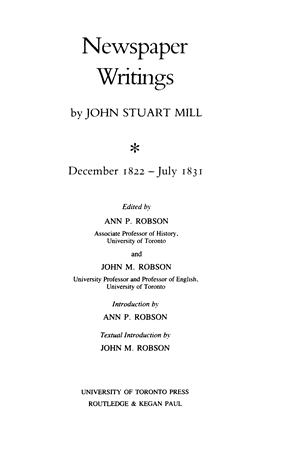
1.: EXCHANGEABLE VALUE [1] TRAVELLER, 6 DEC., 1822, P. 3 - John Stuart Mill, The Collected Works of John Stuart Mill, Volume XXII - Newspaper Writings December 1822 - July 1831 Part I [1822]

Edition used:

The Collected Works of John Stuart Mill, Volume XXII - Newspaper Writings December 1822 - July 1831 Part I, ed. Ann P. Robson and John M. Robson, Introduction by Ann P. Robson and John M. Robson (Toronto: University of Toronto Press, London: Routledge and Kegan Paul, 1986).

Part of: Collected Works of John Stuart Mill, in 33 vols.

About Liberty Fund:

Liberty Fund, Inc. is a private, educational foundation established to encourage the study of the ideal of a society of free and responsible individuals.


1.

EXCHANGEABLE VALUE [1]

TRAVELLER, 6 DEC., 1822, P. 3

This and the next letter, Mill’s first published writings, were occasioned by “Political Economy Club,” Traveller, 2 Dec., p. 3, by Robert Torrens (1780-1864), co-proprietor of the newspaper and a founding member of the Political Economy Club; the subject of Torrens’s article was the meeting of that Club to be held later that day. Mill’s reply brought forth a retort from Torrens in “Exchangeable Value,” Traveller, 7 Dec., p. 3, and the series terminated with a note by Torrens appended to Mill’s second letter. The exchange centred on the theory of value advanced in Elements of Political Economy (London: Baldwin, et al., 1821) by James Mill (1773-1836), J.S. Mill’s father; in his Autobiography Mill says his reply to Torrens was at his father’s “instigation” (CW, Vol. I, p. 89). Headed as title, with the subhead “To the Editor of the Traveller,” the items are described in Mill’s bibliography as “Two letters in the Traveller of [6th Dec.] and [13th Dec.] 1822 containing a controversy with Col. Torrens on the question whether value depends on quantity of labour. Signed S.”

(MacMinn, p. 1.)

sir,

In your notice of the late Meeting of the Political Economy Club, you have inserted a disquisition, which professes to be a refutation of Mr. Mill’s theory of value. I take the liberty of submitting to you several remarks which occurred to me on reading your article.

In the first place, if I rightly understand Mr. Mill’s chapter on Exchangeable Value,1 he cannot be said with propriety to have any theory of value—at least, in that sense in which the word theory is applied to Mr. Ricardo’s doctrines on this subject. Mr. R. renders the word value, as synonymous with productive cost2 —thus introducing a new, and as it appears to me, a needless ambiguity of language. Mr. Mill, on the other hand, never uses the word value in any other than its vulgar acceptation. I am not aware that there is any passage in the Elements of Political Economy, in which the words power of purchasing may not be substituted for the word value, without in any degree affecting the truth of Mr. Mill’s positions.

But though the word value is never employed by Mr. Mill, in any other sense than purchasing power, it is nevertheless true that he endeavours to ascertain what are the circumstances which regulate the purchasing power of commodities.3 He agrees with the distinguished political economist whom we have cited, in considering the regulating circumstance to be cost of production. This cost he considers as resolvable into quantity of labour, and it is to this part of his doctrine that your strictures refer. As your arguments on this subject do not appear to me to be conclusive, I beg leave to offer my objections to their validity.

You say, “Let the rate of profit be 20 per cent.; let a manufacturer in silver and a manufacturer in iron each advance a capital of a thousand pounds, and let the advance of the former consist of ninety days’ hoarded labour, in the form of material, and ten days’ hoarded labour in the form of subsistence, while the advance of the latter consists of ten days’ hoarded labour in the form of material, and ninety in the form of subsistence.” [P. 3.]

You observe that the manufacturer in silver, with ten days’ labour of subsistence, must employ twelve days of immediate labour, in order to realize a profit of 20 per cent.; and that the manufacturer in iron, with his 90 days’ labour of subsistence, will employ 108 days of immediate labour: that therefore the silver goods, when completed, will be the produce of twelve days of immediate labour, and 90 of hoarded labour, in the form of material; while the iron goods will be the produce of 108 days of immediate labour, and 120 of hoarded labour, also in the form of material; forming the two different sums total of 102 and 118 days’ labour.

This being the case, you assert that the silver and the iron goods will exchange for one another. To this I cannot assent. You appear to have forgotten, that if profits are taken into the account at all, we must suppose the two manufacturers to make a profit, not merely on that portion of their capital which they expend in maintaining labour, but also on that portion which they expend in furnishing the raw material. By supposition, the capital of each producer consisted of one hundred days’ labour. You assert that when the production is completed, the silver manufacturer has only the produce of 102 days’ labour, while the iron manufacturer has the produce of 118 days’ labour, in remuneration for their capital. The former then has only a profit of 2 per cent. on his whole capital, the latter has a profit of 18 per cent. on the whole. It is evident that, under these circumstances, the two commodities will not exchange for one another: their values will be in the proportion of 102 to 118—that is, of the quantities of labour by which they were produced. This, at least, will be the case, if profits are to be considered as forming one ingredient in cost of production, the position on which your whole argument is founded.

If profits are equal in the two cases, as the principle of competition will render them, it is unnecessary to take them into the calculation of exchangeable value, which is, by the force of the term, not something absolute, but something relative. If the whole produce of the one capital exchanges for the whole produce of the other, those parts of them which remain when profits are deducted, will also exchange for one another. But if we exclude profits, your objection falls to the ground. Mr. Mill’s argument must, therefore, be considered as resting on the same foundation as before.

You have also started an objection against another of Mr. Mill’s arguments. The value of commodities (says Mr. M.) cannot depend upon capital, since capital is commodities, and if the value of commodities depends on the value of capital, it depends on the value of commodities—that is, on itself.4 You observe, that this argument cuts both ways. If the value of commodities depends upon labour, as the value of labour can only be estimated in commodities, this (say you) is to assert that the value of labour depends on the value of labour. This would be true if Mr. M. had asserted that the value of commodities depends on the value of labour. But he says, that it depends, not on the value but on the quantity of labour:5 there is here no inconsistency. The value of commodities depends upon the quantity of labour employed in producing them. The value of labour, which is not itself produced by labour, cannot be subject to the same laws. Mr. M. in his Chapter on Wages, has expounded the laws which regulate the value of labour.6

S.

[1 ]Elements, Chap. iii, Sect. 2, pp. 69-74.

[2 ]David Ricardo, On the Principles of Political Economy and Taxation (London: Murray, 1817), Chap. i, “On Value,” esp. pp. 19-21. Ricardo (1772-1823), the great economist, M.P. for Portarlington, was a close friend of James Mill, and, like him, a member of the Political Economy Club.

[3 ]Elements, Chap. iii, Sect. 7, pp. 95-8.

[4 ]Ibid., Chap. iii, Sect. 2, pp. 70-1, 74.

[5 ]Ibid., p. 73.

[6 ]Ibid., Chap. ii, Sect. 2, pp. 24-53.