EconlibThe LibraryOther Sites |
Front Page Titles (by Subject) The Collected Works of Frédéric Bastiat - Collected Works of Bastiat. Vol. 2: The Law, The State, and Other Political Writings, 1843-1850
Return to Title Page for Collected Works of Bastiat. Vol. 2: The Law, The State, and Other Political Writings, 1843-1850The Online Library of LibertyA project of Liberty Fund, Inc.Search this Title:Also in the Library:
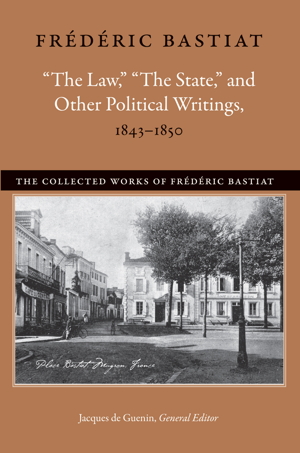
The Collected Works of Frédéric Bastiat - Frédéric Bastiat, Collected Works of Bastiat. Vol. 2: The Law, The State, and Other Political Writings, 1843-1850 [2012]Edition used:The Collected Works of Frédéric Bastiat. Vol. 2: The Law, The State, and Other Political Writings, 1843-1850, Jacques de Guenin, General Editor. Translated from the French by Jane Willems and Michel Willems, with an introduction by Pascal Salin. Annotations and Glossaries by Jacques de Guenin, Jean-Claude Paul-Dejean, and David M. Hart. Translation Editor Dennis O’Keeffe. Academic Editor, David M. Hart (Indianapolis: Liberty Fund, 2012).
Part of: The Collected Works of Frédéric Bastiat, in 6 Vols.About Liberty Fund:Liberty Fund, Inc. is a private, educational foundation established to encourage the study of the ideal of a society of free and responsible individuals. Copyright information:The copyright to this edition, in both print and electronic forms, is held by Liberty Fund, Inc. Fair use statement:This material is put online to further the educational goals of Liberty Fund, Inc. Unless otherwise stated in the Copyright Information section above, this material may be used freely for educational and academic purposes. It may not be used in any way for profit.
The Collected Works of Frédéric BastiatJacques de Guenin, General Editor The Man and the Statesman: The Correspondence and Articles on Politics “The Law,” “The State,” and Other Political Writings, 1843–1850 Economic Sophisms and “What Is Seen and What Is Not Seen” Miscellaneous Works on Economics: From “Jacques-Bonhomme” to Le Journal des Économistes Economic Harmonies The Struggle Against Protectionism: The English and French Free-Trade Movements ![]() Frédéric Bastiat General Editor’s NoteAlthough the Guillaumin edition was generally chronological, the volumes in this series have been arranged thematically: The Man and the Statesman: The Correspondence and Articles on Politics “The Law,” “The State,” and Other Political Writings, 1843–1850 Economic Sophisms and “What Is Seen and What Is Not Seen” Miscellaneous Works on Economics: From “Jacques-Bonhomme” to Le Journal des Économistes Economic Harmonies The Struggle Against Protectionism: The English and French Free-Trade Movements There are four kinds of notes in this volume: footnotes by the editor of the Guillaumin edition (Prosper Paillottet), which are preceded by “(Paillottet’s note)”; footnotes by Bastiat, which are preceded by “(Bastiat’s note)”; new editorial footnotes, which stand alone (unless they are commenting on Paillottet’s notes, in which case they are in square brackets following Paillottet’s note); and source notes, which are given after the title of each article. The source note consists of (1) the volume number and the beginning page number as the work appears in the Œuvres complètes; (2) the original French title; and (3) the date and place of original publication. In the text, Bastiat (as Paillottet does in the notes) makes many passing references to his works, for which we have provided an internal cross-reference if the work is found in this volume. For those works not in this volume, we have provided the location of the original French version in the Œuvres complètes (indicated in a footnote by “OC,” followed by the Guillaumin volume number, beginning page number, and French title of the work). In order to avoid multiple footnotes and cross-references, a glossary of persons, a glossary of places, and a glossary of subjects and terms have been provided to identify those persons, places, and terms mentioned in the text. The glossaries will also provide historical context and background for the reader as well as a greater understanding of Bastiat’s work. If a name as it appears in the text is ambiguous or is found in the glossary under a different name, a footnote has been added to identify the name as it is listed in the glossary. Finally, original italics as they appear in the Guillaumin edition have been retained. Jacques de Guenin Note on the TranslationIn this translation we have made a deliberate decision not to translate Frédéric Bastiat’s French into modern, colloquial American English. Wherever possible we have tried to retain a flavor of the more florid, Latinate forms of expression that were common among the literate class in mid-nineteenth-century France. Bastiat liked long, flowing sentences, in which idea followed upon idea in an apparently endless succession of dependent clauses. For the sake of clarity, we have broken up many but not all of these thickets of expression. In those that remain, you, dear reader, will have to navigate. As was the custom in the 1840s, Bastiat liked to pepper his paragraphs with exclamations like “What!” and aphoristic Latin phrases like Quid leges sine moribus? (What are laws without customs?). We have translated the latter and left most of the former as a reminder that Bastiat wrote in a bygone age when tastes were very different. We have also kept personal names, titles of nobility, and the like in their original French if the persons were French; thus, “M.” instead of “Mr.”; “Mme” instead of “Mrs.”; “Mlle” instead of “Miss”; and “MM” instead of “Messrs.” In the glossaries and footnotes, we have translated the French titles of works referred to by Bastiat or cited by the editors only if the work is well known to English-speaking readers, such as Montesquieu’s Spirit of the Laws or Rousseau’s The Social Contract. Because many of the pamphlets in this volume were originally given as speeches in the Chamber of Deputies (Bastiat was elected to the Constituent Assembly in April 1848 and to the Legislative Assembly in May 1849) and because Bastiat did not live to edit them into a final publishable form, the language can be at times rather colloquial and informal. One needs to remember that the speeches were given in the heat of the revolutionary moment, when France was undergoing considerable upheaval and the liberal forces Bastiat represented were under siege from both the conservatives and the protectionists on the right and the socialists on the left. Other essays in the volume were prepared for publication in such journals as Le Journal des débats, Le Journal des économistes, or Le Libre-échange and were thus in a more polished form. A handful of writings in the volume were published privately by Bastiat as “pamphlets,” which he handed out to his friends, or were submissions to parliamentary committees on various topical matters. Thus, the language he used varied considerably from pamphlet to pamphlet depending on its raison d’être. It is therefore possible that both the original French editor (Paillottet) as well as the translation in this edition have given too final a form to what were in fact ephemeral pamphlets du jour. Concerning the problematical issue of how to translate the French word la liberté—whether to use the more archaic-sounding English word liberty or the more modern word freedom—we have let the context have the final say. Bastiat was much involved with establishing a free-trade movement in France and to that end founded the Free Trade Association (Association pour la liberté des échanges) and its journal Le Libre-échange. In this context the word choice is clear: we must use freedom because it is intimately linked to the idea of “free trade.” The English phrase “liberty of trade” would sound awkward. Another word is pouvoir, which we have variously translated as “power,” “government,” or “authority,” again depending on the context. A third example consists of the words économie politique and économiste. Throughout the eighteenth century and most of the nineteenth, in both French and English the term political economy was used to describe what we now call “economics.” Toward the end of the nineteenth century as economics became more mathematical, the adjective “political” was dropped and not replaced. We have preferred to keep the term political economy both because it was still current when Bastiat was writing and because it better describes the state of the discipline, which proudly mixed an interest in moral philosophy, history, and political theory with the main dish, which was economic analysis; similarly, with the term économiste. Today one can be a free-market economist, a Marxist economist, a Keynesian economist, a mathematical economist, or an Austrian economist, to name a few. The qualifier before the noun is quite important. In Bastiat’s day it was assumed that any “economist” was a free-market economist, and so the noun needed no adjectival qualifier. Only during the 1840s, with the emergence of socialist ideas in France and Germany, did there arise a school of economic thinking that sharply diverged from the free market. But in Bastiat’s day this had not yet become large enough to cause confusion over naming. Even in 1849, when Gustave de Molinari published his charming set of dialogues, Les Soiréesde la rue Saint-Lazare, between three stock characters—the socialist, the conservative, and the economist—it was perfectly clear who was arguing for what, and that the economist was, of course, a laissez-faire, free-market economist. A particularly difficult word to translate is l’industrie, as is its related term industriel. In some respects it is a “false friend,” as one is tempted to translate it as “industry” or “industrious” or “industrial,” but this would be wrong because these terms have the more narrow modern meaning of “heavy industry” or “manufacturing” or “the result of some industrial process.” The meaning in Bastiat’s time was both more general and more specific to a particular social and economic theory current in his day. The word industry in the eighteenth century had the general meaning of “productive” or “the result of hard work,” and this sense continued to be current in the early nineteenth century. Industry also had a specific meaning, which was tied to a social and economic theory developed by Jean-Baptiste Say and his followers Charles Comte and Charles Dunoyer in the 1810s and 1820s, as well as by other theorists such as the historian Augustin Thierry. According to these theorists there were only two means of acquiring wealth: by productive activity and voluntary exchanges in the free market (that is, by “industrie”—which included agriculture, trade, factory production, and services) or by coercive means (conquest, theft, taxation, subsidies, protection, transfer payments, or slavery). Anybody who acquired wealth through voluntary exchange and productive activities belonged to a class of people collectively called les industrieux, in contrast to those individuals or groups who acquired their wealth by force, coercion, conquest, slavery, or government privileges. The latter group were seen as a ruling class or as “parasites” who lived at the expense of les industrieux. Bastiat was very much influenced by the theories of Say, Comte, and Dunoyer and adopted their terminology regarding industry. So to translate industrie in this intellectual context as “production” (or some other modern, neutral term) would be to ignore the resonance the word has within the social and economic theory that was central to Bastiat’s worldview. Hence, at the risk of sounding a bit archaic and pedantic we have preferred to use industry in order to remain true to Bastiat’s intent. Bastiat uses the French term la spoliation many times in his writings. It is even used in the title of two of his pamphlets (found in this volume), “Propriété et spoliation,” published in July 1848 in Le Journal des débats; and “Spoliation et loi,” published in May 1850 in Le Journal des économistes. The Oxford English Dictionary defines spoliation as “the action of ruining or destroying something” and “the action of taking goods or property from somewhere by illegal or unethical means”—from the Latin verb spoliare (strip, deprive). In using this term, Bastiat is making the point that there is a distinction between the two ways in which wealth can be acquired, either through peaceful and voluntary exchange (i.e., the free market) or by theft, conquest, and coercion (i.e., using the power of the state to tax, repossess, or grant special privileges). Some earlier translations of Bastiat use the older word spoliation; the word plunder is also used on occasion. In our translation we have preferred to use plunder. Another possible translation for spoliation is “exploitation,” which carries much the same meaning but has an unfortunate association with Marxist theories of “capitalist exploitation.” A final note on terminology: in Bastiat’s time, the word liberal had the same meaning in France and in America. In the United States, however, the meaning of the word has shifted progressively toward the left of the political spectrum. A precise translation of the French word would be either “classical liberal” or “libertarian,” depending on the context, and indeed Bastiat is considered a classical liberal by present-day conservatives and a libertarian by present-day libertarians. To avoid the resulting awkwardness, we have decided by convention to keep the word liberal, with its nineteenth-century meaning, in the translations as well as in the notes and the glossaries. David M. Hart Note on the Editions of the Œuvres complètesAnother difference between the first and second editions was in the sixth volume, which contained Bastiat’s magnum opus, Economic Harmonies. The first edition of the Œuvres complètes described volume 6 as the “third revised and augmented edition” of Economic Harmonies. This is somewhat confusing but does have some logic to it. The “first” edition of Economic Harmonies appeared in 1850 during the last year of Bastiat’s life but in an incomplete form. The “second” edition appeared in 1851, after his death, edited by “La Société des amis de Bastiat” (most probably by Prosper Paillottet and Roger de Fontenay) and included the second half of the manuscript, which Bastiat had been working on when he died. Thus the edition that appeared in the first edition of the Œuvres complètes was called the “third” edition on its title page. This practice continued throughout the nineteenth century, with editions of Economic Harmonies staying in print as a separate volume as well as being included as volume 6 in later editions of the Œuvres complètes. By 1870–73, therefore, when the third edition of the Œuvres complètes appeared, the version of Economic Harmonies in volume 6 was titled the “sixth” edition of the work. Other “editions” of the Œuvres complètes include a fourth edition, 1878–79, and a fifth edition, 1881–84. If there was a sixth edition, the date is unknown. A seventh edition appeared in 1893, and a final edition may have appeared in 1907. (For a complete listing of the editions of the Œuvres complètes that were used in making this translation, see the bibliography.) David M. Hart AcknowledgmentsThis translation is the result of the efforts of a team comprising Jane Willems and Michel Willems; Dr. Dennis O’Keeffe, Professor of Social Science at the University of Buckingham and Senior Research Fellow at the Institute of Economic Affairs in London, who carefully read the translation and made very helpful suggestions at every stage; Dr. David M. Hart, Director of the Online Library of Liberty Project at Liberty Fund, who supplied much of the scholarly apparatus and provided the translation with the insights of a historian of nineteenth-century European political economy; Dr. Aurelian Craiutu, Professor of Political Science at Indiana University, Bloomington, who read the final translation and contributed his considerable knowledge of nineteenth-century French politics to this undertaking; Dr. Robert Leroux of the University of Ottawa for additional assistance with the translation; and Dr. Laura Goetz, senior editor at Liberty Fund, who organized and coordinated the various aspects of the project from its inception through to final manuscript. I would also like to acknowledge the contribution of Mr. Manuel Ayau (1925–2010), a Liberty Fund board member whose support and enthusiasm for the translation project was crucial in getting it off the ground. This volume thus has all the strengths and all the weaknesses of a voluntary, collaborative effort. My colleagues and I hope that Bastiat would approve, especially as no government official was involved at any stage. Jacques de Guenin IntroductionThe pamphlets and articles in this volume clearly show Frédéric Bastiat to be a keen observer and analyst of the political and economic problems of his time. Many of the pamphlets were written while he was an active politician, a position he held unfortunately for only a short period of time. Bastiat was elected to the Constituent Assembly in April 1848 and then to the Legislative Assembly in May 1849 but died on Christmas Eve in 1850, at the age of forty-nine.1 Despite his brief life, Bastiat was a privileged witness to a particularly unsettled period of French history: after the Revolution of 1789 came a period of political chaos, followed by the Napoleonic Empire, the return of the monarchy in 1815, a revolution in 1830, and another one in 1848, at which date the Second Republic was founded and universal suffrage adopted for the first time in French history. It was also during this period that the “bourgeoisie” became an increasingly influential social class that made possible, after the death of Bastiat, the takeoff of economic growth under Emperor Napoléon III and the beginnings of industrialization in Britain and France. These were the events that provided the background for Bastiat’s numerous writings on economics and politics. The Political Pamphlets as Models of Applied EconomicsBastiat was both a thinker and an actor in public affairs. He was a politician who was inspired by both economic and ethical principles, which is a rare occurrence, whether then or now. Next to Bastiat “the economist,” who wrote such monumental theoretical works as Economic Harmonies (1850), we have Bastiat the “political pamphleteer,” who wrote in response to the political and economic battles of the moment.2 To those economists who dream of attempting to implement their ideas, political life might seem attractive; however, only a very few, like Bastiat, are lucky enough to get that opportunity. While France was wracked by wave after wave of revolutionary change between 1848 and 1850, Bastiat had the chance to present his ideas in speeches to the Assembly, in broadsides handed out in the street, as essays in popular journals, and as articles in academic journals. Throughout the pamphlets, Bastiat demonstrates how the combination of careful logic, consistency of principle, and clarity of exposition is the instrument for solving most economic and social problems. He does not hesitate to present facts and even statistics to his readers, but he does so in a manner that is understandable and coherent because the material is analyzed through the filter of rigorous economic theory.3 In this volume the reader will find discussions covering a wide variety of topics, such as the theory of value and rent (in which Bastiat made path-breaking contributions), public choice and collective action, regulations, taxation, education, trade unions, price controls, capital and growth, and the balance of trade, many of which topics are still at the center of political debate in our own time. Far from being dry and technical discussions of abstruse matters, all Bastiat’s pamphlets are written with such outstanding limpidity that reading them is a joy. Eyewitness to Political and Economic Upheavals (1848–50)After a period as a successful provincial magistrate, Bastiat was elected in the immediate aftermath of the February revolution of 1848 to the Constituent Assembly in Paris. He represented his home département (the Landes, located in the southwest region of France) and became active in opposing both the socialism of the left and the authoritarianism of the right. As a classical liberal advocate of natural rights, universal franchise, the ultraminimalist state, and absolute free trade, Bastiat was not completely at home on the right or on the left side of the Assembly, though he oft en sat on the left because of his opposition to many of the establishment’s policies. On the right sat the monarchists, militarists, large landowners, supporters of the very limited voting franchise, and business interests who advocated tariff protection and subsidies. Occupying the left were the republicans, democrats, socialists, and advocates of state-supported make-work schemes and other subsidies to the poor. As some of his speeches indicate, Bastiat could cleverly play off one side against the other, appealing to the right in his attacks on socialism but appealing to the left in his support of the republic and his criticism of state subsidies to the rich. In 1846 a key economic reform occurring in Britain caught Bastiat’s attention: Prime Minister Robert Peel’s abolition of the Corn Laws.4 The repeal of these laws eliminated many price controls on imported food stuffs and thus lowered the cost of food for those British consumers who were the least well off. The person behind the successful repeal was Richard Cobden whose organization, the Anti–Corn Law League, mobilized British opinion and forced Peel to act as he did. Bastiat, impressed with this popular and successful movement, very much wanted to emulate Cobden’s success by organizing a homegrown French free-trade movement and spent much of his time during the mid-1840s trying to bring this about, with disappointing results.5 Toward the end of his life, as a deputy in the Constituent Assembly and then in the Legislative Assembly, Bastiat became immersed in the struggles against the rise of socialist groups from the left and the opportunistic, interventionist policies of other groups on the right. Many of his pamphlets from this period were economic in nature and designed to alert people to the dangers of growing government intervention in the economy and attacks on the rule of law. The pamphlets are period pieces to the extent that they reflect the day-to-day or week-to-week battles for liberty fought by Bastiat in the Assembly (he served on a budget committee and thus had access to important economic data). However, they are also timeless works of applied economic theory that still stand today as insightful, informative, and even exemplary forms of their kind. Republicanism and Universal SuffrageBastiat was a “sincere” republican in the sense that he favored a republican system of government (as opposed to a monarchical one) and, more precisely, because he favored universal suffrage. Yet he was also aware of the dangers of unrestrained democracy if it were allowed to violate the people’s rights to property (“plunder”) and liberty (“slavery”). In his famous pamphlet “The Law” (1850) Bastiat explains that the law, far from being what it ought to be, namely the instrument that enabled the state to protect individuals’ rights and property, had become the means for what he termed “spoliation,” or plunder. As the will and the capacity to legislate became commonplace—the result of universal suffrage—plunder, too, became commonplace. Bastiat’s views on law and plunder are both modern and prophetic, given that democracy was a relatively new experience in France. Like his contemporary Alexis de Tocqueville, Bastiat was an astute observer of the society of his time as well as a visionary of what unrestrained democracy might lead to, as the following passage shows: Whatever the disciples of the Rousseau school think, those who say that they are very advanced and whom I believe to be retarded by twenty centuries, universal suffrage (taking this word in its strictest sense) is not one of the sacred dogmas with regard to which any examination or even doubt is a crime.6 Bastiat points out the logical contradiction of the Rousseauean law-makers who believed that ordinary citizens are naturally inclined to make bad choices in their own lives (but not in choosing their political representatives apparently), so that they must be deprived of their freedom, whereas the elected rulers of society would necessarily be inclined to make good choices concerning the lives of others: “And if humanity is incapable of making its own judgments, why are people talking to us about universal suffrage?”7 Bastiat concludes with a sad commentary on the effects that unbridled democracy has had in France, writing that although the French people “have led all the others in winning their rights, or rather their political guarantees, they nevertheless remain the most governed, directed, administered, taxed, hobbled, and exploited of all peoples.”8 In the pamphlet “Plunder and Law”9 (1850), written before “The Law” appeared, Bastiat had already expressed his uneasiness concerning the idea of universal suffrage: Following the February revolution, when universal suffrage was proclaimed, I hoped for a moment that its great voice would be heard to say: “No more plunder for anyone, justice for all!” . . . No, by bursting into the National Assembly, each class came to make the law an instrument of plunder for itself according to the principles they upheld. They demanded progressive taxes, free credit, the right to work, the right to state assistance, guaranteed interest rates, a minimum rate of pay, free education, subsidies to industry, etc., etc.; in short, each wanted to live and develop at other people’s expense.10 We thus find in Bastiat’s writings clear statements about the dangerous confusion that exists between two opposite concepts of the law, “law and legislation”—to use the words of the twentieth-century Nobel Prize–winning economist Friedrich Hayek (1899–1992). Legislation is the output of the political process; it is an instrument of plunder and it breeds a war of all against all. But law, properly conceived, is, as Bastiat states, “the common power organized to obstruct injustice and, in short, the law is justice”11 —a straightforward but striking formula that encapsulates a whole body of theory. In witnessing these processes at work in the French assemblies of 1848 and 1849, Bastiat was led to some important theoretical insights into the nature of the state itself. He most clearly expressed these views in another pamphlet, “The State,” which he wrote in that most revolutionary year of 1848 and from which comes perhaps his best-remembered quotation: “The state is the great fiction by which everyone endeavors to live at the expense of everyone else.”12 State EducationIn his writings Bastiat gives a lot of attention to the problem of education. A good example is his opposition to the importance placed upon the teaching of Latin in the school curriculum. In his own education Bastiat had attended a progressive school that emphasized modern languages and practical subjects. He was opposed to learning Latin and reading the works of the famous Latin authors because, in his view, Roman civilization was based on slavery and the glorification of war and the state; commerce, individual rights, and natural law were ignored or downplayed. In a submission to the Mimerel Commission in 1847,13 Bastiat opposed the politicalization of the teaching of economics in higher education. Apart from the fact that political economists were not granted their own faculty but had to teach within the schools of law, the commission at first wanted to abolish the teaching of political economy altogether. Eventually it relented and recommended that if the political economists must teach, they should be required by the state to soften their relentless criticism of protection by giving “equal time” to protectionist ideas—an early version of “teaching the debate,” if you will. Bastiat naturally opposed this measure. His view of state education became so severe that he saw no other option than its complete abolition. His pamphlet “Baccalaureate and Socialism” (1850) was written expressly in order to explain an amendment he had proposed to the National Assembly: he dared to ask that the state-run universities no longer be the sole grantors of degrees, thereby ending the state’s monopoly over the awarding of such degrees.14 Hayek and Spontaneous OrderTwo of the themes Bastiat pursues in the pamphlets are his advocacy of the “harmony” and justice of freely acting individuals in the marketplace and his criticism of state intervention and “plunder” to create authoritarianism or socialism. Friedrich Hayek called these opposing worldviews “spontaneous order” and “constructivism,” respectively. During the 1840s a new socialist movement sprang up in France, and it would play a significant role during the upheavals of the 1848 revolution.15 Bastiat’s writing on this topic16 places the reader at the very center of the debates that explain the historical evolution of France and of a great part of the world. Similarly, as Hayek has persuasively argued, Bastiat is at the very center of the fundamental debates of political philosophy.17 The coexistence since the eighteenth century of both these streams of thought (the classical liberal and the socialist) has arguably been the source of the ambiguity in the meaning of the words liberty and property during the French Revolution and its aftermath. One can see this conflict played out in the various versions of declarations of rights that emerged periodically during the Revolution, beginning with the famous Declaration of the Rights of Man and of the Citizen (1789). Bastiat criticized such thinkers as Fénelon, Montesquieu, Rousseau, Mably, and Robespierre, who had done much to inspire modern enlightened public opinion. Bastiat objected to their claims that property rights are created by the state and are thus “conventional” and not “natural,” that is, existing prior to any man-made law. Rousseau comes in for particularly harsh criticism by Bastiat for the distinction he makes between “individual liberty” (which Rousseau regards as “natural”) and “property” (which Rousseau considers purely conventional). According to Bastiat, this false distinction led Rousseau to conclude that the state had the right to enact legislation establishing the right to work, the right to get relief (welfare), and the right to impose progressive taxation. Robespierre, one of the leaders of the French Revolution, especially during the 1793–94 Reign of Terror, had been directly influenced by Rousseau, whom Bastiat quotes in “Baccalaureate and Socialism”: “Property is the right held by each citizen to enjoy and dispose of possessions that are guaranteed to him by the law.”18 In Bastiat’s view, if property were not a natural right that existed prior to the state, then the state (or whoever temporarily controlled the organs of the state) could define what “property” was and legislate to create any kind of society it desired. The French revolutionaries of the 1790s and the 1840s had tried to apply what Bastiat called the “communist principle” to the formation of declarations of rights and constitutions and to the development of government policies regarding price controls, make-work schemes, and other economic interventions by the state. Such an extreme form of despotism frightened many French citizens in the 1790s. These citizens, seeking security and stability, turned toward a Roman-inspired form of despotism,19 such as that offered by Napoléon Bonaparte. After lurching from the radicalism of the Jacobins to the militaristic dictatorship of Napoléon and to the conservatism of the restored Bourbon monarchy, the French people seemed to have settled upon a form of political armistice after the July revolution, with the forces of revolution and counterrevolution achieving a kind of temporary balance. Bastiat, however, unhappily believed that the French continued to educate their youth with the ideas of Rousseau and Caesar, thus trapping them in a maze that began with dreams of utopia, followed by experimentation in an attempt to create this utopia on earth, and then finally political reaction after these dreams inevitably fell apart. In its incarnation in the revolutionary period this maze began with the ideas of Rousseau, was followed by the revolutionary communism of Robespierre and his followers, and ended in the military despotism of Napoléon. In 1848 it looked to Bastiat as if France were going to repeat this pattern all over again, this time under the influence of the new socialist movement that had sprung up in the 1840s. Peace, Liberty, and TaxesIn the pamphlet “Peace and Freedom or the Republican Budget” (1849), Bastiat’s skill as a writer and thinker enables him to rapidly turn the mundane topic of the national budget into one of principle and high theory. He quickly goes beyond strict budgetary considerations to reach a high level of theoretical analysis and, in so doing, provides an original and audacious contribution to the field of tax theory. In fact, he may be the first author to support the idea that “taxes kill taxes”—in other words, the concept known in our own time as the Laffer Curve. In this text Bastiat blames both the “financiers,” who try to obtain fiscal equilibrium by taxing people, and the so-called advanced republicans, who make so many promises to their constituents that an increase in taxes is unavoidable. Bastiat believed that it was important to secure the stability of the young republic by alleviating the tax burden on the people, thus inducing them to “love the republic.” For Bastiat, in order for public finance to blossom, the rational thing to do would be to decrease tax rates, not increase them, because, for the state, “taxing more is to receive less.”20 Bastiat does not hesitate to write that even if there is a budget deficit, taxes must be reduced, as much out of principle as out of the recognition that economic hardship has been so severe that the people have to receive some relief. As he put it, such a solution “is not boldness, it is prudence”!21 The Left, Taxes, and Trade UnionsIn Bastiat’s lifelong quest to instill into the French people the ideals of liberty, peace, and prosperity—that is, those principles today associated with the conservative right—Bastiat sat on the parliamentary benches with the left. His political position is more easily understood if one remembers that, in his time, those who sat on the right in the Assembly were mainly conservatives, not classical liberals. They were nostalgic for the ancien régime of the pre-1789 period, namely the era of the monarchy and aristocratic class privileges. In fact, Bastiat was very critical of the efforts made by the wealthiest and most politically connected individuals to protect their own interests by manipulating the power of the legislature and the state. Like his friend and colleague in England Richard Cobden, Bastiat passionately believed that in advocating for free markets, low taxes, and free trade he was defending the interests of the poor. The difficulty of Bastiat’s balancing act in the Assembly between left and right can clearly be seen in the reaction to two of his speeches: “Discourse on the Tax on Wines and Spirits” (1849) and “The Repression of Industrial Unions” (1849). In the first speech Bastiat, who represented an agricultural district in which the production of wine was particularly important, attempts to convince his colleagues that the farmers in his locality have to bear an unfair tax burden. He defends the interests of his constituents without compromising what he rightly considers to be the lessons of sound economic theory. What is particularly striking in this speech is the fact that he receives applause from those sitting on the left’s benches. Bastiat points out that poor people suffer the most from state interventionism and that politically influential businessmen are able to induce the state to pass laws giving them protection from foreign competition, with the result that higher prices are created for ordinary consumers. Bastiat concludes therefore that liberalizing trade and freeing up markets benefit the poor. Note that in Bastiat’s time, as in ours, it was a commonly held view that liberals (in the classical sense of the word) supported business interests over the interests of ordinary consumers. It is fascinating to discover that when Bastiat gave this speech, both the champions of the poor and the supporters of the republic (the left) seemed to understand what he was saying and to approve it. Unfortunately, the applause he received in the Assembly was not followed up by any concrete legislation to bring about the reforms he advocated. In the second speech, “The Repression of Industrial Unions,” Bastiat opposes legislation that restricts the right of workers to form the unions proposed by the right. Bastiat explains why both businessmen and workers must be granted the freedom to form trade unions; he argues that “the word union is synonymous with association”22 and that human freedom implies the right to associate with whomever and for whatever purpose one chooses. In addition, Bastiat strongly supports the right to strike, since an individual can legitimately decline to sell his or her work and “when it [an action] is innocent in itself, it cannot become guilty because it is carried out by a large number of individuals.”23 He further proclaims, “For what is a slave if not a man obliged by law to work under conditions that he rejects?” This sentence was greeted in the Assembly with repeated shouts of “Hear! Hear!” from the benches of the left. Contrary to frequently held modern views, Bastiat’s belief is that a consistent (classical) liberal is necessarily against all forms of slavery and is in favor of the right to associate and also to strike, with the important condition that violence is not used. Thus, the state should not forbid trade unions and strikes, but it should punish those who use violence in any strike-related activity. On the basis of these clear principles of individual liberty, Bastiat supported the proposal to allow the creation of trade unions, concluding that “only principles have the power to satisfy people’s minds, to win over their hearts, and to unite all serious minds.”24 The Economists, the Socialists, and Legal PlunderAccording to Bastiat and the liberal, free-trade political economists of his time, there was only one school of economics, that of Les Économistes.25 On the other hand, there were many schools of socialism, all of which opposed the ideas of Les Économistes. The reason for this difference is straightforward in Bastiat’s view: true economists are concerned with principles, and if people agree on principles they cannot express conflicting or incoherent statements. On the contrary, socialists want to rebuild human nature and each school has its own recipe for changing society. Bastiat expresses this view clearly in “Justice and Fraternity” (1848): “I believe that what radically divides us is this: political economy reaches the conclusion that only universal justice should be demanded of the law. Socialism, in its various branches and through applications whose number is of course unlimited, demands in addition that the law should put into practice the dogma of fraternity.”26 For Bastiat, the approaches of the political economists and the socialists are incompatible with each other because socialism necessarily impinges upon individual rights whenever one wants to redistribute wealth by using constraint. The main criterion for evaluating human actions is to ask whether an act is made freely or whether it is obtained by violence. According to Bastiat, legal violence is the most dangerous of human actions because it is wielded without any risk to the politicians and their supporters; moreover, it is even considered virtuous because politicians use it in the name of brotherhood and solidarity. Bastiat’s consistency in opposing all forms of coercion, whether legal or not, separates him from most of his contemporaries. Freedom to ExchangeIt is not surprising that Bastiat frequently opposes protectionist measures and pleads the case for free trade, but what is surprising is the broad range of arguments he uses to make his case. He draws his arguments from many fields of inquiry, such as economics, history, philosophy, and ethics. He reminds us that he was the founder of the Association pour la liberté des échanges (the free-trade association) and not the “association for commercial freedom” or the “association for the gradual reform of tariffs.” The “association for commercial freedom” would suggest support for only a narrowly based interest group that worked in the area of “commerce.” Likewise, the “association for the gradual reform of tariffs” would be inappropriate in Bastiat’s view because it would imply a willingness to compromise with those groups who benefited from protection at the expense of the broad mass of consumers who suffered from it. Thus, he chose for his organization the more general and somewhat abstract name “Association pour la liberté des échanges,” explaining that “the term free trade implies the freedom to dispose of the fruits of your work, in other words, property,”27 and this property could be in the form of wine, cotton cloth, gold bullion, or ideas. Bastiat also makes a striking comparison between slavery and protectionism: “If I use force to appropriate all the work of a man for my benefit, this man is my slave. He is also my slave if, while letting him work freely, I find a way through force or guile to take possession of the fruit of his work.”28 In his battle with both conservatives and socialists Bastiat wanted to make the rhetorical and philosophical point that protectionism was just another form of that age-old means of granting privileges to one group at the expense of the liberty and property of another group. Thus he gave “this new form of servitude the fine title of protection.”29 ConclusionThroughout the writings in this volume, we discover the personality of Bastiat. He is a keen observer and analyst of the times and a passionate politician who rushes into many debates with the hope of changing the course of history during the crucial period in which he lived. It is as if he somehow anticipated that he had only a very short time left to live. The time between his election to the Assembly in early 1848 and his death on Christmas Eve in 1850 was a scant twenty months. During this period he carried out his parliamentary duties, wrote numerous pamphlets, and worked feverishly to complete his magnum opus, Economic Harmonies.30 His aim was to convince as many people as possible that liberal economic theory is the only way to evaluate political decisions rationally and to help bring about the creation of a free, prosperous, and peaceful society. Pascal Salin My thanks to David M. Hart for his editorial contributions and his insights into the history of this period. Frédéric Bastiat Chronology
An expanded and detailed version of the life and works of Bastiat can be found at oll.libertyfund.org/person/25. ![]() Map of France Showing Cities Mentioned by Bastiat Cartography by Mapping Specialists, Madison, Wisconsin. ![]() Map of Southwestern France Cartography by Mapping Specialists, Madison, Wisconsin. [1. ]It is not clear exactly what killed Bastiat. We know from his correspondence that he had a painful throat condition of some kind, which was probably tuberculosis but could also have been throat cancer. Whatever it was that finally killed him, Bastiat died at the peak of his powers as a writer and a politician. [2. ]A future volume will contain Bastiat’s “economic” pamphlets, better known as Economic Sophisms, but it must be understood that in Bastiat’s writing there is no hard and fast barrier between politics, ethics, and economic theory. He moves from one to the other with great ease. [3. ]See, for example, the interesting way in which Bastiat is able to explain the poverty of vine growers in his province by referring to the effects of taxation and protectionism in “Discourse on the Tax on Wines and Spirits,” p. 328. [4. ]See the entry for the “Anti–Corn Law League” in the Glossary of Subjects and Terms. [5. ]A future volume will contain Bastiat’s writings on the free-trade movements in Britain and France. [6. ]“The Law,” p. 112. Italics in the original. [7. ]Ibid., p. 140. [8. ]Ibid., p. 140. [9. ]See “Plunder and Law,” p. 266. [10. ]Ibid., p. 273. [11. ]“The Law,” p. 142. Italics in the original. [12. ]“The State,” p. 97. Italics in the original. [13. ]See “The War Against Chairs of Political Economy,” pp. 277–81. [14. ]Bastiat failed in his effort, and it is only recently that France conceded some autonomy to the universities. [15. ]See the entries for “Saint-Simon, Claude Henri de Rouvroy,” “Fourier, François-Marie Charles,” and “Blanc, Louis,” in the Glossary of Persons. [16. ]In a similar way, Gustave de Molinari, in Les Soirées de la Rue Saint-Lazare (1849), presented a fascinating debate among a socialist, a conservative, and an economist. The latter, who supports individual freedom, opposes both the socialist and the conservative, both of whom think in constructivist terms and, incidentally, frequently agree with each other. The real opposition is not between left and right but between the constructivists—whether “conservative” or “socialist”—and the “liberals.” [17. ]It is interesting that in several chapters of his book The Counter-revolution of Science Hayek explored the ideological situation in France in the nineteenth century, which seemed particularly strange to him. He stressed the paradox of a country in which one could find some of the most eminent representatives of both liberalism and positivism. Concerning the latter, he pointed out the importance of the scientistic prejudice that led to the appearance in the late eighteenth and early nineteenth centuries of “social engineers,” who modeled their discipline on that of the physical and natural sciences. [18. ]“Baccalaureate and Socialism,” p. 209. Italics in the original. [19. ]Napoléon’s dictatorship had also inspired Benjamin Constant (1767–1830) to reflect on the differences between ancient and modern notions of liberty and the dangers of military conquest and political usurpation. See “The Spirit of Conquest and Usurpation and Their Relationship to European Civilization” (1814) and “The Liberty of the Ancients Compared with That of the Moderns” (1819) in Benjamin Constant, Political Writings. [20. ]“Peace and Freedom or the Republican Budget,” p. 294. Italics in the original. [21. ]Ibid., p. 305. [22. ]“The Repression of Industrial Unions,” p. 349. Italics in the original. [23. ]Ibid., p. 350. [24. ]Ibid., p. 361. [25. ]See the entry for “Les Économistes” in the Glossary of Subjects and Terms. [26. ]“Justice and Fraternity,” pp. 60–61. [27. ]“Protectionism and Communism,” p. 237. Italics in the original. [28. ]Ibid., p. 250. [29. ]Ibid., p. 250. Italics in the original. [30. ]A future volume in this series will contain Bastiat’s Economic Harmonies. |

Titles (by Subject)