EconlibThe LibraryOther Sites |
Front Page Titles (by Subject) CHAPTER I.: EFFECTS OF AMERICAN INDEPENDENCE ON IRELAND. - Ireland: Social, Political, and Religious, vol. 1
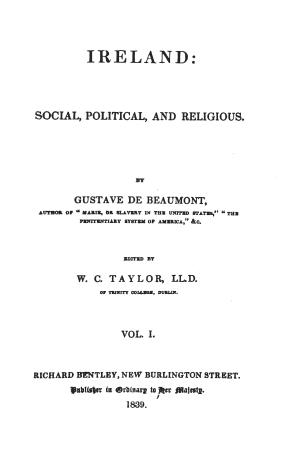
Return to Title Page for Ireland: Social, Political, and Religious, vol. 1The Online Library of LibertyA project of Liberty Fund, Inc.CHAPTER I.: EFFECTS OF AMERICAN INDEPENDENCE ON IRELAND. - Gustave de Beaumont, Ireland: Social, Political, and Religious, vol. 1 [1839]Edition used:Ireland: Social, Political, and Religious, ed. W.C. Taylor (London: Richard Bentley, 1839). Vol. 1.
Part of: Ireland: Social, Political, and Religious, 2 vols.About Liberty Fund:Liberty Fund, Inc. is a private, educational foundation established to encourage the study of the ideal of a society of free and responsible individuals. Copyright information:The text is in the public domain. Fair use statement:This material is put online to further the educational goals of Liberty Fund, Inc. Unless otherwise stated in the Copyright Information section above, this material may be used freely for educational and academic purposes. It may not be used in any way for profit.
CHAPTER I.EFFECTS OF AMERICAN INDEPENDENCE ON IRELAND.1776. I do not know whether there is any single political event in the history of the world, which has produced so great an influence on the history of all nations as the struggle sustained by the United States of America at the close of the eighteenth century. The American revolution was the first great revolution effected in the light of the press, and reflected in the discussions of a free representative government. Observe what an impulse this revolution gave to the debates of the English parliament! It appeared that until then parliamentary liberty of speech was mute, or at least that liberty spoke without being heard at a distance; the press alone has given it loudness of voice. Without it the thirteen colonies of England might have separated from the mother country, but without it the world would have known nothing further of the matter than that they were rebels chastised by their master. The minor events mingled with the war of independence have a trifling appearance. “It was,” said Lafayette, “a war of patrols,” in which the destinies of the world were decided. If you inquire why small events are really so great,—why this war of skirmishes should decide the fate of nations, you can find no other reason than the principle on which the war was grounded. That principle was just and legal resistance against tyranny and oppression. It was the idea, not the fact, that troubled the world. Attila passed over nations like a hurricane over the ocean. The tempest passed by—it was cursed and forgotten. But a petty people revolted; scarcely had blood flowed, though at the distance of two thousand leagues from us, when, though we had nothing to fear from the agitation, we were profoundly affected by it; the fact was the smallest possible, but the principle was immense. The great impression of the American crisis on nations arose from the circumstance of a just cause having never before been so clearly stated; it is not that the cause should be just, it is further requisite that its equity should be apparent. The Americans did not revolt against England, simply because it is better that a nation should be free than dependent; their cause thus presented would have been open to dispute, for there was a contract existing between the parent state and the colonies. But according to the very contract which linked them to England, the colonies could only be taxed through their representatives. Still England wished to tax and constrain them by violence; resistance was their right; they fought, triumphed, shook off the yoke; and the whole world applauded the triumph of right over might. A movement of independence was made amongst all nations. As tyranny was everywhere, efforts for freedom were made everywhere. These great epochs of simultaneous effervescence, and a common struggle for rights, are rare; nations should employ them to conquer security; for when once they are passed, general apathy succeeds to universal agitation. Nowhere was the effect of the American revolution more potent than in Ireland. There was an analogy in the situation of the two countries. The colonies of North America were indeed far more prosperous than Ireland; though they were merely colonies, and treated as such, they had the good fortune to be distant from England. Ireland, which was not a colony, for it had never been occupied under that title,—nor a part of England, for it had never been governed by English laws,—nor a free people, for England made laws to govern it,—Ireland, I say, had one point in common with the United States, that it contended against England for its rights: it demanded liberty to escape from poverty and wretchedness, whilst the American colonies, rich and prosperous, wished only that their dependence should not be increased. These analogies seized on all minds in England and Ireland. In the English parliament, there was not a discussion on America which did not direct attention towards Ireland. See, said the Whig orators in the English parliament, see the effects of the unjust pretensions of governments towards their subjects; fear to engage in an iniquitous contest with Ireland when the state of your colonies forewarns you of the result. “England,” cried an enemy* of Irish liberty, in 1774, “has as good a right to tax Ireland as the colonies.” “Yes,” replied an opposition member, “and the colonies are in revolt precisely because you have taxed them.” It may well be conceived what an effect was produced in Ireland by those great parliamentary discussions, where in marvellous encounter met the greatest and most extraordinary oratorical powers that England has ever produced—Burke, Pitt, Fox, Sheridan,—splendid talents, noble souls, bright geniuses, in whom the love of glory was intimately blended with the love of country! Ireland was inflamed by these discussions; in 1776 America was free; Ireland resolved to be so likewise. The declaration of American independence was likewise the great instrument of Irish independence.† America taught Ireland that a dependent people might become free, and taught England that it is perilous to refuse liberty to those who can take it. The impulse given to England and Ireland by American emancipation had consequences which it is necessary to demonstrate. The first and most important, without doubt, was the abolition of some of the penal laws enacted against the Catholics of Ireland; the first stone taken from the edifice of persecution, and the first step of reform. Let us see in what it consisted. Sect. I.—First Reform of the Penal Laws, 1778.1. Catholics were granted the right of holding land on leases of a hundred and ninety-nine years.* They thus obtained the right of unlimited possession without the right of property. One reason for this limitation was, that conceding this limitation might give the Catholics too much influence at elections. 2. The son of a Catholic turning Protestant had no longer a right to seize on his father’s property, or make him only tenant for life in his estate.* 3. The law requiring Catholic property to be gavelled was repealed, and the rules for Catholic and Protestant inheritance became the same.* Such a reform was doubtless incomplete, and persecution remained armed with sufficient rigours to strike severely those whom it attacked. But the first wound was given to the tyrannical code, and we shall soon see it fall asunder piece by piece. An impulse was given to reform; henceforth no great event could be without its fruit. As the events arise, we shall point out their consequences, and immediately connect the effects with the causes. Just as there was no rationality in the establishment of the penal code, we shall find a want of order and logic in the acts by which it was repealed. The reform seemed to be made by chance or accident, according to the circumstances and necessities of the moment. The legislature abolished as it created the penal code, without plan or method. Sect. II.—Second Effect of American Independence on Ireland, (1778 to 1779.) The Irish Volunteers.The war between England and her colonies not only exercised a moral influence on Ireland, but produced results in that country which may almost be called physical. On account of America, England was at war with France, Spain, and Holland, as well as the United States; it was necessary to withdraw a part of the English army from Ireland to send it to America. The Irish coasts were daily menaced with hostile invasion; Ireland demanded aid, but was told to defend herself the best way she could.* England at the moment was stunned by the number of embarrassments pressing on her from a distance and close at hand. These embarrassments of England added to the strength of Ireland, already encouraged by her success in having obtained the first concession. Besides this movement, Ireland was greatly irritated at being refused the commercial and maritime liberties which she claimed. Associations were formed to refuse the use of English manufactures,† in order that the English, who resisted the commercial advantages of Ireland, should be deprived of them themselves. In this state of things, the viceroy declared that in consequence of the failure of the public revenue, the laws for raising a militia could not be executed.‡ Immediately, by a universal and spontaneous movement, Ireland was covered with a volunteer militia, self-armed, self-regimented, self-organised, which elected its own chiefs, and formed its own rules of discipline, without the government taking any share, direct or indirect, either in its formation or superintendence. The commercial association was transformed into a military association. The government appears to have acted imprudently in allowing the formation and organisation of these “independent companies;” but how could it have opposed them? Doubtless it had the rigorous right, but it had not the inclination; it was, above all things, necessary to avert an invasion, which was imminent, and to conjure away this peril, which was a peril of death. It is very unfortunate for tyrannical governments to have sometimes imperious need of the people; when once this recourse has taken place, the delusion is dissipated: the people discovers that it is strong, and the tyrant weak. It cannot defend the government without learning the art of defending itself against the government. The English government felt the necessity of throwing itself into the arms of Ireland, and entrusting the country with the care of its own preservation. The viceroy distributed sixteen thousand swords and muskets to the volunteers. An imposing force was soon on foot; forty thousand men organised themselves in the twinkling of an eye at their own expense, and without any other impulse than national feeling. Ireland was, without doubt, saved for the moment from hostile invasion, but from that day she also learned the secret of her strength against England. These armed bodies, having no other discipline than that which they imposed on themselves, and refusing all royal regulations, proclaimed themselves sovereign, in so far as they refused to derive their rights as armed citizens from any power but their own. They then discussed affairs of state, and regarded themselves as the true representatives of the nation; they formed a kind of military parliament, and Ireland no longer presented a petition to England, save at the point of the bayonet. They asked why the rights of the citizens should be limited to bearing arms, and why they should not have the right of debating on public affairs. They assembled on fixed days; each corps named representatives; assemblies elected by the majority of citizens passed resolutions, approved or blamed the conduct of the government, recommended such and such measures, censured severely the acts of parliament which appeared injurious to the country. In truth, the parliamentary power was in the popular masses, and the masses were armed. A memorable circumstance prevented the disorders with which such a state of things was rife; it was that the rich, the landlords, the chief men of the country in commerce, amongst the citizens and amongst the nobility, were at the head of the volunteer battalions; they at first entered them from the feeling of nationality which pervaded Ireland on the menace of a foreign invasion; and afterwards, when the volunteer companies organised themselves into political deliberative assemblies, these noblemen and gentlemen remained at their posts from prudential motives. They saw the march of events with terror; they comprehended all the peril of a deliberative army, but they knew how much more dangerous it would become if the chiefs withdrew from the direction. The volunteers taught England that there was such a thing as formidable Ireland, with which she would have to reckon. Composed for the most part of Protestants, they taught England and Ireland itself, that with most of the Protestants the prejudices against the Catholics were weakened; since the delegates from one hundred and forty-three of these companies, who met at Dungannon, on the 15th of February 1782, to demand in the name of their armed constituencies free trade and an independent parliament, adopted also the following resolutions:— “Resolved, (with two dissenting voices only, to this and the following resolution,) that we hold the right of private judgment in matters of religion to be equally sacred in others as ourselves. “Resolved, therefore, that as men and as Irishmen, as Christians and as Protestants, we rejoice in the relaxation of the penal law against our Roman Catholic fellow-subjects, and that we conceive the measure to be fraught with the happiest consequences to the union and prosperity of the inhabitants of Ireland.” It is from this day that the origin of the party of liberal Protestants in Ireland must be dated. Until then, Protestants had only been patriots so far as they wished that Ireland should not be subject to England; but these patriots, so impatient of the English yoke, were satisfied that the Catholics should endure theirs. But now they began to invoke liberty, not only for themselves but for their fellow-citizens. It is true that they only claimed, with a timid voice, the cessation of the persecutions against the Catholics; but they demonstrated their injustice in demanding their cessation; and the population which groaned under the penal laws had henceforth auxiliaries in the ranks of its oppressors. The volunteers, their acts, the impulse which gave public opinion in Ireland, and their moral effect on England, produced the independence of the Irish parliament. Sect. III.—Independence of the Irish Parliament.Poyning’s Law, so called from the name of the viceroy during whose administration, in the time of Henry VII., it had been enacted, declared that no Irish parliament should be holden until “the causes and considerations” of its convocation, and the projects of laws to be discussed, had first been approved by the English government. This law, which rendered the Irish parliament absolutely dependent upon England, had never ceased to excite the complaints of Ireland. On the 19th of July 1782, the Irish parliament declared itself independent of the English parliament, and adopted the principle publicly deliberated by the volunteers, “That no power on earth, save the King, Lords, and Commons of Ireland, had the right to make laws binding on Ireland.” Amongst the crowd of parliamentary combatants, one great chief deserves to be distinguished—Henry Grattan. It is rarely the privilege of an individual to bear so signal a part in a national movement, and to contribute so much to the success of an enterprise otherwise effected by general causes. It was in his living and powerful words that the Irish parliament sent this energetic address to the King. “To assure his Majesty, that his subjects of Ireland are a free people. That the crown of Ireland is an imperial crown inseparably annexed to the crown of Great Britain, on which connexion the interests and happiness of both nations essentially depend: but that the kingdom of Ireland is a distinct kingdom, with a parliament of her own—the sole legislature thereof. That there is no body of men competent to make laws to bind this nation, except the King, Lords, and Commons of Ireland; nor any other parliament which hath any authority or power of any sort whatsoever in this country, save only the parliament of Ireland. To assure his Majesty, that we humbly conceive, that in this right the very essence of our liberties exists; a right which we, on the part of all the people of Ireland, do claim as their birthright, and which we cannot yield but with our lives.” This address, supported by an army of nearly a hundred thousand men, had full success with the Irish parliament, which expressly abolished the laws on which England founded its right of predominance and legislative supremacy over Ireland.* Sect. IV.—Legal Consequences of the Declaration of Irish Independence.We may consider the act by which the Irish parliament asserted its independence as an echo of the declaration of independence by the American colonies. North America inspired the movement, the association of the Irish Volunteers gave Ireland the strength necessary to execute it. It would, however, be a mistaken view of the relations between England and Ireland to compare it to that of the colonies with the metropolitan state. Nothing is more common than to institute such a comparison. Ireland appears for centuries governed by force alone, and hence some have supposed that force was the only bond which united the country to England. To adopt such a view, is to mistake completely the nature of the contract existing between Ireland and England. There is no doubt that after the conquest, and for a long period subsequent, Ireland was at the mercy of England, and might, if she had pleased, inflict on that country a government purely despotic, founded simply on the right of force and conquest. But the question is, not to know if such a course was possible, but if it was really adopted. Now it is clear that such was not the line of conduct pursued towards Ireland. Scarcely had England subdued the country, when she bestowed upon it free institutions, especially recognising the right of Ireland to have a parliament of her own, and to pay no taxes but those which should be voted by her parliament. Scarcely was England mistress of Magna Charta, when she extended its principles to Ireland; a conquered country obtained possession of these rights, not because she constituted an independent state, but because the people on which she depended had granted these franchises; she held her liberties from the very power which might have given chains if it had pleased. Now, if we reflect on the circumstances which accompanied and followed the conquest, we shall see that this generosity of England was feudal. We have already seen under what circumstances and by what title the vassals and subjects of Henry II. established themselves in Ireland. These Anglo-Normans, for the most part noble by birth, preserved in Ireland all the privileges inherent to their rank; and the king no more thought of taking these away than the adventurers did of disputing with the king his quality of liege lord of Ireland. After the conquest, therefore, it is important to regard England as not only engaged with the native Irish, and making them bow beneath the yoke of the conqueror; we must especially consider her in her relations with the conquerors that issued from her own bosom, all freemen, Anglo-Normans by race, in whose presence she stood, and whom she was obliged to treat like the inhabitants of every other province belonging to the crown. There were men in Ireland more or less degraded in the feudal scale, at the top of which the king was placed; but they were all, in the style of the period, free men, not conquered subjects. In truth, for a long time the conquerors of Ireland did not occupy the entire country; for a long time the unsubjugated population of natives which surrounded the pale was treated by England as an enemy, and deprived of all the privileges granted by England to her children; and whilst this state of things endured, we may say that there were two Irelands in the country: one English, and conqueror, the other vanquished or rebellious;—the first sharing in the free institutions of England—the second, enduring all the servitude of conquest. But when the potent hand of Henry VIII. weighed upon the country, the two Irelands became one; those of English or Irish birth were equally subjects of the same empire; one and the same law existed for all—so that, from this time, the condition granted to the Anglo-Norman colonists became the common right of all Ireland. Henry VIII. was not very prodigal of rights and privileges; we cannot tell whether, in his plans of tyranny, he intended to raise the Irish to English liberty, or to depress his English subjects to the servitude of barbarous Ireland. However that may be, the despot established a level in Ireland, and at a later period, the Englishman in this country could not invoke a single political right which did not equally belong to every Irishman. This principle of political liberty, due to the feudal character of the conquest, received a singular development in the religious wars of the sixteenth century. When Protestant England entered into a contest with Catholic Ireland, the question of race was lost in that of creed; there was no debate about reducing the sons of old Erin to the yoke, the point was to stifle the hydra of superstition and popery which had found refuge in Ireland; and this was the reason why England, fanaticised by Scotland, rushed on Ireland. The English settlers, who at this time invaded the Irish soil, seized it, not only to possess the land, but “to plant and nurture the tree of true religion.”* Thus acted the Scotch settlers of James I., the fanatics of Cromwell, and the partisans of William III. Between 1615 and 1688, that is to say, in less than eighty years, Ireland was three times invaded under the pretext of religion, and the religious occupants remained there. Thus, in the same way as England, in 1172, found herself in the presence of a feudal society whose rights she would not refuse to recognise; so, during the agitations of the sixteenth century, Protestant England beheld a Protestant society arise in Ireland, whose rights she was neither able nor willing to restrain. In these times of enthusiasm, with which sometimes a singular spirit of universal levelling was singularly mingled, it was impossible that the notion of placing the Protestants of Ireland in an inferior condition to the Protestants of England could have entered the minds of Englishmen; every privilege granted to Englishmen, exclusive of their Protestant brethren in Ireland, would have been then regarded as an act of impiety and odious injustice. There were then, it is true, terrible conflicts between England and Ireland; there is no doubt that there were then conquerors and conquered, and that England was still victorious. But the vanquished were not Irish, they were Catholics, some of English race, others of Irish descent. A religious party was beaten down, not a nation conquered. During nearly two centuries, the majority of the inhabitants of Ireland enjoyed neither rights nor political privileges, but this majority was not oppressed as a people, but only as a sect. The moment in which the Papists of Ireland endured the most terrible tyranny, was precisely that in which England showed itself most liberal to the only Irish population which it then recognised, that is to say, the Protestants. Never did such a sympathy exist; as they had the same religious passion, they seemed also to have the same common interest; and Cromwell only gave expression to the existing public feelings when he did that which was not finally completed until after another century and a half, that is to say, united Ireland to England.* It must be remarked, that this immense portion of the inhabitants of Ireland, which did not enjoy the privileges of the constitution, was not directly excluded by law; all Irishmen had alike the right of invoking its protection: their incapacity only arose from the repugnance of their consciences to an oath which the law made a condition of exercising nearly all rights, civil and political. Thus, on the day when Catholics and other dissenters obtained a dispensation from the oath, they had entered ipso facto on the enjoyment of all their privileges, the right to which they had never lost, though the exercise had been suspended; and thus they at once participated in the advantages of the free society which had not ceased to exist in Ireland. From the preceding statement, we see how great is the mistake of those persons who believe that they can explain the respective situations of England and Ireland, by the nature of the relations which usually exist between a colony and the metropolitan country. Ireland has never been a colony but in name. The state of a colony implies a political and legislative dependence, a condition of inferiority to the parent state, which would not have been endured by the feudal Ireland of Henry II., nor the Protestant Ireland of Cromwell and William III. Ireland is, besides, too near England to fulfil the conditions of an ordinary colony, which distance from the mother country protects in some sort, and which finds a certain independence in the very impossibility of the metropolitan country’s governing it perpetually. No conquered country close to the conquering can remain in the intermediate position that a colony holds between political independence and entire subjection. Ireland, placed under the English sceptre, must necessarily have been treated as an equal or as an enemy, as free or enslaved; we have seen that it could not be placed in a state of servitude; it consequently received, theoretically at least, the privileges of liberty. There is no doubt that England frequently outraged the liberties she had consecrated; she violated them every time she pleased, for though Ireland had a free government, England did not cease to be the stronger, and her interests frequently hurried her beyond her engagements and even her passions. It was thus that Henry VII., by Poyning’s law, subjected Irish acts of parliament to a sort of preliminary censorship: and at a later period, when England wished to annihilate Irish industry and trade by a single blow, she went so far as to assert that the laws of the English parliament were binding on Ireland. But even whilst submitting, Ireland protested against such an abuse of strength, and England herself formally recognised her excesses when she declared, by her parliament in 1782, “that the English parliament had never the right to make laws for Ireland, nor to interfere with the independence of the Irish parliament.” Before England had recognised this principle, Ireland had herself proclaimed it; and it is worthy of remark, that in declaring herself free, Ireland acted not as a colony breaking its chains, but as a people asserting its rights. Far different from the American provinces, whose declaration of independence was a signal for war in England, never was Ireland more closely united to that country than on the day when her parliamentary independence was established, for that independence was the first condition of the social compact; the United States broke that compact by their emancipation, to which Ireland remained faithful by becoming free. Burke well described the event of 1782, when he called it the 1688 of Ireland.* Sect. V. 1782.—Abolition of certain Penal Laws. Consequences of the Declaration of Parliamentary Independence.The movement of the volunteers, which produced the declaration of independence by the Irish parliament, had two very distinct effects—the one general, which interested all the inhabitants of Ireland, Catholic and Protestant; the other special to the Catholics. In the first respect, the independence of the Irish parliament, though profitable to all, was especially an advantage to the Protestants, who, being in possession of all social advantages, were the more impatient to acquire a free government. Those who are dying of hunger do not look upon parliamentary independence as a means of getting bread; they are too wretched to envy political rights; their ambition leads them only to the immediate object of their wants, and they do not consider that political liberty is the best instrument for constructing social happiness. Nevertheless, the Irish parliament, though exclusively Protestant, could not recover its independence without manifesting it by some acts favourable to the Catholics. Thus, at the same date, (1782, by Act 21 and 22 George III., ch. xxiv.) the laws were abolished which hindered Catholics from acquiring, disposing, selling, purchasing, inheriting, and possessing property like Protestants. This was the completion of the law of 1778; it was the concession of the right of property without restriction; henceforth the Catholic was not a mere tenant on lease, but might be a proprietor like the Protestant. The law was repealed that prohibited Catholics from possessing a horse of higher value than five pounds, and which permitted the horses of Catholics to be seized in time of war, or in case of invasion. Catholics were, therefore, free to possess any goods or chattels. The law was repealed that inflicted punishment on a Catholic priest for performing any office according to the ritual of the Catholic church. The only penalty left was for officiating in a chapel with a bell and steeple. The law was abolished which subjected to imprisonment every Papist who refused to denounce a priest and his assistants for celebrating mass. It was a step to the full toleration of the Catholic worship; the Catholics could not, it is true, perform their worship with pomp and splendour, but still they could pray in silence, according to the forms of their religion. The penalties of imprisonment and transportation denounced against the Catholic priests were repealed. Finally, the law was revoked which prohibited Catholics from being instructors of youth, and guardians to their own children, or those of others.* This was the second act of Catholic emancipation; from this epoch also two changes date, which, though equally advantageous to Protestants and Catholics, ought to be considered especially useful to the latter; to wit, the law which secured their places during good behaviour, (quamdiu se bene gesserunt, and not durante bene placeto,) and a similar law of habeas corpus to that possessed by England. These laws were particularly favourable to the Catholics, for guarantees and tutelary laws are most needed by the poor and oppressed. Sect. VI.—Continuation of the Volunteer Movement. Convention of 1783.It would not be reasonable to suppose that so powerful a body, representing the nation, having strong feelings of its rights, and a consciousness of its power, after having decreed resolutions, immediately transformed into laws by the parliaments of England and Ireland, should rest satisfied there. After the independence of the Irish parliament had been proclaimed and recognised, another matter naturally presented itself—reform of the representation. This parliament was a delusive representation even of the Protestant population; under the influence of corruption, it voted anti-national laws, and popular laws when coerced by fear. It was vainly proclaimed free, for it was so only in name. And as its vices were derived from its very source, that is to say, the electoral system, a radical reform was necessary. Consequently, the National Convention of volunteers, assembled in 1783, proclaimed the necessity of parliamentary reform.* The subject was brought before parliament at the very moment it was debated in this great assembly of the armed nation; so that Ireland might be said to have had two representative assemblies at the same moment; one perfectly legal, but unpopular; the other irregular, but possessing the confidence of the people. Nevertheless, the Irish parliament rejected the proposition of reform by a majority of one hundred and ninety-nine against seventy-seven. More was asked of this parliament than it could effect. In fact, to change the basis of election, would be to ensure that the great majority of its members would not be re-elected; it was asking bad citizens to commit patriotic suicide. The House of Commons also resolved, “that they would support the rights and privileges of parliament against all encroachments.” Perhaps the Irish parliament might have yielded from fear what it would not grant to justice and reason, if there had been any peril in rejecting parliamentary reform; but no such danger existed. The armed volunteers, who had so energetically demanded and obtained parliamentary independence, did not manifest similar zeal for parliamentary reform. Divisions began to creep in amongst them; many believed that when this independence was obtained, everything was accomplished; others, and they were very numerous, began to fear that the prolongation of these discussions, and the consequent reforms, might effect a perilous revolution in the condition of the Catholics. Now, most of the volunteers were Protestants. Observe that the political emancipation of the Catholics was discussed in parliament; it was debated whether they should be admitted to the elective franchise at the same time that the general questions of parliamentary reform were discussed. The two questions were thus linked, and were debated conjointly by the volunteers. These, disposed to alleviate the sufferings of the Catholics, but not to emancipate them, had resolved “that parliamentary reform was necessary, but that Catholics ought not to be admitted to the elective franchise.” Still the two questions were confounded and discussed together in parliament; it may then be easily conceived why the Protestants should fear lest the triumph of the one which they desired might lead to the success of the other: and they had reason to do so, as it was a logical consequence. How could the principles of parliamentary representation, founded on property, be rationally discussed, if the rights of a number of proprietors were resisted on the mere ground of religion, and that too at a moment when the injustice of the penal laws had been fully recognised and proclaimed? This explains the indifference with which the resolution of the Irish House of Commons rejecting parliamentary reform was received. Sect. VII.—Corruption of the Irish Parliament.Parliamentary reform was rejected, and yet the corruption of parliament was extreme. The Commons were composed of three hundred members; it would have been a difficult and troublesome task to bribe three hundred independent deputies; but of this number the greater part were mere creatures of the aristocracy; more than two hundred were members for rotten boroughs,* belonging either to peers or rich proprietors, who were also members of the House of Commons; so that it was only necessary to purchase a few in order to have nearly the entire; sometimes a single person could dispose of twenty boroughs, or forty votes. There were two modes of purchasing members of the House of Commons, by places and pensions. The first was the honourable mode of sale; government had a multitude of places at its disposal. When there was not a sufficient number, new places were created; when existing salaries were not sufficient for remuneration, they were augmented.* With regard to the petty offices of judicature and administration, unsuited to the dignity of national representatives, they were publicly sold, and the money thus raised was employed to purchase votes. When places were exhausted, pensions were given out of the Irish revenue;† the money thus employed was that of poor Ireland, who thus paid those that sold her while they sold themselves. Those pensions, which in 1756 were 44,000l., rose in 1793 to 120,000l. Finally, when places and the fund for pensions were exhausted, the government took what it wanted from the treasury. A viceroy rarely quitted Ireland without leaving an arrear of 200,000l., and sometimes 300,000l. This corruption was practised with incredible openness. Grattan‡ challenged its denial in the of the corrupt parliament, and no voice dared to contradict it. Sometimes, after a strong opposition had been remarked in parliament, people were surprised to see it suddenly vanish; this happened in 1765, on the bill relating to the exportation of grain. But corruption was actually and openly avowed by the officers of the crown.* During the debate on giving the regency of Ireland to the Prince of Wales, the Irish attorney-general, Mr. Fitzgibbon, afterwards Earl of Clare, said to an astonished house and an indignant nation,—“You have set up a little king of your own; half a million, or more, was expended some years ago to break an opposition, the same or a greater sum may be necessary now.” Their original parliaments were annual; by corruption they became rare, and were gradually protracted during the life of the king. Hence it followed, that if government purchased a majority in the first year, it remained its master, and disposed of it at its pleasure until the accession of a new king. To avoid the evil chance of too short a reign, it was once proposed to vote the supplies for twenty-one years; this was proceeding direct to the object, but the motion failed.* In the reign of George III. a different system was established; the parliament became octennial, and was obliged to assemble once every two years at the least. The consequence was, that there was a new parliament to purchase every eight years; the members who sold themselves generally disappeared, and were not returned at the new elections; but others, equally venal, came in their stead, and what was regarded as a guarantee of independence, appeared to several a mere increase of expense to the English government, or rather to Ireland, which had to supply the funds for corruption. The House of Lords was still more easy to gain. The crown exercised over it that ascendency which a superior necessarily possesses over those who derive from him all they have. Besides, they were almost all a new nobility, and consequently had no root in the country. Occupied with their pleasures in London, or attending on the King of England, they were more eager to pass for English lords than to be courageous defenders of the interests of their country. The session of the Irish House of Lords was only marked by some interchanges of courtesy with the viceroy;* and every time that these took place, the Irish lords displayed fresh meanness. “Never,” says the biographer of Lord Charlemont, “did any nobility equal that of Ireland in varying the forms of obsequiousness and servility.” In truth, the Irish House of Lords neither was nor could be a source of embarrassment to the English government. It was too feeble, as a national institution, to render its support valuable; but it offered the British government a resource of another nature which had its value. It sometimes happened that the pension fund was exhausted when money for corruption was wanting; in such a case, peerages were sold to persons who had no claim to nobility, and who were, therefore, eager to become purchasers, and the sums of money derived from this traffic served to purchase the consciences which still remained free. The great merit of the peerage in the eyes of the government consequently was, that the sale of its honours supplied money for bribing the Commons. “Thus,” said Grattan, in the Irish parliament, (Feb. 8th, 1791,) “The ministers have sold the prerogatives of the crown to buy the privileges of the people.” The legal agent between England and the two Irish houses of parliament was the viceroy of Ireland. For a long time, this high functionary attended to no part of his office but the emoluments. The charge of viceroy was regarded as a sinecure which the English government bestowed to arrange some political exigency. When a great lord or borough proprietor demanded some ministerial employment in spite of his absolute incapacity, he was named Lord Lieutenant of Ireland; it was also occasionally a means for some great person, poor or ruined, to make or repair his fortune. The viceroy possessed two magnificent palaces, one in Dublin, the other in the suburbs, but he did not reside in either. Dublin could not compensate him for London, where he was detained by his habits and his pleasures. There were some viceroys who never appeared in Ireland, such as Lord Weymouth, who was nominated to the office in 1765. They generally went over only for a few months to attend the opening of parliament, after which they returned to England. Although his sojourn in Ireland was so brief, the viceroy derived large profits from his office. Lord Wharton, in two years, is said to have netted 45,000l. So unusual in Ireland was a resident viceroy, that when Lord Townshend established himself as such in Dublin (1768) people looked upon the event with amazement, and seemed almost to doubt such a phenomenon. During the absence of the viceroy, the government was entrusted to three lords justices, selected either from the privy council, the judges of the four courts, or the dignitaries of the Anglican church. These were employed by the English government to negociate the majority in parliament. “There were always three or four influential persons in the Irish parliament,” says Dr. Campbell, “whose coalition necessarily produced a majority on any question whatever. These were the individuals whom it was important to gain, and with whom the lords justices treated; the most immoral and scandalous transactions followed. The lords justices leased out the Irish administration; they gave up to those influential members of parliament the disposal of all the employments and dignities dependent on the executive power, the revenue of Ireland, and the funds for pensions; bargaining that those persons in their turn should carry through parliament all laws desired by the English government. The vile agents thus employed by the English ministers were usually called “undertakers.” In virtue of the powers thus delegated to them, the undertakers appointed to all offices, selecting governors of counties, sheriffs, justices of peace, crown lawyers, collectors of excise and customs, &c.: they could even bestow peerages, or rather, as they never did anything gratuitously, they sold all that was given them. Parliament—justice—administration—everything was venal in Ireland. The undertakers had every sort of advantage over the viceroy; as they were always on the spot, they knew better than he did the actual state of affairs, and the course of intrigues. Besides, they lent themselves more pliantly than the viceroy to all the base manœuvres in which they were required to act as instruments. The office of viceroyalty was become so degraded, that no viceroy would execute it. All the power being placed in the hands of the undertakers, the viceroyalty was but a nominal dignity; and if a Lord Lieutenant had employed his right to dispose of places and honours, the undertakers would have complained of a breach of contract. In general, the recommendations of the viceroys were utterly disregarded. Out of twenty viceroys, who, in the course of a century, succeeded each other in Ireland, Lord Townshend was the first who, in 1767, formed the project of administering the government himself. His intentions were pure and honourable; he wished to remove the dominant cabal, and govern Ireland directly, without the intervention of the undertakers. But though the corruptors were removed, all those whom corruption had tainted remained, with the wants and habits they had acquired. Henceforth there were several members of the Irish parliament in both houses, accustomed to live on the pension of England, and whose hostility was to be expected if payment was suspended. Lord Townshend who, above all things, wished to be responsible for Ireland to his own country, had recourse to the only means of success then known. He governed alone, but he governed by bribery, like those whom he had supplanted; but with this difference, that, being a novice in corruption, he submitted to exorbitant conditions from the consciences he purchased; though he reserved no personal gains for himself, he spent more than the undertakers, who never made a bargain without reserving something for their own share. On the whole, it cost Ireland more to be governed by a man of honour than by a set of political intriguers.* He was honourable, and the system was not. There is not a more ludicrous exhibition in the world than an honest man practising corruption; he understands nothing of the roguery with which he has to deal; vile intrigues should be left to mean minds; in such they are sure to be superior. Sect. VIII.—Is a servile Parliament of any use?It is impossible to glance at the parliament of Ireland and its venality, without raising a doubt whether it would not have been better for Ireland to be without any parliamentary representation, than to possess one so corrupt. Of what advantage to a country are representatives setting themselves up for sale? Is it not merely an additional load upon the people that has to pay them? Is not the authority of these pretended representatives a mantle with which power may veil itself, and from which it may derive greater strength for evil, than if abandoned to its own forces? There are, doubtless, immense perils in the corruption of parliament. Still the executive has not always the power of purchasing members, even when it has the will. It sometimes happens, that people are not in a humour to sell themselves; and there are some difficult steps to be taken in the bargain which greatly impede the progress of corruption; finally, so great is the love of liberty, that even apostates to it endeavour to keep something in their own power; they equivocate with the purchasers, and make strange conditions with their own consciences; they endeavour to retain some little honour in the depth of their degradation, and are tempted to display independence at the very moment they accept servitude. Placed between the trust reposed in them by their constituents, and the engagements they have made with the power to which they have yielded, they doubtless belong to those whose money they have received, but not without some tendency towards those whose esteem they wish to preserve. A power hostile to the people, acting independent of any assembly, would simply do as it pleased, without any regard to the interests of the country; the assembly sold to it will not contravene the course of power; but if there exist means of accomplishing what power requires without injuring the people, such means will be adopted even by a venal assembly. In the most venal and corrupt minds there is a kind of tacit compromise between honour and infamy, in consequence of which, the man who, in one way, most treacherously sacrifices the interests of his country, defends it most intrepidly in another. It often happens, also, that the members of parliament who have sold themselves, compel the government to understand, that in order to be strong, they must not be too unpopular; and when a measure of tyranny is required, though they consent to it, yet, to escape execration, they demand that the oppressive act should be accompanied by some national measure.* We must also remember, that corruption is vainly practised on a large scale: it does not taint everybody. There are always some souls elevated above the reach of corruption. We may instance Grattan, Curran, Ponsonby, Lucas.* The minority that remained pure, became powerful by its virtue alone, which brought out in high relief the vices of the majority: and eventually this minority became formidable when supported by the wants and sympathies of the nation. The practice of corruption is beset by a multitude of obstacles and difficulties. If the man purchased be worth little, his defection makes little noise, but also the purchase is of little value. If he possesses importance, without doubt he is worth the money paid for him; but then the intrigue makes a noise. See what a clamour was excited by the defection of the patriot Flood,* when named to an employment revocable at the pleasure of the crown. One matter deserves to be specially remarked. It is not rare in the midst of corruption to find honest men, who resist temptation, treated as dupes or fools, blind to their own interest; and yet where can we find in history an independent character that is not remembered with honour, or a servile creature that is not branded with infamy? The most venal parliament has sometimes another advantage. It is true that it generally aids power against the country; still, when a liberal administration comes, which may happen, it will be seen voting laws useful to the country with more ardour than it displayed in the support of antinational measures. A sudden revolution seizes all the members; what they are commanded to do accords with their desires; they have always been the friends of liberty; they display marvellous zeal in defending the principles which they have hitherto combated; they give more than is asked, so happy are they to have the power of being popular without ceasing to receive the wages of servility. Finally, however prevalent corruption may be, a time comes when it is impotent; those who have been regularly paid for a long time, end by believing that what they receive is their due, and some day or other, in spite of their engagement to servitude, they will be found speaking and acting as if they possessed their liberty. Sometimes, also, public opinion manifests itself so imperiously, that whatever may be the desire which members of parliament feel to resist it, though additions may be made to their pensions, and a barrier raised by money between them and the patriotism outside, it is impossible for them to refuse what the country demands; and then this servile parliament becomes a precious instrument to proclaim the will of the people, which could only be manifested by irregular and violent acts, if it did not possess a constitutional organ for its expression. When a government beholds the members of parliament it has purchased resume their liberty, it sometimes makes bitter complaints. It is wrong; for the consciences it bought had no right to sell themselves. More frequently it is silent; it fears lest one defection should bring several others: if it withdraws the pensions from those who acted independently, they are indignant at being deprived of a property which they regarded as sacred, and become from that moment adversaries of power, the more dangerous as they know all its secret turpitudes; and they become patriots the more zealous as they have the more need of proving the sincerity of their attachment to the popular cause. When persons are alarmed at the cost of a venal parliament, they do not take into account all that would be spent and lavished without any limit or public advantage if there were not a parliament. These considerations, which are in some sort a history of the Irish parliament, perhaps prove that for a nation there is something worse than a corrupt representation, namely, to have none.* [*]Rigby, Master of the Rolls, whom the pen of Junius has consigned to immortal shame. [†]“A voice from America shouted liberty,” was Flood’s fine description of the time. See Hardy’s Life of Charlemont, vol. i. p. 387. [*]17 and 18 George III., chap. xlix. [*]The people of Belfast, alarmed at their unprotected state, petitioned the government for a garrison, and received as an answer, that half a troop of dismounted cavalry, and half a company of invalids, constituted all the force that could be spared.—Tr. [†]One of these associations had the humorous motto, “Burn everything that is imported from England except coals.” [‡]His Majesty’s ministers were obliged not only to pay the Irish troops on service abroad from the British exchequer, but also to remit fifty thousand pounds to Ireland to complete the sum necessary for the payment of the few troops who had been left in that kingdom.” [*]The following statement of the Volunteer force is too important a document to be omitted:—
generals.
[*]This was the cant of the sixteenth century; its meaning is best developed in the following resolutions adopted by the puritans of Massachusetts, when about to seize on lands belonging to the Indians. [*]In Cromwell’s plan of a parliament, (ad 1651,) Ireland was to be represented by thirty members. [*]Plowden, vol. i. p. 521. [*]The sacramental test, which excluded Presbyterians and Protestants from offices of trust under the crown, was also repealed in the session of 1782.—Tr. [*]Nov. 29th, 1783. [*]Some were members for still more rotten corporations, the leaders of which combined to exclude the inhabitants of the towns, whether Protestant or Catholic, from the franchise, so as to enable themselves to sell the representation to some peer who trafficked in boroughs, receiving in return places in the customs or excise for themselves and their children.—Tr. [*]M. de Beaumont deems that his account of the venality and profligacy of the Irish parliament will be scarcely credited; but every one acquainted with the history of the country must be aware that the systematic corruption both of the Irish Lords and Commons is understated. Everybody has heard the story of Mr. Hutchinson, founder of the Donoughmore family, whose vote, on a particular occasion, was purchased by giving his daughter a cornetcy of dragoons.—Tr. [†]“Infamous pensions to infamous men.”—Grattan’s Speeches, vol. i. p. 23. [‡]Mr. Grattan, in the name of the little minority that opposed the destructive and disgraceful system pursued by the Irish administration, used the following pointed and powerful words:—“We charge them publicly, in the face of the country, with making corrupt agreements for the sale of peerages; for doing which, we say they are impeachable. We charge them with corrupt agreements for the disposal of the money arising from the sale to purchase for the servants of the Castle seats in the assembly of the people; for doing which we say that they are impeachable. We charge them with committing these offences, not in one, nor in two, but in many instances; for which complication of offences we say that they are impeachable—guilty of a systematic endeavour to undermine the constitution, in violation of the laws of the land. We pledge ourselves to convict them; we dare them to go into an inquiry; we do not affect to treat them as any other than public malefactors; we speak to them in a style of the most mortifying and humiliating defiance. We pronounce them to be public criminals. Will they dare to deny the charge? I call upon and dare the ostensible member to rise in his place, and say, on his honour, that he does not believe such corrupt agreements have taken place. I wait for a specific answer.” [*]“The threat was proceeded on, the peerage was sold, the caitiffs of corruption were everywhere—in the lobby, in the street, on the steps, and at the door of every parliamentary leader, whose thresholds were worn by the members of the then administration, offering titles to some, amnesty to others, and corruption to all.”—Grattan’s Letter to Lord Clare. Miscellaneous Works, p. 107. [*]It was lost by a majority of one. The casting vote was given by Col. C. Tottenham, who rode up from the country, and arrived barely in time to turn the contest; hence, “Tottenham in boots” became a popular toast.—Tr. [*]For several successive days the journals of the Irish House of Lords present the same record. “Met—heard prayers—ordered the judges to be covered—adjourned.”—Tr. [*]When Lord Townshend left Ireland, the treasury was in an arrear of 265,000l. [*]Thus, in 1769, a money bill planned by the British cabinet, certified in England by the Lord Lieutenant and Irish privy council, and returned under the king’s great seal, was rejected by the Commons after the first reading, because it had not originated in their house. On this occasion the patriots were aided by some pensioners and placemen, who had reserved to themselves a right of opposing the government in questions of importance . . . . On the motion of the prime-serjeant (Mr. Hussey Burgh) Oct. 12th, 1799, the House of Commons unanimously resolved that, in their address to the king, these words should be inserted: “We beg leave, however humbly, to represent to your Majesty, that it is not by temporary expedients, but by a free trade alone, that this nation is now to be saved from impending ruin.”—Tr. [*]The name of Hussey Burgh should not be omitted from this list. The following fragment, almost the only specimen of his eloquence that remains, is said to have produced the most electrical effect ever witnessed in a deliberative assembly. [*]The following character of Flood is contained in Grattan’s reply to Lord Clare’s pamphlet:— [*]M. de Beaumont’s views in this section are so admirably illustrated in the account which Grattan gives of the occasional bursts of patriotism in the Irish parliament, that it is worth while to quote the passage. It is taken from his celebrated reply to Lord Clare’s Union Pamphlet:— |
||||||||||||||||||||||||||||||||||||||||||||||||||||||||||||||||||||||||||||||||||||||||||||||||||||||||||||

Titles (by Subject)