Econlib

The Library

Other Sites

Front Page arrow Titles (by Subject) arrow 6.: Interventionism - Omnipotent Government: The Rise of the Total State and Total War

Return to Title Page for Omnipotent Government: The Rise of the Total State and Total War

Search this Title:

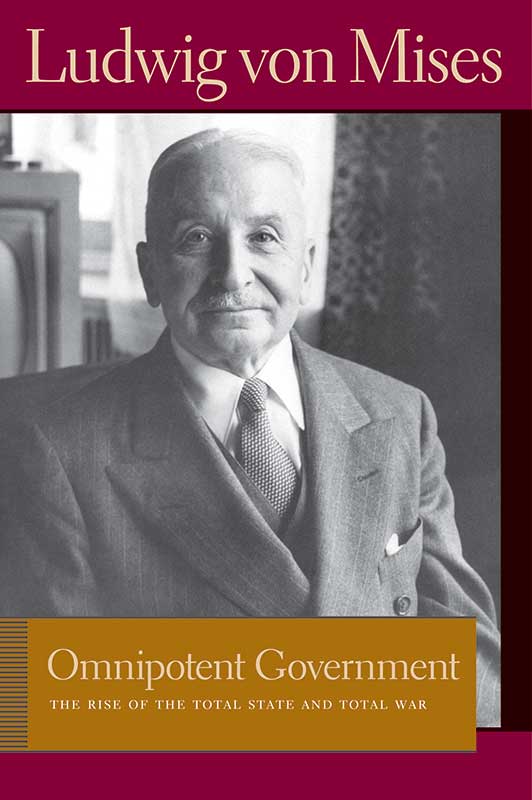
6.: Interventionism - Ludwig von Mises, Omnipotent Government: The Rise of the Total State and Total War [1944]

Edition used:

Omnipotent Government: The Rise of the Total State and Total War, edited with a Foreword by Bettina Bien Greaves (Indianapolis: Indiana, 2011).

About Liberty Fund:

Liberty Fund, Inc. is a private, educational foundation established to encourage the study of the ideal of a society of free and responsible individuals.


6.

Interventionism

All civilizations have up to now been based on private ownership of the means of production. In the past civilization and private ownership have been linked together. If history could teach us anything, it would be that private property is inextricably linked with civilization.

Governments have always looked askance at private property. Governments are never liberal from inclination. It is in the nature of the men handling the apparatus of compulsion and coercion to overrate its power to work, and to strive at subduing all spheres of human life to its immediate influence. Etatism is the occupational disease of rulers, warriors, and civil servants. Governments become liberal only when forced to by the citizens.

From time immemorial governments have been eager to interfere with the working of the market mechanism. Their endeavors have never attained the ends sought. People used to attribute these failures to the inefficacy of the measures applied and to the leniency of their enforcement. What was wanted, they thought, was more energy and more brutality; then success would be assured. Not until the eighteenth century did men begin to understand that interventionism is necessarily doomed to fail. The classical economists demonstrated that each constellation of the market has a corresponding price structure. Prices, wages, and interest rates are the result of the interplay of demand and supply. There are forces operating in the market which tend to restore this—natural—state if it is disturbed. Government decrees, instead of achieving the particular ends they seek, tend only to derange the working of the market and imperil the satisfaction of the needs of the consumers.

In defiance of economic science the very popular doctrine of modern interventionism asserts that there is a system of economic coöperation, feasible as a permanent form of economic organization, which is neither capitalism nor socialism. This third system is conceived as an order based on private ownership of the means of production in which, however, the government intervenes, by orders and prohibitions, in the exercise of ownership rights. It is claimed that this system of interventionism is as far from socialism as it is from capitalism; that it offers a third solution of the problem of social organization; that it stands midway between socialism and capitalism; and that while retaining the advantages of both it escapes the disadvantages inherent in each of them. Such are the pretensions of interventionism as advocated by the older German school of etatism, by the American Institutionalists, and by many groups in other countries. Interventionism is practiced—except for socialist countries like Russia and Nazi Germany—by every contemporary government. The outstanding examples of interventionist policies are the Sozialpolitik of imperial Germany and the New Deal policy of present-day America.

Marxians do not support interventionism. They recognize the correctness of the teachings of economics concerning the frustration of interventionist measures. In so far as some Marxian doctrinaires have recommended interventionism they have done so because they consider it an instrument for paralyzing and destroying the capitalist economy, and hope thereby to accelerate the coming of socialism. But the consistent orthodox Marxians scorn interventionism as idle reformism detrimental to the interests of the proletarians. They do not expect to bring about the socialist utopia by hampering the evolution of capitalism; on the contrary, they believe that only a full development of the productive forces of capitalism can result in socialism. Consistent Marxians abstain from doing anything to interfere with what they deem to be the natural evolution of capitalism. But consistency is a very rare quality among Marxians. So most Marxian parties and the trade-unions operated by Marxians are enthusiastic in their support of interventionism.

A mixture of capitalist and socialist principles is not feasible. If, within a society based on private ownership of the means of production, some of these means are publicly owned and operated, this does not make for a mixed system which combines socialism and capitalism. The enterprises owned and operated by the state or by municipalities do not alter the characteristic features of a market economy. They must fit themselves, as buyers of raw materials, of equipment and of labor, and as sellers of goods and services, into the scheme of the market economy. They are subject to the laws determining production for the needs of consumers. They must strive for profits or, at least, to avoid losses. When the government tries to eliminate or to mitigate this dependence by covering the losses of its plants and shops by drawing on the public funds, the only result is that this dependence is shifted to another field. The means for covering the losses must be raised by the imposition of taxes. But this taxation has its effect on the market. It is the working of the market mechanism, and not the government collecting the taxes, that decides upon whom the incidence of the taxes falls and how it affects production and consumption. The market, not the government, determines the working of those publicly operated enterprises.

Nor should interventionism be confused with the German pattern of socialism. It is the essential feature of interventionism that it does not aim at a total abolition of the market; it does not want to reduce private ownership to a sham and the entrepreneurs to the status of shop managers. The interventionist government does not want to do away with private enterprise; it wants only to regulate its working through isolated measures of interference. Such measures are not designed as cogs in an all-round system of orders and prohibitions destined to control the whole apparatus of production and distribution; they do not aim at replacing private ownership and a market economy by socialist planning.

In order to grasp the meaning and the effects of interventionism it is sufficient to study the working of the two most important types of intervention: interference by restriction and interference by price control.

Interference by restriction aims directly at a diversion of production from the channels prescribed by the market and the consumers. The government either forbids the manufacture of certain goods or the application of certain methods of production, or makes such methods more difficult by the imposition of taxes or penalties. It thus eliminates some of the means available for the satisfaction of human needs. The best-known examples are import duties and other trade barriers. It is obvious that all such measures make the people as a whole poorer, not richer. They prevent men from using their knowledge and ability, their labor and material resources as efficiently as they can. In the unhampered market forces are at work tending to utilize every means of production in a way that provides for the highest satisfaction of human wants. The interference of the government brings about a different employment of resources and thereby impairs the supply.

We do not need to ask here whether some restrictive measures could not be justified, in spite of the diminution of supply they cause, by advantages in other fields. We do not need to discuss the problem of whether the disadvantage of raising the price of bread by an import duty on wheat is outweighed by the increase in income of domestic farmers. It is enough for our purpose to realize that restrictive measures cannot be considered as measures of increasing wealth and welfare, but are instead expenditures. They are, like subsidies which the government pays out of the revenue collected by taxing the citizens, not measures of production policy but measures of spending. They are not parts of a system of creating wealth but a method of consuming it.

The aim of price control is to decree prices, wages, and interest rates different from those fixed by the market. Let us first consider the case of maximum prices, where the government tries to enforce prices lower than the market prices.

The prices set on the unhampered market correspond to an equilibrium of demand and supply. Everybody who is ready to pay the market price can buy as much as he wants to buy. Everybody who is ready to sell at the market price can sell as much as he wants to sell. If the government, without a corresponding increase in the quantity of goods available for sale, decrees that buying and selling must be done at a lower price, and thus makes it illegal either to ask or to pay the potential market price, then this equilibrium can no longer prevail. With unchanged supply there are now more potential buyers on the market, namely, those who could not afford the higher market price but are prepared to buy at the lower official rate. There are now potential buyers who cannot buy, although they are ready to pay the price fixed by the government or even a higher price. The price is no longer the means of segregating those potential buyers who may buy from those who may not. A different principle of selection has come into operation. Those who come first can buy; others are too late in the field. The visible outcome of this state of things is the sight of housewives and children standing in long lines before the groceries, a spectacle familiar to everybody who has visited Europe in this age of price control. If the government does not want only those to buy who come first (or who are personal friends of the salesman), while others go home empty-handed, it must regulate the distribution of the stocks available. It has to introduce some kind of rationing.

But price ceilings not only fail to increase the supply, they reduce it. Thus they do not attain the ends which the authorities wish. On the contrary, they result in a state of things which from the point of view of the government and of public opinion is even less desirable than the previous state which they had intended to alter. If the government wants to make it possible for the poor to give their children more milk, it has to buy the milk at the market price and sell it to these poor parents with a loss, at a cheaper rate. The loss may be covered by taxation. But if the government simply fixes the price of milk at a lower rate than the market, the result will be the contrary of what it wants. The marginal producers, those with the highest costs, will, in order to avoid losses, go out of the business of producing and selling milk. They will use their cows and their skill for other, more profitable purposes. They will, for example, produce cheese, butter, or meat. There will be less milk available for the consumers, not more. Then the government has to choose between two alternatives: either to refrain from any endeavors to control the price of milk and to abrogate its decree, or to add to its first measure a second one. In the latter case it must fix the prices of the factors of production necessary for the production of milk at such a rate that the marginal producers will no longer suffer losses and will abstain from restricting the output. But then the same problem repeats itself on a remoter plane. The supply of the factors of production necessary for the production of milk drops, and again the government is back where it started, facing failure in its interference. If it keeps stubbornly on, pushing forward its schemes, it has to go still further. It has to fix the prices of the factors of production necessary for the production of those factors of production which are needed for the production of milk. Thus the government is forced to go further and further, fixing the prices of all consumer goods and of all factors of production—both human (i.e., labor) and material—and to force every entrepreneur and every worker to continue work at these prices and wages. No branch of industry can be omitted from this all-round fixing of prices and wages and from this general order to produce those quantities which the government wants to see produced. If some branches were to be left free, the result would be a shifting of capital and labor to them and a corresponding fall of the supply of goods whose prices the government has fixed. However, it is precisely these goods which the government considers especially important for the satisfaction of the needs of the masses.*

But when this state of all-round control of business is achieved, the market economy has been replaced by the German pattern of socialist planning. The government’s board of production management now exclusively controls all business activities and decides how the means of production—men and material resources—must be used.

The isolated measures of price fixing fail to attain the ends sought. In fact, they produce effects contrary to those aimed at by the government. If the government, in order to eliminate these inexorable and unwelcome consequences, pursues its course further and further, it finally transforms the system of capitalism and free enterprise into socialism.

Many American and British supporters of price control are fascinated by the alleged success of Nazi price control. They believe that the German experience has proved the practicability of price control within the framework of a system of market economy. You have only to be as energetic, impetuous, and brutal as the Nazis are, they think, and you will succeed. These men who want to fight Nazism by adopting its methods do not see that what the Nazis have achieved has been the building up of a system of socialism, not a reform of conditions within a system of market economy.

There is no third system between a market economy and socialism. Mankind has to choose between those two systems—unless chaos is considered an alternative.*

It is the same when the government takes recourse to minimum prices. Practically the most important case of fixing prices at a higher level than that established on the unhampered market is the case of minimum wages. In some countries minimum wage rates are decreed directly by the government. The governments of other countries interfere only indirectly with wages. They give a free hand to the labor unions by acquiescing in the use of compulsion and coercion by unions against reluctant employers and employees. If it were otherwise strikes would not attain the ends which the trade-unions want to attain. The strike would fail to force the employer to grant higher wages than those fixed by the unhampered market, if he were free to employ men to take the place of the strikers. The essence of labor-union policy today is the application or threat of violence under the benevolent protection of the government. The unions represent, therefore, a vital part of the state apparatus of compulsion and coercion. Their fixing of minimum wage rates is equivalent to a government intervention establishing minimum wages.

The labor unions succeed in forcing the entrepreneurs to grant higher wages. But the result of their endeavors is not what people usually ascribe to them. The artificially elevated wage rates cause permanent unemployment of a considerable part of the potential labor force. At these higher rates the marginal employments for labor are no longer profitable. The entrepreneurs are forced to restrict output, and the demand on the labor market drops. The unions seldom bother about this inevitable result of their activities; they are not concerned with the fate of those who are not members of their brotherhood. But it is different for the government, which aims at the increase of the welfare of the whole people and wants to benefit not only union members but all those who have lost their jobs. The government wants to raise the income of all workers; that a great many of them cannot find employment is contrary to its intentions.

These dismal effects of minimum wages have become more and more apparent the more trade-unionism has prevailed. As long as only one part of labor, mostly skilled workers, was unionized, the wage rise achieved by the unions did not lead to unemployment but to an increased supply of labor in those branches of business where there were no efficient unions or no unions at all. The workers who lost their jobs as a consequence of union policy entered the market of the free branches and caused wages to drop in those branches. The corollary of the rise in wages for organized workers was a drop in wages for un-organized workers. But with the spread of unionism conditions have changed. Workers now losing their jobs in one branch of industry find it harder to get employment in other lines. They are victimized.

There is unemployment even in the absence of any government or union interference. But in an unhampered labor market there prevails a tendency to make unemployment disappear. The fact that the unemployed are looking for jobs must result in fixing wage rates at a height which makes it possible for the entrepreneurs to employ all those eager to work and to earn wages. But if minimum wage rates prevent an adjustment of wage rates to the conditions of demand and supply, unemployment tends to become a permanent mass phenomenon.

There is but one means to make market wage rates rise for all those eager to work: an increase in the amount of capital goods available which makes it possible to improve technological methods of production and thereby to raise the marginal productivity of labor. It is a sad fact that a great war, in destroying a part of the stock of capital goods, must result in a temporary fall in real wage rates, when the shortage of man power brought about by the enlistment of millions of men is once overcome. It is precisely because they are fully aware of this undesirable consequence that liberals consider war not only a political but also an economic disaster.

Government spending is not an appropriate means to brush away unemployment. If the government finances its spending by collecting taxes or by borrowing from the public, it curtails the private citizens’ power to invest and to spend to the same extent that it increases its own spending capacity. If the government finances its spending by inflationary methods (issue of additional paper money or borrowing from the commercial banks) it brings about a general rise of commodity prices. If then money wage rates do not rise at all or not to the same extent as commodity prices, mass unemployment may disappear. But it disappears precisely because real wage rates have dropped.

Technological progress increases the productivity of human effort. The same amount of capital and labor can now produce more than before. A surplus of capital and labor becomes available for the expansion of already existing industries and for the development of new ones. “Technological unemployment” may occur as a transitory phenomenon. But very soon the unemployed will find new jobs either in the new industries or in the expanding old ones. Many millions of workers are today employed in industries which were created in the last decades. And the wage earners themselves are the main buyers of the products of these new industries.

There is but one remedy for lasting unemployment of great masses: the abandonment of the policy of raising wage rates by government decree or by the application or the threat of violence.

Those who advocate interventionism because they want to sabotage capitalism and thereby finally to achieve socialism are at least consistent. They know what they are aiming at. But those who do not wish to replace private property by German Zwangswirtschaft or Russian Bolshevism are sadly mistaken in recommending price control and labor-union compulsion.

The more cautious and sophisticated supporters of interventionism are keen enough to recognize that government interference with business fails in the long run to attain the ends sought. But, they assert, what is needed is immediate action, a short-run policy. Interventionism is good because its immediate effects are beneficial, even if its remoter consequences may be disastrous. Do not bother about tomorrow; only today counts. With regard to this attitude two points must be emphasized: (1) today, after years and decades of interventionist policies, we are already confronted with the long-run consequences of interventionism; (2) wage interventionism is bound to fail even in the short run, if not accompanied by corresponding measures of protectionism.

[* ]For the two situations in which price-control measures can be used effectively within a narrowly confined sphere, the reader is referred to Mises’s Nationalökonomie, pp. 674–675. [See Human Action (1949), 3rd (1966), 4th (1996), and Liberty Fund (2007) editions, pp. 765–766.—Ed.]

[* ]We pass over the fact that, because of the impossibility of economic calculation under it, socialism too must result in chaos.