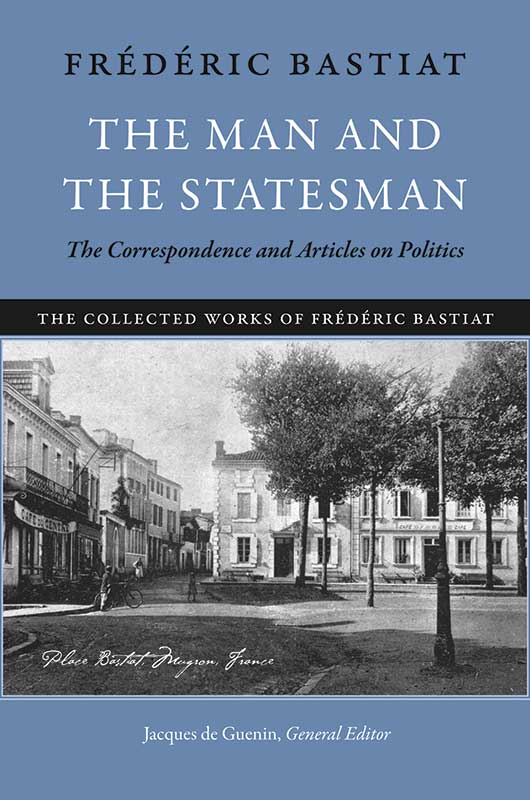
Part of: The Collected Works of Frédéric Bastiat, in 6 Vols. The Collected Works of Frédéric Bastiat. Vol. 1: The Man and the Statesman: The Correspondence and Articles on Politics
- Frédéric Bastiat (author)
- Dennis O’Keeffe (editor)
- Jacques de Guenin (editor)
- Jean-Claude Paul-Dejean (editor)
- David M. Hart (editor)
Vol. 1 of a 6 vol. collection of the works of the 19th century French political economist Frédéric Bastiat. This volume contains 209 letters and a selection of his articles on politics. A detailed glossary contains information about the people, institutions, and ideological issues of his day.
Additional information about the Bastiat translation project can be found at the Bastiat Project Summary page.
Key Quotes
Free Trade
What immense good our journal might do if it contrasted the inanity and danger of current policy with the grandeur and security of free-trade policies! Before the journal was founded, I had a plan to publish a small book each month in the same mold as the Sophisms, in which I would have free rein.…
Free Trade
Like you I love all forms of freedom; and among these, the one that is the most universally useful to mankind, the one you enjoy at each moment of the day and in all of life’s circumstances, is the freedom to work and to trade. I know that making things one’s own is the fulcrum of society and even…
Politics & Liberty
We may be distressed to see writers delight in stirring up all forms of evil passion. However, to hobble the press is also to hobble truth as well as lies. Let us, therefore, take care never to allow the freedom of the press to die. It is distressing that man should be reduced to earning his bread…
Politics & Liberty
So, as we have said, two systems (of reform) , discussed at length by polemicists, now confront one another. One aspires to create the happiness of the people through direct measures. It says: “If someone suffers in any way, the state will be responsible for relieving him. It will give bread,…
Politics & Liberty
When we go through the streets of Paris, which are scarcely wide enough to contain the throngs of people, and remember that in this immense metropolis at this moment there is no king, no court, no municipal guard, no troops, and no civil administration other than that exercised by the citizens over…
Parties & Elections
All the newspapers, without exception, are speaking out against the scramble for office of which the Town Hall is given a sad example. Nobody could be more indignant about, or more disgusted by, this frenzied greed than we. But at the end of the day we have to find the cause of the evil, and it…
Economics
Laissez-faire! I will begin by saying, in order to avoid any ambiguity, that laissez-faire is used here for honest things, with the state instituted precisely to prevent dishonest things. This having been said, and with regard to things that are innocent in themselves, such as work, trade,…
Food & Drink
The 5th (August) at midnight I was expecting blood but it was only wine that was spilt. The citadel has displayed the tricolor flag. The military containment of the Midi and Toulouse has decided that of Bayonne; the regiments down there have displayed the flag. The traitor J—— thus saw that the…