EconlibThe LibraryOther Sites |
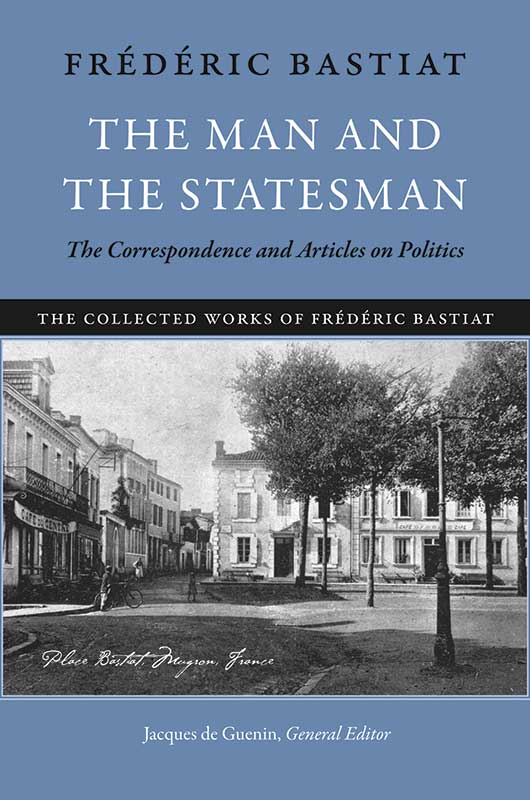
Front Page Titles (by Subject) The Collected Works of Frédéric Bastiat Volume 1 - The Collected Works of Frédéric Bastiat. Vol. 1: The Man and the Statesman: The Correspondence and Articles on Politics
Return to Title Page for The Collected Works of Frédéric Bastiat. Vol. 1: The Man and the Statesman: The Correspondence and Articles on PoliticsThe Online Library of LibertyA project of Liberty Fund, Inc.Search this Title:Also in the Library:
The Collected Works of Frédéric Bastiat Volume 1 - Frédéric Bastiat, The Collected Works of Frédéric Bastiat. Vol. 1: The Man and the Statesman: The Correspondence and Articles on Politics [2011]Edition used:The Collected Works of Frédéric Bastiat. Vol. 1: The Man and the Statesman: The Correspondence and Articles on Politics, translated from the French by Jane and Michel Willems, with an introduction by Jacques de Guenin and Jean-Claude Paul-Dejean. Annotations and Glossaries by Jacques de Guenin, Jean-Claude Paul-Dejean, and David M. Hart. Translation editor Dennis O’Keeffe (Indianapolis: Liberty Fund, 2011).
Part of: The Collected Works of Frédéric Bastiat, in 6 Vols.About Liberty Fund:Liberty Fund, Inc. is a private, educational foundation established to encourage the study of the ideal of a society of free and responsible individuals. Copyright information:The copyright to this edition, in both print and electronic forms, is held by Liberty Fund, Inc. Fair use statement:This material is put online to further the educational goals of Liberty Fund, Inc. Unless otherwise stated in the Copyright Information section above, this material may be used freely for educational and academic purposes. It may not be used in any way for profit.
The Collected Works of Frédéric BastiatJacques de Guenin, General Editor The Man and the Statesman: The Correspondence and Articles on Politics “The Law,” “The State,” and Other Political Writings, 1843-1850 Economic Sophisms and “What Is Seen and What Is Not Seen” Miscellaneous Works on Economics: From “Jacques-Bonhomme” to Le Journal des Économistes Economic Harmonies The Struggle Against Protectionism: The English and French Free-Trade Movements ![]() Frédéric Bastiat General Editor’s NoteAlthough the Guillaumin edition was generally chronological, the volumes in this series have been arranged thematically: The Man and the Statesman: The Correspondence and Articles on Politics “The Law,” “The State,” and Other Political Writings, 1843-1850 Economic Sophisms and “What Is Seen and What Is Not Seen” Miscellaneous Works on Economics: From “Jacques-Bonhomme” to Le Journal des Économistes Economic Harmonies The Struggle Against Protectionism: The English and French Free-Trade Movements The initial Guillaumin edition of the Œuvres complètes, published shortly after Bastiat’s death, comprised six volumes. Later on, Prosper Paillottet, Bastiat’s editor and executor, inherited a number of unpublished letters and articles, some of which were drafts, sometimes not even complete, but always meaningful enough to be of interest. After due consultation with Bastiat’s intellectual friends, including Richard Cobden, Paillottet decided to publish everything in a seventh volume. The drafts themselves were regrouped under the heading ébauches (drafts), and this volume contains some of them. In the text, Bastiat (and Paillottet in the notes) makes many passing references to his works, for which we have provided an internal cross-reference if the work is found in this volume. For those works not in this volume, we have provided the location of the original French version in the Œuvres complètes (indicated in a footnote by “OC,” followed by the Guillaumin volume number, beginning page number, and French title of the work). In order to avoid multiple footnotes and cross-references, three glossaries have been provided for the identification of the persons, places, and subjects and terms mentioned in the text that were important to Bastiat in his time. The glossaries also provide historical context and background for the reader as well as a greater understanding of Bastiat’s work. If a name as it appears in the text is ambiguous or is in the Glossary of Persons under a different name, a brief footnote has been added to the text to identify the name as it is listed in the glossary. It should be remembered that when the Guillaumin edition was issued a number of people who knew Bastiat personally were still alive. The ellipses added by Paillottet, which precede or end some letters and which signal the omission of expressions of politeness or affection, have been reproduced in this edition. Ellipses are also used to indicate either a missing portion of the drafts or a deliberate cut by Paillottet when he thought that the passage in question was too private in nature. Finally, original italics as they appear in the Guillaumin edition have been retained. Jacques de Guenin Note on the TranslationIn this translation we have made a deliberate decision not to translate Frédéric Bastiat’s French into modern, colloquial American English. Wherever possible we have tried to retain a flavor of the more florid, Latinate forms of expression that were common among the literate class in mid-nineteenth-century France. Bastiat liked long, flowing sentences, in which idea followed upon idea in an apparently endless succession of dependent clauses. For the sake of clarity, we have broken up many but not all of these thickets of expression. In those that remain, you, dear reader, will have to navigate. As was the custom in the 1840s, Bastiat liked to pepper his paragraphs with exclamations like “What!” and aphoristic Latin phrases like Quid leges sine moribus? (What are laws without customs?). We have translated the latter and left most of the former as a reminder that this was written in a bygone age when tastes were very different. We have also kept personal names, titles of nobility, and the like in their original French if the persons were French; thus, “M.” instead of “Mr.”; “Mme” instead of “Mrs.”; “Mlle” instead of “Miss”; and “MM” instead of “Messrs.” Because Bastiat was a political theorist and an economist, he used many technical terms and expressions in his writings, some of which need explanation as they have no exact translation into today’s speech. One example is liberté, which could be translated as either “liberty” (if one wanted to retain a more eighteenth-century flavor) or “freedom” (if one wanted a more modern sense). We have used both depending on the context and how it sounded to our ears. Another is pouvoir, which we have variously translated as “power,” “government,” or “authority,” again depending on the context. A third example consists of the words économie politique and économiste. In both French and English throughout the eighteenth, and for most of the nineteenth, centuries, the term political economy was used to describe what we now call “economics.” Toward the end of the nineteenth century as economics became more mathematical, the adjective “political” was dropped and not replaced. We have preferred to keep the term political economy both because it was still current when Bastiat was writing and because it better describes the state of the discipline, which proudly mixed an interest in moral philosophy, history, and political theory with the main dish, which was economic analysis; similarly, with the term économiste. Today one can be a free-market economist, a Marxist economist, a Keynesian economist, a mathematical economist, an Austrian economist, or whatever. The qualifier before the noun is quite important. In Bastiat’s day it was assumed that any “economist” was a free-market economist, and so the noun needed no adjectival qualifier. Only during the 1840s, with the emergence of socialist ideas in France and Germany, did there emerge a school of economic thinking that sharply diverged from the free market. But in Bastiat’s day this had not yet become large enough to cause confusion over naming. Even in 1849, when Gustave de Molinari published his charming set of dialogues, Les Soirées de la rue St. Lazare, between three stock characters—the socialist, the conservative, and the economist—it was perfectly clear who was arguing for what, and that the economist was of course a laissez-faire, free-market economist. A particularly tricky word to translate is industrie, as is its related term industriel. In some respects it is a “false friend,” as one is tempted to translate it as “industry” or “industrious” or “industrial,” but this would be wrong because these terms have the more narrow modern meaning of “heavy industry” or “manufacturing” or “the result of some industrial process.” The meaning in Bastiat’s time was both more general and more specific to a particular social and economic theory current in his day. In the eighteenth century industry had the general meaning of “productive” or “the result of hard work,” and this sense continued to be current in the early nineteenth century. Industry also had a specific meaning, which was tied to a social and economic theory developed by Jean-Baptiste Say and his followers Charles Comte and Charles Dunoyer in the 1810s and 1820s, as well as by other theorists such as the historian Augustin Thierry. According to these theorists there were only two means of acquiring wealth: by productive activity and voluntary exchanges in the free market (i.e., industrie—which included agriculture, trade, factory production, and services) or by coercive means (conquest, theft, taxation, subsidies, protection, transfer payments, or slavery). Anybody who acquired wealth through voluntary exchange and productive activities belonged to a class of people collectively called les industrieux, in contrast to those individuals or groups who acquired their wealth by force, coercion, conquest, slavery, or government privileges. The latter group were seen as a ruling class or as “parasites” who lived at the expense of les industrieux. Bastiat was very much influenced by the theories of Say, Comte, and Dunoyer and adopted their terminology regarding industry. So to translate industrie in this intellectual context as “production” (or some other modern, neutral term) would be to ignore the resonance the word has with the social and economic theory that was central to Bastiat’s worldview. Hence, at the risk of sounding a bit archaic and pedantic, we have preferred to use industry in order to remain true to Bastiat’s intent. When Bastiat uses an English word or phrase, we have mentioned this in a footnote, with one exception: Bastiat frequently writes such terms as “free trade” and “free trader” in English, especially in his correspondence with Richard Cobden, and thus we have not noted these occurrences. A final note on terminology: in Bastiat’s time, the word liberal had the same meaning in France and in America. In the United States, however, the meaning of the word has shifted progressively toward the left of the political spectrum. A precise translation of the French word would be either “classical liberal” or “libertarian,” depending on the context, and indeed Bastiat is considered a classical liberal by present-day conservatives and a libertarian by present-day libertarians. To avoid the resulting awkwardness, we have decided by convention to keep the word liberal, with its nineteenth-century meaning, in the translations as well as in the notes and the glossaries. Note on the Editions of the Œuvres ComplètesAnother difference between the first and second editions was in the sixth volume, which contained Bastiat’s magnum opus, Economic Harmonies. The first edition of the Œuvres complètes described volume 6 as the “third revised and augmented edition” of Economic Harmonies. This is somewhat confusing but does have some logic to it. The “first” edition of Economic Harmonies appeared in 1850 during the last year of Bastiat’s life but in an incomplete form. The “second” edition appeared in 1851, after his death, edited by La Société des amis de Bastiat (most probably by Prosper Paillottet and Roger de Fontenay) and included the second half of the manuscript, which Bastiat had been working on when he died. Thus the edition that appeared in the first edition of the Œuvres complètes was called the “third” edition on its title page. This practice continued throughout the nineteenth century, with editions of Economic Harmonies staying in print as a separate volume as well as being included as volume 6 in later editions of the Œuvres complètes. By 1870-73, therefore, when the third edition of the Œuvres complètes appeared, the version of Economic Harmonies that appeared in volume 6 was titled the “sixth” edition of the work. Other “editions” of the Œuvres complètes include a fourth edition, 1878-79, and a fifth edition, 1881-84. If there was a sixth edition, the date is unknown. A seventh edition appeared in 1893, and a final edition may have appeared in 1907. (For a complete listing of the editions of the Œuvres complètes that were used in making this translation, see the bibliography.) AcknowledgmentsThe Man and the Statesman is the first volume of an English-language edition of the complete works of Frédéric Bastiat. The translation and editorial matter in this book and in the forthcoming volumes are the result of the efforts of a Franco-American team whom I have had the honor to coordinate and whose work I have reviewed at every step. Jane Willems and Michel Willems were the initial translators; Jean-Claude Paul-Dejean, a historian of Bastiat, his epoch, and his surroundings, prepared the initial drafts of the notes and glossaries. The notes were adapted and translated by me; my English was reviewed by Diana Dupuy, of English origin, who in 2001 translated “To the Electors of the District of Saint-Sever” for the Foundation for Economic Education to commemorate the two-hundredth anniversary of the birth of Bastiat. Dr. Dennis O’Keeffe, Professor of Social Science at the University of Buckingham and Senior Research Fellow at the Institute of Economic Affairs in London, carefully read the translation and made very helpful suggestions at every stage. Dr. David Hart, Director of the Online Library of Liberty Project at Liberty Fund, further reviewed the translations. As an expert in eighteenth- and nineteenth-century European economists, he considerably enriched the notes related to the said economists and provided much of the scholarly apparatus. Aurelian Craiutu, Professor of Political Science at Indiana University, Bloomington, reviewed the final translations with Dr. Hart and contributed his considerable knowledge of nineteenth-century French politics to the review of the translation. Last but not least, Dr. Laura Goetz, Senior Editor at Liberty Fund, my constant correspondent on the other side of the Atlantic, organized and coordinated with me the various aspects of the project from its inception through to final manuscript. This volume has thus all the strength and weaknesses of a voluntary, collaborative effort. We hope Bastiat would approve, especially as no government official was involved at any stage. Jacques de Guenin General IntroductionAs in the title of his last publication, What Is Seen and What Is Not Seen, Bastiat’s life contains both “seen” and “unseen” elements. What was readily “seen” by his contemporaries was the arrival in 1844 of a somewhat rustic inhabitant from the provinces into the circle of the sophisticated and urbane Parisian free-market economists. In just a few short years, before his early death in 1850, Bastiat had made a profound impact on French intellectual and political life as a theoretician, a pamphleteer, a journalist, and a deputy (member of Parliament). What is not so readily apparent, either to his contemporaries or to modern readers, is the history of the man before his sudden arrival in Paris. The present volume, most of which has never been translated into English before, attempts to fill that gap in our understanding—from exploring how Bastiat’s origins in a small French country village shaped his self-image to discovering how the economic turmoil of the Napoleonic wars adversely affected his family’s fortunes; how his early education contributed to the development of his uniquely inquiring mind; how his discovery of the ideas of Jean-Baptiste Say in the early Restoration period and the English Anti-Corn Law League in the early 1840s led him to become the leading advocate of free trade in France; and how a gentleman farmer became a politician on the national stage during the 1848 revolution. The “Unseen” Bastiat: Life in the Provinces (1801-44)The Bastiat family came from Laurède, a small village in the county of Mugron in an area of the département of the Landes called La Chalosse. Bastiat’s great-grandfather, who had been a landowner, settled in Mugron in order to open a trading business. Around 1760 Pierre Bastiat, Frédéric’s grandfather, following in the family footsteps, also established a trading house, this time in Bayonne, with his son, also named Pierre, and his son-in-law Henri Monclar. The business benefited from the franchise granted to the port of Bayonne in 1784 that enabled merchants to supply French and Spanish wines to Holland and to trade wool with Spain and Portugal. Like many constitutionally minded liberals of the time, Pierre Bastiat initially approved of the events of the early stage of the French Revolution but came to oppose the Terror. Nevertheless, he took advantage of the forced sale of aristocratic property to purchase his own estate, in 1794, acquiring a domain called Sengresse, near Mugron, with a manor house and twelve sharecropping farms, thus strengthening the economic position of the Bastiat family in the Chalosse region. In 1800 Pierre fils married a young woman from Bayonne with whom he had two children: a son, Frédéric, in 1801, and later a daughter who died soon after birth. But their economic prosperity was short-lived. Napoléon’s continental blockade (1806), which was designed to bring England to its knees by preventing British goods from being sold in Europe; the naval war between Britain and France; the French invasion and occupation of Spain (1808); and the British counterattack through Portugal all severely disrupted Bayonne’s commerce, with its close ties to England and Spain, and created serious problems for the Bastiat-Monclar family trading business. To compound the family’s economic crisis, Frédéric’s parents caught tuberculosis. His mother and grandmother both died in 1808, when he was only seven. His grandfather left the management of the family business to Henri Monclar and retired with his daughter Justine to the Mugron house, taking with him young Frédéric and his father, who died soon after. So, by the age of nine, Frédéric had lost both his mother and his father. He was subsequently brought up by his grandfather and his aunt Justine, a kind, intelligent, and devoted woman, who became his surrogate mother. Bastiat’s ChildhoodFrédéric was a lively child, precocious and gifted, at ease in every circumstance. Perhaps to ensure that his talents were not left undeveloped, Justine decided that he should have an excellent education. She sent him first to the high school in nearby Saint-Sever; however, upon discovering that the education there was mediocre, she sent him in 1814 to one of the most prestigious schools of the time, the high school of Sorèze, near Carcassonne, in the département of Le Tarn. In 1791 the school, a former royal military school, privatized during the Revolution, came under the management of two brothers, François and Raymond-Dominique Ferlus, who introduced educational reforms from which Bastiat was to benefit greatly. The first reform was to enroll pupils from different social, religious, geographical, and cultural backgrounds in order to create a truly cosmopolitan and tolerant environment for learning. Pupils came from several European countries and even as far away as the United States. This is not surprising given the strong connections between the new American republic and France, typified by Thomas Jefferson’s love of French literature and political and economic thought. In addition, by employing a Catholic as well as a Protestant chaplain to minister to students of both denominations, the school exemplified in a day-to-day practical manner the notion that different religious groups could flourish and learn side by side. The second educational reform at Bastiat’s school was the “modernization” of the curriculum to include the study of modern languages. Latin and Greek, so-called dead languages, were minimized in favor of English, German, Italian, and Spanish. Science, mathematics, and accounting introduced the students to practical economic reasoning; the vigorous and open debate of philosophical matters encouraged students to debate ideas while respecting others and developing intellectual agility. Sports and music were also part of the curriculum—Bastiat excelled at sprinting and riding; he also studied the cello, which he continued to play throughout his life. In sum, Bastiat was exposed to a rounded and truly “liberal” education. The third educational reform was the innovative method of teaching. For example, pupils were encouraged to engage in collaborative learning, which led to Bastiat and his friend Victor Calmètes jointly winning first prize in poetry in 1818. Unfortunately, Bastiat was unable to complete his education and to graduate with a baccalaureate. At the age of seventeen he was forced to leave Sorèze in order to return to Bayonne to help his uncle, Henri Monclar, with the family business. Nevertheless, his experience at the school, which exposed him to a cosmopolitan, tolerant, and business-oriented environment, profoundly affected him throughout his life. Bastiat’s Discovery of Political EconomyDuring his nearly seven years in Bayonne, Bastiat continued to broaden his intellectual horizons. He studied business law and read the works of the economists Adam Smith and Jean-Baptiste Say and the philosopher Pierre Laromiguière. The ideas of Say were especially important at this time and, furthermore, had a personal relevance for Bastiat. Bayonne, a once-thriving port, was in decline in part because of the protectionist regime established by the restored monarchy after 1815. Like Bastiat, Say had started out as a businessman (a textile manufacturer) and, like Bastiat, had experienced the effects of protectionism under the continental blockade and the disruptions of the Napoleonic wars. Say’s major work, Traité d’économie politique (Treatise of Political Economy), first published in 1803, was expanded and a new edition was published in 1814, in time to influence a rising generation of post-Napoleonic French liberals like Bastiat. For example, lawyer Charles Comte and journalist Charles Dunoyer both used Say’s ideas to develop a theory of “industrialism,” whereby a new era of unfettered commerce and industry was about to supplant the era of protectionism and warfare, which they believed had passed away with the fall of Napoléon. At this time Bastiat also joined a Masonic lodge, La Zélée, which promoted ideals of virtue, tolerance, and liberalism similar to those he had encountered in Sorèze. He also acquired many contacts at the lodge, such as the banker Jacques Laffitte, who became a friend of the family and later minister of finance and prime minister under Louis-Philippe. In 1824, when Bastiat was twenty-four, his grandfather died, and Bastiat inherited three of the sharecropping farms of Sengresse. Chalosse was a region of mixed farming, in which the only commercial activities were the sale of wine and a few head of cattle. Like many reform-minded landowners before him, Bastiat hoped to increase output and thus profits by replacing the traditional three-year crop rotation (wheat was grown on a third of the land, corn on another third, and the last third was left as fallow) with a two-year rotation, by leaving out the year of fallow. He devoted twenty-five acres to the experiment and engaged the help of the most gifted of his sharecroppers’ sons. His experiments were not successful, however, and he eventually abandoned his efforts, leaving the sharecroppers to cultivate his land in their own traditional way. When he was not engaged in agricultural reform, Bastiat spent much time with his friend Félix Coudroy reading not only the works of Comte and Dunoyer but also those of Benjamin Franklin and Antoine Destutt de Tracy, and discussing their ideas during long walks in the countryside. Bastiat was deeply influenced by Comte’s work, in particular, the Traité de législation (The Treatise of Legislation) (1827; rev. ed., 1835), which he described as “the book that tells you the most, and makes you think most.” One can only wonder at the directions taken in the animated conversations between the two friends as they walked about Bastiat’s recently acquired estate. Bastiat’s First Foray into PoliticsWith the downfall of King Charles X in the revolution of July 1830, Bastiat inserted himself into the political turmoil on the side of the constitutional monarchy. He traveled to Bayonne to try to win over the garrison to the cause of the revolution. He asserted that “our cause is triumphing, the nation is admirable, people are going to be happy.” Although he was a supporter of democracy and sought the return of a republic, Bastiat eventually rallied behind the constitutional monarchy of Louis-Philippe, the July Monarchy, which would last from 1830 until its overthrow in yet another revolution in 1848. Following the 1830 revolution, Bastiat felt confident enough in the future to increase the size of his estate and to begin a new career as justice of the peace. In 1831 he purchased four sharecropping farms, which increased the size of the Sengresse estate by some 25 percent. Because Bastiat did not have the money to pay for the farms on his own, he married Clotilde Hiard, a wealthy heiress.1 In the same year, at the age of twenty-nine, Bastiat was appointed justice of the peace for the county of Mugron, a post he retained until 1846. He carried out his duties with considerable skill, showing common sense, an eye for the quick and efficient solution of disputes, and surprising competence for someone who did not have any formal legal training. His reputation was such that litigants from outside his geographical, or even legal, jurisdiction sought him out to resolve their disputes. His success as justice of the peace led to further activities that cemented his growing reputation as one of the leading citizens of Mugron. In 1833 he was elected general counselor of the county of Mugron, a position to which he was reelected three times until his death in 1850. He showed an interest in everything likely to favor the economic development of the area, in particular a project for a canal alongside the Adour River, about which he published a number of articles. He also fought against the excessive taxation of wine and spirits, which he believed was causing a crisis in the wine industry in the Chalosse region, and against protectionism, which impeded the export of wine. Other activities that engaged Bastiat during this period included membership in the local Landes agricultural society, the creation of a school for sharecroppers’ children (which was ultimately unsuccessful), the organization of the local wine growers, and the writing of articles for the local press. Between 1843 and 1845, he wrote many articles in the Bayonne press that foreshadowed the main themes on free trade that were later to make him famous as the leading advocate of free trade in France.2 Bastiat Discovers Richard Cobden and the Anti-Corn Law LeagueIn Bastiat’s time, Mugron was a busy port on the Adour River with a population of twenty-two hundred. The relative prosperity and cosmopolitan nature of the town was reflected in its educated bourgeoisie, who enjoyed gathering at “The Academy,” a popular club, to discuss various philosophical, political, and economic subjects. Not surprisingly, Bastiat and Coudroy were frequent visitors. One day, in 1844, one of the more anglophobic members of the club furiously brandished a newspaper under Bastiat’s nose, showing translated extracts from a recent speech by Sir Robert Peel, the British prime minister, to Parliament. The translation ended thus: “We will not adopt this measure. If we did, we would fall, like France, to the lowest rank of all the nations.” Bastiat was so surprised that a British prime minister would make such a gratuitous statement about France in Parliament that he bought a subscription to the English newspaper, the Globe and Traveller, in order to see for himself. Some time later, Bastiat was able to read Peel’s speech in the original English and discovered that the words “like France” were not there. It had been a mistranslation into French by a perhaps hostile, anti-British newspaper editor. It was while tracking down this mistranslation of Peel’s speech that Bastiat came across reports in the English press of Richard Cobden’s rapidly growing, popular free-trade movement, the Anti-Corn Law League, a movement that was largely ignored by the French press. For Cobden and his associates in the Anti-Corn Law League, the aim of the campaign was to abolish the protectionist laws that prevented the free import of “corn” (wheat)3 and to introduce a regime of free trade. One of the driving forces behind the free-trade movement was the inadequate harvest of 1844, which had left many poor people short of food, even starving. The British landowning aristocracy, wishing to maintain high domestic prices for wheat, did not want to open the borders to cheaper foreign wheat. Bastiat’s family had personally suffered under protectionism, and he had read and discussed the ideas of the leading economic theorists on the benefits of free trade, but reading about the success of Cobden’s popular movement against protectionism in the British press had galvanized Bastiat. He wished to emulate the Anti-Corn Law League in France. He began by writing a long article, “On the Influence of French and English Tariffs on the Future of the Two Peoples.” The conclusion was clear to Bastiat: England, on the verge of setting up free trade, was going to enjoy increasing prosperity, while France, constrained by protectionism, was going to decline hopelessly. He sent the article to the leading French economics journal, Le Journal des économistes, without much hope that it would be published. However, it was published and became an instant success in the circle of free-market economists in Paris.4 Bastiat was immediately invited to Paris by the foremost French economists of the time, who recognized in him one of their peers. The “Seen” Bastiat (1844-50)So Bastiat moved to Paris. “I must quit Mugron. I must separate myself from those I love,” wrote Bastiat to Coudroy. “But there is life in Paris only, and one vegetates elsewhere.” In addition to his association with the economists, he became friends with the Cheuvreux family, who hosted a salon. We have an amusing description of the newly arrived provincial Bastiat by Mme Cheuvreux, who carefully notes the un-Parisian cut of his clothes: There I saw Bastiat fresh from the Great Landes present himself at M. Say’s5 home. His attire was so conspicuously different from those surrounding him that the eye, however distracted, could not help but stare at him for a moment. The cut of his garments, due to the scissors of a tailor from Mugron, was far away from ordinary designs. Bright colors, poorly assorted, were placed next to one another, without any attempt at harmony. Floss-silk gloves covering his hands, playing with long white cuffs; a sharp collar covering half his face; a little hat, long hair; all that would have looked ludicrous had not the mischievous appearance of the newcomer, his luminous glance, and the charm of his conversation made one quickly forget the rest. Sitting in front of this countryman, I discovered that Bastiat was not only one of the high priests of the temple, but also a passionate initiator. What fire, what verve, what conviction, what originality, what winning and witty common sense! Through this cascade of clear ideas, of these displays, new and to the point, the heart was shown, the true soul of man revealed itself.6 Once settled in Paris, Bastiat directed his newly found passion for free trade into a campaign, modeled on that of the British Anti-Corn Law League, to enlighten the French public about the benefits of free trade and the steps being taken to achieve this on the other side of the Channel. Before he began the campaign in earnest, he wished to bring himself up to date with the latest developments in Britain. So he traveled to England, attended public meetings of the Anti-Corn Law League, and talked with its principal leaders, in particular Cobden, with whom he was to establish a lasting, trustful, and friendly relationship. The documentation he collected on that trip was summarized and translated in the book Cobden and the League, which was published in 1845. In Paris Bastiat felt very much at home among the circle of the free-market economists, or “Les Économistes,” as they called themselves. He began sending out a stream of vigorous articles full of corrosive wit and telling economic insights to the major Parisian and provincial newspapers. Many of these articles appeared individually in Le Journal des économistes and were soon republished in book form as Economic Sophisms. Their impact was considerable, and they were quickly translated into English, German, Italian, and Spanish. Toward the end of 1845 the Bordeaux Chamber of Commerce sought advice from Bastiat about the possibility of creating a movement to push for a customs union between France and Belgium. In a series of articles published in Le Mémorial bordelais, Bastiat argued that their energies would have greater impact if they campaigned more broadly for free trade, along the lines of the Anti-Corn Law League, rather than for a bilateral commercial treaty. The chamber took his advice and on 23 February 1846 (the same month in which the British Parliament voted to abolish the Corn Laws) a Bordeaux free-trade association was created, the first such association to be founded in France. A similar association was soon founded in Paris in July 1846, the Association pour la liberté des échanges, headed by François-Eugène Harcourt (duc d’Harcourt). Bastiat was very much the driving force behind this national free-trade association. He served as its general secretary; he was the editor of Le Libre échange, the association’s weekly paper; and he authored the association’s manifesto,7 which stated in the clearest possible terms that “exchange is a natural right, like property.” It was, however, a difficult task to emulate the success of the British Anti-Corn Law League. Bastiat followed the League’s strategy of organizing public meetings in Paris and some of the major towns, such as Lyons and Marseilles, but after a promising start the association’s membership began to stagnate and by the end of 1847 it was clear that the movement was not flourishing. In a letter to Cobden, Bastiat wrote that in France “instructing the masses is an impossible task, because they have neither the civic right, the habit, nor the liking for grand rallies and public discussion. This is one more reason for me to aim to gain contact with the most enlightened and influential classes through becoming a deputy.”8 This statement indicated a shift in Bastiat’s strategic thinking about the best way to campaign for free trade. If the grassroots approach, which had proven so successful in England, did not work in France, Bastiat was prepared to try something else, in this case standing for election to the Chamber of Deputies. Bastiat’s Political CareerAt the legislative elections of 1846, Bastiat ran against the government-supported candidate, Marie Gustave Larnac. In his “profession of faith,” or election manifesto,9 written to explain his position to the voters, Bastiat outlined his basic political and economic ideas: a government limited strictly to providing only justice, law-enforcement, and defense services; international free trade; freedom of education;10 and protection of property rights. He also criticized the tendency for governments to expand and spend, the excessive number of civil servants in parliament, and the frequent changes of government to satisfy the ambition of some members of parliament to become ministers. But in spite of the clarity and logic of his pamphlet, he was not elected. Another opportunity appeared after the revolutionary days of February 1848, which resulted in the downfall of the July Monarchy and the establishment of the Second Republic. Bastiat was elected in 1848 as deputy of the Landes to the Constituent Assembly and reelected in 1849 to the Legislative Assembly. For the next thirty months, in spite of declining health and family concerns, he worked feverishly as a member of parliament, a pamphleteer, and a theoretician. His parliamentary activities, especially as vice president of the finance committee, enabled him to work with many leading figures, such as the poet and historian Alphonse Lamartine, the novelist Victor Hugo, the political theorist and writer Alexis de Tocqueville, the anarchist and socialist Pierre-Joseph Proudhon, the Catholic priest and orator L’Abbé Jean-Baptiste-Henri Dominique Lacordaire, the future emperor Louis-Napoléon Bonaparte, and the socialist Louis Blanc. Bastiat’s desire was to help build a truly liberal republic, one that would avoid the utopian interventionism of the socialists on the “left” (such as the make-work schemes of the National Workshops) and the authoritarian tendencies of the conservatives of the “right” (who were encouraged by the election of Louis-Napoléon to the presidency of the Republic). Bastiat did not belong to any political party because, in the words of Léon Say, “He had too strong a personality to be a complete politician.” Bastiat chose to fight errors, especially economic errors, from wherever they came. Finding that both the left and the right often made serious errors concerning economic policy, Bastiat did not spare either side when it came to upholding his principles. “This is why on some occasions I had to vote with the left and on others with the right; with the left when it defended liberty and the Republic, with the right when it defended order and security.”11 Although elected vice president of the finance committee—an important position at a time of severe budgetary difficulties for the new government—Bastiat played a modest role, as he was not a naturally gifted public speaker. He was not quick at repartee, and his voice, which was weakened by the illness12 that would soon kill him, did not carry well in the often heated arguments that ensued. Bastiat gave speeches on such diverse subjects as postal reform and taxes, the repression of strikes, and conflicts of interest that result when civil servants or government officials also sit in parliament. He voted against such issues as the reintroduction of imprisonment for debt, the legal suits against Louis Blanc, and the 1.2-million-franc credit asked for by the executive for the purpose of sending a military expedition to Rome (supposedly to free the pope but in fact aimed at destroying the newly created Roman republic). If Bastiat’s true talents did not lie in public speaking, they did indeed lie in the brilliant essays and books that flowed from his pen in the last few years of his life. Among the most influential pamphlets were Protectionism and Communism; Capital and Rent; Peace and Freedom or the Republican Budget; Parliamentary Conflicts of Interest; Damned Money; Free Credit; Baccalaureate and Socialism; The State; Plunder and Law; The Law; and What Is Seen and What Is Not Seen. In these and other essays and pamphlets he fought the interventionist economic ideas of Adolphe Thiers, Joseph Proudhon, and Victor Considérant, among others. He also defended his own ideas on the natural organization of society; on the freedom to work, to exchange, and to seek an education; on the need for the limitation of public expenditure and the reduction of the state to its essential functions; on the adoption of a peaceful foreign policy based on disarmament of the navy and army; and on the possibilities of real social progress. By the latter he explained that “I sincerely hope to see the sufferings of the workers reduced to a minimum, but the more the state gets involved in their fate, the more their sufferings will increase.” Bastiat’s Views on Free Trade and PeaceLike Cobden, Bastiat was convinced that free trade and peace were integrally connected. Both men agreed that free trade would lead to greater international cooperation and would lessen economic conflict among nations. The growth of international economic interdependence brought about by the advancement of free-trade policies would create in each nation a strong domestic lobby for peace; and the elimination of tariffs and subsidies would reduce the power and influence of the vested interests that push for war. It was for these reasons that Bastiat eagerly participated in the burgeoning organized peace movement, which began to hold annual meetings to discuss the issues and to promote peace among nations. The first Peace Congress was held in London in 1843 (the year the Anti-Corn Law League was founded), and a second was held in Brussels in 1848. Bastiat also opposed colonization schemes for much the same reasons. He criticized the idea behind the French colonization of Algeria and the method by which it was carried out, not to mention its exorbitant cost. The outpouring of essays in this period enabled Bastiat to touch upon a number of points of economic theory in a sometimes novel but desultory fashion. He had dreamed for some time of writing his magnum opus, to be titled Economic Harmonies, which would be followed by another volume titled Social Harmonies. Although absorbed by urgent assignments, pressured by time, and consumed by illness, Bastiat wrote an incomplete draft of his book in barely three months. The writing obviously suffers from this haste, and the reviews were mixed as a result. Economic Harmonies received a favorable review abroad and a somewhat mixed one at home. For example, Bastiat’s ideas on value and on the role of natural factors on production, rent, and population did not conform to the orthodox views held by the reviewer in Le Journal des économistes. After Bastiat’s death, in 1850, the controversy over his book continued, with the American economist Henry C. Carey accusing Bastiat of plagiarism.13 During the last year of his life, Bastiat found the energy to write two of his best-known pieces: What Is Seen and What Is Not Seen and The Law. Unfortunately his health deteriorated rapidly, and he suffered from a ceaseless cough. On the advice of his doctor, he went to Italy to enjoy the warmer climate and relieve his symptoms. Upon reaching Rome, exhausted, Bastiat died on 24 December 1850 at the age of forty-nine. France had lost one of its greatest defenders of the free market. Jacques de Guenin and Jean-Claude Paul-Dejean Frédéric Bastiat Chronology
Map of France Showing Cities Mentioned by Bastiat![]() Cartography by Mapping Specialists, Madison, Wisconsin. Map of Southwestern France![]() Cartography by Mapping Specialists, Madison, Wisconsin. [1 ]Bastiat never mentions his wife in his long and detailed correspondence. It appears as if his marriage to her was one strictly of convenience, to finance his estate. Love was expected to come later, as was often the case at the time, but it did not materialize. After their marriage, he apparently had no intimate life with her; and, although he took care of her financially, he left her in the custody of his Aunt Justine. [2 ]These articles, which have never been republished, were not included in the Œuvres complètes but will be reproduced for the first time in the final volume of this edition, The Struggle Against Protectionism: English and French Free Trade Movements. [3 ]The term corn, as mentioned here and elsewhere throughout this book, is used in the British context, meaning grain, especially wheat. [4 ]Le Journal des économistes 9 (August-November 1844): 244. (OC, vol. 1, p. 334, “De l’influence des tarifs français et anglais sur l’avenir des deux peuples.”) [5 ]Jean-Baptiste Say (1767-1832) was the leading political economist in the first third of the nineteenth century. His son, Horace Say (1794-1899), was a businessman active in liberal circles in the 1840s and 1850s. Horace’s son, Léon Say (1826-96), was a banker, a successful politician in the Third Republic, and editor of Le Nouveau dictionnaire d’économie politique (1891). For more detailed information on the Says, see the Glossary of Persons. [6 ]Lettres d’un habitant des Landes, Frédéric Bastiat, pp. 3-4. [7 ]OC, vol. 2, p. 1, “Déclaration des principes.” [8 ]See Letter 46, pp. 75-76. [9 ]See “To the Electors of the District of Saint-Sever,” p. 352. [10 ]Education was a state monopoly. Bastiat felt that education should belong to the private sphere, with the state taking on a supervisory role. [11 ]See “Political Manifestos of April 1849,” p. 393. [12 ]The exact nature of Bastiat’s illness is not known with certitude. It is thought that it was most likely tuberculosis, which killed his parents, or cancer of the larynx. [13 ]Reported in Letters 204, 206, and 209 of the correspondence section of this volume. |

Titles (by Subject) 

