Econlib

The Library

Other Sites

Front Page arrow Titles (by Subject) arrow An Essay Concerning Toleration - A Letter concerning Toleration and Other Writings

Return to Title Page for A Letter concerning Toleration and Other Writings

Search this Title:

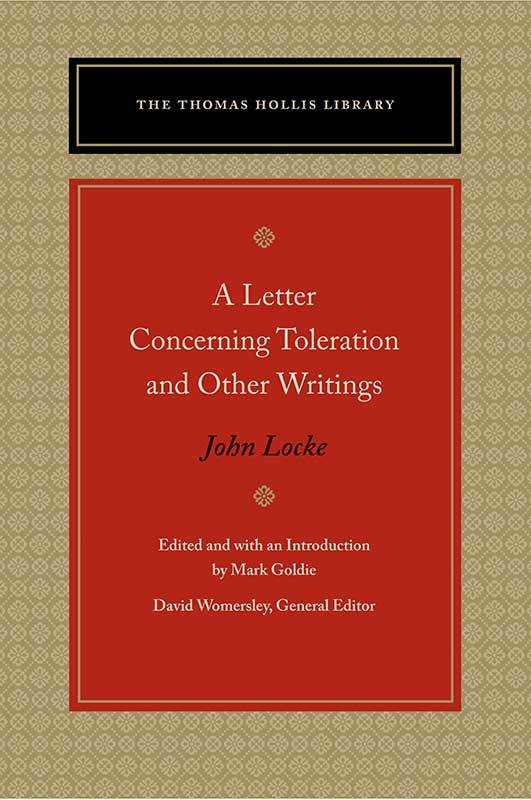
An Essay Concerning Toleration - John Locke, A Letter concerning Toleration and Other Writings [2010]

Edition used:

A Letter concerning Toleration and Other Writings, edited and with an Introduction by Mark Goldie (Indianapolis: Liberty Fund, 2010).

About Liberty Fund:

Liberty Fund, Inc. is a private, educational foundation established to encourage the study of the ideal of a society of free and responsible individuals.


An Essay Concerning Toleration

In the question of liberty of conscience, which has for some years been so much bandied among us, one thing that hath chiefly perplexed the question, kept up the dispute, and increased the animosity, hath been (I conceive) this, that both parties have with equal zeal and mistake too much enlarged their pretensions, whilst one side preach up absolute obedience, and the other claim universal liberty in matters of conscience, without assigning what those things are which have a title to liberty or showing the boundaries of imposition and obedience.

To clear the way to this I shall lay down this for a foundation, which I think will not be questioned or denied. I shall assert:

That the whole trust,1 power and authority of the magistrate is vested in him for no other purpose, but to be made use of for the good, preservation, and peace of men in that society over which he is set, and therefore that this alone is and ought to be the standard and measure according to which he ought to square and proportion his laws, model and frame his government. For if men could live peaceably and quietly together without uniting under certain laws and growing2 into a commonwealth, there would be no need at all of magistrates or polities, which were only made to preserve men in this world from the fraud and violence of one another, so that what was the end of erecting of government, ought alone to be the measure of its proceeding.

There are some that tell us that monarchy is jure divino.3 I will not now dispute this opinion but only mind4 the assertors of it, that if they mean by this (as certainly they must), that the sole supreme arbitrary power and disposal of all things is and ought to be by divine right in a single person, ’tis to be suspected they have forgot what country they were born in, under what laws they live and certainly cannot but be obliged to declare Magna Charta to be downright heresy. If they mean by monarchy jure divino, not an absolute but limited monarchy (which I think is an absurdity, if not a contradiction) they ought to show us his charter from heaven, and let us see where God hath given the magistrate a power to do anything but barely in order to the preservation of his subjects in this life, or else leave us at liberty to believe it as we please, since nobody is bound, or can allow anyone’s pretensions to a power (which he himself confesses limited), farther than he shows his title.

There are others who affirm that all the power and authority the magistrate hath is derived from the grant and consent of the people, and to those I say it cannot be supposed the people should give any one or more of their fellow men an authority over them for any other purpose than their own preservation, or extend the limits of their jurisdiction beyond the limits of this life.

This being premised that the magistrate ought to do or meddle with nothing but barely in order to securing the civil peace and proprieties5 of his subjects, let us next consider the opinions and actions of men, which in reference to toleration divide themselves into three sorts.

First, are all such opinions and actions as in themselves concern not government or society at all, and such are all purely speculative opinions, and divine worship.

Second, are such as in their own nature are neither good nor bad but yet concern society and men’s conversations one with another, and these are all practical opinions and actions in matters of indifference.6

Third,7 are such too as concern society, but are also good or bad in their own nature and these are moral virtues and vices.

I. I say that the first sort only, viz., speculative opinions and divine worship are those things alone which have an absolute and universal right to toleration. First, purely speculative opinions as the belief of the trinity, purgatory, transubstantiation, antipodes,8 Christ’s personal reign on earth, etc., and that in these every man has his unlimited freedom, appears. Because bare speculations give no bias to my conversation with men, nor having any influence on my actions as I am a member of any society, but being such as would be still the same with all the consequences of them though there were no other person besides myself in the world, cannot by any means either disturb the state or inconvenience my neighbour and so come not within the magistrate’s cognizance. Besides, no man can give another man power (and it would be to no purpose if God should) over that over which he has no power himself. Now, that a man cannot command his own understanding, or positively determine today what opinion he will be of tomorrow, is evident from experience, and the nature of the understanding, which can no more apprehend things otherwise than they appear to it, than the eye see other colours than it doth in the rainbow whether those colours be really there or no.9

The other thing that has just claim to an unlimited toleration is the place, time and manner of worshiping my God. Because this is a thing wholly between God and me, and of an eternal concernment above the reach and extent of polities and government, which are but for my well-being in this world. For the magistrate is but an umpire between man and man.10 He can right me against my neighbour but cannot defend me against my God. Whatever evil I suffer by obeying him in other things he can make me amends in this world, but if he force me to a wrong religion, he can make me no reparation in the other world. To which let me add that even in things of this world over which the magistrate has an authority, he never does, and it would be unjustice if he should, any farther than it concerns the good of the public, enjoin men the care of their private civil concernments, or force them to a prosecution of their own private interests, but only protects them from being invaded and injured in them by others, (which is a perfect toleration). And therefore we may well suppose he hath nothing at all to do with my private interest in another world, and that he ought not to prescribe me the way or require my diligence in the prosecution of that good which is of a far higher concernment to me than anything within his power, having no more certain or more infallible knowledge of the way to attain it than I myself, where we are both equally inquirers, both equally subjects, and wherein he can give me no security, that I shall not, nor make me any recompense if I do, miscarry. Can it be reasonable that he that cannot compel me to buy a house should force me his way to venture the purchase of heaven, that he that cannot in justice prescribe me rules of preserving my health, should enjoin me methods of saving my soul, he that cannot choose a wife for me should choose a religion. But if God (which is the point in question) would have men forced to heaven, it must not be by the outward violence of the magistrate on men’s bodies, but the inward constraints of his own spirit on their minds, which are not to be wrought on by any human compulsion, the way to salvation not being any forced exterior performance, but the voluntary and secret choice of the mind; and it cannot be supposed that God would make use of any means, which could not reach, but would rather cross, the attainment of the end. Nor can it be thought that men should give the magistrate a power to choose for them their way to salvation which is too great to give away, if not impossible to part with, since whatever the magistrate enjoined in the worship of God, men must in this necessarily follow what they themselves thought best, since no consideration could be sufficient to force a man from or to that, which he was fully persuaded, was the way to infinite happiness or infinite misery.11 Religious worship being that homage which I pay to that God I adore in a way I judge acceptable to him, and so being an action or commerce passing only between God and myself, hath in its own nature no reference at all to my governor or to my neighbour, and so necessarily produces no action which disturbs the community. For kneeling or sitting at the sacrament12 can in itself tend no more to the disturbance of the government, or injury of my neighbour, than sitting or standing at my own table; wearing a cope or surplice13 in the church, can no more alarm or threaten the peace of the state, than wearing a cloak or coat in the market; being rebaptised no more make a tempest in the commonwealth than it doth in the river, nor than barely washing myself would do in either. If I observe the Friday with the Mahometan, or the Saturday with the Jew, or the Sunday with the Christian, whether I pray with or without a form, whether I worship God in the various and pompous ceremonies of the papists, or in the plainer way of the Calvinists, I see nothing in any of these, if they be done sincerely and out of conscience, that can of itself make me either the worse subject to my prince, or worse neighbour to my fellow subject. Unless it be, that I will out of pride, or overweeningness of my own opinion, and a secret conceit of my own infallibility, taking to myself something of a godlike power, force and compel others to be of my mind, or censure and malign them if they be not. This indeed often happens, but ’tis not the fault of the worship, but the men. And is not the consequence of this or that form of devotion, but the product of depraved ambitious human nature, which successively makes use of all sorts of religion, as Ahab did of keeping a fast: which was not the cause, but means and artifice to take away Naboth’s vineyard.14 Which miscarriages of some professors15 do no more discredit any religion (for the same happens in all) than Ahab’s rapine does fasting.

From what is premised I think will follow:16

That in speculations and religious worship every man hath a perfect uncontrolled liberty, which he may freely use without or contrary to the magistrate’s command, without any guilt or sin at all: provided always that it be all done sincerely and out of conscience to God according to the best of his knowledge and persuasion. But if there be any ambition, pride, revenge, faction, or any such alloy that mixes itself with what he calls conscience, so much there is of guilt, and so much he shall answer for at the day of judgement.17

II. I say all practical principles or opinions by which men think themselves obliged to regulate their actions with one another. As that men may breed their children or dispose of their estates as they please, that men may work or rest when they think fit, that polygamy and divorce are lawful or unlawful, etc.18 These opinions and the actions flowing from them, with all other things indifferent, have a title also to toleration; but yet only so far as they do not tend to the disturbance of the state, or do not cause greater inconveniences than advantages to the community. For all these opinions, except such of them, as are apparently destructive to human society, being things either of indifference or doubt, and neither the magistrate or subject being on either side infallible, he ought no farther to consider them, than as the making laws and interposing his authority in such opinions may conduce to the welfare and safety of his people. But yet no such opinion has any right to toleration, on this ground, that it is a matter of conscience, and some men are persuaded that it is either a sin or a duty. Because the conscience, or persuasion of the subject, cannot possibly be a measure by which the magistrate can, or ought to frame his laws, which ought to be suited to the good of all his subjects, not the persuasions of a part: which often happening to be contrary one to another must produce contrary laws. And there being nothing so indifferent which the consciences of some or other, do not check at,19 a toleration of men in all that which they pretend out of conscience they cannot submit to, will wholly take away all the civil laws and all the magistrate’s power, and so there will be no law, nor government, if you deny the magistrate’s authority in indifferent things, over which it is acknowledged on all hands that he has jurisdiction. And therefore the errors, or scruples of anyone’s conscience, which lead him to, or deter him from the doing of anything, do not destroy the magistrate’s power nor alter the nature of the thing which is still indifferent. For I will not doubt here to call all these practical opinions in respect of the lawmaker indifferent, though perhaps they are not so in themselves. For however the magistrate be persuaded in himself of the reasonableness or absurdity, necessity or unlawfulness of any of them, and is possibly in the right, yet whilst he acknowledges himself not infallible, he ought to regard them in making of his laws, no otherwise, than as things indifferent, except only as that being enjoined, tolerated, or forbidden, they carry with them the civil good and welfare of the people. Though at the same time he be obliged strictly to suit his personal actions to the dictates of his own conscience and persuasion in these very opinions. For not being made infallible in reference to others, by being made a governor over them, he shall hereafter be accountable to God for his actions as a man, according as they are suited to his own conscience and persuasion; but shall be accountable for his laws and administration as a magistrate, according as they are intended to the good, preservation, and quiet of all his subjects in this world as much as is possible, which is a rule so certain and so clear, that he can scarce err in it unless he do it wilfully.

But before I proceed to show the limits of restraint and liberty in reference to these things, it will be necessary to set down the several degrees of imposition, that are, or may be used in matters of opinion.

  • 1. The prohibiting to publish or vent20 any opinion.
  • 2. Forcing to renounce or abjure any opinion.
  • 3. Compelling to declare an assent to the contrary opinion.

There are answerable to these the same degrees of toleration.

From all which I conclude:

A. That the magistrate may prohibit the publishing of any of these opinions when they tend to the disturbance of the government because they are then under his cognizance and jurisdiction.

B. That no man ought to be forced to renounce his opinion, or assent to the contrary, because such a compulsion cannot produce any real effect to that purpose for which it is designed. It cannot alter men’s minds, it can only force them to be hypocrites, and by this way the magistrate is so far from bringing men to embrace the truth of his opinion, that he only constrains them to lie for their own. Nor does this injunction at all conduce to the peace or security of the government but quite the contrary. Because hereby the magistrate does not make anyone to be one jot the more of his mind, but to be very much more his enemy.

C. That any actions flowing from any of these opinions, as also in all other indifferent things, the magistrate has a power to command or forbid so far as they tend to the peace, safety or security of his people, whereof though he be judge, yet he ought still to have a great care, that no such laws be made, no such restraints established, for any other reason, but because the necessity of the state, and the welfare of the people called for them. And perhaps it will not be sufficient, that he barely thinks such impositions, and such rigour necessary, or convenient, unless he hath seriously and impartially considered, and debated whether they be so or no: and his opinion (if he mistake) will no more justify him in the making of such laws, than the conscience or opinion of the subject will excuse him, if he disobey them; if consideration and enquiry could have better informed either of them. And I think it will easily be granted, that the making of laws to any other end, but only for the security of the government and protection of the people in their lives, estates, and liberties, i.e., the preservation of the whole, will meet with the severest doom at the great tribunal, not only because the abuse of that power and trust which is in the lawmaker’s hands, produces greater and more unavoidable mischief than anything else to mankind, for whose good only governments were instituted, but also, because he is not accountable to any tribunal here. Nor can there be a greater provocation to the supreme preserver of mankind, than that the magistrate should make use of that power, which was given him only for the preservation of all his subjects, and every particular person amongst them, as far as it is practicable, should misuse it to the service of his pleasure, vanity, or passion, and employ it to the disquieting or oppression of his fellow men, between whom and himself in respect of the king of kings there is but a small and accidental difference.

D. That if the magistrate in these opinions or actions by laws and impositions endeavour to restrain, or compel men, contrary to the sincere persuasions of their own consciences; they ought to do what their consciences require of them, as far as without violence they can; but withal are bound at the same time quietly to submit to the penalties the law inflicts on such disobedience.21 For by this means they secure to themselves their grand concernment in another world, and disturb not the peace of this; offend not against their allegiance either to God or the king but give both their due, the interest of the magistrate and their own being both safe. And certainly he is a hypocrite, and only pretends conscience and aims at something else in this world, who will not, by obeying his conscience and submitting also to the law, purchase heaven for himself and peace for his country though at the rate22 of his estate, liberty, or life itself. But here also the private person, as well as the magistrate in the former case, must take great care that his conscience or opinion do not mislead him, in the obstinate pursuit or flight23 of anything as necessary or unlawful, which in truth is not so, lest by such an error, or wilfulness, he come to be punished for the same disobedience in this world and the other too. For liberty of conscience being the great privilege of the subject, as the right of imposing is the great prerogative of the magistrate, they ought the more narrowly to be watched, that they do not mislead either magistrate or subject, because of the fair pretences they have. Those wrongs being the most dangerous, most carefully to be avoided, and such as God will most severely punish, which are done under the specious semblances and appearances of right.

III. I say there are, besides the two former, a third sort of actions, which are thought good or bad in themselves, viz., the duties of the second table24 or trespasses against it or the moral virtues of the philosophers.25 These, though they are the vigorous active part of religion, and that wherein men’s consciences are very much concerned, yet I find, that they make but a little part of the disputes of liberty of conscience. I know not whether it be, that if men were more zealous for these, they would be less contentious about the other.26 But this is certain, that the countenancing virtue is so necessary a prop to a state, and the allowance of some vices brings so certain a disturbance and ruin to society, that it was never found that any magistrate did; nor can be suspected, that he ever will, establish vice by a law, or prohibit the practice of virtue. Which does by its own authority, and the advantages it brings to all governments sufficiently establish itself everywhere. Yet give me leave to say, however strange it may seem, that the lawmaker hath nothing to do with moral virtues and vices, nor ought to enjoin the duties of the second table any otherwise, than barely as they are subservient to the good and preservation of mankind under government.27 For could public societies well subsist, or men enjoy peace or safety, without the enforcing of those duties, by the injunctions and penalties of laws, it is certain the lawmaker ought not to prescribe any rules about them, but leave the practice of them entirely to the discretion and consciences of his people. For could even these moral virtues and vices be separated from the relation they have to the weal28 of the public, and cease to be a means to settle or disturb men’s peace and proprieties, they would then become only the private and super-political concernment between God and a man’s soul, wherein the magistrate’s authority is not to interpose. God hath appointed the magistrate his vicegerent29 in this world, with power to command; but ’tis but like other deputies, to command only in the affairs of that place where he is vicegerent. Whoever meddle in the concernments of the other world, have no other power, but to entreat and persuade. The magistrate hath nothing to do with the good of men’s souls or their concernments in another life but is ordained and entrusted with his power only for the quiet and comfortable living of men in society one with another, as has been already sufficiently proved.

And it is yet farther evident, that the magistrate commands not the practice of virtues, because they are virtues, and oblige the conscience, or are the duties of man to God and the way to his mercy and favour, but because they are the advantages of man with man, and most of them the strong ties and bonds of society; which cannot be loosened, without shattering the whole frame. For some of them, which have not that influence on the state, and yet are vices and acknowledged to be so as much as any, as covetousness, disobedience to parents, ingratitude, malice, revenge, and several others, the magistrate never draws his sword against. Nor can it be said, that these are neglected, because they cannot be known, when the secretest of them, revenge and malice, put the distinction in judicature between manslaughter and murder. Yea even charity itself, which is certainly the great duty both of a man and a Christian, hath not yet, in its full latitude, a universal right to toleration: since there are some parts, and instances of it, which the magistrate hath absolutely forbidden, and that, for ought I could ever hear, without any offence to the tenderest consciences. For who doubts that to relieve with an alms the poor, though beggars (if one see them in want), is, if considered absolutely, a virtue and every particular man’s duty, yet this is amongst us prohibited by a law30 and the rigour of a penalty, and yet nobody in this case complains of the violation of his conscience, or the loss of his liberty, which certainly, if it were an unlawful restraint upon the conscience could not be overlooked by so many tender and scrupulous men. God does sometimes (so much does he take care of the preservation of governments) make his law in some degrees submit, and comply with man’s; his law forbids the vice, but the law of man often makes the measures of it. There have been commonwealths that have made theft lawful for such as were not caught in the fact, and perhaps ’twas as guiltless a thing to steal a horse at Sparta, as to win a horse race in England. For the magistrate having a power to appoint ways of transferring proprieties, from one man to another, may establish any, so they be universal, equal and without violence, and suited to the interest and welfare of that society, as this was at Sparta, who being a warlike people found this no ill way, to teach their citizens, vigilance, boldness and activity.31 This I only note by the by, to show how much the good of the commonwealth is the standard of all human laws, when it seems to limit and alter the obligation even of some of the laws of God, and change the nature of vice and virtue.32 Hence it is that the magistrate who could make theft innocent could not yet make perjury or breach of faith lawful, because destructive to human society.

From this power therefore that the magistrate hath over good and bad actions I think it will follow:

1. That he is not bound to punish all, i.e., he may tolerate some vices, for I would fain know what government in the world doth not;

2. That he ought not to command the practice of any vice, because such an injunction cannot be subservient to the good of the people, or preservation of the government;

3. That if it can be supposed that he should command the practice of any vice, the conscientious and scandalized subject is bound to disobey his injunction, but submit to his penalty. As in the former case.

These I suppose are the limits of imposition and liberty, and these three several sorts of things wherein men’s consciences are concerned have right to such a latitude of toleration as I have set down and no more, if they are considered separately and abstractly in themselves.

But yet there are two cases or circumstances which may still upon the same grounds vary the magistrate’s usage of the men that claim this right to toleration.

1. Since men usually take up their religion in gross, and assume to themselves the opinions of their party all at once in a bundle, it often happens, that they mix with their religious worship, and speculative opinions, other doctrines absolutely destructive to the society wherein they live, as is evident in the Roman Catholics that are subjects of any prince but the pope. These therefore blending such opinions with their religion, reverencing them as fundamental truths, and submitting to them as articles of their faith, ought not to be tolerated by the magistrate in the exercise of their religion unless he can be secured, that he can allow one part, without the spreading of the other, and that the propagation of these dangerous opinions may be separated from their religious worship, which I suppose is very hard to be done.33

2.34 Since experience vouches the practice, and men are not all saints that pretend conscience, I think I shall not injure any party, if I say, that most men, at least factions of men, when they have power sufficient, make use of it, right or wrong, for their own advantage, and the establishment of themselves in authority, few men forbearing to grasp at dominion that have power to seize and hold it.35 When therefore men herd themselves into companies with distinctions from the public, and a stricter confederacy with those of their own denomination and party, than other their fellow subjects; whether the distinction be religious or ridiculous it matters not, otherwise than as the ties of religion are stronger, and the pretences of conscience fairer, and apter to draw partisans, and therefore the more to be suspected and the more heedfully to be watched; when, I say, any such distinct party is grown, or growing so numerous as to appear dangerous to the magistrate, and seem visibly to threaten the peace of the state, the magistrate may and ought to use all ways either of policy or power that shall be convenient, to lessen, break and suppress the party and so prevent the mischief. For though their separation were really in nothing but religious worship, and he should use as the last remedy force and severity against them, who did nothing but worship God in their own way, yet did he not really persecute their religion or punish them for that more than, in a battle, the conqueror kills men for wearing white ribbons in their hats, or any other badge about them, but because this was a mark that they were enemies and dangerous. Religion, i.e., this or that form of worship, being the cause of their union and correspondence;36 not of their factiousness and turbulency. For the praying to God in this or that place or posture, does no more make men factious, or at enmity one with another, nor ought otherwise to be treated, than the wearing of hats or turbans, which yet either of them may do by being a note of distinction, and giving men an opportunity to number their forces, know their strength, be confident of one another, and readily unite upon any occasion. So that they are not restrained because of this or that opinion or worship, but because such a number of any opinion whatsoever, who dissented, would be dangerous. The same thing would happen if any fashion of clothes distinct from that of the magistrate, and those that adhere to him, should spread itself, and become the badge of a very considerable part of the people, who thereupon grew into a very strict correspondence and friendship one with another. Might not this well give the magistrate cause of jealousy, and make him with penalties forbid the fashion; not because unlawful, but because of the danger it might occasion? Thus a lay cloak may have the same effect with an ecclesiastical cowl or any other religious habit.

And perhaps the Quakers, were they numerous enough to become dangerous to the state, would deserve the magistrate’s care and watchfulness to break and suppress them, were they no other way distinguished from the rest of his subjects, but by the bare keeping on their hats,37 as much as if they had a set form of religion separate from the state. In which case nobody would think, that the not standing bare were a thing the magistrate levelled his severity against, any otherwise, than as it united a great number of men who, though they dissented from him in a very indifferent and trivial circumstance, yet might thereby endanger the government. And in such case he may endeavor to suppress and weaken or dissolve any party of men, which religion or any other thing hath united to the manifest danger of his government by all those means, that shall be most convenient for that purpose, whereof he is to be judge, nor shall he be accountable in the other world, for what he does directly in order to the preservation and peace of his people according to the best of his knowledge.

Whether force and compulsion be the right way to this end I will not here dispute, but this I dare affirm, that it is the worst, the last to be used, and with the greatest caution. For these reasons:

A. Because it brings that upon a man, which that he might be fenced38 from is the only reason why he is a member of the commonwealth, viz., violence. For were there no fear of violence, there would be no government in the world, nor any need of it.

B. Because the magistrate in using of force, does in part cross what he pretends to, which is to promote the safety of all. For the preservation as much as is possible of the propriety, quiet and life of every individual being his duty; he is obliged not to disturb, or destroy some, for the quiet, or safety of the rest, till it has been tried, whether there be not ways to save all. For so far as he undoes or destroys any of his subjects, for the security of the rest, so far he opposes his own design, which is professed and ought to be only for preservation, to which even the meanest have a title. ’Twould be but an uncharitable as well as unskillful way of cure, and such as nobody would use or consent to, to cut offso much as an ulcered toe, though tending to a gangrene, till all other gentler remedies had proved unsuccessful; though it be a part as low as the earth, and far distant from the head.

I can see but one objection that can be made to this, and that is, that by the application of gentler remedies, such slow methods may make you lose the opportunity of those remedies that if timely would be effectual. Whereas in your faint way of proceeding the malady increases, the faction grows strong, gathers head, and becomes your masters.

To this I answer. That parties and factions grow slowly and by degrees, have their times of infancy and weakness, as well as full growth and strength, and become not formidable in an instant: but give sufficient time for experimenting other kind of cures, without any danger by the delay. But if the magistrate chance to find the dissenters so numerous, as to be in a condition to cope with him, I see not what he can gain by force and severity, when he thereby gives them the fairer pretence to embody,39 and arm, and makes them all unite the firmer against him. But this bordering something upon that part of the question, which concerns more the interest of the magistrate than his duty, I shall refer to a fitter place.40

Hitherto I have only traced out the bounds that God hath set to the power of the magistrate and the obedience of the subject, both which are subjects and equally owe obedience to the great king of kings who expects from them the performance of those duties which are incumbent on them in their several stations and conditions, the sum whereof is that:

1. There are some opinions and actions that are wholly separate from the concernment of the state, and have no direct influence upon men’s lives in society, and those are, all speculative opinions and religious worship, and these have a clear title to universal toleration, which the magistrate ought not to intrench on.

2. There are some opinions and actions, which are in their natural tendency absolutely destructive to human society, as that faith may be broken with heretics,41 that if the magistrate doth not reform religion the subjects may,42 that one is bound to broach and propagate any opinion he believes himself and such like; and in actions all manner of fraud and injustice, etc. And these the magistrate ought not to tolerate at all.

3. There is a third sort of opinions and actions which in themselves do not inconvenience or advantage human society, but only as the temper of the state and posture of affairs may vary their influence to good or bad, as that polygamy is lawful or unlawful, that flesh or fish is to be eaten or abstained from at certain seasons. And such other practical opinions and all actions conversant about matters of indifference. And these have a right to toleration so far only as they do not interfere with the advantages of the public or serve any way to disturb the government.

And thus far of toleration as it concerns the magistrate’s duty. Having showed what he is bound in conscience to do, it will not be amiss to consider a little what he ought to do in prudence.43

But because the duties of men are contained in general established rules, but their prudence is regulated by circumstances relating to themselves in particular, it will be necessary in showing how much toleration is the magistrate’s interest, to come to particulars.

To consider therefore the state of England at present. There is but this one question in the whole matter and that is whether toleration or imposition be the readiest way to secure the safety and peace and promote the welfare of this kingdom.

As to securing your safety and peace, there is but one way which is that your friends at home be many and vigorous,44 and your enemies few and contemptible. Or at least that the inequality of their number make it very dangerous and difficult for malcontents to molest you.

As to promoting the welfare of the kingdom which consists in riches and power, to this most immediately conduces the number and industry of your subjects.45

What influence toleration hath on all these cannot be well seen without considering the different parties now among us. Which may well be comprehended under these two, papist and fanatic.46

I. 1. As to the papists, ’tis certain that several of their dangerous opinions which are absolutely destructive to all governments but the pope’s ought not to be tolerated in propagating those opinions, and whosoever shall spread or publish any of them the magistrate is bound to suppress so far as may be sufficient to restrain it. And this rule reaches not only the papists but any other sort of men amongst us. For such restraint will something hinder the spreading of those doctrines, which will always be of ill consequence and like serpents can never be prevailed on by kind usage to lay by their venom.

2. Papists are not to enjoy the benefit of toleration because where they have power they think themselves bound to deny it to others. For it is unreasonable that any should have a free liberty of their religion, who do not acknowledge it as a principle of theirs that nobody ought to persecute or molest another because he dissents from him in religion. For toleration being settled by the magistrate as a foundation whereon to establish the peace and quiet of his people, by tolerating any who enjoy the benefit of this indulgence, which at the same time they condemn as unlawful, he only cherishes those who profess themselves obliged to disturb his government as soon as they shall be able.

3. It being impossible either by indulgence47 or severity to make papists, whilst papists, friends to your government, being enemies to it both in their principles and interest, and therefore considering them as irreconcilable enemies of whose fidelity you can never be secured, whilst they owe a blind obedience to an infallible pope, who has the keys of their consciences tied to his girdle, and can upon occasion dispense with all their oaths, promises and the obligations they have to their prince, especially being a heretic, and arm them to the disturbance of the government, I think they ought not to enjoy the benefit of toleration.48

Because toleration can never, but restraint may, lessen their number or at least not increase it, as it does usually all other opinions which grow and spread by persecution, and recommend themselves to bystanders by the hardships they undergo, men being forward to have compassion for sufferers and esteem for that religion as pure, and the professors of it as sincere which can stand the test of persecution. But I think it is far otherwise with Catholics who are less apt to be pitied than others because they receive no other usage than what the cruelty of their own principles and practices are known to deserve. Most men judging those severities they complain of, as just punishments due to them as enemies to the state rather than persecutions of conscientious men for their religion, which indeed it is not. Nor can they be thought to be punished merely for their consciences who own themselves at the same time subjects of a foreign and enemy prince.49 Besides the principles and doctrines of that religion are less apt to take inquisitive heads and unstable minds, men commonly in their voluntary changes do pursue liberty and enthusiasm,50 wherein they are still free and at their own disposal rather than give themselves up to the authority and impositions of others. This is certain that toleration cannot make them divide amongst themselves, nor a severe hand over them (as in other dissenting parties) make them cement with the fanatics (whose principles and worship and tempers are so utterly inconsistent), and by that means increasing the number of the united malcontents make the danger greater.51 Add to this that popery having been brought in upon the ignorant and zealous world by the art and industry of their clergy, and kept up by the same artifice backed by power and force, it is the most likely of any religion to decay where the secular power handles them severely, or at least takes from them those encouragements and supports they received by their own clergy.

But if restraint of the papists do not lessen the number of our enemies in bringing any of them over to us, yet it increases the number, it strengthens the hands of our friends, and knits all the Protestant parties firmer to our assistance and defence. For the interest of the king of England as head of the Protestants will be much improved by the discountenancing of popery amongst us. The different parties will sooner unite in a common friendship with us, when they find we really separate from and set ourselves against the common enemy both to our church and all Protestant professions. This will be a hostage of our friendship to them, and a security that they shall not be deceived in the confidence they have of us, and the sincerity of the accord we make with them.

II. All the rest of dissenters come under the opprobrious name of fanatics,52 which I think, by the way, might with more prudence be laid aside and forgotten than made use of. For what understanding man in a disordered state would find out and fix notes of distinction, a thing to be coveted only by those that are factious, or, by giving one common name to different parties, teach those to unite whom he is concerned to divide and keep at a distance one among another.

But to come to what is more material, I think it is agreed on all hands, that it is necessary the fanatics should be made useful and assisting and as much as possible firm to the government as it now stands. Both as to secure it from disturbance at home and defend it against invasions from abroad which nothing can possibly bring to pass but what is able to alter their minds and bring them over to your profession. Or else if they do not part with their opinions, yet may persuade them to lay by their animosity, and become friends to the state though they are not sons of the church.

What efficacy force and severity hath to alter the opinions of mankind, though all history be full of examples, and there is scarce an instance to be found of any opinion driven out of the world by persecution but where the violence of it at once swept away all the professors too. I desire nobody to go farther than his own bosom for an experiment53 whether ever violence gained anything upon his opinion, whether even arguments managed with heat do not lose something of their efficacy, and have not made him the more obstinate in his opinion, so chary is human nature to preserve the liberty of that part wherein lies the dignity of a man, which, could it be imposed on, would make him but little different from a beast. I ask those who in the late times54 so firmly stood the ineffectual persecution55 themselves and found how little it obtained on their opinions, and yet are now so forward to try it upon others, whether all the severity in the world could have drawn them one step nearer to a hearty and sincere embracing the opinions that were then uppermost, let them not say it was because they knew they were in the right, for every man in what he believes, has so far this persuasion that he is in the right. But how little this obstinacy or constancy depends upon knowledge, may appear in those galley slaves who return from Turkey,56 who though they have endured all manner of miseries rather than part with their religion, yet one would guess by the lives and principles of most of them, that they had no knowledge of the doctrine and practise of Christianity at all. Who thinks not that those poor captives who (for renouncing a religion they were not over instructed in nor during the enjoyment of their freedom at home over zealous for) might have regained their liberty, for changing their opinion would not (had their chains given them leave) have cut the throats of those cruel patrons who used them so severely to whom they would yet have done no violence had they been treated civilly like fair prisoners of war. Whereby we may see ’twill be a hazardous attempt for those who design it,57 if they are not much the greater number, to compel dissenters by force and ill usage to be true to that government and serviceable to that interest, which instead of an equal protection affords them no other treatment but disgrace, punishment and persecution: unless those who would thus enforce a uniformity will make chains for all those to whom they will allow no liberty and persuade them also to stand still whilst they put them upon them. For let divines preach duty as long as they will, ’twas never known that men lay down quietly under the oppression and submitted their backs to the blows of others when they thought they had strength enough to defend themselves. I say not this to justify such proceedings, which in the former part of this discourse I think I have sufficiently condemned. But to show what the nature and practice of mankind is and what has usually been the consequence of persecution.

Besides the forcible introducing of opinions keeps people offfrom closing with them by giving men unavoidable jealousies, that it is not truth that is thus carried on, but interest and dominion that is sought in making proselytes by compulsion. For who takes this course to convince anyone of the certain truths of mathematics? ’Tis likely ’twill be said that those are truths on which depends not my happiness. I grant it, and am much indebted to the man that takes care I should be happy, but ’tis hard to think that that comes from charity to my soul which brings such ill usage to my body, or that he is much concerned I should be happy in another world who is pleased to see me miserable in this. I wonder that those who have such a zealous regard to the good of others, do not a little more look after the relief of the poor or think themselves concerned to guard the estates of the rich, which certainly are good things too and make a part of one’s happiness, if we may believe the lives of those who tell us the joys of heaven but endeavor as much as others for large possessions on earth.

But, after all this, could persecution not only now and then conquer a tender faint-hearted fanatic, which yet it rarely does and that usually by the loss of two or three orthodox, could it I say at once drive in all dissenters within the pale of the church, it would not thereby secure but much more threaten the government and make the danger as much greater as it is to have a false, secret but exasperated enemy rather than a fair open adversary. For punishment and fear may make men dissemble, but not convincing anybody’s reason, cannot possibly make them assent to the opinion, but will certainly make them hate the person of their persecutor and give them the greater aversion to both; such compliers only prefer impunity to the declaring of their own opinion, but do not thereby approve of yours. Fear of your power, not love of your government, is that which restrains them, and, if that be the chain that ties them to you, it would certainly hold them surer were they open dissenters, than being secret malcontents, because it would not only be something easier to be worn but harder to be knocked off. At least this is certain that compelling men to your opinion any other way than by convincing them of the truth of it, makes them no more your friends, than forcing the poor Indians by droves into the rivers to be baptised made them Christians.58

Though force cannot master the opinions men have, nor plant new ones in their breasts, yet courtesy, friendship and soft usage may, for several (I think I may say most) men whose business or laziness keep them from examining take many of their opinions upon trust, even in things of religion, but never take them from any man of whose knowledge, friendship and sincerity they have not very good thoughts. Which it is impossible they should have of one that persecutes them.

But inquisitive men, though they are not of another’s mind because of his kindness, yet they are the more willing to be convinced and will be apt to search after reasons that may persuade them to be so whom they are obliged to love.

Since force is a wrong way to bring dissenters offfrom their persuasions, and by drawing them to your opinion you cement them fast to the state, it will certainly prevail much less with those to be your friends who steadfastly retain their persuasion. He that differs in an opinion is only so far at a distance from you, but if you use him ill for that which he believes to be the right he is then at perfect enmity, the one is barely a separation, the other a quarrel. Nor is that all the mischief which severity will do among us as the state of things is at present, for force and harsh usage will not only increase the animosity but number of enemies. For the fanatics taken all together being numerous,59 and possibly more than the hearty friends to the state religion, are yet crumbled into different parties amongst themselves, and are at as much distance one from another as from you, if you drive them not farther offby the treatment they receive from you, for their bare opinions are as inconsistent one with another as with the Church of England. People therefore that are so shattered into different factions are best secured by toleration since being in as good a condition under you, as they can hope for under any, ’tis not like[ly] they should join, to set up any other, whom they cannot be certain will use them so well. But if you persecute them you make them all of one party and interest against you, tempt them to shake offyour yoke and venture for a new government wherein everyone has hopes to get the dominion themselves or better usage under others, who cannot but see that the same severity of the government which helped them to power and partisans to get up, will give others the same desire and same strength to pull them down, and therefore it may be expected they will be cautious how they exercise it. But if you think the different parties are already grown to a consistency and formed into one body and interest against you, whether it were the hardships they suffered under you made them unite or no, when they are so many as to equal or exceed you in number as perhaps they do in England, force will be but an ill and hazardous way to bring them to submission.

If uniformity in England be so necessary as many pretend, and compulsion be the way to it, I demand of those who are so zealous for it, whether they really intend by force to have it or no. If they do not, it is not only imprudent but malicious under that pretence, by ineffectual punishments to disquiet and torment their brethren. For to show how little persecution, if not in the extremest degree, has been able to establish uniformity, I shall ask but this one plain question, was there ever a free toleration in this kingdom. If there were not I desire to know of any of the clergy who were once sequestered,60 how they came to be turned out of their livings and whether impositions and severity were able to preserve the Church of England and hinder the growth of puritans even before the war.61 If therefore violence be to settle uniformity ’tis in vain to mince the matter. That severity which must produce it cannot stop short of the total destruction and extirpation of all dissenters at once, and how well this will agree with the doctrine of Christianity, the principles of our church and reformation from popery, I leave them to judge who can think the massacre of France62 worthy their imitation; and desire them to consider if death, for nothing less can make uniformity, were the penalty of not coming to common prayer, and joining in all our church worship, how much such a law would settle the quiet and secure the government of the kingdom.

The Romish religion that had been but a little while planted and taken but small root in Japan63 (for the poor converts had but little of the efficacious truths and light of Christianity conveyed to them by those teachers who make ignorance the mother of devotion,64 and knew very little beyond an ave Maria, or paternoster)65 could not be extirpated but by the death of many thousands, which too prevailed not at all to lessen their numbers till they extended the severity beyond the delinquents and made it death not only to the family that entertained a priest but also to all of both the families that were next neighbours on either hand though they were strangers or enemies to the new religion. And invented exquisite lingering torments worse than a thousand deaths which though some had strength enough to endure fourteen days together yet many renounced their religion, whose names were all registered with a design that when the professors of Christianity were all destroyed, these too should be butchered all on a day, never thinking the opinion rooted out beyond possibility of spreading again, as long as there were any alive who were the least acquainted with it or had almost heard anything of Christianity more than the name. Nor are the Christians that trade there to this day suffered to discourse, fold their hands, or use any gesture that may show the difference of their religion. If anyone think uniformity in our church ought to be restored though by such a method as this, he will do well to consider how many subjects the king will have left by that time it is done. There is this one thing more observable in the case, which is, that it was not to set up uniformity in religion (for they tolerate seven or eight sects and some so different as is the belief of the mortality or immortality of the soul, nor is the magistrate at all curious or inquisitive what sect his subjects are of, or does in the least force them to his religion), nor any aversion to Christianity, which they suffered a good while quietly to grow up among them, till the doctrine of the popish priest gave them jealousies that religion was but their pretence but empire their design, and made them fear the subversion of their state, which suspicion their own priests improved all they could to the extirpation of this growing religion.

But to show the danger of establishing uniformity.

To give a full prospect of this subject there remain yet these following particulars to be handled:

1. To show what influence toleration is like to have upon the number and industry of your people on which depends the power and riches of the kingdom.

2. That if force must compel all to a uniformity in England, to consider what party alone, or what parties are likeliest to unite to make a force able to compel the rest.

3. To show that all that speak against toleration seem to suppose that severity and force are the only arts of government and way to suppress any faction, which is a mistake.

4. That for the most part the matters of controversy and distinction between sects, are no parts or very inconsiderable ones and appendixes of true religion.

5. To consider how it comes to pass that Christian religion hath made more factions, wars, and disturbances in civil societies than any other, and whether toleration and latitudinism66 would prevent those evils.

6. That toleration conduces no otherwise to the settlement of a government than as it makes the majority of one mind and encourages virtue in all, which is done by making and executing strict laws concerning virtue and vice, but making the terms of church communion as large as may be, i.e., that your articles in speculative opinions be few and large, and ceremonies in worship few and easy. Which is latitudinism.

7. That the defining and undertaking to prove several doctrines which are confessed to be incomprehensible and to be no otherwise known but by revelation,67 and requiring men to assent to them in the terms proposed by the doctors of your several churches, must needs make a great many atheists.

  • But of these when I have more leisure:
  • Sic Cogitavit Atticus68 166769

Additions to the Essay

A. I must only remark before I leave this head of speculative opinions that the belief of a deity is not to be reckoned amongst purely speculative opinions, for it being the foundation of all morality, and that which influences the whole life and actions of men, without which a man is to be counted no other than one of the most dangerous sorts of wild beasts, and so incapable of all society.

B. ’Twill be said that if a toleration shall be allowed as due to all the parts of religious worship it will shut out the magistrate’s power from making laws about those things over which it is acknowledged on all hands that he has a power, viz., things indifferent, as many things made use of in religious worship are, viz., wearing a white or a black garment, kneeling or not kneeling, etc. To which I answer, that in religious worship nothing is indifferent, for it being the using of those habits, gestures, etc., and no other, which I think acceptable to God in my worshipping of him, however they may be in their own nature perfectly indifferent, yet when I am worshipping my God in a way I think he has prescribed and will approve of, I cannot alter, omit, or add any circumstance in that which I think the true way of worship. And therefore if the magistrate permit me to be of a profession or church different from his, ’tis incongruous that he should prescribe any one circumstance of my worship, and ’tis strange to conceive upon what grounds of uniformity any different profession of Christians can be prohibited in a Christian country, where the Jewish religion (which is directly opposite to the principles of Christianity) is tolerated; and would it not be irrational, where the Jewish religion is permitted, that the Christian magistrate, upon pretence of his power in indifferent things, should enjoin or forbid anything, or any way interpose in their way or manner of worship?70

C. And that which may render them yet more incapable of toleration is when, [in addition] to these doctrines dangerous to government, they have the power of a neighbour prince of the same religion at hand to countenance and back them upon any occasion.71

The objection usually made against toleration, that the magistrate’s great business being to preserve [the] peace and quiet of the government, he is obliged not to tolerate different religions in his country, since they bring distinctions wherein men unite and incorporate into bodies separate from the public, they may occasion disorder, conspiracies and seditions in the commonwealth and endanger the government.

I answer: if all things that may occasion disorder or conspiracy in a commonwealth must not be endured in it, all discontented and active men must be removed, and whispering must be less tolerated than preaching, as much likelier to carry on and foment a conspiracy. And if all numbers of men joined in a union and corporation distinct from the public be not to be suffered, all charters of towns, especially great ones, are presently to be taken away. Men united in religion have as little and perhaps less interest against the government than those united in the privileges of a corporation. This I am sure: they are less dangerous as being more scattered and not formed into that order. And the minds of men are so various in matters of religion, and so nice and scrupulous in things of an eternal concernment, that where men are indifferently tolerated, and persecution and force does not drive them together, they are apt to divide and subdivide into so many little bodies, and always with the greatest enmity to those they last parted from or stand nearest to, that they are a guard one upon another, and the public can have no apprehensions of them as long as they have their equal share of common justice and protection. And if the example of old Rome (where so many different opinions, gods, and ways of worship were promiscuously tolerated) be of any weight, we have reason to imagine that no religion can become suspected to the state of ill intention to it, till the government first by a partial usage of them, different from the rest of the subjects, declare its ill intentions to its professors, and so make a state business of it. And if any rational man can imagine that force and compulsion can at any time be the right way to get an opinion or religion out of the world, or to break a party of men that unite in the profession of it, this I dare affirm:

D. Methinks the clergy should, like ambassadors, endeavour to entreat, convince and persuade men to the truth rather than thus solicit the magistrate to force them into their fold. This was the way that gained admittance for Christianity and spread the religion they profess so far into the world: whereas whilst they once a week uncharitably preach against, and the rest of the week as impudently rail at their dissenting brethren, and do not endeavour by the meekness and tender methods of the Gospel, and by the soft cords of love, to draw men to them, but would have even those compelled under their jurisdiction whom they never take care to instruct in their opinions, for I think I may say that preaching a sermon once a week at rovers,72 perhaps learned, perhaps otherwise, doth very little towards instructing men in the knowledge of faith, which after many years hearing one may be still ignorant of, and is seldom effectual to persuade them to good lives. This makes some men suspect that ’tis not the feeding of the sheep73 but the benefit of the fleece that makes these men endeavour by such methods to enlarge their fold. This I am sure is quite contrary to the first way which nursed up Christianity.

E. Though the magistrate have a power of commanding or forbidding things indifferent which have a relation to religion, yet this can only be within that church whereof he himself is a member, who being a lawgiver in matters indifferent in the commonwealth under his jurisdiction, as it is purely a civil society, for their peace, is fittest also to be lawgiver in the religious society (which yet must be understood to be only a voluntary society and during every member’s pleasure), in matters indifferent, for decency and order,74 for the peace of that too. But I do not see how hereby he hath any power to order and direct even matters indifferent in the circumstances of a worship, or within a church whereof he is not professor or member. ’Tis true he may forbid such things as may tend to the disturbance of the peace of the commonwealth to be done by any of his people, whether they esteem them civil or religious. This is his proper business; but to command or direct any circumstances of a worship as part of that religious worship which he himself does not profess nor approve, is altogether without75 his authority, and absurd to suppose. Can anyone think it reasonable, yea, or practicable, that a Christian prince should direct the form of Mahometan worship, the whole religion being thought by him false and profane, and vice versa?; and yet it is not impossible that a Christian prince should have Mahometan subjects who may deserve all civil freedom; and de facto the Turk hath Christian subjects. As absurd would it be that a magistrate, either Popish, Protestant, Lutheran, Presbyterian, Quaker, etc. should prescribe a form to any or all of the differing churches in their way of worship. The reason whereof is because religious worship being that homage which every man pays to his God, he cannot do it in any other way, nor use any other rites, ceremonies, nor forms, even of indifferent things, than he himself is persuaded are acceptable and pleasing to that God he worships; which depending upon his opinion of his God, and what will best please him, it is impossible for one man to prescribe or direct any one circumstance of it to another: and this being a thing different and independent wholly from every man’s concerns in the civil society, which hath nothing to do with a man’s affairs in the other world, the magistrate hath here no more right to intermeddle than any private man, and has less right to direct the form of it, than he hath to prescribe to a subject of his in what manner he shall do his homage to another prince to whom he is feudatory, for something which he holds immediately from him, which, whether it be standing, kneeling, or prostrate, bareheaded or barefooted, whether in this or that habit, etc. concerns not his allegiance to him at all, nor his well government of his people. For though the things in themselves are perfectly indifferent, and it may be trivial, yet, to the worshipper, when he considers them as required by his God, or forbidden, pleasing or displeasing to the invisible power he addresses to, they are by no means so, and till you have altered his opinion (which persuasion can only do) you can by no means, nor without the greatest tyranny, prescribe him a way of worship; which was so unreasonable to do, that we find little bustle about it, and scarce any attempts towards it by the magistrates in the several societies of mankind till Christianity was well grown up in the world, and was become a national religion;76 and since that [time] it hath been the cause of more disorders, tumults and bloodshed than all other causes put together.

But far be it from anyone to think Christ the author of those disorders, or that such fatal mischiefs are the consequence of his doctrine, though they have grown up with it. Antichrist hath sown these tares in the field77 of the church; the rise whereof hath been only hence, that the clergy, by degrees, as Christianity spread, affecting dominion, laid claim to a priest-hood, derived by succession from Christ,78 and so independent from the civil power, receiving (as they pretend) by the imposition of hands, and some other ceremonies agreed on (but variously) by the priesthoods of the several factions, an indelible character, particular sanctity, and a power immediately from heaven to do several things which are not lawful to be done by other men. The chief whereof are: (1) To teach opinions concerning God, a future state, and ways of worship. (2) To do and perform themselves certain rites exclusive of others. (3) To punish dissenters from their doctrines and rules. Whereas (1) it is evident from Scripture, that all priesthood terminated in the great high priest, Jesus Christ, who was the last priest.79 (2) There are no footsteps in Scripture of any so set apart, with such powers as they pretend to, after the apostles’ time, nor that had any indelible character. (3) That it is to be made out, that there is nothing which a priest can do, which another man without any such ordination, (if other circumstances of fitness, and an appointment to it, not disturbing peace and order, concur), may not lawfully perform and do, and the church and worship of God be preserved, as the peace of the state may be by justices of [the] peace, and other officers, who had no ordination or laying on of hands, to fit them to be justices, and by taking away their commissions may cease to be so. So ministers, as well as justices, are necessary, one for the administration of religious public worship, the other of civil justice; but an indelible character, peculiar sanctity of the function, or a power immediately derived from heaven, is not necessary, or as much as convenient, for either.

But the clergy (as they call themselves, of the Christian religion, in imitation of the Jewish priesthood) having, almost ever since the first ages of the church, laid claim to this power separate from civil government, as received from God himself, have, wherever the civil magistrate hath been Christian and of their opinion, and superior in power to the clergy, and they not able to cope with him, pretended this power only to be spiritual, and to extend no farther; but yet still pressed, as a duty on the magistrate, to punish and persecute those who they disliked and declared against. And so where they excommunicated, their under officer, the magistrate, was to execute; and to reward princes for thus doing their drudgery, they have (whenever princes have been serviceable to their ends) been careful to preach up monarchy jure divino; for commonwealths have hitherto been less favourable to their power. But notwithstanding the jus divinum of monarchy, when any prince hath dared to dissent from their doctrines or forms, or been less apt to execute the decrees of the hierarchy, they have been the first and forwardest in giving check to his authority and disturbance to his government. And princes, on the other side, being apt to hearken to such as seem to advance their authority, and bring in religion to the assistance of their absolute power, have been generally very ready to worry those sheep who have ever so little straggled out of those shepherds’ folds, where they were kept in order to be shorn by them both, and to be howled on, both upon subjects and neighbours at their pleasure: and hence have come most of those calamities which have so long disturbed and wasted Christendom. Whilst the magistrate, being persuaded it is his duty to punish those the clergy please to call heretics, schismatics, or fanatics, or else taught to apprehend danger from dissenters in religion, thinks it his interest to suppress them; [and] persecutes all who observe not the same forms in religious worship which is set up in his country. The people, on the other side, finding the mischiefs that fall on them for worshipping God according to their own persuasions, enter into confederacies and combinations to secure themselves as well as they can; so that oppression and vexation on one side, self-defence and desire of religious liberty on the other, create dislikes, jealousies, apprehensions and factions, which seldom fail to break out into downright persecution, or open war.

But notwithstanding the liberality of the clergy to princes, when they have not strength enough to deal with them, be very large; yet when they are once in a condition to strive with him for mastery, then is it seen how far their spiritual power extends, and how, in ordine ad spiritualia,80 absolute temporal power comes in. So that ordination, that begins in priest-hood, if it be let alone, will certainly grow up to absolute empire; and though Christ declares himself to have no kingdom of this world,81 his successors have (whenever they can but grasp the power) a large commission to execute, and that rigorously, civil dominion. The popedom hath been a large and lasting instance of this. And what presbytery could do, even in its infancy when it had a little humbled the magistrate, let Scotland show.82

[1. ]Locke’s later theme of government as fiduciary, a trust, is already visible in this Essay, composed in 1667. See Two Treatises of Government, II, §§149, 156.

[2. ]growing: in MS Locke c. 28, Locke amends this to “entering.”

[3. ]jure divino: by divine right.

[4. ]mind: remind.

[5. ]proprieties: properties. This usage occurs several times below.

[6. ]matters of indifference or things indifferent: see note 75, p. 33.

[7. ]The sections I, II, and III below address each of these three points in turn.

[8. ]“antipodes”: Locke may have in mind Copernican cosmology, for which Galileo was condemned by the Inquisition; but he may be thinking of the medieval heresy that the sphericity of the earth implied the existence of peoples whose origins were independent of Adam.

[9. ]At this point, MS Locke c. 28 contains Addition A: see below.

[10. ]Compare Two Treatises of Government, II, §87.

[11. ]A second version in the Huntington MS adds a sentence here: “Nor do I find that the doctrine of Christianity does invest the magistrate with any new power or give him any more jurisdictions in matters of religion, than he had before from the nature of government in general, or the constitution of that society he is entrusted with.”

[12. ]Puritan dissenters objected to the church’s requirement that worshippers kneel to receive the Eucharist, as they thought it showed a quasi-popish veneration.

[13. ]Puritans disliked the church’s white surplice as being popish and preferred the black “Geneva gown.”

[14. ]1 Kings 21:1–16. Although Ahab piously fasted, he and his wife Jezebel evilly conspired to have Naboth killed so that they could seize his vineyard.

[15. ]professors: those who proclaim or follow a religion.

[16. ]At this point, MS Locke c. 28 contains Addition B: see below. However, the addition might more plausibly precede this sentence.

[17. ]A second version in the Huntington MS adds a sentence here: “Query. Whether it will not hence also follow, that any man or party keeping within the former rules may not lawfully by force [. . .] defend themselves against the magistrate that would by force impose anything on them in opinion or worship, where neither of them directly tend to the disturbance of his government since in this he would then invade them in that over which he has no power, nor do they owe him any more subjection than they do, a foreign prince, whose subjects they are not.” See note 21, p. 133.

[18. ]It is striking that Locke considers polygamy and divorce to be “things indifferent.” He takes the same view elsewhere: e.g., Two Treatises of Government, II, §65, 81–82.

[19. ]check at: balk at.

[20. ]vent: express.

[21. ]Locke, in 1667, appears to be far from advocating a right of resistance, for in this paragraph he adopts the conventional view that, if we disobey the magistrate for conscience’s sake, we must passively suffer the consequences (but see note 17, p. 110).

[22. ]rate: cost.

[23. ]flight: a soaring or sally of the imagination or intellect.

[24. ]second table: the latter half of the Ten Commandments, concerning morality (Exodus 20:12–17).

[25. ]Locke has in mind the pagan moralists such as Aristotle and Cicero.

[26. ]It was a common sentiment of tolerationists that Restoration society mistakenly expended its efforts upon disciplining worship rather than morality. Those who were tolerant as to worship could be vigorous as to “reformation of manners.”

[27. ]Locke appears here to take a more liberal view of the state’s role in relation to morality than he later would in the Letter Concerning Toleration.

[28. ]weal: well-being.

[29. ]vicegerent: delegate, deputy.

[30. ]Locke has in mind the Statute of Labourers (1349): “Because that many [able-bodied] beggars, as long as they may live of begging, do refuse to labour, giving themselves to idleness and vice, and sometimes to theft and other abominations; none upon the said pain of imprisonment shall, under the colour of pity or alms, give anything to such, which may labour, or presume to favour them, so that thereby they may be compelled to labour for their necessary living.”

[31. ]For the right of theft and the quasi-communism of Sparta, see Plutarch, Life of Lycurgus, 17, and Aristotle, Politics, 1263a35–38. Locke had used this example in his Essays on the Law of Nature. Note that Locke appears to allow the legitimacy of state regulation of property. Compare Two Treatises of Government, II, §120.

[32. ]Locke here sails close to the Hobbesian view that good and evil are “but names,” subject to human conventions.

[33. ]Locke is emphatic that Catholics cannot be tolerated, though this is not because of their theology or worship, but because they are dangerous to civil society. He expands below on the dangers of Catholicism. There were a number of attempts by Catholics, especially in the 1660s, to formulate an oath acceptable to themselves and the English state by which they would distinguish their theology from doctrines held to be uncivil. In Locke’s preliminary draft in the Huntington MS he states more explicitly “that papists and all other men have a right to toleration of their religious worship and speculative opinions”; it is only their opinions “destructive to any government but the pope’s” which “have no title to toleration.”

[34. ]In MS Locke c. 28 this section (to “here dispute” near the start of the next but one paragraph) is deleted, and replaced by a new passage: Addition C.

[35. ]It was a common accusation against Protestant dissenters who pleaded for toleration that they had themselves been coercive when in power during the Civil Wars. The present paragraph reflects the government’s concern in the late 1660s to find some reliable way of distinguishing between safe and dangerous dissenters.

[36. ]correspondence: connection or communication.

[37. ]The Quakers were notorious for refusing “hat honour” to their social superiors: they held that, since we are all equally the children of God, we ought not to defer to human hierarchies.

[38. ]fenced: protected.

[39. ]embody: organize.

[40. ]In fact, within half a page Locke turns to prudential arguments for toleration.

[41. ]A doctrine alleged of Catholics: see note 127, p. 50.

[42. ]A doctrine alleged of Calvinists and radical Puritans.

[43. ]About the time Locke was writing, economic and demographic “reason of state” arguments in favor of toleration became fashionable.

[44. ]Here and below there are indications of Locke’s preoccupation, shared by contemporaries, with encouraging demographic growth. A common “reason of state” argument was that toleration encouraged immigration and enhanced population and commerce.

[45. ]“your subjects”: some commentators have suggested that the Essay was written as material that Lord Ashley could present to the king; note also “your safety,” “your friends,” and “your enemies” in the preceding paragraph; “number and industry”: compare Two Treatises of Government, II, §42.

[46. ]fanatic: the common contemporary term for Protestant dissenters.

[47. ]“indulgence”: the other manuscripts of the Essay have toleration. Locke, like his contemporaries, uses the two words more or less interchangeably.

[48. ]On the intolerable principles of Catholics, see note 33, p. 118.

[49. ]Locke takes for granted that the papacy is a secular power, which claims sovereignty over the whole world. Compare Two Treatises of Government, II, §§217, 220.

[50. ]enthusiasm: a recent coinage, denoting excessive religious exaltation, or wild claims to private inspiration. The “sober” religion of orthodox Protestantism was thought a middle way between (Catholic) “superstition” and (sectarian) “enthusiasm.” In 1698 Locke added a chapter, “Of Enthusiasm,” to the fourth edition of his Essay Concerning Human Understanding.

[51. ]King James II, during his short reign (1685–88), would attempt precisely such an improbable alliance of Catholics and dissenters, as common seekers after toleration in the face of an intolerant Church of England.

[52. ]There were several disparate varieties of Protestant dissenters, the chief groups being the Presbyterians, Congregationalists (Independents), Baptists, and Quakers. As Locke points out below, their theological differences were profound, although hostile labeling by their enemies, and the shared experience of persecution, tended to drive them together.

[53. ]an experiment: practical acquaintance with, experience of.

[54. ]late times: the Civil Wars and Interregnum (1642–60). Locke appeals to intolerant Anglicans to recall how their own convictions were not broken by their proscription during the period of the Puritan hegemony.

[55. ]“ineffectual persecution”: MS Locke c. 28 has “ineffectual force of persecution.”

[56. ]Enslavement of European Christians occurred frequently. Turkey probably here means Muslim North Africa and the Near East generally.

[57. ]In place of the next several lines (“if they . . . upon them”), MS Locke c. 28 has: “to bring this island to a condition of a galley where the greater part shall be reduced to the condition of slaves, be forced with blows to row the vessel, but share in none of the lading, nor have any privilege or protection unless they will make chains for all those who are to be used like Turks, and persuade them to stand still whilst they put them on.”

[58. ]It was a Protestant commonplace to deplore the forced conversion of native Americans by the Spaniards. Compare The Constitutions of Carolina, p. 146.

[59. ]Nobody knew what proportion of the population were dissenters, though it was widely believed they were more numerous than is likely to have been the case. Modern estimates suggest ten percent (perhaps twenty in large towns), but dissent was in any case an inexact status, since many people were “partial” or “occasional” conformists. In 1660–62 about one fifth of the clergy broke away, or were driven, from the reestablished church. The number of Catholics was likewise exaggerated, and probably was no more than two percent.

[60. ]sequestered: sequestrated. See note 54, p. 126.

[61. ]The regime of Archbishop William Laud before the outbreak of the Civil Wars in 1642 was notorious for its rigorous prosecution of Puritan nonconformists.

[62. ]The slaughter of Protestants in the St. Bartholomew’s Day Massacre (1572).

[63. ]Locke proceeds to give an account of the bloody suppression of Christianity in Japan that began in 1614. It is not clear from which of several possible sources Locke drew his knowledge of these events.

[64. ]“ignorance [is] the mother of devotion”: a principle proverbially attributed to Catholics. It was allegedly the saying of Pope Gregory the Great when he destroyed the Palatine Library in ca. 600.

[65. ]The most common prayers in Catholicism: the Hail Mary and the Our Father (the Lord’s Prayer).

[66. ]latitudinism: more commonly, latitudinarianism, a recently coined term. It denoted a commitment, grounded in belief in the wide ambit of “things indifferent,” to securing a scheme of “comprehension,” by which the terms and conditions of the Church of England would be liberalized so that moderate dissenters could rejoin the church. Locke insists that there must also be toleration for those who remain outside the pale. It is striking that, in the next paragraph, Locke commits to comprehension. While he held that toleration, in the sense of a plurality of denominations, must be conceded, it was not the most desirable outcome.

[67. ]Probably the several doctrines entailed in that of the Trinity. Note that Locke (whose later theology is often said to have been anti-Trinitarian) here implies that the doctrine of the Trinity is demonstrable from Scripture.

[68. ]Locke used the coterie name “Atticus” around this time. Atticus was a friend of Cicero.

[69. ]In the notebook “Adversaria 1661” there follow two further additions, D and E.

[70. ]On the readmission of the Jews to England, see note 78, p. 34.

[71. ]The “neighbour prince” presumably means France. However, English fear of French ambitions did not crystallize until around 1672; previously the old fear of Spain lingered and figured prominently in Cromwell’s foreign policy in the 1650s.

[72. ]at rovers: at random, haphazardly.

[73. ]John 21:16.

[74. ]1 Corinthians 14:40.

[75. ]without: outside, outwith.

[76. ]national religion: state religion. Locke is referring to the fourth century, when the Roman Empire became Christian.

[77. ]Matthew 13:25.

[78. ]See note 34, p. 17.

[79. ]Hebrews 7:23–25, 10:11–12.

[80. ]Into the spiritual order.

[81. ]John 18:36.

[82. ]Locke presumably refers to Scotland in the era of the domineering Andrew Melville in the 1570s. In his Two Tracts, he cited one of many accounts of Presbyterian tyranny in Scotland: John Maxwell, The Burthen of Issachar (1646), reprinted in 1663 as Presbytery Displayd.