EconlibThe LibraryOther Sites |
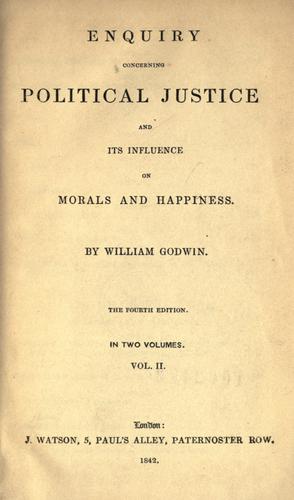
Front Page Titles (by Subject) book v.: of legislative and executive power - An Enquiry Concerning Political Justice, Vol. II.
Return to Title Page for An Enquiry Concerning Political Justice, Vol. II.The Online Library of LibertyA project of Liberty Fund, Inc.Search this Title:Also in the Library:
book v.: of legislative and executive power - William Godwin, An Enquiry Concerning Political Justice, Vol. II. [1793]Edition used:An Enquiry Concerning Political Justice, and its Influence on General Virtue and Happiness, vol. 2 (London: G.G.J. and J. Robinson, 1793).
Part of: An Enquiry Concerning Political Justice, in 2 vols.About Liberty Fund:Liberty Fund, Inc. is a private, educational foundation established to encourage the study of the ideal of a society of free and responsible individuals. Copyright information:The text is in the public domain. Fair use statement:This material is put online to further the educational goals of Liberty Fund, Inc. Unless otherwise stated in the Copyright Information section above, this material may be used freely for educational and academic purposes. It may not be used in any way for profit.
book v.of legislative and executive powerCHAP. I.introductionretrospect of principles already established.—distribution of the remaining subjects.—subject of the present book.—forms of government.—method of examination to be adopted. In the preceding divisions of this work the ground has beenbook v. chap. i. retrospect of principles already established. sufficiently cleared to enable us to proceed with considerable explicitness and satisfaction to the practical detail of political institution. It has appeared that an enquiry concerning the principles and conduct of social intercourse is the most important topic upon which the mind of man can be exercised* ; that upon those principles well or ill conceived, and the manner in which they are executed, the vices and virtues of individuals depend book v. chap. i. that political institution to be good must have its sole foundation in the rules of immutable justice* ; and that those rules, uniform in their nature, are equally applicable to the whole human race† Distribution of the remaining subjects. The different topics of political institution cannot perhaps be more perspicuously distributed than under the four following heads: provisions for general administration; provisions for the intellectual and moral improvement of individuals; provisions for the administration of criminal justice; and provisions for the regulation of property. Under each of these heads it will be our business, in proportion as we adhere to the great and comprehensive principles already established, rather to clear away abuses than to recommend farther and more precise regulations, rather to simplify than to complicate. Above all we should not forget, that government is an evil, an usurpation upon the private judgment and individual conscience of mankind; and that, however we may be obliged to admit it as a necessary evil for the present, it behoves us, as the friends of reason and the human species, to admit as little of it as possible, and carefully to observe whether, in consequence of the gradual illumination of the human mind, that little may not hereafter be diminished. Subject of the present book. And first we are to consider the different provisions that may be made for general administration; including under the phrase general administration all that shall be found necessary of whatbook v. chap. 1. has usually been denominated legislative and executive power. Legislation has already appeared to be a term not applicable to human society* . Men cannot do more than declare and interpret law; nor can there be an authority so paramount, as to have the prerogative of making that to be law, which abstract and immutable justice had not made to be law previously to that interposition. But it might notwithstanding this be found necessary, that there should be an authority empowered to declare those general principles, by which the equity of the community will be regulated, in particular cases upon which it may be compelled to decide. The question concerning the reality and extent of this necessity it is proper to reserve for after consideration. Executive power consists of two very distinct parts: general deliberations relative to particular emergencies, which, so far as practicability is concerned, may be exercised either by one individual or a body of individuals, such as peace and war, taxation † , and the selection of proper periods for convoking deliberative assemblies: and particular functions, such as those of financial detail, or minute superintendence, which cannot be exercised unless by one or at most by a small number of persons. In reviewing these several branches of authority, and consideringForms of government. the persons to whom they may be most properly confided, we book v. chap. 1. Method of examination to be adopted. cannot do better than adopt the ordinary distribution of forms of government into monarchy, aristocracy and democracy. Under each of these heads we may enquire into the merits of their respective principles, first absolutely, and upon the hypothesis of their standing singly for the whole administration; and secondly, in a limited view, upon the supposition of their constituting one branch only of the system of government. It is usually alike incident to them all to confide the minuter branches of executive detail to inferior agents. One thing more it is necessary to premise. The merits of each of the three heads I have enumerated are to be considered negatively. The corporate duties of mankind are the result of their irregularities and follies in their individual capacity. If they had no imperfection, or if men were so constituted as to be sufficiently and sufficiently early corrected by persuasion alone, society would cease from its functions. Of consequence, of the three forms of government and their compositions that is the best, which shall least impede the activity and application of our intellectual powers. It was in the recollection of this truth that I have preferred the term political institution to that of government, the former appearing to be sufficiently expressive of that relative form, whatever it be, into which individuals would fall, when there was no need of force to direct them into their proper channel, and were no refractory members to correct. CHAP. II.of education, the education of a prince.nature of monarchy delineated.—school of adversity.—tendency of superfluity to inspire effeminacy—to deprive us of the benefit of experience—illustrated in the case of princes.—manner in which they are addressed.—inefficacy of the instruction bestowed upon them. First then of monarchy; and we will first suppose thebook v. chap. ii. succession to the monarchy to be hereditary. In this case we have the additional advantage of considering this distinguished mortal, who is thus set over the heads of the rest of his species, from the period of his birth. The abstract idea of a king is of an extremely momentousNature of monarchy delineated. and extraordinary nature; and, though the idea has by the accident of education been rendered familiar to us from our infancy, yet perhaps the majority of readers can recollect the period, when it struck them with astonishment and confounded their powers of apprehension. It being sufficiently evident that some species of government was necessary, and that individuals book v. chap. ii. must concede a part of that sacred and important privilege by which each man is constituted judge of his own words and actions, for the sake of general good, it was next requisite to consider what expedients might be substituted in the room of this original claim. One of these expedients has been monarchy. It was the interest of each individual that his individuality should be invaded as rarely as possible; that no invasion should be permitted to flow from wanton caprice, from sinister and disingenuous views, or from the instigation of anger, partiality and passion; and that this bank, severely levied upon the peculium of each member of the society, should be administered with frugality and discretion. It was therefore without doubt a very bold adventure to commit this precious deposit to the custody of a single man. If we contemplate the human powers whether of body or mind, we shall find them much better suited to the superintendence of our private concerns and to the administering occasional assistance to others, than to the accepting the formal trust of superintending the affairs and watching for the happiness of millions. If we recollect the physical and moral equality of mankind, it will appear a very violent usurpation upon this principle to place one individual at so vast an interval from the rest of his species. Let us then consider how such persons are usually educated, or may be expected to be educated, and how well they are prepared for this illustrious office. School of adversity. It is a common opinion that adversity is the school in which all extraordinary virtue must be formed. Henry the fourth ofbook v. chap. ii. France and Elizabeth of England experienced a long series of calamities before they were elevated to a throne. Alfred, of whom the obscure chronicles of a barbarous age record such superior virtues, passed through the vicissitudes of a vagabond and a fugitive. Even the mixed, and upon the whole the vicious, yet accomplished, characters of Frederic and Alexander, were not formed without the interference of injustice and persecution. This hypothesis however seems to have been pushed too far. It is no more reasonable to suppose that virtue cannot be matured without injustice, than to believe, which has been another prevailing opinion, that human happiness cannot be secured without imposture and deceit. Both these errors have a common source, a distrust of the omnipotence of truth. If their advocates had reflected more deeply upon the nature of the human mind, they would have perceived that all our voluntary actions are judgments of the understanding, and that actions of the most judicious and useful nature must infallibly flow from a real and genuine conviction of truth. But, though the exaggerated opinion here stated of the usefulnessTendency of superfluity to inspire effeminacy: of adversity be erroneous, it is, like many other of our errors, allied to important truth. If adversity be not necessary, it must be allowed that prosperity is pernicious. Not a genuine and philosophical prosperity, which requires no more than sound book v. chap. ii. health with a sound intellect, the capacity of procuring for ourselves by a moderate and well regulated industry the means of subsistence, virtue and wisdom: but prosperity as it is usually understood, that is, a competence, provided for us by the caprice of human institution, inviting our bodies to indolence, and our minds to lethargy; and still more prosperity, as it is understood in the case of noblemen and princes, that is, a superfluity of wealth, which deprives us of all intercourse with our fellow men upon equal terms, and makes us prisoners of state, gratified indeed with baubles and splendour, but shut out from the real benefits of society and the perception of truth. If truth be so intrinsically powerful as to make adversity unnecessary to excite our attention to it, it is nevertheless certain that luxury and wealth have the most fatal effects in distorting it. If it require no foreign aid to assist its energies, we ought however to be upon our guard against principles and situations the tendency of which may be perpetually to counteract it. Nor is this all. One of the most essential ingredients of virtue is fortitude. It was the plan of many of the Grecian philosophers, and most of all of Diogenes, to show to mankind how very limited was the supply that our necessities required, and how little dependent our real welfare and prosperity were upon the caprice of others. Among innumerable incidents upon record that illustrate this principle, a single one may suffice to suggest to our minds its general spirit. Diogenes had a slave whose name was Menas, and Menas thought proper upon somebook v. chap. ii. occasion to elope. “Ha!” said the philosopher, “can Menas live without Diogenes, and cannot Diogenes live without Menas?” There can be no lesson more important than that which is thus conveyed. The man that does not know himself not to be at the mercy of other men, that does not feel that he is invulnerable to all the vicissitudes of fortune, is incapable of a constant and inflexible virtue. He, to whom the rest of his species can reasonably look up with confidence, must be firm, because his mind is filled with the excellence of the object he pursues; and chearful, because he knows that it is out of the power of events to injure him. If any one should choose to imagine that this idea of virtue is strained too high, yet all must allow that no man can be entitled to our confidence, who trembles at every wind, who can endure no adversity, and whose very existence is linked to the artificial character he sustains. Nothing can more reasonably excite our contempt, than a man who, if he were once reduced to the genuine and simple condition of man, would be reduced to despair, and find himself incapable of consulting and providing for his own subsistence. Fortitude is a habit of mind that grows out of a sense of our own independence. If there be a man, who dares not even trust his own imagination with the fancied change of his circumstances, he must necessarily be effeminate, irresolute and temporising. He that loves sensuality or ostentation better than virtue, may be entitled to our pity, but a madman only would entrust to his disposal any thing that was dear to him. book v. chap. ii. to deprive us of the benefit of experience: Again, the only means by which truth, however immutable in its own nature, can be communicated to the human mind is through the inlet of the senses. It is perhaps impossible that a man shut up in a cabinet can ever be wise. If we would acquire knowledge, we must open our eyes, and contemplate the universe. Till we are acquainted with the meaning of terms and the nature of the objects around us, we cannot understand the propositions that may be formed concerning them. Till we are acquainted with the nature of the objects around us, we cannot compare them with the principles we have formed, and understand the modes of employing them. There are other ways of attaining wisdom and ability beside the school of adversity, but there is no way of attaining them but through the medium of experience. That is, experience brings in the materials with which intellect works; for it must be granted that a man of limited experience will often be more capable than he who has gone through the greatest variety of scenes; or rather perhaps, that one man may collect more experience in a sphere of a few miles square, than another who has sailed round the world. To conceive truly the value of experience we must recollect the infinite improvements the human mind has received in a long series of ages, and how an enlightened European differs from a solitary savage. However multifarious are these improvements, there are but two ways in which they can be appropriated by any individual; either at second hand by books and conversation, or at first hand by our own observations of men andbook v. chap. ii. things. The improvement we receive in the first of these modes is unlimited; but it will not do alone. We cannot understand books, till we have seen the subjects of which they treat. He that knows the mind of man, must have observed it for himself; he that knows it most intimately, must have observed it in its greatest variety of situations. He must have seen it without disguise, when no exterior situation puts a curb upon its passions, and induces the individual to exhibit a studied, not a spontaneous character. He must have seen men in their unguarded moments, when the eagerness of temporary resentment tips their tongue with fire, when they are animated and dilated by hope, when they are tortured and anatomised by despair, when the soul pours out its inmost self into the bosom of an equal and a friend. Lastly, he must himself have been an actor in the scene, have had his own passions brought into play, have known the anxiety of expectation and the transport of success, or he will feel and understand about as much of what he sees, as mankind in general would of the transactions of the vitriolised inhabitants of the planet Mercury, or the salamanders that live in the sun.—Such is the education of the true philosopher, the genuine politician, the friend and benefactor of human kind. What is the education of a prince? Its first quality is extremeillustrated in the case of princes.book v. chap. ii. tenderness. The winds of heaven are not permitted to blow upon him. He is dressed and undressed by his lacqueys and valets. His wants are carefully anticipated; his desires without any effort of his profusely supplied. His health is of too much importance to the community to permit him to exert any considerable effort either of body or mind. He must not hear the voice of reprimand or blame. In all things it is first of all to be remembered that he is a prince, that is, some rare and precious creature, but not of human kind. Manner in which they are addressed. As he is the heir to a throne, it is never forgotten by those about him, that considerable importance is to be annexed to his favour or his displeasure. Accordingly they never express themselves in his presence frankly and naturally, either respecting him or themselves. They are supporting a part. They play under a mask. Their own fortune and emolument is always uppermost in their minds, at the same time that they are anxious to appear generous, disinterested and sincere. All his caprices are to be complied with. All his gratifications are to be studied. They find him a depraved and sordid mortal; they judge of his appetites and capacities by their own; and the gratifications they recommend serve to sink him deeper in folly and vice. What is the result of such an education? Having never experienced contradiction, the young prince is arrogant and presumptuous. Having always been accustomed to the slaves of necessity or the slaves of choice, he does not understand even thebook v. chap. ii. meaning of the word freedom. His temper is insolent, and impatient of parley and expostulation. Knowing nothing, he believes himself sovereignly informed, and runs headlong into danger, not from firmness and courage, but from the most egregious wilfulness and vanity. Like Pyrrho among the ancient philosophers, if his attendants were at a distance, and he trusted himself alone in the open air, he would perhaps be run over by the next coach, or fall down the first precipice. His violence and presumption are strikingly contrasted with the extreme timidity of his disposition. The first opposition terrifies him, the first difficulty seen and understood appears insuperable. He trembles at a shadow, and at the very semblance of adversity is dissolved into tears. It has accordingly been observed that princes are commonly superstitious beyond the rate of common mortals. Above all, simple, unqualified truth is a stranger to his ear. It either never approaches; or is so unexpected a guest should once appear, it meets with so cold a reception, as to afford little encouragement to a second visit. The longer he has been accustomed to falshood and flattery, the more grating will it sound. The longer he has been accustomed to falshood and flattery, the more terrible will the task appear to him, to change his tastes, and discard his favourites. He will either place a blind confidence in all men, or, having detected the insincerity of those who were most agreeable to him, will conclude that all men are book v. chap. ii. knavish and designing. As a consequence of this last opinion, he will become indifferent to mankind, callous to their sufferings, and will believe that even the virtuous are knaves under a craftier mask. Such is the education of an individual, who is destined to superintend the affairs and watch for the happiness of millions. In this picture are indeed contained all those features which naturally constitute the education of a prince, into the conducting of which no person of energy and virtue has by accident been introduced. In real life it will be variously modified, but the majority of the features, unless in very rare instances, will remain the same. In no case can the education of a friend and benefactor of human kind, as sketched in a preceding page, by any speculative contrivance be communicated. Inefficacy of the instruction bestowed upon them. Nor is there any difficulty in accounting for this universal miscarriage. The wisest preceptor thus circumstanced must labour under insuperable disadvantages. No situation can be so unnatural as that of a prince, so difficult to be understood by him who occupies it, so irresistibly propelling the mind to mistake. The first ideas it suggests are of a tranquillising and soporific nature. It fills him with the opinion of his secretly possessing some inherent advantage over the rest of his species, by which he is formed to command and they to obey. If you assure him of the contrary, you can expect only an imperfect and temporary credit; for facts, which in this case depose against you, speak a language more emphatic and intelligible than words. If it werebook v. chap. ii. not as he supposes, why should every one that approaches be eager to serve him? The sordid and selfish motives by which they are really animated he is very late in detecting. It may even be doubted whether the individual, who was never led to put the professions of others to the test by his real wants, has in any instance been completely aware of the little credit that is often due to them. A prince finds himself courted and adored long before he can have acquired a merit entitling him to such distinctions. By what arguments can you persuade him laboriously to pursue what appears so completely superfluous? How can you induce him to be dissatisfied with his present acquisitions, while every other person assures him that his accomplishments are admirable and his mind a mirror of sagacity? How will you persuade him who finds all his wishes anticipated, to engage in any arduous undertaking, or propose any distant object for his ambition? But, even should you succeed in this, his pursuits may be expected to be either mischievous or useless. His understanding is distorted; and the basis of all morality, the recollection that other men are beings of the same order with himself, is extirpated. It would be unreasonable to expect from him any thing generous and humane. Unfortunate as he is, his situation is continually propelling him to vice, and destroying the germs of integrity and virtue before they are unfolded. If sensibility begin book v. chap. ii. to discover itself, it is immediately poisoned by the blighting winds of flattery. Amusement and sensuality call with an imperious voice, and will not allow him time to feel. Artificial as is the character he fills, even should he aspire to fame, it will be by the artificial methods of false refinement, or the barbarous inventions of usurpation and conquest, not by the plain and unornamented road of benevolence. Some idea of the methods usually pursued, and the effects produced in the education of a prince, may be collected from a late publication of the celebrated madame de Genlis, in which she gives an account of her own proceedings in relation to the children of the duke d’Orleans. She thus describes the features of their disposition and habits at the time they were committed to her care. “The duke de Valois (the eldest) is frequently coarse in his manners and ignoble in his expressions. He finds a great deal of humour in describing mean and common objects by vulgar expressions; and all this seasoned with the proverbial fertility of Sancho Panza himself, and set off with a loud forced laugh. His prate is eternal, nor does he suspect but that it must be an exquisite gratification to any one to be entertained with it; and he frequently heightens the jest by a falshood uttered in the gravest manner imaginable. Neither he nor his brother has the least regard for any body but himself; they are selfish and grasping to an extreme, considering every thing that is done for them as their due, and imagining that they are in no respect obliged to consult the happiness of others. The slightest reproof is beyondbook v. chap. ii. measure shocking to them, and the indignation they conceive at it immediately vents itself in sullenness or tears. They are in an uncommon degree effeminate, afraid of the wind or the cold, unable to run or to leap, or even so much as to walk at a round pace, or for more than half an hour together. The duke de Valois has an extreme terror of dogs, to such a degree as to turn pale and shriek out at the sight of one.” “When the children of the duke d’Orleans were committed to my care, they had been accustomed in winter to wear under-waistcoats, two pair of stockings, gloves, muffs, &c. The eldest, who was eight years of age, never came down stairs without being supported by the arm of one or two persons; the domestics were obliged to render them the meanest services, and, for a cold or any slight indisposition, sat up with them for nights together.† book v. chap. ii. Madame de Genlis, a woman of uncommon talents and comprehensive views, though herself infected with a considerable number of errors, corrected these defects in the young princes. But few princes have the good fortune to be educated by a mind so powerful and wise as that of madame de Genlis, and we may safely take our standard for the average calculation rather from her predecessors than herself. She forms the exception; they the rule. Even were it otherwise, we have already seen what it is that a preceptor can do in the education of a prince. Nor should it be forgotten that these were not of the class of princes destined to a throne. CHAP. III.private life of a prince.principles by which he is influenced—irresponsibility—impatience of control—habits of dissipation—ignorance—dislike of truth—dislike of justice—pitiable situation of princes. Such is the culture; the fruit that it produces may easily bebook v. chap. iii. conjectured. The fashion which is given to the mind in youth, it ordinarily retains in age; and it is with ordinary cases only that the present argument is concerned. If there have been kings, as there have been other men, in the forming of whom particular have outweighed general causes, the recollection of such exceptions has little to do with the question, whether monarchy be generally speaking a benefit or an evil. Nature has no particular mould of which she forms the intellects of princes; monarchy is certainly not jure divino; and of consequence, whatever system we may adopt upon the subject of natural talents, the ordinary rate of kings will possess at best but the ordinary rate of human understanding. In what has been said, and in what remains to say, we are not to fix our minds upon prodigies, but to think of the species as it is usually found. book v. chap. iii. But, though education for the most part determines the character of the future man, it may not be useless to follow the disquisition a little farther. Education in one sense is the affair of youth, but in a stricter and more accurate sense the education of an intellectual being can terminate only with his life. Every incident that befals us is the parent of a sentiment, and either confirms or counteracts the preconceptions of the mind. Principles by which he is influenced: Now the causes that acted upon kings in their minority, continue to act upon them in their maturer years. Every thing is carefully kept out of sight that may remind them they are menirresponsibility:. Every means is employed that can persuade them that they are of a different species of beings, and subject to different laws of existence. “A king,” such at least is the maxim of absolute monarchies, “though obliged by a rigid system of duties, is accountable for his discharge of those duties only to God.” That is, exposed to a hundred fold more seductions than ordinary men, he has not like them the checks of a visible constitution of things, perpetually through the medium of the senses making their way to the mind. He is taught to believe himself superior to the restraints that bind ordinary men, and subject to a rule peculiarly his own. Every thing is trusted to the motives of an invisible world; which, whatever may be the estimate to which they are entitled in the view of philosophy, mankind are not now to learn are weakly felt by those who are immerged in splendour or affairs, and have little chance of success in contending with the impressions of sense and the allurements of visiblebook v. chap. iii. objects. It is a maxim generally received in the world “thatevery kingimpatience of control: is a despot in his heart,” and themaxim can seldom fail to be verified in the experiment. A limited monarch and an absolute monarch, though inmany respects different, approach in more points thanthey separate. A monarch, strictly without limitation, is perhaps a phenomenon that never yet existed. Allcountries have possessed some check upon despotism, which to their deluded imaginations appeared a sufficientsecurity for their independence. All kings have possessedsuch a portion of luxury and ease, have been so farsurrounded with servility and falshood, and to sucha degree exempt from personal responsibility, as todestroy the natural and wholesome complexion of thehuman mind. Being placed so high, they find but onestep between them and the summit of social authority, and they cannot but eagerly desire to gain that step. Having so frequent occasions of seeing their behestsimplicitly obeyed, being trained in so long a sceneof adulation and servility, it is impossible they shouldnot feel some indignation at the honest firmness thatsets limits to their omnipotence. But to say, “thatevery king is a despot in his heart,” will presentlybe shown to be the same thing as to say, that everyking is by unavoidable necessity the enemy of the human race. book v. chap. iii. habits of dissipation: The principal source of virtuous conduct is to recollect the absent. He that takes into his estimate present things alone, will be the perpetual slave of sensuality and selfishness. He will have no principle by which to restrain appetite, or to employ himself in just and benevolent pursuits. The cause of virtue and innocence, however urgent, will no sooner cease to be heard, than it will be forgotten. Accordingly nothing is found more favourable to the attainment of moral excellence than meditation: nothing more inimical than an uninterrupted succession of amusements. It would be absurd to expect from kings the recollection of virtue in exile or disgrace. It has generally been observed, that even for the loss of a flatterer or a favourite they speedily console themselves. Image after image so speedily succeed in their sensorium, that no one of them leaves a durable impression. A circumstance which contributes to this moral insensibility, is the effeminacy and cowardice which grow out of perpetual indulgence. Their minds spontaneously shrink from painful ideas, from motives that would awaken them to effort, and reflections that would demand severity of disquisition. ignorance: What situation can be more unfortunate than that of a stranger, who cannot speak our language, knows nothing of our manners and customs, and enters into the busy scene of our affairs, without one friend to advise with or assist him? If any thing is to be got by such a man, we may depend upon seeing him instantly surrounded with a group of thieves, sharpers and extortioners. They will make him swallow the most incrediblebook v. chap. iii. stories, will impose upon him in every article of his necessities or his commerce, and he will leave the country at last, as unfriended and in as absolute ignorance as he entered it. Such a stranger is a king; but with this difference, that the foreigner, if he be a man of sagacity and penetration, may make his way through this crowd of intruders, and discover a set of persons worthy of his confidence, which can scarcely in any case happen to a king. He is placed in a vortex peculiarly his own. He is surrounded with an atmosphere through which it is impossible for him to discover the true colours and figure of things. The persons that are near him are in a cabal and conspiracy of their own, and there is nothing about which they are more anxious than to keep truth from approaching him. The man, who is not accessible to every comer, who delivers up his person into the custody of another, and may, for any thing that he can tell, be precluded from that very intercourse and knowledge it is most important for him to possess, whatever name he may bear, is in reality a prisoner. Whatever the arbitrary institutions of men may pretend, the more powerful institutions of nature forbid one man to transact the affairs and provide for the welfare of millions. A king soon finds the necessity of entrusting his functions to the administration of his servants. He acquires the habit of seeing with their eyes and acting with their hands. He finds the necessity of confiding book v. chap. iii. implicitly in their fidelity. Like a man long shut up in a dungeon, his organs are not strong enough to bear the irradiation of truth. Accustomed to receive information of the feelings and sentiments of mankind through the medium of another person, he cannot bear directly to converse with business and affairs. Whoever would detach his confidence from his present favourites, and induce him to pass over again in scrutiny the principles and data upon which he has already determined, requires of him too painful a task. He hastens from his informer to communicate the accusation to his favourite, and the tongue that has been accustomed to gain credit, easily varnishes over this new discovery. He flies from uncertainty, anxiety and doubt to his routine of amusements; or amusement presents itself, is importunate to be received, and presently obliterates the tale that overspread the mind with melancholy and suspicion. Much has been said of intrigue and duplicity. They have been alledged to intrude themselves into the walks of commerce, to haunt the intercourse of men of letters, and to rend the petty concerns of a village with faction. But, wherever else they may be strangers, in courts they undoubtedly find a congenial climate. The intrusive talebearer, who carries knowledge to the ear of kings, is within that circle an object of general abhorrence. The favourite marks him for his victim; and the inactive and unimpassioned temper of the monarch soon resigns him to the vindictive importunity of his adversary. It is in the contemplation of these circumstances that Fenelon has remarked that “kings are the most unfortunate and the most misled of all humanbook v. chap. iii. beings* But in reality were they in possession of purer sources of information,Dislike of truth: it would be to little purpose. Royalty inevitably allies itself to vice. Virtue, in proportion as it has taken possession of any character, is just, consistent and sincere. But kings, debauched by their education, ruined by their situation, cannot endure an intercourse with these attributes. Sincerity, that would tell them of their errors and remind them of their cowardice; justice, that, uninfluenced by the trappings of majesty, would estimate the man at his true desert; consistency, that no temptation would induce to part with its principles; are odious and intolerable in their eyes. From such intruders they hasten to men of a pliant character, who will flatter their mistakes, put a false varnish on their actions, and be visited by no impertinent scruples in assisting the indulgence of their appetites. There is scarcely in human nature an inflexibility that can resist perpetual flattery and compliance. The virtues that grow up among us are cultured in the open soil of equality, not in the artificial climate of greatness. We need the winds to harden, as much as book v. chap. iii. the heat to cherish us. Many a mind, that promised well in its outset, has been found incapable to stand the test of perpetual indulgence and ease, without one shock to waken, and one calamity to stop it in its smooth career. dislike of justice Monarchy is in reality so unnatural an institution, that mankind have at all times strongly suspected it was unfriendly to their happiness. The power of truth upon important topics is such, that it may rather be said to be obscured than obliterated; and falshood has scarcely ever been so successful, as not to have had a restless and powerful antagonist in the heart of its votaries. The man who with difficulty earns his scanty subsistence, cannot behold the ostentatious splendour of a king; without being visited by some sense of injustice. He inevitably questions in his mind the utility of an officer whose services are hired at so enormous a price. If he consider the subject with any degree of accuracy, he is led to perceive, and that with sufficient surprise, that a king is nothing more than a common mortal, exceeded by many and equalled by more in every requisite of strength, capacity and virtue. He feels therefore that nothing can be more groundless and unjust than the supposing that one such man as this is the fittest and most competent instrument for regulating the affairs of nations. These reflections are so unavoidable that kings themselves have often been aware of the danger to their imaginary happiness with which they are pregnant. They have sometimes beenbook v. chap. iii. alarmed with the progress of thinking, and oftener regarded the ease and prosperity of their subjects as a source of terror and apprehension. They justly consider their functions as a sort of public exhibition, the success of which depends upon the credulity of the spectators, and which good sense and courage would speedily bring to a termination. Hence the well known maxims of monarchical government, that ease is the parent of rebellion, and that it is necessary to keep the people in a state of poverty and endurance in order to render them submissive. Hence it has been the perpetual complaint of despotism, that “the restive knaves are overrun with ease, and plenty ever is the nurse of faction* .” Hence it has been the lesson perpetually read to monarchs: “Render your subjects prosperous, and they will speedily refuse to labour; they will become stubborn, proud, unsubmissive to the yoke, and ripe for revolt. It is impotence and misery that alone will render them supple, and prevent them from rebelling against the dictates of authority† .” Pitiable situation of princes. It is a common and vulgar observation that the state of a king is greatly to be pitied. “All his actions are hemmed in with book v. chap. iii. anxiety and doubt. He cannot, like other men, indulge the gay and careless hilarity of his mind; but is obliged, if he be of an honest and conscientious disposition, to consider how necessary the time, which he is thoughtlessly giving to amusement, may be to the relief of a worthy and oppressed individual; how many benefits might in a thousand instances result from his interference; how many a guileless and undesigning heart might be cheared by his justice. The conduct of kings is the subject of the severest criticism, which the very nature of their situation disables them to encounter. A thousand things are done in their name in which they have no participation; a thousand stories are so disguised to their ear as to render the truth absolutely undiscoverable; and the kingis the general scape-goat, loaded with the offences of all his dependents.” No picture can be more just, judicious and humane than that which is thus exhibited. Why then should the advocates of antimonarchical principles be considered as the enemies of kings? They would relieve them from “a load would fink a navy, too much honour† .” They would exalt them to the happy and enviable condition of private individuals. In reality nothing can be more iniquitous and cruel than to impose upon a man the unnatural office of a king. It is not less inequitable towards him that exercises it, than towards them who are subjected to it. Kings, if they understood their own interests, would be the firstbook v. chap. iii. to espouse these principles, the most eager to listen to them, the most fervent in expressing their esteem of the men who undertake to impress upon their species this important truth. CHAP. IV.of a virtuous despotism.supposed excellence of this form of government controverted—from the narrowness of human powers.—case of a vicious administration—of a virtuous administration intended to be formed.—monarchy not adapted to thegovernmentoflargerge states. book v. chap. iv. Supposed excellence of this form of government controverted:There is a principle frequently maintained upon this subject, which is well entitled to our impartial consideration. It is granted by those who espouse it, “that absolute monarchy, from the imperfection of those by whom it is administered, is most frequently attended with evil;” but they assert, “that it is the best and most desirable of all forms under a good and virtuous prince. It is exposed,” say they, “to the fate of all excellent natures, and from the best thing frequently, if corrupted, becomes the worst.” This remark is certainly not very decisive of the general question, so long as any weight shall be attributed to the arguments which have been adduced to evince what sort of character and disposition may be ordinarily expected in princes. It may however be allowed, if true, to create in the mind a sort of partial retrospect to this happy and perfect despotism; and, if it can be shown to be false, it will renderbook v. chap. iv. the argument for the abolition of monarchy, so far as it is concerned, more entire and complete. Now, whatever dispositions any man may possess in favourfrom the narrowness of human powers. of the welfare of others, two things are necessary to give them validity; discernment and power. I can promote the welfare of a few persons, because I can be sufficiently informed of their circumstances. I can promote the welfare of many in certain general articles, because for this purpose it is only necessary that I should be informed of the nature of the human mind as such, not of the personal situation of the individuals concerned. But for one man to undertake to administer the affairs of millions, to supply, not general principles and perspicuous reasoning, but particular application, and measures adapted to the necessities of the moment, is of all undertakings the most extravagant and absurd. The most natural and obvious of all proceedings is for each man to be the sovereign arbiter of his own concerns. If the imperfection, the narrow views and the mistakes of human beings render this in certain cases inexpedient and impracticable, the next resource is to call in the opinion of his peers, persons who from their vicinity may be presumed to have some general knowledge of the case, and who have leisure and means minutely to investigate the merits of the question. It cannot reasonably book v. chap. iv. be doubted, that the same expedient which men employed in their civil and criminal concerns, would by uninstructed mortals be adopted in the assessment of taxes, in the deliberations of commerce, and in every other article in which their common interests were involved, only generalising the deliberative assembly or pannel in proportion to the generality of the question to be decided. Monarchy, instead of referring every question to the persons concerned or their neighbours, refers it to a single individual placed at the greatest distance possible from the ordinary members of the society. Instead of distributing the causes to be judged into as many parcels as they would conveniently admit for the sake of providing leisure and opportunities of examination, it draws them to a single centre, and renders enquiry and examination impossible. A despot, however virtuously disposed, is obliged to act in the dark, to derive his knowledge from other men's information, and to execute his behests by other men's instrumentality. Monarchy seems to be a species of government proscribed by the nature of man; and those persons, who furnished their despot with integrity and virtue, forgot to add omniscience and omnipotence, qualities not less necessary to fit him for the office they had provided. case of a vicious administration: Let us suppose this honest and incorruptible despot to be served by ministers, avaricious, hypocritical and interested. What will the people gain by the good intentions of their monarch? Hebook v. chap. iv. will mean them the greatest benefits, but he will be altogether unacquainted with their situation, their character and their wants. The information he receives will frequently be found the very reverse of the truth. He will be taught that one individual is highly meritorious and a proper subject of reward, whose only merit is the profligate cruelty with which he has served the purposes of his administration. He will be taught that another is the pest of the community, who is indebted for this report to the steady virtue with which he has traversed and defeated the wickedness of government. He will mean the greatest benefits to his people; but when he prescribes something calculated for their advantage, his servants under pretence of complying shall in reality perpetrate diametrically the reverse. Nothing will be more dangerous than to endeavour to remove the obscurity with which his ministers surround him. The man, who attempts so hardy a task, will become the incessant object of their hatred. Though the sovereign should be ever so severely just, the time will come when his observation will be laid asleep, while malice and revenge are ever vigilant. Could he unfold the secrets of his prison houses of state, he would find men committed in his name whose crimes he never knew, whose names he never heard of, perhaps men whom he honoured and esteemed. Such is the history of the benevolent and philanthropic despots whom memory has recorded; and the conclusion from the whole is, that, wherever despotism exists, book v. chap. iv. there it will always be attended with the evils of despotism, capricious measures and arbitrary infliction. of a virtuous administration intended to be formed. “But will not a wise king take care to provide himself with good and virtuous servants?” Undoubtedly he will effect a part of this, but he cannot supersede the essential natures of things. He that executes any office as a deputy will never discharge it in the same perfection as if he were the principal. Either the minister must be the author of the plans which he carries into effect, and then it is of little consequence, except so far as relates to his integrity in the choice of his servants, what sort of mortal the sovereign shall be found; or he must play a subordinate part, and then it is impossible to transfuse into his mind the perspicacity and energy of his master. Wherever despotism exists, it cannot remain in a single hand, but must be transmitted whole and entire through all the progressive links of authority. To render despotism auspicious and benign it is necessary, not only that the sovereign should possess every human excellence, but that all his officers should be men of penetrating genius and unspotted virtue. If they fall short of this, they will, like the ministers of Elizabeth, be sometimes specious profligates* , and sometimes men, who, however admirably adapted for business, consult on many occasions exclusively their private advantage, worship the rising sun, enter into vindictive cabals, and cuff down new fledged merit* . Wherever the continuity is broken, the flood of vice will bear down all before it. One weak or disingenuous man will be the source of unbounded mischief. It is the nature of monarchy under all its forms to confide greatly in the discretion of individuals. It provides no resource for maintaining and diffusing the spirit of justice. Every thing rests upon the permanence and extent of influence of personal virtue. Another position, not less generally asserted than that of theMonarchy not adapted to the government of large states. desirableness of a virtuous despotism, is, “that republicanism is a species of government practicable only in a small state, while monarchy is best fitted to embrace the concerns of a vast and flourishing empire.” The reverse of this, so far at least as relates to monarchy, appears at first sight to be the truth. The competence of any government cannot be measured by a purer standard, than the extent and accuracy of its information. In this respect monarchy appears in all cases to be wretchedly deficient; but, if it can ever be admitted, it must surely be in those narrow and limited instances where an individual can with least absurdity be supposed to be acquainted with the affairs and interests of the whole. CHAP. V.of courts and ministers.systematical monopoly of confidence.—character of ministers—of their dependents.—venality of courts.—universality of this principle. book v. chap. v.We shall be better enabled to judge of the dispositions with which information is communicated and measures are executed in monarchical countries, if we reflect upon another of the evil consequences attendant upon this species of government, the existence and corruption of courts. Systematical monopoly of confidence. The character of this, as well as of every other human institution, arises out of the circumstances with which it is surrounded. Ministers and favourites are a sort of people who have a state prisoner in their custody, the whole management of whose understanding and actions they can easily engross. This they completely effect with a weak and credulous master, nor can the most cautious and penetrating entirely elude their machinations. They unavoidably desire to continue in the administration of his functions, whether it be emolument, or the love of homage, or any more generous motive by which they are attached to it. But the more they are confided in by thebook v. chap. v. sovereign, the greater will be the permanence of their situation; and the more exclusive is their possession of his ear, the more implicit will be his confidence. The wisest of mortals are liable to error; the most judicious projects are open to specious and superficial objections; and it can rarely happen but a minister will find his ease and security in excluding as much as possible other and opposite advisers, whose acuteness and ingenuity are perhaps additionally whetted by a desire to succeed to his office. Ministers become a sort of miniature kings in their turn.Character of ministers: Though they have the greatest opportunity of observing the impotence and unmeaningness of the character, they yet envy it. It is their trade perpetually to extol the dignity and importance of the master they serve; and men cannot long anxiously endeavour to convince others of the truth of any proposition without becoming half convinced of it themselves. They feel themselves dependent for all that they most ardently desire upon this man's arbitrary will; but a sense of inferiority is perhaps the never failing parent of emulation or envy. They assimilate themselves therefore of choice to a man to whose circumstances their own are considerably similar. In reality the requisites, without which monarchical governmentof their dependents. cannot be preserved in existence, are by no means sufficiently book v. chap. v. supplied by the mere intervention of ministers. There must be the ministers of ministers, and a long bead roll of subordination descending by tedious and complicated steps. Each of these lives on the smile of the minister, as he lives on the smile of the sovereign. Each of these has his petty interests to manage, and his empire to employ under the guise of servility. Each imitates the vices of his superior, and exacts from others the adulation he is obliged to pay. It has already appeared that a king is necessarily and almost unavoidably a despot in his heart. He has been used to hear those things only which were adapted to give him pleasure; and it is with a grating and uneasy sensation that he listens to communications of a different sort. He has been used to unhesitating compliance; and it is with difficulty he can digest expostulation and opposition. Of consequence the honest and virtuous character, whose principles are clear and unshaken, is least qualified for his service; he must either explain away the severity of his principles, or he must give place to a more crafty and temporising politician. The temporising politician expects the same pliability in others that he exhibits in himself; and the fault which he can least forgive is an ill timed and inauspicious scrupulosity. Expecting this compliance from all the coadjutors and instruments of his designs, he soon comes to set it up as a standard by which to judge of the merit of all other men. He is deaf tobook v. chap. v. every recommendation but that of a fitness for the secret service of government, or a tendency to promote his interest and extend the sphere of his influence. The worst man with this argument in his favour will seem worthy of encouragement; the best man who has no advocate but virtue to plead for him will be treated with superciliousness and neglect. It is true the genuine criterion of human desert can never be superseded and reversed. But it will appear to be reversed, and appearance will produce many of the effects of reality. To obtain honour it will be thought necessary to pay a servile court to administration, to bear with unaltered patience their contumely and scorn, to flatter their vices, and render ourselves useful to their private gratification. To obtain honour it will be thought necessary by assiduity and intrigue to make to ourselves a party, to procure the recommendation of lords and the good word of women of pleasure and clerks in office. To obtain honour it will be thought necessary to merit disgrace. The whole scene consists in hollowness, duplicity and falshood. The minister speaks fair to the man he despises, and the slave pretends a generous attachment, while he thinks of nothing but his personal interest. That these principles are interspersed under the worst governments with occasional deviations into better it would be folly to deny; that they do not form the great prevailing features wherever a court and a monarch are to be found it would be madness to assert. book v. chap. v. The fundamental disadvantage of such a form of government is, that it renders things of the most essential importance subject through successive gradations to the caprice of individuals. The suffrage of a body of electors will always bear a resemblance more or less remote to the public sentiment. The suffrage of an individual will depend upon caprice, personal convenience or pecuniary corruption. If the king be himself inaccessible to injustice, if the minister disdain a bribe, yet the fundamental evil remains, that kings and ministers, fallible themselves, must upon a thousand occasions depend upon the recommendation of others. Who will answer for these through all their classes, officers of state and deputies of department, humble friends and officious valets, wives and daughters, concubines and confessors? Venality of courts. It is supposed by many, that the existence of permanent hereditary distinction is necessary to the maintenance of order among beings so imperfect as the human species. But it is allowed by all, that permanent hereditary distinction is a fiction of policy, not an ordinance of immutable truth. Wherever it exists, the human mind, so far as relates to political society, is prevented from settling upon its true foundation. There is a perpetual struggle between the genuine sentiments of understanding, which tell us that all this is an imposition, and the imperious voice of government, which bids us, Reverence and obey. In this unequal contest, alarm and apprehension will perpetually haunt the minds of those who exercise usurped power. In this artificial state of man powerful engines must be employed to preventbook v. chap. v. him from rising to his true level. It is the business of the governors to persuade the governed, that it is their interest to be slaves. They have no other means by which to create this fictitious interest, but those which they derive from the perverted understandings and burdened property of the public, to be returned in titles, ribbands and bribes. Hence that system of universal corruption without which monarchy could not exist. It has sometimes been supposed that corruption is particularlyUniversality of this principle. incident to a mixed government. “In such a government the people possess a certain portion of freedom; privilege finds its place as well as prerogative; a certain sturdiness of manner and consciousness of independence are the natives of these countries. The country gentleman will not abjure the dictates of his judgment without a valuable consideration. There is here more than one road to success; popular favour is as sure a means of advancement as courtly patronage. In despotic countries the people may be driven like sheep; however unfortunate is their condition, they know of no other, and they submit to it as an inevitable calamity. Their characteristic feature is a torpid dullness in which all the energies of man are forgotten. But in a country calling itself free the minds of the inhabitants are in a perturbed and restless state, and extraordinary means must be employed to calm their vehemence.” It has sometimes happened to men whose hearts have been pervaded with the love of book v. chap. v. virtue, of which pecuniary prostitution is the most odious corruption, to prefer, while they have contemplated this picture, an acknowledged despotism to a state of specious and imperfect liberty. But this picture is not accurate. As much of it as relates to a mixed government must be acknowledged to be true. But the features of despotism are much too favourably touched. Whether privilege be conceded by the forms of the constitution or no, a whole nation cannot be kept ignorant of its force. No people were ever yet so sunk in stupidity as to imagine one man, because he bore the appellation of a king, literally equal to a million. In a whole nation, as monarchical nations at least must be expected to be constituted, there will be nobility and yeomanry, rich and poor. There will be persons who by their situation, or their wealth, or their talents, form a middle rank between the monarch and the vulgar, and who by their confederacies and their intrigues can hold the throne in awe. These men must be bought or defied. There is no disposition that clings so close to despotism as incessant terror and alarm. What else gave birth to the armies of spies and the numerous state prisons under the late government of France? The eye of the tyrant is never closed. How numerous are the precautions and jealousies that these terrors dictate? No man can go out or come into the country but he is watched. The press must issue no productions that have not the imprimatur of government. All coffee houses and places of public resort are objects ofbook v. chap. v. attention. Twenty people cannot be collected together, unless for the purposes of superstition, but it is immediately suspected that they may be conferring about their rights. Is it to be supposed, that, where the means of jealousy are employed, the means of corruption will be forgotten? Were it so indeed, the case would not be much improved. No picture can be more disgustful, no state of mankind more depressing, than that in which a whole nation is held in obedience by the mere operation of fear, in which all that is most eminent among them, and that should give example to the rest, is prevented under the severest penalties from expressing its real sentiments, and by necessary consequence from forming any sentiments that are worthy to be expressed. But in reality fear was never employed for these purposes alone. No tyrant was ever so unsocial as to have no confederates in his guilt. This monstrous edifice will always be found supported by all the various instruments for perverting the human character, severity, menaces, blandishments, professions and bribes. To this it is in a great degree owing that monarchy is so very costly an establishment. It is the business of the despot to distribute his lottery of seduction into as many prizes as possible. Among the consequences of a pecuniary polity these are to be reckoned the foremost, that every man is supposed to have his price, and that, the corruption being managed in an underhand manner, many a man, book v. chap. v. who appears a patriot, may be really a hireling; by which means virtue itself is brought into discredit, is either regarded as mere folly and romance, or observed with doubt and suspicion, as the cloke of vices which are only the more humiliating the more they are concealed. CHAP. VI.of subjects.monarchy founded in imposture.—kings not entitled to superiority—inadequate to the functions they possess.—means by which the imposture is maintained—i. splendour—2. exaggeration.—this imposture generatesx20141in1. indifference to merit—2. indifference to truth—3. artificial desires—4. pusillanimity.—moral incredulity of monarchical countries.—injustice of luxury—of the inordinate admiration of wealth. Let us proceed to consider the moral effects which the institutionbook v. chap. vi. Monarchy founded in imposture. of monarchical government is calculated to produce upon the inhabitants of the countries in which it flourishes. And here it must be laid down as a first principle that monarchy is founded in imposture. It is false that kings are entitled toKings not entitled to superiority: the eminence they obtain. They possess no intrinsic superiority over their subjects. The line of distinction that is drawn is the offspring of pretence, an indirect means employed for effecting certain purposes, and not the offspring of truth. It tramples upon the genuine nature of things, and depends for its support book v. chap. vi. upon this argument, “that, were it not for impositions of a similar nature, mankind would be miserable.” inadequate to the functions they possess. Secondly, it is false that kings can discharge the functions of royalty. They pretend to superintend the affairs of millions, and they are necessarily unacquainted with these affairs. The senses of kings are constructed like those of other men, they can neither see nor hear what is transacted in their absence. They pretend to administer the affairs of millions, and they possess no such supernatural powers as should enable them to act at a distance. They are nothing of what they would persuade us to believe them. The king is often ignorant of that of which half the inhabitants of his dominions are informed. His prerogatives are administered by others, and the lowest clerk in office is frequently to this and that individual more effectually the sovereign than the king himself. He knows nothing of what is solemnly transacted in his name. Means by which the imposture is supported: 1. splendour: To conduct this imposture with success it is necessary to bring over to its party our eyes and our ears. Accordingly kings are always exhibited with all the splendour of ornament, attendance and equipage. They live amidst a sumptuousness of expence; and this not merely to gratify their appetites, but as a necessary instrument of policy. The most fatal opinion that could lay hold upon the minds of their subjects is that kings are but men. Accordingly they are carefully withdrawn from the profaneness of vulgar inspection; and, when they are exhibited, it is withbook v. chap. vi. every artifice that may dazzle our sense and mislead our judgment. The imposture does not stop with our eyes, but addresses2. exaggeration. itself to our ears. Hence the inflated style of regal formality. The name of the king every where obtrudes itself upon us. It would seem as if every thing in the country, the lands, the houses, the furniture and the inhabitants were his property. Our estates are the king's dominions. Our bodies and minds are his subjects. Our representatives are his parliament. Our courts of law are his deputies. All magistrates throughout the realm are the king's officers. His name occupies the foremost place in all statutes and decrees. He is the prosecutor of every criminal. He is “Our Sovereign Lord the King.” Were it possible that he should die, “the fountain of our blood, the means by which we live,” would be gone: every political function would be suspended. It is therefore one of the fundamental principles of monarchical government that “the king cannot die.” Our moral principles accommodate themselves to our veracity: and accordingly the sum of our political duties (the most important of all duties) is loyalty; to be true and faithful to the king; to honour a man, whom it may be we ought to despise; and to obey; that is, to acknowledge no immutable criterion of justice and injustice. book v. chap. vi. This imposture generates, I. indifference to merit: What must be the effects of this machine upon the moral principles of mankind? Undoubtedly we cannot trifle with the principles of morality and truth with impunity. However gravely the imposture may be carried on, it is impossible but that the real state of the case should be strongly suspected. Man in a state of society, if undebauched by falshoods like these, which confound the nature of right and wrong, is not ignorant of what it is in which merit consists. He knows that one man is not superior to another except so far as he is wiser or better. Accordingly these are the distinctions to which he aspires for himself. These are the qualities he honours and applauds in another, and which therefore the feelings of each man instigate his neighbour to acquire. But what a revolution is introduced among these original and undebauched sentiments by the arbitrary distinctions which monarchy engenders? We still retain in our minds the standard of merit, but it daily grows more feeble and powerless, we are persuaded to think that it is of no real use in the transactions of the world, and presently lay it aside as Utopian and visionary. 2. indifference to truth: Consequences equally injurious are produced by the hyperbolical pretensions of monarchy. There is a simplicity in truth that refuses alliance with this impudent mysticism. No man is entirely ignorant of the nature of man. He will not indeed be incredulous to a degree of energy and rectitude that may exceed the standard of his preconceived ideas. But for one man to pretend to think and act for a nation of his fellows is so preposterousbook v. chap. vi. as to set credibility at defiance. Is he persuaded that the imposition is salutary? He willingly assumes the right of introducing similar falshoods into his private affairs. He becomes convinced that veneration for truth is to be classed among our errors and prejudices, and that, so far from being, as it pretends to be, in all cases salutary, it would lead, if ingenuously practised, to the destruction of mankind. Again, if kings were exhibited simply as they are in themselves3. artificial desire: to the inspection of mankind, the salutary prejudice, as it has been called, which teaches us to venerate them, would speedily be extinct: it has therefore been found necessary to surround them with luxury and expence. Thus are luxury and expence made the standard of honour, and of consequence the topics of anxiety and envy. However fatal this sentiment may be to the morality and happiness of mankind, it is one of those illusions which monarchical government is eager to cherish. In reality, the first principle of virtuous feeling, as has been elsewhere said, is the love of independence. He that would be just must before all things estimate the objects about him at their true value. But the principle in regal states has been to think your father the wisest of men because he is your father* , and book v. chap. vi. your king the foremost of his species because he is a king. The standard of intellectual merit is no longer the man but his title. To be drawn in a coach of state by eight milk-white horses is the highest of all human claims to our veneration. The fame principle inevitably runs through every order of the state, and men desire wealth under a monarchical government, for the same reason that under other circumstances they would have desired virtue. Let us suppose an individual who by severe labour earns a scanty subsistence, to become by accident or curiosity a spectator of the pomp of a royal progress. Is it possible that he should not mentally apostrophise this elevated mortal, and ask, “What has made thee to differ from me?” If no such sentiment pass through his mind, it is a proof that the corrupt institutions of society have already divested him of all sense of justice. The more simple and direct is his character, the more certainly will these sentiments occur. What answer shall we return to his enquiry? That the well being of society requires men to be treated otherwise than according to their intrinsic merit? Whether he be satisfied with this answer or no, will he not aspire tobook v. chap. vi. possess that (which in this instance is wealth) to which the policy of mankind has annexed such high distinction? Is it not indispensible, that, before he believes in the rectitude of this institution, his original feelings of right and wrong should be wholly reversed? If it be indispensible, then let the advocate of the monarchical system ingenuously declare, that, according to that system, the interest of society in the first instance requires the total subversion of all principles of moral truth and justice. With this view let us again recollect the maxim adopted in monarchical countries, “that the king never dies.” Thus with true oriental extravagance we salute this imbecil mortal, “O king, live for ever!” Why do we this? Because upon his existence the existence of the state depends. In his name the courts of law are opened. If his political capacity be suspended for a moment, the centre to which all public business is linked, is destroyed. In such countries every thing is uniform: the ceremony is all, and the substance nothing. In the riots in the year 1780 the mace of the house of lords was proposed to be sent into the passages by the terror of its appearance to quiet the confusion; but it was observed that, if the mace should be rudely detained by the rioters, the whole would be thrown into anarchy. Business would be at a stand, their insignia, and with their insignia their legislative and deliberative functions be gone. Who can expect firmness and energy in a country, where every thing is made to book v. chap. vi. depend not upon justice, public interest and reason, but upon a piece of gilded wood? What conscious dignity and virtue can there be among a people, who, if deprived of the imaginary guidance of one vulgar mortal, are taught to believe that their faculties are benumbed, and all their joints unstrung? 4. pusillanimity. Lastly, one of the most essential ingredients in a virtuous character is undaunted firmness; and nothing can more powerfully tend to destroy this principle than the spirit of a monarchical government. The first lesson of virtue is, Fear no man; the first lesson of such a constitution is, Fear the king. The first lesson of virtue is, Obey no man* ; the first lesson of monarchy is, Obey the king. The true interest of mind demands the annihilation of all factitious and imaginary distinctions; it is inseparable from monarchy to support and render them more palpable than ever. He that cannot speak to the proudest despot with a consciousness that he is a man speaking to a man, and a determination to yield him no superiority to which his inherent qualifications do not entitle him, is wholly incapable of sublime virtue. How many such men are bred within the pale of monarchy? How long would monarchy maintain its ground in a nation of such men? Surely it would be the wisdom of society, instead of conjuring up a thousand phantoms to induce us into error, instead of surrounding us with a thousand fears to deprive us of true energy, to remove every obstacle and smooth the pathbook v. chap. vi. of improvement. Virtue was never yet held in much honour and esteem in aMoral incredulity of monarchical countries. monarchical country. It is the inclination and the interest of courtiers and kings to bring it into disrepute; and they are but too successful in the attempt. Virtue is in their conception arrogant, intrusive, unmanageable and stubborn. It is an assumed outside, by which those who pretend to it intend to gratify their rude tempers or their secret views. Within the circle of monarchy virtue is always regarded with dishonourable incredulity. The philosophical system which affirms self love to be the first mover of all our actions and the falsity of human virtues, is the growth of these countries* . Why is it that the language of integrity and public spirit is constantly regarded among us as hypocrisy? It was not always thus. It was not till the usurpation of Cæsar, that books were written by the tyrant and his partisans to prove that Cato was no better than a snarling pretender† . : There is a farther consideration, which has seldom beenInjustice of luxury adverted to upon this subject, but which seems to be of no inconsiderable book v. chap. vi. importance. In our definition of justice it appeared that our debt to our fellow men extended to all the efforts we could make for their welfare, and all the relief we could supply to their necessities. Not a talent do we possess, not a moment of time, not a shilling of property, for which we are not responsible at the tribunal of the public, which we are not obliged to pay into the general bank of common advantage. Of every one of these things there is an employment which is best, and that best justice obliges us to select. But how extensive is the consequence of this principle with respect to the luxuries and ostentation of human life? Are there many of these luxuries that will stand the test, and approve themselves upon examination to be the best objects upon which our property can be employed? Will it often come out to be true, that hundreds of individuals ought to be subjected to the severest and most incessant labour, that one man may spend in idleness what would afford to the general mass ease, leisure, and consequently wisdom? of the inordinate admiration of wealth. Whoever frequents the habitation of the luxurious will speedily be infected with the vices of luxury. The ministers and attendants of a sovereign, accustomed to the trappings of magnificence, will turn with disdain from the merit that is obscured with the clouds of adversity. In vain may virtue plead, in vain may talents solicit distinction, if poverty seem to the fastidious sense of the man in place to envelop them as it were with its noisome effluvia. The very lacquey knows how tobook v. chap. vi. repel unfortunate merit from the great man's door. Here then we are presented with the lesson which is loudly and perpetually read through all the haunts of monarchy. Money is the great requisite for the want of which nothing can atone. Distinction, the homage and esteem of mankind, are to be bought, not earned. The rich man need not trouble himself to invite them, they come unbidden to his surly door. Rarely indeed does it happen, that there is any crime that gold cannot expiate, any baseness and meanness of character that wealth cannot cover with oblivion. Money therefore is the only object worthy of your pursuit, and it is of little importance by what sinister and unmanly means, so it be but obtained. It is true that virtue and talents do not stand in need of the great man's assistance, and might, if they did but know their worth, repay his scorn with a just and enlightened pity. But unfortunately they are too often ignorant of their strength, and adopt the errors they see universally espoused in the world. Were it otherwise, they would indeed be happier, but the general manners would probably remain the same. The general manners are fashioned by the form and spirit of the national government; and, if in extraordinary cases they become discordant, they speedily subvert it. The evils indeed that arise out of avarice, an inordinate admiration book v. chap. vi. of wealth and an intemperate pursuit of it, are so obvious, that they have constituted a perpetual topic of lamentation and complaint. The object in this place is to consider how far they are extended and aggravated by a monarchical government, that is, by a constitution the very essence of which is to accumulate enormous wealth upon a single head, and to render the ostentation of splendour the chosen instrument for securing honour and veneration. The object is to consider in what degree the luxury of courts, the effeminate softness of favourites, the system, never to be separated from the monarchical form, of putting men's approbation and good word at a price, of individuals buying the favour of government, and government buying the favour of individuals, is injurious to the moral improvement of mankind. As long as the unvarying practice of courts is cabal, and as long as the unvarying tendency of cabal is to bear down talents, and discourage virtue, to recommend cunning in the room of sincerity, a servile and supple disposition in preference to firmness and inflexibility, a convenient morality as better than a strict one, and the study of the red book of promotion rather than the study of general welfare, so long will monarchy be the bitterest and most potent of all the adversaries of the true interests of mankind. CHAP. VII.of elective monarchy.disorders attendant on such an election.—election is intended either to provide a man of great or of moderate talents.—consequences of the first—of the second.—can elective and hereditary monarchy be combined? Having considered the nature of monarchy in general, itbook v. chap. vii. Disorders attendant on such an election. is incumbent on us to examine how far its mischiefs may be qualified by rendering the monarchy elective. One of the most obvious objections to this remedy is the difficulty that attends upon the conduct of such an election. There are machines that are too mighty for the human hand to conduct; there are proceedings that are too gigantic and unwieldy for human institutions to regulate. The distance between the mass of mankind and a sovereign is so immense, the trust to be confided so inestimably great, the temptations of the object to be decided on so alluring, as to set every passion that can vex the mind in tumultuous conflict. Election will therefore either dwindle into an empty form, a congé à élire with the successful candidate's name at full length in the conclusion, book v. chap. vii. an election perpetually continued in the same family, perhaps in the same lineal order of descent; or will become the signal of a thousand calamities, foreign cabal and domestic war. These evils have been so generally understood, that elective monarchy in the strict sense of that appellation has very few advocates. Rousseau, who in his advice to the Polish nation appears to be one of those few, that is, one of those who without loving monarchy conceive an elective sovereignty greatly preferable to an hereditary one, endeavours to provide against the disorders of an election by introducing into it a species of sortition.* In another part of the present enquiry it will be our business to examine how far chance and the decision by lot are compatible with the principles either of sound morality or sober reason. For the present it will be sufficient to say, that the project of Rousseau will probably fall under one part of the following dilemma, and of consequence will be refuted by the same arguments that bear upon the mode of election in its most obvious idea. The design of election is either to provide an officer of great or of moderate talents. The design with which election can be introduced into the constitution of a monarchy must either be that of raising to the kingly office a man of superlative talents and uncommon genius, or of providing a moderate portion of wisdom and good intention for the discharge of these functions, and preventing them from falling to the lot of persons of notorious imbecility. Tobook v. chap. vii. Consequences of the first: the first of these designs it will be objected by many, “that genius is frequently nothing more in the hands of its possessor than an instrument for accomplishing the most pernicious intentions.” And, though in this assertion there is much partial and mistaken exaggeration, it cannot however be denied that genius, such as we find it a midst the present imperfections of mankind, is compatible with very serious and essential errors. If then genius can by temptations of various sorts be led into practical mistake, may we not reasonably entertain a fear respecting the effect of that situation which of all others is most pregnant with temptation? If considerations of inferior note be apt to mislead the mind, what shall we think of this most intoxicating draught, of a condition superior to restraint, stripped of all those accidents and vicissitudes from which the morality of human beings has flowed, with no salutary check, with no intellectual warfare where mind meets mind on equal terms, but perpetually surrounded with sycophants, servants and dependents? To suppose a mind in which genius and virtue are united and permanent, is also undoubtedly to suppose something which no calculation will teach us to expect should offer upon every vacancy. And, if the man could be found, we must imagine to ourselves electors almost as virtuous as the elected, or else error and prejudice, faction and intrigue will render his election at least precarious, perhaps improbable. Add to this that it is sufficiently evident from the unalterable evils of monarchy already enumerated, book v. chap. vii. and which I shall presently have occasion to recapitulate, that the first act of sovereignty in a virtuous monarch, whose discernment was equal to his virtue, would be to annihilate the constitution, which had raised him to a throne. of the second. But we will suppose the purpose of instituting an elective monarchy not to be that of constantly filling the throne with a man of sublime genius, but merely to prevent the sovereignty from falling to the lot of persons of notorious mental imbecility. Such is the strange and pernicious nature of monarchy, that it may be doubted whether this be a benefit. Wherever monarchy exists, courts and administrations must, as long as men can see only with their eyes and act only with their hands, be its constant attendants. But these have already appeared to be institutions so mischievous, that perhaps one of the greatest injuries that can be done to mankind is to persuade them of their innocence. Under the most virtuous despot favour and intrigue, the unjust exaltation of one man and depression of another will not fail to exist. Under the most virtuous despot the true spring there is in mind, the desire to possess merit, and the consciousness that merit will not fail to make itself perceived by those around it, and through their esteem to rise to its proper sphere, will be cut off; and mean and factitious motives be substituted in its room. Of what consequence is it that my merit is perceived by mortals who have no power to advance it? The monarch, shut up in his sanctuary and surrounded with formalities, will never hear of it. How should he? Can he know what is passing in thebook v. chap. vii. remote corners of his kingdom? Can he trace the first timid blossoms of genius and virtue? The people themselves will lose their discernment of these things, because they will perceive their discernment to be powerless in effects. The offspring of mind is daily sacrificed by hecatombs to the genius of monarchy. The seeds of reason and truth become barren and unproductive in this unwholesome climate. And the example perpetually exhibited of the preference of wealth and craft over integrity and talents, produces the most powerful effects upon that mass of mankind, who at first sight may appear least concerned in the objects of generous ambition. This mischief, to whatever it amounts, becomes more strongly fastened upon us under a good monarch than under a bad one. In the latter case it only restrains our efforts by violence, in the former it seduces our understandings. To palliate the defects and skin over the deformity of what is fundamentally wrong, is certainly very perilous, perhaps very fatal to the best interests of mankind. A question has been started, whether it be possible to blendCan elective and hereditary monarchy be combined? elective and hereditary monarchy, and the constitution of England has been cited as an example of this possibility. What was it that the parliament effected at the revolution, and when they settled the succession upon the house of Hanover? They elected not an individual, but a new race of men to fill the throne of these kingdoms. They gave a practical instance of book v. chap. vii. their power upon extraordinary emergencies to change the succession. At the same time however that they effected this in action, they denied it in words. They employed the strongest expressions that language could furnish to bind themselves, their heirs and posterity for ever to adhere to this settlement. They considered the present as an emergence, which, taking into the account the precautions and restrictions they had provided, could never occur again. In reality what sort of sovereignty is that which is partly hereditary and partly elective? That the accession of a family or race of men should originally be a matter of election has nothing particular in it. All government is founded in opinion; and undoubtedly some sort of election, made by a body of electors more or less extensive, originated every new establishment. To whom in this amphibious government does the sovereignty belong upon the death of the first possessor? To his heirs and descendants. What sort of choice shall that be considered, which is made of a man half a century before he begins to exist? By what designation does he succeed? Undoubtedly by that of hereditary descent. A king of England therefore holds his crown independently, or, as it has been energetically expressed, “in contempt” of the choice of the people* . CHAP. VIII.of limited monarchy.liable to most of the preceding objections—to farther objections peculiar to itself.—responsibility considered.—maxim, that the king can do no wrong.—functions of a limited monarch.—impossibility of maintainingtheneutrarality required.—of the dismission of ministers.—responsibility of ministers.—appointment of ministers, its importance—its difficulties.—recapitulation.—strength and weakness of the human species. I proceed to consider monarchy, not as it exists inbook v. chap. viii. countries where it is unlimited and despotic, but, as in certain instances it has appeared, a branch merely of the general constitution. Here it is only necessary to recollect the objections whichLiable to most of the preceding objections: applied to it in its unqualified state, in order to perceive that they bear upon it with the same explicitness, if not with equal force, under every possible modification. Still the government is book v. chap. viii. founded in falshood, affirming that a certain individual is eminently qualified for an important situation, whose qualifications are perhaps scarcely superior to those of the meanest member of the community. Still the government is founded in injustice, because it raises one man for a permanent duration over the heads of the rest of the community, not for any moral recommendation he possesses, but arbitrarily and by accident. Still it reads a constant and powerful lesson of immorality to the people at large, exhibiting pomp and splendour and magnificence instead of virtue, as the index to general veneration and esteem. The individual is, not less than in the most absolute monarchy, unfitted by his education to become either respectable or useful. He is unjustly and cruelly placed in a situation that engenders ignorance, weakness and presumption, after having been stripped in his infancy of all the energies that should defend him against the inroads of these adversaries. Finally, his existence implies that of a train of courtiers and a series of intrigue, of servility, secret influence, capricious partialities and pecuniary corruption. So true is the observation of Montesquieu, that “we must not expect under a monarchy to find the people virtuous* .” to farther objections peculiar to itself. But if we consider the question more narrowly, we shall perhaps find, that limited monarchy has other absurdities and vices which are peculiarly its own. In an absolute sovereignty the king may if he please be his own minister; but in a limitedbook v. chap. viii. one a ministry and a cabinet are essential parts of the constitution. In an absolute sovereignty princes are acknowledged to be responsible only to God; but in a limited one there is a responsibility of a very different nature. In a limited monarchy there are checks, one branch of the government counteracting the excesses of another, and a check without responsibility is the most flagrant of all contradictions. There is no subject that deserves to be more maturely consideredResponsibility considered.book v. chap. viii. than this of responsibility. To be responsible is to be liable to be called into an open judicature, where the accuser and the defendant produce their allegations and evidence on equal terms. Every thing short of this is mockery. Every thing that would give to either party any other influence than that of truth and virtue is subversive of the great ends of justice. He that is arraigned of any crime must descend a private individual to the level plain of justice. If he can bias the sentiments of his judges by his possession of power, or by any compromise previous to his resignation, or by the mere sympathy excited in his successors, who will not be severe in their censures, lest they should be treated with severity in return, he cannot truly be said to be responsible at all. From the honest insolence of despotism we may perhaps promise ourselves better effects, than from the hypocritical disclaimers of a limited government. Nothing can be more pernicious than falshood, and no falshood can be more palpable than that which pretends to put a weapon into the hands of the general interest, which constantly proves blunt and powerless in the very act to strike. Maxim, that the king can do no wrong. It was a confused feeling of these truths, that introduced into limited monarchies the principle “that the king can do no wrong.” Observe the peculiar consistency of this proceeding. Consider what a specimen it affords us of plain dealing, frankness and unalterable sincerity. An individual is first appointed, and endowed with the most momentous prerogatives, and then it is pretended that, not he, but other men are answerable for the abuse of these prerogatives. This pretence may appear tolerable to men bred among the fictions of law, but justice, truth and virtue revolt from it with indignation. Functions of a limited monarch. Having first invented this fiction, it becomes the business of such constitutions as nearly as possible to realise it. A ministry must be regularly formed; they must concert together; and the measures they execute must originate in their own discretion. The king must be reduced as nearly as possible to a cypher. So far as he fails to be completely so, the constitution must be imperfect. What sort of figure is it that this miserable wretch exhibits in the face of the world? Every thing is with great parade transacted in his name. He assumes all the inflated and oriental style which has been already described, and which indeed was upon that occasion transcribed from the practice of a limited monarchy.book v. chap. viii. We find him like Pharaoh's frogs “in our houses and upon our beds, in our ovens and our kneading troughs.” Now observe the man himself to whom all this importance is annexed. To be idle is the abstract of all his duties. He is paid an immense revenue only to dance and to eat, to wear a scarlet robe and a crown. He may not choose any one of his measures. He must listen with docility to the consultations of his ministers, and sanction with a ready assent whatever they determine. He must not hear any other advisers, for they are his known and constitutional counsellors. He must not express to any man his opinion, for that would be a sinister and unconstitutional interference. To be absolutely perfect he must have no opinion, but be the vacant and colourless mirror by which theirs is reflected. He speaks, for they have taught him what he should say; he affixes his signature, for they inform him that it is necessary and proper. A limited monarchy in the articles I have described might beImpossibility of maintaining the neutrality required. executed with great facility and applause, if a king were what such a constitution endeavours to render him, a mere puppet regulated by pullies and wires. But it is perhaps the most egregious and palpable of all political mistakes to imagine that we can reduce a human being to this state of neutrality and torpor. He will not exert any useful and true activity, but he book v. chap. viii. will be far from passive. The more he is excluded from that energy that characterises wisdom and virtue, the more depraved and unreasonable will he be in his caprices. Is any promotion vacant, and do we expect that he will never think of bestowing it on a favourite, or of proving by an occasional election of his own that he really exists? This promotion may happen to be of the utmost importance to the public welfare; or, if not;—every promotion unmeritedly given is pernicious to national virtue, and an upright minister will refuse to assent to it. A king does not fail to hear his power and prerogatives extolled, and he will no doubt at some time wish to essay their reality in an unprovoked war against a foreign nation or against his own citizens. To suppose that a king and his ministers should through a period of years agree in their genuine sentiments upon every public topic, is what human nature in no degree authorises. This is to attribute to the king talents equal to those of the most enlightened statesmen, or at least to imagine him capable of understanding all their projects, and comprehending all their views. It is to suppose him unspoiled by education, undebauched by rank, and with a mind ingenuously disposed to receive the impartial lessons of truth. Of the dismission of ministers. “But, if they disagree, the king can choose other ministers.” We shall presently have occasion to consider this prerogative in a general view; let us for the present examine it in its application to the differences that may occur between the sovereign andbook v. chap. viii. his servants. It is an engine for ever suspended over the heads of the latter to persuade them to depart from the sternness of their integrity. The compliance that the king demands from them is perhaps at first but small; and the minister, strongly pressed, thinks it better to sacrifice his opinion in this inferior point than to sacrifice his office. One compliance of this sort leads on to another, and he that began perhaps only with the preference of an unworthy candidate for distinction ends with the most atrocious political guilt. The more we consider this point, the greater will its magnitude appear. It will rarely happen but that the minister will be more dependent for his existence on the king, than the king upon his minister. When it is otherwise, there will be a mutual compromise, and both in turn will part with every thing that is firm, generous, independent and honourable in man. And in the mean time what becomes of responsibility? TheResponsibility of ministers. measures are mixed and confounded as to their source, beyond the power of human ingenuity to unravel. Responsibility is in reality impossible. “Far otherwise,” cries the advocate of monarchical government: “it is true that the measures are partly those of the king and partly those of the minister, but the minister is responsible for all.” Where is the justice of that? It were better to leave guilt wholly without censure, than to condemn a man for crimes of which he is innocent. In this case the grand criminal escapes with impunity, and the severity book v. chap. viii. of the law falls wholly upon his coadjutors. The coadjutors receive that treatment which constitutes the essence of all bad policy: punishment is profusely menaced against them, and antidote is wholly forgotten. They are propelled to vice by irresistible temptations, the love of power and the desire to retain it; and then censured with a rigour altogether disproportioned to their fault. The vital principle of the society is tainted with injustice, and the same neglect of equity and partial respect of persons will extend itself over the whole. Appointment of ministers, its importance. I proceed to consider that prerogative in limited monarchy, which, whatever others may be given or denied, is inseparable from its substance, the prerogative of the king to nominate to public offices. If any thing be of importance, surely this must be of importance, that such a nomination be made with wisdom and integrity, that the fittest persons be appointed to the highest trusts the state has to confer, that an honest and generous ambition be cherished, and that men who shall most ardently qualify themselves for the care of the public welfare be secure of having the largest share in its superintendence. Its difficulties. This nomination is a most arduous task, and requires the wariest circumspection. It approaches more nearly than any other affair of political society to the exercise of discretion. In all other cases the line of rectitude seems visible and distinct. Justice in the contests of individuals, justice in questions of peace and war, justice in the ordination of law, will not obstinatelybook v. chap. viii. withdraw itself from the research of an impartial and judicious enquirer. But to observe the various portions of capacity scattered through a nation, and minutely to decide among the qualifications of innumerable pretenders, must after all our accuracy be committed to some degree of uncertainty. The first difficulty that occurs is to discover those whom genius and ability have made in the best sense candidates for the office. Ability is not always intrusive; talents are often to be found in the remoteness of a village, or the obscurity of a garret. And, though self consciousness and self possession are to a certain degree the attributes of genius, yet there are many things beside false modesty, that may teach its possessor to shun the air of a court. Of all men a king is least qualified to penetrate these recesses, and discover merit in its hiding place. Encumbered with forms, he cannot mix at large in the society of his species. He is too much engrossed with the semblance of business or a succession of amusements to have leisure for such observations as should afford a just estimate of men's characters. In reality the task is too mighty for any individual, and the benefit can only be secured by the mode of election. Other disadvantages attendant on this prerogative of choosing book v. chap. viii. his own ministers it is needless to enumerate. If enough have not been already said to explain the character of a monarch as growing out of the functions with which he is invested, a laboured repetition in this place would be both tedious and vain. If there be any dependence to be placed upon the operation of moral causes, a king will in almost every instance be found among the most undiscriminating, the most deceived, the least informed and the least heroically disinterested of mankind. Recapitulation. Such then is the genuine and uncontrovertible scene of a mixed monarchy. An individual placed at the summit of the edifice, the centre and the fountain of honour, and who is neutral, or must seem neutral in the current transactions of his government. This is the first lesson of honour, virtue and truth, which mixed monarchy reads to its subjects. Next to the king come his administration and the tribe of courtiers; men driven by a fatal necessity to be corrupt, intriguing and venal; selected for their trust by the most ignorant and ill informed of their countrymen; made solely accountable for measures of which they cannot solely be the authors; threatened, if dishonest, with the vengeance of an injured people; and, if honest, with the surer vengeance of their sovereign's displeasure. The rest of the nation, the subjects at large— Was ever a name so fraught with degradation and meanness as this of subjects? I am, it seems, by the very place of my birth become a subject. Of what, or whom? Can an honest manbook v. chap. viii. consider himself as the subject of any thing but the laws of justice? Can he acknowledge a superior, or hold himself bound to submit his judgment to the will of another, not less liable than himself to prejudice and error? Such is the idol that monarchy worships in lieu of the divinity of truth and the sacred obligation of public good. It is of little consequence whether we vow fidelity to the king and the nation, or to the nation and the king, so long as the king intrudes himself to tarnish and undermine the true simplicity, the altar of virtue. Are mere names beneath our notice, and will they produce no sinister influence upon the mind? May we bend the knee before the shrine of vanity and folly without injury? Far otherwise. Mind had its beginning in sensation, and it depends upon words and symbols for the progress of its associations. The true good man must not only have a heart resolved, but a front erect. We cannot practise abjection, hypocrisy and meanness, without becoming degraded in other men's eyes and in our own. We cannot “bow the head in the temple of Rimmon,” without in some degree apostatising from the divinity of truth. He that calls a king a man, will perpetually hear from his own mouth the lesson, that he is unfit for the trust reposed in him: he that calls him by any sublimer appellation, is hastening fast into the most palpable and dangerous errors. book v. chap. viii. Strength and weakness of the human species. But perhaps “mankind are so weak and imbecil, that it is in vain to expect from the change of their institutions the improvement of their character.” Who made them weak and imbecil? Previously to human institutions they had certainly none of this defect. Man considered in himself is merely a being capable of impression, a recipient of perceptions. What is there in this abstract character that precludes him from advancement? We have a faint discovery in individuals at present of what our nature is capable: why should individuals be fit for so much, and the species for nothing? Is there any thing in the structure of the globe that forbids us to be virtuous? If no, if nearly all our impressions of right and wrong flow from our intercourse with each other, why may not that intercourse be susceptible of modification and amendment? It is the most cowardly of all systems that would represent the discovery of truth as useless, and teach us that, when discovered, it is our wisdom to leave the mass of our species in error. There is not in reality the smallest room for scepticism respecting the omnipotence of truth. Truth is the pebble in the lake; and however slowly in the present case the circles succeed each other, they will infallibly go on till they overspread the surface. No order of mankind will for ever remain ignorant of the principles of justice, equality and public good. No sooner will they understand them, than they will perceive the coincidence of virtue and public good with private interest: nor will any erroneous establishment be able effectually to support itselfbook v. chap. viii. against general opinion. In this contest sophistry will vanish, and mischievous institutions sink quietly into neglect. Truth will bring down all her forces, mankind will be her army, and oppression, injustice, monarchy and vice will tumble into a common ruin. CHAP. IX.of a president with regal powers.enumeration of powers—that of appointing to inferior offices—ofpardoning offences—of convoking deliberative assemblies—of affixing a veto to their decrees.—conclusion.—the title of king estimatedx2014monarchicalacal and aristocratical systems, similarity of their effects. book v. chap. ix.Still monarchy it seems has one refuge left. “We will not,” say some men, “have an hereditary monarchy, we acknowledge that to be an enormous injustice. We are not contented with an elective monarchy, we are not contented with a limited one. We admit the office however reduced, if the tenure be for life, to be an intolerable grievance. But why not have kings, as we have magistrates and legislative assemblies, renewable by frequent elections? We may then change the holder of the office as often as we please.” Enumeration of powers: Let us not be seduced by a mere plausibility of phrase, nor employ words without having reflected on their meaning. What are we to understand by the appellation, a king? If thebook v. chap. ix. office have any meaning, it seems reasonable that the man who holds it, should possess the privilege, either of appointing to certain employments at his own discretion, or of remitting the decrees of criminal justice, or of convoking and dismissing popular assemblies, or of affixing and refusing his sanction to the decrees of those assemblies. Most of these privileges may claim a respectable authority in the powers delegated to their president by the United states of America. Let us however bring these ideas to the touchstone of reason.that of appointing to inferior offices: Nothing can appear more adventurous than the reposing, unless in cases of absolute necessity, the decision of any affair of importance to the public, in the breast of one man. But this necessity will scarcely be alledged in any of the articles just enumerated. What advantage does one man possess over a society or council of men in any of these respects? The disadvantages under which he labours are obvious. He is more easily corrupted, and more easily misled. He cannot possess so many advantages for obtaining accurate information. He is abundantly more liable to the attacks of passion and caprice, of unfounded antipathy to one man and partiality to another, of uncharitable censure or blind idolatry. He cannot be always upon his guard; there will be moments in which the most exemplary vigilance is liable to surprise. Meanwhile we are placing the subject in much too book v. chap. ix. favourable a light. We are supposing his intentions to be upright and just; but the contrary of this will be more frequently the truth. Where powers beyond the capacity of human nature are intrusted, vices the disgrace of human nature will be engendered. Add to this, that the same reasons, which prove that government, wherever it exists, should be directed by the sense of the people at large, equally prove that, wherever public officers are necessary, the sense of the whole, or of a body of men most nearly approaching in spirit to the whole, ought to decide on their pretensions. of pardoning offences: These objections are applicable to the most innocent of the privileges above enumerated, that of appointing to the exercise of certain employments. The case will be still worse if we consider the other privileges. We shall have occasion hereafter to examine the propriety of pardoning offences, considered independently of the persons in whom that power is vested: but, in the mean time, can any thing be more intolerable than for a single individual to be authorised, without assigning a reason, or assigning a reason upon which no one is allowed to pronounce, to supersede the grave decisions of a court of justice, foundedof convoking deliberative assemblies: upon a careful and public examination of evidence? Can any thing be more unjust than for a single individual to assume the function of informing a nation when they are to deliberate, and when they are to cease from deliberation? The remaining privilege is of too iniquitous a nature to be anbook v. chap. ix. of affixing a veto to their decrees. object of much terror. It is not in the compass of credibility to conceive, that any people would remain quiet spectators, while the sense of one man was openly and undisguisedly set against the sense of the national representative in frequent assembly, and suffered to overpower it. Two or three direct instances of the exercise of this negative could not fail to annihilate it for ever. Accordingly, wherever it is supposed to exist, we find it softened and nourished by the genial dew of pecuniary corruption; either rendered unnecessary beforehand by a sinister application to the frailty of individual members, or disarmed and made palatable in the sequel by a copious effusion of venal emollients. If it can in any case be endured, it must be in countries where the degenerate representative no longer possesses the sympathy of the public, and the haughty president is made sacred, by the blood of an exalted ancestry which flows through his veins, or the holy oil which the representatives of the Most High have poured on his head. A common mortal, periodically selected by his fellow-citizens to watch over their interests, can never be supposed to possess this stupendous virtue. If there be any truth in these reasonings, it inevitably followsConclusion. that there are no important functions of general superintendence that can justly be delegated to a single individual. If the office of a president be necessary, either in a deliberative assembly or an administrative council, supposing such a council to exist, his book v. chap. ix. employment will have relation to the order of their proceedings, and by no means consist in the arbitrary preferring and carrying into effect his private decision. A king, if unvarying usage can have given meaning to a word, designs a man upon whose single discretion some part of the public interest is made to depend. What use can there be for such a man in an unperverted and well ordered state? With respect to its internal affairs certainly none. How far the office can be of advantage in our transactions with foreign governments we shall hereafter have occasion to decide. The title of the king estimated. Let us beware by an unjustifiable perversion of terms of confounding the common understanding of mankind. A king is the well known and standing appellation for an office, which, if there be any truth in the arguments of the preceding chapters, has been the bane and the grave of human virtue. Why endeavour to purify and exorcise what is entitled only to execration? Why not suffer the term to be as well understood and as cordially detested, as the once honourable appellation of tyrant afterwards was among the Greeks? Why not suffer it to rest a perpetual monument of the folly, the cowardice and misery of our species? Monarchical and aristocratical Systems, similarity of their effects.in proceeding from the examination of monarchical to that of aristocratical government, it is impossible not to remark that there are several disadvantages common to both. One of thesebook v. chap. ix. is the creation of a separate interest. The benefit of the governed is made to lie on one side, and the benefit of the governors on the other. It is to no purpose to say that individual interest accurately understood will always be found to coincide with general, if it appear in practice, that the opinions and errors of mankind are perpetually separating them and placing them in opposition to each other. The more the governors are fixed in a sphere distinct and distant from the governed, the more will this error be cherished. Theory, in order to produce an adequate effect upon the mind, should be favoured, not counteracted, by practice. What principle in human nature is more universally confessed than self love, that is, than a propensity to think individually of a private interest, to discriminate and divide objects which the laws of the universe have indissolubly united? None, unless it be the esprit de corps, the tendency of bodies of men to aggrandise themselves, a spirit, which, though less ardent than self love, is still more vigilant, and not exposed to the accidents of sleep, indisposition and mortality. Thus it appears that, of all impulses to a narrow, self-interested conduct, those afforded by monarchy and aristocracy are the greatest. Nor must we be too hasty and undistinguishing in applying the principle, that individual interest accurately understood will always be found to coincide with general. Relatively to individuals considered as men it is true; relatively to individuals book v. chap. ix. considered as lords and kings it is false. The man will be served by the sacrifice of all his little peculium to the public interest, but the king will be annihilated. The first sacrifice that justice demands at the hand of monarchy and aristocracy, is that of their immunities and prerogatives. Public interest dictates the laborious dissemination of truth and the impartial administration of justice. Kings and lords subsist only under favour of error and oppression. They will therefore resist the progress of knowledge and illumination; the moment the deceit is dispelled, their occupation is gone. In thus concluding however we are taking for granted that aristocracy will be found an arbitrary and pernicious institution, as monarchy has already appeared to be. It is time that we should enquire in what degree this is actually the case. CHAP. X.of hereditary distinction.birth considered as a physical cause—as a moral cause.—aristocratical estimate of the human species.—education of the great.—recapitulation. A principle deeply interwoven with both monarchybook v. chap. x. Birth considered as a physical cause: and aristocracy in their most flourishing state, but most deeply with the latter, is that of hereditary preheminence. No principle can present a deeper insult upon reason and justice. Examine the new born son of a peer and a mechanic. Has nature designated in different lineaments their future fortune? Is one of them born with callous hands and an ungainly form? Can you trace in the other the early promise of genius and understanding, of virtue and honour? We have been told indeed that “nature will break out* ,” and that “The eaglet of a valiant nest will quickly tower Up to the region of his fire;” and the tale was once believed. But mankind will not soon again be persuaded, that one lineage of human creatures produces beauty and virtue, and another vice. book v. chap. x. An assertion thus bold and unfounded will quickly be refuted if we consider the question a priori. Mind is the creature of sensation; we have no other inlet of knowledge. What are the sensations that the lord experiences in his mother's womb, by which his mind is made different from that of the peasant? Is there any variation in the finer reticulated substance of the brain, by which the lord is adapted to receive clearer and stronger impressions than the husbandman or the smith? “But a generous blood circulates in his heart and enriches his veins.” What are we to understand by this hypothesis? Men's actions are the creatures of their perceptions. He that apprehends most strongly will act most intrepidly. He, in whose mind truth is most distinctly impressed, who, understanding its nature, is best aware of its value, will speak with the most heart-felt persuasion, and write with the greatest brilliancy and energy. By intrepidity and firmness in action we must either understand the judicious and deliberate constancy of a Regulus or a Cato, or the brute courage of a private soldier, which is still an affair of mind, consisting in a slight estimatebook v. chap. x. of life which affords him few pleasures, and a thoughtless and stupid oblivion of danger. What has the blood to do with this?—Health is undoubtedly in most cases the prerequisite of the best exertions of mind. But health itself is a mere negation, the absence of disease. A man must have experienced or imagined the inconveniences of sickness, before he can derive positive pleasure from the enjoyment of health. Again, however extravagant we may be in our estimate of the benefit of health, is it true in fact that the lord enjoys a more vigorous health, experiences a more uniform chearfulness, and is less a prey to weariness and languor than the rustic? High birth may inspire high thoughts as a moral cause; but is it credible that it should operate instinctively and when its existence is unknown, while, with every external advantage to assist, the noblest families so often produce the most degenerate sons? Into its value then as a moral cause let us proceed to enquire. The persuasion of its excellence in this respect is an opinionas a moral cause. probably as old as the institution of nobility itself. The veryAristocratical estimate of the human species. etymology of the word expressing this particular form of government is built upon this idea. It is called aristocracy or the government of the best αριςοι. In the writings of Cicero and the speeches of the Roman senate this order of men is styled the “optimates,” the “virtuous,” the “liberal,” and the “honest.” It is taken for granted, “that the multitude is an unruly beast, with no sense of honour or principle, guided by sordid interest or not less sordid appetite, envious, tyrannical, inconstant and unjust.” From hence they deduced as a consequence, “the necessity of maintaining an order of men of liberal education and elevated sentiments, who should either engross the government of the humbler and more numerous class incapable of governing themselves, or at least should be placed as a rigid guard upon their excesses, with powers adequate to their correction and book v. chap. x. restraint.” The greater part of these reasonings will fall under our examination when we consider the disadvantages of democracy. So much as relates to the excellence of aristocracy it is necessary at present to discuss. The whole proceeds upon a supposition that, “if nobility should not, as its hereditary constitution might seem to imply, be found originally superior to the ordinary rate of mortals, it is at least rendered eminently so by the power of education. Men, who grow up in unpolished ignorance and barbarism, and are chilled with the icy touch of poverty, must necessarily be exposed to a thousand sources of corruption, and cannot have that delicate sense of rectitude and honour, which literature and manly refinement are found to bestow. It is under the auspices of indulgence and ease that civilisation is engendered. A nation must have surmounted the disadvantages of a first establishment, and have arrived at some degree of leisure and prosperity, before the love of letters can take root among them. It is in individuals as in large bodies of men. A few exceptions will occur; but, bating these, it can hardly be expected that men, who are compelled in every day by laborious corporal efforts to provide for the necessities of the day, should arrive at great expansion of mind and comprehensiveness of thinking.” Education of the great. In certain parts of this argument there is considerable truth. The real philosopher will be the last man to deny the power and importance of education. It is therefore necessary, eitherbook v. chap. x. that a system should be discovered for securing leisure and prosperity to every member of the community, or that a paramount influence and authority should be given to the liberal and the wise over the illiterate and ignorant. Now, supposing for the present that the former of these measures is impossible, it may yet be reasonable to enquire whether aristocracy be the most judicious scheme for obtaining the latter. Some light may be collected on this subject from what has already appeared respecting education under the head of monarchy. Education is much, but opulent education is of all its modes the least efficacious. The education of words is not to be despised, but the education of things is on no account to be dispensed with. The former is of admirable use in inforcing and developing the latter; but, when taken alone, it is pedantry and not learning, a body without a soul. Whatever may be the abstract perfection of which mind is capable, we seem at present frequently to need being excited, in the case of any uncommon effort, by motives that address themselves to the individual. But so far as relates to these motives, the lower classes of mankind, had they sufficient leisure, have greatly the advantage of the higher. The plebeian must be the maker of his own fortune; the lord finds his already made. The plebeian must expect to find himself neglected and despised in proportion as he is remiss book v. chap. x. in cultivating the objects of esteem; the lord will always be surrounded with sycophants and slaves. The lord therefore has no motive to industry and exertion; no stimulus to rouse him from the lethargic, “oblivious pool,” out of which every finite intellect originally rose. It must indeed be confessed, that truth does not need the alliance of circumstances, and that a man may arrive at the temple of fame by other pathways than those of misery and distress. But the lord does not content himself with excluding the spur of adversity: he goes farther than this, and provides himself with fruitful sources of effeminacy and error. Man cannot offend with impunity against the great principle of universal good. He that accumulates to himself luxuries and titles and wealth to the injury of the whole, becomes degraded from the rank of man; and, however he may be admired by the multitude, is pitied by the wise and wearisome to himself. Hence it appears, that to elect men to the rank of nobility is to elect them to a post of moral danger and a means of depravity; but that to constitute them hereditarily noble is to preclude them, bating a few extraordinary accidents, from all the causes that generate ability and virtue. Recapitulation. The reasonings we have here repeated upon the subject of hereditarybook v. chap. x. distinction are so obvious, that nothing can be a stronger instance of the power of prejudice instilled in early youth, than the fact of their having been at any time called in question. If we can in this manner produce an hereditary legislator, why not an hereditary moralist or an hereditary poet* ? In reality an attempt in either of these kinds would be more rational and feasible than in the other. From birth as a physical cause it sufficiently appears that little can be expected: and, for education, it is practicable in a certain degree, nor is it easy to set limits to that degree, to infuse poetical or philosophical emulation into a youthful mind; but wealth is the fatal blast that destroys the hopes of a future harvest. There was once indeed a gallant kind of virtue, that, by irresistibly seizing the senses, seemed to communicate extensively to young men of birth, the mixed and equivocal accomplishments of chivalry; but, since the subjects of moral emulation have been turned from personal prowess to the energies of intellect, and especially since the field of that emulation has been more widely opened to the species, the lists have been almost uniformly occupied by those, whose narrow circumstances have goaded them to ambition, or whose undebauched habits and situation in life have rescued them from the poison of flattery and effeminate indulgence. CHAP. XI.moral effects of aristocracy.importance of practical justice.—species of injustice which aristocracy creates.—estimate of the injury produced.—examples. book v. chap. x. Importance of practical justice.There is one thing, more than all the rest, of importance to the well being of mankind, justice. Can there be any thing problematical or paradoxical in this fundamental principle, that all injustice is injury; and a thousand times more injurious by its effects in perverting the understanding and overturning our calculations of the future, than by the immediate calamity it may produce? All moral science may be reduced to this one head, calculation of the future. We cannot reasonably expect virtue from the multitude of mankind, if they be induced by the perverseness of the conductors of human affairs to believe that it is not their interest to be virtuous. But this is not the point upon which the question turns. Virtue, is nothing else but the pursuit of general good. Justice, is the standard which discriminates the advantage of the many and of the few, of the whole and a part. If this first and most important of all subjects be involved inbook v. chap. xi. obscurity, how shall the well being of mankind be substantially promoted? The most benevolent of our species will be engaged in crusades of error; while the cooler and more phlegmatic spectators, discerning no evident clue that should guide them amidst the labyrinth, sit down in selfish neutrality, and leave the complicated scene to produce its own denouement. It is true that human affairs can never be reduced to that state of depravation as to reverse the nature of justice. Virtue will always be the interest of the individual as well as of the public. Immediate virtue will always be beneficial to the present age, as well as to their posterity. But, though the depravation cannot rise to this excess, it will be abundantly sufficient to obscure the understanding, and mislead the conduct. Human beings will never be so virtuous as they might easily be made, till justice be the spectacle perpetually presented to their view, and injustice be wondered at as a prodigy. Of all the principles of justice there is none so material to theSpecies of injustice which aristocracy creates. moral rectitude of mankind as this, that no man can be distinguished but by his personal merit. Why not endeavour to reduce to practice so simple and sublime a lesson? When a man has proved himself a benefactor to the public, when he has already by laudable perseverance cultivated in himself talents, which need only encouragement and public favour to bring them book v. chap. xi. to maturity, let that man be honoured. In a state of society where fictitious distinctions are unknown, it is impossible he should not be honoured. But that a man should be looked up to with servility and awe, because the king has bestowed on him a spurious name, or decorated him with a ribband; that another should wallow in luxury, because his ancestor three centuries ago bled in the quarrel of Lancaster or York; do we imagine that these iniquities can be practised without injury? Estimate of the injury produced. Let those who entertain this opinion converse a little with the lower orders of mankind. They will perceive that the unfortunate wretch, who with unremitted labour finds himself incapable adequately to feed and clothe his family, has a sense of injustice rankling at his heart.
Such is the education of the human species. Such is the fabric of political society. But let us suppose that their sense of injustice were less acute than it is here described, what favourable inference can be drawn from that? Is not the injustice real? If the minds of men be so withered and stupefied by the constancy with which it is practised,book v. chap. xi. that they do not feel the rigour that grinds them into nothing, how does that improve the picture? Let us for a moment give the reins no reflexion, and endeavour accurately to conceive the state of mankind where justice should form the public and general principle. In that case our moral feelings would assume a firm and wholsome tone, for they would not be perpetually counteracted by examples that weakened their energy and confounded their clearness. Men would be fearless, because they would know that there were no legal snares lying in wait for their lives. They would be courageous, because no man would be pressed to the earth that another might enjoy immoderate luxury, because every one would be secure of the just reward of his industry and prize of his exertions. Jealousy and hatred would cease, for they are the offspring of injustice. Every man would speak truth with his neighbour, for there would be no temptation to falshood and deceit. Mind would find its level, for there would be every thing to encourage and to animate. Science would be unspeakably improved, for understanding would convert into a real power, no longer an ignis fatuus, shining and expiring by turns, and leading us into sloughs of sophistry, false science and specious mistake. All men would be disposed to avow their dispositions and actions: none would endeavour to suppress the just eulogium of his neighbour, for, so long as there were tongues to record, the book v. chap. xi. suppression would be impossible; none fear to detect the misconduct of his neighbour, for there would be no laws converting the sincere expression of our convictions into a libel. Examples. Let us fairly consider for a moment what is the amount of injustice included in the institution of aristocracy. I am born, suppose, a Polish prince with an income of £300,000 per annum. You are born a manorial serf or a Creolian negro, by the law of your birth attached to the soil, and transferable by barter or otherwise to twenty successive lords. In vain shall be your most generous efforts and your unwearied industry to free yourself from the intolerable yoke. Doomed by the law of your birth to wait at the gates of the palace you must never enter, to sleep under a ruined weather-beaten roof, while your master sleeps under canopies of state, to feed on putrefied offals while the world is ransacked for delicacies for his table, to labour without moderation or limit under a parching sun while he basks in perpetual sloth, and to be rewarded at last with contempt, reprimand, stripes and mutilation. In fact the case is worse than this. I could endure all that injustice or caprice could inflict, provided I possessed in the resource of a firm mind the power of looking down with pity on my tyrant, and of knowing that I had that within, that sacred character of truth, virtue and fortitude, which all his injustice could not reach. But a slave and a serf are condemned to stupidity and vice, as well as to calamity. Is all this nothing? Is all this necessary for the maintenancebook v. chap. xi. of civil order? Let it be recollected that for this distinction there is not the smallest foundation in the nature of things, that, as we have already said, there is no particular mould for the construction of lords, and that they are born neither better nor worse than the poorest of their dependents. It is this structure of aristocracy in all its sanctuaries and fragments against which reason and philosophy have declared war. It is alike unjust, whether we consider it in the casts of India, the villainage of the feudal system, or the despotism of the patricians of ancient Rome dragging their debtors into personal servitude to expiate loans they could not repay. Mankind will never be in an eminent degree virtuous and happy, till each man shall possess that portion of distinction and no more, to which he is entitled by his personal merits. The dissolution of aristocracy is equally the interest of the oppressor and the oppressed. The one will be delivered from the listlessness of tyranny, and the other from the brutalising operation of servitude. How long shall we be told in vain, “that mediocrity of fortune is the true rampart of personal happiness?” CHAP. XII.of titles.their origin and history.—their miserable absurdity.—truth the only adequate reward of merit. book v. chap. xii. Their origin and history.The case of mere titles is so absurd that it would deserve to be treated only with ridicule, were it not for the serious mischiefs it imposes on mankind. The feudal system was a ferocious monster devouring wherever it came all that the friend of humanity regards with attachment and love. The system of titles appears under a different form. The monster is at length destroyed, and they who followed in his train, and fattened upon the carcasses of those he slew, have stuffed his skin, and by exhibiting it hope still to terrify mankind into patience and pusillanimity. The system of the Northern invaders, however odious, escaped the ridicule of the system of titles. When the feudal chieftains assumed a geographical appellation, it was from some place really subject to their authority; and there was no more absurdity in the style they assumed, than in our calling a man at present the governor of Tangiers or the governor of Gibraltar. The commander in chief or the sovereign did not then give an empty name; he conferred an earldom or a barony, a substantial tract of land, with houses and men, and producing a real revenue. He now grants nothing but the privilege of calling yourself Tom who were beforetime called Will; and, to add to the absurdity, your new appellation is borrowed from some place perhaps you never saw, or some country you never visited. The style however is the same; we are still earls and barons, governors of provinces and commanders of forts, and that with the same evident propriety as the elector of Hanover and arch treasurer of the empire styles himself king of France. Their miserable absurdity Can there be any thing more ludicrous, than that the man, who was yesterday Mr. St. John, the most eloquent speaker of the British house of commons, the most penetrating thinker, the umpire of maddening parties, the restorer of peace to bleeding and exhausted Europe, should be to-day lord Bolingbroke? In what is he become greater and more venerable than he was? In the pretended favour of a stupid and besotted woman, who always hated him, as she uniformly hated talents and virtue, though for her own interest she was obliged to endure him. The friends of a man upon whom a title has recently been conferred, must either be wholly blinded by the partiality of friendship not to feel the ridicule of his situation, or completely debased by the parasitical spirit of dependence not to betray their feelings. Every time they essay to speak, they are in danger of book v. chap. xii. blundering upon the inglorious appellations of Mr. and Sir* . Every time their tongue faulters with unconfirmed practice, the question rushes upon them with irresistible force, “What change has my old friend undergone; in what is he wiser or better, happier or more honourable?” The first week of a new title is a perpetual war of the feelings in every spectator, the genuine dictates of common sense against the arbitrary institutions of society. To make the farce more perfect these titles are subject to perpetual fluctuations, and the man who is to-day earl of Kensington, will to-morrow resign with unblushing effrontery all appearance of character and honour to be called marquis of Kew. History labours under the Gothic and unintelligible burden; no mortal patience can connect the different stories of him who is to-day lord Kimbolton, and to-morrow earl of Manchester; to-day earl of Mulgrave, and to-morrow marquis of Normanby and duke of Buckinghamshire. Truth the only adequate reward of merit. The absurdity of these titles strikes us the more, because they are usually the reward of intrigue and corruption. But, were it otherwise, still they would be unworthy of the adherents of reason and justice. When we speak of Mr. St. John, as of the man, who by his eloquence swayed contending parties, who withdrew the conquering sword from suffering France, and gave forty years of peace and calm pursuit of the arts of lifebook v. chap. xii. and wisdom to mankind, we speak of something eminently great. Can any title express these merits? Is not truth the consecrated and single vehicle of justice? Is not the plain and simple truth worth all the cunning substitutions in the world? Could an oaken garland or a gilded coronet have added one atom to his real greatness? Garlands and coronets may be bestowed on the unworthy and prostituted to the intriguing. Till mankind be satisfied with the naked statement of what they really perceive, till they confess virtue to be then most illustrious when she most disdains the aid of ornament, they will never arrive at that manly justice of sentiment, at which they are destined one day to arrive. By this scheme of naked truth, virtue will be every day a gainer; every succeeding observer will more fully do her justice, while vice, deprived of that varnish with which she delighted to gloss her actions, of that gaudy exhibition which may be made alike by every pretender, will speedily sink into unheeded contempt. CHAP. XIII.of the aristocratical character.intolerance of aristocracy—dependent for its success upon the ignorance of the multitude.—precautions necessary for its support.—different kinds of aristocracy.—aristocracy of the romans: its virtues—itsvicesx2014aristoristocratical distribution of property—regulations by which it is maintained—avarice it engenders.—argument against innovation from the present happy establishment of affairs considered.—conclusion. book v. chap. xiii. Intolerance of aristocracy;Aristocracy in its proper signification implies neither less nor more than a scheme for rendering more permanent and visible by the interference of political institution the inequality of mankind. Aristocracy, like monarchy, is founded in falshood, the offspring of art foreign to the real nature of things, and must therefore, like monarchy, be supported by artifice and false pretences. Its empire however is founded in principles more gloomy and unsocial than those of monarchy. The monarch often thinks it advisable to employbook v. chap. xiii. blandishments and courtship with his barons and officers; but the lord deems it sufficient to rule with a rod of iron. Both depend for their perpetuity upon ignorance. Coulddependent for its success upon the ignorance of the multitude. they, like Omar, destroy the productions of profane reasoning, and persuade mankind that the Alcoran contained every thing which it became them to study, they might then renew their lease of empire. But here again aristocracy displays its superior harshness. Monarchy admits of a certain degree of monkish learning among its followers. But aristocracy holds a stricter hand. Should the lower ranks of society once come to be generally taught to write and read, its power would be at an end. To make men serfs and villains it is indispensibly necessary to make them brutes. This is a question which has long been canvassed with great eagerness and avidity. The resolute advocates of the old system have with no contemptible foresight opposed this alarming innovation. In their well known observation, “that a servant who has been taught to write and read ceases to be any longer a passive machine,” is contained the embryo from which it would be easy to explain the whole philosophy of human society. And who is there that can reflect with patience upon the malevolentPrecautions necessary for its support. contrivances of these insolent usurpers, contrivances the end of which is to keep the human species in a state of endless book v. chap. xiii. degradation? It is in the subjects we are here examining that the celebrated maxim of “many made for one” is brought to the real test. Those reasoners were no doubt wise in their generation, who two centuries ago conceived alarm at the blasphemous doctrine, “that government was instituted for the benefit of the governed, and, if it proposed to itself any other object, was no better than an usurpation.” It will perpetually be found that the men, who in every age have been the earliest to give the alarm of innovation, and have been ridiculed on that account as bigoted and timid, were in reality persons of more than common discernment, who saw, though but imperfectly, in the rude principle the inferences to which it inevitably led. It is time that men of reflexion should choose between the two alternatives: either to go back fairly and without reserve to the primitive principles of tyranny; or, adopting any one of the axioms opposite to these, however neutral it may at first appear, not feebly and ignorantly to shut their eyes upon its countless host of consequences. Different kinds of aristocracy. It is not necessary to enter into a methodical disquisition of the different species of aristocracy, since, if the above reasonings have any force, they are equally cogent against them all. Aristocracy may vest its prerogatives principally in the individual, as in Poland; or entirely restrict them to the nobles in their corporate capacity, as in Venice. The former will be more tumultuous and disorderly; the latter more jealous, intolerant and severe. The magistrates may either recruit their body by election among themselves, as in Holland; or by the choice of the people, as inbook v. chap. xiii. ancient Rome. The aristocracy of ancient Rome was incomparably the mostAristocracy of the Romans: its virtues: venerable and illustrious that ever existed upon the face of the earth. It may not therefore be improper to contemplate in them the degree of excellence to which aristocracy may be raised. They included in their institution some of the benefits of democracy, as generally speaking no man became a member of the senate, but in consequence of his being elected by the people to the superior magistracies. It was reasonable therefore to expect that the majority of the members would possess some degree of capacity. They were not like modern aristocratical assemblies, in which, as primogeniture and not selection decides upon their prerogatives, we shall commonly seek in vain for capacity, except in a few of the lords of recent creation. As the plebeians were long restrained from looking for candidates except among the patricians, that is, the posterity of senators, it was reasonable to suppose that the most eminent talents would be confined to that order. A circumstance which contributed to this was the monopoly of liberal education and the cultivation of the mind, a monopoly which the art of printing has at length fully destroyed. Accordingly all the great literary ornaments of Rome were either patricians, or of the equestrian order, or their immediate dependents. The plebeians, though in their corporate capacity they possessed for some centuries the virtues of sincerity, intrepidity, book v. chap. xiii. love of justice and of the public, could never boast of any of those individual characters in their party that reflect lustre on mankind, except the two Gracchi: while the patricians told of Brutus, Valerius, Coriolanus, Cincinnatus, Camillus, Fabricius, Regulus, the Fabii, the Decii, the Scipios, Lucullus, Marcellus, Cato, Cicero, and innumerable others. With this retrospect continually suggested to their minds it was almost venial for the stern heroes of Rome and the last illustrious martyrs of the republic to entertain aristocratical sentiments. its vices. Let us however consider impartially this aristocracy, so incomparably superior to any other of ancient or modern times. Upon the first institution of the republic, the people possessed scarcely any authority except in the election of magistrates, and even here their intrinsic importance was eluded by the mode of arranging the assembly, so that the whole decision vested in the richer classes of the community. No magistrates of any description were elected but from among the patricians. All causes were judged by the patricians, and from their judgment there was no appeal. The patricians intermarried among themselves, and thus formed a republic of narrow extent in the midst of the nominal one, which was held by them in a state of abject servitude. The idea which purified these usurpations in the minds of the usurpers, was, “that the vulgar are essentially coarse, groveling and ignorant, and that there can be no security for the empire of justice and consistency but in the decided ascendancy of the liberal.” Thus, even while they opposed the essential interests of mankind, they were animatedbook v. chap. xiii. with public spirit and an unbounded enthusiasm of virtue. But it is not less true that they did oppose the essential interests of mankind. What can be more extraordinary than the declamations of Appius Claudius in this style, at once for the moral greatness of mind by which they were dictated, and the cruel intolerance they were intended to inforce? It is inexpressibly painful to see so much virtue through successive ages employed in counteracting the justest requisitions. The result was, that the patricians, notwithstanding their immeasurable superiority in abilities, were obliged to yield one by one the exclusions to which they so obstinately clung. In the interval they were led to have recourse to the most odious methods of counteraction; and every man among them contended who should be loudest in applause of the nefarious murder of the Gracchi. If the Romans were distinguished for so many virtues, constituted as they were, what might they not have been but for the iniquity of aristocratical usurpation? The indelible blemish of their history, the love of conquest, originated in the same cause. Their wars, through every period of the republic, were nothing more than the contrivance of the patricians, to divert their countrymen from attending to the sentiments of unalterable truth, by leading them to scenes of conquest and carnage. They understood the art, common to all governments, of confounding the understandings of the multitude, and persuading them that the most unprovoked book v. chap. xiii. hostilities were merely the dictates of necessary defence. Aristocratical distribution of property: The principle of aristocracy is founded in the extreme inequality of conditions. No man can be an useful member of society, except so far as his talents are employed in a manner conducive to the general advantage. In every society the produce, the means of contributing to the necessities and conveniencies of its members, is of a certain amount. In every society the bulk at least of its members contribute by their personal exertions to the creation of this produce. What can be more reasonable and just, than that the produce itself should with some degree of equality be shared among them? What more injurious than the accumulating upon a few every means of superfluity and luxury, to the total destruction of the ease, and plain, but plentiful, subsistence of the many? It may be calculated that the king even of a limited monarchy, receives as the salary of his office, an income equivalent to the labour of fifty thousand men* . Let us set out in our estimate from this point, and figure to ourselves the shares of his counsellors, his nobles, the wealthy commoners by whom the nobility will be emulated, their kindred and dependents. Is it any wonder that in such countries the lower orders of the community are exhausted by all the hardships of penury and immoderate fatigue? When we see the wealth of a province spread upon the great man's table, can we be surprised that his neighboursbook v. chap. xiii. have not bread to satiate the cravings of hunger? Is this a state of human beings that must be considered as the last improvement of political wisdom? In such a state it is impossible that eminent virtue should not be exceedingly rare. The higher and the lower classes will be alike corrupted by their unnatural situation. But to pass over the higher class for the present, what can be more evident than the tendency of want to contract the intellectual powers? The situation which the wise man would desire for himself and for those in whose welfare he was interested, would be a situation of alternate labour and relaxation, labour that should not exhaust the frame, and relaxation that was in no danger to degenerate into indolence. Thus industry and activity would be cherished, the frame preserved in a healthful tone, and the mind accustomed to meditation and reflection. But this would be the situation of the whole human species, if the supply of our wants were equally distributed. Can any system be more worthy of our disapprobation than that which converts nineteen-twentieths of them into beasts of burden, annihilates so much thought, renders impossible so much virtue and extirpates so much happiness? But it may be alledged, “that this argument isforeign to theregulations by which it is maintained: subject of aristocracy; the inequalityof conditions being the inevitable book v. chap. xiii. consequenceof the institution of property.” It is true thatmany disadvantages flow out of this institution inits simplest form; but these disadvantages, to whateverthey may amount, are greatly aggravated by the operationsof aristocracy. Aristocracy turns the stream of propertyout of its natural channel, and forwards with the mostassiduous care its accumulation in the hands of a veryfew persons. The doctrines of primogeniture and entails, as well as the immense volumes of the laws of transferand inheritance which have infested every part of Europe, were produced for this express purpose. avarice it engenders. At the same time that it has endeavoured to render the acquisition of permanent property difficult, aristocracy has greatly increased the excitements to that acquisition. All men are accustomed to conceive a thirst after distinction and pre-eminence, but they do not all fix upon wealth as the object of this passion, but variously upon skill in any particular art, grace, learning, talents, wisdom and virtue. Nor does it appear that these latter objects are pursued by their votaries with less assiduity, than wealth is pursued by those who are anxious to acquire it. Wealth would be still less capable of being mistaken for the universal passion, were it not rendered by political institution, more than by its natural influence, the road to honour and respect. There is no mistake more thoroughly to be deplored on thisbook v. chap. xiii. Argument against innovation from the present happy establishment of affairs considered. subject, than that of persons, sitting at their ease and surrounded with all the conveniences of life, who are apt to exclaim, “We find things very well as they are;” and to inveigh bitterly against all projects of reform, as “the romances of visionary men, and the declamations of those who are never to be satisfied.” Is it well, that so large a part of the community should be kept in abject penury, rendered stupid with ignorance and disgustful with vice, perpetuated in nakedness and hunger, goaded to the commission of crimes, and made victims to the merciless laws which the rich have instituted to oppress them? Is it sedition to enquire whether this state of things may not be exchanged for a better? Or can there be any thing more disgraceful to ourselves than to exclaim that “All is well,” merely because we are at our ease, regardless of the misery, degradation and vice that may be occasioned in others? There is one argument to which the advocates of monarchyConclusion. and aristocracy always have recourse when driven from every other pretence; the mischievous nature of democracy. “However imperfect the two former of these institutions may be in themselves, they are found necessary,” we are told, “as accommodations to the imperfection of human nature.” It is for the reader who has considered the arguments of the preceding chapters to decide, how far it is probable that circumstances can book v. chap. xiii. occur, which should make it our duty to submit to these complicated evils. Meanwhile let us proceed to examine that democracy of which so alarming a picture has uniformly been exhibited. CHAP. XIV.general features of democracy.definition.—supposed evils of this form of government—ascendancy of the ignorant—of the crafty—inconstancy—rash confidence—groundless suspicion.—merits and defects of democracy compared.—its moral tendendency.—tendency of truth.—representation. Democracy is a system of government according tobook v. chap. xiv. Definition. which every member of society is considered as a man and nothing more. So far as positive regulation is concerned, if indeed that can with any propriety be termed regulation which is the mere recognition of the simplest of all principles, every man is regarded as equal. Talents and wealth, wherever they exist, will not fail to obtain a certain degree of influence, without requiring any positive institution of society to second their operation. But there are certain disadvantages that may seem the necessarySupposed evils of democracy: result of democratical equality. In political society it is reasonable to suppose that the wise will be outnumbered by the book v. chap. xiv. ascendancy of the ignorant: unwise, and it will be inferred “that the welfare of the whole will therefore be at the mercy of ignorance and folly.” It is true that the ignorant will generally be sufficiently willing to be guided by the judicious, “but their very ignorance will incapacitate them from discerning the merit of their guides. The turbulentof the crafty: and crafty demagogue will often possess greater advantages for inveigling their judgment, than the man who with purer intentions may possess a less brilliant talent. Add to this, that the demagogue has a never failing resource in the ruling imperfection of human nature, that of preferring the specious present to the substantial future. This is what is usually termed, playing upon the passions of mankind. Political truth has hitherto proved an enigma, that all the wit of man has been insufficient to solve. Is it to be supposed that the uninstructed multitude should always be able to resist the artful sophistry and captivating eloquence that will be employed to darken it? Will it not often happen that the schemes proposed by the ambitious disturber will possess a meretricious attraction, which the severe and sober project of the discerning statesman shall be unable to compensate? inconstancy: “One of the most fruitful sources of human happiness is to be found in the steady and uniform operation of certain fixed principles. But it is the characteristic of a democracy to be wavering and inconstant. The philosopher only, who has deeply meditated his principles, is inflexible in his adherence to them. The mass of mankind, as they have never arranged their reflections into system, are at the mercy of every momentarybook v. chap. xiv. impulse, and liable to change with every wind. But this inconstancy is directly the reverse of every idea of political justice. “Nor is this all. Democracy is a monstrous and unwieldyrash confidence: vessel launched upon the sea of human passions without ballast. Liberty in this unlimited form is in danger to be lost almost as soon as it is obtained. The ambitious man finds nothing in this scheme of human affairs to set bounds to his desires. He has only to dazzle and deceive the multitude in order to rise to absolute power. “A farther ill consequence flows out of this circumstance.groundless suspicion. The multitude, conscious of their weakness in this respect, will, in proportion to their love of liberty and equality, be perpetually suspicious and uneasy. Has any man displayed uncommon virtues or rendered eminent services to his country? He will presently be charged with secretly aiming at the tyranny. Various circumstances will come in aid of this accusation, the general love of novelty, envy of superior merit, and the incapacity of the multitude to understand the motives and character of those who so far excel them. Like the Athenian, they will be tired of hearing Aristides constantly called the Just. Thus will merit be too frequently the victim of ignorance and envy. Thus will all that is liberal and refined, whatever the human mind in its highest state of improvement is able to conceive, be often overpowered by the turbulence of unbridled passion and the rude dictates of savage folly.” If this picture must inevitably be realised wherever democratical principles are established, the state of human nature would be peculiarly unfortunate. No form of government can be devised which does not partake of monarchy, aristocracy or democracy. We have taken a copious survey of the two former, and it would seem impossible that greater or more inveterate mischiefs can be inflicted on mankind, than those which are inflicted by them. No portrait of injustice, degradation and vice can be exhibited, that can surpass the fair and inevitable inferences from the principle upon which they are built. If then democracy could by any arguments be brought down to a level with such monstrous institutions as these, in which there is neither integrity nor reason, our prospects of the future happiness of mankind would indeed be deplorable. Merits and defects of democracy compared. But this is impossible. Supposing that we should even be obliged to take democracy with all the disadvantages that were ever annexed to it, and that no remedy could be discovered for any of its defects, it would be still greatly preferable to the exclusive system of other forms. Let us take Athens with all its turbulence and instability; with the popular and temperate usurpations of Pisistratus and Pericles; with their monstrous ostracism, by which with undisguised injustice they were accustomed periodically to banish some eminent citizen without the imputation of abook v. chap. xiv. crime; with the imprisonment of Miltiades, the exile of Aristides and the murder of Phocion:—with all these errors on its head, it is incontrovertible that Athens exhibited a more illustrious and enviable spectacle than all the monarchies and aristocracies that ever existed. Who would reject the gallant love of virtue and independence, because it was accompanied with some irregularities? Who would pass an unreserved condemnation upon their penetrating mind, their quick discernment and their ardent feeling, because they were subject occasionally to be intemperate and impetuous? Shall we compare a people of such incredible achievements, such exquisite refinement, gay without insensibility and splendid without intemperance, in the midst of whom grew up the greatest poets, the noblest artists, the most finished orators and political writers, and the most disinterested philosophers the world ever saw,—shall we compare this chosen seat of patriotism, independence and generous virtue, with the torpid and selfish realms of monarchy and aristocracy? All is not happiness that looks tranquillity. Better were a portion of turbulence and fluctuation, than that unwholesome calm which is a stranger to virtue. In the estimate that is usually made of democracy, one of theIts moral tendency. most flagrant sources of error lies in our taking mankind such as monarchy and aristocracy have made them, and from thence judging how fit they are to legislate for themselves. Monarchy book v. chap. xiv. and aristocracy would be no evils, if their tendency were not to undermine the virtues and the understandings of their subjects. The thing most necessary is to remove all those restraints which hold mind back from its natural flight. Implicit faith, blind submission to authority, timid fear, a distrust of our powers, an inattention to our own importance and the good purposes we are able to effect, these are the chief obstacles to human improvement. Democracy restores to man a consciousness of his value, teaches him by the removal of authority and oppression to listen only to the dictates of reason, gives him confidence to treat all other men as his fellow beings, and induces him to regard them no longer as enemies against whom to be upon his guard, but as brethren whom it becomes him to assist. The citizen of a democratical state, when he looks upon the miserable oppression and injustice that prevail in the countries around him, cannot but entertain an inexpressible esteem for the advantages he enjoys, and the most unalterable determination at all hazards to preserve them. The influence of democracy upon the sentiments of its members is altogether of the negative sort, but its consequences are inestimable. Nothing can be more unreasonable than to argue from men as we now find them, to men as they may hereafter be made. Strict and accurate reasoning, instead of suffering us to be surprised that Athens did so much, would at first induce us to wonder that she retained so many imperfections. Tendency of truth. The road to the improvement of mankind is in the utmost degreesimple, to speak and act the truth. If the Athenianshad hadbook v. chap. xiv. more of this, it is impossible they shouldhave been so flagrantly erroneous. To tell the truthin all cases without reserve, to administer justicewithout partiality, are principles which, when oncerigorously adopted, are of all others the most prolific. They enlighten the understanding, give energy to thejudgment, and strip misrepresentation of its speciousnessand plausibility. In Athens men suffered themselvesto be dazzled by splendour and show. If the error intheir constitution which led to this defect can bediscovered, if a form of political society can be devisedin which men shall be accustomed to judge strictlyand soberly, and habitually exercised to the plainnessand simplicity of truth, democracy would in that societycease from the turbulence, instability, ficklenessand violence that have too often characterised it. Nothing can be more certain than the omnipotence oftruth, or, in other words, than the connexion betweenthe judgment and the outward behaviour. If sciencebe capable of perpetual improvement, men will alsobe capable of perpetually advancing in practical wisdomand justice. Once establish the perfectibility of man, and it will inevitably follow that we are advancingto a state, in which truth will be too well known tobe easily mistaken, and justice too habitually practisedto be voluntarily counteracted. Nor shall we see reasonto think upon severe reflection, that this state isso distant as we might at first be inclined to imagine. Error is principally indebted for its permanence tosocial institution. Did we leave individuals to book v. chap. xiv. the progress of their own minds, without endeavouring toregulate them by any species of public foundation, mankind would in no very long period convert to theobedience of truth. The contest between truth and falshoodis of itself too unequal, for the former to stand inneed of support from any political ally. The more itbe discovered, especially that part of it which relatesto man in society, the more simple and self evidentwill it appear; and it will be found impossible anyotherwise to account for its having been so long concealed, than from the pernicious influence of positive institution. Representation. There is another obvious consideration that has frequently been alledged to account for the imperfection of ancient democracies, which is worthy of our attention, though it be not so important as the argument which has just been stated. The ancients were unaccustomed to the idea of deputed, or representative assemblies; and it is reasonable to suppose that affairs might often be transacted with the utmost order in such assemblies, which might be productive of much tumult and confusion, if submitted to the personal discussion of the citizens at large* . By this happy expedient we secure many of the pretended benefits of aristocracy, as well as the real benefits of democracy. The discussion of national affairs is brought before persons of superior education and wisdom: we may conceive of them, notbook v. chap. xiv. only as the appointed medium of the sentiments of their constituents, but as authorised upon certain occasions to act on their part, in the same manner as an unlearned parent delegates his authority over his child to a preceptor of greater accomplishments than himself. This idea within proper limits might be entitled to our approbation, provided the elector had the wisdom not to relax in the exercise of his own understanding in all his political concerns, exerted his censorial power over his representative, and were accustomed, if the representative were unable after the fullest explanation to bring him over to his opinion, to transfer his deputation to another. The true value of the system of representation is as follows. It is not reasonable to doubt that mankind, whether acting by themselves or their representatives, might in no long time be enabled to contemplate the subjects offered to their examination with calmness and true discernment, provided no positive obstacles were thrown in their way by the errors and imperfection of their political institutions. This is the principle in which the sound political philosopher will rest with the most perfect satisfaction. But, should it ultimately appear that representation, and not the intervention of popular assemblies, is the mode which reason prescribes, then an error in this preliminary question, will of course infer errors in the practice which is built upon it. We cannot make one false step, without involving book v. chap. xiv. ourselves in a series of mistakes and ill consequences that must be expected to grow out of it. Such are the general features of democratical government: but this is a subject of too much importance to be dismissed without the fullest examination of every thing that may enable us to decide upon its merits. We will proceed to consider the farther objections that have been alledged against it. CHAP. XV.of political imposture.importance of this topic.—example in the doctrine of eternal punishment—its inutility argued—from history—from the nature of mind.—second example: the religious sanction of a legislative system.—thisideais1instriin strict construction impracticable—2. injurious.—third example: principle of political order.—vice has no essential advantage over virtue.—imposture unnecessary to the cause of justice—not adapted to the nature of man. All the arguments that have been employedto prove thebook v. chap. xv. Importance of this topic. insufficiency of democracy grow out ofthis one root, the supposed necessity of deceptionand prejudice for restraining the turbulence of humanpassions. Without the assumption of this principlethe argument could not be sustained for a moment. Thedirect and decisive answer would be, “Are kingsand lords intrinsically wiser and better than theirhumbler neighbours? Can there be any solid ground ofdistinction except what is founded in personal merit? Are not men, really and book v. chap. xv. strictly considered, equal, except so far as what is personal and inalienablemakes them to differ?” To these questions therecan be but one reply, “Such is the order of reasonand absolute truth, but artificial distinctions arenecessary for the happiness of mankind. Without deceptionand prejudice the turbulence of human passions cannotbe restrained.” Let us then examine the meritsof this theory; and these will best be illustratedby an instance. Example in the doctrine of eternal punishment: It has been held by some divines and some politicians, that the doctrine which teaches that men will be eternally tormented in another world for their errors and misconduct in this, is “in its own nature unreasonable and absurd, but that it is nevertheless necessary, to keep mankind in awe. Do we not see,” say they, “that notwithstanding this terrible denunciation the world is overrun with vice? What then would be the case, if the irregular passions of mankind were set free from their present restraint, and they had not the fear of this retribution before their eyes?” its inutility argued from history: This argument seems to be founded in a singular inattention to the dictates of history and experience, as well as to those of reason. The ancient Greeks and Romans had nothing of this dreadful apparatus of fire and brimstone, and a torment “the smoke of which ascends for ever and ever.” Their religion was less personal than political. They confided in the Gods as protectors of the state, and this inspired them with invincible courage. In periods of public calamity they found a ready consolationbook v. chap. xv. in expiatory sacrifices to appease the anger of the Gods. The attention of these beings was conceived to be principally directed to the ceremonial of religion, and very little to the moral excellencies and defects of their votaries, which were supposed to be sufficiently provided for by the inevitable tendency of moral excellence or defect to increase or diminish individual happiness. If their systems included the doctrine of a future existence, little attention was paid by them to the connecting the moral deserts of individuals in this life with their comparative situation in another. The same defect ran through the systems of the Persians, the Egyptians, the Celts, the Phenicians, the Jews, and indeed every system which has not been in some manner or other the offspring of the Christian. If we were to form our judgment of these nations by the above argument, we should expect to find every individual among them cutting his neighbour's throat, and hackneyed in the commission of every enormity without measure and without remorse. But they were in reality as susceptible of the regulations of government and the order of society, as those whose imaginations have been most artfully terrified by the threats of future retribution, and some of them were much more generous, determined and attached to the public weal. Nothing can be more contrary to a just observation of thefrom the nature of mind. nature of the human mind, than to suppose that these speculative book v. chap. xv. tenets have much influence in making mankind more virtuous than they would otherwise be found. Human beings are placed in the midst of a system of things, all the parts of which are strictly connected with each other, and exhibit a sympathy and unison by means of which the whole is rendered intelligible and as it were palpable to the mind. The respect I shall obtain and the happiness I shall enjoy for the remainder of my life are topics of which my mind has a complete comprehension. I understand the value of plenty, liberty and truth to myself and my fellow men. I perceive that these things and a certain conduct intending them are connected, in the visible system of the world, and not by the supernatural interposition of an invisible director. But all that can be told me of a future world, a world of spirits or of glorified bodies, where the employments are spiritual and the first cause is to be rendered a subject of immediate perception, or of a scene of retribution, where the mind, doomed to everlasting inactivity, shall be wholly a prey to the upbraidings of remorse and the sarcasms of devils, is so foreign to the system of things with which I am acquainted, that my mind in vain endeavours to believe or to understand it. If doctrines like these occupy the habitual reflections of any, it is not of the lawless, the violent and ungovernable, but of the sober and conscientious, persuading them passively to submit to despotism and injustice, that they may receive the recompense of their patience hereafter. This objection is equally applicable to every species of deception. Fables may amuse the imagination; but can never stand in the place of reason and judgment as the principles of humanbook v. chap. xv. conduct.—Let us proceed to a second instance. It is affirmed by Rousseau in his treatise of the Social Contract,Second example: the religious sanction of a legislative system. “that no legislator could ever establish a grand political system without having recourse to religious imposture. To render a people who are yet to receive the impressions of political wisdom susceptible of the evidence of that wisdom, would be to convert the effect of civilisation into the cause. The legislator ought not to employ force and cannot employ reasoning; he is therefore obliged to have recourse to authority of a different sort, which may draw without compulsion, and persuade without conviction* .” book v. chap. xv. These are the dreams of a fertile conception, busy in the erection of imaginary systems. To a rational mind that project would seem to promise little substantial benefit, which set out from so erroneous a principle. To terrify men into the reception of a system the reasonableness of which they were unable to perceive, is surely a very indirect method of rendering them sober, judicious, fearless and happy. This idea is, 1. in strict construction impracticable: In reality no grand political system ever was introduced in the manner Rousseau describes. Lycurgus, as he observes, obtainedbook v. chap. xv. the sanction of the oracle at Delphi to the constitution he had established. But was it by an appeal to Apollo that he persuaded the Spartans to renounce the use of money, to consent to an equal division of land, and to adopt various other regulations the most contrary to their preconceived prejudices? No; it was by an appeal to their understandings, in the midst of long debate and perpetual counteraction, and through the inflexibility of his courage and resolution, that he at last attained his purpose. Lycurgus thought proper, after the whole was concluded, to obtain the sanction of the oracle, conceiving that it became him to neglect no method of substantiating the benefit he had conferred on his countrymen. It is indeed hardly possible to persuade a society of men to adopt any system without convincing them that it is their wisdom to adopt it. It is difficult to conceive of a society of such miserable dupes as to receive a code, without any imagination that it is reasonable or wise or just, but upon this single recommendation that it is delivered to them from the Gods. The only reasonable, and infinitely the most efficacious method of changing the institutions of any people, is by creating in them a general opinion of their erroneousness and insufficiency. But, if it be indeed impracticable to persuade men into the2. injurious. adoption of any system, without employing as our principal argument the intrinsic rectitude of that system, what is the argument which he would desire to use, who had most at heart the book v. chap. xv. welfare and improvement of the persons concerned? Would he begin by teaching them to reason well, or to reason ill? by unnerving their mind with prejudice, or new stringing it with truth? How many arts, and how noxious to those towards whom we employ them, are necessary, if we would successfully deceive? We must not only leave their reason in indolence at first, but endeavour to supersede its exertion in any future instance. If men be for the present kept right by prejudice, what will become of them hereafter, if by any future penetration or any accidental discovery this prejudice shall be annihilated? Detection is not always the fruit of systematical improvement, but may be effected by some solitary exertion of the faculty or some luminous and irresistible argument, while every thing else remains as it was. If we would first deceive, and then maintain our deception unimpaired, we shall need penal statutes, and licensers of the press, and hired ministers of falshood and imposture. Admirable modes these for the propagation of wisdom and virtue! Third example: principle of political order. There is another case similar to that stated by Rousseau, upon which much stress has been laid by political writers. “Obedience,” say they, “must either be courted or compelled. We must either make a judicious use of the prejudices and the ignorance of mankind, or be contented to have no hold upon them but their fears, and maintain social order entirely by the severity of punishment. To dispense us from this painful necessity, authority ought carefully to be invested with a sort of magic persuasion. Citizens should serve their country, not with a frigidbook v. chap. xv. submission that scrupulously weighs its duties, but with an enthusiasm that places its honour in its loyalty. For this reason our governors and superiors must not be spoken of with levity. They must be considered, independently of their individual character, as deriving a sacredness from their office. They must be accompanied with splendour and veneration. Advantage must be taken of the imperfection of mankind. We ought to gain over their judgments through the medium of their senses, and not leave the conclusions to be drawn, to the uncertain process of immature reason* .” This is still the same argument under another form. It takesVice has no essential advantage over virtue. for granted that reason is inadequate to teach us our duty; and of consequence recommends an equivocal engine, which may with equal ease be employed in the service of justice and injustice, but would surely appear somewhat more in its place in the service of the latter. It is injustice that stands most in need of superstition and mystery, and will most frequently be a gainer by the imposition. This hypothesis proceeds upon an assumption, which young men sometimes impute to their parents and preceptors. It says, “Mankind must be kept in ignorance: if they know vice, they will love it too well; if they perceive the charms book v. chap. xv. of error, they will never return to the simplicity of truth.” And, strange as it may appear, this barefaced and unplausible argument has been the foundation of a very popular and generally received hypothesis. It has taught politicians to believe that a people once sunk into decrepitude, as it has been termed, could never afterwards be endued with purity and vigour* . Imposture unnecessary to the cause of justice. Is it certain that there is no alternative between deceit and unrelenting severity? Does our duty contain no inherent recommendations? If it be not our own interest that we should be temperate and virtuous, whose interest is it? Political institution, as has abundantly appeared in the course of this work, and will still farther appear as we go forward, has been too frequently the parent of temptations to error and vice of a thousand different denominations. It would be well, if legislators, instead of contriving farther deceptions and enchantments to retain us in our duty, would remove the impostures which at present corrupt our hearts and engender at once artificial wants and real distress. There would be less need, under the system of plain, unornamented truth, than under theirs, that “every visto should be terminated with the gallows† .” Why deceive me? It is either my wisdom to do the thing you require of me, or it is not. The reasons for doing it are either sufficient or insufficient. If sufficient, why should not they be the machine to govern my understanding? Shall I most improvebook v. chap. xv. while I am governed by false reasons, by imposture and artifice, which, were I a little wiser, I should know were of no value in whatever cause they may be employed; or, while my understanding grows every day sounder and stronger by perpetual communication with truth? If the reasons for what you demand of me be insufficient, why should I comply? It is strongly to be suspected that that regulation, which dares not rest upon its own reasonableness, conduces to the benefit of a few at the expence of the many. Imposture was surely invented by him, who thought more of securing dignity to himself, than of prevailing on mankind to consent to their own welfare. That which you require of me is wise, no farther than it is reasonable. Why endeavour to persuade me that it is more wise, more essential than it really is, or that it is wise for any other reason than the true? Why divide men into two classes, one of which is to think and reason for the whole, and the other to take the conclusions of their superiors on trust? This distinction is not founded in the nature of things; there is no such inherent difference between man and man as it thinks proper to suppose. The reasons that should convince us that virtue is better than vice are neither complicated nor abstruse; and the less they be tampered with by the injudicious interference of political institution, the more will they come home to the understanding and approve themselves to the judgment of every man. book v. chap. xv. Not adapted to the nature of man. Nor is the distinction less injurious, than it is unfounded. The two classes which it creates, must be more and less than man. It is too much to expect of the former, while we consign to them an unnatural monopoly, that they should rigidly consult for the good of the whole. It is an iniquitous requisition upon the latter, that they should never employ their understandings, never penetrate into the essences of things, but always rest in a deceitful appearance. It is iniquitous, that we should seek to withhold from them the principles of simple truth, and exert ourselves to keep alive their fond and infantine mistakes. The time must probably come when the deceit shall vanish; and then the impostures of monarchy and aristocracy will no longer be able to maintain their ground. The change will at that time be most auspicious, if we honestly inculcate the truth now, secure that men's minds will grow strong enough to endure the practice, in proportion as their understanding of the theory excites them to demand it. CHAP. XVI.of the causes of war.offensive war contrary to the nature of democracy.—defensive war exceedingly rare.—erroneousness of the ideas commonly annexed to the phrase, our country.—nature of war delineated.—insufficient causes of war—the acquiringng a healthful and vigorous tone to the public mind—the putting a termination upon private insults—the menaces or preparations of our neighbours—the dangerous consequences of concession.—two legitimate causes of war. Exclusively of those objections which have beenbook v. chap. xvi. urged against the democratical system as it relates to the internal management of affairs, there are others upon which considerable stress has been laid in relation to the transaction of a state with foreign powers, to war and peace, to treaties of alliance and commerce. There is indeed an eminent difference with respect to theseOffensive war contrary to the nature of democracy. between the democratical system and all others. It is perhaps book v. chap. xvi. impossible to shew that a single war ever did or could have taken place in the history of mankind, that did not in some way originate with those two great political monopolies, monarchy and aristocracy. This might have formed an additional article in the catalogue of evils to which they have given birth, little inferior to any of those we have enumerated. But nothing could be more superfluous than to seek to overcharge a subject the evidence of which is irresistible. What could be the source of misunderstanding between states, where no man or body of men found encouragement to the accumulation of privileges to himself at the expence of the rest? A people among whom equality reigned, would possess every thing they wanted, where they possessed the means of subsistence. Why should they pursue additional wealth or territory? These would lose their value the moment they became the property of all. No man can cultivate more than a certain portion of land. Money is representative, and not real wealth. If every man in the society possessed a double portion of money, bread and every other commodity would sell at double their present price, and the relative situation of each individual would be just what it had been before. War and conquest cannot be beneficial to the community. Their tendency is to elevate a few at the expence of the rest, and consequently they will never be undertaken but where the many are the instruments of the few. But this cannot happen in a democracy, till the democracy shall become such only in name. If expedients can be devised for maintainingbook v. chap. xvi. this species of government in its purity, or if there be any thing in the nature of wisdom and intellectual improvement which has a tendency daily to make truth prevail more over falshood, the principle of offensive war will be extirpated. But this principle enters into the very essence of monarchy and aristocracy. Meanwhile, though the principle of offensive war be incompatibleDefensive war exceedingly rare. with the genius of democracy, a democratical state may be placed in the neighbourhood of states whose government is less equal, and therefore it will be proper to enquire into the supposed disadvantages which the democratical state may sustain in the contest. The only species of war in which it can consistently be engaged, will be that, the object of which is to repel wanton invasion. Such invasions will be little likely frequently to occur. For what purpose should a corrupt state attack a country, which has no feature in common with itself upon which to build a misunderstanding, and which presents in the very nature of its government a pledge of its own inoffensiveness and neutrality? Add to which, it will presently appear that this state, which yields the fewest incitements to provoke an attack, will prove a very impracticable adversary to those by whom an attack shall be commenced. One of the most essential principles of political justice is diametricallyErroneousness of the ideas commonly annexed to the phrase, our country.book v. chap. xvi. the reverse of that which impostors and patriots have too frequently agreed to recommend. Their perpetual exhortation has been, “Love your country. Sink the personal existence of individuals in the existence of the community. Make little account of the particular men of whom the society consists, but aim at the general wealth, prosperity and glory. Purify your mind from the gross ideas of sense, and elevate it to the single contemplation of that abstract individual of which particular men are so many detached members, valuable only for the place they fill* .” The lessons of reason on this head are precisely opposite. “Society is an ideal existence, and not on its own account entitled to the smallest regard. The wealth, prosperity and glory of the whole are unintelligible chimeras. Set no value on any thing, but in proportion as you are convinced of its tendency to make individual men happy and virtuous. Benefit by every practicable mode man wherever he exists; but be not deceived by the specious idea of affording services to a body of men, for which no individual man is the better. Society was instituted, not for the sake of glory, not to furnish splendid materials for the page of history, but for the benefit of its members. The love of our country, if we would speak accurately, is another of those specious illusions, which have been invented by impostors in order to render the multitude the blind instruments of theirbook v. chap. xvi. crooked designs.” Meanwhile let us beware of passing from one injurious extreme to another. Much of what has been usually understood by the love of our country is highly excellent and valuable, though perhaps nothing that can be brought within the strict interpretation of the phrase. A wise man will not fail to be the votary of liberty and equality. He will be ready to exert himself in their defence wherever they exist. It cannot be a matter of indifference to him, when his own liberty and that of other men with whose excellence and capabilities he has the best opportunity of being acquainted, are involved in the event of the struggle to be made. But his attachment will be to the cause, and not to the country. Wherever there are men who understand the value of political justice and are prepared to assert it, that is his country. Wherever he can most contribute to the diffusion of these principles and the real happiness of mankind, that is his country. Nor does he desire for any country any other benefit than justice. To apply these principles to the subject of war. And, before that application can be adequately made, it is necessary to recollect for a moment the force of the term. Because individuals were liable to error, and suffered their apprehensions book v. chap. xvi. Nature of war delineated. of justice to be perverted by a bias in favour of themselves, government was instituted. Because nations were susceptible of a similar weakness, and could find no sufficient umpire to whom to appeal, war was introduced. Men were induced deliberately to seek each other's lives, and to adjudge the controversies between them, not according to the dictates of reason and justice, but as either should prove most successful in devastation and murder. This was no doubt in the first instance the extremity of exasperation and rage. But it has since been converted into a trade. One part of the nation pays another part to murder and be murdered in their stead; and the most trivial causes, a supposed insult or a sally of youthful ambition, have sufficed to deluge provinces with blood. We can have no adequate idea of this evil, unless we visit, at least in imagination, a field of battle. Here men deliberately destroy each other by thousands without any resentment against or even knowledge of each other. The plain is strewed with death in all its various forms. Anguish and wounds display the diversified modes in which they can torment the human frame. Towns are burned, ships are blown up in the air while the mangled limbs descend on every side, the fields are laid desolate, the wives of the inhabitants exposed to brutal insult, and their children driven forth to hunger and nakedness. It would be despicable to mention, along with these scenes of horror, and the total subversion of all ideas of moral justice they must occasion in the auditors and spectators, the immense treasures whichbook v. chap. xvi. are wrung in the form of taxes from those inhabitants whose residence is at a distance from the scene. After this enumeration we may venture to enquire what are the justifiable causes and rules of war. It is not a justifiable reason, “that we imagineour own peopleInsufficient causes of war: the acquiring a healthful and vigorous tone to the public mind: would be rendered more cordial and orderly, if we could find a neighbour with whom to quarrel, and who might serve as a touchstone to try the charactersand dispositions of individuals among ourselves* .” Weare not at liberty to have recourse to the most complicatedand atrocious of all mischiefs, in the way of an experiment. book v. chap. xvi. the putting a termination upon private insults: It is not a justifiable reason, “that we have been exposed to certain insults, and that tyrants perhaps have delighted in treating with contempt the citizens of our happy state who have visited their dominions.” Government ought to protect the tranquillity of those who reside within the sphere of its functions; but, if individuals think proper to visit other countries, they must then be delivered over to the protection of general reason. Some proportion must be observed between the evil of which we complain, and the evil which the nature of the proposed remedy inevitably includes. the menaces or preparations of our neighbours: It is not a justifiable reason, “that our neighbour is preparing or menacing hostilities.” If we be obliged to prepare in our turn, the inconvenience is only equal; and it is not to be believed, that a despotic country is capable of more exertion than a free one, when the task incumbent on the latter is indispensible precaution. the dangerous consequences of concession: It has sometimes been held to be sound reasoning upon this subject, “that we ought not to yield little things, which may not in themselves be sufficiently valuable to authorise this tremendous appeal, because a disposition to yield only invites farther experiments* .” Far otherwise; at least when the character of such a nation is sufficiently understood. A people that will notbook v. chap. xvi. contend for nominal and trivial objects, that maintains the precise line of unalterable justice, and that does not fail to be moved at the moment that it ought to be moved, is not the people that its neighbours will delight to urge to extremities. “The vindication of national honour” is a very insufficientthe vindication of national honour. reason for hostilities. True honour is to be found only in integrity and justice. It has been doubted how far a view to reputation ought in matters of inferior moment to be permitted to influence the conduct of individuals; but, let the case of individuals be decided as it may, reputation, considered as a separate motive in the instance of nations, can never be justifiable. In individuals it seems as if I might, consistently with the utmost real integrity, be so misconstrued and misrepresented by others, as to render my efforts at usefulness almost always abortive. But this reason does not apply to the case of nations. Their real story cannot easily be suppressed. Usefulness and public spirit in relation to them chiefly belong to the transactions of their members among themselves; and their influence in the transactions of neighbouring nations is a consideration evidently subordinate. The question which respects the justifiable causes of war, would be liable to few difficulties, if we were accustomed, along with the word, strongly to call up to our minds the thing which that word is intended to represent. book v. chap. xvi. Two legitimate causes of war. Accurately considered, there can probably be but two justifiable causes of war, and one of them is among those which the logic of sovereigns and the law of nations, as it has been termed, proscribe: these are the defence of our own liberty and of the liberty of others. The well known objection to the latter of these cases, is, “that one nation ought not to interfere in the internal transactions of another;” and we can only wonder that so absurd an objection should have been admitted so long. The true principle, under favour of which this false one has been permitted to pass current, is, “that no people and no individual are fit for the possession of any immunity, till they understand the nature of that immunity, and desire to possess it.” It may therefore be an unjustifiable undertaking to force a nation to be free. But, when the people themselves desire it, it is virtue and duty to assist them in the acquisition. This principle is capable of being abused by men of ambition and intrigue; but, accurately considered, the very same argument that should induce me to exert myself for the liberties of my own country, is equally cogent, so far as my opportunities and ability extend, with respect to the liberties of any other country. But the morality that ought to govern the conduct of individuals and of nations is in all cases the same. CHAP. XVII.of the object of war.the repelling an invader.—not reformation—not restraint—not indemnification.—nothing can be a sufficient object of war that is not a sufficient cause for beginning it.—reflections on the balance of power. Let us pass from the causes to the objects of war. Asbook v. chap. xvii. The repelling an invader. defence is the only legitimate cause, the object pursued, reasoning from this principle, will be circumscribed within very narrow limits. It can extend no farther than the repelling the enemy from our borders. It is perhaps desirable that, in addition to this, he should afford some proof that he does not propose immediately to renew his invasion; but this, though desirable, affords no sufficient apology for the continuance of hostilities. Declarations of war and treaties of peace are inventions of a barbarous age, and would never have grown into established usages, if war had customarily gone no farther than to the limits of defence. It will hereafter appear that what has been termed the criminalNot reformation:book v. chap. xvii. justice of nations within themselves, has only two legitimate objects, restraint and reformation. Neither of these objects applies to the case of war between independent states; and therefore ideas of criminal justice are altogether foreign to this subject. War, as we have already seen, perhaps never originates on the offending side in the sentiments of a nation, but of a comparatively small number of individuals: and, if it were otherwise, it is not in a reciprocation of hostilities that good sense would teach us to look for the means of reform. not restraint: Restraint appears to be sometimes necessary with respect to the offenders that exist in the midst of a community, because it is the property of such offenders to assault us with unexpected violence; but nations cannot move with such secrecy as to make an unforeseen attack an object of considerable apprehension. The only effectual means of restraint in this last case is by disabling, impoverishing and depopulating the country of our adversaries; and, if we recollected that they were men as well as ourselves, and the great mass of them innocent of the quarrel against us, we should be little likely to consider these expedients with complacency. not indemnification. Nothing can be a sufficient object of war that is not a sufficient cause for beginning it. Indemnification is another object of war which the same mode of reasoning will not fail to condemn. The true culprits can never be discovered, and the attempt would only serve to confound the innocent and the guilty: not to mention that, nations book v. chap. xvii. having no common umpire, the reverting, in the conclusion of every war, to the justice of the original quarrel and the indemnification to which the parties were entitled, would be a means of rendering the controversy endless. The question respecting the justifiable objects of war would be liable to few difficulties, if we laid it down as a maxim, that, as often as the principle or object of a war already in existence was changed, this was to be considered as equivalent to the commencement of a new war. This maxim impartially applied would not fail to condemn objects of prevention, indemnification and restraint. The celebrated topic of the balance of power is a mixed consideration,Reflections on the balance of power. having sometimes been proposed as the cause for beginning a war, and sometimes as an object to be pursued in a war already begun. A war, undertaken to maintain the balance of power, may be either of defence, as to protect a people who are oppressed, or of prevention to counteract new acquisitions, or to reduce the magnitude of old possessions. We shall be in little danger of error however, if we pronounce wars undertaken to maintain the balance of power to be universally unjust. If any people be oppressed, it is our duty, as we have already said, as far as our ability extends, to fly to their succour. But it would be well if in such cases we called our interference by the name which justice prescribes, and sought against the injustice, and not the power. All hostilities against a neighbouring people, because they are powerful, or because we impute to them evil book v. chap. xvii. designs which they have not yet begun to carry in execution, are an enormous violation of every principle of morality. If one nation chuse to be governed by the sovereign or an individual allied to the sovereign of another, as seems to have been the case of the people of Spain upon the extinction of the elder branch of the house of Austria, we may endeavour to enlighten them on the subject of government and imbue them with principles of liberty, but it is an execrable piece of tyranny to tell them, “You shall exchange the despot you love for the despot you hate, on account of certain remote consequences we apprehend from the accession of the former.” The pretence of the balance of power has in a multitude of instances served as a veil to the intrigue of courts, but it would be easy to show that the present independence of the different states of Europe has in no instance been materially supported by the wars undertaken for that purpose. The fascination of a people desiring to become the appendage of a splendid despotism can rarely occur, and might perhaps easily be counteracted by peaceable means and the dissemination of a few of the most obvious truths. The defence of a people struggling with oppression must always be just, with this single limitation, that the entering into it without urgent need on their part, would unnecessarily spread the calamities of war, and diminish those energies, the exertion of which would contribute to their virtue and happiness. Add to this, that the object itself, the independence of the different states of Europe, is of an equivocal nature. The despotism, which at present prevails among them, is certainly not so excellent as to make us very anxiousbook v. chap. xvii. for its preservation. The press is an engine of so admirable a nature for the destruction of despotism, as to elude the sagacity perhaps of the most vigilant police; and the internal checks upon freedom in a mighty empire and distant provinces, can scarcely be expected to be equally active with those of a petty tyrant. The reasoning will surely be good with respect to war, which has already been employed upon the subject of government, that an instrument, evil in its own nature, ought never to be selected as the means of promoting our purpose, in any case in which selection can be practised. CHAP. XVIII.of the conduct of war.offensive operations.—fortifications.—general action.—stratagem.—military contributions.—capture of mercantile vessels.—naval war.—humanity.—military obedience.—foreign possessions. book v. chap. xvi. Offensive operations.Another topic respecting war, which it is of importance to consider in this place, relates to the mode of conducting it. Upon this article our judgments will be greatly facilitated by a recollection of the principles already established, first, that no war is justifiable but a war purely defensive; and secondly, that a war already begun is liable to change its character in this respect, the moment the object pursued in it becomes in any degree varied. From these principles it follows as a direct corollary, that it is never allowable to make an expedition into the provinces of the enemy, unless for the purpose of assisting its oppressed inhabitants. It is scarcely necessary to add that all false casuistry respecting the application of this exception would be particularly odious; and that it is better undisguisedly to avow the corrupt principles of policy by which we conduct ourselves, than hypocritically to claim the praise of better principles, which we fail not to wrest to the justification of whatever we desire. The case ofbook v. chap. xviii. relieving the inhabitants of our enemy's territory and their desire of obtaining relief ought to be extremely unequivocal; we shall be in great danger of misapprehension on the subject, when the question comes under the form of immediate benefit to ourselves; and above all we must recollect that human blood is not to be shed upon a precarious experiment. The little advantages of war that might be gained by offensive operations will be abundantly compensated, by the character of magnanimous forbearance that a rigid adherence to defence will exhibit, and the effects that character will produce upon foreign nations and upon our own people. Great unanimity at home can scarcely fail to be the effect of severe political justice. The enemy who penetrates into our country, wherever he meets a man, will meet a foe. Every obstacle will oppose itself to his progress, while every thing will be friendly and assisting to our own forces. He will scarcely be able to procure the slightest intelligence, or understand in any case his relative situation. The principles of defensive war are so simple as to procure an almost infallible success. Fortifications are a very equivocal species ofFortifications. General action. protection, and will oftener be of advantage to the enemy, by being first taken, and then converted into magazines for his armies. A moving force on the contrary, if it only hovered about his march, and avoided general action, would always preserve the real superiority. The great engine of military success or miscarriage, book v. chap. xviii. is the article of provisions; and the farther the enemy advanced into our country, the more easy would it be to cut off his supply; at the same time that, so long as we avoided general action, any decisive success on his part would be impossible. These principles, if rigidly practised, would soon be so well understood, that the entering in a hostile manner the country of a neighbouring nation would come to be regarded as the infallible destruction of the invading army. Perhaps no people were ever conquered at their own doors, unless they were first betrayed either by divisions among themselves or by the abject degeneracy of their character. The more we come to understand of the nature of justice, the more it will show itself to be stronger than a host of foes. Men, whose bosoms are truly pervaded with this principle, cannot perhaps be other than invincible. Among the various examples of excellence in almost every department that ancient Greece has bequeathed us, the most conspicuous is her resistance with a handful of men against three millions of invaders. Stratagem. One branch of the art of war, as well as of every other human art, has hitherto consisted in deceit. If the principles of this work be built upon a sufficiently solid basis, the practice of deceit ought in all instances to be condemned, whether it proceed from false tenderness to our friends, or from a desire to hasten the downfal of injustice. Vice is neither the most allowable nor effectual weapon with which to contend against vice. Deceit is not less deceit, whether the falshood be formed into words or bebook v. chap. xviii. conveyed through the medium of fictitious appearances. We should no more allow ourselves to mislead the enemy by false intelligence or treacherous ambuscade, than by the breach of our declarations, or feigned demonstrations of friendship. There is no essential difference between throwing open our arms to embrace them, and advancing towards them with neutral colours or covering ourselves with a defile or a wood. By the practice of surprise and deceit we shall oftenest cut off their straggling parties and shed most blood. By an open display of our force we shall prevent detachments from being made, shall intercept the possibility of supply without unnecessary bloodshed, and there seems no reason to believe that our ultimate success will be less certain. Why should war be made the science of disingenuousness and mystery, when the plain dictates of good sense would answer all its legitimate purposes? The first principle of defence is firmness and vigilance. The second perhaps, which is not less immediately connected with the end to be attained, is frankness and the open disclosure of our purpose even to our enemies. What astonishment, admiration and terror would this conduct excite in those with whom we had to contend? What confidence and magnanimity would accompany it in our own bosoms? Why should not war, as a step towards its complete abolition, be brought to such perfection, as that the purposes of the enemy might be utterly baffled without firing a musket or drawing a sword? book v. chap. xviii. Another corollary not less inevitable from the principles which have been delivered, is that the operations of war should be limited as accurately as possible to the generating no farther evils than defence inevitably requires. Ferocity ought carefully to be banished from it. Calamity should as entirely as possible be prevented to every individual who is not actually in arms, and whose fate has noMilitary contributions. immediate reference to the event of the war. This principle condemns the levying military contributions, and theCapture of mercantile vessels. capture of mercantile vessels. Each of these atrocities would be in another way precluded by the doctrine of simple defence. We should scarcely think of levying such contributions, if we never attempted to pass the limits of our own territory; and every speciesNaval war. of naval war would perhaps be proscribed. Humanity. The utmost benevolence ought to be practised towards our enemies. We should refrain from the unnecessary destruction of a single life, and afford every humane accommodation to the unfortunate. The bulk of those against whom we have to contend are comparatively speaking innocent of the projected injustice. Those by whom it has been most assiduously fostered are entitled to our kindness as men, and to our compassion as mistaken. It has already appeared that all the ends of punishment are foreign to the business of war. It has appeared that the genuine melioration of war, in consequence of which it may be expected absolutely to cease, is by gradually disarming it of its ferocity. The horrors of war have sometimes been apologised by a supposition that the more intolerable it was made, the more quickly would itbook v. chap. xviii. cease to infest the world. But the direct contrary of this is the truth. Severities do but beget severities in return. It is a most mistaken way of teaching men to feel that they are brothers, by imbuing their minds with unrelenting hatred. The truly just man cannot feel animosity, and is therefore little likely to act as if he did. Having examined the conduct of war as it respects our enemiesMilitary obedience., let us next consider it in relation to the various descriptions of persons by whom it is to be supported. We have seen how little a just and upright war stands in need of secrecy. The plans for conducting a campaign, instead of being, as artifice and ambition have hitherto made them, inextricably complicated, will probably be reduced to two or three variations, suited to the different circumstances that can possibly occur in a war of simple defence. The better these plans are known to the enemy, the more advantageous will it be to the resisting party. Hence it follows that the principles of implicit faith and military obedience will be no longer necessary. Soldiers will cease to be machines. The essential circumstance that constitutes men machines in this sense of the word, is not the uniformity of their motions, when they see the reasonableness of that uniformity. It is their performing any motion, or engaging in any action, the object and utility of which they do not clearly understand. It is true that in every state of human society there will be men of an intellectual book v. chap. xviii. capacity much superior to their neighbours. But defensive war, and probably every other species of operation in which it will be necessary that many individuals should act in concert, will perhaps be found so simple in their operations, as not to exceed the apprehension of the most common capacities. It is ardently to be desired that the time should arrive, when no man should lend his assistance to any operation, without at the same time exercising his judgment respecting the honesty and the expected event of that operation. Foreign possessions. The principles here delivered on the conduct of war lead the mind to a very interesting subject, that of foreign and distant territories. Whatever may be the value of these principles considered in themselves, they become altogether nugatory the moment the idea of foreign dependencies is admitted. But in reality what argument possessing the smallest degree of plausibility can be alledged in favour of that idea? The mode in which dependencies are acquired, must be either conquest, cession or colonization. The first of these no true moralist or politician will attempt to defend. The second is to be considered as the same thing in substance as the first, but with less openness and ingenuity. Colonization, which is by much the most specious pretence, is however no more than a pretence. Are these provinces held in a state of dependence for our own sake or for theirs? If for our own, we must recollect this is still an usurpation, and that justice requires we should yield to others what we demand book v. chap. xviii. for ourselves, the privilege of being governed by the dictates of their own reason. If for theirs, they must be told, that it is the business of associations of men to defend themselves, or, if that be impracticable, to look for support to the confederation of their neighbours. They must be told, that defence against foreign enemies is a very inferior consideration, and that no people were ever either wise or happy who were not left to the fair development of their inherent powers. Can any thing be more absurd than for the West India islands for example to be defended by fleets and armies to be transported across the Atlantic? The support of a mother country extended to her colonies, is much oftener a means of involving them in danger, than of contributing to their security. The connexion is maintained by vanity on one side and prejudice on the other. If they must sink into a degrading state of dependence, how will they be the worse in belonging to one state rather than another? Perhaps the first step towards putting a stop to this fruitful source of war, would be to annihilate that monopoly of trade which all enlightened reasoners at present agree to condemn, and to throw open the ports of our colonies to all the world. The principle which will not fail to lead us right upon this subject of foreign dependencies, as well as upon a thousand others, is, that that attribute, however splendid, is not really beneficial to a nation, that is not beneficial to the great mass of individuals of which the nation consists. CHAP. XIX.of military establishments and treaties.a country may look for its defence either to a standing army or an universal militia.—the former condemned.—the latter objected to as of immoral tendency—as unnecessary—either in respect to courage—or disciplinex2014ofa;of a commander.—of treaties. book v. chap. xix.The last topic which it may be necessary to examine as to the subject of war, is the conduct it becomes us to observe respecting it in a time of peace. This article may be distributed into two heads, military establishments and treaties of alliance. A country may look for its defence either to a standing army or an universal militia. If military establishments in time of peace be judged proper, their purpose may be effected either by consigning the practice of military discipline to a certain part of the community, or by making every man whose age is suitable for that purpose a soldier. The former condemned. The preferableness of the latter of these methods to the former is obvious. The man that is merely a soldier, must always bebook v. chap. xix. uncommonly depraved. War in his case inevitably degenerates from the necessary precautions of a personal defence, into a trade by which a man sells his skill in murder and the safety of his existence for a pecuniary recompense. The man that is merely a soldier, ceases to be, in the same sense as his neighbours, a citizen. He is cut off from the rest of the community, and has sentiments and a rule of judgment peculiar to himself. He considers his countrymen as indebted to him for their security; and, by an unavoidable transition of reasoning, believes that in a double sense they are at his mercy. On the other hand that every citizen should exercise in his turn the functions of a soldier, seems peculiarly favourable to that confidence in himself and in the resources of his country, which it is so desirable he should entertain. It is congenial to that equality, which must subsist in an eminent degree before mankind in general can be either virtuous or wise. And it seems to multiply the powers of defence in a country, so as to render the idea of its falling under the yoke of an enemy in the utmost degree improbable. There are reasons however that oblige us to doubt respectingThe latter objected to as of immoral tendency: the propriety of cultivating under any form the system of military discipline in time of peace. It is in this respect with nations as it is with individuals. The man that with a pistol bullet is sure of his mark, or that excels his contemporaries in the exercise of the sword, can hardly escape those obliquities of understanding book v. chap. xix. which these accomplishments are calculated to nourish. It is not to be expected that he should entertain all that confidence in reason and distaste of violence which severe truth prescribes. It is beyond all controversy that war, though the practice of it under the present state of the human species may in some instances be unavoidable, is an idea pregnant with calamity and vice. It cannot be a matter of indifference, for the human mind to be systematically familiarised to thoughts of murder and desolation. The disciple of mere reason would not fail at the sight of a musket or a sword to be impressed with sentiments of abhorrence. Why expel these sentiments? Why connect the discipline of death with ideas of festivity and splendour; which will inevitably happen, if the citizens, without oppression, are accustomed to be drawn out to encampments and reviews? Is it possible that he who has not learned to murder his neighbour with a grace, is imperfect in the trade of man? If it be replied, “that the generating of error is not inseparable from military discipline, and that men may at some time be sufficiently guarded against the abuse, even while they are taught the use of arms;” it will be found upon reflection that this argument is of little weight. Though error be not unalterably connected with the science of arms, it will for a long time remain so. When men are sufficiently improved to be able to handle familiarly and with application of mind the instruments of death without injury, they will also be sufficiently improved to be able to master any study with much greater facility than at presentbook v. chap. xix., and consequently the cultivation of the art military in time of peace will have still fewer inducements to recommend it to our choice.—To apply these considerations to the present situation of mankind. We have already seen that the system of a standing army isas unnecessary: altogether indefensible, and that an universal militia is a much more formidable defence, as well as infinitely more agreeable to the principles of justice and political happiness. It remains to be seen what would be the real situation of a nation surrounded by other nations in the midst of which standing armies were maintained, which should nevertheless upon principle wholly neglect the art military in seasons of peace. In such a nation it will probably be admitted, that, so far as relates to mere numbers, an army may be raised upon the spur of occasion, nearly as soon as in a nation the citizens of which had been taught to be soldiers. But this army, though numerous, would be in want of many of those principles of combination and activity which are of material importance in a day of battle. There is indeed included ineither in respect to courage: the supposition, that the internal state of this people is more equal and free than that of the people by whom they are invaded. This will infallibly be the case in a comparison between a people with a standing army and a people without one; between a people who can be brought blindly and wickedly to the invasion of their peaceful neighbours, and a people who will not be induced to book v. chap. xix. fight but in their own defence. The latter therefore will be obliged to compare the state of society and government in their own country and among their neighbours, and will not fail to be impressed with great ardour in defence of the inestimable advantages they possess. Ardour, even in the day of battle, might prove sufficient. A body of men, however undisciplined, whom nothing could induce to quit the field, would infallibly be victorious over their veteran adversaries, who, under the circumstances of the case, could not possibly have an accurate conception of the object for which they were fighting, and therefore could not entertain an invincible love for it. It is not certain that activity and discipline opposed to ardour, have even a tendency to turn the balance of slaughter against the party that wants them. Their great advantage consists in their power over the imagination to astonish, to terrify and confound. An intrepid courage in the party thus assailed would soon convert them from sources of despair into objects of contempt. or discipline. But it would be extremely unwise in us to have no other resource but in the chance of this intrepidity. A resource much surer and more agreeable to justice is in recollecting that the war of which we treat is a war of defence. Battle is not the object of such a war. An army, which, like that of Fabius, by keeping on the hills, or by whatever other means, rendered it impracticable for the enemy to force them to an engagement, might look with scorn upon his impotent efforts to enslave the country. One advantage included in such a system of war isbook v. chap. xix., that, as its very essence is protraction, the defending army might in a short time be rendered as skilful as the assailants. Discipline, like every other art, has been represented by vain and interested men as surrounded with imaginary difficulties, but is in reality exceedingly simple; and would be learned much more effectually in the midst of real war than in the puppet show exhibitions of a period of peace. It is desirable indeed that we should have a commander of considerableOf a commander. skill, or rather of considerable wisdom, to reduce this patient and indefatigable system into practice. This is of much more importance than the mere discipline of the ranks. But the nature of military wisdom has been greatly misrepresented. Experience in this, as well as in other arts, has been unreasonably magnified, and the general power of a cultivated mind been thrown into shade. It will probably be no long time before this quackery of professional men will be thoroughly exploded. How perpetually do we meet with those whom experience finds incorrigible; while it is recorded of one of the greatest generals of antiquity, that he set out for his appointment wholly unacquainted with his art, and was indebted for that skill, which broke out immediately upon his arrival, to the assiduousness of his enquiries, and a careful examination of those writers by whom the art had most successfully been illustrated* ? At all events it will be admitted, book v. chap. xix. that the maintenance of a standing army or the perpetual discipline of a nation is a very dear price to pay for the purchase of a general, as well as that the purchase would be extremely precarious, if we were even persuaded to consent to the condition. It may perhaps be true, though this is not altogether clear, that a nation by whom military discipline was wholly neglected would be exposed to some disadvantage. In that case it becomes us to weigh the neglect and cultivation together, and to cast the balance on that side to which upon mature examination it shall appear to belong. Of treaties. A second article which belongs to the military system in a season of peace is that of treaties of alliance. This subject may easily be dispatched. Treaties of alliance are in all cases wrong, in the first place, because all absolute promises are wrong, and neither individuals nor bodies of men ought to preclude themselves from the benefit of future improvement and deliberation. Secondly, they are wrong, because they are in all cases nugatory. Governments, and public men, will not, and ought not to hold themselves bound to the injury of the concerns they conduct, because a parchment, to which they or their predecessors were a party, requires it at their hands. If the concert demanded in time of need, approve itself to their judgment or correspond with their inclination, it will be yielded, though they were under no previous engagement for that purpose. Treaties of alliance serve to no other end, than to exhibit by their violation an appearance of profligacy and vice, which unfortunately becomes too oftenbook v. chap. xix. a powerful encouragement to the inconsistency of individuals. Add to this, that, if alliances were engines as powerful, as they are really impotent, they could seldom be of use to a nation uniformly adhering to the principles of justice. They would be useless, because they are in reality ill calculated for any other purposes than those of ambition. They might be pernicious, because it would be beneficial for nations as for individuals to look for resources at home, instead of depending upon the precarious compassion of their neighbours. CHAP. XX.of democracy as connected with the transactions of war.external affairs are of subordinate consideration.—application.—farther objections to democracy—i. it is incompatible with secrecy—this proved to be an excellence—2. its movements are too slow—3. tooprecipitatex20—evils of anarchy considered. book v. chap. xx. External affairs are of subordinate consideration.Having thus endeavoured to reduce the subject of war to its true principles, it is time that we should recur to the maxim delivered at our entrance upon this subject, that individuals are every thing, and society, abstracted from the individuals of which it is composed, nothing. An immediate consequence of this maxim is, that the internal affairs of the society are entitled to our principal attention, and the external are matters of inferior and subordinate consideration. The internal affairs are subjects of perpetual and hourly concern, the external are periodical and precarious only. That every man should be impressed with the consciousness of his independence, and rescued from the influence of extreme want and artificial desires, are purposes the most interesting that can suggest themselvesbook v. chap. xx. to the human mind; but the life of man might pass, in a state uncorrupted by ideal passions, without its tranquillity being so much as once disturbed by foreign invasions. The influence that a certain number of millions, born under the same climate with ourselves, and known by the common appellation of English or French, shall possess over the administrative councils of their neighbour millions, is a circumstance of much too airy and distant consideration, to deserve to be made a principal object in the institutions of any people. The best influence we can exert is that of a sage and upright example. If therefore it should appear that of these two articles, internalApplication. and external affairs, one must in some degree be sacrificed to the other, and that a democracy will in certain respects be less fitted for the affairs of war than some other species of government, good sense would not hesitate between these alternatives. We should have sufficient reason to be satisfied, if, together with the benefits of justice and virtue at home, we had no reason to despair of our safety from abroad. A confidence in this article will seldom deceive us, if our countrymen, however little trained to formal rules and the uniformity of mechanism, have studied the profession of man, understand his attributes and his nature, and have their necks unbroken to the yoke of blind credulity and abject submission. Such men, inured, as we are now supposing them, to a rational state of society, will be full of calm confidence book v. chap. xx. and penetrating activity, and these qualities will stand them in stead of a thousand lessons in the school of military mechanism. If democracy can be proved adequate to wars of defence, and other governments be better fitted for wars of a different sort, this would be an argument, not of its imperfection, but its merit. Farther objections to democracy: 1. it is incompatible with secrecy: It has been one of the objections to the ability of a democracy in war, “that it cannot keep secrets. The legislative assembly, whether it possess the initiative, or a power of control only, in executive affairs, will be perpetually calling for papers, plans and information, cross examining ministers, and sifting the policy and the justice of public undertakings. How shall we be able to cope with an enemy, if he know precisely the points we mean to attack, the state of our fortifications, and the strength and weakness of our armies? How shall we manage our treaties with skill and address, if he be informed precisely of the sentiments of our mind and have access to the instructions of our ambassadors?” this proved to be an excellence: It happens in this instance, that that which the objection attacks as the vice of democracy, is one of its most essential excellencies. The trick of a mysterious carriage is the prolific parent of every vice; and it is an eminent advantage incident to democracy, that, though the proclivity of mind has hitherto reconciled this species of administration in some degree to the keeping of secrets, yet its inherent tendency is to annihilate them. Why should disingenuitybook v. chap. xx. and concealment be more virtuous or more beneficial in nations than in individuals? Why should that, which every man of an elevated mind would disdain in his personal character, be entitled to more lenity and toleration, if undertaken by him as a minister of state? Who is there that sees not, that this inextricable labyrinth was artfully invented, lest the people should understand their own affairs, and, understanding, become inclined to conduct them? With respect to treaties, it is to be suspected that they are in all instances superfluous. But, if public engagements ought to be entered into, what essential difference is there between the governments of two countries endeavouring to overreach each other, and the buyer and seller in any private transaction adopting a similar proceeding? This whole system proceeds upon the idea of national grandeur and glory, as if in reality these words had any specific meaning. These contemptible objects, these airy names, have from the earliest page of history been made the ostensible colour for the most pernicious undertakings. Let us take a specimen of their value from the most innocent and laudable pursuits. If I aspire to be a great poet, a great historian, so far as I am influenced by the dictates of reason, it is that I may be useful to mankind, and not that I may do honour to my country. Is Newton the better because he was an Englishman, or Galileo the worse because he was an Italian? Who can endure to put this high book v. chap. xx. sounding nonsense in the balance against the best interests of mankind, which will always suffer a mortal wound, when dexterity, artifice and concealment are made topics of admiration and applause? The understanding and the virtues of mankind will always keep pace with the manly simplicity of their designs and the undisguised integrity of their hearts. 2. its movements are too slow: It has farther been objected to a democratical state in its transactions with foreign powers, “that it is incapable of those rapid and decisive proceedings, which in some situations have so eminent a tendency to ensure success.” If by this objection it be understood that a democratical state is ill fitted for dexterity and surprise, the rapidity of an assassin, it has already received a sufficient answer. If it be meant that the regularity of its proceedings may ill accord with the impatience of a neighbouring despot, and, like the Jews of old, we desire a king “that we may be like the other nations,” this is a very unreasonable requisition. A just and impartial reasoner will be little desirous to see his country figure high in the diplomatical roll, deeply involved in the intrigues of nations, and assiduously courted by foreign princes as the instrument of their purposes. A more groundless and absurd passion cannot seize upon any people than that of glory, the preferring their influence in the affairs of Europe to their internal happiness and virtue, for these objects will perpetually counteract and clash with each other. But democracy is by no means necessarily of a phlegmaticbook v. chap. xx. character, or obliged to take every proposition that is made to it, ad referendum, for the consideration of certain primary assemblies, like the states of Holland. The first principle in the institution of government itself, is the necessity, under the present imperfections of mankind, of having some man or body of men to act on the part of the whole. Wherever government subsists, the authority of the individual must be in some degree superseded. It does not therefore seem unreasonable for a representative national assembly to exercise in certain cases a discretionary power. Those privileges, which are vested in individuals selected out of the mass by the voice of their fellows, and who will speedily return to a private station, are by no means liable to the same objections, as the exclusive and unaccommodating privileges of an aristocracy. Representation, together with many disadvantages, has this benefit, that it is able impartially and with discernment to call upon the most enlightened part of the nation to deliberate for the whole, and may thus generate a degree of wisdom, a refined penetration of sentiment, which it would have been unreasonable to expect as the result of primary assemblies. A third objection more frequently offered against democratical3. too precipitate. government is, “that it is incapable of that mature and deliberate proceeding which is alone suitable to the decision of such important concerns. Multitudes of men have appeared subject book v. chap. xx. to fits of occasional insanity: they act from the influence of rage, suspicion and despair: they are liable to be hurried into the most unjustifiable extremes by the artful practices of an impostor.” One of the most obvious answers to this objection is, that we must not judge of a sovereign people by the example of the rude multitude in despotic states. We must not judge of men born to the exercise of rational functions, by the example of men rendered mad with oppression, and drunk with the acquisition of new born power. Another answer is, that for all men to share the privileges of all is the law of our nature and the dictate of justice. The case in this instance is parallel to that of an individual in his private concerns. It is true that, while each man is master of his own affairs, he is liable to all the starts of passion. He is attacked by the allurements of temptation and the tempest of rage, and may be guilty of the most fatal errors, before reflection and judgment come forward to his aid. But this is no sufficient reason for depriving men of the direction of their own concerns. We should endeavour to make them wise, and not to make them slaves. The depriving men of their self-government is in the first place unjust, while in the second this self-government, imperfect as it is, will be found more salutary than any thing that can be substituted in its place. Evils of anarchy considered. The nature of anarchy has never been sufficiently understood. It is undoubtedly a horrible calamity, but it is less horrible than despotism. Where anarchy has slain its hundreds, despotism has sacrificed millions upon millions, with this only effect, to perpetuatebook v. chap. xx. the ignorance, the vices and the misery of mankind. Anarchy is a short lived mischief, while despotism is all but immortal. It is unquestionably a dreadful remedy, for the people to yield to all their furious passions, till the spectacle of their effects gives strength to recovering reason: but, though it be a dreadful remedy, it is a sure one. No idea can be supposed, more pregnant with absurdity, than that of a whole people taking arms against each other till they are all exterminated. It is to despotism that anarchy is indebted for its sting. If despotism were not ever watchful for its prey, and mercilessly prepared to take advantage of the errors of mankind, this ferment, like so many others, being left to itself, would subside into an even, clear and delightful calm. Reason is at all times progressive. Nothing can give permanence to error, that does not convert it into an establishment, and arm it with powers to resist an invasion. CHAP. XXI.of the composition of governmenthouses of assembly.—this institution unjust.—deliberate proceeding the proper antidote.—separation of legislative and executive power considered.—superior importance of the latter.—functions of ministers. book v. chap. xxi Houses of assembly.One of the articles which has been most eagerly insisted on by the advocates of complexity in political institutions, is that of “checks, by which a rash proceeding may be prevented, and the provisions under which mankind have hitherto lived with tranquillity, may not be reversed without mature deliberation.” We will suppose that the evils of monarchy and aristocracy are by this time too notorious to incline the speculative enquirer to seek for a remedy in either of these. “Yet it is possible, without the institution of privileged orders, to find means that may answer a similar purpose in this respect. The representatives of the people may be distributed for example into two assemblies; they may be chosen with this particular view to constitute an upper and a lower house, and may be distinguished from each other, either by various qualifications of age or fortune, or by being chosen by a greater or smaller number of electors, or for abook v. chap. xxi shorter or longer term.” To every inconvenience that experience can produce or imaginationThis institution unjust. suggest there is probably an appropriate remedy. This remedy may either be sought in the dictates of reason or in artificial combinations encroaching upon those dictates. Which are we to prefer? There is no doubt that the institution of two houses of assembly is contrary to the primary dictates of reason and justice. How shall a nation be governed? Agreeably to the opinions of its inhabitants, or in opposition to them? Agreeably to them undoubtedly. Not, as we cannot too often repeat, because their opinion is a standard of truth, but because, however erroneous that opinion may be, we can do no better. There is no effectual way of improving the institutions of any people, but by enlightening their understandings. He that endeavours to maintain the authority of any sentiment, not by argument, but by force, may intend a benefit, but really inflicts an extreme injury. To suppose that truth can be instilled through any medium but that of its intrinsic evidence, is the most flagrant of all errors. He that believes the most fundamental proposition through the influence of authority, does not believe a truth, but a falshood. The proposition itself he does not understand, for thoroughly to understand it, is to perceive the degree of evidence with which it is accompanied; thoroughly to understand; it is to know the full meaning of its terms, and, by necessary consequence, to perceivebook v. chap. xxi in what respects they agree or disagree with each other. All that he believes is, that it is very proper he should submit to usurpation and injustice. It was imputed to the late government of France, that, when they called an assembly of notables in 1787, they contrived, by dividing the assembly into seven distinct corps, and not allowing them to vote otherwise than in these corps, that the vote of fifty persons should be capable of operating as if they were a majority in an assembly of one hundred and forty-four. It would have been still worse, if it had been ordained that no measure should be considered as the measure of the assembly, unless it were adopted by the unanimous voice of all the corps: eleven persons might then, in voting a negative, have operated as a majority of one hundred and forty-four. This may serve as a specimen of the effects of distributing a representative national assembly into two or more houses. Nor should we suffer ourselves to be deceived under the pretence of the innocence of a negative in comparison with an affirmative. In a country in which universal truth was already established, there would be little need of a representative assembly. In a country into whose institutions error has insinuated itself, a negative upon the repeal of those errors is the real affirmative. The institution of two houses of assembly is the direct method to divide a nation against itself. One of these houses will in a greater or less degree be the asylum of usurpation, monopoly andbook v. chap. xxi privilege. Parties would expire as soon as they were born, in a country where opposition of sentiments and a struggle of interests were not allowed to assume the formalities of distinct institution. Meanwhile a species of check perfectly simple, and which appearsDeliberate proceeding the proper antidote. sufficiently adequate to the purpose, suggests itself in the idea of a slow and deliberate proceeding which the representative assembly should prescribe to itself. Perhaps no proceeding of this assembly should have the force of a general regulation till it had undergone five or six successive discussions in the assembly, or till the expiration of one month from the period of its being proposed. Something like this is the order of the English house of commons, nor does it appear to be by any means among the worst features of our constitution. A system like this would be sufficiently analogous to the proceedings of a wise individual, who certainly would not wish to determine upon the most important concerns of his life without a severe examination, and still less would omit this examination, if his decision were destined to be a rule for the conduct and a criterion to determine upon the rectitude of other men. Perhaps, as we have said, this slow and gradual proceeding ought in no instance to be dispensed with by the national representative assembly. This seems to be the true line between the book v. chap. xxi functions of the assembly and its ministers. It would give a character of gravity and good sense to this central authority, that would tend eminently to fix the confidence of the citizens in its wisdom and justice. The mere votes of the assembly, as distinguished from its acts and decrees, might serve as an encouragement to the public functionaries, and as affording a certain degree of hope respecting the speedy cure of those evils of which the public might complain; but they should never be allowed to be pleaded as the legal justification of any action. A precaution like this would not only tend to prevent the fatal consequences of any precipitate judgment of the assembly within itself, but of tumult and disorder from without. An artful demagogue would find it much more easy to work up the people into a fit of momentary insanity, than to retain them in it for a month in opposition to the efforts of their real friends to undeceive them. Meanwhile the consent of the assembly to take their demand into consideration might reasonably be expected to moderate their violence. Separation of legislative and executive power considered. Scarcely any plausible argument can be adduced in favour of what has been denominated by political writers a division of powers. Nothing can seem less reasonable, than to prescribe any positive limits to the topics of deliberation in an assembly adequately representing the people; or peremptorily to forbid them the exercise of functions, the depositaries of which are placed under their inspection and censure. Perhaps upon any emergence, totally unforeseen at the time of their election, and uncommonlybook v. chap. xxi important, they would prove their wisdom by calling upon the people to elect a new assembly with a direct view to that emergence. But the emergence, as we shall have occasion more fully to observe in the sequel, cannot with any propriety be prejudged, and a rule laid down for their conduct by a body prior to or distinct from themselves. The distinction of legislative and executive powers, however intelligible in theory, will by no means authorise their separation in practice. Legislation, that is, the authoritative enunciation of abstract orSuperior importance of the latter. general propositions, is a function of equivocal nature, and will never be exercised in a pure state of society, or a state approaching to purity, but with great caution and unwillingness. It is the most absolute of the functions of government, and government itself is a remedy that inevitably brings its own evils along with it. Administration on the other hand is a principle of perpetual application. So long as men shall see reason to act in a corporate capacity, they will always have occasions of temporary emergency for which to provide. In proportion as they advance in social improvement, executive power will, comparatively speaking, become every thing, and legislative nothing. Even at present, can there be any articles of greater importance than those of peace and war, taxation, and the selection of proper periods for the meeting of deliberative assemblies, which, as was observed in the commencement of the present book, are articles of temporary book v. chap. xxi regulation* ? Is it decent, can it be just, that these prerogatives should be exercised by any power less than the supreme, or be decided by any authority but that which most adequately represents the voice of the nation? This principle ought beyond question to be extended universally. There can be no just reason for excluding the national representative from the exercise of any function, the exercise of which on the part of the society is at all necessary. Functions of ministers. The functions therefore of ministers and magistrates commonly so called, do not relate to any particular topic, respecting which they have a right exclusive of the representative assembly. They do not relate to any supposed necessity for secrecy; for secrets are always pernicious, and, most of all, secrets relating to the interests of any society, which are to be concealed from the members of that society. It is the duty of the assembly to desire information without reserve for themselves and the public upon every subject of general importance, and it is the duty of ministers and others to communicate such information, though it should not be expressly desired. The utility therefore of ministerial functions being less than nothing in these respects, there are only two classes of utility that remain to them; particular functions, such as those of financial detail or minute superintendence, which cannot be exercised unless by one or at most by a small number of persons† ; and measures, proportioned to the demand of those necessitiesbook v. chap. xxi which will not admit of delay, and subject to the revision and censure of the deliberative assembly. The latter of these classes will perpetually diminish as men advance in improvement; nor can any thing be of greater importance than the reduction of that discretionary power in an individual, which may greatly affect the interests or fetter the deliberations of the many. CHAP. XXII.of the future history of political societiesquantity of administration necessary to be maintained.—objects of administration: national glory—rivalship of nations.—inferences: i. complication of government unnecessary—2. extensive territory superfluous—3. constraint, its limitations.—project of government: police—defence. book v. chap. xxii Quantity of administration necessary to be maintained.We have now endeavoured to deduce certaingeneral principles upon most of the subjects of legislativeand executive power. But there is one very importanttopic which remains to be discussed. How much of eitherof these powers does the benefit of society requireus to maintain? Objects of administration: national glory: We have already seen that the only legitimate object of political institution is the advantage of individuals. All that cannot be brought home to them, national wealth, prosperity and glory, can be advantageous only to those self interested impostors, who, from the earliest accounts of time, have confounded the understandings of mankind the more securely to sink them in debasementbook v. chap. xxii and misery. The desire to gain a more extensive territory, to conquer orrivalship of nations. to hold in awe our neighbouring states, to surpass them in arts or arms, is a desire founded in prejudice and error. Power is not happiness. Security and peace are more to be desired than a name at which nations tremble. Mankind are brethren. We associate in a particular district or under a particular climate, because association is necessary to our internal tranquillity, or to defend us against the wanton attacks of a common enemy. But the rivalship of nations is a creature of the imagination. If riches be our object, riches can only be created by commerce; and the greater is our neighbour's capacity to buy, the greater will be our opportunity to sell. The prosperity of all is the interest of all. The more accurately we understand our own advantage, the less shall we be disposed to disturb the peace of our neighbour. The same principle is applicable to him in return. It becomes us therefore to desire that he may be wise. But wisdom is the growth of equality and independence, not of injury and oppression. If oppression had been the school of wisdom, the improvement of mankind would have been inestimable, for they have been in that school for many thousand years. We ought therefore to desire that our neighbour should be independent. We book v. chap. xxii ought to desire that he should be free; for wars do not originate in the unbiassed propensities of nations, but in the cabals of government and the propensities that governments inspire into the people at large. If our neighbour invade our territory, all we should desire is to repel him from it; and for that purpose it is not necessary we should surpass him in prowess, since upon our own ground his match is unequal. Not to say that to conceive a nation attacked by another, so long as its own conduct is sober, equitable and moderate, is an exceedingly improbable supposition. Where nations are not brought into avowed hostility, all jealousy between them is an unintelligible chimera. I reside upon a certain spot, because that residence is most conducive to my happiness or usefulness. I am interested in the political justice and virtue of my species, because they are men, that is, creatures eminently capable of justice and virtue; and I have perhaps additional reason to interest myself for those who live under the same government as myself, because I am better qualified to understand their claims, and more capable of exerting myself in their behalf. But I can certainly have no interest in the infliction of pain upon others, unless so far as they are expressly engaged in acts of injustice. The object of sound policy and morality is to draw men nearer to each other, not to separate them; to unite their interests, not to oppose them. Individuals cannot have too frequent or unlimited intercoursebook v. chap. xxii Inferences: 1. complication of government unnecessary: with each other; but societies of men have no interests to explain and adjust, except so far as error and violence may render explanation necessary. This consideration annihilates at once the principal objects of that mysterious and crooked policy which has hitherto occupied the attention of governments. Before this principle officers of the army and the navy, ambassadors and negociators, and all the train of artifices that has been invented to hold other nations at bay, to penetrate their secrets, to traverse their machinations, to form alliances and counter alliances, sink into nothing. The expence of government is annihilated, and together with its expence the means of subduing and undermining the determination of its subjects. Another of the great opprobriums of political science is at the2. extensive territory superfluous. same time completely removed, that extent of territory subject to one head, respecting which philosophers and moralists have alternately disputed whether it be most unfit for a monarchy or for a democratical government. The appearance which mankind in a future state of improvement may be expected to assume, is a policy that in different countries will wear a similar form, because we have all the same faculties and the same wants; but a policy the independent branches of which will extend their authority over a small territory, because neighbours are best informed of each other's concerns, and are perfectly equal to their adjustment. No recommendation can be book v. chap. xxii imagined of an extensive rather than a limited territory, except that of external security. Whatever evils are included in the abstract idea of government, are all of them extremely aggravated by the extensiveness of its jurisdiction, and softened under circumstances of an opposite species. Ambition, which may be no less formidable than a pestilence in the former, has no room to unfold itself in the latter. Popular commotion is like the waves of the sea, capable where the surface is large of producing the most tragical effects, but mild and innocuous when confined within the circuit of an humble lake. Sobriety and equity are the obvious characteristics of a limited circle. It may indeed be objected, “that great talents are the offspring of great passions, and that in the quiet mediocrity of a petty republic the powers of intellect may be expected to subside into inactivity.” This objection, if true, would be entitled to the most serious consideration. But it is to be considered that, upon the hypothesis here advanced, the whole human species would constitute in one sense one great republic, and the prospects of him who desired to act beneficially upon a great surface of mind, would become more animating than ever. During the period in which this state was growing but not yet complete, the comparison of the blessings we enjoyed with the iniquities practising among our neighbours would afford an additional stimulus tobook v. chap. xxii exertion* . Ambition and tumult are evils that arise out of government in3. constraint, its limitations. an indirect manner, in consequence of the habits which government introduces of material action extending itself over multitudes of men. There are other evils inseparable from its existence. The objects of government are the suppression of violence, either external or internal, which might otherwise destroy or bring into jeopardy the well being of the community or its members; and the means it employs is violence of a more regulated kind. For this purpose the concentration of individual forces becomes necessary, and the method in which this concentration is usually obtained, is also constraint. The evils of constraint have been considered on a former occasion† . Constraint employed against delinquents or persons to whom delinquency is imputed, is by no means without its mischiefs. Constraint employed by the majority of a society against the minority who may differ from them upon some question of public good, is calculated at first sight at least to excite a still greater disapprobation. Both of these exertions may indeed appear to rest upon the same principle. Vice is unquestionably no more than error of book v. chap. xxii judgment, and nothing can justify an attempt to correct it by force but the extreme necessity of the case* . The minority, if erroneous, fall under precisely the same general description, though their error may not be of equal magnitude. But the necessity of the case can seldom be equally impressive. If the idea of secession for example were somewhat more familiarised to the conceptions of mankind, it could seldom happen that the secession of the minority could in any degree compare in mischievous tendency with the hostility of a criminal offending against the most obvious principles of social justice. The cases are parallel to those of offensive and defensive war. In putting constraint upon a minority, we yield to a suspicious temper that tells us the opposing party may hereafter in some way injure us, and we will anticipate his injury. In putting constraint upon a criminal, we seem to repel an enemy who has entered our territory and refuses to quit it. Project of government: police: Government can have no more than two legitimate purposes, the suppression of injustice against individuals within the community, and the common defence against external invasion. The first of these purposes, which alone can have an uninterrupted claim upon us, is sufficiently answered by an association of such an extent as to afford room for the institution of a jury, to decide upon the offences of individuals within the community, and upon the questions and controversies respecting property which may chance to arise. It might be easy indeed for an offender tobook v. chap. xxii escape from the limits of so petty a jurisdiction; and it might seem necessary at first that the neighbouring parishes or jurisdictions should be governed in a similar manner, or at least should be willing, whatever was their form of government, to co-operate with us in the removal or reformation of an offender, whose present habits were alike injurious to us and to them. But there will be no need of any express compact, and still less of any common centre of authority, for this purpose. General justice and mutual interest are found more capable of binding men than signatures and seals. In the mean time all necessity for causing the punishment of the crime to pursue the criminal, would soon at least cease, if it ever existed. The motives to offence would become rare: its aggravations few: and rigour superfluous. The principal object of punishment is restraint upon a dangerous member of the community; and the end of this restraint would be answered, by the general inspection that is exercised by the members of a limited circle over the conduct of each other, and by the gravity and good sense that would characterise the censures of men, from whom all mystery and empiricism were banished. No individual would be hardy enough in the cause of vice, to defy the general consent of sober judgment that would surround him. It would carry despair to his mind, or, which is better, it would carry conviction. He would be obliged, by a force not less irresistible than whips and chains, to reform his conduct. book v. chap. xxii defence. In this sketch is contained the rude outline of political government. Controversies between parish and parish would be in an eminent degree unreasonable, since, if any question arose, about limits for example, justice would presently teach us that the individual who cultivates any portion of land, is the properest person to decide to which district he would belong. No association of men, so long as they adhered to the principles of reason, could possibly have any interest in extending their territory. If we would produce attachment in our associates, we can adopt no surer method than that of practising the dictates of equity and moderation; and, if this failed in any instance, it could only fail with him who, to whatever society he belonged, would prove an unworthy member. The duty of any society to punish offenders is not dependent upon the hypothetical consent of the offender to be punished, but upon the duty of necessary defence. But however irrational might be the controversy of parish with parish in such a state of society, it would not be the less possible. For such extraordinary emergencies therefore provision ought to be made. These emergencies are similar in their nature to those of foreign invasion. They can only be provided against by the concert of several districts, declaring and, if needful, inforcing the dictates of justice. One of the most obvious remarks that suggests itself upon these two cases, of hostility between district and district, and ofbook v. chap. xxii foreign invasion which the interest of all calls upon them jointly to repel, is, that it is their nature to be only of occasional recurrence, and that therefore the provisions to be made respecting them need not be in the strictest sense of perpetual operation. In other words, the permanence of a national assembly, as it has hitherto been practised in France, cannot be necessary in a period of tranquillity, and may perhaps be pernicious. That we may form a more accurate judgment of this, let us recollect some of the principal features that enter into the constitution of a national assembly. CHAP. XXIII.of national assembliesthey produce a fictitious unanimity—an unnatural uniformity of opinion.—causes of this uniformity.—consequences of the mode of decision by vote—1. perversion of reason—2. contentious disputes—3. the triumph of ignoranceandvicex2014societyincapableofactingfromitselfx2014ofbeingwellconductedbyothersx2014conclusionx2014modificationofsion.—modification of democracy that results from these considerations. book v. chap. xxiiI They produce a fictitious unanimity:In the first place the existence of a national assembly introduces the evils of a fictitious unanimity. The public, guided by such an assembly, acts with concert, or else the assembly is a nugatory excrescence. But it is impossible that this unanimity can really exist. The individuals who constitute a nation, cannot take into consideration a variety of important questions, without forming different sentiments respecting them. In reality all matters that are brought before such an assembly are decided by a majority of votes, and the minority, after having exposed with all the power of eloquence and force of reasoning of which they are capable the injustice and folly of the measures adopted, arebook v. chap. xxiii obliged in a certain sense to assist in carrying them into execution. Nothing can more directly contribute to the depravation of the human understanding and character. It inevitably renders mankind timid, dissembling and corrupt. He that is not accustomed exclusively to act upon the dictates of his own understanding, must fall infinitely short of that energy and simplicity of which our nature is capable. He that contributes his personal exertions or his property to the support of a cause which he believes to be unjust, will quickly lose that accurate discrimination and nice sensibility of moral rectitude which are the principal ornaments of reason. Secondly, the existence of national councils produces a certainan unnatural uniformity of opinions. species of real unanimity, unnatural in its character, and pernicious in its effects. The genuine and wholsome state of mind is, to be unloosed from shackles, and to expand every fibre of its frame according to the independent and individual impressions of truth upon that mind. How great would be the progress of intellectual improvement, if men were unfettered by the prejudices of education, unseduced by the influence of a corrupt state of society, and accustomed to yield without fear to the guidance of truth, however unexplored might be the regions and unexpected the conclusions to which she conducted us? We cannot advance in the voyage of happiness, unless we be wholly at large upon the stream that would carry us thither: the anchor, that we at first looked upon as the instrument of our safety, will book v. chap. xxiii at last appear to be the means of detaining our progress. Unanimity of a certain species will be the result of perfect freedom of enquiry, and this unanimity would, in a state of perfect freedom, become hourly more conspicuous. But the unanimity, that results from men's having a visible standard by which to adjust their sentiments, is deceitful and pernicious. Causes of this uniformity. In numerous assemblies a thousand motives influence our judgments, independently of reason and evidence. Every man looks forward to the effects which the opinions he avows will produce on his success. Every man connects himself with some sect or party. The activity of his thought is shackled at every turn by the fear that his associates may disclaim him. This effect is strikingly visible in the present state of the British parliament, where men, whose faculties are comprehensive almost beyond all former example, are induced by these motives sincerely to espouse the most contemptible and clearly exploded errors. Consequences of the mode of decision by vote: 1. perversion of reason: Thirdly, the debates of a national assembly are distorted from their reasonable tenour by the necessity of their being uniformly terminated by a vote. Debate and discussion are in their own nature highly conducive to intellectual improvement; but they lose this salutary character the moment they are subjected to this unfortunate condition. What can be more unreasonable, than to demand, that argument, the usual quality of which is gradually and imperceptibly to enlighten the mind, should declare its effect in the close of a single conversation? No sooner does thisbook v. chap. xxiii circumstance occur than the whole scene changes its character. The orator no longer enquires after permanent conviction, but transitory effect. He seeks rather to take advantage of our prejudices than to enlighten our judgment. That which might otherwise have been a scene of philosophic and moral enquiry, is changed into wrangling, tumult and precipitation. Another circumstance that arises out of the decision by vote,2. contentious disputes: is the necessity of constructing a form of words that shall best meet the sentiments and be adapted to the preconceived ideas of a multitude of men. What can be conceived of at once more ludicrous and disgraceful, than the spectacle of a set of rational beings employed for hours together in weighing particles and adjusting commas? Such is the scene that is perpetually witnessed in clubs and private societies. In parliaments this sort of business is usually adjusted before the measure becomes a subject of public inspection. But it does not the less exist; and sometimes it occurs in the other mode, so that, when numerous amendments have been made to suit the corrupt interest of imperious pretenders, the Herculean task remains at last to reduce the chaos into a grammatical and intelligible form. The whole is then wound up with that intolerable insult upon3. the triumph of ignorance and vice. all reason and justice, the deciding upon truth by the casting up of numbers. Thus every thing that we have been accustomed book v. chap. xxiii to esteem most sacred, is determined, at best by the weakest heads in the assembly, but, as it not less frequently happens, by the most corrupt and dishonourable intentions. Society incapable of acting from itself: In the last place, national assemblies will by no means be thought to deserve our direct approbation, if we recollect for a moment the absurdity of that fiction by which society is considered, as it has been termed, as a moral individual. It is in vain that we endeavour to counteract the immutable laws of necessity. A multitude of men after all our ingenuity will still remain no more than a multitude of men. Nothing can intellectually unite them short of equal capacity and identical perception. So long as the varieties of mind shall remain, the force of society can no otherwise be concentrated, than by one man for a shorter or a longer term taking the lead of the rest, and employing their force, whether material or dependent on the weight of their character, in a mechanical manner, just as he would employ the force of a tool or a machine. All government corresponds in a certain degree to what the Greeks denominated a tyranny. The difference is, that in despotic countries mind is depressed by an uniform usurpation; while in republics it preserves a greater portion of its activity, and the usurpation more easily conforms itself to the fluctuations of opinion. of being well conducted by others. The pretence of collective wisdom is the most palpable of all impostures. The acts of the society can never rise above the suggestions of this or that individual who is a member of it. Letbook v. chap. xxiii us enquire whether society, considered as an agent, can really become the equal of certain individuals of whom it is composed. And here, without staying to examine what ground we have to expect that the wisest member of the society will actually take the lead in it, we find two obvious reasons to persuade us that, whatever be the degree of wisdom inherent in him that really superintends, the acts which he performs in the name of the society will be both less virtuous and less able, than under other circumstances they might be expected to be. In the first place, there are few men who, with the consciousness of being able to cover their responsibility under the name of a society, will not venture upon measures, less direct in their motives, or less justifiable in the experiment, than they would have chosen to adopt in their own persons. Secondly, men who act under the name of a society, are deprived of that activity and energy which may belong to them in their individual character. They have a multitude of followers to draw after them, whose humours they must consult, and to whose slowness of apprehension they must accommodate themselves. It is for this reason that we frequently see men of the most elevated genius dwindle into vulgar leaders, when they become involved in the busy scenes of public life. From these reasonings we are sufficiently authorised to conclude,Conclusion. that national assemblies, or in other words assemblies instituted for the joint purpose of adjusting the differences book v. chap. xxiii between district and district, and of consulting respecting the best mode of repelling foreign invasion, however necessary to be had recourse to upon certain occasions, ought to be employed as sparingly as the nature of the case will admit. They should either never be elected but upon extraordinary emergencies, like the dictator of the ancient Romans, or else sit periodically, one day for example in a year, with a power of continuing their sessions within a certain limit; to hear the complaints and representations of their constituents. The former of these modes is greatly to be preferred. Several of the reasons already adduced are calculated to show, that election itself is of a nature not to be employed but when the occasion demands it. There would be no difficulty in suggesting expedients relative to the regular originating of national assemblies. It would be most suitable to past habits and experience, that a general election should take place whenever a certain number of districts demanded it. It would be most agreeable to rigid simplicity and equity that an assembly of two or two hundred districts should take place, in exact proportion to the number of districts by whom that measure was desired. Modification of democracy that results from these considerations. It cannot reasonably be denied that all the objections which have been most loudly reiterated against democracy, become null in an application to the form of government which has now been delineated. Here is no opening for tumult, for the tyranny of a multitude drunk with unlimited power, for political ambition on the part of the few, or restless jealousy and precaution on thebook v. chap. xxiii part of the many. Here no demagogue would find a suitable occasion for rendering the multitude the blind instrument of his purposes. Men in such a state of society would understand their happiness and cherish it. The true reason why the mass of mankind has so often been made the dupe of knaves, has been the mysterious and complicated nature of the social system. Once annihilate the quackery of government, and the most homebred understanding will be prepared to scorn the shallow artifices of the state juggler that would mislead him. CHAP. XXIV.of the dissolution of governmentpolitical authority of a national assembly—of juries.—consequence from the whole. book v. chap. xxiv Political authority of a national assembly:It remains for us to consider what is the degree of authority necessary to be vested in such a modified species of national assembly as we have admitted into our system. Are they to issue their commands to the different members of the confederacy? Or is it sufficient that they should invite them to co-operate for the common advantage, and by arguments and addresses convince them of the reasonableness of the measures they propose? The former of these would at first be necessary. The latter would afterwards become sufficient. The Amphictyonic council of Greece possessed no authority but that which derived from its personal character. In proportion as the spirit of party was extirpated, as the restlessness of public commotion subsided, and as the political machine became simple, the voice of reason would be secure to be heard. An appeal by the assembly to the several districts would not fail to obtain the approbation of all reasonable men, unless it contained in it something so evidently book v. chap. xxiv questionable, as to make it perhaps desirable that it should prove abortive. This remark leads us one step farther. Why should not theof juries. same distinction between commands and invitations, which we have just made in the case of national assemblies, be applied to the particular assemblies or juries of the several districts? At first, we will suppose, that some degree of authority and violence would be necessary. But this necessity does not arise out of the nature of man, but out of the institutions by which he has already been corrupted. Man is not originally vicious. He would not refuse to listen, or to be convinced by the expostulations that are addressed to him, had he not been accustomed to regard them as hypocritical, and to conceive that, while his neighbour, his parent and his political governor pretended to be actuated by a pure regard to his interest, they were in reality, at the expence of his, promoting their own. Such are the fatal effects of mysteriousness and complexity. Simplify the social system in the manner which every motive but those of usurpation and ambition powerfully recommends; render the plain dictates of justice level to every capacity; remove the necessity of implicit faith; and the whole species will become reasonable and virtuous. It will then be sufficient for juries to recommend a certain mode of adjusting controversies, without assuming the prerogative of dictating that adjustment. It will then be sufficient for them to invite book v. chap. xxiv offenders to forsake their errors. If their expostulations proved in a few instances ineffectual, the evils arising out of this circumstance would be of less importance, than those which proceed from the perpetual violation of the exercise of private judgment. But in reality no evils would arise, for, where the empire of reason was so universally acknowledged, the offender would either readily yield to the expostulations of authority; or, if he resisted, though suffering no personal molestation, he would feel so uneasy under the unequivocal disapprobation and observant eye of public judgment, as willingly to remove to a society more congenial to his errors. Consequence from the whole. The reader has probably anticipated me in the ultimate conclusion, from these remarks. If juries might at length cease to decide and be contented to invite, if force might gradually be withdrawn and reason trusted alone, shall we not one day find that juries themselves and every other species of public institution, may be laid aside as unnecessary? Will not the reasonings of one wise man be as effectual as those of twelve? Will not the competence of one individual to instruct his neighbours be a matter of sufficient notoriety, without the formality of an election? Will there be many vices to correct and much obstinacy to conquer? This is one of the most memorable stages of human improvement. With what delight must every well informed friend of mankind look forward to the auspicious period, the dissolution of political government, of that brute engine, which hasbook v. chap. xxiv been the only perennial cause of the vices of mankind, and which, as has abundantly appeared in the progress of the present work, has mischiefs of various sorts incorporated with its substance, and no otherwise to be removed than by its utter annihilation! [*]Book I. [*]Book II, Chap. II. [†]Book I, Chap. VII, VIII. Book III, Chap. VII. [*]Book III, Chap. V. [†]I state the article of taxation as a branch of executive government, since it is not, like law or the declaration of law, a promulgating of some general principle, but is a temporary regulation for some particular emergence. [†]“M.de Valois a encore des manières bien desagréables, des expressions ignobles, & de tems en tems le plus mauvais ton. A présent qu’il est á son aise avec moi, il me debite avec confiance toutes les gentillesses qu’on lui a apprises. Tout cela assaisoné de tous les proverbes de Sancho, et d’un gros rire forcé, qui n’est pas le moindre de ses désagréments. En outre, il est très bavard, grand conteur, & il ment souvent pour se divertir; avec cela la plus grande indiffirence pour M.S. Mde. de Chartres, n’y pensant jamait, les voyant froidement, ne désirant point les voir.—Ils étoient l’un & l’autre de la plus grande impolitesse, oui & non tout court, en un signe de tête, peu reconnoissant, parce qu’ils croient qu’il n’est point de foins, d’attentions, ni d’égards qu’on ne les doive. Il n’étoit pas possible de les reprendere sans les mettre au désespoir; dans ce cas, toujours des pleurs ou de l’humeur. Ils étoient très douillets, craignant le vent, le froid, ne pouvant, non seulement ni courir ni sauter, mais même ni marcher d’un bon pas, & plus d’une demi-heure. Et M. le duc de Valois ayant une peur affreuse des chiens au point de pâlir & de crier quand il en voyoit un.” [*]“Les plus malherures & les plus aveugles de tous les bommes.” Télémaque, Liv. XIII. More forcible and impressive description is scarcely any where to be found, than that of the evils inseparable from monarchical government, contained in this and the following book of Fenelon's work. [*]Tragedy of Jane Shore, Act III. [†]“Si vous mettez les peuples dans l’abondance, its ne travailleront plus, its deviendront fiers, indociles, et seront toujours prets à se revolter: il n’y a que la faiblesse et la misere qui les rendent simples, et qui les empêchent de resister à l’autorite.”Télémaque, Liv. XIII. anxicty [†]Shakespeare: Henry the Eighth, Act III. [*]Dudley earl of Leicester. [*]Cecil earl of Salisbury, lord treasurer; Howard earl of Nottingham, lord admiral, &c. [*]“The persons whom you ought to love infinitely more than me, are those to whom you are indebted for your existence.” “Their conduct ought to regulate yours and be the standard of your sentiments.” “The respect we owe to our father and mother is a sort of worship, as the phrase filial piety implies.” “Ce que vous devez aimer avant moi sans aucune comparaison, ce sont ceux à qui vous devez la vie.” “Leur conduite doit regler la vôtre et fixer votre opinion.” “Le respect que nous devons à notre pere et à notre mere est un culte, comme l’exprime le mot piété filiale.” Leçons d’une Gouvernante, Tome I. [*]Book III, Chap. VI. [*]Maximes, par M. le Duc de la Rochefoucault: De la Fausseté des Vertus Humaines, par M. Esprit. [†]See Plutarch's Lives; Lives of Cæsar and Cicero: Ciecronis Epistoke ad Atticum, Lib. XII. Epist. XL, XLI. [*]Considérations sur le Government de Pologne, Chap. VIII. [*]This argument is stated with great copiousness and irresistible force of reasoning by Mr. Burke towards the beginning of his Reflections on the Revolution in France. [*]“Il n’est pas rare qu’il y ait des princes vertueux: mais it est très difficile dans une monarchie que le peuple le soit.” Esprit des Loix, Liv. III, Chap. V. [*]Tragedy of Douglas, Act iii. [*]See Paine's Rights of Man. [*]Tragedy of Douglas, Act iii. [*]In reality these appellations are little less absurd than those by which they are superseded. [*]Taking the average price of labour at one shilling per diem. [*]The general grounds of this institution have been stated, Book III, Chap. IV. The exceptions which limit its value, will be seen in the twenty-third chapter of the present book. [*]“Pour qu’un peuple naissant pῦt gouter les saines maxims de la politicique & suivre les regles fondamentales de la raison de l’état, il faudroit que l’effet pῦt devenir la cause, que l’esprit social, qui doit être l’ouvrage de l’institution, présidât à l’institution même, & que les hommes fussent avant les lois ce qu’ils doivent devenir par elles. Ainsi donc le législateur ne pouvant employer ni la force ni le raisonnement; c’est une nécessite qu’il recoure à une autorité d’un autre ordre, qui puisse entrainer sans violence, & persuader sans convaincre.” Du Contrat Social, Liv. II. Chap. VII. [*]This argument is the great common place of Mr. Burke's Reflections on the Revolution in France, of several successive productions of Mr. Necker, and of a multitude of other works upon the subject of government. [*]Book I, Chap. VIII. [†]Burke's Reflections. [*]Du Contrat Social, &c. &c. &c. [*]The reader will easily perceive that the pretences by which the people of France were instigated to a declaration of war in April 1792 were in the author's mind in this place. Nor will a few lines be mispent in this note in stating the judgment of an impartial observer upon the wantonness with which they have appeared ready upon different occasions to proceed to extremities. If policy were in question, it might be doubted, whether the confederacy of kings would ever have been brought into action against them, had it not been for their precipitation; and it might be asked, what impression they must expect to be made upon the minds of other states by their intemperate commission of hostility? But that strict justice, which prescribes to us, never by a hasty interference to determine the doubtful balance in favour of murder, is a superior consideration, in comparison with which policy is unworthy so much as to be named. [*]This pretence is sustained in Paley's Moral and Political Philosophy, Book VI. Ch. XII. [*]Ciceronis Lucullus, five Academicorum Liber Secundus, init. [*]Chap. I. p. 381. [†]Ibid. [*]This objection will be copiously discussed in the eighth book of the present work. [†]Book II, Chap. VI. [*]Book II, Chap. VI. Book IV, Chap. VII. |

Titles (by Subject)