Econlib

The Library

Other Sites

Front Page arrow Titles (by Subject) arrow Of the Spirit of the Jurist in the United States, and How It Serves as Counterweight to Democracy f - Democracy in America: Historical-Critical Edition, vol. 2

Return to Title Page for Democracy in America: Historical-Critical Edition, vol. 2

Search this Title:

Of the Spirit of the Jurist in the United States, and How It Serves as Counterweight to Democracy f - Alexis de Tocqueville, Democracy in America: Historical-Critical Edition, vol. 2 [1835]

Edition used:

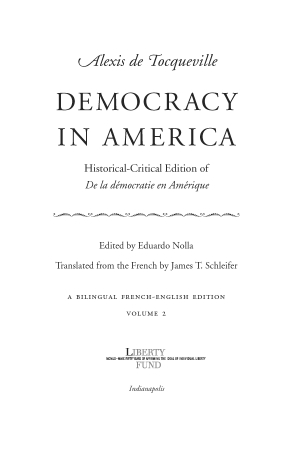
Democracy in America: Historical-Critical Edition of De la démocratie en Amérique, ed. Eduardo Nolla, translated from the French by James T. Schleifer. A Bilingual French-English editions, (Indianapolis: Liberty Fund, 2010). Vol. 2.

Part of: Democracy in America: Historical-Critical Edition, 4 vols.

About Liberty Fund:

Liberty Fund, Inc. is a private, educational foundation established to encourage the study of the ideal of a society of free and responsible individuals.


Of the Spirit of the Jurist in the United States, and How It Serves as Counterweight to Democracyf

Usefulness of trying to find out what the natural instincts of the spirit of the jurist are.—Jurists, called to play a great role in the society that is trying to be born.—How the kind of work that jurists devote themselves to gives an aristocratic turn to their ideas.—Accidental causes that can oppose the development of these ideas.—Facility that the aristocracy has in uniting itself with jurists.—Advantage that a despot could draw from the jurists.—How the jurists form the only aristocratic element that is by nature able to combine with the natural elements of democracy.—Particular causes that tend to give an aristocratic turn to the spirit of the English and American jurists.—The American aristocracy is at the lawyers’ bar and on the judges’ bench.—Influence exercised by jurists on American society.—How their spirit enters into the legislatures, into the administration, and ends by giving the people themselves something of the instinct of magistrates.

[≠I said elsewhere that the American magistracy was vested with a great political power; it remains for me to see how it tends to exercise its power.

American judges are named by the executive power {or by the legislature}; they are hardly ever chosen by the people.

But had you made judges chosen directly by the people, by making them irremovable, you would have given them instincts entirely different from those of the people.

From the moment when a public official is vested with an office for life, he takes a personal interest in society remaining immobile. If he is not always the enemy of progress, he is definitely the enemy of revolutions, and if this official is a man of the law, he is naturally carried by education to prize stability and he becomes attached to stability by inclination.

In fact, in what could be called the spirit of the jurist there is something singularly aristocratic.

Whoever will not allow himself to be preoccupied by a fact but by the ensemble of facts, not by a particular period but by the succession of times, will easily discover this tendency in the spirit of the jurist.≠]

When you visit the Americans and study their laws, you see that the authority that they have given to jurists and the influence that the Americans have allowed them to take in government form today the most powerful barrier to the errors of democracy. To me this effect seems due to a general cause that it is useful to try to determine, because it can recur elsewhere.

Jurists have been mixed up in all the movements of political society in Europe for five hundred years. Sometimes they have served as instruments of the political powers; sometimes they have used the political powers as instruments. In the Middle Ages, jurists cooperated wonderfully in extending the domination of kings; since then, they have worked powerfully to restrict this very power. In England, they were seen to unite intimately with the aristocracy; in France they revealed themselves as its most dangerous enemies. So do jurists yield only to sudden and momentary impulses, or, depending on circumstances, do they more or less obey instincts that are natural to them and that always recur? I would like to clarify this point; for jurists are perhaps called upon to play the first role in the political society trying to be born.

Men who have made law their specialty have drawn from this work habits of order, a certain taste for forms, a sort of instinctive love for the regular succession of ideas, that make them naturally strongly opposed to the revolutionary spirit and to the unthinking passions of democracy.

[{This effect is larger or smaller depending on how you study the law.

In countries like France, where all legislation is written [the jurist (ed.)] contracts the taste for what is regular and legal.}

≠Furthermore, in countries where the law of precedents rules, such as England and America, the taste and respect for what is old are almost always merged in the soul of the jurist with the love of what is legal.

It is not the same in countries where, as in France, the whole legislation is found written in codes.

The English jurist tries to determine what has been done; the French jurist, what the intention was. The first wants≠ evidence; the second, arguments. The one wants decisions; the other wants reasons. [Cf. infra (ed.)

]]

The special knowledge that jurists acquire while studying the law assures them a separate rank in society. They form a sort of privileged class among intelligent people. Each day they rediscover the idea of this superiority in the exercise of their profession; they are masters of a necessary science, the knowledge of which is not widespread; they serve as arbiters among citizens, and the habit of leading the blind passions of the litigants toward the goal gives them a certain contempt for the judgment of the crowd. Add that they naturally form a corps. It isn’t that they agree among themselves and head in concert toward the same point; but the community of study and unity of methods link their minds, as interest could unite their wills.

So you find hidden at the bottom of the soul of jurists a portion of the tastes and habits of the aristocracy. Like the aristocracy, they have an instinctive propensity for order, a natural love of forms; like the aristocracy, they conceive a great distaste for the actions of the multitude and secretly despise the government of the people.g

I do not want to say that these natural tendencies of jurists are strong enough to bind them in an irresistible way. What dominates jurists, as all men, is particular interest, and above all the interest of the moment.

There is a kind of society where men of the law cannot take a rank in the political world analogous to the one that they occupy in private life; you can be sure that, in a society organized in this way, the jurists [despite their natural tastes] will be very active agents of revolution. But then you must try to determine if the cause that leads them to destroy or to change arises among them from a permanent disposition or from an accident. It is true that jurists singularly contributed to overturning the French monarchy in 1789.h It remains to be known if they acted in this way because they had studied the laws, or because they could not contribute toward making them.j

Five hundred years ago, the English aristocracy put itself at the head of the people and spoke in their name; today it upholds the throne and makes itself the champion of royal authority.k The aristocracy, however, has instincts and tendencies that are its own.

You must also guard against taking isolated members of the corps for the corps itself.

In all free governments, of whatever form, you will find jurists among the first ranks of all parties. This same remark is also applicable to the aristocracy. Nearly all the democratic movements that have agitated the world have been led by nobles.

An elite body can never be sufficient for all the ambitions that it contains; there are always more talents and passions than posts, and you do not fail to find a large number of men there who, not able to grow great quickly enough by using the privileges of the corps, seek to grow great by attacking its privileges.

So I do not claim that a period will come when all jurists, or that in all times, most jurists must appear as friends of order and enemies of change.

I am saying that in a society where jurists occupy without dispute the elevated position that belongs to them naturally, [and with all the more reason in the society where they occupy the first rank] their spirit will be eminently conservative and will show itself to be antidemocratic.m

When the aristocracy closes its ranks to jurists, it finds in them enemies all the more dangerous because, below the aristocracy in wealth and power, they are independent of the aristocracy by their work and feel themselves on its level by their enlightenment.

But every time the nobles have wanted to share some of their privileges with the jurists, these two classes have found it very easy to join together and have, so to speak, discovered themselves to be of the same family.

I am equally led to believe that it will always be easy for a king to make jurists the most useful instruments of his power.n

There is infinitely more natural affinity between men of the law and the executive power than between them and the people, although jurists often have to overthrow the first; just as there is more natural affinity between the nobles and the king than between the nobles and the people, even though you have often seen the superior classes of society combine with the others to struggle against royal power. [Jurists often fear the king, but they always despise the people.]

What jurists love above all things is the sight of order, and the greatest guarantee of order is authority. It must not be forgotten, moreover, that if they prize liberty, they generally put legality much above it; they fear tyranny less than arbitrariness and, provided that the legislator himself sees to taking independence away from men, they are more or less content.

So I think that the prince who, in the presence of an invasive democracy, would seek to break down the judicial power in his States and to diminish the political influence of jurists, would commit a great error. He would let go of the substance of authority in order to seize its shadow.

I do not doubt that it would be more profitable for him to introduce jurists into the government. After entrusting despotism to them in the form of violence, perhaps he would rediscover it in their hands with the features of justice and the law.

[As for me, I would never advise any people to leave to the courts the care of guaranteeing its liberty. I would be afraid that the courts would sacrifice it to monarchs or to themselves. This care concerns great political assemblies.]

The government of democracy is favorable to the political power of jurists. When the rich man, the nobleman and the prince are excluded from government, the jurists arrive there by right, so to speak; for then they are the only enlightened and skillful men that the people can choose outside of themselves.o

If jurists are led naturally toward the aristocracy and the prince by their tastes, they are led naturally toward the people by their interest.

Thus, jurists love the government of democracy, without sharing its tendencies and without imitating its weaknesses, double cause to be powerful by democracy and over democracy.

The people, in a democracy, do not distrust jurists, because they know that the interest of jurists is to serve their cause; they listen to them without anger, because they do not assume that jurists have an ulterior motive.p In fact, jurists do not want to overturn the government that democracy has established, but they strive constantly to lead it along a path that is not its own and by means that are foreign to it. The jurist belongs to the people by his interest and by his birth and to the aristocracy by his habits and his tastes; he is like the natural liaison between these two, like the link that unites them.

The body of jurists forms the only aristocratic element that can mingle with the natural elements of democracy without effort and combine with them in a happy and enduring way. I am not unaware of the faults inherent in the spirit of jurists; without this mixture of the spirit of jurists with the democratic spirit, I doubt, however, that democracy could govern society for long, and I cannot believe that today a republic could hope to maintain its existence, if the influence of jurists in public affairs did not increase in proportion to the power of the people.

This aristocratic character that I see in the spirit of jurists is still more pronounced in the United States and in England than in any other country. This is due not only to the study of the law made by English and American jurists, but also to the very nature of legislation and to the position that these interpreters occupy among these two peoples.

The English and the Americans have kept the law of precedents, that is, they continue to draw from the opinions and legal decisions of their fathers the opinions that they must have in matters of the law and the decisions they must render.

So with an English or American jurist, the taste and respect for what is old is nearly always mingled with love of what is regular and legal.

This has still another influence on the turn of mind of jurists and consequently on the course of society.

The English or American jurist seeks what has been done; the French jurist, what you must have wanted to do; [the first, evidence; the second, arguments] the one wants judgments, the other wants reasons.

When you listen to an English or American jurist, you are surprised to see him so often cite the opinion of others, and to hear him speak so little about his own, while among us the contrary happens.

No affair that the French lawyer agrees to handle is so small that he treats it without introducing a system of his own ideas; and he will examine even the constituent principles of the law so that the court be pleased in this regard to have the boundary marker of a disputed inheritance moved back about six feet.

This sort of abnegation of his own sense made by the English and American jurist in order to rely on the sense of his fathers; this type of servitude, in which he is obliged to maintain his thought, must give the spirit of the jurist more timid habits and make him acquire more stationary tendencies in England and America than in France [for a fact is very much more immobile than an idea or an argument].

Our written laws are often difficult to understand, but everyone can read them; in contrast, there is nothing more obscure to the common people and less accessible to them than legislation founded on precedents. This need for the jurist in England and in the United States, this high idea of his knowledge, separate him more and more from the people, and end by putting him in a class apart. The French jurist is only a learned man, but the English or American man of the law in a way resembles the priests of Egypt; like them, he is the sole interpreter of an occult science.

The position that the men of the law occupy in England and in America exercises an influence no less great on their habits and their opinions. The aristocracy of England, which has taken care to draw to its bosom everything that had some natural analogy to it, has given a very great portion of consideration and power to jurists. In English society jurists are not at the first rank, but they consider themselves content with the rank that they occupy. They form something like the junior branch of the English aristocracy, and they love and respect their seniors, without sharing all their privileges. So the English jurists combine with the aristocratic interests of their profession the aristocratic ideas and tastes of the society in which they live.

Therefore in England, above all, you can see in relief the type of jurist that I am trying to paint: the English jurist esteems the laws, not so much because they are good as because they are old; and, if he sees himself reduced to modifying them on some point in order to adapt to the changes that societies are subjected to by time, he resorts to the most incredible subtleties in order to persuade himself that, by adding something to the work of his fathers, he is only developing their thought and completing their efforts. Do not hope to make him recognize that he is an innovator; he will consent to go to absurd lengths before admitting himself guilty of such a great crime. In England was born this legal spirit that seems indifferent to the heart of things in order to pay attention only to the letter, and that would rather go beyond reason and humanity than go beyond the law.

English legislation is like an ancient tree on which jurists have constantly grafted the strangest shoots, in the hope that, while producing different fruits, they will at least blend their foliage with the venerable stock that supports them.

In America, there are no nobles nor men of letters, and the people distrust the rich. So jurists form the superior political class and the most intellectual portion of society.q Thus, they could only lose by innovating: this adds a conservative interest to the natural taste that they have for order.

If you asked me where I place the American aristocracy, I would answer without hesitating that it is not among the rich who have no common bond that gathers them together. The American aristocracy is at the lawyers’ bar and on the judges’ bench.r

The more you think about what happens in the United States, the more you feel persuaded that in this country the body of jurists forms the most powerful and, so to speak, the sole counterweight of democracy.

In the United States you easily discover how appropriate the spirit of the jurist is, by its qualities, and I will say even by its faults, for neutralizing the vices inherent in popular government.

When the American people allow themselves to be intoxicated by their passions, or abandon themselves to the impetus of their ideas, jurists make them feel an almost invisible brake that moderates and stops them. To their democratic instincts, jurists secretly oppose their own aristocratic tendencies; to their love of novelty, the jurists’ superstitious respect for what is old; to the immensity of their designs, the jurists’ narrow views; to their disdain for rules, the jurists’ taste for forms; and to their hotheadedness, the jurists’ habit of proceeding slowly.

The courts are the most visible organs that the body of jurists uses to act upon democracy.

The judge is a jurist who, apart from the taste for order and rules that he acquired in the study of law, draws the love of stability also from his irremovability from office. His legal knowledge had already assured him an elevated position among his fellows; his political power really places him in a rank apart, and gives him the instincts of the privileged classes.

Armed with the right of declaring laws unconstitutional, an American magistrate enters constantly into public affairs.1 He cannot force the people to make laws, but at least he compels them not to be unfaithful to their own laws and to remain consistent.

I am not unaware that a secret tendency exists in the United States that leads the people to reduce the judicial power; in most of the particular state constitutions, the government, at the request of two legislative houses, can remove judges from the bench. Certain constitutions make the members of the courts elective and submit them to frequent reelection.t I dare to predict that sooner or later these innovations will have harmful results and that one day you will see that by diminishing the independence of the magistrates in this way you have attacked not only the judicial power but also the democratic republic itself.

It must not be believed, moreover, that in the United States the spirit of the jurist is enclosed only within the courtrooms; it extends well beyond.

Jurists, forming the only enlightened class that the people do not distrust, are naturally called to occupy most of the public offices. They fill the legislatures and are at the head of administrations, so they exercise a great influence on the formation of the law and on its execution. Jurists are obliged, however, to yield to the current of political opinion that carries them along; but it is easy to find indications of what they would do if they were free. The Americans, who have innovated so much in their political laws, have introduced only slight changes, and with great difficulty, into their civil laws, although several of these laws are strongly repugnant to their social state.u That is because in matters of civil law the majority is always obliged to rely on jurists; and the American jurists, left to their own choice, do not innovate.

It is a very strange thing for a Frenchman to hear the complaints that arise in the United States against the jurists’ stationary spirit and their prejudices in favor of what is established.

The influence of the spirit of the jurist extends still farther than the precise limits that I have just traced.v

There is hardly any political question in the United States that sooner or later does not turn into a judicial question. From that, the obligation that the parties find in their daily polemics to borrow ideas and language from the judicial system. Since most public men are or have formerly been jurists, they make the habits and the turn of ideas that belong to jurists pass into the handling of public affairs. The jury ends up by familiarizing all classes with them. Thus, judicial language becomes, in a way, the common language; so the spirit of the jurist, born inside the schools and courtrooms, spreads little by little beyond their confines; it infiltrates all of society, so to speak; it descends to the lowest ranks, and the entire people finishes by acquiring a part of the habits and tastes of the magistrate.

In the United States, the jurists form a power that is little feared, that is scarcely noticed, that has no banner of its own, that yields with flexibility to the exigencies of time and gives way without resistance to all the movements of the social body. But this power envelops the entire society, penetrates into each of the classes that compose society, works on society in secret, acts constantly on society without society’s knowledge and ends by shaping society according to its desires.

[f. ] Influence exercised by the judicial power on the power of the majority./

When you examine political society in the United States, you notice at first glance only a single principle that seems to bind all the parts strongly together: the people appear as the sole power. Nothing seems able to oppose their will or to thwart their designs.

But here is a man who appears in a way above the people; he does not get his mandate from them; he has, so to speak, nothing to fear from their anger, nor anything to hope from their favor. He is vested, however, with more power than any one of the representatives of the people; for, with a single blow, he can strike with sterility the work emanating from the common will (YTC, CVh, 1, pp. 14-15).

Rousseau (Du contrat social, book II, chapter VII), not wanting to limit the sovereignty of the people in any way, had to put the legislator outside of the political process. Tocqueville, who acknowledged absolute sovereignty in no power, makes the legislator a decisive element of political life.

Several conversations with American lawyers and jurists persuaded the author of the foremost role that lawyers and jurists play in political life. Cf. the conversation with Edward Everett of 24 January 1832 (non-alphabetic notebooks 2 and 3, YTC, BIIa, and Voyage, OC, V, 1, p. 151); the conversation with Mr. Latrobe of 30 October 1831 (ibid., p. 110) and more especially the conversation with Mr. Gallatin of 10 June 1831 (non-alphabetic notebook 1, YTC, BIIa, and Voyage, OC, V, 1, p. 61), where the idea that lawyers constitute a body that serves as a counterweight to democracy is mentioned; the conversations with John C. Spencer of 17 and 18 July 1831 (ibid., pp. 68-69), on the conservative effects of the American legal mentality. When Tocqueville takes up the argument again, he is also thinking of Blackstone (Cf. Correspondence and Conversations of Alexis de Tocqueville with Nassau William Senior, II, p. 44). Also see Gino Gorla, Commento a Tocqueville. L’idea dei diritti (Milan: Dott. A Guiffrè Editore, 1948, pp. 259-68).

[g. ] The manuscript says: “. . . always scorn the people.”

Hervé de Tocqueville:

I do not know if jurists inwardly scorn the government of the people, but definitely they never express this scorn; because they are sure that the ease with which they handle words will always open a role for them in the government of the people. In general, of all classes, jurists are the one in which vanity is the most developed by popular successes. This vanity directs their outwardly expressed opinions and is the foundation of their actions.

This vanity has much less effect when they have an established position as in America, but it will always be formidable when they have a position to establish, or when superiorities are found that offend them, which will always happen in a monarchy where absolute equality cannot be found and where they are too numerous for the places and for the influence that reasonably can be given to them (YTC, CIIIb, 1, p. 76).

[h. ] Hervé de Tocqueville: “They contributed even more to overturning the Restoration, although a part of their desires was fulfilled” (YTC, CIIIb, 1, p. 77).

[j. ] Hervé de Tocqueville: “There is a gap here. Alexis throws himself toward another order of ideas before going deeply enough into those that precede. One or two more paragraphs are necessary here in order to explain more clearly the motives for the conduct of the jurists in 1789 and 1830” (YTC, CIIIb, 1, p. 77).

[k. ] Hervé de Tocqueville: “That is not exact; the English aristocracy only makes itself the champion of its privileges and of those of the clergy” (YTC, CIIIb, 1, pp. 77-78).

[m. ] Édouard de Tocqueville:

The sense of this paragraph must necessarily be changed, for this reflection could apply to all those of ambition, to all agitators, to all the anarchists of the world, as well as to jurists. There is no revolutionary who, reaching the first rank, does not reveal a conservative spirit, that is to say, who does not want to conserve this rank, that speaks for itself. So you must not, after saying that jurists do not have anarchic tendencies, give as proof their conduct and their passions that from this paragraph are precisely those of the anarchists of all times and in all places. Couldn’t you say: I am saying that in a society where jurists will occupy without dispute the rank that legitimately belongs to them, their spirit, etc? (YTC, CIIIb, 1, pp. 68-69).

[n. ] Hervé de Tocqueville:

As for me, I believe that this will always be a nearly insoluble problem for a king. It would be necessary that near the sovereign there were neither court, nor in the State any great superiority that offended the vanity of the jurists. One objects that they love Louis-Philippe. That comes from the contempt that he inspires in them and that precisely makes each one of them believe he has the right to consider himself above Louis-Philippe, though he is the king. Alexis must take care not to be caught in a paradox, as much here as in what follows (YTC, CIIIb, 1, p. 78).

[o. ] “≠In America the second guarantee of liberty is found in the constitution of the judicial power. The absence of administrative centralization is a happy circumstance more than a result of the wisdom of the law-maker. But the judicial power in the United States is a barrier raised by design against the omnipotence of the majority. You can consider it as the only powerful or real obstacle that the American laws have placed in the path of the people≠” (YTC, CVh, 4, pp. 16-17).

[p. ] In the margin: “≠It is to jurists that democracy owes the ability to govern.≠”

[q. ] In the margin: “≠Perhaps put here the large piece added at Baugy.≠”

[r. ] I am not saying that the aristocratic spirit in the United States is found only among jurists; the rich in America, as everywhere else, certainly have great instincts for order and preservation. But they do not form a corps; they are not united together by shared habits, ideas, tastes. There is no intellectual bond that gathers their collective strength; they do not make a corps. The people distrust them and do not mix them into public affairs, while the jurists, who have more or less the same instincts as the rich, do not cause the people any fear (YTC, CVj, 2, pp. 17-18).

[t. ] A lawyer from Montgomery, in Alabama, had, on 6 January 1832, drawn the attention of the author to this fact (nonalphabetic notebooks 1 and 2, YTC, BIIa, and Voyage, OC, V, 1, pp. 140-41).

[u. ] Tocqueville considers this question in the last pages of chapter II of the first part of the first volume.