EconlibThe LibraryOther Sites |
Front Page Titles (by Subject) Introduction a - Democracy in America: Historical-Critical Edition, vol. 1
Return to Title Page for Democracy in America: Historical-Critical Edition, vol. 1The Online Library of LibertyA project of Liberty Fund, Inc.Search this Title:Also in the Library:
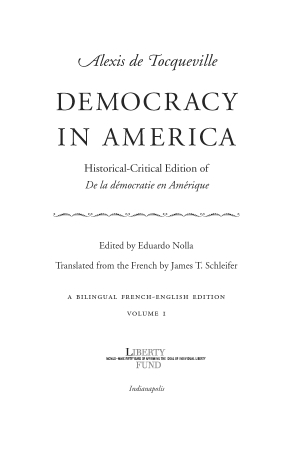
Introduction a - Alexis de Tocqueville, Democracy in America: Historical-Critical Edition, vol. 1 [1835]Edition used:Democracy in America: Historical-Critical Edition of De la démocratie en Amérique, ed. Eduardo Nolla, translated from the French by James T. Schleifer. A Bilingual French-English editions, (Indianapolis: Liberty Fund, 2010). Vol. 1.
Part of: Democracy in America: Historical-Critical Edition, 4 vols.About Liberty Fund:Liberty Fund, Inc. is a private, educational foundation established to encourage the study of the ideal of a society of free and responsible individuals. Copyright information:This bilingual edition of Tocqueville’s work contains a new English translation of the French critical edition published in 1990. The copyright to the French version is held by J. Vrin and it is not available online. The copyright to the English translation, the translator’s note, and index is held by Liberty Fund. Fair use statement:This material is put online to further the educational goals of Liberty Fund, Inc. Unless otherwise stated in the Copyright Information section above, this material may be used freely for educational and academic purposes. It may not be used in any way for profit.
Introductiona[The work that you are about to read is not a travelogue,b <the reader can rest easy>. I do not want him to be concerned with me. You will also not find in this book a complete summary of all the institutions of the United States; but I flatter myself that, in it, the public will find some new documentation and, from it, will gain useful knowledge about a subject that is more important for us than the fate of America and no less worthy of holding our attention.c ] Among the new objects that attracted my attention during my stay in the United States, none struck me more vividly than the equality of conditions.d I discovered without difficulty the prodigious influence that this primary fact exercises on the march of society; it gives a certain direction to the public mind, a certain turn to the laws; to those governing, new maxims, and particular habits to the governed. Soon I recognized that this same fact extends its influence far beyond political mores and laws, and that it has no less dominion over civil society, than over government: it creates opinions, gives birth to sentiments, suggests customs and modifies all that it does not produce. Therefore, as I studied American society, I saw more and more, in equality of conditions, the generating fact from which each particular fact seemed to derive, and I rediscovered it constantly before me as a central point where all of my observations came together. Then I turned my thought back toward our hemisphere, and it seemed to me that I perceived something analogous to the spectacle that the New World offered me. I saw equality of conditions that, without having reached its extreme limits as in the United States, approached those limits more each day; and this same democracy that reigned in American societies, appeared to me to advance rapidly toward power in Europe.e From that moment, I conceived the idea of the book you are about to read.f A great democratic revolution is taking placeg among us; everyone sees it, but not everyone judges it in the same way. Some consider it as something new and, taking it for an accident, they hope still to be able to stop it; while others judge it irresistible, because it seems to them the most continuous, oldest and most permanent fact known in history. I look back for a moment to what France was seven hundred years ago: I find it divided up among a small number of families who own the land and govern the inhabitants; at that time, the right to command is passed down with inheritances from generation to generation; men have only a single way to act on one another, force; you discover only a single source of power, landed property. But then the political power of the clergy becomes established and is soon expanding.h The clergy opens its ranks to all, to the poor and to the rich, to the commoner and to the lord; equality begins to penetrate through the Church into the government, and someone who would have vegetated as a serf in eternal slavery takes his place as a priest among nobles and often goes to take a seat above kings. As society becomes more civilized and more stable with time, the different relationships among men become more complicated and more numerous. The need for civil laws is intensely felt. Then jurists arise; they emerge from the dark precinct of the courts and from the dusty recess of the clerks’ offices, and they go to sit in the court of the prince, alongside feudal barons covered with ermine and iron. Kings ruin themselves in great enterprises; nobles exhaust themselves in private wars; commoners enrich themselves in commerce. The influence of money begins to make itself felt in affairs of State. Trade is a new source of power, and financiers become a political power that is scorned and flattered. Little by little, enlightenment spreads; the taste for literature and the arts reawakens; then the mind becomes an element of success; knowledge is a means of government; intelligence, a social force; men of letters reach public affairs. As new roads to achieve power are found, however, we see the value of birth fall. In the XIth century, nobility had an inestimable value; it is purchased in the XIIIth; the first granting of nobility takes place in 1270,j and equality is finally introduced into government by aristocracy itself. During the seven hundred years that have just passed, it sometimes happened that, in order to struggle against royal authority, or to take power away from their rivals, the nobles gave political power to the people. Even more often, you saw kings make the lower classes of the State participate in government in order to humblek the aristocracy. In France, kings showed themselves to be the most active and most constant of levelers. When they were ambitious and strong, they worked to raise the people to the level of the nobles, and when they were moderate and weak, they allowedm the people to put themselves above kings. The former helped democracy by their talents, the latter by their vices. Louis XI and Louis XIV took care to equalize everything below the throne, and Louis XV himself finally descended into the dust with his court.n As soon as citizens began to own the land in ways other than by feudal tenure, and as soon as personal wealth, once known, could in turn create influence and confer power, no discoveries were made in the arts, no further improvements were introduced into commerce and industry, without also creating as many new elements of equality among men. From this moment, all processes that are found, all needs that are born, all desires that demand to be satisfied, are progress toward universal leveling. The taste for luxury, the love of war, the sway of fashion, the most superficial passions of the human heart as well as the most profound, seem to work in concert to impoverish the rich and to enrich the poor. From the time when works of the mind became sources of strength and wealth, each development of science, each new element of knowledge, each new idea had to be considered as a germ of power put within reach of the people. Poetry, eloquence, memory, mental graces, fires of the imagination, depth of thought, all these gifts that heaven distributes at random, profited democracy, and even when they were in the possession of democracy’s adversaries, they still served its cause by putting into relief the natural grandeur of man; so democracy’s conquests spread with those of civilization and enlightenment, and literature was an arsenal open to all, where the weak and the poor came each day to find arms. When you skim the pages of our history you do not find so to speak any great events that for seven hundred years have not turned to the profit of equality. The Crusades and the English wars decimate the nobles and divide their lands; the institution of the towns introduces democratic liberty into the feudal monarchy; [<the rigors enforced against the Jews bring about the invention of paper wealtho >]; the discovery of firearms equalizes the villein and the noble on the field of battle; printing offers equal resources to their minds; the post comes to deposit enlightenment at the threshold of the hut of the poor as at the gate of palaces; Protestantism maintains that all men are equally able to find the way to heaven. America, which comes into sight, presents a thousand new paths to fortune and delivers the wealth and power [reserved to kings] to obscure adventurers. If you examine what is happening in France from the XIth century every fifty years, at the end of each one of these periods, you will not fail to notice that a double revolution has taken place in the state of society. The noble will have slipped on the social ladder, the commoner will have risen; the one descends, the other ascends. Each half-century brings them closer together, and soon they are going to touch. And this is not only particular to France. In whatever direction we cast our eyes, we notice the same revolution continuing in all of the Christian universe. [Let someone cite to me a republic or a kingdom in which the nobles of today can be compared, I would not say to the nobles of feudal times, but only to their fathers of the last century. {If France hastened the democratic revolution of which I am speaking, France did not give it birth}. For seven hundred years, there is not a single event among Christians that has not turned to the profit of democracy, not a man who has not served its triumph. <≠The clergy by spreading enlightenment and by applying within its bosom the principle of Christian equality, kings by opposing the people to nobles, nobles by opposing the people to kings; writers and the learned by creating intellectual riches for democracy’s use; tradesmen by providing unknown resources for democracy’s activity; the navigator by finding democracy new worlds.≠>] Everywhere you saw the various incidents in the lives of peoples turn to the profit of democracy; all men aided it by their efforts:p those who had in view contributing to its success and those who did not think of serving it; those who fought for it and even those who declared themselves its enemies; all were pushed pell-mell along the same path, and all worked in common, some despite themselves, others without their knowledge, blind instruments in the hands of God. So the gradual development of equality of conditions [{democracy}] is a providential fact;q it has the principal characteristics of one: it is universal, it is lasting, it escapes every day from human power; all events, like all men, serve its development.r Would it be wise to believe that a social movement that comes from so far could be suspended by the efforts of a generation?s Do you think that after having destroyed feudalism and vanquished kings, democracy will retreat before the bourgeois and the rich?t Will it stop now that it has become so strong and its adversaries so weak? So where are we going? No one can say; for we are already lacking terms of comparison; conditions are more equal today among Christians than they have ever been in any time or in any country in the world; thus we are prevented by the magnitude of what is already done from foreseeing what can still be done. The entire book that you are about to read has been written under the impression of a sort of religious terror produced in the soul of the author by the sight of this irresistible revolution that has marched for so many centuries over all obstacles, and that we still see today advancing amid the ruins that it has made. It isn’t necessary for God himself to speak in order for us to discover sure signs of his will; it is enough to examine the regular march of nature and the continuous tendency of events; I know, without the Creator raising his voice, that the stars in space follow the curves traced by his fingers. If long observations and sincere meditations led men of today to recognize that the gradual and progressive development of equality is at once the past and the future of their history, this discovery alone would give this development the sacred character of the will of God. To want to stop democracy would then seem to be struggling against God himself, and it would only remain for nations to accommodate themselves to the social state that Providence imposes on them.u Christian peoples seem to me to offer today a frightening spectacle.v The movement that sweeps them along is already so strong that it cannot be suspended, and it is not yet so rapid as to despair of directing it. Their fate is in their hands; but soon it escapes them.w To instruct democracy, to revive its beliefs if possible, to purify its mores, to regulate its movements, to substitute little by little the science of public affairs for its inexperience, knowledge of its true interests for its blind instincts; to adapt its government to times and places; to modify it according to circumstances and men; such is the first of duties imposed today on those who lead society. A new political sciencex is needed for a world entirely newy [{for a unique situation, laws without precedents are needed}]. But that is what we scarcely consider; placed in the middle of a rapid river, we obstinately fix our eyes on some debris that we still see on the bank, while the current carries us away and pushes us backwards toward the abyss. There is no people of Europe among whom the great social revolutionz that I have just described has made more rapid progress than among us; but here it has always marched haphazardly. The heads of State [{legislator}] never thought to prepare anything in advance for it; it came about despite them or without their knowledge. The most powerful, most intelligent and most moral classes of the nation did not try to take hold of it in order to direct it. So democracy has been abandoned to its wild instincts; it has grown up like those children, deprived of paternal care, who raise themselves in the streets of our cities, and who know society only by its vices and miseries. We still seemed unaware of its existence, when it took hold of power without warning. Then each person submitted with servility to its slightest desires; it was adored as the image of strength; when later it was weakened by its own excesses, legislators conceived the imprudent plan of destroying it instead of trying to instruct and correct it, and not wanting to teach it to govern, they thought only about pushing it away from government. The result was that the democratic revolution took place in the material aspect of society without happening in the laws, ideas, habits and mores,a the change that would have been necessary to make this revolutionb useful. We therefore have democracy, minus what must attenuate its vices and bring out its natural advantages; and seeing already the evils that it brings, we are still unaware of the good that it can give. When royal power, supported by the aristocracy, peacefully governed the peoples of Europe, society, amid its miseries, enjoyed several kinds of happiness, which are difficult to imagine and appreciate today. The power of some subjects raised insurmountable barriers to the tyranny of the prince; and kings, feeling vested in the eyes of the crowd with a nearly divine character, drew, from the very respect that they caused, the will not to abuse their power. Placed an immense distance from the people, the nobles nonetheless took the type of benevolent and tranquil interest in the fate of the people that the shepherdc gives to his flock; and without seeing the poor man as their equal, they watched over his lot as a trust put in their hands by Providence. Not having conceived the idea of a social state other than their own, not imagining that they could ever be equal to their rulers, the people accepted the benefits and did not question the rights of their rulers. They loved them when they were lenient and just and submitted without difficulty and without servility to their rigors as to inevitable evils sent to them by the hand of God. Custom and mores had, moreover, established limits to tyranny and founded a kind of right in the very midst of force. Since the noble did not think that someone would want to wrest from him the privileges that he believed legitimate, and the serf regarded his inferiority as a result of the immutable order of nature, it is conceivable that a kind of reciprocal benevolence could be established between these two classes sharing so different a fate. You then saw in society inequality, miseries, but souls were not degraded. It is not the use of power or the habit of obedience that depraves men; it is the use of a power that they consider as illegitimate and obedience to a power that they regard as usurped and oppressive. On one side were wealth, force, leisure and with them the pursuit of luxury, refinements of taste, pleasures of the mind, devotion to the arts; on the other, work, coarseness and ignorance. But within this ignorant and coarse crowd, you met energetic passions, generous sentiments, profound beliefs and untamed virtues. The social body organized in this way could have stability, power, and above all glory. But ranks are merging; barriers raised between men are falling; estates are being divided; power is being shared, enlightenment is spreading, intellects are becoming equal; the social state is becoming democratic, and the dominion of democracy is finally being established peacefully in institutions and in mores. Then I imagine a society where all, seeing the law as their work, would love it and would submit to it without difficulty; where since the authority of the government is respected as necessary and not as divine, the love that is felt for the head of State would be not a passion, but a reasoned and calm sentiment. Since each person has rights and is assured of preserving his rights, a manly confidence and a kind of reciprocal condescension, as far from pride as from servility, would be established among all classes. Instructed in their true interests, the people would understand that, in order to take advantage of the good things of society, you must submit to its burdens. The free association of citizens would then be able to replace the individual power of the nobles, and the State would be sheltered from tyranny and from license. I understand that in a democratic State, constituted in this manner, society will not be immobile; but the movements of the social body will be able to be regulated and progressive; if you meet less brilliance there than within an aristocracy, you will find less misery; pleasures will be less extreme and well-being more general; knowledge not as great and ignorance more rare; sentiments less energetic and habits more mild; there you will notice more vices and fewer crimes.d If there is no enthusiasm and fervor of beliefs, enlightenment and experience will sometimes obtain great sacrifices from citizens; each man, equally weak, will feel an equal need for his fellows; and knowing that he can gain their support only on condition of lending them his help, he will discover without difficulty that for him particular interest merges with the general interest. The nation taken as a body will be less brilliant, less glorious, less strong perhaps; but the majority of citizens there will enjoy a more prosperous lot, and the people will appear untroubled, not because they despair of being better, but because they know they are well-off.e If everything was not good and useful in such an order of things, society at least would have appropriated everything useful and good that such an order can present; and men, while abandoning forever the social advantages that aristocracy can provide, would have taken from democracy all the good that the latter can offer to them. But we, while giving up the social state of our ancestors, while throwing pell-mell their institutions, their ideas, and their mores behind us, what have we put in their place? The prestige of royal power has vanished, without being replaced by the majesty of laws; today the people scorn authority, but they fear it, and fear extracts more from them than respect and love formerly yielded. I notice that we have destroyed the individual existences that could struggle separately against tyranny [{but I do not see that we have created a collective strength to fulfill their function}], but I see the government that alone inherits all the prerogatives wrenched from families, from corporations or from men; so, to the sometimes oppressive but often conservative strength of a small number of citizens, the weakness of all has succeeded. The division of fortunes has reduced the distance that separated the poor from the rich; but by coming closer together, they seem to have found new reasons to hate each other, and, eyeing one another with looks full of terror and envy, they mutually push each other away from power; for the one as for the other, the idea of rights does not exist, and force appears to them both as the only reason for the present and the sole guarantee of the future. The poor man has kept most of the prejudices of his fathers, without their beliefs; their ignorance, without their virtues; he has accepted, as the rule for his actions, the doctrine of interest, without knowing the science of interest, and his egoism is as wanting in enlightenment as his devotion formerly was. Society is tranquil, not because it is conscious of its strength and its well-being, but on the contrary because it believes itself weak and frail; it is afraid of dying by making an effort. Everyone feels that things are going badly, but no one has the necessary courage and energy to seek something better; we have desires, regrets, sorrows and joys that produce nothing visible or lasting, similar to the passions of old men that end in impotence. Thus we have abandoned what the old state could present of the good, without acquiring what the current state would be able to offer of the useful; we have destroyed an aristocratic society, [and we do not think about organizing on its ruins a moral and tranquil democracy] and, stopping out of complacency amid the debris of the former edifice, we seem to want to settle there forever.f What is happening in the intellectual world is no less deplorable. Hindered in its march or abandoned without support to its disorderly passions, democracy in France has overturned everything that it met on its way, weakening what it did not destroy. You did not see it take hold of society little by little in order to establish its dominion peacefully; it has not ceased to march amid the disorders and the agitation of battle. Animated by the heat of the struggle, pushed beyond the natural limits of his opinion by the opinions and excesses of his adversaries, each person loses sight of the very object of his pursuits and uses a language that corresponds badly to his true sentiments and to his secret instincts. From that results the strange confusion that we are forced to witness. I search my memory in vain; I find nothing that deserves to excite more distress and more pity than what is happening before our eyes;g it seems that today we have broken the natural bond that unites opinions to tastes and actions to beliefs; the sympathy that has been observed in all times between the sentiments and the ideas of men seems to be destroyed, and you would say that all the laws of moral analogy are abolished. You still meet among us Christians full of zeal, whose religious souls love to be nourished by the truths of the other life; they are undoubtedly going to become active in favor of human liberty, source of all moral grandeur. [<Their hearts will open without difficulty to the holy love of country, this religion of the political world so fruitful in generous devotions.>] Christianity, which has made all men equal before God, will not be loath to see all citizens equal before the law. But, by a combination of strange events, religion is at the moment involved amid the powers that democracy is overturning, and it often happens that religion rejects the equality that it loves and curses liberty as an adversary, while, by taking liberty by the hand, religion could be able to sanctify its efforts. Next to these religious men, I find others whose sights are turned toward the earth rather than toward heaven; partisans of liberty, not only because they see in it the origin of the most noble virtues, but above all because they consider it as the source of the greatest advantages, they sincerely desire to secure its dominion and to have men taste its benefits. I understand that the latter are going to hasten to call religion to their aid, for they must know that you cannot establish the reign of liberty without that of mores, nor found mores without beliefs; but they have seen religion in the ranks of their adversaries; that is enough for them; some attack religion and the others dare not defend it [all lack enlightenment or courage]. Past centuries saw base and venal souls advocate slavery, while independent spirits and generous hearts struggled without hope to save human liberty. But today you often meet men naturally noble and proud whose opinions are in direct opposition to their tastes, and who speak in praise of the servility and baseness that they have never known for themselves. There are others, in contrast, who speak of liberty as if they could feel what is holy and great in it and who loudly claim on behalf of humanity rights that they have always disregarded. I notice virtuous and peaceful men placed naturally by their pure morals, tranquil habits, prosperity and enlightenment at the head of the populations that surround them. Full of a sincere love of country, they are ready to make great sacrifices for it. Civilization, however, often finds them to be adversaries; they confuse its abuses with its benefits, and in their minds the idea of evil is indissolubly united with the idea of the new [and they seem to want to establish a monstrous bond between virtue, misery and ignorance so that all three may be struck with the same blowh ]. Nearby I see other men who, in the name of progress, try hard to materialize man, wanting to find the useful without attending to the just, wanting to find knowledge far from beliefs and well-being separate from virtue. These claim to be champions of modern civilization and they arrogantly put themselves at its head, usurping a place that is abandoned to them and that their unworthiness denies to them.j So where are we? Religious men combat liberty, and the friends of liberty attack religion; noble and generous spirits speak in praise of slavery, and base and servile souls advocate independence; honest and enlightened citizens are enemies of all progress, while men without patriotism and without mores become the apostles of civilization and enlightenment! Have all centuries resembled ours then? Has man always had before his eyes, as today, a world where nothing is connected, where virtue is without genius,k and genius without honor; where love of order merges with the taste for tyrants and the holy cult of liberty with scorn for human laws; where conscience throws only a doubtful light upon human actions; where nothing any longer seems either forbidden, or permitted, or honest, or shameful, or true, or false? Will I think that the Creator made man in order to leave him to struggle endlessly amid the intellectual miseries that surround us? I cannot believe it; God is preparing for European societies a future more settled and more calm; I do not know his plans, but I will not cease to believe in them because I cannot fathom them, and I will prefer to doubt my knowledge than his justice. There is a country in the world where the great social revolution that I am speaking about seems more or less to have reached its natural limits; it came about there in a simple and easy way, or rather it can be said that this country sees the results of the democratic revolution that is taking place among us, without having had the revolution itself. The emigrants who came to settle in America at the beginning of the XVIIth century in a way freed the principle of democracy from all those principles that it struggled against within the old societies of Europe, and they transplanted it alone to the shores of the New World. There it was able to grow in liberty and, moving ahead with mores, to develop peacefully in the laws. It seems to me beyond doubt that sooner or later, we will arrive, like the Americans, at a nearly complete equality of conditions. From that, I do not conclude that one day we are necessarily called to draw from such a social state the political consequences that the Americans have drawn from it.m I am very far from believing that they have found the only form of government that democracy may take; but in the two countries the generating cause of laws and mores is the same; that is enough for us to have an immense interest in knowing what that generating cause has produced in each of them. So it is not only to satisfy a curiosity, legitimate for that matter, that I examined America; I wanted to find lessons there from which we would be able to profit. You would be strangely mistaken if you thought that I wanted to do a panegyric; whoever reads this book will be clearly convinced that such was not my purpose;n nor was my goal to advocate any particular form of government in general; for I am among those who believe that there is hardly ever absolute good in laws; I did not even claim to judge if the social revolution, whose march seems irresistible to me, was advantageous or harmful to humanity. I have acknowledged this revolution as an accomplished or nearly accomplished fact, and, from among the peoples who have seen it taking place among them, I sought the people among whom it has reached the most complete and most peaceful development, in order to discern clearly its natural consequences and, if possible, to see the means to make it profitable to men. I admit that in America I saw more than America;o I sought there an image of democracy itself, its tendencies, its character, its prejudices, its passions; I wanted to know democracy, if only to know at least what we must hope or fear from it. In the first part of this work, I tried to show the direction that democracy, delivered in America to its tendencies and abandoned almost without constraint to its instincts, gave naturally to laws, the course that it imparted to government, and in general the power that it gained over public affairs. I wanted to know what good and bad it produced. I sought out what precautions the Americans have used to direct it and what others they have omitted, and I undertook to discern the causes that allow it to govern society. My goal was to portray in a second part [{third volume}] the influence that equality of conditions and the government of democracy exercise in America on civil society, on habits, ideas and mores;p but I begin to feel less enthusiasmq about accomplishing this plan. Before I can complete in this way the task that I proposed for myself, my work will have become nearly useless. Someone else will soon show readers the principal features of the American character and, hiding the seriousness of the descriptions behind a light veil, will lend truth charms with which I would not be able to adorn it.1 I do not know if I have succeeded in making known what I saw in America, but I am sure that I sincerely desired to do so, and that I never yielded, except unknowingly, to the need to adapt facts to ideas, instead of subjecting ideas to facts. When a point could be established with the help of written documents, I have taken care to turn to original texts and to the most authentic and most respected works.2 I have indicated my sources in notes, and everyone will be able to verify them. When it was a matter of opinions, of political customs, of observations of mores, I sought to consult the most enlightened men. If something happened to be important or doubtful, I was not content with one witness, but decided only on the basis of the body of testimonies. Here the reader must necessarily take me at my word. I would often have been able to cite in support of what I advance the authority of names that are known to him, or that at least are worthy to be; but I have refrained from doing so. The stranger often learns by the hearth of his host important truths, that the latter would perhaps conceal from a friend; with the stranger you ease the burden of a forced silence; you are not afraid of his indiscretion because he is passing through. Each one of these confidences was recorded by me as soon as received, but they will never emerge from my manuscripts; I prefer to detract from the success of my accounts than to add my name to the list of those travelers who send sorrows and troubles in return for the generous hospitality that they received. I know that, despite my care, nothing will be easier than to criticize this book, if anyone ever thinks to examine it critically. Those who will want to look closely at it will find, I think, in the entire work, a generative thought that links so to speak all its parts. But the diversity of the subjects that I had to treat is very great, and whoever will undertake to contrast an isolated fact to the whole of the facts that I cite, a detached idea to the whole of the ideas, will succeed without difficulty. So I would like you to grant me the favor of reading me with the same spirit that presided over my work, and would like you to judge this book by the general impression that it leaves, as I myself came to a decision, not due to a particular reason, but due to the mass of reasons. Nor must it be forgotten that the author who wants to make himself understood is obliged to push each of his ideas to all of their theoretical consequences, and often to the limits of what is false and impractical;t for if it is sometimes necessary to step back from the rules of logic in actions, you cannot do the same in discourses, and man finds it almost as difficult to be inconsistent in his words as he normally finds it to be consistent in his actions. [<This, to say in passing, brings out one of the great advantages of free governments, an advantage about which you scarcely think. In these governments, it is necessary to talk a great deal. The need to talk forces men of State to reason, and from speeches a bit of logic is introduced into public affairs.>] I finish by pointing out myself what a great number of readersu will consider as the capital defect of the work.v This book follows in no one’s train exactly; by writing it I did not mean either to serve or to combat any party; I set about to see, not differently, but farther than parties;w and while they are concerned with the next day, I wanted to think about the future.x [a. ] Ideas of the preface./ Irresistible movement of democracy, great fact of the modern world. Importance of this fact superior to all questions of time and of internal politics. America showing this fact come to its completion. Goal of this work to give accurate notions about this fact; moreover, I do not judge this fact. I do not even believe that there is anything of an absolute goodness in institutions. Montesquieu ... Ease of criticizing me. I know that nothing will be easier than to criticize this book, if anyone ever thinks of examining it critically. You will have only to contrast certain particular facts to certain of my general ideas. Nothing is easier; there are facts and arguments for all doctrines. For you to judge me, I would like you to want to do what I did, to see an ensemble of facts and to come to a decision based on the mass of reasons. To whoever will do that and then does not agree with me, I am ready to submit. For if I am sure of having sincerely sought the truth, I am far from considering myself as certain to have found it. To contrast an isolated fact to the ensemble of facts, a detached idea to the sequence of ideas. It isn’t that I don’t have set ideas, but they are general (for there is absolute truth only in general ideas). I believe that tyranny is the greatest evil, liberty the first good. But as for knowing what is most appropriate for preventing the one and creating the other among peoples and knowing if all peoples are made to escape tyranny, that is where doubt begins (YTC, CVh, 3, pp. 96-97). [b. ] The criticism of this passage (YTC, CIIIb, 1, p. 7) made by Louis de Kergorlay has been published in Correspondance avec Kergorlay (OC, XIII, 1, p. 367). [c. ] In a first version of the drafts: [In the margin: I have not said everything that I saw, but I have said everything that I believed at the same time true and useful [v: profitable] to make known, and without wanting to write a treatise on America, I thought only to help my fellow citizens resolve a question that must interest us more deeply.] I see around me facts without number, but I notice one of them that dominates all the others; it is old; it is stronger than laws, more powerful than men; it seems to be a direct product of the divine will; it is the gradual development of democracy in the Christian world. When I say “democracy” here I do not mean to speak only about a political form of government, but of a social state (YTC, CVh, 3, pp. 115-16). [d. ] This first paragraph differs a bit from the manuscript: “There is a fact that more than all the rest attracts the attention of the European upon his arrival on the shores of the New World. A surprising equality reigns there among fortunes; at first glance minds themselves seem equal. I was struck, like others, at the sight of this extreme equality of conditions and I discovered without difficulty ...” [e. ] In the margin: “≠I remember that I saw something analogous in France; I think that you can usefully examine the effects in the two countries, and I conceive the idea of the book.≠” Another version is presented to the side that specifies: “≠in Europe and principally in my own country.≠” The version not struck out in the manuscript says: “... appeared to me ready to take power among us.” Hervé de Tocqueville remarks: “The word ready does not seem good to me. Besides, isn’t it too absolute relative to what is still happening at the moment among us and to the government that succeeded the Restoration?” Next to this observation, another is found, probably from Édouard de Tocqueville, brother of Alexis: “I also agree that this expression must be softened” (YTC, CIIIb, 1, p. 9). The criticisms of Hervé de Tocqueville, father of Alexis, of Edouard and Hippolyte de Tocqueville, his brothers, and those of his friends Gustave de Beaumont and Louis de Kergorlay, made at the time of reading a copy of the manuscript of the first Democracy, are known to us thanks to a copy in Bonnel’s hand. The latter does not identify the authors. Nonetheless, the written comments can be attributed to them without great difficulty, by taking into account tone, style, and the following facts: the observations of Louis de Kergorlay consisted of small slips of paper inserted into the manuscript (only a few of them remain relating to the introduction and to the last section of chapter X of the 1835 part); certain of his notes on the introduction have been published in the correspondence of Tocqueville and Kergorlay (cf. OC, XIII, 1, pp. 364-68; note that the list reproduced on p. 368 is Tocqueville’s, not Kergorlay’s); all comments using the vous form can be attributed to Beaumont, who always used vous with Tocqueville, in distinction to the members of Tocqueville’s family and Kergorlay; finally a letter included in the critical observations (reproduced in note c for p. 142) and some sentences of the first readers of the manuscript inform us that the notes found alongside the commentaries of Hervé were written by Édouard de Tocqueville. By elimination, some remaining less interesting comments could be by Hippolyte, older brother of Alexis. Certain reflections inserted between texts seem to us to be by Alexis himself. The whole of these commentaries are found at the Beinecke Library under the classification CIIIb. There are also a few brief commentaries by Hervé de Tocqueville for chapter IX of the second part of the first volume of 1835 under the classification YTC, CVh, 3, pp. 14-17. [f. ] At the top of the sheet appears, crossed out, the beginning of the section importance of what precedes in relation to europe, the conclusion of chapter 9 of the second part of volume II, constituting at the start the conclusion of the book (since chapter 10 was added at the last moment). This fact, as well as numerous similarities and displacements of paragraphs between the introduction and the conclusion of chapter 9, indicate that the two chapters were very likely written at the same time, probably at the end of the spring or at the beginning of the summer of 1834. [g. ] In the manuscript: “... is reaching completion among us.” Hervé de Tocqueville: “This sentence seems too absolute to me for the reasons that I have just enumerated a short while ago; instead of the words reaching completion, I would like better seems due to take place.” Édouard de Tocqueville: “That is right” (YTC, CIIIb, 1, p. 9). [j. ] The manuscript says “1370.” The correct date is indeed 1270. [k. ] In the manuscript: “... in order to pull down the aristocracy.” Hervé de Tocqueville: “Aren’t the words pull down too absolute here?” Édouard de Tocqueville: “Perhaps humble would be better” (YTC, CIIIb, 1, p. 10). [m. ] Hervé de Tocqueville: “I would like better: they suffered the people, etc” (YTC, CIIIb, 1, p. 10). [n. ] Hervé de Tocqueville: There is an error here; you undoubtedly wanted to put Louis XVI, for if Louis XV prepared the Revolution by his debaucheries, you cannot deny that he was an absolute king until his last moment and his court all powerful. I do not like the word dust which is not of a type elevated enough for the rest of the style; one says, moreover, fall into the dust, but one does not say descend into the dust. Édouard de Tocqueville: I also find this sentence leaves something to be desired. I will not, however, make the same criticism as my father. It is indeed Louis XV who lost the monarchy by depriving it of all of its moral force, of its dignity and of the prestige that surrounded the throne. Only fall into the dust expresses a physical abasement, but it is a moral abasement that must be expressed here, by observing that Louis XV succeeded in killing the aristocracy by discrediting it by the corruption of his court (YTC, CIIIb, 1, p. 11). [o. ] In the margin: “<Letters of exchange, the most democratic of all wealth.>“ [p. ] In the manuscript: “The Catholic priest and the sectarian, the jurist and the poet, the financier and the learned man, the manufacturer and the navigator, kings, nobles themselves, each worked for the people. The people profited from all efforts. Those who had in view ...” [q. ] This sentence has not failed to provoke numerous commentaries. From it certain commentators have been able to conclude a bit quickly that Tocqueville was fatalistic. Thus François Furet (“Le système conceptuel de la Démocratie en Amèrique,” in Michael Hereth and Jutta Höffken, Alexis de Tocqueville. Zur Politik in der Demokratie, Baden Baden: Nomos, 1981, pp. 19-52, especially pp. 23 and 28) sees in Tocqueville the development of the idea of inevitability already present in Chateaubriand. If it is incontestable that this paragraph acknowledges a destiny of a providential nature for the idea of equality, the rest of the book, and all of Tocqueville’s work, is no less a plea in favor of liberty against all forms of fatalism. Marvin Zetterbaum (Tocqueville and the Problem of Democracy, Stanford: Stanford University Press, 1967, pp. 15-19) attempted to resolve this contradiction by attributing to Tocqueville, in this passage, motives of the kind for persuasion and pedagogy: the latter would have insisted on the providential character of democracy in order to take advantage of the religious sentiments of the French aristocracy of the period and thus to persuade the French aristocracy not to oppose the march of democracy. Other authors, in particular Wilhelm Hennis, used a similar argument to see in Tocqueville less of a political thinker than a rhetorician (in the positive sense of the term). Without getting into a discussion of the rhetorical value of Tocqueville’s work (what political discourse is not rhetorical?), it is necessary, nonetheless, to point out that in other places in the book Tocqueville sees in the inevitable character of political equality the result of social equality and of the cartesian method. This time the argument has psychological bases. If one time, even if in the middle of revolutionary disorders, men have had the experience of equality or have thought of themselves as equal, it is very difficult afterward to make them accept social inequality and political differences. So social equality is inevitable if it has existed previously, if only for a short moment, and if you accept the principle according to which social conditions determine political life. The development of social equality remains to be explained. To understand it, it is indispensable to refer to a little known text of Tocqueville, drafted when he worked on Democracy: “Mémoire sur le paupérisme” (Mémoires de la société académique de Cherbourg, 1835, pp. 293-344, reproduced in Commentaire XXIII (1983): 630-36; XXIV, pp. 880-88). There Tocqueville sketches a general history of civilization. Almost literally following the Rousseau of Discours sur l’origine de l’inégalité, he offers a picture according to which men are equal solely when, coming out of the forests, they seek to associate together with their fellow men in order to gain sufficient food and shelter against the elements. Inequality owes its origin to ownership of territory which, in turn, produces the aristocracy. If you pay attention to what is happening in the world since the origin of societies, you will discover without difficulty that equality is found only at the two ends of civilization. Savages are equal to each other because they are all equally weak and ignorant. Very civilized men can all become equal because they all have at their disposal analogous means to attain comfort and happiness. Between these two extremes are found inequality of conditions, the wealth, enlightenment, power of some, the poverty, ignorance and weakness of all the others (p. 636). The process of equality of conditions is dependent on the increase in intellectual and material needs. Tocqueville writes again: Men leave the plow to take up the shuttle and the hammer; from the cottage they pass into the factory; by acting in this way, they obey the immutable laws that preside over the growth of organized societies. So you can no more assign a stopping point to this movement than impose bounds on human perfectibility. The limit of the one like that of the others is known only to God (p. 634). Equality is consequently the direct result of a law of the evolution of intelligence, and only intermediately, like all laws, a product of Providence. Finally, it must be recalled that Tocqueville is content to note here what the entire book will demonstrate and make convincing by the development of precise arguments. (See Correspondance avec Kergorlay,OC, XIII, 1, p. 375; according to André Jardin, this letter in reality would have been written to Eugène Stoffels.) [r. ] Democracy! Don’t you notice that these are the waters of the flood? Don’t you see them advance constantly by a slow and irresistible effort? <Already they cover the fields and the cities, they roll over the destroyed battlements of fortified castles and come to wash against the steps of thrones.> You withdraw, the waves continue their march. You flee, they run behind you. Here you are finally in your last refuge and scarcely have you sat down to take a breath when the waves have already covered the space that still separates you from them. So let us know how to face the future steadily and with open eyes. Instead of wanting to raise impotent dikes, let us seek rather to build the holy [v: tutelary] ark that must carry the human species over this ocean without shores. But this is what hardly occupies us already placed in the middle ... It would be very insane to believe that we have seen the end of this great revolution. This movement continues, no one can say where it will stop. For we are already lacking terms of comparison. Conditions are more equal among us than they have ever been in any time and in any country of the world. Thus the very grandeur of what is done prevents us from foreseeing what can still be done. What will the probable consequences of this immense social revolution be? What new order will emerge from the debris of the one that is falling? Who can say? The men of the IVth century, witnesses to the barbarian invasions, gave themselves over, like us, to a thousand conjectures, but no one thought to foresee the universal establishment of the feudal system that followed the ruin of Rome in all of Europe. To discern effects without going back to causes, to judge what is without knowing what will be, isn’t that moreover the whole of human destiny? We see that the sun changes place and that it advances constantly toward other heavens, we recognize that its movement is regulated, we feel that it obeys the hand of the Creator, but we will not be able to determine the force that makes it move and we are carried along with the sun toward a still unknown point in the universe. In the middle of this impenetrable obscurity of the future, however, the eye sees some shafts of light. You can glimpse even now that the centuries of limited monarchy are rapidly passing and that modern societies are carried by a force superior to that of man either toward the republic or toward despotism and perhaps alternately from one to the other. As for me, I admit, in this century of liberty I fear for the future liberty of the human species. I [do not (ed.)] draw my fears from the past, which cannot be reproduced, but from the very nature of man, which does not change. I see that by a strange oddity of our nature the passion for equality, which should decrease along with inequality of conditions, on the contrary increases as conditions become equal. In proportion [that (ed.)] the trace of hierarchies disappears, that passion alone seems to rule the human heart. Now, men [have (ed.)] two ways to be equal. They can all have the same rights or all be equally deprived of rights, and I tremble at the idea of the choice that they are going to make when I see the little care that is taken to (illegible word) [instruct? (ed.)] them, when I think how much more difficult it is to live free than to vegetate in slavery. I know that there are many honest men who are scarcely frightened by this idea and who would ask no better than to sleep peacefully in the arms of despotism while stammering some words about liberty. But my tastes, like my reason, distance me from them. Those who want thus to achieve order by way of despots hardly know what they desire. Liberty sometimes happens to make light of the existence of men, to be lavish with the resources of society, to disturb souls and to make beliefs waver, but despotism attacks all these things in their principle and in their [broken text (ed.)] (YTC, CVh, 3, pp. 27-30). From the variant of this text (YTC, CVb, pp. 30-32, 26-31), the following details will be retained (pp. 29-30): To claim to stop the march of democracy would be folly. God willing, there is still time to direct it and to prevent it from leading us to the despotism of one [v: military] man, that is to say to the most detestable form of government that the human mind has ever been able to imagine. Sometimes liberty happens to make light of the existence of men, to be lavish with the resources of society, to disturb souls, to make beliefs waver. But despotism attacks these very things in their principle and their essence. It prevents men from multiplying, it exhausts the source of wealth and of well-being, it confuses notions of good and evil and, by taking from man his independence [v: free will], it removes from him as much trace as it can of his divine origin. A free man often does things unworthy of himself, but a slave is less than a man. To abhor despotism is not to do the work of a citizen, but the act of a man. [s. ] Hervé de Tocqueville: “The word effort that I advised deleting a bit above is found again here. Is the word generation suitable? It includes the idea of unanimity of action which will certainly not be found against democracy in the present generation” (YTC, CIIIb, 1, pp. 12-13). [t. ] In the margin: “≠The democratic revolution that carries us along will not retreat after having triumphed for seven hundred years over so many obstacles.≠” [u. ] This paragraph and the preceding one do not exist in the manuscript. In their place, you find this: “If, to want to stop the development of democracy, is to struggle against God himself, what then remains for men to do if not to accommodate themselves to the social state that Providence imposes on them?” The two new paragraphs were probably added following this suggestion by Louis de Kergorlay: The thought enclosed in this paragraph is very beautiful and fundamental, but unfortunately little in fashion, little spread among the public which remains more matter of fact. I believe that to make the public see that it is a thought, that it is a sentiment, that it is something serious, it must be developed a bit more. It is one of the building blocks of your introduction. I have taken the risk of drafting the following three or four sentences as more or less encompassing what I understand as the development of your idea. So in my mind, I put this in place of your paragraph: “Where would the hand of God be more visible than in the most immutable facts of nature? Where does man thus find other proofs of the existence and of the will of the divinity, than in the works of his creator, and what more sublime work could he examine than his own nature? “So if sincere meditations led him one day to acknowledge that the progressive development of democracy is at once the past and the future of his history, this discovery alone would give to this development the sacred character of the will of our sovereign master, to all resistance against this march of our destiny that of a struggle against God himself, and that of a duty to the search for all that can accommodate humanity to the new social state imposed by Providence.” I do not know if you will find these sentences clear or vague, but what I want to express to you is the need for a development that elevates the soul of the reader (YTC, CIIIb, 1, pp. 23-24). [v. ] In the manuscript: “... offer today the most terrible of spectacles.” Hervé de Tocqueville: “The most terrible here is too strong an expression, since the author says farther along that you must not yet despair of being able to direct the movement.” Édouard de Tocqueville: “The word terrible does not seem to me very good either; this expression which prepares for something frightening is not justified by what follows” (YTC, CIIIb, 1, p. 13). [w. ] It would be falling into a great error to believe that the period in which we live resembled any other and that the habitual routine of human passions could be applied to it equally. At the moment when I am speaking, the destinies of the Christian world are in suspense and nations find themselves in a position unique in their lives. The movement that carries them along is already too strong to be able to hope to stop it and not yet strong enough to despair of directing it. At the period in which we are, what are the destinies of a man, the fortune of a law, the successes of a party? These interests of one day disappear before an interest a thousand times greater still, that touches all men and all parties equally and that must be the goal of all laws. Today the question is no longer only knowing what progress civilization will make, but what the fate of civilization will be, not what laws will regulate property, but what the very principle of property will be. It is no longer only a matter of regulating political rights, but civil rights, inheritance, paternity, marriage like the right to vote [v: property qualification]. The time has passed when you struggled to conquer or to keep, not some liberty, but all liberties together, up to that of living. Today, in a word, you must not forget, it is still much more a matter of the very existence of society than of the forms of the government. You can no longer have anything except despotism or the republic. Despotism such as our fathers never knew in any period of history, Roman or Byzantine despotism, mixture of corruption [v: plunder], barbarism, brutality and subtlety, of obsequiousness and of arrogance, no more collective resistance, no more esprit de corps, family honor, aristocratic (four illegible words). Honest men who want absolute power today do not know what they want. They will no longer have the good absolute power of the old monarchy, moderated by mores ... but the absolute power of the Roman Empire ... (YTC, CVh, 3, pp. 20-21, 21-22). [x. ] This affirmation is central and cannot be minimized. Criticism has too generally put the accent on Tocqueville as a traveler, observer of mores and institutions, historian foreshadowing the sociologist. Whereas, the objective that Tocqueville is fixed upon is above all political. The fact that this “science” is defined in terms that to us signal more sociology, history, or psychology must not diminish its importance. Like all political thinkers, like Montequieu or Rousseau, Tocqueville wants to try to rethink what he calls “political science” and to redefine it. He will not cease to come back to the question of the language used to designate concepts and new realities; he will introduce neologisms. It is also the meaning of the memorable speech delivered at the Academy of Moral and Political Sciences in which the author presents himself as a political theorist. It is precisely his talents as a theoretician, he thinks, that have prevented him from making a political career: The art of writing suggests, in fact, to those who have practiced it for a long time habits of mind little favorable to the conduct of affairs. It subjugates them to the logic of ideas, when the crowd never obeys anything except that of passions. It gives them the taste for the fine, the delicate, the ingenious, the original, while it is the awful commonplaces that lead the world. (Speech delivered to the annual public meeting of the Academy of Moral and Political Sciences, Séances et travaux de l’Académie des sciences morales et politiques, XXI, 1852, p. 303; this speech has been reproduced with some omissions in OCB, IX, pp. 116-33). For Tocqueville, political science is a science based on the faculties and eternal instincts of human nature; it spreads from philosophy to the civil law, from theory to written laws and to facts. Such an upside down pyramid is conceived so that the closer you get to facts, the farther you get from generalities: “There is no commentator who does not often rely upon the abstract and general truths that writers on politics have found, and the latter need constantly to base their theory on particular facts and on the studied institutions that commentators have revealed or described” (ibid., p. 305). Parallel to this science exists the art of governing, politics of the practical order, able to be modified constantly. The degree of civilization of a people is always proportional to the complexity of its political science. In other words, the more civilization, the more elaborate the political science; a new world demands as well a new political science: Among all civilized peoples, the political sciences give birth or at least give form to general ideas, from which then follow particular facts, in the middle of which politicians agitate, and the laws that they think they invent. The political sciences form around each society something like a kind of intellectual atmosphere in which the minds of the governed and of those who govern breathe, and from which both, often without knowing, sometimes without wanting to know, draw the principles of their conduct. Barbarians are the only ones where only practice is recognized in politics (ibid., p. 306). [y. ] Hervé de Tocqueville: “I do not know if you can use the expression for a world entirely new while speaking of old Europe. I know well that it is a matter of the political world, but the changes there are not so abrupt that world entirely new applies very exactly.” Édouard de Tocqueville: “Current society is certainly entirely new by comparison with that of forty years ago” (YTC, CIIIb, 1, p. 13). [z. ] “The French Revolution did the same good as the Nile that fertilizes the fields of Egypt by covering them with muck” (YTC, CVh, 3, p. 97). [a. ] This idea is found in the fourth lecture of Guizot’s course on civilization in France. “The revolution that the last century caused to burst forth was a social revolution; it was much more concerned with changing the reciprocal situation of men than their internal and personal dispositions; it wanted to reform the society rather than the individual” (François Guizot, Histoire de la civilisation en France in Cours d’histoire moderne, Brussels: Hauman, 1839, p. 160). Tocqueville attended this course on the history of civilization in France taught by Guizot at the Sorbonne in 1829-1830. The notes for the course, from 11 April 1829 to 29 March 1830, are preserved. His correspondence indicates nonetheless that he attended the course before the month of April (see Correspondance avec Beaumont,OC, VIII, 1, pp. 76-77). Tocqueville, in a letter to Beaumont, dated 30 August 1829 (OC, VIII, 1, pp. 80-81), asserts that he has already read “most of Guizot” and that he found him so “prodigious” that he proposes to his friend to read Guizot with him during the winter. Reading Guizot enlightened him notably about the IVth century (note r from p. 12 bears a reference to the same century). Several times, furthermore, Tocqueville will allude in the Democracy to the eighth lecture of the Cours. Two years later, when he is in America, he writes to his friend and colleague Ernest de Chabrol: “We cannot find here a book that is very necessary to us for helping us analyze American society; this is the lectures of Guizot, including what he said and published three years ago on Roman society and the Middle Ages” (New York, 18 May 1831, YTC, BIa2). It is following Guizot, in the fourth lecture of the Cours, that Tocqueville divides his first notes on American society into civil state and social state. Guizot did not fail to find himself in Tocqueville’s work. In De la démocratie en France (janvier 1849) (Brussels: J. Petit, 1849), whose title alone makes explicit reference to Tocqueville, he seems to blame the latter for having taken the concept of equality and having transformed it into a universal process that pushes irremediably toward popular sovereignty while making the dominion of the middle classes disappear by its momentum. It is not the only time, as we will see, that Tocqueville repeats an idea of Guizot for his particular ends. See Luis Díez del Corral, El pensamiento político de Tocqueville (Madrid: Alianza Universidad, 1989), pp. 353-91; Aurelian Craiutu, Liberalism Under Siege: The Political Thought of the French Doctrinaires (Lanham, Md.: Lexington Books, 2003), pp. 87-122. [b. ] Édouard de Tocqueville: “How can a revolution take place in the material aspect of society without the ideas, laws, habits and mores seconding it? So what then do you call the material aspect of society?” (YTC, CIIIb, 1, p. 14). [c. ] Hervé de Tocqueville: “I am afraid that some might respond to the author that these shepherds were really wolves. You will avoid this disadvantage by generalizing less, by putting a portion of the nobles” (YTC, CIIIb, 1, p. 14). [d. ] “For nearly ten years I have been thinking a part of the things that I revealed to you just now. I was in America only to enlighten myself on this point,” Tocqueville mentions to Kergorlay (?) in a letter dated from 1835 (?) (OC, XIII, 1, p. 374). See note q for p. 12. A certain number of the constituent ideas of the Democracy already appear in a letter from Tocqueville to Charles Stoffels, dated Versailles, 21 April 1830 (that is, nearly a year before the departure for the United States). This letter is reproduced in appendix V. [e. ] Mass floating in the middle, inert, egoistic, without energy, without patriotism, sensual, sybaritic, that has only instincts, that lives from day to day, that becomes in turn the plaything of all the others./ Moderation without virtue, nor courage; moderation that is born from cowardice of the heart and not from virtue, from exhaustion, from fear, from egoism; tranquillity, that does not come about because you are well-off, but because you do not have the courage and the energy necessary to seek something better. Debasement of souls. The passions of old men that end in impotence (YTC, CVh, 3, pp. 36-37). [f. ] There are two states of society that I imagine without difficulty, the one that has been, the other that could be. We have left the virtues of the old order without taking the ideas of the new order. We have thrown pell-mell behind us the vices and the virtues of our ancestors, their habits, their ideas, their mores, and we have put nothing in their place (YTC, CVh, 3, pp. 106-107). aristocratic and monarchical system. our fathers.
democratic and republican system.
current state.
[g. ] Hervé de Tocqueville: This expression is too strong. It takes the thought beyond the truth. What happened at the time of the imprisonment of King Jean and under the last of the Valois was of a nature to cause more distress than what is happening currently. So I would delete the words more distress in the sentence and I would put only: I find nothing that deserves to excite more pity (YTC, CIIIb, 1, pp. 15-16). [h. ] Hervé de Tocqueville: “This last thought is not very clear. Would it perhaps seem a bit gigantesque? It is a kind of irony. But is it very accurate? Who would want to strike virtue? No one, I think.” Édouard de Tocqueville: “This sentence did not fully satisfy me either. I do not see clearly why the persons in question here would desire that virtue, misery and ignorance be struck with the same blow” (YTC, CIIIb, 1, p. 16). [j. ] In the margin: “≠Thus some wanted virtue and misery; others, well-being without virtue.≠” [k. ] Hervé de Tocqueville: “This whole sentence is very beautiful and I would very much like to let the word genius go by. But I cannot do so, because it expresses more than is necessary. It will be asked where is the genius in France and each person will answer: I do not know.” Édouard de Tocqueville: “After long and careful reflection, I do not share the opinion of my father. Genius here means intellectual superiorities and there are always some in a country” (YTC, CIIIb, 1, p. 17). [m. ] Hervé de Tocqueville: I would like the author to have added a sentence here to bring out clearly that he does not mean that the forms of the American government can be adapted to the old European societies whose conditions are so different. Alexis thinks that democracy will end by dominating everywhere, while keeping at the head of government an executive power more or less strong, more or less concentrated. He must, I think, make that understood very clearly by his reader. Édouard de Tocqueville: I find a great deal of accuracy in this observation. You must above all inculcate clearly in the reader the conviction that you have not returned from America with the fixed idea of adapting American institutions to Europe. So it would be good to say that you foresee the establishment of democracy and of equality of conditions which is the consequence of democracy, but very often with other forms and a different social organization; the character, habits and mores of the two countries being eminently dissimilar (YTC, CIIIb, 1, p. 18). The phrase “I am very far ... that democracy may take” does not appear in the manuscript. [n. ] “That governments have relative goodness. When Montesquieu ... I admire him. But when he portrays to me the English constitution as the model of perfection, it seems to me that, for the first time, I see the limit of his genius. This constitution today falls in the same [interrupted text (ed.)]” (YTC, CVh, 4, p. 91). [o. ] Why would I be afraid to say so? While I had my eyes fixed on America, I thought about Europe. I thought about this immense social revolution that is coming to completion among us while we are still discussing its legitimacy and its rights. I thought about the irresistible slope where [we (ed.)] are running, who knows, perhaps toward despotism, perhaps also toward the republic, but definitely toward democracy. There are men who see in the Revolution of 1789 a pure accident and who, like the traveler in the fable, sit down waiting for the river to pass. Vain illusion! Our fathers did not see it being born and we will not see it end. Its turbulent currents will flow for still many generations. More than six hundred years ago the first impulse was given. [In the margin] Some among us consider the present state as a beginning; others, as an end. It is neither the one nor the other; it is an incident in an immense revolution that began before it and has continued since (YTC, CVh, 3, pp. 22-23; see a more or less identical fragment in YTC, CVh, 4, p. 1, and Souvenirs,OC, XII, p. 30). [p. ] Although the second part had been published, probably on the recommendation of Gosselin, the publisher, with the title of the first part, Tocqueville had at one moment wanted to entitle it Influence of Equality on the Ideas and Feelings of Men (See letter to Mill of 14 November 1839, Correspondance anglaise,OC, VI, 1, p. 326). [q. ] In the manuscript: “... but each day I feel less enthusiasm ...” Hervé de Tocqueville: “This turn of phrase seems too explicit to me; it removes in too absolute a way the hope for a 3rd volume.” Édouard de Tocqueville: “That is very true; a sentence more or less like this would be needed: and I give up at least at present. “I also do not like my work will have become useless. We do not know if you are speaking about the future work or this one. At least would become useless would be necessary” (YTC, CIIIb, 1, p. 19). The manuscript says: “... will have become nearly useless.” [t. ] Tocqueville is eager to emphasize that the goal of his book is the description of models, of ideal types that, by definition, do not perfectly coincide with reality. He probably borrows the concept from Montesquieu, even if from Montesquieu to Tocqueville, and later to Max Weber, differences are perceptible. The use of the idea of ideal types (aristocracy and democracy) is of a hermeneutical nature; all attempts to make it a mechanical and automatic process would destroy one of the most remarkable aspects of Tocqueville’s theory. For the latter, the good political regime is characterized by an eternal tension between the two types, idea that points at the very same time to Pascal and to the romanticism of the period. (See in this regard Auguste Comte, Cours de philosophie positive, lesson 47; Emile Durkheim, Montesquieu et Rousseau, précurseurs de la sociologie, Paris: Marcel Rivière, 1953, ch. III; Melvin Richter, “Comparative Political Analysis in Montesquieu and Tocqueville,” Comparative Politics 1, no. 2 (1969): 129-60; Pierre Birnbaum, Sociologie de Tocqueville, Paris: PUF, 1970, pp. 29-39; Gianfranco Poggi, Images of Society, Stanford: Stanford University Press, 1972, pp. 2-82). Cf. note m of p. 694 of volume III. [u. ] In the manuscript: “... what most readers ...” Hervé de Tocqueville: “You must not put most readers. That would shock them because you seem to doubt their intelligence too much. So put some readers in place of most readers. Édouard de Tocqueville (?): “Very right” (YTC, CIIIb, 1, pp. 19-20). [v. ] In the margin: “≠Why I have not put many figures and statistics. Change so rapidly. Insignificant.≠” [w. ] “I believe what I say, only advantage that I have over most of my contemporaries. Nothing more common than to talk of liberty, but nearly everyone wants something more or less than liberty. But I really love it and want it” (YTC, CVh, 3, p. 97). “I am sure that my subject does not lack grandeur. If I fail it will be my fault and not the fault of my subject. In any case, I will have pointed out the path” (YTC, CVh, 3, p. 98). [x. ] “To point out if possible to men what to do to escape tyranny and debasement while becoming democratic. Such is, I think, the general idea by which my book can be summarized and which will appear on every page of the one I am writing at this moment. To work in this direction is, in my eyes, a holy occupation and one for which you must spare neither your money, nor your time, nor your life,” writes Tocqueville to Kergorlay. 26 December 1836 (Correspondance avec Kergorlay,OC, XIII, 1, pp. 431-32). |

Titles (by Subject)