EconlibThe LibraryOther Sites |
Front Page Titles (by Subject) SECTION I.: FORMATION OF THE TEXT OF THE ANALECTS BY THE SCHOLARS OF THE HAN DYNASTY. - The Chinese Classics: Vol. 1. The Life and Teachings of Confucius (Analects, Great Learning, Doctrine of the Mean)
Return to Title Page for The Chinese Classics: Vol. 1. The Life and Teachings of Confucius (Analects, Great Learning, Doctrine of the Mean)The Online Library of LibertyA project of Liberty Fund, Inc.Search this Title:Also in the Library:
SECTION I.: FORMATION OF THE TEXT OF THE ANALECTS BY THE SCHOLARS OF THE HAN DYNASTY. - Confucius, The Chinese Classics: Vol. 1. The Life and Teachings of Confucius (Analects, Great Learning, Doctrine of the Mean) [1869]Edition used:The Chinese Classics: Translated into English with Preliminary Essays and Explanatory Notes by James Legge. Vol. 1. The Life and Teachings of Confucius. Second Edition (London: N. Trübner, 1869).
Part of: The Chinese ClassicsAbout Liberty Fund:Liberty Fund, Inc. is a private, educational foundation established to encourage the study of the ideal of a society of free and responsible individuals. Copyright information:The text is in the public domain. Fair use statement:This material is put online to further the educational goals of Liberty Fund, Inc. Unless otherwise stated in the Copyright Information section above, this material may be used freely for educational and academic purposes. It may not be used in any way for profit.
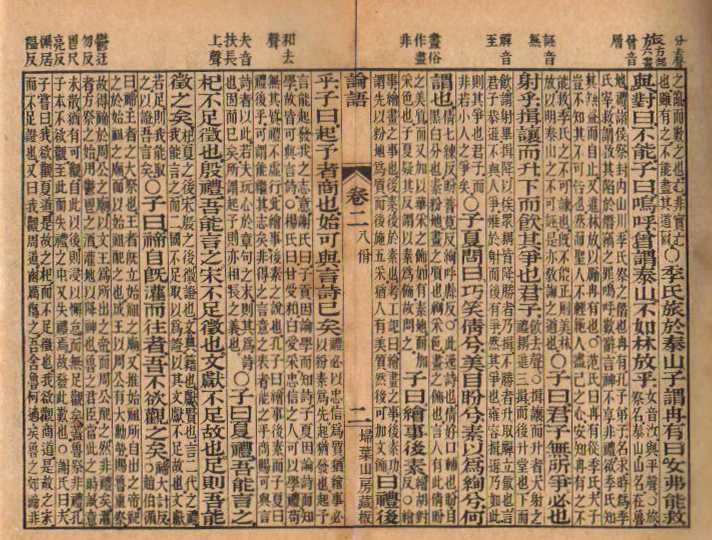
SECTION I.FORMATION OF THE TEXT OF THE ANALECTS BY THE SCHOLARS OF THE HAN DYNASTY.1.When the work of collecting and editing the remains of the Classical Books was undertaken by the scholars of Han, there appeared two different copies of the Analects; one from Loo, the native State of Confucius, and the other from Ts‘e, the State adjoining. Between these there were considerable differences. The former consisted of twenty Books or Chapters, the same as those into which the Classic is now divided. The latter contained two Books in addition, and in the twenty Books, which they had in common, the chapters and sentences were somewhat more numerous than in the Loo exemplar. 2. The names of several individuals are given, who devoted themselves to the study of those two copies of the Classic. Among the patrons of the Loo copy are mentioned the names of Hea-how Shing, grand-tutor of the heir-apparent, who died at the age of 90, and in the reign of the Emperor Seuen (bc 72—48); Seaou Wangche, a general officer, who died in the reign of the Emperor Yuen (bc 47—32); Wei Heen, who was premier of the empire from bc 70—66; and his son Heuen-shing. As patrons of the Ts‘e copy, we have Wang K‘ing, who was a censor in the year bc 99; Yung Tan, and Wang Keih, a statesman who died in the beginning of the reign of the Emperor Yuen. 3. But a third copy of the Analects was discovered about bc 150. One of the sons of the Emperor King was appointed king of Loo, in the year bc 153, and some time after, wishing to enlarge his palace, he proceeded to pull down the house of the K‘ung family, known as that where Confucius himself had lived. While doing so, there were found in the wall copies of the Shoo-king, the Ch‘un Ts‘ew, the Heaou-king, and the Lun Yu or Analects, which had been deposited there, when the edict for the burning of the Books was issued. They were all written, however, in the most ancient form of the Chinese character,1 which had fallen into disuse; and the king returned them to the K‘ung family, the head of which, K‘ung Gan-kwŏ, gave himself to the study of them, and finally, in obedience to an imperial order, published a Work called “The Lun Yu, with explanations of the Characters, and Exhibition of the Meaning.”2 4. The recovery of this copy will be seen to be a most important circumstance in the history of the text of the Analects. It is referred to by Chinese writers, as “The old Lun Yu.” In the historical narrative which we have of the affair, a circumstance is added which may appear to some minds to throw suspicion on the whole account. The king was finally arrested, we are told, in his purpose to destroy the house, by hearing the sound of bells, musical stones, lutes, and harpsichords, as he was ascending the steps that led to the ancestral hall or temple. This incident was contrived, we may suppose, by the K‘ung family, to preserve the house, or it may have been devised by the historian to glorify the sage, but we may not, on account of it, discredit the finding of the ancient copies of the Books. We have K‘ung Gan-kwŏ’s own account of their being committed to him, and of the ways which he took to decipher them. The work upon the Analects, mentioned above, has not indeed come down to us, but his labours on the Shoo-king still remain. 5. It has been already stated, that the Lun Yu of Ts‘e contained two Books more than that of Loo. In this respect, the old Lun Yu agreed with the Loo exemplar. Those two books were wanting in it as well. The last book of the Loo Lun was divided in it, however, into two, the chapter beginning, “Yaou said,” forming a whole Book by itself, and the remaining two chapters formed another Book beginning “Tsze-chang.” With this trifling difference, the old and the Loo copies appear to have agreed together. 6. Chang Yu, prince of Gan-ch‘ang, who died bc 4, after having sustained several of the highest offices of the empire, instituted a comparison between the exemplars of Loo and Ts‘e, with a view to determine the true text. The result of his labours appeared in twenty-one Books, which are mentioned in Lew Hin’s catalogue. They were known as the Lun of the Prince Chang, and commanded general approbation. To Chang Yu is commonly ascribed the ejecting from the Classic of the two additional books which the Ts‘e exemplar contained, but Ma Twan-lin prefers to rest that circumstance on the authority of the old Lun, which we have seen was without them. If we had the two Books, we might find sufficient reason from their contents to discredit them. That may have been sufficient for Chang Yu to condemn them as he did, but we can hardly suppose that he did not have before him the old Lun, which had come to light about a century before he published his Work. 7. In the course of the second century, a new edition of the Analects, with a commentary, was published by one of the greatest scholars which China has ever produced,—Ch‘ing Heuen, known also as Ch‘ing K‘ang-shing. He died in the reign of the Emperor Heen (ad109—220) at the age of 74, and the amount of his labours on the ancient classical literature is almost incredible. While he adopted the Loo Lun as the received text of his time, he compared it minutely with those of Ts‘e and the old exemplar. He produced three different works on the Analects, which unfortunately do not subsist. They were current, however, for several centuries; and the name of one of them—“The Meaning of the Lun Yu explained,”—appears in the Catalogues of Books in the T‘ang dynasty (ad 624—907). 8. On the whole, the above statements will satisfy the reader of the care with which the text of the Lun Yu was fixed during the dynasty of Han. [1 ] Called “tadpole characters.” They were, it is said, the original forms devised by Ts‘ang Këĕ, with large heads and fine tails, like the creature from which they were named. See the notes to the preface to the Shoo-king in “The thirteen Classics.” [2 ] See the preface to the Lun Yu in “The thirteen King.” It has been my principal authority in this Section. |

Titles (by Subject)