EconlibThe LibraryOther Sites |
Front Page Titles (by Subject) MEMOIR OF THE RIGHT HONOURABLE JAMES WILSON. 1 (1860.) - The Works and Life of Walter Bagehot, vol. 3 (Historical & Literary Essays)
Return to Title Page for The Works and Life of Walter Bagehot, vol. 3 (Historical & Literary Essays)The Online Library of LibertyA project of Liberty Fund, Inc.Search this Title:Also in the Library:
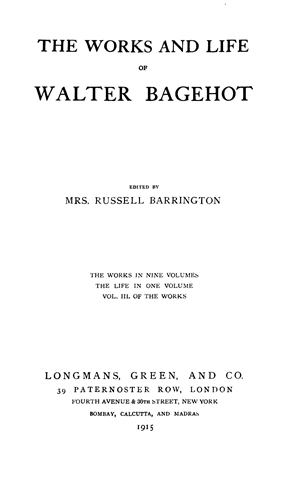
MEMOIR OF THE RIGHT HONOURABLE JAMES WILSON. 1 (1860.) - Walter Bagehot, The Works and Life of Walter Bagehot, vol. 3 (Historical & Literary Essays) [1915]Edition used:The Works and Life of Walter Bagehot, ed. Mrs. Russell Barrington. The Works in Nine Volumes. The Life in One Volume. (London: Longmans, Green, and Co., 1915). Vol. 3.
Part of: The Works and Life of Walter Bagehot, 10 vols.About Liberty Fund:Liberty Fund, Inc. is a private, educational foundation established to encourage the study of the ideal of a society of free and responsible individuals. Copyright information:The text is in the public domain. Fair use statement:This material is put online to further the educational goals of Liberty Fund, Inc. Unless otherwise stated in the Copyright Information section above, this material may be used freely for educational and academic purposes. It may not be used in any way for profit.
MEMOIR OF THE RIGHT HONOURABLE JAMES WILSON.1
Perhaps some of the subscribers to the Economist would not be unwilling to read a brief memoir of Mr. Wilson, even if the events narrated were in no respect peculiar. They might possibly be interested in the biography of an author of whose writings they have read so many, even if the narrative related no marked transitions and no characteristic events. But there were in Mr. Wilson’s life several striking changes. The scene shifts from the manufactory of a small Scotch hatter in a small Scotch town, to London—to the Imperial Parliament—to the English Treasury—to the Council Board of India. Such a biography may be fairly expected to have some interest. The life perhaps of no Political Economist has been more eventful. James Wilson was born at Hawick, in Roxburghshire, on 3rd June, 1805. His father, of whose memory he always spoke with marked respect, was a thriving man of business, extensively engaged in the woollen manufacture of that place. He was the fourth son in a family of fifteen children, of whom, however, only ten reached maturity. Of his mother, who died when he was very young, he scarcely retained any remembrance in after-life. As to his early years little is now recollected, except that he was a very mild and serious boy, usually successful during school hours, but not usually successful in the play-ground. As Mr. Wilson’s father was an influential Quaker, he was sent when ten years old to a Quaker school at Ackworth, where he continued for four years. At that time—it may surprise some of those who knew him in later life to be told—he was so extremely fond of books as to wish to be a teacher; and as his father allowed his sons to choose their line in life, he was sent to a seminary at Earl’s Colne in Essex, to qualify himself for that occupation. But the taste did not last long. As we might expect, the natural activity of his disposition soon induced him to regret his choice of a sedentary life. He wrote to Hawick, “I would rather be the most menial servant in my father’s mill than be a teacher”; and he was permitted to return home at once. Many years later he often narrated that after leaving Earl’s Colne, he had much wished to study for the Scottish Bar, but the rules of the Society of Friends, as then understood, would not allow his father to consent to the plan. He was sometimes inclined half to regret that he had not been able to indulge this taste, and he was much pleased at being told by a great living advocate that “if he had gone to the Bar he would have been very successful”. But at the time there was no alternative, and at sixteen he accordingly commenced a life of business. He did not, however, lose at once his studious predilections. For some years at least he was in the habit of reading a good deal, very often till late in the night. It was indeed then that he acquired almost all the knowledge of books which he ever possessed. In later life he was much too busy to be a regular reader, and he never acquired the habit of catching easily the contents of books or even of articles in the interstices of other occupations. Whatever he did, he did thoroughly. He would not read even an article in a newspaper if he could well help doing so; but if he read it at all, it was with as much slow, deliberate attention as if he were perusing a Treasury minute. At the early age we have mentioned he commenced his business life by being apprenticed to a small hat manufacturer at Hawick; and it is still remembered that he showed remarkable care and diligence in mastering all the minutiæ of the trade. There was, indeed, nothing of the amateur man of business about him at any time. After a brief interval his father purchased his master’s business for him and for an elder brother, named William, and the two brothers in conjunction continued to carry it on at Hawick during two or three years with much energy. So small a town, however, as Hawick then was, afforded no scope for enterprise in this branch of manufacture, and they resolved to transfer themselves to London. Accordingly, in 1824, Mr. Wilson commenced a mercantile life in London (the name of the firm being Wilson, Irwin & Wilson), and was very prosperous and successful for many years. His pecuniary gains were considerable, and to the practical instruction which he then obtained he always ascribed his success as an economist and a financier. “Before I was twenty years of age,” he said at Devonport in 1859, “I was partner in a firm in London, and I can only say, if there is in my life one event which I regard with satisfaction more than another, it is that I had then an opportunity of obtaining experience by observation which has contributed in the main to what little public utility I have since been to my country. During these few years I became acquainted—well acquainted—with the middle classes of this country. I also became acquainted in some degree with the working classes; and also, to a great extent, with the foreign commerce of this country in pretty nearly all parts of the world; and I can only say the information and the experience I thus derived have been to me in my political career of greater benefit than I can now describe.” In 1831 the firm of Wilson, Irwin & Wilson was dissolved by mutual consent. But Mr. Wilson (under the firm of James Wilson & Co.) continued to carry on the same kind of business, and continued to obtain the same success. He began in 1824 with £2000, the gift of his father, and in 1837 was worth nearly £25,000—a fair result for so short a period, and evincing a steady business-like capacity and judgment; for it was the fruit not of sudden success in casual speculation, but of regular attention during several years to one business. From circumstances which we shall presently state, he was very anxious that this part of his career should be very clearly understood. During these years Mr. Wilson led the life of a prosperous and intellectual man of business. He married,1 and formed an establishment suitable to his means, first near his manufactory in London, and afterwards at Dulwich. He took great pleasure in such intellectual society as he could obtain; was specially fond of conversing on political economy, politics, statistics, and the other subjects with which he was subsequently so busily occupied.2 Through life it was one of his remarkable peculiarities to be a very animated man, talking by preference and by habit on inanimate subjects. All the verve, vigour, and life which lively people put into exciting pursuits, he put into topics which are usually thought very dry. He discussed the Currency or the Corn-laws with a relish and energy which made them interesting to almost every one. “How pleasant it is,” he used to say, “to talk a subject out,” and he frequently suggested theories in the excitement of conversation upon his favourite topics which he had never thought of before, but to which he ever afterwards attached, as was natural, much importance. The instructiveness of his conversation was greatly increased as his mind progressed and his experience accumulated. But his genial liveliness and animated vigour were the same during his early years of business life as they were afterwards when he filled important offices of State in England and in Calcutta. Few men can have led a more continuously prosperous and happy life than he did during those years. Unfortunately it was not to continue. In 1836, or thereabouts, Mr. Wilson was unfortunately induced to commence a speculation in indigo, in conjunction with a gentleman in Scotland. It was expected that indigo would be scarce, and that the price would rise rapidly in consequence. Such would indeed appear to have been the case for a short period, since the first purchases in which Mr. Wilson took part yielded a profit. In consequence of this success, he was induced to try a larger venture,—indeed to embark most of his disposable capital. Unfortunately, the severe crisis of 1837 disturbed the usual course of all trades, and from its effect or from some other cause, indigo, instead of rising rapidly, fell rapidly. The effect on Mr. Wilson’s position may be easily guessed. A very great capitalist would have been able to hold till better times, but he was not. “On 1st January,” he said at Devonport, “in a given year, my capital was nearer £25,000 than £24,000, and it was all lost.” Numerous stories were long circulated, most of them exaggerated, and the remainder wholly untrue, as to this period of misfortune in Mr. Wilson’s life; but the truth is very simple. As is usual in such cases, various arrangements were proposed and agreed to, were afterwards abandoned, and others substituted for them. A large bundle of papers carefully preserved by him records with the utmost accuracy the whole of the history. The final result will be best described in his own words at Devonport, which precisely correspond with the balance sheets and other documents still in existence. They are part of a speech in answer to a calumnious rumour that had been circulated in the town:— “Now, how did I act on this occasion? and this is what this placard has reference to. By my own means alone, I was enabled at once to satisfy in full all claims against me individually, and to provide for the early payment of one-half of the whole of the demands against the firm, consisting of myself and three partners. I was further enabled, or the firm was enabled, at once to assign property of sufficient value, as was supposed, to the full satisfaction of the whole of the remainder of the liabilities. An absolute agreement was made, an absolute release was given, to all the partners; there was neither a bankruptcy nor insolvency, neither was the business stopped for one day. The business was continued under the new firm, with which I remained a partner, and from which I ultimately retired in good circumstances. Some years afterwards it turned out that the foreign property which was assigned for the remaining half of the debts of the old firm, of which I was formerly a partner, proved insufficient to discharge them. The legal liability was, as you know, all gone; the arrangement had been accepted—an arrangement calculated and believed by all parties to be sufficient to satisfy all claims in full; but when the affairs of the whole concern were fully wound up, finding that the foreign property had not realised what was anticipated, I had it, I am glad to say, in my power to place at my banker’s, having ascertained the amount, a sum of money to discharge all the remainder of that debt, which I considered morally, though not legally, due. This I did without any kind of solicitation—the thing was not named to me, and I am quite sure never were the gentlemen more taken by surprise than when a friend of mine waited on them privately in London, and presented each of them with a cheque for the balance due to them. Now, perhaps, I have myself to blame for this anonymous attack. I probably brought it on myself, for I always felt that if this matter were made public, it might look like an act of ostentatious obtrusion on my part, and therefore, when I put aside the sum of money necessary for the purpose, I made a request, in the letter I wrote to my bankers, desiring them as an especial favour that they would instruct their clerks to mention the matter to no one; and in order that it should be perfectly private, I employed a personal friend of my own in the city of London, in whose care I placed the whole of the cheques, to wait on those gentlemen and present each of them with a cheque, and I obtained from him a promise, and he from them, not to name the circumstance to any one.” The secrecy thus enjoined was well preserved. Many of the most intimate friends of Mr. Wilson, and his family also, were entirely unacquainted with what he had done, and learnt it only through the accidental medium of an electioneering speech. It may be added, too, that some of those who knew the circumstances, and who have watched Mr. Wilson’s subsequent career, believe that at no part of his life did he show greater business ability, self-command, and energy, than at the crisis of his mercantile misfortunes. It is remarkable that the preface to Mr. Wilson’s first pamphlet, on the Influences of the Corn-laws, is dated 1st March, 1839, the precise time at which he was negotiating with his creditors for a proper arrangement of his affairs; and to those who have had an opportunity of observing how completely pecuniary misfortune unnerves and unmans men—mercantile men, perhaps, more than any others—it will not seem unworthy of remark that a careful pamphlet, with elaborate figures, instinct in every line with vigour and energy, should emanate from a man struggling with extreme pecuniary calamity, and daily harassed with the painful details of it. After 1839 Mr. Wilson continued in business for several years, and with very fair success, considering that his capital was much diminished, and that the hat manufacture was in a state of transition. He finally retired in 1844, and invested most of his capital in the foundation and extension of the Economist. These facts prove, as we believe, the conclusion which he was very desirous to make clear—that, though unfortunate on a particular occasion, Mr. Wilson was by no means, as a rule, unsuccessful in business. He did not at all like to have it said that he was fit to lay down the rules and the theory of business, but not fit to transact business itself. And the whole of his life, on the contrary, proves that he possessed an unusual capacity for affairs—an extraordinary transacting ability. It may, however, be admitted that Mr. Wilson was in several respects by no means an unlikely man to meet, especially in early life, with occasional misfortune. To the last hour of his life he was always sanguine. He naturally looked at everything in a bright and cheerful aspect; his tendency was always to form a somewhat too favourable judgment both of things and men. One proof of this may be sufficient: he was five years Secretary of the Treasury, and he did not leave it a suspicious man. Moreover, Mr. Wilson’s temperament was very active and his mind was very fertile. And though in many parts of business these gifts are very advantageous, in many also they are very dangerous, if not absolutely disadvantageous. Frequently they are temptations. Capital is always limited; often it is very limited; and therefore a man of business, who is managing his own capital, has only defined resources, and can engage only in a certain number of undertakings. But a person of active temperament and fertile mind will soon chafe at that restriction. His inventiveness will show him many ways in which money might easily be made, and he cannot but feel that with his energies he would like to make it. If he have besides a sanguine temperament, he will believe that he can make it. The records of unfortunate commerce abound in instances of men who have been unsuccessful because they had great mind, great energy, and great hope, but had not money in proportion. Some part of this description was, perhaps, applicable to Mr. Wilson in 1839, but exactly how much cannot, after the lapse of so many years, be now known with any accuracy. Mr. Wilson’s position in middle life was by no means unsuitable to a writer on the subjects in which he afterwards attained eminence. He had acquired a great knowledge of business through a long course of industrious years; he had proved by habitual success in business that his habitual judgment on it was sound and good. If he had been a man of only ordinary energy and only ordinary ability, he would probably have continued to grow regularly richer and richer. But by a single error natural to a very sanguine temperament and a very active mind, he had destroyed a great part of the results of his industry. He had a new career to seek. He was willing to expend on it the whole of his great energies. He was ready to take all the pains which were necessary to fit himself for success. When he wrote his first pamphlet he used to say that he thought “the sentences never would come right”. In later life he considered three leading articles in the Economist, full of facts and figures, an easy morning’s work, which would not prevent his doing a good deal else too. Mr. Wilson was a finished man of business obliged by necessity to become a writer on business. Perhaps no previous education and no temporary circumstances could be conceived more likely to train a great financial writer and to stimulate his powers. In 1839 Mr. Wilson published his Influences of the Cornlaws; in 1840, the Fluctuations of Currency, Commerce, and Manufactures; in 1841, The Revenue; or, What should the Chancellor do? in September, 1843, he established the Economist. The origin of the latter may be interesting to our readers. Mr. Wilson proposed to the editor of the Examiner that he should furnish gratuitously a certain amount of writing to that journal on economic and financial subjects; but the offer was declined, though with some regret, on account of the expense of type and paper. A special paper was, therefore, established, which proved in the end as important as the Examiner itself. From the first, Mr. Wilson was the sole proprietor of the Economist, though he obtained pecuniary assistance—especially from the kindness of Lord Radnor. He embarked some capital of his own in it from the first, and afterwards repaid all loans made to him for the purpose of establishing it. It would not be suitable to the design of this memoir to give any criticism of Mr. Wilson’s pamphlets, still less would it become the Economist to pronounce in any manner a judgment on itself. Nevertheless, it is a part of the melancholy duty we have undertaken to give some account of Mr. Wilson’s characteristic position as a writer on Political Economy, and of the somewhat peculiar mode in which he dealt with that subject. Mr. Wilson dealt with Political Economy like a practical man. Persons more familiar with the literature of science might very easily be found. Mr. Wilson’s faculty of reading was small, nor had he any taste for the more refined abstractions in which the more specially scientific political economists had involved themselves. “Political Economy,” said Sydney Smith, “is become in the hands of Malthus and Ricardo, a school of metaphysics. All seem to agree what is to be done; the contention is how the subject is to be divided and defined. Meddle with no such matters.” We are far from alleging that this saying is just; nor would Mr. Wilson have by any means assented to it. But though he would have disavowed it in theory, it nevertheless embodies his instinctive feeling and characteristic practice. He “meddled with no such matters”; though he did not deny the utility of theoretical refinements, he habitually and steadily avoided them. Mr. Wilson’s predominating power was what may be called a business imagination. He had a great power of conceiving transactions. Political economy was to him the science of buying and selling, and of the ordinary bargains of men he had a very steady and distinct conception. In explaining such subjects he did not begin, as political economists have been wittily said to do, with “Suppose a man upon an island,” but “What they do in the city is this. The real course of business is so and so.” Most men of business will think this characteristic a great merit, aad even a theoretical economist should not consider it a defect. The practical value of the science of political economy (the observation is an old one as to all sciences) lies in its “middle principles”. The extreme abstractions from which such intermediate maxims are scientifically deduced lie at some distance from ordinary experience, and are not easily made intelligible to most persons, and when they are made intelligible, most persons do not know how to use them. But the intermediate maxims themselves are not so difficult; they are easily comprehended and easily used. They have in them a practical life, and come home at once to the “business” and the “bosoms” of men. It was in these that Mr. Wilson excelled. His “business imagination” enabled him to see “what men did,” and “why they did it”; “why they ought to do it,” and “why they ought not to do it”. His very clear insight into the real nature of mercantile transactions made him a great and almost an instinctive master of statistical selection. He could not help picking out of a mass of figures those which would tell most. He saw which were really material; he put them prominently and plainly forward, and he left the rest alone. Even now if a student of Parliamentary papers should alight on a return “moved for by Mr. Wilson,” he will do well to give to it a more than ordinary attention, for it will be sure to contain something attainable, intelligible, and distinct. Mr. Wilson’s habit of always beginning with the facts, always arguing from the facts, and always ending with a result applicable to the facts, obtained for his writings an influence and a currency more extensive than would have been anticipated for any writings on political economy. It is not for the Economist to speak of the Economist; but we may observe that through the pages of this journal certain doctrines, whether true or false, have been diffused far more widely than they ever were in England before—far more widely than from their somewhat abstract nature we could expect them to be diffused—far more widely than they are diffused in any other country but this. The business-like method and vigorous simplicity of Mr. Wilson’s arguments converted very many ordinary men of business, who would have distrusted any theoretical and abstruse disquisition, and would not have appreciated any elaborate refinements. Nor was this special influence confined to mercantile men. It penetrated where it could not be expected to penetrate. The Duke of Wellington was, perhaps, more likely to be prejudiced against a theoretical political economist than any eminent man of his day; he belonged to the “pre-scientific period”; he had much of the impatient practicality incident to military insight; he was not likely to be very partial to the “doctrines of Mr. Huskisson”;—nevertheless, the Duke early pointed out Mr. Wilson’s writings to Lord Brougham as possessing especial practical value; and when the Duke at a much later period was disposed to object to the repeal of the Navigation Laws, Mr. Wilson had a special interview to convince him of its expediency. Nor is this faculty of exposition by any means a trifling power. On many subjects it is a common saying “that he only discovers who proves”; but in practical politics we may almost say that he only discovers who convinces. It is of no use to have practical truths received by extraordinary men, unless they are also accepted by ordinary men. Whether Mr. Wilson was exactly a great writer, we will not discuss: but he was a great belief-producer; he had upon his own subjects a singular gift of efficient argument—a peculiar power of bringing home his opinions by convincing reasons to convincible persons. The time at which Mr. Wilson commenced his career as an economical writer was a singularly happy one. An economical century has elapsed since 1839. The Corn-laws were then in full force, and seemed likely to continue so, the agriculturists believed in them, and other classes acquiesced in them; the tentative reforms of Mr. Huskisson were half forgotten; our tariff perhaps contained some specimen of every defect—it certainly contained many specimens of most defects; duties abounded which cramped trade, which contributed nothing to the Exchequer, which were maintained that a minority might believe they profited at the expense of the majority; all the now settled principles of commercial policy were unsettled; the “currency” was under discussion; the Bank of England had been reduced to accept a loan from the Bank of France; capitalists were disheartened and operatives disaffected; the industrial energies, which have since multiplied our foreign commerce, were then effectually impeded by legislative fetters and financial restraints. On almost all of these restraints Mr. Wilson had much to say. Upon the Corn-laws Mr. Wilson developed a theory which was rare when he first stated it, but which was generally adopted afterwards, and which subsequent experience has confirmed. He was fond of narrating an anecdote which shows his exact position in 1839. There had just been a meeting of the Anti-Corn-law League at Manchester, and some speakers had maintained, with more or less vehemence, that the coming struggle was to be one of class against class, inasmuch as the Corn-laws were beneficial to the agriculturists, though they were injurious to manufacturers. The tendency of the argument was to set one part of the nation against another part. Mr. Wilson was travelling in the North, and was writing in a railway carriage part of the Influences of the Corn-laws. By chance a distinguished member of the League, whom Mr. Wilson did not know, happened to travel with him, and asked him what he was about. “I am writing on the Corn-laws,” said Mr. Wilson, “something in answer to the rubbish they have been talking at Manchester.” “You are a bold man,” was the reply; “Protection is a difficult doctrine to support by argument”. But it soon appeared that Mr. Wilson was the better Free-trader of the two. He held that the Corn-laws were injurious to all classes; that the agriculturists suffered from them as much as the manufacturers; that, in consequence, it was “rubbish” to raise a class-enmity on the subject, for the interest of all classes was the same. “We cannot too much lament,” he says in his Influences of the Corn-laws, “and deprecate the spirit of violence and exaggeration with which this subject has always been approached by each party, which no doubt has been the chief cause why so little of real truth or benefit has resulted from the efforts of either; the arguments on either side have been supported by such absurd and magnified statements of the influences of those prohibitory laws on their separate interests, as only to furnish each other with a good handle to turn the whole argument into ridicule. It therefore appears to be necessary to a just settlement of this great question, that these two parties should be first reconciled to a correct view of the real influences thus exerted over their interests, and the interests of the country at large; to a conviction that the imaginary fears of change on the one hand, and the exaggerated advantages expected on the other hand, are equally without foundation; that there are in reality no differences in the solid interests of either party; and that individuals, communities, or countries can only be prosperous in proportion to the prosperity of the whole.” And he proposed to prove “that the agricultural interest has derived no benefit, but great injury, from the existing laws; and that the fears and apprehensions entertained of the ruinous consequences which would result to this interest by the adoption of a free and liberal policy with respect to the trade in corn, are without any foundation; that the value of this property, instead of being depreciated, in the aggregate, would be rather enhanced, and the general interests of the owners most decidedly enhanced thereby;” and, “that while incalculable benefit would arise to the manufacturing interest and the working population generally, in common with all classes of the community, from the adoption of such policy, nothing can be more erroneous than the belief that the price of provisions or labour would on the average be thereby cheapened, but that, on the contrary, the tendency would rather be to produce, by a state of generally increased prosperity, a higher average rate of each”. Whatever might be thought in 1839, in 1860 we can on one point have no doubt whatever. The repeal of the Corn-laws has been followed by the exact effect which Mr. Wilson anticipated. Whether his argument was right or wrong, the result has corresponded with his anticipation. The agriculturists have prospered more—the manufacturers, the merchants, the operatives, all classes in a word, have prospered more since the Corn-laws were repealed, than they ever did before. As to abstract questions of politics there will always be many controversies; but upon a patent contemporaneous fact of this magnitude there cannot be a controversy. It is indisputable also that, for the purposes of the Anti-Corn-law agitation, Mr. Wilson’s view was exceedingly opportune. Mr. Cobden said not long ago (we quote the substance correctly even if the words are wrong), “I never made any progress with the Corn-law question while it was stated as a question of class against class”. And a careful inquirer will find that such is the real moral of the whole struggle. If it had continued to be considered solely or mainly as a manufacturer’s question, it might not have been settled to this hour. In support of this opinion, Mr. Wilson made many speeches at the meetings of the Anti-Corn-law League, though he had little taste for the task of agitation. We cannot give even an analysis of Mr. Wilson’s arguments—our space is too brief—but we will enumerate one or two of the principal points. He maintained that, under our protective laws, the agriculturists never had the benefit of a high price, and always suffered the evil of a low price. When our crop was scanty, it was necessary to sell the small quantity at a high price, or the farmer could not be remunerated. But exactly at that moment foreign corn was permitted by law to be imported. In consequence, during bad years the farmer was exposed to difficulty and disaster, which were greater because, in expectation of an English demand, large stocks were often hoarded on the Continent, and at once poured in to prevent the home-grower compensating himself for a bad harvest by an equivalent rise of price. Nor was the farmer better off in very plentiful years. There was a surplus in this country, and that surplus could not be exported, for the price of wheat was always lower abroad than here. The effect is evident. As corn is an article of the first necessity, a certain quantity of it will always be consumed, but more than that quantity will not be readily consumed. A slight surplus is, therefore, invariably found to lower the price of such articles excessively. In very good years the farmer had to sell his crop at an unremuneratingly low price, while in very bad years he was prevented from obtaining the high price which alone could compensate him for his outlay. Between the effects of the two sorts of years his condition was deplorable, and Parliamentary committees were constantly appointed to investigate it. Mr. Wilson also explained how much these fluctuations in price contracted the home demand for agricultural produce. The manufacturing districts were, he showed, subjected by the Corn-laws to alternate periods of great excitement and great depression. When corn was very cheap, the mass of the community had much to spend on other things; when corn was very dear, they had very little to spend on those things. In consequence, the producers of “other things” were sometimes stimulated by a great demand, and at other times deadened by utter slackness. The labouring classes in the manufacturing districts acquired in periods of plenty a certain taste for what to them were luxuries, and in periods of scarcity were naturally soured at being deprived of them. The manufacturers were frequently induced to invest additional capital by sudden angmentations of demand, and were often ruined by its sudden cessation. It was therefore impossible that the manufacturing classes could be steady customers of the agriculturists, for their own condition was fluctuating and unsteady. Mr. Wilson also showed that if the landed interest was injured by the effects of the Corn-laws, this was of itself enough to injure the manufacturing interests. “The connection,” he wrote, “between the manufacturer and the landed interest in this country is much closer than is generally admitted or believed; not only is the manufacturer dependent on the landed interest for the large portion of his goods which they immediately consume, but also for a very large portion of what he exports to the most distant countries. All commerce is, either directly or indirectly, a simple exchange of the surplus products of one country for those of another. It is therefore a first essential that we should be able to take the cotton of America, the sugar and coffee of India, the silk and teas of China, before they can take our manufactures; and if this be necessary, then must it follow that in proportion to the extent to which we can take their produce, will they be enabled to take our manufactures. Therefore, whatever portion of these products is consumed in this country by the landed interest, must to that extent enable the manufacturer to export his goods in return; and thus any causes which increase this ability on the part of the landed interest to consume, must give a corresponding additional ability to the manufacturers to export. Every pound of coffee or sugar, every ounce of tea, every article of luxury, the produce of foreign climes, whether consumed within the castles and halls of our wealthiest landowners, or in the humble cottages of our lowliest peasantry, alike represent some portion of the exports of this country. On the other hand, the dependence of the landowner is no less twofold on the manufacturer and merchant. He is not only dependent upon them for their own immediate consumption, but also for the consumption of whatever food enters into the cost price of their goods. Although the English farmer does not export his corn or his other produce in the exact shape and form in which he produces them, they constitute not the less on that account a distinct portion of the exports of this country, and that in the best of all possible forms. Just as much as the manufacturer exports the wool or the silk which enters into the fabrics of those materials, does he export the corn which paid for the labour of spinning and weaving them. It would be an utter impossibility that this country could consume its agricultural produce but for our extensive manufacturing population; or that the value of what would be consumed could be near its present rate. If without this aid our agricultural produce were as great as it now is, a large portion would have to seek a market in distant countries it would then have to be exported in the exact form in which it is produced; the expenses of which being so large would reduce very greatly from its value and net price, and the landed interest would be immediately affected thereby. But, as it is, the produce of the land is exported in the condensed form of manufactured goods, at a comparatively trifling expense, which secures a high value to it here. Thus, for example, a few bales of silk or woollen goods may contain as much wheat in their value as would freight a whole ship. To this advantage the landed interest is indebted, exclusively, for the very superior value of property and produce in this country to any other; because, by our great manufacturing superiority, a market is found for our produce over the whole world, conveyed in the cheapest and most condensed form. While the Chinese, or Indians, buy our cottons, our silks, or our woollens, they buy a portion of the grain and other produce of the land of this country; and therefore the producer here, while indulging in the delicacies or luxuries of Oriental climes, may only be consuming a portion of the golden heads of wheat which had gracefully waved in his own fields at a former day. Is it not, therefore, sufficiently clear that no circumstance whatever can either improve or injure one of these interests without immediately in the same way affecting the other? The connection is so close that it is impossible to separate or distinguish them. Any circumstance which limits our commerce must limit our market for agricultural produce; and any possible circumstance which deteriorates the condition of our agriculturists must deteriorate our commerce, by limiting our imports, and consequently our exports. These are general principles, and are capable of extension to the whole world, in all places, and at all times; and the same principle as is thus shown to connect and combine the different interests of any one country, just as certainly operates in producing a similar effect between different countries; and we ardently hope, ere long, to find not only the petty jealousies between different portions of the same community entirely removed, but that all countries will learn that a free and unrestricted co-operation with each other in matters of commerce can only tend to the general benefit and welfare of all.” We do not say that these propositions were exactly discoveries of Mr. Wilson. During the exciting discussion of a great public question, the most important truths which relate to it are “in the air” of the age; many persons see them, or half see them; and it is impossible to trace the precise parentage of any of them. But we do say that these opinions were exactly suited to the broad and practical understanding of Mr. Wilson; that they were very effectively illustrated by him—more effectively probably than by any other writer; that he thought them out for himself with but little knowledge of previous theories; that they, principally, raised Free-trade from a class question to a national question; that to them, whether advocated by Mr. Wilson or by others, the success of the Anti-Corn-law agitation was in a great measure owing; that whatever doubt may formerly have been felt, an ample trial has now proved them to be true. Mr. Wilson’s pamphlet entitled The Revenue; or, Whatshould the Chancellor do? which attracted considerable attention when it was published in 1841, is worth reading now, though dated so many years ago; for it contains an outline of the financial policy which Sir Robert Peel commenced, and which Mr. Gladstone has now almost completed. This pamphlet, which is not very short (it has twenty-seven moderate pages), was begun as an article for the Morning Chronicle, but proved too long for that purpose. It was written with almost inconceivable rapidity—nearly all, we believe, in a single night—though its principles and its many figures will bear a critical scrutiny even now. In the briefest memoir of Mr. Wilson it is necessary to say something of the currency; but it will not be advisable to say very much. If, however, we could rely on the patience of our readers, we should say a good deal. On no subject, perhaps, did Mr. Wilson take up a more characteristic position. He saw certain broad principles distinctly and steadily, and to these he firmly adhered, no matter what refined theories were suggested, or what the opinion of others might be. Mr. Wilson was a stern bullionist. He held that a five-pound note was a promise to pay five pounds. He answered Sir R. Peel’s question, “What is a pound?” with Sir Robert’s own answer. He said it was a certain specified quantity of gold metal. He held that all devices for aiding industry by issuing inconvertible notes were certainly foolish, and might perhaps be mischievous. He held that industry could only be really aided by additional capital—by new machines, new instruments, new raw material; that an addition to a paper currency was as useless to aid deficient capital as it was to feed a hungry population. Mr. Wilson held, secondly, that the sine quâ non, the great prerequisite to a good paper currency, was the maintenance of an adequate reserve by the issuer. He believed that a banker should look at his liabilities as a whole—the notes which he has in circulation and the deposits he has in his ledger taken together; and should retain a sufficient portion of them (say one-third) in cash, or in something equivalent to cash, in daily readiness to pay them at once. Mr. Wilson considered that bankers might be trusted to keep such a reserve, as they would be ruined, sooner or later, if they did not; and if the notes issued by them were always convertible at the pleasure of the holder, he believed that the currency would never be depreciated. He thought, however, that, as bank-notes must pass from hand to hand in the market, and as in practice most persons—most traders, especially—must take them in payment whether they wish to do so or not, some special security might properly be required for their payment. He would have allowed any one who liked to issue bank-notes on depositing Consols to a sufficient amount—the amount, that is, of the notes issued, and an adequate percentage in addition. Lastly, Mr. Wilson believed that the bank-note circulation exercised quite a secondary and unimportant influence upon prices and upon transactions, in comparison with the auxiliary currency of cheques and credits, which has indefinitely augmented during the last thirty years. So far from regarding the public as constantly ready for an unlimited supply of bank-notes, he thought that it was only in times of extreme panic, when this auxiliary currency is diminished and disturbed, that the bank-notes in the hands of the public either could or would be augmented. He believed that the public only kept in their hands as many notes as they wanted for their own convenience, and that all others were in the present day paid back to the banker immediately and necessarily. Unfortunately, however, the currency is not discussed in England with very exact reference to abstract principles. The popular question of every thinker is, “Are you in favour of Peel’s Bill, or are you against it?” And this mode of discussing the subject always placed Mr. Wilson in a position of some difficulty. He concurred in the aim of Sir R. Peel, but objected to his procedure. He wished to secure the convertibility of the bank-note. He believed that the Act of 1844 indirectly induced the Bank Directors to keep more bullion than they would keep otherwise, and in so far he thought it beneficial; but he also thought that the advantages obtained by it were purchased at a needless price; that they might have been obtained much more cheaply; that the machinery of the Act aggravated every panic; that it tended to fix the attention of the public on bank-notes, and so fostered the mischievous delusion that the augmented issue of paper currency would strengthen industry; that it neglected to take account of other forms of credit which are equally important with bank-notes; that, “for one week in ten years”—the week of panic—it created needless and intense apprehension, and so tended to cause the ruin of some solvent commercial men. In brief, though he fully believed the professed object of Sir R. Peel—the convertibility of the bank-note—to be beneficial and inestimable, he as fully believed the special means selected by him to be inconvenient and pernicious. Opinions akin to Mr. Wilson’s, if not identical with them, are very commonly now entertained, both by practical men of business and by professional economists. The younger school of thinkers who have had before them the working of the Act of 1844 and the events of 1847 and 1857, and are not committed by any of the older controversies, are especially inclined to them. Yet from peculiar causes they have not been so popular as Mr. Wilson’s other opinions. His views of finance and of the effect of Free-trade, which were half heresies when he announced them, have now become almost axioms. But the truth of his currency theory is still warmly controverted. The reason is this: Sir R. Peel’s Act is a sort of compromise which is suited to the English people. It was probably intended by its author as a preliminary step; it undoubtedly suits no strict theory; it certainly has great marks of incompleteness; but, “it works tolerably well”; if it produces evils at a crisis, “crises come but seldom”; in ordinary times commerce “goes on very fairly”. The pressure of practical evil upon the English people has never yet been so great as to induce them to face the unpleasant difficulties of the abstract currency question. Mr. Wilson’s opinions have, therefore, never been considered by practical men for a practical object, and it is only when so considered that any opinions of his can be duly estimated. Their essentially moderate character, too, is unfavourable to them—not, indeed, among careful inquirers, but in the hubbub of public controversy. The only great party which has as yet attacked Sir Robert Peel’s Bill is that which desires an extensive issue of inconvertible currency; but to them Mr. Wilson was as much opposed as Sir Robert Peel himself. The two watchwords of the controversy are “caution” and “expansion”: the advocates of the Act of 1844 have seized on the former, the Birmingham school on the latter; the intermediate, and, as we think, juster, opinions of Mr. Wilson have had no party cry to aid them, and they have not as yet therefore obtained the practical influence which he never ceased to anticipate and to hope for them. No more need be said upon the currency question—perhaps we have already said too much: but to those who knew Mr. Wilson well, no subject is more connected with his memory: he was so fond of expounding it, that its very technicalities are, in the minds of some, associated with his voice and image. But it was not by mere correctness of economical speculation that Mr. Wilson was to rise to eminence. A very accurate knowledge of even the more practical aspects of economical science is not of itself a productive source of income. By the foundation of the Economist Mr. Wilson secured for himself, during the rest of his life, competence and comfort, but it was not solely or simply by writing good political economy in it. The organisation of a first-rate commercial paper in 1843 required a great inventiveness and also a great discretion. Nothing of the kind then existed; it was not known what the public most wished to know on business interests; the best shape of communicating information had to be invented in detail. The labour of creating such a paper, and of administering it during its early stages is very great; and might well deter most men even of superior ability from attempting it. At this period of his life Mr. Wilson used to superintend the whole of the Economist; to write all the important leaders, nearly all of the unimportant ones; to make himself master of every commercial question as it arose; to give practical details as to the practical aspects of it; to be on the watch for every kind of new commercial information; to spend hours in adapting it to the daily wants of commercial men. He often worked till far into the morning, and impressed all about him with wonder at the anxiety, labour, and exhaustion he was able to undergo. As has been stated, for some months after the commencement of the Economist he was still engaged in his former business; and after he relinquished that, he used to write the City article and also leaders for the Morning Chronicle, at the very time that he was doing on his own paper far more than most men would have had endurance of mind or strength of body for. Long afterwards he used to speak of this period as far more exhausting than the most exhausting part of a laborious public life. “Our public men,” he once said, “do not know what anxiety means; they have never known what it is to have their own position dependent on their own exertions”. In 1843, and for some time afterwards, he had himself to bear extreme labour and great anxiety together; and even his iron frame was worn and tired by the conjunction. Within seven years from the foundation of the Economist, Mr. Wilson dealt effectively and thoroughly with three first-rate subjects—the railway mania, the famine in Ireland, and the panic of 1847, in addition to the entire question of Free-trade, which was naturally the main topic of economical teaching in those years. On all these three topics he explained somewhat original opinions, which were novelties, if not paradoxes then, though they are very generally believed now. To his writings on the railway mania he was especially fond of recurring, since he believed that by his warnings, very effectively brought out and very constantly reiterated, he had “saved several men their fortunes” at that time. The success of the Economist, and the advantage which the proprietor of it would derive from a first-hand acquaintance with political life, naturally led him to think of gaining a seat in Parliament, and an accidental conversation at Lord Radnor’s table fixed his attention on the borough of Westbury. After receiving a requisition, he visited the place, explained his political sentiments at much length “from an old cart,” and believed that he saw sufficient chances of success to induce him to take a house there. He showed considerable abilities in electioneering, and a close observer once said of him, “Mr. Wilson may, or may not, be the best political economist in England, but depend upon it he is the only political economist who would ever come in for the borough of Westbury”. Though nominally a borough, the constituency is half a rural one, much under the influence of certain Conservative squires. The Liberal party were in 1847 only endeavouring to emancipate themselves from a yoke to which they have now again succumbed. Except for Mr. Wilson’s constant watchfulness, his animated geniality, his residence on the spot, his knowledge of every voter by sight, the Liberal party might never have been successful there. A certain expansive frankness of manner and a wonderful lucidity in explaining his opinions almost to any one, gave Mr. Wilson great advantages as a popular candidate; and it was very remarkable to find these qualities connected with a strong taste for treating very dry subjects upon professedly abstract principles. So peculiar a combination had the success which it merited. In the summer of 1847 he was elected to serve in Parliament for Westbury. Mr. Wilson made his first speech in the House of Commons1 on the motion for a Committee to inquire into the commercial distress at that time prevalent. And it was considered an act of intellectual boldness for a new member to explain his opinions on so difficult a subject as the currency, especially as they were definitely opposed to a measure supported by such overwhelming Parliamentary authority as the Act of 1844 then was. Judging from the report in “Hansard,” and from the recollections of some who heard it, the speech was a successful one. It is very clear and distinct, and its tone is very emphatic, without ever ceasing to be considerate and candid. It contains a sufficient account of Mr. Wilson’s tenets on the currency—so good an account, indeed, that when he read it ten years later, in the panic of 1857, he acknowledged that he did not think he could add a word to it. At the time, however, the test of its Parliamentary success was not the absolute correctness of its abstract principles, but, to use appropriate and technical language, “its getting a rise out of Peel”. Sir Robert had used some certainly inconclusive arguments in favour of his favourite measure, and Mr. Wilson made that inconclusiveness so very clear that he thought it necessary to rise “and explain,” which, on such a subject, was deemed at the moment a great triumph for a first speech. As might be expected from so favourable a commencement, Mr. Wilson soon established a Parliamentary reputation. He was not a formal orator, and did not profess to be so. But he had great powers of exposition, singular command of telling details upon his own subjects, a very pleasing voice, a grave but by no means inanimate manner—qualities which are amply sufficient to gain the respectful attention of the House of Commons. And Mr. Wilson did gain it. But speaking is but half, and in the great majority of cases by far the smaller half, of the duties of a member of Parliament. Mr. Wilson was fond of quoting a saying of Sir R. Peel’s, “That the way to get on in the House of Commons was to take a place and sit there”. He adopted this rule himself, was constant in his attendance at the House, a good listener to other men, and always ready to take trouble with troublesome matters. These plain and business-like qualities, added to his acknowledged ability and admitted acquaintance with a large class of subjects upon which knowledge is rare, gave Mr. Wilson a substantial influence in the House of Commons in an unusually short time. The Corn-laws had been repealed, the pitched battle of Free-trade had been fought and won, but much yet remained to be done in carrying out its principles with effective precision, in applying them to articles other than corn, in exposing the fallacies still abundantly current, and in answering the exceptional case which every trade in succession set up for an exceptional protection. These were painful and complex matters of detail, wearisome to very many persons, and rewarding with no éclat those who took the trouble to master and explain them. But Mr. Wilson shrank from no detail. For several years before he had a seat in the House, he had been used to explain such topics in countless conversations with the most prominent Free-traders and in the Economist. He now did so in the House of Commons, and his influence correspondingly increased. He was able to do an important work better than any one else could do it; and, in English public life, real work rightly done at the right season scarcely ever fails to meet with a real reward. That Mr. Wilson early acquired considerable Parliamentary reputation is evinced by the best of all proofs. He was offered office before he had been six months in the House of Commons, though he had, as the preceding sketch will have made evident, no aristocratic connections—though he was believed to be a poorer man than he really was—though writing political articles for newspapers has never been in England the sure introduction to political power which it formerly was in France—though, on the contrary, it has in general been found a hindrance. In a case like Mr. Wilson’s, the prize of office was a sure proof of evident prowess in the Parliamentary arena. The office which was offered to Mr. Wilson was one of the Secretaryships of the Board of Control. Mr. Wilson related at Hawick his reluctance to accept it, and his reason. Never having given any special attention to Indian topics, he thought it would be absurd and ridiculous in him to accept an office which seemed to require much special knowledge. But Lord John Russell, with “that knowledge of public affairs which long experience ensures,” at once explained to him that a statesman, under our Parliamentary system, must be prepared to serve the Queen “whenever he may be called on”; and accordingly that he must be ready to take any office which he can fill, without at all considering whether it is that which he can best fill. After some deliberation, Mr. Wilson acknowledged the wisdom of this advice, and accepted the office offered him. Long afterwards, in the speech at Hawick to which we have alluded, he said that without the preliminary knowledge of India which he acquired at the Board of Control, he should never have been able to undertake the regulation of her finances. When once installed in his office, he devoted himself to it with his usual unwearied industry. And at least on one occasion he had to deal with a congenial topic. The introduction of railways into India was opposed on many grounds, most of which are now forgotten—such as “the effect upon the native mind,” “the impossibility of inducing the Hindoos to travel in that manner,” and the like; and more serious difficulties occurred in considering the exact position which the Government should assume with regard to such great undertakings in such singular circumstances—the necessity, on the one hand, in an Asiatic country where the State is the sole motive power, of the Government’s doing something—and the danger, on the other hand, of interfering with private enterprise, by its doing, or attempting to do, too much. Mr. Wilson applied himself vigorously to all these difficulties; he exercised the whole of his personal influence, and the whole of that which was given to him by his situation, in dissipating the fanciful obstacles which were alleged to be latent in the unknown tendencies of the Oriental mind; while he certainly elaborated—and he believed that he originally suggested—the peculiar form of State guarantee upon the faith of which so many millions of English capital have been sent to develop the industry of India. Besides discharging the duties of his office, Mr. Wilson represented the Government of the day on several Committees connected with his peculiar topics, and especially on one which fully investigated the Sugar question. Of the latter, indeed, he became so fully master that some people fancied he must have been in the trade; so complete was the familiarity which he displayed with “brown muscovado,” “white clayed,” and all other technical terms which are generally inscrutably puzzling to Parliamentary statesmen. On a Parliamentary Committee Mr. Wilson appeared to great advantage. Though sufficiently confident of the truth of his own opinions, he had essentially a fair mind; he always had the greatest confidence that if the facts were probed the correctness of what he believed would be established, and, therefore, he was always ready to probe the facts to the bottom. He was likewise a great master of the Socratic art of inquiry; he was able to frame a series of consecutive questions which gradually brought an unwilling or a hostile witness to conclusions at which he by no means wished to arrive. His examination-in-chief, too, was as good as his cross-examination, and the animated interest which he evinced in the subject relieved the dreariness which a rehearsed extraction of premeditated answers commonly involves. The examination of Lord Overstone before the Committee of 1848 on Commercial Distress, that of Mr. Weguelin before the Committee on the Bank Acts in 1857, and several of the examinations before the Committee on Life Insurance, of which he was the Chairman, may be consulted as models in their respective kinds. And it should be stated that no man could be less overbearing in examination or cross-examination; much was often extracted from a witness which he did not wish to state, but it was always extracted fairly, quietly, and by seeming inevitable sequence. Mr. Wilson continued at the Board of Control till the resignation of Lord John Russell’s Cabinet in the spring of 1852. He took part in the opposition of the Liberal party to Lord Derby’s Government, and was very deeply interested in the final settlement of the Free-trade question which was effected by the accession of the Protectionist party to office. After a very severe contest he was re-elected for Westbury in July, 1852, and on the formation of the Aberdeen Government he accepted the office of Financial Secretary to the Treasury, which he continued to hold for five years, until the dissolution of Lord Palmerston’s administration in the spring of 1857, and upon his efficiency in which his remarkable reputation as an official administrator was mainly based. The Financial Secretaryship of the Treasury is by no means one of the most conspicuous offices in the Government, and but few persons who have not observed political life closely are at all aware either of its difficulty or of its importance. The office is, indeed, a curious example of the half-grotesque way in which the abstract theory of our historical Constitution contrasts with its practical working. In the theory of the Constitution—a theory which may still be found in popular compendiums—there is an officer called the Lord High Treasurer, who is to advise the Crown and be responsible to the country for all public moneys. In practice, there is no such functionary: by law his office is “in commission”. Certain Lords Commissioners are supposed to form a Board at which financial subjects are discussed, and which is responsible for their due administration. In practice, there is no such discussion and no such responsibility. The functions of the Junior Lords of the Treasury, though not entirely nominal, are but slight. The practical administration of our expenditure is vested in the First Lord of the Treasury, the Chancellor of the Exchequer, and the Financial Secretary of the Treasury. And of these three the constitutional rule is, that the First Lord of the Treasury is only officially responsible for decisions in detail when he chooses to interfere in those decisions. Accordingly, when a First Lord, as was the case with Sir R. Peel, takes a great interest in financial questions, the Chancellor of the Exchequer does the usual work of the Secretary of the Treasury, and the Secretary of the Treasury has in comparison nothing to do. But when, as was the case in the Governments of Lord Aberdeen and Lord Palmerston, the Prime Minister takes no special interest in finance, the Chancellor of the Exchequer is very fully employed in the transaction of his own proper business, and an enormous mass of work, some of it of extreme importance, falls to the Secretary of the Treasury. Of late years, the growth of the miscellaneous civil expenditure of the country has greatly augmented that work, great as it was before. In general, it may be said that the whole of the financial detail of our national expenditure is more or less controlled by the Secretary of the Treasury; that much of it is very closely controlled by him; and that he has vast powers of practical discretion, if only he be a man of ability, industry and courage. For such an office as this Mr. Wilson had very peculiar qualifications. He was perfectly sure to be right in a plain case; and by far the larger part of the ordinary business of the Government, as of individuals, consists of plain cases. A man who is thoroughly sure to decide effectually and correctly the entire mass of easy, obvious cases, is a safer master of practical life than one eminently skilled in difficult cases, but deficient in the more rudimentary qualification. Nor is the power of certainly deciding plain cases rightly, by any means very common, especially among very intellectual men. A certain taint of subtlety, a certain tendency to be wise above the case in hand, mars the practical efficiency of many men whose conversation and whose powers would induce us to expect that they would be very efficient. Mr. Wilson had not a particle of these defects. He struck off each case with a certain sledgehammer efficiency, and every plain case at least with infallible accuracy. It might seem overstrained eulogy—a eulogy which he would not have wished—to claim for Mr. Wilson an equally infallible power of deciding complicated cases. As to such cases there will always be a doubt. Plain matters speak for themselves: they do not require a dissertation to elucidate them: every man of business, as soon as he hears the right decision of them, knows that it is the right decision. But with more refined matters it is not so; as to points involving an abstract theory, like that of the currency, there will and must be differences of judgment to the end of time. We would not, therefore, whatever may be our own opinion, claim for Mr. Wilson as infallible a power of deciding difficult questions as he certainly possessed of deciding plain questions. But we do claim for him even in such matters the greatest secondary excellence, if indeed, a secondary excellence it be. Mr. Wilson was perfectly certain to be intelligible on the most difficult case. Whether he did right or did wrong, must, as we have said, be from the nature of the subject-matter very arguable. But what he did, and why he did it, was never in doubt for a moment. The archives of the Treasury contain countless minutes from his pen, many of them written with what most men would call rapidity, just while the matter was waiting for decision, and on all sorts of subjects, many of them very complicated ones—yet it may be doubted whether any one of those minutes contains a single sentence not thoroughly and conspicuously clear. The same excellence which has been shown in countless articles in the Economist appears in his business-like documents. Wherever his leading articles were written and under whatever circumstances—and some of the most elaborate of them were written under rather strange circumstances (for he could catch up a pen and begin to write on the most involved topic, at any time, in any place, and as a casual observer would think, without any premeditation)—but wherever and however these articles might be written, it may be safely asserted that they do not contain a sentence which a man of business need read twice over, or which he would not find easily and certainly intelligible. At the Treasury it was the same. However complicated and involved the matter to be decided might be—however much it might be loaded with detail or perplexed by previous controversy—Mr. Wilson never failed to make immediately clear the exact opinion he formed upon it, the exact grounds upon which he formed it, and the exact course of action which he thought should be adopted upon it. Many persons well acquainted with practical life will be disposed to doubt whether extreme accuracy of decision is not almost a secondary merit as compared with a perfect intelligibility. In many cases it may be better to have a decision which every one can understand, though with some percentage of error, than an elaborately accurate decision of which the grounds and reasons are not easily grasped, and a plan of action which, from its refined complexity, is an inevitable mystery to the greater number of practical persons. But, putting aside this abstract discussion, we say without fear of contradiction or of doubt, that Mr. Wilson added to his almost infallible power of deciding plain cases, an infallible certainty of being entirely intelligible in complicated cases. Men of business will be able to imagine the administrative capacity certain to be produced by the union of extreme excellence in both qualities. One subsidiary faculty that Mr. Wilson possessed, which was very useful to him in the multifarious business of the Treasury, was an extraordinary memory. On his own subjects and upon transactions in which he had taken a decisive part, he seemed to recollect anything and everything. He was able to answer questions as to business transacted at the Treasury after the lapse of months and even of years without referring to the papers, and with a perfect certainty of substantial accuracy. He would say, without the slightest effort and without the slightest idea that he was doing anything extraordinary: “Such and such a person came to me at the Treasury, and said so and so, and this is what I said to him”. And it is quite possible that he might remember the precise sums of money which were the subject of conversation. A more useful memory for the purpose of life was perhaps never possessed by any one. In the case of great literary memories, such as that of Lord Macaulay and of others, the fortunate possessor has a continued source of pleasurable and constantly recurring recollections; he has a full mind constantly occupied with its own contents, recurring to its long-loved passages from its favourite authors constantly and habitually. But Mr. Wilson never recurred to the transactions in which he had been engaged except when he was asked about them; he lived as little in the past perhaps as is possible for an intellectual person; but the moment the spring was touched by a question or by some external necessity, all the details of the past transaction started into his memory completely, vividly, and perfectly. He had thus the advantage of always remembering his business, and also the advantage of never being burdened by it. Very few persons can ever have had in equal measure the two merits of a fresh judgment and a full mind. Mr. Wilson’s memory was likewise assisted by a very even judgment. It was easier to him to remember what he had done, because, if he had to do the same thing again, he would be sure to do it in precisely the same way. He was not an intolerant person, but the qualities he tolerated least easily were flightiness and inconsistency of purpose. He had furnished his mind, so to say, with fixed principles, and he hated the notion of a mind which was unfurnished. All these mental qualities taken together go far to make up the complete idea of a perfect administrator of miscellaneous financial business, such as that of the English Treasury now is. And Mr. Wilson had the physical qualities also. An iron constitution which feared no labour, and was very rarely incapacitated even for an hour by any illness, enabled him to accomplish with ease and unconsciously an amount of work which few men would not have shrunk from. In the country, where his habits were necessarily more obvious, he habitually spent the whole day from eleven till eight, with some slight interval for a short ride in the middle of the day, over his Treasury bag; and as such was his notion of a holiday, it may be easily conceived that in London, when he had still more to do in a morning, and had to spend almost every evening in the House of Commons, his work was greater than an ordinary constitution could have borne. And it was work of a rather peculiar kind. Some men of routine habits spend many hours over their work, but do not labour very intensely at one time; other men of more excitable natures work impulsively, and clear off everything they do by eager efforts in a short time. But Mr. Wilson in some sense did both. Although his hours of labour were so very protracted, yet if a casual observer happened to enter his library at any moment, he would find him with his blind down to exclude all objects of external interest, his brow working eagerly, his eye fixed intently on the figures before him, and, very likely, his rapid pen passing fluently over the paper. He had all the labour of the chronic worker, and all the labour of the impulsive worker too. And those admitted to his intimacy used to wonder that he was never tired. He came out of his library in an evening more ready for vigorous conversation—more alive to all subjects of daily interest—more quick to gain new information—more ready to expound complicated topics, than others who had only passed an easy day of idleness or ordinary exertion. By the aid of this varied combination of powers, Mr. Wilson was able to grapple with the miscellaneous financial business of the country with very unusual efficiency. Most men would have found the office work of the Secretary of the Treasury quite enough, but he was always ready rather to take away labour and responsibilities from other departments than to throw off any upon them. Nor was his efficiency confined to the labours of his office. The Financial Secretary of the Treasury has a large part of the financial business of the House of Commons under his control, and is responsible for its accurate arrangement. The passing a measure through the House of Commons is a matter of detail; and in the case of the financial measures of the Government, a large part of this—the dullest part, and the most unenvied—falls to the Secretary of the Treasury. He is expected to be the right hand of the Chancellor of the Exchequer in all the most wearisome part of the financial business of the House of Commons; and we have the best authority for stating that, under two Chancellors of the Exchequer, very different from one another in many respects, Mr. Wilson performed this part of his duties with singular efficiency, zeal, and judgment. The Financial Secretary of the Treasury is likewise expected to answer all questions asked in the House as to the civil estimates—a most miscellaneous collection of figures, as any one may satisfy himself by glancing at them. Mr. Wilson’s astonishing memory and great power of lucid exposition enabled him to fulfil this part of his duty with very remarkable efficiency. He gave the dates and the figures without any note, and his exposition was uniformly simple, emphatic, and intelligible, even on the most complicated subjects. The great rule, he used to say, was to answer exactly the exact question; if you attempted an elaborate exposition, collateral issues were necessarily raised, a debate ensued, and the time of the House was lost. Mr. Wilson’s mercantile knowledge and mercantile sympathies were found to be of much use in the consolidation of the Customs in 1853, and he took great interest in settling a scheme for the payment of the duties in cheques instead of bank-notes, by which the circulation has been largely economised and traders greatly benefited. During the autumn of 1857, his long study of the currency question, and his first-hand conversancy with the business of the City, were valuable aids to the Administration of the day in the anxious responsibilities and rapidly shifting scenes of an extreme commercial crisis. It would be impossible to notice the number of measures in which he took part as Secretary of the Treasury, and equally impossible to trace his precise share in them. That office ensures to its holder substantial power, but can rarely give him legislative fame. On two occasions during his tenure of office at the Treasury, Mr. Wilson was offered a different post. In the autumn of 1856 he was offered the Chairmanship of Inland Revenue, a permanent office of considerable value then vacant, which he declined because he did not consider the income necessary, and because (what some people would think odd) it did not afford sufficient occupation. It was a “good pillow,” he said, “but he did not wish to lie down”. The other office offered him was the Vice-Presidency of the Board of Trade in 1855, which would have been a step to him in official rank, but which would have entailed a new election, and he did not feel quite secure that the electors of Westbury would again return him. He did not, however, by any means wish for the change, as the Vice-Presidency of the Board of Trade, though nominally superior, is in real power far inferior to the Secretaryship of the Treasury. In the general election of 1857, Mr. Wilson was returned for Devonport, for which place he continued to sit till his departure for India. He went out of office on the dissolution of Lord Palmerston’s Administration in the spring of 1858, and took an active part in the Liberal opposition to Lord Derby’s Government, though it may be remarked that he carefully abstained from using the opportunities afforded him by his long experience at the Treasury, of harassing his less experienced successors in financial office by needless and petty difficulties. On the return of the Liberal party to power, Mr. Wilson was asked to resume his post at the Treasury, but he declined, as, after five years of laborious service, he wished to have an office of which the details were less absorbing. He accepted, however, the Vice-Presidency of the Board of Trade1 —an office which is not in itself attractive, but which gives its possessor a sort of claim to be President of the Board at the next vacancy. The office of President is frequently accompanied by a seat in the Cabinet, and Mr. Wilson’s reputation on all subjects connected with trade was so firmly established that in his case it would have been practically impossible to pass him over, even if it had been wished. He had, however, secured so firm a position in official circles by his real efficiency, that the dispensers of patronage were, as he believed, likely to give him whatever he desired as soon as the exigencies of party enabled them to do so. He had not been long in office before he had good reason for thinking that he would be offered by the Government the office of Financial Member of the Council of India under very peculiar circumstances. There had never before been such an officer. One member of Council had since 1833 been always sent out from England, but he had always been a lawyer, and his functions were those of a jurist and a regulative administrator, not those of a financier. The mutiny of the Sepoys in 1857 had, however, left behind it a deficit with which the financiers of India did not seem to be able to cope, and which a cumbrous financial system did not give them the best means of vanquishing. There was a general impression that some one with an English training and English habits of business would have a better chance of overcoming the most pressing difficulty of India than any one on the spot. And there was an equally general impression that if any one were to be sent from England to India with such an object, Mr. Wilson was the right person. He united high financial reputation, considerable knowledge of India acquired at the Board of Control, tried habits of business, long experience at the English Treasury, to the sagacious readiness in dealing with new situations which self-made men commonly have, but which is commonly wanting in others. On personal grounds Mr. Wilson was disinclined to accept the office. He was on the threshold of the Cabinet here; he was entitled by his long tenure of office at the Treasury to a pension which would merge in the salary of Indian Councillor; the emoluments of the latter office were not necessary to him; his life was very heavily insured for the benefit of his family; though he had never during his tenure of office at the Treasury been connected directly or indirectly with any kind of commercial undertaking (the Economist alone excepted), some investments which he made in land and securities, entirely beyond the range of politics, had been very fortunate; since the year 1844 everything of a pecuniary kind in which he had been concerned had not only prospered, but remarkably prospered; he felt himself sufficiently rich to pursue the career of prosperous usefulness and satisfied ambition that seemed to be before him here. There was no consideration of private interest which could induce him to undertake anxious and dangerous duties in India; he even ran some pecuniary risk in leaving this country, as it was possible that in the vicissitudes of newspaper property the Economist might again need the attention of its proprietor and founder. On public grounds, however, he believed that it was his duty to accept the office; he took a keen interest in Indian finance; believed that the difficulties of it might be conquered, and thought that in even attempting to conquer them he would be doing the greatest and most lasting public service that it was in his power to accomplish. He accordingly accepted the office of Financial Member of the Council of India, and proceeded to make somewhat melancholy arrangements for leaving this country. He broke up his establishment here, bade farewell to his constituents at Devonport and to the inhabitants of his native place, attended some influential public meetings in towns deeply interested in the commerce of India, and on 20th October, 1859, left England, as it proved, for ever. Of Mr. Wilson’s policy in India it would not be proper to give more than a very brief sketch here. That policy is still fresh in the memory of the public; it has been very frequently explained and discussed in the Economist; it is still being tried; and, though he was fully persuaded of the expediency of his measures, he would not have wished for too warm a eulogy of them while they are as yet untested by the event. In almost the last letter which the present writer received from him, there was a sort of reprimand for permitting this journal to draw too great an attention to his plans, and to ascribe the merit of them too exclusively to him, and too little to the Government of which he was a member. On his arrival in India he found that the Governor-General was on a tour in the Upper Provinces of India, and before doing any business of importance at Calcutta he travelled thither. This journey he thought very advantageous, because it gave him a great insight into the nature of the country, and enabled him to consult the most experienced revenue officers of many large districts on their respective resources, and on the safest mode of making those resources available to the public. He was much struck with the capabilities of the country, and wrote to England in almost so many words “that it was a fine country to tax”. On the other hand, however, he was well aware of the difficulty of his task. The only two possible modes of taxation are direct and indirect, and in the case of India there is a difficulty in adopting either. If we select indirect taxation and impose duties on consumable commodities, the natives of India meet us by declining to consume. Their wants are few, and they will forego most of them if a tax can be evaded thereby. On the other hand, if we adopt in India a direct tax on property or income, there is great difficulty in finding out what each man’s property or income is. In England we trust each person to tell us the amount of his income, but even here the results are not wholly satisfactory; and it would be absurd to fancy that we can place as much reliance upon the veracity of Orientals as upon that of Englishmen. These difficulties, however, Mr. Wilson was prepared to meet. On 18th February, 1860, he proposed his Budget to the Legislative Council at Calcutta, and the reception given to it by all classes was remarkably favourable. He announced, indeed, a scheme of heavy taxation, but the Indian public had been living for a considerable time under a sentence of indefinite taxation, and they were glad to know the worst. Anything distinct was better than vague suspense, and, as usual, Mr. Wilson contrived to make his meaning very distinct. His bearing also exercised a great influence over the Anglo-Indian public. In England he had been remarkable among official men for his constant animation and thorough naturalness of manner; in his office he was as much himself as at a dinner-table or in the House of Commons; he had no tinge of supercilious politeness or artificial blandness. In any new scene of action—especially in such a scene as British India—these qualities were sure to tell beneficially. Plain directness and emphatic simplicity were the external qualities most likely to be useful at Calcutta, and these were Mr. Wilson’s most remarkable qualities. The principal feature of Mr. Wilson’s Budget was the Income Tax, which he avowedly framed after the English fashion. It is true that but little reliance can, perhaps, be placed on the statements of Orientals as to their wealth. It is very possible that the complicated machinery of forms and notices which is in use here may not be applicable in India. All this Mr. Wilson well knew. But he thought that our Indian subjects should have an opportunity of stating their income before they were taxed upon it. If they should state it untruly, or should decline to state it, it might be necessary to tax them arbitrarily. But he did not think it would be decent—that it would be civilised—to begin with an arbitrary assessment. By the Income Tax Act which he framed, it is enacted that other modes may be substituted if in any instance the English mode of assessment should prove inapplicable. In other words, if our Oriental fellow-subjects will not tell us the truth when they are asked, we must tax them as best we can, and they cannot justly complain of unfairness and inequality. We would have been mathematically just, if they had given us the means. The reception of Mr. Wilson’s Budget was universally favourable until the publication of the minute of Sir C. Trevelyan, which, as was inevitable, produced a serious reaction. Heavy taxation can never be very pleasant, and in the Presidency of Madras Sir Charles gave the sanction of the Government—of the highest authority the people saw—to the hope that they would not be taxed. The prompt recall of Sir Charles, however, did much to convince the natives of the firm determination of the English Government, and Mr. Wilson hoped that the ordeal of criticism through which his measures had to pass would ultimately be favourable to them. It certainly secured them from the accusation of being prepared in haste, but it purchased this benefit at the loss to the public of much precious time, and to Mr. Wilson of precious health. Of the substance of this minute it is sufficient to say that its fundamental theory that additional taxation of any sort was unnecessary in India, has scarcely been believed by any one except its author. Almost every one has deemed it too satisfactory to be true. On another point Mr. Wilson’s Budget had been criticised in England, though not in India. It has been considered to be a protective Budget. The mistake has arisen from not attending to what that Budget is. The changes made by Mr. Wilson in the import duties were two. “The first was a reduction from twenty to ten per cent. upon a long list of articles, including haberdashery, millinery, and hosiery, all part of the cotton trade; the second was an increase in the duty upon cotton yarn from five to ten per cent., thus creating a uniform tariff of ten per cent.”1 Of these two, it is plain the reduction from twenty per cent. to ten was not a change that would operate as a protection to Indian industry; and the increase of the duty on yarn has a contrary tendency. Yarn is an earlier, cloth a later, stage of manufacture, and in Mr. Wilson’s own words, “it is a low duty on yarn and a high duty on cloth that encourages native weaving”. For the effect of the general system of high Customs duties in India Mr. Wilson is not responsible, but his predecessors. What he did has no protective tendency. If the Income Tax should, as may be fairly hoped, become a permanent part of the financial system of India, it will serve for a considerable period to keep Mr. Wilson’s name alive there. So efficient an expedient must always attract the notice of the public, and must in some degree preserve the remembrance of the Minister by whom it was proposed. Mr. Wilson, however, undertook two other measures of very great importance. One of these has been frequently described as the introduction into India of the English system of public accounts. But it would be more truly described as the introduction of a rational system of public accounts. There are three natural steps in national finance, which are certainly clearly marked in our English system, but which have a necessary existence independent of that recognition. These three are—first, the estimate of future expenditure; secondly, what we call the Budget, that is, the official calculation of the income by which the coming expenditure is to be defrayed; thirdly, the audit, which shows what the expenditure has been and how it has been met. The system of finance which Mr. Wilson found in India neglected these fundamental distinctions. There were no satisfactory estimates of future expenditure, and no satisfactory calculation of future income. In consequence, the calculations of the official departments have been wrong by millions sterling, and English statesmen have felt great difficulty not only in saying how the deficit was to be removed, but likewise in ascertaining what the amount of the deficit was. At the time of his death Mr. Wilson was eagerly occupied in endeavouring to introduce a better system.1 Mr. Wilson will likewise be remembered as the first Minister who endeavoured to introduce into India a Government paper currency. On 3rd March, 1860, he introduced into the Legislative Council an elaborate plan for this purpose, which, with a slight modification by Sir C. Wood—curious in the theory of the currency, but practically not very important—will speedily, it is probable, be the fundamental currency law—the “Peel’s Act” of British India. The exact mode in which Mr. Wilson regarded these great objects, will perhaps be better explained by two extracts from his latest letters than by any other means. On 4th July, he wrote to a friend:— “Firmness and justice are the only policy for India: no vacillation, or you are gone. They like to be governed; and respect an iron hand, if it be but equal and just. I have, I think, more confidence than ever that the taxes will be established and collected, and without disturbance. But the task is still an enormous one. I must retrench yet at least three and a half millions, and get the same sum from my new taxes to make both ends meet. I am putting the screw on very strongly, but rather by an improved policy in army and police than in reductions of salaries and establishments, which cannot be made. I have set myself five great points of policy to introduce and carry out:— “1. To extend a system of sound taxation to the great trading classes, who hitherto have been exempted, though chiefly benefited by our enormously increased civil expenditure. “2. To establish a paper currency. “3. To reform and remodel our financial system by a plan of annual budgets and estimates, with a Pay Department to check issues, and keep them within the authorised limits,—and an effective audit. “4. A great police system of semi-military organisation, but usually of purely civil application, which, dear though it be, will be cheaper by half a million than our present wretched and expensive system,—and by which we shall be able to reduce our native army to at least one-third;—and by which alone we can utilise the natives as an arm of defence without the danger of congregating idle organised masses. “5. Public works and roads, with a view to increased production of cotton, flax, wool, and European raw materials. “The four first I have made great progress in: the latter must follow. But you will call it ‘a large order’. However, you have no idea of the increased capacity of the mind for undertaking a special service of this kind when removed to a new scene of action, and when one throws off all the cares of engagements less or more trivial by which one is surrounded in ordinary life, and throws one’s whole soul into such a special service, and particularly when one feels assured of having the power to carry it out, I cannot tell you with what ease one determines the largest and gravest question here compared with in England; and I am certain that the more one can exercise real power, there is by far the greater tendency to moderation, care, and prudence.” In a second letter, dated 19th July, he wrote to the same friend from Barrackpore:— “The Indian Exchequer is a huge machine. The English Treasury is nothing to it for complexity, diversity, and remoteness of the points of action. Our great enemies are time and distance; and with all our frontier territories there is scarcely a day passes that we have not an account of some row or inroad. It is a most unwieldy Empire to be governed on the principle of forcing civilisation at every point of it. One day it is the Frontier of Scinde and a quarrel with our native chiefs, which our Resident must check; another it is an intrigue between Herat and Cabul, with a report of Russian forces in the background; the next there is a raid upon our Punjab frontiers to be chastised; then come some accounts of coolness, or misunderstanding, or unreasonable demands from our ally in Nepaul; then follow some inroads from the savage tribes which inhabit the mountains to the rear of Assam and up the Burrampootra; then we have reported brawls in Burmah and Pegu, and disputes among the hill tribes whose relations to the British and the Burmah Governments are ill defined; then we have Central India, with our loyal chiefs Scindiah and Holkar, independent princes with most turbulent populations, which could not be kept in order a day without the presence of British troops and of the Governor-General’s Agent. Besides all these, we have among ourselves a thousand questions of internal administration, rendered more difficult by the ill-defined relations between the Supreme and the Subordinate Governments—the latter always striving to encroach, the former to hold its own. Hence, questions do not come before us simply on their merits, but often as involving these doubtful rights. Then we have Courts of Justice to reform, as well as all other institutions of a domestic kind not to reform alone, but to extend to new territories. Then we have a deficit of £7,000,000, and had a Government teaching the people that all could be done without new taxes. But unfortunately all, except the taxes, are a present certainty—they are a future contingency. What will they yield? I have no precise knowledge. I think from three to four millions a year when in full bloom: this financial year not more than a million. “I have now got a Military Finance Commission in full swing; a Civil Finance Commission also going: I am reorganising the Finance, Pay, and Accountant-General’s Department, in order to get all the advantage of the English system of estimates, Pay Office, and Audit: and this with as little disturbance of existing plans as possible. The latter is a point I have especially aimed at. On the whole, and almost without an exception, I have willing allies in all the existing Offices. No attempt that I see is anywhere made to thwart or impede. “You can well understand, then, how full my hands are, if to all these you add the new currency arrangements; you will not then wonder that my health has rendered it necessary to come down here for a day or two to get some fresh air.” It will be observed that in the last extract Mr. Wilson alludes to his impaired health. For some time after his arrival in India he seemed scarcely to feel the climate. He certainly did not feel it as much as might have been anticipated. He worked extremely hard; scarcely wrote a private letter, but devoted the whole of his great energies to the business around him. His letters for a considerable time abound with such expressions as “Notwithstanding all my hard work, my health is excellent”. From the commencement of the rainy season at Calcutta, however, he ceased to be equally well, his state began to arouse the apprehensions of experienced observers, and he was warned that he should retire for a short time to a better climate. He would not, however, do so until his financial measures had advanced sufficiently far for him to leave them. His position was a very peculiar one. In general, if one administrator leaves his post, another is found to fill it up. But Mr. Wilson was a unique man at Calcutta. He was sent there because he had certain special qualifications which no one there possessed; and, accordingly, he had no one to rely on in his peculiar functions save himself. His presence on the spot was likewise very important. The administration of a department can be frequently transacted by letter, but the organisation of new departments and new schemes requires the unremitting attention of the organiser—the impulse of his energy. The interest, too, which Mr. Wilson took in public business was exceptionally great, and no one who knew him well would suppose that he would leave Calcutta while necessary work, or what he deemed so, was to be done there. Nor was labour the sole trial to which his constitution was exposed. The success of measures so extensive as his, must ever be a matter of anxious doubt until the event decides; and in his case there were some momentary considerations to aggravate that anxiety. There was no experience of such taxation as he had proposed, and the effect of it must therefore be difficult to foresee. Moreover, for a brief period, a famine seemed to be imminent in Upper India, which must have disturbed the whole operation of his financial schemes. In his debilitated state of health this last source of anxiety seemed much to weigh upon him. About the middle of July he went for a week to Barrackpore, near Calcutta. The change was, however, too slight, and, as might be expected, he returned to Calcutta without any material benefit. From that time the disease gradually augmented, and on the evening of 2nd August, he went to bed never to rise from it again. For many days he continued to be very ill, and his family experienced the usual alternations of hope and fear. He was quite aware of his critical state, and made all necessary arrangements with his habitual deliberation and calmness. Lord Canning saw him on the 9th for the last time, and was much struck with the change which illness had made in him. He believed that he saw death in his face, and was deeply impressed with the vivid interest which, even in the last stage of weakness, he took in public affairs, with his keen desire for the success of his plans, and with the little merit which he was disposed to claim for his own share in them. It was hoped that he would be strong enough to bear removal, and it was intended to delay the mail steamer for a few hours to take him to sea—the usual remedy at Calcutta for diseases of the climate. But when the time came there was no chance that his strength would be adequate to the effort. During the whole of the 11th he sank rapidly, and at half-past six in the evening he breathed his last. The mourning at Calcutta was more universal than had ever been remembered. He had not been long in India, but while he had been there he filled a conspicuous and great part; he had done so much, that there were necessarily doubts in the minds of some as to the expediency of part of it. No such doubts, however, were thought of now. “That he should have come out to die here!”—“That he should have left a great English career for this!”—were the phrases in every one’s mouth. The funeral was the largest ever known at Calcutta. It was attended by almost the entire population, from the Governor-General downwards, and not a single voice, on any ground whatever, dissented from the general grief. Very little now remains to be said. A few scattered details, some of them perhaps trivial, must complete this sketch. Mr. Wilson’s face was striking, though not handsome. His features were irregular, but had a peculiar look of mind and energy, while a strongly marked brow and very large eyebrows gave to all who saw him an unfailing impression of massive power and firm determination. Mr. Wilson’s moral character in its general features resembled his intellectual. He was not a man of elaborate scruples and difficult doubts, and he did not much like those who were. His conscientiousness was of a plain, but very practical kind; he had a single-minded rectitude which went straight to the pith of a moral difficulty—which showed him what he ought to do. On such subjects he was somewhat intolerant of speculative reasoning. “The common-sense is so and so,” he used to say, and he did not wish to be plagued with anything else. In one respect his manner did not uniformly give a true impression of him. He always succeeded in conveying his meaning, in stating what he wished to have done and why he wished it; he never failed to convince any one of his inexhaustible vigour and his substantial ability; but he sometimes did fail in giving a true expression to his latent generosity and real kindliness. He shrank almost nervously from the display of feeling, and sometimes was thought by casual observers to feel nothing, when in reality he was much more sensitive than they were. Another peculiarity which few persons would have attributed to him aided this mistake. It may seem strange in a practised Secretary of the Treasury, but he used to say that through life he had suffered far more from shyness than from anything else. Only very close observers could have discovered this, for his manner was habitually impressive and unfaltering. But common acquaintances, sometimes even persons who saw him on business, erroneously imputed to unthinking curtness, that which was due in truth to nervous hesitation. With his subordinates in office he was, however, very cordial. He discussed matters of business with them, listened carefully to their suggestions or objections, and very frequently was guided by their recommendations. He had no paltry desire to monopolise the whole credit of what might be done. He probably worked harder than any Secretary of the Treasury before or since; but so far from depressing those below him, he encouraged their exertions, co-operated with them, and was ever ready to bear hearty testimony to the tried merit of efficient public servants. He was also quite willing to forget the temporary misunderstandings which are so apt to occur among earnest men who take different views of public affairs. He was eminently tolerant. Though he had almost always a strong conviction of his own, he never felt the least wish to silence discussion. Believing that his own opinions were true, he was only the more confident that the more the subject was discussed, the more true they would be found to be. Few men ever transacted so much important business with so little of the pettiness of personal feeling. In the foregoing sketch Mr. Wilson has of necessity been regarded almost exclusively as a public man, but his private life has many remarkable features, if it were proper to enlarge on them. His enjoyment of simple pleasures, of society, of scenery, of his home, was very vivid. No one who saw him in his unemployed moments would have believed that he was one of the busiest public men of his time. He never looked worn or jaded, and always contributed more than his share of geniality and vivacity to the scene around him. Like Sir Walter Scott, he loved a bright light; and the pleasantest society to him was that of the cheerful and the young. The universal regret which has been expressed at Mr. Wilson’s death is the best tribute to his memory. It has been universally felt that on his special subjects and for his peculiar usefulness he was “a finished man,” and in these respects he has left few such behind him. The qualities which he had the opportunity of displaying were those of an administrator and a financier. But some of those who knew him best, believed that he only wanted an adequate opportunity to show that he had also many of the higher qualities of a statesman; and it was the feeling that he would perhaps have such an opportunity which reconciled them to his departure for India. As will have been evident from this narrative, he was placed in many changing circumstances, and in the gradual ascent of life was tried by many increasing difficulties. But at every step his mind grew with the occasion. We at least believe that he had a great sagacity and a great equanimity, which might have been fitly exercised on the very greatest affairs. But it was not so to be. The intelligence of Mr. Wilson’s death was formally communicated by the Indian to the Home Government in the following despatch:— “To the Right Honourable Sir Charles Wood, Bart., G.C.B., Secretary of State for India.“Sir,—The painful task is imposed upon us of announcing to Her Majesty’s Government the death of our colleague, the Right Honourable James Wilson. “2. This lamentable event took place on the evening of Saturday, the 11th, after an illness of a few days. “3. We enclose a copy of the notification by which we yesterday communicated the mournful intelligence to the public. The funeral took place at the time mentioned in the notification; and the great respect in which our lamented colleague was held was evinced by a very large attendance of the general community, in addition to the public officers, civil and military. “4. We are unable adequately to express our sense of the great loss which the public interests have sustained in Mr. Wilson’s death. We do not doubt, however, that this will be as fully appreciated by Her Majesty’s Government, as it is by ourselves, and as we have every reason to believe it will be by the community generally throughout India. “5. But we should not satisfy our feelings in communicating this sad occurrence to Her Majesty’s Government, if we did not state our belief that the fatal disease which has removed Mr. Wilson from amongst us was in a great degree the consequence of his laborious application to the duties of his high position, and of his conscientious determination not to cease from the piosecution of the important measures of which he had charge, until their success was ensured. Actuated by a self-denying devotion to the objects for which he came out to this country, Mr. Wilson continued to labour indefatigably long after the general state of his health had become such as to cause anxiety to the physician who attended him, and it was within a few days only after the Income Tax had become law, and when, at the earnest request of his medical adviser, he was preparing to remove from Calcutta for the remainder of the rainy season, that he was seized with the illness that has carried him off. “6. It is our sincere conviction that this eminent public servant sacrificed his life in the discharge of his duty. We have, etc., “Canning. “H. B. E. Frere. “C. Beadon. “Fort William, 13th August.” [1 ] This was published as a supplement to the Economist, soon after Mr. Wilson’s death in 1860. [1 ] He was married on 5th January, 1832, to Miss Elizabeth Preston, of Newcastle, and this has given rise to a statement that he was once in business at Newcastle. This is, however, an entire mistake. He was never in business anywhere except at Hawick and London. It may be added, that on the occasion of his marriage he voluntarily ceased to be a member of the Society of Friends, for whom he always, however, retained a high respect. During the rest of his life he was a member of the Church of England. [2 ] Among his friends of this period, should be especially mentioned Mr. G. R. Porter, of the Board of Trade, the author of The Progress of the Nation, whose mind he described twenty years later as the most accurate he had ever known. [1 ] On 30th November, 1847. [1 ] He was at the same time made a Privy-Councillor. [1 ]Economist of 8th Sept., 1860, p. 977. [1 ] His measures were adopted and are still in use to the great advantage of the finance system of India. (Ed.) |

Titles (by Subject)