EconlibThe LibraryOther Sites |
Front Page Titles (by Subject) HARTLEY COLERIDGE. 1 (1852.) - The Works and Life of Walter Bagehot, vol. 1 (Memoir, Early Essays)
Return to Title Page for The Works and Life of Walter Bagehot, vol. 1 (Memoir, Early Essays)The Online Library of LibertyA project of Liberty Fund, Inc.Search this Title:Also in the Library:
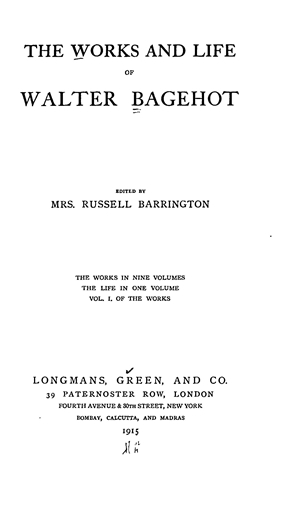
HARTLEY COLERIDGE. 1 (1852.) - Walter Bagehot, The Works and Life of Walter Bagehot, vol. 1 (Memoir, Early Essays) [1915]Edition used:The Works and Life of Walter Bagehot, ed. Mrs. Russell Barrington. The Works in Nine Volumes. The Life in One Volume. (London: Longmans, Green, and Co., 1915). Vol. 1.
Part of: The Works and Life of Walter Bagehot, 10 vols.About Liberty Fund:Liberty Fund, Inc. is a private, educational foundation established to encourage the study of the ideal of a society of free and responsible individuals. Copyright information:The text is in the public domain. Fair use statement:This material is put online to further the educational goals of Liberty Fund, Inc. Unless otherwise stated in the Copyright Information section above, this material may be used freely for educational and academic purposes. It may not be used in any way for profit.
HARTLEY COLERIDGE.1
Hartley Coleridge was not like the Duke of Wellington.2 Children are urged by the example of the great statesman and warrior just departed—not indeed to neglect “their book” as he did—but to be industrious and thrifty; to “always perform business,” to “beware of procrastination,” to “never fail to do their best”: good ideas, as may be ascertained by referring to the masterly despatches on the Mahratta transactions—“great events,” as the preacher continues, “which exemplify the efficacy of diligence even in regions where the very advent of our religion is as yet but partially made known”. But
And it were almost a worse wilderness if there were not some, to relieve the dull monotony of activity, who are children through life; who act on wayward impulse, and whose will has never come; who toil not and who spin not; who always have “fair Eden’s simpleness”: and of such was Hartley Coleridge. “Don’t you remember,” writes Gray to Horace Walpole, “when Lord B. and Sir H. C. and Viscount D., who are now great statesmen, were little dirty boys playing at cricket? For my part I do not feel one bit older or wiser now than I did then.” For as some apply their minds to what is next them, and labour ever, and attain to governing the Tower, and entering the Trinity House,—to commanding armies, and applauding pilots,—so there are also some who are ever anxious to-day about what ought only to be considered to-morrow; who never get on; whom the earth neglects, and whom tradesmen little esteem; who are where they were; who cause grief, and are loved; that are at once a by-word and a blessing; who do not live in life, and it seems will not die in death: and of such was Hartley Coleridge. A curious instance of poetic anticipation was in this instance vouchsafed to Wordsworth. When Hartley was six years old, he addressed to him these verses, perhaps the best ever written on a real and visible child:—
And so it was. As often happens, being very little of a boy in actual childhood, Hartley preserved into manhood and age all of boyhood which he had ever possessed—its beaming imagination and its wayward will. He had none of the natural roughness of that age. He never played—partly from weakness, for he was very small, but more from awkwardness. His uncle Southey used to say he had two left hands, and might have added that they were both useless. He could no more have achieved football, or mastered cricket, or kept in with the hounds, than he could have followed Charles’s Wain or played pitch and toss with Jupiter’s satellites. Nor was he very excellent at schoolwork. He showed, indeed, no deficiency. The Coleridge family have inherited from the old scholar of Ottery St. Mary a certain classical facility which could not desert the son of Samuel Taylor. But his real strength was in his own mind. All children have a world of their own, as distinct from that of the grown people who gravitate around them as the dreams of girlhood from our prosaic life; as the ideas of the kitten that plays with the falling leaves, from those of her carnivorous mother that catches mice and is sedulous in her domestic duties. But generally about this interior existence children are dumb. You have warlike ideas, but you cannot say to a sinewy relative, “My dear aunt, I wonder when the big bush in the garden will begin to walk about; I’m sure it’s a crusader, and I was cutting it all the day with my steel sword. But what do you think, aunt, for I’m puzzled about its legs, because you see, aunt, it has only one stalk; and besides, aunt, the leaves.” You cannot remark this in secular life; but you hack at the infelicitous bush till you do not altogether reject the idea that your small garden is Palestine, and yourself the most adventurous of knights. Hartley had this, of course, like any other dreamy child, but in his case it was accompanied with the faculty of speech, and an extraordinary facility in continuous story-telling. In the very earliest childhood he had conceived a complete outline of a country like England, whereof he was king himself, and in which there were many wars, and rumours of wars, and foreign relations and statesmen, and rebels and soldiers. “My people, Derwent,” he used to begin, “are giving me much pain; they want to go to war.” This faculty, as was natural, showed itself before he went to school, but he carried on the habit of fanciful narration even into that bleak and ungenial region. “It was not,” says his brother, “by a series of tales, but by one continuous tale, regularly evolved, and possessing a real unity, that he enchained the attention of his auditors, night after night, as we lay in bed, for a space of years, and not unfrequently for hours together.” . . . “There was certainly,” he adds, “a great variety of persons sharply characterised, who appeared on the stage in combination and not in succession.” Connected, in Hartley, with this premature development of the imagination, there was a singular deficiency in what may be called the sense of reality. It is alleged that he hardly knew that Ejuxrea, which is the name of his kingdom, was not as solid a terra firma as Keswick or Ambleside. The deficiency showed itself on other topics. His father used to tell a story of his metaphysical questioning. When he was about five years old, he was asked, doubtless by the paternal metaphysician, some question as to why he was called Hartley. “Which Hartley?” replied the boy. “Why, is there more than one Hartley?” “Yes, there is a deal of Hartleys; there is Picture Hartley (Hazlitt had painted a picture of him), and Shadow Hartley, and there’s Echo Hartley, and there’s Catchmefast Hartley,” seizing his own arm very eagerly, and as if reflecting on the “summject and ommject,” which is to say, being in hopeless confusion. We do not hear whether he was puzzled and perplexed by such difficulties in later life; and the essays which we are reviewing, though they contain much keen remark on the detail of human character, are destitute of the Germanic profundities; they do not discuss how existence is possible, nor enumerate the pure particulars of the soul itself. But considering the idle dreaminess of his youth and manhood, we doubt if Hartley ever got over his preliminary doubts—ever properly grasped the idea of fact and reality. This is not nonsense. If you attend acutely, you may observe that in few things do people differ more than in their perfect and imperfect realisation of this earth. To the Duke of Wellington a coat was a coat; “there was no mistake”; no reason to disbelieve it; and he carried to his grave a perfect and indubitable persuasion that he really did (what was his best exploit), without fluctuation, shave on the morning of the battle of Waterloo. You could not have made him doubt it. But to many people who will never be Field-Marshals, there is on such points, not rational doubt, but instinctive questioning. “Who the devil,” said Lord Byron, “could make such a world? No one, I believe.” “Cast your thoughts,” says a very different writer,1 “back on the time when our ancient buildings were first reared. Consider the churches all around us; how many generations have passed since stone was put upon stone, till the whole edifice was finished! The first movers and instruments of its erection, the minds that planned it, and the limbs that wrought at it, the pious hands that contributed to it, and the holy lips that consecrated it, have long, long ago been taken away, yet we benefit by their good deed. Does it not seem strange that men should be able, not merely by acting on others, not by a continued influence carried on through many minds in succession, but by a single direct act, to come into contact with us, and, as if with their own hand, to benefit us who live centuries later?” Or again, speaking of the lower animals: “Can anything be more marvellous or startling, than that we should have a race of beings about us, whom we do but see, and as little know their state, or can describe their interests or their destiny, as we can tell of the inhabitants of the sun and moon? It is indeed a very overpowering thought, that we hold intercourse with creatures who are as much strangers to us, as mysterious as if they were the fabulous, unearthly beings, more powerful than man, and yet his slaves, which Eastern superstitions have invented. . . . Cast your thoughts abroad on the whole number of them, large and small, in vast forests, or in the water, or in the air, and then say whether the presence of such countless multitudes, so various in their natures, so strange and wild in their shapes, is not” as incredible as anything can be. We go into a street, and see it thronged with men, and we say, Is it true, are there these men? We look on a creeping river, till we say, Is there this river? We enter the law courts: we watch the patient Chancellor: we hear the droning wigs:—surely this is not real,—this is a dream,—nobody would do that,—it is a delusion. We are really, as the sceptics insinuate, but “sensations and impressions,” in groups or alone, that float up and down; or, as the poet teaches, phantoms and images, whose idle stir but mocks the calm reality of the “pictures on the wall”. All this will be called dreamy; but it is exactly because it is dreamy that we notice it. Hartley Coleridge was a dreamer: he began with Ejuxrea, and throughout his years, he but slumbered and slept. Life was to him a floating haze, a disputable mirage: you must not treat him like a believer in stocks and stones—you might as well say he was a man of business. Hartley’s school education is not worth recounting; but beside and along with it there was another education, on every side of him, singularly calculated to bring out the peculiar aptitudes of an imaginative mind, yet exactly, on that very account, very little likely to bring it down to fact and reality, to mix it with miry clay, or define its dreams by a daily reference to the common and necessary earth. He was bred up in the house of Mr. Southey, where, more than anywhere else in all England, it was held that literature and poetry are the aim and object of every true man, and that grocery and other affairs lie beneath at a wholly immeasurable distance, to be attended to by the inferior animals. In Hartley’s case the seed fell on fitting soil. In youth, and even in childhood, he was a not unintelligent listener to the unspeakable talks of the Lake poets. “It was so,” writes his brother, “rather than by a regular course of study, that he was educated; by desultory reading, by the living voice of Coleridge, Southey, and Wordsworth, Lloyd, Wilson, and De Quincey; and again, by homely familiarity with townsfolk and countryfolk of every degree; lastly, by daily recurring hours of solitude—by lonely wanderings with the murmur of the Brathay in his ear.” Thus he lived till the time came that he should go to Oxford, and naturally enough, it seems, he went up with much hope and strong excitement; for, quiet and calm as seem those ancient dormitories, to him, as to many, the going among them seemed the first entrance into the real world—the end of torpidity—the beginning of life. He had often stood by the white Rydal Water, and thought it was coming, and now it was come in fact. At first his Oxford life was prosperous enough. An old gentleman,1 who believes that he too was once an undergraduate, well remembers how Hartley’s eloquence was admired at wine parties and breakfast parties. “Leaning his head on one shoulder, turning up his dark bright eyes, and swinging backwards and forwards in his chair, he would hold forth by the hour, for no one wished to interrupt him, on whatever subject might have been started—either of literature, politics, or religion—with an originality of thought, a force of illustration,” which the narrator doubts “if any man then living, except his father, could have surpassed.” The singular gift of continuous conversation—for singular it is, if in any degree agreeable—seems to have come to him by nature, and it was through life the one quality which he relied on for attraction in society. Its being agreeable is to be accounted for mainly by its singularity; if one knew any respectable number of declaimers—if any proportion of one’s acquaintance should receive the gift of the English language, and “improve each shining hour” with liquid eloquence, how we should regret their present dumb and torpid condition! If we are to be dull—which our readers will admit to be an appointment of providence—surely we will be dull in silence. Do not sermons exist, and are they not a warning to mankind? In fact, the habit of common and continuous speech is a symptom of mental deficiency. It proceeds from not knowing what is going on in other people’s minds. S. T. Coleridge, it is well known, talked to everybody, and to everybody alike; like a Christian divine, he did not regard persons. “That is a fine opera, Mr. Coleridge,” said a young lady, some fifty years back. “Yes, ma’am; and I remember Kant somewhere makes a very similar remark, for, as we know, the idea of philosophical infinity—” Now, this sort of talk will answer with two sorts of people—with comfortable, stolid, solid people, who don’t understand it at all—who don’t feel that they ought to understand it—who feel that they ought not—that they are to sell treacle and appreciate figs—but that there is this transcendental superlunary sphere, which is known to others—which is now revealed in the spiritual speaker, the unmitigated oracle, the evidently celestial sound. That the dreamy orator himself has no more notion what is passing in their minds than they have what is running through his, is of no consequence at all. If he did know it, he would be silent; he would be jarred to feel how utterly he was misunderstood; it would break the flow of his everlasting words. Much better that he should run on in a never-pausing stream, and that the wondering rustics should admire for ever. The basis of the entertainment is that neither should comprehend the other.—But in a degree yet higher is the society of an omniscient orator agreeable to a second sort of people,—generally young men, and particularly—as in Hartley’s case—clever undergraduates. All young men like what is theatrical, and by a fine dispensation all clever young men like notions. They want to hear about opinions, to know about opinions. The ever-flowing rhetorician gratifies both propensions. He is a notional spectacle. Like the sophist of old, he is something and says something. The vagabond speculator in all ages will take hold on those who wish to reason, and want premises—who wish to argue, and want theses—who desire demonstrations, and have but presumptions. And so it was acceptable enough that Hartley should make the low tones of his musical voice glide sweetly and spontaneously through the cloisters of Merton, debating the old questions, the “fate, free-will, foreknowledge,”—the points that Ockham and Scotus propounded in these same enclosures—the common riddles, the everlasting enigmas of mankind. It attracts the scorn of middle-aged men (who depart πρὸς τὰ ἱερά, and fancy they are wise), but it is a pleasant thing, that impact of hot thought upon hot thought, of young thought upon young thought, of new thought upon new thought. It comes to the fortunate once, but to no one a second time thereafter for ever. Nor was Hartley undistinguished in the regular studies of the University. A regular, exact, accurate scholar he never was; but even in his early youth he perhaps knew much more and understood much more of ancient literature than seven score of schoolmasters and classmen. He had, probably, in his mind a picture of the ancient world, or of some of it, while the dry literati only know the combinations and permutations of the Greek alphabet. There is a pleasant picture of him at this epoch, recorded by an eye-witness. “My attention,” he narrates, “was at first aroused by seeing from a window a figure flitting about amongst the trees and shrubs of the garden with quick and agitated motion. This was Hartley, who, in the ardour of preparing for his college examination, did not even take his meals with the family, but snatched a hasty morsel in his own apartment, and only sought the free air when the fading daylight prevented him from seeing his books. Having found who he was that so mysteriously flitted about the garden, I was determined to lose no time in making his acquaintance, and through the instrumentality of Mrs. Coleridge I paid Hartley a visit in what he called his den. This was a room afterwards converted by Mr. Southey”—as what chink was not?—“into a supplementary library, but then appropriated as a study to Hartley, and presenting a most picturesque and student-like disorder of scattered pamphlets and folios.” This is not a picture of the business-like reading man—one wonders what fraction of his time he did read—but it was probably the happiest period of his life. There was no coarse prosaic action there. Much musing, little studying,—fair scholarship, an atmosphere of the classics, curious fancies, much perusing of pamphlets, light thoughts on heavy folios—these make the meditative poet, but not the technical and patient-headed scholar; yet, after all, he was happy, and obtained a second class. A more suitable exercise, as it would have seemed at first sight, was supplied by that curious portion of Oxford routine, the Annual Prize Poem. This, he himself tells us, was, in his academic years, the real and single object of his ambition. His reason is, for an autobiographical reason, decidedly simple. “A great poet,” he says, “I should not have imagined myself, for I knew well enough that the verses were no great things.” But he entertained at that period of life—he was twenty-one—a favourable opinion of young ladies; and he seems to have ascertained, possibly from actual trial, that verses were not in themselves a very emphatic attraction. Singular as it may sound, the ladies selected were not only insensible to what is, after all, a metaphysical line, the distinction between good poetry and bad, but were almost indifferent to poetry itself. Yet the experiment was not quite conclusive. Verses might fail in common life, and yet succeed in the Sheldonian theatre. It is plain that they would be read out; it occurred to him, as he naïvely relates, that if he should appear “as a prizeman,” “as an intelligible reciter of poetry,” he would be an object of “some curiosity to the fair promenaders in Christchurch Meadow”; that the young ladies “with whom he was on bowing and speaking terms might have felt a satisfaction in being known to know me, which they had never experienced before”. “I should,” he adds, “have deemed myself a prodigious lion, and it was a character I was weak enough to covet more than that of poet, scholar, or philosopher.” In fact, he did not get the prize. The worthy East Indian who imagined that, in leaving a bequest for a prize to poetry, he should be as sure of possessing poetry for his money as of eggs, if he had chosen eggs, or butter, if he had chosen butter, did not estimate rightly the nature of poetry, or the nature of the human mind. The mechanical parts of rhythm and metre are all that a writer can be certain of producing, or that a purchaser can be sure of obtaining; and these an industrious person will find in any collection of the Newdegate poems, together with a fine assortment of similes and sentiments, respectively invented and enjoined by Shem and Japhet for and to the use of after generations. And there is a peculiar reason why a great poet (besides his being, as a man of genius, rather more likely than another, to find a difficulty in the preliminary technicalities of art) should not obtain an academical prize, to be given for excellent verses to people of about twenty-one. It is a bad season. “The imagination,” said a great poet of the very age, “of a boy is healthy, and the mature imagination of a man is healthy, but there is a space of life between, in which the soul is in a ferment, the character undecided, the way of life uncertain, the ambition thick-sighted.”1 And particularly in a real poet, where the disturbing influences of passion and fancy are most likely to be in excess, will this unhealthy tinge be most likely to be excessive and conspicuous. Nothing in the style of “Endymion” would have a chance of a prize; there are no complete conceptions, no continuance of adequate words. What is worse, there are no defined thoughts, or aged illustrations. The characteristic of the whole is beauty and novelty, but it is beauty which is not formed, and novelty which is strange and wavering. Some of these defects are observable in the copy of verses on the “Horses of Lysippus,” which Hartley Coleridge contributed to the list of unsuccessful attempts. It does not contain so much originality as we might have expected; on such a topic we anticipated more nonsense; a little, we are glad to say, there is, and also that there is an utter want of those even raps which are the music of prize poems,—which were the right rhythm for Pope’s elaborate sense, but are quite unfit for dreamy classics or contemplative enthusiasm. If Hartley, like Pope, had been the son of a shopkeeper, he would not have received the paternal encouragement, but rather a reprimand,—“Boy, boy, these be bad rhymes”; and so, too, believed a grizzled and cold examiner. A much worse failure was at hand. He had been elected to a Fellowship, in what was at that time the only open foundation in Oxford, Oriel College: an event which shows more exact scholarship in Hartley, or more toleration in the academical authorities for the grammatical delinquencies of a superior man, than we should have been inclined, a priori, to attribute to either of them. But it soon became clear that Hartley was not exactly suited to that place. Decorum is the essence, pomposity the advantage, of tutors. These Hartley had not. Beside the serious defects which we shall mention immediately, he was essentially an absent and musing, and therefore at times a highly indecorous man; and though not defective in certain kinds of vanity, there was no tinge in his manner of scholastic dignity. A schoolmaster should have an atmosphere of awe, and walk wonderingly, as if he was amazed at being himself. But an excessive sense of the ludicrous disabled Hartley altogether from the acquisition of this valuable habit; perhaps he never really attempted to obtain it. He accordingly never became popular as a tutor, nor was he ever described as “exercising an influence over young persons”. Moreover, however excellently suited Hartley’s eloquence might be to the society of undergraduates, it was out of place at the Fellows’ table. This is said to be a dull place. The excitement of early thought has passed away; the excitements of active manhood are unknown. A certain torpidity seems natural there. We find too that, probably for something to say, he was in those years rather fond of exaggerated denunciation of the powers that be. This is not the habit most grateful to the Heads of Houses. “Sir,” said a great authority, “do you deny that Lord Derby ought to be Prime Minister? you might as well say, that I ought not to be Warden of So and So.” These habits rendered poor Hartley no favourite with the leading people of his college, and no great prospective shrewdness was required to predict that he would fare but ill, if any sufficient occasion should be found for removing from the place a person so excitable and so little likely to be of use in inculcating “safe” opinions among the surrounding youth. Unhappily, the visible morals of Hartley offered an easy occasion. It is not quite easy to gather from the narrative of his brother the exact nature or full extent of his moral delinquencies; but enough is shown to warrant, according to the rules, the unfavourable judgment of the collegiate authorities. He describes, probably truly, the commencement of his errors—“I verily believe that I should have gone crazy, silly, mad with vanity, had I obtained the prize for my ‘Horses of Lysippus’. It was the only occasion in my life wherein I was keenly disappointed, for it was the only one upon which I felt any confident hope. I had made myself very sure of it; and the intelligence that not I but Macdonald was the lucky man, absolutely stupefied me; yet I contrived for a time to lose all sense of my misfortunes in exultation for Burton’s success. . . . I sang, I danced, I whistled, I ran from room to room, announcing the great tidings, and trying to persuade myself that I cared nothing at all for my own case. But it would not do. It was bare sands with me the next day. It was not the mere loss of the prize, but the feeling or phantasy of an adverse destiny. . . . I foresaw that all my aims and hopes would prove frustrate and abortive; and from that time I date my downward declension, my impotence of will, and my melancholy recklessness. It was the first time I sought relief in wine, which, as usual in such cases, produced not so much intoxication as downright madness.” Cast in an uncongenial society, requiring to live in an atmosphere of respect and affection—and surrounded by gravity and distrust—misconstrued and half tempted to maintain the misconstruction; with the waywardness of childhood without the innocency of its impulses; with the passions of manhood without the repressive vigour of a man’s will,—he lived as a woman lives that is lost and forsaken, who sins ever and hates herself for sinning, but who sins, perhaps, more on that very account; because she requires some relief from the keenness of her own reproach; because, in her morbid fancy, the idea is ever before her; because her petty will is unable to cope with the daily craving and the horrid thought—that she may not lose her own identity—that she may not give in to the rigid, the distrustful, and the calm. There is just this excuse for Hartley, whatever it may be worth, that the weakness was hereditary. We do not as yet know, it seems most likely that we shall never know, the precise character of his father. But with all the discrepancy concerning the details, enough for our purpose is certain of the outline. We know that he lived many and long years a prey to weaknesses and vice of this very description; and though it be false and mischievous to speak of hereditary vice, it is most true and wise to observe the mysterious fact of hereditary temptation. Doubtless it is strange that the nobler emotions and the inferior impulse, their peculiar direction or their proportionate strength, the power of a fixed idea—that the inner energy of the very will, which seems to issue from the inmost core of our complex nature, and to typify, if anything does, the pure essence of the immortal soul—that these and such as these should be transmitted by material descent, as though they were an accident of the body, the turn of an eye-brow or the feebleness of a joint,—if this were not obvious, it would be as amazing, perhaps more amazing, than any fact which we know; it looks not only like predestinated, but even heritable election. But, explicable or inexplicable—to be wondered at or not wondered at—the fact is clear; tendencies and temptations are transmitted even to the fourth generation both for good and for evil, both in those who serve God and in those who serve Him not. Indeed, the weakness before us seems essentially connected—perhaps we may say on a final examination essentially identical—with the dreaminess of mind, the inapprehensiveness of reality which we remarked upon before. Wordsworth used to say, that “at a particular stage of his mental progress he used to be frequently so wrapt into an unreal transcendental world of ideas, that the external world seemed no longer to exist in relation to him, and he had to convince himself of its existence by clasping a tree or something that happened to be near him”. But suppose a mind which did not feel acutely the sense of reality which others feel, in hard contact with the tangible universe; which was blind to the distinction between the palpable and the impalpable, or rather lived in the latter in preference to, and nearly to the exclusion of, the former. What is to fix such a mind, what is to strengthen it, to give it a fulcrum? To exert itself, the will, like the arm, requires to have an obvious and a definite resistance, to know where it is, why it is, whence it comes, and whither it goes. “We are such stuff as dreams are made of,” says Prospero. So, too, the difficulty of Shakespeare’s greatest dreamer, Hamlet, is that he cannot quite believe that his duty is to be done where it lies, and immediately. Partly from the natural effect of a vision of a spirit which is not, but more from native constitution and instinctive bent, he is for ever speculating on the reality of existence, the truth of the world. “How,” discusses Kant, “is Nature in general possible?” and so asked Hamlet too. With this feeling on his mind, persuasion is useless and argument in vain. Examples gross as earth exhort him, but they produce no effect; but he thinks and thinks the more.
Hartley himself well observes that on such a character the likelihood of action is inversely as the force of the motive and the time for deliberation. The stronger the reason, the more certain the scepticism. Can anything be so certain? Does not the excess of the evidence alleged make it clear that there is something behind, something on the other side? Search then diligently lest anything be overlooked. Reflection “puzzles the will,” Necessity “benumbs like a torpedo”: and so
Why should we say any more? We do but “chant snatches of old tunes”. But in estimating men like the Coleridges—the son even more than the father—we must take into account this peculiar difficulty—this dreamy unbelief—this daily scepticism—this haunting unreality—and imagine that some may not be quite responsible either for what they do, or for what they do not—because they are bewildered, and deluded, and perplexed, and want the faculty as much to comprehend their difficulty as to subdue it. The Oxford life of Hartley is all his life. The failure of his prospects there, in his brother’s words, “deprived him of the residue of his years”. The biography afterwards goes to and fro—one attempt after another failing, some beginning in much hope, but even the sooner for that reason issuing in utter despair. His literary powers came early to full perfection. For some time after his expulsion from Oriel he was resident in London, and the poems written there are equal, perhaps are superior, to any which he afterwards produced. This sonnet may serve as a specimen:—
He soon, however, went down to the Lakes, and there, except during one or two short intervals, he lived and died. This exception was a residence at Leeds, during which he brought out, besides a volume containing his best poems, the book which stands at the head of our article—the Lives of Northern Worthies. We selected the book, we confess, with the view mainly of bringing a remarkable character before the notice of our readers—but in itself the work is an excellent one, and of a rare kind. Books are for various purposes—tracts to teach, almanacs to sell, poetry to make pastry, but this is the rarest sort of book, a book to read. As Dr. Johnson said, “Sir, a good book is one you can hold in your hand, and take to the fire”. Now there are extremely few books which can, with any propriety, be so treated. When a great author, as Grote or Gibbon, has devoted a whole life of horrid industry to the composition of a large history, one feels one ought not to touch it with a mere hand—it is not respectful. The idea of slavery hovers over the Decline and Fall. Fancy a stiffly dressed gentleman, in a stiff chair, slowly writing that stiff compilation in a stiff hand: it is enough to stiffen you for life. Or is poetry readable? Of course it is rememberable; when you have it in the mind, it clings; if by heart, it haunts. Imagery comes from it; songs which Iull the ear, heroines that waste the time. But this Biographia is actually read; a man is glad to take it up, and slow to lay it down; it is a book which is truly valuable, for it is truly pleasing; and which a man who has once had it in his library would miss from his shelves, not only in the common way, by a physical vacuum, but by a mental deprivation. This strange quality it owes to a peculiarity of style. Many people give many theories of literary composition, and Dr. Blair, whom we will read, is sometimes said to have exhausted the subject; but, unless he has proved the contrary, we believe that the knack in style is to write like a human being. Some think they must be wise, some elaborate, some concise; Tacitus wrote like a pair of stays; some startle as Thomas Carlyle, or a comet, inscribing with his tail. But legibility is given to those who neglect these notions, and are willing to be themselves, to write their own thoughts in their own words, in the simplest words, in the words wherein they were thought; and such, and so great, was in this book the magnanimity of Hartley. As has been said, from his youth onwards, Hartley’s outward life was a simple blank. Much writing, and much musing, some intercourse with Wordsworth, some talking to undergraduate readers or Lake ladies, great loneliness, and much intercourse with the farmers of Cumberland—these pleasures, simple enough, most of them, were his life. The extreme pleasure of the peasantry in his conversation, is particularly remarked. “Aye, but Mr. Coleridge talks fine,” observed one. “I would go through fire and water for Mr. C.,” interjected another. His father, with real wisdom, had provided (in part, at least) for his necessary wants in the following manner:— “This is a codicil to my last will and testament. “S. T. Coleridge. “Most desirous to secure, as far as in me lies, for my dear son Hartley, the tranquillity essential to any continued and successful exertion of his literary talents, and which, from the like characters of our minds in this respect, I know to be especially requisite for his happiness, and persuaded that he will recognise in this provision that anxious affection by which it is dictated, I affix this codicil to my last will and testament. . . . And I hereby request them (the said trustees) to hold the sum accruing to Hartley Coleridge from the equal division of my total bequest between him, his brother Derwent, and his sister Sara, after his mother’s decease, to dispose of the interests or proceeds of the same portion to or for the use of my dear son Hartley Coleridge, at such time or times, in such manner, or under such conditions, as they, the trustees above named, know to be my wish, and shall deem conducive to the attainment of my object in adding the codicil, namely, the anxious wish to ensure for my son the continued means of a home, in which I comprise board, lodging, and raiment. Providing that nothing in this codicil shall be so interpreted as to interfere with my son H. C.’s freedom of choice respecting his place of residence, or with his power of disposing of his portion by will after his decease according as his own judgments and affections may decide.” An excellent provision, which would not, however, by the English law, have disabled the “said Hartley” from depriving himself of “the continued means of a home” by alienating the principal of the bequest; since the jurisprudence of this country has no legal definition of “prodigality,” and does not consider any person incompetent to manage his pecuniary affairs unless he be quite and certainly insane. Yet there undoubtedly are persons, and poor Hartley was one of them, who though in general perfectly sane, and even with superior powers of thought or fancy, are as completely unable as the most helpless lunatic to manage any pecuniary transactions, and to whom it would be a great gain to have perpetual guardians and compulsory trustees. But such people are rare, and few principles are so English as the maxim de minimis non curat lex. He lived in this way for thirty years, or nearly so, but there is nothing to tell of all that time. He died 6th January, 1849, and was buried in Grasmere churchyard—the quietest place in England, “by the yews,” as Arnold says, “that Wordsworth planted, the Rotha with its big silent pools passing by”. It was a shining January day when Hartley was borne to the grave. “Keep the ground for us,” said Mr. Wordsworth to the sexton; “we are old, and it cannot be long.” We have described Hartley’s life at length for a peculiar reason. It is necessary to comprehend his character, to appreciate his works; and there is no way of delineating character but by a selection of characteristic sayings and actions. All poets, as is commonly observed, are delineated in their poems, but in very different modes. Each minute event in the melancholy life of Shelley is frequently alluded to in his writings. The tender and reverential character of Virgil is everywhere conspicuous in his pages. It is clear that Chaucer was shrewd. We seem to have talked with Shakespeare, though we have forgotten the facts of his life; but it is not by minute allusion, or a tacit influence, or a genial and delightful sympathy, that a writer like Hartley Coleridge leaves the impress of himself, but in a more direct manner, which it will take a few words to describe. Poetry begins in Impersonality. Homer is a voice—a fine voice, a fine eye, and a brain that drew with light; and this is all we know. The natural subjects of the first art are the scenes and events in which the first men naturally take an interest. They don’t care—who does?—for a kind old man; but they want to hear of the exploits of their ancestors—of the heroes of their childhood—of them that their fathers saw—of the founders of their own land—of wars, and rumours of wars—of great victories boldly won—of heavy defeats firmly borne—of desperate disasters unsparingly retrieved. So in all countries—Siegfried, or Charlemagne, or Arthur—they are but attempts at an Achilles: the subject is the same—the κλέα ἀνδρω̑ν and the death that comes to all. But then the mist of battles passes away, and the sound of the daily conflict no longer hurtles in the air, and a generation arises skilled with the skill of peace, and refined with the refinement of civilisation, yet still remembering the old world, still appreciating the old life, still wondering at the old men, and ready to receive, at the hand of the poet, a new telling of the old tale—a new idealisation of the legendary tradition. This is the age of dramatic art, when men wonder at the big characters of old, as schoolboys at the words of Æschylus, and try to find in their own breasts the roots of those monstrous, but artistically developed impersonations. With civilisation too comes another change: men wish not only to tell what they have seen, but also to express what they are conscious of. Barbarians feel only hunger, and that is not lyrical; but as time runs on, arise gentler emotions and finer moods and more delicate desires which need expression, and require from the artist’s fancy the lightest touches and the most soothing and insinuating words. Lyrical poetry, too, as we know, is of various kinds. Some, as the war song, approach to the epic, depict events and stimulate to triumph; others are love songs to pour out wisdom, others sober to describe champagne; some passive and still, and expressive of the higher melancholy, as Gray’s “Elegy in a Country Churchyard”. But with whatever differences of species and class, the essence of lyrical poetry remains in all identical; it is designed to express, and when successful does express, some one mood, some single sentiment, some isolated longing in human nature. It deals not with man as a whole, but with man piecemeal, with man in a scenic aspect, with man in a peculiar light. Hence lyrical poets must not be judged literally from their lyrics: they are discourses; they require to be reduced into the scale of ordinary life, to be stripped of the enraptured element, to be clogged with gravitating prose. Again, moreover, and in course of time, the advance of ages and the progress of civilisation appear to produce a new species of poetry which is distinct from the lyrical, though it grows out of it, and contrasted with the epic, though in a single respect it exactly resembles it. This kind may be called the self-delineative, for in it the poet deals not with a particular desire, sentiment, or inclination in his own mind, not with a special phase of his own character, not with his love of war, his love of ladies, his melancholy, but with his mind viewed as a whole, with the entire essence of his own character. The first requisite of this poetry is truth. It is, in Plato’s phrase, the soul “itself by itself” aspiring to view and take account of the particular notes and marks that distinguish it from all other souls. The sense of reality is necessary to excellence; the poet being himself, speaks like one who has authority; he knows and must not deceive. This species of poetry, of course, adjoins on the lyrical, out of which it historically arises. Such a poem as the “Elegy” is, as it were, on the borders of the two; for while it expresses but a single emotion, meditative, melancholy, you seem to feel that this sentiment is not only then and for a moment the uppermost, but (as with Gray it was) the habitual mood, the pervading emotion of his whole life. Moreover, in one especial peculiarity, this sort of poetry is analogous to the narrative or epic. No two things certainly can, in a general aspect, be more distantly removed one from another, the one dealing in external objects and stirring events, the other with the stillness and repose of the poet’s mind; but still in a single characteristic the two coincide. They describe character, as the painters say, in mass. The defect of the drama is, that it can delineate only motion. If a thoughtful person will compare the character of Achilles, as we find it in Homer, with the more surpassing creations of dramatic invention, say with Lear or Othello, he will perhaps feel that character in repose, character on the lonely beach, character in marble, character in itself, is more clearly and perfectly seen in the epic narrative, than in the conversational drama. It of course requires immense skill to make mere talk exhibit a man as he is ἑτάρων ἄτερ. Now this quality of epic poetry the self-delineative precisely shares with it. It describes a character—the poet’s—alone by itself. And therefore, when the great master in both kinds did not hesitate to turn aside from his “high argument” to say—
pedants may prose as they please about the “impropriety” of “interspersing” species of composition which are by nature remote; but Milton felt more profoundly that in its treatment of character the egotistical poetry is allied to the epic; that he was putting together elements which would harmoniously combine; that he was but exerting the same faculties in either case—being guided thereto by a sure instinct, the desire of genius to handle and combine every one of the subjects on which it is genius. Now it is in this self-delineative species of poetry that, in our judgment, Hartley Coleridge has attained to nearly, if not quite, the highest excellence; it pervades his writings everywhere. But a few sonnets may be quoted to exemplify it:—
Indeed, the whole series of sonnets with which the earliest and best work of Hartley began is (with a casual episode on others) mainly and essentially a series on himself. Perhaps there is something in the structure of the sonnet rather adapted to this species of composition. It is too short for narrative, too artificial for the intense passions, too complex for the simple, too elaborate for the domestic; but in an impatient world where there is not a premium on self-describing, who so would speak of himself must be wise and brief, artful and composed—and in these respects he will be aided by the concise dignity of the tranquil sonnet. It is remarkable that in this, too, Hartley Coleridge resembled his father. Turn over the early poems of S. T. Coleridge, the minor poems (we exclude “The Ancient Mariner” and “Christabel,” which are his epics), but the small shreds which Bristol worshipped and Cottle paid for, and you will be disheartened by utter dulness. Taken on a decent average, and perhaps excluding a verse here and there, it really seems to us that they are inferior to the daily works of the undeserving and multiplied poets. If any reader will peruse any six of the several works intituled Poems by a Young Gentleman, we believe he will find the refined anonymity less insipid than the small productions of Samuel Taylor. There will be less puff and less ostentation. The reputation of the latter was caused not by their merit but by their time. Fifty years ago people believed in metre, and it is plain that Coleridge (Southey may be added, for that matter) believed in it also; the people in Bristol said that these two were wonderful men, because they had written wonderfully small verses; and such is human vanity, that both for a time accepted the creed. In Coleridge, who had large speculative sense, the hallucination was not permanent—there are many traces that he rated his Juvenilia at their value; but poor Southey, who lived with domestic women, actually died in the delusion that his early works were perfect, except that he tried to “amend” the energy out of “Joan of Arc,” which was the only good thing in it. His wife did not doubt that he had produced stupendous works. Why, then, should he? But experience has now shown that a certain metrical facility, and a pleasure in the metrical expression of certain sentiments, are in youth extremely common. Many years ago, Mr. Moore is reported to have remarked to Sir Walter Scott, that hardly a magazine was then published which did not contain verses that would have made a sensation when they were young men. “Confound it, Tom,” was the reply, “what luck it was we were born before all these fellows.” And though neither Moore nor Scott are to be confounded with the nameless and industrious versifiers of the present day, yet it must be allowed that they owed to their time and their position—to the small quantity of rhyme in the market of the moment, and the extravagant appreciation of their early productions—much of that popular encouragement which induced them to labour upon more excellent compositions and to train themselves to write what they will be remembered by. But, dismissing these considerations, and returning to the minor poems of S. T. Coleridge, although we fearlessly assert that it is impossible for any sane man to set any value on—say the “Religious Musings”—an absurd attempt to versify an abstract theory, or the essay on the Pixies, who had more fun in them than the reader of it could suspect—it still is indisputable that scattered here and there through these poems, there are lines about himself (lines, as he said in later life, “in which the subjective object views itself subjectivo-objectively”) which rank high in that form of art. Of this kind are the “Tombless Epitaph,” for example, or the lines,—
and so on. In fact, it would appear that the tendency to, and the faculty for, self-delineation are very closely connected with the dreaminess of disposition and impotence of character which we spoke of just now. Persons very subject to these can grasp no external object, comprehend no external being; they can do no external thing, and therefore they are left to themselves. Their own character is the only one which they can view as a whole, or depict as a reality; of every other they may have glimpses, and acute glimpses, like the vivid truthfulness of particular dreams; but no settled appreciation, no connected development, no regular sequence whereby they may be exhibited on paper or conceived in the imagination. If other qualities are supposed to be identical, those will be most egotistical who only know themselves; the people who talk most of themselves will be those who talk best. In the execution of minor verses, we think we could show that Hartley should have the praise of surpassing his father; but nevertheless it would be absurd, on a general view, to compare the two men. Samuel Taylor was so much bigger; what there was in his son was equally good, perhaps, but then there was not much of it; outwardly and inwardly he was essentially little. In poetry, for example, the father has produced two longish poems, which have worked themselves right down to the extreme depths of the popular memory, and stay there very firmly, in part from their strangeness, but in part from their power. Of Hartley, nothing of this kind is to be found—he could not write connectedly; he wanted steadiness of purpose, or efficiency of will, to write so voluntarily; and his genius did not, involuntarily, and out of its unseen workings, present him with continuous creations; on the contrary, his mind teemed with little fancies, and a new one came before the first had attained any enormous magnitude. As his brother observed, he wanted “back thought”. “On what plan, Mr. Coleridge, are you arranging your books?” inquired a lady. “Plan, madam? I have no plan: at first I had a principle; but then I had another, and now I do not know.” The same contrast between the “shaping mind” of the father, and the gentle and minute genius of the son, is said to have been very plain in their conversation. That of Samuel Taylor was continuous, diffused, comprehensive.
“Great talker, certainly,” said Hazlitt, “if you will let him start from no data, and come to no conclusion.” The talk of Hartley, on the contrary, though continuous in time, was detached in meaning; stating hints and observations on particular subjects; glancing lightly from side to side, but throwing no intense light on any, and exhausting none. It flowed gently over small doubts and pleasant difficulties, rippling for a minute sometimes into bombast, but lightly recovering and falling quietly in “melody back”. By way, it is likely, of compensation to Hartley for this great deficiency in what his father imagined to be his own forte—the power of conceiving a whole—Hartley possessed, in a considerable degree, a species of sensibility to which the former was nearly a stranger. “The mind of S. T. Coleridge,” says one who had every means of knowing and observing, “was not in the least under the influence of external objects.” Except in the writings produced during daily and confidential intimacy with Wordsworth (an exception that may be obviously accounted for), no trace can perhaps be found of any new image or metaphor from natural scenery. There is some story too of his going for the first time to York, and by the Minster, and never looking up at it. But Hartley’s poems exhibit a great sensibility to a certain aspect of exterior nature, and great fanciful power of presenting that aspect in the most charming and attractive forms. It is likely that the London boyhood of the elder Coleridge was,—added to a strong abstractedness which was born with him,—a powerful cause in bringing about the curious mental fact, that a great poet, so susceptible to every other species of refining and delightful feeling, should have been utterly destitute of any perception of beauty in landscape or nature. We must not forget that S. T. Coleridge was a bluecoat boy,—what do any of them know about fields? And similarly, we require in Hartley’s case, before we can quite estimate his appreciation of nature, to consider his position, his circumstances, and especially his time. Now it came to pass in those days that William Wordsworth went up into the hills. It has been attempted in recent years to establish that the object of his life was to teach Anglicanism. A whole life of him has been written by an official gentleman, with the apparent view of establishing that the great poet was a believer in rood-lofts, an idolater of piscinæ. But this is not capable of rational demonstration. Wordsworth, like Coleridge, began life as a heretic, and as the shrewd Pope unfallaciously said, “once a heretic, always a heretic”. Sound men are sound from the first; safe men are safe from the beginning, and Wordsworth began wrong. His real reason for going to live in the mountains was certainly in part sacred, but it was not in the least Tractarian:—
His whole soul was absorbed in the one idea, the one feeling, the one thought, of the sacredness of hills.
The defect of this religion is, that it is too abstract for the practical, and too bare for the musing. The worship of sensuous beauty—the southern religion—is of all sentiments the one most deficient in his writings. His poetry hardly even gives the charm, the entire charm, of the scenery in which he lived. The lighter parts are little noticed: the rugged parts protrude. The bare waste, the folding hill, the rough lake, Helvellyn with a brooding mist, Ulswater in a grey day: these are his subjects. He took a personal interest in the corners of the universe. There is a print of Rembrandt said to represent a piece of the Campagna, a mere waste, with a stump and a man, and under is written “Tacet et loquitur”; and thousands will pass the old print-shop where it hangs, and yet have a taste for paintings, and colours, and oils: but some fanciful students, some lonely stragglers, some long-haired enthusiasts, by chance will come, one by one, and look, and look, and be hardly able to take their eyes from the fascination, so massive is the shade, so still the conception, so firm the execution. Thus is it with Wordsworth and his poetry. Tacet et loquitur. Fashion apart, the million won’t read it. Why should they?—they could not understand it. Don’t put them out,—let them buy, and sell, and die;—but idle students, and enthusiastic wanderers, and solitary thinkers, will read, and read, and read, while their lives and their occupations hold. In truth, his works are the Scriptures of the intellectual life; for that same searching, and finding, and penetrating power which the real Scripture exercises on those engaged, as are the mass of men, in practical occupations and domestic ties, do his works exercise on the meditative, the solitary, and the young.
And he had more than others—
And therefore he has had a whole host of sacred imitators. Mr. Keble, for example, has translated him for women. He has himself told us that he owed to Wordsworth the tendency ad sanctiora which is the mark of his own writings; and in fact he has but adapted the tone and habit of reverence which his master applied to common objects and the course of the seasons, to sacred objects and the course of the ecclesiastical year,—diffusing a mist of sentiment and devotion altogether delicious to a gentle and timid devotee. Hartley Coleridge is another translator. He has applied to the sensuous beauties and seductive parts of external nature the same cultus which Wordsworth applied to the bare and the abstract. It is—
It is, as it were, female beauty in wood and water; it is Rydal Water on a shining day; it is the gloss of the world with the knowledge that it is gloss: the sense of beauty, as in some women, with the feeling that yet it is hardly theirs:—
And he knew it himself: he has sketched the essence of his works:—
We had more to say of Hartley: we were to show that his “Prometheus” was defective; that its style had no Greek severity, no defined outline; that he was a critic as well as a poet, though in a small detached way, and what is odd enough, that he could criticise in rhyme. We were to make plain how his heart was in the right place, how his love affairs were hopeless, how he was misled by his friends; but our time is done, and our space is full, and these topics must “go without day” of returning. We may end as we began. There are some that are bold and strong and incessant and energetic and hard, and to these is the world’s glory; and some are timid and meek and impotent and cowardly and rejected and obscure. “One man esteemeth one day above another, another esteemeth every day alike.” And so of Hartley, whom few regarded; he had a resource, the stillness of thought, the gentleness of musing, the peace of nature.
He is gone from among them. [1 ] Hartley Coleridge’s Lives of the Northern Worthies. A new edition. 3 vols. Moxon. [2 ] This essay was published immediately after the death of the Duke of Wellington. [3 ] Hartley Coleridge: “Sonnet to Childhood”. [1 ] John Henry Newman. [1 ] Rev. Alexander Dyce. [1 ] Keats in the Preface to “Endymion”. [1 ] Shakespeare: “Hamlet”. [2 ]Ibid. [1 ]Paradise Lost. [1 ] “Lines on a Friend” (November, 1794). [1 ] Coleridge: “Fears in Solitude” (1798). [1 ] Wordsworth’s “Excursion”. [2 ] “Tintern Abbey.” [1 ] “Feast of Brougham Castle.” [2 ] “Tintern Abbey.” [3 ] Hartley Coleridge: “Sonnet”. [1 ] Hartley Coleridge: “Sonnet”. [1 ] “Feast of Brougham Castle.” [2 ] Hartley Coleridge: “Sonnet”. |

Titles (by Subject)