EconlibThe LibraryOther Sites |
Front Page Titles (by Subject) PART 4: Ideas - Planning for Freedom: Let the Market System Work. A Collection of Essays and Addresses
Return to Title Page for Planning for Freedom: Let the Market System Work. A Collection of Essays and AddressesThe Online Library of LibertyA project of Liberty Fund, Inc.Search this Title:Also in the Library:
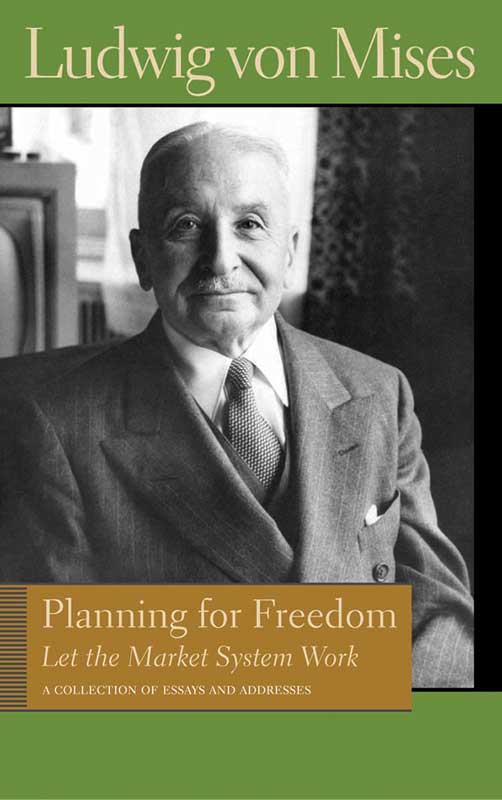
PART 4: Ideas - Ludwig von Mises, Planning for Freedom: Let the Market System Work. A Collection of Essays and Addresses [1952]Edition used:Planning for Freedom: Let the Market System Work. A Collection of Essays and Addresses, edited with a Foreword by Bettina Bien Greaves (Indianapolis: Liberty Fund, 2008).
About Liberty Fund:Liberty Fund, Inc. is a private, educational foundation established to encourage the study of the ideal of a society of free and responsible individuals. Copyright information:Published online with the kind permission of the copyright holders, the Foundation for Economic Education. In particular for the following articles: “Laissez Faire or Dictatorship”, “The Gold Problem”, Benjamin M. Anderson Challenges the Philosophy of the Pseudo-Progressives”, “Lord Keynes and Say’s Law”, “Stones into Bread”, “Economic Teaching at the Universities”, and “Trends can Change”. Fair use statement:This material is put online to further the educational goals of Liberty Fund, Inc. Unless otherwise stated in the Copyright Information section above, this material may be used freely for educational and academic purposes. It may not be used in any way for profit.
PART 4IdeasProfit is a product of the mind, of success in anticipating the future state of the market. It is a spiritual and intellectual phenomenon. . . . Men must choose between capitalism and socialism. They cannot avoid this dilemma by resorting to a capitalist system without entrepreneurial profit. . . . If control of production is shifted from the hands of entrepreneurs, daily anew elected by a plebiscite of the consumers, into the hands of the supreme commander . . . neither representative government nor any civil liberties can survive. —“Profit and Loss” 13My Contributions to Economic Theory*Your kind invitation to address you on my contributions to economic theory honors me greatly. It is not an easy task. Looking back on my work, I realize very well that the share of one individual in the total achievements of an epoch is small indeed, that he is indebted not only to his predecessors and teachers, but to all his colleagues and no less to his pupils. I know how much I owe to the economists of this country in particular since the time, many years ago, when my teacher Böhm-Bawerk directed my attention to the study of the works of John Bates Clark, Frank A. Fetter, and other American scholars. And during all my activities, the recognition of my contributions by American economists encouraged me. Nor can I forget that, when still a student at the University of Vienna, I published a monograph on the development of Austrian labor legislation, an American economist was the first who showed an interest in it. And later the first scholar who appreciated my The Theory of Money and Credit was again an American, my distinguished friend Professor B. M. Anderson, in his book The Value of Money, published in 1917. Monetary TheoryWhen I first began to study the problems of monetary theory there was a general belief, namely, that modern marginal utility economics was unable to deal with monetary theory in a satisfactory way. Helfferich was the most outspoken of those who held this opinion. In his Treatise on Money he tried to establish that marginal utility analysis must necessarily fail in its attempts to build up a theory of money. This challenge provided me with the incentive to use the methods of modern marginal utility economics in the study of monetary problems. To do so I had to use an approach radically different from that of the mathematical economists who try to establish the formulas of the so-called equation of exchange. In dealing with such an equation the mathematical economist assumes that something (obviously, one of the elements of the equation) changes and that corresponding changes in the other values must needs follow. These elements of the equation are not items in the individual’s economy, but categories of the whole economic system, and consequently the changes do not occur with individuals but with the whole system, with the Volkswirtschaft as a whole. This way of reasoning is eminently unrealistic and differs radically from the procedure of modern catallactics.* It is a return to the manner of reasoning which doomed to frustration the work of the older Classical economists. Monetary problems are economic problems and have to be dealt with in the same way as all other economic problems. The monetary economist does not have to deal with universal entities like volume of trade meaning total volume of trade, or quantity of money meaning all the money current in the whole economic system. Still less can he make use of the nebulous metaphor “velocity of circulation.” He has to realize that the demand for money arises from the preferences of individuals within a market society. Because everybody wishes to have a certain amount of cash, sometimes more, sometimes less, there is a demand for money. Money is never simply in the economic system, money is never simply circulating. All the money available is always in the cash-holdings of somebody. Every piece of money may one day—sometimes oftener, sometimes more seldom—pass from one man’s cash-holding to another man’s. But at every moment it is owned by somebody and is a part of somebody’s cash-holdings. The decisions of individuals regarding the magnitude of their cash-holding, their choices between the dis-utility of holding more cash and its advantages constitute the ultimate factor in the formation of purchasing power. Changes in the supply of money or in the demand for it can never occur for all individuals at the same time and to the same extent and they, therefore, never affect their judgments of value and their behavior as buyers and sellers to the same degree. Therefore the changes in prices do not affect all commodities at the same time and to the same degree. The over-simple formula both of the primitive quantity theory and of contemporary mathematical economists according to which prices, that is, all prices, rise or fall in the proportion of the increase or decrease in the quantity of money is absolutely wrong. We have to study monetary changes as changes which occur first for some groups of individuals only and slowly spread over the whole economic system to the extent that the additional demand of those first benefited reaches other classes of individuals. Only in this way can we obtain a realistic insight into the social consequences of monetary changes. The Business CycleTaking this as my point of departure I developed a general theory of money and credit and tried to explain the business cycle as a credit phenomenon. This theory, which is today styled the monetary theory or sometimes the Austrian theory of the trade cycle, led me to make some criticism of the continental, especially of the German, credit system. Readers were at first more interested in my pessimistic judgment of the trends of German Central Bank policy and my pessimistic forecast which nobody believed in 1912 until a few years later things turned out much worse even than I had predicted. It is the fate of the economist that people are more interested in his conclusions than in his explanations, and that they are reluctant to abandon a policy whose undesired but inevitable results the economist has demonstrated. Economic Calculation under SocialismFrom my studies of monetary and credit problems, which later stimulated me to found the Austrian Institute of Business Cycle Research, I came to the study of the problem of economic calculation within a socialist community. In my essay on economic calculation in a socialist world, first published in 1920, and then later in my book on Socialism, I have proved that an economic system, where there is no private ownership of the means of production, could not find any criterion for determining the values of the factors of production and therefore could not calculate. Since I first touched upon this point, many dozens of books and many hundreds of articles published in different languages have dealt with the problem; this discussion has left my thesis unshattered. The treatment of the problems connected with planning, of course total planning and socialization, has been given a completely new direction by the indication of this as the crucial point. Is There a Middle Way?From the comparative study of the essential features both of capitalist and socialist economy I came to the related problem of whether, apart from these two thinkable systems of social cooperation, i.e., private ownership of the means of production and public ownership, there is a third possible social system. Such a third solution, a system which its proponents claim is neither socialism nor capitalism, but midway between both and avoiding the disadvantages of each and retaining the advantages of both, has again and again been suggested. I tried to examine the economic implications of these systems of government interference and to demonstrate that they can never attain the ends which people wish to attain with them. I later broadened the field of my research in order to include the problems of the stato corporativo, the panacea recommended by fascism. Human ActionOccupation with all these problems made necessary an approach to the question of the values and ends of human activity. The reproach of sociologists to the effect that economists deal only with an unrealistic “economic man” could no longer be endured. I tried to demonstrate that the economists were never so narrow as their critics believed. The prices whose formation we try to explain are a function of demand and it does not make any difference what kind of motives actuated those involved in the transaction. It is immaterial whether the motives of those who wish to buy are egoistic or altruistic, moral or immoral, patriotic or unpatriotic. Economics deals with the scarce means of attaining ends, irrespective of the quality of the ends. The ends are beyond the scope of rationality, but every action of a conscious being directed towards a specific goal is necessarily rational. It is futile to convict economics because it is rational and deals with rationality. Of course, science is always rational. In my treatise on economic theory,* published in the German language in Geneva a few months ago—an English edition will be published in the near future† —I have dealt not only with the economic problems of a market society but in the same way with the economics of all other thinkable types of social cooperation. I think that this is indispensable in a world where the fundamental principles of economic organization are at stake. I try in my treatise to consider the concept of static equilibrium as instrumental only and to make use of this purely hypothetical abstraction only as a means of approaching an understanding of a continuously changing world. It is one of the shortcomings of many economic theorists that they have forgotten the purpose underlying the introduction of this hypothetical concept into our analysis. We cannot do without this notion of a world where there is no change; but we have to use it only for the purpose of studying changes and their consequences, that means for the study of risk and uncertainty and therefore of profits and losses. Capital Accumulation and Interest TheoryThe logical result of this view is the disintegration of some mythical interpretations of economic entities. The almost metaphysical use of terms like capital has to be avoided. There is in nature nothing which corresponds to the terms capital or income. There are different commodities, producers goods, and consumers goods; it is the intention of the individuals or of acting groups which makes some goods capital and others income. The maintenance of capital or the accumulation of new capital is always the outcome of a conscious action on the part of men who restrict their consumption to limits which do not reduce the value of the stock available. It is a mistake to assume the immutability of the capital stock as something natural which does not require special attention. In this respect I have to disagree with the opinions of one of the most eminent economists of our time, with Professor Knight of Chicago. The weak point of the Böhm-Bawerkian theory [of capital and interest] is not, as Professor Knight believes, the useless introduction of the concept of the period of production. It is a more serious deficiency that Böhm-Bawerk reverts to the errors of the so-called productivity theory. Like Professor Fetter of Princeton I aimed at an elimination of this weakness by basing the explanation of interest on time preference only. The touchstone of any economic theory is according to an oft-quoted dictum, the treatment of the trade cycle. I have tried not only to restate the monetary theory of the cycle but also to demonstrate that all other explanations cannot avoid using the main argument of this theory. Of course, the boom means an upward movement of prices or at least a compensation for tendencies working toward falling prices, and to explain this requires the postulation of a rising supply of credit or money. Economist’s Role: Challenge Economic ErrorIn every part of my treatise I try to take into account the relative weight to be assigned to different institutional factors and to different economic data. I further discuss the objections raised not only by different theoretical schools but also by those who deny the possibility of any economic science. The economist has to answer those who believe that there is no such thing as a universally valid science of society, who doubt the unity of human logic and experience and try to replace what they call international and, therefore, as they say, vain knowledge with doctrines which represent the peculiar point of view of their own class, nation or race. We do not have the right to let these pretensions pass unchallenged even if we have to assert truths which to us seem obvious. But it is sometimes necessary to repeat truths because we find repeated instances of the old errors. 14Economic Teaching at the Universities*A few years ago a House of Representatives subcommittee on publicity and propaganda in the executive departments, under the chairman-ship of Representative Forest A. Harness, investigated federal propaganda operations. On one occasion the committee had as a witness a government-employed doctor. When asked if his public speeches throughout the country presented both sides of the discussion touching compulsory national health insurance, this witness answered: “I don’t know what you mean by both sides.” This naive answer throws light on the state of mind of people who proudly call themselves progressive intellectuals. They simply do not imagine that any argument could be advanced against the various schemes they are suggesting. As they see it, everybody, without asking questions, must support every project aiming at more and more government control of all aspects of the citizen’s life and conduct. They never try to refute the objections raised against their doctrines. They prefer, as Mrs. Eleanor Roosevelt recently did in her column, to call dishonest those with whom they do not agree. Many eminent citizens hold educational institutions responsible for the spread of this bigotry. They sharply criticize the way in which economics, philosophy, sociology, history and political science are taught at most American universities and colleges. They blame many teachers for indoctrinating their students with the ideas of all-round planning, socialism and communism. Some of those attacked try to deny any responsibility. Others, realizing the futility of this mode of defense, cry out about “persecution” and infringement of “academic freedom.” Yet what is unsatisfactory with present-day academic conditions— not only in this country but in most foreign nations—is not the fact that many teachers are blindly committed to Veblenian, Marxian and Keynesian fallacies, and try to convince their students that no tenable objections can be raised against what they call progressive policies. The mischief is rather to be seen in the fact that the statements of these teachers are not challenged by any criticism in the academic sphere. The pseudo-liberals monopolize the teaching jobs at many universities. Only men who agree with them are appointed as teachers and instructors of the social sciences, and only textbooks supporting their ideas are used. The essential question is not how to get rid of inept teachers and poor textbooks. It is how to give the students an opportunity to hear something about the ideas of economists rejecting the tenets of the interventionists, inflationists, Socialists and Communists. Methods of the “Progressive” TeachersLet us illustrate the matter by reviewing a recently published book. A professor of Harvard University edits, with the support of an advisory committee whose members are all like himself professors of economics at Harvard University, a series of textbooks, the “Economics Handbook Series.” In this series there was published a volume on socialism. Its author, Paul M. Sweezy, opens his preface with the declaration that the book “is written from the standpoint of a Socialist.” The editor of the series, Professor Seymour E. Harris, in his introduction goes a step further in stating that the author’s “viewpoint is nearer that of the group which determines Soviet policy than the one which now [1949] holds the reins of government in Britain.” This is a mild description of the fact that the volume is from the first to the last page an uncritical eulogy of the Soviet system. Now it is perfectly legitimate for Dr. Sweezy to write such a book and for professors to edit and to publish it. The United States is a free country—one of the few free countries left in the world—and the Constitution and its amendments grant to everybody the right to think as he likes and to have published in print what he thinks. Sweezy has in fact unwittingly rendered a great service to the discerning public. For his volume clearly shows to every judicious reader conversant with economics that the most eminent advocates of socialism are at their wits’ end, do not know how to advance any plausible argument in favor of their creed, and are utterly at a loss to refute any of the serious objections raised against it. But the book is not designed for perspicacious scholars well acquainted with the social sciences. It is, as the editors’ introduction emphasizes, written for the general reader in order to popularize ideas and especially also for use in the classroom. Laymen and students who know nothing or very little about the problems involved will draw all their knowledge about socialism from it. They lack the familiarity with theories and facts which would enable them to form an independent opinion about the various doctrines expounded by the author. They will accept all his theses and descriptions as incontestable science and wisdom. How could they be so presumptuous as to doubt the reliability of a book, written, as the introduction says, by an “authority” in the field and sponsored by a committee of professors of venerable Harvard! The shortcoming of the committee is not to be seen in the fact that they have published such a book, but in the fact that their series contains only this book about socialism. If they had, together with Dr. Sweezy’s book, published another volume critically analyzing communist ideas and the achievements of socialist governments, nobody could blame them for disseminating communism. Decency should have impelled them to give the critics of socialism and communism the same chance to represent their views to the students of universities and colleges as they gave to Dr. Sweezy. On every page of Dr. Sweezy’s book one finds really amazing statements. Thus, in dealing with the problem of civil rights under a socialist regime, he simply equates the Soviet Constitution with the American Constitution. Both, he declares, are generally accepted as the statement of the ideals which ought to guide the actions of both the state and the individual citizen. That these ideals are not always lived up to—either in the Soviet Union or in the United States—is certainly both true and important; but it does not mean that they do not exist or that they can be ignored, still less that they can be transformed into their opposite. Leaving aside most of what could be advanced to explode this reasoning, there is need to realize that the American Constitution is not merely an ideal but the valid law of the country. To prevent it from becoming a dead letter there is an independent judiciary culminating in the Supreme Court. Without such a guardian of law and legality any law can be and is ignored and transformed into its opposite. Did Dr. Sweezy never become aware of this nuance? Does he really believe that the millions languishing in Soviet prisons and labor camps can invoke habeas corpus? To say it again: Dr. Sweezy has the right—precisely because the American Bill of Rights is not merely an ideal, but an enforced law—to transform every fact into its opposite. But professors who hand out such praise of the Soviets to their students without informing them about the opinions of the opponents of socialism must not raise the cry of witchhunt if they are criticized. Professor Harris in his introduction contends that “those who fear undue influence of the present volume may be cheered by a forthcoming companion volume on capitalism in this series written by one as devoted to private enterprise as Dr. Sweezy is to socialism.” This volume, written by Professor David McCord Wright of the University of Virginia, has been published in the meantime. It deals incidentally also with socialism and tries to explode some minor socialist fallacies, such as the doctrine of the withering away of the State, a doctrine which even the most fanatical Soviet authors relegate today to an insignificant position. But it certainly cannot be considered a satisfactory substitute, or a substitute at all, for a thoroughly critical examination of the whole body of socialist and communist ideas and the lamentable failure of all socialist experiments. Some of the teachers try to refute the accusations of ideological intolerance leveled against their universities and to demonstrate their own impartiality by occasionally inviting a dissenting outsider to address their students. This is mere eyewash. One hour of sound economics against several years of indoctrination of errors! The present writer may quote from a letter in which he declined such an invitation: What makes it impossible for me to present the operation of the market economy in a short lecture—whether fifty minutes or twice fifty minutes—is the fact that people, influenced by the prevailing ideas on economic problems, are full of erroneous opinions concerning this system. They are convinced that economic depressions, mass unemployment, monopoly, aggressive imperialism and wars, and the poverty of the greater part of mankind, are caused by the unhampered operation of the capitalist mode of production. If a lecturer does not dispel each of these dogmas, the impression left with the audience is unsatisfactory. Now, exploding any one of them requires much more time than that assigned to me in your program. The hearers will think: “He did not refer at all to this” or “He made only a few casual remarks about that.” My lecture would rather confirm them in their misunderstanding of the system. . . . If it were possible to expound the operation of capitalism in one or two short addresses, it would be a waste of time to keep the students of economics for several years at the universities. It would be difficult to explain why voluminous textbooks have to be written about this subject. . . . It is these reasons that impel me reluctantly to decline your kind invitation. The Alleged Impartiality of the UniversitiesThe pseudo-progressive teachers excuse their policy of barring all those whom they smear as old-fashioned reactionaries from access to teaching positions by calling these men biased. The reference to bias is quite out of place if the accuser is not in a position to demonstrate clearly in what the deficiency of the smeared author’s doctrine consists. The only thing that matters is whether a doctrine is sound or unsound. This is to be established by facts and deductive reasoning. If no tenable arguments can be advanced to invalidate a theory, it does not in the least detract from its correctness if the author is called names. If, on the other hand, the falsity of a doctrine has already been clearly demonstrated by an irrefutable chain of reasoning, there is no need to call its author biased. A biographer may try to explain the manifestly exploded errors of the person whose life he is writing about by tracing them back to bias. But such psychological interpretation is immaterial in discussions concerning the correctness or falsity of a theory. Professors who call those with whom they disagree biased merely confess their inability to discover any fault in their adversaries’ theories. Many “progressive” professors have for some time served in one of the various alphabetical government agencies. The tasks entrusted to them in the bureaus were as a rule ancillary only. They compiled statistics and wrote memoranda which their superiors, either politicians or former managers of corporations, filed without reading. The professors did not instill a scientific spirit into the bureaus. But the bureaus gave them the mentality of authoritarianism. They distrust the populace and consider the State (with a capital S) as the God-sent guardian of the wretched underlings. Only the Government is impartial and unbiased. Whoever opposes any expansion of governmental powers is by this token unmasked as an enemy of the commonweal. It is manifest that he “hates” the State. Now if an economist is opposed to the socialization of industries, he does not “hate” the State. He simply declares that the commonwealth is better served by private ownership of the means of production than by public ownership. Nobody could pretend that experience with nationalized enterprises contradicts this opinion. Another typically bureaucratic prejudice which the professors acquired in Washington is to call the attitudes of those opposing government controls and the establishment of new offices “negativism.” In the light of this terminology all that has been achieved by the American individual enterprise system is only “negative”; the bureaus alone are “positive.” There is, furthermore, the spurious antithesis “plan or no plan.” Only totalitarian government planning that reduces the citizens to mere pawns in the designs of the bureaucracy is called planning. The plans of the individual citizens are simply “no plans.” What semantics! How Modern History Is TaughtThe progressive intellectual looks upon capitalism as the most ghastly of all evils. Mankind, he contends, lived rather happily in the good old days. But then, as a British historian said, the Industrial Revolution “fell like a war or a plague” on the peoples. The “bourgeoisie” converted plenty into scarcity. A few tycoons enjoy all luxuries. But, as Marx himself observed, the worker “sinks deeper and deeper” because the bourgeoisie “is incompetent to assure an existence to its slave within his slavery.” Still worse are the intellectual and moral effects of the capitalist mode of production. There is but one means, the progressive believes, to free mankind from the misery and degradation produced by laissez-faire and rugged individualism, viz., to adopt central planning, the system with which the Russians are successfully experimenting. It is true that the results obtained by the Soviets are not yet fully satisfactory. But these shortcomings were caused only by the peculiar conditions of Russia. The West will avoid the pitfalls of the Russians and will realize the Welfare State without the merely accidental features that disfigured it in Russia and in Hitler Germany. Such is the philosophy taught at most present-day schools and propagated by novels and plays. It is this doctrine that guides the actions of almost all contemporary governments. The American “progressive” feels ashamed of what he calls the social backwardness of his country. He considers it a duty of the United States to subsidize foreign socialist governments lavishly in order to enable them to go on with their ruinous socialist ventures. In his eyes the real enemy of the American people is Big Business, that is, the enterprises which provide the American common man with the highest standard of living ever reached in history. He hails every step forward on the road toward all-round control of business as progress. He smears all those who hint at the pernicious effects of waste, deficit spending and capital decumulation as reactionaries, economic royalists and Fascists. He never mentions the new or improved products which business almost every year makes accessible to the masses. But he goes into raptures about the rather questionable achievements of the Tennessee Valley Authority, the deficit of which is made good out of taxes collected from Big Business. The most infatuated expositors of this ideology are to be found in the university departments of history, political science, sociology and literature. The professors of these departments enjoy the advantage, in referring to economic issues, that they are talking about a subject with which they are not familiar at all. This is especially flagrant in the case of historians. The way in which the history of the last two hundred years has been treated is really a scandal. Only recently eminent scholars have begun to unmask the crude fallacies of Lujo Brentano, the Webbs, the Hammonds, Tawney, Arnold Toynbee, Elie Halévy, the Beards and other authors. At the last meeting of the Mont Pèlerin Society the occupant of the chair of economic history at the London School of Economics, Professor T. S. Ashton, presented a paper in which he pointed out that the commonly accepted views of the economic developments of the nineteenth century “are not informed by any glimmering of economic sense.” The historians tortured the facts when they concocted the legend that “the dominant form of organization under industrial capitalism, the factory, arose out of the demands, not of ordinary people, but of the rich and the rulers.” The truth is that the characteristic feature of capitalism was and is mass production for the needs of the masses. Whenever the factory with its methods of mass production by means of power-driven machines invaded a new branch of production, it started with cheap goods for the broad masses. The factories turned to the production of more refined and therefore more expensive merchandise only at a later stage, when the unprecedented improvement which they had caused in the masses’ standard of living made it reasonable to apply the methods of mass production to better articles as well. Big business caters to the needs of the many; it depends exclusively upon mass consumption. In his capacity as consumer the common man is the sovereign whose buying or abstention from buying decides the fate of entrepreneurial activities. The “proletarian” is the much-talked-about customer who is always right. The most popular method of deprecating capitalism is to make it responsible for every condition which is considered unsatisfactory. Tuberculosis, and, until a few years ago, syphilis, were called diseases of capitalism. The destitution of scores of millions in countries like India, which did not adopt capitalism, is blamed on capitalism. It is a sad fact that people become debilitated in old age and finally die. But this happens not only to salesmen but also to employers, and it was no less tragic in the pre-capitalistic ages than it is under capitalism. Prostitution, dipsomania and drug addiction are all called capitalist vices. Whenever people discuss the alleged misdeeds of the capitalists, a learned professor or a sophisticated artist refers to the high income of movie stars, boxers and wrestlers. But who contributes more to these incomes, the millionaires or the “proletarians”? It must be admitted that the worst excesses in this propaganda are not committed by professors of economics but by the teachers of the other social sciences, by journalists, writers and sometimes even by ministers. But the source from which all the slogans of this hectic fanaticism spring is the teachings handed down by the “institutionalist” school of economic policies. All these dogmas and fallacies can be ultimately traced back to allegedly economic doctrines. The Proscription of Sound EconomicsThe Marxians, Keynesians, Veblenians and other “progressives” know very well that their doctrines cannot stand any critical analysis. They are fully aware of the fact that one representative of sound economics in their department would nullify all their teachings. This is why they are so anxious to bar every “orthodox” from access to the strongholds of their “un-orthodoxy.” The worst consequence of this proscription of sound economics is the fact that gifted young graduates shun the career of an academic economist. They do not want to be boycotted by universities, book reviewers and publishing firms. They prefer to go into business or the practice of law, where their talents will be fairly appreciated. It is mainly compromisers, who are not eager to find out the shortcomings of the official doctrine, who aspire to the teaching positions. There are few competent men left to take the place of the eminent scholars who die or reach the retirement age. Among the rising generation of instructors are hardly any worthy successors of such economists as Frank A. Fetter and Edwin W. Kemmerer of Princeton, Irving Fisher of Yale and Benjamin M. Anderson of California. There is but one way to remedy this situation. True economists must be given the same opportunity in our faculties which only the advocates of socialism and interventionism enjoy today. This is surely not too much to ask as long as this country has not yet gone totalitarian. 15The Political Chances of Genuine Liberalism*The outlook of many eminent champions of genuine liberalism is rather pessimistic today. As they see it, the vitriolic slogans of the socialists and interventionists call forth a better response from the masses than the cool reasoning of judicious men. The majority of the voters are just dull and mentally inert people who dislike thinking and are easily deceived by the enticing promises of irresponsible pied pipers. Subconscious inferiority complexes and envy push people toward the parties of the left. They rejoice in the policies of confiscating the greater part of the income and wealth of successful businessmen without grasping the fact that these policies harm their own material interests. Disregarding all the objections raised by economists, they firmly believe that they can get many good things for nothing. Even in the United States people, although enjoying the highest standard of living ever attained in history, are prepared to condemn capitalism as a vile economy of scarcity and to indulge in daydreams about an economy of abundance in which everybody will get everything “according to his needs.” The case for freedom and material prosperity is hopeless. The future belongs to the demagogues who know nothing else than to dissipate the capital accumulated by previous generations. Mankind is plunging into a return to the dark ages. Western civilization is doomed. The Ideas of the Masses Come from IntellectualsThe main error of this widespread pessimism is the belief that the destructionist ideas and policies of our age sprang from the proletarians and are a “revolt of the masses.” In fact, the masses, precisely because they are not creative and do not develop philosophies of their own, follow the leaders. The ideologies which produced all the mischiefs and catastrophes of our century are not an achievement of the mob. They are the feat of pseudo-scholars and pseudo-intellectuals. They were propagated from the chairs of universities and from the pulpit, they were disseminated by the press, by novels and plays, and by the movies and the radio. The intellectuals converted the masses to socialism and interventionism. These ideologies owe the power they have today to the fact that all means of communication have been turned over to their supporters and almost all dissenters have been virtually silenced. What is needed to turn the flood is to change the mentality of the intellectuals. Then the masses will follow suit. Furthermore it is not true that the ideas of genuine liberalism are too complicated to appeal to the untutored mind of the average voter. It is not a hopeless task to explain to the wage earners that the only means to raise wage rates for all those eager to find jobs and to earn wages is to increase the per head quota of capital invested. The pessimists under-rate the mental abilities of the “common man” when they assert that he cannot grasp the disastrous consequences of policies resulting in capital decumulation. Why do all “underdeveloped countries” ask for American aid and American capital? Why do they not rather expect aid from socialist Russia? Government Programs Raise PricesThe acme of the policies of all self-styled progressive parties and governments is to raise artificially the prices of vital commodities above the height they would have attained on the markets of unhampered laissez-faire capitalism. Only an infinitesimal fraction of the American people is interested in the preservation of a high price for sugar. The immense majority of the American voters are buyers and consumers, not producers and sellers of sugar. Nonetheless the American government is firmly committed to a policy of high sugar prices by rigorously restricting both the importation of sugar from abroad and domestic production. Similar policies are adopted with regard to the prices of bread, meat, butter, eggs, potatoes, cotton and many other agricultural products. It is a serious blunder to call this procedure indiscriminately a pro-farmers policy. Less than one fifth of the United States’s total population are dependent upon agriculture for a living. Yet the interests of these people with regard to the prices of various agricultural products are not identical. The dairyman is not interested in a high, but in a low price for wheat, fodder, sugar and cotton. The owners of chicken farms are hurt by high prices of any agricultural product but chickens and eggs. It is obvious that the growers of cotton, grapes, oranges, apples, grapefruit and cranberries are prejudiced by a system which raises the prices of staple foods. Most of the items of the so-called pro-farm policy favor only a minority of the total farming population at the expense of the majority not only of the non-farming, but also of the farming population. Things are hardly different in other fields. When the railroadmen or the workers of the building trades, supported by laws and administrative practices which are admittedly loaded against their employers, indulge in feather-bedding and other devices allegedly destined to “create more jobs,” they are unfairly fleecing the immense majority of their fellow citizens. The unions of the printers enhance the prices of books and periodicals and thus affect all people eager to read and to learn. The so-called pro-labor policies bring about a state of affairs under which each group of wage earners is intent upon improving their own conditions at the expense of the consumers, viz., the enormous majority. Nobody knows today whether he wins more from those policies which are favoring the group to which he himself belongs than he loses on account of the policies which favor all the other groups. But it is certain that all are adversely affected by the general drop in the productivity of industrial effort and output which these allegedly beneficial policies inevitably bring about. Until a few years ago the advocates of these unsuitable policies tried to defend them by pointing out that their incidence reduces only the wealth and income of the rich and benefits the masses at the sole expense of useless parasites. There is no need to explode the fallacies of this reasoning. Even if we admit its conclusiveness for the sake of argument, we must realize that, with the exception of a few countries, this “surplus” fund of the rich has already been exhausted. Even Mr. Hugh Gaitskell, Sir Stafford Cripps’s successor as the Führer of Great Britain’s economy, could not help declaring that “there is not enough money to take away from England’s rich to raise standards of living any further.” In the United States the policy of “soaking the rich” has not yet gone so far as that. But if the trend of American politics is not entirely reversed very soon, this richest of all countries will have to face the same situation in a few years. Prospects for a Genuine Liberal RevivalConditions being such, the prospects for a genuinely liberal revival may appear propitious. At least fifty per cent of the voters are women, most of them housewives or prospective housewives. To the common sense of these women a program of low prices will make a strong appeal. They will certainly cast their ballot for candidates who proclaim: Do away peremptorily with all policies and measures destined to enhance prices above the height of the unhampered market! Do away with all this dismal stuff of price supports, parity prices, tariffs and quotas, intergovernmental commodity control agreements and so on! Abstain from increasing the quantity of money in circulation and from credit expansion, from all illusory attempts to lower the rate of interest and from deficit spending! What we want is low prices. In the end these judicious householders will even succeed in convincing their husbands. In the Communist Manifesto Karl Marx and Frederick Engels asserted: “The cheap prices of its commodities are the heavy artillery with which capitalism batters down all Chinese walls.” We may hope that these cheap prices will also batter down the highest of all Chinese walls, viz., those erected by the folly of bad economic policies. To express such hopes is not merely wishful thinking. 16Trends Can Change*One of the cherished dogmas implied in contemporary fashionable doctrines is the belief that tendencies of social evolution as manifested in the recent past will prevail in the future too. Study of the past, it is assumed, discloses the shape of things to come. Any attempt to reverse or even to stop a trend is doomed to failure. Man must submit to the irresistible power of historical destiny. To this dogma is added the Hegelian idea of progressive improvement in human conditions. Every later stage of history, Hegel taught, is of necessity a higher and more perfect state than the preceding one, is progress toward the ultimate goal which God in his infinite goodness set for mankind. Thus any doubt with regard to the excellence of what is bound to come is unwarranted, unscientific and blasphemous. Those fighting “progress” are not only committed to a hopeless venture. They are also morally wicked, reactionary, for they want to prevent the emergence of conditions that will benefit the immense majority. From the point of view of this philosophy its adepts, the self-styled “progressives,” deal with the fundamental issues of economic policies. They do not examine the merits and demerits of suggested measures and reforms. This would, in their eyes, be unscientific. As they see it, the only question that has to be answered is whether such proposed innovations do or do not agree with the spirit of our age and follow the direction which destiny has ordained for the course of human affairs. The drift of the policies of the recent past teaches us what is both inescapable and beneficial. The only legitimate source for the cognition of what is salutary and has to be accomplished today is the knowledge of what was accomplished yesterday. In the last decades there prevailed a trend toward more and more government interference with business. The sphere of the private citizen’s initiative was narrowed down. Laws and administrative decrees restricted the field in which entrepreneurs and capitalists were free to conduct their activities in compliance with the wishes of the consumers as manifested in the structure of the market. From year to year an ever-increasing portion of profits and interest on capital invested was confiscated by taxation of corporation earnings and individual incomes and estates. “Social” control, i.e., government control, of business is step by step substituted for private control. The “progressives” are certain that this trend toward wresting “economic” power from the parasitic “leisure class” and its transfer to “the people” will go on until the “welfare state” will have supplanted the nefarious capitalistic system which history has doomed for ever. Notwithstanding sinister machinations on the part of “the interests,” mankind, led by government economists and other bureaucrats, politicians, and union bosses, marches steadily toward the bliss of an earthly paradise. The prestige of this myth is so enormous that it quells any opposition. It spreads defeatism among those who do not share the opinion that everything which comes later is better than what preceded and are fully aware of the disastrous effects of all-round planning, i.e., totalitarian socialism. They, too, meekly submit to what, the pseudo-scholars tell them, is inevitable. It is this mentality of passively accepting defeat that has made socialism triumph in many European countries and may very soon make it conquer in this country too. The Marxian dogma of the inevitability of socialism was based on the thesis that capitalism necessarily results in progressive impoverishment of the immense majority of people. All the advantages of technological progress benefit exclusively the small minority of exploiters. The masses are condemned to increasing “misery, oppression, slavery, degradation, exploitation.” No action on the part of governments or labor unions can succeed in stopping this evolution. Only socialism, which is bound to come “with the inexorability of a law of nature,” will bring salvation by “the expropriation of the few usurpers by the mass of people.” Facts have belied this prognosis no less than all other Marxian forecasts. In the capitalist countries the common man’s standard of living is today incomparably higher than it was in the days of Marx. It is simply not true that the fruits of technological improvement are enjoyed exclusively by the capitalists while the laborer, as the Communist Manifesto says, “instead of rising with the progress of industry, sinks deeper and deeper.” Not a minority of “rugged individualists,” but the masses, are the main consumers of the products turned out by large-scale production. Only morons can still cling to the fable that capitalism “is incompetent to assure an existence to its slave within his slavery.” Today the doctrine of the irreversibility of prevailing trends has supplanted the Marxian doctrine concerning the inevitability of progressive impoverishment. Now this doctrine is devoid of any logical or experimental verification. Historical trends do not necessarily go on for ever. No practical man is so foolish as to assume that prices will keep rising because the price curves of the past show an upward tendency. On the contrary, the more prices soar, the more alarmed cautious businessmen become about a possible reversal. Almost all prognostications which our government statisticians made on the basis of their study of the figures available—which necessarily always refer to the past—have proved faulty. What is called extrapolation of trend lines is viewed by sound statistical theory with the utmost suspicion. The same refers also to developments in fields which are not open to description by statistical figures. There was, for instance, in the course of ancient Greco-Roman civilization a tendency toward an interregional division of labor. The trade between the various parts of the vast Roman Empire intensified more and more. But then came a turning point. Commerce declined and there finally emerged the medieval manor system, with almost complete autarky of every landowner’s household. Or, to quote another example, there prevailed in the eighteenth century a tendency toward reducing the severity and the horrors of war. In 1770 the Comte de Guibert could write: “Today the whole of Europe is civilized. Wars have become less cruel. Except in combat no blood is shed; prisoners are respected; towns are no longer destroyed; the country is no more ravaged.” Can anybody maintain that this trend has not been changed? But even if it were true that an historical trend must go on forever, and that therefore the coming of socialism is inevitable, it would still not be permissible to infer that socialism will be a better, or even more than that, the most perfect state of society’s economic organization. There is nothing to support such a conclusion other than the arbitrary pseudo-theological surmises of Hegel, Comte and Marx, according to which every later stage of the historical process must necessarily be a better state. It is not true that human conditions must always improve, and that a relapse into very unsatisfactory modes of life, penury and barbarism is impossible. The comparatively high standard of living which the common man enjoys today in the capitalist countries is an achievement of laissez-faire capitalism. Neither theoretical reasoning nor historical experience allows the inference that it could be preserved, still less be improved under socialism. In the last decades in many countries the number of divorces and of suicides has increased from year to year. Yet hardly anybody will have the temerity to contend that this trend means progress toward more satisfactory conditions. The typical graduate of colleges and high schools very soon forgets most of the things he has learned. But there is one piece of indoctrination which makes a lasting impression on his mind, viz., the dogma of the irreversibility of the trend toward all-round planning and regimentation. He does not doubt the thesis that mankind will never return to capitalism, the dismal system of an age gone forever, and that the “wave of the future” carries us toward the promised land of Cockaigne. If he had any doubts, what he reads in newspapers and what he hears from the politicians would dispel them. For even the candidates nominated by the parties of opposition, although critical of the measures of the party in power, protest that they are not “reactionary,” and do not venture to stop the march toward “progress.” Thus the average man is predisposed in favor of socialism. Of course, he does not approve of everything that the Soviets have done. He thinks that the Russians have blundered in many respects, and he excuses these errors as being caused by their unfamiliarity with freedom. He blames the leaders, especially Stalin, for the corruption of the lofty ideal of all-round planning. His sympathies go rather to Tito, the upright rebel, who refuses to surrender to Russia. Not so long ago he displayed the same friendly feelings for Benes, and until only a few months ago for Mao Tse-tung, the “agrarian reformer.” At any rate, a good part of American public opinion believes that this country is in essential matters backward, as it has not yet, like the Russians, wiped out production for profit and unemployment and has not yet attained stability. Practically nobody thinks that he could learn something important about these problems from a serious occupation with economics. The dogmas of the irreversibility of prevailing tendencies and of their unfailingly beneficial effects render such studies supererogatory. If economics confirms these dogmas, it is superfluous; if it is at variance with them, it is illusory and deceptive. Now trends of evolution can change, and hitherto they almost always have changed. But they changed only because they met firm opposition. The prevailing trend toward what Hilaire Belloc called the servile state will certainly not be reversed if nobody has the courage to attack its underlying dogmas. 17Profit and Loss*Entrepreneurs Earn Profits by Anticipating Consumer WantsIn the capitalist system of society’s economic organization the entrepreneurs determine the course of production. In the performance of this function they are unconditionally and totally subject to the sovereignty of the buying public, the consumers. If they fail to produce in the cheapest and best possible way those commodities which the consumers are asking for most urgently, they suffer losses and are finally eliminated from their entrepreneurial position. Other men who know better how to serve the consumers replace them. If all people were to anticipate correctly the future state of the market, the entrepreneurs would neither earn any profits nor suffer any losses. They would have to buy the complementary factors of production at prices which would, already at the instant of the purchase, fully reflect the future prices of the products. No room would be left either for profit or for loss. What makes profit emerge is the fact that the entrepreneur who judges the future prices of the products more correctly than other people do buys some or all of the factors of production at prices which, seen from the point of view of the future state of the market, are too low. Thus the total costs of production—including interest on the capital invested—lag behind the prices which the entrepreneur receives for the product. This difference is entrepreneurial profit. On the other hand, the entrepreneur who misjudges the future prices of the products allows for the factors of production prices which, seen from the point of view of the future state of the market, are too high. His total costs of production exceed the prices at which he can sell the product. This difference is entrepreneurial loss. Thus profit and loss are generated by success or failure in adjusting the course of production activities to the most urgent demand of the consumers. Once this adjustment is achieved, they disappear. The prices of the complementary factors of production reach a height at which total costs of production coincide with the price of the product. Profit and loss are ever-present features only on account of the fact that ceaseless change in the economic data makes again and again new discrepancies, and consequently the need for new adjustments originate. The Entrepreneur Is an Enterprise’s DecisionmakerMany errors concerning the nature of profit and loss were caused by the practice of applying the term profit to the totality of the residual proceeds of an entrepreneur. Interest on the capital employed is not a component part of profit. The dividends of a corporation are not profit. They are interest on the capital invested plus profit or minus loss. The market equivalent of work performed by the entrepreneur in the conduct of the enterprise’s affairs is entrepreneurial quasi-wages but not profit. If the enterprise owns a factor on which it can earn monopoly prices, it makes a monopoly gain. If this enterprise is a corporation, such gains increase the dividend. Yet they are not profit proper. Still more serious are the errors due to the confusion of entrepreneurial activity and technological innovation and improvement. The maladjustment, the removal of which is the essential function of entrepreneurship, may often consist in the fact that new technological methods have not yet been utilized to the full extent to which they should be in order to bring about the best possible satisfaction of consumers’ demand. But this is not necessarily always the case. Changes in the data, especially in consumers’ demand, may require adjustments which have no reference at all to technological innovations and improvements. The entrepreneur who simply increases the production of an article by adding to the existing production facilities a new outfit without any change in the technological method of production is no less an entrepreneur than the man who inaugurates a new way of producing. The business of the entrepreneur is not merely to experiment with new technological methods, but to select from the multitude of technologically feasible methods those which are best fit to supply the public in the cheapest way with the things they are asking for most urgently. Whether a new technological procedure is or is not fit for this purpose is to be provisionally decided by the entrepreneur and will be finally decided by the conduct of the buying public. The question is not whether a new method is to be considered as a more “elegant” solution of a technological problem. It is whether, under the given state of economic data, it is the best possible method of supplying the consumers in the cheapest way. The activities of the entrepreneur consist in making decisions. He determines for what purpose the factors of production should be employed. Any other acts which an entrepreneur may perform are merely accidental to his entrepreneurial function. It is this that laymen often fail to realize. They confuse the entrepreneurial activities with the conduct of the technological and administrative affairs of a plant. In their eyes not the stockholders, the promoters and speculators, but hired employees are the real entrepreneurs. The former are merely idle parasites who pocket the dividends. Now nobody ever contended that one could produce without working. But neither is it possible to produce without capital goods, the previously produced factors of further production. These capital goods are scarce, i.e., they do not suffice for the production of all things which one would like to have produced. Hence the economic problem arises: to employ them in such a way that only those goods should be produced which are fit to satisfy the most urgent demands of the consumers. No good should remain unproduced on account of the fact that the factors required for its production were used—wasted— for the production of another good for which the demand of the public is less intense. To achieve this is, under capitalism, the function of entrepreneurship that determines the allocation of capital to the various branches of production. Under socialism it would be a function of the state, the social apparatus of coercion and oppression. The problem whether a socialist directorate, lacking any method of economic calculation, could fulfill this function is not to be dealt with in this essay. There is a simple rule of thumb to tell entrepreneurs from non-entrepreneurs. The entrepreneurs are those on whom the incidence of losses on the capital employed falls. Amateur-economists may confuse profits with other kinds of intakes. But it is impossible to fail to recognize losses on the capital employed. Government Is Necessary to Preserve and ProtectWhat has been called the democracy of the market manifests itself in the fact that profit-seeking business is unconditionally subject to the supremacy of the buying public. Non-profit organizations are sovereign unto themselves. They are, within the limits drawn by the amount of capital at their disposal, in a position to defy the wishes of the public. A special case is that of the conduct of government affairs, the administration of the social apparatus of coercion and oppression, viz., the police power. The objectives of government, the protection of the inviolability of the individuals’ lives and health and of their efforts to improve the material conditions of their existence, are indispensable. They benefit all and are the necessary prerequisite of social cooperation and civilization. But they cannot be sold and bought in the way merchandise is sold and bought; they have therefore no price on the market. With regard to them there cannot be any economic calculation. The costs expended for their conduct cannot be confronted with a price received for the product. This state of affairs would make the officers entrusted with the administration of governmental activities irresponsible despots if they were not curbed by the budget system. Under this system the administrators are forced to comply with detailed instructions enjoined upon them by the sovereign, be it a self-appointed autocrat or the whole people acting through elected representatives. To the officers limited funds are assigned which they are bound to spend only for those purposes which the sovereign has ordered. Thus the management of public administration becomes bureaucratic, i.e., dependent on definite detailed rules and regulations. Bureaucratic management is the only alternative available where there is no profit and loss management.* On the Market, Consumers Are SovereignThe consumers by their buying and abstention from buying elect the entrepreneurs in a daily repeated plebiscite as it were. They determine who should own and who not, and how much each owner should own. As is the case with all acts of choosing a person—choosing holders of public office, employees, friends or a consort—the decision of the consumers is made on the ground of experience and thus necessarily always refers to the past. There is no experience of the future. The ballot of the market elevates those who in the immediate past have best served the consumers. However, the choice is not unalterable and can daily be corrected. The elected who disappoints the electorate is speedily reduced to the ranks. Each ballot of the consumers adds only a little to the elected man’s sphere of action. To reach the upper levels of entrepreneurship he needs a great number of votes, repeated again and again over a long period of time, a protracted series of successful strokes. He must stand every day a new trial, must submit anew to reelection as it were. It is the same with his heirs. They can retain their eminent position only by receiving again and again confirmation on the part of the public. Their office is revocable. If they retain it, it is not on account of the deserts of their predecessor, but on account of their own ability to employ the capital for the best possible satisfaction of the consumers. The entrepreneurs are neither perfect nor good in any metaphysical sense. They owe their position exclusively to the fact that they are better fit for the performance of the functions incumbent upon them than other people are. They earn profit not because they are clever in performing their tasks, but because they are more clever or less clumsy than other people are. They are not infallible and often blunder. But they are less liable to error and blunder less than other people do. Nobody has the right to take offense at the errors made by the entrepreneurs in the conduct of affairs and to stress the point that people would have been better supplied if the entrepreneurs had been more skillful and prescient. If the grumbler knew better, why did he not himself fill the gap and seize the opportunity to earn profits? It is easy indeed to display foresight after the event. In retrospect all fools become wise. A popular chain of reasoning runs this way: The entrepreneur earns profit not only on account of the fact that other people were less successful than he in anticipating correctly the future state of the market. He himself contributed to the emergence of profit by not producing more of the article concerned; but for intentional restriction of output on his part, the supply of this article would have been so ample that the price would have dropped to a point at which no surplus of proceeds over costs of production expended would have emerged. This reasoning is at the bottom of the spurious doctrines of imperfect and monopolistic competition. It was resorted to a short time ago by the American administration when it blamed the enterprises of the steel industry for the fact that the steel production capacity of the United States was not greater than it really was. Certainly those engaged in the production of steel are not responsible for the fact that other people did not likewise enter this field of production. The reproach on the part of the authorities would have been sensible if they had conferred on the existing steel corporations the monopoly of steel production. But in the absence of such a privilege, the reprimand given to the operating mills is not more justified than it would be to censure the nation’s poets and musicians for the fact that there are not more and better poets and musicians. If somebody is to blame for the fact that the number of people who joined the voluntary civilian defense organization is not larger, then it is not those who have already joined but only those who have not. Capital and Factors of Production Are LimitedThat the production of a commodity p is not larger than it really is, is due to the fact that the complementary factors of production required for an expansion were employed for the production of other commodities. To speak of an insufficiency of the supply of p is empty rhetoric if it does not indicate the various products m which were produced in too large quantities with the effect that their production appears now, i.e., after the event, as a waste of scarce factors of production. We may assume that the entrepreneurs who instead of producing additional quantities of p turned to the production of excessive amounts of m and consequently suffered losses did not intentionally make their mistake. Neither did the producers of p intentionally restrict the production of p. Every entrepreneur’s capital is limited; he employs it for those projects which, he expects, will, by filling the most urgent demand of the public, yield the highest profit. An entrepreneur at whose disposal are 100 units of capital employs, for instance, 50 units for the production of p and 50 units for the production of q. If both lines are profitable, it is odd to blame him for not having employed more, e.g., 75 units, for the production of p. He could increase the production of p only by curtailing correspondingly the production of q. But with regard to q the same fault could be found by the grumblers. If one blames the entrepreneur for not having produced more p, one must blame him also for not having produced more q. This means: one blames the entrepreneur for the facts that there is a scarcity of the factors of production and that the earth is not a land of Cockaigne. Perhaps the grumbler will object on the ground that he considers p a vital commodity, much more important than q, and that therefore the production of p should be expanded and that of q restricted. If this is really the meaning of his criticism, he is at variance with the valuations of the consumers. He throws off his mask and shows his dictatorial aspirations. Production should not be directed by the wishes of the public but by his own despotic discretion. But if our entrepreneur’s production of q involves a loss, it is obvious that his fault was poor foresight and not intentional. Entrance into the ranks of the entrepreneurs in a market society, not sabotaged by the interference of government or other agencies resorting to violence, is open to everybody. Those who know how to take advantage of any business opportunity cropping up will always find the capital required. For the market is always full of capitalists anxious to find the most promising employment for their funds and in search of the ingenious newcomers, in partnership with whom they could execute the most remunerative projects. People often failed to realize this inherent feature of capitalism because they did not grasp the meaning and the effects of capital scarcity. The task of the entrepreneur is to select from the multitude of technologically feasible projects those which will satisfy the most urgent of the not yet satisfied needs of the public. Those projects for the execution of which the capital supply does not suffice must not be carried out. The market is always crammed with visionaries who want to float such impracticable and unworkable schemes. It is these dreamers who always complain about the blindness of the capitalists who are too stupid to look after their own interests. Of course, the investors often err in the choice of their investments. But these faults consist precisely in the fact that they preferred an unsuitable project to another that would have satisfied more urgent needs of the buying public. Entrepreneurs Follow Consumers When Deciding What to ProducePeople often err very lamentably in estimating the work of the creative genius. Only a minority of men are appreciative enough to attach the right value to the achievement of poets, artists and thinkers. It may happen that the indifference of his contemporaries makes it impossible for a genius to accomplish what he would have accomplished if his fellow-men had displayed better judgment. The way in which the poet laureate and the philosopher à la mode are selected is certainly questionable. But it is impermissible to question the free market’s choice of the entrepreneurs. The consumers’ preference for definite articles may be open to condemnation from the point of view of a philosopher’s judgment. But judgments of value are necessarily always personal and subjective. The consumer chooses what, as he thinks, satisfies him best. Nobody is called upon to determine what could make another man happier or less unhappy. The popularity of motor cars, television sets and nylon stockings may be criticized from a “higher” point of view. But these are the things that people are asking for. They cast their ballots for those entrepreneurs who offer them this merchandise of the best quality at the cheapest price. In choosing between various political parties and programs for the commonwealth’s social and economic organization most people are uninformed and groping in the dark. The average voter lacks the insight to distinguish between policies suitable to attain the ends he is aiming at and those unsuitable. He is at a loss to examine the long chains of aprioristic reasoning which constitute the philosophy of a comprehensive social program. He may at best form some opinion about the short-run effects of the policies concerned. He is helpless in dealing with the long-run effects. The socialists and communists in principle often assert the infallibility of majority decisions. However, they belie their own words in criticizing parliamentary majorities rejecting their creed, and in denying to the people, under the one-party system, the opportunity to choose between different parties. But in buying a commodity or abstaining from its purchase there is nothing else involved than the consumer’s longing for the best possible satisfaction of his instantaneous wishes. The consumer does not—like the voter in political voting—choose between different means whose effects appear only later. He chooses between things which immediately provide satisfaction. His decision is final. An entrepreneur earns profit by serving the consumers, the people, as they are and not as they should be according to the fancies of some grumbler or potential dictator. Entrepreneurs Earn Profits by Removing MaladjustmentsProfits are never normal. They appear only where there is a maladjustment, a divergence between actual production and production as it should be in order to utilize the available material and mental resources for the best possible satisfaction of the wishes of the public. They are the prize of those who remove this maladjustment; they disappear as soon as the maladjustment is entirely removed. In the imaginary construction of an evenly rotating economy there are no profits. There the sum of the prices of the complementary factors of production, due allowance being made for time preference, coincides with the price of the product. The greater the preceding maladjustments, the greater the profit earned by their removal. Maladjustments may sometimes be called excessive. But it is inappropriate to apply the epithet “excessive” to profits. People arrive at the idea of excessive profits by confronting the profit earned with the capital employed in the enterprise and measuring the profit as a percentage of the capital. This method is suggested by the customary procedure applied in partnerships and corporations for the assignment of quotas of the total profit to the individual partners and shareholders. These men have contributed to a different extent to the realization of the project and share in the profits and losses according to the extent of their contribution. But it is not the capital employed that creates profits and losses. Capital does not “beget profit” as Marx thought. The capital goods as such are dead things that in themselves do not accomplish anything. If they are utilized according to a good idea, profit results. If they are utilized according to a mistaken idea, no profit or losses result. It is the entrepreneurial decision that creates either profit or loss. It is mental acts, the mind of the entrepreneur, from which profits ultimately originate. Profit is a product of the mind, of success in anticipating the future state of the market. It is a spiritual and intellectual phenomenon. The absurdity of condemning any profits as excessive can easily be shown. An enterprise with a capital of the amount c produced a definite quantity of p which it sold at prices that brought a surplus of proceeds over costs of s and consequently a profit of n per cent. If the entrepreneur had been less capable, he would have needed a capital of 2c for the production of the same quantity of p. For the sake of argument we may even neglect the fact that this would have necessarily increased costs of production as it would have doubled the interest on the capital employed, and we may assume that s would have remained unchanged. But at any rate s would have been confronted with 2c instead of c and thus the profit would have been only n/2 per cent of the capital employed. The “excessive” profit would have been reduced to a “fair” level. Why? Because the entrepreneur was less efficient and because his lack of efficiency deprived his fellow-men of all the advantages they could have got if an amount c of capital goods had been left available for the production of other merchandise. Profits Transfer Capital to Those Who Serve the Public BestIn branding profits as excessive and penalizing the efficient entrepreneurs by discriminatory taxation, people are injuring themselves. Taxing profits is tantamount to taxing success in best serving the public. The only goal of all production activities is to employ the factors of production in such a way that they render the highest possible output. The smaller the input required for the production of an article becomes, the more of the scarce factors of production is left for the production of other articles. But the better an entrepreneur succeeds in this regard, the more is he vilified and the more is he soaked by taxation. Increasing costs per unit of output, that is, waste, is praised as a virtue. The most amazing manifestation of this complete failure to grasp the task of production and the nature and functions of profit and loss is shown in the popular superstition that profit is an addendum to the costs of production, the height of which depends uniquely on the discretion of the seller. It is this belief that guides governments in controlling prices. It is the same belief that has prompted many governments to make arrangements with their contractors according to which the price to be paid for an article delivered is to equal costs of production expended by the seller increased by a definite percentage. The effect was that the purveyor got a surplus the higher, the less he succeeded in avoiding superfluous costs. Contracts of this type enhanced considerably the sums the United States had to expend in the two world wars. But the bureaucrats, first of all the professors of economics who served in the various war agencies, boasted of their clever handling of the matter. All people, entrepreneurs as well as non-entrepreneurs, look askance upon any profits earned by other people. Envy is a common weakness of men. People are loath to acknowledge the fact that they themselves could have earned profits if they had displayed the same foresight and judgment the successful businessman did. Their resentment is the more violent the more they are subconsciously aware of this fact. There would not be any profits but for the eagerness of the public to acquire the merchandise offered for sale by the successful entrepreneur. But the same people who scramble for these articles vilify the businessman and call his profit ill got. The semantic expression of this enviousness is the distinction between earned and unearned income. It permeates the textbooks, the language of the laws and administrative procedure. Thus, for instance, the official Form 201 for the New York state income tax return calls “earnings” only the compensation received by employees and, by implication, all other income, also that resulting from the exercise of a profession, unearned income. Such is the terminology of a state whose governor is a Republican and whose state assembly has a Republican majority. Public opinion condones profits only as far as they do not exceed the salary paid to an employee. All surplus is rejected as unfair. The objective of taxation is, under the ability-to-pay principle, to confiscate this surplus. Now one of the main functions of profits is to shift the control of capital to those who know how to employ it in the best possible way for the satisfaction of the public. The more profits a man earns, the greater his wealth consequently becomes, the more influential does he become in the conduct of business affairs. Profit and loss are the instruments by means of which the consumers pass the direction of production activities into the hands of those who are best fit to serve them. Whatever is undertaken to curtail or to confiscate profits impairs this function. The result of such measures is to loosen the grip the consumers hold over the course of production. The economic machine becomes, from the point of view of the people, less efficient and less responsive. The jealousy of the common man looks upon the profits of the entrepreneurs as if they were totally used for consumption. A part of them is, of course, consumed. But only those entrepreneurs attain wealth and influence in the realm of business who consume merely a fraction of their proceeds and plough back the much greater part into their enterprises. What makes small business develop into big business is not spending, but saving and capital accumulation. Profits Exceed Losses in a Progressing EconomyWe call a stationary economy an economy in which the per head quota of the income and wealth of the individuals remains unchanged. In such an economy what the consumers spend more for the purchase of some articles must be equal to what they spend less for other articles. The total amount of the profits earned by one part of the entrepreneurs equals the total amount of losses suffered by other entrepreneurs. A surplus of the sum of all profits earned in the whole economy above the sum of all losses suffered emerges only in a progressing economy, that is, in an economy in which the per head quota of capital increases. This increment is an effect of saving that adds new capital goods to the quantity already previously available. The increase of capital available creates maladjustments insofar as it brings about a discrepancy between the actual state of production and that state which the additional capital makes possible. Thanks to the emergence of additional capital, certain projects which hitherto could not be executed become feasible. In directing the new capital into those channels in which it satisfies the most urgent among the previously not satisfied wants of the consumers, the entrepreneurs earn profits which are not counterbalanced by the losses of other entrepreneurs. The enrichment which the additional capital generates goes only in part to those who have created it by saving. The rest goes, by raising the marginal productivity of labor and thereby wage rates, to the earners of wages and salaries and, by raising the prices of definite raw materials and foodstuffs, to the owners of land, and, finally, to the entrepreneurs who integrate this new capital into the most economical production processes. But while the gain of the wage earners and of the landowners is permanent, the profits of the entrepreneurs disappear once this integration is accomplished. Profits of the entrepreneurs are, as has been mentioned already, a permanent phenomenon only on account of the fact that maladjustments appear daily anew by the elimination of which profits are earned. Let us for the sake of argument resort to the concept of national income as employed in popular economics. Then it is obvious that in a stationary economy no part of the national income goes into profits. Only in a progressing economy is there a surplus of total profits over total losses. The popular belief that profits are a deduction from the income of workers and consumers is entirely fallacious. If we want to apply the term deduction to the issue, we have to say that this surplus of profits over losses as well as the increments of the wage earners and the landowners is deducted from the gains of those whose saving brought about the additional capital. It is their saving that is the vehicle of economic improvment, that makes the employment of technological innovations possible and raises productivity and the standard of living. It is the entrepreneurs whose activity takes care of the most economical employment of the additional capital. As far as they themselves do not save, neither the workers nor the landowners contribute anything to the emergence of the circumstances which generate what is called economic progress and improvement. They are benefited by other peoples’ saving that creates additional capital on the one hand and by the entrepreneurial action that directs this additional capital toward the satisfaction of the most urgent wants on the other hand. A retrogressing economy is an economy in which the per head quota of capital invested is decreasing. In such an economy the total amount of losses incurred by entrepreneurs exceeds the total amount of profits earned by other entrepreneurs. Expressing Profits in Monetary Terms Can Cause ProblemsThe originary praxeological categories of profit and loss are psychic qualities and not reducible to any interpersonal description in quantitative terms. They are intensive magnitudes. The difference between the value of the end attained and that of the means applied for its attainment is profit if it is positive and loss if it is negative. Where there are social division of efforts and cooperation as well as private ownership of the means of production, economic calculation in terms of monetary units becomes feasible and necessary. Profit and loss are computable as social phenomena. The psychic phenomena of profit and loss, from which they are ultimately derived, remain, of course, incalculable intensive magnitudes. The fact that in the frame of the market economy entrepreneurial profit and loss are determined by arithmetical operations has misled many people. They fail to see that essential items that enter into this calculation are estimates emanating from the entrepreneur’s specific understanding of the future state of the market. They think that these computations are open to examination and verification or alteration on the part of a disinterested expert. They ignore the fact that such computations are as a rule an inherent part of the entrepreneur’s speculative anticipation of uncertain future conditions. For the task of this essay it suffices to refer to one of the problems of cost accounting. One of the items of a bill of costs is the establishment of the difference between the price paid for the acquisition of what is commonly called durable production equipment and its present value. This present value is the money equivalent of the contribution this equipment will make to future earnings. There is no certainty about the future state of the market and about the height of these earnings. They can only be determined by a speculative anticipation on the part of the entrepreneur. It is preposterous to call in an expert and to substitute his arbitrary judgment for that of the entrepreneur. The expert is objective insofar as he is not affected by an error made. But the entrepreneur exposes his own material well-being. Of course, the law determines magnitudes which it calls profit and loss. But these magnitudes are not identical with the economic concepts of profit and loss and must not be confused with them. If a tax law calls a magnitude profit, it in effect determines the height of taxes due. It calls this magnitude profit because it wants to justify its tax policy in the eyes of the public. It would be more correct for the legislator to omit the term profit and simply to speak of the basis for the computation of the tax due. The tendency of the tax laws is to compute what they call profit as high as possible in order to increase immediate public revenue. But there are other laws which are committed to the tendency to restrict the magnitude they call profit. The commercial codes of many nations were and are guided by the endeavor to protect the rights of creditors. They aimed at restricting what they called profit in order to prevent the entrepreneur from withdrawing to the prejudice of creditors too much from the firm or corporation for his own benefit. It was these tendencies which were operative in the evolution of the commercial usages concerning the customary height of depreciation quotas. There is no need today to dwell upon the problem of the falsification of economic calculation under inflationary conditions. All people begin to comprehend the phenomenon of illusory profits, the offshoot of the great inflations of our age. Failure to grasp the effects of inflation upon the customary methods of computing profits originated the modern concept of profiteering. An entrepreneur is dubbed a profiteer if his profit and loss statement, calculated in terms of a currency subject to a rapidly progressing inflation, shows profits which other people deem “excessive.” It has happened very often in many countries that the profit and loss statement of such a profiteer, when calculated in terms of a non-inflated or less inflated currency, showed not only no profit at all but considerable losses. Even if we neglect for the sake of argument any reference to the phenomenon of merely inflation-induced illusory profits, it is obvious that the epithet profiteer is the expression of an arbitrary judgment of value. There is no other standard available for the distinction between profiteering and earning fair profits than that provided by the censor’s personal envy and resentment. Logician Distinguishes “Legitimate” from “Illegitimate” ProfitsIt is strange indeed that an eminent logician, the late L. Susan Steb-bing, entirely failed to perceive the issue involved. Professor Stebbing equated the concept of profiteering to concepts which refer to a clear distinction of such a nature that no sharp line can be drawn between extremes. The distinction between excess profits or profiteering, and “legitimate profits,” she declared, is clear, although it is not a sharp distinction.* Now this distinction is clear only in reference to an act of legislation that defines the term excess profits as used in its context. But this is not what Stebbing had in mind. She explicitly emphasized that such legal definitions are made “in an arbitrary manner for the practical purposes of administration.” She used the term legitimate without any reference to legal statutes and their definitions. But is it permissible to employ the term legitimate without reference to any standard from the point of view of which the thing in question is to be considered as legitimate? And is there any other standard available for the distinction between profiteering and legitimate profits than one provided by personal judgments of value? Professor Stebbing referred to the famous acervus and calvus arguments of the old logicians. Many words are vague insofar as they apply to characteristics which may be possessed in varying degrees. It is impossible to draw a sharp line between those who are bald and those who are not. It is impossible to define precisely the concept of baldness. But what Professor Stebbing failed to notice is that the characteristic according to which people distinguish between those who are bald and those who are not is open to a precise definition. It is the presence or the absence of hair on the head of a person. This is a clear and unambiguous mark of which the presence or absence is to be established by observation and to be expressed by propositions about existence. What is vague is merely the determination of the point at which non-baldness turns into baldness. People may disagree with regard to the determination of this point. But their disagreement refers to the interpretation of the convention that attaches a certain meaning to the word baldness. No judgments of value are implied. It may, of course, happen that the difference of opinion is in a concrete case caused by bias. But this is another thing. The vagueness of words like bald is the same that is inherent in the indefinite numerals and pronouns. Language needs such terms as for many purposes of daily communication between men an exact arithmetical establishment of quantities is superfluous and too bothersome. Logicians are badly mistaken in attempting to attach to such words whose vagueness is intentional and serves definite purposes the precision of the definite numerals. For an individual who plans to visit Seattle the information that there are many hotels in this city is sufficient. A committee that plans to hold a convention in Seattle needs precise information about the number of hotel beds available. Professor Stebbing’s error consisted in the confusion of existential propositions with judgments of value. Her unfamiliarity with the problems of economics, which all her otherwise valuable writings display, led her astray. She would not have made such a blunder in a field that was better known to her. She would not have declared that there is a clear distinction between an author’s “legitimate royalties” and “illegitimate royalties.” She would have comprehended that the height of the royalties depends on the public’s appreciation of a book and that an observer who criticizes the height of royalties merely expresses his personal judgment of value. Suppose Profits Were Abolished?Those who spurn entrepreneurial profit as “unearned” mean that it is lucre unfairly withheld either from the workers or from the consumers or from both. Such is the idea underlying the alleged “right to the whole produce of labor” and the Marxian doctrine of exploitation. It can be said that most governments—if not all—and the immense majority of our contemporaries by and large endorse this opinion although some of them are generous enough to acquiesce in the suggestion that a fraction of profits should be left to the “exploiters.” There is no use in arguing about the adequacy of ethical precepts. They are derived from intuition; they are arbitrary and subjective. There is no objective standard available with regard to which they could be judged. Ultimate ends are chosen by the individual’s judgments of value. They cannot be determined by scientific inquiry and logical reasoning. If a man says, “This is what I am aiming at whatever the consequences of my conduct and the price I shall have to pay for it may be,” nobody is in a position to oppose any arguments against him. But the question is whether it is really true that this man is ready to pay any price for the attainment of the end concerned. If this latter question is answered in the negative, it becomes possible to enter into an examination of the issue involved. If there were really people who are prepared to put up with all the consequences of the abolition of profit, however detrimental they may be, it would not be possible for economics to deal with the problem. But this is not the case. Those who want to abolish profit are guided by the idea that this confiscation would improve the material well-being of all non-entrepreneurs. In their eyes the abolition of profit is not an ultimate end but a means for the attainment of a definite end, viz., the enrichment of the non-entrepreneurs. Whether this end can really be attained by the employment of this means and whether the employment of this means does not perhaps bring about some other effects which may to some or to all people appear more undesirable than conditions before the employment of this means, these are questions which economics is called upon to examine. The idea to abolish profit for the advantage of the consumers involves that the entrepreneur should be forced to sell the products at prices not exceeding the costs of production expended. As such prices are, for all articles the sale of which would have brought profit, below the potential market price, the available supply is not sufficient to make it possible for all those who want to buy at these prices to acquire the articles. The market is paralyzed by the maximum price decree. It can no longer allocate the products to the consumers. A system of rationing must be adopted. The suggestion to abolish the entrepreneur’s profit for the benefit of the employees aims not at the abolition of profit. It aims at wresting it from the hands of the entrepreneur and handing it over to his employees. Under such a scheme the incidence of losses incurred falls upon the entrepreneur, while profits go to the employees. It is probable that the effect of this arrangement would consist in making losses increase and profits dwindle. At any rate, a greater part of the profits would be consumed and less would be saved and ploughed back into the enterprise. No capital would be available for the establishment of new branches of production and for the transfer of capital from branches which—in compliance with the demand of the customers—should shrink into branches which should expand. For it would harm the interests of those employed in a definite enterprise or branch to restrict the capital employed in it and to transfer it into another enterprise or branch. If such a scheme had been adopted half a century ago, all the innovations accomplished in this period would have been rendered impossible. If, for the sake of argument, we were prepared to neglect any reference to the problem of capital accumulation, we would still have to realize that giving profit to the employees must result in rigidity of the once attained state of production and preclude any adjustment, improvement and progress. In fact, the scheme would transfer ownership of the capital invested into the hands of the employees. It would be tantamount to the establishment of syndicalism and would generate all the effects of syndicalism, a system which no author or reformer ever had the courage to advocate openly. A third solution of the problem would be to confiscate all the profits earned by the entrepreneurs for the benefit of the state. A one hundred per cent tax on profits would accomplish this task. It would transform the entrepreneurs into irresponsible administrators of all plants and workshops. They would no longer be subject to the supremacy of the buying public. They would just be people who have the power to deal with production as it pleases them. The policies of all contemporary governments which have not adopted outright socialism apply all these three schemes jointly. They confiscate by various measures of price control a part of the potential profits for the alleged benefit of the consumers. They support the labor unions in their endeavors to wrest, under the ability-to-pay principle of wage determination, a part of the profits from the entrepreneurs. And, last but not least, they are intent upon confiscating, by progressive income taxes, special taxes on corporation income, and “excess profits” taxes, an ever-increasing part of profits for public revenue. It can easily be seen that these policies if continued will very soon succeed in abolishing entrepreneurial profit altogether. The joint effect of the application of these policies is already today rising chaos. The final effect will be the full realization of socialism by smoking out the entrepreneurs. Capitalism cannot survive the abolition of profit. It is profit and loss that force the capitalists to employ their capital for the best possible service to the consumers. It is profit and loss that make those people supreme in the conduct of business who are best fit to satisfy the public. If profit is abolished, chaos results. Profits and Losses Guide EntrepreneursAll the reasons advanced in favor of an anti-profit policy are the outcome of an erroneous interpretation of the operation of the market economy. The tycoons are too powerful, too rich and too big. They abuse their power for their own enrichment. They are irresponsible tyrants. Bigness of an enterprise is in itself an evil. There is no reason why some men should own millions while others are poor. The wealth of the few is the cause of the poverty of the masses. Each word of these passionate denunciations is false. The businessmen are not irresponsible tyrants. It is precisely the necessity of making profits and avoiding losses that gives to the consumers a firm hold over the entrepreneurs and forces them to comply with the wishes of the people. What makes a firm big is its success in best filling the demands of the buyers. If the bigger enterprise did not better serve the people than a smaller one, it would long since have been reduced to smallness. There is no harm in a businessman’s endeavors to enrich himself by increasing his profits. The businessman has in his capacity as a businessman only one task: to strive after the highest possible profit. Huge profits are the proof of good service rendered in supplying the consumers. Losses are the proof of blunders committed, of failure to perform satisfactorily the tasks incumbent upon an entrepreneur. The riches of successful entrepreneurs are not the cause of anybody’s poverty; they are consequences of the fact that the consumers are better supplied than they would have been in the absence of the entrepreneur’s effort. The penury of millions in the backward countries is not caused by anybody’s opulence; it is the correlative of the fact that their country lacks entrepreneurs who have acquired riches. The standard of living of the common man is highest in those countries which have the greatest number of wealthy entrepreneurs. It is to the foremost material interest of everybody that control of the factors of production should be concentrated in the hands of those who know how to utilize them in the most efficient way. It is the avowed objective of the policies of all present-day governments and political parties to prevent the emergence of new millionaires. If this policy had been adopted in the United States fifty years ago, the growth of the industries producing new articles would have been stunted. Motorcars, refrigerators, radio sets and a hundred other less spectacular but even more useful innovations would not have become standard equipment of most of the American family households. The average wage earner thinks that nothing else is needed to keep the social apparatus of production running and to improve and to increase output than the comparatively simple routine work assigned to him. He does not realize that the mere toil and trouble of the routinist is not sufficient. Sedulousness and skill are spent in vain if they are not directed toward the most important goal by the entrepreneur’s foresight and are not aided by the capital accumulated by capitalists. The American worker is badly mistaken when he believes that his high standard of living is due to his own excellence. He is neither more industrious nor more skillful than the workers of Western Europe. He owes his superior income to the fact that his country clung to “rugged individualism” much longer than Europe. It was his luck that the United States turned to an anti-capitalistic policy as much as forty or fifty years later than Germany. His wages are higher than those of the workers of the rest of the world because the capital equipment per head of the employee is highest in America and because the American entrepreneur was not so much restricted by crippling regimentation as his colleagues in other areas. The comparatively greater prosperity of the United States is an outcome of the fact that the New Deal did not come in 1900 or 1910, but only in 1933. If one wants to study the reasons for Europe’s backwardness, it would be necessary to examine the manifold laws and regulations that prevented in Europe the establishment of an equivalent of the American drugstore and crippled the evolution of chain stores, department stores, supermarkets and kindred outfits. It would be important to investigate the German Reich’s effort to protect the inefficient methods of traditional Handwerk (handicraft) against the competition of capitalist business. Still more revealing would be an examination of the Austrian Gewerbepolitik, a policy that from the early eighties on aimed at preserving the economic structure of the ages preceding the Industrial Revolution. The worst menace to prosperity and civilization and to the material well-being of the wage earners is the inability of union bosses, of “union economists” and of the less intelligent strata of the workers themselves to appreciate the role entrepreneurs play in production. This lack of insight has found a classical expression in the writings of Lenin. As Lenin saw it all that production requires besides the manual work of the laborer and the designing of the engineers is “control of production and distribution,” a task that can easily be accomplished “by the armed workers.” For this accounting and control “have been simplified by capitalism to the utmost, till they have become the extraordinarily simple operations of watching, recording and issuing receipts, within the reach of everybody who can read and write and knows the first four rules of arithmetic.”* No further comment is needed. In the eyes of the parties who style themselves progressive and leftist the main vice of capitalism is the inequality of incomes and wealth. The ultimate end of their policies is to establish equality. The moderates want to attain this goal step by step; the radicals plan to attain it at one stroke, by a revolutionary overthrow of the capitalist mode of production. However, in talking about equality and asking vehemently for its realization, nobody advocates a curtailment of his own present income. The term equality as employed in contemporary political language always means upward levelling of one’s income, never downward levelling. It means getting more, not sharing one’s own affluence with people who have less. If the American automobile worker, railroadman or compositor says equality, he means expropriating the holders of shares and bonds for his own benefit. He does not consider sharing with the unskilled workers who earn less. At best, he thinks of equality of all American citizens. It never occurs to him that the peoples of Latin America, Asia and Africa may interpret the postulate of equality as world equality and not as national equality. Worldwide Income Equalization Would Damage the International Capital MarketThe political labor movement as well as the labor union movement flamboyantly advertise their internationalism. But this internationalism is a mere rhetorical gesture without any substantial meaning. In every country in which average wage rates are higher than in any other area, the unions advocate insurmountable immigration barriers in order to prevent foreign “comrades” and “brothers” from competing with their own members. Compared with the anti-immigration laws of the European nations, the immigration legislation of the American republics is mild indeed because it permits the immigration of a limited number of people. No such normal quotas are provided in most of the European laws. All the arguments advanced in favor of income equalization within a country can with the same justification or lack of justification also be advanced in favor of world equalization. An American worker has no better title to claim the savings of the American capitalist than has any foreigner. That a man has earned profits by serving the consumers and has not entirely consumed his funds but ploughed back the greater part of them into industrial equipment does not give anybody a valid title to expropriate this capital for his own benefit. But if one maintains the opinion to the contrary, there is certainly no reason to ascribe to anybody a better right to expropriate than to anybody else. There is no reason to assert that only Americans have the right to expropriate other Americans. The big shots of American business are the scions of people who immigrated to the United States from England, Scotland, Ireland, France, Germany and other European countries. The people of their country of origin contend that they have the same title to seize the property acquired by these men as the American people have. The American radicals are badly mistaken in believing that their social program is identical or at least compatible with the objectives of the radicals of other countries. It is not. The foreign radicals will not acquiesce in leaving to the Americans, a minority of less than seven per cent of the world’s total population, what they think is a privileged position. A world government of the kind the American radicals are asking for would try to confiscate by a world income tax all the surplus an average American earns above the average income of a Chinese or Indian worker. Those who question the correctness of this statement would drop their doubts after a conversation with any of the intellectual leaders of Asia. There is hardly any Iranian who would qualify the objections raised by the British Labor government against the confiscation of the oil wells as anything else but a manifestation of the most reactionary spirit of capitalist exploitation. Today governments abstain from virtually expropriating—by foreign exchange control, discriminatory taxation and similar devices—foreign investments only if they expect to get in the next years more foreign capital and thus to be able in the future to expropriate a greater amount. The disintegration of the international capital market is one of the most important effects of the anti-profit mentality of our age. But no less disastrous is the fact that the greater part of the world’s population looks upon the United States—not only upon the American capitalists but also upon the American workers—with the same feelings of envy, hatred and hostility with which, stimulated by the socialist and communist doctrines, the masses everywhere look upon the capitalists of their own nation. Will Government Programs Achieve Their Goals?A customary method of dealing with political programs and movements is to explain and to justify their popularity by referring to the conditions which people found unsatisfactory and to the goals they wanted to attain by the realization of these programs. However, the only thing that matters is whether or not the program concerned is fit to attain the ends sought. A bad program and a bad policy can never be explained, still less justified by pointing to the unsatisfactory conditions of its originators and supporters. The sole question that counts is whether or not these policies can remove or alleviate the evils which they are designed to remedy. Yet almost all our contemporaries declare again and again: If you want to succeed in fighting communism, socialism and interventionism, you must first of all improve peoples’ material conditions. The policy of laissez faire aims precisely at making people more prosperous. But it cannot succeed as long as want is worsened more and more by socialist and interventionist measures. In the very short run the conditions of a part of the people can be improved by expropriating entrepreneurs and capitalists and by distributing the booty. But such predatory inroads, which even the Communist Manifesto described as “despotic” and as “economically insufficient and untenable,” sabotage the operation of the market economy, impair very soon the conditions of all the people, and frustrate the endeavors of entrepreneurs and capitalists to make the masses more prosperous. What is good for a quickly vanishing instant, (i.e., in the shortest run) may very soon (i.e., in the long run) result in most detrimental consequences. Historians are mistaken in explaining the rise of Nazism by referring to real or imaginary adversities and hardships of the German people. What made the Germans support almost unanimously the twenty-five points of the “unalterable” Hitler program was not some conditions which they deemed unsatisfactory, but their expectation that the execution of this program would remove their complaints and render them happier. They turned to Nazism because they lacked common sense and intelligence. They were not judicious enough to recognize in time the disasters that Nazism was bound to bring upon them. The immense majority of the world’s population is extremely poor when compared with the average standard of living of the capitalist nations. But this poverty does not explain their propensity to adopt the communist program. They are anti-capitalistic because they are blinded by envy, ignorant and too dull to appreciate correctly the causes of their distress. There is but one means to improve their material conditions, namely, to convince them that only capitalism can render them more prosperous. The worst method to fight communism is that of the Marshall Plan. It gives to the recipients the impression that the United States alone is interested in the preservation of the profit system while their own concerns require a communist regime. The United States, they think, is aiding them because its people have a bad conscience. They themselves pocket this bribe but their sympathies go to the socialist system. The American subsidies make it possible for their governments to conceal partially the disastrous effects of the various socialist measures they have adopted. Not poverty is the source of socialism, but spurious ideological pre-possessions. Most of our contemporaries reject beforehand, without having ever studied them, all the teachings of economics as aprioristic nonsense. Only experience, they maintain, is to be relied upon. But is there any experience that would speak in favor of socialism? Retorts the socialist: But capitalism creates poverty; look at India and China. The objection is vain. Neither India nor China has ever established capitalism. Their poverty is the result of the absence of capitalism. What happened in these and other underdeveloped countries was that they were benefited from abroad by some of the fruits of capitalism without having adopted the capitalist mode of production. European, and in more recent years also American, capitalists invested capital in their areas and thereby increased the marginal productivity of labor and wage rates. At the same time these peoples received from abroad the means to fight contagious diseases, medications developed in the capitalist countries. Consequently mortality rates, especially infant mortality, dropped considerably. In the capitalist countries this prolongation of the average length of life was partially compensated by a drop in the birth rate. As capital accumulation increased more quickly than population, the per head quota of capital invested grew continuously. The result was progressing prosperity. It was different in the countries which enjoyed some of the effects of capitalism without turning to capitalism. There the birth rate did not decline at all or not to the extent required to make the per head quota of capital invested rise. These nations prevent by their policies both the importation of foreign capital and the accumulation of domestic capital. The joint effect of the high birth rate and the absence of an increase in capital is, of course, increasing poverty. There is but one means to improve the material well-being of men, viz., to accelerate the increase in capital accumulated as against population. No psychological lucubrations, however sophisticated, can alter this fact. There is no excuse whatever for the pursuit of policies which not only fail to attain the ends sought, but even seriously impair conditions. As soon as the problem of profits is raised, people shift it from the praxeological sphere into the sphere of ethical judgments of value. Then everybody glories in the aureole of a saint and an ascetic. He himself does not care for money and material well-being. He serves his fellow-men to the best of his abilities unselfishly. He strives after higher and nobler things than wealth. Thank God, he is not one of those egoistic profiteers. Businessmen Improve Social Cooperation and Economic Welfare by Earning ProfitsThe businessmen are blamed because the only thing they have in mind is to succeed. Yet everybody—without any exception—in acting aims at the attainment of a definite end. The only alternative to success is failure; nobody ever wants to fail. It is the very essence of human nature that man consciously aims at substituting a more satisfactory state of affairs for a less satisfactory. What distinguishes the decent man from the crook is the different goals they are aiming at and the different means they are resorting to in order to attain the ends chosen. But they both want to succeed in their sense. It is logically impermissible to distinguish between people who aim at success and those who do not. Practically everybody aims at improving the material conditions of his existence. Public opinion takes no offense at the endeavors of farmers, workers, clerks, teachers, doctors, ministers, and people from many other callings to earn as much as they can. But it censures the capitalists and entrepreneurs for their greed. While enjoying without any scruples all the goods business delivers, the consumer sharply condemns the selfishness of the purveyors of this merchandise. He does not realize that he himself creates their profits by scrambling for the things they have to sell. Neither does the average man comprehend that profits are indispensable in order to direct the activities of business into those channels in which they serve him best. He looks upon profits as if their only function were to enable the recipients to consume more than he himself does. He fails to realize that their main function is to convey control of the factors of production into the hands of those who best utilize them for his own purposes. He did not, as he thinks, renounce becoming an entrepreneur out of moral scruples. He chose a position with a more modest yield because he lacked the abilities required for entrepreneur-ship or, in rare cases indeed, because his inclinations prompted him to enter upon another career. Mankind ought to be grateful to those exceptional men who out of scientific zeal, humanitarian enthusiasm or religious faith sacrificed their lives, health and wealth, in the service of their fellow-men. But the philistines practice self-deception in comparing themselves with the pioneers of medical X-ray application or with nuns who attend people afflicted with the plague. It is not self-denial that makes the average physician choose a medical career, but the expectation of attaining a respected social position and a suitable income. Everybody is eager to charge for his services and accomplishments as much as the traffic can bear. In this regard there is no difference between the workers, whether unionized or not, the ministers, and teachers on the one hand and the entrepreneurs on the other hand. Neither of them has the right to talk as if he were Francis d’Assisi. What Is Morally Good Fosters Social CooperationThere is no other standard of what is morally good and morally bad than the effects produced by conduct upon social cooperation. A—hypothetical—isolated and self-sufficient individual would not in acting have to take into account anything else than his own well-being. Social man must in all his actions avoid indulging in any conduct that would jeopardize the smooth working of the system of social cooperation. In complying with the moral law man does not sacrifice his own concerns to those of a mythical higher entity, whether it is called class, state, nation, race or humanity. He curbs some of his own instinctive urges, appetites and greed, that is his short-run concerns, in order to serve best his own—rightly understood or long-run—interests. He foregoes a small gain that he could reap instantly lest he miss a greater but later satisfaction. For the attainment of all human ends, whatever they may be, is conditioned by the preservation and further development of social bonds and interhuman cooperation. What is an indispensable means to intensify social cooperation and to make it possible for more people to survive and to enjoy a higher standard of living is morally good and socially desirable. Those who reject this principle as un-Christian ought to ponder over the text: “That thy days may be long upon the land which the Lord thy God giveth thee.” They can certainly not deny that capitalism has made man’s days longer than they were in the precapitalistic ages. There is no reason why capitalists and entrepreneurs should be ashamed of earning profits. It is silly that some people try to defend American capitalism by declaring: “The record of American business is good; profits are not too high.” The function of entrepreneurs is to make profits; high profits are the proof that they have well performed their task of removing maladjustments of production. Of course, as a rule capitalists and entrepreneurs are not saints excelling in the virtue of self-denial. But neither are their critics saintly. And with all the regard due to the sublime self-effacement of saints, we cannot help stating the fact that the world would be in a rather desolate condition if it were peopled exclusively by men not interested in the pursuit of material well-being. Socialists Ignore the Role of Change and Entrepreneurial Decisions in Producing and Creating WealthThe average man lacks the imagination to realize that the conditions of life and action are in a continual flux. As he sees it, there is no change in the external objects that constitute his well-being. His world view is static and stationary. It mirrors a stagnating environment. He knows neither that the past differed from the present nor that there prevails uncertainty about future things. He is at a complete loss to conceive the function of entrepreneurship because he is unaware of this uncertainty. Like children who take all the things the parents give them without asking any questions, he takes all the goods business offers him. He is unaware of the efforts that supply him with all he needs. He ignores the role of capital accumulation and of entrepreneurial decisions. He simply takes it for granted that a magic table appears at a moment’s notice laden with all he wants to enjoy. This mentality is reflected in the popular idea of socialization. Once the parasitic capitalists and entrepreneurs are thrown out, he himself will get all that they used to consume. It is but the minor error of this expectation that it grotesquely overrates the increment in income, if any, each individual could receive from such a distribution. Much more serious is the fact that it assumes that the only thing required is to continue in the various plants production of those goods they are producing at the moment of the socialization in the ways they were hitherto produced. No account is taken of the necessity to adjust production daily anew to perpetually changing conditions. The dilettante-socialist does not comprehend that a socialization effected fifty years ago would not have socialized the structure of business as it exists today but a very different structure. He does not give a thought to the enormous effort that is needed in order to transform business again and again to render the best possible service. This dilettantish inability to comprehend the essential issues of the conduct of production affairs is not only manifested in the writings of Marx and Engels. It permeates no less the contributions of contemporary pseudo-economics. The imaginary construction of an evenly rotating economy is an indispensable mental tool of economic thinking. In order to conceive the function of profit and loss, the economist constructs the image of a hypothetical, although unrealizable, state of affairs in which nothing changes, in which tomorrow does not differ at all from today, and in which consequently no maladjustments can arise and no need for any alteration in the conduct of business emerges. In the frame of this imaginary construction there are no entrepreneurs and no entrepreneurial profits and losses. The wheels turn spontaneously, as it were. But the real world in which men live and have to work can never duplicate the hypothetical world of this mental makeshift. Now one of the main shortcomings of the mathematical economists is that they deal with this evenly rotating economy—they call it the static state—as if it were something really existing. Prepossessed by the fallacy that economics is to be treated with mathematical methods, they concentrate their efforts upon the analysis of static states which, of course, allow a description in sets of simultaneous differential equations. But this mathematical treatment virtually avoids any reference to the real problems of economics. It indulges in quite useless mathematical play without adding anything to the comprehension of the problems of human acting and producing. It creates the misunderstanding as if the analysis of static states were the main concern of economics. It confuses a merely ancillary tool of thinking with reality. The mathematical economist is so blinded by his epistemological prejudice that he simply fails to see what the tasks of economics are. He is anxious to show us that socialism is realizable under static conditions. As static conditions, as he himself admits, are unrealizable, this amounts merely to the assertion that in an unrealizable state of the world socialism would be realizable. A very valuable result, indeed, of a hundred years of the joint work of hundreds of authors, taught at all universities, publicized in innumerable textbooks and monographs and in scores of allegedly scientific magazines! There is no such thing as a static economy. All the conclusions derived from preoccupation with the image of static states and static equilibrium are of no avail for the description of the world as it is and will always be. Men Must Choose Capitalism or Socialism: There Is No Middle WayA social order based on private control of the means of production cannot work without entrepreneurial action and entrepreneurial profit and, of course, entrepreneurial loss. The elimination of profit, whatever methods may be resorted to for its execution, must transform society into a senseless jumble. It would create poverty for all. In a socialist system there are neither entrepreneurs nor entrepreneurial profit and loss. The supreme director of the socialist commonwealth would, however, have to strive in the same way after a surplus of proceeds over costs as the entrepreneurs do under capitalism. It is not the task of this essay to deal with socialism. Therefore it is not necessary to stress the point that, not being able to apply any kind of economic calculation, the socialist chief would never know what the costs and what the proceeds of his operations are. What matters in this context is merely the fact that there is no third system feasible. There cannot be any such thing as a non-socialist system without entrepreneurial profit and loss. The endeavors to eliminate profits from the capitalist system are merely destructive. They disintegrate capitalism without putting anything in its place. It is this that we have in mind in maintaining that they result in chaos. Men must choose between capitalism and socialism. They cannot avoid this dilemma by resorting to a capitalist system without entrepreneurial profit. Every step toward the elimination of profit is progress on the way toward social disintegration. In choosing between capitalism and socialism people are implicitly also choosing between all the social institutions which are the necessary accompaniment of each of these systems, its “superstructure” as Marx said. If control of production is shifted from the hands of entrepreneurs, daily anew elected by a plebiscite of the consumers, into the hands of the supreme commander of the “industrial armies” (Marx and Engels) or of the “armed workers” (Lenin), neither representative government nor any civil liberties can survive. Wall Street, against which the self-styled idealists are battling, is merely a symbol. But the walls of the Soviet prisons within which all dissenters disappear forever are a hard fact. The typeface used in setting this book is Electra, designed in 1935 by the great American typographer William Addison Dwiggins. Dwiggins was a student and associate of Frederic Goudy and served for a time as acting director of Harvard University Press. In his illustrious career as typographer and book designer (he coined the term “graphic designer”), Dwiggins created a number of typefaces, including Metro and Caledonia, and designed as well many of the typographic ornaments or “dingbats” familiar to readers. Electra is a crisp, elegant, and readable typeface, strongly suggestive of calligraphy. The contrast between its strokes is relatively muted, and it produces an even but still “active” impression in text. Interestingly, the design of the italic form—called “cursive” in this typeface—is less calligraphic than the italic form of many faces, and more closely resembles the roman. This book is printed on paper that is acid-free and meets the requirements of the American National Standard for Permanence of Paper for Printed Library Materials, z39.48–1992.(archival) Book design adapted by Erin Kirk New, Watkinsville, Georgia, after a design by Martin Lubin Graphic Design, Jackson Heights, New York Typography by Newgen Printed and bound by Worzalla, Stevens Point, Wisconsin [* ] Address delivered before the economics faculty of New York University at the Faculty Club on November 20, 1940. [* ] Catallactics is a name for the science of exchanges, the “branch of knowledge to investigate the market phenomena, that is, the determination of the mutual exchange ratios of the goods and services negotiated on markets, their origin in human action and their effects upon later action.” Mises, Human Action [1966, 1996, and Liberty Fund, 2007], page 232. [* ]Nationalökonomie, Theorie des Handelns und Wirtschaftens, Éditions Union, Geneva, Switzerland, May 1940, 772 pages. [† ] [Editor’s note: Mises’s Human Action, first published by Yale University Press in 1949, was a complete rewrite, not a translation, of his 1940 Nationaloekonomie.] [* ] Originally published in The Freeman, April 7, 1952, as “Our Leftist Economic Teaching.” Reprinted with permission from the Foundation for Economic Education. [* ] First printed in Farmand, February 17, 1951, Oslo, Norway. [* ] Originally published in The Freeman, February 12, 1951. Reprinted with permission from the Foundation for Economic Education. [* ] A paper prepared for the meeting of the Mont Pèlerin Society held in Beauvallon, France, September 9 to 16, 1951. [* ] Cf. Mises, Human Action, Yale University Press, 1949, pages 305–7 [Auburn, Ala.: Ludwig von Mises Institute, 1998; Indianapolis: Liberty Fund, 2007]; Bureaucracy, Yale University Press, 1944, pages 40–73 [Grove City, Pa.: Libertarian Press, 1996; Indianapolis: Liberty Fund, 2007]. [* ] Cf. L. Susan Stebbing, Thinking to Some Purpose (Pelican Books A44), pages 185–87. [* ] Lenin, State and Revolution, 1917 (Edition by International Publishers, New York, pages 83– 84). The italics are Lenin’s (or the communist translator’s). |

Titles (by Subject)