EconlibThe LibraryOther Sites |
Front Page Titles (by Subject) PART 3: Mises: Critic of Inflationism and Socialism - Planning for Freedom: Let the Market System Work. A Collection of Essays and Addresses
Return to Title Page for Planning for Freedom: Let the Market System Work. A Collection of Essays and AddressesThe Online Library of LibertyA project of Liberty Fund, Inc.Search this Title:Also in the Library:
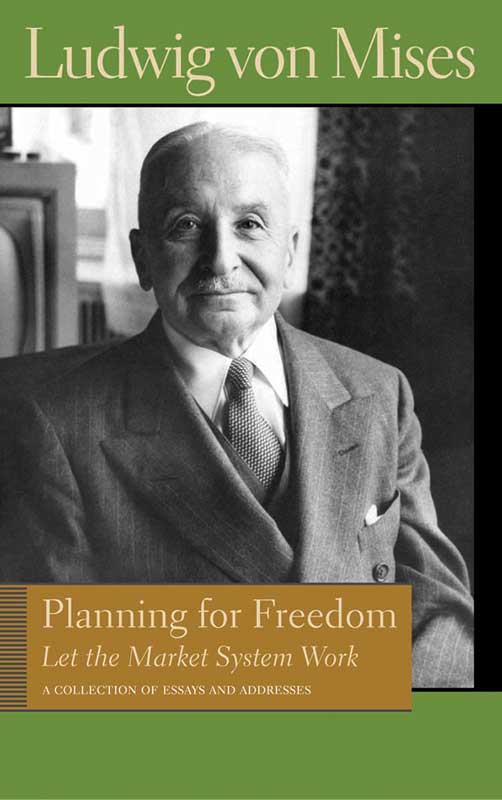
PART 3: Mises: Critic of Inflationism and Socialism - Ludwig von Mises, Planning for Freedom: Let the Market System Work. A Collection of Essays and Addresses [1952]Edition used:Planning for Freedom: Let the Market System Work. A Collection of Essays and Addresses, edited with a Foreword by Bettina Bien Greaves (Indianapolis: Liberty Fund, 2008).
About Liberty Fund:Liberty Fund, Inc. is a private, educational foundation established to encourage the study of the ideal of a society of free and responsible individuals. Copyright information:Published online with the kind permission of the copyright holders, the Foundation for Economic Education. In particular for the following articles: “Laissez Faire or Dictatorship”, “The Gold Problem”, Benjamin M. Anderson Challenges the Philosophy of the Pseudo-Progressives”, “Lord Keynes and Say’s Law”, “Stones into Bread”, “Economic Teaching at the Universities”, and “Trends can Change”. Fair use statement:This material is put online to further the educational goals of Liberty Fund, Inc. Unless otherwise stated in the Copyright Information section above, this material may be used freely for educational and academic purposes. It may not be used in any way for profit.
PART 3Mises: Critic of Inflationism and SocialismNo effusions of authors however brilliant and sophisticated can alter the perennial economic laws. They are and work and take care of themselves. —“Lord Keynes and Say’s Law” Tyranny is the political corollary of socialism, as representative government is the political corollary of the market economy. —“Liberty and Its Antithesis” 9Benjamin M. Anderson Challenges the Philosophy of the Pseudo-Progressives*The Two Lines of Marxian Thought and PoliciesIn all countries which have not openly adopted a policy of outright and all-round socialization the conduct of government affairs has been for many decades in the hands of statesmen and parties who style themselves “progressives” and scorn their opponents as “reactionaries.” These progressives become sometimes (but not always) very angry if somebody calls them Marxians. In this protest they are right insofar as their tenets and policies are contrary to some of the Marxian doctrines and their application to political action. But they are wrong insofar as they unreservedly endorse the fundamental dogmas of the Marxian creed and act accordingly. While calling in question the ideas of Marx, the champion of integral revolution, they subscribe to piecemeal revolution. For there are in the writings of Marx two distinct sets of theorems incompatible with each other: the line of the integral revolution as upheld in earlier days by Kautsky and later by Lenin, and the “reformist” line of revolution by instalments as vindicated by Sombart in Germany and the Fabians in England. Common to both lines is the unconditional damnation of capitalism and its political “superstructure,” representative government. Capitalism is described as a ghastly system of exploitation. It heaps riches upon a constantly diminishing number of “expropriators” and condemns the masses to increasing misery, oppression, slavery and degradation. But it is precisely this awkward system which “with the inexorability of a law of nature” finally brings about salvation. The coming of socialism is inevitable. It will appear as the result of the actions of the class-conscious proletarians. The “people” will finally triumph. All machinations of the wicked “bourgeois” are doomed to failure. But here the two lines diverge. In the Communist Manifesto Marx and Engels designed a plan for the step-by-step transformation of capitalism into socialism. The proletarians should “win the battle of democracy” and thus raise themselves to the position of the ruling class. Then they should use their political supremacy to wrest, “by degrees,” all capital from the bourgeoisie. Marx and Engels give rather detailed instructions for the various measures to be resorted to. It is unnecessary to quote in extenso their battle plan. Its diverse items are familiar to all Americans who have lived through the years of the New Deal and the Fair Deal. It is more important to remember that the fathers of Marxism themselves characterized the measures they recommended as “despotic inroads on the rights of property and the conditions of bourgeois production” and as “measures which appear economically insufficient and untenable, but which in the course of the movement outstrip themselves, necessitate further inroads upon the old social order, and are unavoidable as a means of entirely revolutionizing the mode of production.”* It is obvious that all the “reformers” of the last one hundred years were dedicated to the execution of the scheme drafted by the authors of the Communist Manifesto in 1848. In this sense Bismarck’s Sozialpolitik as well as Roosevelt’s New Deal have a fair claim to the epithet Marxian. But on the other hand Marx also conceived a doctrine radically different from that expounded in the Manifesto and absolutely incompatible with it. According to this second doctrine “no social formation ever disappears before all the productive forces are developed for the development of which it is broad enough, and new higher methods of production never appear before the material conditions of their existence have been hatched out in the womb of the previous society.” Full maturity of capitalism is the indispensable prerequisite for the appearance of socialism. There is but one road toward the realization of socialism, namely, the progressive evolution of capitalism itself which, through the incurable contradictions of the capitalist mode of production, causes its own collapse. Independently of the wills of men this process “executes itself through the operation of the inherent laws of capitalist production.” The utmost concentration of capital by a small cluster of expropriators on the one hand and unendurable impoverishment of the exploited masses on the other hand are the factors that alone can give rise to the great revulsion which will sweep away capitalism. Only then will the patience of the wretched wage earners give way and with a sudden stroke they will in a violent revolution overthrow the “dictatorship” of the bourgeoisie grown old and decrepit. From the point of view of this doctrine Marx distinguishes between the policies of the petty bourgeois and those of the class-conscious proletarians. The petty bourgeois in their ignorance put all their hopes upon reforms. They are eager to restrain, to regulate and to improve capitalism. They do not see that all such endeavors are doomed to failure and make things worse, not better. For they delay the evolution of capitalism and thereby the coming of its maturity which alone can bring about the great debacle and thus deliver mankind from the evils of exploitation. But the proletarians, enlightened by the Marxian doctrine, do not indulge in these reveries. They do not embark upon idle schemes for an improvement of capitalism. They, on the contrary, recognize in every progress of capitalism, in every impairment of their own conditions and in every new recurrence of economic crisis a progress toward the inescapable collapse of the capitalist mode of production. The essence of their policies is to organize and to discipline their forces, the militant battalions of the people, in order to be ready when the great day of the revolution dawns. This rejection of petty-bourgeois policies refers also to traditional labor union tactics. The plans of the workers to raise, within the framework of capitalism, wage rates and their standards of living through unionization and through strikes are vain. For the inescapable tendency of capitalism, says Marx, is not to raise but to lower the average standard of wages. Consequently he advised the unions to change their policies entirely. “Instead of the conservative motto: A fair day’s wage for a fair day’s work, they ought to inscribe on their banner the revolutionary watchword: Abolition of the wages system.” It is impossible to reconcile these two varieties of Marxian doctrines and of Marxian policies. They preclude one another. The authors of the Communist Manifesto in 1848 recommended precisely those policies which their later books and pamphlets branded as petty-bourgeois nonsense. Yet they never repudiated their scheme of 1848. They arranged new editions of the Manifesto. In the preface of the 1872 edition they declared that the principles for political action as outlined in 1848 need to be improved, as such practical measures must be always adjusted to changing historical conditions. But they did not, in this preface, stigmatize such reforms as the outcome of petty-bourgeois mentality. Thus the dualism of the two Marxian lines remained. It was in perfect agreement with the intransigent revolutionary line that the German Social-Democrats in the eighties voted in the Reichstag against Bismarck’s social security legislation and that their passionate opposition frustrated Bismarck’s intention to socialize the German tobacco industry. It is no less consonant with this revolutionary line that the Stalinists and their henchmen describe the American New Deal and the Keynesian patent medicines as clever but idle contrivances designed to salvage and to preserve capitalism. The present-day antagonism between the Communists on the one hand and the Socialists, New Dealers, and Keynesians on the other hand is a controversy about the means to be resorted to for the attainment of a goal common to both of these factions, namely the establishment of all-round central planning and the entire elimination of the market economy. It is a feud between two factions both of which are right in referring to the teachings of Marx. And it is paradoxical indeed that in this controversy the anti-Communists’ title to the appellation “Marxian” is vested in the document called the Communist Manifesto. The Guide of the ProgressivesIt is impossible to understand the mentality and the policy of the progressives if one does not take into account the fact that the Communist Manifesto is for them both manual and holy writ, the only reliable source of information about mankind’s future as well as the ultimate code of political conduct. The Communist Manifesto is the only piece of the writings of Marx which they have really perused. Apart from the Manifesto they know only a few sentences out of context and without any bearing on the problems of current policies. But from the Manifesto they have learned that the coming of socialism is inevitable and will transform the earth into a Garden of Eden. They call themselves progressives and their opponents reactionaries precisely because, fighting for the bliss that is bound to come, they are borne by the “wave of the future” while their adversaries are committed to the hopeless attempt to stop the wheel of Fate and History. What a comfort to know that one’s own cause is destined to conquer! Then the progressive professors, writers, politicians, and civil servants discover in the Manifesto a passage which especially flatters their vanity. They belong to that “small section of the ruling class,” to that “portion of the bourgeois ideologists” who have gone over to the proletariat, “the class that holds the future in its hands.” Thus they are members of that elite “who have raised themselves to the level of comprehending theoretically the historical movements as a whole.” Still more important is the fact that the Manifesto provides them with an armor which makes them proof against all criticisms levelled against their policies. The bourgeois describe these progressive policies as “economically insufficient and untenable” and think that they have thereby demonstrated their inadequacy. How wrong they are! In the eyes of the progressives the excellence of these policies consists in the very fact that they are “economically insufficient and untenable.” For exactly such policies are, as the Manifesto says, “unavoidable as a means of entirely revolutionizing the mode of production.” The Communist Manifesto serves as a guidebook not only to the personnel of the ever-swelling hosts of bureaucrats and pseudo- economists. It reveals to the “progressive” authors the very nature of the “bourgeois class culture.” What a disgrace is this so-called bourgeois civilization! Fortunately the eyes of the self-styled “liberal” writers have been opened wide by Marx. The Manifesto tells them the truth about the unspeakable meanness and depravity of the bourgeoisie. Bourgeois marriage is “in fact a system of community of women.” The bourgeois “sees in his wife a mere instrument of production.” Our bourgeois, “not content with having the wives and daughters of their proletarians at their disposal, not to speak of common prostitutes, take the greatest pleasure in seducing each other’s wives.” In this vein innumerable plays and novels portray the conditions of the rotten society of decaying capitalism. How different are conditions in the country whose proletarians, the vanguard of what the great Fabians, Sidney and Beatrice Webb, called the New Civilization, have already “liquidated” the exploiters! It may be granted that the Russian methods cannot be considered in every respect as a pattern to be adopted by the “liberals” of the West. It may also be true that the Russians, properly irritated by the machinations of the Western capitalists who are unceasingly plotting for a violent overthrow of the Soviet regime, become angry and sometimes give vent to their indignation in unfriendly language. Yet the fact remains that in Russia the word of the Communist Manifesto has become flesh. While under capitalism “the workers have no country” and “have nothing to lose but their chains,” Russia is the true fatherland of all proletarians of the entire world. In a purely technical and legal sense it may be wrong for an American or Canadian to hand over confidential state documents or the secret designs of new weapons to the Russian authorities. From a higher point of view it may be understandable. Anderson’s Fight Against DestructionismSuch was the ideology that got hold of the men who in the last decades controlled the administration and determined the course of American affairs. It was against such a mentality that the economists had to fight in criticizing the New Deal. Foremost among these dissenters was Benjamin McAlester Anderson. Throughout most of these fateful years he was the editor and sole author, first of the Chase Economic Bulletin (issued by the Chase National Bank), and then of the Economic Bulletin (issued by the Capital Research Company). In his brilliant articles he analyzed the policies when they were still in the state of development and then later again when their disastrous consequences had appeared. He raised his warning voice when there was still time to abstain from inadequate measures, and later he was never at a loss to show how the havoc which had been done by rejecting his previous objections and suggestions could be reduced as much as possible. His criticism was never merely negative. He was always intent upon indicating roads which could lead out of an impasse. His was a constructive mind. Anderson was not a doctrinaire remote from contact with reality. In his capacity as the economist of the Chase National Bank (from 1919 to 1939) he had ample opportunity to learn everything about American economic conditions. His familiarity with European business and politics was not surpassed by any other American. He knew intimately all the men who were instrumental in the conduct of national and international banking, business and politics. An indefatigable student, he was well acquainted with the content of state documents, statistical reports and many confidential papers. His information was always complete and up-to-date. But his most eminent qualities were his inflexible honesty, his unhesitating sincerity and his unflinching patriotism. He never yielded. He always freely enunciated what he considered to be true. If he had been prepared to suppress or only to soften his criticism of popular but obnoxious policies, the most influential positions and offices would have been offered to him. But he never compromised. This firmness marks him as one of the outstanding characters in this age of the supremacy of time-servers. His criticism of the easy money policy, of credit expansion and inflation, of the abandonment of the gold standard, of unbalanced budgets, of Keynesian spending, of price control, of subsidies, of silver purchases, of the tariff and many other similar expedients was crushing. The apologists of these nostrums did not have the remotest idea how to refute his objections. All they did was to dismiss Anderson as “orthodox.” Although the undesired effects of the “unorthodox” policies he had assailed never failed to appear exactly as he had predicted, almost nobody in Washington paid any heed to his words. The reason is obvious. The essence of Anderson’s criticism was that all these measures were “economically insufficient and untenable,” that they were “despotic inroads” on the conditions of production, that they “necessitate further inroads” and that they must finally destroy our whole economic system. But these were just the ends which the Washington Marxians were aiming at. They did not bother about sabotaging all essential institutions of capitalism, for in their eyes capitalism was the worst of all evils and was doomed anyway by the inexorable laws of historical evolution. Their plan was to bring about, step by step, the welfare state of central planning. In order to attain this goal they had adopted the “untenable” policies which the Communist Manifesto had declared to be “unavoidable as a means of entirely revolutionizing the mode of production.” Anderson never tired of pointing out that the attempts to lower the rate of interest by means of credit expansion must result in an artificial boom and its inevitable aftermath, depression. In this vein he had attacked, long before 1929, the easy money policy of the twenties, and later again, long before the breakdown of 1937, the New Deal’s pump-priming. He preached to deaf ears. For his opponents had learned from Marx that the recurrence of depressions is a necessary outcome of the absence of central planning and cannot be avoided where there is “anarchy of production.” The heavier the crisis may be, the nearer it brings the day of salvation when socialism will be substituted for capitalism. The policy of keeping wage rates, either by government decree or by union violence and intimidation, above the height the unhampered labor market would have determined creates mass unemployment prolonged year after year. In dealing with American conditions as well as with those of Great Britain and other European countries, Anderson again and again referred to this economic law which, as even Lord Beveridge had asserted a few years before, is not contested by any competent authority. His arguments did not impress those who paraded as “friends of labor.” They considered private enterprise’s alleged “inability to provide jobs for all” as inevitable and were resolved to use mass unemployment as a lever for the realization of their designs. If one wants to repulse the onslaughts of the Communists and Socialists and to shield Western civilization from Sovietization, it is not enough to disclose the abortiveness and impropriety of the progressive policies allegedly aiming at improving the economic conditions of the masses. What is needed is a frontal attack upon the whole web of Marxian, Veblenian, and Keynesian fallacies. As long as the syllogisms of these pseudo-philosophies retain their undeserved prestige, the average intellectual will go on blaming capitalism for all the disastrous effects of anti-capitalist schemes and devices. Anderson’s Posthumous Economic HistoryBenjamin Anderson devoted the last years of his life to the composition of a great book, the financial and economic history of our age of wars and progressing disintegration of civilization. The most eminent historical works have come from authors who wrote the history of their own time for an audience contemporary with the events recorded. When gloom began to descend on the glory of Athens, one of its best citizens dedicated himself to Clio. Thucydides wrote the history of the Peloponnesian Wars and of the fateful direction of Athenian politics not merely as an unaffected student. His keen mind had fully recognized the disastrous significance of the course his countrymen were steering. He had been himself in politics and in the fighting forces. In writing history he wanted to serve his fellow-citizens. He wanted to admonish and to warn them, to stop their march toward the abyss. Such also were the intentions of Anderson. He did not write merely for the sake of recording. His history is in some way also a continuation and recapitulation of his critical examination and interpretation of current events as provided by his Bulletins and other papers. It does not chronicle a dead past. It deals with forces which are still operating and spreading ruin. Like Thucydides, Anderson was eager to serve those who desire an exact knowledge of the past as a key to the future. Like Thucydides, too, Anderson unfortunately did not live to see his book published. After his premature death, much lamented by all his friends and admirers, the D. Van Nostrand Company published it, with a preface by Henry Hazlitt, under the title Economics and the Public Welfare, Financial and Economic History of the United States, 1914–1946. It contains more than this title indicates. For the economic and financial history of the United States in this period was so closely intertwined with that of all other nations that his narrative embraces the whole orbit of Western civilization. The chapters dealing with British and French affairs are without doubt the best that has been said about the decline of these once flourishing countries. It is very difficult for a reviewer to select from the treasure of information, wisdom and keen economic analysis assembled in this volume the most precious gems. The discriminating reader is captivated from the first page on and will not put it aside before he has reached the last page. There are people who think that economic history neglects what they call the “human angle.” Now, the proper field of economic history is prices and production, money and credit, taxes and budgets, and other such phenomena. But all these things are the outcome of human volitions and actions, plans and ambitions. The topic of economic history is man with all his knowledge and ignorance, his truth and his errors, his virtues and his vices. Let us quote one of Anderson’s observations. In commenting upon America’s abandonment of the gold standard he remarks: “There is no need in human life so great as that men should trust one another and should trust their government, should believe in promises, and should keep promises in order that future promises may be believed in and in order that confident cooperation may be possible. Good faith—personal, national, and international—is the first prerequisite of decent living, of the steady going on of industry, of governmental financial strength, and of international peace” (pages 317–18). Such were the ideas that prompted the self-styled progressives to depreciate Anderson as “orthodox,” “old-fashioned,” “reactionary” and “Victorian.” Sir Stafford Cripps, who twelve times solemnly denied that he would ever change the official relation of the pound against dollars and then, when he had done so, protested that he naturally could not admit such intention, is more to their liking. 10Lord Keynes and Say’s Law*ILord Keynes’s main contribution did not lie in the development of new ideas but “in escaping from the old ones,” as he himself declared at the end of the preface to his “General Theory.” The Keynesians tell us that his immortal achievement consists in the entire refutation of what has come to be known as Say’s Law of Markets. The rejection of this law, they declare, is the gist of all Keynes’s teachings; all other propositions of his doctrine follow with logical necessity from this fundamental insight and must collapse if the futility of his attack on Say’s Law can be demonstrated.* Now it is important to realize that what is called Say’s Law was in the first instance designed as a refutation of doctrines popularly held in the ages preceding the development of economics as a branch of human knowledge. It was not an integral part of the new science of economics as taught by the Classical economists. It was rather a preliminary—the exposure and removal of garbled and untenable ideas which dimmed people’s minds and were a serious obstacle to a reasonable analysis of conditions. Whenever business turned bad, the average merchant had two explanations at hand: the evil was caused by a scarcity of money and by general overproduction. Adam Smith, in a famous passage in “The Wealth of ations,” exploded the first of these myths. Say devoted himself predominantly to a thorough refutation of the second. As long as a definite thing is still an economic good and not a “free good,” its supply is not, of course, absolutely abundant. There are still unsatisfied needs which a larger supply of the good concerned could satisfy. There are still people who would be glad to get more of this good than they are really getting. With regard to economic goods there can never be absolute overproduction. (And economics deals only with economic goods, not with free goods such as air which are no object of purposive human action, are therefore not produced, and with regard to which the employment of terms like underproduction and overproduction is simply nonsensical.) With regard to economic goods there can be only relative overproduction. While the consumers are asking for definite quantities of shirts and of shoes, business has produced, say, a larger quantity of shoes and a smaller quantity of shirts. This is not general overproduction of all commodities. To the overproduction of shoes corresponds an underproduction of shirts. Consequently the result cannot be a general depression of all branches of business. The outcome is a change in the exchange ratio between shoes and shirts. If, for instance, previously one pair of shoes could buy four shirts, it now buys only three shirts. While business is bad for the shoemakers, it is good for the shirtmakers. The attempts to explain the general depression of trade by referring to an allegedly general overproduction are therefore fallacious. Commodities, says Say, are ultimately paid for not by money, but by other commodities. Money is merely the commonly used medium of exchange; it plays only an intermediary role. What the seller wants ultimately to receive in exchange for the commodities sold is other commodities. Every commodity produced is therefore a price, as it were, for other commodities produced. The situation of the producer of any commodity is improved by any increase in the production of other commodities. What may hurt the interests of the producer of a definite commodity is his failure to anticipate correctly the state of the market. He has overrated the public’s demand for his commodity and underrated its demand for other commodities. Consumers have no use for such a bungling entrepreneur; they buy his products only at prices which make him incur losses, and they force him, if he does not in time correct his mistakes, to go out of business. On the other hand, those entrepreneurs who have better succeeded in anticipating the public demand earn profits and are in a position to expand their business activities. This, says Say, is the truth behind the confused assertions of businessmen that the main difficulty is not in producing but in selling. It would be more appropriate to declare that the first and main problem of business is to produce in the best and cheapest way those commodities which will satisfy the most urgent of the not yet satisfied needs of the public. Thus Smith and Say demolished the oldest and most naïve explanation of the trade cycle as provided by the popular effusions of inefficient traders. True, their achievement was merely negative. They exploded the belief that the recurrence of periods of bad business was caused by a scarcity of money and by a general overproduction. But they did not give us an elaborated theory of the trade cycle. The first explanation of this phenomenon was provided much later by the British Currency School. The important contributions of Smith and Say were not entirely new and original. The history of economic thought can trace back some essential points of their reasoning to older authors. This in no way detracts from the merits of Smith and Say. They were the first to deal with the issue in a systematic way and to apply their conclusions to the problem of economic depressions. They were therefore also the first against whom the supporters of the spurious popular doctrine directed their violent attacks. Sismondi and Malthus chose Say as the target of passionate volleys when they tried—in vain—to salvage the discredited popular prejudices. IISay emerged victoriously from his polemics with Malthus and Sismondi. He proved his case, while his adversaries could not prove theirs. Henceforth, during the whole rest of the nineteenth century, the acknowledgment of the truth contained in Say’s Law was the distinctive mark of an economist. Those authors and politicians who made the alleged scarcity of money responsible for all ills and advocated inflation as the panacea were no longer considered economists but “monetary cranks.” The struggle between the champions of sound money and the inflationists went on for many decades. But it was no longer considered a controversy between various schools of economists. It was viewed as a conflict between economists and anti-economists, between reasonable men and ignorant zealots. When all civilized countries had adopted the gold standard or the gold-exchange standard, the cause of inflation seemed to be lost forever. Economics did not content itself with what Smith and Say had taught about the problems involved. It developed an integrated system of theorems which cogently demonstrated the absurdity of the inflationist sophisms. It depicted in detail the inevitable consequences of an increase in the quantity of money in circulation and of credit expansion. It elaborated the monetary or circulation credit theory of the business cycle which clearly showed how the recurrence of depressions of trade is caused by the repeated attempts to “stimulate” business through credit expansion. Thus it conclusively proved that the slump, whose appearance the inflationists attributed to an insufficiency of the supply of money, is on the contrary the necessary outcome of attempts to remove such an alleged scarcity of money through credit expansion. The economists did not contest the fact that a credit expansion in its initial stage makes business boom. But they pointed out how such a contrived boom must inevitably collapse after a while and produce a general depression. This demonstration could appeal to statesmen intent on promoting the enduring well-being of their nation. It could not influence demagogues who care for nothing but success in the impending election campaign and are not in the least troubled about what will happen the day after tomorrow. But it is precisely such people who have become supreme in the political life of this age of wars and revolutions. In defiance of all the teachings of the economists, inflation and credit expansion have been elevated to the dignity of the first principle of economic policy. Nearly all governments are now committed to reckless spending and finance their deficits by issuing additional quantities of unredeemable paper money and by boundless credit expansion. The great economists were harbingers of new ideas. The economic policies they recommended were at variance with the policies practiced by contemporary governments and political parties. As a rule many years, even decades, passed before public opinion accepted the new ideas as propagated by the economists and before the required corresponding changes in policies were effected. It was different with the “new economics” of Lord Keynes. The policies he advocated were precisely those which almost all governments, including the British, had already adopted many years before his “General Theory” was published. Keynes was not an innovator and champion of new methods of managing economic affairs. His contribution consisted rather in providing an apparent justification for the policies which were popular with those in power in spite of the fact that all economists viewed them as disastrous. His achievement was a rationalization of the policies already practiced. He was not a “revolutionary,” as some of his adepts called him. The “Keynesian revolution” took place long before Keynes approved of it and fabricated a pseudo-scientific justification for it. What he really did was to write an apology for the prevailing policies of governments. This explains the quick success of his book. It was greeted enthusiastically by the governments and the ruling political parties. Especially enraptured were a new type of intellectuals, the “government economists.” They had had a bad conscience. They were aware of the fact that they were carrying out policies which all economists condemned as contrary to purpose and disastrous. Now they felt relieved. The “new economics” reestablished their moral equilibrium. Today they are no longer ashamed of being the handymen of bad policies. They glorify themselves. They are the prophets of the new creed. IIIThe exuberant epithets which these admirers have bestowed upon his work cannot obscure the fact that Keynes did not refute Say’s Law. He rejected it emotionally, but he did not advance a single tenable argument to invalidate its rationale. Neither did Keynes try to refute by discursive reasoning the teachings of modern economics. He chose to ignore them, that was all. He never found any word of serious criticism against the theorem that increasing the quantity of money cannot effect anything else than, on the one hand, to favor some groups at the expense of other groups, and, on the other hand, to foster capital malinvestment and capital decumulation. He was at a complete loss when it came to advancing any sound argument to demolish the monetary theory of the trade cycle. All he did was to revive the self-contradictory dogmas of the various sects of inflationism. He did not add anything to the empty presumptions of his predecessors, from the old Birmingham School of Little Shilling Men down to Silvio Gesell. He merely translated their sophisms—a hundred times refuted—into the questionable language of mathematical economics. He passed over in silence all the objections which such men as Jevons, Walras and Wicksell—to name only a few—opposed to the effusions of the inflationists. It is the same with his disciples. They think that calling “those who fail to be moved to admiration of Keynes’s genius” such names as “dullard” or “narrow-minded fanatic”* is a substitute for sound economic reasoning. They believe that they have proved their case by dismissing their adversaries as “orthodox” or “neo-classical.” They reveal the utmost ignorance in thinking that their doctrine is correct because it is new. In fact, inflationism is the oldest of all fallacies. It was very popular long before the days of Smith, Say and Ricardo, against whose teachings the Keynesians cannot advance any other objection than that they are old. IVThe unprecedented success of Keynesianism is due to the fact that it provides an apparent justification for the “deficit spending” policies of contemporary governments. It is the pseudo-philosophy of those who can think of nothing else than to dissipate the capital accumulated by previous generations. Yet no effusions of authors however brilliant and sophisticated can alter the perennial economic laws. They are and work and take care of themselves. Notwithstanding all the passionate fulminations of the spokesmen of governments, the inevitable consequences of inflationism and expansionism as depicted by the “orthodox” economists are coming to pass. And then, very late indeed, even simple people will discover that Keynes did not teach us how to perform the “miracle . . . of turning a stone into bread,”† but the not at all miraculous procedure of eating the seed corn.‡ 11Stones into Bread, the Keynesian Miracle*IThe stock-in-trade of all Socialist authors is the idea that there is potential plenty and that the substitution of socialism for capitalism would make it possible to give to everybody “according to his needs.” Other authors want to bring about this paradise by a reform of the monetary and credit system. As they see it, all that is lacking is more money and credit. They consider that the rate of interest is a phenomenon artificially created by the man-made scarcity of the “means of payment.” In hundreds, even thousands, of books and pamphlets they passionately blame the “orthodox” economists for their reluctance to admit that inflationist and expansionist doctrines are sound. All evils, they repeat again and again, are caused by the erroneous teachings of the “dismal science” of economics and the “credit monopoly” of the bankers and usurers. To unchain money from the fetters of “restrictionism,” to create free money (Freigeld, in the terminology of Silvio Gesell) and to grant cheap or even gratuitous credit, is the main plank in their political platform. Such ideas appeal to the uninformed masses. And they are very popular with governments committed to a policy of increasing the quantity both of money in circulation and of deposits subject to check. However, the inflationist governments and parties have not been ready to admit openly their endorsement of the tenets of the inflationists. While most countries embarked upon inflation and on a policy of easy money, the literary champions of inflationism were still spurned as “monetary cranks.” Their doctrines were not taught at the universities. John Maynard Keynes, late economic adviser to the British government, is the new prophet of inflationism. The “Keynesian Revolution” consisted in the fact that he openly espoused the doctrines of Silvio Gesell. As the foremost of the British Gesellians, Lord Keynes adopted also the peculiar messianic jargon of inflationist literature and introduced it into official documents. Credit expansion, says the Paper of the British Experts of April 8, 1943, performs the “miracle . . . of turning a stone into bread.”* The author of this document was, of course, Keynes. Great Britain has indeed traveled a long way to this statement from Hume’s and Mill’s views on miracles. IIKeynes entered the political scene in 1920 with his book, The Economic Consequences of the Peace. He tried to prove that the sums demanded for reparations were far in excess of what Germany could afford to pay and to “transfer.” The success of the book was overwhelming. The propaganda machine of the German nationalists, well entrenched in every country, was busily representing Keynes as the world’s most eminent economist and Great Britain’s wisest statesman. Yet it would be a mistake to blame Keynes for the suicidal foreign policy that Great Britain followed in the interwar period. Other forces, especially the adoption of the Marxian doctrine of imperialism and “capitalist warmongering,” were of incomparably greater importance in the rise of appeasement. With the exception of a small number of keen-sighted men, all Britons supported the policy which finally made it possible for the Nazis to start the Second World War. A highly gifted French economist, Étienne Mantoux, has analyzed Keynes’s famous book point for point. The result of his very careful and conscientious study is devastating for Keynes the economist and statistician, as well as Keynes the statesman. The friends of Keynes are at a loss to find any substantial rejoinder. The only argument that his friend and biographer, Professor E. A. G. Robinson, could advance is that this powerful indictment of Keynes’s position came “as might have been expected, from a Frenchman.” (Economic Journal, vol. LVII, p. 23.) As if the disastrous effects of appeasement and defeatism had not affected Great Britain also! Étienne Mantoux, son of the famous historian Paul Mantoux, was the most distinguished of the younger French economists. He had already made valuable contributions to economic theory—among them a keen critique of Keynes’s General Theory, published in 1937 in the Revue d’Économie Politique—before he began his The Carthaginian Peace or the Economic Consequences of Mr. Keynes (Oxford University Press, 1946). He did not live to see his book published. As an officer in the French forces he was killed on active service during the last days of the war. His premature death was a heavy blow to France, which is today badly in need of sound and courageous economists. IIIIt would be a mistake, also, to blame Keynes for the faults and failures of contemporary British economic and financial policies. When he began to write, Britain had long since abandoned the principle of laissez-faire. That was the achievement of such men as Thomas Carlyle and John Ruskin and, especially, of the Fabians. Those born in the eighties of the nineteenth century and later were merely epigones of the university and parlor Socialists of the late Victorian period. They were no critics of the ruling system, as their predecessors had been, but apologists of government and pressure group policies whose inadequacy, futility and perniciousness became more and more evident. Professor Seymour E. Harris has just published a stout volume of collected essays by various academic and bureaucratic authors dealing with Keynes’s doctrines as developed in his General Theory of Employment, Interest and Money, published in 1936. The title of the volume is The New Economics, Keynes’ Influence on Theory and Public Policy (Alfred A. Knopf, New York, 1947). Whether Keynesianism has a fair claim to the appellation “new economics” or whether it is not, rather, a rehash of often-refuted Mercantilist fallacies and of the syllogisms of the innumerable authors who wanted to make everybody prosperous by fiat money, is unimportant. What matters is not whether a doctrine is new, but whether it is sound. The remarkable thing about this symposium is that it does not even attempt to refute the substantiated objections raised against Keynes by serious economists. The editor seems to be unable to conceive that any honest and uncorrupted man could disagree with Keynes. As he sees it, opposition to Keynes comes from “the vested interests of scholars in the older theory” and “the preponderant influence of press, radio, finance and subsidized research.” In his eyes, non-Keynesians are just a bunch of bribed sycophants, unworthy of attention. Professor Harris thus adopts the methods of the Marxians and the Nazis, who preferred to smear their critics and to question their motives instead of refuting their theses. A few of the contributions are written in dignified language and are reserved, even critical, in their appraisal of Keynes’s achievements. Others are simply dithyrambic outbursts. Thus Professor Paul A. Samuelson tells us: “To have been born as an economist before 1936 was a boon—yes. But not to have been born too long before!” And he proceeds to quote Wordsworth:
Descending from the lofty heights of Parnassus into the prosaic valleys of quantitative science, Professor Samuelson provides us with exact information about the susceptibility of economists to the Keynesian gospel of 1936. Those under the age of 35 fully grasped its meaning after some time; those beyond 50 turned out to be quite immune, while economists in-between were divided. After thus serving us a warmed-over version of Mussolini’s giovanezza theme, he offers more of the outworn slogans of fascism, e.g., the “wave of the future.” However, on this point another contributor, Mr. Paul M. Sweezy, disagrees. In his eyes Keynes, tainted by “the shortcomings of bourgeois thought” as he was, is not the savior of mankind, but only the forerunner whose historical mission it is to prepare the British mind for the acceptance of pure Marxism and to make Great Britain ideologically ripe for full socialism. IVIn resorting to the method of innuendo and trying to make their adversaries suspect by referring to them in ambiguous terms allowing of various interpretations, the camp-followers of Lord Keynes are imitating their idol’s own procedures. For what many people have admiringly called Keynes’s “brilliance of style” and “mastery of language” were, in fact, cheap rhetorical tricks. Ricardo, says Keynes, “conquered England as completely as the Holy Inquisition conquered Spain.” This is as vicious as any comparison could be. The Inquisition, aided by armed constables and executioners, beat the Spanish people into submission. Ricardo’s theories were accepted as correct by British intellectuals without any pressure or compulsion being exercised in their favor. But in comparing the two entirely different things, Keynes obliquely hints that there was something shameful in the success of Ricardo’s teachings and that those who disapprove of them are as heroic, noble and fearless champions of freedom as were those who fought the horrors of the Inquisition. The most famous of Keynes’s aperçus is: “Two pyramids, two masses for the dead, are twice as good as one; but not so two railways from London to York.” It is obvious that this sally, worthy of a character in a play by Oscar Wilde or Bernard Shaw, does not in any way prove the thesis that digging holes in the ground and paying for them out of savings “will increase the real national dividend of useful goods and services.” But it puts the adversary in the awkard position of either leaving an apparent argument unanswered or of employing the tools of logic and discursive reasoning against sparkling wit. Another instance of Keynes’s technique is provided by his malicious description of the Paris Peace Conference. Keynes disagreed with Clemenceau’s ideas. Thus, he tried to ridicule his adversary by broadly expatiating upon his clothing and appearance which, it seems, did not meet with the standard set by London outfitters. It is hard to discover any connection with the German reparations problem in the fact that Clemenceau’s boots “were of thick black leather, very good, but of a country style, and sometimes fastened in front, curiously, by a buckle instead of laces.” After 15 million human beings had perished in the war, the foremost statesmen of the world were assembled to give mankind a new international order and lasting peace—and the British Empire’s financial expert was amused by the rustic style of the French prime minister’s footwear. Fourteen years later there was another international conference. This time Keynes was not a subordinate adviser, as in 1919, but one of the main figures. Concerning this London World Economic Conference of 1933, Professor Robinson observes: “Many economists the world over will remember . . . the performance in 1933 at Covent Garden in honour of the Delegates of the World Economic Conference, which owed its conception and organization very much to Maynard Keynes.” Those economists who were not in the service of one of the lamentably inept governments of 1933 and therefore were not delegates and did not attend the delightful ballet evening will remember the London Conference for other reasons. It marked the most spectacular failure in the history of international affairs of those policies of neo-Mercantilism which Keynes backed. Compared with this fiasco of 1933, the Paris Conference of 1919 appears to have been a highly successful affair. But Keynes did not publish any sarcastic comments on the coats, boots and gloves of the delegates of 1933. VAlthough Keynes looked upon “the strange, unduly neglected prophet Silvio Gesell” as a forerunner, his own teachings differ considerably from those of Gesell. What Keynes borrowed from Gesell as well as from the host of other pro-inflation propagandists was not the content of their doctrine, but their practical conclusions and the tactics they applied to undermine their opponents’ prestige. These stratagems are: (a) All adversaries, that is, all those who do not consider credit expansion as the panacea, are lumped together and called orthodox. It is implied that there are no differences between them. (b) It is assumed that the evolution of economic science culminated in Alfred Marshall and ended with him. The findings of modern subjective economics are disregarded. (c) All that economists from David Hume on down to our time have done to clarify the results of changes in the quantity of money and money substitutes is simply ignored. Keynes never embarked upon the hopeless task of refuting these teachings by ratiocination. In all these respects the contributors to the symposium adopt their master’s technique. Their critique aims at a body of doctrine created by their own illusions, which has no resemblance to the theories expounded by serious economists. They pass over in silence all that economists have said about the inevitable outcome of credit expansion. It seems as if they have never heard anything about the monetary theory of the trade cycle. For a correct appraisal of the success which Keynes’s General Theory found in academic circles, one must consider the conditions prevailing in university economics during the period between the two world wars. Among the men who occupied chairs of economics in the last few decades, there have been only a few genuine economists, i.e., men fully conversant with the theories developed by modern subjective economics. The ideas of the old classical economists, as well as those of the modern economists, were caricatured in the textbooks and in the classrooms; they were called such names as old-fashioned, orthodox, reactionary, bourgeois or Wall Street economics. The teachers prided themselves on having refuted for all time the abstract doctrines of Manchesterism and laissez-faire. The antagonism between the two schools of thought had its practical focus in the treatment of the labor union problem. Those economists disparaged as orthodox taught that a permanent rise in wage rates for all people eager to earn wages is possible only to the extent that the per capita quota of capital invested and the productivity of labor increases. If— whether by government decree or by labor union pressure—minimum wage rates are fixed at a higher level than that at which the unhampered market would have fixed them, unemployment results as a permanent mass phenomenon. Almost all professors of the fashionable universities sharply attacked this theory. As these self-styled “unorthodox” doctrinaires interpreted the economic history of the last two hundred years, the unprecedented rise in real wage rates and standards of living was caused by labor unionism and government pro-labor legislation. Labor unionism was, in their opinion, highly beneficial to the true interests of all wage-earners and of the whole nation. Only dishonest apologists of the manifestly unfair interests of callous exploiters could find fault with the violent acts of the unions, they maintained. The foremost concern of popular government, they said, should be to encourage the unions as much as possible and to give them all the assistance they needed to combat the intrigues of the employers and to fix wage rates higher and higher. But as soon as the governments and legislatures had vested the unions with all the powers they needed to enforce their minimum wage rates, the consequences appeared which the “orthodox” economists had predicted; unemployment of a considerable part of the potential labor force was prolonged year after year. The “unorthodox” doctrinaires were perplexed. The only argument they had advanced against the “orthodox” theory was the appeal to their own fallacious interpretation of experience. But now events developed precisely as the “abstract school” had predicted. There was confusion among the “unorthodox.” It was at this moment that Keynes published his General Theory. What a comfort for the embarrassed “progressives”! Here, at last, they had something to oppose to the “orthodox” view. The cause of unemployment was not the inappropriate labor policies, but the shortcomings of the monetary and credit system. No need to worry any longer about the insufficiency of savings and capital accumulation and about deficits in the public household. On the contrary. The only method to do away with unemployment was to increase “effective demand” through public spending financed by credit expansion and inflation. The policies which the General Theory recommended were precisely those which the “monetary cranks” had advanced long before and which most governments had espoused in the depression of 1929 and the following years. Some people believe that Keynes’s earlier writings played an important part in the process which converted the world’s most powerful governments to the doctrines of reckless spending, credit expansion and inflation. We may leave this minor issue undecided. At any rate it cannot be denied that the governments and peoples did not wait for the General Theory to embark upon these “Keynesian”—or more correctly, Gesellian policies. VIKeynes’s General Theory of 1936 did not inaugurate a new age of economic policies; rather, it marked the end of a period. The policies which Keynes recommended were already then very close to the time when their inevitable consequences would be apparent and their continuation would be impossible. Even the most fanatical Keynesians do not dare to say that present-day England’s distress is an effect of too much saving and insufficient spending. The essence of the much glorified “progressive” economic policies of the last decades was to expropriate ever-increasing parts of the higher incomes and to employ the funds thus raised for financing public waste and for subsidizing the members of the most powerful pressure groups. In the eyes of the “unorthodox,” every kind of policy, however manifest its inadequacy may have been, was justified as a means of bringing about more equality. Now this process has reached its end. With the present tax rates and the methods applied in the control of prices, profits and interest rates, the system has liquidated itself. Even the confiscation of every penny earned above 1,000 pounds a year will not provide any perceptible increase to Great Britain’s public revenue. The most bigoted Fabians cannot fail to realize that henceforth funds for public spending must be taken from the same people who are supposed to profit from it. Great Britain has reached the limit both of monetary expansionism and of spending. Conditions in this country are not essentially different. The Keynesian recipe to make wage rates soar no longer works. Credit expansion, on an unprecedented scale engineered by the New Deal, for a short time delayed the consequences of inappropriate labor policies. During this interval the Administration and the union bosses could boast of the “social gains” they had secured for the “common man.” But now the inevitable consequences of the increase in the quantity of money and deposits has become visible; prices are rising higher and higher. What is going on today in the United States is the final failure of Keynesianism. There is no doubt that the American public is moving away from the Keynesian notions and slogans. Their prestige is dwindling. Only a few years ago politicians were naively discussing the extent of national income in dollars without taking into account the changes which government-made inflation had brought about in the dollar’s purchasing power. Demagogues specified the level to which they wanted to bring the national (dollar) income. Today this form of reasoning is no longer popular. At last the “common man” has learned that increasing the quantity of dollars does not make America richer. Professor Harris still praises the Roosevelt Administration for having raised dollar incomes. But such Keynesian consistency is found today only in classrooms. There are still teachers who tell their students that “an economy can lift itself by its own bootstraps” and that “we can spend our way into prosperity.”* But the Keynesian miracle fails to materialize; the stones do not turn into bread. The panegyrics of the learned authors who cooperated in the production of the present volume merely confirm the editor’s introductory statement that “Keynes could awaken in his disciples an almost religious fervor for his economics, which could be effectively harnessed for the dissemination of the new economics.” And Professor Harris goes on to say, “Keynes indeed had the Revelation.” There is no use in arguing with people who are driven by “an almost religious fervor” and believe that their master “had the Revelation.” It is one of the tasks of economics to analyze carefully each of the inflation-ist plans, those of Keynes and Gesell no less than those of their innumerable predecessors from John Law down to Major Douglas. Yet no one should expect that any logical argument or any experience could ever shake the almost religious fervor of those who believe in salvation through spending and credit expansion. 12Liberty and Its Antithesis*As the harbingers of socialism tell us again and again, socialism will not only make all people rich, but will also bring perfect freedom to everybody. The transition to socialism, declares Frederick Engels, the friend and collaborator of Marx, is the leap of mankind from the realm of necessity into the realm of freedom. Under capitalism, say the Communists, there is bondage for the immense majority; in the Soviet Union alone there is genuine liberty for all. The treatment of this problem of freedom and bondage has been muddled by confounding it with the issues of the nature-given conditions of man’s existence. In nature there is nothing that could be called freedom. Nature is inexorable necessity. It is the state of affairs into which all created beings are placed and with which they have to cope. Man has to adjust his conduct to the world as it is. He lacks the power to rise in rebellion against the “laws of nature.” If he wants to substitute more satisfactory conditions for less satisfactory, he has to comply with them. Freedom in Society Means Freedom for Individuals to ChooseThe concept of freedom and its antithesis make sense only in referring to the conditions of social cooperation among men. Social cooperation, the basis of any really human and civilized existence, can be achieved by two different methods. It can be cooperation by virtue of contract and voluntary coordination on the part of all individuals, or it can be cooperation by virtue of command on the part of a Führer and compulsory subordination of the many. The latter system is authoritarian. In the libertarian system every individual is a moral person, that is, he is free to choose and to act and is responsible for his conduct. In the authoritarian system the supreme chief alone is a free agent while all the others are bondsmen subject to his discretion. Where the authoritarian system is fully established, as was for instance the case in the empire of the Inca in pre-Columbian America, the subjects are merely in a zoological sense human; virtually they are deprived of their specifically human faculty of choosing and acting and are not accountable for their conduct. It was in accordance with this degradation of man’s moral dignity that the Nazi criminals declined any responsibility for their deeds by pointing out that all they did was to obey the orders of their superiors. Western civilization is based upon the libertarian principle, and all its achievements are the result of the actions of free men. Only in the frame of a free society is it meaningful to distinguish between what is good and ought to be done and what is bad and ought to be avoided. Only in such a free society has the individual the power to choose between morally commendable and morally reprehensible conduct. Man is not a perfect being and there is no perfection in human affairs. Conditions in the free society are certainly in many regards unsatisfactory. There is still ample room for the endeavors of those who are intent upon fighting evil and raising the moral, intellectual and material level of mankind. Socialism Leads to Total ControlBut the designs of the Communists, Socialists, and all their allies aim at something else. They want to establish the authoritarian system. What they mean in extolling the benefits to be derived from what they call “planning” is a society in which all of the people should be prevented from planning their own conduct and from arranging their lives according to their own moral convictions. One plan alone should prevail, the plan of the great idol State (with a capital S), the plan of the supreme chief of the government, enforced by the police. Every individual should be forced to renounce his autonomy and to obey, without asking questions, the orders issued from the Politburo, the Führer’s secretariat. This is the kind of freedom that Engels had in mind. It is precisely the opposite of what the term freedom used to signify up to our age. It was the great merit of Professor Friedrich von Hayek to have directed attention to the authoritarian character of the socialist schemes, whether they are advocated by international or by nationalist socialists, by atheists or by misguided believers, by white-skinned or by dark-skinned fanatics. Although there have always been authors who exposed the authoritarianism of the socialist designs, the main criticism of socialism centered around its economic inadequacy, and did not sufficiently deal with its effects upon the lives of the citizens. Because of this neglect of the human angle of the issue, the great majority of those supporting socialist policies vaguely assumed that the restriction of the individuals’ freedom by a socialist regime will apply “only” to economic matters and will not affect freedom in non-economic affairs. But as Hayek in 1944 clearly pointed out in his book The Road To Serfdom, economic control is not merely control of a sector of human life that can be separated from the rest; it is the control of the means for all our ends. As the socialist state has sole control of the means, it has the power to determine which ends are to be served and what men are to strive for. It is not an accident that Marxian socialism in Russia and nationalist socialism in Germany resulted in the complete abolition of all civil liberties and the establishment of the most rigid despotism. Tyranny is the political corollary of socialism, as representative government is the political corollary of the market economy. Now Professor Hayek has enlarged and substantiated his ideas in a comprehensive treatise, The Constitution of Liberty.* In the first two parts of this book the author provides a brilliant exposition of the meaning of liberty and the creative powers of a free civilization. Endorsing the famous definition that describes liberty as the rule of laws and not of men, he analyzes the constitutional and legal foundations of a commonwealth of free citizens. He contrasts the two schemes of society’s social and political organization, government by the people (representative government) based upon legality, and government by the discretionary power of an authoritarian ruler or a ruling clique, an Obrigkeit as the Germans used to call it. Fully appreciating the moral, practical and material superiority of the former, he shows in detail what the legal requirements of such a state of affairs are and what has to be done in order to make it work and to defend it against the machinations of its foes. The Welfare State Leads to SocialismUnfortunately, the third part of Professor Hayek’s book is rather disappointing. Here the author tries to distinguish between socialism and the Welfare State. Socialism, he alleges, is on the decline; the Welfare State is supplanting it. And he thinks that the Welfare State is, under certain conditions, compatible with liberty. In fact, the Welfare State is merely a method for transforming the market economy step by step into socialism. The original plan of socialist action as developed by Karl Marx in 1848 in the Communist Manifesto aimed at a gradual realization of socialism by a series of governmental measures. The ten most powerful of such measures were enumerated in the Manifesto. They are well known to everybody because they are the very measures that form the essence of the activities of the Welfare State, of Bismarck’s and the kaiser’s German Sozialpolitik as well as of the American New Deal and British Fabian Socialism. The Communist Manifesto calls these measures which it suggests “economically insufficient and untenable,” but it stresses the fact that “in the course of the movement [they] outstrip themselves, necessitate further inroads upon the old social order, and are unavoidable as a means of entirely revolutionizing the mode of production.” Later, Marx adopted a different method for the policies of his party. He abandoned the tactics of a gradual approach to the total state of socialism and instead advocated a violent revolutionary overthrow of the “bourgeois” system that at one stroke should “liquidate” the “exploiters” and establish “the dictatorship of the proletariat.” It was this that Lenin did in 1917 in Russia and what the Communist International plans to achieve everywhere. What separates the Communists from the advocates of the Welfare State is not the ultimate goal of their endeavors, but the methods by means of which they want to attain a goal that is common to both of them. The difference of opinions that divides them is the same that distinguishes the Marx of 1848 from the Marx of 1867, the year of the first publication of the first volume of Das Kapital. The Failure of Economic PlanningHowever, the fact that Professor Hayek has misjudged the character of the Welfare State does not seriously detract from the value of his great book. For his searching analysis of the policies and concerns of the Welfare State shows to every thoughtful reader why and how these much-praised welfare policies inevitably always fail. These policies never attain those—allegedly beneficial—ends which the government and the self-styled progressives who advocated them wanted to attain, but—on the contrary—bring about a state of affairs which—from the very point of view of the government and its supporters—is even more unsatisfactory than the previous state of affairs they wanted to “improve.” If the government does not repeal its first intervention, it is induced to supplement it by further acts of intervention. As these fail again, still more meddling with business is resorted to until all economic freedom has been virtually abolished. What emerges is the system of all-round planning, i.e., socialism of the type which the German Hindenburg Plan was aiming at in the First World War and which was later put into effect by Hitler after his seizure of power, and by the British Coalition Cabinet in the Second World War. The main error that prevents many of our contemporaries from adequately comprehending the significance of various party programs and the trend of the welfare policies is their failure to recognize that there is apart from outright nationalization of all plants and farms (as effected in Russia and China) a second method for the full realization of socialism. Under this system that is commonly called “planning” (or, in war time, war socialism) the various plants and farms remain outwardly and seemingly units, but they become entirely and unconditionally subject to the orders of the supreme planning authority. Every citizen, whatever his nominal position in the economic system may be, is bound to toil in strict compliance with the orders of the planning board, and his income—the amount he is permitted to spend for his consumption—is exclusively determined by these orders. Some labels and terms of the capitalistic system may be preserved, but they signify under the altered conditions something entirely different from what they used to signify in the market economy. Other terms may be changed. Thus in Hitler Germany the head of an outfit who supplanted the entrepreneur or the corporation president of the market economy was styled “shop manager” (Betriebsführer) and the labor force “followers” (Gefolgschaft). As the theoretical pace-makers of this system, e.g., the late Professor Othmar Spann, has pointed out again and again, it retains only the name of private ownership, while in fact there is exclusively public—state—ownership. Only by paying full attention to these fundamental issues can one form a correct appreciation of the political controversies in the nations of Western civilization. For if socialism and communism should succeed in these countries, it will be the socialism of the planning scheme and not the socialism of the nationalization scheme. The latter is a method applicable to predominantly agricultural countries like those of Eastern Europe and Asia. In the industrial countries of the West the planning scheme is more popular because even the most fanatical statolatrists shrink from directly nationalizing the intricate apparatus of modern manufacturing. Yet the “planning scheme” is just as destructive of freedom as the “nationalization scheme” and both lead on to the authoritarian state. [* ] Originally published in Plain Talk, February 1950. Reprinted with permission from the Foundation for Economic Education. [* ] It is important to realize that the words “necessitate further inroads upon the old social order” are lacking in the original German text of the Manifesto as well as in the later authorized German editions. They were inserted in 1888 by Engels into the translation by Samuel Moore which was published with the subtitle: “Authorized English Translation, edited and annotated by Frederick Engels.” [* ] Originally published in The Freeman, October 30, 1950. Reprinted with permission from the Foundation for Economic Education. [* ] P. M. Sweezy in The New Economics, ed. by S. E. Harris, New York, 1947, p. 105. [* ] Professor G. Haberler, [“The General Theory,” in The New Economics, ibid.,] p. 161 [† ] Keynes, [“Proposals for an International Clearing Union,” in The New Economics, ibid.,] p. 332. [‡ ] See Henry Hazlitt, The Failure of the “New Economics,” chapter 3 on “Keynes vs. Say’s Law,” pp. 32–43. Arlington House, New Rochelle, New York, 1959. See also Clarence B. Carson, “Permanent Depression,” The Freeman, December 1979, volume 29, no. 12, pp. 743–51. The Foundation for Economic Education, Inc., Irvingtonon-Hudson, New York. [* ] Originally published in Plain Talk, March 1948, as “The Keynesian Miracle.” Reprinted with permission from the Foundation for Economic Education. [* ] [Editor’s note: Reprinted as “Proposals for an International Clearing Union,” in The New Economics, ed. Seymour E. Harris (New York: Knopf, 1947), p. 332.] [* ] Cf. Lorie Tarshis, The Elements of Economics, New York 1947, p. 565. [* ]Christian Economics, August 1, 1960. [* ] F. A. Hayek, The Constitution of Liberty, the University of Chicago Press, 1959, 580 pages. |

Titles (by Subject)