EconlibThe LibraryOther Sites |
Front Page Titles (by Subject) PART 2: Money, Inflation, and Government - Planning for Freedom: Let the Market System Work. A Collection of Essays and Addresses
Return to Title Page for Planning for Freedom: Let the Market System Work. A Collection of Essays and AddressesThe Online Library of LibertyA project of Liberty Fund, Inc.Search this Title:Also in the Library:
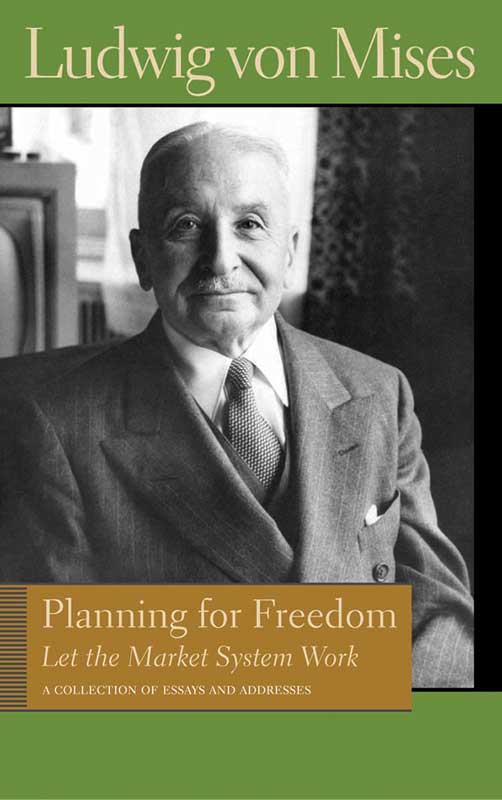
PART 2: Money, Inflation, and Government - Ludwig von Mises, Planning for Freedom: Let the Market System Work. A Collection of Essays and Addresses [1952]Edition used:Planning for Freedom: Let the Market System Work. A Collection of Essays and Addresses, edited with a Foreword by Bettina Bien Greaves (Indianapolis: Liberty Fund, 2008).
About Liberty Fund:Liberty Fund, Inc. is a private, educational foundation established to encourage the study of the ideal of a society of free and responsible individuals. Copyright information:Published online with the kind permission of the copyright holders, the Foundation for Economic Education. In particular for the following articles: “Laissez Faire or Dictatorship”, “The Gold Problem”, Benjamin M. Anderson Challenges the Philosophy of the Pseudo-Progressives”, “Lord Keynes and Say’s Law”, “Stones into Bread”, “Economic Teaching at the Universities”, and “Trends can Change”. Fair use statement:This material is put online to further the educational goals of Liberty Fund, Inc. Unless otherwise stated in the Copyright Information section above, this material may be used freely for educational and academic purposes. It may not be used in any way for profit.
PART 2Money, Inflation, and GovernmentNothing is inflationary except inflation, i.e., an increase in the quantity of money in circulation and credit subject to check (check-book money). And under present conditions nobody but the government can bring an inflation into being. —“Wages, Unemployment, and Inflation” 4Middle-of-the-Road Policy Leads to Socialism*The Unpopularity of CapitalismThe fundamental dogma of all brands of socialism and communism is that the market economy or capitalism is a system that hurts the vital interests of the immense majority of people for the sole benefit of a small minority of rugged individualists. It condemns the masses to progressing impoverishment. It brings about misery, slavery, oppression, degradation and exploitation of the working men, while it enriches a class of idle and useless parasites. This doctrine was not the work of Karl Marx. It had been developed long before Marx entered the scene. Its most successful propagators were not the Marxian authors, but such men as Carlyle and Ruskin, the British Fabians, the German professors and the American Institutionalists. And it is a very significant fact that the correctness of this dogma was contested only by a few economists who were very soon silenced and barred from access to the universities, the press, the leadership of political parties and, first of all, public office. Public opinion by and large accepted the condemnation of capitalism without any reservation. SocialismBut, of course, the practical political conclusions which people drew from this dogma were not uniform. One group declared that there is but one way to wipe out these evils, namely to abolish capitalism entirely. They advocate the substitution of public control of the means of production for private control. They aim at the establishment of what is called socialism, communism, planning, or state capitalism. All these terms signify the same thing. No longer should the consumers, by their buying and abstention from buying, determine what should be produced, in what quantity and of what quality. Henceforth a central authority alone should direct all production activities. InterventionismA second group seems to be less radical. They reject socialism no less than capitalism. They recommend a third system, which, as they say, is as far from capitalism as it is from socialism, which as a third system of society’s economic organization stands midway between the two other systems and, while retaining the advantages of both, avoids the disadvantages inherent in each. This third system is known as the system of interventionism. In the terminology of American politics it is often referred to as the middle-of-the-road policy. What makes this third system popular with many people is the particular way they choose to look upon the problems involved. As they see it, two classes, the capitalists and entrepreneurs on the one hand and the wage earners on the other hand, are arguing about the distribution of the yield of capital and entrepreneurial activities. Both parties are claiming the whole cake for themselves. Now, suggest these mediators, let us make peace by splitting the disputed value equally between the two classes. The State as an impartial arbiter should interfere and should curb the greed of the capitalists and assign a part of the profits to the working classes. Thus it will be possible to dethrone the moloch capitalism without enthroning the moloch of totalitarian socialism. Yet this mode of judging the issue is entirely fallacious. The antagonism between capitalism and socialism is not a dispute about the distribution of booty. It is a controversy about which of two schemes for society’s economic organization, capitalism or socialism, is conducive to the better attainment of those ends which all people consider as the ultimate aim of activities commonly called economic, viz., the best possible supply of useful commodities and services. Capitalism wants to attain these ends by private enterprise and initiative, subject to the supremacy of the public’s buying and abstention from buying on the market. The socialists want to substitute the unique plan of a central authority for the plans of the various individuals. They want to put in place of what Marx called the “anarchy of production” the exclusive monopoly of the government. The antagonism does not refer to the mode of distributing a fixed amount of amenities. It refers to the mode of producing all those goods which people want to enjoy. The conflict of the two principles is irreconcilable and does not allow of any compromise. Control is indivisible. Either the consumers’ demand as manifested on the market decides for what purposes and how the factors of production should be employed, or the government takes care of these matters. There is nothing that could mitigate the opposition between these two contradictory principles. They preclude each other. Interventionism is not a golden mean between capitalism and socialism. It is the design of a third system of society’s economic organization and must be appreciated as such. It is not the task of today’s discussion to raise any questions about the merits either of capitalism or of socialism. I am dealing today with interventionism alone. And I do not intend to enter into an arbitrary evaluation of interventionism from any preconceived point of view. My only concern is to show how interventionism works and whether or not it can be considered as a pattern of a permanent system of society’s economic organization. The interventionists emphasize that they plan to retain private ownership of the means of production, entrepreneurship and market exchange. But, they go on to say, it is peremptory to prevent these capitalist institutions from spreading havoc and unfairly exploiting the majority of people. It is the duty of government to restrain, by orders and prohibitions, the greed of the propertied classes lest their acquisitiveness harms the poorer classes. Unhampered or laissez-faire capitalism is an evil. But in order to eliminate its evils, there is no need to abolish capitalism entirely. It is possible to improve the capitalist system by government interference with the actions of the capitalists and entrepreneurs. Such government regulation and regimentation of business is the only method to keep off totalitarian socialism and to salvage those features of capitalism which are worth preserving. On the ground of this philosophy, the interventionists advocate a galaxy of various measures. Let us pick out one of them, the very popular scheme of price control. Price ControlThe government believes that the price of a definite commodity, e.g., milk, is too high. It wants to make it possible for the poor to give their children more milk. Thus it resorts to a price ceiling and fixes the price of milk at a lower rate than that prevailing on the free market. The result is that the marginal producers of milk, those producing at the highest cost, now incur losses. As no individual farmer or businessman can go on producing at a loss, these marginal producers stop producing and selling milk on the market. They will use their cows and their skill for other more profitable purposes. They will, for example, produce butter, cheese or meat. There will be less milk available for the consumers, not more. This, of course, is contrary to the intentions of the government. It wanted to make it easier for some people to buy more milk. But, as an outcome of its interference, the supply available drops. The measure proves abortive from the very point of view of the government and the groups it was eager to favor. It brings about a state of affairs, which—again from the point of view of the government—is even less desirable than the previous state of affairs which it was designed to improve. Now, the government is faced with an alternative. It can abrogate its decree and refrain from any further endeavors to control the price of milk. But if it insists upon its intention to keep the price of milk below the rate the unhampered market would have determined and wants nonetheless to avoid a drop in the supply of milk, it must try to eliminate the causes that render the marginal producers’ business unremunerative. It must add to the first decree concerning only the price of milk a second decree fixing the prices of the factors of production necessary for the production of milk at such a low rate that the marginal producers of milk will no longer suffer losses and will therefore abstain from restricting output. But then the same story repeats itself on a remoter plane. The supply of the factors of production required for the production of milk drops, and again the government is back where it started. If it does not want to admit defeat and to abstain from any meddling with prices, it must push further and fix the prices of those factors of production which are needed for the production of the factors necessary for the production of milk. Thus the government is forced to go further and further, fixing step by step the prices of all consumers’ goods and of all factors of production—both human, i.e., labor, and material—and to order every entrepreneur and every worker to continue work at these prices and wages. No branch of industry can be omitted from this all-round fixing of prices and wages and from this obligation to produce those quantities which the government wants to see produced. If some branches were to be left free out of regard for the fact that they produce only goods qualified as non-vital or even as luxuries, capital and labor would tend to flow into them and the result would be a drop in the supply of those goods, the prices of which the government has fixed precisely because it considers them as indispensable for the satisfaction of the needs of the masses. But when this state of all-round control of business is attained, there can no longer be any question of a market economy. No longer do the citizens by their buying and abstention from buying determine what should be produced and how. The power to decide these matters has devolved upon the government. This is no longer capitalism; it is all-round planning by the government, it is socialism. Socialism, the German PatternIt is, of course, true that this type of socialism preserves some of the labels and the outward appearance of capitalism. It maintains, seemingly and nominally, private ownership of the means of production, prices, wages, interest rates, and profits. In fact, however, nothing counts but the government’s unrestricted autocracy. The government tells the entrepreneurs and capitalists what to produce and in what quantity and quality, at what prices to buy and from whom, at what prices to sell and to whom. It decrees at what wages and where the workers must work. Market exchange is but a sham. All the prices, wages and interest rates are determined by the authority. They are prices, wages and interest rates in appearance only; in fact they are merely quantity relations in the government’s orders. The government, not the consumers, directs production. The government determines each citizen’s income, it assigns to everybody the position in which he has to work. This is socialism in the outward guise of capitalism. It is the Zwangswirtschaft of Hitler’s German Reich and the planned economy of Great Britain. For the scheme of social transformation which I have depicted is not merely a theoretical construction. It is a realistic portrayal of the succession of events that brought about socialism in Germany, in Great Britain and in some other countries. The Germans, in the First World War, began with price ceilings for a small group of consumers’ goods considered as vital necessaries. It was the inevitable failure of these measures that impelled them to go further and further until, in the second period of the war, they designed the Hindenburg plan. In the context of the Hindenburg plan no room whatever was left for a free choice on the part of the consumers and for initiative action on the part of business. All economic activities were unconditionally subordinated to the exclusive jurisdiction of the authorities. The total defeat of the Kaiser swept the whole imperial apparatus of administration away and with it went also the grandiose plan. But when in 1931 Chancellor Brüning embarked anew on a policy of price control and his successors, first of all Hitler, obstinately clung to it, the same story repeated itself. Socialism, the British ExperienceGreat Britain and all the other countries which in the First World War adopted measures of price control had to experience the same failure. They too were pushed further and further in their attempts to make the initial decrees work. But they were still at a rudimentary stage of this development when the victory and the opposition of the public brushed away all schemes for controlling prices. It was different in the Second World War. Then Great Britain again resorted to price ceilings for a few vital commodities and had to run the whole gamut proceeding further and further until it had substituted all-round planning of the country’s whole economy for economic freedom. When the war came to an end, Great Britain was a socialist commonwealth. It is noteworthy to remember that British socialism was not an achievement of Mr. Attlee’s Labor government, but of the war cabinet of Mr. Winston Churchill. What the Labor Party did was not the establishment of socialism in a free country, but retaining socialism as it had developed during the war in the postwar period. The fact has been obscured by the great sensation made about the nationalization of the Bank of England, the coal mines and other branches of business. However, Great Britain is to be called a socialist country not because certain enterprises have been formally expropriated and nationalized, but because all the economic activities of all citizens are subject to full control of the government and its agencies. The authorities direct the allocation of capital and of manpower to the various branches of business. They determine what should be produced. Supremacy in all business activities is exclusively vested in the government. The people are reduced to the status of wards, unconditionally bound to obey orders. To the businessmen, the former entrepreneurs, merely ancillary functions are left. All that they are free to do is to carry into effect, within a neatly circumscribed narrow field, the decisions of the government departments. One Intervention Leads to Further InterventionsWhat we have to realize is that price ceilings affecting only a few commodities fail to attain the ends sought. On the contrary. They produce effects which from the point of view of the government are even worse than the previous state of affairs which the government wanted to alter. If the government, in order to eliminate these inevitable but unwelcome consequences, pursues its course further and further, it finally transforms the system of capitalism and free enterprise into socialism of the Hindenburg pattern. The same is true of all other types of meddling with the market phenomena. Minimum wage rates, whether decreed and enforced by the government or by labor union pressure and violence, result in mass unemployment prolonged year after year as soon as they try to raise wage rates above the height of the unhampered market. The attempts to lower interest rates by credit expansion generate, it is true, a period of booming business. But the prosperity thus created is only an artificial hothouse product and must inexorably lead to the slump and to the depression. People must pay heavily for the easy-money orgy of a few years of credit expansion and inflation. The recurrence of periods of depression and mass unemployment has discredited capitalism in the opinion of injudicious people. Yet these events are not the outcome of the operation of the free market. They are on the contrary the result of well-intentioned but ill-advised government interference with the market. There are no means by which the height of wage rates and the general standard of living can be raised other than by accelerating the increase of capital as compared with population. The only means to raise wage rates permanently for all those seeking jobs and eager to earn wages is to raise the productivity of the industrial effort by increasing the per-head quota of capital invested. What makes American wage rates by far exceed the wage rates of Europe and Asia is the fact that the American worker’s toil and trouble is aided by more and better tools. All that good government can do to improve the material well-being of the people is to establish and to preserve an institutional order in which there are no obstacles to the progressing accumulation of new capital, required for the improvement of technological methods of production. This is what capitalism did achieve in the past and will achieve in the future too if not sabotaged by a bad policy. Socialism by Intervention or ExpropriationInterventionism cannot be considered as an economic system destined to stay. It is a method for the transformation of capitalism into socialism by a series of successive steps. It is as such different from the endeavors of the communists to bring about socialism at one stroke. The difference does not refer to the ultimate end of the political movement; it refers mainly to the tactics to be resorted to for the attainment of an end that both groups are aiming at. Karl Marx and Frederick Engels recommended successively each of these two ways for the realization of socialism. In 1848, in the Communist Manifesto, they outlined a plan for the step-by-step transformation of capitalism into socialism. The proletariat should be raised to the position of the ruling class and use its political supremacy “to wrest, by degrees, all capital from the bourgeoisie.” This, they declare, “cannot be effected except by means of despotic inroads on the rights of property and on the conditions of bourgeois production; by means of measures, therefore, which appear economically insufficient and untenable, but which in the course of the movement outstrip themselves, necessitate further inroads upon the old social order, and are unavoidable as a means of entirely revolutionizing the mode of production.” In this vein they enumerate by way of example ten measures. In later years Marx and Engels changed their minds. In his main treatise, Das Kapital, first published in 1867, Marx saw things in a different way. Socialism is bound to come “with the inexorability of a law of nature.” But it cannot appear before capitalism has reached its full maturity. There is but one road to the collapse of capitalism, namely the progressive evolution of capitalism itself. Then only will the great final revolt of the working class give it the finishing stroke and inaugurate the everlasting age of abundance. From the point of view of this later doctrine Marx and the school of orthodox Marxism reject all policies that pretend to restrain, to regulate and to improve capitalism. Such policies, they declare, are not only futile, but outright harmful. For they rather delay the coming of age of capitalism, its maturity, and thereby also its collapse. They are therefore not progressive, but reactionary. It was this idea that led the German Social Democratic party to vote against Bismarck’s social security legislation and to frustrate Bismarck’s plan to nationalize the German tobacco industry. From the point of view of the same doctrine, the communists branded the American New Deal as a reactionary plot extremely detrimental to the true interests of the working people. What we must realize is that the antagonism between the interventionists and the communists is a manifestation of the conflict between the two doctrines of the early Marxism and of the late Marxism. It is the conflict between the Marx of 1848, the author of the Communist Manifesto, and the Marx of 1867, the author of Das Kapital. And it is paradoxical indeed that the document in which Marx endorsed the policies of the present-day self-styled anti-communists is called the Communist Manifesto. There are two methods available for the transformation of capitalism into socialism. One is to expropriate all farms, plants and shops and to operate them by a bureaucratic apparatus as departments of the government. The whole of society, says Lenin, becomes “one office and one factory, with equal work and equal pay,”* the whole economy will be organized “like the postal system.”† The second method is the method of the Hindenburg plan, the originally German pattern of the welfare state and of planning. It forces every firm and every individual to comply strictly with the orders issued by the government’s central board of production management. Such was the intention of the National Industrial Recovery Act of 1933 which the resistance of business frustrated and the Supreme Court declared unconstitutional. Such is the idea implied in the endeavors to substitute planning for private enterprise. Socialism via Foreign Exchange ControlThe foremost vehicle for the realization of this second type of socialism is in industrial countries like Germany and Great Britain foreign exchange control. These countries cannot feed and clothe their people out of domestic resources. They must import large quantities of food and raw materials. In order to pay for these badly needed imports, they must export manufactures, most of them produced out of imported raw material. In such countries almost every business transaction directly or indirectly is conditioned either by exporting or importing or by both exporting and importing. Hence the government’s monopoly of buying and selling foreign exchange makes every kind of business activity depend on the discretion of the agency entrusted with foreign exchange control. In this country matters are different. The volume of foreign trade is rather small when compared with the total volume of the nation’s trade. Foreign exchange control would only slightly affect the much greater part of American business. This is the reason why in the schemes of our planners there is hardly any question of foreign exchange control. Their pursuits are directed toward the control of prices, wages and interest rates, toward the control of investment, and the limitation of profits and incomes. Effects of Progressive TaxationLooking backward on the evolution of income tax rates from the beginning of the Federal income tax in 1913 until the present day, one can hardly expect that the tax will not one day absorb 100% of all surplus above the income of the average voter. It is this that Marx and Engels had in mind when in the Communist Manifesto they recommended “a heavy progressive or graduated income tax.” Another of the suggestions of the Communist Manifesto was “abolition of all right of inheritance.” Now, neither in Great Britain nor in this country have the laws gone up to this point. But again, looking backward upon the past history of the estate taxes, we have to realize that they more and more have approached the goal set by Marx. Estate taxes of the height they have already attained for the upper brackets are no longer to be qualified as taxes. They are measures of expropriation. The philosophy underlying the system of progressive taxation is that the income and the wealth of the well-to-do classes can be freely tapped. What the advocates of these tax rates fail to realize is that the greater part of the incomes taxed away would not have been consumed but saved and invested. In fact, this fiscal policy does not only prevent the further accumulation of new capital. It brings about capital decumulation. This is certainly today the state of affairs in Great Britain. The Trend Toward SocialismThe course of events in the past thirty years shows a continuous although sometimes interrupted progress toward the establishment in this country of socialism of the British and German pattern. The U. S. embarked later than these two other countries upon this decline and is today still farther away from its end. But if the trend of this policy will not change, the final result will only in accidental and negligible points differ from what happened in the England of Attlee and in the Germany of Hitler. The middle-of-the-road policy is not an economic system that can last. It is a method for the realization of socialism by installments. Many people object. They stress the fact that most of the laws which aim at planning or at expropriation by means of progressive taxation have left some loopholes which offer to private enterprise a margin within which it can go on. That such loopholes still exist and that thanks to them this country is still a free country is certainly true. But this loopholes capitalism is not a lasting system. It is a respite. Powerful forces are at work to close these loopholes. From day to day the field in which private enterprise is free to operate is narrowed down. Of course, this outcome is not inevitable. The trend can be reversed as was the case with many other trends in history. The Marxian dogma according to which socialism is bound to come “with the inexorability of a law of nature” is just an arbitrary surmise devoid of any proof. But the prestige which this vain prognostic enjoys not only with the Marxians, but with many self-styled non-Marxians, is the main instrument of the progress of socialism. It spreads defeatism among those who otherwise would gallantly fight the socialist menace. The most powerful ally of Soviet Russia is the doctrine that the “wave of the future” carries us toward socialism and that it is therefore “progressive” to sympathize with all measures that restrict more and more the operation of the market economy. Antidote to Socialism, Laissez Faire IdeologyEven in this country which owes to a century of “rugged individualism” the highest standard of living ever attained by any nation, public opinion condemns laissez-faire. In the last fifty years thousands of books have been published to indict capitalism and to advocate radical interventionism, the welfare state and socialism. The few books which tried to explain adequately the working of the free market economy were hardly noticed by the public. Their authors remained obscure, while such authors as Veblen, Commons, John Dewey and Laski were exuberantly praised. It is a well-known fact that the legitimate stage as well as the Hollywood industry are no less radically critical of free enterprise than are many novels. There are in this country many periodicals which in every issue furiously attack economic freedom. There is hardly any magazine of opinion that would plead for the system that supplied the immense majority of the people with good food and shelter, with cars, refrigerators, radio sets and other things which the subjects of other countries call luxuries. The impact of this state of affairs is that practically very little is done to preserve the system of private enterprise. There are only middle-ofthe-roaders who think they have been successful when they have delayed for some time an especially ruinous measure. They are always in retreat. They put up today with measures which only ten or twenty years ago they would have considered as undiscussable. They will in a few years acquiesce in other measures which they today consider as simply out of the question. What can prevent the coming of totalitarian socialism is only a thorough change in ideologies. What we need is neither anti-socialism nor anti-communism but an open positive endorsement of that system to which we owe all the wealth that distinguishes our age from the comparatively straitened conditions of ages gone by. 5Inflation and Price Control*Under Socialism, Government Controls; Under Capitalism, the Market DirectsUnder socialism production is entirely directed by the orders of the central board of production management. The whole nation is an “industrial army” (a term used by Karl Marx in the Communist Manifesto) and each citizen is bound to obey his superior’s orders. Everybody has to contribute his share to the execution of the overall plan adopted by the Government. In the free economy no production czar tells a man what he should do. Everybody plans and acts for himself. The coordination of the various individuals’ activities, and their integration into a harmonious system for supplying the consumers with the goods and services they demand, is brought about by the market process and the price structure it generates. The market steers the capitalistic economy. It directs each individual’s activities into those channels in which he best serves the wants of his fellow-men. The market alone puts the whole social system of private ownership of the means of production and free enterprise in order and provides it with sense and meaning. There is nothing automatic or mysterious in the operation of the market. The only forces determining the continually fluctuating state of the market are the value judgments of the various individuals and their actions as directed by these value judgments. The ultimate factor in the market is the striving of each man to satisfy his needs and wants in the best possible way. Supremacy of the market is tantamount to the supremacy of the consumers. By their buying, and by their abstention from buying, the consumers determine not only the price structure, but no less what should be produced and in what quantity and quality and by whom. They determine each entrepreneur’s profit or loss, and thereby who should own the capital and run the plants. They make poor men rich and rich men poor. The profit system is essentially production for use, as profits can be earned only by success in supplying consumers in the best and cheapest way with the commodities they want to use. Price Control Leads to Central PlanningFrom this it becomes clear what government tampering with the price structure of the market means. It diverts production from those channels into which the consumers want to direct it into other lines. Under a market not manipulated by government interference there prevails a tendency to expand the production of each article to the point at which a further expansion would not pay because the price realized would not exceed costs. If the government fixes a maximum price for certain commodities below the level which the unhampered market would have determined for them and makes it illegal to sell at the potential market price, production involves a loss for the marginal producers. Those producing with the highest costs go out of the business and employ their production facilities for the production of other commodities, not affected by price ceilings. The government’s interference with the price of a commodity restricts the supply available for consumption. This outcome is contrary to the intentions which motivated the price ceiling. The government wanted to make it easier for people to obtain the article concerned. But its intervention results in shrinking of the supply produced and offered for sale. If this unpleasant experience does not teach the authorities that price control is futile and that the best policy would be to refrain from any endeavors to control prices, it becomes necessary to add to the first measure, restricting merely the price of one or of several consumers’ goods, further measures. It becomes necessary to fix the prices of the factors of production required for the production of the consumers’ goods concerned. Then the same story repeats itself on a remoter plane. The supply of those factors of production whose prices have been limited shrinks. Then again the government must expand the sphere of its price ceilings. It must fix the prices of the secondary factors of production required for the production of those primary factors. Thus the government must go farther and farther. It must fix the prices of all consumers’ goods and of all factors of production, both material factors and labor, and it must force every entrepreneur and every worker to continue production at these prices and wage rates. No branch of production must be omitted from this all-round fixing of prices and wages and this general order to continue production. If some branches were to be left free, the result would be a shifting of capital and labor to them and a corresponding fall in the supply of the goods whose prices the government has fixed. However, it is precisely these goods which the government considers as especially important for the satisfaction of the needs of the masses. But when such a state of all-round control of business is achieved, the market economy has been replaced by a system of centralized planning, by socialism. It is no longer the consumers but the government who decides what should be produced and in what quantity and quality. The entrepreneurs are no longer entrepreneurs. They have been reduced to the status of shop managers—or Betriebsführer, as the Nazis said— and are bound to obey the orders issued by the government’s central board of production management. The workers are bound to work in the plants to whom the authorities have assigned them; their wages are determined by authoritarian decrees. The government is supreme. It determines each citizen’s income and standard of living. It is totalitarian. Price control is contrary to purpose if it is limited to some commodities only. It cannot work satisfactorily within a market economy. The endeavors to make it work must needs enlarge the sphere of the commodities subject to price control until the prices of all commodities and services are regulated by authoritarian decree and the market ceases to work. Either production can be directed by the prices fixed on the market by the buying or the abstention from buying on the part of the public; or it can be directed by the government’s offices. There is no third solution available. Government control of a part of prices only results in a state of affairs which—without any exception—everybody considers as absurd and contrary to purpose. Its inevitable result is chaos and social unrest. Price Control in GermanyIt has been asserted again and again that German experience has proved that price control is feasible and can attain the ends sought by the government resorting to it. Nothing can be more erroneous. When the First World War broke out, the German Reich immediately adopted a policy of inflation. To prevent the inevitable outcome of inflation, a general rise in prices, it resorted simultaneously to price control. The much-glorified efficiency of the German police succeeded rather well in enforcing these price ceilings. There were no black markets. But the supply of the commodities subject to price control quickly fell. Prices did not rise. But the public was no longer in a position to purchase food, clothes and shoes. Rationing was a failure. Although the government reduce more and more the rations allotted to each individual, only a few people were fortunate enough to get all that the ration card entitled them to. In their endeavors to make the price control system work, the authorities expanded step by step the sphere of the commodities subject to price control. One branch of business after the other was centralized and put under the management of a government commissary. The government obtained full control of all vital branches of production. But even this was not enough as long as other branches of industry were left free. Thus the government decided to go still farther. The Hindenburg Program aimed at all-round planning of all production. The idea was to entrust the direction of all business activities to the authorities. If the Hindenburg Program had been executed, it would have transformed Germany into a purely totalitarian commonwealth. It would have realized the ideal of Othmar Spann, the champion of “German” socialism, to make Germany a country in which private property exists only in a formal and legal sense, while in fact there is public ownership only. However, the Hindenburg Program had not yet been completely put into effect when the Reich collapsed. The disintegration of the imperial bureaucracy brushed away the whole apparatus of price control and of war socialism. But the nationalist authors continued to extol the merits of the Zwangswirtschaft, the compulsory economy. It was, they said, the most perfect method for the realization of socialism in a predominantly industrial country like Germany. They triumphed when Chancellor Brüning in 1931 went back to the essential provisions of the Hindenburg Program and when later the Nazis enforced these decrees with the utmost brutality. The Nazis did not, as their foreign admirers contend, enforce price control within a market economy. With them price control was only one device within the frame of an all-round system of central planning. In the Nazi economy there was no question of private initiative and free enterprise. All production activities were directed by the Reichswirtschaftsministerium. No enterprise was free to deviate in the conduct of its operations from the orders issued by the government. Price control was only a device in the complex of innumerable decrees and orders regulating the minutest details of every business activity and precisely fixing every individual’s tasks on the one hand and his income and standard of living on the other. What made it difficult for many people to grasp the very nature of the Nazi economic system was the fact that the Nazis did not expropriate the entrepreneurs and capitalists openly and that they did not adopt the principle of income equality which the Bolshevists espoused in the first years of Soviet rule and discarded only later. Yet the Nazis removed the bourgeois completely from control. Those entrepreneurs who were neither Jewish nor suspect of liberal and pacifist leanings retained their positions in the economic structure. But they were virtually merely salaried civil servants bound to comply unconditionally with the orders of their superiors, the bureaucrats of the Reich and the Nazi party. The capitalists got their (sharply reduced) dividends. But like other citizens they were not free to spend more of their incomes than the Party deemed as adequate to their status and rank in the hierarchy of graduated leadership. The surplus had to be invested in exact compliance with the orders of the Ministry of Economic Affairs. The experience of Nazi Germany certainly did not disprove the statement that price control is doomed to failure within an economy not completely socialized. Those advocates of price control who pretend that they aim at preserving the system of private initiative and free enterprise are badly mistaken. What they really do is to paralyze the operation of the steering device of this system. One does not preserve a system by destroying its vital nerve; one kills it. Inflation Is Monetary ExpansionInflation is the process of a great increase in the quantity of money in circulation. Its foremost vehicle in continental Europe is the issue of non-redeemable legal tender banknotes. In this country inflation consists mainly in government borrowing from the commercial banks and also in an increase in the quantity of paper money of various types and of token coins. The government finances its deficit spending by inflation. Inflation must result in a general tendency towards rising prices. Those into whose pockets the additional quantity of currency flows are in a position to expand their demand for vendable goods and services. An additional demand must, other things being equal, raise prices. No sophistry and no syllogisms can conjure away this inevitable consequence of inflation. The semantic revolution which is one of the characteristic features of our day has obscured and confused this fact. The term inflation is used with a new connotation. What people today call inflation is not inflation, i.e., the increase in the quantity of money and money substitutes, but the general rise in commodity prices and wage rates which is the inevitable consequence of inflation. This semantic innovation is by no means harmless. First of all there is no longer any term available to signify what inflation used to signify. It is impossible to fight an evil which you cannot name. Statesmen and politicians no longer have the opportunity to resort to a terminology accepted and understood by the public when they want to describe the financial policy they are opposed to. They must enter into a detailed analysis and description of this policy with full particulars and minute accounts whenever they want to refer to it, and they must repeat this bothersome procedure in every sentence in which they deal with this subject. As you cannot name the policy increasing the quantity of the circulating medium, it goes on luxuriantly. The second mischief is that those engaged in futile and hopeless attempts to fight the inevitable consequences of inflation—the rise in prices—are masquerading their endeavors as a fight against inflation. While fighting the symptoms, they pretend to fight the root causes of the evil. And because they do not comprehend the causal relation between the increase in money in circulation and credit expansion on the one hand and the rise in prices on the other, they practically make things worse. The best example is provided by the subsidies. As has been pointed out, price ceilings reduce supply because production involves a loss for the marginal producers. To prevent this outcome governments often grant subsidies to the farmers operating with the highest costs. These subsidies are financed out of additional credit expansion. Thus they result in increasing the inflationary pressure. If the consumers were to pay higher prices for the products concerned, no further inflationary effect would emerge. The consumers would have to use for such surplus payments only money which had been already put into circulation. Thus the allegedly brilliant idea to fight inflation by subsidies in fact brings about more inflation. The Real Dangers of InflationThere is practically no need today to enter into a discussion of the comparatively slight and harmless inflation that under a gold standard can be brought about by a great increase in gold production. The problems the world must face today are those of runaway inflation. Such an inflation is always the outcome of a deliberate government policy. The government is on the one hand not prepared to restrict its expenditure. On the other hand it does not want to balance its budget by taxes levied or by loans from the public. It chooses inflation because it considers it as the minor evil. It goes on expanding credit and increasing the quantity of money in circulation because it does not see what the inevitable consequences of such a policy must be. There is no cause to be too much alarmed about the extent to which inflation has gone already in this country. Although it has gone very far and has done much harm, it has certainly not created an irreparable disaster. There is no doubt that the United States is still free to change its methods of financing and to return to a sound money policy. The real danger does not consist in what has happened already, but in the spurious doctrines from which these events have sprung. The superstition that it is possible for the government to eschew the inexorable consequences of inflation by price control is the main peril. For this doctrine diverts the public’s attention from the core of the problem. While the authorities are engaged in a useless fight against the attendant phenomena, only few people are attacking the source of the evil, the treasury’s methods of providing for the enormous expenditures. While the bureaus make headlines with their activities, the statistical figures concerning the increase in the nation’s currency are relegated to an inconspicuous place in the newspapers’ financial pages. Here again the example of Germany may stand as a warning. The tremendous German inflation which reduced in 1923 the purchasing power of the mark to one billionth of its prewar value was not an act of God. It would have been possible to balance Germany’s postwar budget without resorting to the Reichsbank’s printing press. The proof is that the Reich’s budget was easily balanced as soon as the breakdown of the old Reichsbank forced the government to abandon its inflationary policy. But before this happened, all German would-be experts stubbornly denied that the rise in commodity prices, wage rates and foreign exchange rates had anything to do with the government’s method of reckless spending. In their eyes only profiteering was to blame. They advocated thoroughgoing enforcement of price control as the panacea and called those recommending a change in financial methods “deflationists.” The German nationalists were defeated in the two most terrific wars of history. But the economic fallacies which pushed Germany into its nefarious aggressions unfortunately survive. The monetary errors developed by German professors such as Lexis and Knapp and put into effect by Havenstein, the Reichsbank’s president in the critical years of its great inflation, are today the official doctrine of France and of many other European countries. There is no need for the United States to import these absurdities. 6Economic Aspects of the Pension Problem*Workers Pay the Cost of Their Pension Benefits ThemselvesWhenever a law or labor union pressure burdens the employers with an additional expenditure for the benefit of the employees, people talk of “social gains.” The idea implied is that such benefits confer on the employees a boon beyond the salaries or wages paid to them and that they are receiving a grant which they would have missed in the absence of such a law or such a clause in the contract. It is assumed that the workers are getting something for nothing. This view is entirely fallacious. What the employer takes into account in considering the employment of additional hands or in discharging a number of those already in his service, is always the value of the services rendered or to be rendered by them. He asks himself: How much does the employment of the man concerned add to the output? Is it reasonable to expect that the expenditure caused by his employment will at least be recovered by the sale of the additional product produced by his employment? If the answer to the second question is in the negative, the employment of the man will cause a loss. As no enterprise can in the long run operate on a loss basis, the man concerned will be discharged or, respectively, will not be hired. In resorting to this calculation the employer takes into account not only the individual’s take-home wages, but all the costs of employing him. If, e.g., the government—as is the case in some European countries—collects a percentage of each firm’s total payroll as a tax which the firm is strictly forbidden to deduct from wages paid to the workers, the amount that enters into the calculation is: wages paid out to the worker plus the quota of the tax. If the employer is bound to provide for pensions, the sum entered into the calculation is: wages paid out plus an allowance for the pension, computed according to actuarial methods. The consequence of this state of affairs is that the incidence of all alleged “social gains” falls upon the wage-earner. Their effect does not differ from the effect of any kind of raise in wage rates. On a free labor market wage rates tend toward a height at which all employers ready to pay these rates can find all the men they need and all the workers ready to work for this rate can find jobs. There prevails a tendency toward full employment. But as soon as the laws or the labor unions fix rates at a higher level, this tendency disappears. Then workers are discharged and there are job-seekers who cannot find employment. The reason is that at the artificially raised wage rates only the employment of a smaller number of hands pays. While on an un-hampered labor market unemployment is only transitory, it becomes a permanent phenomenon when the governments or the unions succeed in raising wage rates above the potential market level. Even Lord Beveridge, about twenty years ago, admitted that the continuance of a substantial volume of unemployment is in itself the proof that the price asked for labor as wages is too high for the conditions of the market. And Lord Keynes, the inaugurator of the so-called “full employment policy,” implicitly acknowledged the correctness of this thesis. His main reason for advocating inflation as a means to do away with unemployment was that he believed that gradual and automatic lowering of real wages as a result of rising prices would not be so strongly resisted by labor as any attempt to lower money wage rates. What prevents the government and the unions from raising wage rates to a steeper height than they actually do is their reluctance to price out of the labor market too great a number of people. What the workers are getting in the shape of pensions payable by the employing corporation reduces the amount of wages that the unions can ask for without increasing unemployment. The unions in asking pensions for which the company has to pay without any contribution on the part of the beneficiaries have made a choice. They have preferred pensions to an increase in take-home wages. Economically it does not make any difference whether the workers do contribute or do not to the fund out of which the pensions will be paid. It is immaterial for the employer whether the cost of employing workers is raised by an increase in take-home wages or by the obligation to provide for pensions. For the worker, on the other hand, the pensions are not a free gift on the part of the employer. The pension claims they acquire restrict the amount of wages they could get without calling up the spectre of unemployment. Correctly computed, the income of a wage earner entitled to a pension consists of his wages plus the amount of the premium he would have to pay to an insurance company for the acquisition of an equivalent claim. Ultimately the granting of pensions amounts to a restriction of the wage earner’s freedom to use his total income according to his own designs. He is forced to cut down his current consumption in order to provide for his old age. We may neglect dealing with the question whether such a restriction of the individual worker’s freedom is expedient or not. What is important to emphasize is merely that the pensions are not a gift on the part of the employer. They are a disguised wage raise of a peculiar character. The employee is forced to use the increment for acquiring a pension. The Same Government That Offers Pensions Reduces Their Purchasing PowerIt is obvious that the amount of the pension each man will be entitled to claim one day can only be fixed in terms of money. Hence the value of these claims is inextricably linked with the vicissitudes of the American monetary unit, the dollar. The present Administration is eager to devise various schemes for old-age and disability pensions. It is intent upon extending the number of people included in the government’s social security system and to increase the benefits under this system. It openly supports the demands of the unions for pensions to be granted by the companies without contribution on the part of the beneficiaries. But at the same time the same administration is firmly committed to a policy which is bound to lower more and more the purchasing power of the dollar. It has proclaimed unbalanced budgets and deficit spending as the first principle of public finance, as a new way of life. While hypocritically pretending to fight inflation, it has elevated boundless credit expansion and recklessly increased the amount of money in circulation to the dignity of an essential postulate of popular government and economic democracy. Let nobody be fooled by the lame excuse that what is intended is not permanent deficits, but only the substitution of balancing the budget over a period of several years for balancing it every year. According to this doctrine in years of prosperity budgetary surpluses are to be accumulated which have to be balanced against the deficits incurred in years of depression. But what is to be considered as good business and what as bad business is left to the decision of the party in power. The Administration itself declared that the fiscal year 1949 was, in spite of a moderate recession near its end, a year of prosperity. But it did not accumulate a surplus in this year of prosperity; it produced a considerable deficit. Remember how the Democrats in the 1932 electoral campaign criticized the Hoover Administration for its financial shortcomings. But as soon as they came into office, they inaugurated their notorious schemes of pump-priming, deficit spending and so on. What the doctrine of balancing budgets over a period of many years really means is this: As long as our own party is in office, we will enhance our popularity by reckless spending. We do not want to annoy our friends by cutting down expenditures. We want the voters to feel happy under the artificial short-lived prosperity which the easy money policy and a rich supply of additional money generate. Later, when our adversaries will be in office, the inevitable consequence of our expansionist policy, viz., depression, will appear. Then we shall blame them for the disaster and assail them for their failure to balance the budget properly. It is very unlikely that the practice of deficit spending will be abandoned in the not too distant future. As a fiscal policy it is very convenient to inept governments. It is passionately advocated by hosts of pseudo-economists. It is praised at the universities as the most beneficial expedient of “unorthodox,” really “progressive” and “anti-fascist” methods of public finance. A radical change of ideologies would be required to restore the prestige of sound fiscal procedures, today de-cried as “orthodox” and “reactionary.” Such an overthrow of an almost universally accepted doctrine is unlikely to occur as long as the living generation of professors and politicians has not passed away. The present writer, having for more than forty years uncompromisingly fought against all varieties of credit expansion and inflation, is forced sadly to admit that the prospects for a speedy return to sound management of monetary affairs are rather thin. A realistic evaluation of the state of public opinion, the doctrines taught at the universities and the mentality of politicians and pressure groups must show us that the inflationist tendencies will prevail for many years. The inevitable result of inflationary policies is a drop in the monetary unit’s purchasing power. Compare the dollar of 1950 with the dollar of 1940! Compare the money of any European or American country with its nominal equivalent a dozen or two dozen years ago! As an inflationary policy works only as long as the yearly increments in the amount of money in circulation are increased more and more, the rise in prices and wages and the corresponding drop in purchasing power will go on at an accelerated pace. The experience of the French franc may give us a rough image of the dollar thirty or forty years from today. Now it is such periods of time that count for pension plans. The present workers of the United States Steel Corporation will receive their pensions in twenty, thirty or forty years. Today a pension of one hundred dollars a month means a rather substantial allowance. What will it mean in 1980 or 1990? Today, as the Welfare Commissioner of the City of New York has shown, 52 cents can buy all the food a person needs to meet the daily caloric and protein requirements. How much will 52 cents buy in 1980? Such is the issue. What the workers are aiming at in striving after social security and pensions is, of course, security. But their “social gain” withers away with the drop in the dollar’s purchasing power. In enthusiastically supporting the Fair Deal’s fiscal policy, the union members are themselves frustrating all their social security and pension schemes. The pensions they will be entitled one day to claim will be a mere sham. No solution can be found for this dilemma. In an industrial society all deferred payments must be stipulated in terms of money. They shrink with the shrinking of the money’s purchasing power. A policy of deficit spending saps the very foundation of all interpersonal relations and contracts. It frustrates all kinds of savings, social security benefits and pensions. Government Spending Is No Substitute for Capital AccumulationHow can it happen that the American workers fail to see that their policies are at cross purposes? The answer is: they are deluded by the fallacies of what is called “new economics.” This allegedly new philosophy ignores the role of capital accumulation. It does not realize that there is but one means to increase wage rates for all those eager to get jobs and thereby to improve the standard of living, namely to accelerate the increase of capital as compared with population. It talks about technological progress and productivity without being aware that no technological improvement can be achieved if the capital required is lacking. Just at the instant in which it became obvious that the most serious obstacle to any farther economic betterment is, not only in the backward countries but also in England, the shortage of capital, Lord Keynes, enthusiastically supported by many American authors, advanced his doctrine of the evils of saving and capital accumulation. As these men see it, all that is unsatisfactory is caused by the inability of private enterprise to cope with the conditions of the “mature” economy. The remedy they recommend is simple indeed. The state should fill the gap. They blithely assume that the state has unlimited means at its disposal. The state can undertake all projects which are too big for private capital. There is simply nothing that would surpass the financial power of the government of the United States. The Tennessee Valley project and the Marshall Plan were just modest beginnings. There are still many valleys in America left for further action. And then there are many rivers in other parts of the globe. Only a short time ago Senator McMahon outlined a gigantic project that dwarfs the Marshall Plan. Why not? If it is unnecessary to adjust the amount of expenditure to the means available, there is no limit to the spending of the great god State. It is no wonder that the common man falls prey to the illusions which dim the vision of dignified statesmen and learned professors. Like the expert advisers of the president, he entirely neglects to recognize the main problem of American business, viz., the insufficiency of the accumulation of new capital. He dreams of abundance while a shortage is threatening. He misinterprets the high profits which the companies report. He does not perceive that a considerable part of these profits are illusory, a mere arithmetical consequence of the fact that the sums laid aside as depreciation quotas are insufficient. These illusory profits, a phony result of the drop in the dollar’s purchasing power, will be absorbed by the already risen costs of replacing the factories’ worn-out equipment. Their ploughing back is not additional investment, it is merely capital maintenance. There is much less available for a substantial expansion of investment and for the improvement of technological methods than the misinformed public thinks. Pension Benefits Depend on Capital and InvestmentLooking backward fifty or a hundred years we observe a steady progress of America’s ability to produce and thereby to consume. But it is a serious blunder to assume that this trend is bound to continue. This past progress has been effected by a speedy increase of capital accumulation. If the accumulation of new capital is slowed down or entirely ceases, there cannot be any question of further improvements. Such is the real problem American labor has to face today. The problems of capital maintenance and the accumulation of new capital do not concern merely “management.” They are vital for the wage earner. Exclusively preoccupied with wage rates and pensions, the unions boast of their Pyrrhic victories. The union members are not conscious of the fact that their fate is tied up with the flowering of their employers’ enterprises. As voters they approve of a taxation system which taxes away and dissipates for current expenditure those funds which would have been saved and invested as new capital. What the workers must learn is that the only reason why wage rates are higher in the United States than in other countries is that the per head quota of capital invested is higher. The psychological danger of all kinds of pension plans is to be seen in the fact that they obscure this point. They give to the workers an unfounded feeling of security. Now, they think, our future is safe. No need to worry any longer. The unions will win for us more and more social gains. An age of plenty is in sight. Yet, the workers should be worried about the state of the supply of capital. They should be worried because the preservation and the further improvement of what is called “the American way of life” and “an American standard of living” depends on the maintenance and the further increase of the capital invested in American business. A man who is forced to provide of his own account for his old age must save a part of his income or take out an insurance policy. This leads him to examine the financial status of the savings bank or the insurance company or the soundness of the bonds he buys. Such a man is more likely to get an idea of the economic problems of his country than a man whom a pension scheme seemingly relieves of all worries. He will get the incentive to read the financial page of his newspaper and will become interested in articles which thoughtless people skip. If he is keen enough, he will discover the flaw in the teachings of the “new economics.” But the man who confides in the pension stipulated believes that all such issues are “mere theory” and do not affect him. He does not bother about those things on which his well-being depends because he ignores this dependence. As citizens such people are a liability. A nation cannot prosper if its members are not fully aware of the fact that what alone can improve their conditions is more and better production. And this can only be brought about by increased saving and capital accumulation. 7Wages, Unemployment, and Inflation*Consumers Guide Production and Determine Prices and WagesOur economic system—the market economy or capitalism—is a system of consumers’ supremacy. The customer is sovereign; he is, says a popular slogan, “always right.” Businessmen are under the necessity of turning out what the consumers ask for and they must sell their wares at prices which the consumers can afford and are prepared to pay. A business operation is a manifest failure if the proceeds from the sales do not reimburse the businessman for all he has expended in producing the article. Thus the consumers in buying at a definite price determine also the height of the wages that are paid to all those engaged in the industries. It follows that an employer cannot pay more to an employee than the equivalent of the value the latter’s work, according to the judgment of the buying public, adds to the merchandise. (This is the reason why the movie star gets much more than the charwoman.) If he were to pay more, he would not recover his outlays from the purchasers; he would suffer losses and would finally go bankrupt. In paying wages, the employer acts as a mandatory of the consumers, as it were. It is upon the consumers that the incidence of the wage payments falls. As the immense majority of the goods produced are bought and consumed by people who are themselves receiving wages and salaries, it is obvious that in spending their earnings the wage earners and employees themselves are foremost in determining the height of the compensation they and those like them will get. Better Tools Help Workers Produce and Earn MoreThe buyers do not pay for the toil and trouble the worker took nor for the length of time he spent in working. They pay for the products. The better the tools are which the worker uses in his job, the more he can perform in an hour, the higher is, consequently, his remuneration. What makes wages rise and renders the material conditions of the wage earners more satisfactory is improvement in the technological equipment. American wages are higher than wages in other countries because the capital invested per head of the worker is greater and the plants are thereby in the position to use the most efficient tools and machines. What is called the American way of life is the result of the fact that the United States has put fewer obstacles in the way of saving and capital accumulation than other nations. The economic backwardness of such countries as India consists precisely in the fact that their policies hinder both the accumulation of domestic capital and the investment of foreign capital. As the capital required is lacking, the Indian enterprises are prevented from employing sufficient quantities of modern equipment, are therefore producing much less per man-hour, and can only afford to pay wage rates which, compared with American wage rates, appear as shockingly low. There is only one way that leads to an improvement of the standard of living for the wage-earning masses, viz., the increase in the amount of capital invested. All other methods, however popular they may be, are not only futile, but are actually detrimental to the well-being of those they allegedly want to benefit. Raising Wages Artificially Causes UnemploymentThe fundamental question is: is it possible to raise wage rates for all those eager to find jobs above the height they would have attained on an unhampered labor market? Public opinion believes that the improvement in the conditions of the wage earners is an achievement of the unions and of various legislative measures. It gives to unionism and to legislation credit for the rise in wage rates, the shortening of hours of work, the disappearance of child labor, and many other changes. The prevalence of this belief made unionism popular and is responsible for the trend in labor legislation of the last two decades. As people think that they owe to unionism their high standard of living, they condone violence, coercion, and intimidation on the part of unionized labor and are indifferent to the curtailment of personal freedom inherent in the union-shop and closed-shop clauses. As long as these fallacies prevail upon the minds of the voters, it is vain to expect a resolute departure from the policies that are mistakenly called progressive. Yet this popular doctrine misconstrues every aspect of economic reality. The height of wage rates at which all those eager to get jobs can be employed depends on the marginal productivity of labor. The more capital—other things being equal—is invested, the higher wages climb on the free labor market, i.e., on the labor market not manipulated by the government and the unions. At these market wage rates all those eager to employ workers can hire as many as they want. At these market wage rates all those who want to be employed can get a job. There prevails on a free labor market a tendency toward full employment. In fact, the policy of letting the free market determine the height of wage rates is the only reasonable and successful full-employment policy. If wage rates, either by union pressure and compulsion or by government decree, are raised above this height, lasting unemployment of a part of the potential labor force develops. Credit Expansion May Lower Real Wages Temporarily and Spark a “Boom”These opinions are passionately rejected by the union bosses and their followers among politicians and the self-styled intellectuals. The panacea they recommend to fight unemployment is credit expansion and inflation, euphemistically called “an easy money policy.” As has been pointed out above, an addition to the available stock of capital previously accumulated makes a further improvement of the industries’ technological equipment possible, thus raises the marginal productivity of labor and consequently also wage rates. But credit expansion, whether it is effected by issuing additional banknotes or by granting additional credits on bank accounts subject to check, does not add anything to the nation’s wealth of capital goods. It merely creates the illusion of an increase in the amount of funds available for an expansion of production. Because they can obtain cheaper credit, people erroneously believe that the country’s wealth has thereby been increased and that therefore certain projects that could not be executed before are now feasible. The inauguration of these projects enhances the demand for labor and for raw materials and makes wage rates and commodity prices rise. An artificial boom is kindled. Under the conditions of this boom, nominal wage rates which before the credit expansion were too high for the state of the market and therefore created unemployment of a part of the potential labor force are no longer too high and the unemployed can get jobs again. However, this happens only because under the changed monetary and credit conditions prices are rising or, what is the same expressed in other words, the purchasing power of the monetary unit drops. Then the same amount of nominal wages, i.e., wage rates expressed in terms of money, means less in real wages, i.e., in terms of commodities that can be bought by the monetary unit. Inflation can cure unemployment only by curtailing the wage earner’s real wages. But then the unions ask for a new increase in wages in order to keep pace with the rising cost of living and we are back where we were before, i.e., in a situation in which large-scale unemployment can only be prevented by a further expansion of credit. This is what happened in this country as well as in many other countries in the last years. The unions, supported by the government, forced the enterprises to agree to wage rates that went beyond the potential market rates, i.e., the rates which the public was prepared to refund to the employers in purchasing their products. This would have inevitably resulted in rising unemployment figures. But the government policies tried to prevent the emergence of serious unemployment by credit expansion, i.e., inflation. The outcome was rising prices, renewed demands for higher wages and reiterated credit expansion; in short, protracted inflation. Endless Inflation Leads to DisasterBut finally the authorities become frightened. They know that inflation cannot go on endlessly. If one does not stop in time the pernicious policy of increasing the quantity of money and fiduciary media, the nation’s currency system collapses entirely. The monetary unit’s purchasing power sinks to a point which for all practical purposes is not better than zero. This happened again and again, in this country with the Continental Currency in 1781, in France in 1796, in Germany in 1923. It is never too early for a nation to realize that inflation cannot be considered as a way of life and that it is imperative to return to sound monetary policies. In recognition of these facts the administration and the Federal Reserve authorities some time ago discontinued the policy of progressive credit expansion. It is not the task of this short article to deal with all the consequences which the termination of inflationary measures brings about. We have only to establish the fact that the return to monetary stability does not generate a crisis. It only brings to light the malinvestments and other mistakes that were made under the hallucination of the illusory prosperity created by the easy money. People become aware of the faults committed and, no longer blinded by the phantom of cheap credit, begin to readjust their activities to the real state of the supply of material factors of production. It is this—certainly painful, but unavoidable— readjustment that constitutes the depression. One of the unpleasant features of this process of discarding chimeras and returning to a sober estimate of reality concerns the height of wage rates. Under the impact of the progressive inflationary policy the union bureaucracy acquired the habit of asking at regular intervals for wage raises, and business, after some sham resistance, yielded. As a result these rates were at the moment too high for the state of the market and would have brought about a conspicuous amount of unemployment. But the ceaselessly progressive inflation very soon caught up with them. Then the unions asked again for new raises and so on. It does not matter what kind of justification the unions and their henchmen advance in favor of their claims. The unavoidable effects of forcing the employers to remunerate work done at higher rates than those the consumers are willing to restore to them in buying the products are always the same: rising unemployment figures. At the present juncture the unions try to take up the old, a hundred times refuted purchasing power fable. They declare that putting more money into the hands of the wage earners—by raising wage rates, by increasing the benefits to the unemployed and by embarking upon new public works—would enable the workers to spend more and thereby stimulate business and lead the economy out of the recession into prosperity. This is the spurious pro-inflation argument to make all people happy through printing paper bills. Of course, if the quantity of the circulating media is increased, those into whose pockets the new fictitious wealth comes—whether they are workers or farmers or any other kind of people—will increase their spending. But it is precisely this increase in spending that inevitably brings about a general tendency of all prices to rise or, what is the same expressed in a different way, a drop in the monetary unit’s purchasing power. Thus the help that an inflationary action could give to the wage earners is only of a short duration. To perpetuate it, one would have to resort again and again to new inflationary measures. It is clear that this leads to disaster. Public, Political, and Union Pressures Can Lead Government to InflateThere is a lot of nonsense said about these things. Some people assert that wage raises are “inflationary.” But they are not in themselves inflationary. Nothing is inflationary except inflation, i.e., an increase in the quantity of money in circulation and credit subject to check (check-book money). And under present conditions nobody but the government can bring an inflation into being. What the unions can generate by forcing the employers to accept wage rates higher than the potential market rates is not inflation and not higher commodity prices, but unemployment of a part of the people anxious to get a job. Inflation is a policy to which the government resorts in order to prevent the large-scale unemployment the unions’ wage raising would otherwise bring about. The dilemma which this country—and no less many other countries— has to face is very serious. The extremely popular method of raising wage rates above the height the unhampered labor market would have established would produce catastrophic mass unemployment if inflationary credit expansion were not to rescue it. But inflation has not only very pernicious social effects. It cannot go on endlessly without resulting in the complete breakdown of the whole monetary system. Public opinion, entirely under the sway of the fallacious labor union doctrines, sympathizes more or less with the union bosses’ demand for a considerable rise in wage rates. As conditions are today, the unions have the power to make the employers submit to their dictates. They can call strikes and, without being restrained by the authorities, resort with impunity to violence against those willing to work. They are aware of the fact that the enhancement of wage rates will increase the number of jobless. The only remedy they suggest is more ample funds for unemployment compensation and a more ample supply of credit, i.e., inflation. The government, meekly yielding to a misguided public opinion and worried about the outcome of the impending election campaign, has unfortunately already begun to reverse its attempts to return to a sound monetary policy. Thus we are again committed to the pernicious methods of meddling with the supply of money. We are going on with the inflation that with accelerated speed makes the purchasing power of the dollar shrink. Where will it end? This is the question which Mr. Reuther and all the rest never ask. Only stupendous ignorance can call the policies adopted by the self-styled progressives “pro-labor” policies. The wage earner like every other citizen is firmly interested in the preservation of the dollar’s purchasing power. If, thanks to his union, his weekly earnings are raised above the market rate, he must very soon discover that the upward movement in prices not only deprives him of the advantages he expected, but besides makes the value of his savings, of his insurance policy and of his pension rights dwindle. And, still worse, he may lose his job and will not find another. All political parties and pressure groups protest that they are opposed to inflation. But what they really mean is that they do not like the unavoidable consequences of inflation, viz., the rise in living costs. Actually they favor all policies that necessarily bring about an increase in the quantity of the circulating media. They ask not only for an easy money policy to make the unions’ endless wage boosting possible but also for more government spending and—at the same time—for tax abatement through raising the exemptions. Duped by the spurious Marxian concept of irreconcilable conflicts between the interests of the social classes, people assume that the interests of the propertied classes alone are opposed to the unions’ demand for higher wage rates. In fact, the wage earners are no less interested in a return to sound money than any other group or class. A lot has been said in the last months about the harm fraudulent officers have inflicted upon the union membership. But the havoc done to the workers by the unions’ excessive wage boosting is much more detrimental. It would be an exaggeration to contend that the tactics of the unions are the sole threat to monetary stability and to a reasonable economic policy. Organized wage earners are not the only pressure group whose claims menace today the stability of our monetary system. But they are the most powerful and most influential of these groups and the primary responsibility rests with them. Well-being Depends on Savings and Capital FormationCapitalism has improved the standard of living of the wage earners to an unprecedented extent. The average American family enjoys today amenities of which, only a hundred years ago, not even the richest nabobs dreamed. All this well-being is conditioned by the increase in savings and capital accumulated; without these funds that enable business to make practical use of scientific and technological progress the American worker would not produce more and better things per hour of work than the Asiatic coolies, would not earn more and would, like them, wretchedly live on the verge of starvation. All measures which— like our income and corporation tax system—aim at preventing further capital accumulation or even at capital decumulation are therefore virtually anti-labor and anti-social. One further observation must still be made about this matter of saving and capital formation. The improvement of well-being brought about by capitalism made it possible for the common man to save and thus to become in a modest way himself a capitalist. A considerable part of the capital working in American business is the counterpart of the savings of the masses. Millions of wage earners own saving deposits, bonds and insurance policies. All these claims are payable in dollars and their worth depends on the soundness of the nation’s money. To preserve the dollar’s purchasing power is also from this point of view a vital interest of the masses. In order to attain this end, it is not enough to print upon the bank notes the noble maxim In God We Trust. One must adopt an appropriate policy. 8The Gold Problem*Why have a monetary system based on gold? Because, as conditions are today and for the time that can be foreseen today, the gold standard alone makes the determination of money’s purchasing power independent of the ambitions and machinations of governments, of dictators, of political parties, and of pressure groups. The gold standard alone is what the nineteenth-century freedom-loving leaders (who championed representative government, civil liberties, and prosperity for all) called “sound money.” The eminence and usefulness of the gold standard consists in the fact that it makes the supply of money depend on the profitability of mining gold, and thus checks large-scale inflationary ventures on the part of governments. The gold standard did not fail. Governments deliberately sabotaged it, and still go on sabotaging it. But no government is powerful enough to destroy the gold standard so long as the market economy is not entirely suppressed by the establishment of socialism in every part of the world. Governments believe that it is the gold standard’s fault alone that their inflationary schemes not only fail to produce the expected benefits, but unavoidably bring about conditions that (also in the eyes of the rulers themselves and most of the people) are considered as much worse than the alleged or real evils they were designed to eliminate. Except for the gold standard, governments are told by pseudo-economists that they could make everybody perfectly prosperous. Let us test the three doctrines advanced for the support of this fable of government omnipotence. The Fiction of Government Omnipotence“The state is God,” said Ferdinand Lassalle, the founder of the German socialist movement. As such, the state has the power to “create” unlimited quantities of money and thus to make everybody happy. Intrepid and clear-headed people branded such a policy of “creating” money as inflation. The official terminology calls it nowadays “deficit spending.” But whatever the name used in dealing with this phenomenon may be, its meaning is obvious. The government increases the quantity of money in circulation. Then a greater quantity of money “chases” (as a rather silly but popular way of talking about these problems says) a quantity of goods and services that has not been increased. The government’s action did not add anything to the available amount of useful things and services. It merely made the prices paid for them soar. If the government wishes to raise the income of some people, for example, government employees, it has to confiscate by taxation a part of some other people’s incomes, and then distribute the amount collected to its employees or favored groups. Then the taxpayers are forced to restrict their spending, while the recipients of the higher salaries or benefits are increasing their spending to the same amount. There does not result a conspicuous change in the purchasing power of the monetary unit. But if the government provides the money it wants for the payment of higher salaries by printing it or the granting of additional credits, the new money in the hands of these beneficiaries constitutes on the market an additional demand for the not-increased quantity of goods and services offered for sale. The unavoidable result is a general tendency of prices to rise. Any attempts the governments and their propaganda offices make to conceal this concatenation of events are in vain. Deficit spending means increasing the quantity of money in circulation. That the official terminology avoids calling it inflation is of no avail whatever. The government and its chiefs do not have the powers of the mythical Santa Claus. They cannot spend except by taking out of the pockets of some people for the benefit of others. The “Cheap-Money” FallacyInterest is the difference in the valuation of present goods and future goods; it is the discount in the valuation of future goods as against that of present goods. Interest cannot be “abolished” as long as people prefer an apple available today to an apple available only in a year, in ten years, or in a hundred years. The height of the originary rate of interest,* which is the main component of the market rate of interest as determined on the loan market, reflects the difference in the people’s valuation of present and future satisfaction of needs. The disappearance of interest, that is, an interest rate of zero, would mean that people do not care a whit about satisfying any of their present wants and are exclusively intent upon satisfying their future wants, their wants of the later years, decades, and centuries to come. People would only save and invest and would not be consuming. On the other hand, if people were to stop saving, that is, making any provision for the future, be it even the future of the tomorrow, and would not save at all and consume all capital goods accumulated by previous generations, the rate of interest would rise beyond any limits. It is thus obvious that the height of the market rate of interest ultimately does not depend on the whims, fancies, and pecuniary interests of the personnel operating the government apparatus of coercion and compulsion, the much-referred-to “public sector” of the economy. But the government has the power to push the Federal Reserve System, and the banks subject to it, into a policy of cheap money. Then the banks are expanding credit. Underbidding the rate of interest as established on the not-manipulated loan market, they offer additional credit created out of nothing. Thus they are inescapably falsifying the businessmen’s estimation of market conditions. Although the supply of capital goods (that can only be increased by additional saving) remained unchanged, the illusion of a richer supply of capital is conjured up. Business is induced to embark upon projects which a sober calculation, not misled by the cheap-money ventures, would have disclosed as mal-investments (over-investment in capital). The additional quantities of credit inundating the market make prices and wages soar. An artificial boom, a boom built entirely upon the illusions of ample and easy money, develops. But such a boom cannot last. Sooner or later it must become clear that, under the illusions created by the credit expansion, business has embarked upon projects for the execution of which the real savings are not rich enough. When this mal-investment becomes visible, the boom collapses. The depression that follows is the process of liquidating the errors committed in the excesses of the artificial boom; it is the return to calm reasoning and a reasonable conduct of affairs within the limits of the available supply of capital goods. It is a painful process, but it is a process of restoration of business health. Credit expansion is not a nostrum to make people happy. The boom it engenders must inevitably lead to a debacle and unhappiness. If it were really possible to substitute credit expansion (cheap money) for the accumulation of capital goods by saving, there would not be any poverty in the world. The economically backward nations would not have to complain about the insufficiency of their capital equipment. All they would have to do for the improvement of their conditions would be to expand money and credit more and more. No “foreign aid” schemes would have emerged. But in granting foreign aid to the backward nations, the American government implicitly acknowledges that credit expansion is no real substitute for genuine capital accumulation through saving. The Failure of Minimum Wage Legislation and of Union CoercionThe height of wage rates is determined by the consumers’ appraisal of the value the worker’s labor adds to the value of the article available for sale. As the immense majority of the consumers are themselves earners of wages and salaries, this means that the determination of the compensation for work and services rendered is made by the same kind of people who are receiving these wages and salaries. The fat earnings of the movie star and the boxing champion are provided by the welders, street sweepers, and charwomen who attend the performances and matches. An entrepreneur who would try to pay a hired man less than the amount this man’s work adds to the value of the product would be priced out of the labor market by the competition of other entrepreneurs eager to earn money. On the other hand, no entrepreneur can pay more to his helpers than the amount the consumers are prepared to refund to him in buying the product. If he were to pay higher wages, he would suffer losses and would be ejected from the ranks of the businessmen. Governments decreeing minimum wage laws above the level of the market rates restrict the number of hands that can find jobs. Such governments are producing unemployment of a part of the labor force. The same is true for what is euphemistically called “collective bargaining.” The only difference between the two methods concerns the apparatus enforcing the minimum wage. The government enforces its orders in resorting to policemen and prison guards. The unions “picket.” They and their members and officials have acquired the power and the right to commit wrongs to person and property, to deprive individuals of the means of earning a livelihood, and to commit many other acts which no one can do with impunity.* Nobody is today in a position to disobey an order issued by a union. To the employers no other choice is left than either to surrender to the dictates of the unions or to go out of business. But governments and unions are impotent against economic law. Violence can prevent the employers from hiring help at potential market rates, but it cannot force them to employ all those who are anxious to get jobs. The result of the governments’ and the unions’ meddling with the height of wage rates cannot be anything else than an incessant increase in the number of unemployed. It is precisely to prevent this outcome that the government-manipulated banking systems of all Western nations are resorting to inflation. Increasing the quantity of money in circulation and thereby lowering the purchasing power of the monetary unit, they are cutting down the oversized payrolls to a height consonant with the state of the market. This is today called Keynesian full-employment policy. It is in fact a method to perpetuate by continued inflation the futile attempts of governments and labor unions to meddle with the conditions of the labor market. As soon as the progress of inflation has adjusted wage rates so far as to avoid a spread of unemployment, government and unions resume with renewed zeal their ventures to raise wage rates above the level at which every job-seeker can find a job. The experience of this age of the New Deal, the Fair Deal, the New Frontier, and the Great Society confirms the fundamental thesis of the true British lovers of political liberty in the nineteenth century, namely, that there is but one means to improve the material conditions of all of the wage earners, viz., to increase the per-head quota of real capital invested. This result can only be brought about by additional saving and capital accumulation, never by government decrees, labor-union violence and intimidation, and inflation. The foes of the gold standard are wrong also in this regard. The Inescapable Consequence, Namely, the United States Government Gold Holdings Will ShrinkIn many parts of the earth an increasing number of people realize that the United States and most of the other nations are firmly committed to a policy of progressing inflation. They have learned enough from the experience of the recent decades to conclude that on account of these inflationary policies an ounce of gold will one day become more expensive in terms both of the currency of the United States and of their own country. They are alarmed and would like to avoid being victimized by this outcome. Americans are forbidden to own gold coins and gold ingots.* Their attempts to protect their financial assets consist in the methods that the Germans in the most spectacular inflation that history knows called Flucht in die Sachwerte (flight into real values). They are investing in common stocks and real estate, and prefer to have debts payable in legal tender money rather than holding claims payable in it. Even in the countries in which people are free to buy gold there are up to now no conspicuous purchases of gold on the part of financially potent individuals and institutions. Up to the moment at which French agencies began to buy gold, the buyers of gold were mostly people with modest incomes anxious to keep a few gold coins as a reserve for rainy days. It was the purchases via the London gold market on the part of such people that reduced the gold holdings of the United States. There is only one method available to prevent a further reduction of the American gold reserve, namely, radical abandonment of deficit spending as well as of any kind of “easy-money” policy. [* ] Address delivered before the University Club in New York, April 18, 1950. First printed by Commercial and Financial Chronicle, May 4, 1950. [* ] Cf. Lenin, State and Revolution, Little Lenin Library No. 14, New York 1932, p. 84. [† ] Ibidem, p. 44. [* ]The Commercial and Financial Chronicle, December 20, 1945. [* ]The Commercial and Financial Chronicle, February 23, 1950. [* ]Christian Economics, March 4, 1958. [* ] Originally published in The Freeman, June 1965. Reprinted with permission from the Foundation for Economic Education. [* ] See “Originary Interest” in Human Action by Ludwig von Mises, pages 526–32 (fourth edition, Irvington-on-Hudson, N. Y.: Foundation for Economic Education, 1996). [* ] Cf. Roscoe Pound, Legal Immunities of Labor Unions, Washington, D.C., 1957, page 21. [* ] [Editor’s note: In 1933, U.S. citizens were denied the right to own gold coins and gold ingots. They regained that right in January 1976.] |

Titles (by Subject)