EconlibThe LibraryOther Sites |
Front Page Titles (by Subject) PART 1: The Free Market Economy versus Government Planning - Planning for Freedom: Let the Market System Work. A Collection of Essays and Addresses
Return to Title Page for Planning for Freedom: Let the Market System Work. A Collection of Essays and AddressesThe Online Library of LibertyA project of Liberty Fund, Inc.Search this Title:Also in the Library:
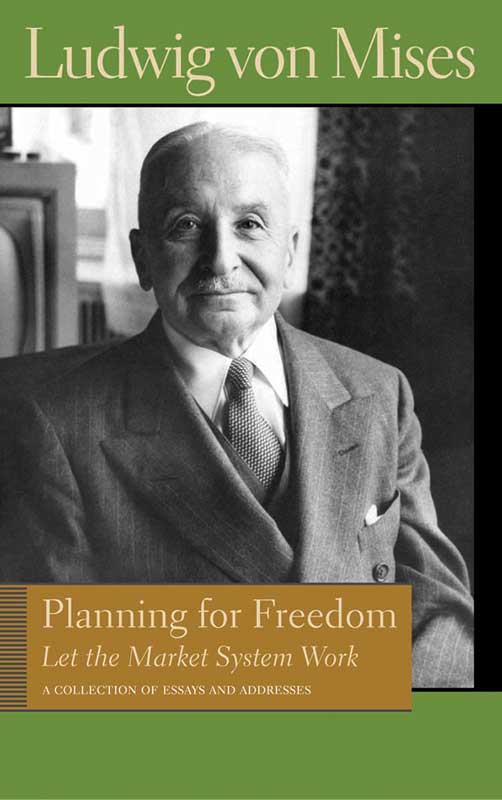
PART 1: The Free Market Economy versus Government Planning - Ludwig von Mises, Planning for Freedom: Let the Market System Work. A Collection of Essays and Addresses [1952]Edition used:Planning for Freedom: Let the Market System Work. A Collection of Essays and Addresses, edited with a Foreword by Bettina Bien Greaves (Indianapolis: Liberty Fund, 2008).
About Liberty Fund:Liberty Fund, Inc. is a private, educational foundation established to encourage the study of the ideal of a society of free and responsible individuals. Copyright information:Published online with the kind permission of the copyright holders, the Foundation for Economic Education. In particular for the following articles: “Laissez Faire or Dictatorship”, “The Gold Problem”, Benjamin M. Anderson Challenges the Philosophy of the Pseudo-Progressives”, “Lord Keynes and Say’s Law”, “Stones into Bread”, “Economic Teaching at the Universities”, and “Trends can Change”. Fair use statement:This material is put online to further the educational goals of Liberty Fund, Inc. Unless otherwise stated in the Copyright Information section above, this material may be used freely for educational and academic purposes. It may not be used in any way for profit.
PART 1The Free Market Economy versus Government PlanningThere is no other planning for freedom and general welfare than to let the market system work. —“Planning for Freedom” The alternative is not plan or no plan. The question is: whose planning? Should each member of society plan for himself or should the paternal government alone plan for all? —“Laissez Faire or Dictatorship” 1Planning for Freedom*“Planning” and InterventionismThe term ‘planning’ is mostly used as a synonym for socialism, communism, and authoritarian and totalitarian economic management. Sometimes only the German pattern of socialism—Zwangswirtschaft* —is called planning, while the term socialism proper is reserved for the Russian pattern of outright socialization and bureaucratic operation of all plants, shops, and farms. At any rate, planning in this sense means all-around planning by the government and enforcement of these plans by the police power. Planning in this sense means full government control of business. It is the antithesis of free enterprise, private initiative, private ownership of the means of production, market economy, and the price system. Planning and capitalism are utterly incompatible. Within a system of planning production is conducted according to the government’s orders, not according to the plans of capitalists and entrepreneurs eager to profit by best filling the wants of the consumers. But the term planning is also used in a second sense. Lord Keynes, Sir William Beveridge, Professor Hansen, and many other eminent men assert that they do not want to substitute totalitarian slavery for freedom. They declare that they are planning for a free society. They recommend a third system, which, as they say, is as far from socialism as it is from capitalism, which, as a third solution of the problem of society’s economic organization, stands midway between the two other systems, and while retaining the advantages of both, avoids the disadvantages inherent in each. These self-styled progressives are certainly mistaken when they pretend that their proposals are new and unheard of. The idea of this third solution is very old indeed, and the French have long since baptized it with a pertinent name; they call it interventionism. Hardly anybody can doubt that history will link the idea of social security, more closely than with the American New Deal and with Sir William Beveridge, with the memory of Bismarck whom our fathers did not precisely describe as a liberal. All the essential ideas of present-day interventionist progressivism were neatly expounded by the supreme brain-trusters of imperial Germany, Professors Schmoller and Wagner, who at the same time urged their Kaiser to invade and to conquer the Americas. Far be it from me to condemn any idea only on account of its not being new. But as the progressives slander all their opponents as old-fashioned, orthodox, and reactionary, it is expedient to observe that it would be more appropriate to speak of the clash of two orthodoxies; the Bismarck orthodoxy versus the Jefferson orthodoxy. InterventionismBefore entering into an investigation of the interventionist system of a mixed economy two points must be clarified: First: If within a society based on private ownership of the means of production some of these means are owned and operated by the government or by municipalities, this still does not make for a mixed system which would combine socialism and private ownership. As long as only certain individual enterprises are publicly controlled, the characteristics of the market economy determining economic activity remain essentially unimpaired. The publicly owned enterprises, too, as buyers of raw materials, semi-finished goods, and labor and as sellers of goods and services must fit into the mechanism of the market economy. They are subject to the law of the market; they have to strive after profits or, at least, to avoid losses. When it is attempted to mitigate or to eliminate this dependence by covering the losses of such enterprises with subsidies out of public funds, the only result is a shifting of this dependence somewhere else. This is because the means for the subsidies have to be raised somewhere. They may be raised by collecting taxes. But the burden of such taxes has its effects on the public, not on the government collecting the tax. It is the market, and not the revenue department, which decides upon whom the tax falls and how it affects production and consumption. The market and its inescapable law are supreme. Second: There are two different patterns for the realization of socialism. The one pattern—we may call it the Marxian or Russian pattern—is purely bureaucratic. All economic enterprises are departments of the government just as the administration of the army and the navy or the postal system. Every single plant, shop, or farm, stands in the same relation to the superior central organization as does a post office to the office of the postmaster general. The whole nation forms one single labor army with compulsory service; the commander of this army is the chief of state. The second pattern—we may call it the German or Zwangswirtschaft system—differs from the first one in that it, seemingly and nominally, maintains private ownership of the means of production, entrepreneur-ship, and market exchange. So-called entrepreneurs do the buying and selling, pay the workers, contract debts, and pay interest and amortization. But they are no longer entrepreneurs. In Nazi Germany they were called shop managers or Betriebsführer. The government tells these seeming entrepreneurs what and how to produce, at what prices and from whom to buy, at what prices and to whom to sell. The government decrees at what wages laborers should work and to whom and under what terms the capitalists should entrust their funds. Market exchange is but a sham. As all prices, wages, and interest rates are fixed by the authority, they are prices, wages, and interest rates in appearance only; in fact they are merely quantitative terms in the authoritarian orders determining each citizen’s income, consumption, and standard of living. The authority, not the consumers, directs production. The central board of production management is supreme; all citizens are nothing but civil servants. This is socialism, with the outward appearance of capitalism. Some labels of the capitalistic market economy are retained, but they signify here something entirely different from what they mean in the market economy. It is necessary to point out this fact to prevent a confusion of socialism and interventionism. The system of hampered market economy or interventionism differs from socialism by the very fact that it is still market economy. The authority seeks to influence the market by the intervention of its coercive power, but it does not want to eliminate the market altogether. It desires that production and consumption should develop along lines different from those prescribed by the unhindered market, and it wants to achieve its aim by injecting into the working of the market orders, commands, and prohibitions for whose enforcement the police power and its apparatus of coercion and compulsion stand ready. But these are isolated interventions; their authors assert that they do not plan to combine these measures into a completely integrated system which regulates all prices, wages, and interest rates, and which thus places full control of production and consumption in the hands of the authorities. How to Raise WagesThe fundamental principle of those truly liberal economists who are nowadays generally abused as orthodox, reactionaries, and economic royalists is this: There are no means by which the general standard of living can be raised other than by accelerating the increase of capital as compared with population. All that good government can do to improve the material well-being of the masses is to establish and to preserve an institutional setting in which there are no obstacles to the progressive accumulation of new capital and its utilization for the improvement of technical methods of production. The only means to increase a nation’s welfare is to increase and to improve the output of products. The only means to raise wage rates permanently for all those eager to earn wages is to raise the productivity of labor by increasing the per-head quota of capital invested and improving the methods of production. Hence, the liberals conclude that the economic policy best fitted to serve the interests of all strata of a nation is free trade both in domestic business and in international relations. The interventionists, on the contrary, believe that government has the power to improve the masses’ standard of living partly at the expense of the capitalists and entrepreneurs, partly at no expense at all. They recommend the restriction of profits and the equalization of incomes and fortunes by confiscatory taxation, the lowering of the rate of interest by an easy money policy and credit expansion, and the raising of the workers’ standard of living by the enforcement of minimum wage rates. They advocate lavish government spending. They are, curiously enough, at the same time in favor of low prices for consumers’ goods and of high prices for agricultural products. The liberal economists, that is, those disparaged as orthodox, do not deny that some of these measures can, in the short run, improve the lot of some groups of the population. But, they say, in the long run they must produce effects which, from the point of view of the government and the supporters of its policies, are less desirable than the previous state of affairs they wanted to alter. These measures are, therefore, when judged from the point of view of their own advocates, contrary to purpose. Depression, the Aftermath of Credit ExpansionIt is true, many people believe that economic policy should not bother at all about long-run consequences. They quote a dictum of Lord Keynes: “In the long run we are all dead.” I do not question the truth of this statement; I even consider it as the only correct declaration of the neo-British Cambridge school. But the conclusions drawn from this truism are entirely fallacious. The exact diagnosis of the economic evils of our age is: we have outlived the short-run and are suffering from the long-run consequences of policies which did not take them into consideration. The interventionists have silenced the warning voices of the economists. But things developed precisely as these much abused orthodox scholars had predicted. Depression is the aftermath of credit expansion; mass unemployment prolonged year after year is the inextricable effect of attempts to keep wage rates above the level which the unhampered market would have fixed. All those evils which the progressives interpret as evidence of the failure of capitalism are the necessary outcome of allegedly social interference with the market. It is true that many authors who advocated these measures and many statesmen and politicians who executed them were impelled by good intentions and wanted to make people more prosperous. But the means chosen for the attainment of the ends aimed at were inappropriate. However good intentions may be, they can never render unsuitable means any more suitable. It must be emphasized that we are discussing means and measures, not ends. The matter at issue is not whether the policies advocated by the self-styled progressives are to be recommended or condemned from any arbitrary preconceived point of view. The essential problem is whether such policies can really attain the ends aimed at. It is beside the mark to confuse the debate by referring to accidental and irrelevant matters. It is useless to divert attention from the main problem by vilifying capitalists and entrepreneurs and by glorifying the virtues of the common man. Precisely because the common man is worthy of all consideration, it is necessary to avoid policies detrimental to his welfare. The market economy is an integrated system of intertwined factors that mutually condition and determine one another. The social apparatus of coercion and compulsion, i.e., the state, certainly has the might to interfere with the market. The government or agencies in which the government, either by legal privilege or by indulgence, has vested the power to apply violent pressure with impunity are in a position to decree that certain market phenomena are illegal. But such measures do not bring about the results which the interfering power wants to attain. They not only render conditions more unsatisfactory for the interfering authority. They disintegrate the market system altogether, they paralyze its operation, they bring about chaos. If one considers the working of the market system as unsatisfactory, one must try to substitute another system for it. This is what the socialists aim at. But socialism is not the subject matter of this meeting’s discussion. I was invited to deal with interventionism, i.e., with various measures designed to improve the operation of the market system, not to abolish it altogether. And what I contend is that such measures must needs bring about results which from the point of view of their supporters are more undesirable than the previous state of affairs they wanted to alter. Karl Marx on LaborKarl Marx did not believe that government or trade union interference with the market can attain the beneficial ends expected. Marx and his consistent followers condemned all such measures in their frank language as reformist nonsense, capitalist fraud, and petty-bourgeois idiocy. They called the supporters of such measures reactionaries. Clemenceau was right when he said: “One is always a reactionary in somebody’s opinion.” Karl Marx declared that under capitalism all material goods and likewise labor are commodities, and that socialism will abolish the commodity character both of material goods and of labor. The notion “commodity character” is peculiar to the Marxian doctrine; it was not used before. Its meaning is that goods and labor are negotiated on markets, are sold and bought on the basis of their value. According to Marx the commodity character of labor is implied in the very existence of the wages system. It can disappear only at the “higher stage” of communism as a consequence of the disappearance of the wages system and of payment of wage rates. Marx would have ridiculed the endeavors to abolish the commodity character of labor by an international treaty and the establishment of an International Labor Office and by national legislation and the allocation of money to various national bureaus. I mention these things only in order to show that the progressives are utterly mistaken in referring to Marx and the doctrine of the commodity character of labor in their fight against the economists whom they call reactionary. Wage Rates and UnemploymentWhat these old orthodox economists said was this: A permanent rise in wage rates for all people eager to earn wages is only possible as far as the per-head quota of capital invested and concomitantly the productivity of labor increases. It does not benefit the people if minimum wage rates are fixed at a level above that which the unhampered market would have fixed. It does not matter whether this tampering with wage rates is done by government decree or by labor union pressure and compulsion. In either case, the outcome is pernicious to the welfare of a great section of the population. On an unhampered labor market wage rates are fixed, by the interplay of demand and supply, at a level at which all those eager to work can finally find jobs. On a free labor market unemployment is temporary only and never affects more than a small fraction of the people. There prevails a continuous tendency for unemployment to disappear. But if wage rates are raised by the interference of government or unions above this level, things change. As long as only one part of labor is unionized, the wage rise enforced by the unions does not lead to unemployment, but to an increased supply of labor in those branches of business where there are no efficient unions or no unions at all. The workers who lost their jobs as a consequence of union policy enter the market of the free branches and cause wages to drop in these branches. The corollary of the rise in wages for organized workers is a drop in wages for unorganized workers. But if fixing of wage rates above the potential market level becomes general, workers losing their jobs cannot find employment in other branches. They remain unemployed. Unemployment emerges as a mass phenomenon prolonged year after year. Such were the teachings of these orthodox economists. Nobody succeeded in refuting them. It was much easier to abuse their authors. Hundreds of treatises, monographs, and pamphlets sneered at them and called them names. Novelists, playwrights, politicians joined the chorus. But truth has its own way. It works and produces effects even if party programs and textbooks refuse to acknowledge it as truth. Events have proved the correctness of the predictions of the orthodox economists. The world faces the tremendous problem of mass unemployment. It is vain to talk about employment and unemployment without precise reference to a definite rate of wages. The inherent tendency of capitalist evolution is to raise real wage rates steadily. This outcome is the effect of the progressive accumulation of capital by means of which technological methods of production are improved. Whenever the accumulation of additional capital stops, this tendency comes to a standstill. If capital consumption is substituted for an increase of capital available, real wage rates must drop temporarily until the checks to a further increase in capital are removed. The malinvestment, i.e., the squandering of capital that is the most characteristic feature of credit expansion and the orgy of the fictitious boom it produces, the confiscation of profits and fortunes, wars and revolutions are such checks. It is a sad fact that they temporarily lower the masses’ standard of living. But these sad facts cannot be brushed away by wishful thinking. There are no other means to remove them than those recommended by the orthodox economists: a sound money policy, thrift in public expenditures, international cooperation for safeguarding durable peace, economic freedom. The remedies suggested by the unorthodox doctrinaires are futile. Their application makes things worse, not better. There are well-intentioned men who exhort union leaders to make only moderate use of their powers. But these exhortations are in vain because their authors do not realize that the evils they want to avoid are not due to lack of moderation in the wage policies of the unions. They are the necessary outcome of the whole economic philosophy underlying union activities with regard to wage rates. It is not my task to inquire what good effects unions could possibly bring about in other fields, for instance in education, professional training, and so on. I deal only with their wage policies. The essence of these policies is to prevent the unemployed from finding jobs by underbidding union rates. This policy splits the whole potential labor force into two classes: the employed who earn wages higher than those they would have earned on an unhampered labor market, and the unemployed who do not earn anything at all. In the early thirties money wage rates in this country dropped less than the cost of living. Hourly real wage rates increased in the midst of a catastrophic spread of unemployment. For many of those employed the depression meant a rise in the standard of living, while the unemployed were victimized. The repetition of such conditions can only be avoided by entirely discarding the idea that union compulsion and coercion can benefit all those eager to work and to earn wages. What is needed is not lame warnings. One must convince the workers that the traditional union policies do not serve the interests of all, but only those of one group. While in individual bargaining the unemployed virtually have a voice, they are excluded in collective bargaining. The union officers do not care about the fate of non-members and especially not about that of beginners eager to enter their industry. Union rates are fixed at a level at which a considerable part of available manpower remains unemployed. Mass unemployment is not proof of the failure of capitalism, but the proof of the failure of traditional union methods. The same considerations apply to the determination of wage rates by government agencies or by arbitration. If the decision of the government or the arbitrator fixes wage rates at the market level, it is superfluous. If it fixes wage rates at a higher level, it produces mass unemployment. The fashionable panacea suggested, lavish public spending, is no less futile. If the government provides the funds required by taxing the citizens or by borrowing from the public, it abolishes on the one hand as many jobs as it creates on the other. If government spending is financed by borrowing from commercial banks, it means credit expansion and inflation. Then the prices of all commodities and services must rise, whatever the government does to prevent this outcome. If in the course of an inflation the rise in commodity prices exceeds the rise in nominal wage rates, unemployment will drop. But what makes unemployment shrink is precisely the fact that real wage rates are falling. Lord Keynes recommended credit expansion because he believed that the wage earners will acquiesce in this outcome; he believed that “a gradual and automatic lowering of real wage rates as a result of rising prices” would not be so strongly resisted by labor as an attempt to lower money wage rates. It is very unlikely that this will happen. Public opinion is fully aware of the changes in purchasing power and watches with burning interest the movements of the index of commodity prices and of cost of living. The substance of all discussions concerning wage rates is real wage rates, not nominal wage rates. There is no prospect of outsmarting the unions by such tricks. But even if Lord Keynes’s assumption were correct, no good could come from such a deception. Great conflicts of ideas must be solved by straight and frank methods; they cannot be solved by artifices and make-shifts. What is needed is not to throw dust into the eyes of the workers, but to convince them. They themselves must realize that the traditional union methods do not serve their interests. They themselves must abandon of their own accord policies that harm both them and all other people. The Role of Profit and LossWhat those allegedly planning for freedom do not comprehend is that the market with its prices is the steering mechanism of the free enterprise system. Flexibility of commodity prices, wage rates and interest rates is instrumental in adapting production to the changing conditions and needs of the consumers and in discarding backward technological methods. If these adjustments are not brought about by the interplay of the forces operating on the market, they must be enforced by government orders. This means full government control, the Nazi Zwangswirtschaft. There is no middle way. The attempts to keep commodity prices rigid, to raise wage rates and to lower interest rates ad libitum only paralyze the system. They create a state of affairs which does not satisfy anybody. They must be either abandoned by a return to freedom of the market, or they must be completed by pure and undisguised socialism. The inequality of income and fortunes is essential in capitalism. The progressives consider profits as objectionable. The very existence of profits is in their eyes a proof that wage rates could be raised without harm to anybody else than idle parasites. They speak of profit without dealing with its corollary, loss. Profit and loss are the instruments by means of which the consumers keep a tight rein on all entrepreneurial activities. A profitable enterprise tends to expand, an unprofitable one tends to shrink. The elimination of profit renders production rigid and abolishes the consumers’ sovereignty. This will happen not because the enterprisers are mean and greedy, and lack these monkish virtues of self-sacrifice which the planners ascribe to all other people. In the absence of profits the entrepreneurs would not learn what the wants of the consumers are, and if they were to guess, they would not have the means to adjust and to expand their plants accordingly. Profits and losses withdraw the material factors of production from the hands of the inefficient and convey them into the hands of the more efficient. It is their social function to make a man the more influential in the conduct of business the better he succeeds in producing commodities for which people scramble. It is therefore beyond the point to apply to profits the yardstick of personal merit or happiness. Of course, Mr. X would probably be as happy with 10 millions as with 100 millions. From a metaphysical point of view, it is certainly inexplicable why Mr. X should make 2 millions a year, while the chief justice or the nation’s foremost philosophers and poets make much less. But the question is not about Mr. X; it is about the consumers. Would the consumers be better and more cheaply supplied if the law were to prevent the most efficient entrepreneurs from expanding the sphere of their activities? The answer is clearly in the negative. If the present tax rates had been in effect from the beginning of our century, many who are millionaires today would live under more modest circumstances. But all those new branches of industry which supply the masses with articles unheard of before would operate, if at all, on a much smaller scale, and their products would be beyond the reach of the common man. The Market System Serves the Common ManThe market system makes all men in their capacity as producers responsible to the consumer. This dependence is direct with entrepreneurs, capitalists, farmers, and professional men, and indirect with people working for salaries and wages. The economic system of the division of labor, in which everybody provides for his own needs by serving other people, cannot operate if there is no factor adjusting the producers’ efforts to the wishes of those for whom they produce. If the market is not allowed to steer the whole economic apparatus, the government must do it. The socialist plans are absolutely wrong and unrealizable. This is another subject. But the socialist writers are at least clear-sighted enough to see that simply to paralyze the market system results in nothing but chaos. When they favor such acts of sabotage and destruction, they do so because they believe that the chaos brought about will pave the way for socialism. But those who pretend that they want to preserve freedom, while they are eager to fix prices, wage rates, and interest rates at a level different from that of the market, delude themselves. There is no other alternative to totalitarian slavery than liberty. There is no other planning for freedom and general welfare than to let the market system work. There is no other means to attain full employment, rising real wage rates, and a high standard of living for the common man than private initiative and free enterprise. 2Laissez Faire or Dictatorship*What the “Encyclopaedia of the Social Sciences” Says about Laissez FaireFor more than a hundred years the maxim laissez faire, laissez passer has been a red rag to harbingers of totalitarian despotism. As these zealots see it, this maxim condenses all the shameful principles of capitalism. To unmask its fallacies is therefore tantamount to exploding the ideological foundations of the system of private ownership of the means of production, and implicitly demonstrating the excellence of its antithesis, viz., communism and socialism. The Encyclopaedia of the Social Sciences may fairly be considered as representative of the doctrines taught at American and British universities and colleges. Its ninth volume contains an article “Laissez Faire” from the pen of the Oxford professor and author of detective stories, G. D. H. Cole. In the five and a quarter pages of his contribution Professor Cole freely indulges in the use of deprecatory epithets. The maxim “cannot stand examination,” it is only prevalent in “popular economics,” it is “theoretically bankrupt,” an “anachronism,” it survives only as a “prejudice,” but “as a doctrine deserving of theoretical respect it is dead.” Resort to these and many other similar opprobrious appellations fails to disguise the fact that Professor Cole’s arguments entirely miss the point. Professor Cole is not qualified to deal with the problems involved because he simply does not know what the market economy is and how it works. The only correct affirmation of his article is the truism that those rejecting laissez faire are Socialists. He is also right in declaring that the refutation of laissez faire is “as prominent in the national idea of Fascism in Italy as in Russian Communism.” The volume which contains Mr. Cole’s article was published in January 1933. This explains why he did not include Nazi Germany in the ranks of those nations which have freed themselves from the spell of the sinister maxim. He merely registers with satisfaction that the conception rejecting laissez faire is “at the back of many projects of national planning which, largely under Russian influence, is now being put forward all over the world.” Laissez Faire Means Free Market EconomyLearned historians have bestowed much pains upon the question to whom the origin of the maxim laissez faire, laissez passer is to be attributed.* At any rate it is certain that in the second part of the eighteenth century the outstanding French champions of economic freedom— foremost among them Gournay, Quesnay, Turgot, and Mirabeau— compressed their program for popular use into this sentence. Their aim was the establishment of the unhampered market economy. In order to attain this end they advocated the abolition of all statutes preventing the more industrious and more efficient people from outdoing the less industrious and less efficient competitors and restricting the mobility of commodities and of men. It was this that the famous maxim was designed to express. In occasionally using the words laissez faire, laissez passer, the eighteenth century economists did not intend to baptize their social philosophy the laissez-faire doctrine. They concentrated their efforts upon the elaboration of a new system of social and political ideas which would benefit mankind. They were not eager to organize a faction or party and to find a name for it. It was only later, in the second decade of the nineteenth century, that a term came to signify the total complex of the political philosophy of freedom, viz., liberalism. The new word was borrowed from Spain where it designated the friends of constitutional government and religious freedom. Very soon it was used all over Europe as a label for the endeavors of those who stood for representative government, freedom of thought, of speech and of the press, private ownership of the means of production, and free trade. The liberal program is an indivisible and indissoluble whole, not an arbitrarily assembled patchwork of diverse components. Its various parts condition one another. The idea that political freedom can be preserved in the absence of economic freedom, and vice versa, is an illusion. Political freedom is the corollary of economic freedom. It is no accident that the age of capitalism became also the age of government by the people. If individuals are not free to buy and to sell on the market, they turn into virtual slaves dependent on the good graces of the omnipotent government, whatever the wording of the constitution may be. The fathers of socialism and modern interventionism were fully aware that their own programs were incompatible with the political postulates of liberalism. The main target of their passionate attacks was liberalism as a whole. They did not make a distinction between the political and the economic aspects of liberalism. But as the years went on, the Socialists and interventionists of the Anglo-Saxon countries discovered that it was a hopeless venture to attack liberalism and the idea of liberty openly. The prestige of liberal institutions was so overwhelming in the English-speaking world that no party could risk defying them directly. Anti-liberalism’s only chance was to camouflage itself as true and genuine liberalism and to denounce the attitudes of all other parties as a mere counterfeit liberalism. The continental Socialists had fanatically smeared and disparaged liberalism and progressivism, and contemptuously derogated democracy as “pluto-democracy.” Their Anglo-Saxon imitators, who at first had adopted the same procedure, after a while reversed their semantics and arrogated to themselves the appellations liberal, progressive and democratic. They began flatly to deny that political freedom is the corollary of economic freedom. They boldly asserted that democratic institutions can work satisfactorily only where the government has full control of all production activities and the individual citizen is bound to obey unconditionally all orders issued by the central planning board. In their eyes all-round regimentation is the only means to make people free, and freedom of the press is best guaranteed by a government monopoly of printing and publishing. They were not plagued by any scruples when they stole the good old name of liberalism and began to call their own tenets and policies liberal. In this country the term “liberalism” is nowadays more often than not used as a synonym for communism. The semantic innovation which the Socialists and interventionists thus inaugurated left the advocates of freedom without any name. There was no term available to call those who believe that private ownership of the material factors of production is the best, in fact, the only means to make the nation and all its individual citizens as prosperous as possible and to make representative government work. The Socialists and interventionists believe that such people do not deserve any name, but are to be referred to only by such insulting epithets as “economic royalists,” “Wall Street sycophants,” “reactionaries,” and so on. This state of affairs explains why the phrase laissez faire was more and more used to signify the ideas of those who advocate the free market economy as against government planning and regimentation. The Cairnes Argument against Laissez FaireToday it is no longer difficult for intelligent men to realize that the alternative is market economy or communism. Production can either be directed by buying and abstention from buying on the part of all people, or it can be directed by the orders of the supreme chief of state. Men must choose between these two systems of society’s economic organization. There is no third solution, no middle way. It is a sad fact that not only politicians and demagogues have failed to see this essential truth, but that even some economists have erred in dealing with the problems involved. There is no need to dwell upon the unfortunate influence which originated from John Stuart Mill’s confused treatment of government interference with business. It becomes evident from Mill’s Autobiography that his change of mind resulting in what he calls “a greater approximation . . . to a qualified socialism”* was motivated by purely personal feelings and affections and not by emotionally undisturbed reasoning. It is certainly one of the tasks of economics to refute the errors which deform the disquisitions of so eminent a thinker as Mill. But it is unnecessary to argue against the prepossessions of Mrs. Mill. A few years after Mill, another outstanding economist, J. E. Cairnes, dealt with the same problem.† As a philosopher and essayist Mill by far supersedes Cairnes. But as an economist Cairnes was not second to Mill, and his contributions to the epistemology of the social sciences are of incomparably greater value and importance than those of Mill. Yet, Cairnes’s analysis of laissez faire does not display that brilliant precision of reasoning which is the distinguishing mark of his other writings. As Cairnes sees it, the assertion implied in the doctrine of laissez faire is that “the promptings of self-interest will lead individuals, in all that range of their conduct which has to do with their material well-being, spontaneously to follow that course which is most for their own good and for the good of all.” This assertion, he says, “involves the two following assumptions: first, that the interests of human beings are fundamentally the same—that what is most for my interest is also most for the interest of other people; and, secondly, that individuals know their interests in the sense in which they are coincident with the interests of others, and that, in the absence of coercion, they will in this sense follow them. If these two propositions be made out, the policy of laissez faire . . . follows with scientific rigour.” Cairnes is disposed to accept the first—the major—premise of the syllogism, that the interests of human beings are fundamentally the same. But he rejects the second—the minor—premise.* “Human beings know and follow their interests according to their lights and dispositions; but not necessarily, nor in practice always, in the sense in which the interest of the individual is coincident with that of others and of the whole.”† Let us for the sake of argument accept the way in which Cairnes presents the problem and in which he argues. Human beings are fallible and therefore sometimes fail to learn what their true interests would require them to do. Furthermore, there are “such things in the world as passion, prejudice, custom, esprit de corps, class interest, to draw people aside from the pursuit of their interests in the largest and highest sense.”‡ It is very unfortunate that reality is such. But, we must ask, is there any means available to prevent mankind from being hurt by people’s bad judgment and malice? Is it not a non sequitur to assume that one could avoid the disastrous consequences of these human weaknesses by substituting the government’s discretion for that of the individual citizens? Are governments endowed with intellectual and moral perfection? Are the rulers not human too, not themselves subject to human frailties and deficiencies? The theocratic doctrine is consistent in attributing to the head of the government superhuman powers. The French royalists contend that the solemn consecration at Rheims conveys to the king of France, anointed with the sacred oil which a dove from Heaven brought down for the consecration of Clovis, divine dispensation. The legitimate king cannot err and cannot do wrong, and his royal touch miraculously cures scrofula. No less consistent was the late German professor Werner Sombart in declaring that Führertum is a permanent revelation and that the Führer gets his orders directly from God, the supreme Führer of the Universe.* Once you admit these premises, you can no longer raise any objections against planning and socialism. Why tolerate the incompetence of clumsy and ill-intentioned bunglers if you can be made happy and prosperous by the God-sent authority? But Cairnes is not prepared to accept “the principle of State control, the doctrine of paternal government.”† His disquisitions peter out in vague and contradictory talk that leaves the relevant question unanswered. He does not comprehend that it is indispensable to choose between the supremacy of individuals and that of the government. Some agency must determine how the factors of production should be employed and what should be produced. If it is not the consumer, by means of buying and abstention from buying on the market, it must be the government by compulsion. If one rejects laissez faire on account of man’s fallibility and moral weakness, one must for the same reasons also reject every kind of government action. Cairnes’s mode of arguing, provided it is not integrated into a theocratic philosophy in the manner of the French royalists or the German Nazis, leads to complete anarchism and nihilism. One of the distortions to which the self-styled “progressives” resort in smearing laissez faire is the statement that consistent application of laissez faire must result in anarchy. There is no need to dwell upon this fallacy. It is more important to stress the fact that Cairnes’s argument against laissez faire, when consistently carried through to its inevitable logical consequences, is essentially anarchistic. “Conscious Planning” versus “Automatic Forces”As the self-styled “progressives” see things, the alternative is: “automatic forces” or “conscious planning.”* It is obvious, they go on saying, that to rely upon automatic processes is sheer stupidity. No reasonable man can seriously recommend doing nothing and letting things go without any interference through purposive action. A plan, by the very fact that it is a display of conscious action, is incomparably superior to the absence of any planning. Laissez faire means: let evils last and do not try to improve the lot of mankind by reasonable action. This is utterly fallacious and deceptive talk. The argument advanced for planning is derived entirely from an inadmissable interpretation of a metaphor. It has no foundation other than the connotations implied in the term “automatic,” which is customarily applied in a metaphorical sense to describe the market process. Automatic, says the Concise Oxford Dictionary, means “unconscious, unintelligent, merely mechanical.” Automatic, says Webster’s Collegiate Dictionary, means “not subject to the control of the will . . . performed without active thought and without conscious intention or direction.” What a triumph for the champion of planning to play this trump-card! The truth is that the choice is not between a dead mechanism and a rigid automatism on the one hand and conscious planning on the other hand. The alternative is not plan or no plan. The question is: whose planning? Should each member of society plan for himself or should the paternal government alone plan for all? The issue is not automatism versus conscious action; it is spontaneous action of each individual versus the exclusive action of the government. It is freedom versus government omnipotence. Laissez faire does not mean: let soulless mechanical forces operate. It means: let individuals choose how they want to cooperate in the social division of labor and let them determine what the entrepreneurs should produce. Planning means: let the government alone choose and enforce its rulings by the apparatus of coercion and compulsion. The Satisfaction of Man’s “True” NeedsUnder laissez faire, says the planner, the goods produced are not those which people “really” need, but those goods from the sale of which the highest returns are expected. It is the objective of planning to direct production toward the satisfaction of “true” needs. But who should decide what “true” needs are? Thus, for instance, Professor Harold Laski, the former chairman of the British Labor Party, determined the objective of planned direction of investment as “the use of the investor’s savings will be in housing rather than in cinemas.”* It does not matter whether or not one agrees with the professor’s personal view that better houses are more important than moving pictures. The fact is that consumers, by spending part of their money for admission to the movies, have made another choice. If the masses of Great Britain, the same people whose votes swept the Labor Party into power, were to stop patronizing the moving pictures and to spend more for comfortable homes and apartments, profit-seeking business would be forced to invest more in building homes and apartment houses, and less in the production of swanky pictures. What Professor Laski aimed at is to defy the wishes of the consumers and to substitute his own will for theirs. He wanted to do away with the democracy of the market and to establish the absolute rule of a production czar. He might pretend that he is right from a “higher” point of view, and that as a superman he is called upon to impose his own set of valuestatic/s on the masses of inferior men. But then he should have been frank enough to say so plainly. All this passionate praise of the super-eminence of government action is merely a poor disguise for the individual interventionist’s self-deification. The Great God State is great only because it is expected to do exclusively what the individual advocate of interventionism wants to be achieved. The only true plan is the one of which the individual planner fully approves. All other plans are simply counterfeit. What the author of a book on the benefits of planning has in mind is, of course, always his own plan alone. No planner was ever shrewd enough to consider the possibility that the plan which the government will put into practice could differ from his own plan. The various planners agree only with regard to their rejection of laissez faire, i.e., the individual’s discretion to choose and to act. They disagree entirely on the choice of the unique plan to be adopted. To every exposure of the manifest and incontestable defects of interventionist policies the champions of interventionism always react in the same way. These faults, they say, were the sins of spurious interventionism; what we are advocating is good interventionism. And, of course, good interventionism is the professor’s own brand only. “Positive” Policies versus “Negative” PoliciesIn dealing with the ascent of modern statism, socialism and interventionism, one must not neglect the preponderant role played by the pressure groups and lobbies of civil servants and those university graduates who longed for government jobs. Two associations were paramount in Europe’s progress toward “social reform”: the Fabian Society in England and the Verein für Sozialpolitik in Germany. The Fabian Society had in its earlier days a “wholly disproportionate representation of civil servants.”* With regard to the Verein für Sozialpolitik, one of its founders and most eminent leaders, Professor Lujo Brentano, admitted that at the beginning it called for no other response than from the civil servants.† It is not surprising that the civil service mentality was reflected in the semantic practices of the new factions. Seen from the point of view of the particular group interests of the bureaucrats, every measure that makes the government’s payroll swell is progress. Politicians who favor such a measure make a positive contribution to welfare, while those who object are negative. Very soon this linguistic innovation became general. The interventionists, in claiming for themselves the appellation “liberal,” explained that they, of course, were liberals with a positive program as distinguished from the merely negative program of the “orthodox” laissez-faire people. Thus he who advocates tariffs, censorship, foreign exchange control, price control supports a positive program that will provide jobs for customs officers, censors, and employees of the offices for price control and foreign exchange control. But free traders and advocates of the freedom of the press are bad citizens; they are negative. Laissez faire is the embodiment of negativism, while socialism, in converting all people into government employees, is 100 percent positive. The more a former liberal completes his defection from liberalism and approaches socialism, the more “positive” does he become. It is hardly necessary to stress that this is all nonsense. Whether an idea is enunciated in an affirmative or in a negative proposition depends entirely on the form which the author chooses to give it. The “negative” proposition, I am against censorship, is identical with the “positive” proposition, I am in favor of everybody’s right to publicize his opinions. Laissez faire is not even formally a negative formula; rather it is the contrary of laissez faire that would sound negative. Essentially, the maxim asks for private ownership of the means of production. This implies, of course, that it rejects socialism. The supporters of laissez faire object to government interference with business not because they “hate” the “state” or because they are committed to a “negative” program. They object to it because it is incompatible with their own positive program, the free market economy.* ConclusionLaissez faire means: let the individual citizen, the much talked-about common man, choose and act and do not force him to yield to a dictator. 3Capital Supply and American Prosperity*One of the amazing phenomena of the present election campaign is the way in which speakers and writers refer to the state of business and to the economic condition of the nation. They praise the administration for the prosperity and for the high standard of living of the average citizen. “You never had it so good,” they say, and, “Don’t let them take it away.” It is implied that the increase in the quantity and the improvement in the quality of products available for consumption are achievements of a paternal government. The incomes of the individual citizens are viewed as handouts graciously bestowed upon them by a benevolent bureaucracy. The American government is considered as better than that of Italy or of India because it passes into the hands of the citizens more and better products than they do. Capital Investment Increases ProductionIt is hardly possible to misrepresent in a more thorough way the fundamental facts of economics. The average standard of living is in this country higher than in any other country of the world, not because the American statesmen and politicians are superior to the foreign statesmen and politicians, but because the per-head quota of capital invested is in America higher than in other countries. Average output per man-hour is in this country higher than in other countries, whether England or India, because the American plants are equipped with more efficient tools and machines. Capital is more plentiful in America than it is in other countries because up to now the institutions and laws of the United States put fewer obstacles in the way of big-scale capital accumulation than did those foreign countries. It is not true that the economic backwardness of foreign countries is to be imputed to technological ignorance on the part of their peoples. Modern technology is by and large no esoteric doctrine. It is taught at many technological universities in this country as well as abroad. It is described in many excellent textbooks and articles of scientific magazines. Hundreds of aliens are every year graduated from American technological institutes. There are in every part of the earth many experts perfectly conversant with the most recent developments of industrial technique. It is not a lack of the “know-how” that prevents foreign countries from fully adopting American methods of manufacturing, but the insufficiency of capital available. Under Capitalism, Individual Responsibility and Thrift Are AppreciatedThe climate of opinion in which capitalism could thrive was characterized by the moral approbation of the individual citizen’s eagerness to provide for his own and his family’s future. Thrift was appreciated as a virtue no less beneficial to the individual saver himself than to all other people. If people do not consume their whole incomes, the non-consumed surplus can be invested, it increases the amount of capital goods available and thereby makes it possible to embark upon projects which could not be executed before. Progressive capital accumulation results in perpetual economic betterment. All aspects of every citizen’s life are favorably affected. The continuous tendency toward an expansion of business activities opens an ample field for the display of the energies of the rising generation. Looking backward upon his youth and the conditions in his parent’s home, the average man cannot help realizing that there is progress toward a more satisfactory standard of living. Such were the conditions in all countries on the eve of the First World War. Conditions were certainly not everywhere the same. There were the countries of Western Capitalism on the one hand, and on the other hand the backward nations which were slow and reluctant in adopting the ideas and the methods of modern progressive business. But these backward nations were amply benefited by the investment of capital provided by the capitalists of the advanced nations. Foreign capital built their railroads and factories and developed their natural resources. The spectacle that the world offers today is very different. As it was forty years ago, the world is divided into two camps. There is, on the one hand, the capitalist orbit, considerably shrunk when compared with its size in 1914. It includes today the United States and Canada and some of the small nations of Western Europe. The much greater part of the earth’s population lives in countries strictly rejecting the methods of private property, initiative, and enterprise. These countries are either stagnating or faced with a progressive deterioration of their economic conditions. United States Living StandardsLet us illustrate this difference by contrasting, as typical of each of the two groups, conditions in this country and those in India. In the United States, capitalist big business almost every year supplies the masses with some novelties: either improved articles to replace similar articles used long since or things which had been altogether unknown before. The latter—as for instance, television sets or nylon hosiery—are commonly called luxuries, as people previously lived rather contented and happy without them. The average common man enjoys a standard of living which, only fifty years ago, his parents or grandparents would have considered as fabulous. His home is equipped with gadgets and facilities which the well-to-do of earlier ages would have envied. His wife and his daughters dress elegantly and apply cosmetics. His children, well fed and cared for, have the benefit of a high school education, many also of a college education. If one observes him and his family on their weekend outings, one must admit that he looks prosperous. There are, of course, also Americans whose material conditions appear unsatisfactory when compared with those of the great majority of the nation. Some authors of novels and plays would have us believe that their gloomy descriptions of the lot of this unfortunate minority is representative of the fate of the common man under capitalism. They are mistaken. The plight of these wretched Americans is rather representative of conditions as they prevailed everywhere in the precapitalistic ages and still prevail in the countries which were either not at all or only superficially touched by capitalism. What is wrong with these people is that they have not yet been integrated into the frame of capitalist production. Their penury is a remnant of the past. The progressive accumulation of new capital and the expansion of big-scale production will eradicate it by the same methods by means of which it has already improved the standard of living of the immense majority, viz., by raising the per-head quota of capital invested and thereby the marginal productivity of labor. India’s Living StandardsNow let us look at India. Nature has endowed its territory with valuable resources, perhaps more richly than the soil of the United States. On the other hand, climatic conditions make it possible for man to subsist on a lighter diet and to do without many things which in the rough winter of the greater part of the United States are indispensable. Nonetheless, the masses of India are on the verge of starvation, shabbily dressed, crammed into primitive huts, dirty, illiterate. From year to year things are getting worse; for population figures are increasing while the total amount of capital invested does not increase or, even more likely, decreases. At any rate, there is a progressive drop in the per-head quota of capital invested. Laissez Faire Ideas Brought Industrialization to EnglandIn the middle of the eighteenth century conditions in England were hardly more propitious than they are today in India. The traditional system of production was not fit to provide for the needs of an increasing population. The number of people for whom there was no room left in the rigid system of paternalism and government tutelage of business grew rapidly. Although at that time England’s population was not much more than fifteen percent of what it is today, there were several millions of destitute poor. Neither the ruling aristocracy nor these paupers themselves had any idea about what could be done to improve the material conditions of the masses. The great change that within a few decades made England the world’s wealthiest and most powerful nation was prepared for by a small group of philosophers and economists. They demolished entirely the pseudo-philosophy that hitherto had been instrumental in shaping the economic policies of the nations. They exploded the old fables: (1) that it is unfair and unjust to outdo a competitor by producing better and cheaper goods; (2) that it is iniquitous to deviate from traditional methods of production; (3) that labor-saving machines bring about unemployment and are therefore an evil; (4) that it is one of the tasks of civil government to prevent efficient businessmen from getting rich and to protect the less efficient against the competition of the more efficient; and (5) that to restrict the freedom and the initiative of entrepreneurs by government compulsion or by coercion on the part of other powers is an appropriate means to promote a nation’s well-being. In short: these authors expounded the doctrine of free trade and laissez faire. They paved the way for a policy that no longer obstructed the businessman’s effort to improve and to expand his operations. What begot modern industrialization and the unprecedented improvement in material conditions that it brought about was neither capital previously accumulated nor previously assembled technological knowledge. In England, as well as in the other Western countries that followed it on the path of capitalism, the early pioneers of capitalism started with scanty capital and scanty technological experience. At the outset of industrialization was the philosophy of private enterprise and initiative, and the practical application of this ideology made the capital swell and the technological know-how advance and ripen. One must stress this point because its neglect misleads the statesmen of all backward nations in their plans for economic improvement. They think that industrialization means machines and textbooks of technology. In fact, it means economic freedom that creates both capital and technological knowledge. India Lacks Capitalist IdeasLet us look again at India. India lacks capital because it never adopted the pro-capitalist philosophy of the West and therefore did not remove the traditional institutional obstacles to free enterprise and big-scale accumulation. Capitalism came to India as an alien imported ideology that never took root in the minds of the people. Foreign, mostly British, capital built railroads and factories. The natives looked askance not only upon the activities of the alien capitalists but no less upon those of their countrymen who cooperated in the capitalist ventures. Today the situation is this: Thanks to new methods of therapeutics, developed by the capitalist nations and imported to India by the British, the average length of life has been prolonged and the population is rapidly increasing. As the foreign capitalists have either already been virtually expropriated or have to face expropriation in the near future, there can no longer be any question of new investment of foreign capital. On the other hand, the accumulation of domestic capital is prevented by the manifest hostility of the government apparatus and the ruling party. The Indian government talks a lot about industrialization. But what it really has in mind is nationalization of already existing privately owned industries. For the sake of argument, we may neglect referring to the fact that this will probably result in a progressive decumulation of the capital invested in these industries as was the case in most of the countries that have experimented with nationalization. At any rate, nationalization as such does not add anything to the already prevailing extent of investment. Mr. Nehru admits that his government does not have the capital required for the establishment of new state-owned industries or for the expansion of such industries already existing. Thus, he solemnly declares that his government will give to private industries “encouragement in every way.” And he explains in what this encouragement will consist: we will promise them, he says, “that we would not touch them for at least ten years, maybe more.” He adds: “We do not know when we shall nationalize them.”* But the businessmen know very well that new investments will be nationalized as soon as they begin to yield returns. Envy Fosters Anti-capitalismI have dwelt so long upon the affairs of India because they are representative of what is going on today almost in all parts of Asia and Africa, in great parts of Latin America and even in many European countries. In all these countries the population is increasing. In all these countries foreign investments are expropriated, either openly or surreptitiously by means of foreign exchange control or discriminatory taxation. At the same time, their domestic policies do their best to discourage the formation of domestic capital. There is much poverty in the world today; and the governments, in this regard in full agreement with public opinion, perpetuate and aggravate this poverty by their policies. As these people see it, their economic troubles were in some unspecified way caused by the capitalist countries of the West. This notion included, until a few years ago, also the advanced nations of Western Europe, especially also the United Kingdom. With recent economic changes, the number of nations to which it refers has been more and more restricted; today it means practically only the United States. The inhabitants of all those countries in which the average income is considerably lower than in this country look upon the United States with the same feelings of envy and hatred with which within the capitalist countries those voting the ticket of the various communist, socialist and interventionist parties look upon the entrepreneurs of their own nation. The same slogans that are employed in our domestic antagonisms—such as Wall Street, big business, monopolies, merchants of death—are resorted to in speeches and articles by the anti-American politicians when they are attacking what is called in Latin America, Yankeeism, and in the other hemisphere, Americanism. In these effusions there is little difference between the most chauvinistic nationalists and the most enthusiastic adepts of Marxian internationalism, between the self-styled conservatives eager to preserve traditional religious faith and political institutions, and the revolutionaries aiming at the violent overthrow of all that exists. The popularity of these ideas is by no means an effect of the inflammatory propaganda of the Soviets. It is just the other way round. The communist lies and calumnies get their persuasiveness, whatever it may be, from the fact that they agree with the socio-political doctrines taught at most of the universities and held by the most influential politicians and writers. Anti-capitalistic Ideas Are WorldwideThe same ideas dominate the minds in this country and determine the attitude of statesmen with regard to all the problems concerned. People are ashamed of the fact that American capital developed the natural resources in many countries which lacked both the capital and the trained specialists required. When various foreign governments expropriated American investments or repudiated loans granted by the American saver, the public either remained indifferent or even sympathized with the expropriators. With the ideas underlying the programs of the most influential political groups and taught at most of the educational institutions, no other reaction could be expected. Four years ago there assembled in Amsterdam the World Council of Churches, an organization of one-hundred-and-fifty-odd denominations. We read in the report drafted by this ecumenical body the following statement: “Justice demands that the inhabitants of Asia and Africa should have the benefits of more machine production.” This implies that the technological backwardness of these nations has been caused by an injustice committed by some individuals, groups of individuals or nations. The culprits are not specified. But it is understood that the indictment refers to the capitalists and businessmen of the shrinking number of capitalist countries, practically to the United States and Canada. Such is the opinion of very judicious conservative churchmen acting in full awareness of their responsibilities. The same doctrine is at the bottom of the foreign aid and the Point Four policies of the United States. It is implied that the American taxpayers have the moral obligation to provide capital for nations that have expropriated foreign investments and are preventing the accumulation of domestic capital by various schemes. There is no use indulging in wishful thinking. Under the present state of international law foreign investments are unsafe and at the mercy of each sovereign nation’s government. It is generally agreed that every sovereign government has the right to decree a fictitious parity of its inflated currency as against dollars or gold and to try to enforce this arbitrarily fixed spurious parity by foreign exchange control, that is, by virtually expropriating foreign investors. As far as some foreign governments still abstain from such confiscations, they do so because they hope to talk foreigners into more investments and thus to be later in a position to expropriate more. In the ranks of those nations that do all that can be done to prevent their industries from getting badly needed capital, we find today also Great Britain, once the cradle of free enterprise and before 1914 the world’s richest or second richest country. In exuberant and entirely un-deserved praise of the late Lord Keynes, a Harvard professor found in his hero but one weakness. Keynes, he said, “always exalted what was at any moment truth and wisdom for England into truth and wisdom for all times and places.”* I heartily disagree. Just at the moment in which it must have become manifest to every judicious observer that England’s economic distress was caused by an insufficient supply of capital, Keynes enounced his notorious doctrine of the alleged dangers of saving and passionately recommended more spending. Keynes tried to provide a belated and spurious justification of a policy that Great Britain had adopted in defiance of the teachings of all its great economists. The essence of Keynesianism is its complete failure to conceive the role that saving and capital accumulation play in the improvement of economic conditions. Importance of Capital SavingsThe main problem for this country is: Will the United States follow the course of the economic policies adopted by almost all foreign nations, even by many of those which had been foremost in the evolution of capitalism? Up to now in this country the amount of savings and formation of new capital still exceeds the amount of dissaving and decumulation of capital. Will this last? To answer such a question one must look upon the ideas about economic matters held by public opinion. The question is: Do the American voters know that the unprecedented improvement in their standard of living that the last hundred years brought was the result of the steady rise in the per-head quota of capital invested? Do they realize that every measure leading to capital decumulation jeopardizes their prosperity? Are they aware of the conditions that make their wage rates tower above those of other countries? If we pass in review the speeches of political leaders, the editorials of newspapers and textbooks of economics and finance, we cannot help discovering that very little attention, if at all, is paid to the problems of capital equipment. Most people take it simply for granted that some mysterious factor is operative that makes the nation richer from year to year. Government economists have computed a rate of yearly increase in the national income for the past fifty years and blithely assume that in the future the same rate will prevail. They discuss problems of taxation without even mentioning the fact that our present tax system collects large funds, which would have been saved by the taxpayer, and employs them for current expenditure. A typical instance of this mode of dealing (or rather, nondealing) with the problem of America’s capital supply may be cited. A few days ago the American Academy of Political and Social Science published a new volume of its Annals, entirely devoted to the investigation of vital issues of the nation. The title of the volume is Meaning of the 1952Presidential Election. To this symposium Professor Harold M. Groves of the University of Wisconsin contributed an article, “Are Taxes Too High?” The author comes out “with a largely negative answer.” From our point of view, the most interesting feature of the article is the fact that it reaches this conclusion without even mentioning the effects which taxes on income, corporations, excess profits and estates have upon the maintenance and formation of capital. What economists have said about these problems either remained unknown to the author or he does not consider it worthy of an answer. One does not misrepresent the economic ideas determining the course of American policies if one blames them for not being conscious of the role the supply of new capital plays in improving and expanding production. An instructive example has been provided by the conflict between the government and business concerning the adequacy of depreciation quotas under inflationary conditions. In all the agitated debates concerning profits, taxes and the height of wage rates the capital supply is hardly mentioned, if at all. In comparing American wage rates and standards of living with those of foreign countries, most authors and politicians fail to stress the differences in the per-head quotas of capital invested. In the latest forty years American taxation more and more adopted methods which considerably slowed down the pace of capital accumulation. If it continues along this line, it will one day reach the point at which no further increase in capital will be possible, or even decumulation will set in. There is only one way open to stop this evolution in time and to spare this country the fate of England and France. One must substitute sound economic ideas for fables and illusions. Scarcity of CapitalUp to this point I have employed the terms capital shortage and scarcity of capital without further explication and definition. This was quite sufficient as long as I dealt primarily with the conditions of countries whose capital supply appears as inadequate when compared with the supply in more advanced countries, especially in the economically most advanced country, the United States. But in examining American problems, a more searching interpretation of terms is required. Strictly speaking, capital has always been scarce and will always be. The available supply of capital goods can never become so abundant that all projects, the execution of which could improve the material well-being of people, could be undertaken. If it were otherwise, mankind would live in the Garden of Eden and would not have to bother at all about production. Whatever the state of the capital supply may be, in this real world of ours there will always be business projects that cannot be launched because the capital they would require is employed for other enterprises, the products of which are more urgently asked for by the consumers. In every branch of industry there are limits beyond which the investment of additional capital does not pay. It does not pay because the capital goods concerned can find employment in the production of goods which are in the eyes of the buying public more valuable. If, other things being equal, the supply of capital increases, projects which hitherto could not be undertaken become profitable and are started. There is never a lack of investment opportunities. If there is lack of opportunities for profitable investment, the reason is that all the capital goods available have already been invested in profitable projects. In speaking of the capital shortage of a country that is poorer than other countries one does not refer to this phenomenon of the general and perpetual shortage of capital. One merely compares the state of affairs in this individual country with that of other countries in which capital is more abundant. Looking upon India one may say: Here are a number of artisans producing with a total capital of ten thousand dollars products with the market value of, let us say, one million dollars. In an American factory with a capital equipment of one million dollars the same number of workers turn out products with the market value of 500 times as many dollars. Indian businessmen unfortunately lack the capital to make such investments. The consequence is that productivity per man is lower in India than in America, that the total amount of goods available for consumption is smaller and that the average Indian is poor when compared with the average American. There is, especially under inflationary conditions, no reliable standard available that could be applied in measuring the degree of the scarcity of capital. Where it is impossible to compare a country’s conditions with those of countries in which the supply of capital is more plentiful, as is the case with this country, only comparisons with the hypothetical size of the capital supply (as it would have been if certain things had not happened) are possible. There is in such a country no phenomenon that would present itself as capital scarcity so clearly and manifestly as the capital scarcity presents itself today to the people of India. All that can be said is: If in our nation people had saved more in the past, some improvements in technological methods (and lateral expansion of production by duplication of equipment of the kind already in existence for which the capital required is lacking) would have been feasible. “Soak the Rich” TaxationIt is not easy to explain this state of affairs to people misled by the passionate anti-capitalistic agitation. As the self-styled intellectuals see it, the capitalist system and the greed of the businessmen are to blame for the fact that the total sum of products turned out for consumption is not greater than it actually is. The only way to do away with poverty they know is to take away—by means of progressive taxation—as much as possible from the well-to-do. In their eyes the wealth of the rich is the cause of the poverty of the poor. In accordance with this idea the fiscal policies of all nations and especially also of the United States were in the last decades directed toward confiscating ever-increasing portions of the wealth and income of the higher brackets. The greater part of the funds thus collected would have been employed by the taxpayers for saving and additional capital accumulation. Their investment would have increased productivity per man-hour and would in this way have provided more goods for consumption. It would have raised the average standard of living of the common man. If the government spends them for current expenditure, they are dissipated and capital accumulation is concomitantly slowed down. Whatever one may think about the reasonableness of this policy of soaking the rich, it is impossible to deny the fact that it has already reached its limits. In Great Britain the Socialist Chancellor of the Exchequer had to admit a few years ago that even total confiscation of all that has still been left to people with higher incomes would add only a quite negligible sum to internal revenue and that there can no longer be any question of improving the lot of the indigent by taking it away from the rich. In this country a total confiscation of incomes above twenty-five thousand dollars would at best yield much less than one billion dollars, a very small sum indeed when compared with the size of our present budget and the probable deficit. The main principle of the financial policies of the self-styled progressives has been pursued to the point at which it defeats itself and its absurdity becomes manifest. The progressives are at their wit’s end. Henceforth, if they want to expand public expenditure further, they will have to tax more heavily precisely those classes of voters for whose support they have hitherto canvassed by placing the main burden upon the shoulders of the minority of wealthier people. (A very embarrassing dilemma indeed for the next Congress.) To Raise Wages, Increase Capital InvestmentBut it is exactly the perplexity of this situation that offers a favorable opportunity for the substitution of sound economic principles for the pernicious errors that prevailed in the last decades. Now is the time to explain to the voters the causes of American prosperity on the one hand, and of the plight of the backward nations on the other hand. They must learn that what makes American wage rates much higher than those in other countries is the size of capital invested and that any further improvement of their standard of living depends on a sufficient accumulation of additional capital. Today only the businessmen worry about the provision of new capital for the expansion and improvement of their plants. The rest of the people are indifferent with regard to this issue, not knowing that their well-being and that of their children is at stake. What is needed is to make the importance of these problems understood by everybody. No party platform is to be considered as satisfactory that does not contain the following point: As the prosperity of the nation and the height of wage rates depend on a continual increase in the capital invested in its plants, mines and farms, it is one of the foremost tasks of good government to remove all obstacles that hinder the accumulation and investment of new capital. [* ] Address delivered before the American Academy of Political and Social Science, Philadelphia, Pa., March 30, 1945. [* ] [Editor’s note: “Zwang (German), compulsion; Wirtschaft (German), economy; hence, “compulsory economy.”] [* ] Originally published in Plain Talk, January 1949. Reprinted with permission from the Foundation for Economic Education. [* ] Cf. especially A. Oncken, Die Maxime laissez faire et laissez passer, ihr Ursprung, ihr Werden, Bern 1886; G. Schelle, Vincent de Gournay, Paris 1897, pp. 214–26. [* ] Cf. John Stuart Mill, Autobiography, London 1873, p. 191. [† ] Cf. J. E. Cairnes, “Political Economy and Laissez Faire,” an introductory lecture delivered in University College, London, November, 1870; reprinted in Essays in Political Economy, London 1873, pp. 232–64. [* ] Cf. Cairnes, l.c., pp. 244–45. [† ] Cf. Cairnes, l.c., p. 250. [‡ ] Cf. Cairnes, l.c., p. 246. [* ] Cf. W. Sombart, Deutscher Sozialismus, Charlottenburg 1934, p. 213 (American edition: A New Social Philosophy, translated by K. F. Geiser, Princeton 1937, p. 194). [† ] Cf. Cairnes, l.c., p. 251. [* ] Cf. A. H. Hansen, “Social Planning for Tomorrow,” in The United States after the War, Cornell University Lectures, Ithaca 1945, pp. 32–33. [* ] Cf. Laski’s broadcast, Revolution by Consent, reprinted in Talks, Vol. X, Number 10, p. 7 (October 1945). [* ] Cf. A. Gray, The Socialist Tradition Moses to Lenin, London 1946, p. 385. [† ] Cf. L. Brentano, Ist das “System Brentano” zusammengebrochen?, Berlin 1918, p. 19. [* ] The present writer refuted this distinction between “positive” and “constructive” socialism and interventionism on the one hand, and “negative” liberalism of the laissez-faire type on the other in his article “Sozialliberalismus,” first published in 1926 in Zeitschrift für die Gesamte Staatswissenschaft, and reprinted in 1929 in his book Kritik des Interventionismus, pp. 55–90. [Editor’s note: This article was translated as “Social Liberalism” and published in A Critique of Interventionism (New Rochelle, N. Y.: Arlington House, 1977), pp. 71–106; 2d revised ed., Critique of Interventionism (Irvington-on-Hudson, N. Y.: Foundation for Economic Education, 1996), pp. 43–70.] [* ] Address delivered before the University Club of Milwaukee (Wisconsin) on October 13, 1952. [* ] Cf. Jawaharlal Nehru, Independence and After: A Collection of Speeches, 1946–1949, New York 1950, page 192. [* ] Cf. J. Schumpeter, “Keynes, the Economist,” in The New Economics, ed. by S. E. Harris, New York 1947, page 85. |

Titles (by Subject)