EconlibThe LibraryOther Sites |
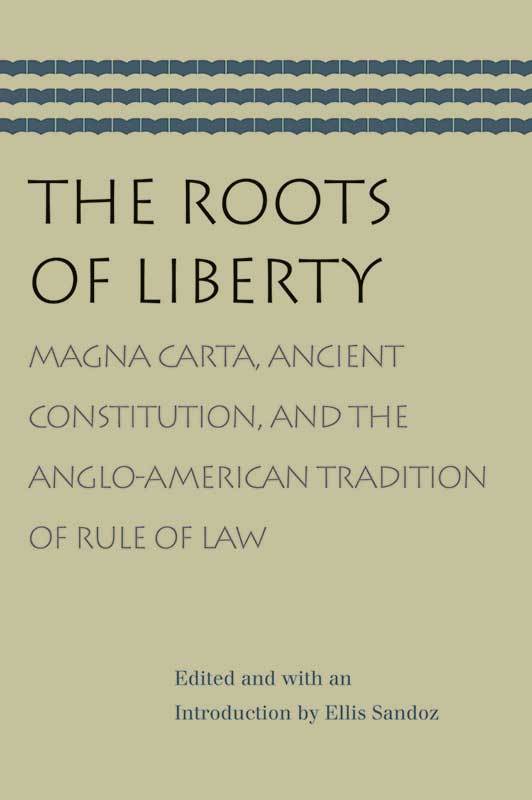
Front Page Titles (by Subject) 3.: Ancient Constitutions in the Age of Sir Edward Coke and John Selden (Paul Christianson) - The Roots of Liberty: Magna Carta, Ancient Constitution, and the Anglo-American Tradition of Rule of Law
Return to Title Page for The Roots of Liberty: Magna Carta, Ancient Constitution, and the Anglo-American Tradition of Rule of LawThe Online Library of LibertyA project of Liberty Fund, Inc.Search this Title:Also in the Library:
3.: Ancient Constitutions in the Age of Sir Edward Coke and John Selden (Paul Christianson) - Ellis Sandoz, The Roots of Liberty: Magna Carta, Ancient Constitution, and the Anglo-American Tradition of Rule of Law [1993]Edition used:The Roots of Liberty: Magna Carta, Ancient Constitution, and the Anglo-American Tradition of Rule of Law, edited and with an Introduction by Ellis Sandoz (Indianapolis: Liberty Fund, 2008).
About Liberty Fund:Liberty Fund, Inc. is a private, educational foundation established to encourage the study of the ideal of a society of free and responsible individuals. Copyright information:The copyright to this edition, in both print and electronic forms, is held by Liberty Fund, Inc. except for the translations into English of Fortescue made by S.B. Chrimes which is held by Cambridge University Press 1942. Fair use statement:This material is put online to further the educational goals of Liberty Fund, Inc. Unless otherwise stated in the Copyright Information section above, this material may be used freely for educational and academic purposes. It may not be used in any way for profit.
3.Ancient Constitutions in the Age of Sir Edward Coke and John SeldenDebate over the nature and shape of the constitution became very intense at times in early seventeenth-century England, in part because many viable alternatives jostled for hegemony. Although some historians continued to characterize these disputes as a struggle for sovereignty between the crown and parliament (in reality, between the king and the House of Commons) into the 1950s, Margaret Judson had already softened the edges of confrontation and J. G. A. Pocock had provided a cosmopolitan model for hearing the historical voices of both common and civil lawyers. Other historians of political thought tempered the threats of “divine right” monarchy by placing it within wider intellectual contexts. While accounts of parliaments centering on the clash between the king and the Commons continued to appear into the 1970s, such historians as J. S. Roskell, John Kenyon, and G. R. Elton had begun to question this interpretative pattern in the 1960s. During the later 1970s, a host of revisionist studies, with Conrad Russell’s book as the flagship, not only gave greater prominence to the court and the Lords than had other recent accounts, but also replaced the pattern of opposition with one of the search for consensus.1 So far had many historians moved away from the traditional interpretation by 1978 that J. H. Hexter could ask: “Why has the matter of liberty and the rule of law on the one hand and lawless rule and despotism or tyranny on the other slipped out of focus in the cleverest writing of the past fifty years about the causes of the English Revolution?” Questions sometimes obtain unanticipated answers, and recently absolutist versus constitutionalist interpretations have received a good deal of attention from such literary and art historians as Jonathan Goldberg, Stephen Orgel, and Roy Strong, and an even more carefully stated presentation by the historian of political thought Johann Sommerville.2 From the works of divines, civil lawyers, and, to a lesser extent, playwrights, Sommerville documented the existence of absolutist political ideas in early Stuart England, stressed their rational coherence, and argued that they vied for dominance with natural law constitutionalist theories and the less coherent interpretations of common lawyers. Those historians and literary critics who have stressed the conflict between absolute monarchy and parliamentary rule as the key to the constitutional disputes of early Stuart England have taken the publications of James VI in Scotland as the key to understanding the discourse of James I and Charles I in England. The line from the Trew Law and the Basilikon Doron to the masques and paintings of the reign of Charles I appeared undeviating. What James wrote in the 1590s governed royal political thought during the first four decades of the seventeenth century. However, during the past decade a number of historians have begun to notice greater nuances of constitutional disagreement, especially during the early part of the reign of Charles I, as seen in the works of Glen Burgess, Thomas Cogswell, Richard Cust, John Reeve, Malcolm Smuts, and myself.3 Drawing upon recent studies and a modification of the model of the ancient constitution first articulated by Pocock, this essay will make a chronological analysis of selected portions of the discourse of constitutional dispute in the period before 1630. It will argue that James changed his discourse in 1610 by fashioning an interpretation of “constitutional monarchy created by kings” which vied for hegemony with at least two other versions of the ancient constitution, “constitutional monarchy governed by the common law” and “mixed monarchy,” voiced in the same year by Thomas Hedley and John Selden. Although James continued to derive his power from God in arguments against the claims of papal supremacy (as noted by Sommerville), absolutist arguments only began to impinge upon domestic affairs in justifications for the loan of 1627 (as noted by Cust) and became an important stream of discourse only during the 1630s (as noted by Reeve). The first half of the essay will concentrate upon the interpretations fashioned by James, Hedley, and Selden in 1610 and upon treatises written by common lawyers during the following decade. The second half will concentrate upon and illustrate the clash of constitutionalist positions in the parliamentary session of 1628, especially in the debates leading up to the drafting and passage of the Petition of Right. Although covering only a small portion of the debates over the distribution and exercise of power which took place in early seventeenth-century England, such thick descriptions from the second decade and the end of the third decade should provide a plentiful illustration of the rich discourse on the ancient constitution uttered by a wide variety of voices. Schooled in Reformed theology and practiced in the civil law tradition of Scotland, King James VI published such cogent absolutist works as The Trew Law of Free Monarchies (Edinburgh, 1598) and Basilikon Doron (Edinburgh, 1599), both reprinted in London in 1603. Written more in theological than in civil law discourse, the Trew Law briefly set down “the trew grounds, whereupon I am to build, out of the Scriptures, since Monarchie is the trew paterne of Divinitie . . . next from the fundamental Lawes of our owne Kingdome . . . thirdly, from the law of Nature, by divers similitudes drawn out of the same.” The scriptures showed that “Kings are called Gods by the propheticall King David, because they sit upon GOD his Throne in the earth, and have the count of their administration to give unto him.” Kings hold their power from God and account to him alone. Nature reinforces the rule of one through patriarchy: “By the Law of Nature the King becomes a naturall Father to all his Lieges at his Coronation: And as the Father of his fatherly duty is bound to care for the nourishing, education, and vertuous government of his children; even so is the king bound to care for all his subjects.” As well as fitting into the assumptions of a patriarchal society, the image of father and children resonated with language commonly used to describe the relationship of God with his people. In the “fundamental laws” of Scotland, kings held both a logical and a historical priority of place. Recounting the establishment of a kingdom in Scotland by Fergus and his successors, James combined a negative blast against the writings of George Buchanan, his tutor, with a positive vision in which wise kings accepted by barbarians created the kingdom of the Scots; “before any Parliaments were holden,” the kings of Scotland distributed the land, “devised and established” the “formes of government,” and “were the authors and makers of the Lawes.”4 According to James VI, the laws of God, nature, and Scotland combined to place sovereignty in the hands of the king. In return, subjects had the duty to obey. Although a similar theory of absolute monarchy marked his arguments against Catholic divines, it found little public voice in the speeches of James I in his new kingdom. After ascending the throne of England, the British monarch displayed considerable discretion. In 1604 and 1605, the addresses delivered at the opening of the sessions of parliament contained little constitutional content, while that of 1607 tactfully stressed the positive role of parliaments in making and revising laws. However, in some of the early programs of his reign, such as the union between England and Scotland and Bate’s Case on impositions judged in the Exchequer, some of his new subjects perceived a threat to the common law of England. In 1607, James spoke of the union of laws largely from a universalist perspective and tended to interpret the common law as a “municipal law,” just one local variation on the universal principles best expressed in the Roman law and capable of improvement if codified, extended, and interpreted according to civil law principles. Although aiming at reconciliation, James made what common lawyers must have perceived as a dangerous attack upon the “obscuritie” and “want of fulnesse” in the unwritten nature and particular principles of English customs. During the next decade, a host of common lawyers would defend the certainty of English judgments; however, the call for a codification of the common law by parliament had the support of such luminaries as Sir Edward Coke. For those who attempted a charitable construction, James tipped his hand by discussing the civil law prerogative of sovereigns to grant citizenship, for “in such a question wherein no positive Law is resolute, Rex est Judex [the king is the judge], for he is Lex loquens [a speaking law], and is to supply the Law,” a privilege which he hastened to decline to put into action.5 In 1607, James had not yet learned to speak in language appropriate to the common law. CONSTITUTIONAL MONARCHY CREATED BY KINGSThe discourse of the king changed, however, in a creative speech delivered to both Houses on March 21, 1610, in which James fashioned a case for “constitutional monarchy created by kings.” This interpretation clearly echoed one side of the medieval common law legacy, the branch that stressed the creative initiatives of kings. Caught in a dilemma, James sought to dissociate himself from the interpretations of the royal prerogative made in The Interpreter, a book recently published by John Cowell, the professor of civil law at Cambridge. In one passage, Cowell had argued that the king of England was “above the Law by his absolute power” and in another that “simply to binde the prince to or by these laws [of England], were repugnant to the nature and constitution of an absolute monarchy.” Pushing to an extreme the not entirely dissimilar ideas expressed in the Trew Law, Cowell’s interpretation of royal power had come under very strong attack in the House of Commons. Attempting to maintain some continuity with his published writings and yet to adapt his theory to the English situation, King James opened his speech by comparing the powers of kings with that of God: “The State of monarchie is the supremest thing upon earth: For Kings are not onely gods Lieutenants upon earth and sit upon gods throne, but even by goD himselfe they are called Gods.” Kings derive their authority from God. James needed to maintain this position on the powers of kings in the abstract for his polemics against Roman Catholic writers, but here he also distinguished “betweene the generall power of a King in Divinity, and the settled and established State of this Crowne, and Kingdome.” 6 The “divine right” of kings remained a powerful part of the argument throughout the speech, but now took a new historical and covenantal twist. A transitional sentence in which the British monarch distinguished between the unlimited powers of “Kings in their first originall” and the limited powers of “setled Kings and Monarches, that doe at this time governe in civill Kingdomes” marked the shift. Just as God had come to govern “his people and Church within the bounds of his reveiled will,” So in the first originall of Kings, whereof some had their beginning by Conquest, and some by election of the people, their wills at that time served for Law; Yet how soone Kingdomes began to be setled in civilitie and policie, then did Kings set down their minds by Lawes, which are properly made by the King onely; but at the rogation of the people, the Kings grant being obteined thereunto. And so the King became to be Lex loquens, after a sort, binding himselfe by a double oath to the observation of the fundamentall Lawes of his kingdom: Tacitly, as by being a King, and so bound to protect aswell the people, as the Lawes of the Kingdome; And Expresely, by his oath at his Coronation: So as every just King in a setled Kingdome is bound to observe that paction made to his people by his Lawes, in framing his government agreeable thereunto, according to that paction which God made with Noe after the deluge, Here after Seed-time, and Harvest, Cold and Heate, Summer and Winter, and Day and Night shall not cease, so long as the earth remaines. And therefore a King governing in a setled Kingdome leaves to be a King, and degenerates into a Tyrant, as sone as he leaves off to rule according to his Lawes.7 This passage worked the themes and imagery of earlier speeches and writings into a new mode of discourse in which “Kings set down their minds by Lawes,” binding upon themselves and their successors; the coronation oath was a formal “covenant” by the king to observe “the fundamentall Lawes of the Kingdome” and held just as strongly as “that paction which God made with Noe after the deluge,” which would last until the end of the earth. This looks like a direct contradiction of one of Cowell’s contentions. The stress placed upon the covenant of God and kings changed the relationship of an individual king to the law in a “civil kingdom.” Kings ruled by arbitrary will only at the start of societies; in making law they restricted their own freedom of action and that of their successors.8 Just as God chose to channel his grace through the church, so kings chose to exercise their power through courts of law and parliaments; like God, they could not go back on their word. In one imaginative leap, James had subverted the derivation of political power from the people argued in the standard constitutionalist position, appropriated the strengths of constitutional government (stability and the consent of the community of the realm), and still maintained the creative initiatives of monarchs. The arbitrary power of early kings gave place to the greater stability of established laws and practices. Although pointedly declaring his faith in the common law in this speech, James also expressed a desire to preserve the study of the civil law at English universities, both as a civilizing influence and as a means of communicating with foreign nations. Here he mirrored the receptionist view of the common lawyers, that is, that the common law had “received” useful portions of the Roman and canon laws and allowed these to operate only within the limits established by custom or statute. To distance himself from Cowell and assuage any fears that he meant to favor the Roman or civil law, James stressed that it should remain “so bounded, (I meane to such Courts and Causes) as have beene in ancient use; As the Ecclesiastical Courts, Court of Admiraltie, Court of Requests, and such like,” while “reserving ever to the Common Law” all matters “concerning the Kings Prerogative, or the possessions of Subjects, in any questions, either betweene the King, and any of them, or amongst themselves, in the points of Meum et tuum [mine and yours].” Encompassing such “fundamentall Lawes of this Kingdome,” the common law provided a firm support for monarchy. 9 This discourse proclaimed that James had set aside both the natural law absolutism and much of the theological mentality displayed in his earlier works. What some listeners may have perceived as a universalist perspective still intruded into the observation that Scotland, France, and Spain were governed not “meerely by the Civill Law, but every one of them hath their owne municipall Lawes agreeable to their Customes, as this Kingdome hath the Common Law.” This seemed to reduce the common law to mere municipal custom. Defensive common lawyers also may have perceived a threat in the king’s reiterated plea that aspects of the common law “be purged and cleared” by “the advise of Parliament.” James asked for three major reforms: first, the writing of the law in “our vulgar Language: for now it is in an old, mixt, and corrupt Language, onely understood by Lawyers”; second, the production of “a setled Text in all Cases . . . so that the people should not depend upon the bare opinions of Judges, and uncertain Reports”; and third, the review and reconciliation of statutes, reports, and precedents. Such a codification of the common law by act of parliament would have diminished the powers of judges and juries to create customs; on the other hand, it would have enhanced the recognition that the monarch, peers, and representatives of the commons made law: “For the King with his Parliament here [in England] are absolute, (as I understand) in making or forming any sort of Lawes.” 10 Emphasizing the crucial role of statute, James proclaimed that absolute lawmaking power in England resided with the king-in-parliament. This marked a significant transformation of his earlier absolutist discourse. Within a few years of becoming king of England, James VI and I tentatively had come to understand the affinity of the common law for the initiatives of princes and had fashioned traditional common law discourse into a cogently argued interpretation of constitutional monarchy which retained the initiative for governing in the hands of the crown. Of course, plenty of room still existed for debate over the nature of the ancient constitution of England. More than hints of civil law discourse continued to trouble relations between King James and members of his first parliament. Despite royal warnings, members of the House of Commons continued to attack the judgment of the Exchequer in Bate’s Case, which had upheld the legality of impositions. Informed of this, the king returned from Thet-ford and on May 21 lectured members of the lower House about the impropriety of such debates. Although defending his right to impositions from English precedents, James could not resist the comparative perspective normally taken by civil lawyers in arguing that “all kings Christian as well elective as successive have power to lay impositions. I myself in Scotland before I came higher, Denmark, Sweden that is but newly successive, France, Spain, all have this power.” Specifically refuting three sorts of arguments against impositions, James spent considerable effort in warning against the dangers of limiting the discretionary powers of the crown: You must not set such laws as make the shadows of kings and dukes of Venice; no Christians but papists and puritans were ever of that opinion. If you have a good king you are to thank God, if an ill king he is a curse to the people but preces et lachrimae [prayers and tears] were ever their arms. But may you therefore bridle him? Shall I turn this upon you, you have many privileges yourselves but because heady and ill-disposed men may abuse them, therefore shall you not have them? Only “papists and puritans” favored ascending theories of constitutional government. By subverting the reciprocity of trust between prince and people, such attacks upon the prerogatives of kings also weakened the privileges of members of parliament. Having defended his rights against attacks made in the Commons, James ended this portion of the speech by offering a token of peace, the promise that he would not increase impositions during his lifetime without first consulting parliament.11 However, this promise came too late to dampen the fears aroused by what members of the Commons perceived as the application of civil law discourse to the English constitution. The interpretations voiced by King James soon engendered replies from a host of common lawyers sitting in the House of Commons. In the insular voice of his colleagues, Nicholas Fuller noted that although “the King were in truth very wise yet is he a stranger to this government” and offered to remedy this situation: “The King speaks of France and Spain what they may do, I pray let us be true to the King and true to ourselves and let him know what by the laws of England he may do.” Apparently, the chancellor, justices of the King’s Bench and Common Pleas, attorney general, and solicitor general could not tell the king what he might do by the common law as well as could the attorneys sitting in the House of Commons! The dispute over the right of the Commons to debate the legitimacy of impositions ended with a tactical withdrawal by the king in a conference with members of the House held on May 24. Concerns over the constitution reached a climax in the powerful debate over impositions held in committees of the whole House which lasted from June 23 to July 2 and featured long, learned speeches by such worthies as Sir Francis Bacon, Sir John Doderidge, Heneage Finch, Nicholas Fuller, William Hakewill, Sir Henry Hobart, Thomas Hedley, and James Whitelocke.12 Supporting their cases with full lists of precedents, most of these speakers attacked the prerogative right to levy impositions; centering on the crux of the matter, Hedley fashioned a compelling interpretation of the common law and its relation to the royal prerogative, the powers of parliament, and the liberties of English freemen. CONSTITUTIONAL MONARCHY GOVERNED BY THE COMMON LAWDrawing upon the tradition of Sir John Fortescue, Hedley reworked the concept of dominium politicum et regale into a more complete, subtle, and sophisticated model of “constitutional monarchy governed by the common law” than that available in the writings or speeches of his contemporaries. In 1610, Fortescue’s De Laudibus Legum Angliae, which existed in many manuscripts, several printed Latin editions, and several English translations, still provided the most lengthy, analytic, and highly regarded account of the relationship of the crown and the common law in the governance of England. The prefaces to the early Reports of Sir Edward Coke, solicitor general (1592–1594), attorney general (1594–1606), chief justice of the Common Pleas (1606–1613), and chief justice of the King’s Bench (1613–16), provide a contemporary context. In the lengthy preface to the Third Reports, Coke made reference to particular writs and processes having existed “time out of mind of man in the times of Saint Edmund” and outlined a history of the common law from the time of Brutus (ob. 1103 bc), through the Druids, Romans, Saxons, and Conquest to the early Norman kings, which filled in portions of Fortescue’s similar sketch with additional historical evidence. Uneasy in his grasp of early Norman laws, Coke argued that Domesday Book “was made in the raigne of St. Edward the Confessor” and that “it is verily thought that William the Conquerour finding the excellencie and equitie of the Lawes of England, did transport some of them into Normandie, and taught the former Lawes written as they say in Greeke, Latine, Brittish, and Saxon tongues (for the better use of Normans) in the Normane language, and the which are at this day (though in processe of time much altered) called the Customes of Normandy. ”13 In other words, instead of introducing Norman law into England, William the Conqueror had introduced British laws into Normandy! Although well read in the English common law from the days of Glanville forward, Coke displayed little grasp of the contemporary debate over the history of the Britons, nor had he picked up the humanist historical method pioneered by the great antiquary William Camden. In the Fourth Reports, however, the attorney general provided a coherent definition of English law which differentiated the common law from customs and statutes without mentioning those laws of God and nature so crucial for Fortescue: The Lawes of England consist of three parts, The common Law, Customes, and acts of Parliament: For any fundamentall point of the ancient Common laws and customes of the Realme, it is a Maxime in pollicie, and a triall by experience, that the alteration of any of them is most daungerous; For that which hath beene refined and perfected by all the wisest men in former succession of ages, and proved and approved by continual experience to be good and profitable for the common wealth, cannot without great hazard and danger to be altered or changed. In the judgment in Calvin’s Case printed in the Seventh Reports, Coke would develop at length the important theme of experience, the view that the common law had withstood the test of time. In the Fifth Reports, he stressed the protection offered to lives and property of English subjects by the common law: “The auntient and excellent Lawes of England are the birth-right and most auntient and best inheritance that the subjects of this realm have, for by them he injoyeth not onely his inheritance and goods in peace and quietnes, but his life and his most deare Countrey in safety.” The Sixth Reports quoted at length from Fortescue, from two Saxon charters, and from an “Act of Parliament holden in the 10 yeare of King Henry the second” to demonstrate to the most skeptical the antiquity of the common law.14 In these early works, Coke had touched upon some of the themes which would come together in Hedley’s speech, but these scattered remarks did not provide as coherent an interpretation as that fashioned by the less famous attorney. Hedley opened by stressing the power of parliament to deal with high matters of law: “these which doubt whether the parliament may judge of law, let them read the statute of 25 Edward 3, where they may see many cases formerly adjudged high treason to be declared to be no treason.” This led into a discussion of the nature of the common law which explicitly rejected “what judges will,” “common reason,” “reason approved by the judges,” and “the parliament, which is nothing else in effect but the mutual consent of the king and people,” as “that which gives matter and form and all complements to the common law.” Because a parliament could not change the laws of succession, bind future parliaments, nor abrogate the whole of the common law, Hedley argued, “the parliament hath his power and authority from the common law, and not the common law from the parliament.”15 Common law reigned supreme in the ancient constitution. The wisdom “strength, honor, and estimation” of the common law sprang from its foundational principle, the test of time: “Time is wiser than the judges, wiser than the parliament, nay wiser than the wit of man.” This principle led to a working definition of the common law which embraced both reason and immemorial custom: “the common law is a reasonable usage, throughout the whole realm, approved time out of mind in the king’s courts of record which have jurisdiction over the whole kingdom, to be good and profitable for the commonwealth.” The local nature of customs, “confined to certain and particular places” in the country, would not suffice alone, nor would reason unaided by experience; the art and wisdom of generations of judges created general laws out of particular cases by applying the principle of “equity, that whatsoever falleth under the same reason will be found the same law,” but this took place in an indirect manner in which “many other secondary reasons” intervened until local customs were finally “deduced by degrees . . . to some primitive maxim, depending immediately upon some prescription or custom”; in this complex process, common lawyers displayed “as much art and learning, wisdom and excellency of reason as in any law, art or profession whatsoever.”16 This subtle interplay of maxims and immemorial custom built continuity and flexibility into the laws. The rationality of maxims assured that “no unreasonable usage will ever make a custom (pleadable in law),” while the ability to overrule judgments assured that the mere “reason or opinion of 3 or 4 judges” could not make law. The continual questioning of judgments did not mean, as King James mistakenly had claimed, that common law lacked certainty; an examination of “all the suits in law” would reveal that for every case “delayed for doubtfulness of the law, there have been 1000, nay 10,000, proceeded and ended without any question or doubt at all in law.” Hedley claimed that the unwritten nature of the common law provided greater certainty than statutes and civil law, both of which needed continual interpretation. The “work of time” so “adopted and accommodated this law to this kingdom” as “the skin to the hand, which groweth with it”; “confirmed by time,” immemorial custom far better upheld the liberties of free-men and “establisheth kings and their regal power” than could any law created by “the wisest lawgivers or parliament or council,” for such law was not “reversible by that power that made it.”17 Any attempt to replace the refined wisdom of generations with the fallible judgments of one parliament, as in the “reforms” advocated by King James, appeared to threaten the very nature of the common law. Having established that the common law was founded on good, immemorial usage, Hedley could fairly easily deal with the issue of impositions. He dismissed all arguments from international law; the powers of other princes had nothing to do with the laws of England; all that mattered were English customs and statutes. In support of the right of the king to “lay such impositions without assent of parliament,” Hedley could see only “certain precedents and one only judgment now lately given in the Exchequer in Bate, his case.” Bate’s case represented an exception. The precedents cited in that judgment bore little weight; not only had they come from times of war, they had aroused the opposition of contemporaries. In addition, the crown had not attempted to collect extra-parliamentary impositions “for 180 years together, vizt. sithence the time of King E.3 till the end of Queen Mary”; this cast doubt on any royal right, for “as time maketh a custom, so time will discontinue and dissolve the same.” In addition, no writ or authority in the law books existed to support this purported prerogative; although “the common law be no written law, yet there is no principle or maxim of law which is not to be found in some of our books,” so their absence here seemed telling. Since “the king without assent of parliament cannot alter” or make “any law,” the introduction of impositions by royal prerogative alone broke the common law: in this kingdom of England, the laws of the kingdom are the inheritance not only of the king, but also of the subjects, of which the king ought not to disseise them or disinherit them. Therefore it followeth consequently and necessarily, that the king cannot alter the property of the lands or goods of any of his free subjects without their consent, for that is to desseise or disinherit them of the fruit and benefit of the law, which is all one as to disinherit them of the law itself.18 By enforcing an action which changed the law without the formal consent of the peers and the people, the decision in Bate’s case endangered the liberties and property of all English freemen. Hedley spoke at length about “the ancient freedom and liberty of the subjects of England” as confirmed by Magna Carta and upheld by the judgments of law; Magna Carta emerged as a repairing of the distortions of the ancient constitution wrought by the Norman conquest, “a restoring or confirming of the ancient laws and liberties of the kingdom, which by the Conquest before had been much impeached or obscured.” Although the forces opposing King John had countered the force of the conquest, the power of the sword eventually gave way to collective confirmation of the great charter: “This Charter, if it was first gotten in time of war, hath been since confirmed in time of peace at the least 30 times by several parliaments in several kings’ times and ages, which Charter (as I said) doth notably confirm the freedom and liberty of the subjects.” The nexus between the liberties of free Englishmen and the military power of kings received considerable discussion, including lengthy passages on the superior fighting capacities of the English yeomen: “our infantry which are selected out of the commons and are not only more numerous than their chivalry or gentry of these other states, but better soldiers also, for their courage is equal, because their freedom and liberty is equal with theirs.”19 Because Magna Carta had restored the ancient relationship between the liberties of freemen and the prerogatives of the crown, threats to this balance also endangered the defense of the realm. Even this brief analysis should have demonstrated that Hedley fashioned a complex model of the ancient constitution which more than subverted the interpretation of “constitutional monarchy created by kings” advocated by King James some two months earlier. Hedley voiced an interpretation favored by many common lawyers. By reducing all law to local, regional, and national custom refined by reason through the continual trying of cases, it rebutted the universalist claims of civil lawyers. By stressing the superior wisdom of time, it countered the claims of both natural law absolutists and mixed monarchists, both of whom placed the capacity to make law in the hands of a single or collective sovereign. Immemorial custom, common to the realm and induced into maxims, gave the common law its wisdom, strength, flexibility, and continuity. The common law assigned all powers and privileges within the realm. MIXED MONARCHYBefore the end of 1610, another major interpretation of the ancient constitution appeared in the Jani Anglorum facies altera (London, 1610) of John Selden. Covering the laws of southern Britain from the days of the ancient Britons to the death of Henry II, it was the first lengthy history of the English constitution. In contrast to King James and Thomas Hedley, Selden fashioned an image of the ancient constitution as a mixed monarchy in which kings, clergy, nobles, and freemen had shared sovereignty from the very beginning. In the early pages of the Jani Anglorum, the ancient constitution emerged as a political structure in which the major marks of sovereignty resided outside the hands of any single monarch. Ruled by petty kings or queens, the Britons met together in assemblies (“per concilium”) to discuss public affairs and to decide such crucial matters as foreign relations or war and peace. So small were these kingdoms that southern Britain best fit into the category of an aristocracy, rather than a monarchy. British society gained its unity from a common law and religion, not from any single political authority. Religious leaders, the Druids, acted as the guardians of rituals, morals, and laws. Portrayed as judiciously combining the salient characteristics of priests and judges, the Druids gathered at a central meeting place to make, interpret, and preserve the laws for all of Britain. Not written down, such laws perforce sprang from custom. They owed nothing to the will of a royal law-giver. Indeed, Selden’s interpretation of the pre-Roman period left even less room for a powerful monarchy than had his model, François Hotman’s account of ancient Gaul. 20 This subtle section of the Jani Anglorum subverted any historical claim that kings founded the English portion of the ancient constitution of Britain. Monarchy and Germanic customs arrived in England with the Saxon invasion and provided a lasting framework for the ancient constitution. Although seven Saxon kingdoms had existed at first, only one king held a recognized position of suzerainty. Unlike ancient Britain, then, Saxon England possessed a true monarchy. “The king was always one amongst the heptarchs or seven rulers, who was accounted (I have Beda to vouch it) the Monarch of all England. ” These kings proclaimed law with the advice of the leading men of the realm. Consultation took place within an institutional system which derived from the Germanic wapentakes described by Tacitus; these became the witans of the Anglo-Saxons and, in turn, were called parliaments under the Normans. “These assemblies were termed by the Saxons, Wittena gemotes, i.e. meetings of the wise men, and Micil sinodes, i.e. the great assemblies. At length we borrowed of the French the name of parliaments. . . . An usage, that not without good reason seems to have come from the ancient Germans. ”21 In addition to making or declaring the law, such bodies chose those who enforced the law locally. The framework of the Saxon constitution, with its royal rule through consultation, proved strong and flexible enough to absorb one group of foreign invaders, the Danes, and the potentially disruptive change of religion from paganism to Christianity. The greatest challenge came, however, with the end of the Saxon monarchy. The undeniable reality of the Norman conquest posed more of an obstacle for Selden than it had for Hedley. Aware of the arguments over the origins of feudal tenure presented by members of the French historical school of legal studies, Selden stood on the brink of applying these insights to England by arguing that the feudal law arrived with the Conqueror. Not only did William I introduce new laws and customs, he employed old procedures and laws in new ways. However, Selden drew back from unequivocal support for this interpretation. The case for a sharp break remained ambiguous, especially since the laws of William the Conqueror appeared to differ little from those of Canute or Edward the Confessor. Indeed, a careful comparison of Norman offices of state and early titles of honor with those of the Saxons led to the conclusion stated in the last sentence of the Jani Anglorum: “As to doing justice, as in all other cases, and managing of publick affairs, the Normans had almost the same names and titles of officers and offices as the Saxons had.”22 Not much room for innovation here. William the Conqueror, while often acting for expedient reasons, paradoxically preserved not only a large number of Saxon laws but the fundamental shape of the Saxon constitution. During the following centuries, feudal laws blended with Saxon customs to produce a potent, vital constitution presided over by the three estates of king, magnates, and representatives of the commons, all gathered together in parliaments, the symbol and reality of England’s mixed monarchy. The Jani Anglorum detailed the development of this pattern up to the death of Henry II. When pondering whether King Stephen had “banished” the Roman civil or Roman Catholic canon law from England, however, the account used the complaints against the favorites of Richard II, recorded in the Rotuli Parliamentorum, to demonstrate that the civil law had never held sway in England. But the barons of parliament reply, That they would be tyed up to no rules, nor be led by the punctilioes of the Roman law, but would by their own authority pass judgement . . . inasmuch as the realm of England was not before this time, nor in the intention of our said lord the king and lords of parliament ever shall be ruled or governed by the civil law. And hereupon the persons impleaded are sentenced to be banished.23 This passage showed how the common law towered over its potential rivals within the realm and underlined the sovereign place of the king-in-parliament in the constitution. COMPETING COMMON LAW VOICESIn 1610, King James VI and I, Thomas Hedley, and John Selden gave public voice to three rival interpretations of the “ancient constitution”: “constitutional monarchy created by kings,” “constitutional monarchy governed by the common law,” and “mixed monarchy.” That of James not only received a hearing in parliament but also rapidly appeared in print in three editions, that of Hedley remained in manuscript, while that of Selden received a single printing.24 As well as providing competing models for understanding the laws, statutes, and legal writings from the past, these interpretations also enabled divergent distributions of power in the present, with “constitutional monarchy created by kings” empowering durable initiatives for the crown, “mixed monarchy” creative powers for parliaments, and “constitutional monarchy governed by the common law” creative jurisdiction for judges and juries. Each interpretation carried practical implications for contemporary understanding of the emergency powers of the crown, the liberties of the people, and the governance of the realm. Far from remaining static, these interpretations provided the foundations for competing traditions of constitutional discourse in the decades which followed. Portions of Hedley’s model of “constitutional monarchy governed by the common law” received support in the preface of the Irish Report of Sir John Davies, attorney general of Ireland, and in the Eighth, Ninth, and Tenth Reports of Sir Edward Coke. In his preface, Davies stressed the immemorial nature of the common law, while in his prefaces, Coke argued for its antiquity. Both eschewed the violent interpretation of the Norman Conquest put forward by Hedley. Cautiously unwilling to discern a serious break at the Conquest, Davies noted: the Norman Conqueror found the auncient lawes of England so honorable, and profitable, both for the Prince and people, as that he thought it not fitt to make any alteration in the fundamentall pointes or substance thereof . . . he altered some legall formes of proceeding, and to honor his owne language, and for a marke of Conquest withall, he caused the pleading of divers Actions to be made and entred in French, and set forth his publique Ordinances and Acts of Counsell in the same tongue. In other words, William changed some of the language of the law, but he retained its substance. More firmly, Coke deliberately stressed that King William I “sware to observe” the “good, approved, and auncient” laws of the realm, calling together “twelve of the most discreete and wise men in everie shire throughout all England ” to declare their laws, the “summe of which, composed by him into a Magna Charta (the groundworke of all those that after followed) hee blessed with the seale of securitie and wish of eternitie, closing it up with this generall: And wee further commaunde that all men keepe and observe duely the Lawes of King Edward. ”25 In other words, the Conqueror formally embraced the laws of Anglo-Saxon England through a charter of confirmation which acted as a model for later charters. Although William II “corrupted” justice, according to Coke, a “great charter” of Henry I “restored the Lawe of King Edward, (such Lawe as was in the time of the holy Confessor) with those amendments which his father added by the advise of his barons.” King Stephen, in his “great Charter of Liberties to the barons and commons of England,” confirmed: “All the Liberties and good lawes which Henry king of England my Uncle graunted unto them: And I graunt them all the good lawes and good customes which they enjoyed in the raigne of King Edward,” while his successor, Henry II, confirmed the restoration earlier made by his grandfather, Henry I. Within this sequence, the Magna Carta and Charter of the Forests from the reign of King John merely carried forward the pattern of the past; in turn, they were “established and confirmed by the great charter made in 9. Henry. 3. which for their excellencie have since that time beene confirmed and commanded to be put in execution by the wisdome and authoritie of 30. several parliaments and above.”26 In other words, a series of Great Charters marked the transition from the Saxon to the medieval constitution, while the treatises of great common lawyers, from Glanville, Bracton, and the author of Fleta forward to Fortescue, both testified to the antiquity of the common law and also carried it forward into new situations. Numerous written records demonstrated the continuity of English law from the days of the Saxons to the early seventeenth century. Similar plentiful ancient sources did not exist for Sir John Davies, whose preface to the Primer Report started off by stressing that although the records of English rule in Ireland stretched back to the time of King John, during all the time that the lawes of England have had theire course in Ireland, which is nowe full foure hundred yeares, there hath not beene any Report made and published of any Case in lawe, argued, or adjudged in this Kingdome: but all the arguments and reasons of the judgements and resolutions given in the Courts of Ireland, have hitherto beene utterly lost, and buried in oblivion. With no equivalent of the medieval English law reports and treatises available, it was difficult to explain how the common law could have ruled in Ireland for four centuries without any major writings. Only the preface of the Primer Report dealt with the ancient constitution of Ireland; the text provided a detailed account of important cases on what Hans Pawlisch has called “highly sensitive aspects of constitutional and administrative reform at issue in the first twelve years of James I’s reign.”27 As solicitor general and attorney general in Ireland, Davies played a key role in this “legal imperialism.” At stake was the largely successful attempt of the English protestant officials in Ireland to replace Gaelic laws with English common laws in such important matters as religion, landholding, inheritance, fishery rights, customs, and coinage. How could the legal mind behind these changes provide a justification for the immemorial, and therefore proper, rule of the common law in Ireland? Davies stressed the unwritten nature of the common law, ever “preserved in the memory of men, though no mans memory can reach to the originall thereof.” This, in turn, led to a definition of the common law similar to that offered by Hedley: For the Common lawe of England is nothing else but the Common custome of the Realme: And a custome which hath obtained the force of a lawe, is alwayes said to bee Jus non scriptum [unwritten law], for it cannot bee made or created, either by Charter, or by Parliament, which are actes reduced to writting, and are alwayes matter of Record, but being onely matter of fact, and consisting in use and practise; it can be recorded and registred no where, but in the memory of the people. Custom grew to perfection by continual usage from time out of mind and was more “perfect” and “excellent” than any written law. Davies argued that this meant that no “Lawegiver” created the common law: “for neither did the King make his owne prerogative nor the Judges make the Rules or Maximes of the law, nor the common subject prescribe and limitt the liberties which he enjoyeth by the law. . . . Long experience, and many trialls of what was best for the common good, did make the Common lawe.” If no single or collective lawgiver made the law, none could withdraw or change it in any major way. This included parliaments. When statutes had changed “any fundamentall pointes of the Common lawe, those alterations have beene found by experience to bee so inconvenient for the common wealth, as that the common lawe hath in effect beene restored againe, in the same points, by other Actes of Parliament, in succeeding ages.”28 On placing the common law above the king in or out of parliament, Coke, Davies, and Hedley all agreed. For Davies, however, the supremacy of the common law over assemblies had immediate practical consequences. It empowered the servants of the crown in Ireland to introduce a “reform” program which had failed to pass in successive Irish parliaments through a series of judicial decisions. As the solicitor general and later the attorney general of Ireland who presented the arguments recorded in the Primer Report, Davies had appealed to a historical interpretation of the common laws of England and Ireland and a concurrence with the civil law of nations. These arguments and decisions made it even more necessary for Davies to stress the benign, reasonable certainty of the common law, especially of its rules and maxims. England having had a good and happy Genius from the beginning, hath bin inhabited alwaies with a vertuous and wise people, who ever embraced honest and good Customes, full of Reason and conveniencie, which being confirmed by common use and practise, and continued time out of minde, became the common lawe of the Land. And though this law bee the peculiar invention of this Nation, and delivered over from age to age by Tradition (for the common lawe of England is a Tradition, and learned by Tradition as well as by Bookes) yet may wee truly say, That no humane lawe written or unwritten, hath more certainty in the Rules and Maximes, more coherence in the parts thereof, or more harmony of reason in it: nay, wee may confidently averr, that it doth excell all other lawes in upholding a free Monarchie, which is the most excellent forme of government, exalting the prerogative Royall, and being very tender and watchfull to preserve it, and yet maintaining withall, the ingenuous liberty of the subject.29 Nowhere else in the world could one find such a reasonable law, well tried by time, which carefully balanced the prerogatives of the crown and the liberties of the subject. For Davies, the common law captured the native genius of the English conquerors; only savages could reject such a valuable gift. This praise of the English common law articulated a historical justification for its imposition upon the newly conquered territory of northern Ireland. Despite the complaints of some “of our Countrimen,” Davies argued, the “Customary unwritten lawe” of England was “farre more apt and agreeable, then the Civill or Canon lawe, or any other written lawe in the world besides,” a claim often made by English common lawyers in the early-modern period. In the parliament of Merton, “the greate and wise-men of England” had refused to change their law of inheritance, and in the parliament of 11 Richard II, they had declared that “the Realme of England, neither had bin in former times, nor here after should bee Ruled and governed by the Civill law.” Indeed, Davies devoted the greatest portion of his preface to a defense against such criticisms of the common law as the use of law French in reports, the certainty of judgments, the delay of justice, and the defense by lawyers of bad causes.30 Ironically, the unwritten subtext of legal imperialism, so vigorously argued in the cases in the text of the Primer Report, received no discussion in the defense of the common law presented in the preface. Although Coke also faced questions about the antiquity and provincial nature of the common law, he sought refuge neither in unwritten custom nor in immemoriality. Perhaps uncomfortable about aspects of his earlier arguments for continuity over the Conquest, he returned to this issue in 1613 and 1614. Using the Mirror of Justices, characterized as “a very auntient and learned treatise of the Lawes and usages of this kingdome whereby this Realme was governed about 1100. yeares past,” he attempted to prove that parliaments, chancery, King’s Bench, Common Pleas, Exchequer, itinerant justices, various county and local courts, the court of admiralty, and serjeants-of-law all existed before the Conquest. An analysis of the laws of Kings Ine, Edward, Edgar, Ethelred, Edmund, and Canute supported the argument that the “high Court of Parliament” was “a part of the frame of the common lawes,” one that lasted through the Conquest and guided the will of the Conqueror. Additional evidence from the Modus Tenendi Parliamentum argued that these assemblies contained “the kings, the lords, and commons, according to the maner continued to this day,” while the equating of Anglo-Saxon “burghes” with medieval parliamentary boroughs showed that “divers of the most auntient Burghes, that yet send burgesses to the Parliament, flourished before the Conquest.” This strong emphasis upon parliaments marked a new departure for the chief justice. Although the Saxons called this court micel gemott, the great assemblie, wittena gemott, the assemblie of the wise men, the Latin Authors of those times called it Commune concilium, magna curia, generalis conventus, &c[common council, great court, general convention]. And let it be granted that William the conqueror changed the name of this court, and first called it by the name of Parliament, yet manifest it is by that which hath beene said, that he changed not the frame or jurisdiction of this court in any point.31 By 1614, the identification of the witenagemots of the Saxons with the parliaments of the Normans had become a commonplace. Reliant upon sources which pretended greater antiquity than they possessed and not as familiar with the institutions of Anglo-Saxon England as Selden had become by 1614, Coke could more easily read later institutions back into the past. Drawing again upon the Mirror of Justices in the Tenth Reports, Coke continued to stress the continuity of the ancient constitution over the Norman Conquest; however, this preface also systematically listed and briefly discussed such early works on the common law as Glanville, Bracton, Britton, Fleta, the Novae Narrationes, and the Old Natura Brevium and such fifteenth- and sixteenth-century treatises as those by Fortescue, Nicholas Statham, Thomas Littleton, Anthony Fitzherbert, Christopher St. German, William Stamford, John Parkins, William Rastell, Sir Robert Brooke, Sir James Dyer, and William Lambard.32 This systematically strengthened the link of the past to the present. Throughout the prefaces to his Reports, Coke presented an image of the common law and constitution as ancient, with the major institutions of governance, including the central law courts, parliaments, and other central and county offices, going back in an unbroken chain to the days of the Saxons. Placing credence in the Mirror of Justices and the Modus Tenendi Parliamentum as reliable evidence for Anglo-Saxon institutions, long after other leading antiquaries had abandoned these as early sources, Coke displayed considerable historical naïveté. This prevented him from building an up-to-date, systematic historical case for continuity. Presenting a coherent image of the common law as immemorial, unwritten custom, Davies spent even less space on historical interpretation; he did not have the profusion of medieval treatises that Coke used to link the laws of twelfth and thirteenth centuries to those of the present. In the first eleven Reports, Coke occasionally argued that a particular custom reached back beyond human memory, but he did not follow Hedley or Davies (and through them, Bracton and Glanville) to characterize the entire common law as immemorial, unwritten custom. Lumping Coke and Davies together into one model of the “common-law mind” presents some serious distortion of their positions.33 Although interesting and not without influence, the prefaces of these Reports did not add up to a systematic interpretation of the ancient constitution that matched the completeness and coherence of those presented by Hedley and Selden. Within the context of the prefaces of Coke and Davies, the eminence of John Selden’s annotated critical edition of Sir John Fortescue’s De Laudibus Legum Angliae in 1616 takes on added significance. Although several editions and translations of this key treatise already existed in print, Selden employed the humanist technique of collating several manuscripts to prepare his Latin text and added an Elizabethan English translation and copious notes, mostly in English. In other words, this fifteenth-century treatise received the respect normally accorded only to the classics.34 The notes not only brought portions of Fortescue’s interpretation more closely in line with recent scholarship, but worked to subvert both the concept of immemorial custom argued by Davies and the anachronistic historical interpretations voiced by Coke. For a confident, learned young man just starting to become known for his Titles of Honor (London, 1614), this edition of the most prestigious common law text on governance marked a bold political move. The historical sophistication and learning which raised Selden’s annotations so far above any other contemporary attempt to defend the antiquity of the common law became apparent in the notes upon that long passage quoted by Coke in the preface to the Sixth Reports. Fortescue had argued that the Britons, Romans, Saxons, and Normans had ruled England through the same customs and that these represented the most ancient law in the world. Coke took this interpretation more or less at face value; Selden dealt with it in a critical, independent manner. He poured the scorn of humanist philology on Fortescue’s argument that common law predated the laws of ancient Rome: The antiquity which he means of our Laws before the Civill of Rome is only upon these conditions. First that the story of Brute bee to be credited, and then that the same kind of law and policy hath ever since continu’d in Britain. That Storie supposed him heere CCC. yeers and more before Rome built. But (with no disparagment to our common laws) we have no testimony touching the inhabitants of the Isle before Julius Caesar, nor any of the name of it till Polybius, in Greeke, nor till Lucretius in Latin. . . . All testimony of later time, made of that which long since must be, if at all it were, is much to bee suspected. And though the Bards knew divers things by tradition . . . yet I see not why any, but one that is too prodigall of his faith, should beleeve it more then Poeticall story, which is all one (for the most part) with a fiction.35 Under the principle of synchronism, scholars should place little credence in evidence for the Trojan origin of the British monarchy because the evidence for this interpretation came from poets who lived centuries after the event. With the demise of the legend of Brutus went a defense of the antiquity of the common law treasured by generations of Englishmen. Selden’s quiet scholarship subverted the whole image of the common law as immemorial custom, unchanged through thousands of years. Carefully drawing upon a wide range of evidence—including such ancient authors as Caesar, Tacitus, and Pliny; Justus Lipsius, the foremost expert of his day; and inscriptions found on ruins from Roman Britannia—Selden demolished Fortescue’s assertion that the Romans had ruled Britain by the common law. Nor had the same customs survived unscathed through the turmoil of succeeding conquests by the Saxons, Danes, and Normans: But questionlesse, the Saxons made a mixture of the British customes with their own; the Danes with the old British, the Saxon and their own; and the Normans the like. The old laws of the Saxons mencion the Danish law (Danelage) the Mercian law (Mercenlage) and the Westsaxon law (Westsaxonlage) of which also some Counties were governed by one, and some by another. All these being considered by William I. comparing them with the laws of Norway. . . . They were you see called St. Edwards laws, and to this day, are. But cleerly, divers Norman customes were in practice first mixt with them, and to these times continue. As succeeding ages, so new nations (coming in by a Conquest, although mixt with a title, as of the Norman Conqueror, is to be affirmed) bring alwaies some alteration, by this wel considered, That the laws of this realm being never changed will be better understood. This passage deliberately deconstructed Fortescue’s seamless web of law into a series of distinct customs which kings and conquerors restructured into suitable collections, such as the laws of King Canute, King Edward, and King William. Aware of the distinctions which separated the laws of Wessex, Mercia, and the Danelaw, Selden solved some of the puzzles of Saxon law codes; since Coke had thought that the “Marchenleg” was a “Booke of the Lawes of England in the British toong” written by “Mercia proba,” the wife of “king Gwintelin,” some “356. yeres before the birth of Christ,” this represented a considerable scholarly accomplishment.36 So did the image of law as something changing over time in relation to the changing needs of the community of the realm. Moving outside the insular perspective which marked the writings of those who defended “constitutional monarchy ruled by the common law,” Selden noted that the Roman civil law had not commanded a continuous allegiance in western Europe from the days of ancient Rome, but had passed from usage from 565 to 1125 ad, and stressed this point to defend the superior antiquity of the common law over the recently revived Roman civil law. In addition, he provided a profoundly historical model for reducing all laws to a combination of the original “state” or constitution of a particular society, rationally tempered over time by statutes and customs. In response to those who asked “When and how began your common laws?” Selden replied: Questionless it’s fittest answered by affirming, when in like kind as the laws of all other States, that is, When there was first a State in that land, which the common law now governs: then were naturall laws limited for the conveniencie of civill societie here, and those limitations have been from thence, increased, altered, interpreted, and brought to what now they are although perhaps (saving the meerly immutable part of nature) now, in regard of their first being, they are not otherwise then the ship, that by often mending had no piece of the first materialls, or as the house that’s so often repaired, ut nihil ex pristina materia supersit [that none of the earlier material remains], which yet (by the Civill law) is to be accounted the same still. . . . Little then follows in point of honor or excellency specially to be atributed to the laws of a Nation in generall, by an argument thus drawn from differences of antiquitie, which in substance is alike in all. Neither are laws thus to be compar’d. Those which best fit the state wherein they are, cleerly deserve the name of the best laws.37 This answered the slights of the civilians in their own discourse and also provided a historical model for interpreting the laws of England, or any other independent European jurisdiction. Instead of reading late medieval common law back into Saxon England, Selden argued that at their origin societies formed a “State” or distribution of powers which limited the law of nature through the creation of positive laws and customs. Although various individual laws were added or repealed to adjust to the ever-changing needs of society, the shape of the “State,” as with the often repaired boat, remained the same. The mutability of laws did not create an impermanent commonwealth. In England the ship of state took the form of a mixed monarchy in which the king, nobility, clergy, and freemen had shared in the ability to make law through custom and statute from the very beginning. Other jurisdictions had different distributions of power and different methods for making new and repealing old laws. Each of the kingdoms of Europe possessed its own ancient constitution. In 1610, King James VI and I, Thomas Hedley, and John Selden fashioned three rival interpretations of the ancient constitution, which I have called “constitutional monarchy created by kings,” “constitutional monarchy governed by the common law,” and “mixed monarchy.” Each drew upon aspects of common law discourse and molded these into a reasonably coherent model of governance which dealt with the distribution of power, privileges, liberties, and responsibilities within the society. During the following years, portions of Hedley’s “constitutional monarchy governed by the common law” received considerable support from leading legal spokesmen. Although subverting the continuity of English institutions over the Norman Conquest in his first edition of Titles of Honor, Selden came to provide a major defense of “mixed monarchy” in his edition of Fortescue and his Historie of Tithes (London, 1618). In a speech made in the Star Chamber to the assembled justices of the central common law courts on June 20, 1616, King James I extended his theory of “constitutional monarchy created by kings” to cover all English magistrates and, reminding the judges that they were “no makers of Law, but Interpretours of Law, according to the true sense thereof,” chided Coke and his colleagues to “observe the ancient Lawes and customes of England . . . within the bound of direct Law, or Presidents; and of those, not every snached President, carped now here, now there, as it were running by the way; but such as have never beene controverted, but by the contrary, approved by common usage, in times of the best Kings, and by most Learned Judges.”38 By the middle of the second decade of the seventeenth century, the seamless discourse of the common law, if it had ever existed as the immemorial jus non scripta of Hedley and Davies or the creation by royal actions of James, had become a collection of competing scripts. Although King James and a number of common lawyers had voiced at least three discrete interpretations of the ancient constitution during the second decade of the seventeenth century, neither confrontation nor closure had yet arrived. In practice, Selden’s model of “mixed monarchy” continued to interact and overlap in rather untidy ways with Hedley’s “constitutional monarchy governed by the common law.” Neither directly confronted the royal image of “constitutional monarchy created by kings.” Since Coke and Davies held positions as leading legal servants of the crown at the times they published their treatises and since prudent people with political ambitions could not directly challenge the known ideas of the monarch in public, such reticence hardly seemed surprising. Although Lords Chancellor Ellesmere and Bacon had worked out interpretations which mirrored (and perhaps helped to form) that of the king, neither they nor James had openly challenged the general interpretations voiced by Hedley, Davies, Coke, and Selden. By the end of that decade, however, such spokesmen as James, Coke, and Selden had gained considerable experience in drawing upon evidence from the history of England to define and refine their positions. This, along with more immediate concerns, may help to account for the alacrity of the constitutional debate which opened in the parliament of 1621 and reached an early peak in the parliament of 1628–1629.39 Rather than providing a survey of those debates, the rest of this essay will take a more detailed look at the constitutional discourse used in the session of 1628. Deliberations about the nature of England’s government appeared very germane in 1626–1627. As the privy council scrambled to find the soldiers, the sailors, the supplies, and, above all, the money to win wars against Spain and France, it acted in ways which, while not completely without precedent, moved well beyond the ordinary methods of governance. A number of these wartime practices stood out as perceived grievances, namely the billeting of troops in people’s homes, the use of martial law in England to discipline troops, the formal request of loans for stipulated sums from those subjects who would normally pay parliamentary subsidies, and the imprisonment of those who refused to provide such loans. Billeting and martial law pressed upon scattered communities, but the loan of 1626 touched upon most men of property. The vast majority paid; more than a few brave gentlemen and yeomen refused and faced incarceration. Among those jailed, five knights sought release on bail through a writ of habeas corpus. Seeking to defend its action, the privy council instructed the Warden of the Fleet to enter on the return of these writs that the knights involved were “committed by his majesty’s special commandment.” This sufficed for one, Sir Thomas Darnel, but not for the others: Sir John Heveningham, Sir Walter Erle, Sir John Corbet, and Sir Edward Hampden. Starting on November 22, 1627, learned counsel for the knights presented their case before the King’s Bench; on November 26, the attorney general, Sir Robert Heath, replied with the case for the crown; and on November 27, the Lord Chief Justice, Sir Nicholas Hyde, reported the resolution of the court.40 Despite the care of the judges to protect both the prerogative of the crown and the liberties of the people in their decision, a great debate over the essence of the common law and the ancient constitution had commenced. THE FIVE KNIGHTS’ CASEThe actions of the council, the defense of prerogative taxation by at least four divines, and the Five Knights’ Case of 1627 worked together to precipitate the debates over the prerogatives of the crown and the liberties of the subject which took place in the parliament of 1628. In the search for a consensus, such key spokesmen as Sir Edward Coke, Sir Dudley Digges, Edward Littleton, John Selden, a host of other lawyers in the House of Commons, Attorney General Heath, Solicitor General Sir Richard Shelton, and Sir Francis Ashley, King’s Serjeant, articulated and defended rival interpretations of the ancient constitution with practical implications for the everyday relationships between the king’s servants and the subjects of the realm. Deriving the liberties of subjects from the grants of monarchs, Heath favored “constitutional monarchy created by kings.” When “that first stone of sovereignty was . . . laid,” he argued in the Five Knights’ Case, the sovereign stood alone; kings, having created the law, could “do no wrong” and remained free, especially in times of emergency, to step outside “legal and ordinary” procedures; the imprisoned knights should follow “the right way for their delivery, which is by a petition to the king. Whether it be a petition of right or grace, I know not; it must be, I am sure, to the king,” the fount of all law and bounty.41 This spelled out some of the legal implications of the theory articulated by James VI and I in 1610; by creating institutions of government and legal procedures, kings had limited royal power, but the crown still retained a great deal of initiative and discretion for dealing with matters of state. The attorneys for the defense in the Five Knights’ Case—Selden, Sir John Bramston, William Noy, and Sir Henry Calthorp—argued that the crown must follow recognized procedures or else it would jeopardize the ancient liberties of freeborn Englishmen. This severely diminished the discretionary power of the crown, but need not have refuted the model of “constitutional monarchy created by kings.” While his colleagues seemed to advocate “constitutional monarchy governed by the common law,” Selden pursued his model of “mixed monarchy”; the refusal of the crown to spell out a specific charge against Sir Edward Hampden when presented with a writ of habeas corpus represented an attempt to establish as customary a procedure which endangered the hereditary liberties of freemen. By attempting to change the law with improper reference to precedent and statute, the collective modes of creating law, such actions challenged the mixed nature of the English monarchy. The legal cases presented by Heath, Selden, and the other attorneys applied the rival interpretations of the English constitution articulated by James, Hedley, and Selden to a concrete issue at law.42 Of a far different nature, the sermons of Isaac Bargrave, Roger Manwaring, Robert Sibthorpe, and Matthew Wren supported the loan and the punishment of those who refused to provide money to the crown on the basis of civil law arguments. Manwaring, especially, developed the divine right derivation of royal power from God into an absolutist argument that the English monarch had a prerogative power to tax without the consent of parliament: If any King shall command that which stands not in any opposition to the originall lawe of God, nature, Nations and the Gospell (though it be not correspondent in every circumstance to laws Nationall and Municipall) no subject may without hazard of his own damnation in rebelling against God, question or disobey the will and pleasure of his soveraigne. For as the father of his country he commands what his pleasure is out of counsell and judgement.43 This raised the laws of God, nature, and nations above the common law of England in a very relevant, practical manner and severely weakened the obedience to the common law covenanted by King James. Although some divines had used similar absolutist arguments earlier in the century, especially to defend the powers of the English monarch against claims of papal supremacy, they now served to justify domestic policy. The sermons of the divines raised the specter of transforming England into an absolute monarchy. THE PARLIAMENTARY SESSION OF 1628All these issues received considerable attention in the Parliament of 1628–1629. The debates of the House of Lords and the House of Commons provide a rich vein of constitutional discourse which deliberately drew upon the De Laudibus of Fortescue, the speech of March 21, 1610, of James I, the Reports of Coke, the Irish Report of Davies, and the research of Selden to uphold both the prerogative of the crown and the liberties of English freemen. Concentrating upon Coke and Selden, but drawing upon the speeches of a range of lawyers and royal servants, the following pages will attempt to give the reader a sense of the many voices involved. Since each of these speeches dealt with particular points in debates on specific topics, some care will be taken to sketch in the context. The attempted impeachment of Manwaring also provided an occasion for a heated contestation of absolutist discourse. Condemnation of the loan and of the billeting of troops raised few problems, but discretionary imprisonment (an issue involving competing interpretations of the common law) and martial law (an issue involving the relationship between the civil and common laws) proved very contentious and demand greater attention. Since both sides tacitly agreed to accept Magna Carta as the practical starting point for the issues at stake, most of their historical discussions covered that portion of the ancient constitution which had existed from 1215 to 1628. When parliament opened on March 17, 1628, Sir Edward Coke sat in the Commons as a knight for Buckinghamshire and John Selden as a burgess for Ludgershall (Wiltshire), a borough controlled by the earl of Hertford.44 On March 21, Coke preferred a bill “against long and unjust detainment of men in prison.” On the next day, the Commons heard rousing, general speeches on the issue of the liberties of subjects from such experienced orators as Sir Francis Seymour, Sir John Eliot, Sir Benjamin Rudyard, Sir Thomas Wentworth, Sir Robert Phelips, and Sir Edward Coke. In the committee on religion, complaints arose against the books of such Arminian divines as John Cosin and Richard Montague and on such sermons preached in support of the recent loan as those by Manwaring and Sibthorp. On March 25, the issue of discretionary imprisonment arose in a committee of the whole House. Selden laid the bait by suggesting that “since the business concerns the King and his privy councillors, I desire therefore a day may be appointed for the King’s counsel to come in and defend what was done if they can.” On the same day, the committee of the whole voted unanimously that “The subjects of England have such propriety in their goods and estates that they cannot be taken from them, nor subject to any levies without their assent in parliament.”45 This struck a blow against the recent loan and paved the way for further expressions of grievance. The business of Manwaring’s sermons would remain in the wings for several months, while the issues of imprisonment, billeting, and martial law dominated center stage. Extended debate over discretionary imprisonment opened on March 27, with a lengthy speech in a committee of the whole by Richard Cresheld, a future serjeant-at-law. After agreeing that kings “are gods before men,” he argued that “the act of power in imprisoning and confining his Majesty’s subjects in such manner without any declaration of the cause, is against the fundamentall laws and liberties of this realm.” Near the close of his argument, Cresheld noted: “Sir John Davies . . . said in those reports of the tanistry customs: that the kings of England have always had a monarchy royal and not monarchy seignoral, where under the first, saith he, the subjects are freemen, and have propriety in their goods and freehold, and inheritance in their lands; but under the latter they are as villeins and slaves and proprietors of nothing.” He also cited Littleton, Brooke, Plowden, Dyer, Coke, and the year books for the reigns of Edward III, Henry VII, and Henry VIII. Near the end of his speech, Cresheld asked if any of the “counsel in the late cause adjudged in the King’s Bench” would care to show how Magna Carta and the first Statute of Westminster applied to “the letting of people to bail.”46 Selden obliged immediately with a detailed presentation which listed the “remedies provided by the common law against imprisonment.” His reading of the Five Knights’ Case did not stand uncontested, however, for Solicitor General Shelton firmly supported the decision made by the King’s Bench and pointed out that the case had not dealt with the power of the king and council to commit, but with the granting of bail to people imprisoned on the special command of the king by means of a writ of habeas corpus. He noted that “the judgment was remittitur quosque, etc., which was not to authorize their imprisonment, but that the court would take further time to advise of it,” and added that “Sir Edward Coke had in 12 Jacobus done the like,” that is, refused bail in a similar case.47 With both sides engaged, a full-scale debate raged in the committee of the whole House for the next two days. A series of lawyers opposed the right of the crown to imprison without specifying a cause; while some speakers attacked Attorney General Heath’s defense of such commitments on the grounds of reason of state and others defended the privy council’s reading of the royal prerogative, Shelton prodded Coke into explaining his change of mind since the judgments of 12 and 14 James I. Although denying that the king ordinarily had the power of discretionary imprisonment, Sir Francis Nethersole, the agent for Elizabeth of Bohemia, drew upon the law of nature and a common law maxim to argue that the king needed this power for emergencies: It is not my opinion that the King hath or ought to have any legal ordinary power to commit men in an ordinary judicial manner without cause, but in some time and in some rare cases we are to allow the King to commit men without setting down the cause of the commitment, and that from the law of nature that dispenseth with her laws to preserve things. Want of power in the head is not good for the body, but having been taught that all reasons of foreign laws here are dreams, I will allege only the laws of England. It is a written law in the common law salus populi suprema lex est. The maxim came from Coke’s Tenth Reports. Selden quipped back with a maxim of his own, “Salus populi suprema lex, et libertas popula summa salus populi [The welfare of the people is the supreme law and the liberty of the people the greatest welfare of the people],” and drew upon the case of the Apostle Paul to add, “It was the law of the Empire not to send a prisoner without signifying the crimes laid against him.”48 Those who wished to defend the actions of the crown on civil or natural law principles received a clear warning. On March 29, the spirit of King James entered into the debate through the mouth of Henry Sherfield, the recorder of Salisbury, who quoted at length from those sections of the speech of March 21, 1610, where James had said that “no law can be more advantageous to extend the King’s prerogative than the common law” and “there is a difference between a king in general and in divinity, and the King of England who is bound by his oath to preserve our laws.” This centered upon the crux of the speech, the distinction made by James between natural law absolutist and common law constitutionalist interpretations of monarchy. Interpreting the maxim quoted by Nethersole, Sherfield provided a common lawyer’s reply: “To rule by law is the King’s and the people’s security. Also the liberty of the subject is one of the great favorites of the law. . . . The King cannot arrest a man or command one to arrest him. When no cause is set down in the warrant, the law adjudgeth it to be void.”49 The security of the people consisted in following the proper legal procedures. Shortly thereafter Coke intervened in the debate to attack discretionary imprisonment because of “the universality of persons” who could suffer from “this absolute authority that is pretended” and because of the “indefiniteness of the time” that they could suffer in prison without a charge, for had “the law given this prerogative it would have set some time to it.” Such a principle went against the reason of the common law. Before making his earlier ruling, Coke also explained, he had only had time to consult one authority; now after having consulted many more precedents, he admitted his earlier mistake. As the debate neared an end, Selden moved: “Let a subcommittee search into those judgments and precedents.” Supported by Phelips and Coke, the motion carried. Selden chaired the subcommittee and, on March 29, obtained permission to enlarge its search by obtaining copies of the relevant documents.50 This marked the conclusion of the opening debate. During the days and months ahead, this subcommittee proved a formidable body; it reported directly to the committee of the whole without having to pass through the House in session. This brilliant procedural move made it easier for Selden and his colleagues to maintain their initiative. Persistent in their probing, the members unearthed an actual conspiracy on the part of Attorney General Heath to have a judgment in favor of the prerogative of discretionary imprisonment entered on the roll of the King’s Bench. This unrecorded draft went beyond the issue of bail to support commitment “generally by mandate of the King” even though “on the aforesaid return no special cause of detention appears.” The Commons expressed its increased fear over the actions of the king’s servants by unanimously passing through the committee of the whole three strong resolutions against discretionary imprisonment.51 Another aspect of the struggle for the liberties of English freemen emerged on April 2, when the committee of the whole discussed “the violation of the propriety of goods by loans, taxing of men’s goods, and billeting of soldiers” in the afternoon. On the next day, the House unanimously passed the resolutions against discretionary imprisonment and, for good measure, added a fourth on the property of the subject. Two days later, Sir Edward Coke carried a motion to request a conference with the Lords “concerning certain ancient and fundamental liberties of England”; Digges would introduce the case of the Commons, and Littleton, Selden, and Coke, each with two able assistants, would present the recently passed resolutions and the arguments in support of their adoption to the Lords.52 This conference took place on April 7 and set much of the tone for the first session of this parliament. Digges opened with a learned, composite model of the ancient constitution: that the laws of England are grounded on reason more ancient than books, consisting much in unwritten customs . . . so ancient that from the Saxon days, notwithstanding the injuries and ruins of time, they have continued in most parts the same, as may appear in old remaining monuments of the laws of Ethelbert, the first Christian king of Kent; Ina, the king of the West Saxons; Offa, of the Mercians; and of Alfred, the great monarch who united the Saxon Heptarchy, whose laws are yet to be seen published, as some think by parliament. . . . By the blessing of God a good king, Edward, commonly called St. Edward, did awaken those laws . . . which William the Conqueror and all his successors since that time have sworn unto. And here, my Lords, by many cases frequent in our modern laws strongly concurring with those of the ancient Saxon kings, I might, if time were not more precious, demonstrate that our laws and customs were the same.53 Portions of the interpretations of Coke, Davies, Hedley, and Selden infused this speech, but the spirit and scholarship of Selden prevailed. The reference to unwritten custom probably came from Davies and Hedley. Scholarly insights into the Saxon laws, especially to the manuscript of the laws of Alfred in the library of Sir Robert Cotton, bore the mark of Selden; on the other hand, a citation to the Book of Lichfield (not quoted above) could have come from either Coke or Selden. The absence of Trojan origins and of references to the Mirror of Justices and Modus Tenendi Parliamentum undoubtedly stemmed from the influence of Selden, who also probably provided quotations from the preambles of Saxon law codes, with their reference to the advice of nobles, clergy, and those learned in the laws, although the latter may have come from Coke. No doubt, Digges added his own well-honed sense of rhetorical flourish. After presenting the background, Digges went on to show how the liberties of English freemen, which stretched back to the days of the Saxons and had received confirmation many times since, had suffered a severe invasion in recent years: Be pleased then to know, that it is an undoubted and fundamental point of this so ancient common law of England, that the subject hath a true property in his goods and possessions, which doth preserve as sacred that meum et tuum that is the nurse of industry, and mother of courage, and without which there can be no justice, of which meum et tuum is the proper object. But the undoubted birthright of free subjects hath lately not a little been invaded and prejudiced by pressures, the more grievous because thy have been pursued by imprisonment contrary to the franchises of this land. Later in the conference, Coke would take up the theme of industry and courage. The failure of habeas corpus in the Five Knights’ Case, Digges went on to explain, had enforced an examination of the relevant “acts of parliaments, precedents and reasons” by the Commons, whose spokesmen now would present the results of their research to the Lords, with Littleton handling the statutes, Selden the precedents, and Coke the reasons.54 Littleton sought to establish that the phrase per legem terrae (by the law of the land) in Magna Carta and the subsequent statutes meant that the imprisonment of an English freeman must take place through either indictment or presentment, while Selden tried to demonstrate that the precedents showed that those imprisoned upon the mandate of the king or council had received bail upon a writ of habeas corpus. Littleton quoted the relevant portions of the statutes, including the Matthew Paris version of Magna Carta, chapter 29, and gave a lengthy explanation of why the word repleviable from the first statute of Westminster did not mean “bailable”; this expanded upon and systematically developed the arguments presented before the King’s Bench and the House of Commons by Selden. Selden patiently explained the procedure used when seeking remedy through a writ of habeas corpus and then recited, one by one, some thirty-one precedents, read the full text of draft judgment for the Five Knights’ Case drawn up at the command of the attorney general, and provided the resolution of the judges of 34 Elizabeth I as recorded in the book of selected cases compiled by Lord Chief Justice Anderson.55 Last came the chance of the former Lord Chief Justice to finish the case of the Commons. After reading the four resolutions passed by the lower House into the record, Coke spent the major part of his time developing nine legal reasons to demonstrate “That these acts of parliament and these judicial precedents in affirmance thereof (recited by my colleagues), are but declarations of the fundamental laws of this kingdom.” The first developed the distinction between freemen and villeins, arguing that “if free men of England might be imprisoned at the will and pleasure of the King by his commandment, they were then in worse case than bondmen and villeins; for the lord of a villein cannot command another to imprison his villein without cause, as of disobedience, or refusing to serve, as is agreed in our law books.” The second reason argued that, in such matters, the king must act “judicially, by his judges”; the third discussed the remedies to commitment offered by various writs; the fourth opposed “the extent and universality of the pretended power to imprison”; and the fifth stressed the “indefiniteness of time” as stipulated in the return. Selden had used the first and second of these arguments in his presentation before the King’s Bench and in his speech in the Commons of March 27. As noted above, Coke had already expressed the third, fourth, and fifth in a debate in the committee of the whole House.56 In an eloquent passage, Coke portrayed the dolorous consequences of failing to uphold the distinction between meum et tuum: The sixth general reason is drawn a damno et dedecore [from injury and disgrace], from the loss and dishonor of the English nation, in two respects: 1, for their valor and prowress so famous through the whole world; 2, for their industry, for who will endeavour to employ himself in any profession, either of war, liberal science, or merchandise, etc., if he be but tenant at will of his liberty? And no tenant at will will support or improve anything, because he hath no certain estate; and thus should be both dedecus and damnum to the English nation and it should be no honor to the King to be king of slaves. Both the power and riches of the realm sprang from the liberties of English freemen. Readers of Fortescue knew this argument well, and, of course, Hedley had developed it at some length in the parliament of 1610. Coke went on to emphasize that “the pretended power” of discretionary imprisonment “being against the power of the King and of his people can be no part of his prerogative,” that an expression of the cause of commitment provided greater safety to the king should a prisoner escape, and, last, that earlier judgments had ruled against similar actions.57 The Lords observed an impressive performance. The spokesmen of the Commons, guided in many points by the visible and invisible hand of Selden, had delivered a learned lesson on the nature of the ancient constitution and a powerful defense of the liberty of freeborn Englishmen. DEBATES IN THE COMMONS ON THE MILITARYWhile the Lords engaged in their own investigation of the resolutions of the Commons and the draft judgment, the Commons returned to the questions of the billeting and pressing of soldiers. During a debate on impressment, Selden launched into a long historical account on the raising of troops, showing that “Three courses were used,” in the past, “for levying of forces for wars: 1. By calling them together who are bound to serve by tenure. 2. By sending to those who were engaged by covenant to serve the King. 3. By this new way of pressing.” The first predated the conquest, grew under William I to provide “60,000 knights and armed men,” and still continued in force; the second “was the frequent way” from Edward II to Henry VIII and usually involved the granting of indentures to “barons and great men” who “could raise 1,000 men at any time”; the third became standard only under the Tudors. Citing statutes from the reigns of Richard II, Henry VI, Henry VII, Henry VIII, and Edward VI, Selden drew the radical conclusion that “in all these statutes there is not a word of any soldiers pressed or sent away by compulsion, and so the law then knew no pressing.”58 For those schooled in any version of the ancient constitution, therefore, the conclusion obviously followed that the crown could not press troops legally. Faced with the collapse of the regular method of raising soldiers and sailors while England was engaged in a war with Spain and France, reformer after reformer, including Phelips, John Pym, Digges, Wentworth, and Eliot, supported the apprehensions expressed by Solicitor Shelton on this issue and not the historical arguments presented by Selden. Coke directed attention away from impressment and back to the crux of the complaints made by constituents, the misuse of power by royal servants: “The prerogative of the King is like a river which men cannot live without, but if it swell it will overflow, and perhaps run out of the course, and that swelling is caused by the misemployment of the power of deputy lieutenants, and this I desire should be examined.” Defusing the issue, Coke moved “that there may be a select committee to draw a bill for this business.”59 As one of the few people who had a historical grasp of tenure in 1628, Selden presented an account too accurate and too drastic for the perception of most of his contemporaries; ironically but clearly, he overstepped the bounds of parliamentary propriety! In order to expedite grievances over the conduct of troops, the Commons divided these into two categories: billeting and martial law. Although debate continued on the contentious issue of martial law, the House expeditiously heard individual complaints on billeting and established a subcommittee to draft a petition to the king on this issue. On April 9, Sir Nathaniel Rich presented a draft petition on billeting; within two days, it passed the final two readings. Accompanied by the Commons, Speaker Finch presented the petition to King Charles on April 14; it pointed to the unprecedented nature of billeting, noted the grave difficulties that this procedure had created in the country, and asked “for the present removal of this unsupportable burden, and that your Majesty would be graciously pleased to secure us from the like pressure in time to come.” In his answer, the king promised to examine the petition, but he prodded the Commons to vote supply with greater speed and to spend less energy on worrying about liberties: “I have faithfully declared that I will be as forward for the preservation of your liberties as yourselves; therefore go on without distrust or more apologies.”60 Ironically, the new evidence on the draft judgment revealed in the Lords just two days previously helped to sap the confidence of members of parliament in the “forwardness” of Charles or at least of some of his ministers for the liberties of Englishmen. INVESTIGATIONS IN THE LORDS ON DISCRETIONARY IMPRISONMENTWhile the Commons prepared its petition on billeting, the Lords heard Attorney General Heath offer his interpretation of discretionary imprisonment. Since the papers delivered to the Lords on April 9 for examination by the king’s counsel were fourteen acts of parliament copied from records in the Tower of London, eleven “several sheets of precedents out of the King’s Bench, etc.,” the draft judgment prepared by Attorney General Heath, and reports of the speeches made on April 7, with that by Digges running to one sheet of paper, that by Littleton to twelve “sides close written,” that by Selden sixty sides, and that by Coke nine sides, he did not lack a target. Opening his testimony on April 12, Heath agreed with the summary of the issues at stake made by the Commons: “The first, that no free man ought to be imprisoned by the King or Council without cause shown. If he be restrained by the King or Council, etc., being returned by habeas corpus ought to be delivered.”61 Following, however, came a lengthy, detailed attack upon the interpretation put forward in the resolutions of the Commons and the arguments presented by Littleton, Selden, and Coke. After discussing Magna Carta and the statutes cited, the attorney general made the telling point that it was “strange that there should be no printed book nor statute that positively says the King cannot commit without showing a cause, being it is a thing so much concerns the liberty of the subject.” Turning from statutes to precedents, the experienced common lawyer explained: “When we cannot tell what lex terrae [the law of the land] or consuetudo Angliae [the custom of England] is, we resor[t] to the usual practice of former times.” Each case received a careful interpretation which showed how it did not display the bailing of a prisoner without some direction from the king or privy council; a comment on the last case underlined his differences with the spokesmen of the Commons by noting, “The rules laid down by Mr. Selden [were] utterly mistaken.” Heath also defended his “draft of the judgment intended to be entered” in the roll of the King’s Bench; carefully, he noted that he had “called upon the clerk often,” admitted that he could not “have entered it without acquainting the judges,” and explained that, comparing it with “the old precedents,” he “found no difference but a few words more and therefore resolved never to enter it.” At this point, the duke of Buckingham supported his client by interceding to say, “The Attorney had a check from the King because he had not entered that draft.” This intervention, while it took some pressure off Heath, hardly reassured those who feared for their liberties. After debating the issue of allowing the Commons a chance to reply to the presentation made by Heath, the Lords agreed and ordered “Mr. Attorney to put his arguments in writing so soon as he can” for a full discussion of the issues at a joint conference of both Houses.62 To those peers upset by Buckingham’s report of the royal command to register a judgment on the controlment roll against all customary practice, the testimony of the judges must have sounded more comforting. On April 14 and 15, the justices spoke individually and established a number of points about the Five Knights’ Case. First, in the words of Justice Whitelocke, there “was no judgment, nothing done to derogate from the king or invade” the liberties of the people, only “a rule in court of advisari vult [will advise],” that is, the ruling that the prisoners had been remitted until the court should advise on the matter. This meant that the prisoners could seek bail again at any time on a new writ of habeas corpus. In the words of Justice Jones, the judges “all agreed that the next day, or the next term a new habeas corpus might have been demanded by the parties, and they must have done justice,” while Whitelocke added, “I never did read a record that did make it appear to me that the judges of the King’s Bench did deliver a man upon the first return of per mandatum domini regis [by command of the lord king].” In regard to the draft judgment, Whitelocke reported the comforting news that the Justices and clerk had followed the old customs: “Mr. Attorney did that which beseemed a good servant. We as judges between the King and people. We gave order to the clerk to enter nothing but that which was accustomed to ancient course.”63 In other words, the justices had deliberately avoided deciding the issue of discretionary imprisonment and had not allowed the clerk to enter on the roll the draft judgment presented by Attorney General Heath. After hearing the justices of the King’s Bench and receiving their submission as a written report, many Lords came to see the forthcoming joint conference as a means for reaching some sort of accommodation between the prerogatives of the crown and the liberties of the people. THE GREAT DEBATEA dramatic joint conference of both Houses, held on the afternoons of April 16 and 17, gave formal reality to the ideal of the High Court of Parliament and capped the debate between the spokesmen of the Commons and the attorney general. Lord Keeper Coventry opened the proceedings by reading the declaration of the justices which summarized their reports to the Lords. Although acknowledging that Magna Carta in “all parts” and the six “subsequent statutes”—among the many statutes cited by Littleton, the six accepted by both sides as later explanations of Magna Carta, chapter 29, seem to have been 3 Edward I, chapter 15 (the first statute of Westminster); 5 Edward III, chapter 9; 25 Edward III, statute 5, chapter 4; 28 Edward III, number 9; 37 Edward III, chapter 18; and 42 Edward III, chapter 3—still stood in force, Attorney General Heath correctly noted that a “difference in the manner of application” of these laws still remained in dispute, and especially the “great question” of “how far the words of lex terrae extend.” In reply to the opening orations, Coke explained that the spokesmen of the Commons had “delegatam potestatem [delegated power], to hear only,” and not to speak to “that which is new,” so they would “not meddle with the resolution of the judges, but report it to the House.” Littleton next agreed that the seven statutes remained in force, but he reiterated the view expressed during and after the Five Knights’ Case that Magna Carta made little sense unless “per legem terrae” bestowed greater privileges upon freemen than upon villeins.64 The spokesmen of the Commons continued to insist that “by the law of the land” meant imprisonment by either indictment or presentment, while Heath argued that the common law demanded only a general cause such as the command of the king or council. The most profoundly disturbing reading came in an intervention by Sir Francis Ashley who seemed to challenge the supremacy of the common law in England: We must consider what is lex terrae, which is not so strictly to be taken as if lex terrae, were only that part of the municipal law of this realm which we call the common law; for there are divers other jurisdictions exercised in this kingdom which are also to be reckoned the law of the land, as in Caudrey’s case, in the 5th Report, fol. 8. The ecclesiastical law is held the law of the land to punish blasphemies, apostasies, heresies, schisms, simony, incest, and the like, for a good reason there rendered, vizt.: that otherwise the King should not have power to do justice to subjects in all cases, nor to punish all crimes within his kingdom. The admiral jurisdiction is also lex terrae, for things done upon the sea. . . . The martial law likewise, though not to be exercised in times of peace when recourse may be had to the King’s courts; yet, in time of invasion or other times of hostility when an army royal is in the field . . . it is then the law of the land, and is jus gentium [the law of nations], which ever serves for a supply in defect of the common law when ordinary proceedings cannot be had. And so it is also in the case of the law merchant . . . where the cause shall be determined by the law of nature. In like manner it is in the law of state: when the necessity of state requires it, they do and may proceed according to natural equity, as in those other cases because, in cases where the law of the land provides not, there the proceedings may be by the law of natural equity; and infinite are the occurrences of state unto which the common law extends not. And, if this proceeding of state should not also be accounted the law of the land, then do we fall in the same inconvenience mentioned in Caudrey’s case, that the King should not be able to do justice in all cases within his own dominions. Not only had Ashley spoken with “no authority nor direction” from the Lords, as Lord President Manchester immediately pointed out, he had asserted a number of highly provocative points.65 Most common lawyers held that the canon and civil laws exercised jurisdiction in England only to the degree that the common law had allowed by statute or custom; this meant that the common law was the law of the land, while the others were laws only through such a reception. Few common lawyers would have agreed that the law of nations (jus gentium) should supply any purported “defect” in the common law; indeed, most would have viewed that assertion, normally forwarded by civil lawyers, as a threat to the supremacy of the common law in England. The “law of state” raised a particularly ominous specter, because of its promised almost infinite possibilities of extension. No doubt, Manwaring would have found the loan of 1627 equitable! An unidentified spokesman of the House of Commons, probably Selden, quickly answered: We read of no law of state, and that none of these laws can be meant there [in Magna Carta] save the common law, which is the principal and general law, and is always understood by the way of excellency when mention is of the law of the land generally. And that though each of the other laws which are admitted into this kingdom by custom or act of parliament may justly be called “a law of the land,” yet none of them can have the preeminence to be styled “the law of the land.” And no statute, law book, or other authority, printed or unprinted, could be shown to prove that the law of the land, being generally mentioned was ever intended of any other than the common law; and yet even by these other laws a man may not be committed without a cause expressed.66 Others intervened, as well, to answer the points raised by Ashley, before returning to a point-by-point refutation of the interpretations presented by Heath. Most of the two-day conference centered upon a long, case-by-case dispute over the precedents, in which members from both sides fought valiantly to persuade the Lords to accept their case. Even an attempt by Coke and Heath to end the conference with gentility ended up in a squabble which made accommodation more difficult. COMMON LAW AND MARTIAL LAWAshley’s intervention probably sensitized members of the Commons to an even greater extent about any attempt to detract from the supremacy of the common law. The issue of competition among various jurisdictions erupted in the Commons on April 18 with a heated debate on martial law in a committee of the whole which pitted the civil lawyer, dean of arches, and admiralty judge Sir Henry Marten against such common law worthies as Sir Edward Coke. In a long, learned speech, Marten had suggested, “where the [common] law may be executed with convenience the martial law is not to be executed, as the common law may with conveniency be executed. This reacheth not to soldiers in tenure or covenant, but the soldiers in actu [in the line of duty]. Execution of martial law is needful where the sovereign and state hold it needful and it impeacheth not the common law.” Although attempting to take into account the sensitivity of common lawyers and noting later in the speech that the “common law permits admiral law,” thus mirroring the receptionist model of the common lawyers rather than the universalist perspective of many civil lawyers, Marten’s reference to convenience and the discretionary powers of the sovereign created discomfort in the minds of other members. Among other voices, Coke answered: “Sir H. Marten said martial law is to be used in convenient time. Who shall judge of that? It will bring all to an absolute power. He said the laws common and martial may stand together. It is impossible. . . . If the soldier and the judge should sit both of one bench the drum would drown the voice of the crier.”67 Were convenience allowed to rule and courts martial and common law courts to sit at the same time, Coke feared a slide into absolutist practices and a subversion of common law jurisdiction. Let custom continue to rule, he advised. If the courts in Westminster stayed open, England remained at peace. Common law commissions of oyer and terminer could take care of any difficult cases in the countryside. Silent at first, Selden joined in during the second day of this discussion with an impassioned defense of the ancient constitution against any who would make other laws equal and coordinate with the common law of England: Our question is whether these commissions for martial law are not against law or no. There was no difference between lawyers yesterday. One civilian differed from us, not as a lawyer but as a statesman. A soldier (said he) is subject to the common law and to martial law for conveniency. Convenience does not make a law, neither does civil law govern as it is studied. By the civil law a soldier is to be ruled only by martial law and not by the civil or common law. Whatsoever civilians discourse, they always thus conclude: haec omnia constant ad jura Comistabuli et Marescalli Angliae [all these things belong to the jurisdiction of the Constable and Marshal of England]. Let them then dispute those courts and deliver their opinion. As the canon law, the law of marrying, and the law merchant does stand with the common law, so they say does the martial law. There are but two ways of making laws, custom and act of parliament. Those are laws of custom. Can any man tell me what martial law is, and how to punish men according to the commission only? It hath reference to instructions by the Council, and it was never known in England that any law was made but by custom or act of parliament. . . . I say this is a third way of making laws; and this is a new law, not heard of before. In the state of Rome no other authority made martial law but that that made the common law. The same is done in the Low Countries. As for our definition of time of war, it was said by one that it was for the preparation to war. Why then war is peace, because it is a preparation to peace, and peace to war. It was said that in former times all men of fashion were soldiers, and if they were all subject to martial law, where was this common law. As for martial law to be exercized upon the marching of an army, it may be done by a commission of oyer and terminer, and so it hath been done in former times. Amongst those pleas that do remain, there are very few placita exercitus [pleas of the army], and those of one year only, of Edward the 3rd, some thinking them to be martial law, but there was no such plea, but by the verge within the army by common law. As in the King’s Household, and within the verge, the Lord Steward is judge, so were those placita exercitus before the steward, being all under the verge. I avouch 2 passages out of an old book against Sir H. Marten, H[enry] 7: 1, all belongs to the Constable and Marshal when the battles be ordained; 2ly, in the martial court, and when the King is in war, only the Constable and Marshal ought to hold court. Probably only those familiar with Selden’s earlier writings would have grasped the full import of this speech. It contained two main points. First, that neither the civil nor the common law dealt with such major matters as martial law on the arbitrary principle of convenience; both used established procedures for disciplining soldiers under arms: Roman law placed soldiers under a martial law coordinate with civil jurisdiction, and common law offered three choices, enforcement of order through a royal commission of oyer and terminer, an act of parliament, or the Marshal’s court. The rule of law had no place for “convenience.” Second, Selden stressed two legitimate methods of making law within the ancient constitution: custom and act of parliament. Since the recent instructions issued by a royal commission upon the mandate of the privy council fulfilled neither of these conditions, they represented a new and dangerous method of creating law. This speech with its complex argument not only addressed the issues at hand, of course, it also summarized that interpretation of the ancient constitution upheld by Selden for the past decade, his vision of England as a mixed monarchy, with the king, the Lords, and the Commons sharing power from the very beginning. No wonder that his colleagues entrusted him with the chair in the subcommittees on discretionary imprisonment and on martial law.68 THE PROPOSITIONS OF THE LORDSAfter censuring Serjeant Ashley for the “unfitting speeches” which he had made at the conference, the Lords spent two full days of debate on the resolutions of the Commons. Unable to reach agreement in the House, they appointed a committee on April 23 to work out suggestions for an accommodation; it produced the propositions sent to the Commons on April 25, “in writing with liberty for to add, alter, or take away any part of it.” In the midst of a lengthy report by Selden on the place of martial law in the ancient constitution, a messenger from the Lords interrupted to request a meeting of a committee of members from both Houses. At this gathering, the peers presented five propositions which asked King Charles (1) to “declare” that Magna Carta and the six subsequent statutes remained in force; (2) to “declare” that “every free subject of this realm has a fundamental propriety in his goods and a fundamental liberty of his person”; (3) to “ratify and confirm” to his subjects “all their ancient several just liberties, privileges, and rights”; (4) to pledge that “his Majesty” would “proceed according to the common law”; and (5) “touching his Majesty’s royal prerogative, intrinsical, incident to sovereignty and entrusted him from God,” to “resolve” that when he “shall find just cause for reason of state to imprison or restrain any man’s person, his Majesty would graciously declare that within a convenient time he shall and will express the cause of the commitment or restraint, either general or special.”69 On the whole and especially in the fifth point, these statements reflected the language and enshrined the interpretation supported by Attorney General Heath. The Lords had devised a clever set of proposals which appeared to present a viable compromise between the royal prerogative and popular liberties but, in reality, upheld a moderate version of the model of “constitutional monarchy created by kings” put forward by spokesmen for the crown. The Commons opened debates on the five propositions on April 26. Many members, including not a few with connections in the upper House—such as Sir Nathaniel Rich, Sir Dudley Digges, and John Pym—favored some sort of accommodation between the previous resolutions of the Commons and the new suggestions from the Lords.70 Sir Edward Coke and Selden, however, strongly opposed these calls for compromise. Coke attacked each of the resolutions in turn, but saved his greatest fire for the fifth. First he objected to the dangerous precedent of allowing an intrinsic prerogative: “His Majesty’s prerogative ‘intrinsical.’ It is a word we find not much in the law. It is meant that intrinsical prerogative is not bounded by any law, or by any law qualified. We must admit this intrinsical prerogative an exempt prerogative, and so all our laws are out. And this intrinsical prerogative is entrusted him by God and then it is due jure divino [divine right], and then no law can take it away.” This would set the royal prerogative above the law of the land, a move that destroyed the assumptions of “constitutional monarchy governed by the common law.” Second, Coke displayed caution about such uncertain phrases as “reason of state” and “a convenient time” which left too much initiative to royal servants: “If we agree to this imprisonment ‘for matters of state’ and ‘a convenient time,’ we shall leave Magna Carta and the other statutes and make them fruitless, and do what our ancestors would never do.” Again, this would destroy the ancient constitution. Third, accepting such a definition of royal prerogative would create a dangerous new law which would fundamentally alter the distribution of power within the kingdom: “We are now about to declare and we shall now introduce and make a new law, and no king in Christendom claims that law, and it binds the subject where he was never bound. Never yet was any fundamental law shaken but infinite trouble ensued.”71 The proposition of the Lords would give unprecedented powers to the kings of England. Better to confirm old laws than to make new ones which would bind the subject and endanger the nature of the constitution. Starting out on a more technical tack, Selden distinguished firmly between the resolutions of the Commons which declared the law and the propositions of the Lords which attempted to “explain” the law: “Our resolutions we sent to the Lords were matters of law; and I think, nay I am sure, no man can question the reason of them. But the Lords l[a]ying by the consideration of our propositions, being law, have proposed these to explain what is law.” Such attempts at explanation, no matter how well intended, muddied the situation; a declaration of the law bore weight in the common law courts, but an explanation did not. In addition, the particular statements presented serious difficulties: “Of the first 3 there is no use; the 4th we have already; and the 5 is not fit to be asked, because it is not fit to be had.” Selden attacked each in turn: “Magna Carta has been confirmed 32 or 33 times, and to have it confirmed 34 times I do not know what good it will do.” As for the “fundamental propriety” and personal “liberty” of the subject, he retorted: “I never heard it denied but in the pulpit, which is of no weight.” A general confirmation of liberties was “not fit to be asked” because “I conceive his Majesty never proceeded but according to law.” The fifth proposition drew his strongest fire; it contradicted the earlier resolution of the Commons on discretionary imprisonment and it would “destroy our fundamental liberties,” for the wording, with its “reason of state” and “convenient time,” allowed “any person” to suffer commitment “at pleasure. By this the cause may be concealed in the breast for a convenient time, and no man is exempted. At this little gap every man’s liberty may in time go out.”72 A number of members felt that the first three proposals might contain some useful suggestions, but none dared to oppose the powerful condemnation of the fifth made by Selden and Coke. The two great common lawyers had slowed the initiative seized by the Lords; in the process, however, they had stalled the business of the parliament. Both sides sought a way out of the impasse. Charles showed his support for the propositions of the Lords with a personal promise to work within the law. In a statement read to the two Houses by the Lord Keeper on April 28, the king confirmed that he holds the statute of Magna Carta, and the six other statutes insisted upon for the subject’s liberty, to be all in force, and assures you that he will maintain all his subjects in the just freedom of their persons and safety of their estates, and that he will govern according to the laws and statutes of this realm, and that you shall find as much security in his majesty’s royal word and promise as in the strength of any law you can make, so that hereafter you shall never have cause to complain. Having given his personal word on the liberties of free subjects, Charles also urged members of the lower House to press ahead with the provision of supply. Sir John Coke, the secretary of state, who had fought battles in the Council on this issue, eagerly accepted the king’s promise to govern by the common law and, quoting from the parliamentary speech of James VI and I from 1610, attempted to persuade the lower House to accept the compromise so graciously offered: We cannot but remember what his father said, “He is no king, but a tyrant, that governs not by law.” But this kingdom is to be governed by the common law, and his Majesty assures us so much; the interpretation is left to the judges and to his great council, and all is to be regulated by the common law. I mean not Magna Carta only, for that Magna Carta was part of the common law and the ancient laws of this kingdom. . . . But his Majesty stopped not there. . . . He assures us our liberties are just: they are not of grace, but of right. Nay, he assures us that he will govern us according to the law of the realm, and that we shall find as much security in his Majesty’s promise as in any law we can make.73 Secretary Coke, speaking the language of the common law, rejoiced in the royal message. To one familiar with the normal constitutional discourse of King Charles, the public statement that subjects held their liberties as a matter of right and the promise to rule by the common law looked like a major compromise. In the guise of a concession, however, the king had offered little of substance. To the position already defended by Attorney General Heath, he added only the personal promise of the living monarch. During this whole debate, stretching back to the Five Knights’ Case, none of the participants had questioned the force of Magna Carta and the six statutes, nor the willingness of the crown to govern by the law. What both sides disputed was how the king’s servants should proceed. On this point the attorneys for the crown and the lawyers in the Commons had presented rival interpretations of the ancient constitution. These still clashed. Still, in a world of face-to-face politics, this sort of ploy had some chance of success; a personal appeal might have satisfied the sense of grievance felt by many gentlemen. FROM BILL ON LIBERTIES TO PETITION OF RIGHTThe Commons responded to the king’s promise immediately by unanimously voting, upon a motion by Eliot, to frame a bill on “the liberty of the subjects in their persons and estates”; when the committee appointed to carry out this task met that afternoon, Selden arrived to help with the drafting. The next morning, Sir Edward Coke reported out a bill “for our liberties”; debate on this draft bill stretched over several days, and some members, including Coke, pressed for spelling out a charge at the time of imprisonment. On May 1, Sir John Coke interrupted the discussion with another message from the monarch: “His Majesty would know whether we will rest on his royal word or no, declared to us by the Lord Keeper; which if we do, he assures us shall be really performed.”74 Rival loyalties tugged at the knights and burgesses. Caught between King Charles’s insistence that the administration of the law had become a matter of trust and their constituents’ demand for redress of grievances, the members of parliament at first floundered. Gaining back some confidence, the Commons began to draft a reply to the king’s speeches on May 2. Despite another message that afternoon in which Charles promised once more to abide by the law and threatened to end the session in slightly more than a week, the Commons pressed forward and presented its answer on May 5. When the monarch’s reply moved little beyond his earlier messages and threatened the refusal of the royal assent to a bill on the liberties of the subject, another impasse appeared; after much debate and discussion, the Commons abandoned its attempt to uphold its liberties by statute and decided to proceed by petition of right, a collective version of the procedure recommended by Attorney General Heath in the Five Knights’ Case. Although Selden believed that this change would produce a weaker result (“I think no man doubts that this is of equal force with an act of parliament, for certainly it is not”), he could not oppose the shift from bill to petition in public without angering his patron. Tired of trying to persuade other members to continue to proceed by bill, Coke put the motion to change to a petition.75 The Commons quickly assembled a petition for the protection of specific English liberties, but the struggle for its approval by the Lords and the monarch still loomed ahead. In a meeting of a select committee of members from both Houses held on May 8, Sir Edward Coke presented a fair copy of the Petition of Right to delegates of the Lords; on the same day, the lower House sweetened the pot by moving forward on the subsidy. Both the king and the peers replied four days later, Charles with a letter to the Lords in which he stressed “our royal power, lent unto us from God” and claimed that any limitation on the royal prerogative of discretionary imprisonment “would dissolve the very foundation and frame of our monarchy,” and the upper House with eight amendments to the text of the petition. The Lord Keeper presented both the letter and the proposed alterations to the Commons in a meeting of the joint conference of both Houses.76 The Commons considered these documents on May 14 and decided, after due discussion, not to answer the king’s letter, to accept portions of the amendments, and to reject all the rest. After considerable prompting by the peers, the Commons finally explained why it refused to answer the letter from Charles I: “first, because it is no parliamentary way, for the King’s assent must come after the petition is exhibited; and also that the debate of it would spend time.” Technically, of course, this was correct; the monarch could neither give nor refuse consent until after the bill or petition had passed both Houses. Solicitous to save the honor of the king, the peers suggested an additional clause for the petition, which would explain that “We present this our humble petition to your Majesty not only with a care of preserving our own liberties, but with a due regard to leave entire that sovereign power wherewith your Majesty is trusted for the protection, safety, and happiness of your people.” The Commons countered by asking how far the upper House agreed with it on the “form and substance of our petition”; when the peers continued to press for their amendments, a series of conferences between select committees from each House helped to thresh out the differences.77 Although this took some time, the Petition of Right finally received its final reading in both Houses on May 27 and obtained a satisfactory form of royal assent on June 7. In between came John Pym’s speech at the impeachment of Manwaring, one of the most lengthy and resounding affirmations of the ancient constitution in the whole of this parliament. The subcommittee of the committee of religion had put in a good many hours in preparing charges against Manwaring, carefully combing through his book, comparing his citations and quotations from Francisco Suárez with the original, and gathering reports on sermons preached recently. They finally reported on May 5; after further work, Pym reported from the committee on religion to the House on May 14. After some discussion over whether to proceed against Manwaring by attainder or impeachment, Pym noted, “If we go by bill we cannot give our reasons,” and Selden agreed, “We cannot fitly go otherwise than by the Lords. This is a temporal crime to have parliaments thus scandaled in parliaments. To go by bill, I do not think it fit. In such cases there was never any bill of attainder.”78 The House charged the former subcommittee, with the addition of Secretary Coke, Sir Robert Poyntz, Sir Edward Rodney, and Selden, to draw up the charge. After several other discussions in May, the charge was read in the Commons and presented to the Lords at a conference on June 4. Arguing that “by the laws and statutes of this realm the free subjects in England do undoubtedly inherit this right and liberty not to be compelled to contribute any tax or tallage or to make any loans not set or imposed by common consent by act of parliament” and justifying those who refused to lend, the Commons charged Manwaring with “a wicked and malicious intention to seduce and misguide the conscience of the King’s most excellent Majesty touching the observation of the laws and customs of this kingdom, to avert his Majesty’s mind from calling of parliaments, to alienate his royal heart from his people, and to cause jealousies, sedition, and division in the kingdom.”79 Ironically, Manwaring, who had accused those who refused the loan of sedition, now faced the same charge. It was only fitting that Pym, the sustaining force in the investigation, should have the glory of the presentation. Sommerville has noted: “Maynwaring’s political arguments were largely derived from the works of such theorists as De Dominis, Saravia, Buckeridge and Andrewes. He displayed a wide knowledge of recent absolutist literature. Steeped in the learning of the neo-scholastics, he cared little for the ideology of Coke and his colleagues.” Although Pym also displayed some familiarity with natural law theorists, especially Suárez, and should, from Sommerville’s interpretation, have attacked the divine from that perspective, the member for Tavistock chose instead to make his presentation to the Lords on the grounds of the ancient constitution. This did not spring from ignorance, for, on May 22, Robert Mason had attacked Manwaring in the House for falsifying Suárez and had quoted a natural law constitutionalist argument from the Spanish Jesuit’s De Legibus to make the point.80 Natural law, however, did not provide a basis for impeachable offenses; as usual in the governance of early Stuart England, one had to turn to the common law for such purposes. Arguing that “no alteration of the form of government in a state can be made without danger of ruin,” that English “laws did not grow by grant of princes, nor by pragmatic sanction, but are fundamental from the very original of this kingdom and are part of the essential constitution thereof ” and that “these laws are not only for the good of the subject, but for the honor and profit of the King himself,” Pym built upon Selden’s interpretation of the ancient constitution as a mixed monarchy. Arguing that “William the Conqueror swore in person to maintain and observe” these “ancient, original, and essential” laws, Pym also pointed out, in familiar tones, that were they removed “all industry, courage, and valor will fail” and this would diminish the riches of the king as well as those of the people. Presenting the charge in six points which added to those listed above the crimes of “inciting of the King’s displeasure against his subjects” and “scandalizing of the law, and seeking to subvert it,” Pym proceeded to demonstrate each point with quotations from Manwaring’s published sermons. As for those “limitations by which” Manwaring “would seem to qualify his assertions,” such as requiring loans only “in time of urgent and pressing necessity” and levying them “in a due proportion,” Pym argued that Manwaring “would seem not to leave the power arbitrary; but these limitations leave the judgment arbitrary and the subject remediless; so as they are limitations in show, not in substance.” This point gained added force from the example of the people in Normandy who lost their former liberties by the regrant of their laws from the French king with the proviso that taxes and aids might be collected without the consent of the three estates “in cases of urgent necessity.”81 Within the context of similar fears expressed in the debates over the Petition of Right, this point must have sounded an understandable warning. In a telling stroke, Pym contrasted the “sentences of authors as speak of kings in general or such kingdoms as are not regulate by any certain law” with the familiar words of King James from his speech of March 21, 1610: “But now in this our time we are to distinguish . . . between the state of settled kings and monarchs that do at this time govern in civil kingdoms,” etc. “. . . every just king in a settled kingdom is bound to observe that paction made to this people by his laws, in framing his government agreeable thereunto,” etc. “And therefore a king governing in a settled kingdom, leaves to be a king, and degenerates into a tyrant, as soon as he leaves off to rule according to his laws,” etc. “. . . all kings that are not tyrants or perjured will be glad to bound themselves within the limit of their laws; and they that persuade them to the contrary are vipers and pests, both against them and the commonwealth.” The implications of the last sentence, echoing phrases applied to Manwaring earlier in the speech, were clear. Once again, a member of the parliament of 1628 returned to this crucial passage in James I’s speech to bolster a common law interpretation of the constitution. Pym did not accept the theory of “constitutional monarchy created by kings,” but even it provided unassailable protection against an absolutist like Manwaring. While Pym noted Manwaring’s falsifications of Suárez, he kept even these within a common law context. After reciting seven precedents of disciplinary actions against similar advocates of absolutism, starting in the reign of Edward I and ending with the case of Dr. Cowell, the speech ended with a plea for examination, judgment, and punishment of the offender. On the day after Pym presented this charge to the Lords, impeachment proceedings against the duke of Buckingham began to surface in the Commons.82 Throughout the parliamentary session of 1628, men such as Coke, Digges, Eliot, Littleton, Pym, and Selden sought to redress what they saw as the injustices and dangers of the Buckingham regime: first by forcing it to operate within the boundaries of the ancient law on specific, significant points and second by a direct attack upon the favorite, which lies outside of the scope of this essay. The campaign to force the king’s servants to follow the common law opened as a renewal of the Five Knights’ Case, with its crucial constitutional issues, in the High Court of Parliament. In lengthy presentations to the Lords and especially in the joint conferences of April 7, 16, and 17, the spokesmen of the Commons and the spokesman of the crown presented their rival views on discretionary imprisonment and on the basic framework of the English constitution, this time with the support of considerably more research. In his speech of June 4, Pym used an interpretation of the ancient constitution as the basis for the impeachment of Manwaring for attempting to alienate the king from parliaments, the law, and his people with absolutist arguments. The spokesmen for both sides acted as if they argued for the truth, rather than just an interpretation. Coke and Selden believed that their version of the ancient constitution represented historical reality as established by the most demanding canons of English and continental scholarship, while that put forward by the attorney general both misrepresented the past and endangered the nature of the English monarchy. Heath probably believed just as strongly in his model, justified it primarily on the basis of solid common law tradition, and viewed the arguments of the Commons as derogatory to royal power. Once engaged, each of these legal teams also put together its own case, in part, in reaction to that of the other side. As men who lived on their reputations, they had strong professional reasons for wanting to win such a public contest. These mixed motives may have varnished the truth for which they struggled, but the dispute involved real issues. The stress upon “reason of state” given by Attorney General Heath and Serjeant Ashley not only heralded the importation of a dubious continental principle into the common law, it defended a perspective which gave greater freedom to the crown than that model of “mixed monarchy” upheld by Selden or that of “constitutional monarchy governed by the common law” upheld by Coke. Indeed, on April 16 and 17, Heath deserted the “reason of state” of his presentation in the Five Knights’ Case for a more familiar common law defense of “constitutional monarchy created by kings.” Contests over the “ancient constitution” involved much more than political theory; they included many practical, everyday operations of the law. Common lawyers and many other members of both Houses grasped this fact, but they still believed that the king and the principal royal servants remained open to persuasion, that dialogue would carry the day. Early in the session, Selden shared some of this optimism. This spurred him on to greater action, which, in turn, increased his prominence in the House; hence, the prodigious research carried out into statutes and precedents and the care taken in fashioning the arguments presented before the Lords. Selden’s discovery of the attempt to enter a judgment drafted by the attorney general in the Rolls of the King’s Bench, against all established practice and against the wishes of the justices, must have convinced him even more strongly of the need for restraining royal servants within the limits prescribed by a proper understanding of the law. Members of the lower House clearly found the continual messages by King Charles very perplexing and must have seen the tenacious defense of “constitutional monarchy created by kings” by Attorney General Heath and others as an annoyingly willful persistence in error, not as a failure on the part of the Commons to establish the veracity of its case.83 The willingness of most members to shift from a bill to a petition of right in order to reach an accommodation affected Selden more adversely than Coke. Having long defended the view that the common law and English constitution consisted of specific laws and procedures established by either custom or statute, Selden resisted the move away from procedure by bill as a grave mistake and refused to expend much energy on the passage of the petition. He more than suspected that such a flimsy device as a petition of right could not keep royal servants within the confines of the ancient constitution. Coke wanted to have even an imperfect official ratification of the law on record rather than none at all. Future events would suggest that both may have made a correct assessment, Selden for the immediate future and Coke for the long run. If the speeches of James I and Thomas Hedley and the treatise of John Selden spelled out three competing versions of the ancient constitution in 1610, and these had formed the basis for interpreting the nitty-gritty detail disputed in the parliament of 1628 in the attempt to reach a constitutional consensus, then no single interpretation had reached a position of hegemony by the end of 1628. Ironically, with the language of “reason of state” and the absolutist natural law discourse of several divines, new and, to common lawyers, dangerous voices entered the domestic debate in 1627. If the literary and art historians have interpreted the discourse of the Caroline court correctly, these “new counsels” became even more powerful in the 1630s. Because the most absolute monarch had to enforce his will primarily through the common law courts in England, “constitutional monarchy created by monarchs” did not pass entirely from the language of leading royal servants. Of course, in His Majesties Answer to the XIX Propositions (London, 1642), even King Charles would be driven back to the interpretation announced in the speech of March 21, 1610, by his father. Taking the high ground of defending a constitution in which the king, the Lords, and the Commons represented a mixture of monarchy, aristocracy, and democracy, this carefully written appeal sought to subvert the Nineteen Propositions as unprecedented and dangerous. Particularly telling was the accusation that the “Cabalists of this businesse” had thought fit to remove a troublesome Rub in their way, The Law; To this end, (that they might undermine the very foundation of it) a new Power hath been assumed to interpret and declare Laws without Us by extemporary Votes, without any Case judicially before either House, (which is in effect the same thing as to make Laws without Us) Orders and Ordinances made onely by both Houses (tending to a pure arbitrary power) were pressed upon the people as Laws, and their obedience required of them. This reversed the accusation of plotting to undermine the ancient constitution and erect an arbitrary authority, long made against royal servants, and applied it against the leaders of the two Houses. The Militia Ordinance represented just one such attempt to “erect an upstart Authority without us.” Professing confidence in “the Loyalty, good affections and integrity of the intentions of that great Bodie,” His Majesties Answer blamed “the Malignity of Designe (as dangerous to the Lawes of this Kingdom, the Peace of the same, and the Liberties of all Our good Subjects, as to Our Selfe, and Our just Prerogative)” upon the “subtill Informations, mischievous Practices, and evill Counsels of ambitious turbulent Spirits, disaffected to Gods true Religion, and the Unity of the Professors thereof, Our Honour and Safety, and the publike Peace and prosperity of Our people,” spirits “not without a strong influence upon the very actions of both Houses.” This echoed the proclamation issued at the dissolution of the session of 1629. The accusation that parliamentary leaders aimed at making this “Kingdom a Republique” and a “new Utopia of Religion and Government” complemented warnings of the disastrous consequences of imbalance among the “three estates.” In a fruitful combination of conspiracy theory with attacks upon particular demands, telling asides, and an appealing defense of the “ancient, equall, happy, well-poised and never-enough commended Constitution of the Government of this Kingdom,” the king’s advisers sought to subvert the appeal of the Nineteen Propositions.84 On the eve of the outbreak of civil war in England, as in the first three decades of the seventeenth century, constitutional debates in England more often pitted rival interpretations of the ancient constitution against each other than theories of absolutism against constitutionalism. [1. ] Cf. Margaret Judson, The Crisis of the Constitution: An Essay in Constitutional and Political Thought in England, 1603–1645 (New Brunswick, N.J., 1949), and J. G. A. Pocock, The Ancient Constitution and the Feudal Law: A Study of English Historical Thought in the Seventeenth Century (Cambridge, England, 1957), with Williams B. Mitchell, The Rise of the Revolutionary Party in the English House of Commons, 1603–1629 (New York, 1957), and George Mosse, Struggle for Sovereignty in England (New York, 1950). For “divine right” monarchy see Christopher Morris, English Political Thought from Tyndale to Hooker (Oxford, 1950), W. H. Greenleaf, Order, Empiricism and Politics (Oxford, 1964), and James Daly, Cosmic Harmony and Political Thinking in Early Stuart England (Philadelphia, 1979). For parliaments, cf. Thomas L. Moir, The Addled Parliament (Oxford, 1958), Robert Ruigh, The Parliament of 1624 (Cambridge, Mass., 1971), and Robert Zaller, The Parliament of 1621 (Berkeley, 1971), with J. S. Roskell, “Perspectives in English Parliamentary History,” Bulletin of the John Rylands Library 46 (1963–1964): 448–75; J. P. Kenyon, The Stuart Constitution, 1603–1688: Documents and Commentary (Cambridge, 1965; 2d ed., 1986); G. R. Elton, “A High Road to Civil War?” in Charles H. Carter, ed., From the Renaissance to the Counter-Reformation (New York, 1965), 325–47, and “Tudor Government: The Points of Contact: Parliament,” Transactions of the Royal Historical Society, fifth series, 24 (1974): 183–200; Conrad Russell, Parliaments and English Politics, 1621–1629 (Oxford, 1979); and Paul Christianson, “Politics and Parliaments in England, 1604–1629,” Canadian Journal of History/Annales Canadiennes D’Histoire 16 (1981): 107–13. [2. ] J. H. Hexter, “Power Struggle, Parliament, and Liberty in Early Stuart England,” Journal of Modern History 50 (1978): 48. See Jonathan Goldberg, James I and the Politics of Literature (Baltimore, 1983); Stephen Orgel, The Illusion of Power (Berkeley, 1975); Stephen Orgel and Roy Strong, Inigo Jones: The Theatre of the Stuart Court, 2 vols. (London, 1973); Roy Strong, Van Dyck: Charles I on Horseback (London, 1972) and Britannia Triumphans: Inigo Jones, Rubens and Whitehall Palace (London, 1980); and J. P. Sommerville, Politics and Ideology in England, 1603–1640 (London, 1986), “Ideology, Property and the Constitution,” in Richard Cust and Ann Hughes, eds., Conflict in Early Stuart England (London, 1989), 47–71, and “James I and the Divine Right of Kings: English Politics and Continental Theory,” in Linda Levy Peck, ed., The Mental World of the Jacobean Court (Cambridge, 1991), chap. 4. [3. ] See Glen Burgess, “Common Law and Political Theory in Early Stuart England,” Political Science 40 (1988): 4–17; Paul Christianson, “John Selden, the Five Knights’ Case, and Discretionary Imprisonment in Early Stuart England,” Criminal Justice History 6 (1985): 65–87, “Royal and Parliamentary Voices on the Ancient Constitution, c. 1604–1621,” in Peck, ed., Mental World, chap. 5, “Young John Selden and the Ancient Constitution, ca. 1610–18,” Proceedings of the American Philosophical Society 128 (1984): 271–315; Thomas Cogswell, The Blessed Revolution: English Politics and the Coming of War, 1621–1624 (Cambridge, England, 1989); Richard Cust, The Forced Loan and English Politics, 1626–1628 (Oxford, 1987); L. J. Reeve, Charles I and the Road to Personal Rule (Cambridge, England, 1989), “The Arguments in the King’s Bench in 1629 Concerning the Imprisonment of John Selden and Other Members of the House of Commons,” Journal of British Studies 25 (1986): 264–87, and “The Legal Status of the Petition of Right,” Historical Journal 29 (1986): 257–77; and R. Malcolm Smuts, Court Culture and the Origins of a Royalist Tradition in Early Stuart England (Philadelphia, 1987). [4. ] Charles Howard McIlwain, ed., The Political Works of James I: Reprinted from the Edition of 1616 (Cambridge, Mass., 1918), 54–55, 62. For the early works of James see Jenny Wormald, “James VI and I, Basilikon Doran and The Trew Law of Free Monarchies: The Scottish Context and the English Translation,” in Peck, ed., Mental World, chap. 3. For a more lengthy analysis of the constitutional thought of King James see Christianson, “Royal and Parliamentary Voices,” 72–78, 85–86, 87–88, 89, 92–93. [5. ] McIlwain, ed., Political Works of James I, 292–93, 299; Sir Edward Coke, Le Quart Part des Reportes (London, 1604), sig. B3; for the question of law reform in early seventeenth-century England see Louis A. Knafla, Law and Politics in Jacobean England: The Tracts of Lord Chancellor Ellesmere (Cambridge, England, 1977), chap. 5. For the relationship of civil to common law see Paul Christianson, “Political Thought in Early Stuart England,” Historical Journal 30 (1987): 955–71, and Brian P. Levack, The Civil Lawyers in England, 1603–1641 (Oxford, 1973). [6. ] John Cowell, The Interpreter (Cambridge, 1607), sig. 2Q1r, 3A3v; McIlwain, ed., Political Works of James I, 307, 308; see Sommerville, Politics and Ideology, 121–27 (for Cowell) and 132–34 (for a different reading of the speech of James). [7. ] McIlwain, ed., Political Works of James I, 309; the covenants God made with Noah, Abraham, Moses, and through Christ provided the starting points of the “covenant theology” so favored by early seventeenth-century Reformed preachers. [8. ] Cf. Daly, Cosmic Harmony, 25. James may well have built upon the interpretation of Lord Chancellor Ellesmere as outlined in his judgment in Calvin’s Case; for Ellesmere’s constitutional ideas see Knafla, Law and Politics, chap. 2. [9. ] McIlwain, ed., Political Works of James I, 310–11. In the previous sentences the king had defended the continued practice and study of the civil law in England. [10. ] Ibid., 311, 311–12, 309, 310. [11. ] Elizabeth Read Foster, ed., Proceedings in Parliament 1610, 2 vols. (New Haven, 1966), 2:102, 103, 104–5. Although James delivered this speech to both Houses in Whitehall on May 21, 1610, he pointedly singled out members of the Commons for criticism. [12. ] Ibid., 2:109; for the speeches in these debates see 108–10, 114–17, 152–252. Many of the speakers on both sides later became royal judges in the Chancery, Common Pleas, or King’s Bench. [13. ] Sir Edward Coke, Le Tierce Part des Reportes (London, 1602), sigs. C3v, C4r–D2r (quoted at length in Pocock, Ancient Constitution, 38), C4r, and E1v; Domesday, of course, dated from the reign of William the Conqueror. Sir Edward Coke, Le Second Part des Reportes (London, 1602), contained a brief panegyric of the equality, certainty, and antiquity of the common law. For the debate over British history see T. D. Kendrick, British Antiquity (London, 1950), and for Camden see especially F. J. Levy, Tudor Historical Thought (San Marino, 1967). [14. ] Sir Edward Coke, Le Quart Part des Reportes (London, 1604), sig. B2v, Quinta Pars Relationam (London, 1605), and La Size Part des Reports (London, 1607); see La Sept Part des Reports (London, 1608), f. 2–3 (quoted in Pocock, Ancient Constitution, 35). Compare Coke’s definition of the common law with that of Sir John Fortescue, De Laudibus Legum Angliae, ed. John Selden (London, 1616), chaps. 8 and 17, which also gave an account of its antiquity similar to that contained in the Third Reports. [15. ] Foster, Proceedings in Parliament 1610, 2:173, 174. The treason statute of 25 Edward III, of course, formed the basis for treason in early Stuart England; see Conrad Russell, “The Theory of Treason in the Trial of Strafford,” English Historical Review 80 (1965): 30–50. For Hedley, also see J. G. A. Pocock, The Ancient Constitution and the Feudal Law: A Study of English Historical Thought in the Seventeenth Century; a Reissue with a Retrospect (Cambridge, England, 1987), retrospect chap. 1, and Sommerville, Politics and Ideology; neither credits Hedley with the important role stressed in my interpretation. [16. ] Foster, Proceedings in Parliament 1610, 2:175, 176. Compare the last passage with Sir John Doderidge, The English Lawyer (London, 1631), 124–25: “The matter of the Law of England generally taken, ex qua constituitur [with respect to its origin], is the law of Nature, the law of God, the generall Customes of the Realm, Maximes drawn out of the Law of Nature, as the Principles of reason, primarily and secondarily deduced, Constitutions and Acts of Parliament. Materia [material] circa quam, on which it worketh, are lites et contentiones [suits and disputes], cases of debate daily comming into question touching persons, possessions, and injuries done by word or act.” On pp. 154–62, Doderidge provided examples of such maxims drawn from logic, natural philosophy, moral philosophy, civil law, and canon law. [17. ] Foster, Proceedings in Parliament 1610, 2:178–79, 179–80, 180. In The Speech of the Lord Chancellor of England, in the Eschequer Chamber Touching the “Post-Nati” (London, 1609), Ellesmere quoted Ranulf de Glanville and Henry de Bracton on this point, but also interpreted the civil law as unwritten law; see Knafla, Law and Politics, 217–18. None of Coke’s early Reports argued that the common law was unwritten. [18. ] Foster, Proceedings in Parliament 1610, 2:181–82, 182, 188–89; see 189–90; since other speakers had established at length the chronology and contested nature of impositions collected by prerogative, Hedley did not need to recite the precedents. [19. ] Ibid., 190, 195; without any explicit reference to Machiavelli, the last passage went on to attack the false security of trusting in mercenary soldiers; see p. 196. [20. ] John Selden, “The Reverse or Back Face of the English Janus,” in his Tracts, trans. Redman Westcot [Dr. Adam Littleton] (London, 1683), 17 (see also 17–18, 93); cf. Coke, Le Tierce Part, sig. C4r–D1r. Since Selden favorably cited Coke’s Reports on several occasions in this early section, he must have made a deliberate break both in his attack upon Brutus and in his classification of the government of the Britons as an aristocracy; see “English Janus,” 17, 56. See François Hotman, Francogallia, ed. Ralph E. Giesey and J. H. M. Salmon (Cambridge, 1972), 154–55. [21. ] Selden, “English Janus,” 95, 94, 32, and Jani Anglorum facies altera (London, 1610), 43, 124–25. For a fuller account of Selden’s early works see Christianson, “Young John Selden.” [22. ] Selden, “English Janus,” 98; see also 52, 55, 57–58, 94–99. For the obstacle of the Norman Conquest, cf. Pocock, Ancient Constitution, 42–43, 53–55, 99–102, 149–50, and passim, with Johann P. Sommerville, “History and Theory: The Norman Conquest in Early Stuart Political Thought,” Political Studies 34 (1986): 249–61. [23. ] Selden, “English Janus,” 68; see also 58–91. [24. ] For the editions of the speech by James see A. W. Pollard and G. R. Red-grave, A Short-Title Catalogue of Books Printed in . . . 1475–1640, rev. W. A. Jackson, F. S. Ferguson, and Katherine F. Pantzer (London, 1976), nos. 14396, 14396.3, 14396.7. Much of the material in Selden’s Jani Anglorum would soon appear in his “Illustrations” to Michael Drayton, Poly-Olbion (London, 1613); see Christianson, “Young John Selden,” 282–86. [25. ] Sir John Davies, Le Primer Report des Cases et Matters en Ley Resolves et Adjudges en les Courts del Roy en Ireland (Dublin, 1615), sig. *3r, and Sir Edward Coke, La Huictme Part des Reports (London, 1611), preface; the marginal note for Coke’s first section in italics is to “Es. lib. Monast. de Lichfield.,” that for the second section in italics to “Ex libro manuscripto de legibus antiquis.” The common law side of Davies came through in this preface; ironically, the cases reported drew strongly on the civil law as well; see Hans J. Pawlisch, Sir John Davies and the Conquest of Ireland: A Study in Legal Imperialism (Cambridge, 1985). [26. ] Coke, La Huictme Part, preface; Coke cited Roger of Hoveden for the first quotation and relied on Hoveden, William of Malmesbury, and Matthew Paris for the second. [27. ] Davies, Primer Report, sig. *1v; Pawlisch, Sir John Davies, pp. 34–35. Coke had discussed the medieval English common law reports in the preface to his Tierce Part, sig. D3r. Davies dedicated the Primer Report to Lord Chancellor Elles-mere. [28. ] Davies, Primer Report, sig. *1v–2r, *2v (Pocock, Ancient Constitution, 32–33, quotes this and the following two paragraphs), *3r, *2r. Davies cited Ellesmere’s speech in Calvin’s Case for his interpretation of the unwritten nature of the law and clearly drew his references to Glanville and Bracton from the same speech as well; see Knafla, Law and Politics, 217. Coke had placed the common law above king and parliament in the preface to his Tierce Part, sig. D4r, and Quart Part, sig. B2v. [29. ] Davies, Primer Report, sig. *2v. [30. ] Ibid., sig. *2v, 3r; see also sig. 3r–11v; Coke had dealt with the question of the uncertainty of judgments in the preface to his Second Part and the use of law French in Tierce Part, sig. E1r. [31. ] Sir Edward Coke, La Neufme Part des Reports (London, 1613), preface, sigs. c1r–2r, 2v–3r, c3v. The Modus was a fourteenth-century treatise which purported to come from the reign of Edward the Confessor; Selden had questioned its antiquity and that of the Mirror in 1610 and firmly dismissed it in 1614; see Christianson, “Young John Selden,” 278, 312 nn. 47, 48. [32. ] Sir Edward Coke, La Dixme Part des Reports (London, 1614), sigs. d3 and d3v–[e2r]. [33. ] These prefaces provide the major primary sources for Pocock, Ancient Constitution, chap. 2. As early as 1610, in the Jani Anglorum, Selden had used William Lambard, Archaionomia, sive de Priscis Anglorum Legibus (London, 1538), as his major source for Anglo-Saxon laws; Coke’s major contribution came in the cases discussed in the Reports. [34. ] For a fuller discussion of this edition see Christianson, “Young John Selden,” 295–99. [35. ] Fortescue, De Laudibus, Selden’s notes, p. 15; for the passage commented upon see chap. 17; it was quoted at length in Coke, Size Part, sig. ¶3, and Christianson, “Young John Selden,” 296. Selden attacked the legend of Brutus in his notes to Poly-Olbion published in 1613; see Christianson, “Young John Selden,” 283–84. [36. ] Fortescue, De Laudibus, Selden’s notes, pp. 7–9, and Coke, Tierce Part, sig. D1r; see also Selden’s notes, pp. 9–14, and Christianson, “Young John Selden,” 296–97. [37. ] Fortescue, De Laudibus, Selden’s notes, pp. 19–20. [38. ] McIlwain, ed., Political Works of James I, 335. For a fuller discussion of this speech see Christianson, “Royal and Parliamentary Voices,” 85–86. For Titles of Honor and Historie of Tithes see Christianson, “Young John Selden,” 286–95, 299–307. [39. ] For example, even Ellesmere’s fairly particular observations on the parliament of 1604–1610, in which Hedley’s speech was delivered, and his criticisms of Coke’s Reports remained in manuscript; see Knafla, Law and Politics, chap. 8. For the debates in the parliament of 1621 see Christianson, “Royal and Parliamentary Voices,” 87–94. For differing interpretations of disagreements in the parliaments of the 1620s see Russell, Parliaments and English Politics; Cust and Hughes, eds., Conflict in Early Stuart England; and Cogswell, Blessed Revolution. [40. ] Quoted in J. A. Guy, “The Origins of the Petition of Right Reconsidered,” Historical Journal 25 (1982): 291; see also 291–92. Guy has worked out the correct chronology on the basis of the records of the King’s Bench. [41. ] T. B. Howell, ed., A Complete Collection of State Trials (London, 1809), 3:50. Recent accounts of the Five Knights’ Case and its bearing upon actions taken in the parliamentary session of 1628 appear in David S. Berkowitz, “Reason of State and the Petition of Right, 1603–1629,” in Roman Schnur, ed., Staatsräson: Studien zur Geschichte eines politischen Begriffs (Berlin, 1975), 165–212; Linda S. Popofsky, “Habeas Corpus and ‘Liberty of the Subject’: Legal Arguments for the Petition of Right in the Parliament of 1628,” Historian 41 (1979): 257–75; Guy, “Petition of Right,” 289–312; and Christianson, “Discretionary Imprisonment.” For the political context see Cust, Forced Loan; for the constitutional debate see Judson, Crisis of the Constitution; and for the parliamentary setting see Russell, Parliaments and English Politics. [42. ] For a fuller discussion see Christianson, “Discretionary Imprisonment,” 65–72. [43. ] Roger Manwaring, Religion and Allegiance (London, 1627), as quoted in Cust, Forced Loan, 64 (see also 62–67), and Sommerville, Politics and Ideology, 127–31. [44. ] See John K. Gruenfelder, Influence in Early Stuart Elections, 1604–1640 (Columbus, 1981), 163. In 1628, the Seymour connection also included Sir Francis Seymour and Edward Kirton, Sir Francis’s estate manager. For the Petition of Right see Berkowitz, “Reason of State,” 190–212; Christianson, “Discretionary Imprisonment”; Jess Stoddart Flemion, “The Struggle for the Petition of Right in the House of Lords: The Study of an Opposition Party Victory,” Journal of Modern History 45 (1973): 193–210, and “A Savings to Satisfy All: The House of Lords and the Meaning of the Petition of Right,” Parliamentary History 10 (1991): 27–44; Guy, “Petition of Right,” 296–312; Popofsky, “Habeas Corpus,” 257–75; Russell, Parliaments and English Politics, chap. 6; and Stephen D. White, Sir Edward Coke and “The Grievances of the Commonwealth,” 1621–1628 (Chapel Hill, N.C., 1979), chap. 7. The main body of sources for this parliament is: Robert C. Johnson, Maija Jansson Cole, Mary Frear Keeler, and William B. Bidwell, eds., Proceedings in Parliament 1628, 6 vols.; Commons Debates 1628, vols. 1–4 (New Haven, 1977–1978); Lords Debates 1628, vol. 5, and Appendices and Indexes, vol. 6 (New Haven, 1983) [henceforth, Commons 1628, vols. 1–4, and Lords 1628]. [45. ]Commons 1628, 2:42, 109, 135; for the opening speeches see 55–74 and for the committee on religion see 85–87, 89, 92–93. [46. ] Ibid., 2:147, 150, 149. For Cresheld see Wilfrid R. Prest, The Rise of the Barristers: A Social History of the English Bar, 1590–1640 (Oxford, 1986), 276–77 and n. 101, 352–53. [47. ]Commons 1628, 2:150–51, 152; see also 150–52, 154–55, 158–59, 161–62, 164–65, and Christianson, “Discretionary Imprisonment,” 72–73. [48. ]Commons 1628, 2:172, 183; for the full debate see 171–85, 188–209; this maxim appeared in Coke, Dixme Part, f. 139. [49. ]Commons 1628, 2:188–89. For Sherfield see Paul Slack, “Religious Protest and Urban Authority: The Case of Henry Sherfield, Iconoclast,” in Derek Baker, ed., Studies in Church History (Cambridge, 1972), 9:295–302, and Prest, Barristers, 390, 414–16. [50. ]Commons 1628, 2:191–92, 173–74; see also 176–77, 181, 193, 202. For Selden’s notes from subcommittee meetings see Proceedings in Parliament 1628, 6:94, 105. [51. ]Commons 1628, 2:212 n. 3 (a translation of the Latin of the draft judgment); for the resolutions see 231, 239, 240; for the drafting see 236–37. [52. ] Ibid., 2:252, 276, 296. [53. ] Ibid., 2:333–34. For this speech see Popofsky, “Habeas Corpus,” 268–70. [54. ]Commons 1628, 2:334, 333–58. For the speeches at this conference see Christianson, “Discretionary Imprisonment,” 74–76, and cf. White, Sir Edward Coke, 137–42. [55. ]Commons 1628, 2:334–56. For Selden’s speech of March 27 see 2:150–52, 154–55, 158–59, 161–62, 164–65, and Bodleian, Selden MS, supra 123, f. 244r. [56. ]Commons 1628, 2:356, 357–58; for Coke’s earlier speech see 2:191–92; for Selden’s earlier speeches see 2:150–52, 154–55, 158–59, 161–62, 164–65, and Howell, State Trials, 3:16–19. [57. ]Commons 1628, 2:358. [58. ] Ibid., 2:279–81; cf. 286–87, 290–91, 292. Selden had discovered tenures by knight service, but he still favored a monetary value for a knight’s fee at this time. One of the few contemporaries who could have grasped this interpretation readily was Sir Henry Spelman; see Pocock, Ancient Constitution, chap. 5. [59. ]Commons 1628, 2:288, 293; see also 287–88, 291, 292–93. [60. ] Ibid., 2:360–71, 452–53; for Rich’s report see 391; for the passage of the petition see 376, 397; and for the text of the petition see 451–52. [61. ]Lords 1628, 186, 208, 203. [62. ] Ibid., 206, 213, 203, 198; for Heath’s report see 197–203, 206, 208–13, and for the debates of the Lords over when and whether to hold a conference with the Commons see 204–14, 232–33, 235–37. [63. ] Ibid., 222, 223, 225; for the report by the Justices of the King’s Bench to the Lords see 217, 219–20, 222–26, 228–32, 234–40, and Guy, “Petition of Right,” 301. [64. ]Commons 1628, 2:500–501; see also Lords 1628, 268–71. For a fuller account of this great debate see Christianson, “Discretionary Imprisonment,” 77–82. [65. ]Lords 1628, 282–83, 284. For an extended account of Ashley’s interpretation, which draws more fully upon his reading of 1616 on Magna Carta, chap. 29, at the Middle Temple see Faith Thompson, Magna Carta: Its Role in the Making of the English Constitution 1300–1629 (Minneapolis, 1948), 286–93, 343–45. [66. ]Commons 1628, 2:530. This repeated arguments made at greater length in the notes to Fortescue and the Historie of Tithes; see Christianson, “Young John Selden,” 297–99, 305–8. Selden had earlier argued in the Commons that “no prince in Christendom” claimed the privilege of discretionary imprisonment; see Commons 1628, 2:159. [67. ]Commons 1628, 2:542–43, 558; for the full debate see 541–61. [68. ] Ibid., 2:566, 568, 572; this quotation is a composite text drawing mainly upon the versions found in Proceedings and Debates and in Stowe MSS. 366; for the committee see 569, 573, 577. [69. ]Lords 1628, 293, 344–45; Commons 1628, 3:74, 81 (see also 72–74, 79, 83–85, 86–87, 88–90). For the disputes in the Lords see Lords 1628, 293, 300, 303, 311–18, 330–31, 333–37, 339–41, 344–47; Berkowitz, “Reason of State,” 196–98, 204–7; Flemion, “Struggle for the Petition of Right,” 199–202, 205–8, and “A Savings to Satisfy All,” 33–36. [70. ]Commons 1628, 3:94–119. Rich was a relative of the earl of Warwick, Digges the client of the archbishop of Canterbury, and Pym a client of the earl of Bedford; for Rich see the D.N.B., 16:1005, and Gruenfelder, Influence in Elections, 157; for Digges see Thomas Kiffin, “Sir Dudley Digges: A Study in Early Stuart Politics” (Ph.D. diss., New York University, 1972), chap. 13, passim; and for Pym see Conrad Russell, “The Parliamentary Career of John Pym, 1621–9,” in Peter Clark, Alan G. R. Smith, and Nicholas Tyacke, eds., The English Commonwealth 1547–1640: Essays in Politics and Society Presented to Joel Hurstfield (Leicester, 1979), chap. 8. [71. ]Commons 1628, 3:95. [72. ] Ibid., 3:110, 105–6 (the first quotation combines accounts from two diaries), 101, 110, 96. Also see Guy, “Petition of Right,” 304–5. [73. ]Commons 1628, 3:125, 125–27. Coke made reference to the speech by James from March 21, 1610. [74. ] Ibid., 3:130, 189; see also 149, 150, 152, 153–54, 155, 159, 165, 166, 167, 168, 172–82. See Flemion, “A Savings to Satisfy All,” 38–39. [75. ]Commons 1628, 3:317; see also 189–92, 195–99, 201–5, 210–12, 272. For these events see Guy, “Petition of Right,” 305–11; White, Sir Edward Coke, 258–64; Elizabeth Read Foster, “Petitions and the Petition of Right,” Journal of British Studies 14 (1974): 35, 37–38, 40–43; and Michael B. Young, “The Origins of the Petition of Right Reconsidered Further,” Historical Journal 27 (1984): 449–52. Sir Francis Seymour favored proceeding by petition as early as May 1, and on May 6, when the crucial vote took place, he seconded the motion of Sir Edward Coke to change from a bill to a petition of right. Selden clearly disagreed, but could not directly oppose his patron in public. Commons 1628, 3:187, 191, 194, 202, 204, 211, 212, 215, 220, 222, 223, 225, 226, 227, 235, 237, 240–41, 244, 272, 277, 283, 286, 290, 296. Since Seymour strongly advocated a detailed procedure and would not accept the general answers propounded by King Charles as sufficient, the disagreement appears to have been tactical, not strategic. [76. ]Commons 1628, 3:372; see also 325–31, 369, 371–73, 374, 378–79, 379–80, 382; also see Lords 1628, 394–97, 399–403, 405–6, 409–13, 421–36, 438–42, 445, 447–48, 451–57, 460–69, 473, 475–77, 479–87, 489–96, 499–500, 507–17, 520–28, 532–33, 536. [77. ]Commons 1628, 3:407, 452, 465; see also 387–401, 404, 406–9, 411–14, 417, 464, 469, 472, 479; see Lords 1628, 409–13, 422–23, 424–36, 445, 447–48, 451–57, 475–76, 479–80, 483–84, 486–87, 508, 513, 517. See Flemion, “A Savings to Satisfy All,” 40–42. [78. ]Commons 1628, 3:406, 404; see also 408, 409–10, 413. Selden’s opposition to attainders did not begin in 1641. [79. ] Ibid., 4:102; see also 86, 90, 92, 101–3. [80. ] Sommerville, Politics and Ideology, 129; Commons 1628, 3:528. [81. ]Commons 1628, 4:103, 104, 107; the charges against Manwaring appear on 104 and the demonstrations on 104–7. Selden was named to the committee which drafted the charge on three occasions, and both Coke and Selden had argued in favor of this confirmation of the old laws by William. [82. ] Ibid., 4:108 (the omissions are Pym’s); see also 108–9, 109–10, 114–35. [83. ] For the “constitutionalist” nature of the case put by Selden, Sir Edward Coke, and other common lawyers see J. G. A. Pocock, “The Commons Debates of 1628,” Journal of the History of Ideas 29 (1978): 332–34. [84. ]His Majesties Answer to the XIX Propositions (London, 1642) [E151.25; June 18], 2, 4–5, 8, 17, 17–22. See especially Michael Mendle, Dangerous Positions: Mixed Government, the Estates of the Realm, and Making of the “Answer to the XIX Propositions” (University, Ala., 1985) and Corrine Comstock Weston and Janelle Renfrow Greenberg, Subjects and Sovereigns: The Grand Controversy over Legal Sovereignty in Stuart England (Cambridge, England, 1981). |

Titles (by Subject)