EconlibThe LibraryOther Sites |
Front Page Titles (by Subject) CHAPTER XVII.: OF OFFENCES AGAINST PRIVATE PROPERTY. - Commentaries on the Laws of England in Four Books, vol. 2
Return to Title Page for Commentaries on the Laws of England in Four Books, vol. 2The Online Library of LibertyA project of Liberty Fund, Inc.Search this Title:Also in the Library:
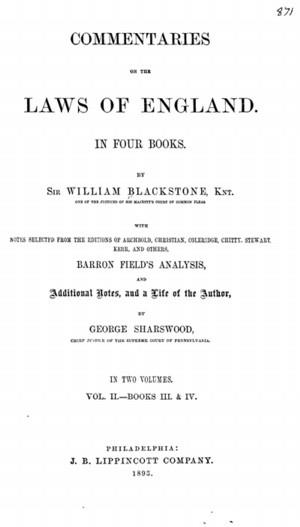
CHAPTER XVII.: OF OFFENCES AGAINST PRIVATE PROPERTY. - Sir William Blackstone, Commentaries on the Laws of England in Four Books, vol. 2 [1753]Edition used:Commentaries on the Laws of England in Four Books. Notes selected from the editions of Archibold, Christian, Coleridge, Chitty, Stewart, Kerr, and others, Barron Field’s Analysis, and Additional Notes, and a Life of the Author by George Sharswood. In Two Volumes. (Philadelphia: J.B. Lippincott Co., 1893).
Part of: Commentaries on the Laws of England in Four Books, 2 vols.About Liberty Fund:Liberty Fund, Inc. is a private, educational foundation established to encourage the study of the ideal of a society of free and responsible individuals. Copyright information:The text is in the public domain. Fair use statement:This material is put online to further the educational goals of Liberty Fund, Inc. Unless otherwise stated in the Copyright Information section above, this material may be used freely for educational and academic purposes. It may not be used in any way for profit.
CHAPTER XVII.OF OFFENCES AGAINST PRIVATE PROPERTY.**229]The next and last species of offences against private subjects are such as more immediately affect their property. Of which there are two which are attended with a breach of the peace; larceny and malicious mischief; and one that is equally injurious to the rights of property, but attended with no act of violence, which is the crime of forgery. Of these three in their order. I. Larceny, or theft, by contraction for latrociny, latrocinium, is distin guished by the law into two sorts: the one called simple larceny, or plain thef unaccompanied with any other atrocious circumstance; and mixed or compound larceny, which also includes in it the aggravation of a taking from one’s house or person.1 And, first, of simple larceny, which, when it is the stealing of goods above the value of twelve-pence, is called grand larceny; when of goods to that value, or under, is petit larceny; offences which are considerably distinguished in their punishment, but not otherwise. I shall therefore first consider the nature of simple larceny in general, and then shall observe the different degrees of punishment inflicted on its two several branches. Simple larceny, then, is “the felonious taking and carrying away of the personal goods of another.” This **230]offence certainly commenced then, whenever it was, that the bounds of property, or laws of meum and tuum, were established. How far such an offence can exist in a state of nature, where all things are held to be common, is a question that may be solved with very little difficulty. The disturbance of any individual in the occupation of what he has seized to his present use seems to be the only offence of this kind incident to such a state. But, unquestionably, in social communities, when property is established, the necessity whereof we have formerly seen,(a) any violation of that property is subject to be punished by the laws of society; though how far that punishment shall extend is matter of considerable doubt. At present we will examine the nature of theft, or larceny, as laid down in the foregoing definition. 1. It must be a taking.2 This implies the consent of the owner to be wanting. Therefore no delivery of the goods from the owner to the offender, upon trust, can ground a larceny. As if A. lends B. a horse, and he rides away with him; or if I send goods by a carrier, and he carries them away; these are no larcenies.(b) But if the carrier opens a bale or pack of goods, or pierces a vessel of wine, and takes away part thereof, or if he carries it to the place appointed and afterwards takes away the whole, these are larcenies;(c) for here the animus furandi is manifest; since in the first case he had otherwise no inducement to open the goods, and in the second the trust was determined, the delivery having taken its effect. But bare non-delivery shall not, of course, be intended to arise from a felonious design, since that may happen from a variety of other accidents. Neither by the common law was it larceny in any servant to run away with the goods committed to him to keep, but only a breach of civil trust. But, by statute 33 Hen. VI. c. 1, the servants of persons deceased, accused of embezzling their masters’ goods, may, by writ out of chancery (issued by the advice of **231]the chief justices and chief baron, or any two of them) and proclamation made thereupon, be summoned to appear personally in the court of king’s bench to answer their masters’ executors in any civil suit for such goods, and shall, on default of appearance, be attainted of felony. And, by statute 21 Hen. VIII. c. 7, if any servant embezzles his master’s goods to the value of forty shillings, it is made felony; except in apprentices, and servants under eighteen years old.3 But if he had not the possession, but only the care and oversight, of the goods, as the butler of the plate, the shepherd of the sheep, and the like, the embezzling of them is felony at common law.(d) So if a guest robs his inn or tavern of a piece of plate, it is larceny; for he hath not the possession delivered to him, but merely the use;(e) and so it is declared to be by statutes 3 & 4 W. and M. c. 9 if a lodger runs away with the goods from his ready-furnished lodgings.4 Under some circumstances also a man may be guilty of felony in taking his own goods; as if he steals them from a pawnbroker, or any one to whom he hath delivered and intrusted them, with intent to charge such bailee with the value; or if he robs his own messenger on the road, with an intent to charge the hundred with the loss according to the statute of Winchester.(f) 2. There must not only be a taking, but a carrying away;5cepit et asportavit was the old law-Latin. A bare removal from the place in which he found the goods, though the thief does not quite make off with them, is a sufficient asportation or carrying away. As, if a man be leading another’s horse out of a close, and be apprehended in the fact; or if a guest, stealing goods out of an inn, has removed them from his chamber down-stairs; these have been adjudged sufficient carryings away to constitute a larceny.(g) Or if a thief, intending to steal plate, takes it out of a chest in which it was and lays it down upon the floor, but is surprised before he can make his escape with it, this is larceny.(h) **232]3. This taking and carrying away must also be felonious; that is, done animo furandi: or, as the civil law expresses it, lucri causa.(i)6 This requisite, besides excusing those who labour under incapacities of mind or will, (of whom we spoke sufficiently at the entrance of this book,)(k) indemnifies also mere trespassers and other petty offenders. As, if a servant takes his master’s horse without his knowledge and brings him home again; if a neighbour takes another’s plough that is left in the field and uses it upon his own land and then returns it; if, under colour of arrear of rent where none is due, I distrain another’s cattle or seize them; all these are misdemeanours and trespasses, but no felonies.(l) The ordinary discovery of a felonious intent is where the party doth it clandestinely, or, being charged with the fact, denies it. But this is by no means the only criterion of criminality; for in cases that may amount to larceny the variety of circumstances is so great and the complications thereof so mingled that it is impossible to recount all those which may evidence a felonious intent or animum furandi; wherefore they must be left to the due and attentive consideration of the court and jury. 4. This felonious taking and carrying away must be of the personal goods of another; for if they are things real, or savour of the realty, larceny at the common law cannot be committed of them. Lands, tenements, and hereditaments (either corporeal or incorporeal) cannot in their nature be taken and carried away. And of things likewise that adhere to the freehold, as corn, grass, trees, and the like, or lead upon a house, no larceny could be committed, by the rules of the common law, but the severance of them was, and in many things is still, merely a trespass, which depended on a subtilty in the legal notions of our ancestors. These things were parcel of the real estate, and therefore, while they continued so, could not by any possibility be the subject of theft, being absolutely fixed and immovable.(m) And if they were **233]severed by violence, so as to be changed into movables, and at the same time by one and the same continued act carried off by the person who severed them, they could never be said to be taken from the proprietor in this their newly-acquired state of mobility, (which is essential to the nature of larceny,) being never, as such, in the actual or constructive possession of any one but of him who committed the trespass. He could not in strictness be said to have taken what at that time were the personal goods of another, since the very act of taking was what turned them into personal goods. But if the thief severs them at one time, whereby the trespass is completed, and they are converted into personal chattels in the constructive possession of him on whose soil they are left or laid, and come again at another time, when they are so turned into personalty, and takes them away, it is larceny; and so it is if the owner or any one else has severed them.(n) And now, by the statute 4 Geo. II. c. 42, to steal or rip, cut or break, with intent to steal, any lead, or iron bar, rail, gate, or palisado fixed to a dwelling-house or out-house, or in any court or garden thereunto belonging, or to any other building, is made felony, liable to transportation for seven years;7 and to steal, damage, or destroy underwood or hedges, and the like,8 to rob orchards or gardens of fruit growing therein,9 to steal or otherwise destroy any turnips, potatoes, cabbages, parsnips, peas, or carrots, or the roots of madder when growing, are(o) punished criminally10 by whipping, small fines, imprisonment, and satisfaction to the party wronged, according to the nature of the offence. Moreover, the stealing by night of any trees, or of any roots, shrubs, or plants of the value of 5s., is, by statute 6 Geo. III. c. 36, made felony in the principals, aiders, and abettors, and in the purchasers thereof knowing the same to be stolen: and, by statutes 6 Geo. III. c. 48 and 13 Geo. III. c. 33, the stealing of any timber-trees therein specified,(p) and of any root, **234]shrub, or plant, by day or night, is liable to pecuniary penalties for the two first offences, and for the third is constituted a felony liable to transportation for seven years.11 Stealing ore out of mines is also no larceny, upon the same principle of adherence to the freehold, with an exception only to mines of black lead, the stealing of ore out of which, or entering the same with intent to steal, is felony, punishable with imprisonment and whipping, or transportation not exceeding seven years; and to escape from such imprisonment or return from such transportation is felony without benefit of clergy, by statute 25 Geo. II. c. 10.12 Upon nearly the same principle the stealing of writings relating to a real estate is no felony, but a trespass;(q) because they concern the land, or (according to our technical language) savour of the realty, and are considered as part of it by the law, so that they descend to the heir, together with the land which they concern.13(r) Bonds, bills, and notes, which concern mere choses in action, were also at the common law held not to be such goods whereof larceny might be committed, being of no intrinsic value,(s) and not importing any property in possession of the person from whom they are taken. But, by the statute 2 Geo. II. c. 25, they are now put upon the same footing, with respect to larcenies, as the money they were meant to secure.14 By statute 15 Geo. II. c. 13, officers or servants of the bank of England secreting or embezzling any note, bill, warrant, bond, deed, security, money, or effects intrusted with them or with the company, are guilty of felony without benefit of clergy. The same is enacted by statute 24 Geo. II. c. 11 with respect to officers and servants of the South-Sea Company. And, by statute 7 Geo. III. c. 50, if any officer or servant of the post-office shall secrete, embezzle, or destroy any letter or packet containing any banknote or other valuable paper particularly specified in the act, or shall steal the same out of any letter or *[*235packet, he shall be guilty of felony without benefit of clergy. Or, if he shall destroy any letter or packet with which he has received money for the postage, or shall advance the rate of postage on any letter or packet sent by the post and shall secrete the money received by such advancement, he shall be guilty of single felony.15 Larceny also could not at common law be committed of treasure-trove or wreck till seized by the king or him who hath the franchise; for till such seizure no one hath a determinate property therein. But, by statute 26 Geo. II. c. 19, plundering or stealing from any ship in distress (whether wreck or no wreck) is felony without benefit of clergy; in like manner as, by the civil law,(s) this inhumanity is punished in the same degree as the most atrocious theft.16 Larceny also cannot be committed of such animals in which there is no property either absolute or qualified; as of beasts that are feræ naturæ and unreclaimed, such as deer, hares, and coneys in a forest, chase, or warren; fish in an open river or pond; or wild fowls at their natural liberty.(t) But if they are reclaimed or confined and may serve for food, it is otherwise, even at common law; for of deer so enclosed in a park that they may be taken a pleasure, fish in a trunk, and pheasants and partridges in a mew, larceny may be committed.(u) And now, by statute 9 Geo. I. c. 22, to hunt, wound, kill, or steal any deer, to rob a warren, or to steal fish from a river or pond, (being in these cases armed and disguised,) also to hunt, wound, kill, or steal any deer, in the king’s forests or chases enclosed, or in any other enclosed place where deer have been usually kept, or by gift or promise of reward to procure any person to join them in such unlawful act; all these are felonies without benefit of clergy.17 And the statute 16 Geo. III. c. 30 enacts that every unauthorized person, his aiders and abettors, who shall course, hunt, shoot at, or otherwise attempt to kill, wound, or destroy any red or fallow deer in any forest, chase, purlieu, or antient walk, or in any enclosed park, paddock, wood, or other ground **236]where deer are usually kept, shall forfeit the sum of 20l., or for every deer actually killed, wounded, destroyed, taken in any toil or snare, or carried away, the sum of 30l., or double those sums in case the offender be a keeper; and upon a second offence (whether of the same or a different species,) shall be guilty of felony, and transportable for seven years. Which latter punishment is likewise inflicted on all persons armed with offensive weapons who shall come into such places with an intent to commit any of the said offences, and shall there unlawfully beat or wound any of the keepers in the execution of their offices, or shall attempt to rescue any person from their custody. Also, by statute 5 Geo. III. c. 14, the penalty of transportation for seven years is inflicted on persons stealing or taking fish in any water within a park, paddock, garden, orchard, or yard, and on the receivers, aiders, and abettors; and the like punishment, or whipping, fine, or imprisonment, is provided for the taking or killing of coneys(v) by night in open warrens; and a forfeiture of five pounds to the owner of the fishery is made payable by persons taking or destroying (or attempting so to do) any fish in any river or other water within any enclosed ground, being private property.18 Stealing hawks, in disobedience to the rules prescribed by the statute 37 Edw. III. c. 19, is also felony.(w)19 It is also said(x) that if swans be lawfully marked it is felony to steal then; though at large in a public river; and that it is likewise felony to steal them, though unmarked, if in any private river or pond; otherwise it is only a trespass. But of all valuable domestic animals, as horses and other beasts of draught, and of all animals domitæ naturæ, which serve for food, as neat or other cattle, swine, poultry, and the like, and of their fruit or produce, taken from them while living, as milk or wool,(y) larceny may be committed; and also of the flesh of such as are either domitæ or feræ naturæ, when killed.(z)20 **[**235As to those animals which do not serve for food, and which therefore the law holds to have no intrinsic value, as dogs of all sorts, and other creatures kept for whim and pleasure, though a man may have a base property therein and maintain a civil action for the loss of them,(a) yet they are not of such estimation as that the crime of stealing them amounts to larceny.(b) But, by statute 10 Geo. III. c. 18, very high pecuniary penalties, or a long imprisonment and whipping in their stead, may be inflicted by two justices of the peace (with a very extraordinary mode of appeal to the quarter sessions) on such as steal, or knowingly harbour a stolen dog, or have in their custody the skin of a dog that has been stolen.(c)21 Notwithstanding, however, that no larceny can be committed unless there be some property in the thing taken, and an owner, yet, if the owner be unknown, provided there be a property, it is larceny to steal it, and an indictment will lie, for the goods of a person unknown.(d) In like manner as among the Romans the lex Hostilia de furtis provided that a prosecution for theft might be carried on without the intervention of the owner.(e) This is the case of stealing a shroud out of a grave; which is the property of those, whoever they were, that buried the deceased; but stealing the corpse itself, which has no owner, (though a matter of great indecency,) is no felony unless some of the grave-clothes be stolen with it.(f) Very different from the law of the Franks, which seems to have respected both as equal offences, when it directed that a person who had dug a corpse out of the ground in order to strip it should be banished from society, and no one suffered to relieve his wants till the relations of the deceased consented to his readmission.(g) Having thus considered the general nature of simple larceny, I come next to treat of its punishment. Theft, by the Jewish law, was only punished with a pecuniary fine, and satisfaction to the party injured.(h) And in the civil law ****236]till some very late constitutions, we never find the punishment capital. The laws of Draco, at Athens, punished it with death; but his laws were said to be written in blood: and Solon afterwards changed the penalty to a pecuniary mulct. And so the Attic laws in general continued,(h) except that once, in a time of dearth, it was made capital to break into a garden and steal figs; but this law, and the informers against the offence, grew so odious that from them all malicious informers were styled sycophants; a name which we have much perverted from its original meaning. From these examples, as well as the reason of the thing, many learned and scrupulous men have questioned the propriety, if not lawfulness, of inflicting capital punishment for simple theft.(i) And certainly the natural punishment for injuries to property seems to be the loss of the offender’s own property; which ought to be universally the case, were all men’s fortunes equal. But as those who have no property themselves are generally the most ready to attack the property of others, it has been found necessary instead of a pecuniary to substitute a corporal punishment; yet how far this corporal punishment ought to extend is what has occasioned the doubt. Sir Thomas More,(j) and the marquis Beccaria,(k) at the distance of more than two centuries from each other, have very sensibly proposed that kind of corporal punishment which approaches the nearest to a pecuniary satisfaction, viz., a temporary imprisonment, with an obligation to labour, first for the party robbed, and afterwards for the public, in works of the most slavish kind; in order to oblige the offender to repair, by his industry and diligence, the depredations he has committed upon private property and public order. But, notwithstanding **237]all the remonstrances of speculative politicians and moralists, the punishment of theft still continues, throughout the greatest part of Europe, to be capital; and Puffendorf,(l) together with Sir Matthew Hale,(m) are of opinion that this must always be referred to the prudence of the legislature, who are to judge, say they, when crimes are become so enormous as to require such sanguinary restrictions.(n) Yet both these writers agree that such punishment should be cautiously inflicted, and never without the utmost necessity. Our antient Saxon laws nominally punished theft with death, if above the value of twelvepence; but the criminal was permitted to redeem his life by a pecuniary ransom; as among their ancestors, the Germans, by a stated number of cattle.(o) But in the ninth year of Henry the First this power of redemption was taken away, and all persons guilty of larceny above the value of twelvepence were directed to be hanged; which law continues in force to this day.(p) For though the inferior species of theft or petit larceny is only punished by imprisonment or whipping at common law,(q) or, by statute 4 Geo. I. c. 11, may be extended to transportation for seven years, as is also expressly directed in the case of the plate-glass company,(r) yet the punishment of grand larceny, or the stealing above the value of twelvepence, (which sum was the standard in the time of king Athelstan, eight hundred years ago,) is at common law regularly death. Which, considering the great intermediate alteration(s) in the price or denomination of money, is undoubtedly a very rigorous constitution, and made Sir Henry Spelman (above a century since, when money was at twice its present rate) complain that, while every thing else was risen in its nominal value and become dearer, the life of man had continually grown *[*238cheaper.(t) It is true that the mercy of juries will often make them strain a point and bring in larceny to be under the value of twelvepence when it is really of much greater value; but this, though evidently justifiable and proper when it only reduces the present nominal value of money to the antient standard,(u) is otherwise a kind of pious perjury, and does not at all excuse our common law in this respect from the imputation of severity, but rather strongly confesses the charge. It is likewise true, that by the merciful extensions of the benefit of clergy by our modern statute law, a person who commits a simple larceny to the value of thirteenpence or thirteen hundred pounds, though guilty of a capital offence, shall be excused the pains of death; but this is only for the first offence. And in many cases of simple larceny the benefit of clergy is taken away by statute; as for horse-stealing in the principals and accessories both before and after the fact;(w) theft by great and notorious thieves in Northumberland and Cumberland,(x) taking woollen cloth from off the tenters,(y) or linens, fustians, calicoes, or cotton goods from the place of manufacture,(z)22 (which extends, in the last case, to aiders, assisters, procurers, buyers, and receivers;) feloniously driving away or otherwise stealing one or more sheep or other cattle specified in the acts,23 or killing them with intent to steal the whole or any part of the carcase,(a) or aiding or assisting therein; thefts on navigable rivers above the value of forty shillings,(b) or being present, aiding and assisting, thereat;24 *[*239plundering vessels in distress, or that have suffered shipwreck;(c) stealing letters sent by the post;(d) and also stealing deer, fish, hares, and coneys under the peculiar circumstances mentioned in the Waltham black act.25(e) Which additional severity is owing to the great malice and mischief of the theft in some of these instances; and, in others, the difficulties men would otherwise lie under to preserve those goods which are so easily carried off. Upon which last principle the Roman law punished more severely than other thieves the abigei, or stealers of cattle,(f) and the balnearii, or such as stole the clothes of persons who were washing in the public baths;(g) both which constitutions seem to be borrowed from the laws of Athens.(h) And so too the antient Goths punished with unrelenting severity thefts of cattle, or corn that was reaped and left in the field; such kind of property (which no human industry can sufficiently guard) being esteemed under the peculiar custody of heaven.(i) And thus much for the offence of simple larceny. Mixed or compound larceny is such as has all the properties of the former, but is accompanied with either one or both of the aggravations of a taking from one’s house or person. First, therefore, of larceny from the house, and then of larceny from the person. 1. Larceny from the house, though it seems (from the considerations mentioned in the preceding chapter)(j) to have a higher degree of guilt than simple larceny, yet it is not at all distinguished from the other at common law,(k) unless where it is accompanied with the circumstance of breaking the house by night, and then we have seen that it falls under another description, viz., that of burglary. But now, by several acts of parliament, (the history of which is very ingeniously deduced by a learned modern writer,(l) who hath shown them to have gradually arisen from our **240]improvements in trade and opulence,) the benefit of clergy is taken from larcenies committed in a house in almost every instance, except that larceny of the stock or utensils of the plate-glass company from any of their houses, &c. is made only a single felony, and liable to transportation for seven years.(m) The multiplicity of the general acts is apt to create some confusion; but upon comparing them diligently we may collect that the benefit of clergy is denied upon the following domestic aggravations of larceny, viz.: First, in larcenies above the value of twelve-pence, committed—1. In a church or chapel, with or without violence or breaking the same:(n) 2. In a booth or tent in a market or fair, in the daytime or in the night, by violence or breaking the same, the owner or some of his family being therein:(o) 3. By robbing a dwelling-house in the daytime, (which robbing implies a breaking,) any person being therein:(p) 4. In a dwelling-house by day or by night, without breaking the same, any person being therein and put in fear,(q) which amounts in law to a robbery; and in both these last cases the accessory before the fact is also excluded from his clergy.26 Secondly, in larcenies to the value of five shillings, committed—1. By breaking any dwelling-house, or any out-house, shop, or warehouse thereunto belonging, in the daytime, although no person be therein;(r) which also now extends to aiders, abettors, and accessories before the fact:(s) 2. By privately stealing goods, wares, or merchandise, in any shop, warehouse,(t) coach-house, or stable, by day or by night, though the same be not broken open, and though no person be therein;(u)27 which likewise extends to such as assist, hire, or command the offence to be committed. Lastly, in larcenies to the value of forty shillings, in a dwelling-house or its out-houses, although the same be not broken, and whether any person be therein or no, unless committed against their masters by apprentices under the age of fifteen.(v) This also extends to those who aid or assist in the commission of any such offence.28 *[*2412. Larceny from the person is either by privately stealing or by open and violent assault, which is usually called robbery. The offence of privately stealing from a man’s person, as by picking his pocket or the like privily without his knowledge, was debarred of the benefit of clergy so early as by the statute 8 Eliz. c. 4.29 But then it must be such a larceny as stands in need of the benefit of clergy, viz., of above the value of twelvepence, or else the offender shall not have judgment of death. For the statute creates no new offence, but only prevents the prisoner from praying the benefit of clergy, and leaves him to the regular judgment of the antient law.(w) This severity (for a most severe law it certainly is) seems to be owing to the ease with which such offences are committed, the difficulty of guarding against them, and the boldness with which they were practised (even in the queen’s court and presence) at the time when this statute was made: besides that this is an infringement of property in the manual occupation or corporal possession of the owner which was an offence even in a state of nature. And therefore the saccularii or cutpurses were more severely punished than common thieves by the Roman and Athenian laws.(x)30 Open and violent larceny from the person, or robbery, the rapina of the civilians, is the felonious and forcible taking from the person of another of goods or money to any value by violence or putting him in fear.(y) 1. There must be a taking, otherwise it is no robbery. A mere attempt to rob was indeed held to be felony so late as Henry the Fourth’s time,(z) but afterwards it was taken to be only a misdemeanour, and punishable with fine and imprisonment, till the **242]statute 7 Geo. II. c. 21, which makes it a felony (transportable for seven years) unlawfully and maliciously to assault another with any offensive weapon or instrument, or by menaces or by other forcible or violent manner to demand any money or goods, with a felonious intent to rob.31 If the thief, having once taken a purse, returns it, still it is a robbery; and so it is whether the taking be strictly from the person of another, or in his presence only; as where a robber by menaces and violence puts a man in fear, and drives away his sheep or his cattle before his face.(a) But if the taking be not either directly from his person or in his presence, it is no robbery.(b) 2. It is immaterial of what value the thing taken is: a penny as well as a pound thus forcibly extorted makes a robbery.(c) 3. Lastly, the taking must be by force or a previous putting in fear, which makes the violation of the person more atrocious than privately stealing; for, according to the maxim of the civil law,(d) “qui vi rapuit, fur improbior esse videtur.” This previous violence or putting in fear is the criterion that distinguishes robbery from other larcenies; for if one privately steals sixpence from the person of another, and afterwards keeps it by putting him in fear, this is no robbery, for the fear is subsequent;(e) neither is it capital, as privately stealing, being under the value of twelvepence. Not that it is indeed necessary, though usual, to lay in the indictment that the robbery was committed by putting in fear: it is sufficient if laid to be done by violence.(f) And when it is laid to be done by putting in fear, this does not imply any great degree of terror or affright in the party robbed: it is enough that so much force or threatening by word or gesture be used as might create an apprehension of danger, or induce a man to part with his property without or against his consent.(g) Thus, if a man be knocked down without previous warning and stripped of his property while senseless, though strictly he cannot be said to be put in fear, **243]yet this is undoubtedly a robbery. Or, if a person with a sword drawn begs an alms, and I give it him through mistrust and apprehension of violence, this is a felonious robbery.(h) So if, under a pretence of sale, a man forcibly extorts money from another, neither shall this subterfuge avail him. But it is doubted(i) whether the forcing a higgler or other chapman to sell his wares, and giving him the full value of them, amounts to so heinous a crime as robbery.32 This species of larceny is debarred of the benefit of clergy by statute 23 Hen. VIII. c. 1 and other subsequent statutes, not indeed in general, but only when committed in a dwelling-house or in or near the king’s highway. A robbery, therefore, in a distant field, or footpath, was not punished with death,(k) but was open to the benefit of clergy, till the statute 3 & 4 W. and M. c. 9, which takes away clergy from both principals and accessories before the fact, in robbery, wheresoever committed.33 II. Malicious mischief, or damage, is the next species of injury to private property which the law considers as a public crime. This is such as is done, not animo furandi, or with an intent of gaining by another’s loss, which is some, though a weak, excuse, but either out of a spirit of wanton cruelty or black and diabolical revenge. In which it bears a near relation to the crime of arson; for as that affects the habitation, so this does the other property, of individuals. And therefore any damage arising from this mischievous disposition, though only a trespass at common law, is now by a multitude of statutes made penal in the highest degree. Of these I shall extract the contents in order of time. And, first, by statute 22 Hen. VIII. c. 11, perversely and maliciously to cut down or destroy the powdike in the fens of Norfolk and Ely is felony.34 And, in like manner, it is, by many special statutes enacted upon the occasions, made felony to destroy the several sea-banks, river-banks, public navigations, and bridges, erected by virtue of those acts of **244]parliament. By statute 43 Eliz. c. 13, (for preventing rapine on the northern borders,) to burn any barn or stack of corn or grain; or to imprison or carry away any subject in order to ransom him, or to make prey or spoil of his person or goods upon deadly feud or otherwise, in the four northern counties of Northumberland, Westmoreland, Cumberland, and Durham, or being accessory before the fact to such carrying away or imprisonment; or to give or take any money or contribution, there called blackmail, to secure such goods from rapine; is felony without benefit of clergy. By statute 22 & 23 Car. II. c. 7, maliciously, unlawfully, and willingly, in the night-time to burn, or cause to be burned or destroyed, any ricks or stacks of corn, hay, or grain, barns, houses, buildings, or kilns,35 or to kill any horses, sheep, or other cattle, is felony; but the offender may make his election to be transported for seven years; and to maim or hurt such horses, sheep, or other cattle is a trespass, for which treble damages shall be recovered.36 By statute 4 & 5 W. and M. c. 23, to burn on any waste, between Candlemas and Midsummer, any grig, ling, heath, furze, goss, or fern is punishable with whipping and confinement in the house of correction. By statute 1 Anne, st. 2, c. 9, captains and mariners belonging to ships and destroying the same, to the prejudice of the owners, (and, by 4 Geo. I. c. 12, to the prejudice of insurers also,) are guilty of felony without benefit of clergy. And by statute 12 Anne, st. 2, c. 18, making any hole in a ship in distress, or stealing her pumps, or aiding or abetting such offence, or wilfully doing any thing tending to the immediate loss of such ship, is felony without benefit of clergy.37 By statute 1 Geo. I. c. 48, maliciously to set on fire any underwood, wood, or coppice is made single felony. By statute 6 Geo. I. c. 23, the wilful and malicious tearing, cutting, spoiling, burning, or defacing of the garments or clothes of any person passing in the streets or highways, with intent so to do, is felony. This was occasioned by the insolence of certain weavers and others, who, upon the introduction of some Indian fashions prejudicial to their own manufactures, made it their practice to deface them, either by open outrage, or by privily cutting, or casting aqua-fortis *[*245in the streets upon such as wore them.38 By statute 9 Geo. I. c. 22,39 commonly called the Waltham black act, occasioned by the devastations committed near Waltham, in Hampshire, by persons in disguise or with their faces blacked, (who seem to have resembled the Roberdsmen, or followers of Robert Hood, that in the reign of Richard the First committed great outrages on the borders of England and Scotland;)(l) by this black act, I say, which has in part been mentioned under the several heads of riots, menaces, mayhem, and larceny,(m) it is further enacted that to set fire to any house, barn, or out-house, (which is extended by statute 9 Geo. III. c. 29 to the malicious and wilful burning or setting fire to all kinds of mills,) or to any hovel, cock, mow, or stack of corn, straw, hay, or wood; or unlawfully or maliciously to break down the head of any fish-pond, whereby the fish shall be lost or destroyed; or, in like manner, to kill, maim, or wound any cattle; or cut down or destroy any trees planted in an avenue, or growing in a garden, orchard, or plantation, for ornament, shelter, or profit; all these malicious acts, or procuring by gift or promise of reward any person to join them therein, are felonies without benefit of clergy; and the hundred shall be chargeable for the damages unless the offender be convicted.40 In like manner, by the Roman law, to cut down trees, and especially vines, was punished in the same degree as robbery.(n) By statutes 6 Geo. II. c. 37, and 10 Geo. II. c. 32, it is also made felony without the benefit of clergy maliciously to cut down any river or sea bank, whereby lands may be overflowed or damaged; or to cut any hop-binds growing in a plantation of hops,41 or wilfully and maliciously to set on fire, or cause to be set on fire, any mine, pit, or depth of coal.42 By statute 11 Geo. II. c. 22, to use any violence in order to deter any person from buying corn or grain; to seize any carriage or horse carrying grain or meal to or from any market or seaport; or to use any outrage with such intent; or to scatter, take away, spoil, or damage such grain or meal, is punished **246]for the first offence with imprisonment and public whipping; and the second offence, or destroying any granary where corn is kept for exportation, or taking away or spoiling any grain or meal in such granary, or in any ship, boat, or vessel intended for exportation, is felony, subject to transportation for seven years.43 By statute 28 Geo. II. c. 19, to set fire to any goss, furze, or fern growing in any forest or chase is subject to a fine of five pounds.44 By statutes 6 Geo. III. c. 36 & 48, and 13 Geo. III. c. 33, wilfully to spoil or destroy any timber or other trees, roots, shrubs, or plants is for the two first offences liable to pecuniary penalties; and for the third, if in the daytime, and even for the first, if at night, the offender shall be guilty of felony and liable to transportation for seven years.45 By statute 9 Geo. III. c. 29, wilfully and maliciously to burn or destroy any engine, or other machines therein specified, belonging to any mine,46 or any fences for enclosures pursuant to any act of parliament, is made single felony, and punishable with transportation for seven years, in the offender, his advisers and procurers.47 And, by statute 13 Geo. III. c. 38, the like punishment is inflicted on such as break into any house, &c. belonging to the plate-glass company, with intent to steal, cut, or destroy any of their stock or utensils, or shall wilfully and maliciously cut or destroy the same. And these are the principal punishments of malicious mischief. III. **247Forgery,48 or the crimen falsi is an offence which was punished by the civil law with deportation or banishment, and sometimes with death.(o) It may with us be defined at common law to be “the fraudulent making or alteration of a writing to the prejudice of another man’s right,” for which the offender may suffer fine, imprisonment, and pillory.49 And also, by a variety of statutes, a more severe punishment is inflicted on the offender in many particular cases, which are so multiplied of late as almost to become general. I shall mention the principal instances. By statute 5 Eliz. c. 14, to forge or make, or knowingly to publish or give in evidence, any forged deed, court-roll, or will, with intent to affect the right of real property, either freehold or copyhold, is punished by a forfeiture to the party grieved of double costs and damages; by standing in the pillory and having both his ears cut off and his nostrils slit and seared, by forfeiture to the crown of the profits of his lands, and by perpetual imprisonment. For any forgery relating to a term of years, or annuity, bond, obligation, acquittance, release, or discharge of any debt or demand of any personal chattels, the same forfeiture is given to the party grieved; and on the offender is inflicted the pillory, loss of one of his ears, and a year’s imprisonment: the second offence in both cases being felony without benefit of clergy. Besides this general act, a multitude of others, since the revolution, (when paper-credit was first established,) have inflicted capital punishment on the forging, altering, or uttering as true when forged, of any bank bills or notes, or *[*248other securities;(p)50 of bills of credit issued from the exchequer;(q)51 of South-Sea bonds, &c.;(r) of lottery tickets or orders;(s)52 of army or navy debentures;(t) of East India bonds;(u) of writings under the seal of the London or royal exchange assurance;(w) of the hand of the receiver of the prefines(x) or of the accountant-general, and certain other officers of the court of chancery;(y) of a letter of attorney, or other power to receive or transfer stock or annuities, and on the personating a proprietor thereof to receive or transfer such annuities, stock, or dividends;(z) also on the personating, or procuring to be personated, any seaman or other person entitled to wages or other naval emoluments, or any of his personal representatives; and the taking or procuring to be taken any false oath in order to obtain a probate or letters of administration, in order to receive such payments;53 and the forging or procuring to be forged, and likewise the uttering or publishing as true, of any counterfeited seaman’s will or power;(a)54 to which may be added, though not strictly reducible to this head, the counterfeiting of Mediterranean passes under the hands of the lords of the admiralty, to protect one from the piratical States of Barbary;(b) the forging or imitating of any stamps to defraud the public revenue,(c)55 and the forging of any marriage register or license;(d)56 all which are, by distinct acts of parliament, made felonies without benefit of clergy. By statute 13 Geo. III. c. 52 and 59, forging or counterfeiting any stamp or mark to denote the standard of gold and silver plate, and certain other offences of the like tendency, are punished with transportation for fourteen years.57 By statute 12 Geo. III. c. 48, certain **249]frauds on the stamp-duties therein described, principally by using the same stamps more than once, are made single felony, and liable to transportation for seven years. And the same punishment is inflicted, by statute 13 Geo. III. c. 38,58 on such as counterfeit the common seal of the corporation for manufacturing plate-glass, (thereby erected,) or knowingly demand money of the company by virtue of any writing under such counterfeit seal. There are also certain other general laws with regard to forgery, of which the first is 2 Geo. II. c. 25, whereby the first offence in forging or procuring to be forged, acting or assisting, therein, or uttering or publishing as true, any forged deed, will, bond, writing obligatory, bill of exchange, promissory note, endorsement, or assignment thereof, or any acquittance or receipt for money or goods, with intention to defraud any person, (or corporation,)(e) is made felony without benefit of clergy. And, by statutes 7 Geo. II. c. 22 and 18 Geo. III. c. 18, it is equally penal to forge or cause to be forged or utter as true a counterfeit acceptance of a bill of exchange, or the number or principal sum of any accountable receipt for any note, bill, or any other security for money, or any warrant or order for the payment of money or delivery of goods.59 So that, I believe, through the number of these general and special provisions, there is now hardly a case possible to be conceived wherein forgery that tends to defraud, **250]whether in the name of a real or fictitious person,(f) is not made a capital crime.60 These are the principal infringements of the rights of property, which were the last species of offences against individuals or private subjects which the method of distribution has led us to consider. We have before examined the nature of all offences against the public or commonwealth; against the king or supreme magistrate, the father and protector of that community; against the universal law of all civilized nations; together with some of the more atrocious offences of publicly pernicious consequence against God and his holy religion. And these several heads comprehend the whole circle of crimes and misdemeanours, with the punishment annexed to each, that are cognizable by the laws of England.61 [1 ] By stat. 7 & 8 Geo. IV. c. 29, s. 2, it is enacted “that the distinction between grand and petit larceny shall be abolished, and every larceny, whatever be the value of the property stolen, shall be deemed to be of the same nature, and shall be subject to the same incidents in all respects, as grand larceny was before the commencement of this act; and every court whose power as to the trial of larceny was before the commencement of this act limited to petty larceny shall have power to try every case of larceny the punishment of which cannot exceed the punishment hereinafter mentioned for simple larceny, and also to try all accessories to such larceny.” By sect. 3, every person convicted of simple larceny, or of any felony thereby made punishable like simple larceny, shall (except in the cases thereinafter otherwise provided for) be liable to transportation for seven years, or imprisonment not exceeding two years, and, if a male, to one, two, or three public whippings; and, by sect. 4, where the sentence is imprisonment, the courts have a discretionary power to award hard labour or solitary confinement in addition. This observation has been introduced here that the reader may observe how far the present provisions of the law vary from the text in his progress through this important chapter, and to remind him that the subtle distinctions between grand and petty larceny are now entirely abolished. By sect. 61, in every felony punishable under this act, every principal in the second degree, and every accessory before the fact, shall be punishable with death, or otherwise, in the same manner as the principal in the first degree; and every accessory after the fact (except only a receiver of stolen property) shall on conviction be liable to imprisonment for any term not exceeding two years; and every person aiding, abetting, counselling, or procuring the commission of any misdemeanour punishable under this act, shall be liable to be indicted and punished as a principal offender. As to the venue in cases of larceny see 7 Geo. IV. c. 64, ss. 12, 13.—Chitty. [(a) ] See book ii. p. 8, &c. [2 ] The cases upon this important requisite of the offence of larceny are so numerous, and the distinctions so subtle, that it will be necessary to go into considerable detail to give a complete view of the law upon the subject. See, in general, 3 Chitt. Crim. L. 2d ed. 917 to 924. 1st. Where the offender lawfully acquired the possession of the goods, but under a bare charge, the owner still retaining his property in them, the offender will be guilty of larceny at common law in embezzling them. Thus, in addition to the instances put by the learned author, of the butler, the shepherd, and guest at an inn, if a master deliver property into the hands of a servant for a special purpose, as to leave it at the house of a friend, or to get change, or deposit with a banker, the servant will be guilty of felony in applying it to his own use, for it still remains in the constructive possession of its owner. 2 Leach, 870, 942; and see 2 East, P. C. 563; sed vide East, P. C. 562. R. & R. C. C. 215. 4 Taunt. 258, S. C. If a banker’s clerk is sent to the money-room to bring cash for a particular purpose, and be takes the opportunity of secreting some for his own use, (1 Leach, 344,) he is guilty of larceny. And see 1 Leach, 251. Kelw. 33. Cowp. 294. And if several persons play together at cards, and deposit money for that purpose, not parting with their property therein, and one sweep it all away and take it to himself, he will be guilty of theft, if the jury find that he acted with a felonious design. 1 Leach, 270. Cald. 295. So if there be a plan to cheat a man of his property, under colour of a bet, and he parts with the possession only, to deposit as a stake with one of the confederates, the taking by such confederate is felonious. Russ. & Ry. C. C. 413. And if a bag of wheat be delivered to a warehouseman for safe custody, and he take the wheat out of the bag and dispose of it, it is larceny. Russ. & Ry. C. C. 337. And where a banker’s clerk took notes from the till, under colour of a check from a third person, which check he obtained by having entered a fictitious balance in the books in favour of that person, it was held he was guilty of felony, the fraudulent obtaining the check being nothing more than mere machinery to effect his purpose. 4 Taunt. 304. R. & R. C. C. 221, S. C. 2 Leach, C. C. 1083. And where one employed as a clerk in the daytime, but not residing in the house, embezzles a bill of exchange which he received from his master in the usual course of business, with directions to transmit it by the post to a correspondent, it was held larceny. 2 East, P. C. 565; and see 2 Chitt. C. L. 2d ed. 917, b. And where goods have not been actually reduced into the owner’s possession, yet if he has intrusted another to deliver them to his servant, and they are delivered accordingly, and the servant embezzle them, he will be guilty of larceny; as where a corn-factor, having purchased a cargo of oats on board a ship, sent his servant with his barge to receive part of the oats in loose bulk, and the servant ordered some of them to be put into sacks, which he afterwards embezzled, this was holden larceny. 2 East, P. C. 1798. 2 Leach, 825. The learned commentator has already noticed the 21 Hen. VIII. c. 7, making the embezzlement of goods above the value of forty shillings felony, when intrusted to a servant by his master. The act extends only to such persons who were servants to the owner of the goods, both at the time of their delivery and when they were stolen. 1 Hawk. c. 33, s. 12. 2 East, P. C. 562. To bring the case within the act, the goods must have been delivered to the servant to keep for the master; and the words “kept to the use of the master” imply that they are to be returned to the master. 2 East, P. C. 562. The act does not extend to goods the actual property of which were not in the master at the time; and therefore it is said that if the property be changed, as by melting the money down, or malting corn, and then it be taken away, it is not within the statute. 1 Hawk. c. 33, s. 15. 2 East, P. C. 563; sed quære. See 1 Hawk. c. 33, s. 15. The act only extends to where the owner has actually had them in his possession, and not where his servant has merely received them to his use. No wasting or consuming the goods is within the act, however wilful. Hawk. b. i. c. 33, s. 14. 2dly. Where the offender unlawfully acquired the possession of goods, as by fraud or force, &c., with intent to steal them, the owner still retaining his property in them, such an offender will be guilty of larceny in embezzling them. Therefore, in addition to the instances mentioned in the text, hiring a horse on pretence of taking a journey, and immediately selling it, is larceny, because the jury found the defendant acted animo furandi in making the contract, and the parting with the possession had not changed the nature of the property. 2 East, P. C. 685. 1 Leach, 212; and see 2 Leach, 420. 2 East, P. C. 691. So, obtaining a horse by pretending another person wanted to hire it to go to B., but in truth with intent to steal it, and not going to B., but taking the horse elsewhere and selling it, is larceny. 1 Leach, 409. 2 East, P. C. 689. So where the prisoner, intending to steal the mail-bags from a post-office, procured them to be let down to him by a string from the window of the post-office, under pretence that he was the mail-guard, he was held guilty of larceny. 2 East, P. C. 603. It is larceny for a person hired for the special purpose of driving sheep to a fair to convert them to his own use, he having the intention so to do at the time of receiving them from the owner. 1 Ry. & M. C. C. 87. And where a man ordered a pair of candlesticks from a silversmith, to be paid for on delivery, to be sent to his lodgings, whither they were sent accordingly, with a bill of parcels, by a servant, and the prisoner, contriving to send the servant back under some pretence, kept the goods, it was holden larceny. Cited in 2 Leach, 420. And if a sale of goods is not completed, and the pretended purchasor absconds with them, and from the first his intention was to defraud, he is guilty of stealing, (1 Leach, 92;) and to obtain money from another by ring-dropping is a similar offence, if there was an original design to steal, (1 Leach, 238; 2 Leach, 572;) and where the owner of goods sends them by a servant, to be delivered to A., and B., pretending to be A., obtains them from him, B. is guilty of larceny. 2 East, P. C. 673. So where the prisoner, pretending to be the servant of a person who had bought a chest of tea deposited at the East India Company’s warehouse, got a request-paper and permit for the chest, and took it away with the assent of a person in the company’s service who had the charge of it, this was held felony. R. & Ry. C. C. 173. So to obtain a bill of exchange from an endorsee under a pretence of getting it discounted, is felony, if the jury find that the party did not intend to leave the bill in the possession of the defendant previous to receiving the money to be obtained on his credit, and that he undertook to discount with intent to convert it to his own use, (1 Leach, 294;) and it seems that if a person procure possession of a house with an intent to steal the lead affixed to it, he may be indicted, on the 4 Geo. II. c. 32, for the statutable larceny. 2 Leach. 850. In all these cases the defendant’s original design in obtaining the goods was felonious, and the owner never parted with his property therein; for where either is not the case there can be no larceny, as will appear from the following instances. Thus, where a house was burning and a neighbour took some of the goods, apparently to save them from the flames, and afterwards converted them to his own use, it was holden no felony, because the jury thought the original design honest. 1 Leach, 411, notes. And it is certain that if the property in effects be given voluntarily, whatever false pretence has been used to obtain it, no felony can be committed. 1 Hale P. C. 506. R. & R. C. C. 225, S. P. Thus, obtaining silver on pretence of sending a half-guinea presently in exchange is no felony. 2 East, P. C. 672. So, writing a letter in the name of a third person to borrow money, which he obtains by that fraud, is only a misdemeanour, (2 East, P. C. 673;) and it makes no difference, in these cases, that the credit was obtained by fraudulently using the name of another to whom it was intended to be given, (1 Leach, 303, notes. 2 East, P. C. 673. R. & R. C. C. 225;) and if a horse-dealer delivers a horse to another on his promise to return immediately and pay for it, the party’s riding off and not returning is no felony. 1 Leach, 467. 2 East, P. C. 669. So if a tradesman sells goods to a stranger as for ready money, and sends them to him by a servant, who delivers them and takes in payment for them bills which prove to be mere fabrications, this will be no larceny, though the party took his lodgings for the express purpose of obtaining the goods by fraud; because the owner parted with his property. 2 Leach, 614. So fraudulently winning money at gaming, where the injured party really intended to play, is no larceny, though a conspiracy to defraud appear in evidence. 2 Leach, 610. So brokers, bankers, or agents embezzling securities deposited with them for security or any special purpose are not guilty of larceny, (4 Taunt. 258. 2 Leach, 1054. R. & R. C. C. 215, S. C.;) but this decision occasioned the 52 Geo. III. c. 63 to be passed, making it a misdemeanour in brokers, bankers, and others to embezzle securities deposited with them for safe custody or for any special purpose, in violation of good faith and contrary to the special purpose for which they were deposited. Thus, in all cases where a voluntary delivering by the prosecutor is the defence to be relied on, two questions arise: first, whether the property was parted with by the owner, secondly, whether, supposing it was not, the prisoner, at the time he obtained it, conceived a felonious design. In the first case, no fraud or breach of trust can make a conversion larceny; in the second, the complexion of the offence must depend on the felonious design. 3dly. Where the offender lawfully acquired the possession of and qualified property in goods under colour of bailment, but with the intention of stealing them; or where the bailment has been determined either by the wrongful act of the offender or by the intention of the parties, if he afterwards embezzle such goods he will be guilty of larceny. For in the first case, after the determination of the special contract by any plain and unequivocal wrongful act of the bailee inconsistent with that contract, the property, as against the bailee, reverts to the owner, although the actual possession remain in the bailee. 2 East, P. C. 691, 627. The most remarkable case of this description is that of a carrier pointed out by the learned commentator. So the conversion of money with a felonious intent, which was found in a bureau delivered to a carpenter to be repaired, by breaking it open, when there was no necessity for so doing for the purpose of repairs, will amount to a larceny, (8 Ves. 405. 2 Leach, 952. 2 Russ. 1045;) and in the same case it was said that if a pocket-book containing bank-notes were left in the pocket of a coat sent to be mended, and the tailor took the pocket-book out of the pocket and the notes out of the pocket-book with a felonious intent, it would amount to a felony. If the master and owner of a ship steal some of the goods delivered to him to carry, it is not larceny in him, unless he took the goods out of their package; nor, if larceny, would it be an offence within 24 Geo. II. c. 45. R. & R. C. C. 92. And if corn be sent to a miller to grind and he take part of it he will be guilty of felony, (1 Roll. Abr. 73;) but where forty bags of wheat were sent to the prisoner, a warehouseman, for safe custody until sold by the prosecutor, and the prisoner’s servant, by direction of the prisoner, emptied four of the bags and mixed their contents with other inferior wheat, and part of the mixture was disposed of by the prisoner and the remainder was placed in the prosecutor’s bags which had thus been emptied, and there was no severing of any part of the wheat in any one bag with intent to embezzle that part only which was so severed, the prisoner was held guilty of larceny in taking the wheat out of the bag. R. & R. C. C. 337. And where property which the prosecutors had bought was weighed out in the presence of their clerk and delivered to their carter’s servant to cart, who let other persons take away the cart and dispose of the property for his benefit jointly with that of the other persons, it was held that the carter’s servant was not guilty of a mere breach of trust, but that he as well as the other persons were guilty of larceny at common law. Russ. & Ry. C. C. 125; and see 2 East, P. C. 568 to 574, 695 to 698. But in all these cases the defendant must have had an intention of stealing the property at the time it was delivered to him. R. & R. C. C. 441, overruling 2 East, P. C. 690, 694. 2 Russ. 1089, 1090. 1 R. & M. C. C. 87. 4thly. Where the offender has the qualified property and actual possession of the goods at the time of the embezzlement, he will not be guilty of larceny at common law. Thus, where a servant or clerk had received property for the use of his master, and the master never had any other possession than such possession by his servant or clerk, it was doubted whether the latter was guilty of felony in stealing such property or was guilty merely of a breach of trust. 2 Leach, 835. Hale, 668. East, P. C. 570, 571. And see 4 Taunt. 258. Russ. & Ry. C. C. 215, S. C. 2 Leach, C. C. 1054. So a cashier of the bank could not be guilty of felony in embezzling an India bond which he had received from the court of chancery and was in his actual as well as constructive possession. 1 Leach, 28. So if a clerk received money of a customer, and without at all putting it in the till converted it to his own use, he was guilty only of a breach of trust; though, had he once deposited it and then taken it again, he would have been guilty of felony. 2 Leach, 835. Servants and Clerks.—The dangers resulting from this doctrine occasioned the enact ment of 39 Geo. III. c. 85 against such embezzlements by servants or clerks, rendering the offence punishable with transportation for fourteen years. This act extends only to such servants as are employed to receive money, and to instances in which they receive money by virtue of their employment. It seems an apprentice, though under the age of eighteen, is within the act, (R. & R. C. C. 80;) so is a female servant. R. & R. C. C. 267. A person employed upon commission to travel for orders and to collect debts is a clerk within the act, though he is employed by many different houses on each journey, and pays his own expenses out of his commission on each journey, and does not live with any of his employers nor act in any of their counting-houses. R. & R. C. C. 198. So a servant in the employment of A. & B., who are partners, is the servant of each, and if he embezzle the private money of one may be charged, under the act, as the servant of that individual partner. 3 Stark. C. N. P. 70. A man is sufficiently a servant within the act although he is only occasionally employed when he has nothing else to do; and it is sufficient if he was employed to receive the money he embezzled, though receiving money may not be in his usual employment, and although it was the only instance in which he was so employed. R. & Ry. C. C. 299. A clerk intrusted to receive money at home from out-door collectors received it abroad from out-door customers, it was held that such receipt of money may be considered, “by virtue of his employment,” within the act, though it is beyond the limits in which he is authorized to receive money from his employers. R. & Ry. C. C. 319. So if a servant, generally employed by his master to receive sums of one description and at one place only, is employed by him in a particular instance to receive a sum of a different description and at a different place, this latter sum is to be considered as received by him by virtue of his employment; for he fills the character of servant, as it is by being employed as servant he receives the money. R. & Ry. C. C. 516. Where the owner of a colliery employed the prisoner as captain of one of his barges, to carry out and sell coal, and paid him for his labour by allowing him two-thirds of the price for which he sold the coals, after deducting the price charged at the colliery, he was held a servant within the act, and, having embezzled the price, he was guilty of larceny within the act. R. & R. C. C. 139. So a servant who received money for his master for articles made of his master’s materials, which he embezzled, was held within the act, though he made the articles and was to have a given portion of the price for making them. Russ. & Ry. C. C. 145. The act is not confined to clerks and servants of persons in trade; it extends to the clerks and servants employed to receive of all persons whatever. Therefore, where the overseers of a township employed the prisoner as their accountant and treasurer, and he received and paid all the money receivable or payable on their account, he received a sum and embezzled it, he was held a clerk and servant within the act. R. & R. C. C. 349. 2 Stark. C. N. P. 349, S. C. If a servant, immediately on receiving a sum for his masters, enters a smaller in his book, and ultimately account to his master for the smaller sum only, he may be considered as embezzling the difference at the time he made the entry; and it will make no difference though he received other sums for his master on the same day, and in paying them and the smaller sum to his master together he might give his master every piece of money or note he received at the time he made the false entry. R. & R. C. C. 463. 3 Stark. N. P. C. 67, S. C. It seems the act does not apply to cases which were larceny at common law. 2 Leach, C. C. 1033. R. & R. C. C. 160, S. C. Peck’s case, cor. Park, J. Staffordshire Sum. Ass. 1817. 3 Stark. Evid. 842. It is questionable, therefore, whether, if a servant receives money from his master to pay C., and does not pay it, he can be indicted for embezzlement, (Russ. & Ry. C. C. 267,) but as counts for larceny at common law and for embezzlement under the statute may be joined in the same indictment, any difficulty in this respect may be avoided. See 3 M. & S. 549, 550. Although property has been in the possession of the prisoner’s masters, and they only intrust the custody of such property to a third person to try the honesty of their servant, if the servant receives it from such third person and embezzles it, it is an offence within the act. R. & R. C. C. 160. 2 Leach, 1033, S. C. Party stealing his own Goods, &c.—Besides the cases already mentioned in the text, if a man steals his own goods from his own bailee, though he has no intent to charge the bailee, but his intent is to defraud the king, yet if the bailee had an interest in the possession and could have withheld it from the owner, the taking is a larceny. R. & R. C. C. 470. 3 Burn, J., 24th ed., 240, S. C. And a man may be accessory after the fact to a larceny committed on himself by receiving and harbouring the thief instead of bringing him to justice, (Fost. 123;) but a joint tenant in common of effects cannot be guilty of larceny in appropriating the whole to his own purpose, (1 Hale, 513;) but if a part-owner of property steal it from the person in whose custody it is and who is responsible for its safety, he is guilty of larceny. R. & R. C. C. 478. 3 Burn, J., 24th ed., 241, S. C. Nor can a wife commit larceny of her husband’s goods, because his custody is in law hers, and they are considered as one person. 1 Hale, 514. On the same ground, no third person can be guilty of larceny by receiving the husband’s goods from the wife; and if she keep the key of the place where the property is kept, her privity will be presumed, and the defendant must be acquitted. 1 Leach, 47. See 1 Hale, 45, 516. Kel. 37. The taking must always be against the will of the owner, (1 Leach, 47;) but if the owner, in order to detect a number of men in the act of stealing, directs a servant to appear to encourage the design and lead them on till the offence is complete, so long as he did not induce the original intent, but only provided for its discovery after it was formed, the criminality of the thieves will not be destroyed. 2 Leach, 913. So if a man be suspected of an intent to steal, and another, to try him, leaves property in his way which he takes, he is guilty of larceny. 2 Leach, 921. And if, on thieves breaking in to plunder a house, a servant, by desire of his master, show them where the plate is kept which they remove, this circumstance will not affect the crime. 2 Leach, 922.—Chitty. [(b) ] 1 Hal. P. C. 504. [(c) ] 3 Inst. 107. [3 ] The above statutes, with others on the same subject, are repealed, by the 7 & 8 Geo. IV. c. 27; and by the 7 & 8 Geo. IV. c. 29, 46, any clerk or servant stealing any chattel, money, or valuable security belonging to, or in the possession or power of, his master, is punishable with transportation for any term not exceeding fourteen years and not less than seven, or with imprisonment for any term not exceeding three years, with whippings. S. 47 enacts that any clerk or servant, or person employed as such, receiving or taking, by virtue of such employment, into his possession any chattel, money, or valuable security, for, or in the name or on the account of, his master, and fraudulently embezzling the same or any part thereof, shall be deemed to have feloniously stolen the same from his master, although such chattel, &c. was not received into the master’s possession otherwise than by the actual possession of such clerk or servant or other person so employed, and shall be liable to any of the punishments set forth in s. 45. By s. 48, “for preventing the difficulties that have been experienced in the prosecution of the last-mentioned offenders,” it is enacted “that it shall be lawful to charge in the indictment, and proceed against the offender for, any number of distinct acts of embezzlement, not exceeding three, which may have been committed by him against the same master within the space of six calendar months from the first to the last of such acts; and in every such indictment, except where the offence shall relate to any chattel, it shall be sufficient to allege the embezzlement to be of money, without specifying any particular coin or valuable security; and such allegation, so far as regards the description of the property, shall be sustained, if the offender shall be proved to have embezzled any amount, although the particular species of coin or valuable security of which such amount was composed shall not be proved; or if he shall be proved to have embezzled any piece of coin or valuable security, or any portion of the value thereof, although such piece of coin or valuable security may have been delivered to him in order that some part of the value thereof should be returned to the party delivering the same, and such part shall have been returned accordingly.” Each act of embezzlement should be set forth in a separate count; and the prosecutor cannot be compelled to elect which he will singly proceed upon. The indictment need not state from whom the money alleged to have been embezzled was received. Rex vs. Beacall, 1 C. & P. 454. The day laid is not material. By statute 5 Geo. IV. c. 20, s. 10, persons employed in the post-office embezzling notes, parliamentary proceedings, or newspapers, &c. are guilty of a misdemeanour, and punishable by fine and imprisonment, the offence to be tried either where committed or where the offender is apprehended. By 7 & 8 Geo. IV. c. 29, s. 49, bankers, merchants, brokers, attorneys, and other agents, embezzling money intrusted to them to be applied to any special purpose, or embezzling any goods or valuable security intrusted to them for safe custody or for any special purpose, are guilty of a misdemeanour, and punishable in any of the modes pointed out in s. 46. S. 50 provides that the act shall not affect trustees or mortgagees, nor bankers, &c. receiving money due on securities, or disposing of securities on which they have a lien. By s. 51, factors pledging for their own use any goods, or documents relating to goods, intrusted to them for the purpose of sale, are guilty of a misdemeanour, and punishable by transportation for fourteen or seven years, or by fine and imprisonment, as the court shall award,—the clause not to extend to cases where the pledge does not exceed the amount of their lien. And, by s. 52, these provisions as to agents shall not lessen any remedy which the party aggrieved previously had at law or in equity. A person intrusted, as a private friend, with a bill to get it discounted, and converting it to his own use, is not an agent within the meaning of the act. Rex vs. Prince, 2 C. & P. 517.—Chitty. [(d) ] 1 Hal. P. C. 506. [(e) ] 1 Hawk. P. C. 90. [4 ] Repealed, by 7 & 8 Geo. IV. c. 27; and, by 7 & 8 Geo. IV. c. 29, s. 45, it is enacted that if any person shall steal any chattel or fixture let to be used by him in or with any house or lodging, he shall be guilty of felony, and be pun shed as for simple larceny; and the indictment may be preferred in the common form as for larceny, and as if the offender were not a tenant or lodger; and in either case the property may be laid in the owner or person letting to hire. In Healey’s case, R. & M. 1. it was considered unnecessary to state by whom the lodging was let, the judges holding that the letting might be stated either according to the fact or according to the legal operation. The statement as to the party by whom the lodging is let would be regulated by this case under the present act.—Chitty. [(f) ] Fost. 123, 124. [5 ] If a thief cut a belt on which a purse is hung and it drops to the ground where he leaves it, or if he compel a man to lay down goods which he is carrying, and is apprehended before he raises them from the ground, the crime is incomplete. 1 Leach, 322, n. b. 1 Hale, 533. And if goods are tied to a string, which is fastened at one end to a counter, and a person, intending to steal them, takes hold of the other and removes them towards the door as far as the string will permit him, this will be no felony. So where the prosecutor had his keys tied to the strings of his purse in his pocket, which the prisoner endeavoured to take from him and was detected with the purse in his hand, but the strings still hung to the pocket by the keys, this was holden to be no asportation, and therefore no larceny was committed. 1 Leach, 321, n. a. 1 Hale, 508. But a very slight asportation will suffice. Thus, to snatch a diamond from a lady’s ear which is instantly dropped among the curls of her hair. (1 Leach, 320. 2 East, P. C. 557;) to remove sheets from a bed and carry them into an adjoining room, (1 Leach, 222, in notes,)—to take plate from a trunk and lay it on the floor with intent to carry it away, (ibid,)—and to remove a package from one part of a wagon to another with a view to steal it, (1 Leach, 236,) have respectively been holden to be felonies; and where the prisoner had lifted up a bag from the bottom of a boot of a coach but was detected before he had got it out, it did not appear that it was entirely removed from the space it at first occupied in the boot, but the raising it from the bottom had completely removed each part of it from the space that specific part occupied, this was held a complete asportation. 1 Ry. & Moody, C. C. 14. But if the defendant merely change the position of a package from lying endways to lengthways, for the greater convenience of taking out its contents, and cuts the outside of it for that purpose, but is detected before he has taken any thing, there will be no larceny committed. Id. ibid. in notes. Where it is one continuing transaction, though there be several distinct asportations in law by several persons, yet all may be indicted as principals who concur in the felony before the final carrying away of the goods from the virtual custody of the owner, (2 East, P. C. 557;) but two cannot be convicted upon an indictment charging a joint larceny, unless there be evidence to satisfy a jury that they were concerned in a joint taking. 2 Stark. on Evidence, 840. If one steal another man’s goods, and afterwards another stealeth from him, the owner may prosecute the first or the second felon at his choice. Dalt. c. 162. There is no occasion that the carrying away be by the hand of the party accused; for if he procured an innocent agent, as a child or a lunatic, to take the property, or if he obtained it from the sheriff by a replevin, without the slightest colour of title, and with a felonious design, he will himself be a principal offender. Hawk. b. 1, c. 33, s. 12.—Chitty. [(g) ] 3 Inst. 108, 109. [(h) ] 1 Hawk. P. C. 93. [(i) ] Inst. 4, 1, 1. [6 ] The felonious quality consists in the intention of the prisoner to defraud the owner and to apply the thing stolen to his own use; and it is not necessary that the taking should be done lucri causa: taking with an intent to destroy will be sufficient to constitute the offence if done to serve the prisoner or another person, though not in a pecuniary way. R. & R. C. C. 292. In a late singular case it was determined that where a servant clandestinely took his master’s corn, though to give it to his master’s horses, he was guilty of larceny, the servant in some degree being likely to diminish his labour thereby. R. & R. C. C. 307. 3 Burn, J., 24th ed. 209. See a late case, Russ. & Ry. C. C. 118, under very particular circumstances. It is sufficient if the prisoner intend to appropriate the value of the chattel and not the chattel itself to his own use, as where the owner of goods steals them from his own servant or bailee in order to charge him with the amount. 7 Hen. VI. f. 43. The intention must exist at the time of the taking; and no subsequent felonious intention will render the previous taking felonious. We have seen that a taking by finding, and a subsequent conversion, will not amount to a felony. 3 Inst. 108. 1 Hawk. c. 33, s. 2. 2 Russ. 1041. But if the goods are found in the place where they are usually suffered to lie, as a horse on a common, cattle in the owner’s fields, or money in a place where it clearly appears the thief knew the owner to have concealed it, (1 Hale, 507, 508. 2 East, P. C. 664,) or if the finder in any way know the owner, or if there be any mark on the goods by which the owner can be ascertained, (see 3 Burn, J., 24th ed., 213,) the taking will be felonious. So if a parcel be left in a hackney-coach, and the driver open it, not merely from curiosity, but with a view to appropriate part of its contents to his own use, or if the prosecutor order him to deliver the package to the servant and he omits so to do, he will be guilty of felony. 2 East, P. C. 664. 1 Leach, 413, 415, and in notis. Where the taking exists, but without fraud, it may amount only to a trespass. This is also a point frequently depending on circumstantial evidence, and to be left for the jury’s decision. Thus, where the prisoners entered another’s stable at night and took out his horses, and rode them thirty-two miles and left them at an inn, and were afterwards found pursuing their journey on foot, they were held to have committed only a trespass, and not a felony. 2 East, P. C. 662. It depends also on circumstances what offence it is to force a man in the possession of goods to sell them: if the defendant takes them and throws down more than their value, it will be evidence that it was only trespass; if less were offered, it would probably be regarded as felony. 1 East, Rep. 615, 636. And it seems that the taking may be only a trespass where the original assault was felonious. Thus, if a man searches the pockets of another for money and finds none, and afterwards throws the saddle from his horse on the ground and scatters broad from his packages, he will not be guilty of robbery, (2 East, P. C. 662;) though he might certainly have been indicted for feloniously assaulting with intent to steal, for that offence was complete. The openness and notoriety of the taking, where possession has not been obtained by force or stratagem, is a strong circumstance to rebut the inference of a felonious intention, (1 Hale, 507; East, P. C. 661, 662;) but this alone will not make it the less a felony. Kel. 82. 2 Raym. 276. 2 Vent. 94. A taking by mere accident, or in joke, or mistaking another’s property for one’s own, is neither legally nor morally a crime. 2 Hale. 507, 509.—Chitty. [(k) ] See page 20. [(l) ] 1 Hal. P. C. 509. [(m) ] See book ii. p. 16. [(n) ] 3 Inst. 109. 1 Hal. P. C. 510. [7 ] By statute 7 & 8 Geo. IV. c. 29, s. 44, stealing, ripping, cutting, or breaking with intent to steal, any glass or woodwork belonging to any building, or any utensil or fixture made of metal or other material fixed in or to any building whatsoever, or metal fixtures in land being private property, or for a fence to any house, garden, or area, or in any square, &c., is a felony punishable as in the case of simple larceny.—Chitty. [8 ] By statute 7 & 8 Geo. IV. c. 30, s. 19, persons maliciously destroying or damaging any trees, shrubs, or underwood growing in any park, pleasure-ground, garden, orchard, or avenue (in case the injury exceeds the sum of 1l.) shall be guilty of felony, and be punished with transportation for seven years, or imprisonment not exceeding two years, with public whipping in addition, and committing the offence on trees, &c. growing elsewhere (where the injury exceeds 5l.) is subject to the same punishment. And, by sect. 20, destroying such property, wheresoever growing, of any value above one shilling, renders the offender liable to a fine of 5l. for the first offence, to hard labour and imprisonment not exceeding twelve months for the second offence, with whipping in addition, and to transportation or imprisonment as in the last section, as for a felony, for a third offence.—Chitty. [9 ] By 7 & 8 Geo. IV. c. 29, s. 42, stealing or destroying any plant, root, fruit, or vegetable production growing in any garden, orchard, nursery-ground, hot-house, green-house, or conservatory, is punishable, for a first offence, with imprisonment and hard labour not exceeding six calendar months, or a fine not exceeding 20l. over and above the value of the articles stolen; and the second offence is felony, punishable as in the case of simple larceny.—Chitty. [(o) ] Stat. 43 Eliz. c. 7. 15 Car. II. c. 2. 31 Geo. II. c. 35. 6 Geo. III. c. 48. 9 Geo. III. c. 41. 13 Geo. III. c. 32. [10 ] By 7 & 8 Geo. IV. c. 29, s. 43, the first offence is punishable with hard labour and imprisonment not exceeding one month, or with a fine not exceeding 1l., besides the value of the articles stolen; and the second offence with whipping and imprisonment for a term not exceeding six months. The words of the act are stealing or destroying “any cultivated root or plant used for the food of man or beast, or for medicine, or for distilling, or for dyeing, or for or in the course of any manufacture, and growing in any land open or enclosed not being a garden, orchard, or nursery-ground.”—Chitty. [(p) ] Oak, beech, chestnut, walnut, ash, elm, cedar, fir, asp, lime, sycamore, birch, poplar, alder, larch, maple, and hornbeam. [11 ] By 7 & 8 Geo. IV. c. 29, s. 38, persons stealing, or destroying with intent to steal, any tree, shrub, or underwood growing in any park, pleasure-ground, garden, or near houses, (where the injury exceeds the sum of 1l.,) are guilty of felony, and liable to be punished as in cases of simple larceny; and stealing, or damaging with intent to steal, such property elsewhere above the value of 5l., is declared felony, and liable to the same punishment. And, by sect. 39, stealing, or damaging with intent to steal, any trees, shrubs, &c., wheresoever growing, to the value of one shilling, is punishable with a fine of 5l. for the first offence; with hard labour, whipping, and imprisonment not exceeding twelve months for the second offence; and the third offence is felony, punishable as in case of simple larceny. There seems to be no punishment if the property stolen or destroyed be under the value of a shilling.—Chitty. [12 ] By 7 & 8 Geo. IV. c. 29, s. 37, stealing, or severing with intent to steal, any ore or other substance from certain mines, is felony, and punishable as in case of simple larceny. The 25 Geo. II. c. 105 is repealed, by 7 & 8 Geo. IV. c. 27.—Chitty. [(q) ] 1 IIal. P. C. 510. Stra. 1137. [13 ] By statute 7 & 8 Geo. IV. c. 29, 23, the stealing any description of writings relating to the title of real estates is punishable with transportation for seven years, or with fine and imprisonment, at the discretion of the court; and, by 24, these provisions are not to deprive the party aggrieved of the remedies he now has, at law or in equity. This enactment is new. See 3 Inst. 109. 1 Hale, 110.—Chitty. [(r) ] See book 11. page 438. [(s) ] 8 Rep. 33. [14 ] Repealed, by 7 & 8 Geo. IV. c. 27; and, by 7 & 8 Geo. IV. c. 29, s. 5, persons stealing any tally, order, or other security, either public or private, relating to this country, or to any foreign state, or any debenture, deed, bond, bill, note, warrant, order, or other security for money, or any order for the delivery of goods, shall be guilty of felony, and punished as though they had stolen any chattel of equal value, according to the interest the parties have in the securities stolen; and all the documents enumerated in the act shall be deemed to be included in the words “valuable security.” A check on a banker, written on unstamped paper, payable to D. F. J. and not made payable to bearer, is not a valuable security within the meaning of the act. Rex vs. Yates, Car. C. L. 273, 233.—Chitty. But now, by stat. 4 & 5 Vict. c. 56, s. 1, the punishment of death is repealed, and these offences are punishable with transportation for life or for any term not less than seven years, or imprisonment not exceeding three years,—and now penal servitude is substituted.—Stewart. See also statutes 11 Geo. IV. and 1 W. IV. c. 66, and 1 Vict. c. 90. As to offences by servants in the post-office, see 1 Vict. c. 36.—Sharswood. [15 ] See 5 Geo. III. c. 25, 42 Geo. III. c. 81, and 52 Geo. III. c. 143, with respect to these offences, by the latter of which statutes the provisions of the former are incorporated, and accessories before the fact are ousted of clergy, and may be tried before the principal is convicted. In a case under 7 Geo. III. c. 50, where a person was indicted as charger and sorter, and was acquitted on this special count, it was held that he could not be convicted on a general count as a person employed in the post-office on evidence that he was no otherwise employed than as a sorter. Shaw’s case, 2 East, P. C. 580. A bill of exchange may be laid as a warrant for the payment of money within that statute. Willoughby’s case, 2 East, P. C. 581.—Chitty. [(s) ]Cod. 6, 2, 18. [16 ] Repealed, by 7 & 8 Geo. IV. c. 27; and, by 7 & 8 Geo. IV. c. 29, s. 17, stealing goods or merchandise from any vessel, barge, or boat, in any port, river, or canal, or from any dock, wharf, or quay adjacent, is punishable with transportation for life or not less than seven years, or imprisonment not exceeding four years, with whipping to male offenders in addition.—Chitty. [(t) ] 1 Hal. P. C. 511. Fost 366. [(u) ] 1 Hawk. P. C. 94. 1 Hal. P. C. 511. [17 ] Repealed, by 7 & 8 Geo. IV. c. 27.—Chitty. [(v) ] See stat. 22 & 23 Car. II. c. 25. [18 ] These are also repealed.—Chitty. [(w) ] 3 Inst. 98. [19 ] Repealed, by 7 & 8 Geo. IV. c. 27.—Chitty. [(x) ] Dalt. Just. c. 156. [(y) ] Dalt. 21. Crompt. 36. 1 Hawk. P. C. 93. 1 Hal. P. C. 507. The King vs. Martin, by all the judges. P. 17 Geo. III. [(z) ] 1 Hal. P. C. 511. [20 ] By statute 7 & 8 Geo. IV. c. 29, s. 25, it is enacted “that if any person shall steal any horse, mare, gelding, colt, or filly, or any bull, cow, ox, heifer, or calf, or any ram, ewe, sheep, or lamb, or shall wilfully kill any of such cattle, with intent to steal the carcass, or skin, or any part of the cattle so killed, every such offender shall be guilty of felony, and, being convicted thereof, shall suffer death as a felon.”—Chitty. [(a) ] See book ii. page 393. [(b) ] 1 Hal. P. C. 512. [(c) ] See the remarks in page 4. The statute hath now continued eighteen sessions of parliament unrepealed. [21 ] By statute 7 & 8 Geo. IV. c. 29, s. 31, stealing any dog, beast, or bird ordinarily kept in a state of confinement, and not the subject of larceny at common law, is punishable by fine not exceeding 20l., together with the value of the dog, &c. lost, for the first offence, and imprisonment not exceeding twelve months and whipping for the second offence. By sect. 32, persons being found in possession of any stolen dog or beast, or the skin thereof, or any bird, or plumage thereof, shall restore the same to the owners by order of a justice; and persons having them in their possession, knowing them to have been stolen, shall suffer the same punishment for each offence as set forth in sect. 31. And sect. 33 makes the killing, wounding, or taking any housedove or pigeon, under such circumstances as shall not amount to larceny at common law, punishable by fine, on conviction before a justice of the peace.—Chitty. These provisions, so far as they relate to dogs, are repealed, by stat. 8 & 9 Vict. c. 47, which enacts that the punishment for dog-stealing shall be imprisonment for six months and a fine over and above the value of the dog of 20l. for a first offence, and eighteen months’ imprisonment for a second offence; and penalties are imposed for having possession of stolen dogs or their skins.—Stewart. [(d) ] 1 Hal. P. C. 512. [(e) ] Gravin. l. 3, 106. [(f) ] See book ii. page 429. [(g) ] Montesq. Sp. L. b. xxx. c. 19. [(h) ] Exod. xxii. [(h) ] Petit. LL. Attic. l. 7, tit. 5. [(i) ]Est enim ad vindicanda furta nimis atrox, nec tamen ad refrænanda sufficiens; quippe neque furtum simplex tam ingens facinus est, ut capite debeat plecti; neque ulla pœna est tanta, ut ab latrociniis cohibeat eos, qui nullam aliam artem quærendi victus habent. Mori Utopia, edit. Glasg. 1750, page 21. Denique, cum lex Mosaica, quanquam inclemens et aspera, tamen pecunia furtum, haud morte, mulctavit; ne putemus Deum, in nova lege clementiæ qua pater imperat filiis majorem indulsisse nobis invicem sæviendi licentiam. Hæc sunt cur non licere putem; quam vero sit ibsurdum, atque etiam perniciosum reipublicæ, furem atque homicidam ex æquo puniri, nemo est (opinor) qui nesciat. Ibid. 39. [(j) ]Utop. page 42. [(k) ] Ch. 22. [(l) ] L. of N. b. viii. c. 3. [(m) ] 1 Hal. P. C. 13. [(n) ] See page 9. [(o) ] Tac. de Mor. Germ. c. 12. [(p) ] 1 Hal. P. C. 12. 3 Inst. 53. [(q) ] 3 Inst. 218. [(r) ] Stat. 13 Geo. III. c. 38. [(s) ] In the reign of king Kenry I. the stated valne, at the exchequer, of a pasture-fed ox, was one shilling, (Duil. de Scacc. l. 1, 7,) which, if we should even suppose to mean the solidus legalis mentioned by Lyndewode, (prev l. 3, c. 13. See book ii. page 509,) of the seventy-second part of a pound of gold, is only equal to 13s. 4d. of the present standard. [(t) ] Gloss. 350. [(u) ] 2 Inst. 189. [(w) ] Stat. 1 Edw. VI. c. 12. 2 & 3 Edw. VI. c. 33. 31 Eliz. c. 12. [(x) ] Stat. 18 Car. II. c. 3. [(y) ] Stat. 22 Car. II. c. 5. But, as it is sometimes difficult to prove the identity of the goods so stolen, the onus probandi with respect to innocence is now, by statute 15 Geo. II. c. 27, thrown on the persons in whose custody such goods are found, the failure whereof is, for the first time, a misdemeanour punishable by the forfeiture of the treble value; for the second, by imprisonment also, and the third time it becomes a felony, punished with transportation for seven years. [(z) ] Stat. 18 Geo. II. c. 27. Note, in the three last cases an option is given to the judge to transport the offender: for life in the first case, for seven years in the second, and for fourteen years in the third,—in the first and third cases instead of sentence of death, in the second after sentence is given. [22 ] Clergy is restored by 4 Geo. IV. c. 53, which is now repealed by 7 & 8 Geo. IV. c. 27; and, by 7 & 8 Geo. IV. c. 28, s. 6, it is enacted “that benefit of clergy with respect to persons convicted of felony shall be abolished, but that nothing herein contained shall prevent the joinder, in any indictment, of any counts which might have been joined before the passing of this act.” By statute 7 & 8 Geo. IV. c. 30, s. 3, maliciously cutting or destroying any goods or article of silk, woollen, linen, or cotton, or of any such materials mixed, or of any framework-knitted piece, stocking, hose, or lace, being in any loom or frame, or on any machine or engine, rack, or tenter, or any machinery whatsoever belonging to those manufactures, or entering any manufactory, building, or place with intent to commit such offences, is punishable with transportation for life or not less than seven years, or imprisonment not exceeding four years, with whipping in addition to male offenders. The 4 Geo. IV. c. 46 is repealed by 7 & 8 Geo. IV. c. 27. The former statute repealed the capital felony prescribed by 22 Geo. III. on this subject. By 7 & 8 Geo. IV. c. 29, s. 16, stealing to the value of 10s. any silk, woollen, linen, or cotton, or any mixture of such materials, whilst exposed in any stage of manufacture, in any field, or building, or other place, is punishable with transportation for life or not exceeding fourteen years, or imprisonment not exceeding four years, with private or public whipping.—Chitty. [23 ] Repealed, by 7 & 8 Geo. IV. c. 27.—Chitty. [(a) ] Stat. 14 Geo. II. c. 6. 15 Geo. II. c. 34. See book i. p. 88. [(b) ] Stat. 24 Geo. II. c. 45. [24 ] Clergy was allowed by statute 4 Geo. IV. c. 54, which is now repealed, by 7 & 8 Geo. IV. c. 27.—Chitty. [(c) ] Stat. 12 Anne, st. 2, c. 18. 26 Geo. II. c. 19. [(d) ] Stat. 7 Geo. III. c. 50. [25 ] By 7 & 8 Geo. IV. c. 29, s. 18, any person plundering or stealing any part of any ship or vessel which shall be in distress, or wrecked, stranded, or cast on shore, or any goods, merchandise, or articles of any kind belonging to such ship or vessel, shall suffer death as a felon; provided that where articles of small value shall be stranded or cast on shore, and stolen, without cruelty, outrage, or violence, the offender may be prosecuted and punished as for simple larceny; and in either case the offender may be tried in the county in which the offence is committed, or that next adjoining. The 12 Anne, st. 2, c. 18, and 26 Geo. II. c. 19, so far as they relate to the same subject, were repealed, by the 7 & 8 Geo. IV. c. 27.—Chitty. [(e) ] Stat. 9 Geo. I. c. 22. [(f) ]Ff. 47, t. 14. [(g) ] Ibid. t. 17. [(h) ] Pott. Antiq. b. i. c. 26. [(i) ] Stiernh. de jure Goth. l. 3, c. 5. [(j) ] See page 223. [(k) ] 1 Hawk. P. C. 98. [(l) ] Barr, 375, &c. [(m) ] Stat. 13. Geo. III. c. 38. [(n) ] Stat. 23. Hen. VIII. c. 1. 1 Edw. VI. c. 12. 1 Hal. P. C. 518. [(o) ] Stat. 5 & 6 Edw. VI. c. 9. 1 Hal. P. C. 522. [(p) ] 3 & 4 W. and M. c. 9. [(q) ] Ibid. [26 ] By 7 & 8 Geo. IV. c. 29, s. 12, it is enacted “that if any person shall break and enter any dwelling-house, and steal therein any chattel, money, or valuable security, to any value whatever, or shall steal any such property to any value whatever in any dwelling-house, any person therein being put in fear, or shall steal in any dwelling-house any chattel, money, or valuable security, to the value, in the whole, of 5l. or more, every such offender being convicted thereof, shall suffer death as a felon.” And, by sect. 14, breaking into any building being within the curtilage of a dwelling-house, but not part thereof, and stealing therefrom, is punishable with transportation for life or not less than seven years, or imprisonment not exceeding four years, with private or public whipping to male offenders. The 23. Hen. VIII. c. 1, s. 3, 1 Edw. VI. c. 12, s. 10, 5 & 6 Edw. VI. c. 9, s. 4, 39 Eliz. c. 15, 3 & 4 W. and M. c. 9, 10 & 11 W. III. c. 23, 12 Anne, st. 1, c. 7, ss. 1, 2, are all repealed, by 7 & 8 Geo. IV. c. 27.—Chitty. [(r) ] Stat. 39 Eliz. c. 15. [(s) ] Stat. 3 & 4 W. and M. c. 9. [(t) ] See Foster, 78. Barr. 379. [(u) ] Stat. 10 & 11 W. III. c. 23. [27 ] By statute 7 & 8 Geo. IV. c. 29, s. 15, persons breaking and entering any shop, warehouse, or counting-house, and stealing therein any chattel, money, or valuable security, are liable to transportation for life or not less than seven years, or imprisonment not exceeding four years, with private or public whipping for male offenders.—Chitty. [(v) ] Stat. 12 Anne, st. 1, c. 7. [28 ] Repealed, by stat. 7 & 8 Geo. IV. c. 27. The sum mentioned in the text is now raised to five pounds.—Chitty. [29 ] Repealed, by 7 & 8 Geo. IV. c. 27; and see 7 & 8 Geo. IV. c. 28, ss. 6, 7; the former enacting that benefit of clergy, with respect to persons convicted of felony, shall be abolished, and the latter, that no person convicted of felony shall suffer death unless for some felony excluded from benefit of clergy before or on the first day of the then present session of parliament, or made punishable with death by some statute passed after that day.—Chitty. [(w) ] 1 Hawk. P. C. 98. The like observation will certainly hold in the cases of horse-stealing, (1 Hal. P. C. 531,) thefts in Northumberland and Cumberland, and stealing woollen cloth from the tenters, and possibly in such other cases where it is provided by any statute that simple larceny, under certain circumstances, shall be felony without benefit of clergy. [(x) ]Ff. 47, 11, 7. Pott. Antiq. b. i. c. 26. [30 ] By 7 & 8 Geo. IV. c. 29, s. 6, if any person shall rob any other person of any chattel, money, or valuable security, every such offender, being convicted thereof, shall suffer death as a felon; and, if any person shall steal any such property from the person of another, or shall assault any other person with intent to rob him, or shall with menaces or by force demand any such property of any other person, with intent to steal the same, every such offender shall be guilty of felony, and, being convicted thereof, shall be liable to transportation for life or not less than seven years, or to be imprisoned not exceeding four years, with, if a male, public or private whippings. This statute is nearly a consolidation of 3 W. and M. c. 9, s. 1, respecting robbery, of 48 Geo. III. c. 129, respecting stealing from the person, and of 4 Geo. IV. c. 54, respecting assaults, &c. with intent to rob. The 23 Hen. VIII. c. 1, 3 W. and M. c. 9, and 1 Edw. VI. c. 12, relating to robbery, the 48 Geo. III. c. 129, relating to stealing from the person, and the 4 Geo. IV. c. 54, relating to assaults with intent to rob, are repealed, by the 7 & 8 Geo. IV. c. 27. The value of the property is immaterial in all the cases mentioned in the new act. To constitute a stealing from the person, the thing must be completely removed from the person: removal from the place where it was, if it remain throughout with the person, is not sufficient. Rex vs. Thompson, 1 R. & M. C. C. 78.—Chitty. The punishment for this offence is now awarded by stat. 1 Vict. c. 87, s. 2, which repeals so much of 7 & 8 Geo. IV. c. 29 as relates to these offences, and enacts that whosoever shall rob any person, and, at the time of or immediately before or after such robbery, shall stab, cut, or wound any person, shall be guilty of felony, and be punishable with death; and, by ss. 3 & 10, whoever shall, being armed with any offensive weapon or instrument, rob, or assault with intent to rob, any person, or, together with one or more persons, shall rob any person, and, at the time of or immediately before or after such robbery, shall beat, strike, or use any other personal violence to any person, or, by s. 5, shall rob any person or steal any property from the person of another, shall be guilty of felony, and be liable to transportation for life or for not less than fifteen years, or imprisonment for three years,—for which penal servitude is now substituted. 16 & 17 Vict. c. 99. The assaulting with intent to rob, or obtaining property by menaces, (except where a greater punishment is awarded by the act,) is punishable with imprisonment not exceeding three years.—Stewart. [(y) ] 1 Hawk. P. C. 95. [(z) ] 1 Hal. P. C. 532. [31 ] By 7 & 8 Geo. IV. c. 29, s. 7, if any person shall accuse or threaten to accuse any other person of any infamous crime, as described in s. 9, with a view or intent to extort or gain from him, and shall by intimidating him by such accusation or threat extort or gain from him, any chattel, money, or valuable security, every such offender shall be deemed guilty of robbery, and shall be indicted and punished accordingly. It is equally a robbery to extort money from a person by threatening to accuse him of an unnatural crime, whether the party so threatened has been guilty of such crime or not. Rex vs. Gardner, 1 C. & P. 79.—Chitty. [(a) ] Ibid. 533. [(b) ] Comyns, 478. Stra. 1015. [(c) ] 1 Hawk. P. C. 97. [(d) ]Ff. 4, 2, 14, 12. [(e) ] 1 Hal. P. C. 534. [(f) ] Trin. 3 Anne, by all the judges. [(g) ] Fost. 128. [(h) ] 1 Hawk. P. C. 96. [(i) ] Ibid. 97. [32 ] And see R. & R. C. C. 146. 1 Leach, 139, 193, 278. 3 Chit. C. L. 803. Mr. Justice Ashurst says, “The true definition of robbery is the stealing or taking from the person of another, or in the presence of another, property of any amount, with such a degree of force or terror as to induce the party unwillingly to part with his property: and whether terror arises from real or expected violence to the person, or from a sense of injury to the character, makes no kind of difference: for to most men the idea of losing their fame and reputation is equally if not more terrific than the dread of personal injury. The principal ingredient in robbery is a man’s being forced to part with his property; and the judges are unanimously of opinion that, upon the principles of law as well as the authority of former decisions, a threat to accuse a man of the greatest of all crimes is a sufficient force to constitute the crime of robbery by putting in fear.” 1 Leach, 280. And fear of loss of character and service upon a charge of sodomitical practices is sufficient to constitute robbery, though the party has no fear of being taken into custody or of punishment. R. & R. C. C. 375. But if no actual force was used, and, at the time of parting with the money, the party were under no apprehension, but gave it merely for the purpose of bringing the offenders to justice, they cannot be capitally convicted, though we have seen it is otherwise where personal violence is employed. 1 East, P. C. 734. R. & R. C. C. 408. And the influence exercised over the mind, where the force is merely constructive, must be of such a kind as to disenable the prosecutor to make resistance. 2 Leach, 721. 6 East, 126. So that a threat to take an innocent person before a magistrate, and thence to prison, without charging him with any specific crime, is not sufficient to make the party a robber if he obtain money to induce him to forbear. 2 Leach, 721. Indeed, it has been said that the only instance in which a threat will supply the place of force is an accusation of unnatural practices. 2 Leach, 730, 731. 1 Leach, 139 2 Russ. 1009. And it has recently been held—contrary, it seems, to the principle of some former decisions—that even in this case the money must be taken immediately on the threat, and not after time has been allowed to the prosecutor to deliberate and advise with friends as to the best course to be pursued. (1 East, P. C. Append. xxi.;) though, as some of the judges dissented, it does not seem to be decisive. Where, on the other hand, there is an immediate threat of injury to the property, as by pulling down a house with a mob in time of riots, which produces great alarm and induces a man to part with his money, this has been holden to be a sufficient putting in fear to constitute robbery. 2 East, P. C. 729, 731. And if a man assaults a woman with intent to commit a rape, and she, in order to prevail on him to desist, offers him money which he takes, but continues his endeavours till prevented by the approach of a third person, he will be guilty of robbery, though his original intent was to ravish. 1 East, P. C. 711. If thieves meet a person and, by menaces of death, make him swear to bring them money, and he, under the continuing influence of fear for his life, complies, this is robbery in them, though it would not be so if he had no personal fear and acted merely from a superstitious regard to an oath so extorted. 1 East, P. C. 714. In the absence of force, to constitute robbery, the fear must arise before and at the time of the property being taken: it is not enough that it arise afterwards; and where the prisoner by stealth took some money out of the prosecutor’s pocket, who turned round, saw the prisoner, and demanded the money, but the prisoner threatening him he desisted through fear from making any further demand, it was held no robbery. Roll. Rep. 154. 1 Hale, 534. To constitute a robbery, where an actual violence is relied on and no putting in fear can be expressly shown, there must be a struggle, or at least a personal outrage. So that to snatch property suddenly from the hand, to seize a parcel carried on the head, to carry away a hat and wig without force, and to take an umbrella of a sudden, have been respectively holden to be mere larcenies. 1 Leach, 290, 291, and in notes. But where a man snatched at the sword of a gentleman hanging at his side, and the latter, perceiving the design, laid hold on the scabbard, on which a contest ensued and the thief succeeded in wresting the weapon from its owner, his offence was holden to be robbery. Id. ibid. Snatching an article from a man will constitute robbery if it is attached to his person or clothes so as to afford resistance; and therefore, where the prosecutor’s watch was fastened to a steel chain which went round his neck, and the seal and chain hung from his fob, and the prisoner laid hold of the seal and chain and pulled the watch from his fob but the steel chain still secured it, and by two jerks the prisoner broke the steel chain and made off with the watch, it was held a robbery, for the prisoner did not get the watch at once but had to overcome the resistance the steel chain made, and actual force was used for that purpose. R. & R. C. C. 419. And where a heavy diamond pin, with a corkscrew stalk, which was twisted and strongly fastened in a lady’s hair, was snatched out and part of the hair torn away, the judges came to a similar decision. 1 Leach, 335. The case of the man who tore an ear-ring from the ear, and in so doing lacerated the flesh, serves also to confirm this position. 1 Leach, 320. Nor will it excuse the violence that it was done under pretence of law; for where a bailiff handcuffed a prisoner and used her with great cruelty for the purpose of extorting money from her, he was holden to be guilty; as were also a number of men for seizing a wagon under pretence that there was no permit when none was in reality necessary. 1 Leach, 280. 1 East, P. C. 709.—Chitty. [(k) ] 1 Hal. P. C. 535. [33 ] These statutes are repealed, by 7 & 8 Geo. IV. c. 27.—Chitty. [34 ] By 15 Car. II. c. 17, s. 13, maliciously to cut down or to destroy any works for conveying the waters of the great Bedford level is subject to the same punishment.—Chitty. [35 ] By stat. 7 & 8 Geo. IV. c. 30, s. 17, maliciously setting fire to any stack of corn, grain, pulse, straw, hay, or wood is a capital felony; and setting fire to any crops of corn, grain, or pulse, whether standing or cut down, or to any part of a wood, coppice, or plantation of trees, or to any heath, gorse, furze, or fern, wheresoever growing, is a felony, punishable with transportation not exceeding seven years, or imprisonment not exceeding two years, with private or public whipping for male offenders. The 43 Eliz. c. 13, 4 W. and M. c. 23, 22 & 33 Car. II. c. 7, 1 Geo. I. s. 2, c. 48, 6 Geo. I. c. 16, 9 Geo. I. c. 22, and 28 Geo. II. c. 19, s. 3, are repealed, by 7 & 8 Geo. IV. c. 27.—Chitty. [36 ] By stat. 7 & 8 Geo. IV. c. 30, s. 16, maliciously killing, maiming, or wounding any cattle is a felony, punishable with transportation for life or not less than seven years, or imprisonment not exceeding four years, with private or public whipping. The 22 & 23 Car. II. c. 7, 14 Geo. II. c. 6, and 15 Geo. II. c. 34, on this head, are repealed, by 7 & 8 Geo. IV. c. 27. By s. 25, it is provided that malice against the owner of the property destroyed shall not be essential to any offence under the act.—Chitty. [37 ] By 7 & 8 Geo. IV. c. 30, s. 9, maliciously setting fire to, or in any wise destroying, any ship or vessel, whether in a finished or unfinished state, is a capital felony. And, by s. 10, maliciously damaging any ship otherwise than by fire is a felony, punishable with transportation for seven years or imprisonment not exceeding two years, with private or public whipping. And, by s. 11, exhibiting false lights or signals to bring any ship or vessel into danger, or tending to its immediate destruction, or destroying the same in distress or when cast on shore, or any of its contents, or preventing any assistance to those on board, is made a capital felony. And, by 1 & 2 Geo. IV. c. 75, s. 11, injuring or concealing any buoys, ropes, or marks belonging to any anchor or cable attached to any ship or vessel whatever, whether in distress or otherwise, is punishable with transportation for any term not exceeding seven years, or imprisonment for any number of years at the discretion of the court.—Chitty. [38 ] This statute was repealed, by 7 Geo. IV. c. 64, and no subsequent enactment on the subject has been made.—Chitty. [39 ] Repealed, by 7 & 8 Geo. IV. c. 27.—Chitty. [(l) ] 3 Inst. 197. [(m) ] See pages 144, 208, 235, 240. [40 ] By 7 & 8 Geo. IV. c. 30, s. 15, maliciously breaking down or destroying the dam of any fishpond, or of any water being private property, or in which there is any private right of fishery, with intent to destroy the fish therein, or putting any lime or other noxious ingredient therein with intent to destroy the fish, or breaking down the dam of any mill-pond, is declared to be a misdemeanour, punishable at the discretion of the court with transportation for seven years or imprisonment not exceeding two years with private or public whipping for male offenders. 5 Eliz. c. 21 and 4 Geo. IV. c. 54 are repealed as they relate to this subject, by 7 & 8 Geo. IV. c. 27, as also the 9 Geo. III. c. 29. By statute 7 & 8 Geo. IV. c. 31, s. 2, it is enacted “that if any church or chapel, or any chapel for the religious worship of persons dissenting from the united church of England and Ireland, duly registered or recorded, or any house, stable, coach-house, out-house, warehouse, office, shop, mill, malt-house, hop-oast, barn, or granary, or any building or erection used in carrying on any trade or manufacture or branch thereof, or any machinery, whether fixed or movable, prepared for or employed in any manufacture or in any branch thereof, or any steam-engine or other engine for sinking, draining, or working any mine, or any staith, building, or erection used in conducting the business of any mine, or any bridge, wagon-way, or trunk for conveying minerals from any mine, shall be feloniously demolished, pulled down, or destroyed, wholly or in part, by any persons riotously and tumultuously assembled together, in every such case the inhabitants of the hundred, wapentake, ward, or other district in the nature of a hundred, by whatever name it shall be denominated, in which any of the said offences shall be committed, shall be liable to yield full compensation to the person or persons damnified by the offence, not only for the damage so done to any of the subjects hereinbefore enumerated, but also for any damage which may at the same time be done by any such offenders to any fixture, furniture, or goods whatever in any such church, chapel, house, or other of the buildings or erections aforesaid.” By sect. 3, persons damnified by the offence, or the servant in whose charge the injured property was intrusted, must within seven days after the offence has been committed go before a justice of the peace residing within the hundred, and state on oath the name of the offender, if known, and submit to an examination touching the offence, and become bound to prosecute the offenders when taken. The action must be commenced within three calendar months after the offence. By sect. 4, all process in the action must be served on the high constable, who within seven days must give notice thereof to two magistrates of the division, and who may defend or let judgment go by default, as advised. By sect. 5, any inhabitant of the hundred may be a competent witness. By sect. 6, if the plaintiff recovers, the writ of execution is not to be enforced, but the sheriff on receipt of it is to make his warrant to the county treasurer, who is directed to pay the amount. Sect. 7 directs that the high constable’s expenses are to be allowed by two justices and paid by the county treasurer. The whole of such moneys are to be levied on the hundred over and above their share of the county rate. By sect. 8, where the injury does not exceed 30l., the parties are to give notice to the high constable of their claim for compensation, who is to exhibit the same to two magistrates in the division, and they are to appoint a special petty session between twenty and thirty days afterwards to determine the claim. By stat. 7 & 8 Geo. IV. c. 27, all prior acts relating to actions against the hundred are repealed; and the hundred is now no longer liable in cases of robbery, but only in cases where the damage is done by a riotous assembly.—Chitty. [(n) ]Ff. 47, 7, 2. [41 ] Benefit of clergy was restored, by stat. 4 Geo. IV. c. 46, and transportation and imprisonment substituted. This act is now repealed, by 7 & 8 Geo. IV. c. 27, as also the acts mentioned in the text.—Chitty. [42 ] By stat. 7 & 8 Geo. IV. c. 30, s. 18, maliciously destroying any hop-binds growing on poles in plantations of hops is a felony, liable to transportation for life or not less than seven years, or imprisonment not exceeding four years, with private or public whipping. And, by sect. 5, setting fire to any coal-mine is a capital felony.—Chitty. [43 ] The latter part of this act, relating to the damages to which the hundred is liable, is repealed, by 7 & 8 Geo. IV. c. 27; and see, as to the offences mentioned in the text, 9 Geo. IV. c. 31, s. 26.—Chitty. [44 ] Repealed.—Chitty. [45 ] The statutes mentioned in the text are repealed.—Chitty. [46 ] By stat. 7 & 8 Geo. IV. c. 27, the above is repealed. And, by 7 & 8 Geo. IV. c. 30, s. 6, maliciously causing any water to be conveyed into any mine with intent to damage it, or obstructing any air-way, water-way, drain, pit, level, or shaft belonging thereto, is punishable as a felony, with transportation for seven years or imprisonment not exceeding two years, with private or public whipping. By sect. 7, maliciously destroying or damaging with such intent any engine or other machines belonging to any mine, or any erections attached thereto, or any bridge, wagon-way, or trunk connected with the same is a felony, liable to the same punishment as in the last-recited clause.—Chitty. [47 ] By statute 7 & 8 Geo. IV. c. 30, s. 23, maliciously destroying any description of fence whatsoever, or any wall, stile, or gate, is punishable, for the first offence, with fine not exceeding 5l. above the value of the injury done, and with imprisonment not exceeding twelve months, with hard labour and private or public whipping for any subsequent offence. By 7 & 8 Geo. IV. c. 29, s. 40, stealing, or destroying with intent to steal, any live or dead fence, wooden fence, stile, or gate, is subject to a penalty not exceeding 5l. above the value of the loss or injury sustained for the first offence, and to hard labour and imprisonment not exceeding twelve months, with whipping, for subsequent offences. And by the same statute, s. 41, suspected persons found with any tree or shrub, underwood, live or dead fence, post, pale, rail, stile, or gate, of the value of two shillings, and not satisfactorily accounting for it, are liable to a penalty of 2l. above the value of the article found. The following statutes on this head are repealed, by 7 & 8 Geo. IV. c. 27, viz.: 13 Edw. I. s. 1, c. 46; 6 Geo. I. c. 16; 9 Geo. III. c. 29; 16 Geo. III. c. 30.—Chitty. [48 ]Forgery.—We will endeavour to elucidate the nature of, and what constitutes, this offence, by considering—1st, What false making is sufficient; 2d, With what intent the forgery must be committed; and 3d, How far the instrument forged must appear to be genuine. The consideration of what instruments may be the subjects of forgery will follow. See, in general, 3 Chit. C. L. 2d ed. 1022 to 1044, a. 1. What false making is sufficient.—It is not necessary that the whole instrument should be fictitious. Making a fraudulent insertion, alteration, or erasure in any material part of a true document by which another may be defrauded; the fraudulent application of a false signature to a true instrument, or a real signature to a false one; and the alteration of a date of a bill of exchange after acceptance, by which its payment may be accelerated, are forgeries. 1 Hale, 683, 684, 685. 4 T. R. 320. Altering a bill from a lower to a higher sum is forging it; and a person may be indicted, on the 7 Geo. II. c. 22, for forging such an instrument, though the statute has the word alter as well as forge; and in the same case it was held no ground of defence that before the alteration it had been paid by the drawer and re-issued. R. & R. C. C. 33. 2 East, P. C. 979, S. C. So altering a banker’s one-pound note by substituting the word ten for the word one is a forgery. Russ. & Ry. C. C. 101. See 2 Burn, J., 24th ed. 491, and 2 East, P. C. 986. If a note be made payable at a country banker’s, or at their banker’s in London, who fails, it is forgery to introduce a piece of paper over the names of the London bankers who have so failed, containing the names of another banking-house in London. Russ. & Ry. C. C. 164. 2 Taunt. 328. 2 Leach, 1040, S. C.; and see 2 East, P. C. 856. 2 Burn, J., 24th ed. 492, S. C. Expunging an endorsement on a bank-note with a liquor unknown has been holden to be an erasure within 8 & 9 W. III. c. 20. 3 P. Wms. 419. The instrument must in itself be false; for if a man merely pass for another, who is the maker or endorser of a true instrument, it is no forgery, though it may be within the statute of false pretences. 1 Leach, 229. The instrument counterfeited must also bear a resemblance to that for which it is put forth, but need not be perfect or complete: it is sufficient if it is calculated to impose on mankind in general, though an individual skilled in that kind of writings would detect its fallacy. Thus, if it appears that several persons have taken forged bank-notes as good ones, the offender will be deemed guilty of counterfeiting them though a person from the bank should swear that they would never impose on him, being in several respects defective. 2 East, P. C. 950. And it has been holden that a bank-note may be counterfeited though the paper contains no water-mark, and though the word pounds is omitted, that word being supplied by the figures in the margin. 1 Leach, 174. For it was said that in forgery there need not be an exact resemblance, but it is sufficient if the instrument counterfeited be prima facie fitted to pass for the writing which it represents. 1 Leach, 179. As to how far the instrument should appear genuine, and the forging of fictitious names, see infra, Div. III. II. With what intent the Forgery must be committed.—The very essence of forgery is an intent to defraud; and therefore the mere imitation of another’s writing, the assumption of a name, or the alteration of a written instrument, where no person can be injured, does not come within the definition of the offence. Most of the statutes expressly make an intent to defraud a necessary ingredient in the crime: whether it existed or not is a question for the jury to determine. But it is in no case necessary that any actual injury should result from the offence. 2 Stra. 747. 2 Lord Raym. 1461. The question as to the party’s intent is for a jury; and such jury ought to infer an intent to defraud the person who would have to pay the instrument if it were genuine, although, from the manner of executing the forgery, or from that person’s ordinary caution, it would not be likely to impose on him, and although the object was general, to defraud whoever might take the instrument, and the intention of defrauding in particular the person who would have to pay the instrument, if genuine, did not enter into the prisoner’s contemplation. R. & Ry. C. C. 291; and see id. 769. III. How far the Instrument forged must appear genuine.—It is of no consequence whether the counterfeited instrument be such as if real would be effectual to the purpose it intends, so long as there is a sufficient resemblance to impose on those to whom it is uttered. Whether the fraud be effected on the party to whom an instrument is addressed or whose writing is counterfeited, or on a third person who takes it upon the credit it assumes, is immaterial. Thus, to counterfeit a conveyance with a wrong name has been deemed within 5 Eliz. c. 14, though it would have been ineffectual if genuine. 1 Keb. 803. 3 Keb. 51. The fabrication of an order for payment of a sailor’s prize-money is forgery, as we have already seen, though it be invalid as wanting the requisites required by statute. 2 Leach, 883. The offence of uttering a forged stamp will be complete though, at the time of uttering, that part which in a genuine stamp would in terms specify the amount of duty is concealed, and in fact cut out, and though that part where the papers were entire did not contain any thing specifying the amount of duty, provided the parts left visible are like a genuine stamp. Russ. & Ry. C. C. 229, 212. We have also seen that the forgery of an instrument, as a last will, comes within the statutes although the supposed testator is living. 1 Leach, 449. And it may be collected from a number of cases that forgery in the name of a person who has no real existence is as much criminal as if there was an intent to defraud an individual whose writing is counterfeited. 1 Leach, 83. Thus, the making of a bill of exchange is within the acts though all the names to it are fictitious. 2 East, P. C. 957. To counterfeit a power of attorney, as by the administratrix and daughter of a seaman who died childless, is capital. Fost. 116. Nor is it necessary that any additional credit should be obtained by using the fictitious name. 1 Leach, 172; and see R. & Ry. C. C. 75, 90, 209, 278. So to put a fictitious name on a bill endorsed in blank, in order to circulate it with secrecy, is a similar offence. 1 Leach, 215. And indeed it seems that it is not necessary to constitute forgery that there should be an intent to defraud any particular person; and a general intent to defraud will suffice. 3 T. R. 176. 1 Leach, 216, 217, in notis. But, to support a charge of forgery by subscribing a fictitious name, there must be satisfactory evidence on the part of the prosecutor that it is not the party’s real name and that it was assumed for the purpose of fraud in that instance. Russ. & Ry. C. C. 260. Assuming and using a fictitious name, though for purposes of concealment and fraud, will not amount to forgery if it were not for that very fraud, or system of fraud, of which the forgery forms a part. Russ. & Ry. C. C. 260. If there is proof of what is the prisoner’s real name, it is for him to prove that he used the assumed name before the time he had the fraud in view, even in the absence of all proof as to what name he had used for several years before the fraud in question. Russ. & Ry. C. C. 278. And see Russ. & Ry. C. C. 405. 3 Brod. & Bing. 228, S. C. 2 Burn, J., 24th ed. 510. Russ. & Ry. C. C. 463, S. C. A defect in the stamp will not avail the prisoner, (1 Leach, 257, 258, in notis. 2 East, P. C. 955;) and it has even been decided that, if there be no stamp at all on a counterfeit promissory note, it may still be forgery, (2 Leach, 703,)—though this case seems to go too far; for how can a promissory note without the appearance of a stamp have such a similitude to a genuine instrument as is requisite to constitute forgery? But, though the validity of the instrument if real is thus immaterial, it must not appear on its face, so that no one of common understanding would give it credit. Thus, it will not be forgery to fabricate a will for land as attested by only two witnesses. 2 East, P. C. 953. Nor is it felony to counterfeit a bill of exchange for a sum more than twenty shillings and less than five pounds, without mentioning the abode of the payee and being attested by a subscribing witness; as such an instrument is, by 17 Geo. III. c. 30, absolutely void. 1 Leach, 431. These cases will sufficiently explain the law on this subject.—Chitty. [(o) ] Inst. 4, 18, 7. [49 ] The punishment of pillory is now taken away, by 56 Geo. III. c. 138. Besides this punishment, the defendant is holden incapable of being examined as a witness till restored to competence by the king’s pardon. Com. Dig. Testmoigne A. 3, 4. And, by 12 Geo. I. c. 29, in case persons convicted of forgery shall afterwards practise as attorneys, solicitors, or law-agents, the court where they practise shall examine the matter in a summary way and order the offender to be transported for seven years.—Chitty. [(p) ] Stat. 8 & 9 W. III. c. 20, 36. 11 Geo. I. c. 9. 12 Geo. I. c. 82. 15 Geo. II. c. 18. 13 Geo. III. c. 79. [50 ] As to the further provisions relative to this description of forgery, vide 41 Geo. III. c. 39; 45 Geo. III. c. 89; 52 Geo. III. c. 138, and 1 Geo. IV. c. 92, under which last act, relating to bank-notes, by s. 11, persons engraving, cutting, etching, scraping, or by other means marking upon any plate of copper, brass, steel, &c. any engraving, &c. for the purpose of producing a print or impression of all or any part of a bank-note, or a blank bank-note of the said governor and company, without their authority, or having unlawfully in their possession any such plate, &c., or wilfully disposing of any such blank bank-note or part of such bank-note as aforesaid, are liable to transportation for fourteen years. By s. 2, persons unlawfully cutting, etching, &c. or procuring, &c., or assisting in making upon any plate of copper, brass, steel, &c., any line-work, as or for the groundwork of a promissory note or bill of exchange, which shall be intended to resemble the groundwork of a bank-note of the governor and company, or any device, the impression from which shall contain the words “Bank of England” in white letters upon a black or dark ground, with or without white lines therein, or shall contain in any part thereof the numerical sum or amount of such note or bill in black and red register-work, or shall show the reversed contents thereof, or shall contain any words, figures, characters, or patterns intended to resemble the ornaments on such note, or any word, figure, &c. in white on a black ground, intended to resemble the amount in the margin of such note, or using such plate or other instrument intended to represent the whole or part of any such note, or knowingly having in their possession any such plate, &c., or disposing of any such paper impressions, or knowingly having such in their custody, are guilty of felony and liable to transportation for fourteen years. The bank having preferred one indictment for uttering a forged note, and another for having the same in possession, and having elected to proceed on the latter charge, it was held that, although facts sufficient to support the capital charge were made out in proof, an acquittal for the minor offence ought not to be directed, because the whole of the minor charge was proved and did not merge in the larger. R. & R. C. C. 378. On an indictment for forging a bank-note, the cashier who signed “for the governor and company of the bank of England” is a competent witness to prove the forgery; for he is not by such a signature personally responsible for the payment of the note, (1 Leach, C. C. 311. R. & R. C. C. 378;) but he is not an essential witness, as his handwriting may be disproved by other witnesses. Rex vs. Hughes, and Rex vs. M’Guire, 2 East, P. C. 1002. 1 Leach, C. C. 311. What circumstances are sufficient to constitute the offence of uttering, which must be attended with a guilty knowledge, and what proofs required to substantiate it, may be deduced from the following abstract of decided cases which have been selected from among many others. Where a prisoner, charged with uttering a forged note to A. B., knowing it to be forged, gave forged notes to a boy who was not aware of their being forgeries, and directed the boy to pay away the note described in the indictment at A. B.’s for the purchase of goods, and the boy did so and brought back the goods and the change to the prisoner; it was held by the twelve judges an uttering by the prisoner to A. B. Rex vs. Giles, Car. C. L. 191. So the delivering a box containing, among other things, forged stamps to the party’s own servant, that he might carry them to an inn to be forwarded by a carrier to a customer in the country, is an uttering. And if the delivery be in one county, and the inn to which they are carried by the servant in another, the prisoner may be indicted in the former. The offence of uttering a forged stamp will be complete although, at the time of uttering, certain parts of the stamp are concealed, all the parts that are visible being like those of a genuine stamp. Rex vs. Collicott, R. & R. C. C. 212. It is not necessary that a promissory note should be negotiable, in order to be a promissory note within the 2 Geo. II. c. 25, so as to be the subject of an indictment for forging or uttering it. Rex vs. Box, id. 300. An indictment, on 45 Geo. III. c. 89, for uttering forged notes, need not state to whom they were disposed: it is sufficient to state that the prisoner disposed of the notes with intent to defraud the bank, he knowing them at the time to be forged, and although the person to whom they were disposed purchased them as and for forged notes, and purchased them on his own solicitation and as agent for the bank, for the purpose of bringing the prisoner to punishment. Rex vs. Holden, id. 154. Uttering a forged order for the payment of money under a false representation is evidence of knowing it to be forged. Id. 169. To prove the guilty knowledge of an utterer of a forged bank-note, evidence may be given of the prisoner’s having previously uttered other forged notes, knowing them to be forged. Rex vs. Whiley, 2 Leach, C. C. 983. So upon an indictment for uttering a forged note, evidence is admissible of the prisoner’s having at a former period uttered others of a similar manufacture, and that others of similar fabrication had been discovered on the files of the bank with the prisoner’s handwriting on the back of them, in order to show the prisoner’s knowledge of the note mentioned in the indictment being a forgery. Rex vs. Ball, R. & R. C. C. 132. But in order to show a guilty knowledge on an indictment for uttering forged bank-notes, evidence of another uttering, subsequent to the one charged, is inadmissible, except the latter uttering was in some way connected with the principal case, or it can be shown that the notes were of the same manufacture; for only previous or contemporaneous acts can show quo animo a thing is done. Rex vs. Taverner, Car. C. L. 195. So, if a second uttering be made the subject of a distinct indictment, it cannot be given in evidence to show a guilty knowledge in a former uttering. Rex vs. Smith, 2 C. & P. 633. The person whose name is forged was formerly held to be not a competent witness to prove the forgery, (Rex vs. Russell, 1 Leach, C. C. 8;) but he has recently been made competent, by the 9 Geo. IV. c. 32, s. 2.—Chitty. [(q) ] See the several acts for issuing them. [51 ] See also the 48 Geo. III. c. 1. 58 Geo. III. c. 23, s. 38. R. & R. C. C. 67.—Chitty. [(r) ] Stat. 9 Anne, c. 21. 6 Geo. I. c. 4 and 11. 12 Geo. I. c. 32. [(s) ] See the several acts for the lotteries. [52 ] This is now a clergyable felony. 4 Geo. IV. c. 60, s. 11.—Chitty. [(t) ] Stat. 5 Geo. I. c. 14. 9 Geo. I. c. 5. [(u) ] Stat. 12 Geo. I. c. 32. [(w) ] Stat. 6 Geo. I. c. 18. [(x) ] Stat. 32 Geo. II. c. 14. [(y) ] Stat. 12 Geo. I. c. 32. [(z) ] Stat. 8 Geo. I. c. 22. 9 Geo. I. c. 12. 31 Geo. II. c. 22, 77. [53 ]Vide also 3 Geo. III. c. 16; 26 Geo. III. c. 23; 32 Geo. III. c. 33; 55 Geo. III. c. 60; 57 Geo. III. c. 127; 4 Geo. IV. c. 46; and 5 Geo. IV. c. 107; by sect. 5 of which latter statute the punishment previously due to these offences is changed to transportation for life or otherwise. Personating a seaman who is dead is within the act; as where a prisoner applied at the Greenwich Hospital for prize-money in the name of J. B., and J. B. was dead, and supposed to be so at the hospital, though the prisoner did not obtain the money, he was convicted of the offence. Rex vs. Martin, R. & R. C. C. 324. So where a prisoner personated one “S. Cuff,” who was dead, and whose prize-money had been paid to his mother, it was held that it did not vary the prisoner’s guilt, and that he might be convicted on the 54 Geo. III. c. 93, s. 89. Rex vs. Cramp id. 327. To constitute the offence of personating the name of a seaman under the 57 Geo. III. c. 127, s. 4, the person entitled, or really supposed to be so, to prize-money, must be personated: personating a man who never had any connection with the ship is not an offence within the act. Rex vs. Tannet, id. 351. And, by 59 Geo. III. c. 56, s. 3, persons falsely representing themselves as the next of kin of any seaman, &c., or any agent whose authority is revoked offering to receive wages, pay, prize-money, or other allowance, are guilty of a misdemeanour. By sect. 12, inserting a false date in any order for the payment of prize-money is made a misdemeanour; and, by sect. 17, persons really entitled to prize-money, &c. using false orders or certificates to procure the same are guilty of a misdemeanour.—Chitty. [(a) ] Stat. 31 Geo. II. c. 10. 9 Geo. III. c. 30. [54 ] See also 55 Geo. III. c. 60, s. 31, and 59 Geo. III. c. 56, by the 18th section of which the falsely personating officers, seamen, marines, supernumeraries, &c. entitled to wages, or their representatives, or forging or uttering any letter of attorney, order, bill, ticket, or other certificate, assignment, last will, or other power whatsoever, in order to obtain any prize-money, &c., or uttering any such letter of attorney, order, bill, &c., knowing the same to be forged, in order to receive any prize-money, &c., or taking a false oath to obtain a probate or letters of administration in order to receive prize-money, &c., or demanding or receiving wages, &c., knowing the will to be forged, or the probate or administration to have been obtained by a false oath with intent to defraud, is made a capital felony. By 1 & 2 Geo. IV. c. 49, s. 3, procuring persons to sign a false petition under this act, or procuring others to demand money due, or supposed to be due, to seamen, &c., under a certificate from the inspector of seamen’s wills, is punishable with transportation for seven years; and, by s. 4, procuring others to utter any forged letter of attorney or other document to obtain seamen’s wages, &c., or procuring others to demand or receive such wages, &c., is punishable with death. By 7 Geo. IV. c. 16, s. 38, the personating any Chelsea pensioner, &c., or forging any documents, or knowingly uttering such forgeries to obtain any pension, &c., is punishable with transportation for life or otherwise. A bill drawn on the commissioners of the navy for pay may be a bill of exchange, and a person may be indicted for the forgery of it as such, although it is not in the form prescribed by 35 Geo. III. c. 94. Rex vs. Chisholm, R. & R. C. C. 297.—Chitty. [(b) ] Stat. 4 Geo. II. c. 18. [(c) ] See the several stamp-acts. [55 ] By 6 Geo. IV. c. 106, forging or uttering the drafts or other instrument of the receiver-general or controller-general of the customs is a capital felony. Vide also, as to stamps, 37 Geo. III. c. 90; 44 Geo. III. c. 98; 48 Geo. III. c. 149; 52 Geo. III. c. 143; 55 Geo. IV. c. 184 and c. 185; and 6 Geo. IV. c. 119; which makes it a capital felony to forge or utter false stamps to newspapers. See also 9 Geo. IV. c. 18, which makes it a capital felony to forge the stamps of any cards or dice.—Chitty. [(d) ] Stat. 26 Geo. II. c. 33. [56 ] The forgery of documents relating to marriage registers and licenses is punishable now only with transportation for life. 4 Geo. IV. c. 76, s. 29.—Chitty. [57 ] This is now a capital felony.—Chitty. [58 ] Revived, by 33 Geo. III. c. 17, s. 23.—Chitty. [(e) ] Stat. 31 Geo. II. c. 22, 78. [59 ] See 45 Geo. III. c. 89, 49 Geo. III. c. 35, and 8 Geo. IV. c. 8, respecting widows’ pensions, remittance-bills, the forging of which, or procuring others to forge them, is made a felony punishable with transportation.—Chitty. [(f) ] Fost. 116, &c. [60 ] It has frequently been determined that drawing, endorsing, or accepting a bill of exchange in a fictitious name is a forgery. Bolland’s case, &c., Leach, 78, 159, 192. 1 Hen. Bla. 588. Fost. 116. It is also forgery to fabricate a will by counterfeiting the name of a pretended testator who is still living. Cogan’s case, ibid. 355. If a person puts his own name to an instrument, representing himself to be a different person of that name, with an intent to defraud, he is guilty of forgery. 4 T. R. 28. But where a bill of exchange is endorsed by a person in his own name, and another represents himself to be that person, he is not guilty of forgery, but it is a misdemeanour. Hevey’s case, Leach, 268. A bill or note may be produced in evidence against a prisoner prosecuted for the forgery of it; and he may be convicted upon the usual evidence of the forgery, though it has never been stamped pursuant to the stamp-acts. Hawkeswood’s and Reculist’s cases, Leach, 292 and 811. For the forgery in such a case is committed with an intent to defraud; and the legislature meant only to prevent their being given in evidence when they were proceeded upon to recover the value of the money thereby secured. But lord Kenyon has declared that he did not approve of the decision of the majority of the judges in these cases. Peake, 168. It has been declared that the forgery of a bill of exchange in a form which rendered it void under the 17 Geo. III. c. 30 (see 2 book, 467) was not a capital offence, because if real it was not valid or negotiable. Moffat’s case. Leach, 483. Every indictment for forgery must set out the forged instrument in words and figures. Mason’s case, 1 East, 182. But it is sufficient to set forth the receipt at the bottom of an account without setting out the account itself. Testick’s case, ibid. 181. The word purport in an indictment for forgery signifies the substance of an instrument as it appears on the face of it: tenor means an exact copy of it. Ibid. 180. Leach, 753. The most effectual statute for the prevention of the forgery of bank-notes is the 41 Geo. III. c. 41, which enacts that if any one shall knowingly have in his possession or in his house any forged bank-notes, knowing the same to be forged, without lawful excuse, the proof whereof shall lie upon the person accused, he shall be guilty of felony, and shall be transported for fourteen years. And if any person shall make any plate or instrument for forging bank-notes, or any part of a bank-note, or shall knowingly have them in his possession without authority in writing from the governor and company of the Bank of England, he shall be guilty of felony, and shall be transported for seven years. But before this statute this must have been an indictable offence as a misdemeanour. See ante. 99, note 7. By the 45 Geo. III. c. 89, the statutes for the punishment of forgery are extended to every part of Great Britain.—Chitty. By statute 11 Geo. IV., and 1 W. IV. c. 60, all the statutes making this offence capital, as well those mentioned by Blackstone as all others, were repealed; but some of the statutes not having this effect mentioned by him were left unrepealed. Forgeries are now punished either with transportation for life (which is now the severest punishment which can be awarded to this crime) or for a term of years, or imprisonment for a term of years, according to the nature of the forgery,—and for all these penal servitude may now be substituted.—Stewart. [61 ] See a complete collection of the acts of parliament relating to the crime of forgery (too numerous even to abstract here) in Collyer’s Crim. Stat. 142, et seq., with the notes thereon.—Chitty. |

Titles (by Subject)