EconlibThe LibraryOther Sites |
Front Page Titles (by Subject) CHAPTER IV.: OF OFFENCES AGAINST GOD AND RELIGION. - Commentaries on the Laws of England in Four Books, vol. 2
Return to Title Page for Commentaries on the Laws of England in Four Books, vol. 2The Online Library of LibertyA project of Liberty Fund, Inc.Search this Title:Also in the Library:
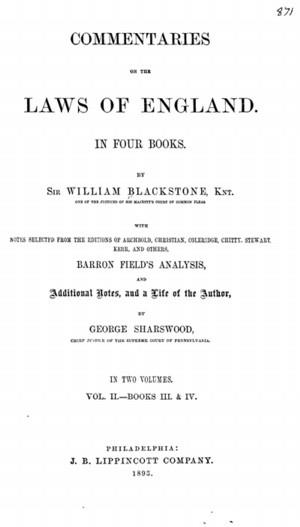
CHAPTER IV.: OF OFFENCES AGAINST GOD AND RELIGION. - Sir William Blackstone, Commentaries on the Laws of England in Four Books, vol. 2 [1753]Edition used:Commentaries on the Laws of England in Four Books. Notes selected from the editions of Archibold, Christian, Coleridge, Chitty, Stewart, Kerr, and others, Barron Field’s Analysis, and Additional Notes, and a Life of the Author by George Sharswood. In Two Volumes. (Philadelphia: J.B. Lippincott Co., 1893).
Part of: Commentaries on the Laws of England in Four Books, 2 vols.About Liberty Fund:Liberty Fund, Inc. is a private, educational foundation established to encourage the study of the ideal of a society of free and responsible individuals. Copyright information:The text is in the public domain. Fair use statement:This material is put online to further the educational goals of Liberty Fund, Inc. Unless otherwise stated in the Copyright Information section above, this material may be used freely for educational and academic purposes. It may not be used in any way for profit.
CHAPTER IV.OF OFFENCES AGAINST GOD AND RELIGION.**41](k)In the present chapter we are to enter upon the detail of the several species of crimes and misdemeanours, with the punishments annexed to each by the law of England. It was observed in the beginning of this book(a) that crimes and misdemeanours are a breach and violation of the public rights and duties owing to the whole community, considered as a community, in its social aggregate capacity. And in the very entrance of these commentaries(b) it was shown that human laws can have no concern with any but social and relative duties, being intended only to regulate the conduct of man, considered under various relations, as a member of civil society. All crimes ought therefore to be estimated merely according to the mischiefs which they produce in civil society;(c) and of consequence private vices or breach of mere absolute duties, which man is bound to perform considered only as an individual, are not, cannot be, the object of any municipal law any further than as by their evil example, or other pernicious effects, they may prejudice the community and thereby become a species of public crimes. Thus the vice of drunkenness, if committed privately and alone, is beyond the knowledge and of course beyond the reach of human tribunals; but if committed publicly, in the face of the world, its evil example makes it liable to temporal censures. The vice of lying, which consists (abstractedly taken) in a criminal violation of truth, and therefore, in any *[*42shape, is derogatory from sound morality, is not, however, taken notice of by our law unless it carries with it some public inconvenience, as spreading false news; or some social injury, as slander and malicious prosecution, for which a private recompense is given. And yet drunkenness and malevolent lying are in foro conscientiæ as thoroughly criminal when they are not, as when they are, attended with public inconvenience. The only difference is that both public and private vices are subject to the vengeance of eternal justice; and public vices are besides liable to the temporal punishment of human tribunals. On the other hand: there are some misdemeanours which are punished by the municipal law that have in themselves nothing criminal, but are made unlawful by the positive constitutions of the state for public convenience; such as poaching, exportation of wool, and the like. These are naturally no offences at all; but their whole criminality consists in their disobedience to the supreme power, which has an undoubted right, for the well-being and peace of the community, to make some things unlawful which are in themselves indifferent. Upon the whole, therefore, though part of the offences to be enumerated in the following sheets are offences against the revealed law of God, others against the law of nature, and some are offences against neither; yet in a treatise of municipal law we must consider them all as deriving their particular guilt here punishable from the law of man. Having premised this caution, I shall next proceed to distribute the several offences, which are either directly or by consequence injurious to civil society, and therefore punishable by the laws of England, under the following general heads: first, those which are more immediately injurious to God and his holy religion; secondly, such as violate and transgress the law of nations; thirdly, such as more especially affect the sovereign executive power of the state, or the king and his government; fourthly, such as more directly *[*43infringe the rights of the public or commonwealth; and lastly, such as derogate from those rights and duties, which are owing to particular individuals, and in the preservation and vindication of which the community is deeply interested. First, then, of such crimes and misdemeanours as more immediately offend Almighty God, by openly transgressing the precepts of religion, either natural or revealed; and mediately by their bad example and consequence the law of society also; which constitutes that guilt in the action which human tribunals are to censure. 1. Of this species the first is that of apostasy, or a total renunciation of Christianity, by embracing either a false religion or no religion at all. This offence can only take place in such as have once professed the true religion. The perversion of a Christian to Judaism, paganism, or other false religion, was punished by the emperors Constantine and Julian with confiscation of goods;(d) to which the emperors Theodosius and Valentinian added capital punishment, in case the apostate endeavoured to pervert others to the same iniquity;(e) a punishment too severe for any temporal laws to inflict upon any spiritual offence; and yet the zeal of our ancestors imported it into this country; for we find by Bracton(f) that in his time apostates were to be burnt to death. Doubtless the preservation of Christianity, as a national religion, is, abstracted from its own intrinsic truth, of the utmost consequence to the civil state: which a single instance will sufficiently demonstrate. The belief of a future state of rewards and punishments, the entertaining just ideas of the moral attributes of the Supreme Being, and a firm persuasion that he superintends and will finally compensate every action in human life, (all which are clearly revealed in the doctrines, and forcibly inculcated by the precepts, of our Saviour Christ,) these are the grand foundation of all judicial oaths; which call God to witness the truth of those facts, which perhaps may be only known to him and the party attesting; all moral evidence, **44]therefore, all confidence in human veracity, must be weakened by apostasy and overthrown by total infidelity.(g) Wherefore all affronts to Christianity, or endeavours to depreciate its efficacy, in those who have once professed it, are highly deserving of censure. But yet the loss of life is a heavier penalty than the offence, taken in a civil light, deserves; and taken in a spiritual light, our laws have no jurisdiction over it. This punishment therefore has long ago become obsolete; and the offence of apostasy was for a long time the object only of the ecclesiastical courts, which corrected the offender pro salute animæ. But about the close of the last century the civil liberties to which we were then restored being used as a cloak of maliciousness, and the most horrid doctrines, subversive of all religion, being publicly avowed both in discourse and writings, it was thought necessary again for the civil power to interpose by not admitting those miscreants(h) to the privileges of society who maintained such principles as destroyed all moral obligation. To this end it was enacted, by statute 9 & 10 W. III. c. 32, that if any person educated in, or having made profession of, the Christian religion, shall, by writing, printing, teaching, or advised speaking, deny the Christian religion to be true, or the holy scriptures to be of divine authority, he shall upon the first offence be rendered incapable to hold any office or place of trust; and for the second be rendered incapable of bringing any action, being guardian, executor, legatee, or purchaser of lands, and shall suffer three years’ imprisonment without bail. To give room, however, for repentance, if, within four months after the first conviction, the delinquent will in open court publicly renounce his error, he is discharged for that once from all disabilities. II. A second offence is that of heresy, which consists not in a total denial of Christianity, but of some of its essential **45]doctrines publicly and obstinately avowed; being defined by Sir Matthew Hale, “sententia rerum divinarum humano sensu excogitata, palam docta et pertinaciter defensa.”(i) And here it must also be acknowledged that particular modes of belief or unbelief, not tending to overturn Christianity itself, or to sap the foundations of morality, are by no means the object of coercion by the civil magistrate. What doctrines shall therefore be adjudged heresy was left by our old constitution to the determination of the ecclesiastical judge; who had herein a most arbitrary latitude allowed him. For the general definition of a heretic given by Lyndewode,(k) extends to the smallest deviation from the doctrines of holy church; “hæreticus est qui dubitat de fide catholica, et qui negligit servare ea, quæ Romana ecclesia statuit, seu servare decreverat.” Or, as the statute 2 Hen. IV. c. 15 expresses it in English, “teachers of erroneous opinions, contrary to the faith and blessed determinations of the holy church.” Very contrary this to the usage of the first general councils, which defined all heretical doctrines with the utmost precision and exactness. And what ought to have alleviated the punishment, the uncertainty of the crime, seems to have enhanced it in those days of blind zeal and pious cruelty. It is true that the sanctimonious hypocrisy of the canonists went at first no further than enjoining penance, excommunication, and ecclesiastical deprivation for heresy; though afterwards they proceeded boldly to imprisonment by the ordinary, and confiscation of goods in pios uses. But in the mean time they had prevailed upon the weakness of bigoted princes to make the civil power subservient to their purposes, by making heresy not only a temporal but even a capital offence: the Romish ecclesiastics determining, without appeal, whatever they pleased to be heresy, and shifting off to the secular arm the odium and drudgery of executions; with which they themselves were too tender and delicate to intermeddle. Nay, they pretended to intercede and pray on behalf of the convicted heretic, ut citra mortis periculum sententia circa eum moderatur;(l) well *[*46knowing at the same time that they were delivering the unhappy victim to certain death. Hence the capital punishments inflicted on the antient Donatists and Manichæans by the emperors Theodosius and Justinian:(m) hence also the constitution of the emperor Frederic, mentioned by Lyndewode,(n) adjudging all persons, without distinction, to be burned with fire who were convicted of heresy by the ecclesiastical judge. The same emperor, in another constitution,(o) ordained that if any temporal lord, when admonished by the church, should neglect to clear his territories of heretics within a year, it should be lawful for good catholics to seize and occupy the lands and utterly to exterminate the heretical possessors. And upon this foundation was built that arbitrary power, so long claimed and so fatally exerted by the pope, of disposing even of the kingdoms of refractory princes to more dutiful sons of the church. The immediate event of this constitution was something singular, and may serve to illustrate at once the gratitude of the holy see and the just punishment of the royal bigot: for upon the authority of this very constitution the pope afterwards expelled this very emperor Frederic from his kingdom of Sicily and gave it to Charles of Anjou.(p) Christianity being thus deformed by the demon of persecution upon the continent, we cannot expect that our own island should be entirely free from the same scourge. And therefore we find among our antient precedents(q) a writ de hæretico comburendo, which is thought by some to be as antient as the common law itself. However, it appears from thence that the conviction of heresy by the common law was not in any petty ecclesiastical court, but before the archbishop himself in a provincial synod; and that the delinquent was delivered over to the king to do as he should please with him; so that the crown had a control over the spiritual power, and might pardon the convict by issuing no process against him; the writ de hæretico comburendo being not a writ of course, but issuing only by the special direction of the king in council.(r) *[*47But in the reign of Henry the Fourth, when the eyes of the Christian world began to open, and the seeds of the Protestant religion (though under the opprobrious name of lollardy)(s) took root in this kingdom; the clergy, taking advantage from the king’s dubious title to demand an increase of their own power, obtained an act of parliament(t) which sharpened the edge of persecution to its utmost keenness. For by that statute the diocesan alone, without the intervention of a synod, might convict of heretical tenets; and unless the convict abjured his opinions, or if after abjuration he relapsed, the sheriff was bound ex officio, if required by the bishop, to commit the unhappy victim to the flames, without waiting for the consent of the crown. By the statute 2 Hen. V. c. 7, lollardy was also made a temporal offence and indictable in the king’s courts; which did not thereby gain an exclusive, but only a concurrent, jurisdiction with the bishop’s consistory. Afterwards, when the final reformation of religion began to advance, the power of the ecclesiastics was somewhat moderated; for though what heresy is was not then precisely defined, yet we were told in some points what it is not: the statute 25 Hen. VIII. c. 14 declaring that offences against the see of Rome are not heresy, and the ordinary being thereby restrained from proceeding in any case upon mere suspicion; that is, unless the party be accused by two credible witnesses, or an indictment of heresy be first previously found in the king’s courts of common law. And yet the spirit of persecution was not then abated, but only diverted into a lay channel. For in six years afterwards, by statute 31 Hen. VIII. c. 14, the bloody law of the six articles was made, which established the six most contested points of popery, transubstantiation, communion in one kind, the celibacy of the clergy, monastic vows, the sacrifice of the mass, and auricular confession; which points were “determined and resolved by the most **48]godly study, pain, and travail of his majesty: for which his most humble and obedient subjects, the lords spiritual and temporal, and the commons in parliament assembled, did not only render and give unto his highness their most high and hearty thanks,” but did also enact and declare all oppugners of the first to be heretics, and to be burned with fire; and of the five last to be felons, and to suffer death. The same statute established a new and mixed jurisdiction of clergy and laity for the trial and conviction of heretics; the reigning prince being then equally intent on destroying the supremacy of the bishops of Rome and establishing all other their corruptions of the Christian religion. I shall not perplex this detail with the various repeals and revivals of these sanguinary laws in the two succeeding reigns; but shall proceed directly to the reign of queen Elizabeth; when the reformation was finally established with temper and decency, unsullied with party rancour or personal caprice and resentment. By statute 1 Eliz. c. 1, all former statutes relating to heresy are repealed, which leaves the jurisdiction of heresy as it stood at common law; viz., as to the infliction of common censures in the ecclesiastical courts; and, in case of burning the heretic, in the provincial senate only.(u) Sir Matthew Hale is indeed of a different opinion, and holds that such power resided in the diocesan also, though he agrees that in either case the writ de hæretico comburendo was not demandable of common right, but grantable or otherwise merely at the king’s discretion.(v) But the principal point now gained was that by this statute a boundary is for the first time set to what shall be accounted heresy; nothing for the future being to be so determined but only such tenets which have been heretofore so declared, 1. By the words of the canonical scriptures; 2. By the first four general councils, or such others as have only used the words of the holy scriptures; or, 3. Which shall hereafter be so declared by the parliament with the assent of the clergy in convocation. Thus was heresy reduced to a greater certainty than before; though it might not have been the worse to have defined it in terms still more precise and particular: as a man continued still **49]liable to be burned for what perhaps he did not understand to be heresy till the ecclesiastical judge so interpreted the words of the canonical scriptures. For the writ de hæretico comburendo remained still in force; and we have instances of its being put in execution upon two anabaptists in the seventeenth of Elizabeth, and two Arians in the ninth of James the First. But it was totally abolished, and heresy again subjected only to ecclesiastical correction vro salute animæ, by virtue of the statute 29 Car. II. c. 9. For in one and the same reign our lands were delivered from the slavery of military tenures, our bodies from arbitrary imprisonment by the habeas corpus act, and our minds from the tyranny of superstitious bigotry by demolishing this last badge of persecution in the English law. In what I have now said, I would not be understood to derogate from the just rights of the national church, or to favour a loose latitude of propagating any rude undigested sentiments in religious matters. Of propagating, I say; for the bare entertaining them, without an endeavour to diffuse them, seems hardly cognizable by any human authority. I only mean to illustrate the excellence of our present establishment, by looking back to former times. Every thing is now as it should be, with respect to the spiritual cognizance and spiritual punishment of heresy: unless, perhaps, that the crime ought to be more strictly defined, and no prosecution permitted, even in the ecclesiastical courts, till the tenets in question are by proper authority previously declared to be heretical. Under these restrictions, it seems necessary for the support of the national religion that the officers of the church should have power to censure heretics, yet not to harass them with temporal penalties, much less to exterminate or destroy them. The legislature hath indeed thought it proper that the civil magistrate should again interpose with regard to one species of heresy very prevalent in modern times; for, by statute 9 & 10 W. III. c. 32, if any person educated in the Christian religion, or professing the same, shall, by writing, printing, teaching, or advised speaking, deny any one of the persons of the Holy Trinity to be God, or maintain that there are *[*50more Gods than one, he shall undergo the same penalties and incapacities which were just now mentioned to be inflicted on apostasy by the same statute.1 And thus much for the crime of heresy. III. Another species of offences against religion are those which affect the established church. And these are either positive or negative: positive, by reviling its ordinances; or negative, by non-conformity to its worship. Of both of these in their order. 1. And, first, of the offence of reviling the ordinances of the church. This is a crime of a much grosser nature than the other of mere non-conformity, since it carries with it the utmost indecency, arrogance, and ingratitude: indecency, by setting up private judgment in virulent and factious opposition to public authority; arrogance, by treating with contempt and rudeness what has at least a better chance to be right than the singular notions of any particular man; and ingratitude, by denying that indulgence and undisturbed liberty of conscience to the members of the national church which the retainers to every petty conventicle enjoy. However, it is provided, by statutes 1 Edw. VI. c. 1, and 1 Eliz. c. 1, that whoever reviles the sacrament of the Lord’s supper shall be punished by fine and imprisonment; and, by the statute 1 Eliz. c. 2, if any minister shall speak any thing in derogation from the book of common prayer, he shall, if not beneficed, be imprisoned one year for the first offence, and for life for the second; and if he be beneficed, he shall for the first offence be imprisoned six months, and forfeit a year’s value of his benefice; for the second offence he shall be deprived, and suffer one year’s imprisonment; and for the third shall in like manner be deprived, and suffer imprisonment for life. And if any person whatsoever shall, in plays, songs, or other open words, speak any thing in derogation, depraving, or despising of said book, or shall forcibly prevent the reading of it, or cause any other service to be used in its stead, he shall forfeit for the first offence a hundred marks; for the second, four hundred; and for the third shall forfeit all his goods and chattels, and suffer imprisonment for life.2 *[*51These penalties were framed in the infancy of our present establishment, when the disciples of Rome and of Geneva united in inveighing with the utmost bitterness against the English liturgy; and the terror of these laws (for they seldom, if ever, were fully executed) proved a principal means, under Providence, of preserving the purity as well as decency of our national worship. Nor can their continuance to this time (of the milder penalties at least) be thought too severe and intolerant; so far as they are levelled at the offence, not of thinking differently from the national church, but of railing at that church and obstructing its ordinances for not submitting its public judgment to the private opinion of others. For, though it is clear that no restraint should be laid upon rational and dispassionate discussions of the rectitude and propriety of the established mode of worship, yet contumely and contempt are what no establishment can tolerate.(w) A rigid attachment to trifles, and an intemperate zeal for reforming them, are equally ridiculous and absurd; but the latter is at present the less excusable, because from political reasons, sufficiently hinted at in a former volume,(x) it would now be extremely unadvisable to make any alterations in the service of the church; unless by its own consent, or unless it can be shown that some manifest impiety or shocking absurdity will follow from continuing the present forms. 2. Non-conformity to the worship of the church is the other or negative branch of this offence. And for this there is much more to be pleaded than for the former; being a matter of private conscience, to the scruples of which our present laws have shown a very just and Christian indulgence. For undoubtedly all persecution and oppression of weak consciences, on the score of religious persuasions, are highly unjustifiable upon every principle of natural reason, civil liberty, or sound religion. But care must be taken not to carry this indulgence into such extremes as may endanger **52]the national church: there is always a difference to be made between toleration and establishment. Non-conformists are of two sorts: first, such as absent themselves from divine worship in the established church, through total irreligion, and attend the service of no other persuasion. These, by the statutes of 1 Eliz. c. 2, 23 Eliz. c. 1, and 3 Jac. I. c. 4, forfeit one shilling to the poor every Lord’s day they so absent themselves, and 20l. to the king if they continue such default for a month together. And if they keep any inmate, thus irreligiously disposed, in their houses, they forfeit 10l. per month. The second species of non-conformists are those who offend through a mistaken or perverse zeal. Such were esteemed by our laws, enacted since the time of the reformation, to be papists and Protestant dissenters; both of which were supposed to be equally schismatics in not communicating with the national church; with this difference, that the papists divided from it upon material, though erroneous, reasons; but many of the dissenters upon matters of indifference, or, in other words, upon no reason at all. Yet certainly our ancestors were mistaken in their plans of compulsion and intolerance. The sin of schism, as such, is by no means the object of temporal coercion and punishment. If, through weakness of intellect, through misdirected piety, through perverseness and acerbity of temper, or (which is often the case) through a prospect of secular advantage in herding with a party, men quarrel with the ecclesiastical establishment, the civil magistrate has nothing to do with it, unless their tenets and practice are such as threaten ruin or disturbance to the state. He is bound indeed to protect the established church; and, if this can be better effected by admitting none but its genuine members to offices of trust and emolument, he is certainly at liberty so to do: the disposal of offices being matter of favour and discretion. But, this point being once secured, all persecution for diversity of opinions, however ridiculous or absurd they may be, is contrary to every principle of sound policy and civil freedom. The names and subordination of the clergy, the posture of devotion, the materials and **53]colour of the minister’s garment, the joining in a known or unknown form of prayer, and other matters of the same kind, must be left to the option of every man’s private judgment. With regard, therefore, to Protestant dissenters, although the experience of their turbulent disposition in former times occasioned several disabilities and restrictions (which I shall not undertake to justify) to be laid upon them by abundance of statutes,(y) yet at length the legislature, with a spirit of true magnanimity, extended that indulgence to these sectaries which they themselves, when in power, had held to be countenancing schism and denied to the church of England.(z) The penalties are conditionally suspended by the statute 1 W. and M. st. 1, c. 18, “for exempting their majesties’ Protestant subjects, dissenting from the church of England, from the penalties of certain laws,” commonly called the toleration act; which is confirmed by the statute 10 Anne, c. 2, and declares that neither the laws above mentioned, nor the statutes 1 Eliz. c. 2, § 14, 3 Jac. I. c. 4 & 5, nor any other penal laws made against popish recusants, (except the test acts,) shall extend to any dissenters other than papists and such as deny the Trinity: provided, 1. that they take the oaths of allegiance and supremacy (or make a similar affirmation, being Quakers)(a) and subscribe the declaration against popery; 2. that they repair to some congregation certified to and registered in the court of the bishop or archdeacon, or at the county sessions; 3. that the doors of such meeting-house shall be unlocked, unbarred, and unbolted; in default of which the persons meeting there are still liable to all the penalties of the former acts. Dissenting teachers, in order to be exempted from the penalties of the statutes 13 & 14 Car. II. c. 4, 15 Car. II. c. 6, 17 Car. II. c. 2, and 22 Car. II. c. 1, are also to subscribe the articles of religion mentioned in the statute 13 Eliz. c. 12, (which only concern the confession of the true Christian faith and the doctrine of the sacraments,) with an express exception *[*54of those relating to the government and powers of the church and to infant baptism; or, if they scruple subscribing the same, shall make and subscribe the declaration prescribed by statute 19 Geo. III. c. 44, professing themselves to be Christians and Protestants, and that they believe the scriptures to contain the revealed will of God, and to be the rule of doctrine and practice. Thus, though the crime of non-conformity is by no means universally abrogated, it is suspended and ceases to exist with regard to those Protestant dissenters during their compliance with the conditions imposed by these acts; and, under these conditions, all persons, who will approve themselves no papists or oppugners of the Trinity, are left at full liberty to act as their consciences shall direct them in the matter of religious worship. And if any person shall wilfully, maliciously, or contemptuously disturb any congregation assembled in any church or permitted meeting-house, or shall misuse any preacher or teacher there, he shall (by virtue of the same statute, 1 W. & M.) be bound over to the sessions of the peace and forfeit twenty pounds.3 But, by statute 5 Geo. I. c. 4, no mayor or principal magistrate must appear at any dissenting meeting with the ensigns of his office,(b) on pain of disability to hold that or any other office: the legislature judging it a matter of propriety that a mode of worship set up in opposition to the national, when allowed to be exercised in peace, should be exercised also with decency, gratitude, and humility. Dissenters also, who subscribe the declaration of the act 19 Geo. III., are exempted (unless in the case of endowed schools and colleges) from the penalties of the statutes 13 & 14 Car. II. c. 4, and 17 Car. II. c. 2, which prohibit (upon pain of fine and imprisonment) all persons from teaching school, unless they be licensed by the ordinary, and subscribe a declaration of conformity to the liturgy of the church, and reverently frequent divine service, established by the laws of this kingdom.4 As to papists, what has been said of the Protestant dissenters would hold equally strong for a general toleration of them; **55]provided their separation was founded only upon difference of opinion in religion, and their principles did not also extend to a subversion of the civil government. If once they could be brought to renounce the supremacy of the pope, they might quietly enjoy their seven sacraments, their purgatory and auricular confession, their worship of relics and images, nay, even their transubstantiation. But while they acknowledge a foreign power superior to the sovereignty of the kingdom, they cannot complain if the laws of that kingdom will not treat them upon the footing of good subjects. Let us therefore now take a view of the laws in force against the papists; who may be divided into three classes, persons professing popery, popish recusants convict, and popish priests. 1. Persons professing the popish religion, besides the former penalties for not frequenting their parish church, are disabled from taking their lands, either by descent or purchase, after eighteen years of age, until they renounce their errors; they must at the age of twenty-one register their estates before acquired, and all future conveyances and wills relating to them; they are incapable of presenting to any advowson, or granting to any other person any avoidance of the same; they may not keep or teach any school, under pain of perpetual imprisonment; and if they willingly say or hear mass, they forfeit the one two hundred, the other one hundred marks, and each shall suffer a year’s imprisonment. Thus much for persons who, from the misfortune of family prejudices or otherwise, have conceived an unhappy attachment to the Romish church from their infancy and publicly profess its errors. But if any evil industry is used to rivet these errors upon them, if any person sends another abroad to be educated in the popish religion or to reside in any religious house abroad for that purpose, or contributes to their maintenance when there; *[*56both the sender, the sent, and the contributor are disabled to sue in law or equity, to be executor or administrator to any person, to take any legacy or deed of gift, and to bear any office in the realm, and shall forfeit all their goods and chattels, and likewise all their real estate for life. And where these errors are also aggravated by apostasy or perversion, where a person is reconciled to the see of Rome, or procures others to be reconciled, the offence amounts to high treason. 2. Popish recusants, convicted in a court of law of not attending the service of the church of England, are subject to the following disabilities, penalties, and forfeitures, over and above those before mentioned. They are considered as persons excommunicated; they can hold no office or employment; they must not keep arms in their houses, but the same may be seized by the justices of the peace; they may not come within ten miles of London, on pain of 100l.; they can bring no action at law, or suit in equity: they are not permitted to travel above five miles from home, unless by license, upon pain of forfeiting all their goods; and they may not come to court under pain of 100l. No marriage or burial of such recusant, or baptism of his child, shall be had otherwise than by the ministers of the church of England, under other severe penalties. A married woman, when recusant, shall forfeit two-thirds of her dower or jointure; may not be executrix or administratrix to her husband, nor have any part of his goods; and during the coverture may be kept in prison, unless her husband redeems her at the rate of 10l. a month, or the third part of all his lands. And, lastly, as a feme-covert recusant may be imprisoned, so all others must, within three months after conviction, either submit and renounce their errors, or, if required so to do by four justices, must abjure and renounce the realm: and if they do not depart, or if they return without the king’s license, they shall be guilty of felony, and suffer death as felons without the benefit of clergy. There is also an inferior species of recusancy, (refusing to make the declaration against popery enjoined by statute 30 Car. II. st. 2, when tendered by the proper magistrate,) which, if the party resides within ten miles of London, makes him an absolute recusant convict; or, if at a greater distance, suspends him from having any seat in *[*57parliament, keeping arms in his house, or any horse above the value of five pounds. This is the state, by the laws now in being,(c) of a lay papist. But, 3. The remaining species or degree, viz., popish priests, are in a still more dangerous condition. For by statute 11 & 12 W. III. c. 4, popish priests or bishops celebrating mass or exercising any part of their functions in England, except in the houses of ambassadors, are liable to perpetual imprisonment. And, by the statute 27 Eliz. c. 2, any popish priest, born in the dominions of the crown of England, who shall come over hither from beyond sea, (unless driven by stress of weather, and tarrying only a reasonable time),(d) or shall be in England three days without conforming and taking the oaths, is guilty of high treason: and all persons harbouring him are guilty of felony without the benefit of clergy. This is a short summary of the laws against the papists, under their three several classes of persons professing the popish religion, popish recusants convict, and popish priests. Of which the president Montesquieu observes,(e) that they are so rigorous, though not professedly of the sanguinary kind, that they do all the hurt that can possibly be done in cold blood. But in answer to this it may be observed (what foreigners who only judge from our statute-book are not fully apprized of) that these laws are seldom exerted to their utmost rigour: and, indeed, if they were, it would be very difficult to excuse them. For they are rather to be accounted for from their history, and the urgency of the times which produced them, than to be approved (upon a cool review) as a standing system of law. The restless machinations of the Jesuits during the reign of Elizabeth, the turbulence and uneasiness of the papists under the new religious establishment, and the boldness of their hopes and wishes for the succession of the queen of Scots, obliged the parliament to counteract so dangerous a spirit by laws of a great, and then perhaps necessary, severity. The powder-treason in the succeeding reign struck a panic into **58]James I., which operated in different ways: it occasioned the enacting of new laws against the papists, but deterred him from putting them in execution. The intrigues of queen Henrietta in the reign of Charles I., the prospect of a popish successor in that of Charles II., the assassination-plot in the reign of king William, and the avowed claim of a popish pretender to the crown in that and subsequent reigns, will account for the extension of these penalties at those several periods of our history. But if a time shall ever arrive, and perhaps it is not very distant, when all fears of a pretender shall have vanished, and the power and influence of the pope shall become feeble, ridiculous, and despicable not only in England but in every kingdom of Europe, it probably would not then be amiss to review and soften these rigorous edicts; at least, till the civil principles of the Roman Catholics called again upon the legislature to renew them: for it ought not to be left in the breast of every merciless bigot to drag down the vengeance of these occasional laws upon inoffensive, though mistaken, subjects; in opposition to the lenient inclination of the civil magistrate, and to the destruction of every principle of toleration and religious liberty. This hath partly been done by statute 18 Geo. III. c. 60, with regard to such papists as duly take the oath therein prescribed of allegiance to his majesty, abjuration of the pretender, renunciation of the pope’s civil power, and abhorrence of the doctrines of destroying and not keeping faith with heretics and deposing or murdering princes excommunicated by authority of the see of Rome: in respect of whom only the statute of 11 & 12 W. III. is repealed so far as it disables them from purchasing or inheriting, or authorizes the apprehending or prosecuting the popish clergy, or subjects to perpetual imprisonment either them or any teachers of youth.5 In order the better to secure the established church against perils from non-conformists of all denominations, infidels, Turks, Jews, heretics, papists, and sectaries, there are, however, two bulwarks erected; called the corporation and test acts: by the former of which(f) no person can be legally elected to any office relating to the government of any city or corporation, unless within a twelvemonth before he has received the sacrament of the Lord’s supper according to the rites of the church of England; and he is also enjoined to take the oaths of allegiance and supremacy at the *[*59same time that he takes the oath of office; or, in default of either of these requisites, such election shall be void.6 The other, called the test act,(g) directs all officers, civil and military, to take the oaths and make the declaration against transubstantiation in any of the king’s courts at Westminster, or at the quarter sessions, within six calendar months after their admission; and also within the same time7 to receive the sacrament of the Lord’s supper according to the usage of the church of England, in some public church, immediately after divine service and sermon, and to deliver into court a certificate thereof signed by the minister and church-warden, and also to prove the same by two credible witnesses; upon forfeiture of 500l. and disability to hold the said office.8 And of much the same nature with these is the statute 7 Jac. I. c. 2, which permits no person to be naturalized or restored in blood but such as undergo a like test: which test having been removed in 1753, in favour of the Jews, was the next session of parliament restored again with some precipitation. Thus much for offences which strike at our national religion, or the doctrine and discipline of the church of England in particular. I proceed now to consider some gross impieties and general immoralities which are taken notice of and punished by our municipal law; frequently in concurrence with the ecclesiastical, to which the censure of many of them does also of right appertain; though with a view somewhat different: the spiritual court punishing all sinful enormities for the sake of reforming the private sinner, pro salute animæ; while the temporal courts resent the public affront to religion and morality on which all governments must depend for support, and correct more for the sake of example than private amendment. IV. The fourth species of offences, therefore, more immediately against God and religion, is that of blasphemy against the Almighty by denying his being or providence; or by contumelious reproaches of our Saviour Christ.9 Whither also may be referred all profane scoffing at the holy scripture, or exposing it to contempt and ridicule. These are offences punishable at common law by fine and imprisonment, or other infamous corporal punishment;(h) for Christianity is part of the laws of England.(i) V. Somewhat allied to this, though in an inferior degree, is the offence of profane and common swearing and **60]cursing. By the last statute against which, 19 Geo. II. c. 21, which repeals all former ones, every labourer, sailor, or soldier profanely cursing or swearing shall forfeit 1s.; every other person, under the degree of a gentleman, 2s.; and every gentleman, or person of superior rank, 5s., to the poor of the parish; and, on the second conviction, double; and for every subsequent offence, treble the sum first forfeited; with all charges of conviction: and in default of payment shall be sent to the house of correction for ten days. Any justice of the peace may convict upon his own hearing, or the testimony of one witness; and any constable or peace officer, upon his own hearing, may secure any offender and carry him before a justice and there convict him.10 If the justice omits his duty he forfeits 5l., and the constable 40s. And the act is to be read in all parish churches and public chapels the Sunday after every quarter-day, on pain of 5l., to be levied by warrant from any justice.11 Besides this punishment for taking God’s name in vain in common discourse, it is enacted, by statute 3 Jac. I. c. 21, that if, in any stage-play, interlude, or show, the name of the Holy Trinity, or any of the persons therein, be jestingly or profanely used, the offender shall forfeit 10l., one moiety to the king, and the other to the informer. VI. A sixth species of offence against God and religion, of which our antient books are full, is a crime of which one knows not well what account to give. I mean the offence of witchcraft, conjuration, enchantment, or sorcery. To deny the possibility, nay, actual existence, of witchcraft and sorcery is at once flatly to contradict the revealed word of God, in various passages both of the Old and New Testament: and the thing itself is a truth to which every nation in the world hath in its turn borne testimony, either by examples seemingly well attested or by prohibitory laws; which at least suppose the possibility of commerce with evil spirits. The civil law punishes with death not only the sorcerers themselves, but also those who consult them,(j) imitating in the former the express law of God,(k) “Thou shalt not suffer a witch to live.” And our own laws, both before and since the conquest, have been *[*61equally penal; ranking this crime in the same class with heresy, and condemning both to the flames.(l) The president Montesquieu(m) ranks them also both together, but with a very different view: laying it down as an important maxim that we ought to be very circumspect in the prosecution of magic and heresy; because the most unexceptionable conduct, the purest morals, and the constant practice of every duty in life are not a sufficient security against the suspicion of crimes like these. And indeed the ridiculous stories that are generally told, and the many impostures and delusions that have been discovered in all ages, are enough to demolish all faith in such a dubious crime; if the contrary evidence were not also extremely strong. Wherefore it seems to be the most eligible way to conclude, with an ingenious writer of our own,(n) that in general there has been such a thing as witchcraft; though one cannot give credit to any particular modern instance of it. Our forefathers were stronger believers when they enacted, by statute 33 Hen. VIII. c. 8, all witchcraft and sorcery to be felony without benefit of clergy; and again, by statute 1 Jac. I. c. 12, that all persons invoking any evil spirit, or consulting, covenanting with, entertaining, employing, feeding, or rewarding, any evil spirit; or taking up dead bodies from their graves to be used in any witchcraft, sorcery, charm, or enchantment; or killing or otherwise hurting any person by such infernal arts, should be guilty of felony without benefit of clergy, and suffer death. And if any person should attempt by sorcery to discover hidden treasure, or to restore stolen goods, or to provoke unlawful love, or to hurt any man or beast, though the same were not effected, he or she should suffer imprisonment and pillory for the first offence, and death for the second. These acts continued in force till lately, to the terror of all antient females in the kingdom: and many poor wretches were sacrificed thereby to the prejudice of their neighbours and their own illusions; not a few having, by some means or other, confessed the fact at the gallows. But all executions for this dubious crime are now at an end; our legislature having at length followed the wise example of **62]Louis XIV. in France, who thought proper, by an edict, to restrain the tribunals of justice from receiving informations of witchcraft.(o) And accordingly it is with us enacted, by statute 9 Geo. II. c. 5, that no prosecution shall for the future be carried on against any persons for conjuration, witchcraft, sorcery, or enchantment. But the misdemeanour of persons pretending to use witchcraft, tell fortunes, or discover stolen goods, by skill in the occult sciences, is still deservedly punished with a year’s imprisonment, and standing four times in the pillory.12 VII. A seventh species of offenders in this class are all religious impostors: such as falsely pretend an extraordinary commission from heaven, or terrify and abuse the people with false denunciations of judgments. These, as tending to subvert all religion by bringing it into ridicule and contempt, are punishable by the temporal courts with fine, imprisonment, and infamous corporal punishment.(p) VIII. Simony, or the corrupt presentation of any one to an ecclesiastical benefice for gift or reward, is also to be considered as an offence against religion; as well by reason of the sacredness of the charge which is thus profanely bought and sold, as because it is always attended with perjury in the person presented.(q)13 The statute 31 Eliz. c. 6 (which, so far as it relates to the forfeiture of the right of presentation, was considered in a former book)(r) enacts that if any patron, for money or any other corrupt consideration or promise, directly or indirectly given, shall present, admit, institute, induct, instal, or collate, any person to an ecclesiastical benefice or dignity, both the giver and taker shall forfeit two years’ value of the benefice or dignity; one moiety to the king, and the other to any one who will sue for the same. If persons also corruptly resign or exchange their benefices, both the giver and taker shall in like manner forfeit double the value of the money or other corrupt consideration.14 And persons who shall **63]corruptly ordain or license any minister, or procure him to be ordained or licensed, (which is the true idea of simony,) shall incur a like forfeiture of forty pounds; and the minister himself of ten pounds, besides an incapacity to hold any ecclesiastical preferment for seven years afterwards. Corrupt elections and resignations in colleges, hospitals, and other eleemosynary corporations, are also punished by the same statute with forfeiture of the double value, vacating the place or office, and a devolution of the right of election for that turn to the crown.15 IX. Profanation of the Lord’s day, vulgarly (but improperly) called sabbath-breaking, is a ninth offence against God and religion, punished by the municipal law of England. For, besides the notorious indecency and scandal of permitting any secular business to be publicly transacted on that day in a country professing Christianity, and the corruption of morals which usually follows its profanation, the keeping one day in the seven holy, as a time of relaxation and refreshment as well as for public worship, is of admirable service to a state, considered merely as a civil institution. It humanizes, by the help of conversation and society, the manners of the lower classes, which would otherwise degenerate into a sordid ferocity and savage selfishness of spirit; it enables the industrious workman to pursue his occupation in the ensuing week with health and cheerfulness; it imprints on the minds of the people that sense of their duty to God so necessary to make them good citizens, but which yet would be worn out and defaced by an unremitted continuance of labour, without any stated times of recalling them to the worship of their Maker. And, therefore, the laws of king Athelstan(s) forbade all merchandizing on the Lord’s day, under very severe penalties. And by the statute 27 Hen. VI. c. 5, no fair or market shall be held on the principal festivals, Good Friday, or any Sunday, (except the four Sundays in harvest,) on pain of forfeiting the goods exposed to sale. And since, by the statute 1 Car. I. c. 1, no persons shall assemble out of their own parishes for any sport whatsoever upon this day; nor, in their parishes, shall use any bull or *[*64bear baiting, interludes, plays, or other unlawful exercises or pastimes; on pain that every offender shall pay 3s. 4d. to the poor. This statute does not prohibit, but rather impliedly allows, any innocent recreation or amusement, within their respective parishes, even on the Lord’s day, after divine service is over. But, by statute 29 Car. II. c. 7, no person is allowed to work on the Lord’s day, or use any boat or barge, or expose any goods to sale; except meat in public houses, milk at certain hours, and works of necessity or charity, on forfeiture of 5s. Nor shall any drover, carrier, or the like travel upon that day, under pain of twenty shillings.16 X. Drunkenness is also punished, by statute 4 Jac. I. c. 5, with the forfeiture of 5s., or the sitting six hours in the stocks: by which time the statute presumes the offender will have regained his senses, and not be liable to do mischief to his neighbours. And there are many wholesome statutes by way of prevention, chiefly passed in the same reign of king James I., which regulate the licensing of alehouses, and punish persons found tippling therein; or the master of such houses permitting them.17 XI. The last offence which I shall mention, more immediately against religion and morality, and cognizable by the temporal courts, is that of open and notorious lewdness; either by frequenting houses of ill fame, which is an indictable offence;(t)18 or by some grossly scandalous and public indecency, for which the punishment is by fine and imprisonment.(u)19 In the year 1650, when the ruling power found it for their interest to put on the semblance of a very extraordinary strictness and purity of morals, not only incest and wilful adultery were made capital crimes, but also the repeated act of keeping a brothel, or committing fornication, were (upon a second conviction) made felony without benefit of clergy.(w) But at the restoration, when men, from an abhorrence of the hypocrisy of the late times, fell into the contrary extreme of licentiousness, it was not thought proper to renew a law of **65]such unfashionable rigour. And these offences have been ever since left to the feeble coercion of the spiritual court according to the rules of the canon law; a law which has treated the offence of incontinence, nay, even adultery itself, with a great degree of tenderness and lenity, owing perhaps to the constrained celibacy of its first compilers. The temporal courts therefore take no cognizance of the crime of adultery otherwise than as a private injury.(x) But, before we quit this subject, we must take notice of the temporal punishment for having bastard children, considered in a criminal light; for, with regard to the maintenance of such illegitimate offspring, which is a civil concern, we have formerly spoken at large.(y) By the statute 18 Eliz. c. 3, two justices may take order for the punishment of the mother and reputed father, but what that punishment shall be is not therein ascertained; though the contemporary exposition was that a corporal punishment was intended.(z) By statute 7 Jac. I. c. 4, a specific punishment (viz., commitment to the house of correction) is inflicted on the woman only. But in both cases it seems that the penalty can only be inflicted if the bastard becomes chargeable to the parish; for otherwise the very maintenance of the child is considered as a degree of punishment. By the last-mentioned statute, the justice may commit the mother to the house of correction, there to be punished and set on work for one year; and in case of a second offence, till she find sureties never to offend again.20 [(k) ] 1 Hal. P. C. 625, 626. 2 Hawk. P. C. 373. Foster, 361. [(a) ] See page 5. [(b) ] See book i. pages 123, 124. [(c) ] Beccar. ch. 8. [(d) ] Cod. 1, 7, 1. [(e) ] Ibid. 6. [(f) ]T. 3, c. 9. [(g) ]Utiles esse opiniones has, quis negat, cum intelligat, quam multa firmentur jurejurando; quantæ salutis sint fœderum religiones: quam multos divini supplicii metus a scelere revocavit: quamque sancta sit societas civium inter ipsos, Diis immortalibus interpositis tum judicibus, tum testibus? Cic. de LL ii. 7. [(h) ]Mescroyantz in our ancient law-books is the same of unbelievers. [(i) ] 1 Hal. P. C. 384. [(k) ]Cap. de hæreticis. [(l) ]Decretal l. 5, t. 40, c. 27. [(m) ]Cod. l. 1, tit. 5. [(n) ]C. de hæreticis. [(o) ]Cod. 1, 5, 4. [(p) ] Baldus in Cod. 1, 5, 4. [(q) ] F. N. B. 269. [(r) ] 1 Hal. P. C. 395. [(s) ] So called, not from lolium, or tares, (an etymology which was afterwards devised in order to justify the burning of them, Matt. xiii. 30,) but from one Walter Lolhard, a German reformer, ad 1315. Mod. Un. Hist. xxvi. 13. Spelm Gloss. 371. [(t) ] 2 Hen. IV. c. 15. [(u) ] 5 Rep. 23. 12 Rep. [Editor: illegible character] 92. [(v) ] 1 Hal. P. C. 405. [1 ] This statute has been repealed, as far as it affects Unitarians only, by the 53 Geo. III. c. 160. Prosecutions for reviling the Trinity seem to have been generally framed on the construction of the common law. The 9 & 10 W. III. has not altered the common law as to the offence of blasphemy, but only given a cumulative punishment. And it seem: also the 53 Geo. III. c. 160 does not alter the common law, but only removes the penalties imposed upon persons denying the Trinity by 9 & 10 W. III. c. 32, and extends to such persons the benefits conferred upon all other Protestant dissenters, by 1 W. and M. s. 1, c. 18. 1 Bar. & Cres. 26.—Chitty. [2 ] This statute of 1 Eliz. c. 2 was repealed, as far as relates to Protestant dissenters, by the 31 Geo. III. c. 32, s. 3.—Chitty. [(w) ] By an ordinance, (Aug. 23, 1645,) which continued till the restoration, to preach, write, or print any thing in derogation or depraving of the directory for the then established. Presbyterian worship, subjected the offender, upon indictment, to a discretionary fine not exceeding fifty pounds. Scobell, 98. [(x) ] Book i. page 8. [(y) ] 23 Eliz. c. 1. 29 Eliz. c. 6. 35 Eliz. c. 1. 22 Car. II. c. 1. [(z) ] The ordinance of 1645 (before cited) inflicted imprisonment for a year on the third offence, and pecuniary penalties on the former two, in case of using the Book of Common Prayer not only in a place of public worship, but also in any private family. [(a) ] See stat. 8 Geo. I. c. 6. [3 ] To constitute an offence within this act, the party must come into the place of worship. See 5 T. R. 542. The enactment is repeated, without the words “come into,” in the 52 Geo. III. c. 155, s. 12, which imposes the heavier penalty of 40l. The act applies only where the thing is done wilfully and of purpose maliciously to disturb the congregation or misuse the preacher. Per Abbott, C. J. 2 B. & C. 699; sed vid. Peake, R. 132. 5 T. R. 542. Each defendant is liable to the penalty. 5 T. R. 542. An indictment found at sessions may be removed into King’s Bench by prosecutor before verdict. 5 T. R. 542. 4 M. & S. 508.—Chitty. [(b) ] Sir Humphrey Edwin, a lord mayor of London, bad the imprudence, soon after the toleration act, to go to a Presbyterian meeting-house in his formalities; which is alluded to by Dean Swift, in his Tale of a Tub, under the allegory of Jack getting on a great horse and eating custard. [4 ] The 13 & 14 Car. II. c. 1. 17 Car. II. c. 2, and 22 Car. II. c. 1, are repealed by the 52 Geo. III. c. 155, s. 1, by which all places of religious worship of Protestants must be certified to the bishop of the diocese, or the archdeacon of the archdeaconry, or to the justices at the general or quarter sessions, and shall be also registered; and a penalty to the amount of 20l. and not less than 20s. may be inflicted for permitting meetings in places not so certified or registered; and, by sect. 4, every person teaching or preaching at, or being in, such place so certified, is exempted from penalties, as a person who has taken the oath and made the declaration prescribed by the 1 W. & M. st. 1, c. 18, or any act amending the same. By sect. 5, every one preaching or teaching at such place so certified shall, when required by a magistrate, take and subscribe the oath and declaration specified in the 19 Geo. III. c. 44; and, if he refuse to take it, he must not teach or preach, under a penalty of not exceeding 10l. nor less than 10s.; but he need not go more than five miles from his place of residence to take such oath; and, by sect. 6, such person may compel a justice to administer such oath to him, and to attest his subscription to such declaration and give him a certificate thereof. By sect. 11, no place of public meeting for religious worship must have the doors fastened, so as to prevent persons entering therein during the time of such meeting, under a penalty to the teacher of not exceeding 20l. nor less than 10s. By sect 13, the act is not to affect the celebration of divine service, according to the rights of the Church of England and Ireland, by ministers of such church, in places before then used for that purpose, or licensed or consecrated by any person so to do, nor affect the jurisdiction of bishops or others exercising lawful authority in the church over the said church, according to the rules and discipline of the same and to the laws of the realm. And, by sect. 14, the act is not to extend to Quakers, nor to meetings convened by them, or in any manner to affect any act relating to them, except those expressly above repealed.—Chitty. By a still more important statute, (9 Geo. IV. c. 17,) the former acts which imposed the necessity of receiving the sacrament as a test or qualification for holding corporation offices and employments were repealed, and a declaration to be made within six months after admittance in lieu of the sacramental test is substituted; but the not making the declaration which is intended for the protection of the Protestant Church renders the appointment void.—Stewart. [(c) ] Stat. 23 Eliz. c. 1. 27 Eliz. c. 2, 29 Eliz. c. 6, 35 Eliz. c. 2. 1 Jac. II. c. 4. 3 Jac. I. c. 4 and 5. 7 Jac. I. c. 6. 3 Car. I. c. 3. 25 Car. II. c. 2. 30 Car. II. st. 1 W. & M. c. 9, 15, and 26. 11 & 12 W. III. c. 4. 12 Anne, st. 2, c. 14. 1 Geo. I. st. 2, c. 55. 3 Geo. I. c. 18. 11 Geo. II. c. 17. [(d) ] Raym 377. Latch 1. [(e) ] Sp. L. b. xix. c. 27. [5 ] But now, by the statute 31 Geo. III. c. 32, (amended and explained by the 43 Geo. III. c. 30,) which may be called the toleration act of the Roman Catholics, all the severe and cruel restrictions and penalties enumerated by the learned judge are removed from those Roman Catholics who are willing to comply with the requisitions of that statute, which are that they must appear at some of the courts of Westminster, or at the quarter-sessions held for the county, city, or place where they shall reside, and shall make and subscribe a declaration that they profess the Roman Catholic religion, and also an oath, which is exactly similar to that required by the 18 Geo. III. c. 60, the substance of which is stated above in the text. On this declaration and oath being duly made by any Roman Catholic, the officer of the court shall grant him a certificate; and such officer shall yearly transmit to the privy council lists of all persons who have thus qualified themselves within the year in his respective court. The statute (sect. 4) they provides that a Roman Catholic thus qualified shall not be prosecuted under any statute for not repairing to a parish church, nor shall he be prosecuted for being a papist, nor for attending or performing mass or other ceremonies of the Church of Rome; provided (by sect. 5) that no place shall be allowed for an assembly to celebrate such worship until it is certified to the sessions; nor shall any minister officiate in it until his name and description are recorded there. And (by sect. 6 of 31 Geo. III. c. 32) no such place of assembly shall have its doors locked or barred during the time of meeting or divine worship. If any Roman Catholic whatever is elected constable, church-warden, overseer, or into any parochial office, he may execute the same by a deputy, to be approved as if he were to act for himself as principal. Id. s. 7. But every minister who has qualified shall be exempt from serving upon juries and from being elected into any parochial office. Id. s. 8. And all the laws for frequenting divine service on Sundays shall continue in force, except where persons attend some place of worship allowed by this statute or the toleration act of the dissenters. 1 W. and M. s. 1, c. 18. Id. s. 9. If any person disturb a congregation allowed under this act, he shall, as for disturbing a dissenting meeting, be bound over to the next sessions, and, upon conviction there, shall forfeit twenty pounds. Sect. 10. But no Roman Catholic minister shall officiate in any place of worship having a steeple and a bell, or at any funeral in a church or churchyard, or shall wear the habits of his order, except in a place allowed by this statute, or in a private house, where there shall not be more than five persons besides the family. Id. s. 11. This statute shall not exempt Roman Catholics from the payment of tithes or other dues to the church; nor shall it affect the statutes concerning marriages, or any law respecting the succession to the crown. Id. s. 12. No person who has qualified shall be prosecuted for instructing youth, except in an endowed school, or a school in one of the English universities; and except, also, that no Roman Catholic schoolmaster shall receive into his school the child of any Protestant father, (id. ss. 13, 14, 15;) nor shall any Roman Catholic keep a school until his or her name be recorded as a teacher at the sessions. Id. s. 16. But no religious order is to be established; and every endowment of a school or college by a Roman Catholic shall still be superstitious and unlawful. Id. s. 17. And no person henceforth shall be summoned to take the oath of supremacy and the declaration against transubstantiation. Id. s. 18. Nor shall Roman Catholics who have qualified be remoyable from London to Westminster, (id. s. 19;) neither shall any peer who has qualified be punishable for coming into the presence or palace of the king or queen. Id. s. 20. And no papist whatever shall be any longer obliged to register their names and estates, or enrol their deeds and wills. Id. s. 21. And every Roman Catholic who has qualified may be permitted to act as a barrister, attorney, and notary. Id. s. 22. By the 43 Geo. III. c. 30, Roman Catholics taking the oath and making the declaration prescribed by 31 Geo. III. c. 32 shall be entitled to all the benefits given by 10 Geo. III. c. 60, as fully as if they had taken the oath therein prescribed. The Roman Catholics cannot sit in either house of parliament, because every member of parliament must take the oath of supremacy, and repeat and subscribe the declaration against transubstantiation, (see 1 book, 162;) nor can they vote at elections for the members of the house of commons, because before they vote they must take the oath of supremacy. Ibid. 180. The Roman Catholics in Ireland are permitted to vote at elections, but they cannot sit in either house of parliament. A bequest or disposition for the purpose of educating children in the Roman Catholic religion is unlawful. But the fund will not pass to the testator’s next of kin, but it shall be applied to such charitable purposes as his majesty shall please to direct by his signmanual. 7 Ves. Jr. 490.—Christian. By 43 Geo. III. c. 30, all Roman Catholics who shall take and subscribe the declaration and oath specified in the 31 Geo. III. c. 32 are as fully entitled to the benefits of the 18 Geo. III. c. 60 as if the oath prescribed by that act had been taken. 53 Geo. III. c. 128 provides certain rules as to taking commissions in the army, and relieves Roman Catholics from the restrictions and penalties contained in 25 Car. II. c. 2.—Chitty. By stat. 10 Geo. IV. c. 7, almost all disabilities are removed from persons professing this religion. Roman Catholics now enjoy all the privileges attached to property which are enjoyed by their fellow-subjects.—Stewart. [(f) ] Stat. 13 Car. II. st. 2, c. 1. [6 ] By the 5 Geo. I. c. 6, s. 3, the election into a corporate office shall not be void on account of the person elected having omitted to receive the sacrament within a year before the election, unless he shall be removed within six months after his election, or unless a prosecution be commenced within that time, and be carried on without delay; and during that time the office is not void, but only voidable; and the person elected, until a removal or prosecution within the time limited, is entitled to all the incidental rights of his office in as full an extent as if he had actually received the sacrament within a year previous to his election. 2 Burr. 1016.—Chitty. [(g) ] Stat. 25 Car. II. c. 2, explained by 9 Geo. II. c. 26. [7 ] The 25 Car. II. c. 2—the original test act—required that both the sacrament and the oaths should be taken within three months; and, by subsequent statutes, the time for taking the oaths has been enlarged to six months; but the time for taking the sacrament remains unaltered, which must still be taken within three months after admission into the office. And, by several statutes subsequent to the test act, various descriptions of persons, whose offices are not considered civil or military, are required to take the oaths within six months after their respective appointments, though they are not required to take the sacrament. Among these are all ecclesiastical persons promoted to benefices, members of colleges who have attained the age of eighteen years, teachers of scholars or pupils, dissenting ministers, high constables, and practisers of the law. 1 Geo. I. st. 2, c. 13. 2 Geo. II. c. 31. 9 Geo. II. c. 26.—Christian. [8 ] But before the end of every session of parliament an act is passed to indemnify all persons who have not complied with the requisition of the corporation and its[Editor: illegible character] acts, provided they qualify themselves within a time specified in the act; and provided also that judgment in any action or prosecution has not been obtained against them for their former omission.—Christian. [9 ] It is not lawful even to publish a correct account of the proceedings in a court of justice if it contain matter of a scandalous, blasphemous, or indecent nature, (3 B. & A. 167;) and a publication stating our Saviour to be an impostor, and a murderer in principle, and a fanatic, is a libel at common law. 1 B. & C. 26. The general law as to this offence, as collected from 2 Stra. 834, Fitzg. 64, Barn. R. 162, is that it is illegal to write against Christianity in general; that it is also illegal to write against any one of its evidences or doctrines, so as to manifest a malicious design to undermine it altogether; but that it is not illegal to write, with decency, on controverted points, whereby it is possible some articles of belief may be affected.—Chitty. [(h) ] 1 Hawk. P. C. 7. [(i) ] 1 Ventr. 293. 2 Strange, 834. [10 ] The conviction must be within eight days after the offence. 12. Each oath or curse being a distinct complete offence, there can be no question, I conceive, but a person may incur any number of penalties in one day,—though Dr. Burn doubts whether any number of oaths or curses in one day amounts to more than one offence. 3 Burn, 325. Persons belonging to his majesty’s navy, if guilty of profane cursing and swearing, are liable to suffer such punishment as a court-martial shall think proper to inflict. 22 Geo. II. c. 33.—Chitty. [11 ] By the 4 Geo. IV. c. 31, this latter provision is repealed.—Chitty. [(j) ]Cod. l. 9, c. 18. [(k) ] Exod. xxii. 18. [(l) ] 3 Inst. 44. [(m) ] Sp. L. b. xii. c. 4. [(n) ] Mr. Addison, Spect. No. 117. [(o) ] Voltaire, Siecl. Louis XIV. ch. 29. Mod. Un. Hist. xxv. 215. Yet Voughlans (de droit criminel, 353, 459) still reckers up sorcery and witchcraft among the crimes punishable in France. [12 ] By the vagrant act, (5 Geo. IV. c. 8, s. 4,) persons pretending or professing to tell fortunes, or using any subtle craft, means, or device, by palmistry, or otherwise, to deceive and impose on any of his majesty’s subjects, are rogues and vagabonds.—Chitty. [(p) ] 1 Hawk. P. C. 7. [(q) ] 3 Inst. 156. [13 ] But, according to 2 Bla. Rep. 1052, 1 Ld. Raym. 449, Moore, Rep. 564, simony is not an offence criminally punishable at common law.—Chitty. [(r) ] See book ii. p. 279. [14 ] Any resignation or exchange for money is corrupt, however apparently fair the transaction: as where a father, wishing that his son in orders should be employed in the duties of his profession, agreed to secure, by a bond, the payment of an annuity exactly equal to the annual produce of a benefice, in consideration of the incumbent’s resigning in favour of his son. The annuity being afterwards in arrear, the bond was put in suit, and the defendant pleaded the simoniacal resignation in bar; and lord Mansfield and the court, though they declared that it was an unconscientious defence, yet, as the resignation had been made for money, determined that it was corrupt and simoniacal and in consequence that the bond was void. Young vs. Jones, E. T. 1782.—Christian. [15 ] By stat. 9 Geo. IV. c. 94, bonds of resignation of any benefice in favour of a son, grandson, brother, uncle, nephew, or grand-nephew, upon notice or request, are rendered valid, notwithstanding the 31 Eliz. c. 6; but the new act is not to extend to any engagements unless the deed be deposited within two months with the registrar of the diocese or peculiar jurisdiction wherein the benefice is situated. The passing of this act, it is believed, arose out of the fluctuating and contradictory decisions of our courts upon the subject.—Chitty. [(s) ] C. 24. [16 ] It has been recently held that the driver of a stage-van to and from London to York is a common carrier within the meaning of 3 Car. I. c. 1, and subject to the penalties thereof for travelling on Sunday. Rex. vs. Middleton, 4 D. & R. 824. Where a parol contract was entered into for the purchase of a horse above the value of 10l., on a Sunday, with a warranty of soundness, and the horse was not delivered and paid for until the following Tuesday, held, first, that the contract was not complete until the latter day; and, second, that supposing it to be void within the 29 Car. II. c. 7, s. 2, still it was not an available objection on the part of the vendor in an action for a breach of the warranty, the vendee being ignorant of the fact that the former was exercising his ordinary calling on the Sunday. Bloxsome vs. Williams, 5 D. & R. 82. 3 B. & C. 232. The 11 & 12 W. III. c. 21, and all other acts for the regulation of watermen plying upon the river Thames, are repealed by the 7 & 8 Geo. IV. c. 75, which permits a limited number of watermen, under certain regulations, to ply upon the Thames, within certain specified limits, on Sundays. By 29 Car. II. c. 7, no arrest can be made nor process served on a Sunday except for treason, felony, or breach of the peace. Ante, book iii. 290. Neither is the hundred answerable to the party robbed for a robbery committed on a Sunday. But where a plaintiff was robbed in going to his parish church, in his coach, on a Sunday, he recovered against the hundred, under the statute of Winton, (13 Edw. I. st. 2,) the court observing that the statute of Charles must be construed to extend only to cases of travelling, and that it might have been otherwise if the plaintiff had been making visits, or the like. Teshmaker vs. The Hundred of Edmonton, M. 7 Geo. I. See 1 Stra. 406. Com. 345. Killing game on a Sunday is prohibited, under heavy penalties, by 13 Geo. III. c. 80.—Chitty. [17 ] Justices of the peace have an absolute and uncontrolled power and discretion in granting and refusing ale-licenses; but if it should appear from their own declarations or the circumstances of their conduct that they have either refused or granted a license from a partial or corrupt motive, they are punishable in the court of King’s Bench by information, or they may be prosecuted by indictment. 1 Burr. 556. 1 T. R. 692. But the court of King’s Bench refused a mandamus to justices to rehear an application for an ale-house license, which they had refused, though it was suggested that their refusal had proceeded from a mistaken view of their jurisdiction. Rex vs. Farringdon Without, (Justices,) 4 D. & R. 735. So they refused a mandamus to rehear a similar application at any other period of the year than within the first twenty days of September, though the justices might have refused the license under a mistake of the law. Rex vs. Surrey, (Justices,) 5 D. & R. 308.—Chitty. [(t) ] Poph. 208. [18 ] As to the offence of keeping or frequenting bawdy-houses, see post, 167. A woman cannot be indicted for being a bawd generally; for the bare solicitation of chastity is not indictable. Hawk. b. 1, c. 74. 1 Salk. 382.—Chitty. [(u) ] 1 Siderf. 168. [19 ] Many offences of private incontinence fall properly and exclusively under the jurisdiction of the ecclesiastical court, and are appropriated to it; but where the incontinence or lawdness is public, or accompanied with conspiracy, it is indictable. Exposing a party’s person to the public view is an offence contra bonos mores, and indictable. See 1 Sid. 168. 2 Camp. 89. 1 Keb. 620. And, by the vagrant act, (5 Geo. IV. c. 83, s. 4,) exposing a man’s person with intent to insult a female is an offence for which the offender may be treated as a rogue and vagabond; and so is the wilfully exposing an obscene print or indecent exhibition: indeed, this would be an indictable offence at common law. 2 Stra. 789. 1 Barn. Rep. 29. 4 Burr. 2527, 2574. And, by the same act of 5 Geo. IV. c. 83, s. 3, every common prostitute wandering in public and behaving in a riotous and indecent manner may be treated as an idle and disorderly person within the meaning of that act. Publicly selling and buying a wife is clearly an indictable offence, (3 Burr. 1438;) and many prosecutions against husbands for selling and others for buying have recently been sustained, and imprisonment for six months inflicted. Procuring or endeavouring to procure the seduction of a girl seems indictable. 3 St. Tr. 519. So is endeavouring to lead a girl into prostitution. 3 Burr. 1438; and see post, 209, 212, as to the offence of seduction. It is an indictable offence to dig up and carry away a dead body out of a churchyard. 2 T. R. 733. Leach, C. L. 4th ed. 497, S. C. 2 East, P. C. 652; post, 236; ante, 2 book, 429. And the mere disposing of a dead body for gain and profit is an indictable offence. Russ. & R. C. C. 366, note. 1 Dowl. & R. N. P. C. 13. And it is a misdemeanour to arrest a dead body, and thereby prevent a burial in due time. 4 East, 465. The punishment for such an offence is fine and imprisonment. 2 T. R. 733. All such acts of indecency and immorality are public misdemeanours, and the offenders may be punished either by an information granted by the court of King’s Bench, or by an indictment preferred before a grand jury at the assizes or quarter-sessions.—Chitty. [(w) ] Scobell, 121. [(x) ] See book iii. p. 139. [(y) ] See book i. page 458. [(z) ] Dalt. Just. ch. 11. [20 ] The 7 Jac. I. c. 4, s. 7 (which provided certain punishments for lewd females who had bastards) is repealed by 50 Geo. III. c. 51, s. 1, which enacts “that in cases when a woman shall have a bastard child which may be chargeable to the parish, any two justices before whom such woman shall be brought may commit her, at their discretion, to the house of correction in their district, for a time not exceeding twelve calendar months nor less than six weeks.” By section 3, upon the woman’s good behaviour during her confinement, any two justices may release and discharge her from further confinement. By section 4, justices are restrained from committing any woman till she has been delivered one month. The child must be chargeable, or likely to become so, in order to authorize a conviction. 2 Nolan, 256, 3d ed.—Chitty. |

Titles (by Subject)