EconlibThe LibraryOther Sites |
Front Page Titles (by Subject) CHAPTER IX.: OF SUBORDINATE MAGISTRATES. - Commentaries on the Laws of England in Four Books, vol. 1
Return to Title Page for Commentaries on the Laws of England in Four Books, vol. 1The Online Library of LibertyA project of Liberty Fund, Inc.Search this Title:Also in the Library:
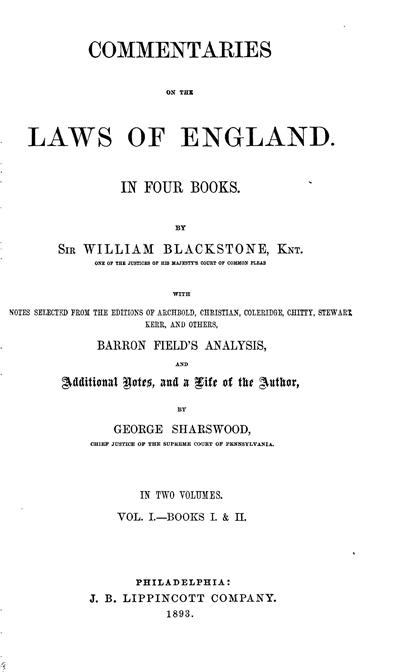
CHAPTER IX.: OF SUBORDINATE MAGISTRATES. - Sir William Blackstone, Commentaries on the Laws of England in Four Books, vol. 1 [1753]Edition used:Commentaries on the Laws of England in Four Books. Notes selected from the editions of Archibold, Christian, Coleridge, Chitty, Stewart, Kerr, and others, Barron Field’s Analysis, and Additional Notes, and a Life of the Author by George Sharswood. In Two Volumes. (Philadelphia: J.B. Lippincott Co., 1893). Vol. 1 - Books I & II.
Part of: Commentaries on the Laws of England in Four Books, 2 vols.About Liberty Fund:Liberty Fund, Inc. is a private, educational foundation established to encourage the study of the ideal of a society of free and responsible individuals. Copyright information:The text is in the public domain. Fair use statement:This material is put online to further the educational goals of Liberty Fund, Inc. Unless otherwise stated in the Copyright Information section above, this material may be used freely for educational and academic purposes. It may not be used in any way for profit.
CHAPTER IX.OF SUBORDINATE MAGISTRATES.In a former chapter of these commentaries(a) we distinguished magistrates into two kinds: supreme, or those in whom the sovereign power of the state resides; and subordinate, or those who act in an inferior secondary sphere. We have hitherto considered the former kind only; namely, the supreme legislative power or parliament, and the supreme executive power, which is the king: and are now to proceed to inquire into the rights and duties of the principal subordinate magistrates. And herein we are not to investigate the powers and duties of his majesty’s great officers of state, the lord treasurer, lord chamberlain, the principal secretaries, or the like; because I do not know that they are in that capacity in any considerable degree the objects of our laws, or have any very important share of magistracy conferred upon them: except that the secretaries of state are allowed the power of commitment, in order to bring offenders to trial.(b) Neither shall I here treat of the office and authority of the lord chancellor, or the other judges of the superior courts of justice; because they will find a more proper place in the third part of these commentaries. Nor shall I enter into any minute disquisitions, with regard to the rights and dignities of mayors and *[*339aldermen, or other magistrates of particular corporations; because these are mere private and strictly municipal rights, depending entirely upon the domestic constitution of their respective franchises. But the magistrates and officers, whose rights and duties it will be proper in this chapter to consider, are such as are generally in use, and have a jurisdiction and authority dispersedly throughout the kingdom: which are, principally, sheriffs, coroners, justices of the peace, constables, surveyors of highways, and overseers of the poor. In treating of all which I shall inquire into, first, their antiquity and original; next, the manner in which they are appointed and may be removed; and, lastly, their rights and duties. And first of sheriffs. I. The sheriff is an officer of very great antiquity in this kingdom, his name being derived from two Saxon words, Sheriffs were formerly chosen by the inhabitants of the several counties. In confirmation of which it was ordained by statute 28 Edw. I. c. 8, that the people should have election of sheriffs in every shire, where the shrievalty is not of inheritance. For anciently in some counties the sheriffs were hereditary; as I apprehend they were in Scotland1 till the statute 20 Geo. II. c. 43; and still continue in the county of Westmoreland to this day:2 *[*340the city of London having also the inheritance of the shrievalty of Middlesex vested in their body by charter.(d)3 The reason of these popular elections is assigned in the same statute, c. 13, “that the commons might choose such as would not be a burden to them.” And herein appears plainly a strong trace of the democratical part of our constitution; in which form of government it is an indispensable requisite that the people should choose their own magistrates.(e) This election was in all probability not absolutely vested in the commons, but required the royal approbation. For, in the Gothic constitution, the judges of the county courts (which office is executed by our sheriff) were elected by the people, but confirmed by the king; and the form of their election was thus managed: the people, or incolæ territorii, chose twelve electors, and they nominated three persons, ex quibus rex unum confirmabat.(f) But with us in England these popular elections, growing tumultuous, were put an end to by the statute 9 Edw. II. st. 2, which enacted that the sheriffs should from thenceforth be assigned by the chancellor, treasurer, and the judges; as being persons in whom the same trust might with confidence be reposed. By statutes 14 Edw. III. c. 7, 23 Hen. VI. c. 8, and 21 Hen. VIII. c. 20, the chancellor, treasurer, president of the king’s council, chief justices, and chief baron, are to make this election; and that on the morrow of All Souls, in the exchequer. And the king’s letters-patent, appointing the new sheriffs, used commonly to bear date the 6th day of November.(g) The statute of Cambridge, 12 Ric. II. c. 2, ordains that the chancellor, treasurer, keeper of the privy seal, steward of the king’s house, the king’s chamberlain, clerk of the rolls, the justices of the one bench and the other, barons of the exchequer, and all other that shall be called to ordain, name, or make justices of the peace, sheriffs, and other officers of the king, shall be sworn to act indifferently, and to appoint no man that sueth either privily or openly to be put in office, but such only as they shall judge to be the best and most sufficient. And the custom now is (and has been at least **341]ever since the time of Fortescue,(h) who was chief justice and chancellor to Henry the Sixth) that all the judges, together with the other great officers and privy counsellors, meet in the exchequer on the morrow of All Souls yearly, (which day is now altered to the morrow of St. Martin by the last act for abbreviating Michaelmas term,) and then and there the judges propose three persons, to be reported (if approved of) to the king, who afterwards appoints one of them to be sheriff.4 This custom, of the twelve judges proposing three persons, seems borrowed from the Gothic constitution before mentioned; with this difference, that among the Goths the twelve nominors were first elected by the people themselves. And this usage of ours at its first introduction, I am apt to believe, was founded upon some statute, though not now to be found among our printed laws: first, because it is materially different from the direction of all the statutes before mentioned: which it is hard to conceive that the judges would have countenanced by their concurrence, or that Fortescue would have inserted in his book, unless by the authority of some statute: and also, because a statute is expressly referred to in the record, which Sir Edward Coke tells us,(i) he transcribed from the council book of 3 March, 34 Henry VI. and which is in substance as follows.5 The king had of his own authority appointed a man sheriff of Lincolnshire, which office he refused to take upon him: whereupon the opinions of the judges were taken, what should be done in this behalf. And the two chief justices, Sir John Fortescue and Sir John Prisot, delivered the unanimous opinion of them all: “that the king did an error when he made a person sheriff, that was not chosen and presented to him according to the statute; that the person refusing was liable to no fine for disobedience, as if he had been one of the three persons chosen according to the tenor of the statute;6 that they would advise the king to have recourse to the three persons that were chosen according to the statute, or that some other thrifty man be entreated to occupy the office for this year; and that, the next year, to eschew such inconveniences, the order of the statute in this behalf made be observed.” But notwithstanding this unanimous resolution of *[*342all the judges of England, thus entered in the council book, and the statute 34 & 35 Hen. VIII. c. 26, § 61, which expressly recognises this to be the law of the land, some of our writers(j) have affirmed, that the king, by his prerogative, may name whom he pleases to be sheriff, whether chosen by the judges or no. This is grounded on a very particular case in the fifth year of queen Elizabeth, when, by reason of the plague, there was no Michaelmas term kept at Westminster; so that the judges could not meet there in crastino animarum to nominate the sheriffs: whereupon the queen named them herself, without such previous assembly, appointing for the most part one of the two remaining in the last year’s list.(k) And this case, thus circumstanced, is the only authority in our books for the making these extraordinary sheriffs. It is true, the reporter adds, that it was held that the queen by her prerogative might make a sheriff without the election of the judges, non obstante aliquo statuto in contrarium: but the doctrine of non obstante’s, which sets the prerogative above the laws, was effectually demolished by the bill of rights at the revolution, and abdicated Westminster hall when king James abdicated the kingdom. However, it must be acknowledged, that the practice of occasionally naming what are called pocket-sheriffs, by the sole authority of the crown, hath uniformly continued to the reign of his present majesty; in which, I believe, few (if any) compulsory instances have occurred.7 Sheriffs, by virtue of several old statutes, are to continue in their office no longer than one year: and yet it hath been said(l) that a sheriff may be appointed durante bene placito, or during the king’s pleasure; and so is the form of the royal writ.(m) Therefore, till a new sheriff be named, his office cannot be determined, unless by his own death, or the demise of the king; in which last case it was usual for the successor to send a new writ to the old sheriff;(n) but now by statute 1 Anne, st. 1, c. 8, all officers appointed by the *[*343preceding king may hold their offices for six months after the king’s demise, unless sooner displaced by the successor. We may further observe, that by statute 1 Ric. II. c. 11, no man that has served the office of sheriff for one year, can be compelled to serve the same again within three years after.8 We shall find it is of the utmost importance to have the sheriff appointed according to law, when we consider his power and duty. These are either as a judge, as the keeper of the king’s peace, as a ministerial officer of the superior courts of justice, or as the king’s bailiff. In his judicial capacity he is to hear and determine all causes of forty shillings’ value and under, in his county court, of which more in its proper place; and he has also a judicial power in divers other civil cases.(o) He is likewise to decide the elections of knights of the shire, (subject to the control of the house of commons,) of coroners, and of verderors; to judge of the qualifications of voters, and to return such as he shall determine to be duly elected. As the keeper of the king’s peace, both by common law and special commission, he is the first man in the county, and superior in rank to any nobleman therein, during his office.(p) He may apprehend, and commit to prison, all persons who break the peace, or attempt to break it; and may bind any one in recognizance to keep the king’s peace.9 He may, and is bound ex officio to pursue and take all traitors, murderers, felons, and other misdoers, and commit them to gaol for safe custody. He is also to defend his county against any of the king’s enemies when they come into the land: and for this purpose, as well as for keeping the peace and pursuing felons, he may command all the people of his county to attend him; which is called the posse comitatus, or power of the county:(q) and this summons every person above fifteen years old, and under the degree of a peer, is bound to attend upon warning,(r) *[*344under pain of fine and imprisonment.(s) But though the sheriff is thus the principal conservator of the peace in his county, yet by the express directions of the great charter,(t) he, together with the constable, coroner, and certain other officers of the king, are forbidden to hold any pleas of the crown, or, in other words, to try any criminal offence. For it would be highly unbecoming, that the executioners of justice should be also the judges; should impose, as well as levy, fines and amercements; should one day condemn a man to death, and personally execute him the next. Neither may he act as an ordinary justice of the peace during the time of his office:(u) for this would be equally inconsistent: he being in many respects the servant of the justices. In his ministerial capacity the sheriff is bound to execute all process issuing from the king’s courts of justice.10 In the commencement of civil causes, he is to serve the writ, to arrest, and to take bail; when the cause comes to trial, he must summon and return the jury; when it is determined, he must see the judgment of the court carried into execution. In criminal matters, he also arrests and imprisons, he returns the jury, he has the custody of the delinquent, and he executes the sentence of the court, though it extend to death itself. As the king’s bailiff, it is his business to preserve the rights of the king within his bailiwick; for so his county is frequently called in the writs; a word introduced by the princes of the Norman line, in imitation of the French, whose territory is divided into bailiwicks, as that of England into counties.(w) He must seize to the king’s use all lands devolved to the crown by attainder or escheat; must levy all fines and forfeitures; must seize and keep all waits, wrecks, estrays, and the like, unless they be granted to some subject; and must also collect the king’s rents within the bailiwick, if commanded by process from the exchequer.(x) **345]To execute these various offices, the sheriff has under him many inferior officers; an under-sheriff, bailiffs, and gaolers; who must neither buy, sell, nor farm their offices, on forfeiture of 500l.(y)11 The under-sheriff usually performs all the duties of the office;12 a very few only excepted, where the personal presence of the high-sheriff is necessary. But no under-sheriff shall abide in his office above one year;(z) and if he does, by statute 23 Hen. VI. c. 8, he forfeits 200l., a very large penalty in those early days. And no under-sheriff or sheriff’s officer shall practise as an attorney during the time he continues in such office:(a) for this would be a great inlet to partiality and oppression. But these salutary regulations are shamefully evaded, by practising in the names of other attorneys, and putting in sham deputies by way of nominal under-sheriffs: by reason of which, says Dalton,(b) the under-sheriffs and bailiffs do grow so cunning in their several places, that they are able to deceive, and it may well be feared that many of them do deceive, both the king, the high-sheriff, and the county. Bailiffs, or sheriff’s officers, are either bailiffs of hundreds, or special bailiffs.13 Bailiffs of hundreds are officers appointed over those respective districts by the sheriffs, to collect fines therein; to summon juries; to attend the judges and justices at the assizes, and quarter sessions; and also to execute writs and process in the several hundreds. But, as these are generally plain men, and not thoroughly skilful in this latter part of their office, that of serving writs, and making arrests and executions, it is now usual to join special bailiffs with them; who are generally mean persons, employed by the sheriffs on account only of their adroitness and dexterity in hunting and seizing their prey. The sheriff being **346]answerable for the misdemesnors14 of these bailiffs, they are therefore usually bound in an obligation with sureties for the due execution of their office, and thence are called bound-bailiffs; which the common people have corrupted into a much more homely appellation. Gaolers are also the servants of the sheriff, and he must be responsible for their conduct.15 Their business is to keep safely all such persons as are committed to them by lawful warrant: and, if they suffer any such to escape, the sheriff shall answer it to the king, if it be a criminal matter; or, in a civil case, to the party injured.(c) And to this end the sheriff must(d) have lands sufficient within the county to answer the king and his people.16 The abuses of gaolers and sheriff’s officers, towards the unfortunate persons in their custody, are well restrained and guarded against by statute 32 Geo. II. c. 28; and by statute 14 Geo. III. c. 59, provisions are made for better preserving the health of prisoners, and preventing the gaol-distemper. The vast expense, which custom has introduced in serving the office of high-sheriff, was grown such a burden to the subject, that it was enacted by statute 13 & 14 Car. II. c. 21, that no sheriff (except of London, Westmoreland, and towns which are counties of themselves) should keep any table at the assizes, except for his own family, or give any presents to the judges or their servants, or have more than forty men in livery: yet, for the sake of safety and decency, he may not have less than twenty men in England and twelve in Wales; upon forfeiture, in any of these cases, of 200l.18 II. The coroner’s is also a very ancient office at the common law. IIe is called coroner, coronator, because he hath principally to do with pleas of the crown, or such wherein the king is more immediately concerned.(e) And in this light the lord chief justice of the King’s Bench is the principal coroner in the kingdom; and may, if he pleases, exercise the jurisdiction of a coroner in any part of the realm.(f) But **347]there are also particular coroners for every county of England; usually four, but sometimes six, and sometimes fewer.(g) This office(h) is of equal antiquity with the sheriff; and was ordained together with him to keep the peace, when the earls gave up the wardship of the county. He is still chosen by all the freeholders in the county court,19 as by the policy of our ancient laws the sheriffs, and conservators of the peace, and all other officers were, who were concerned in matters that affected the liberty of the people;(i) and as verderors of the forest still are, whose business it is to stand between the prerogative and the subject in the execution of the forest laws. For this purpose there is a writ at common law de coronatore eligendo;(j) in which it is expressly commanded the sheriff, “quod talem eligi faciat, qui melius et sciat, et velit, et possit, officio illi intendere.” And, in order to effect this the more surely, it was enacted by the statute(k) of Westm. 1, that none but lawful and discreet knights should be chosen: and there was an instance in the 5 Edw. III. of a man being removed from this office, because he was only a merchant.(l)20 But it seems it is now sufficient if a man hath lands enough to be made a knight,21 whether he be really knighted or not:(m) for the coroner ought to have an estate sufficient to maintain the dignity of his office, and answer any fines that may be set upon him for his misbehaviour;(n) and if he hath not enough to answer, his fine shall be levied on the county, as the punishment for electing an insufficient officer.(o) Now indeed, through the culpable neglect of gentlemen of property, this office has been suffered to fall into disrepute, and get into low and indigent hands; so that, although formerly no coroners would condescend to be paid for serving their country, and they were, by the aforesaid statute of Westm. 1, expressly forbidden to take a *[*348reward, under pain of a great forfeiture to the king; yet for many years past they have only desired to be chosen for the sake of their perquisites; being allowed fees for their attendance by the statute 3 Henry VII. c. 1, which Sir Edward Coke complains of heavily;(p) though, since his time, those fees have been much enlarged.(q)22 The coroner is chosen for life; but may be removed, either by being made sheriff, or chosen verderor, which are offices incompatible with the other; or by the king’s writ de coronatore exonerando, for a cause to be therein assigned, as that he is engaged in other business, is incapacitated by years or sickness, hath not a sufficient estate in the county, or lives in an inconvenient part of it.(r) And by the statute 25 Geo. II. c. 29, extortion, neglect, or misbehaviour are also made causes of removal. The office and power of a coroner are also, like those of the sheriff, either judicial or ministerial; but principally judicial. This is in great measure ascertained by statute 4 Edw. I. de officio coronatoris; and consists, first, in inquiring when any person is slain, or dies suddenly, or in prison, concerning the manner of his death. And this must be “super visum corporis;”(s)23 for, if the body be not found, the coroner cannot sit.(t) He must also sit at the very place where the death happened; and his inquiry is made by a jury from four, five, or six of the neighbouring towns, over whom he is to preside. If any be found guilty, by this inquest, of murder or other homicide, he is to commit them to prison for further trial, and is also to inquire concerning their lands, goods, and chattels, which are forfeited thereby: but, whether it be homicide or not, he must inquire whether any deodand has accrued to the king, or the *[*349lord of the franchise, by this death; and must certify the whole of this inquisition, (under his own seal and the seals of his jurors,)(u) together with the evidence thereon, to the court of King’s Bench, or the next assizes. Another branch of his office is to inquire concerning shipwrecks, and certify whether wreck or not, and who is in possession of the goods. Concerning treasuretrove, he is also to inquire who were the finders, and where it is, and whether any one be suspected of having found or concealed a treasure; “and that may be well perceived (saith the old statute of Edw. I.) where one liveth riotously, haunting taverns, and hath done so of long time:” whereupon he might be attached, and held to bail upon this suspicion only. The ministerial office of the coroner is only as the sherirf’s substitute. For when just exception can be taken to the sheriff, for suspicion of partiality, (as that he is interested in the suit, or of kindred to either plaintiff or defendant,) the process must then be awarded to the coroner instead of the sheriff, for execution of the king’s writs.(v)24 III. The next species of subordinate magistrates, whom I am to consider, are justices of the peace; the principal of whom is the custos rotulorum, or keeper of the records of the county. The common law hath ever had a special care and regard for the conservation of the peace; for peace is the very end and foundation of civil society. And therefore, before the present constitution of justices was invented, there were peculiar officers appointed by the common law for the maintenance of the public peace. Of these some had, and still have, this power annexed to other offices which they hold; others had it merely by itself, and were thence named custodes, or conservatores pacis. Those that were so, virtute officii, still continue: but the latter sort are superseded by the modern justices. The king’s majesty(w) is, by his office and dignity royal, the principal conservator of the peace within all his dominions; *[*350and may give authority to any other to see the peace kept, and to punish such as break it: hence it is usually called the king’s peace. The lord chancellor, or keeper, the lord treasurer, the lord high steward of England, the lord mareschal, the lord high constable of England, (when any such officers are in being,) and all the justices of the court of King’s Bench, (by virtue of their offices,) and the master of the rolls, (by prescription,) are general conservators of the peace throughout the whole kingdom, and may commit all breakers of it, or bind them in recognizances to keep it:(x) the other judges are only so in their own courts. The coroner is also a conservator of the peace within his own county;(y) as is also the sheriff;(z) and both of them may take a recognizance or security for the peace. Constables, tithing-men, and the like, are also conservators of the peace within their own jurisdictions, and may apprehend all breakers of the peace and commit them, till they find sureties for their keeping it.(a)25 Those that were, without any office, simply and merely conservators of the peace, either claimed that power by prescription;(b) or were bound to exercise it by the tenure of their lands;(c) or, lastly, were chosen by the freeholders in full county court before the sheriff; the writ for their election directing them to be chosen “de probioribus et potentioribus comitatus sui in custodes pacis.”(d) But when queen Isabel, the wife of Edward II., had contrived to depose her husband by a forced resignation of the crown and had set up his son Edward III. in his place; this, being a thing then without example in England, it was feared would much alarm the people: especially as the old king was living, though hurried about from castle to castle, till at last he met with an untimely death. To prevent therefore any risings, or other disturbances of the peace, the new king sent writs to all the sheriffs in England, the form of which is preserved by **351]Thomas Walsingham,(e) giving a plausible account of the manner of his obtaining the crown; to wit, that it was done ipsius patris bene placito: and withal commanding each sheriff that the peace be kept throughout his bailiwick, on pain and peril of disinheritance, and loss of life and limb. And in a few weeks after the date of these writs, it was ordained in parliament,(f) that, for the better maintaining and keeping of the peace in every county, good men and lawful, which were no maintainers of evil, or barretors in the country, should be assigned to keep the peace. And in this manner, and upon this occasion, was the election of the conservators of the peace taken from the people, and given to the king;(g) this assignment being construed to be by the king’s commission.(h) But still they were only called conservators, wardens, or keepers of the peace, till the statute 34 Edw. III. c. 1 gave them the power of trying felonies; and then they acquired the more honourable appellation of justices.(i) These justices are appointed by the king’s special commission under the great seal, the form of which was settled by all the judges, ad 1590.(j) This appoints them all,(k) jointly and severally, to keep the peace, and any two or more of them to inquire of and determine felonies and other misdemesnors: in which number some particular justices, or one of them, are directed to be always included, and no business to be done without their presence; the words of the commission running thus, “quorum aliquem vestrum, A. B. C. D. &c. unum esse volumus;” whence the persons so named are usually called justices of the quorum. And formerly it was customary to appoint only a select number of justices, eminent for their skill and discretion, to be of the quorum; but now the practice is to advance almost all of them to that dignity, naming them all over again in the quorum clause, except perhaps only some one inconsiderable person for the sake of propriety; and no exception is now allowable, **352]for not expressing in the form of warrants, &c. that the justice who issued them is of the quorum.(l) When any justice intends to act under this commission, he sues out a writ of dedimus potestatem, from the clerk of the crown in chancery, empowering certain persons therein named to administer the usual oaths to him; which done, he is at liberty to act. Touching the number and qualifications of these justices, it was ordained by statute 18 Edw. III. c. 2, that two or three, of the best reputation in each county, shall be assigned to be keepers of the peace. But these being found rather too few for that purpose, it was provided by statute 34 Edw. III. c. 1, that one lord, and three or four of the most worthy men in the county, with some learned in the law, shall be made justices in every county. But afterwards the number of justices, through the ambition of private persons, became so large, that it was thought necessary, by statute 12 Ric. II. c. 10, and 14 Ric. II. c. 11, to restrain them at first to six, and afterwards to eight only. But this rule is now disregarded, and the cause seems to be (as Lambard observed long ago)(m) that the growing number of statute laws, committed from time to time to the charge of justices of the peace, have occasioned also (and very reasonably) their increase to a larger number. And, as to their qualifications, the statutes just cited direct them to be of the best reputation, and most worthy men in the county; and the statute 13 Ric. II. c. 7 orders them to be of the most sufficient knights, esquires, and gentlemen of the law. Also by statute 2 Hen. V. st. 1, c. 4, and st. 2, c. 1, they must be resident in their several counties. And because, contrary to these statutes, men of small substance had crept into the commission, whose poverty made them both covetous and contemptible, it was enacted by statute 18 Hen. VI. c. 11, that no justice should be put in commission if he had not lands to the value of 20l. per annum. And, the rate of money being greatly altered since that time, it is now enacted by statute 5 Geo. II. c. 18, that every justice, except *[*353as is therein excepted, shall have 100l. per annum clear of all deductions;26 and, if he acts without such qualification, he shall forfeit 100l. This qualification(n) is almost an equivalent to the 20l. per annum required in Henry the Sixth’s time; and of this(o) the justice must now make oath. Also it is provided by the act 5 Geo. II. that no practising attorney, solicitor, or proctor shall be capable of acting as a justice of the peace. As the office of these justices is conferred by the king, so it subsists only during his pleasure; and is determinable, 1. By the demise of the crown; that is, in six months after.(p) But if the same justice is put in commission by the successor, he shall not be obliged to sue out a new dedimus, or to swear to his qualification afresh:(q) nor, by reason of any new commission, to take the oaths more than once in the same reign.(r) 2. By express writ under the great seal,(s) discharging any particular person from being any longer justice. 3. By superseding the commission by writ of supersedeas, which suspends the power of all the justices, but does not totally destroy it; seeing it may be revived again by another writ, called a procedendo. 4. By a new commission, which virtually, though silently, discharges all the former justices that are not included therein; for two commissions cannot subsist at once. 5. By accession of the office of sheriff or coroner.(t)27 Formerly it was thought, that if a man was named in any commission of the peace, and had afterwards a new dignity conferred upon him, that this determined his office; he no longer answering the description of the commission: but now(u) it is provided, that, notwithstanding a new title of dignity, the justice on whom it is conferred shall still continue a justice. The power, office, and duty of a justice of the peace depend on his commission, and on the several statutes which **354]have created objects of his jurisdiction. His commission, first, empowers him singly to conserve the peace; and thereby gives him all the power of the ancient conservators at the common law, in suppressing riots and affrays, in taking securities for the peace, and in apprehending and committing felons and other inferior criminals. It also empowers any two or more to hear and determine all felonies and other offences; which is the ground of their jurisdiction at sessions, of which more will be said in its proper place. And as to the powers, given to one, two,28 or more justices by the several statutes, which from time to time have heaped upon them such an infinite variety of business, that few care to undertake, and fewer understand, the office; they are such and of so great importance to the public, that the country is greatly obliged to any worthy magistrate that, without sinister views of his own, will engage in this troublesome service. And therefore if a well-meaning justice makes any undesigned slip in his practice, great lenity and indulgence are shown to him in the courts of law; and there are many statutes made to protect him in the upright discharge of his office;(w) which, among other privileges, prohibit such justices from being sued for any oversights without notice beforehand;29 and stop all suits begun, on tender made of sufficient amends. But, on the other hand, any malicious or tyrannical abuse of their office is usually severely punished; and all persons who recover a verdict against a justice, for any wilful or malicious injury, are entitled to double costs.30 It is impossible upon our present plan to enter minutely into the particulars of the accumulated authority thus committed to the charge of these magistrates. I must therefore refer myself at present to such subsequent parts of these commentaries, as will in their turns comprise almost every object of the justices’ jurisdiction; and, in the mean time, recommend to the student the perusal of Mr. Lambard’s Eirenarcha, and Dr. Burn’s Justice of the Peace, wherein he will find every thing relative to this subject, both in ancient and modern practice, collected with great care and accuracy, and disposed in a most clear and judicious method. *[*355I shall next consider some officers of lower rank than those which have gone before, and of more confined jurisdiction; but still such as are universally in use through every part of the kingdom. IV. Fourthly, then, of the constable. The word constable is frequently said to be derived from the Saxon, konin Constables are of two sorts, high constables and petty constables. The former were first ordained by the statute of Winchester, as before mentioned; are appointed at the court-leets of the franchise or hundred over which they preside, or, in default of that, by the justices at their quarter sessions; and are removable by the same authority that **356]appoints them.(a)33 The petty constables are inferior officers in every town and parish, subordinate to the high constable of the hundred, first instituted about the reign of Edw. III.(b) These petty constables have two offices united in them; the one antient, the other modern. Their antient office is that of headborough, tithing-man, or borsholder, of whom we formerly spoke,(c) and who are as antient as the time of king Alfred: their more modern office is that of constable merely; which was appointed, as was observed, so lately as the reign of Edward III. in order to assist the high constable.(d) And in general the antient headboroughs, tithing-men, and borsholders were made use of to serve as petty constables; though not so generally, but that in many places they still continue distinct officers from the constable. They are all chosen by the jury at the court-leet; or, if no court-leet be held, are appointed by two justices of the peace.(e) The general duty of all constables, both high and petty, as well as of the other officers, is to keep the king’s peace in their several districts; and to that purpose they are armed with very large powers, of arresting and imprisoning, of breaking open houses, and the like; of the extent of which powers, considering what manner of men are for the most part put into these offices, it is perhaps very well that they are generally kept in ignorance.34 One of their principal duties, arising from the statute of Winchester, which appoints them, is to keep watch and ward in their respective jurisdictions. Ward, guard, or custodia, is chiefly applied to the daytime, in order to apprehend rioters, and robbers on the highways; the manner of doing which is left to the discretion of the justices of the peace and the constable:(f) the hundred being, however, answerable for all robberies committed therein, by daylight, for having kept negligent guard. Watch is properly applicable to the night only, (being called among our Teutonic ancestors wacht or wacta,)(g) and it **357]begins at the time when ward ends and ends when that begins; for, by the statute of Winchester, in walled towns the gates shall be closed from sunsetting to sunrising, and watch shall be kept in every borough and town, especially in the summer season, to apprehend all rogues, vagabonds, and night-walkers, and make them give an account of themselves. The constable may appoint watchmen at his discretion, regulated by the custom of the place; and these, being his deputies, have for the time-being the authority of their principal. But with regard to the infinite number of other minute duties that are laid upon constables by a diversity of statutes, I must again refer to Mr. Lambard and Dr. Burn; in whose compilations may be also seen what powers and duties belong to the constable or tithing-man indifferently, and what to the constable only: for the constable may do whatever the tithing-man may; but it does not hold e converso, the tithing-man not having an equal power with the constable.35 V. We are next to consider the surveyors of the highways. Every parish is bound of common right to keep the highroads that go through it in good and sufficient repair; unless by reason of the tenure of lands, or otherwise, this care is consigned to some particular private person. From this burthen no man was exempt by our ancient laws, whatever other immunities he might enjoy: this being part of the trinoda necessitas, to which every man’s estate was subject; viz., expeditio contra hostem, arcium constructio, et pontium reparatio. For, though the reparation of bridges only is expressed, yet that of roads also must be understood; as in the Roman law, ad instructiones reparationesque itinerum et pontium, nullum genus hominum, nulliusque dignitatis ac venerationis meritis, cessare oportet.(h) And indeed now, for the most part, the care of the roads only seems to be left to parishes, that of bridges being in great measure devolved upon the county at large by statute 22 Hen. VIII. c. 5. If the parish neglected these repairs, they might formerly, as they may still, be indicted for such their neglect: but it was not then **358]incumbent on any particular officer to call the parish together and set them upon this work: for which reason, by the statute 2 & 3 Ph. and M. c. 8, surveyors of the highways were ordered to be chosen in every parish.(i) These surveyors were originally, according to the statutes of Philip and Mary, to be appointed by the constable and church-wardens of the parish; but now they are constituted by two neighbouring justices, out of such inhabitants or others as are described in statute 13 Geo. III. c. 78, and may have salaries allotted them for their trouble. Their office and duty consists in putting in execution a variety of laws for the repairs of the public highways; that is, of ways leading from one town to another: all which are now reduced into one act by statute 13 Geo. III. c. 78, which enacts, 1. That they may remove all annoyances in the highways, or give notice to the owner to remove them, who is liable to penalties for non-compliance. 2. They are to call together all the inhabitants and occupiers of lands, tenements, and hereditaments within the parish, six days in every year, to labour in fetching materials, or repairing the highways: all persons keeping draughts, (of three horses, &c.,) or occupying lands, being obliged to send a team for every draught, and for every 50l. a year which they keep or occupy: persons keeping less than a draught, or occupying less than 50l. a year, to contribute in a less proportion; and all other persons chargeable, between the ages of eighteen and sixty-five, to work or find a labourer. But they may compound with the surveyors at certain easy rates established by the act. And every cartway leading to any market-town must be made twenty feet wide at the least, if the fences will permit; and may be increased by two justices, at the expense of the parish, to the breadth of thirty feet. 3. The surveyors may lay out their own money in purchasing materials for repairs, in erecting guide-posts, and making drains, and shall be reimbursed by a rate to be allowed at a special sessions. *[*3594. In case the personal labour of the parish be not sufficient, the surveyors, with the consent of the quarter sessions, may levy a rate on the parish, in aid of the personal duty, not exceeding, in any one year, together with the other highway rates, the sum of 9d. in the pound; for the due application of which they are to account upon oath. As for turnpikes, which are now pretty generally introduced in aid of such rates, and the law relating to them, these depend principally on the particular powers granted in the several road acts, and upon some general provisions which are extended to all turnpike roads in the kingdom, by statute 13 Geo. III. c. 84, amended by many subsequent acts.(k) VI. I proceed therefore, lastly, to consider the overseers of the poor; their original, appointment, and duty. The poor of England, till the time of Henry VIII., subsisted entirely upon private benevolence, and the charity of well-disposed Christians.36 For, though it appears by the mirror,(l) that by the common law the poor were to be “sustained by parsons, rectors of the church, and the parishioners, so that none of them die for default of sustenance;” and though, by the statutes 12 Ric. II. c. 7, and 19 Hen. VII. c. 12, the poor are directed to abide in the cities or towns wherein they were born, or such wherein they had dwelt for three years, (which seem to be the first rudiments of parish settlements,) yet, till the statute 27 Hen. VIII. c. 55, I find no compulsory method chalked out for this purpose; but the poor seem to have been left to such relief as the humanity of their neighbours would afford them. The monasteries were, in particular, their principal resource; and, among other bad effects which attended the monastic institutions, it was not perhaps one of the least (though frequently esteemed quite otherwise) that they supported and fed a very numerous and very idle poor, whose sustenance depended upon what was daily distributed in alms at the gates *[*360of the religious houses. But, upon the total dissolution of these, the inconvenience of thus encouraging the poor in habits of indolence and beggary was quickly felt throughout the kingdom: and abundance of statutes were made in the reign of king Henry the Eighth and his children, for providing for the poor and impotent; which, the preambles to some of them recite, had of late years greatly increased. These poor were principally of two sorts: sick and impotent, and therefore unable to work; idle and sturdy, and therefore able, but not willing, to exercise any honest employment. To provide in some measure for both of these, in and about the metropolis, Edward the Sixth founded three royal hospitals; Christ’s and St. Thomas’s, for the relief of the impotent through infancy or sickness; and Bridewell for the punishment and employment of the vigorous and idle. But these were far from being sufficient for the care of the poor throughout the kingdom at large: and therefore, after many other fruitless experiments, by statute 43 Eliz. c. 2, overseers of the poor were appointed in every parish. By virtue of the statute last mentioned, these overseers are to be nominated yearly in Easter-week, or within one month after, (though a subsequent nomination will be valid,)(m) by two justices dwelling near the parish. They must be substantial householders, and so expressed to be in the appointment of the justices.(n) Their office and duty, according to the same statute, are principally these: first, to raise competent sums for the necessary relief of the poor, impotent, old, blind, and such other, being poor and not able to work: and secondly, to provide work for such as are able, and cannot otherwise get employment, but this latter part of their duty, which, according to the wise regulations of that salutary statute, should go hand in hand with the other, is now most shamefully neglected. However, for these joint purposes, they are empowered to **361]make and levy rates upon the several inhabitants of the parish, by the same act of parliament; which has been further explained and enforced by several subsequent statutes. The two great objects of this statute seem to have been, 1. To relieve the impotent poor, and them only. 2. To find employment for such as are able to work; and this principally, by providing stocks of raw materials to be worked up at their separate homes, instead of accumulating all the poor in one common workhouse; a practice which puts the sober and diligent upon a level (in point of their earnings) with those who are dissolute and idle, depresses the laudable emulation of domestic industry and neatness, and destroys all endearing family connections, the only felicity of the indigent. Whereas, if none were relieved but those who are incapable to get their livings, and that in proportion to their incapacity; if no children were removed from their parents, but such as are brought up in rags and idleness; and if every poor man and his family were regularly furnished with employment, and allowed the whole profits of their labour;—a spirit of busy cheerfulness would soon diffuse itself through every cottage; work would become easy and habitual, when absolutely necessary for daily subsistence; and the peasant would go through his task without a murmur, if assured that he and his children, when incapable of work through infancy, age, or infirmity, would then, and then only, be entitled to support from his opulent neighbours. This appears to have been the plan of the statute of queen Elizabeth; in which the only defect was confining the management of the poor to small parochial districts; which are frequently incapable of furnishing proper work, or providing an able director. However, the laborious poor were then at liberty to seek employment wherever it was to be had: none being obliged to reside in the places of their settlement, but such as were unable or unwilling to work; and those places of settlement being only such where they **362]were born, or had made their abode, originally for three years,(o) and afterwards (in the case of vagabonds) for one year only.(p) After the restoration, a very different plan was adopted, which has rendered the employment of the poor more difficult, by authorizing the subdivisions of parishes; has greatly increased their number, by confining them all to their respective districts; has given birth to the intricacy of our poor-laws, by multiplying and rendering more easy the methods of gaining settlements; and, in consequence, has created an infinity of expensive law-suits between contending neighbourhoods, concerning those settlements and removals. By the statute 13 & 14 Car. II. c. 12, a legal settlement was declared to be gained by birth or by inhabitancy, apprenticeship, or service, for forty days: within which period all intruders were made removable from any parish by two justices of the peace, unless they settled in a tenement of the annual value of 10l. The frauds, naturally consequent upon this provision, which gave a settlement by so short a residence, produced a statute, 1 Jac. II. c. 17, which directed notice in writing to be delivered to the parish officers, before a settlement could be gained by such residence. Subsequent provisions allowed other circumstances of notoriety to be equivalent to such notice given; and those circumstances have from time to time been altered, enlarged, or restrained, whenever the experience of new inconveniences, arising daily from new regulations, suggested the necessity of a remedy. And the doctrine of certificates was invented, by way of counterpoise, to restrain a man and his family from acquiring a new settlement by any length of residence whatever, unless in two particular excepted cases; which makes parishes very cautious of giving such certificates, and of course confines the poor at home, where frequently no adequate employment can be had. The law of settlements may be therefore now reduced to the following general heads; or, a settlement in a parish may be acquired, 1, By birth; for, wherever a child is first known *[*363to be, that is always prima facie the place of settlement, until some other can be shown.(q) This is also generally the place of settlement of a bastard child;(r) for a bastard, having in the eye of the law no father, cannot be referred to his settlement, as other children may.(s) But in legitimate children, though the place of birth be prima facie the settlement, yet it is not conclusively so; for there are, 2, Settlements by parentage, being the settlement of one’s father or mother: all legitimate children being really settled in the parish where their parents are settled, until they get a new settlement for themselves.(t) A new settlement may be acquired several ways; as, 3, by marriage. For a woman marrying a man that is settled in another parish changes her own settlement: the law not permitting the separation of husband and wife.(u) But if the man has no settlement, hers is suspended during his life, if he remains in England and is able to maintain her; but in his absence, or after his death, or during, perhaps, his inability, she may be removed to her old settlement.(v) The other methods of acquiring settlements in any parish are all reducible to this one, of forty days’ residence therein: but this forty days’ residence (which is to be construed to be lodging or lying there) must not be by fraud, or stealth, or in any clandestine manner; but made notorious by one or other of the following concomitant circumstances. The next method therefore of gaining a settlement is, 4, By forty days’ residence, and notice. For if a stranger comes into a parish, and delivers notice in writing of his place of abode, and number of his family, to one of the overseers, (which must be read in the church and registered,) and resides there unmolested for forty days after such notice, he is legally settled thereby.(w) For the law presumes that such a one at the time of notice is not likely to become chargeable, else he would not venture to give it; or that, in such case, the parish would take care to remove him. But there are also other circumstances equivalent to such notice: therefore, 5, Renting for a year *[*364a tenement of the yearly value of ten pounds, and residing forty days in the parish, gains a settlement without notice;(x) upon the principle of having substance enough to gain credit for such a house. 6. Being charged to and paying the public taxes and levies of the parish; excepting those for scavengers, highways,(y) and the duties on houses and windows:(z) and, 7, Executing, when legally appointed, any public parochial office for a whole year in the parish, as church-warden, &c. are both of them equivalent to notice, and gain a settlement,(a) if coupled with a residence of forty days. 8. Being hired for a year, when unmarried and childless, and serving a year in the same service; and 9, Being bound an apprentice, gives the servant and apprentice a settlement, without notice,(b) in that place wherein they serve the last forty days. This is meant to encourage application to trades, and going out to reputable services. 10. Lastly, the having an estate of one’s own, and residing thereon forty days, however small the value may be, in case it be acquired by act of law, or of a third person, as by descent, gift, devise, &c., is a sufficient settlement:(c) but if a man acquire it by his own act, as by purchase, (in its popular sense, in consideration of money paid,) then unless the consideration advanced, bona fide, be [Editor: illegible character]0l. it is no settlement for any longer time than the person shall inhabit thereon.(d) He is in no case removable from his own property; but he shall not, by any trifling or fraudulent purchase of his own, acquire a permanent and lasting settlement. All persons, not so settled, may be removed to their own parishes, on complaint of the overseers, by two justices of the peace, if they shall adjudge them likely to become chargeable to the parish into which they have intruded: unless they are in a way of getting a legal settlement, as by having hired a house of 10l. per annum, or living in an **365]annual service; for then they are not removable.(e) And in all other cases, if the parish to which they belong will grant them a certificate, acknowledging them to be their parishioners, they cannot be removed merely because likely to become chargeable, but only when they become actually chargeable.(f) But such certificated person can gain no settlement by any of the means above mentioned, unless by renting a tenement of 10l. per annum, or by serving an annual office in the parish, being legally placed therein; neither can an apprentice or servant to such certificated person gain a settlement by such their service.(g) These are the general heads of the laws relating to the poor, which, by the resolutions of the courts of justice thereon within a century past, are branched into a great variety.37 And yet, notwithstanding the pains that have been taken about them, they still remain very imperfect, and inadequate to the purposes they are designed for: a fate that has generally attended most of our statute laws, where they have not the foundation of the common law to build on. When the shires, the hundreds, and the tithings were kept in the same admirable order in which they were disposed by the great Alfred, there were no persons idle, consequently none but the impotent that needed relief: and the statute of 43 Eliz. seems entirely founded on the same principle. But when this excellent scheme was neglected and departed from, we cannot but observe with concern what miserable shifts and lame expedients have from time to time been adopted, in order to patch up the flaws occasioned by this neglect. There is not a more necessary or more certain maxim in the frame and constitution of society, than that every individual must contribute his share in order to the well-being of the community: and surely they must be very deficient in sound policy, who suffer one half of a parish to continue idle, dissolute, and unemployed, and at length are amazed to find that the industry of the other half is not able to maintain the whole. [(a) ] Ch. ii. page 146. [(b) ] 1 Leon. [Editor: Illegible character] 2 Leon. 175. Comb. 143. 5 Mod. 84. Salk. 347. Carth. 291. [(c) ] Dalton of Sheriffs, c. 1. [1 ] The Scotch sheriff differs very considerably from the English sheriff. The Scotch sheriff is properly a judge, and by statute 20 Geo. II. c. 43, he must be a lawyer of three years, standing, and is declared incapable of acting in any cause for the county of which he is sheriff. He is called sheriff-depute; he must reside within the county four months in the year; he holds his office ad vitam aut culpam. He may appoint substitutes, who, as well as himself, receive stated salaries. The king may appoint a high sheriff for the term of one year only. The civil jurisdiction of the sheriff-depute extends to all personal actions on contract, bond, or obligation, to the greatest extent; and generally in all civil matters not especially committed to other courts. His criminal jurisdiction extends to the trial of murder, though the regular circuits of the courts of justiciary prevent such trials occurring before him. He takes cognizance of theft, and other felonies, and all offences against the police. His ministerial duties are similar to those of sheriffs in England.—Chitty. [2 ] The earl of Thanet is hereditary sheriff of Westmoreland. This office may descend to, and be executed by, a female; for “Ann, countess of Pembroke, had the office of hereditary sheriff of Westmoreland, and exercised it in person. At the assizes at Appleby she sat with the judges on the bench.” Harg. Co. Litt. 326.—Christian. [(d) ] 3 Rep. 72. [3 ] The election of the sheriffs of London and Middlesex was granted to the citizens of London forever, in very ancient times, upon condition of their paying 300l. a year to the king’s exchequer. In consequence of this grant, they have always elected two sheriffs, though these constitute together but one officer; and, if one die, the other cannot act till another is elected. 4 Bac. Abr. 447. In the year 1748, the corporation of London made a by-law, imposing a fine of 600l. upon every person who, being elected, should refuse to serve the office of sheriff. See the case of Evans, Esq., and the chamberlain of London 2 Burn, E. L. 185.—Christian. [(e) ] Montesq. Sp. L. b. 2, c. 2. [(f) ] Stiernh. de jure Goth. l. 1, c. 3. [(g) ] Stat. 12 Edw. IV. c. 1. [(h) ]De L. L. c. 24. [4 ] The following is the present mode of nominating sheriffs in the exchequer on the morrow of St. Martin:— The chancellor, chancellor of the exchequer, the judges, and several of the privy council, assemble, and an officer of the court administers an oath to them in old French, that they will nominate no one from favour, partiality, or any improper motive: this done, the same officer, having the list of the counties in alphabetical order, and of those who were nominated the year preceding, reads over the three names, and the last of the three he pronounces to be the present sheriff; but where there has been a pocket-sheriff, he reads the three names upon the list, and then declares who is the present sheriff. If any of the ministry or judges has an objection to the names, he then mentions it, and another gentleman is nominated in his room; if no objection is made, some one rises and says, “To the two gentlemen I know no objection, and I recommend A. B., Esq., in the room of the present sheriff.” Another officer has a paper with a number of names given him by the clerk of assize for each county, which paper generally contains the names of the gentlemen upon the former list, and also of gentlemen who are likely to be nominated; and whilst the three are nominated, he prefixes 1, 2, or 3 to their names, according to the order in which they are placed, which, for greater certainty, he afterwards reads over twice. Several objections are made to gentlemen,—some, perhaps, at their own request; such as that they are abroad, that their estates are small and encumbered, that they have no equipage, that they are practising barristers, or officers in the militia, &c. The new sheriff is generally appointed about the end of the following Hilary term This extension of the time was probably in consequence of the 17 Edw. IV. c. 7, which enables the old sheriff to hold his office over Michaelmas and Hilary terms.—Christian. [(i) ] 2 Inst. 559. [5 ] I am inclined to disagree with the learned judge’s conjecture that the present practice originated from a statute which cannot now be found; because if such a statute ever existed, it must have been passed between the date of this record, the 34 Henry VI., and the statute 23 Henry VI. c. 8, referred to by the learned commentator in the preceding page; for that statute recites and ratifies the 14 Edw. III. c. 7, which provides only for the nomination of one person to fill the office when vacant; yet the former statute, 9 Edw. II. st. 2, leaves the number indefinite, viz.: sheriffs shall be assigned by the chancellor, &c.; and if such a statute had passed in the course of those eleven years, it is probable that it would have been referred to by subsequent statutes. I should conceive that the practice originated from the consideration that, as the king was to confirm the nomination by his patent, it was more convenient and respectful to present three to him than only one; and though this proceeding did not exactly correspond with the directions of the statute, yet it was not contrary to its spirit, or in strictness to its letter; and therefore the judges might, perhaps, think themselves warranted in saying that the three persons were chosen according to the tenor of the statute.—Christian. [6 ] In the King vs. Woodrow, 2 T. R. 731, an information was granted against a person so refusing, and the reason assigned was, “because the vacancy of the office occasioned a stop of public justice.” It should also seem that indictment would properly have lain, but that the information was granted because the year would be nearly expired before the indictment could be tried.—Chitty. [(j) ] Jenkins, 229. [(k) ] Dyer, 225. [7 ] When the king appoints a person sheriff, who is not one of the three nominated; the exchequer, he is called a pocket-sheriff. It is probable, that no compulsory instance of the appointment of a pocket-sheriff ever occurred; and the unanimous opinion of the judges, preserved in the record cited by the learned commentator from 2 Inst. 559, precludes the possibility of such a case. This is an ungracious prerogative; and whenever it is exercised, unless the occasion is manifest, the whole administration of justice throughout one county for a twelvemonth, if not corrupted, is certainly suspected. The cause ought to be urgent or inevitable when recourse is had to this prerogative.—Christian. The sheriff, after nomination to his office, and before delivery to him of his patent, must enter into a recognizance in the exchequer, under pain of 100l., for payment of his proffers and all other profits of the sheriffwick, to make account and appoint a sufficient under-sheriff for execution of process. See Com. Dig. tit. Viscount, A. (2.) Dalt. Sh. 7, 2 & 3 Edw. VI. c. 34. How to do this, see Impey’s Off. of Sheriff, 11. Dalt. Sheriff, 291. See form of recognizance, Impey, 18. So he must find surety for performing his office, if the king please. Mad. 642. After such recognizance given, he must procure out of chancery the patent of office, the patent of assistance, and the writ for discharge of the old sheriff. Crompt. Off. of Sher. 202, 203. Vide County, (B. 1, &c.) See form of patent, Impey, 18, form of patent of assistance, 19. See also form of writ of discharge, Impey, 19. Also, before the sheriff acts in his office, he must, by 3 Geo. I. c. 15, take an oath that he will truly serve the king in the office of sheriff, &c.; truly keep the king’s rights, and all that belongeth to the crown, &c.; not respite the king’s debts for gift or favour; where it may be done without great grievance, rightfully treat the people in his bailiwick, &c.; truly acquit at the exchequer all those of whom he shall receive any thing of the king’s debts; nothing take whereby the king may lose, or his right be letted, &c.; truly return and serve the king’s writs, &c.; take no bailiffs but such as he will answer for, &c.; return reasonable issues, &c.; make due panels, &c.; hath not nor will not let to farm, &c. his sheriffwick, or any office belonging to it; truly execute the laws, and in all things behave himself for the honour of the king and good of his subjects, and discharge his office to the best of his skill and power. Crompt. Off. Sh. 202. Vide for his oath the st. 3 Geo. I. c. 15, s. 18. Mad. 640, and Burn. J. 24 ed., by Chetwynd, tit. Sheriff. The breach of this oath, though a high offence, is not perjury. 11 Co. 98; but see Dy. 61, a. The sheriff, (except of Wales, London, Middlesex, counties palatine, or of any city or town being a county within itself,) within six months after his election, must take and subscribe the oaths of allegiance, supremacy, and abjuration, in one of the courts at Westminster, or the general or quarter session where he resides, between nine and twelve in the forenoon, (1 Geo. stat. 2, c. 13, s. 2. 2 Geo. II. c. 31, s. 3, 4. 9 Geo. II. c. 26, s. 3,) and must, within six months after admittance and receiving his authority, (16 Geo. II. c. 30, s. 3,) receive the sacrament and subscribe the declaration against transubstantiation. 25 Car. II. c. 2, s. 2, 3, 9. The new sheriff being appointed and sworn, he ought at or before the next county court to deliver a writ of discharge to the old sheriff, who is set over all the prisoners in the gaol severally by their names (together with all the writs) precisely, by view and indenture between the two sheriffs, wherein must be comprehended all the actions which the old sheriff hath against every prisoner, though the executions are of record. And till the delivery of the prisoners to the new sheriff, they remain in the custody of the old sheriff, notwithstanding the letters-patent of appointment, the writ of discharge, and the writ of delivery; neither is the new sheriff obliged to receive the prisoners but at the gaol only. But the office of the old sheriff ceases when the writ of discharge cometh to him. Wood’s Inst. b. 1, c. 7. By stat. 20 Geo. II. c. 37, the old sheriff must turn over to his successor, by indenture and schedule, all such writs and process as remain unexecuted, and the new sheriff must execute and return the same. When a sheriff quits his office, the custody of the county gaol can only belong to his successor. The county gaol is the prison for malefactors, and the sheriff ought to keep them there; but prisoners for debt, &c., where action lies against the sheriff for their escape, may be kept in what place the sheriff pleases. 1 Ld. Raym. 136. The new sheriff, at the first county court after his election and the discharge of the old sheriff, must read or cause to be read his patent and writ of assistance, and also nominate his under-sheriff, or county clerk, and depute, appoint, and proclaim four deputies at the least in that county, to make replevins for the ease of the county, (the deputies not to be twelve miles distant one from another, in every quarter of the county, one to grant replevins in the sheriff’s name and to make deliverance of distresses,) and the sheriff, for every month he shall lack such deputies, shall forfeit 5l.; and within two months next after he hath received his patent he may appoint such deputies, &c. Dalt. 19. Formerly, if a person refused to take upon him the office of sheriff, he was punished in the starchamber; but now, if he refuses to take the office, or the oaths, or officiates as sheriff before he has qualified himself, he may be proceeded against by information in the King’s Bench, (Cath. 307. 3 Lev. 116. 2 Mod. 300. Dyer, 167;) and this though he was excommunicated, whereby he cannot take the test to qualify himself, (R. 2 Mod. 300,) or was not qualified by taking the sacrament within a year preceding. Vide 4 Mod. 269. Salk. 167. 1 Ld. Raym. 29. 2 Vent. 248.—Chitty. [(l) ] 4 Rep. 32. [(m) ] Dalt. of Sheriffs, 8. [(n) ] Dalt. of Sheriffs, 7. [8 ] If there be other sufficient within the county. Until a different regulation was made by 8 Eliz. c. 16, in a great many instances two counties had one and the same sheriff: this is still the case in the counties of Cambridge and Huntingdon.—Christian. [(o) ] Dalt. c. 4. [(p) ] 1 Roll. Rep. 237. [9 ] If resisted in execution of his office, he may imprison the party until he be carried before a magistrate. 1 Saund. 81. So if, at a county court held for the election of knights of the shire, a freeholder interrupt the proceedings by making a disturbance, the sheriff may order him to be taken into custody and taken before a justice of the peace 1 Taunt. 146.—Chitty. [(q) ] Dalt. c. 95. [(r) ] Lamb. Eiren. 315. [(s) ] Stat. 2 Hen. V. c. 8. [(t) ] Cap. 17. [(u) ] Stat. 1 Mar. st. 2, c. 8. [10 ] By the common law, sheriffs are to some purposes considered as officers of the courts, as the constable is of the justices of the peace. Salk. 175. 2 Lord Ray. 1195. Fortes. 129. Tidd, 8 ed. 52. As writs and process are directed to the sheriff, neither he nor his officers are to dispute the authority of the court out of which they issue, but he and his officers are at their peril truly to execute the same, and that according to the command of the said writs, and hereunto they are sworn, (Dalt. 104;) and he must do the duty of his office and show no favour, nor be guilty of oppression. Dalt. 109. But the sheriff ought to be favoured before any private person. 4 Co. 33. The statutes relating to the sheriff’s accounts are the 27 Edw. I. s. 1, c. 2. 4 Hen. V. c. 2. 2 & 3 Edw. VI. c. 4. 13 & 14 Car. II. c. 21. 3 Geo. I, c. 15, and see Com. Dig. tit Viscount, G.—Chitty. [(w) ] Fortesc. de L. L. c. 24. [(x) ] Dalt. c. 9. [(y) ] Stat. 3 Geo. I. c. 15. [11 ] As to under-sheriffs in general, see Bac. Ab. Sheriff, H. Com. Dig. Viscount B. The sheriff is not bound to make an under-sheriff, (Hob. 13, sed vid. 1 & 2 P. & M. c. 12,) and the sheriff may remove him when he pleases, and this though he makes him irremovable. Id. The under-sheriff is appointed by deed, which is afterwards filed in the king’s remembrancer’s office in the exchequer. Hob. 12. By the 27 Eliz. c. 12, the under-sheriff, except of counties in Wales and county palatine of Chester, must take an oath which is now prescribed by the 3 Geo. I. c. 15. He must also take the oaths of allegiance, &c. in the same manner as the high-sheriff, and within the same time, (see supra, note;) and he must not intermeddle with the office before such oath is taken, on pain of forfeiting 40l. 27 Eliz. c. 12. For security to the sheriff, the under-sheriff usually gives a bond of indemnity to save the sheriff harmless; to make account in the exchequer, and procure the high-sheriff’s discharge, to return juries, with the privity of the sheriff, to execute no process of weight without the sheriff’s privity, to account to the sheriff and attend him, to be ready to attend the sheriff; for his good behaviour in his office, to take or use no extortion, to give attendance at the king’s court. See Dalt. c. 2, p. 20. To indemnify him from escapes. Hob. 14. But a bond or covenant that the under-sheriff shall not execute process, &c. without the sheriff’s consent, is void; for when the sheriff appoints his under-sheriff, he ex consequenti gives him authority to exercise all the ordinary office of the sheriff himself. Hob. 13. The under-sheriff may do all that the sheriff himself can do except that which the sheriff himself ought to do in person, as to execute a writ of waste, redisscisin, partition, dower, &c., (6 Co. 12. Hob. 13. Dalt. 34. Jenk. 181;) for in all cases where the writ commands the sheriff to go in person, there the writ is his commission, from which he cannot deviate. Dalt. 34. The under-sheriff hath not, nor ought to have, any interest in the office itself, neither may he do any thing in his own name, (Salk. 96,) but only in the name of the high-sheriff, who is answerable for him, because the writs are directed to the high-sheriff. If the sheriff dies before his office is expired, his under-sheriff or deputy shall continue in office, and execute the same in the deceased sheriff’s name until a new sheriff be sworn, and he shall be answerable, and the security given by the under-sheriff to the deceased sheriff is to continue during the interval. 3 Geo. I. c. 15, s. 8. By 3 Geo. I. c. 15, none shall sell, buy, let, or take to farm the office of under-sheriff, &c., or other office belonging to the office of high-sheriff, nor contract for the same for money or other consideration, directly or indirectly, &c., on pain of 500l., a moiety to the king and a moiety to him who shall sue, provided the suit be in two years, provided that nothing in that act shall prevent the sheriff, under-sheriff, &c. from taking the just fees and perquisites of his office, or from accounting for them to the sheriff, or giving security to do so, or from giving, taking, or securing a salary or recompense to the under-sheriff, or the under-sheriff in case of sheriff’s death from constituting a deputy. Dalt 3, 514. Hob. 13. 2 Brownl. 281. If an action is brought for a breach of duty in the office of sheriff, it should be against the high-sheriff, as for an act done by him, and not against the under-sheriff; and if it proceeds from a fault of the under-sheriff or bailiff, that is matter to be settled between them and the high-sheriff. Cowp. Rep. 403. In Ireland, however, this is otherwise, except the wrong complained of was the immediate act or default of the high-sheriff. 57 Geo. III. c. 68, s. 9. If the attorney for the defendant was under-sheriff, that would be ground of challenge to the array, but not for a motion for a new trial. 1 Smith’s Rep. 304.—Chitty. [12 ] In Laicock’s case, 9 R. 49, Latch. 187, s. c., the action was brought against the under-sheriff for a false return of non est inventus. It appeared that whilst the writ was pending, and before the return, the under-sheriff had sight of the defendant; but ruled, that the action did not lie against the under-sheriff, for the high-sheriff only is chargeable, and not the under-sheriff.—Chitty. [(z) ] Stat. 42 Edw. III. c. 9. [(a) ] Stat. 1 Hen. V. c. 4. [(b) ] Of Sheriffs, c. 115. [13 ] The sheriff’s bailiffs are to take the oaths appointed by stat. 27 Eliz. c. 12; they are to be sworn to the supremacy and for the exercise of their office, under 40l.; and if they commit any act contrary to their oath, they shall lose treble damages. See Impey, Off. of Sh. 43. By 1 Hen. V. c. 4, R. M. 1654, K. B. no sheriff’s bailiff shall be attorney in the king’s courts during the time he is in office. No sheriff’s officer, bailiff, or other person can be bail in any action, (R. M. 14 Geo. II. 2 Strange, 890. 2 Bla. Rep. 799. Loft. 155. See Tidd, 8 ed. 79,) nor take any warrant of attorney. R. E. 15 Car. II. Of the duties of bailiffs, see Impey, Off. of Sheriff, 43. Hawk. P. C. Index, tit. Bailiff. By 23 Hen. VI. c. 10, judges of assize shall inquire into the conduct of bailiffs, and punish them for any misdeed in office. They are liable to be proceeded against summarily for extortion, under 32 Geo. II. c. 28, s. 11. 2 Bos. & Pul. 88. If sheriff appoint a special bailiff to arrest defendant at request of plaintiff, he cannot be ruled to return the writ, (4 T. R. 119. 1 Chitty’s Rep. 613;) but he is, notwithstanding, responsible for the safe custody of defendant after arrested. 8 Term. Rep. 505.—Chitty. [14 ] See Drake vs. Sykes, 7 T. R. 113. Doe d. James vs. Brawn, 5 B. & A. 243. These cases discuss the question of the civil ability of the sheriff for the acts of these men. It thence appears that it is not every obnoxious deed committed by them, while holding the office of sheriff’s bailiffs, that subjects the sheriff to the consequences of such deeds; but it must appear that he employed them in the particular instance.—Chitty. The term “misdemesnor” is not used here in its strict legal sense of criminal misfeasance or non-feasance: at least, it must not be understood that the sheriff is criminally answerable for any thing done or left undone by his bailiffs. Civilly he is responsible for the misconduct of his officer when charged by him with the execution of the law, but then he must in every particular case be connected with the bailiff by evidence: it will not be enough to show that the person doing the act held the office of sheriff’s bailiff, but he must be proved to have been employed by the sheriff in this particular instance. The rule is otherwise with the under-sheriff: he is the general deputy of the sheriff; and his acts for all civil purposes are the acts of the sheriff, without showing his appointment or any special authority in each particular case. Drake vs. Sykes, 7 T. R. 113. James vs. Brawn, 5 B. & A. 243.—Coleridge. There are two kinds of deputies of a sheriff; a general deputy or under-sheriff, who, by virtue of his appointment, has authority to execute all the ordinary duties of the office, and a special deputy, who is officer pro hac vice, to execute a particular writ on some certain occasion. Allen vs. Smith, 7 Halst. 159. No deputy can transfer his general powers, but he may constitute a servant or bailiff to do a particular act: hence an under-sheriff may depute a person to serve a writ. Hunt vs. Burrel, 5 Johns. 137. The sheriff is liable for the acts of his deputies, and it is not necessary to show a particular warrant to the officer, nor that the sheriff adopts the deputy’s acts. Hazard vs. Israel, 1 Binn. 240. This liability extends to all acts done under colour of his office, as in seizing the goods of one man under an execution against another. Wilbur vs. Strickland, 1 Rawle, 458. Satterwhite vs. Carson, 3 Iredell, 549. Knowlton vs. Bartlett, 1 Peck. 271. But for personal torts, though committed while about the execution of official duties, the deputy alone is liable. Smith vs. Joiner, 1 Chip. 62. Harrington vs. Fuller, 6 Shep. 277. The admissions or declarations of a deputy are evidence against the sheriff, where they accompany the official acts of the deputy or tend to charge him. The State vs. Allen, 5 Iredell, 36. The declarations of an under-sheriff are evidence to charge the high-sheriff only where his acts might be given in evidence to charge him, and then rather as acts than as declarations, his declarations being considered as part of the res gestæ. Wheeler vs. Hambright, 9 S. & R. 390.—Sharswood. [15 ] The gaol itself is the king’s pro bono publico, (2 Inst. 589;) but by 14 Edw. III. c. 10, the sheriffs are to have the custody of gaols, &c., (and see 13 R. II. c. 15,) except gaols whereof any persons or body corporate have the keeping of estate of inheritance, or by succession. 19 Hen. VII. c. 10. Therefore the sheriffs shall put in such keepers for whom they will answer. But by 3 Geo. I. c. 15, s. 10, the office of gaoler cannot be bought or farmed, under 500l. penalty. By 4 Geo. IV. c. 64, s. 10, the gaoler must not be an under-sheriff or bailiff, nor shall be concerned in any occupation or trade soever. When a sheriff quits his office, the custody of the county gaol can only belong to his successor. 1 Ld. Raym. 136. As the gaoler is but the sheriff’s servant, he may be discharged at the sheriff’s pleasure; and if he refuse to surrender up or quit possession of the gaol, the sheriff may turn him out by force, as he may any private person. Also, they are each of them so far under the regulation of the court of King’s Bench that they will compel the sheriffs to assign prisoners, &c. and gaolers to surrender up gaols, &c.; and for any abuse of office the gaoler forfeits it. See Co. Litt. 233, 9. Co. 5. 3 Mod. 143. The gaoler must reside within the prison. He must not, nor must any person in trust for him or employed by him, sell, or have any benefit or advantage from the sale of, any article to any prisoner, nor supply the prison. 4 Geo. IV. c. 64, s. 10. As far as practicable, he must see every, and at least inspect every, cell once in every twenty-four hours; and in visiting females he must be attended by the matron or other female officer. Id. He must keep a journal recording as to punishments, &c. and other occurrences of importance, &c., to be laid before justices at sessions, to be signed by the chairman. Id. The keeper must not put prisoners in irons, unless in case of necessity, (Id.;) and see as to this 1 Hale, 601. 2 Hawk. c. 22, s. 32. 2 Inst. 381. By the 4 Geo. IV. c. 64, s. 40, a penalty is imposed on a gaoler permitting the sale of spirituous liquors. In some cases gross cruelty on the part of the gaoler causing death would amount even to murder. See Fost. 322, 17. How. St. Tri. 398. 2 Stra. 856. 1 East, P. C. 331. Fost. 321. Hale, 432. 2 Hale, 57. 1 Russel on Crimes, 667. By 4 Geo. IV. c. 64, sect. 41, a power is given to the keeper to examine into and punish certain offences therein specified; and by sect. 14, gaolers shall attend quarter sessions, to report actual state of prisons; sect. 19, returns are to be made at the several assizes, by keepers of prisons, of the persons sentenced to hard labour. By sect. 20, lists of prisoners tried for felony are to be transmitted to the secretary of state, by the keeper, under penalty of 20l. By sect. 21, the keeper shall deliver to court of Quarter Sessions a certificate as to how far the rules have been observed, under penalty of 20l.; and see id. sect. 22. By sect. 34, books are to be kept, in which the visits, &c. of the chaplain, &c. shall be entered, and the keeper must take care of it. In criminal cases, if a gaoler assist a felon in making an actual escape, it is felony at common law, (2 Leach, 671;) and in some cases it is an escape to suffer a prisoner to have greater liberty than can be by law allowed him, as to admit him to bail at law, or suffer him to go beyond the limits of the prison. Hawk. b. 2, c. 19, s. 5. A voluntary escape amounts to the same kind of crime, and is punishable in the same way as the original offender, whether he be attainted, indicted, or only in custody on suspicion. 1 Hale, 234. 2 Hawk. c. 19, s. 22. And a person who wrongfully takes on himself the office of gaoler is as much liable as if he were duly appointed. 1 Hale, 594. But no one can be punishable in this degree for the fault of a deputy. 1 Salk. 272, note. Nor can any gaoler be a felon in respect of a voluntary escape, unless at the time the offence of his prisoner was felony, and cannot be made so by its becoming so faterwards. 1 Hale, 591. Neither can he be thus indicted till after the attainder of the principal, (Hawk. b. 2, c. 19, s. 26,) though he may be fined for the misprision. Id. A negligent escape may be punished by fine at common law, 2 Hawk. c. 19, s, 31, and a sheriff is thus liable for the default of his deputy, id. One instance of such negligence does not amount to a forfeiture of the gaoler’s office, though a repetition of such misfeasance will enable the court to oust him in their discretion. Hawk. b. 2, c. 19, s. 30. See 5 Edw. III. c. 8, as to punishment for marshal’s negligent escape. When a gaol is broken by thieves, the gaoler is answerable; not so if broken by king’s enemies. 3 Inst. 52. The king may pardon a voluntary escape before it is committed. 2 Hawk. c. 19, s. 32; and see further as to prison breach and rescue, post, 4 book, 130, 131. In civil cases, if the sheriff’s gaoler suffer a prisoner to escape, the action must be brought against the sheriff, not against the gaoler; for an escape out of the gaoler’s custody is, by intendment of the law, out of the sheriff’s custody. 2 Lev. 159. 2 Jones, b. 2. 2 Mod. 124. 5 Mod. 414, 416. But an action lies against a gaoler for a voluntary escape, as well as against the sheriff, it being in the nature of a rescue. 2 Salk. 441. 3 Salk. 18; and see further, as to the action for escape, post 3 book, 165. With respect to the gaoler’s fees, by 55 Geo. III. c. 50, s. 2, the quarter sessions are to make allowances to gaolers, &c.; and by s. 3 the allowances are to be paid out of the county rates. The sec. 11 points out how allowances are to be raised for places which do not contribute to county rates, and by s. 12, allowances in particular places are to be paid. The 54 Geo. III. c. 97 directs how allowances to the gaoler of Dover Castle prison, &c. are to be paid. The 55 Geo. III. c. 50, s. 13 inflicts a punishment on gaolers exacting any fee or gratuity from prisoners. And by s. 1 of same act, all fees or gratuities paid at gaols and bridewells are abolished, with exception of the king’s bench prison, fleet, marshalsea, and palace courts. Id. s. 14.—Chitty. [(c) ][Editor: Illegible character][Editor: Illegible character] [Editor: Illegible character] 4 Rep. 34. [(d) ] 9 Edw. II. st. 2. 2 Edw. III. c. 4. 4 Edw. III. c. 9. 5 Edw. III. c. 4. 13 & 14 Car. II. c. 21, 7. [16 ] This is the only qualification required from a sheriff. That it was the intention of our ancestors that the lands of a sheriff should be considerable, abundantly appears from their having this provision so frequently repeated, and at the same time that they obtained a confirmation of magna charta and their most valuable liberties. As the sheriff, both in criminal and civil cases, may have the custody of men of the greatest property in the country, his own estate ought certainly to be large, that he may be above all temptation to permit them to escape, or to join them in their flight. In ancient times this office was frequently executed by the nobility and persons of the highest rank in the kingdom. Eligebantur olim ad hoc officium potentissimi sæpe numero totius regni proceres, barones, comites, duces, interdum et regum filii. Spel. Gloss. Vicecom. Bishops also were not unfrequently sheriffs. Richard, duke of Gloucester, (afterwards Richard the Third,) was sheriff of Cumberland five years together. Burn, Hist. Cumb. 570. It does not appear that there is any express law to exclude the nobility from the execution of this office, though it has been long appropriated to commoners.—Christian. [18 ] Sheriffs are, in the United States, officers appointed or elected under the constitutions and laws of the several States, and are the principal conservators of the peace in the counties to which they belong, and execute the process of the several courts within their jurisdiction. Their powers, duties, and liabilities correspond generally with those of sheriffs at common law, and they have additional duties and responsibilities by various statutes. The sheriff may take the power of the county,—posse comitatus,—if necessary, to execute process; and every man is bound to be aiding and assisting, upon order or summons, in preserving the peace and apprehending offenders, and is punishable if he refuses. 10 Johns. 85. The federal officers under the government of the United States corresponding in their functions to sheriffs are denominated marshals. They are appointed for each judicial district by the President and Senate for the term of four years, but are removable by the President at pleasure. It is the duty of the marshal to attend the district and circuit courts, and to execute within the district all lawful precepts directed to him, and to command all requisite assistance in the execution of his duty. There are also various special duties assigned by statute to the marshals. The appointment of deputies is a power incident to the office, and the marshal is responsible civiliter for their conduct, and they are removable not only at his pleasure, but they are also by statute made removable at the pleasure of the district or circuit courts. Act of Congress, Sept. 24, 1789. 1 Story’s Laws, 62. 1 Kent’s Com. 309.—Sharswood. [(e) ] 2 Inst. 31. 4 Inst. 271. [(f) ] 4 Rep. 57. [(g) ] F. N. B. 163. [(h) ] Mirror, c. 1, 3. [19 ] Stat. 28 E. I. c. 3 recognises the coroner of the king’s house, and consequently, he is not so chosen. Coroners so chosen are called coroners virtute cartæ sive commissionis. The king claims the power of appointing his own coroner by prescription, but the subject cannot claim it except by grant from the crown. Similar, therefore, to the coroner of the king’s household, is the coroner for the city and liberties of Westminster, who is appointed by the dean and chapter; coroners in the isle of Ely, who are appointed by the bishop; the coroner of the king’s bench prison and the marshalsea, who is the master of the crown office; and the coroner of London, which office is vested in the lord mayor by charter. (For the most ample information on this subject, see “Jervis on the Office and Duties of Coroners.”)—Chitty. [(i) ] 2 Inst. 558. [(j) ] F. N. B. 163. [(k) ] 3 Edw. I. c. 10. [(l) ] 2 Inst. 32. [20 ] That this was an office of high dignity in ancient times, appears from Chaucer’s description of the Frankelin:—
Selden, tit. Hon. 2 & 3, s. 4, observes that some copies have it coronour, others countour. But the office of an accountant is perfectly inconsistent with the character described, unless a countour signified an escheator.—Christian. [21 ] Which, by the statutum de militibus, 1 Edw. II., were lands to the amount of 20l.per annum.—Christian. [(m) ] F. N. B. 163, 164. [(n) ] Ibid. [(o) ] Mirr. c. 1, 3. 2 Inst. 175. [(p) ] 2 Inst. 210. [(q) ] Stat. 25 Geo. II. c. 29. [22 ] Some cases, as to the right to fees, will be found 7 T. R. 52; 2 B. & A. 203. By the first, it may appear that coroners for a franchise cannot be paid out of the county rates provided by this statute. By the second case, he is not entitled to expenses of return from taking an inquisition. And it also appears that, where the taking the inquisition was wholly unnecessary, he has no legal claim for fees; see 11 East, 229. Nor, where several inquisitions are taken at the same place, and upon one journey, can he claim mileage for his travelling expenses for more than one inquisition. 8 D. & R. 147. And at an inquest taken upon a dead body, under stat. 25 Geo. II. c. 29, the inquest must, in order to entitle the coroner to his fee, be signed by all the jurors. The King vs. Norfolk Justices, Nol. 141.—Chitty. [(r) ] F. N. B. 163, 164. [(s) ] 4 Inst. 271. [23 ] When an unnatural death happens, the township are bound, under pain of amercement, to give notice to the coroner. 1 Burn, J. 25 ed. 786. Indeed, it seems indictable to bury a party who died an unnatural death, without a coroner’s inquest, id.; and if the township suffer the body to putrefy, without sending for the coroner, they shall be amerced, id. When notice is given to the coroner, he should issue a precept to the constable of the four, five, or six next townships, to return a competent number of good and lawful men of their townships, to appear before him in such a place, to make an inquisition touching that matter; or he may send his precept to the constable of the hundred. 2 Hale, 59. 4 Edw. I. st. 2. Wood. Inst. 4, c. b. 1. As to form of inquisition, see 2 Lord Ray, 1305. Burn, J. 1 vol. 25 ed. 787, 789. If the constable make no return, or the jurors returned appear not, they may be amerced. 2 Hale, 59. It seems that a coroner ought to execute his office in person, and not by deputy, for he is a judicial officer. 2 Hale, 58. Wood. Inst. b. 4, c. 1. 1 Burn, J. 24 ed. 787, 789. 3 Bar. & Ald. 260. The jury, appearing, is to be sworn, and charged by the coroner to inquire, upon the view of the body, how the party came to his death. 2 Hale, 60. See form of charge, 4 Edw. I. st. 2, called the statute de officio coronatoris. 1 Burn, J. 24 ed. 789. The coroner must hear evidence on all hands, if offered to him, and that upon oath. 2 Hale, 157. 1 Leach, 43. When the inquest is determined, the body may be buried. 4 Edw. I. st. 2. As to the manner of holding inquests, &c. on parties dying in prisons, see Umfreville’s Coron. 212. 2 Hale, 61. 1 Burn, J. 24 ed. 789. 3 B. & A. 260. If the body be interred before the coroner come, he must dig it up; which may be done lawfully within any convenient time, as in fourteen days. 2 Hawk. c. 9, s. 23. 1 Burn, J. 24 ed. 787. If the body cannot be viewed, the coroner can do nothing: but the justices of the peace, or of Oyer and Terminer, may inquire of it. 1 East, P. C. 379. Hawk. b. 1, c. 27, s. 12, 13. 1 Burr. 17. But it is not necessary that the inquisition be taken at the same place where the body was viewed; but they may adjourn to a place more convenient. 2 Hawk. c. 9, s. 25.—Chitty. It seems probable that in ancient times the whole inquisition was taken with the body lying before the coroner and jury,—or, at least, that the body was not buried till the inquisition was concluded. Now, however, it is sufficient if the coroner and jury have together a view of the body, (such a view as enables them to ascertain whether there are any marks of violence on it or any appearances explanatory of the cause of the death,) and, if the latter, are there sworn by the former in the presence of the body. These two, however, are indispensable conditions to a proceeding by the coroner. See R. vs. Ferrand, 3 B. & A. 260. When, therefore, circumstances render a compliance with them impossible, the coroner cannot inquire, unless, indeed, he have a special commission for the purpose; but justices of the peace, or of Oyer and Terminer, may. 2 Hawk. P. C. c. 9, s. 25.—Coleridge. A justice of the peace has no authority to hold an inquisition super visum corporis. Ex parte Schultz, 6 Whart. 269. In taking an inquisition of death, the coroner, as a public agent, has authority to order a post mortem examination by medical men, at the public charge. Alleghany County vs. Watt, 3 Barr. 462. Commonwealth vs. Harmon, 4 ibid. 269.—Sharswood. It has been doubted in a recent case by a great authority (lord Abinger, Jewison vs. Dyson, 9 Mee. & W. 585) whether the coroner can be properly called a judicial officer, or his court a court of record; but it had been previously held expressly by lord Tenterden (Garnett vs. Ferrand, 6 Barn. & C. 625) that “the court of the coroner is a court of record, of which the coroner is the judge;” and it was then decided, moreover, that it is for the coroner alone to determine whether he will conduct the inquiry openly or privately, so as best to further the ends of justice, which may be utterly frustrated by premature publicity.—Warren. [(t) ] Thus, in the Gothic constitution, before any fine was payable by the neighbourhood, for the slaughter of a man therein, “de corpore delicti constare oportebat; i.e. non tam fuisse aliquem in territorio isto mortuum inventum, quam vulneratum et cæsum. Potest enim homo etiam ex alia cause subito mori.” Stiernhook de jure Gothor. l. 5, c. 4. [(u) ] Stat. 33 Hen. VIII. c. 12. 1 & 2 P. and M. c. 13. 2 West. Symbol. 310. Crompt. 264. Tremain P. C. 621. [(v) ] 4 Inst. 271. [24 ] By the act of Congress Sept. 24, 1789, (1 Story’s Laws, 63,) it is provided that, in all causes wherein the marshal or his deputy shall be a party, the writs and precepts therein shall be directed to such disinterested person as the court, or any justice or judge thereof, may appoint; and the person so appointed is hereby authorized to execute and return the same.—Sharswood. [(w) ] Lambard, Elrenarch, 12. [(x) ] Lamb. 12. [(y) ] Britton, 3. [(z) ] F. N. B. 81. [(a) ] Lamb. 14. [25 ] The judges of the Supreme Court and of the several district courts of the United States, and all judges and justices of the courts of the several States, having authority by the laws of the United States to take cognizance of offences against the constitution and laws thereof, shall respectively have the like power and authority to hold to security of the peace and for good behaviour, in cases arising under the constitution and laws of the United States, as may or can be lawfully exercised by any judge or justice of the peace of the respective States, in cases cognizable before them. Act of Congress, 16 July, 1798, s. 1. 1 Story’s Laws, 556.—Sharswood. [(b) ] Lamb. 15. [(c) ] Lamb. 17. [(d) ] Lamb. 16. [(e) ] Hist. ad 1327. [(f) ] Stat. 1 Edw. III. c. 16. [(g) ] Lamb. 20. [(h) ] Stat. 4 Edw. III. c. 2. 18 Edw. III. st. 2, c. 2. [(i) ] Lamb. 23. [(j) ] Lamb. 43. [(k) ] See the form itself, Lamb. 35. Burn. tit. Justices, 1. [(l) ] Stat. 26 Geo. II. c. 27. See also stat. 7 Geo. III. c. 21. [(m) ] Lamb. 34. [26 ] By the 18 Geo. II. c. 20, a party to become a justice of the peace must have in possession, either in law or equity, for his own use and benefit, a freehold, copyhold, or customary estate for life, or for some greater estate, or an estate for some long term of years, determinable upon one or more life or lives, or for a certain term originally created for twenty-one years or more, in lands, tenements, or hereditaments, in England or Wales, of the clear yearly value of 100l. above all encumbrances, &c., or else must be entitled to the immediate reversion or remainder of and in such lands, &c. leased for one or more lives, or for a term determinable on the death of one or more lives, upon reserved rents of the yearly value of 300l.; and he must take the oath thereby prescribed of his being so qualified, and if he be not so qualified he forfeits 100l. for acting. But by sect. 13, 14, 15, there is a proviso, that this act does not extend to corporation justices, to peers, &c., or the eldest son or heir-apparent of any peer or person qualified to serve as a knight of the shire, or to officers of the board of green cloth, &c., or to the principal officers of the navy, under-secretaries of state, heads of colleges, or to the mayors of Cambridge and Oxford. It has been decided that a person to be qualified for the office must have a clear estate of 100l. per annum in law or equity, for his own use, in possession. Holt. C. N. P. 458. The acts of a justice of the peace who has not duly qualified are not absolutely void; and, therefore, persons seizing goods under a warrant of distress, signed by a justice who had not taken the oaths at the general sessions, nor delivered in the certificate required, are not trespassers, though the magistrate be liable to the penalty and to be indicted 3 B. & A. 266.—Chitty. [(n) ] See Bishop Fleetwood’s calculations in his Chronicon Pretiosum. [(o) ] Stat. 18 Geo. II. c. 20. [(p) ] Stat. 1 Anne, c. 8. [(q) ] Stat. 1 Geo. III. c. 13. [(r) ] Stat. 7 Geo. III. c. 9. [(s) ] Lamb. 67. [(t) ] Stat. 1 Mar. st. 1, c. 8. [27 ] A sheriff cannot act as a justice during the year of his office; but neither the statute referred to, nor, I apprehend, any other statute, disqualifies a coroner from acting as a justice of the peace; nor do the two offices in their nature seem incompatible.—Christian. [(u) ] Stat. 1 Edw. VI. c. 7. [28 ] Where a statute requires any act to be done by two justices, it is an established rule, that if the act is of a judicial nature, or is the result of discretion, the two justices must be present to concur and join in it, otherwise it will be void; as in orders of removal and filiation, the appointment of overseers, and the allowance of the indenture of a parish apprentice; but where the act is merely ministerial, they may act separately, as in the allowance of a poor-rate. This is the only act of two justices which has yet been construed to be ministerial; and the propriety of this construction has been justly questioned. 4 T. Rep. 380. But it has been held, that an order of removal signed by two justices separately is not void but voidable, and can only be avoided by an appeal to the sessions. 4 T. R. 596.—Christian. [(w) ] Stat. 7 Jac. I. c. 5; 21 Jac. I. c. 12; 24 Geo. II. c. 44. [29 ] A justice of the peace acts ministerially or judicially. Ministerially, in preserving the peace, hearing charges against offenders, issuing summons or warrants thereon, examining the informant and his witnesses and taking their examinations, binding over the parties and witnesses to prosecute and give evidence, bailing the supposed offender, or committing him for trial, &c. See the conduct to be observed, 1 Chitty’s Crim. L. 31 to 116. In cases where a magistrate proceeds ministerially rather than judicially, if he acts illegally he is liable to an action at the suit of the party injured; as if he maliciously issues a warrant for felony, without previous oath of a felony having been committed. 2 T. R. 225. 1 East, 64. Sir W. Jones, 178. Hob. 63. 1 Bulst. 64. So if he refuse an examination on the statute hue and cry. 1 Leon. 323. Judicially, as when he convicts for an offence. His conviction, drawn up in due form, and unappealed against, is conclusive, and cannot be disputed in an action, (1 Brod. & Bing. 432. 3 Moore, 294. 16 East, 13. 7 T. R. 633, n. a.;) though if the commitment thereon was illegal, trespass lies, (Wicks vs. Clutterbuck, M. T. 1824. J. B. Moore’s Rep. C. P.;) and if he corruptly and maliciously, without due ground, convict a party, (Rex vs. Price, Caldecot, 305,) or refuse a license, he is punishable by information or indictment, though not by action. 1 Burr. 556. 2 Burr. 653. 3 Burr. 1317, 1716. Bac. Ab. Justices of the Peace, F. 1 Chitty’s Crim. L. 873 to 877. So an information will be granted for improperly granting an ale license. See 1 T. R. 692. J. Burn, J. 24 ed. 48, tit. Alehouses. 4 T. R. 451. In some cases a mere improper interference appears to be thus punishable: thus, where two sets of magistrates have a concurrent jurisdiction, and one set appoint a meeting to license alehouses, their jurisdiction attaches so as to exclude the others, though they may all meet together on the first day; and if, after such appointment, the other set meet, and grant licenses on a subsequent day, the proceeding is illegal, and subjects them to an indictment. 4 Term. Rep. 451. Where a criminal information is applied for against a magistrate, the question for the court is not whether the act done be found on investigation to be strictly right or not, but whether it proceeded from an unjust, oppressive, or corrupt motive, (among which fear and favour are generally included,) or from mistake or error only. In the latter case, the court will not grant the rule. 3 B. & A. 432, and see 1 Burr. 556. 2 Burr. 1162. 3 Burr. 1317, 1716. 1 Wils. 7. 1 Term. Rep. 692. In general the court will not grant a criminal information, unless an application for it is made within the second term after the offence committed, there being no intervening assizes, and notice of the application be previously given to the justice. 13 East, 270. And the court will not grant a rule nisi for a criminal information against a magistrate, so late in the second term after the imputed offence as to preclude him from the opportunity of showing cause against it in the same term. 13 East, 322. And in a case where the facts tending to criminate a magistrate took place twelve months before the application to the court, they refused to grant a criminal information, though the prosecutor, in order to excuse the delay, stated, that the facts had not come to his knowledge till very shortly previous to the application. 5 B. & A. 612. In an action against a magistrate for a malicious conviction, it is not sufficient for the plaintiff to show that he was innocent of the offence of which he was convicted, but he must also prove, from what passed before the magistrate, that there was a want of probable cause for the magistrate to convict. 1 Marsh. 220.—Chitty. [30 ] That is, where the judge certifies in court that the injury was wilful and malicious.—Christian. Of course, the question very often arises, under what circumstances a magistrate is entitled to these protections; in other words, when he can be said to have done the act complained of “in the execution of his office.” It is obvious that these words must not be construed strictly, because the statutes contemplate protection to persons who have unintentionally done wrong and exceeded the jurisdiction of their office. Accordingly, it has been held in many cases, that if the defendant honestly intended to act as a magistrate, and the act done was in a matter within the jurisdiction of magistrates, he is within the protection of the statutes, though he exceeded his powers and transgressed the law. Briggs vs. Evelyn, 2 H. Black. 114. Weller vs. Take, 9 East, 364.—Coleridge. An action will not lie against a justice of the peace for an act done judicially and within the scope of his jurisdiction, unless he acts corruptly or from impure motives. Gregory vs. Brown, 4 Bibb, 28. Little vs. Moore, 1 Southard, 74. If, however, a justice of the peace issues an order or warrant of arrest contrary to the provisions of the constitution or for a matter over which he has no jurisdiction, and the party is arrested, the justice is liable in an action of trespass, nor is he entitled to notice of such a suit. Johnson vs. Tompkins, 1 Baldwin, 571. Spencer vs. Perry, 4 Shep. 255. Where the act done is entirely foreign to the magistrate’s jurisdiction, notice is not necessary; but where he has a general jurisdiction over the subject-matter and intended to act as a magistrate, he is entitled to notice. Jones vs. Hughes, 5 S. & R. 301.—Sharswood. [31 ] We may form a judgment of his power, and the condition of the people of this country, in the fifteenth century, from the following clause in a commission in the 7 Edw. IV. to Richard earl Rivers:—Plenam potestatem et auctoritatem damus et committimus ad cognoscendum et procedendum in omnibus et singulis causis et negotiis de et super crimine læsæ majestatis, seu ipsius occasione, cæterisque causis quibuscunque, summarie et de plano, sine strepitu et figurâ judicii, solâ facti veritate inspectâ. Rym. Fœd. tom. xi. p. 582.—Christian. [(x) ] Phillip’s Life of Pole, ii. 111. [(y) ] Of Constables, 5. [(z) ] 13 Edw. I. c. 6. [32 ] Constables have been known as most efficient public officers long before the stat. of Westm. 13 Ed. I. st. 2, c. 6, ad 1285. This is evident from a writ or mandate preserved in the adversaria to Watts’s edition of Matthew Paris, and from which cc. 4, 6 of the stat. of Westminster are evidently taken; though it has, says Sir Thomas Tomlins, “hitherto escaped the notice of every writer or speaker upon the subject.” See Tomlins’s Law Dictionary, title Constable.—Chitty. [(a) ] Salk. 150. [33 ] It should seem that a constable cannot, in case of an affray, arrest without a warrant from a magistrate, unless an actual breach of the peace be committed in his presence, or in other words, flagrante delicto. He cannot arrest of his own authority, after the affray is over. 2 Camp. 367, 371. 2 Lord Ray. 1296. 1 Russell, book 3, c. 3, on manslaughter, to sec. 4, and see 2 Bar. & Cres. 699; and see further as to the powers and duties of constables acting without warrants, or otherwise, post, 4 book, 292. 1 Chit. Crim. Law, 20 to 24. A constable executing his warrant out of his district was formerly a trespasser, (1 H. Bla. 15,) and in a late case it was held, that where a warrant was directed “to A. B. to constables of W. and to all other his majesty’s officers,” the constables of W. (their names not being inserted in the warrant) could not execute it out of that district. 1 Bar & C. 288. But now, by 5 Geo. IV. c. 18, constables may execute warrants out of their precincts, provided it be within the jurisdiction of the justice granting or backing the same. It is the duty of a constable to present a highway within his district for non-repair, and he is entitled to the costs of the prosecution. 3 M. & S. 465. By 33 Geo. III. c. 55, any constable or parish officer may, upon complaint upon oath before two justices, be convicted of neglect of duty, or disobedience of any lawful warrant or order, and may be fined any sum not exceeding 40s.; but he may appeal to the sessions. And by 5 Geo. IV. c. 83, s. 11, constables or peace officers neglecting their duty are liable to the penalty of 5l. With respect to the indemnity and protection extended to constables in their office, the 7 Ja. I. c. 5 (made perpetual by 21 Ja. I. c. 12) permits them to plead the general issue only in an action brought against them for any thing done concerning their office, and gives double costs if a verdict be given for them; and sec. 5 requires such action to be brought in the county where the fact was committed. Formerly the constable was bound to take notice of the jurisdiction of the justice, insomuch that if the justice issued a warrant in any matter wherein he had no jurisdiction, the constable was punishable for the execution of it. But now, by 24 Geo. II. c. 44, s. 6, no action shall be brought against any constable, &c. acting in obedience to a justice’s warrant, until demand in writing signed by the party or his agent, &c. intending to bring such action, of the perusal and copy of such warrant, and the same hath been refused or neglected within six days after such demand. And in case the constable complies with the demand, by showing the warrant, and permitting a copy to be taken, then, on action brought, on production and proof of the warrant, a verdict shall be given for the constable, &c. notwithstanding a defect in the justice’s jurisdiction; and the same protection is given where the constable is sued jointly with the justice. And by sec. 8, no action shall be brought against any constable acting as aforesaid, but within six months after the act committed. The intent of these provisions was to prevent the constable, or other officer, when acting in obedience to his warrant, from being answerable on account of any defect of jurisdiction in the justice. 3 Burr. 1742. 1 Bla. Rep. 555, S. C. 3 Esp. 226. 2 M. & S. 259. And for cases, &c. on this act, see Tidd, 8 ed. 31, 32. 1 Chit. Crim. Law, 68, 69. By 1 & 2 Geo. IV. c. 88, a severe punishment is to be inflicted on persons assaulting constables to prevent the apprehension or detainer of persons charged with felony. The statutes 27 Geo. II. c. 20, s. 2, 3 Jac. I. c. 10, s. 1, 27 Geo. II. c. 3, s. 1, 4, 41 Geo. III. U. K. c. 78, s. 1, 2, 1 Geo. IV. c. 37, s. 3, and 18 Geo. III. c. 19, s. 4, relate to the expenses of the constable in his office; and see cases 2 B. & A. 522. 5 B. & A. 180, 755, on the 18 Geo. III. c. 19, s. 4. By 12 Geo. II. c. 29, s. 8, and 55 Geo. III. c. 51, s. 12, high constables are to account at sessions.—Chitty. [(b) ] Spelm. Gloss. 148. [(c) ] Page 115. [(d) ] Lamb. 9. [(e) ] Stat. 14 & 15 Car. II. c. 12. [34 ] Every one who reflects upon the subject must surely dissent from the proposition in the text, which contains, by implication, a censure both upon the legislature and the executive. It is manifestly absurd to presume that a man who is ignorant of the extent of his authority is less likely to abuse it than he who clearly understands its due limit. Admitting that the ignorant officer, from fear, or from a more laudable motive, restricts himself within bounds much more contracted than the law has prescribed, it is clear he must sometimes fail in the discharge of his duty, to the great detriment of public justice. How much better would it be that the duty of these officers should be accurately defined, and that they should be chosen from among men of intelligence, who would have the good sense to know the extent of their power, and the good feeling not to exceed it!—Christian. A constable may justify an arrest for reasonable cause of suspicion alone; and in this respect he stands on more favourable ground than a private person, who must show, in addition to such cause, that a felony was actually committed. Russell vs. Shuster, 8 W. & S. 308.—Sharswood. [(f) ] Dalt. Just. c. 104. [(g) ]Excubias et explorationes quas wactas vocant. Capitular. Hludov. [Editor: Illegible character] cap. 1, ad 815. [35 ] The peace of the kingdom is now preserved, especially in towns, by well-organized and efficient bodies of police, which originated in the metropolis, in the year 1829, under the auspices of Sir Robert Peel, (stat. 10 Geo. IV. c. 44,) and has been ever since gradually and rapidly extending throughout the three kingdoms.—Warren. [(h) ] C. 11, 74, 4. [(i) ] This office, Mr. Dalton (Just. cap. 50) says, exactly answers that of the curatores viarum of the Romans; but it should seem that theirs was an office of rather more dignity and authority than ours, not only from comparing the method of making and mending the Roman ways with those of our country parishes, but also because one Thermus, who was the curator of the Flaminian Way, was candidate for the consulship with Julius Cæsar. Cic. ad Attic. l. 1, ep. 1. [(k) ] Stat. 14 Geo. III. c. 14, 36, 57, 82. 16 Geo. III. c. 39. 18 Geo. III. c. 28. [36 ] The poor in Ireland, to this day, have no relief but from private charity. 2 Ld. Mountm. 118.—Christian. [(l) ] C. 1, 3. [(m) ] Stra. 1123. [(n) ] 2 Lord Raym. 1394. [(o) ] Stat. 19 Hen. VII. c. 12. 1 Edw. VI. c. 8. 3 Edw. VI. c. 16. 14 Eliz. c. 5. [(p) ] Stat. 39 Eliz. c. 4. [(q) ] Carth. 433. Comb. 364. Salk. 485. 1 Lord Raym. 567. [(r) ] See page 459. [(s) ] Salk. 427. [(t) ] Salk. 528. 2 Lord Raym. 1473. [(u) ] Stra. 544. [(v) ] Foley, 249, 251, 252. Burr Set. C. 370. [(w) ] Stat. 13 & 14 Car. II. c. 12. 1 Jac. II. c. 17. 3 & 4 W. [Editor: Illegible character] M. c. 11. [(x) ] Stat. 13 & 14 Car. II. c. 12. [(y) ] Stat. 9 Geo. I. c. 7, 6. [(z) ] Stat. 21 Geo. II. c. 10. 18 Geo. III. c. 20. [(a) ] Stat. 3 & 4 W. and M. c. 11. [(b) ] Stat. 3 & 4 W. and M. c. 11. 8 & 9 W. III. c. 10. [Editor: Illegible character] Geo. II. c. 11. [(c) ] Salk. 524. [(d) ] Stat. 9 Geo. I. c. 7. [(e) ] Salk. 472. [(f) ] Stat. 8 & 9 W. III. c. 30. [(g) ] Stat. 12 Anne, c. 18. [37 ] For a full and complete knowledge of this extensive subject, recourse must be had to Burn’s Justice, by Chitty, and Mr. Const’s valuable edition of Bott, and the reporters there referred to.—Christian. |

Titles (by Subject)
, the reeve, bailiff, or officer of the shire. He is called in Latin vice-comes, as being the deputy of the earl or comes; to whom the custody of the shire is said to have been committed at the first division of this kingdom into counties. But the earls in process of time, by reason of their high employments and attendance on the king’s person, not being able to transact the business of the county, were delivered of that burden:
apel, and to signify the support of the king. But, as we borrowed the name as well as the office of constable from the French, I am rather inclined to deduce it, with Sir Henry Spelman and Dr. Cowel, from that language; wherein it is plainly derived from the Latin comes stabuli, an officer well known in the empire; so called because, like the great constable of France, as well as the lord high constable of England, he was to regulate all matters of chivalry, tilts, tournaments, and feats of arms, which were performed on horseback.