Econlib

The Library

Other Sites

Front Page arrow Titles (by Subject) arrow SECTION II.: OF THE NATURE OF LAWS IN GENERAL. - Commentaries on the Laws of England in Four Books, vol. 1

Return to Title Page for Commentaries on the Laws of England in Four Books, vol. 1

Search this Title:

Also in the Library:

Subject Area: Law

SECTION II.: OF THE NATURE OF LAWS IN GENERAL. - Sir William Blackstone, Commentaries on the Laws of England in Four Books, vol. 1 [1753]

Edition used:

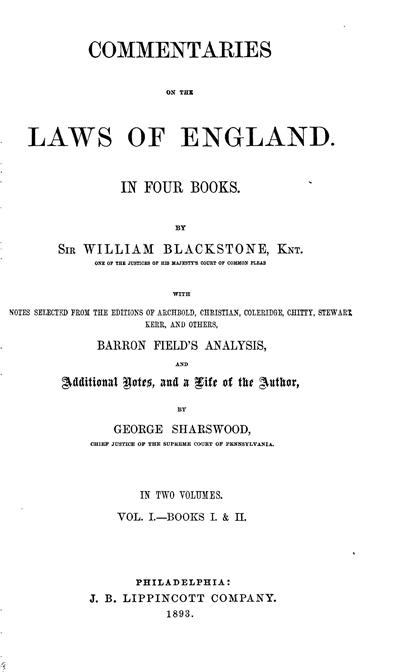
Commentaries on the Laws of England in Four Books. Notes selected from the editions of Archibold, Christian, Coleridge, Chitty, Stewart, Kerr, and others, Barron Field’s Analysis, and Additional Notes, and a Life of the Author by George Sharswood. In Two Volumes. (Philadelphia: J.B. Lippincott Co., 1893). Vol. 1 - Books I & II.

Part of: Commentaries on the Laws of England in Four Books, 2 vols.

About Liberty Fund:

Liberty Fund, Inc. is a private, educational foundation established to encourage the study of the ideal of a society of free and responsible individuals.


SECTION II.

OF THE NATURE OF LAWS IN GENERAL.

Law, in its most general and comprehensive sense, signifies a rule of action; and is applied indiscriminately to all kinds of action, whether animate or inanimate, rational or irrational. Thus we say, the laws of motion, of gravitation, of optics, or mechanics, as well as the laws of nature and of nations. And it is that rule of action which is prescribed by some superior, and which the inferior is bound to obey.

Thus, when the Supreme Being formed the universe, and created matter out of nothing, he impressed certain principles upon that matter, from which it can never depart, and without which it would cease to be. When he put that matter into motion, he established certain laws of motion, to which all movable bodies must conform. And, to descend from the greatest operations to the smallest, when a workman forms a clock, or other piece of mechanism, he establishes, at his own pleasure, certain arbitrary laws for its direction,—as that the hand shall describe a given space in a given time, to which law as long as the work conforms, so long it continues in perfection, and answers the end of its formation.

If we farther advance, from mere inactive matter to vegetable and animal life, we shall find them still governed by laws, more numerous indeed, but equally fixed and invariable. The whole progress of plants, from the seed to the root, and from thence to the seed again; the method of animal **39]nutrition, digestion, secretion, and all other branches of vital economy; are not left to chance, or the will of the creature itself, but are performed in a wondrous involuntary manner, and guided by unerring rules laid down by the great Creator.

This, then, is the general signification of law, a rule of action dictated by some superior being; and, in those creatures that have neither the power to think, nor to will, such laws must be invariably obeyed, so long as the creature itself subsists, for its existence depends on that obedience. But laws, in their more confined sense, and in which it is our present business to consider them, denote the rules, not of action in general, but of human action or conduct; that is, the precepts by which man, the noblest of all sublunary beings, a creature endowed with both reason and free-will, is commanded to make use of those faculties in the general regulation of his behaviour.1

Man, considered as a creature, must necessarily be subject to the laws of his Creator, for he is entirely a dependent being. A being, independent of any other, has no rule to pursue, but such as he prescribes to himself; but a state of dependence will inevitably oblige the inferior to take the will of him on whom he depends as the rule of his conduct; not, indeed, in every particular, but in all those points wherein his dependence consists. This principle, therefore, has more or less extent and effect, in proportion as the superiority of the one and the dependence of the other is greater or less, absolute or limited. And consequently, as man depends absolutely upon his Maker for every thing, it is necessary that he should, in all points, conform to his Maker’s will.

This will of his Maker is called the law of nature. For as God, when he created matter, and endued it with a principle of mobility, established certain rules for the perpetual direction of that motion, so, when he created man, and endued him with free-will to conduct himself in all parts of **40]life, he laid down certain immutable laws of human nature, whereby that free-will is in some degree regulated and restrained, and gave him also the faculty of reason to discover the purport of those laws.2

Considering the Creator only as a being of infinite power, he was able unquestionably to have prescribed whatever laws he pleased to his creature, man, however unjust or severe. But, as he is also a being of infinite wisdom, he has laid down only such laws as were founded in those relations of justice that existed in the nature of things antecedent to any positive precept. These are the eternal immutable laws of good and evil, to which the Creator himself, in all his dispensations, conforms; and which he has enabled human reason to discover, so far as they are necessary for the conduct of human actions. Such, among others, are these principles: that we should live honestly, should hurt nobody, and should render to every one his due; to which three general precepts Justinian(a) has reduced the whole doctrine of law.3

But if the discovery of these first principles of the law of nature depended only upon the due exertion of right reason, and could not otherwise be obtained than by a chain of metaphysical disquisitions, mankind would have wanted some inducement to have quickened their inquiries, and the greater part of the world would have rested content in mental indolence, and ignorance its inseparable companion. As, therefore, the Creator is a being not only of infinite power, and wisdom, but also of infinite goodness, he has been pleased so to contrive the constitution and frame of humanity, that we should want no other prompter to inquire after and pursue the rule of right, but only our own self-love, that universal principle of action. For he has so intimately connected, so inseparably interwoven the laws of eternal justice with the happiness of each individual, that the latter cannot be attained but by observing the former; and, if the former be punctually obeyed, it cannot but induce the latter. In consequence of which mutual connection of justice and human felicity, he *[*41has not perplexed the law of nature with a multitude of abstracted rules and precepts, referring merely to the fitness or unfitness of things, as some have vainly surmised, but has graciously reduced the rule of obedience to this one paternal precept, “that man should pursue his own true and substantial happiness.” This is the foundation of what we call ethics, or natural law; for the several articles into which it is branched in our systems, amount to no more than demonstrating that this or that action tends to man’s real happiness, and therefore very justly concluding that the performance of it is a part of the law of nature; or, on the other hand, that this or that action is destructive of man’s real happiness, and therefore that the law of nature forbids it.4

This law of nature, being coeval with mankind, and dictated by God himself, is of course superior in obligation to any other. It is binding over all the globe in all countries, and at all times: no human laws are of any validity, if contrary to this; and such of them as are valid derive all their force and all their authority, mediately or immediately, from this original.5

But, in order to apply this to the particular exigencies of each individual, it is still necessary to have recourse to reason, whose office it is to discover, as was before observed, what the law of nature directs in every circumstance of life, by considering what method will tend the most effectually to our own substantial happiness. And if our reason were always, as in our first ancestor before his transgression, clear and perfect, unruffled by passions, unclouded by prejudice, unimpaired by disease or intemperance, the task would be pleasant and easy; we should need no other guide but this. But every man now finds the contrary in his own experience; that his reason is corrupt, and his understanding full of ignorance and error.

This has given manifold occasion for the benign interposition of divine Providence, which, in compassion to the frailty, the imperfection, and the blindness of human reason, **42]hath been pleased, at sundry times and in divers manners, to discover and enforce its laws by an immediate and direct revelation. The doctrines thus delivered we call the revealed or divine law, and they are to be found only in the holy scriptures. These precepts, when revealed, are found upon comparison to be really a part of the original law of nature, as they tend in all their consequences to man’s felicity. But we are not from thence to conclude that the knowledge of these truths was attainable by reason, in its present corrupted state; since we find that, until they were revealed, they were hid from the wisdom of ages. As then the moral precepts of this law are indeed of the same original with those of the law of nature, so their intrinsic obligation is of equal strength and perpetuity. Yet undoubtedly the revealed law is of infinitely more authenticity than that moral system which is framed by ethical writers, and denominated the natural law; because one is the law of nature, expressly declared so to be by God himself; the other is only what, by the assistance of human reason, we imagine to be that law. If we could be as certain of the latter as we are of the former, both would have an equal authority; but, till then, they can never be put in any competition together.

Upon these two foundations, the law of nature and the law of revelation, depend all human laws; that is to say, no human laws should be suffered to contradict these. There are, it is true, a great number of indifferent points in which both the divine law and the natural leave a man at his own liberty, but which are found necessary, for the benefit of society, to be restrained within certain limits. And herein it is that human laws have their greatest force and efficacy; for, with regard to such points as are not indifferent, human laws are only declaratory of, and act in subordination to, the former. To instance in the case of murder: this is expressly forbidden by the divine, and demonstrably by the natural law; and, from these prohibitions, arises the true unlawfulness of this crime. Those human laws that annex a punishment to it do not at all increase its moral guilt, or *[*43superadd any fresh obligation, in foro conscientiæ, to abstain from its perpetration. Nay, if any human law should allow or enjoin us to commit it, we are bound to transgress that human law, or else we must offend both the natural and the divine. But, with regard to matters that are in themselves indifferent, and are not commanded or forbidden by those superior laws,—such, for instance, as exporting of wool into foreign countries,—here the inferior legislature has scope and opportunity to interpose, and to make that action unlawful which before was not so.

If man were to live in a state of nature, unconnected with other individuals, there would be no occasion for any other laws than the law of nature, and the law of God. Neither could any other law possibly exist: for a law always supposes some superior who is to make it; and, in a state of nature, we are all equal, without any other superior but Him who is the author of our being. But man was formed for society; and, as is demonstrated by the writers on this subject,(b) is neither capable of living alone, nor indeed has the courage to do it. However, as it is impossible for the whole race of mankind to be united in one great society, they must necessarily divide into many, and form separate states, commonwealths, and nations, entirely independent of each other, and yet liable to a mutual intercourse. Hence arises a third kind of law to regulate this mutual intercourse, called “the law of nations,” which, as none of these states will acknowledge a superiority in the other, cannot be dictated by any, but depends entirely upon the rules of natural law, or upon mutual compacts, treaties, leagues, and agreements between these several communities: in the construction also of which compacts we have no other rule to resort to, but the law of nature; being the only one to which all the communities are equally subject; and therefore the civil law(c) very justly observes, that quod naturalis ratio inter omnes homines constituit, vocatur jus gentium.7

**44]Thus much I thought it necessary to premise concerning the law of nature, the revealed law, and the law of nations, before I proceeded to treat more fully of the principal subject of this section, municipal or civil law; that is, the rule by which particular districts; communities, or nations, are governed; being thus defined by Justinian,(d)jus civile est quod quisque sibi populus constituit.” I call it municipal law, in compliance with common speech; for, though strictly that expression denotes the particular customs of one single municipium or free town, yet it may with sufficient propriety be applied to any one state or nation which is governed by the same laws and customs.

Municipal law, thus understood, is properly defined to be “a rule of civil conduct prescribed by the supreme power in a state, commanding what is right and prohibiting what is wrong.”8 Let us endeavour to explain its several properties, as they arise out of this definition. And, first, it is a rute: not a transient sudden order from a superior to or concerning a particular person; but something permanent, uniform, and universal. Therefore a particular act of the legislature to confiscate the goods of Titius, or to attaint him of high treason, does not enter into the idea of a municipal law: for the operation of this act is spent upon Titius only, and has no relation to the community in general; it is rather a sentence than a law.9 But an act to declare that the crime of which Titius is accused shall be deemed high treason: this has permanency, uniformity, and universality, and therefore is properly a rule. It is also called a rule, to distinguish it from advice or counsel, which we are at liberty to follow or not, as we see proper, and to judge upon the reasonableness or unreasonableness of the thing advised: whereas our obedience to the law depends not upon our approbation, but upon the maker’s will. Counsel is only matter of persuasion, law is matter of injunction; counsel acts only upon the willing, law upon the unwilling also.

*[*45It is also called a rule, to distinguish it from a compact or agreement; for a compact is a promise proceeding from us, law is a command directed to us. The language of a compact is, “I will, or will not, do this;” that of a law is, “thou shalt, or shalt not, do it.” It is true there is an obligation which a compact carries with it, equal in point of conscience to that of a law; but then the original of the obligation is different. In compacts we ourselves determine and promise what shall be done, before we are obliged to do it; in laws, we are obliged to act without ourselves determining or promising any thing at all. Upon these accounts law is defined to be “a rule.

Municipal law is also “a rule of civil conduct.” This distinguishes municipal law from the natural, or revealed; the former of which is the rule of moral conduct, and the latter not only the rule of moral conduct, but also the rule of faith. These regard man as a creature, and point out his duty to God, to himself, and to his neighbour, considered in the light of an individual. But municipal or civil law regards him also as a citizen, and bound to other duties towards his neighbour than those of mere nature and religion: duties, which he has engaged in by enjoying the benefits of the common union; and which amount to no more than that he do contribute, on his part, to the subsistence and peace of the society.

It is likewise “a rule prescribed.” Because a bare resolution, confined in the breast of the legislator, without manifesting itself by some external sign, can never be properly a law. It is requisite that this resolution be notified to the people who are to obey it. But the manner in which this notification is to be made, is matter of very great indifference. It may be notified by universal tradition and long practice, which supposes a previous publication, and is the case of the common law of England. It may be notified viva voce, by officers appointed for that purpose, as is done with regard to proclamations, and such acts of parliament as are appointed**46] to be publicly read in churches and other assemblies. It may lastly be notified by writing, printing, or the like; which is the general course taken with all our acts of parliament. Yet, whatever way is made use of, it is incumbent on the promulgators to do it in the most public and perspicuous manner; not like Caligula, who (according to Dio Cassius) wrote his laws in a very small character, and hung them upon high pillars, the more effectually to ensnare the people. There is still a more unreasonable method than this, which is called making of laws ex post facto; when after an action (indifferent in itself) is committed, the legislator then for the first time declares it to have been a crime, and inflicts a punishment upon the person who has committed it. Here it is impossible that the party could foresee that an action, innocent when it was done, should be afterwards converted to guilt by a subsequent law; he had therefore no cause to abstain from it; and all punishment for not abstaining must of consequence be cruel and unjust.(e) All laws should be therefore made to commence in futuro, and be notified before their commencement; which is implied in the term “prescribed.” But when this rule is in the usual manner notified, or prescribed, it is then the subject’s business to be thoroughly acquainted therewith; for if ignorance, of what he might know were admitted as a legitimate excuse, the laws would be of no effect, but might always be eluded with impunity.10

But farther: municipal law is “a rule of civil conduct prescribed by the supreme power in a state.” For legislature, as was before observed, is the greatest act of superiority that can be exercised by one being over another. Wherefore it is requisite to the very essence of a law, that it be made by the supreme power Sovereignty and legislature are indeed convertible terms; one cannot subsist without the other.

*[*47This will naturally lead us into a short inquiry concerning the nature of society and civil government; and the natural, inherent right that belongs to the sovereignty of a state, wherever that sovereignty be lodged, of making and enforcing laws.

The only true and natural foundations of society are the wants and the fears of individuals. Not that we can believe, with some theoretical writers, that there ever was a time when there was no such thing as society either natural or civil; and that, from the impulse of reason, and through a sense of their wants and weaknesses, individuals met together in a large plain, entered into an original contract, and chose the tallest man present to be their governor. This notion, of an actually existing unconnected state of nature, is too wild to be seriously admitted: and besides it is plainly contradictory to the revealed accounts of the primitive origin of mankind, and their preservation two thousand years afterwards; both which were effected by the means of single families These formed the first natural society, among themselves; which, every day extending its limits, laid the first though imperfect rudiments of civil or political society: and when it grew too large to subsist with convenience in that pastoral state, wherein the patriarchs appear to have lived, it necessarily subdivided itself by various migrations into more. Afterwards, as agriculture increased, which employs and can maintain a much greater number of hands, migrations became less frequent: and various tribes, which had formerly separated, reunited again; sometimes by compulsion and conquest, sometimes by accident, and sometimes perhaps by compact. But though society had not its formal beginning from any convention of individuals, actuated by their wants and their fears; yet it is the sense of their weakness and imperfection that keeps mankind together; that demonstrates the necessity of this union; and that therefore is the solid and natural foundation, as well as the cement of civil society. And this is what we mean by the original contract of society; which, though perhaps in no instance it has ever been formally expressed at the first institution of a state, yet in nature and reason must always be understood and implied, *[*48in the very act of associating together: namely, that the whole should protect all its parts, and that every part should pay obedience to the will of the whole, or, in other words, that the community should guard the rights of each individual member, and that (in return for this protection) each individual should submit to the laws of the community; without which submission of all it was impossible that protection should be certainly extended to any.11

For when civil society is once formed, government at the same time results of course, as necessary to preserve and to keep that society in order. Unless some superior be constituted, whose commands and decisions all the members are bound to obey, they would still remain as in a state of nature, without any judge upon earth to define their several rights, and redress their several wrongs. But, as all the members which compose this society were naturally equal, it may be asked, in whose hands are the reins of government to be intrusted? To this the general answer is easy; but the application of it to particular cases has occasioned one half of those mischiefs, which are apt to proceed from misguided political zeal. In general, all mankind will agree that government should be reposed in such persons, in whom those qualities are most likely to be found, the perfection of which is among the attributes of Him who is emphatically styled the Supreme Being; the three grand requisites, I mean, of wisdom, of goodness, and of power: wisdom, to discern the real interest of the community; goodness, to endeavour always to pursue that real interest; and strength, or power, to carry this knowledge and intention into action. These are the natural foundations of sovereignty, and these are the requisites that ought to be found in every well constituted frame of government.

How the several forms of government we now see in the world at first actually began, is matter of great uncertainty, and has occasioned infinite disputes. It is not my business or intention to enter into any of them. However they began, or by *[*49what right soever they subsist, there is and must be in all of them a supreme, irresistible, absolute, uncontrolled authority, in which the jura summi imperii, or the rights of sovereignty, reside. And this authority is placed in those hands, wherein (according to the opinion of the founders of such respective states, either expressly given, or collected from their tacit appro bation) the qualities requisite for supremacy, wisdom, goodness, and power, are the most likely to be found.

The political writers of antiquity will not allow more than three regular forms of government: the first, when the sovereign power is lodged in an aggregate assembly, consisting of all the free members of a community, which is called a democracy; the second, when it is lodged in a council, composed of select members, and then it is styled an aristocracy; the last, when it is intrusted in the hands of a single person, and then it takes the name of a monarchy. All other species of government, they say, are either corruptions of, or reducible to, these three.

By the sovereign power, as was before observed, is meant the making of laws, for wherever that power resides, all others must conform to and be directed by it, whatever appearance the outward form and administration of the government may put on. For it is at any time in the option of the legislature to alter that form and administration by a new edict or rule, and to put the execution of the laws into whatever hands it pleases; by constituting one, or a few, or many executive magistrates: and all the other powers of the state must obey the legislative power in the discharge of their several functions, or else the constitution is at an end.12

In a democracy, where the right of making laws resides in the people at large, public virtue, or goodness of intention, is more likely to be found, than either of the other qualities of government. Popular assemblies are frequently foolish in their contrivance, and weak in their execution; but generally mean to do the thing that is right and just, and have always a degree of patriotism or public spirit. In *[*50aristocracies there is more wisdom to be found, than in the other frames of government; being composed, or intended to be composed, of the most experienced citizens: but there is less honesty than in a republic, and less strength than in a monarchy. A monarchy is indeed the most powerful of any; for, by the entire conjunction of the legislative and executive powers, all the sinews of government are knitted together, and united in the hand of the prince: but then there is imminent danger of his employing that strength to improvident or oppressive purposes.

Thus these three species of government have, all of them, their several perfections and imperfections. Democracies are usually the best calculated to direct the end of a law; aristocracies to invent the means by which that end shall be obtained; and monarchies to carry these means into execution. And the ancients, as was observed, had in general no idea of any other permanent form of government but these three: for though Cicero(f) declares himself of opinion “esse optime constitutam rempublicam quæ ex tribus generibus illis, regali, optimo, et populari, sit modice confusa;” yet Tacitus treats this notion of a mixed government, formed out of them all, and partaking of the advantages of each, as a visionary whim, and one that, if effected, could never be lasting or secure.(g)

But, happily for us of this island, the British constitution has long remained, and I trust will long continue, a standing exception to the truth of this observation. For, as with us the executive power of the laws is lodged in a single person, they have all the advantages of strength and despatch, that are to be found in the most absolute monarchy: and, as the legislature of the kingdom is intrusted to three distinct powers, entirely independent of each other; first, the king; secondly, the lords spiritual and temporal, which is an aristocratical assemblage of persons selected for their piety, **51]their birth, their wisdom, their valour, or their property; and, thirdly, the House of Commons, freely chosen by the people from among themselves, which makes it a kind of democracy: as this aggregate body, actuated by different springs, and attentive to different interests, composes the British parliament, and has the supreme disposal of every thing; there can no inconvenience be attempted by either of the three branches, but will be withstood by one of the other two; each branch being armed with a negative power, sufficient to repel any innovation which it shall think inexpedient or dangerous.

Here then is lodged the sovereignty of the British constitution; and lodged as beneficially as is possible for society. For in no other shape could we be so certain of finding the three great qualities of government so well and so happily united. If the supreme power were lodged in any one of the three branches separately, we must be exposed to the inconveniences of either absolute monarchy, aristocracy, or democracy; and so want two of the three principal ingredients of good polity, either virtue, wisdom, or power. If it were lodged in any two of the branches; for instance, in the king and House of Lords, our laws might be providently made and well executed, but they might not always have the good of the people in view: if lodged in the king and commons, we should want that circumspection and mediatory caution, which the wisdom of the peers is to afford: if the supreme rights of legislature were lodged in the two houses only, and the king had no negative upon their proceedings, they might be tempted to encroach upon the royal prerogative, or perhaps to abolish the kingly office, and thereby weaken (if not totally destroy) the strength of the executive power. But the constitutional government of this island is so admirably tempered and compounded, that nothing can endanger or hurt it, but destroying the equilibrium of power between one branch of the legislature and the rest. For if ever it should happen that the independence of any one of the three should be lost, or that it should become subservient to the views of either of the other two, there would **52]soon be an end of our constitution.13 The legislature would be changed from that, which (upon the supposition of an original contract, either actual or implied) is presumed to have been originally set up by the general consent and fundamental act of the society: and such a change, however effected, is according to Mr. Locke,(h) (who perhaps carries his theory too far,) at once an entire dissolution of the bands of government; and the people are thereby reduced to a state of anarchy, with liberty to constitute to themselves a new legislative power.

Having thus cursorily considered the three usual species of government, and our own singular constitution, selected and compounded from them all, I proceed to observe, that, as the power of making laws constitutes the supreme authority, so wherever the supreme authority in any state resides, it is the right of that authority to make laws; that is, in the words of our definition, to prescribe the rule of civil action. And this may be discovered from the very end and institution of civil states. For a state is a collective body, composed of a multitude of individuals, united for their safety and convenience, and intending to act together as one man. If it therefore is to act as one man, it ought to act by one uniform will. But, inasmuch as political communities are made up of many natural persons, each of whom has his particular will and inclination, these several wills cannot by any natural union be joined together, or tempered and disposed into a lasting harmony, so as to constitute and produce that one uniform will of the whole. It can therefore be no otherwise produced than by a political union; by the consent of all persons to submit their own private wills to the will of one man, or of one or more assemblies of men, to whom the supreme authority is intrusted: and this will of that one man, or assemblage of men, is in different states, according to their different constitutions, understood to be law.

Thus far as to the right of the supreme power to make laws; but farther, it is its duty likewise. For since the *[*53respective members are bound to conform themselves to the will of the state, it is expedient that they receive directions from the state declaratory of that its will. But, as it is impossible, in so great a multitude, to give injunctions to every particular man, relative to each particular action, it is therefore incumbent on the state to establish general rules, for the perpetual information and direction of all persons in all points, whether of positive or negative duty. And this, in order that every man may know what to look upon as his own, what as another’s; what absolute and what relative duties are required at his hands; what is to be esteemed honest, dishonest, or indifferent; what degree every man retains of his natural liberty; what he has given up as the price of the benefits of society; and after what manner each person is to moderate the use and exercise of those rights which the state assigns him, in order to promote and secure the public tranquillity.

From what has been advanced, the truth of the former branch of our definition, is (I trust) sufficiently evident; that “municipal law is a rule of civil conduct prescribed by the supreme power in a state.” I proceed now to the latter branch of it; that it is a rule so prescribed, “commanding what is right, and prohibiting what is wrong.

Now in order to do this completely, it is first of all necessary that the boundaries of right and wrong be established and ascertained by law. And when this is once done, it will follow of course that it is likewise the business of the law, considered as a rule of civil conduct, to enforce these rights, and to restrain or redress these wrongs. It remains therefore only to consider in what manner the law is said to ascertain the boundaries of right and wrong; and the methods which it takes to command the one and prohibit the other.

For this purpose every law may be said to consist of several parts: one, declaratory; whereby the rights to be observed, and the wrongs to be eschewed, are clearly defined and *[*54laid down: another, directory; whereby the subject is instructed and enjoined to observe those rights, and to abstain from the commission of those wrongs: a third, remedial, whereby a method is pointed out to recover a man’s private rights, or redress his private wrongs: to which may be added a fourth, usually termed the sanction, or vindicatory branch of the law; whereby it is signified what evil or penalty shall be incurred by such as commit any public wrongs, and transgress or neglect their duty.

With regard to the first of these, the declaratory part of the municipal law, this depends not so much upon the law of revelation or of nature, as upon the wisdom and will of the legislator. This doctrine, which before was slightly touched, deserves a more particular explication. Those rights then which God and nature have established, and are therefore called natural rights, such as are life and liberty, need not the aid of human laws to be more effectually invested in every man than they are; neither do they receive any additional strength when declared by the municipal laws to be inviolable. On the contrary, no human legislature has power to abridge or destroy them, unless the owner shall himself commit some act that amounts to a forfeiture. Neither do divine or natural duties (such as, for instance, the worship of God, the maintenance of children, and the like) receive any stronger sanction from being also declared to be duties by the law of the land. The case is the same as to crimes and misdemesnors, that are forbidden by the superior laws, and therefore styled mala in se, such as murder, theft, and perjury; which contract no additional turpitude from being declared unlawful by the inferior legislature. For that legislature in all these cases acts only, as was before observed, in subordination to the great law-giver, transcribing and publishing his precepts. So that, upon the whole, the declaratory part of the municipal law has no force or operation at all, with regard to actions that are naturally and intrinsically right or wrong.

**55]But, with regard to things in themselves indifferent, the case is entirely altered. These become either right or wrong, just or unjust, duties or misdemesnors, according as the municipal legislator sees proper, for promoting the welfare of the society, and more effectually carrying on the purposes of civil life. Thus our own common law has declared, that the goods of the wife do instantly upon marriage become the property and right of the husband; and our statute law has declared all monopolies a public offence: yet that right, and this offence, have no foundation in nature, but are merely created by the law, for the purposes of civil society. And sometimes, where the thing itself has its rise from the law of nature, the particular circumstances and mode of doing it become right or wrong, as the law of the land shall direct. Thus, for instance, in civil duties; obedience to superiors is the doctrine of revealed as well as natural religion: but who those superiors shall be, and in what circumstances or to what degrees they shall be obeyed, it is the province of human laws to determine. And so, as to injuries or crimes, it must be left to our own legislature to decide, in what cases the seizing another’s cattle shall amount to a trespass or a theft; and where it shall be a justifiable action, as when a landlord takes them by way of distress for rent.

Thus much for the declaratory part of the municipal law: and the directory stands much upon the same footing; for this virtually includes the former, the declaration being usually collected from the direction. The law that says, “thou shalt not steal,” implies a declaration that stealing is a crime. And we have seen(i) that, in things naturally indifferent, the very essence of right and wrong depends upon the direction of the laws to do or to omit them.

The remedial part of a law is so necessary a consequence of the former two, that laws must be very vague and imperfect **56]without it. For in vain would rights be declared, in vain directed to be observed, if there were no method of recovering and asserting these rights, when wrongfully withheld or invaded. This is what we mean properly, when we speak of the protection of the law. When, for instance, the declaratory part of the law has said, “that the field or inheritance, which belonged to Titius’s father, is vested by his death in Titius;” and the directory part has “forbidden any one to enter on another’s property, without the leave of the owner:” if Gaius after this will presume to take possession of the land, the remedial part of the law will then interpose its office; will make Gaius restore the possession to Titius, and also pay him damages for the invasion.

With regard to the sanction of laws, or the evil that may attend the breach of public duties, it is observed, that human legislators have for the most part chosen to make the sanction of their laws rather vindicatory than remuneratory, or to consist rather in punishments, than in actual particular rewards. Because, in the first place, the quiet enjoyment and protection of all our civil rights and liberties, which are the sure and general consequence of obedience to the municipal law, are in themselves the best and most valuable of all rewards. Because also, were the exercise of every virtue to be enforced by the proposal of particular rewards, it were impossible for any state to furnish stock enough for so profuse a bounty. And farther, because the dread of evil is a much more forcible principle of human actions than the prospect of good.(k) For which reasons, though a prudent bestowing of rewards is sometimes of exquisite use, yet we find that those civil laws, which enforce and enjoin our duty, do seldom, if ever, propose any privilege or gift to such as obey the law; but do constantly come armed with a penalty denounced against transgressors, either expressly defining the nature and quantity of the punishment, or else leaving it to the discretion of the judges, and those who are intrusted with the care of putting the laws in execution.

*[*57Of all the parts of a law the most effectual is the vindicatory. For it is but lost labour to say, “do this, or avoid that,” unless we also declare, “this shall be the consequence of your non-compliance.” We must therefore observe, that the main strength and force of a law consists in the penalty annexed to it. Herein is to be found the principal obligation of human laws.

Legislators and their laws are said to compel and oblige: not that by any natural violence they so constrain a man, as to render it impossible for him to act otherwise than as they direct, which is the strict sense of obligation; but because, by declaring and exhibiting a penalty against offenders, they bring it to pass that no man can easily choose to transgress the law; since, by reason of the impending correction, compliance is in a high degree preferable to disobedience. And, even where rewards are proposed as well as punishments threatened, the obligation of the law seems chiefly to consist in the penalty; for rewards, in their nature, can only persuade and allure; nothing is compulsory but punishment.

It is true, it hath been holden, and very justly, by the principal of our ethical writers, that human laws are binding upon men’s consciences. But if that were the only or most forcible obligation, the good only would regard the laws, and the bad would set them at defiance. And, true as this principle is, it must still be understood with some restriction. It holds, I apprehend, as to rights; and that, when the law has determined the field to belong to Titius, it is matter of conscience no longer to withhold or to invade it. So also in regard to natural duties, and such offences as are mala in se: here we are bound in conscience; because we are bound by superior laws, before those human laws were in being, to perform the one and abstain from the other. But in relation to those laws which enjoin only positive duties, and forbid only such things as are not mala in se, but mala prohibita merely, without any intermixture of moral guilt, *[*58annexing a penalty to non-compliance,(l) here I apprehend conscience is no farther concerned, than by directing a submission to the penalty, in case of our breach of those laws: for otherwise the multitude of penal laws in a state would not only be looked upon as an impolitic, but would also be a very wicked thing; if every such law were a snare for the conscience of the subject. But in these cases the alternative is offered to every man; “either abstain from this, or submit to such a penalty:” and his conscience will be clear, whichever side of the alternative he thinks proper to embrace. Thus, by the statutes for preserving the game, a penalty is denounced against every unqualified person that kills a hare, and against every person who possesses a partridge in August. And so too, by other statutes, pecuniary penalties are inflicted for exercising trades without serving an apprenticeship thereto,14 for not burying the dead in woollen, for not performing the statute-work on the public roads, and for innumerable other positive misdemesnors. Now these prohibitory laws do not make the transgression a moral offence, or sin: the only obligation in conscience is to submit to the penalty, if levied. It must however be observed, that we are here speaking of laws that are simply and purely penal, where the thing forbidden or enjoined is wholly a matter of indifference, and where the penalty inflicted is an adequate compensation for the civil inconvenience supposed to arise from the offence.15 But where disobedience to the law involves in it also any degree of public mischief or private injury, there it falls within our former distinction, and is also an offence against conscience.(m)

I have now gone through the definition laid down of a municipal law; and have shown that it is “a rule of civil conduct prescribed by the supreme power in a state, commanding what is right, and prohibiting what is wrong;” in the explication of which I have endeavoured to interweave a few useful principles concerning the nature of civil government, and the obligation of human laws Before I conclude this section, it may not be amiss to add a few observations concerning the interpretation of laws.

When any doubt arose upon the construction of the Roman laws, the usage was to state the case to the emperor in writing, and take his opinion upon it. This was certainly a bad method of interpretation. To interrogate the legislature to decide particular disputes is not only endless, but affords great room for partiality and oppression. The answers of the emperor were called his rescripts, and these had in succeeding cases the force of perpetual laws; though they ought to be carefully distinguished by every rational civilian from those general constitutions which had only the nature of things for their guide. The emperor Macrinus, as his historian Capitolinus informs us, had once resolved to *[*59abolish these rescripts, and retain only the general edicts: he could not bear that the hasty and crude answers of such princes as Commodus and Caracalla should be reverenced as laws. But Justinian thought otherwise,(n) and he has preserved them all. In like manner the canon laws, or decretal epistles of the popes, are all of them rescripts in the strictest sense. Contrary to all true forms of reasoning, they argue from particulars to generals.

The fairest and most rational method to interpret the will of the legislator is by exploring his intentions at the time when the law was made, by signs the most natural and probable. And these signs are either the words, the context, the subject matter, the effects and consequence, or the spirit and reason of the law. Let us take a short view of them all.

1. Words are generally to be understood in their usual and most known signification; not so much regarding the propriety of grammar, as their general and popular use. Thus the law mentioned by Puffendorf(o) which forbade a layman to lay hands on a priest, was adjudged to extend to him who had hurt a priest with a weapon. Again, terms of art, or technical terms, must be taken according to the acceptation of the learned in each art, trade, and science. So in the act of settlement, where the crown of England is limited “to the princess Sophia, and the heirs of her body, being Protestants,” it becomes necessary to call in the assistance of lawyers to ascertain the precise idea of the words “heirs of her body,” which, in a legal sense, comprise only certain of her lineal descendants.16

**60]2. If words happen to be still dubious, we may establish their meaning from the context, with which it may be of singular use to compare a word, or a sentence, whenever they are ambiguous, equivocal, or intricate. Thus the proeme, or preamble, is often called in to help the construction of an act of parliament.17 Of the same nature and use is the comparison of a law with other laws, that are made by the same legislator, that have some affinity with the subject, or that expressly relate to the same point.18 Thus, when the law of England declares murder to be felony without benefit of clergy, we must resort to the same law of England to learn what the benefit of clergy is; and, when the common law censures simoniacal contracts, it affords great light to the subject to consider what the canon law has adjudged to be simony.19

3. As to the subject matter, words are always to be understood as having a regard thereto, for that is always supposed to be in the eye of the legislator, and all his expressions directed to that end. Thus, when a law of our Edward III. forbids all ecclesiastical persons to purchase provisions at Rome, it might seem to prohibit the buying of grain and other victual; but, when we consider that the statute was made to repress the usurpations of the papal see, and that the nominations to benefices by the pope were called provisions, we shall see that the restraint is intended to be laid upon such provisions only.

4. As to the effects and consequence, the rule is, that where words bear either none, or a very absurd signification, if literally understood, we must a little deviate from the received sense of them. Therefore the Bolognian law, mentioned by Puffendorf,(p) which enacted “that whoever drew blood in the streets should be punished with the utmost severity,” was held after long debate not to extend to the surgeon who opened the vein of a person that fell down in the street with a fit.

*[*615. But, lastly, the most universal and effectual way of discovering the true meaning of a law, when the words are dubious, is by considering the reason and spirit of it; or the cause which moved the legislator to enact it.20 For when this reason ceases, the law itself ought likewise to cease with it. An instance of this is given in a case put by Cicero, or whoever was the author of the treatise inscribed to Herennius.(q) There was a law, that those who in a storm forsook the ship should forfeit all property therein; and that the ship and lading should belong entirely to those who stayed in it. In a dangerous tempest all the mariners forsook the ship, except only one sick passenger, who, by reason of his disease, was unable to get out and escape. By chance the ship came safe to port. The sick man kept possession, and claimed the benefit of the law. Now here all the learned agree, that the sick man is not within the reason of the law; for the reason of making it was, to give encouragement to such as should venture their lives to save the vessel; but this is a merit which he could never pretend to, who neither stayed in the ship upon that account, nor contributed any thing to its preservation.21

From this method of interpreting laws by the reason of them, arises what we call equity, which is thus defined by Grotius:(r) “the correction of that wherein the law (by reason of its universality) is deficient.” For, since in laws all cases cannot be foreseen or expressed, it is necessary that, when the general decrees of the law come to be applied to particular cases, there should be somewhere a power vested of defining those circumstances, which (had they been foreseen) the legislator himself would have expressed. And these are the cases which, according to Grotius, “lex non exacte definit, sed arbitrio boni viri permittit.22

Equity thus depending, essentially, upon the particular circumstances of each individual case, there can be no established **62]rules and fixed precepts of equity laid down, without destroying its very essence, and reducing it to a positive law. And, on the other hand, the liberty of considering all cases in an equitable light must not be indulged too far, lest thereby we destroy all law, and leave the decision of every question entirely in the breast of the judge. And law, without equity, though hard and disagreeable, is much more desirable for the public good than equity without law; which would make every judge a legislator, and introduce most infinite confusion; as there would then be almost as many different rules of action laid down in our courts, as there are differences of capacity and sentiment in the human mind.

[1 ] This, perhaps, is the only sense in which the word law can be strictly used; for in all cases where it is not applied to human conduct, it may be considered as a metaphor, and in every instance a more appropriate term may be found. When it is used to express the operations of the Deity or Creator, it comprehends ideas very different from those which are included in its signification when it is applied to man, or his other creatures. The volitions of the Almighty are his laws: he had only to will, ϕως γενεσθω και εγενετι. When we apply the word law to motion, matter, or the works of nature or of art, we shall find in every case, that with equal or greater propriety and perspicuity we might have used the words quality, property, or peculiarity.—We say that it is a law of motion, that a body put in motion in vacuo must forever go forward in a straight line with the same velocity; that it is a law of nature, that particles of matter shall attract each other with a force that varies inversely as the square of the distance from each other; and mathematicians say, that a series of numbers observes a certain law, when each subsequent term bears a certain relation or proportion to the preceding term: but, in all these instances, we might as well have used the word property or quality, it being as much the property of all matter to move in a straight line, or to gravitate, as it is to be solid or extended; and when we say that it is the law of a series that each term is the square or square-root of the preceding term, we mean nothing more than that such is its property or peculiarity. And the word law is used in this sense in those cases only which are sanctioned by usage; as it would be thought a harsh expression to say, that it is a law that snow should be white, or that fire should burn. When a mechanic forms a clock, he establishes a model of it either in fact or in his mind, according to his pleasure; but if he should resolve that the wheels of his clock should move contrary to the usual rotation of similar pieces of mechanism, we could hardly with any propriety established by usage apply the term law to his scheme. When law is applied to any other object than man, it ceases to contain two of its essential ingredient ideas, viz. disobedience and punishment.

Hooker, in the beginning of his Ecclesiastical Polity, like the learned judge, has with incomparable eloquence interpreted law in its most general and comprehensive sense. And most writers who treat law as a science begin with such an explanation. But the editor, though it may seem presumptuous to question such authority, has thought it his duty to suggest these few observations upon the signification of the word law.Christian.

It has been objected that law, in its proper sense, is confined to the conduct of intelligent beings. It is to be observed, however, that we apply the term in the English language to any rule whatever which we conceive to have been established by a superior. In this sense, all the operations of nature may be considered as the result of certain rules laid down by the Supreme Being in creation; in other words, that every existence, spiritual, animal, vegetable, or mineral, had impressed upon it certain rules of action. They may be called qualities, properties, or peculiarities; but, considering them all as the work of an Almighty Creator, it is perfectly accurate and most proper to call them laws. By the use of this word we keep constantly in mind, as we ought, that the universe was not the result of a blind chance, but the work of Intelligence. A perfectly correct, as well as most general, definition of the word law is, the command of a superior.

In most languages there are two words,—one expressive of law in its general or abstract, and another in its concrete, sense. Thus, in Latin, jus expresses the former, lex the latter; in French, droit and loi; in German, recht and gesetz. The word right, in English, might be adopted for the abstract sense of law; but it has not been. Usus non jus facit norma loquendi. Considering the word law as comprehending this general and abstract sense, there is no objection to the text.—Sharswood.

[2 ] The laws of our moral being are the necessary relations sustained by us to our Maker and to other beings. The existence of a Supreme Being—a Spirit infinite, eternal, omniscient, omnipotent—is a first truth of moral science. It may be assumed safely as an admitted truth. Having created us such as we are, our relations to him and to one another arose not from his will, but from those eternal principles of rectitude which were coeternal with his will. “Erat enim ratio profecta a rerum natura et ad recti faciendum impellens, et a delicto avocans; quæ tum denique incepit lex esse non cum scripta est, sed tum, cum orta est; orta autem simul est cum mente divina.”—Cic. de Legg., I. ii. s. 4. The same may be affirmed of other than moral relations. We may say without the slightest irreverence that, having created things having extension, God could not make two things, both equal to a third, which would not at the same time be equal to one another. There is, in like manner, an inherent difference between right and wrong, independently of the will of any being. God himself cannot make right wrong or wrong right. Right and wrong are eternal as the Deity. They depend upon the relations of moral beings; and, even before such beings were created, those relations existed in possibility, though not in act. The will of God existed coeternally with himself; and that will, infinitely perfect and incorrupt, never could do else than choose the right and refuse the wrong. Right and wrong are not created existences, but the moral qualities of created existences.

It may well be questioned, then, whether the learned commentator, in starting with the assertion that the law of nature is the will of the Creator, has not assumed an erroneous principle as the foundation of his reasoning. In his sense, the law of nature denotes “the rules of human action or conduct; that is, the precepts by which man, the noblest of all sublunary beings, a creature endowed with both reason and free-will, is commanded to make use of those faculties in the general regulation of his behaviour.” It is clear that this law respects entirely the question of what is right and wrong. It is true that, in willing to create moral beings, our Maker knew what their necessary relations both to himself and each other would be; and, in a secondary sense, he may be said to have willed the existence of those relations. But this is an entirely different thing from the idea that the rules of right and wrong resulting from those relations were simple creations of his will; for that implies that he might have made them other than they are.—Sharswood.

[(a) ]Juris præcepta sunt hæc, honeste vivere, alterum non lædere, suum cuique tribuere. Inst. I. i. 3.

[3 ] It is rather remarkable, that both Harris, in his translation of Justinian’s Institutes, and the learned Commentator, whose profound learning and elegant taste in the classics no one will question, should render in English, honeste vivere, to live honestly. The language of the Institutes is far too pure to admit of that interpretation; and besides, our idea of honesty is fully conveyed by the words suum cuique tribuere. I should presume to think that honeste vivere signifies to live honourably, or with decorum, or bienséance; and that this precept was intended to comprise that class of duties of which the violations are ruinous to society, and not by immediate but remote consequences, as drunkenness, debauchery, profaneness, extravagance, gaming, &c.—Christian.

[4 ] There is in every moral being a faculty or sense by which he is enabled to distinguish right from wrong. There have been a great number of theories among those who have rejected the doctrine of a moral sense. They have succeeded each man in showing every other theory but his own to be baseless. The reductio ad absurdum of every other system, which ingenuity has ever framed; would alone seem to leave the advocates of a moral sense in possession of the field. The appeal, after all, must be made to every man’s consciousness. And why not? Every other faculty is proved in the same way. Let any one attempt to demonstrate that there is in men a natural taste for beauty. He will be met by precisely the same course of argument as that which attacks the existence of the moral sense, or, as it may well be termed, the taste for moral beauty. All men have it not in the same perfection. In some it is undeveloped, in some it is corrupted. Indeed, the same objections may be urged against the perceptions of the palate or of any other natural sense. That some men love the taste of tobacco by no means proves that there is not a natural faculty in all men which distinguishes between the qualities of sweet and bitter.

The commentator appears to have adopted the idea that utility is the standard of right and wrong; in other words, that we are determined in our judgment of the moral qualities of an action solely by a consideration of its effect on our happiness. Such a doctrine contradicts the common sense and feeling of mankind. If a gross instance of ingratitude to a benefactor—of filial impiety—of marital cruelty—is presented to the mind, no man stops to estimate its consequences before pronouncing judgment of condemnation or feeling a sense of detestation. If a grovelling miser were robbed of his treasure by a philanthropist in order to devote every cent of it to the relief of suffering humanity, nay, though the result should be peace and joy to many families, without one element of unhappiness to the sordid wretch whose property was thus wrested from him, the common sense and feeling of mankind would condemn the act as wrong. It would be right on the utilitarian scheme, even if you give the widest scope to the idea of utility, as Archdeacon Paley has done; for even the precedent, if we confine its authority (as all precedents must be) to the very case given, would not be bad.

“According to this view,” says the Rev. Dr. Alexander, “unless a man is persuaded that he shall gain something by keeping his word, he is under no obligation to do it. Even if God should clearly make known his will and lay upon him his command, he is under no obligation to obey, unless certain that he shall receive benefit by so doing. This is, indeed, to make virtue a mercenary thing and reduce all motives to a level. And, as self-love or the desire of happiness is the only rational motive, (and all men possess this in a sufficient degree of strength,) the only conceivable difference between the good and the bad consists in the superior sagacity which the one has above the other to discern what will most contribute to happiness. And if what we call vice or sin could be made to contribute to happiness, then it would change its nature and become virtue.”—Elements of Moral Science, p. 57.

Right and wrong, indeed, are words which are often employed in common speech in a much larger sense than is attached to them by moral science; and it is necessary to distinguish this popular from their strictly philosophical meaning. Right, in this popular sense, is synonymous with expediency,—fitness to an end. In the strict sense of the word, as a moral quality, right is conformity to that rule of moral conduct which the conscience approves; wrong, that which it disapproves. It is not the conscience, but the understanding, which is called into exercise when we judge of questions of expediency or utility,—of the fitness of certain things or actions to certain ends. That feeling of complacency which, in its higher or lower degrees, we term admiration or approbation, must always accompany a judgment of moral right; detestation or disapprobation, a judgment of moral wrong.—Sharswood.

[5 ] Mr. Justice Coleridge remarks that he understands the author to mean by this merely that a human law against the law of nature has no binding force on the conscience, and that if a man submits to the penalty of disobedience he stands acquitted; and that, in this sense, the position seems unquestionable. He subsequently states that the burden of proof and the moral responsibility in case of error lie on him who disobeys; that is, on him who sets up his own understanding of the divine law as a ground in conscience for refusing to submit to the lawfully-constituted legislature of the country.

It appears to me, however, that, in such a case, the subject or citizen has only one of two alternatives: revolution,—an appeal to the ultimate power which exists in every society, after he has tried all the ordinary forms of the constitution to obtain a repeal of the obnoxious law,—or removal to another country. I cannot agree that when a law, decided to be constitutional, is in full force, its provisions can be conscientiously violated, even though its penalty be submitted to. It may be necessary to do so for a time, and such necessity may afford a sufficient justification in foro conscientiæ. I do not say that a man’s circumstances, and especially his relation to his family, may not be such as to make this justification permanently a good one. All I mean to say is that he ought not voluntarily to place himself, or remain, in such a position.—Sharswood.

[(b) ] Puffendorf, l. 7, c. 1, compared with Barbeyrac’s Commentary.

[(c) ]Ff. i. 1, 9.

[7 ] The law of nature, or morality, which teaches the duty towards one’s neighbour, would scarce be wanted in a solitary state, where man is unconnected with man. A state of nature, to which the laws of nature, or of morals, more particularly refer, must signify the state of men, when they associate together previous to, or independent of, the institutions of regular government. The ideal equality of men in such a state no more precludes the idea of a law, than the supposed equality of subjects in a republic. The superior, who would prescribe and enforce the law in a state of nature, would be the collective force of the wise and good, as the superior in a perfect republic is a majority of the people, or the power to which the majority delegate their authority.—Christian.

Modern writers have agreed that the term International Law is more proper than Law of Nations. Jus gentium is rather what Adam Smith has called natural jurisprudence, which he says is “a theory of the principles which ought to run through, and to be the foundation of, the laws of all nations.” The two phrases jus naturæ and jus gentium are used by the Roman lawyers almost indiscriminately. Jus feciale more properly was employed to express among the Romans what we mean by the law of nations. They had a college of heralds, by whose ministry the declaration of war was always announced to the enemy, and by whom occasionally, no doubt, questions connected with the relation of states were considered. The history of Rome is a history of continual wars. From Numa to Augustus, the gates of the temple of Janus were never closed. Hence most of the questions which arose must necessarily have been connected with a state of war. On the other hand, the definition of jus gentium by the Digest is, Quod naturalis ratio inter omnes homines constituit, idque apud omnes peræque custoditur vocaturque jus gentium.—Dig. i. 9. What is termed the Law of Nations was more accurately called the jus inter gentes—the law between or among nations—by Dr. Zouch, an English civilian, distinguished in the celebrated controversy between the civil and common lawyers, during the reign of Charles II., as to the extent of the admiralty jurisdiction. He suggested this term as more appropriate to express the real scope and object of the law. An equivalent term in the French language was subsequently proposed by Chancellor D’Aguesseau, as better adapted to express the idea properly annexed to that system of jurisprudence commonly called le droit des gens, but which, according to him, ought to be called le droit entre les gens. The term International Law has since been advocated by Mr. Bentham, as well adapted to express in our language, “in a more significant manner, that branch of jurisprudence which goes under the name of law of nations,—a denomination [he remarks] so uncharacteristic, that, were it not for the force of custom, it would rather seem to refer to internal or municipal jurisprudence.” The terms International Law and Droit international have now taken root in our legal nomenclature, and are constantly used in all discussions connected with this important science.—Sharswood.

[(d) ]Inst. i. 2, 1.

[8 ] Though the learned judge treats this as a favourite definition, yet, when it is examined, it will not perhaps appear so satisfactory as the definition of civil or municipal law, or the law of the land, cited above from Justinian’s Institutes, viz. Quod quisque populus ipse sibi jus constituit, id ipsius proprium civitatis est vocaturque jus civile, quasi jus proprium ipsius civitatis.

A municipal law is completely expressed by the first branch of the definition: “A rule of civil conduct prescribed by the supreme power in a state.” And the latter branch, “commanding what is right, and prohibiting what is wrong,” must either be superfluous, or convey a defective idea of a municipal law; for if right and wrong are referred to the municipal law itself, then whatever it commands is right, and what it prohibits is wrong, and the clause would be insignificant tautology. But if right and wrong are to be referred to the law of nature, then the definition will become deficient or erroneous; for though the municipal law may seldom or never command what is wrong, yet in ten thousand instances it forbids what is right.—It forbids an unqualified person to kill a hare or a partridge; it forbids a man to exercise a trade without having served seven years as an apprentice; it forbids a man to keep a horse or a servant without paying the tax. Now all these acts were perfectly right before the prohibition of the municipal law. The latter clause of this definition seems to have been taken from Cicero’s definition of a law of nature, though perhaps it is there free from the objections here suggested: Lex est summa ratio insita à naturâ quæ jubet ea, quæ facienda sunt prohibetque contraria.—Cic. de Leg. lib. i. c. 6.

The description of law given by Demosthenes is perhaps the most perfect and satisfactory that can either be found or conceived: Οί δὲ νόμοι τὸ δὶκαιον καὶ τὸ καλὸν καὶ τὸ συμφέρον βούλονται, καὶ τοῦτο ζητοῦσι. καὶ ἑπειδὰν εὑρεθῆ, κοινὸν τοῦτο πρόϛαγμα ἀπεδείχθν, πᾶσιν ὶσον καὶ ομοιον. καὶ τοῦτ’, ἑϛι ·νόμος, ᾢ πάντας προσήκει πείθεσθαι διὰ πολλὰ καὶ μάλισθ’, ὀτι πᾶς ἐϛι νόμος εὐρημα μὲν καὶ δῶρον θεῶν, δόγμα δ’ ἀνθρώπον ϕρονίμων, ἐπανόρθωμα δε των ἑκουσίων καὶ ἀκουσίων ἁμαρτνμάτων, πόλεως δὲ συιθήκη κοινή· καθ ἣν πᾶσι προσήκει ζῇν τοῖς ἐν τῇ πόλει. “The design and object of the laws is to ascertain what is just, honourable, and expedient; and, when that is discovered, it is proclaimed as a general ordinance, equal and impartial to all. This is the origin of law, which, for various reasons, all are under an obligation to obey; but especially because all law is the invention and gift of heaven, the sentiment of wise men, the correction of every offence, and the general compact of the state; to live in conformity with which is the duty of every individual in society.”—Orat. 1, cont. Aristogit.Christian.

It has been justly observed that the last clause of this definition is surplusage, if the meaning be that what the law commands is therefore right, and what it prohibits wrong. But mere law, the command of a superior, cannot per se annex the moral quality of right or wrong to the action in itself considered, commanded or prohibited. Right or wrong are abstract moral qualities, resulting necessarily from the relations of persons or things. No law can make that right which is itself wrong. The definition of Cicero certainly avoids this objectionable feature of Blackstone’s language:—Lex est summa ratio insita à naturâ, quæ jubet ea, quæ facienda sunt prohibetque contraria. If the definition of the text were modified so as to conform to this idea, it would be better:—“Municipal law is a rule of civil conduct prescribed by the supreme power in a state, commanding what is to be done, and forbidding the contrary.”—Sharswood.

[9 ] The act to confiscate the goods of Titius would, in Latin, be lex, not jus; in French, loi, not droit; in English, however, it is called law. Public and private acts of the legislature are indiscriminately termed laws.Sharswood.

[(e) ] Such laws among the Romans were denominated privilegia,* or private laws, of which Cicero (de leg. 3, 19, and in his oration, pro domo, 17) thus speaks: “Vetant leges sacratæ, vetant duodecim tabulæ, leges privatis homimbus irrogari; id enim est privilegium. Nemo unquam tulit nihil est crudelius, nihil perniciosius, nihil quod minus hæc civitas ferre possit.

[* ] An ex post facto law may be either of a public or of a private nature; and when we speak generally of an ex post facto law, we perhaps always mean a law which comprehends the whole community.

The Roman privilegia seem to correspond to our bills of attainder, and bills of pains and penalties, which, though in their nature they are ex post facto laws, yet are never called so.—Christian.

[10 ] Many instances formerly occurred of acts of parliament taking effect prior to the passing thereof, by legal relation from the first day of the session. See 1, Lev. 91, 4 T. R. 660; but this is remedied by 33 Geo. III. c. 13; and frequently it is provided that the act shall commence at a future-named day.

In New York, every law, unless a different time is prescribed therein, takes effect on the twentieth day after the day of its final passage. 1 R. S. 157.

The statutes of the United States take effect from their date. 1 Kent’s Com. 426; 1 Gallis. 62; 7 Wheat. 164. The constitution of the United States prevents Congress from passing any ex post facto law. Article 1, sec. 2, 3. So, article 1, sect. 10, 1, prevents any State from passing any ex post facto law, or law impairing the obligation of contracts. By ex post facto laws is only meant laws relating to criminal, not civil, matters. 7 Johns. R. 477; 3 Dallas, 386. See, however, 2 Peters 681,—Mr. Justice Johnson’s opinion.

According to the rule of the English law, acts of parliament took effect by relation to the first day of the session of parliament at which they were passed, unless some other day was specially named in the body of the act. The entire session of parliament was regarded by a fiction as one day. In the case of the King vs. Thurston, this doctrine of carrying a statute back by relation to the first day of the session was admitted in the King’s Bench, although the consequence of it was to render an act murder which would not have been so without such relation. (1 Lev. 91.) By the stat. 33 Geo. III. c. 13, it was declared that statutes are to have effect only from the time they receive the royal assent; and the former rule was abolished, to use the words of the statute, by reason of “its great and manifest injustice.”

In the United States, an act of Congress takes effect from the time of its passage. So wide-spread is the territory the inhabitants of which may be affected by the provisions of such act, that it is impossible they can have notice of the existence of the law until some time after it has been passed.

The Code Napoleon declared that laws were binding from the moment their promulgation could be known; and that the promulgation should be considered as known in the department of the Imperial residence one day after that promulgation, and in each of the other departments of the French empire after the expiration of the same space of time, augmented by as many days as there were distances of twenty leagues between the seat of government and the place. The New York Revised Statutes have also declared that every law, unless a different time be prescribed therein, shall take effect throughout the State on and not before the twentieth day after the day of its final passage.

By the constitution of the United States, art. 1, s. 8 and 10, Congress and the States are forbidden to pass ex post facto laws. An ex post facto law is one which renders an act punishable in a manner in which it was not punishable when it was committed. Every law that makes an act done before the passing of the law, and which was innocent when done, criminal, or which aggravates a crime and makes it greater than it was when it was committed, or which changes the punishment and inflicts a greater punishment than the law annexed to the crime when committed, or which alters the legal rules of evidence and makes less or different testimony than the law required at the time of the commission of the offence sufficient in order to convict the offender, falls within this definition. Ex post facto laws relate to penal and criminal proceedings, which impose punishments or forfeitures, and not to civil proceedings, which affect private rights retrospectively. Retrospective laws and State laws divesting vested rights, unless ex post facto, or impairing the obligation of contracts, do not fall within the prohibition contained in the constitution of the United States, however repugnant they may be to the principles of sound legislation. Of retrospective laws Lord Bacon says, “Cujus generis leges; raro et magna cum cautione sunt adhibendæ: neque enim placet Janus in legibus.”—Tract. de Just. Univ., aphorisin xlvii. 1 Kent Com. 405. Calder vs. Bull, 3 Dall. 386 Fletcher vs. Peck, 6 Cranch, 135. Satterlee vs. Matthewson, 2 Peters, 413. Watson vs. Mercer, 8 Peters, 88.—Sharswood.

[11 ] Man is by nature a social being. He is made to live in the society of other moral beings. He cannot be contented in a state of solitude. He would rather “dwell in the midst of alarm than reign” in a desert. The commentator is right when he says that “man was formed for society, and, as is demonstrated by the writers on this subject, is neither capable of living alone, nor, indeed, has the courage to do it.” But it is not consistent with this admission to say, as he afterwards does, that “the only true and natural foundations of society are the wants and fears of individuals.” It may be fearlessly asserted that a state of solitude would be unnatural and unsuited to a man if he had no wants and no fears. He confounds in this passage society and government. It is true that the wants and fears of individuals in society tend to government; or, as he after wards expresses it, government “results of course, as necessary to preserve and keep society in order.” But it would be more philosophical to go one step further back to that principle in human nature which makes the wants and fears of men in society tend necessarily to government. That principle is, that, strong as the social feelings are, the individual or selfish (using the word in a sense not necessarily bad) are still stronger. Each man, in consequence, looks more to his own interest and happiness than those of others, and conflicts must take place,—universal discord and confusion, destructive of the social state and the ends for which it is ordained. There must be a controlling power somewhere lodged; and, wherever or whatever it is, that is Government.

It having been shown that government is a necessary relation of man from his natural constitution, it follows that government is right. The moral government of the Supreme Being over the universe of matter and mind has this same moral quality. It is therefore in a secondary sense that all government—and, of course, human government—may be said to be of divine ordination. In the creation of moral beings with social natures, this relation of government resulted as necessarily as the equality of the three angles of a triangle to two right angles. It is in this sense we are to receive the declaration that “the powers that be are ordained of God.”—Rom. xiii. 1.

Writers have amused themselves with supposing an original compact in every society. The nearest approach to such a thing in history is to be found in the original settlement of the United States. The different colonies were constituted under charters from the crown of Great Britain; and the original adventurers, as well as those who succeeded, may without much violence be considered as having, either expressly or tacitly, become parties to a compact of society founded upon the terms set forth in those charters. Each colony was a separate state or nation. They all agreed in recognising the King of Great Britain as their supreme executive magistrate, and the power of the British Parliament to extend over them in certain respects; but, in the main, their local laws were to be made by them through their Representative Assemblies. At the Revolution, they threw off their dependence upon the British crown and declared themselves “free and independent States.” The Declaration of Independence was the joint and several act of the colonies, and its effect was to constitute each separate colony a free and independent State. So they themselves considered; for, as they had done before, they continued to act by a Congress of States, each State, by its delegates, having one vote in the Congress; and when, subsequently, they entered into articles of confederation, it was declared expressly, “Each State retains its sovereignty, freedom, and independence, and every power, jurisdiction, and right which is not by this Confederation expressly delegated to the United States in Congress assembled.”

The fundamental principle announced to the world in the Declaration of Independence was that governments derive their just powers from the consent of the governed, that it is the right of the people to alter or abolish their form of government and institute a new one, laying its foundation on such principles and organizing its powers in such form as to them shall seem most likely to effect their safety and happiness. This may be treated as the established doctrine of this country. Nor is it inconsistent with any thing before advanced in these notes; for, while government is a moral relation necessarily resulting from the nature of men, and therefore of divine ordination, the particular form of government is evidently of human contrivance. The great majority of governments have been the result of force or fraud; yet even these may be considered as resting upon the tacit consent or acquiescence of the governed. If they have the physical power, they are competent to overthrow it; nor are other nations justified in interfering in such domestic conflicts. It is to be remarked that in the freest nations—even in the republics which compose the United States—the consent of the entire body of the people has never been expressly obtained. The people comprehend all the men, women, and children of every age and class. A certain number of the men have assumed to act in the name of all the community. The qualifications of electors or voters was in general settled by the colonial charters, and so continued until altered subsequently by the authority of the same body. It was settled, too, that the acts of the majority of such body of electors were binding on the whole number.

Very plainly, then, it is essential to the American doctrine to hold that every citizen shall have a right at any time to expatriate himself. It is well known that it is settled to the contrary in the English courts. Nemo potest exuere patriam. But how can the consent of the governed be in any sense implied if the citizen is coerced to remain a member of the state through all the changes which its form of government may undergo, whether with or without his approbation? It is clear that in any such change he may remove himself and his property to another country if he chooses, and should be allowed a reasonable time in which to make his election. This course was adopted at the period of the American Revolution. All persons, whether natives or inhabitants, were considered entitled to make their choice either to remain subjects of the British crown or to become citizens of one or other of the United States. This choice was necessarily to be made within a reasonable time. In some cases, that time was pointed out by express acts of the legislature; and the fact of abiding within the State after its assumed independence, or after some other specified period, was declared to be an election to become a citizen. That was the course in Massachusetts, New York, New Jersey, and Pennsylvania. In other States, no special laws were passed, but each case was left to be decided upon its own circumstances, according to the voluntary acts and conduct of the party.—Sharswood.

[12 ] The sovereignty or supreme power in every state resides ultimately in the body of the people. Blackstone supposes the jura summi imperii, or the right of sovereignty, to reside in those hands in which the exercise of the power of making laws is placed. Our simple and more reasonable idea is, that the government is a mere agency established by the people for the exercise of those powers which reside in them. The powers of government are not, in strictness, granted, but delegated, powers. As all delegated powers are, they are trust powers, and may be revoked. It results that no portion of sovereignty resides in government. A man makes no grant of his estate when he constitutes an attorney to manage it. The sovereignty—the jura summi imperii—resides in the body of the state or nation by whose consent, expressed or implied, a form of government was at one time established as the organ to make known its sovereign will. This sovereignty is indivisible, and can be lost only in one way,—by a voluntary or forced subjection to, or merger with, some other state or people.

That act of the people which constitutes the form of government we call the constitution. It may be a general unlimited delegation of all the power of the people to certain prescribed functionaries. This is the case with the English constitution. The king, Lords, and Commons are vested with unlimited power. They can change at any time the established form of the government, and have done so in many instances, as in the change of the succession to the throne, the powers and organization of the Lords and House of Commons. What is popularly termed the English constitution are certain principles according to which the government has been organized, and which, according to the most liberal view, forms an implied restriction upon the omnipotence of the king, Lords, and Commons. Yet it is certain that, if Parliament were to pass a law clearly inconsistent with those principles, no court in England would venture to pronounce it void. And if it could not be repealed by the force of the popular will, by the same power which made it, it would have to be submitted to as the law of the land, unless the people chose to resort to a revolution. Revolution means nothing more nor less than a peaceable or forcible change by a people of their constitution.

The constitutions of our American Republics have always been written. The charters which prescribed the forms of government were so. Those adopted by the several States at the period of the Revolution were all so. They not only organized the several departments,—the legislative, executive, and judicial,—but by various Bills of Rights, as well as express restrictions, prescribed limitations to the power of the government. In other words, certain of the powers of sovereignty they refused to delegate, and as to others, provided that they should only be exercised in a prescribed manner. It results that the provisions of the constitution, emanating directly from the people, are the expression of their permanent will, and no act of the government inconsistent with it of any validity. The courts will pronounce such acts invalid, null, and void. “It is emphatically the province and duty of the judicial department to say what the law is. Those who apply the rule to particular cases must of necessity expound and interpret that rule. If two laws conflict with each other, the courts must decide on the operation of each. So if a law be in opposition to the constitution, if both the law and the constitution apply to a particular case, so that the court must either decide that case conformably to the law, disregarding the constitution, or conformably to the constitution, disregarding the law, the court must determine which of the conflicting rules governs the case. This is of the essence of judicial duty. If, then, the courts are to regard the constitution, and the constitution is superior to any ordinary act of the legislature, the constitution, and not such ordinary act, must govern the case to which they both apply. Those, then, who controvert the principle that the constitution is to be considered in court as a paramount law are reduced to the necessity of maintaining that courts must close their eyes on the constitution and see only the law. This doctrine must subvert the very foundation of all written constitutions. It would declare that an act which, according to the principles and theory of our government, is entirely void, is yet in practice completely obligatory. It would declare that, if the legislature shall do what is expressly forbidden, such act, notwithstanding the express prohibition, is in reality effectual. It would be giving to the legislature a practical and real omnipotence with the same breath which professes to restrict their powers within narrow limits. It is prescribing limits and declaring that those limits may be passed at pleasure.”—C.J. Marshall, in Marbury vs. Madison, 1 Cranch, 177.

In general, in our State constitutions the right of suffrage is almost universally extended to all free white male citizens, and the principle is to give effect to the will of the numerical majority of the voters. Yet the States are not pure, but representative, democracies. The legislative functions are vested in two separate bodies, differently constituted,—a Senate and a House,—whose concurrence is required to the passage of laws, and a qualified veto is generally allowed to the executive. But, as the representatives of the people in the legislatures are elected by separate districts, it may so happen, if there are large majorities for some of the representatives, while those of different views are chosen by small majorities, that either or both branches may not truly represent the views of a majority of all the voters. While the bare numerical majority may be safely intrusted with the election of the executive magistrate, and in general, directly or indirectly, with the disposition of the offices of trust and profit, it has long been a prevailing opinion that something more than a bare numerical majority should be required in the passage of laws. Stability is of the highest importance in regard to measures of financial and jurisprudential policy; and, where parties are pretty nearly equally divided, a sudden gust of popular excitement—a flying camp of voters easily swayed by passion or interest from one side to another—what is still worse, a small neutral party with one idea, ready to make its terms with either of the others—will often change the politics of a state so frequently as to be very injurious to the best interests of the commonwealth. The difficulty is, and has been felt to be, how to arrange such a system which, while not denying to the numerical majority its legitimate influence, will operate to afford such a check upon it as to secure the rights and interests of the minority. Perhaps the adoption of a different basis for the two branches, as of territory for the Senate, and of population for the lower house, comes nearer practicability than any other plan.

Besides the constitutions of the several States, there is also the constitution of the United States, with paramount authority over the people of all the States. By that constitution certain specified powers were delegated to a general or federal government,—all powers not delegated being reserved to the States or to the people. The special powers thus delegated are principally such as concern the foreign relations of the country, the rights of war and peace, the regulation of foreign and domestic commerce, and other objects most appropriately assigned to the general government. The government invested with the exercise of these powers is distributed into legislative, executive, and judicial departments. The legislative is divided into two branches,—a Senate, composed of two members from each State, elected by the legislature thereof, and a House, composed of representatives from each State in proportion to their respective numbers, determined by adding to the whole number of free persons, including those bound to service for a term of years and excluding Indians not taxed, three-fifths of all other persons. The voters in each State are such persons as by the constitution thereof are the electors of the most numerous branch of the State legislature. The executive power is vested in a President, who is chosen by electors chosen in each State as its legislature may prescribe,—each State being entitled to as many electors as it has Senators and representatives. He has a qualified veto upon the acts of the legislature. The judicial power is vested in a supreme court, and such inferior courts as may be established by law,—the judges receiving their appointment from the President by and with the advice and consent of the Senate, and holding, their office by the tenure of good behaviour. It is unnecessary to proceed with further details on this subject. The student must be referred to the instrument itself, with which he should make himself familiar at an early stage of his professional studies; and it would be well worth his while to commit it to memory so as to have its very words at all times at command.—Sharswood.

[(f) ] In his fragments, de rep. l. 2.

[(g) ]Cunclas nationes et urbes populus aut primores, aut unguli regunt; delecta ex his et constituta reipublicæ forma laudari facilius quam evenire, vel si evenit, haud diuturna esse potest.Ann. l. 4.

[13 ] If it be true that there would be an end of the constitution if at any time any one of the three should become subservient to the views of either of the other branches, then assuredly the constitution is at an end; for it would be difficult to contend that in the times of Henry VIII. and Elizabeth the two Houses of Parliament were not subservient to the crown, or that before the Reform Act the House of Lords had not the ascendency, or that since that act the House of Commons have not had it. Indeed, it does not seem easy to name any eventful period of our constitutional history when the exact equilibrium of power, referred to by Blackstone, existed. That this supposed theory of our constitution is now denied by political writers of different parties is, at any rate, in disputable.—Stewart.

[(h) ] On government, part 2, 212.

[(i) ] See page 43.

[(k) ] Locke, Hum. Und., b. ii. c. 21.

[(l) ] See book ii. page 420.

[14 ] By stat. 54 Geo. III., c. 96, this law, and by stat. 54 Geo. III., c. 108 that for not burying in woollen, are repealed.—Chitty.

[15 ] This is a doctrine to which the editor cannot subscribe. It is an important question, and deserves a more extensive discussion than can conveniently be introduced into a note. The solution of it may not only affect the quiet of the minds of conscientious men, but may be the foundation of arguments and decisions in every branch of the law. To form a true judgment upon this subject, it is necessary to take into consideration the nature of moral and positive laws. The principle of both is the same,—viz., utility, or the general happiness and true interests of mankind, “atque ipsa utilitas justi prope mater et æqui.

But the necessity of one set of laws is seen prior to experience; of the other, posterior. A moral rule is such, that every man’s reason, if not perverted, dictates it to him as soon as he associates with other men. It is universal, and must be the same in every part of the world. Do not kill, do not steal, do not violate promises, must be equally obligatory in England, Lapland, Turkey, and China. But a positive law is discovered by experience to be useful and necessary only to men in certain districts, or under peculiar circumstances. It is said that it is a capital crime in Holland to kill a stork, because that animal destroys the vermin which would undermine the dykes, or banks, upon which the existence of the country depends. This may be a wise law in Holland; but the life of a stork in England would be of no more value than that of a sparrow, and such a law would be useless and cruel in this country.

By the laws of nature and reason, every man is permitted to build his house in any manner he pleases; but, from the experience of the destructive effects of fire in London, the legislature, with great wisdom, enacted that all party-walls should be of a certain thickness; and it is somewhat surprising that they did not extend this provident act to all other great towns. (14 Geo. III., c. 78.)

It was also discovered, by experience, that dreadful consequences ensued when seafaring people, who returned from distant countries infected with the plague, were permitted immediately to come on shore and mix with the healthy inhabitants. It was, therefore, a wise and merciful law, though restrictive of natural right and liberty, which compelled such persons to be purified from all contagion by performing quarantine (Book iv., 161.)

He who, by the breach of these positive laws, introduces conflagration and pestilence, is surely guilty of a much greater crime than he is who deprives another of his purse or his horse.

The laws against smuggling are entirely juris positivi; but the criminality of actions can only be measured by their consequences; and he who saves a sum of money by evading the payment of a tax does exactly the same injury to society as he who steals so much from the treasury, and is therefore guilty of as great immorality, or as great an act of dishonesty. Or, smuggling has been compared to that species of fraud which a man would practise who should join with his friends in ordering a dinner at a tavern, and, after the festivity and gratifications of the day, should steal away and leave his companions to pay his share of the reckoning.

Punishments or penalties are never intended as an equivalent or a composition for the commission of the offence; but they are that degree of pain or inconvenience which is supposed to be sufficient to deter men from introducing that greater degree of inconvenience which would result to the community from the general permission of that act which the law prohibits. It is no recompense to a man’s country for the consequences of an illegal act that he should afterwards be whipped, or should stand in the pillory, or lie in a jail. But in positive laws, as in moral rules, it is equally false that omnia peccata paria sunt. If there are laws (such as the game-laws) which, in the public opinion, produce little benefit or no salutary effect to society, a conscientious man will feel, perhaps, no further regard for the observance of them than from the consideration that his example may encourage others to violate those laws which are certainly beneficial to the community. Indeed, the last sentence of the learned judge upon this subject is an answer to his own doctrine; for the disobedience of any law in existence must be presumed to involve in it either public mischief or private injury. It is related of Socrates that he made a promise with himself to observe the laws of his country; but this is nothing more than what every good man ought both to promise and perform; and he ought to promise, still further, that he will exert all his power to compel others to obey them. As the chief design of established government is the prevention of crimes and the enforcement of the moral duties of man, obedience to that government necessarily becomes one of the highest of moral obligations; and the principle of moral and positive laws being precisely the same, they become so blended that the discrimination between them is frequently difficult or impracticable, or, as the author of “The Doctor and Student” has expressed it with beautiful simplicity, “In every law positive well made is somewhat of the law of reason and of the law of God; and to discern the law of God and the law of reason from the law positive is very hard.” 1 Dial. c. 4. An eloquent modern divine has also said, “Let the great general duty of submission to civil authority be engraven on our hearts, wrought into the very habit of the mind, and made a part of our elementary morality.” Hall’s Sermon, Oct. 1803.—Christian.

The morality of this position of the learned commentator has been well questioned. Its soundness as a legal principle, though it once had sway in the courts, has been since repudiated. With all the qualifications which have been cautiously annexed to it in the text,—namely, that the thing forbidden or enjoined is wholly a matter of indifference, and the penalty inflicted an adequate compensation for the civil inconvenience supposed to arise from the offence,—it must be admitted to be fraught with practical danger to society. There is a moral obligation resting on every individual to obey the laws of that community in which he lives. The breach of any known law is a violation of that obligation. If the laws be so multiplied that the citizen cannot be expected to know or understand them, then, although in the eye of the law he may not be excused,—legis ignorantia neminem excusat,—yet it is different in foro conscientiæ. This is the answer to the suggestion that such laws would be a snare to the conscience. But if the subject knows, or ought to know, the law, if he had exercised ordinary diligence, he has no right to set up his own judgment as to the indifference of the action which the legislature has prohibited or enjoined. Every penalty implies a prohibition, even if not expressed. It is now well settled that every contract to do a thing made penal by statute is void as unlawful. Aubert vs. Maze, 2 Bos. & Pul. 371. Cannon vs. Bryce, 3 B. & Ald. 179. De Begnis vs. Armistead, 10 Bingh. 107. Mitchell vs. Smith, 4 Dall. 269; 1 Binn. 118. Elkins vs. Parkhurst, 17 Verm. 105.—Sharswood.

[(m) ]Lex pure poenalis obligat tantum ad poenam, non item ad culpam: lex poenalis mixta et ad culpam obligat, et ad poenam. (Sanderson de conscient. obligat. prael. viii. 17. 24.)

[(n) ]Inst. 1, 2, 6.

[(o) ] L. of N. and N. 5, 12, 3.

[16 ] If words or expressions have acquired a definite meaning in law, they must be so expounded. 2 M. & Sel. 230. 1 Term. Rep. 723.

The natural import of the words is to be adopted; and if technical words are used, they are in general to have assigned to them their technical sense. Ex parte Hall, 1 Pick. 261. The State vs. Smith, 5 Humph. 392. Bank vs. Cook, 4 Pick. 405. Where a word has a clear and settled meaning at common law, it ought to have the same meaning in construing a statute in which it is used. Adams vs. Turrentine, 8 Iredell, 147. Where a law is plain and unambiguous, whether expressed in general or limited terms, there is no room left for construction, and a resort to extrinsic facts is not permitted to ascertain its meaning. Bartlett vs. Morris, 9 Porter, 266. No mere misnomer in the name of a natural person or corporation is fatal to the validity of an act if the person or corporation intended can be collected from the words. Blanchard vs. Sprague, 3 Summer, 279. The term “person” in a statute embraces not only natural but artificial persons or corporations, unless the language indicates that it was used in a more limited sense. Bank vs. Andrews, 8 Porter, 404. U.S. vs. Ammedy, 11 Wheat. 392. Where provision is made that criminal prosecutions are to be instituted “on complaint,” a complaint under oath or affirmation is implied as a part of the technical meaning of the terms. Campbell vs. Thompson, 4 Shep. 117. The word “may” always is held to mean “must” or “shall” in cases where the public interest and rights are concerned, and where the public or third persons have a claim de jure that the power delegated should be exercised. Ex parte Simonton, 9 Porter, 390. Minor vs. Bank, 1 Peters, 64. Schuyler Co. vs. Mercer Co., 4 Gilman, 20. Turnpike vs. Miller, 5 Johns. Ch. Rep. 101. A conjunctive may be taken in a disjunctive sense: in other words, “and” may be construed to be “or.” Barker vs. Esty, 19 Vermont, 131. By judicial construction, in some instances the extent and force of the term “void” when used in statutes has been limited so as to mean “voidable;” that is, to be made void by some plea or act of the party in whose favour the statutes are set up. Green vs. Kemp, 13 Mass. 515. Smith vs. Saxton, 6 Pick. 483.—Sharswood.

[17 ] But a positive enactment is not to be considered restrained by the preamble. 1 Term. Rep. 44. 4 Term. Rep. 790. 3 M. & Sel. 66. Lofft’s Rep. 783.—Chitty.

[18 ] It is an established rule of construction that statutes in pari materiâ, or upon the same subject, must be construed with reference to each other; that is, that what is clear in one statute shall be called in aid to explain what is obscure and ambiguous in another. Thus, the last qualification act to kill game (22 and 23 Car. II., c. 25) enacts “that every person not having lands or tenements, or some other estate of inheritance, of the clear yearly value of 100l. or for life, or having lease or leases of ninety-nine years of the clear yearly value of 150l.,” (except certain persons,) shall not be allowed to kill game. Upon this statute a doubt arose whether the words or for life should be referred to the 100l. or to the 150l. per annum. The Court of King’s Bench, having looked into the former qualification acts, and having found that it was clear by the first qualification act (13 R. I. st. 1, c. 13) that a layman should have 40s. a year, and a priest 10l. a year, and that, by the 1 Ja. c. 27, the qualifications were clearly an estate of inheritance of 10l. a year, and an estate for life of 30l. a year, they presumed that it still was the intention of the legislature to make the yearly value of an estate for life greater than that of an estate of inheritance, though the same proportions were not preserved; and thereupon decided that clergymen, and all others possessed of a life-estate, only must have 150l. a year to be qualified to kill game. Lowndes vs. Lewis, E. T. 22 Geo. III.

The same rule to discover the intention of a testator is applied to wills,—viz.: the whole of a will shall be taken under consideration in order to decipher the meaning of an obscure passage in it.—Christian. See 5 Cowen, 421.

[19 ] It may be laid down that the intention of the makers of a statute is to govern, even though the construction grounded upon such intention may appear to be contrary to the literal import of the words. Every technical rule as to the construction or form of particular terms must yield to the clear expression of the paramount will of the legislature. Wilkinson vs. Leland, 2 Peters, 661. In construing statutes, penal as well as others, an interpretation must never be adopted, which will defeat the evident purpose of the law, if it will admit of any other reasonable construction. The Emily and Caroline, 9 Wheat. 388.

All the parts of a statute—title and preamble as well as the body—may be consulted for the purpose of arriving at a knowledge of the general intention of the lawgivers. The title and preamble, however, yield always to the clear expressions of the body of the act, and are referred to as explanatory only when an ambiguity exists. Jackson vs. Gilchrist, 15 Johns. 89. Holbrook vs. Holbrook, 1 Pick. 248. Eastman vs. McAlpin, 1 Kelly, 157. Bartlett vs. Morris, 9 Porter, 266. When the language of the enacting part or body of a law is doubtful and may admit of a larger or more restricted interpretation, the preamble may be referred to in order to determine which sense was intended by the legislature. The U.S. vs. Webster, Davies, 38. The true rule seems to be that, where an inconvenience or particular mischief would arise from giving the enacting words their broad and general meaning, they shall in that case be restrained by the preamble, but not otherwise. Seidenbender vs. Charles, 4 S. & R. 166. Lucas vs. McBlair, 12 Gill. & Johns. 1. James vs. Dubois, 1 Harring, 285.

Statutes in pari materiâ are to be construed together. Schooner Harriet, 1 Story, 51 Soctt vs. Searles, 1 S. & M. 590. Harrison vs. Walker, 1 Kelly, 32. If it can be gathered from a subsequent statute what meaning the legislature attached to the words of a former one, this will amount to a legislative declaration of its meaning. U.S. vs. Freeman. 3 How. U.S. 556. The general system of legislation upon the subject-matter may be taken into view, in order to throw light upon a particular act relating to the same subject. Fort vs. Burch, 6 Barb. S. C. 60. Thus, the history of legislation, including the language of repealed statutes, may be referred to and considered. Henry vs. Tilson, 17 Verm. 479.—Sharswood.

[(p) ]l. 5, c. 12, 8.

[20 ] The ends contemplated are to be considered, and general words may be thereby restrained. 3 Maule and Selwyn, 510.—Chitty.

[(q) ]l. 1, c. 11.

[21 ] See a very sensible chapter upon the interpretation of laws in general, in Rutherforth’s Institutes of Natural Law, b. ii. c. 7.—Christian.

[(r) ]De Æquitate, 3.

[22 ] The only equity, according to this description, which exists in our government, either resides in the king, who can prevent the summum jus from becoming summa injuria, by an absolute or a conditional pardon, or in juries, who determine whether any, or to what extent, damages shall be rendered. But equity, as here explained, is by no means applicable to the court of chancery; for the learned judge has elsewhere truly said, that “the system of our courts of equity is a laboured connected system, governed by established rules, and bound down by precedents, from which they do not depart, although the reason of some of them may perhaps be liable to objection.” Book iii. 432.—Christian.

What the learned commentator here says is certainly inaccurate, if it leads to the supposition that any other rules of interpretation are applied to statutes in courts of equity than in courts of law. On the contrary, herein equity follows the law, just as it does in the construction of wills and other instruments. In England, the court of chancery often sends cases to the common law courts, in order to procure their opinion on such points. The system administered in that court differs from the common law mainly in its means of getting at the truth by enforcing a discovery by the defendant under oath, and by the peculiar remedy it affords by injunction and the decree for specific performance.

What the commentator does mean, perhaps, is what is generally termed the equity of a statute, which is in reality a compendious mode of expressing his fifth rule of interpretation. Those cases are said to be within the equity of a statute which, though not directly comprehended by its language, are nevertheless within the intention of the lawgiver, reached by its reason and spirit.

It seems that when, had the legislature foreseen the occurrence of a particular contingency, the letter of the statute would have been enlarged to receive it, this is sufficient warrant for the courts to bring it within the spirit. Brinker vs. Brinker, 7 Barr, 23.—Sharswood.