EconlibThe LibraryOther Sites |
Front Page Titles (by Subject) SECTION I.: ON THE STUDY OF THE LAW. † - Commentaries on the Laws of England in Four Books, vol. 1
Return to Title Page for Commentaries on the Laws of England in Four Books, vol. 1The Online Library of LibertyA project of Liberty Fund, Inc.Search this Title:Also in the Library:
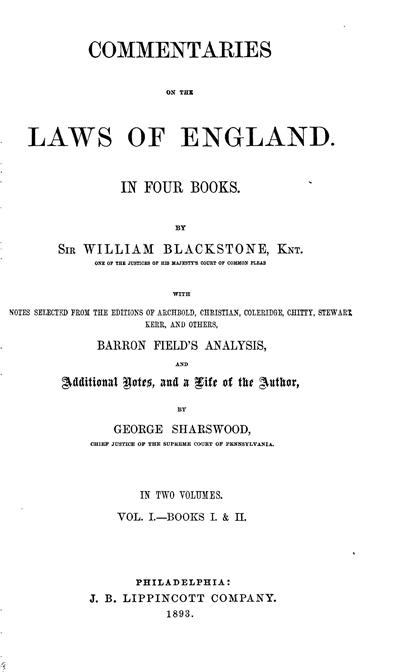
SECTION I.: ON THE STUDY OF THE LAW. † - Sir William Blackstone, Commentaries on the Laws of England in Four Books, vol. 1 [1753]Edition used:Commentaries on the Laws of England in Four Books. Notes selected from the editions of Archibold, Christian, Coleridge, Chitty, Stewart, Kerr, and others, Barron Field’s Analysis, and Additional Notes, and a Life of the Author by George Sharswood. In Two Volumes. (Philadelphia: J.B. Lippincott Co., 1893). Vol. 1 - Books I & II.
Part of: Commentaries on the Laws of England in Four Books, 2 vols.About Liberty Fund:Liberty Fund, Inc. is a private, educational foundation established to encourage the study of the ideal of a society of free and responsible individuals. Copyright information:The text is in the public domain. Fair use statement:This material is put online to further the educational goals of Liberty Fund, Inc. Unless otherwise stated in the Copyright Information section above, this material may be used freely for educational and academic purposes. It may not be used in any way for profit.
SECTION I.ON THE STUDY OF THE LAW.†Mr. Vice-Chancellor and the Gentlemen of the University. The general expectation of so numerous and respectable an audience, the novelty, and (I may add) the importance of the duty required from this chair, must unavoidably be productive of great diffidence and apprehensions in him who has the honour to be placed in it. He must be sensible how much will depend upon his conduct in the infancy of a study, which is now first adopted by public academical authority; which has generally been reputed (however unjustly) of a dry and unfruitful nature; and of which the theoretical elementary parts, have hitherto received a very moderate share of cultivation. He cannot but reflect that, if either his plan of instruction be crude and injudicious, or the execution of it lame and superficial, it will cast a damp upon the farther progress of this most useful and most rational branch of learning; and may defeat for a time the *[*4public-spirited design of our wise and munificent benefactor. And this he must more especially dread, when he feels by experience how unequal his abilities are (unassisted by preceding examples) to complete, in the manner he could wish, so extensive and arduous a task; since he freely confesses, that his former more private attempts have fallen very short of his own ideas of perfection. And yet the candour he has already experienced, and this last transcendent mark of regard, his present nomination by the free and unanimous suffrage of a great and learned university, (an honour to be ever remembered with the deepest and most affectionate gratitude,) these testimonies of your public judgment must entirely supersede his own, and forbid him to believe himself totally insufficient for the labour at least of this employment. One thing he will venture to hope for, and it certainly shall be his constant aim, by diligence and attention to atone for his other defects: esteeming, that the best return which he can possibly make for your favourable opinion of his capacity, will be his unwearied endeavours in some little degree to deserve it. The science thus committed to his charge, to be cultivated, methodized, and explained in a course of academical lectures, is that of the laws and constitution of our own country: a species of knowledge, in which the gentlemen of England have been more remarkably deficient than those of all Europe besides. In most of the nations of the continent, where the civil or imperial law, under different modifications, is closely interwoven with the municipal laws of the land, no gentleman, or at least no scholar, thinks his education is completed, till he has attended a course or two of lectures, both upon the institutes of Justinian and the local constitutions of his native soil, under the very eminent professors that abound in their several universities. And in the northern parts of our own island, where also the municipal laws are frequently connected with the civil, it is difficult to meet with a person of liberal education, who is destitute of a competent knowledge in that science which is to be the guardian of his natural rights and the rule of his civil conduct. **5]Nor have the imperial laws been totally neglected even in the English nation. A general acquaintance with their decisions has ever been deservedly considered as no small accomplishment of a gentleman; and a fashion has prevailed, especially of late, to transport the growing hopes of this island to foreign universities, in Switzerland, Germany, and Holland; which, though infinitely inferior to our own in every other consideration, have been looked upon as better nurseries of the civil, or (which is nearly the same) of their own municipal law. In the mean time, it has been the peculiar lot of our admirable system of laws to be neglected, and even unknown, by all but one practical profession; though built upon the soundest foundations, and approved by the experience of ages. Far be it from me to derogate from the study of the civil law, considered (apart from any binding authority) as a collection of written reason. No man is more thoroughly persuaded of the general excellence of its rules, and the usual equity of its decisions, nor is better convinced of its use as well as ornament to the scholar, the divine, the statesman, and even the common lawyer. But we must not carry our veneration so far as to sacrifice our Alfred and Edward to the manes of Theodosius and Justinian; we must not prefer the edict of the prætor, or the rescript of the Roman emperor, to our own immemorial customs, or the sanctions of an English parliament; unless we can also prefer the despotic monarchy of Rome and Byzantium, for whose meridians the former were calculated, to the free constitution of Britain, which the latter are adapted to perpetuate. Without detracting, therefore, from the real merits which abound in the imperial law, I hope I may have leave to assert, that if an Englishman must be ignorant of either the one or the other, he had better be a stranger to the Roman than the English institutions. For I think it an undeniable position, that a competent knowledge of the laws of that society **6]in which we live, is the proper accomplishment of every gentleman and scholar; an highly useful, I had almost said essential, part of liberal and polite education. And in this I am warranted by the example of ancient Rome; where, as Cicero informs us,(a) the very boys were obliged to learn the twelve tables by heart, as a carmen necessarium or indispensable lesson, to imprint on their tender minds an early knowledge of the laws and constitution of their country.1 But, as the long and universal neglect of this study with us in England seems in some degree to call in question the truth of this evident position, it shall therefore be the business of this introductory discourse, in the first place to demonstrate the utility of some general acquaintance with the municipal law of the land, by pointing out its particular uses in all considerable situations of life. Some conjectures will then be offered with regard to the causes of neglecting this useful study: to which will be subjoined a few reflections on the peculiar propriety of reviving it in our own universities. And, first, to demonstrate the utility of some acquaintance with the laws of the land, let us only reflect a moment on the singular frame and polity of that land which is governed by this system of laws. A land, perhaps, the only one in the universe, in which political or civil liberty is the very end and scope of the constitution.(b) This liberty, rightly understood, consists in the power of doing whatever the laws permit,(c)2 which is only to be effected by a general conformity of all orders and degrees to those equitable rules of action by which the meanest individual is protected from the insults and oppression of the greatest. As therefore every subject is interested in the preservation of the laws, it is incumbent upon every man to be acquainted with those at least with which he is immediately concerned; lest he incur the censure, as well as inconvenience, of living in society without knowing the obligations which it lays him under. And thus much may suffice for *[*7persons of inferior condition, who have neither time nor capacity to enlarge their views beyond that contracted sphere in which they are appointed to move. But those, on whom nature and fortune have bestowed more abilities and greater leisure, cannot be so easily excused. These advantages are given them, not for the benefit of themselves only, but also of the public: and yet they cannot, in any scene of life, discharge properly their duty either to the public or themselves, without some degree of knowledge in the laws. To evince this the more clearly, it may not be amiss to descend to a few particulars. Let us therefore begin with our gentlemen of independent estates and fortune, the most useful as well as considerable body of men in the nation; whom even to suppose ignorant in this branch of learning is treated by Mr. Locke(d) as a strange absurdity. It is their landed property, with its long and voluminous train of descents and conveyances, settlements, entails, and incumbrances, that forms the most intricate and most extensive object of legal knowledge. The thorough comprehension of these, in all their minute distinctions, is perhaps too laborious a task for any but a lawyer by profession; yet still the understanding of a few leading principles, relating to estates and conveyancing, may form some check and guard upon a gentleman’s inferior agents, and preserve him at least from very gross and notorious imposition. Again, the policy of all laws has made some forms necessary in the wording of last wills and testaments, and more with regard to their attestation. An ignorance in these must always be of dangerous consequence, to such as by choice or necessity compile their own testaments without any technical assistance. Those who have attended the courts of justice are the best witnesses of the confusion and distresses that are hereby occasioned in families; and of the difficulties that arise in discerning the true meaning of the testator, or sometimes in discovering any meaning at all; so that in the end his estate *[*8may often be vested quite contrary to these his enigmatical intentions, because perhaps he has omitted one or two formal words, which are necessary to ascertain the sense with indisputable legal precision, or has executed his will in the presence of fewer witnesses than the law requires. But to proceed from private concerns to those of a more public consideration. All gentlemen of fortune are, in consequence of their property, liable to be called upon to establish the rights, to estimate the injuries, to weigh the accusations and sometimes to dispose of the lives of their fellow-subjects, by serving upon juries. In this situation they have frequently a right to decide, and that upon their oaths, questions of nice importance, in the solution of which some legal skill is requisite; especially where the law and the fact, as it often happens, are intimately blended together. And the general incapacity, even of our best juries, to do this with any tolerable propriety, has greatly debased their authority; and has unavoidably thrown more power into the hands of the judges, to direct, control, and even reverse their verdicts, than perhaps the constitution intended. But it is not as a juror only that the English gentleman is called upon to determine questions of right, and distribute justice to his fellow-subjects: it is principally with this order of men that the commission of the peace is filled. And here a very ample field is opened for a gentleman to exert his talents, by maintaining good order in his neighbourhood; by punishing the dissolute and idle; by protecting the peaceable and industrious; and, above all, by healing petty differences, and preventing vexatious prosecutions. But, in order to attain these desirable ends, it is necessary that the magistrate should understand his business; and have not only the will, but the power also, (under which must be included the knowledge,) of administering legal and effectual justice. Else, when he has mistaken his authority, through passion, through ignorance, or absurdity, he will be the object of **9]contempt from his inferiors, and of censure from those to whom he is accountable for his conduct. Yet farther; most gentlemen of considerable property, at some period or other in their lives, are ambitious of representing their country in parliament: and those, who are ambitious of receiving so high a trust, would also do well to remember its nature and importance. They are not thus honourably distinguished from the rest of their fellow-subjects, merely that they may privilege their persons, their estates, or their domestics; that they may list under party banners; may grant or withhold supplies; may vote with or vote against a popular or unpopular administration; but upon considerations far more interesting and important. They are the guardians of the English constitution; the makers, repealers, and interpreters of the English laws; delegated to watch, to check, and to avert every dangerous innovation, to propose, to adopt, and to cherish any solid and well-weighed improvement; bound by every tie of nature, of honour, and of religion, to transmit that constitution and those laws to posterity, amended if possible, at least without any derogation. And how unbecoming must it appear in a member of the legislature to vote for a new law, who is utterly ignorant of the old! what kind of interpretation can he be enabled to give, who is a stranger to the text upon which he comments! Indeed it is perfectly amazing that there should be no other state of life, no other occupation, art, or science, in which some method of instruction is not looked upon as requisite, except only the science of legislation, the noblest and most difficult of any. Apprenticeships are held necessary to almost every art, commercial or mechanical: a long course of reading and study must form the divine, the physician, and the practical professor of the laws; but every man of superior fortune thinks himself born a legislator. Yet Tully was of a different opinion: “It is **10]necessary,” says he,(e) “for a senator to be thoroughly acquainted with the constitution; and this,” he declares, “is a knowledge of the most extensive nature; a matter of science, of diligence, of reflection; without which no senator can possibly be fit for his office.” The mischiefs that have arisen to the public from inconsiderate alterations in our laws, are too obvious to be called in question; and how far they have been owing to the defective education of our senators, is a point well worthy the public attention. The common law of England has fared like other venerable edifices of antiquity, which rash and unexperienced workmen have ventured to new-dress and refine, with all the rage of modern improvement. Hence frequently its symmetry has been destroyed, its proportions distorted, and its majestic simplicity exchanged for specious embellishments and fantastic novelties. For, to say the truth, almost all the perplexed questions, almost all the niceties, intricacies, and delays, (which have sometimes disgraced the English, as well as other courts of justice,) owe their original not to the common law itself, but to innovations that have been made in it by acts of parliament, “overladen (as Sir Edward Coke expresses it)(f) with provisoes and additions, and many times on a sudden penned or corrected by men of none or very little judgment in law.” This great and well-experienced judge declares, that in all his time he never knew two questions made upon rights merely depending upon the common law; and warmly laments the confusion introduced by ill-judging and unlearned legislators. “But if,” he subjoins, “acts of parliament were after the old fashion penned, by such only as perfectly knew what the common law was before the making of any act of parliament concerning that matter, as also how far forth former statues had provided remedy for former mischiefs and defects discovered by experience; then should very few questions in law arise, *[*11and the learned should not so often and so much perplex their heads to make atonement and peace, by construction of law, between insensible and disagreeing words, sentences, and provisoes, as they now do.” And if this inconvenience was so heavily felt in the reign of Queen Elizabeth, you may judge how the evil is increased in later times, when the statute book is swelled to ten times a larger bulk, unless it should be found that the penners of our modern statutes have proportionably better informed themselves in the knowledge of the common law. What is said of our gentlemen in general, and the propriety of their application to the study of the laws of their country, will hold equally strong or still stronger with regard to the nobility of this realm, except only in the article of serving upon juries. But, instead of this, they have several peculiar provinces of far greater consequence and concern; being not only by birth hereditary counsellors of the crown, and judges upon their honour of the lives of their brother-peers, but also arbiters of the property of all their fellow-subjects, and that in the last resort. In this their judicial capacity they are bound to decide the nicest and most critical points of the law: to examine and correct such errors as have escaped the most experienced sages of the profession, the lord keeper, and the judges of the courts at Westminster. Their sentence is final, decisive, irrevocable; no appeal, no correction, not even a review, can be had: and to their determination, whatever it be, the inferior courts of justice must conform; otherwise the rule of property would no longer be uniform and steady. Should a judge in the most subordinate jurisdiction be deficient in the knowledge of the law, it would reflect infinite contempt upon himself, and disgrace upon those who employ him. And yet the consequence of his ignorance is comparatively very trifling and small: his judgment may be examined, and his errors rectified, by other courts. But how much more serious and affecting is the case of a superior judge, *[*12if without any skill in the laws he will boldly venture to decide a question upon which the welfare and subsistence of whole families may depend! where the chance of his judging right, or wrong, is barely equal; and where, if he chances to judge wrong, he does an injury of the most alarming nature, an injury without possibility of redress. Yet, vast as this trust is, it can nowhere be so properly reposed as in the noble hands where our excellent constitution has placed it: and therefore placed it, because, from the independence of their fortune and the dignity of their station, they are presumed to employ that leisure which is the consequence of both, in attaining a more extensive knowledge of the laws than persons of inferior rank: and because the founders of our polity relied upon that delicacy of sentiment, so peculiar to noble birth; which, as on the one hand it will prevent either interest or affection from interfering in questions of right, so on the other it will bind a peer in honour, an obligation which the law esteems equal to another’s oath, to be master of those points upon which it is his birth-right to decide.3 The Roman pandects will furnish us with a piece of history not unapplicable to our present purpose. Servius Sulpicius, a gentleman of the patrician order, and a celebrated orator, had occasion to take the opinion of Quintus Mutius Scævola, the then oracle of the Roman law; but, for want of some knowledge in that science, could not so much as understand even the technical terms, which his friend was obliged to make use of. Upon which Mutius Scævola could not forbear to upbraid him with this memorable reproof,(g) “that it was a shame for a patrician, a nobleman, and an orator of causes, to be ignorant of that law in which he was so peculiarly concerned.” This reproach made so deep an impression on Sulpicius, that he immediately applied himself to the study of the law, wherein he arrived to that **13]proficiency, that he left behind him about an hundred and fourscore volumes of his own compiling upon the subject; and became, in the opinion of Cicero,(h) a much more complete lawyer than even Mutius Scævola himself. I would not be thought to recommend to our English nobility and gentry to become as great lawyers as Sulpicius; though he, together with this character, sustained likewise that of an excellent orator, a firm patriot, and a wise, indefatigable senator; but the inference which arises from the story is this, that ignorance of the laws of the land hath ever been esteemed dishonourable in those who are intrusted by their country to maintain, to administer, and to amend them. But surely there is little occasion to enforce this argument any farther to persons of rank and distinction, if we of this place may be allowed to form a general judgment from those who are under our inspection: happy that while we lay down the rule, we can also produce the example. You will therefore permit your professor to indulge both a public and private satisfaction by bearing this open testimony, that, in the infancy of these studies among us, they were favoured with the most diligent attendance, and pursued with the most unwearied application, by those of the noblest birth and most ample patrimony, some of whom are still the ornaments of this seat of learning, and others, at a greater distance, continue doing honour to its institutions, by comparing our polity and laws with those of other kingdoms abroad, or exerting their senatorial abilities in the councils of the nation at home. Nor will some degree of legal knowledge be found in the least superfluous to persons of inferior rank, especially those of the learned professions. The clergy in particular, besides the common obligations they are under in proportion to their rank and fortune, have also abundant reason, considered **14]merely as clergymen, to be acquainted with many branches of the law, which are almost peculiar and appropriated to themselves alone. Such are the laws relating to advowsons, institutions, and inductions; to simony and simoniacal contracts; to uniformity, residence, and pluralities; to tithes and other ecclesiastical dues; to marriages, (more especially of late,) and to a variety of other subjects, which are consigned to the care of their order by the provisions of particular statutes. To understand these aright, to discern what is warranted or enjoined, and what is forbidden by law, demands a sort of legal apprehension, which is no otherwise to be acquired than by use and a familiar acquaintance with legal writers. For the gentlemen of the faculty of physic, I must frankly own that I see no special reason why they in particular should apply themselves to the study of the law, unless in common with other gentlemen, and to complete the character of general and extensive knowledge; a character which their profession, beyond others, has remarkably deserved. They will give me leave however to suggest, and that not ludicrously, that it might frequently be of use to families upon sudden emergencies, if the physician were acquainted with the doctrine of last wills and testaments, at least so far as relates to the formal part of their execution.4 But those gentlemen who intend to profess the civil and ecclesiastical laws, in the spiritual and maritime courts of this kingdom, are of all men (next to common lawyers) the most indispensably obliged to apply themselves seriously to the study of our municipal laws. For the civil and canon laws, considered with respect to any intrinsic obligation, have no force or authority in this kingdom; they are no more binding in England than our laws are binding at Rome. But as far as these foreign laws, on account of some peculiar propriety, have in some particular cases, and in some particular courts, been introduced and allowed by our laws, so far they oblige, and no farther; their authority being wholly founded upon that permission and adoption. In which we are not singular in our *[*15notions; for even in Holland, where the imperial law is much cultivated, and its decisions pretty generally followed, we are informed by Van Leeuwen(i) that “it receives its force from custom and the consent of the people, either tacitly or expressly given; for otherwise,” he adds, “we should no more be bound by this law, than by that of the Almains, the Franks, the Saxons, the Goths, the Vandals, and other of the ancient nations.” Wherefore, in all points in which the different systems depart from each other, the law of the land takes place of the law of Rome, whether ancient or modern, imperial or pontifical. And, in those of our English courts wherein a reception has been allowed to the civil and canon laws, if either they exceed the bounds of that reception, by extending themselves to other matters than are permitted to them; or if such courts proceed according to the decisions of those laws, in cases wherein it is controlled by the law of the land, the common law in either instance both may, and frequently does, prohibit and annul their proceedings:(k) and it will not be a sufficient excuse for them to tell the king’s courts at Westminster, that their practice is warranted by the laws of Justinian or Gregory, or is conformable to the decrees of the Rota or imperial chamber.5 For which reason it becomes highly necessary for every civilian and canonist, that would act with safety as a judge, or with prudence and reputation as an advocate, to know in what cases and how far the English laws have given sanction to the Roman; in what points the latter are rejected; and where they are both so intermixed and blended together as to form certain supplemental parts of the common law of England, distinguished by the titles of the king’s maritime, the king’s military, and the king’s ecclesiastical law; the propriety of which inquiry the university of Oxford has for more than a century so thoroughly seen, that in her statutes(l) she appoints, that one of the three questions to be annually discussed at the act by the jurist-inceptors shall relate to the common law; subjoining this reason, “quia juris civilis studiosos decet haud imperitos esse **16]juris municipalis, et differentias exteri patriique juris notas habere.” And the statutes(m) of the university of Cambridge speak expressly to the same effect. From the general use and necessity of some acquaintance with the common law, the inference were extremely easy with regard to the propriety of the present institution, in a place to which gentlemen of all ranks and degrees resort, as the fountain of all useful knowledge. But how it has come to pass that a design of this sort has never before taken place in the university, and the reason why the study of our laws has in general fallen into disuse, I shall previously proceed to inquire. Sir John Fortescue, in his panegyric on the laws of England, (which was written in the reign of Henry the Sixth,) puts(n) a very obvious question in the mouth of the young prince, whom he is exhorting to apply himself to that branch of learning: “Why the laws of England, being so good, so fruitful and so commodious, are not taught in the universities, as the civil and canon laws are?” In answer to which he gives(o) what seems, with due deference be it spoken, a very jejune and unsatisfactory reason; being, in short, that “as the proceedings at common law were in his time carried on in three different tongues, the English, the Latin, and the French, that science must be necessarily taught in those three several languages; but that in the universities all sciences were taught in the Latin tongue only;” and therefore he concludes, “that they could not be conveniently taught or studied in our universities.” But without attempting to examine seriously the validity of this reason, (the very shadow of which, by the wisdom of your late constitutions, is entirely taken away,) we perhaps may find out a better, or at least a more plausible account, why the study of the municipal laws has been banished from these seats of science, than what the learned chancellor thought it prudent to give to his royal pupil. **17]That ancient collection of unwritten maxims and customs, which is called the common law, however compounded or from whatever fountains derived, had subsisted immemorially in this kingdom; and, though somewhat altered and impaired by the violence of the times, had in great measure weathered the rude shock of the Norman conquest. This had endeared it to the people in general, as well because its decisions were universally known, as because it was found to be excellently adapted to the genius of the English nation. In the knowledge of this law consisted great part of the learning of those dark ages; it was then taught, says Mr. Selden,(p) in the monasteries, in the universities, and in the families of the principal nobility. The clergy, in particular, as they then engrossed almost every other branch of learning, so (like their predecessors the British Draids),(q) they were peculiarly remarkable for their proficiency in the study of the law. Nullus clericus nisi causidicus, is the character given of them soon after the conquest by William of Malmsbury.(r) The judges there fore were usually created out of the sacred order,(s) as was likewise the case among the Normans;(t) and all the inferior offices were supplied by the lower clergy, which has occasioned their successors to be denominated clerks to this day. But the common law of England, being not committed to writing, but only handed down by tradition, use, and experience, was not so heartily relished by the foreign clergy, who came over hither in shoals during the reign of the conqueror and his two sons, and were utter strangers to our constitution as well as our language. And an accident, which soon after happened, had nearly completed its ruin. A copy of Justinian’s pandects, being newly(u) discovered at Amalfi,6 *[*18soon brought the civil law into vogue all over the west of Europe, where before it was quite laid aside,(w) and in a manner forgotten, though some traces of its authority remained in Italy(x) and the eastern provinces of the empire.(y) This now became in a particular manner the favourite of the popish clergy, who borrowed the method and many of the maxims of their canon law from this original. The study of it was introduced into several universities abroad, particularly that of Bologna, where exercises were performed, lectures read, and degrees conferred in this faculty, as in other branches of science; and many nations on the continent, just then beginning to recover from the convulsions consequent upon the overthrow of the Roman empire, and settling by degrees into peaceable forms of government, adopted the civil law, (being the best written system then extant,) as the basis of their several constitutions; blending and interweaving it among their own feodal customs, in some places with a more extensive, in others a more confined authority.(z) Nor was it long before the prevailing mode of the times reached England For Theobald, a Norman abbot, being elected to the see of Canterbury,(a) and extremely addicted to this new study, brought over with him in his retinue many learned proficients therein; and, among the rest, Roger, surnamed Vacarius, whom he placed in the university of Oxford(b) to teach it to the people of this country. But it did not meet with the same easy reception in England, where a mild and rational system of laws had been long established, as it did upon the continent; and though the monkish clergy, devoted to the will of a foreign primate, received it with eagerness and zeal, yet the laity, who were more interested to preserve the old constitution, and had already severely felt the effect of many Norman innovations, continued wedded to the use of the common law: King Stephen immediately **19]published a proclamation,(c) forbidding the study of the laws, then newly imported from Italy, which was treated by the monks(d) as a piece of impiety; and, though it might prevent the introduction of the civil law process into our courts of justice, yet did not hinder the clergy from reading and teaching it in their own schools and monasteries. From this time the nation seems to have been divided into two parties, the bishops and clergy, many of them foreigners, who applied themselves wholly to the study of the civil and canon laws, which now came to be inseparably interwoven with each other, and the nobility and laity, who adhered with equal pertinacity to the old common laws; both of them reciprocally jealous of what they were unacquainted with, and neither of them, perhaps, allowing the opposite system that real merit which is abundantly to be found in each. This appears, on the one hand, from the spleen with which the monastic writers(e) speak of our municipal laws upon all occasions; and, on the other, from the firm temper which the nobility shewed at the famous parliament of Merton, when the prelates endeavoured to procure an act to declare all bastards legitimate in case the parents intermarried at any time afterwards; alleging this only reason, because holy church (that is, the canon law) declared such children legitimate; but “all the earls and barons (says the parliament roll)(f) with one voice an swered, that they would not change the laws of England, which had hitherto been used and approved.” And we find the same jealousy prevailing above a century afterwards,(g) when the nobility declared, with a kind of prophetic spirit, “that the realm of England hath never been unto this hour, neither by the consent of our lord the king, and the lords of parliament, shall it ever be **20]ruled or governed by the civil law.”(h) And of this temper between the clergy and laity many more instances might be given. While things were in this situation, the clergy, finding it impossible to root out the municipal law, began to withdraw themselves by degrees from the temporal courts;7 and to that end, very early in the reign of King Henry the Third, episcopal constitutions were published,(i) forbidding all ecclesiastics to appear as advocates in foro sæculari: nor did they long continue to act as judges there, not caring to take the oath of office which was then found necessary to be administered, that they should in all things determine according to the law and custom of this realm,(k) though they still kept possession of the high office of chancellor, an office then of little juridical power; and afterwards, as its business increased by degrees, they modelled the process of the court at their own discretion. But wherever they retired, and wherever their authority extended, they carried with them the same zeal to introduce the rules of the civil, in exclusion of the municipal law. This appears in a particular manner from the spiritual courts of all denominations, from the chancellor’s courts in both our universities, and from the high court of chancery before mentioned; in all of which the proceedings are to this day in a course much conformed to the civil law: for which no tolerable reason can be assigned, unless that these courts were all under the immediate direction of the popish ecclesiastics, among whom it was a point of religion to exclude the municipal law; Pope Innocent the Fourth having forbidden(l) the very reading of it by the clergy, because its decisions were not founded on the imperial constitutions, but merely on the customs of the laity. And if it be considered, that our universities began about that period to receive their present form of scholastic discipline; that they were then, and continued to *[*21be till the time of the Reformation, entirely under the influence of the popish clergy; (Sir John Mason the first Protestant, being also the first lay, Chancellor of Oxford;) this will lead us to perceive the reason, why the study of the Roman laws was in those days of bigotry(m) pursued with such alacrity in these seats of learning; and why the common law was entirely despised, and esteemed little better than heretical. And, since the Reformation, many causes have conspired to prevent its becoming a part of academical education. As, first, long usage and established custom; which, as in every thing else, so especially in the forms of scholastic exercise, have justly great weight and authority. Secondly, the real intrinsic merit of the civil law, considered upon the footing of reason and not of obligation, which was well known to the instructors of our youth; and their total ignorance of the merit of the common law, though its equal at least, and perhaps an improvement on the other. But the principal reason of all, that has hindered the introduction of this branch of learning, is, that the study of the common law being banished from hence in the times of popery, has fallen into a quite different channel, and has hitherto been wholly cultivated in another place. But, as the long usage and established custom of ignorance of the laws of the land, begin now to be thought unreasonable; and as by these means the merit of those *[*22laws will probably be more generally known; we may hope that the method of studying them will soon revert to its antient course, and the foundations at least of that science will be laid in the two universities; without being exclusively confined to the channel which it fell into at the times I have just been describing. For, being then entirely abandoned by the clergy, a few stragglers excepted, the study and practice of it devolved of course into the hands of laymen: who entertained upon their parts a most hearty aversion to the civil law,(n) and made no scruple to profess their contempt, nay even their ignorance(o) of it in the most public manner. But still as the balance of learning was greatly on the side of the clergy, and as the common law was no longer taught, as formerly, in any part of the kingdom, it must have been subjected to many inconveniences, and perhaps would have been gradually lost and overrun by the civil, (a suspicion well justified from the frequent transcripts of Justinian to be met with in Bracton and Fleta,) had it not been for a peculiar incident, which happened at a very critical time, and contributed greatly to its support. The incident which I mean was the fixing of the court of common pleas, the grand tribunal for disputes of property, to be held in one certain spot; that the seat of ordinary justice might be permanent and notorious to all the nation. Formerly that, in conjunction with all the other superior **23]courts, was held before the king’s capital justiciary of England, in the aula regis, or such of his palaces wherein his royal person resided; and removed, with his household, from one end of the kingdom to the other. This was found to occasion great inconvenience to the suitors; to remedy which it was made an article of the great charter of liberties, both that of King John and King Henry the Third,(p) that “common pleas should no longer follow the king’s court, but be held in some certain place:” in consequence of which they have ever since been held (a few necessary removals in times of the plague excepted) in the palace of Westminster only. This brought together the professors of the municipal law, who before were dispersed about the kingdom, and formed them into an aggregate body; whereby a society was established of persons, who, (as Spelman(q) observes,) addicting themselves wholly to the study of the laws of the land, and no longer considering it as a mere subordinate science for the amusement of leisure hours, soon raised those laws to that pitch of perfection, which they suddenly attained under the auspices of our English Justinian, King Edward the First. In consequence of this lucky assemblage, they naturally fell into a kind of collegiate order, and, being excluded from Oxford and Cambridge, found it necessary to establish a new university of their own. This they did by purchasing at various times certain houses (now called the inns of court and of chancery) between the city of Westminster, the place of holding the king’s courts, and the city of London; for advantage of ready access to the one, and plenty of provisions in the other.(r) Here exercises were performed, lectures read, and degrees were at length conferred in the common law, as at other universities in the canon and civil. The degrees were those of barristers (first styled apprentices(s) from apprendre, to **24]learn) who answered to our bachelors: as the state and degree of a serjeant,(t)servientis ad legem, did to that of doctor. The crown seems to have soon taken under its protection this infant seminary of common law; and, the more effectually to foster and cherish it, King Henry the Third, in the nineteenth year of his reign, issued out an order directed to the mayor and sheriffs of London, commanding that no regent of any law schools within that city should, for the future, teach law therein.(u) The word law, or leges, being a general term, may create some doubt, at this distance of time, whether the teaching of the civil law or the common, or both, is hereby restrained But in either case it tends to the same end. If the civil law only is prohibited, (which is Mr. Selden’s(w) opinion,) it is then a retaliation upon the clergy, who had excluded the common law from their seats of learning. If the municipal law be also included in the restriction, (as Sir Edward Coke(x) understands it, and which the words seem to import,) then the intention is evidently this; by preventing private teachers within the walls of the city, to collect all the common lawyers into the one public university, which was newly instituted in the suburbs. *[*25In this juridical university (for such it is insisted to have been by Fortescue(y) and Sir Edward Coke)(z) there are two sorts of collegiate houses; one called inns of chancery, in which the younger students of the law were usually placed, “learning and studying, (says Fortescue,)(a) the originals, and, as it were, the elements of the law; who, profiting therein, as they grew to ripeness, so were they admitted into the greater inns of the same study, called the inns of court.” And in these inns of both kinds, he goes on to tell us, the knights and barons, with other grandees and noblemen of the realm, did use to place their children, though they did not desire to have them thoroughly learned in the law, or to get their living by its practice: and that in his time there were about two thousand students at these several inns, all of whom, he informs us, were filii nobilium, or gentlemen born.8 Hence it is evident, that (though under the influence of the monks, our universities neglected this study, yet) in the time of Henry the Sixth it was thought highly necessary, and was the universal practice, for the young nobility and gentry to be instructed in the originals and elements of the laws. But by degrees this custom has fallen into disuse; so that, in the reign of Queen Elizabeth, Sir Edward Coke(b) does not reckon above a thousand students, and the number at present is very considerably less. Which seems principally owing to these reasons: first, because the inns of chancery, being now almost totally filled by the inferior branch of the profession, are neither commodious nor proper for the resort of gentlemen of any rank or figure; so that there are very rarely any young students entered at the inns of chancery: secondly, because in the inns of court all sorts of regimen and academical superintendence, either with regard to morals or studies, are found impracticable, and therefore entirely neglected: lastly, because persons of birth and fortune, after having finished their usual courses at the universities, have *[*26seldom leisure or resolution sufficient to enter upon a new scheme of study at a new place of instruction. Wherefore few gentlemen now resort to the inns of court, but such for whom the knowledge of practice is absolutely necessary; such, I mean, as are intended for the profession: the rest of our gentry (not to say our nobility also) having usually retired to their estates, or visited foreign kingdoms, or entered upon public life, without any instruction in the laws of the land, and indeed with hardly any opportunity of gaining instruction, unless it can be afforded them in these seats of learning. And that these are the proper places, for affording assistances of this kind to gentlemen of all stations and degrees, cannot (I think) with any colour of reason be denied. For not one of the objections, which are made to the inns of court and chancery, and which I have just now enumerated, will hold with regard to the universities. Gentlemen may here associate with gentlemen of their own rank and degree. Nor are their conduct and studies left entirely to their own discretion; but regulated by a discipline so wise and exact, yet so liberal, so sensible, and manly, that their conformity to its rules (which does at present so much honour to our youth) is not more the effect of constraint than of their own inclinations and choice. Neither need they apprehend too long an avocation hereby from their private concerns and amusements, or (what is a more noble object) the service of their friends and their country. This study will go hand in hand with their other pursuits: it will obstruct none of them; it will ornament and assist them all. But if, upon the whole, there are any still wedded to monastic prejudice, that can entertain a doubt how far this study is properly and regularly academical, such persons I am afraid either have not considered the constitution and design of an university, or else think very meanly of it. It must be a deplorable narrowness of mind, that would confine these seats of instruction to the limited views of one or two learned professions. To the praise of this age be it spoken, a more open *[*27and generous way of thinking begins now universally to prevail. The attainment of liberal and genteel accomplishments, though not of the intellectual sort, has been thought by our wisest and most affectionate patrons,(c) and very lately by the whole university,(d) no small improvement of our ancient plan of education: and therefore I may safely affirm that nothing (how unusual soever) is, under due regulations, improper to be taught in this place, which is proper for a gentleman to learn. But that a science, which distinguishes the criterions of right and wrong; which teaches to establish the one, and prevent, punish, or redress the other; which employs in its theory the noblest faculties of the soul, and exerts in its practice the cardinal virtues of the heart; a science, which is universal in its use and extent, accommodated to each individual, yet comprehending the whole community; that a science like this should ever have been deemed unnecessary to be studied in an university, is matter of astonishment and concern.9 Surely, if it were not before an object of academical knowledge, it was high time to make it one: and to those who can doubt the propriety of its reception among us, (if any such there be,) we may return an answer in their own way, that ethics are confessedly a branch of academical learning; and Aristotle himself has said, speaking of the laws of his own country, that jurisprudence, or the knowledge of those laws, is the principal and most perfect branch of ethics.(e) From a thorough conviction of this truth, our munificent benefactor, Mr. Viner, having employed above half a century in amassing materials for new-modelling and rendering more commodious the rude study of the laws of the land, consigned **28]both the plan and execution of these his public-spirited designs to the wisdom of his parent university. Resolving to dedicate his learned labours “to the benefit of posterity and the perpetual service of his country,”(f) he was sensible he could not perform his resolution in a better and more effectual manner, than by extending to the youth of this place, those assistances of which he so well remembered and so heartily regretted the want. And the sense which the university has entertained of this ample and most useful benefaction must appear beyond a doubt from their gratitude, in receiving it with all possible marks of esteem;(g) from their alacrity and unexampled dispatch in carrying it into execution;(h) and, above all, from the laws and constitutions by which they have effectually guarded it from the neglect and abuse to which such institutions are liable.(i) We have seen an universal emulation who best should understand, or most faithfully pursue, the designs of our generous patron: and with pleasure we recollect, that those who are most distinguished **30]by their quality, their fortune, their station, their learning, or their experience, have appeared the most zealous to promote the success of Mr. Viner’s establishment. The advantages that might result to the science of the law itself, when a little more attended to in these seats of knowledge, perhaps, would be very considerable. The leisure and abilities of the learned in these retirements might either suggest expedients, or execute those dictated by wiser heads,(k) for improving its method, retrenching its superfluities, and reconciling the little contrarieties, which the practice of many centuries will necessarily create in any human system; a task which those who are deeply employed in business, and the more active scenes of the profession, can hardly condescend to engage in. And as to the interest, or (which is the same) the reputation of the universities themselves, I may venture to pronounce, that if ever this study should arrive to any tolerable perfection, either here or at Cambridge, the nobility and gentry of this kingdom would not shorten their residence upon this account, nor perhaps entertain a worse opinion of the benefits of academical education. Neither should it be considered as a matter of light importance, that while we thus extend the pomæria of university learning, and adopt a new tribe of citizens within these philosophical walls, we interest a very **31]numerous and very powerful profession in the preservation of our rights and revenues.10 For I think it past dispute that those gentlemen who resort to the inns of court with a view to pursue the profession, will find it expedient, whenever it is practicable, to lay the previous foundations of this, as well as every other science, in one of our learned universities. We may appeal to the experience of every sensible lawyer, whether any thing can be more hazardous or discouraging, than the usual entrance on the study of the law. A raw and unexperienced youth, in the most dangerous season of life, is transplanted on a sudden into the midst of allurements to pleasure, without any restraint or check but what his own prudence can suggest; with no public direction in what course to pursue his inquiries; no private assistance to remove the distresses and difficulties which will always embarrass a beginner. In this situation he is expected to sequester himself from the world, and, by a tedious lonely process, to extract the theory of law from a mass of undigested learning; or else, by an assiduous attendance on the courts, to pick up theory and practice together, sufficient to qualify him for the ordinary run of business. How little, therefore, is it to be wondered at, that we hear of so frequent miscarriages; that so many gentlemen of bright imaginations grow weary of so unpromising a search,(l) and addict themselves wholly to amusements, or other less innocent pursuits; and that so many persons of moderate capacity confuse themselves at first setting out, and continue ever dark and puzzled during the remainder of their lives. The evident want of some assistance in the rudiments of legal knowledge has given birth to a practice, which, if ever it had grown to be general, must have proved of extremely *[*32pernicious consequence I mean the custom, by some so very warmly recommended, of dropping all liberal education, as of no use to students in the law, and placing them, in its stead, at the desk of some skilful attorney, in order to initiate them early in all the depths of practice, and render them more dexterous in the mechanical part of business. A few instances of particular persons, (men of excellent learning and unblemished integrity,) who, in spite of this method of education, have shone in the foremost ranks of the bar, afforded some kind of sanction to this illiberal path to the profession, and biassed many parents, of short-sighted judgment, in its favour; not considering that there are some geniuses formed to overcome all disadvantages, and that, from such particular instances, no general rules can be formed; nor observing that those very persons have frequently recommended, by the most forcible of all examples, the disposal of their own offspring, a very different foundation of legal studies, a regular academical education. Perhaps, too, in return, I could now direct their eyes to our principal seats of justice, and suggest a few lines in favour of university learning:(m)11 but in these, all who hear me, I know, have already prevented me. Making, therefore, due allowance for one or two shining exceptions, experience may teach us to foretell that a lawyer, thus educated to the bar, in subservience to attorneys and solicitors,(n) will find he has begun at the wrong end. If practice be the whole he is taught, practice must also be the whole he will ever know: if he be not instructed in the elements and first principles upon which the rule of practice is founded, the least variation from established precedents will totally distract and bewilder him: ita lex scripta est(o) is the utmost his knowledge will arrive at; he must never aspire to form, and seldom expect to comprehend, any arguments drawn, a priori, from the spirit of the laws and the natural foundations of justice. *[*33Nor is this all; for (as few persons of birth or fortune, or even of scholastic education, will submit to the drudgery of servitude, and the manual labour of copying the trash of an office,) should this infatuation prevail to any considerable degree, we must rarely expect to see a gentleman of distinction or learning at the bar. And what the consequence may be, to have the interpretation and enforcement of the laws (which include the entire disposal of our properties, liberties, and lives) fall wholly into the hands of obscure or illiterate men, is matter of very public concern. The inconveniences here pointed out can never be effectually prevented, but by making academical education a previous step to the profession of the common law, and at the same time making the rudiments of the law a part of academical education. For sciences are of a sociable disposition, and flourish best in the neighbourhood of each other; nor is there any branch of learning but may be helped and improved by assistances drawn from other arts. If, therefore, the student in our laws hath formed both his sentiments and style by perusal and imitation of the purest classical writers, among whom the historians and orators will best deserve his regard; if he can reason with precision, and separate argument from fallacy, by the clear simple rules of pure unsophisticated logic; if he can fix his attention, and steadily pursue truth through any the most intricate deduction, by the use of mathematical demonstrations; if he has enlarged his conceptions of nature and art, by a view of the several branches of genuine experimental philosophy; if he has impressed on his mind the sound maxims of the law of nature, the best and most authentic foundation of human laws; if, lastly, he has contemplated those maxims reduced to a practical system in the laws of imperial Rome; if he has done this, or any part of it, (though all may be easily done under as able instructors as ever graced any seats of learning,) a student thus qualified may enter upon the study of the law with incredible advantage and reputation. And if, at the conclusion, or during **34]the acquisition of these accomplishments, he will afford himself here a year or two’s further leisure, to lay the foundation of his future labours in a solid scientifical method, without thirsting too early to attend that practice which it is impossible he should rightly comprehend, he will afterwards proceed with the greatest ease, and will unfold the most intricate points with an intuitive rapidity and clearness. I shall not insist upon such motives as might be drawn from principles of economy, and are applicable to particulars only: I reason upon more general topics. And therefore to the qualities of the head, which I have just enumerated, I cannot but add those of the heart; affectionate loyalty to the king, a zeal for liberty and the constitution, a sense of real honour, and well-grounded principles of religion, as necessary to form a truly valuable English lawyer, a Hyde, a Hale, or a Talbot. And, whatever the ignorance of some, or unkindness of others, may have heretofore untruly suggested, experience will warrant us to affirm, that these endowments of loyalty and public spirit, of honour and religion, are nowhere to be found in more high perfection than in the two universities of this kingdom. Before I conclude, it may perhaps be expected that I lay before you a short and general account of the method I propose to follow, in endeavouring to execute the trust you have been pleased to repose in my hands. And in these solemn lectures, which are ordained to be read at the entrance of every term, (more perhaps to do public honour to this laudable institution, than for the private instruction of individuals,)(p) I presume it will best answer the intent of our benefactor, and the expectation of this learned body, if I attempt to illustrate at times such detached titles of the law as are the most easy to be understood, and most capable of historical or critical ornament. But in reading the complete course, which is annually consigned to my care, a more regular method will be necessary; and, till a better is proposed, I **35]shall take the liberty to follow the same that I have already submitted to the public,(q) to fill up and finish that outline with propriety and correctness, and to render the whole intelligible to the uninformed minds of beginners, (whom we are too apt to suppose acquainted with terms and ideas, which they never had opportunity to learn,) this must be my ardent endeavour, though by no means my promise, to accomplish. You will permit me, however, very briefly to describe rather what I conceive an academical expounder of the laws should do, than what I have ever known to be done. He should consider his course as a general map of the law, marking out the shape of the country, its connections and boundaries, its greater divisions and principal cities: it is not his business to describe minutely the subordinate limits, or to fix the longitude and latitude of every inconsiderable hamlet. His attention should be engaged, like that of the readers in Fortescue’s inns of chancery, “in tracing out the originals, and as it were the elements, of the law.” For if, as Justinian(r) has observed, the tender understanding of the student be loaded at the first with a multitude and variety of matter, it will either occasion him to desert his studies, or will carry him heavily through them, with much labour delay, and despondence. These originals should be traced to their fountains, as well as our distance will permit; to the customs of the Britons and Germans, as recorded by Cæsar and Tacitus; to the codes of the northern nations on the continent, and more especially to those of our own Saxon princes; to the rules of the Roman law either left here in the days of Papinian, or imported by Vacarius and his *[*36followers; but above all, to that inexhaustible reservoir of legal antiquities and learning, the feodal law, or, as Spelman(s) has entitled it, the law of nations in our western orb. These primary rules and fundamental principles should be weighed and compared with the precepts of the law of nature, and the practice of other countries; should be explained by reasons, illustrated by examples, and confirmed by undoubted authorities; their history should be deduced, their changes and revolutions observed, and it should be shown how far they are connected with, or have at any time been affected by, the civil transactions of the kingdom. A plan of this nature, if executed with care and ability, cannot fail of administering a most useful and rational entertainment to students of all ranks and professions; and yet it must be confessed that the study of the laws is not merely a matter of amusement; for, as a very judicious writer(t) has observed upon a similar occasion, the learner “will be considerably disappointed, if he looks for entertainment without the expense of attention.” An attention, however, not greater than is usually bestowed in mastering the rudiments of other sciences, or sometimes pursuing a favourite recreation or exercise. And this attention is not equally necessary to be exerted by every student upon every occasion. Some branches of the law, as the formal process of civil suits, and the subtle distinctions incident to landed property, which are the most difficult to be thoroughly understood, are the least worth the pains of understanding, except to such gentlemen as intend to pursue the profession. To others I may venture to apply, with a slight alteration, the words of Sir John Fortescue(u) when first his royal pupil determines to engage in this study: “It will not be necessary for a gentleman, as such, to examine with a close application the critical niceties of the law. It will fully be sufficient, and he may well enough be denominated a lawyer, if under the instruction of a master he traces up the principles and grounds of the *[*37law, even to their original elements. Therefore, in a very short period, and with very little labour, he may be sufficiently informed in the laws of his country, if he will but apply his mind in good earnest to receive and apprehend them. For, though such knowledge as is necessary for a judge is hardly to be acquired by the lucubrations of twenty years, yet, with a genius of tolerable perspicacity, that knowledge which is fit for a person of birth or condition may be learned in a single year, without neglecting his other improvements.” To the few therefore (the very few I am persuaded) that entertain such unworthy notions of an university, as to suppose it intended for mere dissipation of thought; to such as mean only to while away the awkward interval from childhood to twenty-one, between the restraints of the school and the licentiousness of politer life, in a calm middle state of mental and of moral inactivity; to these Mr. Viner gives no invitation to an entertainment which they never can relish. But to the long and illustrious train of noble and ingenuous youth, who are not more distinguished among us by their birth and possessions, than by the regularity of their conduct and their thirst after useful knowledge, to these our benefactor has consecrated the fruits of a long and laborious life, worn out in the duties of his calling; and will joyfully reflect (if such reflections can be now the employment of his thoughts) that he could not more effectually have benefited posterity, or contributed to the service of the public, than by founding an institution which may instruct the rising generation in the wisdom of our civil polity, and inspire them with a desire to be still better acquainted with the laws and constitution of their country.12 [† ] Read in Oxford at the opening of the Vinerian lectures, 25th October, 1758. The author had been elected first Vinerian professor the 20th of October previously. [(a) ]De Legg. 2, 23. [1 ] In the Great Law enacted by the first General Assembly of Pennsylvania, convened at Chester or Upland, Dec. 4, 1682, containing sixty-one chapters, was one requiring the laws to be taught in the schools of the province and territories.—Gordon’s Hist. of Penna., p. 71; Hazard’s Annals, 634.—Sharswood. [(b) ] Montesq. Esp. L. l. 11, c. 5. [(c) ]Facultas ejus, quod cuique facere libet, nisi quid vi, aut jure prohibetur. Inst. 1. 3. 1. [2 ] This definition has been much criticized. “Consistently with this, a negro slave on a sugar-estate is free: he may do whatever the laws permit him to do.”—Coleridge. If we read what follows as part of the definition, it evidently contemplates just and equal laws,—equitable rules of action. Civil liberty is the power of doing whatsoever we will, except when restrained by just and equal laws. Political liberty is that condition in which a man’s civil liberty is fully secured. Mr. Justice Coleridge cites, as preferable to the text, the following definition from Locke:—“Freedom of men under government is to have a standing rule to live by, common to every one of that society, and made by the legislative power vested in it; a liberty to follow my own will in all things, when the rule prescribes not, and not to be subject to the inconstant, uncertain, unknown, arbitrary will of another man.”—On Government, b. xi. c. 4. Mr. Locke’s definition confounds civil with political liberty, which ought always to be carefully distinguished in discussions upon this subject.—Sharswood. [(d) ] Education, Sec. 187. [(e) ]De Legg. 3. 18. Est senatori necessarium nosse rempublicam: idque late patet —genus hoc omne scientiæ, diligentiæ memoriæ est; sine quo paratus esse senator nullo parto potest test. [(f) ] 2 Rep pref. [3 ] This assertion, that the law esteems the word of honour of a peer as an obligation equal to another’s oath, is not accurate. In the courts of common law, when a nobleman is examined as a witness, he must be sworn to speak the truth, just as a commoner must But, in courts of equity, peers and peeresses are privileged to put in their answers on their honour only, when others are required to be sworn. And so the members of the House of Peers, when sitting judicially upon the trial of impeachments, are upon their pledge of honour only. It may be remarked also, as qualifying what is said of the jurisdiction of the House of Peers as the highest court of errors and appeals, that this part of their business is transacted by the Lord Chancellor, and those members, who are lawyers by profession and have filled judicial stations. The lay peers, who attend the sessions, abstain from voting in such cases. Baron Parke was recently raised to the peerage, with the title of Lord Wensleydale, for the avowed purpose of strengthening the legal staff in that body. He was first created a baron for life; but, much dissatisfaction having been expressed at such a precedent, as of a dangerous nature in its tendency to increase the influence of the crown, a patent was issued to him entailing the dignity to him and his heirs male.—Sharswood. [(g) ]Ff. 1. 2. 2. 43. Turpe esse patricio, et nobili, et causas oranti, jus in quo versareiur ignorare. [(h) ]Brut. 41. [4 ] It ought, perhaps, to be added in this place, that, as medical men are frequently required to testify as experts in courts of justice, it is quite important that they should possess at least a knowledge of the general principles of the law which apply to those classes of cases in which they are most liable to be called upon. Such are mental capacity to make contracts, wills, and do other legal acts, or to incur liability for crimes, the causes of death, the period of gestation, and other similar questions. The subject of Medical Jurisprudence, or, as it is perhaps more properly termed, Forensic Medicine, has of late years much attracted the attention of the medical profession, and many works have been prepared and published. One of the latest and best is “Wharton and Stille’s Medical Jurisprudence,” an American work which appears to exhaust all the topics which belong to this title,—a title both in law and medicine, which thus links together these two honourable professions.—Sharswood. [(i) ]Dedicatio corporis juris civilis. Edit. 1663. [(k) ] Hale Hist. C. L. c. 2. Selden in Fletam. 5 Rep. Cau drey’s case. 2 Inst. 599. [5 ] The Rota, or Ruota Romana, is the highest papal court of appeal. It has a collegiate constitution, and consists of twelve prelates. Its jurisdiction extends over all Christendom; and it decides not only spiritual controversies, but questions concerning ecclesiastical benefices. The name is said to be derived from the circumstance that the floor of their hall is overlaid with marble slabs in the form of wheels. Others, however, attribute the name to the fact that in ancient Rome a round public building stood upon the place where this tribunal was first established. The Imperial Chamber was a court of the German Empire, instituted by the Emperor Maximilian I. in 1495. It had concurrent jurisdiction with the Aulic Council, and was intended, among other things, to adjust the disputes between the different members of the German Empire, and between them and the Emperor. It expired in 1506.—Sharswood. [(l) ]Tit. VII. Sect. 2 2. [(m) ]Doctor legum mox a doctoratu dabit operam legibus Anglise, ut non sit imperitus earum legum quas habet sua patria, et differentias exteri patriique juris noscat. Stat. Eliz. R. C. 14. Cowell, Institut. in proemio. [(n) ] C. 47. [(o) ] C. 48. [(p) ]In Fletam, 7, 7. [(q) ] Cæsar de Bello Gal. 6, 12. [(r) ]De Gest. Reg. l. 4. [(s) ] Dugdale, Orig. Jurid. c. 8. [(t) ]Les juges sont sages personnes et autentiques,—sicome les archevesques, evesques, les chanoines des eglises cathedraulx, et les autres personnes qui ont dignites in saincte eglise; les abbez, les prieurs conventaulx, et les gouverneurs des eglises, &c. Grand Coustumier, ch. 9. [(u) ]Circ. ad 1130. [6 ] The common account of this matter is that this copy of the Pandects was transcribed at Constantinople, in the seventh century, by a Greek scribe. It was discovered at Amalfi, ad 1135, by the Pisans, who took that city. Their ally, Lothaire II., granted them the copy in recompense of their services. On Pisa being taken by the Florentines, ad 1406, it was transported to Florence, rebound in purple, placed in a rich casket in the ancient palace of the republic as a sacred relic, and shown to the curious by the monks or magistrates uncovered. It is supposed that all editions of the Pandects trace their origin to this copy. M. Savigny contests the whole of this account, and, after examination of the historical evidence produced in its favour, pronounces it unsatisfactory, (Hist. Droit. Rom., vol. ii. c. 15.) Mr. Hallam also gives reasons for doubting it, (Middle Ages, vol. ii. p. 520.) The Florentine manuscript is undoubtedly the oldest in existence; but it appears to be the better opinion that many others were copied from still older ones. They were quoted by John of Chartres, who died ad 1117, by Theobald, Archbishop of Canterbury, and by Vacarius, the first professor of civil law in England, in ad 1140.—Colquhoun’s Summary, vol. i. p. 67.—Sharswood. [(w) ]LL. Wisigoth. 2, 1, 9. [(x) ]Capitular. Hludov. Pii. 4, 102. [(y) ] Selden in Fletam. 5, 5. [(z) ] Domat’s Treatise of Law, c. 13 9. Epistol. Innocent IV. in M. Paris ad ad 1254. [(a) ]ad 1138. [(b) ] Gervas. Dorobern. Act. Pontif. Cantuar. col. 1665. [(c) ] Rog. Bacon citat. per Selden, in Fletam. 7, 6, in Fortesc. c. 33, and 8 Rep. Pref. [(d) ] Joan Sarisburiens. Polycrat. 8, 22. [(e) ]Idem, ibid. 5, 16. Polydor. Virgil. Hist. l. 9. [(f) ]Stat. Merton. 20. Hen. III. c. 9. Et omnes comites et barones una voce responderunt, quod nolunt leges Angus mutare, quæ hucusque usitatæ sunt et approbatæ. [(g) ] 11 Ric. II. [(h) ] Selden, Jan. Anglor, l. 2. 43, in Fortesc. c. 33. [7 ] Mr. F. Hargrave, in his notes to the first volume of Blackstone, has here presented an interesting history of the contests which have existed since this event between the clergy and the common lawyers. He shows that prior to the Reformation the latter kept the ecclesiastics within proper bounds,—that they were prominent actors in the events of the Reformation. Subsequently, if we are to believe Whitelocke’s speech to the House of Commons in 1649, (Parl. Hist. iii. 1341,) the lawyers bore no mean part in the field of battle on the side of the Parliament. “The gown,” says he, “does not abate a man’s courage or his wisdom, or make him less capable of using a sword. You all know this to be true by the great services performed by Lieutenant-General Jones, and Commissary Ireton, and many of the members and other lawyers, who, putting off their gowns when you required it, have served you stoutly and successfully as soldiers, and undergone great dangers and hardships.” He remarks, also, that in the Westminster Assembly, Hale, Maynard, Wilde, Selden, Whitelocke, St. John, and other lawyers, successfully resisted the attempts of the Presbyterians to clothe themselves with the jus divinum, which had just been stripped from the deposed hierarchy. Bishop Burnet, indeed, seems to have thought that antipathy to the national church is an inseparable characteristic of the lawyers. In his account of the contests between the French bishops and the parliament of Paris, in the beginning of the seventeenth century, is the following passage:—“It has been everywhere observed that no host of men have made head against those things which have been called rights of the church, with more zeal and indignation than lawyers and secular courts. This ecclesiastics impute to their enmity to the church and their envy at her prosperity; lawyers, on the other hand, pretend that their studies carry them further than other men into the discovery of those cheats and late inventions by which the world has been imposed on in former ages.”—(Rights of Princes, ch. 8.)—Sharswood. [(i) ] Spelman, Concil. ad 1217. Wilkins, vol. 1 p. 574, 599. [(k) ] Selden, in Fletam. 9, 3. [(l) ] M. Paris, ad 1254. [(m) ] There cannot be a stronger instance of the absurd and superstitious veneration that was paid to these laws, than that the most learned writers of the times thought they could not form a perfect character, even of the blessed virgin, without making her a civillian and a canonist; which Albertus Magnus, the renowned Dominican doctor of the thirteenth century, thus proves in his Summa de laudibus christifers virginis (divinum magis quam humanum opus) qu. 23 5. “Item quod jura civilia, et leges, et decreta scivit in summo, probatur hoc modo: sapientia advocati manifestatur in tribus; unum quod obtineat omnia contra judicem justum et sapientem; secundo, quod contra adversarium astutum et sagacem; tertio, quod in causa desperata: sed beatissima virgo, contra judicem sapientissimum, Dominum; contra adversarium callidissimum diabdum; in causa nostra desperata; sententiam optatam obtinuit.” To which an eminent Franciscan, two centuries afterwards, Bernardinus de Busti, (Mariale, part 4, serm. 9,) very gravely subjoins this note: “Nec videtur incongruum mulieres habere peritiam juris. Legitur enim de uxore Joannis Andreæ glossatoris, quod tantam peritiam in utroque jure habuit, ut publice in scholis legere ausa sit.” [(n) ] Fortesc. de Laud. L. L. c. 23. [(o) ] This remarkably appeared in the case of the Abbot of Torum, M. 22 Edw. III. 24, who had caused a certain prior to be summoned to answer at Avignon for erecting an oratory contra inhibitionem novi operis: by which words Mr. Selden (in Flet. 8, 5) very justly understands to be meant the title de novi operis nuntiatione both in the civil and canon laws, (Ff. 39, 1, c. 8, 11 and Decretal. not Extrav. 5, 32,) whereby the erection of any new buildings in prejudice of more ancient ones was prohibited. But Skipwith, the king’s sergeant, and afterwards Chief Baron of the Exchequer, declares them to be flat nonsense: “in ceux parolx, contra inhibitionem novi operis, ny ad pas entendment;” and Justice Schardelow mends the matter but little by informing him, that they signify a restitution in their law: for which reason he very sagely resolves to pay no sort of regard to them. “Ceo n’est que un restitution en lour ley, pur que a ceo n’avomus regard, &c.” [(p) ] C. 11. [(q) ]Glossar. 334. [(r) ] Fortesc. c. 48. [(s) ] Apprentices or narristers seem to have been first appointed by an ordinance of king Edward the First in parliament, in the 20th year of his reign. Spelm. Gloss. 37. Dugdale, Orig. Jurid. 55. [(t) ] The first mention which I have met with in our lawbooks of serjeants or countors is in the statute of Westm. 1, 3 Edw. I. c. 29, and in Horn’s Mirror, c. 1 10, c. 2, 5 c. 3, 1, in the same reign. But M. Paris, in his life of John II., Abbot of St. Alban’s, which he wrote in 1255, 39 Henry III. speaks of advocates at the common law, or countors, (quos banci narratores vulgariter appellamus,)—as of an order of men well known. And we have an example of the antiquity of the coif in the same author’s History of England, ad 1259, in the case of one William de Bussy; who, being called to account for his great knavery and mal-practices, claimed the benefit of his orders or clergy, which till then remained an entire secret; and to that end voluit ligamenta coifæ suæ solvere, ut palam monstraret se tonsuram habere clericalem; sed non est permissus.—Satelles vero eum arripiens, non per coifæ ligamina sed per guttur eum apprehendens, traxit ad carcerem. Hence Sir H. Spelman conjectures (Glossar. 335) that coifs were introduced to hide the tonsure of such renegade clerks, as were still tempted to remain in the secular courts in the quality of advocates or judges, notwithstanding their prohibition by canon. [(u) ]Ne aliquis scholas regens de legibus in sadem civitate de cætero ibidem leges doceat. [(w) ]In Flet. 8, 2. [(x) ] 2 Inst. proem. [(y) ] C. 49. [(z) ] 3 Rep. pref. [(a) ] C. 49. [8 ] The number was not materially different in the time of Ben Jonson, who has given evidence of their influence and character in the dedication of his comedy of Every Man out of his Humour, which he inscribed “To the noblest nurseries of humanity and liberty in the kingdom,—the Inns of Court.” By humanity is evidently meant classical learning,—a meaning of the word which is now almost lost by disuse. To characterize a law school as the nursery of sound literature and civil liberty is indeed a highly-wrought eulogium of the legal profession,—a tribute, however, which it is believed that its history shows to have been well merited. In the time of Jonson, the Inns of Court were still in a very flourishing condition. In the year 1586, there were in term 1703, out of term 643. There were four Inns of Court,—Gray’s Inn, Lincoln’s Inn, the Middle Temple, and the Inner Temple. These had attached to them certain Inns of Chancery, in all numbering eight. Clifford’s Inn, Clement’s Inn, and Lion’s Inn belonged to the Inner Temple; New Inn, to the Middle Temple; Furnival’s Inn (which has since ceased to exist) and Thavie’s Inn to Lincoln’s Inn, and Staple’s Inn and Barnard’s Inn to Gray’s Inn. Sir Edward Coke seems to consider the writ of Henry III., mentioned in the text as intended to attack the memory of Magna Charta and the Charter of the Forest, by silencing, in an arbitrary and summary manner, legal teachers who based upon these documents instruction in the laws of England. It may be doubted whether the opinion of Sir William Blackstone, that the lawyers were collected together at so early a period, will bear examination. Of Lincoln’s Inn Dugdale mentions a tradition as still current among the ancients, that the professors of the law were brought to settle in that place by Henry, Earl of Lincoln, “about the beginning of Edward II.’s time.” This was written more than seventy years after the nineteenth of Henry III. There is an account of Gray’s Inn (formerly the property of the Lords Gray of Wilton) as having been held by lease from them by students of the law, in the time of King Edward III. And Dugdale gives a traditionary account that the temple, having passed to the Knights Hospitallers in the reign of Edward III., came to the lawyers by demise from them. The word Inns was anciently used to denote town-houses, in which the nobility and gentry resided when they were in attendance at court; and it is frequently employed by the old poets to denote a noble mansion. The Inns of Court were in French termed hostells. In all our Latin records they are called hospitia; while diversoria is the name applied to public lodging-houses, which are now commonly known as inns. The buildings originally purchased for the purposes of these legal societies, having been at the time handsome private residences, still retained in their new use the ancient names by which they were designated. The Middle and Inner Temple were formerly dwellings of the Knights Templars. Lincoln’s and Gray’s Inns anciently belonged to the Earls of Lincoln and Gray. So the names of the several Inns of Chancery are taken from the names of their original proprietors, except New Inn, Staple’s Inn, which belonged to the Merchants of the Staple, and Lion’s Inn, which was a common inn with the sign of a lion. At a very early period Holborn was a quiet suburban village of London, watered by a little rivulet which descended to the river Fleet, with an extensive prospect of the adjacent country. It was called Old Bourne, from which it derived its modern name. It was in and near this secluded and beautiful spot that the professors and practitioners of the common law of England established their chambers and university. Situated between the city of Westminster, the place of holding the king’s courts, on the one side, and the city of London on the other, they enjoyed the advantage of “ready access to the one and plenty of provisions in the other.” A river separated them from the city, flowing from Battle Bridge past the foot of Holborn Hill, and joining the Thames at Blackfriars. This river was called the Fleet or Swift River, and gave their names to Fleet Street and Fleet Prison. The Inns of Chancery were originally in fact, what in later years they became only in name,—preparatory seminaries for the study of the grounds and principles of the law. Such men as More, Coke, and Holt were chosen to deliver lectures. They were governed by principals and ancients, elected by the members, exercising their authority in subordination to the benchers of the Inns of Court to which they respectively belonged. The readings, in time, came to be attended with costly entertainments, which eventually led to the suspension of these valuable exercises. The Inns of Court were much celebrated for the magnificence of their revels. The last of these took place in 1773, in the Inner Temple, in honour of Mr. Talbot, when he took leave of that house, of which he was a bencher, on having the Great Seal delivered to him. Something of the same kind was exhibited in Lincoln’s Inn in 1845, on the occasion of the queen’s visit at the opening of the New Hall, when Prince Albert was made a barrister and bencher. In modern times, lectures and examinations have been reintroduced into these establishments; but attendance upon them is entirely voluntary. To entitle a person to be called, he must keep twelve terms. A term is kept by the student being present at a certain number of dinners, generally five in each term. He must also have gone nine times through a certain ceremony which is called performing an exercise. The student is furnished by the steward with a piece of paper, on which is supposed to be written an argument on some point of law; but, owing to the negligence of successive copyists, the writing now consists of a piece of legal jargon wholly unintelligible. When, after dinner, grace has been said, the student advances to the barristers’ table and commences reading from this paper; upon which one of the senior barristers present makes him a bow, takes the paper from him, and tells him that it is quite sufficient. With the payment of the necessary fees and taking certain oaths, the student, having kept his terms and performed his exercises, receives his call to the bar. “The original institution of the Inns of Court nowhere precisely appears; but it is certain that they are not corporations, and have no charter from the crown. They are voluntary societies, which for ages have submitted to a government analogous to that of the seminaries of learning.”—Lord Mansfield. The student who desires to be more fully informed on this subject is referred to Dugdale’s Origines Juridicales, Herbert’s Antiquities of the Inns of Court and Chancery, and Pearce’s History of the Inns of Court. A commission was issued May 8, 1854, by the crown to several distinguished lawyers, to inquire into the arrangements in the Inns of Court and Inns of Chancery for the promoting the study of the law and jurisprudence. Their report was made Aug. 10, 1855, and contains a mass of the most interesting and valuable information, not only in regard to the state, revenues, and management of the institutions, which were the subject of the inquiry, but as to the state of legal education not only in England and Scotland, but in the different countries of Europe and the United States of America. The commissioners recommend that a university be constituted, with the power of conferring degrees in law; the chancellor of the university to be elected for life, the electors being all barristers (including serjeants) and masters of law; the senate, consisting of thirty-two members, to be elected eight by each Inn of Court. They contemplate a preliminary examination prior to admission as a student, unless in the case of one who has obtained the degree of Bachelor of Arts, or Master or Bachelor in Law, at some university within the British dominions; and that no person shall be called to the bar without having passed an examination satisfactory in at least one subject of each of the following two branches: First branch: a, constitutional law and legal history; b, jurisprudence; c, the Roman civil law. Second branch: a, common law; b, equity; c, the law of real property.—Sharswood. [(b) ] 3 Rep. pref. [(c) ] Lord Chancellor Clarendon, in his dialogue of education, among his tracts, p. 325, appears to have been very solicitous, that it might be made “a part of the ornament of our learned academies, to teach the qualities of riding, dancing, and fencing, at those hours when more serious exercises should be intermitted.” [(d) ] By accepting in full convocation the remainder of Lord Clarendon’s history from his noble descendants, on condition to apply the profits arising from its publication to the establishment of a manege in the university. [9 ] This brief eulogium upon the science of the laws has been the subject of deserved admiration. We may add to it the following, which have been equally celebrated:— “Of law there can be no less acknowledged than that her seat is the bosom of God her voice the harmony of the world. All things in heaven and earth do her homage,—the very least as feeling her care, the greatest as not exempted from her power: both angels and men and creatures, of what condition soever, though each in different sort and manner, yet all with uniform consent, admiring her as the mother of their peace and joy.”—Hooker’s Eccl. Pol. “I might instance in other professions the obligation men lie under of applying to certain parts of history; and I can hardly forbear doing it in that of the law,—in its nature the noblest and most beneficial to mankind, in its abuse and debasement the most pernicious. A lawyer now is nothing more, (I speak of ninety-nine in a hundred at least,) to use some of Tully’s words, ‘Nisi leguleius quidam cautus, et acutus præco actionum, cantor formularum, auceps syllabarum.’ But there have been lawyers that were orators, philosophers, historians. There have been Bacons and Clarendons. There will be none such any more till, in some better age, true ambition or the love of fame prevails over avarice, and till men find leisure and encouragement to prepare themselves for the exercise of this profession by climbing up to the vantage-ground—so my Lord Bacon calls it—of science, instead of grovelling all their lives below in a mean but gainful application to all the little arts of chicane. Till this happen, the profession of the law will scarce deserve to be ranked among the learned professions; and, whenever it happens, one of the vantage-grounds to which men must climb is metaphysical, and the other historical, knowledge. They must pry into the secret recesses of the human heart and become well acquainted with the whole moral world, that they may discover the abstract reason of all laws; and they must trace the laws of particular states—especially of their own—from the first rough sketches to the more perfect draughts,—from the first causes or occasions that produced them, through all the effects, good and bad, that they produced.”—Bolingbroke:Study of History. “Law,” said Dr. Johnson, “is the science in which the greatest powers of the understanding are applied to the greatest number of facts.” “And no one,” said Sir James Mackintosh, “who is acquainted with the variety and multiplicity of the subjects of jurisprudence, and with the prodigious powers of discrimination employed upon them, can doubt the truth of this observation.” “The science of jurisprudence is the pride of the human intellect, which, with all its defects, redundancies, and errors, is the collected reason of ages, combining the principles of original justice with the infinite variety of human concerns. One of the first and noblest of human sciences,—a science which does more to quicken and invigorate the human understanding than all other kinds of human learning put together; but it is not apt, except in persons very happily born, to open and liberalize the mind exactly in the same proportion.”—Edmund Burke. “There is not, in my opinion, in the whole compass of human affairs so noble a spectacle as that which is displayed in the progress of jurisprudence; where we may contemplate the cautious and unwearied exertions of wise men through a long course of ages, withdrawing every case, as it arises, from the dangerous power of discretion and subjecting it to inflexible rules, extending the dominion of justice and reason, and gradually contracting within the narrowest possible limits the domain of brutal force and arbitrary will.”—(Sir James Mackintosh.)—Sharswood. [(e) ] Τελεια μαλιστα αρετη, δτι της τελειας αρετης χρησις εστι. Ethic. ad Nicomach. l. 5, c. 3. [(f) ] See the Preface to the 18th volume of his abridgment. [(g) ] Mr. Viner is enrolled among the public benefactors of the university by decree of convocation. [(h) ] Mr. Viner died June 5, 1756. His effects were collected and settled, near a volume of his work printed, almost the whole disposed of, and the accounts made up, in a year and a half from his decease, by the very diligent and worthy administrators, with the will annexed, (Dr. West and Dr. Good, of Magdalene; Dr. Whaley, of Oriel; Mr. Buckler, of All Souls; and Mr. Betts, of University college;) to whom that care was consigned by the university. Another half year was employed in considering and setting a plan of the proposed institution, and in framing the statutes thereupon, which were finally confirmed by convocation on the 3d of July, 1758. The professor was elected on the 20th October following, and two scholars on the succeeding day. And, lastly, it was agreed at the annual audit in 1761, to establish a fellowship; and a fellow was accordingly elected in January following. The residue of this fund, arising from the sale of Mr. Viner’s abridgment, will probably be sufficient hereafter to found another fellowship and scholarship, or three more scholarships, as shall be thought most expedient. [(i) ] The statutes are in substance as follows:— 1. That the accounts of this benefaction be separately kept, and annually audited by the delegates of accounts and professor, and afterwards reported to convocation. 2. That a professorship of the laws of England be established, with a salary of two hundred pounds per annum; the professor to be elected by convocation, and to be at the time of his election at least a master of arts or bachelor of civil law in the university of Oxford, of ten years’ standing from his matriculation: and also a barrister at law, of four years’ standing at the bar. 3. That such professor (by himself, or by deputy to be previously approved by convocation) do read one solemn public lecture on the laws of England, and in the English language, in every academical term, at certain stated times previous to the commencement of the common law term, or forfeit twenty pounds for every omission to Mr. Viner’s general fund: and also (by himself or by deputy to be approved, if occasional, by the vice-chancellor and proctors; or, if permanent, both the cause and the deputy to be annually approved by convocation,) do yearly read one complete course of lectures on the laws of England, and in the English language, consisting of sixty lectures at the least, to be read during the university term time, with such proper intervals, that not more than four lectures may fall within any single week; that the professor do give a month’s notice of the time when the course is to begin, and do read gratis to the scholars of Mr. Viner’s foundation; but may demand of other auditors such gratuity as shall be settled from time to time by decree of convocation, and that for every of the said sixty lectures omitted, the professor, on complaint made to the vice-chancellor within the year, do forfeit forty shillings to Mr. Viner’s general fund, the proof of having performed his duty to lie upon the said professor. 4. That every professor do continue in his office during life, unless in case of such misbehaviour as shall amount to banuition by the university statutes, or unless he deserts the profession of the law by betaking himself to another profession; or unless, after one admonition by the vice-chancellor and proctors for notorious neglect, he is guilty of another flagrant omission; in any of which cases he be deprived by the vice-chancellor, with consent of the house of convocation. 5. That such a number of fellowships, with a stipend of fifty pounds per annum, and scholarships with a stipend of thirty pounds, be established, as the convocation shall from time to time ordain, according to the state of Mr. Viner’s revenues. 6. That every fellow be elected by convocation, and at the time of election be unmarried, and at least a master of arts or a bachelor of civil law, and a member of some college or hall in the university of Oxford; the scholars of this foundation, or such as have been scholars, (if qualified and approved of by convocation,) to have the preference: that if not a barrister when chosen, he be called to the bar within one year after his election; but do reside in the university two months in every year, or, in case of non-residence, do forfeit the stipend of that year to Mr. Viner’s general fund. 7. That every scholar be elected by convocation, and at the time of election be unmarried, and a member of some college or hall in the university of Oxford, who shall have been matriculated twenty-four calendar months at the least; that he do take the degree of bachelor of civil law with all convenient speed (either proceeding in arts or otherwise); and previous to his taking the same, between the second and eighth year from his matriculation, be bound to attend two courses of the professor’s lectures, to be certified under the professor’s hand; and within one year after taking the same to be called to the bar; that he do annually reside six months, till he is of four years’ standing, and four months from that time till he is master of arts or bachelor of civil law; after which he be bound to reside two months in every year; or, in case of non-residence, do forfeit the stipend of that year to Mr. Viner’s general fund. 8. That the scholarships do become void in case of non-attendance on the professor, or not taking the degree of bachelor of civil law, being duly admonished so to do by the vice-chancellor and proctors; and that both fellowships and scholarships do expire at the end of ten years after each respective election; and become void in case of gross misbehaviour, non-residence for two years together, marriage, not being called to the bar within the time before limited, (being duly admonished so to be by the vice-chancellor and proctors,) or deserting the profession of the law by following any other profession; and that in any of these cases the vice-chancellor, with consent of convocation, do declare the place actually void. 9. That in case of any vacancy of the professorship, fellowships, or scholarships, the profits of the current year be ratably divided between the predecessor, or his representatives, and the successor; and that a new election be had within one month afterwards, unless by that means the time of election shall fall within any vacation, in which case it be deferred to the first week in the next full term. And that before any convocation shall be held for such election, or for any other matter relating to Mr. Viner’s benefaction, ten days’ public notice be given to each college and hall of the convocation, and the cause of convoking it. [(k) ] See Lord Bacon’s proposals and offer of a digest. [10 ] Hitherto, however, the study of the law at the English universities has not been cultivated with much success, even where facilities have been afforded to it. In 1758 a professorship of law was founded under the will of Mr. Viner, and Blackstone was the first Vinerian professor. The professorship, although commenced under such brilliant auspices, has, according to Mr. Christian, long sunk into the inglorious duty of receiving the stipend. But the report of the Oxford University commission gives strong reason for expecting, not only an active revival of the duties of that learned professor, but also the establishment of a law school in the University, on the very principles contended for by Blackstone. From the Downing professorship of law at Cambridge, founded in 1800, results equally beneficial may be expected. In the latter university, also, the civil law classes (in which English and international law also find place) have for some years past been working with good results. The evidence taken by the university commissioners is much in favour of the present system; but they recommend a complete fusion of the studies of English civil and international law with a board of legal studies. “The faculty of law,” they say, “should embrace an examination of the principles upon which existing systems of laws are founded, and investigations of the principles on which all laws ought to be founded.” And they are of opinion that the foundation of professional education should be laid at the university. Within the last few years some additional facilities for this study have been afforded in the metropolis. Two professorships of law have been established,—the one at King’s College, the other at the London University, where courses of lectures on various branches of the law are delivered. Law lectures are also regularly given at the Incorporated Law Society. It has long been much regretted that no part of the resources of the Inns of Court should be devoted to the endowment of lectureships on the various branches of the law, and to a general scheme of legal education. It is to the honour of the present rulers of these institutions that they have at length, and after much deliberation, taken steps to wipe off this stain on the character of the Inns of Court as seminaries of legal learning. A scheme, which, if not so comprehensive as the subject would admit, is an admirable commencement, has been adopted by the Inns of Court, whereby readerships have been established on—1. Constitutional law and legal history; 2. Jurisprudence and the civil law; 3. The law of real property; 4. The common law; and 5. Equity. A year’s attendance at the lectures of the readers is now compulsory on all candidates for the bar who had not, by the first day of Trinity Term, 1852, kept twelve terms. Examinations are held on the subjects lectured upon, and studentships and certificates of merit are conferred. It is to be maturely considered, however, whether these examinations should not be made compulsory before any law degree is conferred.—Stewart. [(l) ] Sir Henry Spelman, in the preface to his glossary, has given us a very lively picture of his own distress upon this occasion: “Emisit me mater Londinum, juris nostri capessendi gratia; cujus cum vestibulum salutassem, reperissemque linguam peregrinam, dialectum barbarum, methodum inconcinnam, molem non ingentem solum sed perpetuis humeris sustinendam, excidit mihi (fateor) animus. &c.” [(m) ] The four highest judicial offices were at that time filled by gentlemen, two of whom had been fellows of All Souls College; another, student of Christ Church; and the fourth, a fellow of Trinity College, Cambridge. [11 ] Lord Northington and Lord Chief-Justice Willes, of All Souls College, Lord Mansfield, of Christ Church, and Sir Thomas Sewall, Master of the Rolls, of Trinity College, Cambridge, then occupied the highest judicial offices.—Sharswood. [(n) ] See Kennet’s Life of Somner, p. 67. [(o) ]Ff. 40, 9, 12. [(p) ] See Lowth’s Oratio Crewiana, p. 365. [(q) ] The Analysis of the Laws of England, first published ad 1756, and exhibiting the order and principal divisions of the ensuing Commentaries, which were originally submitted to the university in a private course of lectures ad 1753. [(r) ]Incipientibus nobis exponere jura populi Romani, ita videntur tradi posse commodissime, si primo levi ac simplici via singula tradantur: alioqui, si statim ab initio rudem adhuc et infirmum animum studiosi multitudine ac varietate rerum oneravimus, duorum alterum, aut desertorem studiorum efficiemus, aut cum magno labore, sæpe etiam cum diffidentia (quæ plerumque juvenes avertit) serius ad id perducemus ad quod, leviore via ductus, sine magno labore. et sine ulla diffidentie maturius perduci potuisset. Inst. I. 1 2. [(s) ] Of parliaments, 57. [(t) ] Dr. Taylor’s Pref. to Elem. of Civil Law. [(u) ]De Laud. Leg. c. 8. [12 ] It is proposed to present a few considerations upon the proper mode of training for the practice of the profession of the law in this country. They will be altogether of a practical character. The bar in the United States is open to all who wish to enter it. It is mostly under the regulation of the various courts, and their rules have been framed upon the most liberal principles. Generally a certain period of study has been prescribed, never, it is believed, exceeding three years. In some States, however, even this restriction is not found. The applicant for admission is examined, as to his knowledge and qualifications either by the courts or by a committee of members of the bar. The profession is the avenue to political honours and influence. Those who attain eminence in it are largely rewarded, and, with ordinary prudence, cannot fail to accumulate a handsome competence. Hence the young and ambitious are found crowding into it. There is a great—perhaps an overdue—haste in American youth to enter upon the active and stirring scenes of life. Hence it is undoubtedly true that many men are to be found in the ranks of the profession without adequate preparation. Very often the difficulties presented by the want of a suitable education are overcome by native energy, application, and perseverance; but more commonly they prevent permanent success, and confine the unlettered advocate to the lower walks of the profession, which promise neither profit nor honour. Unless in cases of extraordinary enthusiasm and where there are evident marks of bright natural talents, a young man without the advantages of education should be discouraged from commencing the study of the law. Not that a collegiate or classical course of training should be insisted on as essential,—although it is, doubtless, of the highest importance. Classical studies are especially calculated to exercise the mental faculties in habits of close investigation and searching analysis, as well as to form the taste upon models of the purest eloquence. The orators and historians of Greece and of Rome are a school in which exalted patriotism, high-toned moral feeling, and a generous enthusiasm can be most successfully cultivated. With a good English education, however, many a man has made a respectable figure at the bar. Lord Campbell has said that “he who is not a good lawyer before he comes to the bar will never be a good one after it.” It is, no doubt, highly necessary that the years of preparation should be years of earnest, diligent study; but it is entirely too much to say, with us, that a course of three years’ reading, at so early a stage, will make a good lawyer. In truth, the most important part of every lawyer’s education begins with his admission to practice. He that ceases then to follow a close and systematical course of reading, although he may succeed in acquiring a considerable amount of practical knowledge, from the necessity he will be under of investigating different questions, yet it will not be of that deep-laid character necessary to sustain him in every emergency. It may be safe, then, to divide the period of a lawyer’s preparation into—first, a course of two or three years’ reading before his admission, and, second, one of five or seven years’ close and continued application after that event. At the commencement of his studies in the office of his legal preceptor, the cardinal maxim by which he should be governed in his reading should be non multa, sed multum. Indeed, it was an observation of Lord Mansfield, that the quantity of professional reading absolutely necessary, or even really useful, to a lawyer, was not so great as was usually imagined. The Commentaries of Blackstone and of Chancellor Kent should be read, and read again and again. The elementary principles so well and elegantly presented and illustrated in these two justly-celebrated works should be rendered familiar. They form, too, a general plan or outline of the science, by which the student will be able to arrange and systematize all his subsequent acquisitions. To these may be added a few books of a more practical cast; such as Tidd’s Practice, Stephens on Pleading, Greenleaf’s Evidence, Stephens or Leigh’s Nisi Prius, Mitford or Story’s Equity Pleading, which, with such reading of the local law of the State in which he purposes to settle as may be necessary, make up the best part of office-reading. It will be better to have well mastered thus much than to have run over three times as many books hastily and superficially. Let the student often stop and examine himself upon what he has read. It would be an excellent mode of proceeding for him, after having read a lecture or chapter, to lay aside the book and endeavour to commit the substance of it to writing, trusting entirely to his memory for the matter, and using his own language. After having done this, let him reperuse the section, by which he will not only discern what parts have escaped his memory, but the whole will be more certainly impressed upon his mind, and become incorporated with it as if it had been originally his own work. Let him cultivate intercourse with others pursuing the same studies, and converse frequently upon the subject of their reading. The biographer of Lord-Keeper North has recorded of him that “he fell into the way of putting cases, (as they call it,) which much improved him, and he was most sensible of the benefit of discourse; for I have observed him often say that (after his day’s reading) at his night’s congress with his professional friends, whatever the subject was, he made it the subject of discourse in the company; for, said he, I read many things which I am sensible I forgot; but I found, withal, that if I had once talked over what I had read, I never forgot that.” Much, of course, will depend upon what may be termed the mental temperament of the student himself, which no one can so well observe as his immediate preceptor; and he will be governed accordingly in the selection of the works to be placed in his hands, and his general course of training. No lawyer does his duty who does not frequently examine his student,—not merely as an important means of exciting him to attention and application, but in order to acquire such an acquaintance with the character of his pupil’s mind—its quickness or slowness, its concentrativeness or discursiveness—as to be able to form a judgment as to whether he requires the curb or the spur. It is an inestimable advantage to a young man to have a judicious and experienced friend watching anxiously his progress, and competent to direct him when, if left to himself, he will most probably wander in darkness and danger. In regard to the more thorough and extended course of reading which may and ought to be prosecuted after admission to the bar, the remarks of one of the most distinguished men, who has ever graced the American bar, whose own example has enforced and illustrated their value, may be commended to the serious consideration of the student. “There are two very different methods of acquiring a knowledge of the laws of England,” says Horace Binney, (art. Edward Tilghman, Encyclopedia Americana, vol. xiv.,) “and by each of them men have succeeded in public estimation to an almost equal extent. One of them, which may be called the old way, is a methodical study of the general system of law, and of its grounds and reasons, beginning with the fundamental law of estates and tenures, and pursuing the derivative branches in logical succession, and the collateral subjects in due order; by which the student acquires a knowledge of principles that rule in all departments of the science, and learns to feel, as much as to know, what is in harmony with the system and what not. The other is, to get an outline of the system, by the aid of commentaries, and to fill it up by desultory reading of treatises and reports, according to the bent of the student, without much shape or certainty in the knowledge so acquired, until it is given by investigation in the courts of practice. A good deal of law may be put together by a facile or flexible man in the second of these modes, and the public are often satisfied; but the profession itself knows the first, by its fruits, to be the most effectual way of making a great lawyer.” Under this view, the following course of reading may be pursued. The whole subject is divided into heads, and the order of proceeding is suggested. All the books named may not be within the student’s reach: some may be omitted, or others may be substituted. It may, however, be somewhat irksome to pursue any one branch for too long a period unvaried. When that is found to be the case, the last five heads may be adopted as collateral studies, and pursued simultaneously with the first three. I.Real Estate and Equity.—Hale’s History of the Common Law. Reeves’s History of the English Law. Robertson’s Charles V. Hallam’s Middle Ages. Datrymple on Feudal Property. Wright on Tenures. Finch’s Law. Doctor and Student. Littleton’s Tenures. Coke upon Littleton. Preston on Estates. Fearne on Contingent Remainders. Sheppard’s Touchstone. Preston on Abstracts. Preston on Conveyancing. Jeremy on Equity. Story’s Equity Jurisprudence. Powell on Mortgages. Bacon on Uses. Sanders on Uses and Trusts. Sugden on Powers. Sugden on Vendors and Purchasers. Powell on Devises. Jarman on Wills. Washburn on Real Property. II.Practice, Pleading, and Evidence.—Sellon’s Practice. Tidd’s Practice. Stephen on Pleading. Williams’s Saunders. Greenleaf on Evidence. Mitford’s Equity Pleading. Barton’s Suit in Equity. Newland’s Chancery. Gresley on Equity Evidence. III.Crimes and Forfeitures.—Hale’s Pleas of the Crown. Foster’s Crown Law. Yorke on Forfeiture. Coke’s Institutes, Part III. Russell on Crimes and Misdemeanors. Roscoe on Criminal Evidence. Chitty’s Criminal Law. Wharton’s Criminal Law. Bishop’s Criminal Law. IV.Natural and International Law.—Burlamaqui’s Natural and Political Law, Grotius de Jure Belli et Pacis. Rutherford’s Institutes. Vattel’s Law of Nations. Bynkershoeck Quæstiones Publici Juris. Wicquefort’s Ambassador. Bynkershoeck de Foro Legatorum. Mackintosh’s Discourse. Wheaton’s History of International Law. Robinson’s Admiralty Reports. Cases in the Supreme Court U. S. Dunlap’s Admiralty Practice. V.Constitutional Law.—Coke’s Institutes, Part II. Hallam’s Constitutional History. Wynne’s Eunomus. De Lolme, with Stephens’s Introduction. The Federalist. Rawle on the Constitution. Story on the Constitution. Baldwin’s Constitutional Views. Upshur’s Brief Enquiry. Calhoun’s Works, vol. i. All the Cases on the Subject in the S. C. U. S. VI.Civil Law.—Butler’s Horæ Juridicæ. Gibbon’s History of the Rise and Fall, chap. 44. Justinian’s Institutes. Taylor’s Elements. Mackeldy’s Compendium. Colquhoun’s Summary. Domat’s Civil Law. Savigny’s Histoire du Droit Romain. Savigny’s Traité du Droit Romain. VII.Persons and Personal Property.—Reeves on Domestic Relations. Bingham on Infancy and Coverture. Roper on Husband and Wife. Angell and Ames on Corporations. Pothier’s Works. Smith on Contracts. Jones on Bailments. Story on Bailments. Story on Partnerships. Byles on Bills. Abbott on Shipping. Duer on Insurance. Emerigon Traité des Assurances. Boulay-Paty Cours de Droit Commercial. Story on the Conflict of Laws. Parsons on Contracts. Parsons’s Elements of Mercantile Law. Parsons on Shipping, Insurance, and Admiralty; being a Treatise on Maritime Law. Phillips on Insurance. VIII.Executors and Administrators.—Roper on Legacies. Toller on Executors. Williams on Executors. Lovelass’s Law’s Disposal. Very few Report books are set down in this list as to be read in course. In his regular reading, the student should constantly, where it is in his power, resort to and examine the leading cases referred to and commented upon by his authors. In this way he will read them more intelligently, and they will be better impressed on his memory. It is believed that the course thus sketched, if steadily and laboriously pursued, will make a very thorough lawyer. There is certainly nothing in the plan beyond the reach of any young man with industry and application, in a period of from five to seven years, with a considerable allowance for the interruptions of business and relaxation. He must have, however, certain fixed and regular hours for his law-studies, and he must not suffer the charms of a light literature to allure him aside. The fruits of study cannot be gathered without its toil. In the law, a young man must be the architect of his own character, as well as of his fortune. “The profession of the law,” says Mr. Ritso, “is that, of all others, which imposes the most extensive obligations upon those who have had the confidence to make choice of it; and, indeed, there is no other path of life in which the unassumed superiority of individual merit is more conspicuously distinguished according to the respective abilities of the parties. The laurels that grow within these precincts are to be gathered with no vulgar hands: they resist the unhallowed grasp, like the golden branch with which the hero of the Æneid threw open the adamantine gates that led to Elysium.”—Sharswood. |

Titles (by Subject)