Econlib

The Library

Other Sites

Front Page arrow Titles (by Subject) arrow ARMEN A. ALCHIAN, The Economic and Social Impact of Free Tuition - New Individualist Review

Return to Title Page for New Individualist Review

Search this Title:

Also in the Library:

Subject Area: Economics
Subject Area: Political Theory
Subject Area: History
Order this book from Liberty Fund

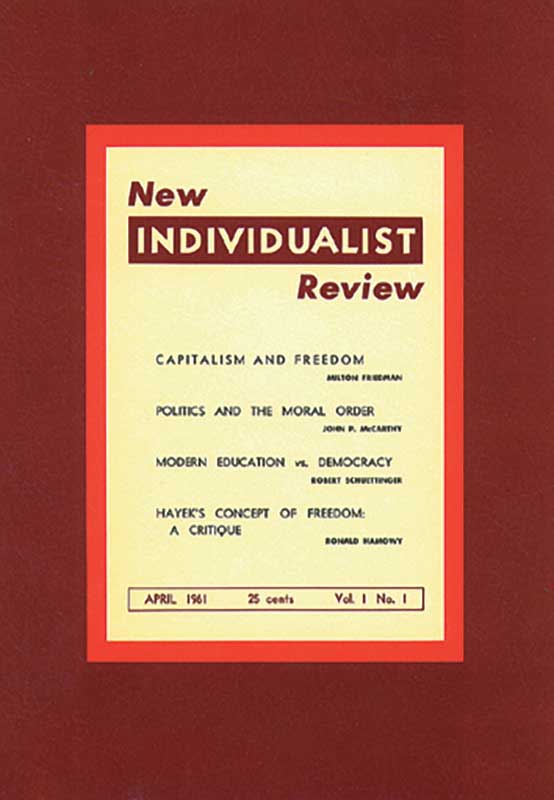
ARMEN A. ALCHIAN, The Economic and Social Impact of Free Tuition - Ralph Raico, New Individualist Review [1961]

Edition used:

New Individualist Review, editor-in-chief Ralph Raico, introduction by Milton Friedman (Indianapolis: Liberty Fund, 1981).

About Liberty Fund:

Liberty Fund, Inc. is a private, educational foundation established to encourage the study of the ideal of a society of free and responsible individuals.


The Economic and Social Impact of Free Tuition

RARELY DO educational issues provoke as much passion as the proposal to raise tuition fees in California colleges. Unfortunately, the passion has not been matched by reason—it is hard to find a clear statement of the consequences of or reasons for a zero tuition or a high tuition fee. It is hard to determine from the public comments whether the antagonists differ about what the consequences of alternative tuition arrangements would be or have different preferences with respect to well perceived consequences. Some defenders of zero tuition have asserted that zero tuition is necessary for aid to poorer students, for the maintenance of our great system of higher education, for the preservation of free and prosperous society, for achievement of great social benefits, for educational opportunity for all, is a hallowed century-old tradition, and that tuition is a tax on education. Some proponents of tuition fees have argued, for example, that the university and colleges are harboring delinquents who would not be there with full tuition, the poor are aiding the rich, students should pay tuition in order to appreciate their education, taxes are excessive, and low tuition requires exploitation of an underpaid faculty, to cite a few. Most of these arguments are so patently fallacious or nonsensical or irrelevant that they do disservice to the more intelligent arguments. But there are some propositions that merit closer examination. To evaluate them it is first necessary to identify at some length the issues that are involved in analyzing and thereby choosing among the alternatives—and in the process make clear my own preferences. If I overlook significant objectives or consequences, perhaps others will be stimulated to fill the gaps.

The issues represent a classic topic for applied economics—the effects of different means of allocating scarce resources among competing claimants. A rational analysis of the consequences of tuition systems requires separation of two questions: (1) Who should bear the costs of education? (2) If someone other than the student should pay for his education, in what form should the aid be given?

Unless the distinction between these two issues is grasped, confusion is inevitable. The case for zero tuition is not established by demonstrating that aid to students is desirable. Full tuition may still be desirable, with the desired aid taking the form of explicit grants-in-aid or scholarships from which the student pays the tuition fee of his chosen school.

The issue of the most desirable form of aid should be separated from still another closely related question: What is the desired method of financing and controlling colleges—as distinct from financing students? For example, aid to students in the form of zero tuition means also that the state finances the colleges’ activities directly by legislative appropriations with the students and their parents having less influence on financing and controlling the activities of colleges. Where student aid is in the form of grants-in-aid or scholarships, students and parents paying full tuition to their chosen colleges have a greater role in determining which colleges shall be financed and rewarded for superior performances. Recognition of these differences in effect explains why some people have asserted the administrators and members of state universities and colleges, which are currently financed by direct legislative appropriation, have sought from self-interest, rather than educational interest, to maintain the impression that zero tuition is the only feasible or sensible means of aid to students—in order to repress student influence and control over the colleges while retaining the influence of politicians.

ADVOCATES OF subsidization of college students (regardless of the method) assume that if each student bore the full cost there would be too little college education as well as a decrease of educational opportunity. What makes it desirable to have more education than if students pay full costs? Several arguments are advanced. Let us discuss these in ascending order of sophistication.

(1) “Although the costs of education are less than the gains to the students themselves, some are unable to finance their education now. A subsidy would provide educational opportunity to the poor.” (2) “Cultural education, though not profitable in market earnings, and hence not capable of being paid for out of enhanced earnings, is nevertheless desirable.” (3) “Even if every student acquires as much education as is worthwhile to him, he would take too little, because the individual ignores the beneficial social gains indirectly conferred on other members of society—giving what some people call ‘external social effects.’ Therefore, society at large should induce students to take more education than indicated by their private interests.”

The argument that the poor can not afford to pay for a profitable college education is deceptive. What is meant by a “poor” person. Is he a college calibre student? All college calibre students are rich in both a monetary and non-monetary sense. Their inherited superior mental talent—human capital—is great wealth. For example, the college calibre student is worth on the average about $200,000, and on the average, approximately $20,000-$50,000 of that has been estimated as the enhanced value derived from college training, depending upon his major field and profession.

Failure to perceive this inherent wealth of college calibre students reflects ignorance of two economic facts. One is the enormous human wealth in our society. Every good educator recognizes that inanimate capital goods are not the only forms of wealth. The second fact is the difference between current earnings and wealth. For example, a man with a million dollars worth of growing trees, or untapped oil is a rich man—though he is not now marketing any of his wealth or services. So it is with the college calibre student. Though his current market earnings are small, his wealth—the present wealth value of his future earnings—is larger than for the average person. This is true no matter what the current earnings or wealth of his parents. It is wealth, not current earnings nor parent’s wealth, that is the measure of a student’s richness. College calibre students with low current earnings are not poor. Subsidized higher education, whether by zero tuition, scholarships, or zero interest loans, grants the college student a second windfall—a subsidy to exploit his initial windfall inheritance of talent. This is equivalent to subsidizing drilling costs for owners of oil-bearing lands in Texas.

There remains an even more seriously deceptive ambiguity—that between the subsidization of college education and provision of educational opportunity. Educational opportunity is provided if any person who can benefit from attending college is enabled to do so despite smallness of current earnings. Nothing in the provision of full educational opportunity implies that students who are financed during college should not later repay out of their enhanced earnings those who financed that education. Not to ask for repayment is to grant students a gift of wealth at the expense of those who do not attend college or who attend tuition colleges and pay for themselves. This is true because, for one reason, our tax bills do not distinguish between those directly benefitted by having obtained a zero tuition educational subsidy and those not so benefitted. Alumni with higher incomes pay more taxes, but they do not pay more than people with equal incomes who financed their own education or never went to college.

MANY DISCUSSIONS about educational opportunity refer to proportions of students from poorer and richer families at tuition free colleges. However strong the emotional appeal, the proportion of rich and poor family students is relevant only to the separate issue of wealth redistribution, per se, consequent to state operated zero tuition education. It has nothing to do with the extent of educational opportunity. Though data for California colleges and taxes suggest that lower income groups provide a smaller proportion of students than of taxes to support education, such comparisons are irrelevant, so far as provision of educational opportunity is concerned. These data tell how much wealth redistribution there is among the less educated, the poor, the educated, and the rich. That wealth redistribution is good or bad depending upon whether one believes the educational system should be used as a device to redistribute wealth as well as to enhance wealth, knowledge, and educational opportunity. No matter how zero tuition in tax supported schools may redistribute wealth, the provision of full educational opportunity does not require redistributions of wealth. Yet, it seems to me, many people confuse these two entirely separate issues or think the latter is necessary for the former. To think that college calibre students should be given zero tuition is to think that smart people should be given wealth at the expense of the less smart.

When some zero tuition university alumni say that without zero tuition they could not have attended college, they should have a modest concern for the implications of that statement. One poor, “uneducated” resident of Watts, upon hearing Ralph Bunche say that he could not have had a college education unless tuition were free, opined, “Perhaps it’s time he repay out of his higher income for that privilege granted him by taxes on us Negroes who never went to college.” That reply spots the difference between educational opportunity and a redistribution of wealth.

Full educational opportunity would be provided if college calibre students could borrow against their future enhanced earnings. Students could repay out of their enhanced future earnings. Although, currently, loans are available from private lenders and also from publicly supported loans, a subsidy could provide a state guarantee of repayment of educational loans exactly as housing loans are guaranteed for veterans. Students could select among optional repayment methods. Some could contract to repay in full with interest; others could opt for a sort of insurance system, whereby the amount repaid was related to their income, with upper and lower limits to amounts repaid being specified. A host of possibilities are available. In fact today with income taxes, the college alumni are repaying part of the educational costs via taxes (but so are others who did not attend college).

Some people are impressed by the size of the debt that a college graduate would have to repay, but they should be impressed with the fact that the debt is less than the enhanced earnings he has thereby obtained and is an indication of the wealth bonanza given the student who is subsidized by society.

There remains one more facet of the educational opportunity argument. Even if a college education may be a very profitable investment for some person, he may, because of inexperience or lack of confidence, not appreciate his situation or be willing to borrow at available rates of interest. This presumably is an argument for subsidizing those students who lack confidence or understanding of their possibilities, and it may be a meaningful argument on its own ground, but it is not an argument for subsidizing “poor” students.

Pleas are made for subsidizing cultural education which, though it may add nothing to the student’s future market earnings, will enhance his general welfare. But a person’s welfare is increased if he gets more food, housing, recreation, beer drinking, and fancier cars. It would seem therefore that the relevant argument for helping students is one of helping them regardless of whether they wish their welfare increased via cultural education or better food. A grant of money to be spent as the recipient deems appropriate is an efficient form of aid—as judged by the recipient. Subsidized cultural education rather than money gifts could be justified if the giver knows better than the recipient what is good for the recipient. I cannot make that leap of faith for the collegiate student, although other people do it easily and confidently.

A case can be made for subsidizing the poor and the rich to take more education—more than a person would take when motivated by his own interests alone. It is often said there are privately unheeded, net social benefits, so each person will under-invest in education from the social point of view, regardless of whether he is rich or poor; but we must separate the illusory from the real external available gains.

EDUCATION MAKES A person more productive, as a doctor, lawyer, merchant, or engineer. Other people benefit from his greater productivity, because more engineers enable lower costs of engineering services for the rest of society. Engineers, looking only to their private gain would, it is said, undervalue the total benefit of having more engineers; too few people would seek sufficient engineering education. If this sounds persuasive, economics can teach you something. The increased supply of engineers reduces the prices of engineering services—even if by only a trivial amount—and thereby reduces the income of other engineers. Their income loss is the gain to the rest of society. This is a transfer of income from existing engineers to non-engineers; it is not a net social gain. The benefitted parties gain at the expense of existing members of the engineering profession, who lose some of their scarcity value as more educated people are created. This is a transfer from the more educated to the less educated. A striking awareness of this effect is evident in the advocacy by labor groups of immigration restriction. Restricting the inflow of laborers of particular skills prevents reductions in wages of incumbent workers with similar skills and prevents a transfer of wealth from them to the rest of American society. An immigrant or a more educated person would have provided an increased product and he would have obtained that value by the sale of his services, but the lower wages to that type of services would have transferred some of the incomes of similar workers to the rest of society. This external transfer effect is not a net contribution to social output. It is not a reason for subsidizing education.

For external effects to serve as a valid basis for more education two conditions must be satisfied: (1) There must be a net social gain (not transfer) unheeded by the student. The ability to read reduces dangers and inconvenience to other people; ability to be sanitary enhances health of other people, or economic education may—but probably will not—prevent passage of socially detrimental, special interest legislation. These are examples of education with external social gains, which we shall assume are not heeded by the student in his private actions because they do not affect the marketable value of his services. Professional education of doctors, engineers, lawyers, economists, mathematicians, etc., has not been shown to fit in that category. Perhaps education at the undergraduate collegiate level in the elements of law, psychology, political science, mathematics, economics may make for better non-market decisions or actions.

I confess to a strong suspicion that such education is most significant at the grade school level, diminishes at higher levels, and disappears for professional or cultural, artistic, personal satisfaction courses, and is possibly reversed at graduate levels (by overtraining and insistence on excessively high standards of training for granting of licenses to practice in some professions—though this is a point the validity of which is not crucial to the main issue here).

(2) The second condition is that there must be further external gains unheeded by students at the college level. The fact of having achieved net external gains is not sufficient to warrant subsidization. The crucial condition is the failure to achieve still further available incremental net social gain from further education. Before concluding that they exist because of a tendency for people to ignore them, we should note that people attend college for reasons other than financial marketable gain. College attendance for personal reasons includes cultural, artistic education, and attendance to find mates. All these tend to extend education beyond maximizing one’s market wealth and possibly even beyond that yielding unheeded social gains. But the facts are not conclusive in either direction.

Incidentally, an especially common but erroneous contention, presumably relying on the external effect, is that the growth, prosperity, and unusual position of California depend upon the free tuition, higher education system. What does this mean? If this means that free tuition has contributed to higher wealth for the educated then this is no argument for either free tuition or more education. If it means the prosperity and growth of aircraft, electronics, motion picture, or agricultural industries in California are dependent upon free tuition, the contention remains unsupported by any analytic or factual evidence, and in fact can be falsified by comparisons with other states. Even if it could be demonstrated that subsidized higher education was responsible, the issue of free tuition would still not be touched. If this means that free tuition did attract some people to seek their education in California, they proceeded to reap the gain in their own higher income. If they provided a real net social benefit, it should have exceeded the extent of their subsidization to be justifiable. The same proposition holds for residents of California. If this argument is accepted, it is difficult to justify charging newcomers a full tuition while permitting existing residents a “free tuition.” Yet, we have seen no proponent of zero tuition advocate zero tuition for all newcomers from all other states. If this means that the higher incomes for more people increase tax receipts, then the relevance of that completely escapes me. If this means California has a larger population, then this means higher land prices. But in so far as benefits to “California” have any relevance, I believe they should be viewed as benefits to people in California rather than as benefits to owners of a geographically identified piece of land, unless by “California” one means “land owners or politicians,” who indeed do prefer larger populations as a source of political power and higher land values.

To induce students to take more education than is privately worth their while—in order to obtain the otherwise unheeded external gains—does call for payments to students. If a student were paid for doing what he would have done anyway, or if his education were subsidized to increase his wealth, he would be receiving a gift. But a payment (whether as zero tuition or a money payment) to the student to extend his education, for the sake of achieving real, external benefits that he otherwise would have not produced, is a payment for services, much as if he were to build houses, for the benefit of the rest of society. Such payments may well be independent of the income or future income of the student as well as of his parents. Though there is nothing that says the rich would provide less real external effects from more education, my conjecture is that the rich would in any event take more education than the poor for cultural reasons and would therefore require a smaller inducement to take the “optimal” extra amount of education for external social benefits. This can form a basis for advocating more educational inducements to the poor than to the rich, but not necessarily by a zero tuition inducement to rich and poor alike.

It should be noted however that there is already subsidization of higher education by private philanthropy on a scale that staggers the imagination. The endowment funds of colleges and philanthropic foundations aiding education runs into the scores of billions. Even if only half that were used to subsidize education (and the rest for research), the amount can not be regarded as minor, on any standard.

NO MATTER WHAT your beliefs about the validity or relevance of the preceding consideration, let us accept them, for the sake of analysis of alternative means of providing aid, for full educational opportunity, cultural aid, or extra inducements to education. (Of course, those who think the preceding arguments are too weak to warrant taxpayers’ giving aid to college students can ignore all that follows, for to them there is no case for any state action, nor of zero tuition). The rest will want to ask, “What is the best form of aid or inducement?”

We can enable or induce students to take more education with the following offer: “On the condition that you take certain kinds of education, we shall bear enough of the costs to induce you to do so.” The costs he would have borne are the income foresaken and the tuition costs. (Food and living costs can be ignored for he would be incurring them no matter what he did). Which of the following is the preferred way of extending that aid to potential students? (1) We pay directly the costs of extra education by operating the school to provide the extra education; this is the zero tuition system. (2) We pay him an equal amount on the condition he take the additional, specified type of education, but he decides which school to attend and he pays the tuition to the school. This is an educational voucher or G.I. type educational bill-of-rights (used after World War II for veterans).

The first requires also that the state directly finance and operate the school providing the education; the second permits the student to choose from competing schools and direct payment to the school he chooses. These two alternatives are sufficient to illustrate the major implications of zero versus high tuition modes of subsidy. The wealth effect for the student is superficially the same in either case, and the financial cost to the subscriber can be the same in each case, once it is decided how much education to subsidize for whom. The costs to the subscriber may be the same, but the results are not.

In the California state system of higher education, the tuition fee is zero for all state schools and for all kinds of training, regardless of whether it contributes to a net social gain or not, and regardless of how rich the student is.

Zero tuition implies that the appropriate aid or subsidy for every student of a state school is exactly equal to the tuition cost no matter what subject he takes. No basis for zero tuitions as being the proper amount has ever been presented; maybe the aid should be even larger, to compensate for foresaken earnings.

Because low or zero-tuition schools are believed to have a larger proportion of less wealthy students than high tuition colleges, zero tuition schools are believed to do a better job of providing educational opportunity for less wealthy students. But this entails the earlier confusion between provision of opportunity and provision of a wealth bonanza; zero tuition schools give bigger wealth gifts to the mentally able students than do the high tuition schools.

Of course, higher tuition will, other things left unchanged, reduce the number of financially insecure students attending tuition colleges. The case for raising tuition is not that aid should be denied but instead that “zero tuition” is a less desirable means of providing aid to students; it entails undersirable controls and political interference with education and lowers the quality of education. Yet there is another method of providing full educational opportunity and at the same time improving the quality and quantity of education and reducing political controls. That alternative is a system of full tuition supplemented by grants-in-aid to those who qualify as financially insecure and deserving students.

It is important to note that the financing of colleges to provide education is different from subsidizing students. The zero tuition is a subsidy to the college as well as to the student. Subsidies to students alone can be provided with a full tuition system; in fact they are now being so provided by many private schools that do charge full tuition.

The alternative to the zero tuition method of providing educational opportunity or giving aid is tuition, with loans or with grants of money. The critical difference, in my opinion, between no tuition and tuition, under these circumstances, is that the former lets the state politician and college administrator and faculty directly exert more control over education whereas the latter enables the student to exercise more power by his choice of college.

Subsidies to whatever extent desired could be provided by a system of grants-in-aid via scholarships. That would appear to be more expensive administratively (but only administratively) than zero tuition, precisely because an effort is made to eliminate the haphazard bonanzas in the zero tuition system. The presumption is that the cost of selecting the students to be subsidized is less than the savings from the avoidance of subsidies to all students.

Tuition with grants-in-aid to students is not visionary. It is proven, practical, economical and currently used. New York State already has a large system of Regents scholarships. California has a smaller scale system with about 2,000 scholarships. After World War II, the Federal government granted millions of veterans educational vouchers for tuition, books, and incidental expenses under an enormously successful act known as the G.I. Bill. All these granted aid regardless of the student’s current financial status. In California the university and state colleges now receive about $500 million annually directly from the legislature. That would finance 250,000 scholarships of $2000 each. The university’s budget would finance 125,000 students, more than the number now attending.

At present many arrangements exist whereby private colleges take into account the financial status of students in deciding how much tuition to charge each student. Even more efficient would be a system of loans with interest to be repaid after graduation out of the student’s enhanced earnings. Under a loan system, the problem of filtering rich students from the financially distressed would be reduced to trivial dimensions, since the rich would have little, if anything, to gain by borrowing. This would provide full educational opportunity with little need for a means test.

Full tuition does not in any way restrict the achievability of full education opportunity. That can be achieved explicitly and openly by the scope of grants and subsidized loans. Just as social security and welfare payments are made in money with the recipient choosing his purchases from competing producers, so a full tuition system with grants-in-aid or loans would enable separation of the issue of the amount, if any, of the subsidy from that of the best means of providing and controlling education.

Under a system of full tuition fees, with whatever loans and scholarship voucher grants are deemed desirable, students could choose their education from the whole world. Any accredited college or educational institution whether it be for barbers, television technicians, beauty operators, mechanics, butchers, doctors, lawyers, or historians could serve. Ours would then really be the best educational system in the world; no longer would Californians be confined to California state operated schools. Whatever one’s beliefs about the desirable degree of subsidy for more education, and whatever his beliefs about who should get it, the full tuition voucher coupled with scholarships and loans would magically open a new, larger world of choice.

An alternative form of aid to students is a tax-credit allowance whereby parents, or students, could later receive a tax offset to their payments for tuition. This would put private college students on a more equal basis with low tuition public colleges. In my opinion, this would be equality at the wrong level of equality. Rather than give tax credits as a means of maintaining zero tuition. I would prefer placing a tax liability on students attending public colleges with low or zero tuition. Whereas the tax credit provides subsidies and aid to all students at the expense of non-students, the tax-liability assessment places the costs of providing the education more squarely on those who benefit from the education. A tax credit gives equal treatment to private and public college students—at the expense of non-students. A tax-liability gives equality to private and public college students and to college and non-college people, with each bearing only the costs of service provided for their benefit. If tax-liability assessments are out of the question politically, the tax credit would be the next best; but it would not achieve one of the major purposes of a full tuition system.

WITH FULL COST tuition, competition among California colleges, and even among academic departments would change. Instead of competition for funds being negotiated among university committees, deans, regents, state college boards, and legislators, competition would rely more on classroom behavior of instructors who would be more dependent on student attendance vis-a-vis other departments and other colleges. This would enormously enhance the power of the student in the former zero tuition colleges. Giving students more attention and influence in the university would indeed occur, exactly as the customer exercises more power at the grocery—by his purchases and choice among competing products and stores, but not by leaping over the counter and insisting on power to run the store, as occurs with current protest. Currently at the grade school level many parents are turning to private schools precisely because the parents can choose more fully the kind of education given their children—via the power of the purse. The poorer people do not have that option—but they would with a tuition-grant system.

Since the producer usually knows more about what he is producing than does the consumer, the producer illogically tends to conclude that he is a better judge about the appropriate quality and quantity for the consumer. This tendency is especially rewarding if the producer can thereby obtain a sheltered competitive position in the production of the good. He would tend to produce a quality and quantity in a style related more to that which enhances his welfare and less to what students and parents prefer.

It is easy to see that with zero tuition the university faculty benefits from research and graduate activity that builds an impressive publication record and research status, with the currently less rewarding teaching of undergraduates being relegated to the less “distinguished,” lower-ranking faculty or graduate students. The “publish or perish” rule would be less powerful under full tuition, because teaching would become a more important source of student directed funds. Survival of the better teachers who are weak in publication would be enhanced. It is interesting and amusing to note, incidentally, that students at the University of California are now attempting to protect some members of the faculty from being dropped because of inadequate research and publication. The protection comes by the students “donating” funds to hire the man to give classes; this is a voluntary, spontaneous full tuition system. If allowed to expand, students would determine who was on the staff and who got the bigger incomes, just as they now decide which restaurants shall survive and prosper.

This is a simple application of the old, powerful, fundamental principle of behavior. The lower the price at which goods are distributed, relative to the market value, the greater the degree of discrimination and arbitrary criteria that the “seller” will display. Its corollary is that the lower the seller’s right to the monetary proceeds, the greater his gain from underpricing the goods. The gains to the university administration and faculty from low tuition are classic examples, first expounded in Adam Smith’s The Wealth of Nations. The greater the portion of a college’s funds coming from tuition fees, the greater the power of the students and the greater the role teaching will play in the survival and prosperity of the members of the faculty. The less will the faculty choose which students shall attend, how they shall behave, etc. The lower is the ratio of tuition payments, the greater the power of the faculty over the students because the students are less able to exert significant effects on the financing of schools or departments as a reward for “good” performance—as they can with restaurants. The faculty says “education is different” and students are poor judges of good education; students are swayed by popular, theatrical teachers and do not appreciate the more valuable scholarly teachers. One wonders how students happen to go to the better and possibly tougher schools in the first place. The faculty of any college prefers lower tuition—until the budget expenditures can not be met from non-tuition sources. And even then there is conflict of interest within the college between those who are threatened by the budget cut and those with tenure who are not. If the cut, or loss of income, would mean merely fewer undergraduates and fewer new teachers, clearly the least difficult resolution from the current faculty’s interest is the reduction in new students, rather than an increase in tuition.

WITH ZERO TUITION the state schools have expanded relative to higher tuition private colleges, and the state university with its higher salaried teachers and more expensive education is more attractive to students than the state colleges and junior colleges. The ex-president and the administrators of zero tuition institutions correctly insist that zero tuition is the great principle underlying the growth of the university; but it is not a source of better education for California students. We should not confuse the amount of money with the way the money is obtained. More and better education, as judged by students, could be obtained at the same, or less, cost with the full tuition control of colleges coupled to loans and whatever grants-in-aid are desirable.

With full cost tuition, the less expensive junior colleges would attract students and income from the university and colleges. Predictably, the few administrative voices heard in favor of higher tuition seem, from my observation, to come from junior college administrators—who believe they would out-perform the university if put on a quality-cost basis of competition for students.

A counter argument to the preceding propositions is that junior college education is “inferior” to university education. Although the quality of the university as a research institution is high, not as much can be established for its quality as a teaching institution to educate college students. The move to junior colleges with full tuition would occur if the more expensive university education were not matched by the higher quality as judged by students and parents. The university would have to improve its teaching to hold students at its higher costs. If it could not, the results would constitute evidence that the high cost and high quality combination was not a superior combination of quality, cost, and quantity. A Rolls-Royce gives higher quality transportation than a Ford, but it does not follow that more Rolls should be produced than Fords. Education must be judged by the quality, quantity, and costs, rather than in terms of only those who are educated at the highest, most expensive levels.

Yet, despite this patent fact of life, when faced with a budget cut the administrators of the state university plump four square for “quality at all costs”—for maintenance of quality education for a selected few regardless of how many must be turned away and given instead an “inferior” education. On what criterion is it established that it is better to maintain the level of quality of education for fewer students at the cost of sacrificing education for others? Would one argue that in the event of a social security reduction, we should reduce the number of recipients in order to maintain the quality of those lucky enough to keep getting social security payments? But analogies aside, the elite, authoritarian arguments by university administrators and faculty for a given level of quality, regardless of the sacrifices imposed on excluded students or on tax payers is sobering evidence of the seductiveness of self-interest pleading.

THE FACULTY AND administration of higher education in California has evolved in the zero tuition environment, with appropriately adapted behavioral traits. They have learned to use that political structure; they have learned how to appeal to the political processes and to legislators and governors for more financing. They have been almost exclusively reliant on the political process. They praise politicians for statesmanlike, responsible behavior when the university budget is increased; but if it is decreased, they cry of political interference. Having accepted almost exclusive dependence on financing directly from the political and legislative processes, they should not complain of “political interference” when that same political process examines more intently the budget and the operations of the university. Are they really surprised that the venerable law “He who pays, controls” still is effective?

Legislators generally tend to favor direct state legislative financing of education coupled with no tuition, rather than full tuition with grants-in-aid. The closer the tuition approaches full cost, the less the power of the legislators over the educational institutions. It is not entirely accidental that Congress used a grant-in-aid system for veterans; there was no Federal college system.

We must constantly remember the difference between paternalism and independence. Independence from the competition of political processes and politicians’ interests can be enhanced by full tuition, but it will bring greater dependence on competition among educators in satisfying students’ whims and interest. Either the students pay and control, or the political processes and politicians do. Yet some of the faculty seem to think they can avoid both. For educators there is no free lunch nor “free” tuition.

The situation reminds one of the Russian plight. Dissatisfaction with the quality of goods produced by Russian firms is sparking attempts to restore market prices as reflections of consumers’ interests. While the Russian economists and consumers advocate more control via the market, producers and politicians show far less interest in weakening their power by moving away from Socialism.

There remains a subtle, but effective means whereby full tuition would lead to more education than if directly provided by government at zero tuition. As matters stand now, an education at a tuition school may be worth $2000, or say, $500 more than the education at zero tuition state schools. For that superior education worth $500 more, the student would have to pay the full tuition cost of $2000. He gets no relief for not using state schools. If education were on a full tuition basis, this obstacle to more and higher quality education would be removed. We should not assume that spending more by government for direct provision of education necessarily yields more education. This phenomenon, I conjecture, is powerful at all levels of education.

A PREFERENCE FOR full tuition implies nothing whatsoever about the desirable extent of aid or subsidy to students. Unfortunately much of the debate has erroneously assumed that zero tuition is a necessary or a preferred method of aid while full tuition is a device to avoid aid to students. No matter how much aid, if any, should be given to students, the case for full tuition does not rest on a denial of aid. It rests on the premise that, whether or not aid is given to students, the financing of schools should be controlled more directly by students and their parents because the kind of education thereby made available is deemed to be better—by those who advocate full tuition.

Full tuition, plus grants-in-aid to whatever extent one believes is justified, directs educational activities more to the interest of students and less to that of the university staff. And after all, is it not the students whose interests are fundamental rather than the university’s, as an institution? Is it the students’ interests as reckoned by students and parents rather than the convenience to the educators that is a better guide? My choice of answers is obvious. I suspect that these are the crucial issues on which advocates of zero tuition will differ with me.

My opposition to zero tuition arises because I do not like the way it redistributes wealth, nor do I like the totality of the effects of the kinds of competition it induces relative to that which would prevail under full tuition, supplemented by grants and loans. The latter yields more variety of educational opportunities and just as much educational opportunity and presumptively, greater detectability and survival of superior education. It reduces the producers’ control over the products that the customers can have. The influence of selecting their colleges and controlling payments is a trait with high survival in the world outside of academia and which should be cultivated. The decreased role of the state and political activity in administering education is also a consequence I find congenial. Higher tuition would improve the quality of education rather than reduce it. The quantity would be affected not by either a zero or high tuition, but by how much is spent for education. Zero tuition does not mean more is spent for education, nor that more poor people can attend. To believe it does is to think zero tuition is the only or best way to subsidize or aid students—and that contention begs the fundamental question of what is the best way.

All these consequences seem to work against my interests as a member of a zero tuition college. If I thought this one exposition of economic analysis and one man’s preferences really were capable of converting our system of educational subsidies from the zero tuition to a full tuition system with scholarships, loans, and vouchers, I might be less willing to expose it, for the price may be high enough to make me join with those who, whatever may be their reason, prefer the Holy Zero, (excuse me, the free) tuition system.

[* ] Armen A. Alchian is Professor of Economics at the University of California, Los Angeles. He is co-author of the textbook University Economics and author of a number of important articles on costs and property rights. Acknowledgement is made to the Lilly Endowment, Inc. for a research grant to U.C.L.A. during which the present article was written. The opinions expressed here in no way reflect any conditions of that research grant.