Econlib

The Library

Other Sites

Front Page arrow Titles (by Subject) arrow JAY A. SIGLER, The Political Thought of Michael Oakeshott - New Individualist Review

Return to Title Page for New Individualist Review

Search this Title:

Also in the Library:

Subject Area: Economics
Subject Area: Political Theory
Subject Area: History
Order this book from Liberty Fund

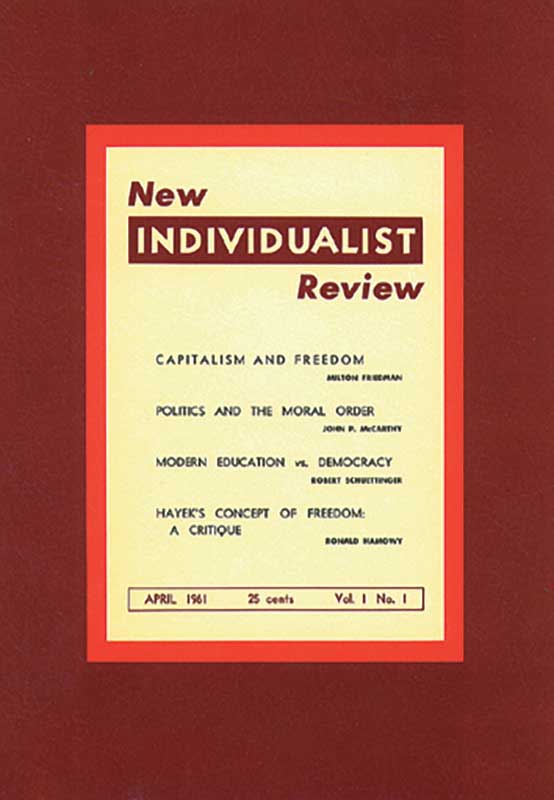
JAY A. SIGLER, The Political Thought of Michael Oakeshott - Ralph Raico, New Individualist Review [1961]

Edition used:

New Individualist Review, editor-in-chief Ralph Raico, introduction by Milton Friedman (Indianapolis: Liberty Fund, 1981).

About Liberty Fund:

Liberty Fund, Inc. is a private, educational foundation established to encourage the study of the ideal of a society of free and responsible individuals.


The Political Thought of Michael Oakeshott

PROF. MICHAEL OAKESHOTT, of the London School of Economics, is widely regarded as the most articulate and influential conservative political theorist in England today. A successor to the chair of Harold J. Laski, eminent Marxist theorist, Prof. Oakeshott has dealt extensively with refining a conception of conservatism within the tradition of Edmund Burke and St. Thomas Aquinas. While resisting the creation of an orthodox conservative ideology to counteract the dominant liberal ideology, Oakeshott has sought to provide a philosophical basis for criticism of liberalism. As founder of the Cambridge Journal, Oakeshott sought to provide an outlet for English conservative thought. Since Prof. Oakeshott is a philosopher, historian, and critic of some note we find in his writings possibly the epitome of the best in conservative thought.

The importance of the conservatism of Prof. Oakeshott is due to his philosophical rigor and consistency. The philosophical basis for Oakeshott’s conservatism is to be found in his first book, Experience and its Modes, written in 1933, when Oakeshott was thirty-two years old. In an effort to identify the basis of all knowledge as the totality of empirical experience taken as a coherent whole, Oakeshott insisted that only in the coherence of experience could truth be found.1 From this standpoint, a slice of experience, which Oakeshott calls “a mode of experience,” may be considered an abstraction from reality, not reality itself.2 The tendency to confuse the abstraction of ideology with the concrete world of experience was a fundamental error which Oakeshott sought constantly to avoid, as his later work indicates. This awareness generates his philosophic suspicion of all ideological generalizations.

Even history can provide no sure guide to political activities:

Both the active politician and the writer on politics, both the reformer and the conservator invoke the oracle of history and interpret its answer according to their predisposition, giving out their conclusions as the lessons of history. But history itself has neither the ideas nor the language wherewith to teach practical conclusions.3

History itself is experience, just like the experience of the contemporary environment.4 Abstractions drawn from it, since they describe only a portion of reality, cannot be wholly “true.” Patriotism, a love of the past, is often based on a fancied past, or a remembered past, rather than the historical past. It is this part, which is known as our past, which forms each nation’s private view of history.5 It is in that “political past” rather than the actual, historical past that Oakeshott finds the source of a nation’s traditions and customs. It may not be “truth” but it may provide the best guide to future action.

Many political beliefs which appear to be coherent doctrines turn out on examination to be less than that. It may be that “the social and political beliefs of representative democracy are more in the nature of a tradition and a tendency than a well-knit doctrine.”6 Most competing contemporary ideologies are superficial and non-philosophical, enjoying in this respect no superiority over contemporary democracy. Among contemporary social theories “the Catholic social and political doctrine stands far above any of the others, for it at least has the help of a profound thinker, St. Thomas Aquinas, and is not dependent for its philosophy on some vague leaning towards a half understood and wholly confused pragmatism.”7 Oakeshott finds many of the principles of conservatism in Catholic philosophy.8 Certainly, he feels we have much to learn from the coherence and consistency of that system.

In traditional political philosophy the search for an entire and coherent understanding of political life as an aspect of total civilization engaged the greatest thinkers. In high political philosophy mere reflection on political life is replaced by “the intellectual restoration of a unity damaged and impaired by the normal negligence of human partiality.”9 Such classical political philosophies are not now being written. Political ideology is a pale shadow of a political philosophy, an abstraction of an abstraction. In any event, the great political philosophies did not believe, as do contemporary ideologists, that political activity is a good in itself, but believed, instead, that politics “is contributory to an end which it cannot itself bring about.”10 With the disappearance of the belief in high moral ends, the scope of activity of the political thinker is diminished. Oakeshott himself plays the role of critic of ideology rather than builder of a massive system of political philosophy.

IN OUR LIFETIME the attempts to construct metaphysical systems of thought have been replaced by the construction of scientific theories. Oakeshott, although respectful of the achievements of modern science, is suspicious of attempts to transfer the methods of science to the arena of politics.11 Yet the belief “that politics, at their best, are the science of the arrangement and improvement of human societies in accordance with certain abstract ideals” has been the main “inspiration of political activity in Western Europe for the last two hundred years.”12 Fascism, rather than being a reaction to the rational ideas of contemporary liberalism, is seen by Oakeshott as a rejection instead of far older traditional ideas of representative government, ideas which liberalism, with its project of a science of politics, also rejects.13 This is what makes scientific politics a dangerous conception. The academic study called “political science” is also condemned by Oakeshott as unsuitable even for university undergraduates, because no such scientific understanding as yet exists.14

This is an age in which Oakeshott sees an almost universal speculative interest in morals and politics; but Oakeshott feels that undue interest in morals and politics is a sign of an unhealthy society It is an age when the coherence of a universal philosophical scheme is impossible.15 The alleged stability of earlier ages is largely exaggerated. It may be true that other ages “possessed more reliable habits of behaviour, but a clear view of the ends of human existence has never been enjoyed except by a few rare individuals.”16

In a scientific age such as our own, Oakeshott reminds us that the methods of science depend upon the faithfulness of the scientist “to the traditions of scientific inquiry.”17 Politics itself is a “second-rate form of human activity, neither an art nor a science.”18 The study of politics “should be an oecological study of a tradition of behaviour,”19 not a pursuit for false hopes of human engineering or a rashly optimistic science of politics. We must be humble in the face of human variety and the fallibility of human “rationality.” No political theory or ideology can grasp the whole of experience. There is no chart of politically rational theory.

In political activity, then, men set sail on a boundless and bottomless sea; there is neither harbour for shelter nor floor for anchorage, neither starting-place nor appointed destination.20

The concept of tradition is central to Oakeshott’s approach. A “tradition of behaviour” is “a principle of continuity” which is derived from the past and extends into the future. It is not learned as an abstract idea, but is a “concrete, coherent manner of living in all its intricateness.”21 The coherence of human activity, what gives life its pattern, is inherent in the activity of living. The elements of the pattern are called “customs, traditions, laws.”22 Oakeshott goes so far as to say that “in general, constitutional tradition is a good substitute for philosophy.”23 In simpler terms, a “tradition of behaviour” is a better guide to political conduct than any theory or ideology because it is based upon the whole of life, rather than upon some abstraction derived from life. Experience is a more trustworthy guide than any book, but “even in the most favourable circumstances,” it may take “two or three generations to acquire” the political traditions of a society.24

AN IDEOLOGY, FOR Oakeshott, is an abridgement of a tradition. The conversion of a “habit of behaviour” into a comparatively rigid system of abstract ideas creates a “politics of destruction and creation” as a substitute for “the politics of repair.”25 It is of the essential character of an ideology that it presents itself as knowledge. However, ideology “by itself is always an insufficient guide” because political fact, actual experience, must always precede political activity.26 Ideology, then, is always false knowledge because it is an abstraction of reality, even at its best. Oakeshott finds himself opposed to ideology in any form, including conservative ideology. It is the distinguishing feature of Oakeshott’s variety of conservatism that he sees the opposition of conservatism and liberalism as one of contrary claims to knowledge. This peculiar feature of Oakeshott’s conservatism is that it attempts to make the lack of a specific program or doctrine a merit rather than a shortcoming. The conservative is one who is sceptical “about the possibility of . . . perfection,” one who is determined “not to allow human life to be perverted by the tyranny of a person or fixed by the tyranny of an idea.”27

Oakeshott identifies the source of ideological infection as the development of what he calls “modern Rationalism.” The rationalist stands for independence of mind on all subjects at all times, irrespective of tradition or authority. Confident of his capacity for “reason” the rationalist “has no sense of the cumulation of experience”28 and optimistically pursues the “politics of perfection” heedless of the limits of unaided reason and regardless of the disturbances and injuries he may cause. The philosophy of John Locke, of Bentham, and Godwin encouraged this faith which has resulted in the mixed blessings represented by the ideas of “open diplomacy, the planned society, federalism, nationalism, votes for women, the world state and the destruction of the Austro-Hungarian Empire.”29 The flaw in the rationalist theory is the assumption of the existence of a mistake-proof apparatus called a “mind” which is an independent instrument made capable of dealing with experience by means of externally imposed educational training.30 Brushing aside accumulated customs and habits, the rationalist romantically assumes that each generation begins with a fresh political and social slate. The existence of a mentally discoverable “natural law” is a typical rationalist error, and is rejected by Oakeshott.”31

Against the charge that the rejection of rationalism creates an irrational position, Oakeshott replies that rationalism itself is not a “rational” doctrine and that the definition of “rational” behavior includes more than the rationalists admit. Oakeshott defines “rational” conduct as “faithfulness to the knowledge we have of how to conduct the specific activity we are engaged in,” and “acting in such a way that the coherence of the idiom of activity to which the conduct belongs is preserved and possibly enhanced.”32 Scientific activity is “rational” to the extent to which it follows its own traditions of procedure. Political activity is “rational” to the extent that the politician proceeds in accordance with the customs and traditions of the nation.

Nations are “hereditary, co-operative groups, many of them of ancient lineage” which enjoy a past, a present and a future.33 Democracy and other ideologies are not subject to export because they are not formal belief systems but are contained within the tradition of a nation. Politics, then, becomes a “pursuit of intimations,”34 a present conversation with the past on behalf of the future.

THE BUSINESS OF THE politician is to prevent the concentration of power in a society and to break up all concentrations of power which have the appearance of becoming dangerous.35 Thus Oakeshott is strongly in favor of anti-monopoly legislation, although also a friend of the institution of private property. He defends private property as the surest bulwark for personal liberty; but the maximum diffusion of the power which springs from ownership is the proven source of liberty. Massive corporate businesses or massive labor organizations both threaten liberty by imposing limitations upon the prerogatives of individual behavior. The possession of private property permits a man to choose among groups and to move freely within society; and a freely competing economic system is the essence of personal freedom.36

Collectivism is the enemy of freedom, but it may be found in many guises. Collectivism and freedom are the real alternatives. The collectivist rejects the idea of the diffusion of power and insists upon the necessity of central direction. The creation of great unified power is necessary to this end and ultimately a collectivist government must enforce its imposed order at the price of liberty.37 The collectivist fails to understand the “poetic character of all human activity” and the ultimate result of such a society is that “everybody (with the partial exception of the planners themselves) is deprived of so much freedom that the regime would at once be recognized as a tyranny” if we were not deluded into thinking that we had exchanged a new freedom for our lost freedom.38

The word “conservative” itself is really a description of an emotional disposition more than a creed or doctrine. It signifies a preference for the familiar to the unknown, experience to the experimental, an acceptance of the need of change within the framework of accepted rules and practices. The conservative, who is a reluctant innovator, believes that the role of government is limited to keeping the peace, rather than including the power to impose choices. He believes this because he is suspicious of any claims to political expertise, and aware of the essentially selfish pursuit of happiness. Yet a man could be radical in all other respects while being conservative in his politics. The conservative accepts the world and people as they are, with all their flaws and imperfections.39 Ultimately, Oakeshott is in agreement with Hobbes, whom he greatly admires, in that:

Here in civil society is neither fulfillment nor wisdom to discern fulfillment, but peace . . . the only thing in human life, on Hobbes’s theory, that can be permanently established.40

SOME HAVE SAID OF Oakeshott that his ideas are unoriginal, but it may be, as Bernard Crick suggests, that Oakeshott has written “two or three of the subtlest political essays of the century.”41 Another critic claims that Oakeshott has assumed the posture of anti-politics, of one who is bored with politics and politicians.42 Regardless of the final appraisal, it still seems true, as Russell Kirk insists, that Oakeshott’s essays reveal the low estate of American conservatism.43 It is this author’s contention that a thorough reading of Oakeshott’s writings reveals a consistent philosophical approach to modern conservatism, a consistency lacking in American conservatism, as it is in most contemporary political thought.

If Oakeshott is extremely historical, this is not inappropriate for a conservative.44 If Oakeshott is deeply concerned with the dangers of planning, this too, is consistent with the mainstream of modern conservatism.45 It is true, as Peter Viereck insists, that American conservatism lacks a long tradition rooted in feudalism;46 but that does not necessarily disprove Oakeshott’s contention that all societies have traditions which are guides to present action. Neither is it a fair criticism to suggest that a conservative position need be doctrinaire, or contain particular programs or actions.47

The achievement of Prof. Oakeshott has been to provide a contemporary restatement of the essence of conservatism, based on a consistently maintained philosophical position. In doing so, Oakeshott borrows from many preceding conservative thinkers, composing an amalgam of his own. Although rejecting, with Burke, Hobbes’s attempt to create a scientific politics,48 Prof. Oakeshott is close to accepting Hobbes’s view of human nature. Although discarding the idea of natural rights, Oakeshott retains a deep admiration for Aquinas, from whom Oakeshott draws some of his own views regarding the proper role of government.49 Oakeshott admittedly builds on the work of Henry Simons in his essay on private property,50 but he goes beyond Simons to provide a logical defense of private property as a necessary part of individual freedom. Oakeshott is not merely echoing Burke’s famous statement: “The individual is foolish . . . but the species is wise,”51 when he rests his case against rationalism by citing the “tradition of behavior.” He is trying, instead, to counteract the abstractions of rationalist innovators with the concrete facts of everyday and historical experience. It is Oakeshott’s aim to indicate the method of political knowledge and by his success in achieving that goal he must be judged.

[* ] Jay A. Sigler is Assistant Professor of Political Science at Rutgers University.

[1 ]Experience and Its Modes (Cambridge: The University Press, 1933), p. 323.

[2 ]Ibid., p. 327.

[3 ]Ibid., p. 316.

[4 ]Ibid., p. 99.

[5 ]Ibid., p. 103.

[6 ]The Social and Political Doctrines of Contemporary Europe (Cambridge: The University Press, 1939), p. xvi.

[7 ]Ibid.

[8 ]Ibid., pp. xix-xx.

[9 ] Introduction to Leviathan, by Thomas Hobbes (New York: Macmillan, 1947), p. x.

[10 ]Ibid., p. lxix.

[11 ] “Science and Society,” Cambridge Journal, I (July 1948), 696-97.

[12 ] “Scientific Politics,” Cambridge Journal, I (March 1948), 349-50.

[13 ]Ibid., p. 351.

[14 ] “The Study of Politics in a University,” in Rationalism in Politics (New York: Basic Books, 1962), p. 329n.

[15 ] “The Universities,” Cambridge Journal, II (May 1949), 530.

[16 ]Ibid., p. 520.

[17 ] “Rational Conduct.” in Rationalism in Politics, p. 103.

[18 ] Introduction to Leviathan, by Thomas Hobbes, p. lxiv.

[19 ] “Political Education,” in Peter Laslett, ed., Philosophy, Politics and Society (New York: Macmillan, 1956), p. 19.

[20 ]Ibid., p. 15.

[21 ]Ibid., p. 17.

[22 ] “Rational Conduct,” op. cit., p. 105.

[23 ] “Contemporary British Politics,” Cambridge Journal, I (May 1948), 475-76.

[24 ] “Rationalism in Politics,” in Rationalism in Politics, p. 30.

[25 ]Ibid., p. 21.

[26 ] “Political Education,” op. cit., p. 9.

[27 ] “Scientific Politics,” op. cit., p. 357.

[28 ] “Rationalism in Politics,” op. cit., p. 2.

[29 ]Ibid., p. 6.

[30 ] “Rational Conduct,” op. cit., pp. 85-87.

[31 ] “Science and Society,” op. cit., p. 696. He also rejects the concept of natural rights in “Rationalism in Politics,” op. cit., p. 27n.

[32 ] “Rational Conduct,” op. cit., pp. 101-2. As Oakeshott states: “. . . it is important that a writer who wishes to contest the excessive claims of ‘Rationalism’ should observe the difference [between rational inquiry and ‘rationalism’] because if he fails to do so he will not only be liable to self-contradiction . . . but also he will make himself appear the advocate of irrationality, which is going further than he either needs or intends to go.” “Scientific Politics,” op. cit., p. 349.

[33 ] “Political Education,” op. cit., p. 2.

[34 ]Ibid., p. 13.

[35 ] “Contemporary British Politics,” op. cit., p. 486.

[36 ] “The Political Economy of Freedom,” in Rationalism in Politics, pp. 46-48. In certain cases Oakeshott entertains the idea that government monopoly might be preferable to American-style private radio and television. “The B.B.C.,” Cambridge Journal, IV (June 1951), 553-54.

[37 ] “The Political Economy of Freedom,” op. cit., p. 51.

[38 ] “Contemporary British Politics,” op. cit., p. 484. War is considered by Oakeshott to be the enemy of freedom because it encourages that artificial unity which is the aim of the collectivist planner. “The Universities,” op. cit., p. 525.

[39 ] “On Being Conservative,” in Rationalism in Politics, pp. 168-96.

[40 ]Introduction to Leviathan, by Thomas Hobbes, p. lxvi.

[41 ] “The World of Michael Oakeshott.” Review of Rationalism in Politics, Encounter, XX, No 6 (June 1963), 65.

[42 ] David Marquand, “Floating,” Review of Rationalism in Politics, New Statesman, LXIV (October 26, 1962), 574.

[43 ] Review of Rationalism in Politics, American Academy of Political and Social Science, Annals, CCCXLVII (May 1963), 181.

[44 ] “In the demonstration of the validity of ideas history had been, in truth, one of the great weapons of the conservative. From history one may derive a behaviorial criticism of both revolution and reform,” F. G. Wilson. “The Anatomy of Conservatives,” Ethics, LXX (July 1960), 276.

[45 ] “But the conservative concern, always the same, has been consistently with the ‘planners,’ the thinkers of abstract schemes, the know-better innovations of the politically unresponsive intellectuals.” Gerhart Niemayer, Review of Conservatism in America, by Clinton Rossiter, Journal of Public Law, IV (Fall 1955), 443.

[46 ] Peter Viereck, Conservatism Revisited (Rev. ed.; New York: The Free Press, 1962), p. 143.

[47 ] See Willmoore Kendall, The Conservative Affirmation (Chicago: Henry Regnery Co., 1963).

[48 ] Edmund Burke, Burke’s Politics, ed. by R.J.S. Hoffman and P. Levack (New York: Alfred A. Knopf, 1949), p. 228.

[49 ] St. Thomas maintains that it is the function of the political ruler merely to maintain peace and order by seeing to it that all the services of public administration and defense are performed, thus removing all impediments to the good life. See G. H. Sabine, A History of Political Theory (New York: Henry Holt, 1950), p. 250.

[50 ]Economic Policy for a Free Society (Chicago: University of Chicago Press, 1948).

[51 ] Burke, op. cit., p. 227.