Econlib

The Library

Other Sites

Front Page arrow Titles (by Subject) arrow WALTER Y. OI , The Real Costs of a Volunteer Military - New Individualist Review

Return to Title Page for New Individualist Review

Search this Title:

Also in the Library:

Subject Area: Economics
Subject Area: Political Theory
Subject Area: History
Order this book from Liberty Fund

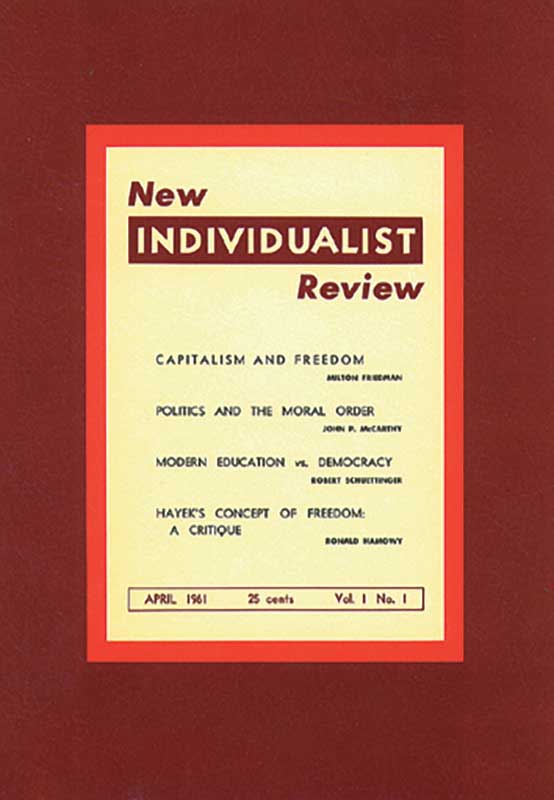
WALTER Y. OI , The Real Costs of a Volunteer Military - Ralph Raico, New Individualist Review [1961]

Edition used:

New Individualist Review, editor-in-chief Ralph Raico, introduction by Milton Friedman (Indianapolis: Liberty Fund, 1981).

About Liberty Fund:

Liberty Fund, Inc. is a private, educational foundation established to encourage the study of the ideal of a society of free and responsible individuals.


The Real Costs of a Volunteer Military

ONE OF SEVERAL proposed alternatives to the current draft is the establishment of an all-volunteer force. To say that a particular alternative such as an all-volunteer force is preferable to the current draft implies that the cost of this alternative is, in some sense, lower than the cost of procuring military personnel with the current draft system. Yet in his statement before the House Armed Services Subcommittee, T. D. Morris, Assistant Secretary of Defense, indicated that an all-volunteer force of 2.65 million men would increase military payroll budgets by $4 to $17 billion per year.

The budgetry payroll of the Department of Defense is not, however, the economic cost of labor resources allocated to the uniformed services. The presence of a draft has surely affected both the level and structure of military pay; moreover, the men who actually entered active military service were recruited or conscripted through manpower procurement programs which rely in differing degrees on the coercive influence of a draft liability. A change to a purely voluntary force would have to be accompanied by increases in military compensation, and substantial changes in the procurement channels through which men are recruited into the armed forces. The composition and structure of an all-volunteer force would thus differ significantly from that of the present force, which contains many men who were enlisted under the pressure of a draft liability. A third alternative, such as the lottery, would yet produce a different composition of the armed forces; but this article will deal with cost comparisons for only two military manpower procurement arrangements—a purely voluntary one, and the one which has evolved under the current draft law.

There are at least three senses in which the maintenance of a defense establishment entails a financial cost: (1) budgetry cost, (2) cost to the economy, and (3) cost to the individual military service participants. According to the defense budget for fiscal year 1965, the cost for active-duty military personnel was $12.7 billion, while retirement benefits accounted for another $1.4 billion. If the higher levels of military pay which are required to attract sufficient volunteers were applied to the probable age structure of a voluntary force, this writer obtains an estimate of the budgetary cost that is $4 billion greater than that of a mixed conscript and volunteer force.1

The financial cost of military personnel provides a measure for the value of the civilian outputs that could have been produced by the labor which was allocated instead to the armed forces; but this concept of cost completely ignores the welfare loss due to the occupational preferences of the individuals themselves for military versus civilian employments. In a sense, it is just a measure of technical efficiency, indicating the alternative cost in terms of foregone civilian output that was required to achieve given goals of military preparedness. The concept of full economic cost, on the other hand, acknowledges the occupational preferences of prospective recruits. If an individual has an aversion for service life, he could, in principle, be compensated enough to induce him to volunteer. Presently, individuals who would require such compensation are involuntarily inducted, while others reluctantly volunteer before they are drafted. These imputed compensations to overcome aversions for military service would be included in any computation of the full economic cost of acquiring military personnel; but our task here is merely to arrive at an estimate of financial costs. Finally, it must be remembered that the mechanics of the current draft law impose costs in the form of uncertainties on youths in the draftable ages. The incidence of inductions (who will be drafted) and the time of induction are not known in advance.

TO EVALUATE THE comparative costs of an all-volunteer force and of the force which has evolved under current law, this writer first examined the implications of a continued draft which produced a mixed force of conscripts, true volunteers, and draft-motivated, reluctant volunteers. It was assumed for this paper that active duty force strengths in the years ahead (1970-75) would return to their pre-Viet Nam levels of 2.65 million men, in order to utilize available Department of Defense data.

The manpower procurement channels which have evolved under the current draft are reflected in the patterns of active military service which were observed in the six years prior to Viet Nam, 1960-65. An analysis of these patterns indicates the probable characteristics of a mixed force under a continued draft. In order to maintain a force strength of 2.65 million men, annual accessions of 507,700 men must be recruited or conscripted from civilian life. With a smaller male population in the period prior to Viet Nam, roughly 59 per cent of males who were physically and mentally qualified for military service entered the active duty forces. By 1970-75 it is projected that only 38.5 per cent of qualified males of military age will be demanded by the armed services.

To estimate the cost of an entirely voluntary force, it is necessary first to consider the case assuming that the draft would be abolished with no accompanying changes in pay or other recruitment incentives. Under this assumption, the services would obviously lose the draftees who had accounted for 21 per cent of the accessions to enlisted ranks in 1960-65. In addition, a significant fraction of regular enlistees could properly be called reluctant volunteers who enlisted in preference to being drafted. The incidence of reluctant volunteers was inferred from a survey of responses to the question:

If there had been no draft, and you had no military obligation, do you think you would have volunteered for active military service?

If the draft were eliminated, reluctant volunteers would also likely be lost from the armed forces. Voluntary enlistments in all services could be expected to fall by 38.1 percent, and to the regular army alone by 43.2 per cent. Moreover, these surveys indicate that 41.3 per cent of newly commissioned officers were motivated to enter military service because of the threat of being drafted.

The fall in initial accessions due to the loss of conscripts and reluctant volunteers would result in a decline in the sustainable force strength. Since a voluntary force, however, would enjoy a greater rate of re-enlistment, the decline in strength would be smaller than the fall in accessions. The annual turnover rate of Army enlisted men is around 25 per cent when over half of accessions are draftees and reluctant volunteers. If all enlistments were true volunteers, it is estimated that the turnover rate could be lowered to 17 per cent.

The improved retention patterns which can be expected to apply to an all-volunteer force were then used to estimate the gross flow demand for accessions to achieve the assumed strength objective of 2.65 million men. The deficit between requirements (gross flow demand for assumed strengths) and voluntary enlistments could be eliminated by attracting more volunteers with higher military pay. To eliminate a deficit of 1.6 (the ratio of requirements to voluntary enlistments) in the Army, it was estimated that first term military pay would have to be increased by 68 per cent, from $2,500 to $4,200 per year. As a result, the pay of career men in the Army would have to increase by 17 per cent also. In addition to higher levels of military pay, the move to a voluntary force would imply a change in the composition of the armed services—the age structure would move to a larger fraction of older men in the career force. It would also be anticipated that a smaller fraction of officers would be college graduates.

IN BOTH THE MIXED and voluntary type of miltary force, 2.65 million men, it is assumed, would be required to maintain the defense of the nation, and thereby would be kept out of the civilian labor force. The financial cost to the economy can thus be defined as the opportunity cost equal to the value of goods and services that could have been produced by these servicemen. If servicemen were paid the same incomes as civilians of comparable ages and educational attainments, the men in the mixed force would earn $13 billion per year. The corresponding figure for the voluntary force would be $14.2 billion, or some 9.1 per cent higher than the mixed force, reflecting a preservation within the armed forces of the acquired military skills and experience of the older men, while in the mixed force many of the men do not remain in the services beyond their initial term—thus losing this experience. Although the voluntary force has a lower average educational attainment, it also contains older men who usually earn higher salaries than younger men, and on balance the age effect outweighs the smaller average education. To the extent that military service is not a perfect substitute for civilian job experience, the financial cost to the economy of the present type of mixed force contains a downward bias: civilian employment experience provides a man with skills he can take directly to a new job, while military experience is only partially useful in later employment.

The financial cost to individual military service participants is restricted to their monetary losses, suffered by those men who were coerced into active military service by the draft liability. By 1970-75, it is projected that only 55,300 men would need to be involuntarily drafted; but another 153,700 men per year would be expected to volunteer for enlisted ranks because of their draft liabilities. By using data for 1963-64, this writer was able to arrive at estimates of annual civilian and first-term military incomes for these reluctant service participants. The differentials between alternative civilian and military incomes represents an implicit tax that is placed on those who were forced to serve. If each draftee serves 19 years, and each reluctant volunteer for 3.5 years, the aggregate implicit tax which is borne by members in this age group is estimated to be $691 million. To the extent that some officers (notably doctors and dentists) serve an initial tour of active duty because of the draft, the size of this invisible tax is even larger. If reluctant participants were compensated for their aversion to military service life, it is estimated that the military pay budget would have to be increased by $826 million a year. This is the amount of the implicit tax, or cost, that is imposed on men who are coerced into military service by the draft. If the true volunteers were awarded the same pay as the reluctant service participants, the economic cost of the draft then easily exceeds the budgetary cost of moving to an all-volunteer force. It should be noted that these financial costs altogether disregard the welfare loss through the occupational preferences of individuals for military versus civilian jobs.

To sum up, a force strength of 2.65 million men could be achieved on a purely voluntary basis by 1970-75 if the military pay budget were increased by approximately $4 billion. Because of its higher retention rates, only 27.5 per cent of qualified males in each age class would be needed to sustain this voluntary force. On the other hand, if the draft is continued, the higher personnel turnover in a mixed force would mean that 38.5 per cent of all qualified males will have to enter military service each year. Some men will be involuntarily inducted, while others reluctantly volunteer because they might be drafted.

SELL NIR TO YOUR FRIENDS

There is no better way to promote limited government, free market ideas than to place a copy of NIR in the hands of every concerned individual. Our quantity rates:

2for $1.803 for $2.454 for $3.00
5for $3.50 plus 50 cents for each additional copy
10for $6.00 plus 40 cents for each additional copy
25for 12.00 plus 35 cents for each additional copy
50for $20.75$40.00 in multiples of 100

Schedule of dealers’ discounts:

10-24 copies, 48%. 25-49 copies, 56%. 50-99 copies, 60%.

Details of consignment contract are available on request.

[* ] Walter Y. Oi is Associate Professor of Economics at the University of Rochester. He was for several years Manpower Consultant for the Departure of Defense, and participated in the University of Chicago Conference on the Draft, December 1966.

[1 ] The reader is directed to the author’s “The Costs and Implications of an All-Volunteer Force,” in Sol Tax, ed., The Draft (Chicago: University of Chicago Press, 1967), chap. xxii, pp. 221-51.