|
|
Front Page Titles (by Subject) NEW BOOKS AND ARTICLES - New Individualist Review
NEW BOOKS AND ARTICLES - Ralph Raico, New Individualist Review [1961]Edition used:New Individualist Review, editor-in-chief Ralph Raico, introduction by Milton Friedman (Indianapolis: Liberty Fund, 1981).
About Liberty Fund:Liberty Fund, Inc. is a private, educational foundation established to encourage the study of the ideal of a society of free and responsible individuals. Copyright information:The copyright to this publication is held by Liberty Fund, Inc. The New Individualist Review is prohibited for use in any publication, journal, or periodical without written consent of J. M. Cobb, J. M. S. Powell, or David Levy.
Fair use statement:
This material is put online to further the educational goals of Liberty Fund, Inc. Unless otherwise stated in the Copyright Information section above, this material may be used freely for educational and academic purposes. It may not be used in any way for profit.
- Publisher’s Note
- Introduction
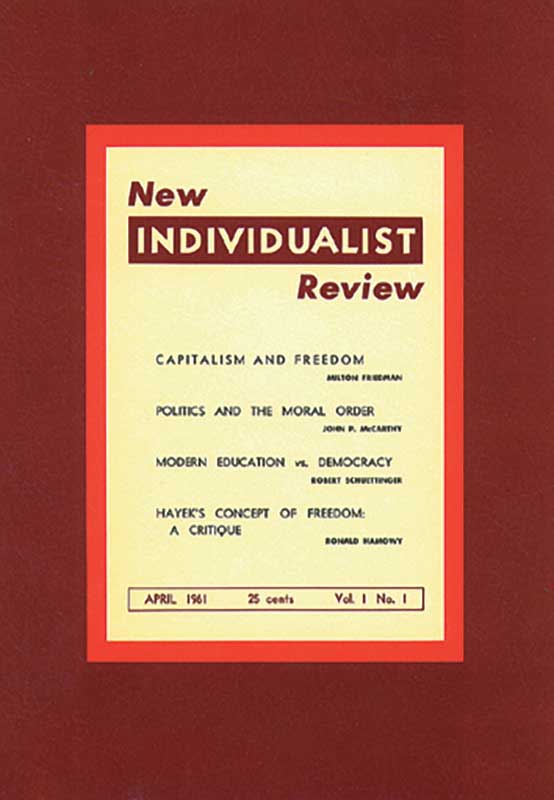
- Volume 1, Number 1, April 1961
- An Editorial …
- Milton Friedman, Capitalism and Freedom
- John P. Mccarthy, Politics and the Moral Order
- John Weicher, Individualism and Politics: the Next Four Years: an Appraisal
- Ralph Raico, Great Individualists of the Past: Wilhelm Von Humboldt
- Robert Schuettinger, Modern Education Vs. Democracy
- Ronald Hamowy: Hayek’s Concept of Freedom: a Critique
- New Books and Articles
- Volume 1, Number 2, Summer 1961
- Murray N. Rothbard, the Fallacy of the “ Public Sector ”
- John Weicher, Individualism and Politics: the Question of Federal Aid to Education
- Robert Schuettinger, Great Individualists of the Past: Tocqueville and the Bland Leviathan
- Tocqueville On Socialism
- Edward C. Facey, Conservatives Or Individualists: Which Are We?
- John Weicher, Mr. Facey’s Article: a Comment
- F. A. Hayek, Communication: Freedom and Coercion: Some Comments and Mr. Hamowy’s Criticism
- John Weicher, Book Review: the Moulding of Communists, By Frank S. Meyer
- New Books and Articles
- Volume 1, Number 3, November 1961
- Ronald Hamowy and William F. Buckley, Jr., “ National Review ”: Criticism and Reply
- Russell Kirk, Ritualistic Liberalism
- Bruce Goldberg: Ayn Rand’s “ For the New Intellectual ”
- Leonard Liggio, Herbert Butterfield: Christian Historian As Creative Critic
- Roger Claus, an Approach For Conservatives
- John P. Mccarthy, John Courtney Murray and the American Proposition
- New Books and Articles
- Volume 1, Number 4, Winter 1962
- Robert M. Hurt, Antitrust and Competition *
- Ralph Raico, Reflections In Berlin
- Eugene Miller, David Hume: Whig Or Tory?
- Martin Glasser, the Judicial Philosophy of Felix Frankfurter
- Wilhelm Roepke, Communication: the Intellectual Collapse of European Socialism
- Murray N. Rothbard, On Freedom and the Law
- J. Edwin Malone, Fertig’s “ Prosperity Through Freedom ”
- New Books and Articles
- Volume 2, Number 1, Spring 1962
- Harry Elmer Barnes, A. J. P. Taylor and the Causes of World War Ii
- James M. O’connell, the New Conservativism
- G. C. Wiegand, Individual Freedom and Economic Security
- Robert M. Hurt, Sin and the Criminal Law
- John P. Mccarthy, the Shortcomings of Right-wing Foreign Policy
- Robert M. Schuchman, J. B. Conant’s “ Slums and Suburbs ”
- Robert Schuettinger, F. J. Johnson’s “ No Substitute For Victory ”
- New Books and Articles
- Volume 2, Number 2, Summer 1962
- Milton Friedman, Is a Free Society Stable?
- Howard Buffett, an Opportunity For the Republican Party
- Murray N. Rothbard, H. L. Mencken: the Joyous Libertarian
- Richard W. Duesenberg, Individualism and Corporations
- John Weicher, Conservatives, Cities, and Mrs. Jacobs
- Sam Peltzman, Housing In Latin America, Public and Private
- New Books and Articles
- Volume 2, Number 3, Autumn 1962
- George J. Stigler, the Intellectual and the Market Place
- Robert M. Hurt, Observations On the Soviet “ Lost Generation ”
- John Van Sickle, Economic Growth Vs. “ Growth ” Economics
- Robert Schuchman, Civil Liberties In the Welfare State
- Benjamin A. Rogge, New Conservatives and Old Liberals
- When America Spoke With One Voice
- Ludwig Von Mises, a New Treatise On Economics (rothbard)
- John Weicher, a “ Fusionist ” Approach to Freedom 1
- New Books and Articles
- Volume 2, Number 4, Spring 1963
- The Regulatory Bureaus:
- Christopher D. Stone, ICC: Some Reminiscences On the Future of American Transportation
- Sam Peltzman, Cab: Freedom From Competition
- Robert M. Hurt, Fcc: Free Speech, “ Public Needs, ” and Mr. Minow
- Otto Von Habsburg, Czecho-slovakia and the Ussr
- Robert Cunningham, the Case Against Coercion
- John P. Mccarthy , Ireland, Victim of Its Own Politicians
- New Books and Articles
- Volume 3, Number 1, Summer 1963
- Robert L. Cunningham, Education: Free and Public?
- Bruno Leoni, “ Consumer Sovereignty ” and the Law
- Israel M. Kirzner, On the Premises of Growth Economics
- Murray N. Rothbard, the Negro Revolution
- Robert Schuettinger, Foreign Aid In Latin America
- Sam Peltzman, “ Economics of the Free Society ”
- New Books and Articles
- Volume 3, Number 2, Winter 1964
- F. A. Hayek, Kinds of Order In Society
- B. R. Shenoy, the Results of Planning In India
- Michael F. Zaremski, Red China’s Great Leap Backward
- Bruce Goldberg, Skinner’s Behaviorist Utopia
- Ralph Raico , Great Individualists of the Past: Benjamin Constant
- New Books and Articles
- Newe Bokes & Articulles
- Volume 3, Number 3, Autumn 1964
- The Conservatism of Richard M. Weaver *
- James Powell, the Foundations of Weaver’s Traditionalism
- Weaver On Society, Past and Present:
- I.: The Southern Tradition
- 2.: The Humanities In a Century of the Common Man
- George J. Stigler, Reflections On the Loss of Liberty
- Ralph Raico, the Fusionists On Liberalism and Tradition
- William H. Nolte, H. L. Mencken and the American Hydra
- New Books and Articles
- Volume 3, Number 4, Spring 1965
- Yale Brozen, the Revival of Traditional Liberalism
- Gordon Tullock, Constitutional Mythology
- Denis V. Cowen, Prospects For South Africa
- Benjamin A. Rogge, Communication: Note On the Election
- William S. Stokes, Economic Liberalism In Post-war Germany
- Robert M. Schuchman, Property Law and Racial Discrimination
- New Books and Articles
- Volume 4, Number 1, Summer 1965
- Benjamin A. Rogge, Financing Higher Education In the United States
- Philip B. Kurland, Trends In the U. S. Supreme Court
- G. Warren Nutter, How Soviet Planning Works
- Edwin Harwood, Collectivism In Social Theory
- Robert L. Cunningham, Justice, “ Needs, ” and Charity
- Communication: the 1964 Election
- William A. Rusher, Rusher On Goldwater:
- Benjamin A. Rogge, Reply to Mr. Rusher:
- Stephen J. Tonsor, the View From London Bridge
- New Books and Articles
- Volume 4, Number 2, Winter 1966
- Murray N. Rothbard, Herbert Clark Hoover: a Reconsideration
- W. H. Hutt, Twelve Thoughts On Inflation
- M. Stanton Evans, Raico On Liberalism and Religion
- Ralph Raico, Reply to Mr. Evans
- Francis Lieber, Anglican and Gallican Liberty
- E. G. West, the Uneasy Case For State Education
- Thomas Molnar, Communication: South Africa Reconsidered
- Stanley G. Long, Review: Alchian and Allen’s “ University Economics ”
- New Books and Articles
- Volume 4, Number 3, Spring 1966
- Karl Brunner, the Triple Revolution: a New Metaphysics
- Henry Hazlitt, Agnosticism and Morality
- Yale Brozen, Wage Rates, Minimum Wage Laws, and Unemployment
- Reed J. Irvine, Economic Development and Free Markets
- Sudha R. Shenoy, the Sources of Monopoly
- Hirschel Kasper, What’s Wrong With Right-to-work Laws
- W. H. Hutt, Communication: “fragile” Constitutions
- Sam Peltzman, Books: Kefauver and Populist Economics
- Sam Peltzman, Books: Freedom Under Lincoln By Dean Sprague
- New Books and Articles
- Volume 4, Number 4, Spring 1967
- Milton Friedman, Why Not a Volunteer Army?
- Richard Flacks, Conscription In a Democratic Society
- Walter Y. Oi , the Real Costs of a Volunteer Military
- Bruce K. Chapman, the Politics of Conscription
- Joe Michael Cobb, Emigration As an Alternative to the Draft
- James Powell, Anti-militarism and Laissez Faire
- The Anti-militarist Tradition: Robert A. Taft, 1940
- The Anti-militarist Tradition: Oswald Garrison Villard, 1916
- The Anti-militarist Tradition: Daniel Webster, 1814
- New Books and Articles
- Volume 5, Number 1, Winter 1968
- W. H. Hutt, the Rhodesian Calumny
- Svetozar Pejovich, Community, Leadership and Progress
- Jay A. Sigler, the Political Thought of Michael Oakeshott
- Ljubo Sirc, Two Decades of Economic Planning In Yugoslavia
- David Levy, Marxism and Alienation
- Armen A. Alchian, the Economic and Social Impact of Free Tuition
- Books
- New Books and Articles
NEW BOOKS AND ARTICLES
THE FOLLOWING IS A SELECT LIST OF BOOKS AND ARTICLES WHICH, IN THE OPINION OF THE EDITORS, MAY BE OF INTEREST TO OUR READERS. - Robert M. Hurt and Robert M. Schuchman, “The Economic Rationale of Copyright,” American Economic Review, LVI (May 1966), 421-32. The authors, who were both closely associated with New Individualist Review, argue that copyright is not the most suitable way either to protect property rights in publication or to promote publication. “If we believe in the theory that an author is entitled to certain moral rights as an extension of his personality, then traditional tort law protection could satisfy our objectives short of a copyright monopoly grant. If we are attracted by the analysis of the Register of Copyrights, that society has an obligation to support the creators of literary products, our goal could be achieved by other methods of reward than copyright, such as tax exemptions for royalties or payment of cash bounties for literary creation. . . .We can say that the traditional assumption that copyrights enhance the general welfare is at least subject to attack on theoretical grounds; the subject certainly deserves more investigation and less self-rightious defense.”
- One of the most interesting and lively publications on the market today is Innovator, devoted to “applications, experiments, and advanced developments of liberty.” In its June issue, several authors provide the reader with information about the origins of the government postal monopoly, and the non-governmental origins of most of the technological advances which the industry has made. An earlier issue (January 1966) carried articles concerned with the question of privately owned roads and highways, as opposed to the present system of government-maintained roads. Published in newsletter format, a year’s subscription is $2.00. Write: Innovator, Box 34718, Los Angeles, Calif. 90034.
- Grant McConnell, “P.R. in the Forests,” Sierra Club Bulletin, April 1966. Prof. McConnell, of the Department of Political Science at the University of Chicago, cites evidence in this article to add the United States Forest Service to the list of regulatory agencies taken over and made to serve the interests of those supposedly regulated: “As with other reforming and formally independent agencies, time and exposure took their toll. In order to survive and also maintain its bureaucratic autonomy, the Forest Service had to accomodate itself to the interest groups whose activities it was supposed to regulate. Over time, the service, like such other independent regulatory agencies as the ICC, the CAB and the SEC, acquired as its own constituency a particular industry, in this case lumber. Thus, in symbiotic relationship, there lies behind the Forest Service a strongly organized and determined lumbering industry.” Write: Sierra Club, 220 Bush Street, San Francisco, Calif. 94104. This article is an adaptation of one by the same title which appeared in the Nation, December 27, 1965, and additional material is in Prof. McConnell’s recent book, Private Power and American Democracy (New York: Alfred A. Knopf, 1966), $4.95.
- Jora R. Minasian, “Television Pricing and the Theory of Public Goods,” Journal of Law and Economics, VII (October 1964), 71-80. This article, in the form of an analysis of the theory of public goods advanced by Prof. Paul A. Samuelson, is a fine addition to the literature on pay television. Prof. Minasian is chiefly concerned with the additional choices in programming which would be yielded by subscription TV, since, of the two, subscription pricing would be more responsive to minority consumer wants. This article should be read in conjunction with R.H. Coase’s article, “The Federal Communications Commission,” in the second volume of the Journal (1959). For subscriptions or single copies, write: The Journal of Law and Economics, University of Chicago Law School, Chicago, Illinois 60637. Single copies, $2.50; students, $1.00. The Journal is issued annually; subscription prices are multiples of single copy prices.
- Two articles in major publications have recently noted a striking comparison between the United States today and the first years of the Roman Empire: Thomas Molnar, “Imperial America: A Look into the Future,” National Review, May 3, 1966, and Hans J. Morgenthau, “The Colossus of Johnson City,” New York Review of Books, March 31, 1966. Although the two authors differ markedly in their political views, both writers recognize that Empire may work unintended effects upon American federal institutions. These articles, and many others offering a more thorough treatment of the subject, ought to be of interest (i) to conservatives who advocate a vigorous foreign policy but limited government at home, and (ii) to social democrats who oppose such a foreign policy but favor a vigorous government at home. Specifically to be recommended is a pamphlet by Garet Garrett, first published in 1952 and reprinted in his book The People’s Pottage (Caldwell, Idaho: Caxton Printers, 1953), entitled “The Rise of Empire.” This short piece is an excellent, perceptive analysis of the degeneration of a republic into an empire through the actions of a strong central executive and an aggressive foreign policy. A condensed reprint of this article appeared in the Winter 1966 issue of Left and Right (Box 395, Cathedral Station, New York NY 10025; 85 cents).
- An informative discussion of the recent Supreme Court ruling in the Ginzberg and other pornography cases is provided in the April 11, 1966, issue of The New Leader, by Richard Morgan of Columbia University (“The Court and Obscenity”). Morgan emphasizes the lack of logic and arbitrariness of the Brennan decision against Ginzberg, underwritten by Warren, Fortas, and two other Justices. The issue is dealt with also in an editorial in the April 19, 1966, issue of National Review (“Ginzberg and Pornography”), a contribution to the discussion notable not so much for the light it casts on the problem as for the insight it provides into the thinking of contemporary American conservatives. National Review’s editorial comment exhausts itself in irrelevent sallies against “the hypocrite Ginzberg. . .a pornographer-for-profit,” the foolishness of some of his supporters, etc. The focus is on personalities, and missing entirely is any discussion of the one important question: Should the government be permitted to censor any publication simply on the grounds of obscenity; and if so, Why?
- “The Draft is Unfair,” by Jack Raymond. The New York Times Magazine, January 2, 1966. A brief summation of the reasons underlying the frequent charge of unfairness leveled against conscription as it operates in the United States. We will hopefully be excused for considering the most significant part of the article to be the extended comments by Prof. Milton Friedman, who favors an all-volunteer military force except in cases of wars on the scale of World War II (but his position on volunteer forces holds for cases such as Viet Nam). States Friedman: “Conscription is a tax in kind—that is, forced labor imposed on the young men who are drafted or who volunteer to serve because of the threat of the draft. One of the great advances in human freedom was the conversion of taxes in kind to money taxes. A similar advance would be attained now by repealing conscription and using volunteer enlistments to staff our armed forces. In order to do so, we would, of course, have to make military service sufficiently attractive in terms not only of pay but of career opportunities and conditions of service to get the number of men we need. But this is an advantage, not a disadvantage. It would be not only more equitable but also more efficient.” Friedman considers that the estimated increased cost of the volunteer system ($4-6 billion) is somewhat exaggerated, and thinks that the taxpayers would be ready to accept the increased costs in order to abolish a bad institution.
- In the second issue of Left and Right, published last Autumn, Murray N. Rothbard has an article of major interest on “Liberty and the New Left.” The author persuasively maintains that the New Left—in contradistinction to the old Left—places a good deal of emphasis on values which the libertarian also shares: decentralization of power, personal autonomy, distrust of government, its bureaucracy and police. Moreover, certain writers closely associated with the New Left, e.g., Paul Goodman, are proving interestingly attracted to the voluntarism of laissez faire capitalism.
- Ronald Hamowy, “Left and Right Meet,” The New Republic, March 12, 1966. Ronald Hamowy of Stanford University, discusses the transposition which has taken place between Right and Left: whereas the New Left seems to be libertarian, the Right-wing has become more statist in the last decade. This article appears also in a book Thoughts of the Young Radicals, published by The New Republic, and available from them for 75 cents.
- In its April 21 and April 28, 1966, issues, The Village Voice featured a report on Synanon, the radically different and relatively extremely successful method of treating narcotics addicts (“The Synanon Way,” by Ross Wetzteon). “In an area where statistics are more inconclusive than usual, the most conservative estimate is that Synanon has nine times the ‘cure-rate’ of any other method. Other estimates are bolder—no other method works at all.” Especially interesting from the viewpoint of libertarians is the fact that Synanon has been developed and the centers were started for its application completely independent of any governmental agency. New York City recently offered the organization a grant of $328,000, but this was turned down. Marvin Tobman, one of the leaders of the school, explained that if money comes from the government, “no matter how much it is, it’s no good. All the money would mean is that we’d become dependent. Pretty soon they’d be sure to get their hooks into us and before you know it they’d be saying you have to put this bed over there and move that chest of drawers over there. We’d end up just another run-of-the-mill flophouse. This way it’s all ours.” Funds for the organization come from private donations (averaging $25-30), private organizations such as Yale University, and from the proceeds of Synanon Industries, Inc., “the largest distributor of pens on the West Coast.”
WANTED: IDEAS ON LIBERTY
The staff and supporters of The Foundation for Economic Education have been searching diligently for improved understanding, explanation, and practice of the basic principles of private property, individual choice and responsibility, voluntary exchange, limited government—the economic, political, and moral foundations of a free society.
The findings include an impressive shelf of books (many of them by other publishers) and the Foundation’s monthly journal. The Freeman.
We welcome the opportunity to consider your ideas on liberty for publication. Just send them (with return postage, please) to The Freeman, Irvington-on-Hudson, New York.
And, if you’d like sample copies, or care to see The Freeman and other Foundation releases regularly, that, too, can be arranged—at your request. The “subscription fee,” if any, we leave to your discretion.
Foundation for Economic Education, Inc.
Irvington-on-Hudson, New York
AN EXCITING OFFER FOR DISCRIMINATING READERS
Ranging from psychology, myth, law and philosophy to a massive set surveying the world’s major religions, these distinguished reference volumes are indicative of the high quality of selections that are available to members of the Book Find Club. These are books of current interest and lasting value—books that will make precious additions to your home library.
To receive the two sets of your choice for just $4 95, you need only agree to take four more books in the coming year from among the many Selections and Alternates that will be offered to you month by month. In addition to the savings you enjoy on every book offered by the club, you will receive bonus credit for each book or record you purchase after completing the introductory agreement. Whenever you have three such credits, we will mail you a certificate that can be redeemed for a FREE book of your choice from our extensive list of bonus selections.
Take advantage of this unusual opportunity today Simply fill out and return the coupon to us. You can receive as many as 10 volumes with an immediate savings of up to $40 50.
Know Your Enemy!!
The editors of NEW INDIVIDUALIST REVIEW have recently, through their highly placed contacts in the Communist Empire, come into possession of a fantastic and hitherto secret Communist blue-print for world domination. Entitled BLUE-PRINT FOR WORLD DOMINATION, it was composed in the depths of the Kremlin in 1920, by a noted Bolshevik writer, and has been ratified and re-ratified by numerous Communist Congresses and countless Communist deeds. Every patriotic American must familiarize himslef with this shocking and sobering document! Here are the Conclusions, as set forth by its author, the well-known Bolshevik leader, V. I. LENIN.
“In order to conquer the world for our Godless Creed we must employ infinite craftiness and patience. The most difficult nation to vanquish will be the United States, for there the people are basically prosperous, moral, and un-revolutionary, because of the inspiring achievements of free enterprise. After the United States has been initially softened up by the abolition of the gold standard and the introduction of welfare legislation, we will begin this Three-Point Program for victory over America:
“(1) First we will trick them into banning prayer in the public schools. Just as fluoridation of water destroys the body, so the elimination of public-school prayer destroys the spirit.
“(2) Then, in keeping with our almost Oriental immoralism, we will begin the steady introduction of pornographic materials—both those which are rankly so, and those which we will camouflage as “avant-gardism”—into American society. Pornography will be the chief weapon in our campaign to rot out the moral fibre of America, but abstract art and 12-tone music are not to be neglected in this connection.
“(3) Our final take-over will be preceded by an unparalleled crusade to destroy the magazine, NEW INDIVUDUALIST REVIEW. This quarterly journal, because it is so highly informative, entertaining, and intellectual, is perhaps our single most serious problem in the United States, rivalled only by the Strategic Air Command. To destroy NEW INDIVIDUALIST REVIEW is to make America a plum ripe for the picking!”
Block Communist Plans for World Domination Today! Subscribe to NEW INDIVIDUALIST REVIEW!
 The Journal of Law and Economics is published annually in October by the University of Chicago Law School. It specializes in the discussion of public policy. The editor of Volumes I to VI was Aaron Director. Subsequent volumes have appeared under the editorship of R. H. Coase.
All volumes of The Journal of Law and Economics may be obtained for the price of $2.50 per volume. However, the Journal is also available at a special student rate of $1.00 per volume. Those students wishing to obtain all volumes of The Journal of Law and Economics issued to date (through Volume VII) should remit $8.00, or, if they wish also to include Volume IX (October 1966), $9.00. Please make all remittances payable to the University of Chicago Law School. Send orders and remittances (and if wishing to pay at student rates, particulars of student status) to:
Publications Secretary
The Journal of Law and Economics
University of Chicago Law School
1111 East 60th Street
Chicago, Illinois 60637
THE NATION’S ECONOMIC OBJECTIVES Edited by EDGAR O. EDWARDS Contributors. Kenneth E. Boulding, Arthur F. Burns, Lester V. Chandler, Seymour E. Harris, Simon Kuznets, Fritz Machlup, Edward S. Mason, and Jacob Viner. “This book will be a source of pride and pleasure to economists. We can be proud of the demonstration that some economists have something important to say to the public and can say it in an understandable and interesting way.” —HERBERT STEIN, American Economic Review.
167 pages Paper, $1.75 Cloth, $4.95
STRATEGIC POWER AND SOVIET FOREIGN POLICY By ARNOLD L. HORELICK and MYRON RUSH “. . .a first-rate piece of work—original in presentation and conclusions, sound and often brilliant in its analysis, and extremely well written.” —HANS J. MORGENTHAU. The authors brilliantly analyze the crucial relationship between strategic military power and Soviet foreign policy, showing how the Soviet leaders have been both attracted by the political potentialities of nuclear weapons and sobered by their dangers. They detail the inner workings of the massive Soviet effort to deceive the West about the USSR’s ICBM superiority and the way in which the Soviet leaders attempted to manipulate Western beliefs about the strategic balance to their advantage in Berlin. The Cuban missile crisis, which resulted from Soviet failure in Berlin and the collapse of the “missile gap” myth, is analyzed as it may have been viewed from Moscow. The book concludes with an examination of future alternative Soviet military-foreign policies likely to be considered by the present Soviet leaders in the light of past failures. A RAND Corporation Research Study.
224 pages, $5.95
THE GARDEN AND THE WILDERNESS Religion and Government in American Constitutional History By MARK DE WOLFE HOWE “...a totally absorbing series of lectures on the tradition of church and state relations in the United States....Mr. Howe does not quarrel with the Supreme Court’s conclusions in a notable series of decisions...but he wishes the justices were better historians....an instructive book and a timely one” —MERRILL D. PETERSON, Virginia Quarterly Review.
208 pages, $4.50
UNIVERSITY OF CHICAGO PRESS
Chicago/London
In Canada, University of Toronto Press
VOLUME 4, NUMBER 4, SPRING 1967
SYMPOSIUM ON CONSCRIPTION:
WHY NOT A VOLUNTEER ARMY?
MILTON FRIEDMAN
CONSCRIPTION IN A DEMOCRATIC SOCIETY
RICHARD FLACKS
THE REAL COSTS OF A VOLUNTEER MILITARY
WALTER Y. OI
EMIGRATION AS AN ALTERNATIVE TO THE DRAFT
JOE MICHAEL COBB
A JOURNAL OF CLASSICAL LIBERAL THOUGHT | Spring 1967 | $1.00 | Vol. 4, No. 4 |
BOUND VOLUMES OF NEW INDIVIDUALIST REVIEW
The Editors of New Individualist Review are pleased to announce in conjunction with publication of the first number in our fifth volume the issue of a small number of complete, bound sets of the journal which will be available for distribution in December of 1968. These rare and valuable sets will include the three out-of-print issues of New Individualist Review which are not available to the general public, and unavailable in most libraries; issues, we might add, containing articles by F.A. Hayek, Milton Friedman, Murray N. Rothbard, as well as all of the original editors of the journal.
This announcement is being made in the endeavor to supplement our subscription revenues with contributions from readers and supporters who may have been unaware of our need and dependence upon supplemental contributions for continued publication. The number of bound sets of New Individualist Review which will be available is strictly limited by the availability of the out-of-print numbers; it may be impossible to repeat this offer. If you would like to obtain one of these sets and assist N.I.R. in its publication, please send your check in the amount of $100.00 or more to New Individualist Review, Ida Noyes Hall, University of Chicago, Illinois 60637.
NIR Back Issues
Certain back issues of NEW INDIVIDUALIST REVIEW can be purchased for a limited time at the special rate of $1.00 per copy. Among the issues presently available are those containing: “Sin and the Criminal Law,” by Robert M. Hurt (II/1) “National Review: Criticism and Reply,” by Ronald Hamowy and William F. Buckley, Jr. (I/3) “The Fusionists on Liberalism and Tradition,” by Ralph Raico (III/3) “Civil Liberties in the Welfare State,” by Robert M. Schuchman (II/3) “The Uneasy Case for State Education,” by E.G. West (IV/2) “Why Not A Volunteer Army?” by Milton Friedman (IV/4)
A complete set of the available back copies (fourteen issues) may be ordered for $13.00, postpaid. The three out-of-print numbers can be provided by xerographic reproduction at a cost of $4.00 each. Address inquiries to:
NEW INDIVIDUALIST REVIEW
Ida Noyes Hall, University of Chicago
Chicago, Illinois 60637
| Why Not a Volunteer Army? | | | 3 | MILTON FRIEDMAN | | Conscription in a Democratic Society | | | 10 | RICHARD FLACKS | | The Real Costs of a Volunteer Military | | | 13 | WALTER Y. OI | | The Politics of Conscription | | | | 17 | BRUCE K. CHAPMAN | | Emigration as an Alternative to the Draft | | | 26 | JOE MICHAEL COBB | | Anti-Militarism and Laissez Faire | | | | 37 | JAMES POWELL | | THE ANTI-MILITARIST TRADITION: | | | | Robert A. Taft, 1940 | | | | 43 | Radio Address | | Oswald Garrison Villard, 1916 | | | | 48 | Editorial in the NATION | | Daniel Webster, 1814 | | | | 51 | Speech before Congress | | New Books and Articles | | | | 60 | |
NEW INDIVIDUALIST REVIEW is published quarterly by New Individualist Review, Inc., at Ida Noyes Hall, University of Chicago, Chicago, Illinois 60637. Telephone 312/363-8778.
Opinions expressed in signed articles do not necessarily represent the views of the editors. Editorial, advertising, and subscription correspondence and manuscripts should be sent to NEW INDIVIDUALIST REVIEW. Ida Noyes Hall, University of Chicago, Chicago, Illinois 60637. All manuscripts become the property of NEW INDIVIDUALIST REVIEW.
Subscription rates: $3.00 per year. Two years at $5.75.
Second printing revised. Copyright 1968 by New Individualist Review, Inc., Chicago, Illinois. All rights reserved. Republication of less than 200 words may be made without specific permission of the publisher, provided NEW INDIVIDUALIST REVIEW is duly credited and two copies of the publication in which such material appears are forwarded to NEW INDIVIDUALIST REVIEW.
EDITORIAL STAFF
Editor-in-Chief • J. M. Cobb
Associate Editors • David Levy
James M. S. Powell
Editorial Assistant • J. Huston McCulloch
Contributing Editors • Robert L. Cunningham
Bruce Goldberg • Sam Peltzman
Ralph Raico • Robert Schuettinger
EDITORIAL ADVISORS
Yale Brozen • Milton Friedman • George J. Stigler
University of Chicago | F. A. Hayek | Benjamin A. Rogge | | University of Freiburg | Wabash College |
Complaints of the loss of individuality and the lessening of respect for the person and his rights have become a commonplace of our time; they nonetheless point to a cause for genuine concern. NEW INDIVIDUALIST REVIEW, an independent journal associated with no organization or political party, believes that in the realm of politics and economics the system most effectively guaranteeing proper respect for individuality is that which, historically, has gone by the name of classical liberalism; the elements of this system are private property, civil liberties, the rule of law, and, in general, the strictest limits placed on the power of government. It is the purpose of the Review to stimulate and encourage explorations of important problems from a viewpoint characterized by thoughtful concern with individual liberty.
|