EconlibThe LibraryOther Sites |
Front Page Titles (by Subject) W. H. HUTT, COMMUNICATION: Fragile Constitutions - New Individualist Review
Return to Title Page for New Individualist ReviewThe Online Library of LibertyA project of Liberty Fund, Inc.Search this Title:Also in the Library:
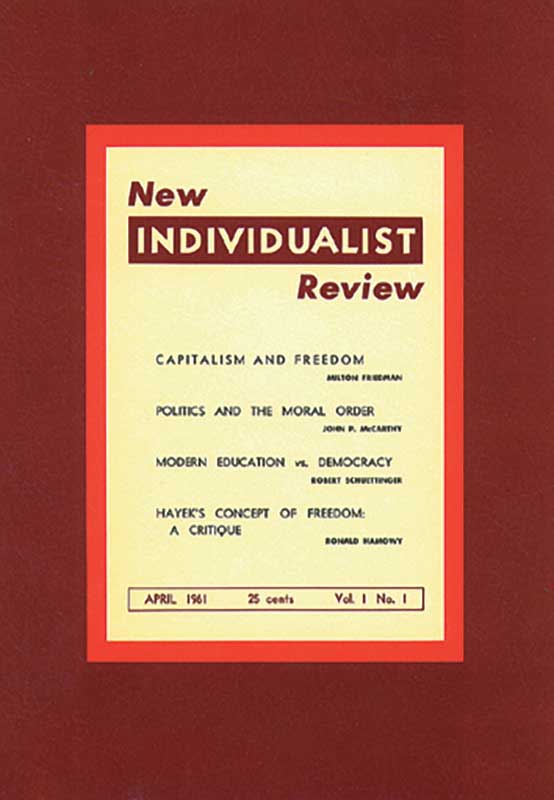
W. H. HUTT, COMMUNICATION: “Fragile” Constitutions - Ralph Raico, New Individualist Review [1961]Edition used:New Individualist Review, editor-in-chief Ralph Raico, introduction by Milton Friedman (Indianapolis: Liberty Fund, 1981).
About Liberty Fund:Liberty Fund, Inc. is a private, educational foundation established to encourage the study of the ideal of a society of free and responsible individuals. Copyright information:The copyright to this publication is held by Liberty Fund, Inc. The New Individualist Review is prohibited for use in any publication, journal, or periodical without written consent of J. M. Cobb, J. M. S. Powell, or David Levy. Fair use statement:This material is put online to further the educational goals of Liberty Fund, Inc. Unless otherwise stated in the Copyright Information section above, this material may be used freely for educational and academic purposes. It may not be used in any way for profit.
COMMUNICATION:
PROF. THOMAS MOLNAR’S courteous criticism of Dr. Denis Cowen’s interesting article on “Prospects for South Africa”1 reminds me of an occasion some years ago when I was addressing a meeting of the South African Institute of Race Relations (from the floor). The question of constitutional protection of minorities had arisen. I put forward the proposition that “the essence of an effective constitution is that it is built on mistrust, not on faith.” I can remember the murmer of disapproval—even seething indignation—which swept over the gathering. Most of the kindly, well-meaning people present—many of them clergy—could simply not contemplate so cynical a view. Several years before that, at another meeting of the same Institute, I had argued that the prospect of an African majority, through the ultimate extension of the franchise on the basis of “one man, one vote,” created wholly justifiable fears on the part of the Whites. I suggested that, if the sharing of political power with the Africans was ever to be peacefully achieved, it would have to be based on constitutional entrenchment of the rights of the three minorities—the Whites, the Coloureds (i.e., the half-castes), and the Indians. I suggested further that, for the presently-enfranchised Whites to be persuaded to share their virtual monopoly of political power, it would be absolutely essential to renounce the principle of universal suffrage on a common roll and accept some form of weighted franchise. I was told that the Africans would never agree to any such arrangement; that the very suggestion implied a slight on the majority race and a wish to maintain them in a permanent condition of inferiority and subordinacy; and, much to my regret, my proposal evoked an angry attack in the press from Alan Paton, for whom I have a profound admiration as a genuine humanitarian and one of the greatest novelists of this generation. Professor Molnar’s position appears to be exactly the opposite to that of the sentimentalists whose opposition I have recorded. He seems to argue categorically that no effective constitutional protection for minorities, such as the Whites in South Africa, is possible, unless the constitution denies all political representation to the majority group. Those who believe, as the Progressive Party in South Africa does, that the solution lies in the direction of limitations on voting rights, he describes as “starry-eyed liberals and misguided intellectuals.” Actually, that Party happens to be the only political party of which I myself have ever been a member, and I hardly deserve to be called “liberal” in the current American sense of the word. The sole reason why I felt compelled to join the Progressives a few years ago was that they are the only party in my country which has any glimmering of insight into the imperative need to restrain majority power. However wrong they may be on some issues, they do perceive that, if we are to find any democratic solution to the incipient racial conflict which history has bequeathed us, it is the state which we must somehow control. Yet we are reminded by Prof. Molnar that very few bills of rights and constitutions have “proved more than very fragile paper barriers.” This is undoubtedly true; but his point is, we should notice, not that constitutional entrenchments cannot be effective when they are enforced, but that constitutions will be torn up when they are unpalatable to majorities. The tearing up of the 1910 constitution of South Africa through the subterfuge of packing the Senate, and the absence of Constitutional restraint to prevent political appointments to the Supreme Court of the United States (which appointments have led to the Court’s functioning on vital issues—as I once heard it put—“like a constitutional convention in permanent session”), ought properly to shake the faith of those who, like myself, believe that minorities can be effectively protected by entrenched constitutional provisions with a rigid separation of powers. But if a constitution is framed by those who have studied dispassionately the manner in which time-serving politicians have in the past trampled on bills of rights, and who recognize therefore that their task must be carried out in an atmosphere of the utmost distrust of politicians and parliaments, and even of judges, must they necessarily fail? Obviously, a more effective means of ensuring judicial independence and preventing judicial tyranny than has yet been achieved in the United States is needed. Moreover, the question of control of the police and the armed forces is also a vital issue. I DO NOT THINK THE leaders of the Progressive Party in South Africa have gone nearly far enough in their studies of these and other aspects of the working of constitutions. The complex racial difficulties with which they are faced demand more imagination and inventiveness than they have yet given to their task; but they are pioneers among realistic political thinkers about race relations in South Africa. They deserve every encouragement and the frankest criticism from their friends. May not the attitude of Prof. Molnar on this issue have been influenced by a belief that a more humane form of apartheid is possible? Does he believe that the “separate development” of Africans in Bantustans like the Transkei, in which they will be permitted local government rights and ultimately perhaps (although this is very unlikely) some measure of political independence, can provide a statesmanlike solution? The truth is that, in spite of all the efforts to bring about segregation of one of the races in South Africa—the Africans—they seem to be in the process of integration into the White economy at an accelerating pace. As a very wise resolution submitted to a meeting of the Institute of Race Relations recently put it, “Segregation is an ideal. . . . It does not exist in any general or fundamental form in South Africa. The fact of integration and the ideal of segregation are on different planes and do not admit of a middle course between them. . . .” And the resolution suggests that one proper field of activity is, therefore, “demonstration of the fact of integration and exploration of ways to live with it. . . .” In spite of strenuous, indeed ruthless, governmental attempts to turn back the tide, economic integration is growing. Is it really conceivable, then, that a minority race will be able permanently to deny equality of opportunity to the other races, who constitute an overwhelming majority of the population, and to withhold from Africans the effective right to vote in the areas in which most of them must work? If Prof. Molnar thinks that this is possible, does he not invite the application to himself of his own epithet, “starryeyed”? When the minorities in my country fear eventual domination by the Africans—possibly imbued with the spirit of African nationalism and thirsting for revenge—these minorities are, of course, fearing what nationalists can achieve through the machinery of the state. The Progressive Party and Dr. Cowen are thinking in terms of preventing the abuse of state power. If Prof. Molnar maintains that they have not yet satisfactorially solved the problem of how to do so, I agree with him. But surely he cannot contend that they are groping for a solution in the wrong direction. Origins of Apartheid:In the following excerpts from his book, Economics of the Colour Bar, Prof. Hutt discusses the origins of apartheid. In the opinion of the Editors, an awareness of the history of apartheid is important in light of the preceding discussion. WE DO NOT . . . find in colour prejudice as such the main origin-nor, perhaps, even the most important cause—of most economic colour bars. The chief source of colour discrimination is, I suggest, to be found in the natural determination to defend economic privilege (the preservation of “customary economic relationships between the races”), non-Whites simply happening to be the essentially underprivileged groups in South Africa. Certainly colour custom and colour prejudice have been persistently exploited in efforts to win electoral support for measures which seek to curb the tendency of the profit system to admit the poorer races to better opportunities; but such casuistic exploitation of custom and prejudice does not make it the prime motive for the exclusion of competition from the despised or feared Coloureds, Asiatics or Africans. . . .1 Because of the shortage of skilled personnel in South Africa at the beginning of the century, artisan immigrants, reared in the traditions of the emergent restrictionist ideologies and British trade unionism, were brought to fill artisan and foreman posts. It is hardly surprising that, after the Boer war (and together with their Afrikaner comrades after 1907), they should have endeavored to enforce a sort of closed shop which denied all opportunities for advancement to their non-White comrades. The political background of the period had produced stereotypes which actively encouraged the formation of labour unions, and the strike power so created seems to have enabled the Whites to perpetuate the ratio of White to non-White wage-rates which had been established by the 1880’s. In this way, the unions managed not only to preserve the remuneration of their members against the competition of their fellow Whites, but later to forbid the training of Africans for employment in responsible, supervisory and skilled occupations. What was probably at that time the most blatant colour bar of history (although by no means the most burdensome) received the force of law in 1911. The motive was industrial peace; but it was sought via an appeasement of the militant White labour organization, which appeared then to be growing in strike power and political support. The beginnings of militant unionism date from the 1880’s and 1890’s when branches of British labour unions were opened in South Africa. The leadership was in the hands of typical union officials of the British type-hard, ruthless but scarcely Marxist. Quite early in South African labour history, however, the influence of the extreme Left seems to have been discernable, and resort to violence in support of strike action was not uncommon. This tendency was probably due to infiltration of the class-war idea from foreign countries rather than from the relatively respectable British trade unionism of the day....2 During the First World War, the White miners’ union had succeeded in enforcing wage-rate increases many times larger than those obtained by the unorganized Africans. But the position of the latter had in some respects improved because, through the emergency, they had been permitted to undertake semi-skilled work especially as drill-sharpeners. This opportunity for a small proportion of Africans mitigated the increased costs of mining gold, the price of which rose to a premium after the war for a short period only. When it was obvious that the sterling price of gold would return to its standard level, the mine-owners naturally attempted to retain Africans in semi-skilled tasks and tried further to obtain some relaxation of other wasteful provisions enforced through regulations under the 1911 Colour Bar Act. They asked for a ratio of 10.5 Africans to 1 White; but the labour union demanded 3.5 to 1. A disastrous strike followed in 1922. The miners were supported by a general strike on the Rand, which developed into virtually an armed uprising. Those who revolted were mainly Afrikaners, but as always the extremists of the Left were experts in the art of fishing in troubled waters. W. H. Andrews, who was shortly to become Secretary of the Communist Party in South Africa, played a leading role in this fight for White privilege. The revolt was crushed but powerful publicity had been given to the notion that the Whites were fighting against capitalist exploiters for the preservation of their traditional and rightful economic supremacy. In that sense, the strike, which has been called the “colour bar strike,” was a victory for Andrews and those who called themselves socialists. At the time of the strike, the overwhelming majority of the white miners (foremen or artisans, as distinct from executives) were Afrikaners from the Transvaal and the Orange Free State, and their anti-colour indoctrination had been fruitfully exploited from the first by the Marxist-indoctrinated inspirers and leaders of the insurrection, such as Andrews. The result was a great boost to the South African Labour Party, which was modelled more or less on its British counterpart and was on the best terms with the British trade-union movement. In 1924, largely through the impact upon White opinion of the 1922 strike, it obtained the chance of sharing in government through a coalition formed with the Nationalist Party, a socialistically-oriented party representing Afrikaners who accepted the principle of White supremacy and non-White subjection. Without this active co-operation of a typically British sort of Socialist party to form a Labour-Nationalist “Pact,” the era which introduced the most serious forms of colour injustice might never have emerged....3 THE “RATE FOR THE JOB” was the vital principle in the most powerful yet most subtle colour bar that has ever operated. Equal pay for equal work (i.e., for identical outputs of a given quality) is a result of the neutrality of the free non-discriminatory market. It is no method of achieving such a market. When the standard wage-rate is forced above the free market level (whether through legal enactment or the strike threat), thereby reducing the output which can be produced profitably, it must have the effect of preventing the entry of subordinate races or classes into the protected field or of actually excluding them from it. This has been by far the most effective method of preserving White privileges, largely because it can be represented as non-discriminatory. Whereas some of the policies of the Labour-Nationalist Pact amounted to blatant discrimination (such as the deliberate dismissal of non-Whites in order to employ Whites in government service), the effects of the “civilized labour” restraints have been far more important. They have rendered much more formidable the restraints imposed by custom and prejudice that have debarred non-Whites from avenues of economic advancement. They have, indeed, had a more unjust impact than “influx control” and “job reservation” under apartheid. . . .4 The initial disadvantages of the non-Whites due to home background and lack of resources for investment in their own education have in themselves been a minor hindrance to their progress. It will generally pay private enterprise to see that education, both general and technical, is made available where openings for the employment of the attributes and skills acquired are not likely to be suppressed. But powerful custom or prejudice, collusive action and legal enactment, by closing potential avenues of employment may destroy the motive for investment in human capital. Indeed, it will be wasteful for the state, for business concerns or for individuals to devote their energies and limited incomes to such purposes. But there would have been an irresistibly strong demand for developing the industrial usefulness of the Coloureds if it had not been for fears that any such move would have encountered other legislative steps to render unusable the skills so developed. The profit motive is powerful; but when it is likely to be overruled by legislation or regulation its power to serve the community is hamstrung. . . .5 I have tried to show that in South Africa it has been to the advantage of investors as a whole that all colour bars should be broken down; and that the managements of commercial and industrial firms (when they have not been intimidated by politicians wielding the planning powers of the state) have striven to find methods of providing more productive and better remunerated opportunities for the non-Whites. . . .6 The virtues of the free market do not depend upon the virtues of the men at the political top but on the dispersed powers of substitution exercised by men in their role as consumers. In that role, a truely competitive market enables them to exert the energy which enforces the neutrality of business decision-making in respect of race, colour, creed, sex, class, accent, school, or income group. The reader will have noticed that at no time have I claimed that the free market which released the “liberating force” has been motivated by altruistic sentiment. . . .7 [* ] W. H. Hutt has been Professor of Commerce and Dean of the Faculty of Commerce at the University of Cape Town, South Africa. He is currently Visiting Professor of Economics at the University of Virginia. [1 ] The two articles mentioned appeared, respectively, in the Winter 1966 and Spring 1965 issues of New Individualist Review. [1 ] W. H. Hutt, The Economics of the Colour Bar (London: Institute of Economic Affairs, 1964), p. 27. [2 ]Ibid., pp.58-59. [3 ]Ibid., pp.68-69. [4 ]Ibid., pp.72-73. [5 ]Ibid., p.79. [6 ]Ibid., p.173. [7 ]Ibid., pp.174-75. |

Titles (by Subject)