Econlib

The Library

Other Sites

Front Page arrow Titles (by Subject) arrow HENRY HAZLITT, Agnosticism and Morality - New Individualist Review

Return to Title Page for New Individualist Review

Search this Title:

Also in the Library:

Subject Area: Economics
Subject Area: Political Theory
Subject Area: History
Order this book from Liberty Fund

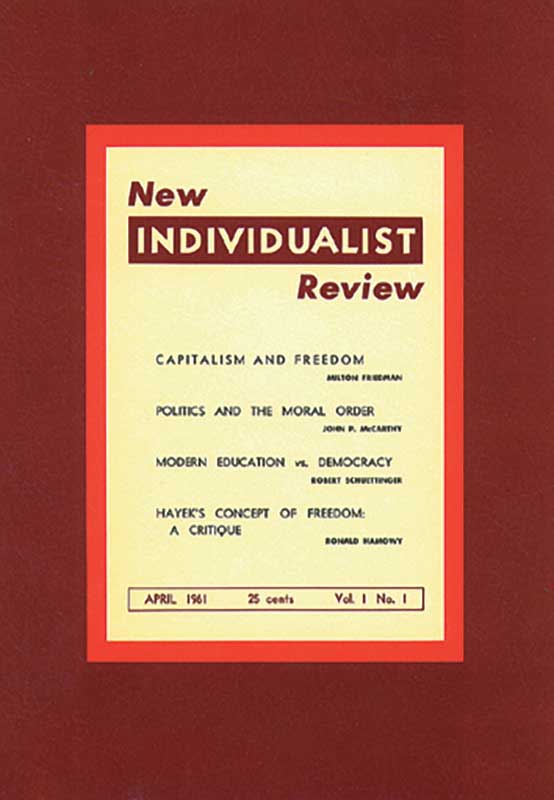
HENRY HAZLITT, Agnosticism and Morality - Ralph Raico, New Individualist Review [1961]

Edition used:

New Individualist Review, editor-in-chief Ralph Raico, introduction by Milton Friedman (Indianapolis: Liberty Fund, 1981).

About Liberty Fund:

Liberty Fund, Inc. is a private, educational foundation established to encourage the study of the ideal of a society of free and responsible individuals.


Agnosticism and Morality

I THINK I SHOULD begin with a confession of faith—or lack of faith. I am an agnostic. Having made this confession, I think I should go on to say just what an agnostic is, and is not, and just what kind of agnostic I consider myself to be.

An agnostic is, first of all, a man who confesses his own ignorance—specifically, his own ignorance of the ultimate nature of the universe, of the ultimate destiny of man, of whether the universe has or has not a “purpose,” and finally, of whether there is or is not a God or Supreme Being governing the universe.

It is possible to define an agnostic by two negatives: Although, on the one hand, he is not convinced of the existence of God, he is not certain of His non-existence either. A man who declares himself to be an atheist declares that there is no God. The agnostic replies that such a statement is mere dogmatism, and assumes knowledge and evidence that do not exist. Yet, there is a wide range of possible differences, intellectual and emotional, among agnostics; and I think I should explain just where I stand in that spectrum. An agnostic may merely be one who confesses his personal ignorance of whether or not there is a God. He may be willing to admit that perhaps others know, or can know, or at least that mankind may someday know. I should not blankly deny this last possibility, but I regard it as enormously improbable.

The human intellect is wonderful, judged by animal standards; it has recently shown itself capable of accomplishments that a highly intelligent man before the birth of Aristotle would have thought impossible, and, in fact, of accomplishments that would have amazed even Leibnitz or Newton or Darwin. Yet the human intellect is primarily an instrument for dealing with practical problems. While it is capable of amazingly abstract concepts, it can carry back the chain of cause and effect only for a finite and limited distance. This little animal brain, weighing three or four pounds, and these limited animal senses, were not evolved to comprehend infinite time or space, or the complexity of an infinite number of facts; or a First Cause.

The human brain has, of course, achieved wonderful results by inventing and manipulating symbols, as in mathematics; but these results, I think, lead us to deceive ourselves as to the true extent of our knowledge. Any man can say “a million,” or “a billion,” or a “hundred billion,” and write down the symbols or perform various operations with them in a matter of seconds or minutes; but how many men can have a true conception of even a million—a million dollars or a million miles or a million anything else: As an economic journalist I have been stuck, in recent years, with how little impression it makes on people to tell them that we have a five billion dollar budget deficit, or that we have given away more than one hundred billion dollars in foreign aid.

The more a man knows, the more he realizes the extent of his ignorance, and the greater that ignorance seems to him. One of the most striking examples of this is Sir Isaac Newton, the greatest intellect of his age, and possibly the greatest that has ever lived: “I do not know what I may appear to the world,” he wrote, “but to myself I seem to have been only a boy playing on the seashore, and diverting myself in now and then finding a smoother pebble or a prettier shell than ordinary, whilst the great ocean of truth lay all undiscovered before me.”

I became an agnostic, as I remember, at the age of seventeen or eighteen; and I gave up my belief in God and human immortality painfully and reluctantly. Today my agnosticism is more thoroughgoing than it was then. I remember being for some time attracted by Herbert Spencer’s concept of the Unknowable; but I later decided that Spencer knew too much about the Unknowable. He knew that it was unknowable; he seemed also to know just where the Unknowable began, and the exact dividing line between it and the Knowable. I decided that none of these things were known and probably could not be known.

Today I am not sure that I know even the meaning of the ultimate religious or philosophical questions, let alone the positive or negative answers. What is the meaning of the question: “Is there a God?” or “Is there a Supreme Being?” What is the meaning of the answer: “There is a God” or “There is no God”? How would we establish whether either answer is true? What sort of evidence would we look for to establish the truth or the probable truth of our answer? What necessary consequences would follow from the truth or falsity of either answer? What necessary difference, for example, would the truth or falsity of either answer make in our own earthly goals or our own conduct?

What sort of concept lies behind the words either of the theist or the atheist, “Do you believe in a personal God?” What is meant by “personal” in this connection? That God looks like a human being—like the God painted by Michelangelo on the ceiling of the Sistine Chapel, for example? That he is the size of a human being? Or twice the size? Or how many times the size? That he has a definite location in space—“in heaven,” for example? That he is “within us”? Like a microbe? Exactly what does this spacial metaphor mean, and is it consistent with belief in a “personal” God? Or does a “personal” God simply think or feel like a human being? Think with our limitations, or without them? Feel the way a person feels? But in what respect? Surely not in physical appetites, or in sexual drive, or in energy or fatigue, or in ambition or frustration, or in seeing the same things as beautiful, indifferent, or ugly—or in showing the same tastes and responses that make up at least nine-tenths of all human feelings and actions.

LET US ABANDON THESE insoluble problems and come to a problem that seems at first glance more soluble. Let us ask: How do, or how should, our intellectual answers—whether theism, atheism, or agnosticism—affect our attitude toward the universe—our trusts and hopes and fears, for ourselves or for mankind, our goals, our morality, our attitude towards each other? A large number of modern philosophers have concluded, in despair of knowing what to believe, that the essence or religion is simply such an attitude. I have myself been attracted by the statement of Gerald Heard, for example, that the essence of religion is a belief that the universe is friendly; but this attitude of trust in the universe, as regards its intentions towards mankind, rests on a belief. What is the ground or justification for this belief? To be sure, the universe has been friendly enough toward man in the past to make it possible for him to evolve, to multiply, to live longer, and to increase his material satisfactions enormously. What reason, though, do we have for assuming that this will go on indefinitely, that the earth will not grow cold—or collide with a comet or some other body? Hurricanes, tornadoes, floods, droughts, and earthquakes are, after all, a matter of annual occurrence, and seem to be entirely indifferent to our human hopes or prayers.

I have given time to confessing and explaining my reasons for doubt. I am not triumphant about my doubts. I am not eager to infect anybody else with them. I am not eager to undermine anyone else’s religious faith. In brief, I am not eager to argue for my doubts; I am merely trying to explain them.

What I do wish to state, however, is my conviction that one’s belief or lack of belief on religious matters neither logically should, nor in fact does, affect one’s actions, goals, and moral conduct to anything like the extent that is commonly imagined. This conviction rests on both empirical and on deductive grounds. Those who are acquainted with the history of moral philosophy know that there is no sharp and consistent difference between the moral injunctions preached by the pagan philosophers and by the early Christian philosophers. There is no sharp and consistent difference between the “justice” of Socrates and Plato, between the “golden mean,” the “temperance” and the “high-mindedness” of Aristotle, between the virtues preached by the Stoic philosophers, by Epictetus with his counsels to “endure” and “refrain,” by Marcus Aurelius and his precept to “reverence the gods and help men”—and the virtues recommended by, say, Thomas Acquinas. In fact, as Henry Sidgwick reminds us: “The moral philosophy of Thomas Aquinas is, in the main, Aristotelianism with a Neo-Platonic tinge.” And when Aquinas lists the moral virtues by which others receive their due, his list of such virtues, to the number of ten, “is taken en bloc from the Nicomachean Ethics.”1

It is not merely in moral philosophy, however, but in prevailing commonsense ethics, that we find, in spite of peripheral differences, a great central core of agreement in the moral codes of different nations and peoples and even of historical eras, notwithstanding fundamental differences in religion. Practically all widely-shared moral codes have been against domestic murder and violence, law-breaking, looting, banditry, theft, ingratitude, treachery, lying, promise-breaking, etc. Practically all such codes have been for law and order, domestic peaceableness, promise-keeping, truth-telling, loyalty, mutual aid, good manners, etc.; and all this for the simple reason that justice and morality are absolutely indispensable for the very preservation of society.

For the same reason, whatever different names they may have given to it, or whatever aspect they may have emphasized, all moral codes have implicitly recognized that the very function and goal of a moral code is, on the negative side, to prevent or minimize violence, conflict and strife; and on the positive side, to promote human well-being and happiness. The minimum goal of our moral rules is to avoid conflict and collision, to learn how to keep out of each other’s way. In a wider setting moral rules are necessary so that we can all reasonably count on each other’s statements, promises, and actions, so that we not only may avoid acting at cross-purposes but can co-operate with each other to promote our mutual welfare.

TOO MUCH TIME HAS been wasted in moral philosophy in comparing or contrasting the relative necessity and merits of “egoism” and “altruism.” There is no basic conflict, but coincidence and harmony, between the rules of action that would do most to promote the welfare of the individual and those that would do most to promote the welfare of society. One could hardly promote one without promoting the other, or harm one without harming the other. It is in the interest of every individual to live in an orderly, peaceful, secure, co-operative—i.e., a moral—society. Social co-operation is the heart of morality, and the means by which each of us can most effectively supply his own wants and maximize his own satisfactions.

Whether or not a man believes in God, he has exactly the same reasons for following the rules of prudential ethics. If he is an idler, a spendthrift, or a gambler, a glutton, a drunkard, or a drug addict, he will pay the same penalties for his sins in the one case as in the other. Whether or not a man believes in God, he has exactly the same reasons for obeying the traffic laws: they exist for his own protection as well as the protection of others, and if he violates them he takes the same risks with his own life as well as the same risks with the law. Finally, whether or not a man believes in God, he is likely to have the same sympathy with his fellow men, the same respect for their opinion, the same desire for their good will, and the same impulse to act decently towards them. “It is a curious assumption of religious moralists,” once wrote Santayana, “that their precepts would never be adopted unless people were persuaded by external evidence that God had positively established them. Were it not for divine injunction and threats, everyone would like nothing better than to kill and to steal and to bear false witness.”2 The religious moralists who hold this view assume that those who do not believe in God are moral only because they are afraid of being caught. Yet their own argument also assumes that religious people are moral chiefly because they believe that God will reward them if they are, and punish them if they are not.

Those who are truly moral, in fact, whether theists, agnostics, or atheists, are so because they believe that virtue is its own reward, and sin its own punishment. They believe that good actions promote human well-being, including their own, and that evil actions injure others as well as themselves. In brief, whether we are Catholics, Protestants, Jews, agnostics, or atheists, we can agree on essentially the same moral code. If most of us, even if we are professed Christians, cannot always bring ourselves to love each other, most of us, religious or non-religious, can be brought to see the advantages of being decent and polite and even kind to each other.

Morality, in other words, is autonomous; it is not dependent on one’s religion. As Stephen Toulmin has put it, writing from the standpoint of a religious man:

Where there is a good moral reason for choosing one course of action rather than another, morality is not to be contradicted by religion. Ethics provides the reason for choosing the “right” course: religion helps us to put our hearts into it.3

Finally, as William James wrote: “Whether a God exist, or whether no God exist, in yon blue heaven above us bent, we form at any rate an ethical republic here below.”4 This, I think, is the best if not the only basis on which it is possible for the religious and the non-religious to co-operate intellectually in moral, legal, and political philosophy.

This does not mean that any of us need abandon religious or ontological speculations. On the contrary, we should all strive to keep alive the sense of wonder and awe before the inscrutable mystery of the universe, before the tremendous mystery of existence—not merely of the existence of mankind, but of the existence of anything, the existence of a grain of sand, or of the planets, the sun, the solar system, the stars, the Milky Way, the constellations and galaxies without end. The difference between a philosopher and a philistine, between a thinking man and a Babbitt, is that the thinking man has not lost his sense of wonder. In his Voyage of the Beagle, Darwin tells us how, at one place where the ship anchored, the native savages were enormously curious about the rowboats in which the British came ashore; but they showed no interest in the ship itself. It was so far beyond their understanding that they simply took it for granted. It is a very limited and shallow mind that takes the existence and nature of the universe for granted.

LET US BY ALL MEANS keep alive our interest in ultimate questions; but let us recognize that they are ultimate questions, final questions. Our own conclusions on these matters, if we arrive at any, should not be made the necessary premises for agreement on practical actions or policy.

All of my readers are, I take it, devoted to a greater or lesser degree to liberty; and among the liberties that all of us hold most precious is liberty of opinion—for ourselves and for others. If we respect this, we will not insist that others must accept our own particular religious, epistemological, or ontological premises before we will even condescend to argue with them on moral, legal, or political questions.

[* ] Henry Hazlitt is a Contributing Editor of Newsweek, and author of a number of books, among them Economics in One Lesson, The Foundations of Morality, and The Failure of the New Economics.

[1 ]Outlines of the History of Ethics (1886), pp. 141-42.

[2 ]Dominations and Powers (New York: Scribners, 1951), p. 156.

[3 ]An Examination of the Place of Reason in Ethics (Cambridge: Cambridge University Press, 1950), p. 219.

[4 ] “The Moral Philosopher and the Moral Life,” (1891), in Pragmatism and other Essays (New York: Washington Square Press, 1963), p. 223.