Econlib

The Library

Other Sites

Front Page arrow Titles (by Subject) arrow FRANCIS LIEBER, Anglican and Gallican Liberty - New Individualist Review

Return to Title Page for New Individualist Review

Search this Title:

Also in the Library:

Subject Area: Economics
Subject Area: Political Theory
Subject Area: History
Order this book from Liberty Fund

FRANCIS LIEBER, Anglican and Gallican Liberty - Ralph Raico, New Individualist Review [1961]

Edition used:

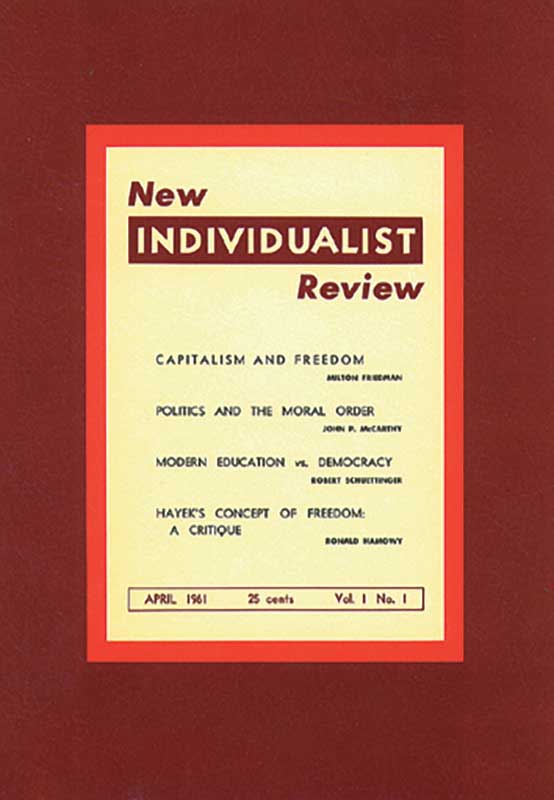
New Individualist Review, editor-in-chief Ralph Raico, introduction by Milton Friedman (Indianapolis: Liberty Fund, 1981).

About Liberty Fund:

Liberty Fund, Inc. is a private, educational foundation established to encourage the study of the ideal of a society of free and responsible individuals.


Anglican and Gallican Liberty

Francis Lieber, scholar and political writer, was born in Prussia in 1800, emigrated to America in 1827, and soon thereafter became an American citizen. His career was divided between teaching at the University of South Carolina and Columbia College, and such public services as the composition of legal rules to protect non-combatants and their property in time of war (his suggestions were adopted by Lincoln for the Union Army and subsequently embodied in the Hague Conventions of 1899 and 1907). His main energies, however, were devoted to a comprehensive statement of liberalism, the social philosophy which was his lifelong concern. The following selection, from his Miscellaneous Writings,1is a characteristic example both of Lieber’s liberal political thinking and his admiration for his adopted country.

IN THE SPHERE of political freedom there arise, as in all spheres of unfettered action, different schools, to borrow a term from the province of philosophy and that of the arts. It is thus that we have in the province of political freedom an Anglican and Gallican school. The term Anglican has been adopted here for want of a better one. We stand in need of a term which designates characteristics peculiar to the Anglican race in Europe, here, and in other parts of the world. If they are not all peculiar to this race, they are at least characteristics which form very prominent marks of its politics.

It is by no means the object here to show the gradual development of modern liberty and of the Anglican characteristics, their causes, and the circumstances under which they developed themselves, but rather to point out in what at this moment consist the striking features of these two political schools. With this view, it may be stated at once, that Anglican liberty distinguishes itself above all by a decided tendency to fortify individual independence, and by a feeling of self-reliance. The higher the being stands in the scale of nature, the more distinct is its individuality until it reaches in man its highest degree, and among men again we find the same principle prevailing. The higher, the more intellectual, and the more ethical the being is, the more prominent is also his own peculiar individuality. The same progress is observed in the scale of civil liberty. Individuality is almost annihilated in absolutism—whether this be of a monarchical or a democratic cast—while the highest degree of freedom (in the Anglican view of the subject) brings out the individuality of every one and the individual activity of each, as best it seems to him, in its freest play. Independence in the highest degree, compatible with safety and broad national guarantees of liberty, is the great aim of Anglican liberty, and self-reliance is the chief source from which it draws its strength. At no period has the deplorable absorbing concentration of power which characterizes the political systems of the continent of Europe during the seventeenth and eighteenth centuries obtained a footing among the Anglican peoples, although it was several times strenuously attempted. All the maxims of the common law most dear to the people, and most frequently quoted with pride as distinguishing it favorably from the civil law, embody this manly feeling of individual independence.

Everywhere is liberty considered by the Anglican nation to consist, in a very high degree, in a proper limitation of public power. Anglican liberty may be said to consist, essentially, in a proper restriction of government, on the one hand, and a proper amount of power on the other, sufficient to prevent mutual interference with the personal independence among the people themselves, so that order and a law-abiding spirit becomes another of its distinctive features. No people of the past or present have ever made use of the right of association, even where it fully existed, equal to the vast and at times gigantic application of this right to great practical purposes of a social, as well as political, character among the English and Americans. Public interference is odious to them. Government, to them, is not considered the educator, leader, or organizer of society. On the contrary, in reading the many constitutions which this race has produced, and the object of which is to define the spheres of the various public powers and to fix the rights of the individual, we almost fancy to read over all of them the motto, “Hands off.”

This tendency of seeking liberty, above all, in untrammelled action has produced among others the following great effects.

The untrammelled action or absence of public interference (which of course must in its nature be almost always of an executive character) has not been restricted to individuals, but as a matter of course the spirit has extended to institutions and whole branches of power, so that time was allowed to them to grow, to develop themselves, and to acquire their own independent being; consequently, we find the word law possesses a meaning very different from that which the corresponding words have even in their most comprehensive sense with other nations; we find a common law rooted deeper in the people than any enacted law or constitution; we find a parliamentary law (no “reglement”); we find the indispensable principle of the precedent of greater power than minister or crown, even though it be worn by a Stuart, or a Henry the Eighth.

Secondly, a consequence of the principle of self-reliance is that liberty is conceived far more essentially to consist in a great amount of important rights than in a direct share in the government. The latter is sought after as a security and guarantee for the former.

Thirdly, Anglican liberty consists in or produces the utmost variety, as all untrammelled life and unfettered individual actions necessarily do. Equality (if sought in aught else than in equality of freedom from interference, and if believed to consist in uniformity alone) is monotony, and becomes the opposite to life and action.

Fourthly, the Anglican race has mixed up subjects purely social with politics far less than any other race, and, it may be safely averred, has allowed itself to be less misled by phantoms, and adhered more to positive realities in the sphere of public life, than any other division of mankind.

EVERY GREAT PRINCIPLE or movement of mankind has its own characteristic fanaticism, caricature, or mischievous extravagance. This applies to all movements, religious, social, or political, and Anglican individualism leads, if carried beyond its proper line, to selfish isolation and heartless egotism. The fanaticism of Anglican individualism is Utilitarianism as it has been taught by some. But it must not be forgotten that we speak here of civil liberty alone. No American or Englishman has ever maintained that we can do without patriotism, without devotion to the public, and it is a striking fact, admitted by all, that nowhere is shown so much public spirit, during successive periods, as by the Anglican people, although it might have been supposed that their individualism would have led to the opposite. The reason is that Anglican liberty makes the people rely upon themselves, and not upon public power; they feel, therefore, that they ought to help each other and to depend upon their own united action, and not call for the aid of government at every step.

From a point of view, therefore, which belongs to Anglican liberty, the French device—Liberty, Equality, Fraternity, will appear in this light: Liberty is aspired to by all; it is the breath of conscious man. If equality means absence of privilege, unfounded upon political equivalents, it is comprehended within the term of liberty; if it mean, however, social uniformity, it is rather the characteristic of absolutism, and not of liberty. For if liberty means unrestrainedness, it implies variety. Bating the monarch, there exists nowhere in Europe or America a degree of equality equal to that in all Eastern despotisms, or that which existed in the worst period of Athens, where democratic absolutism was consistently carried out; where ultimately the principle of equality required the razing even of talent, fitness, and virtue, and the lot decided upon appointments. After the principle of equality had been established in such a manner, Aristotle described democratic liberty (or what we, according to modern terminology, would call democratic absolutism) as consisting in this: that every citizen is, in regular turn, ruling and ruled. Diversity is the law of all organic life, and despotism and freedom find their parallels in nature, in inorganic matter, and organic bodies. As to fraternity, it is the broad principle proclaimed by Christ; it is the divine principle of all social existence; it is one of the wells from which we shall draw, to irrigate our otherwise sterile life; it is like charity, like honesty, like forbearance, and to be true, ought to be infused into all our actions and measures, but it is no right, it is not liberty; nor does it necessarily indicate freedom. There is in some respects more political fraternity among Mohammedans than, unfortunately, among Christian people. Not that we put any slight value upon fraternity; Christians ought to have far more; but we merely mean to show that it is not necessarily connected with liberty. Fraternity exists often in the highest degree among the rudest tribes. That this device was adopted during the first French revolution was natural. It had a meaning in contradistinction to the utterly selfish and immoral state of things which had existed and which it was a settled purpose to destroy: but its resumption in the present third French revolution leads to misconceptions or rests on a confusion of ideas, which seems as great as if in America a political banner were raised with the motto, Liberty, Love of our Enemy, and Salvation; or Liberty, Production, and Daring. All these are excellent or sacred things, but used as distinctive political characteristics would either have no meaning or might easily be made to mean mischievous things.

QUITE DIFFERENT from Anglican is Gallican liberty. The history of England distinguishes itself from that of all the other nations of Europe by nothing more than by the fact that, in that country alone, the nobility assimilated itself at a very remote period with the people. As early as in the year 1215 the noblemen did not wholly forget the people. The plodding husbandman was included in the Magna Charta; and repeatedly afterwards we find the knights siding with the citizens. The nobility of all other countries, however, were and remained selfish, oppressive and rebellious barons. Louis XI and Richelieu greatly broke their power in France, and Louis XIV completed the work. No citizen-liberty having existed in that country, Louis found himself perfectly unlimited so soon as he had changed the baron into the servile courtier; and now a system of such absorbing centralization began that, when he died, he left France without institutions (if we take the term in the Anglican sense, meaning institutions with an independent and individual existence), as he left her without money and without morality in the leading classes. The absorbing centralization of power went on in all successive periods, and whatever changes of government have taken place, the process of centralization was only speeded on by it. The ball was ever rolling in that direction. The first French revolution, whatever benefit it otherwise produced, accelerated and perfected it much; Napoleon carried it still further, and a minister of the present provisional government, M. Ledru Rollin, lately declared, in one of his proclamations, that France should imitate the example of Paris, which he called the center and representative of French virtue, intelligence, action, and patriotism. How strange a similar declaration of an English minister, with reference to London, would sound in the ear of an Englishman, or of our President with reference to New York, or any state of ours!2

Concentration of the most stringent kind existing, and it being neither disrelished nor suspected by the people, it is obvious that, coupled with the idea of liberty, in contradistinction to despotism, it can produce no other idea than equality—an equal change of “ruled and being ruler”; and since equality, with this political meaning, is a practical impossibility with a nation so vast as the French, we have the further consequence that, practically speaking, equality means in France always the exclusive sway of a certain class. He that seeks now to sway is the Ouvrier, and Bourgeoisie has actually become a name of shame or hatred, as the term noblesse had become in the first revolution.

Gallican liberty, then, is sought in the government, and, according to an Anglican point of view, it is looked for in a wrong place, where it cannot be found. Necessary consequences of the Gallican view are that the French look for the highest degree of political civilization in organization, that is, in the highest degree of interference by public power. The question whether this interference be despotism or liberty is decided solely by the fact who interferes, and for the benefit of which class the interference takes place, while according to Anglican views this interference would always be either absolutism or aristocracy, and the present dictatorship of the ouvriers would appear to us an uncompromising aristocracy of the ouvriers.

The universal acknowledgment of organization makes the Frenchmen look for every improvement at once to government. Self-reliance does not exist in detail. While the British race seeks for one of the great applications of liberty in free trade, the French call for organization of labor, and M. Louis Blanc has proposed a plan, accordingly, which would appear to us as insufferable tyranny, and annihilation of individuality. While we have seen, in the Anti-Corn-Law League, a mighty private association coping with the most powerful interest that ever existed in a legislature, the British land-owner, and ultimately forcing government to fall into its own ranks, we do not find a solitary club in Paris pursuing one detailed practical measure, but all discuss the best organization, and to the Minister of Justice, and of Worship, and to others whom previous “organization” had already created, a Minister of Labor, and even one of Progress has been added, if the papers have informed us correctly. In Anglican liberty the movement not only begins with the people, but also the practical carrying out. In France, liberty is expected to begin practically with government organization and to descend to the people.

This is so true, that a large number of the French (we believe it to be a minority, but it is the active and loud minority) seem to have wholly discarded the idea that liberty is the main object to be striven for, and call for a social reorganization. A very busy and widespread club at Paris has actually hoisted a banner on which the word Liberty is omitted, bearing the following device: Equality, Solidarity, Fraternity. Here, then, we have the caricature of French liberty, as we have in ultra-utilitarianism that of Anglican freedom. Equality and solidarity are necessary elements of all politics. Without solidarity no nation could be a nation, no state a state. Every one is obliged to bear with laws which he considers bad, or the consequences of a war which he condemns. It is the price we pay for living in a civil society; but if solidarity be elevated into a distinctive mark of a specific political or social system it is the death-blow to individualism, and a Spartan republic, destroying even the family, must be the consequence. Here, too, is to be found the reason of the striking phenomenon that at all periods the fanatics who have attempted the abolition of private property always made war against exclusive or individual marriage at the same time. Many communists have preached it, and many religious fanatics in the Middle Ages have attempted it.

The fact that Gallican liberty expects everything from organization, while Anglican liberty inclines to development, explains why we see in France so little improvement and expansion of institutions; but when improvement is attempted, a total abolition of the preceding state of things—a beginning ab ovo—a re-discussion of the first elementary principles.

ANGLICAN LIBERTY produces variety, as was stated before, and demands absence of unnecessary restraint; Gallican liberty demands uniformity and even uniforms, so odious to Americans. A proclamation of the provisional government, dated April 30, 1849, actually begins with the words: “Considering that the principal of equality implies uniformity of costume for the citizens called to the same functions,” etc., prescribing a costume—coat, waistcoat, and pantaloons, to the members of the national assembly—that assembly which, according to the expression of the provisional government itself, is the highest representative of national sovereignty that has ever assembled, and into whose hands that same provisional government will lay down its power. Nothing can show more distinctly the difference between Anglican and Gallican liberty than that this order was possible.

In England and America, the principle of liberty dictates that all that can be done by private enterprise ought to be left to it, and that the people ought to enjoy the fruits of competition in the highest possible degree. In France, on the other hand, the provisional government made arrangements to buy up all the railways so soon as the king had been expelled.

All political changes, according to Anglican liberty, are intended more efficiently to protect the changes which society has worked for itself; according to Gallican liberty, the great changes are intended to be, not political, but social, organized by government: that is, according to Anglican liberty, forced upon society by the successful party, which, nevertheless, may be a very small minority owing to the peculiar power which, in the great system of concentration, Paris exercises over France, and which all movable masses exercise over populous cities—an influence considered salutary according to Gallican views of liberty, and disastrous according to Anglican.

THE OBJECT OF this paper has been to show the difference of the two schools, and it would be foreign to the subject to dwell upon the generous enthusiasm which pervades at this moment large parts of the French people, and, coupled as it is with the fearful reminiscences of former days, has produced some very remarkable effects; but enthusiasm cannot last, and, if it could, it cannot become a substitute for individualism, an indispensable element of our ethical nature. Enthusiasm is a necessary element of all great actions of individuals as well as masses, but he who founds upon it plans of a permanent state of things, whether in worship or politics, deprives his system of durability. Nothing can insure principles against an early withering but institutions. No ruler, however popular or brilliant, no period, however glorious, and no enthusiasm, however generous, can produce lasting good if they do not lead first of all to the foundation of expansive institutions. Nations must neither depend upon popular rulers, nor trust their own enthusiasm. If they do, everything is frail and evanescent, and the continuity of the state, without which there is no law, order, strength, or greatness, is rendered impossible.

This remark leads us to the last observation we mean to make upon the difference of Anglican and Gallican liberty. The Anglican race is a decidedly institution-loving and institution-building race, as the Romans were, who built up the civil law. They are conservative as well as progressive, and believe that conservatism is as necessary an element as progression. The fanaticism of conservatism is a Chinese idolatry of the past and the old. The French, on the other hand, as they appear, at least in modern times, are philosophizing, often brilliant, organizers, and resemble in this more the Greeks, who built up no law but whose philosophers proposed invented governments. The fanaticism of this disposition is a restless re-beginning at every step and denial of the necessity of continuous progress.

It must have appeared to the reader that the writer of this paper is an advocate and lover of the principles of Anglican liberty; that he believes the French are mistaking democratic absolutism for democratic liberty; that the whole Continent will have to pass through long periods of ardent struggle before it can rid itself of the consequences of the unhallowed centralization which absolute princes in their blindness mistook for power and fastened upon the people; that he is a devoted friend to independence and the liberty of the individual, which, in his opinion, need be as little connected with selfishness as Christianity is, although this religion, above all others, throws man upon his individual responsibility, thus raising him immeasurably; that, however dazzling the effects of democratic absolutism occasionally may be, it is still not freedom, which, like dew, nourishes every blade in its own individuality, and thus produces the great combined phenomenon of living nature; and that he would infinitely prefer a life in one of our loneliest log-houses to a barrack-residence of absolute equality, stifling his own individuality and that of every one of his fellow-citizens, however brilliant that barrack might be furnished.3 But whether these are the views of the writer or not, is of little importance. The truth remains the same, that the difference pointed out by him exists between the two modes of liberty, that they differ widely, and that it behooves every sincere friend of liberty to reflect maturely on the subject and to come to clear results; especially on the European continent, where liberty is in a nascent state, and is of course exposed to be seriously injured in the tender age of her infancy; while a closer geographical connection with France often leads to the adoption of measures and views peculiar to that country, when no intrinsic reason for doing so exists. The European continental countries have had their periods of absorbing and life-destroying centralization. The principles of our liberty, therefore, are peculiarly necessary to the people of the European continent. Many of them seem to fall into the same unfortunate delusion of expecting everything from organization by public power.

[1 ] This text is taken from Miscellaneous Writings of Francis Lieber, Vol. II, Contributions to Political Science (Philadelphia: J. B. Lippincott, 1881). pp. 377-88. This essay appeared originally in a newspaper published at Columbia, South Carolina, June 7, 1849.

[2 ] The most remarkable fact in history, so far as centralization is concerned, is probably the last French revolution (of 1848). A minority—but allow even a majority—of a single city changes a monarchy into a republic; the republic is telegraphed into the provinces and France is a republic, without any attempt at resistance, any show of adhesion to the former government, any struggle. If all France had been so thoroughly prepared for the republic (which we now know was not the case) that nothing more than the breathing of the name was necessary, the former government must long before have collapsed. If this was not the case, the socalled republic would not have been received so easily, were not the French accustomed to receive everything from Paris, fashions, pronunciations, and orders, and even now telegraphic despatches telling the prefect Monsieur so and so, that Il n’y a plus de roi, or some such thing. Is not the people in a very abject state where such things can occur? Is this not Russian? Does it not remind of the worst times of Rome? The French often, nay, almost universally, confound this submission to Paris with laudable patriotism. But this only shows the more the absorbing centralization which exits in France.

[3 ] The writer is no admirer of the feudal ages. He has repeatedly given views of that period, the essential principles of which with its graduated allegiance are wholly unfit for our nobler freedom. Whenever he has spoken of individual freedom in this paper, he has meant individual independence within nationalized societies, under the protection of broad, wide, organic, pervading civil liberty—the very opposite to mediaeval spitefulness, arrogation, lawlessness, unnational and unsocial liberty.