EconlibThe LibraryOther Sites |
Front Page Titles (by Subject) ROBERT L. CUNNINGHAM, Justice, Needs, and Charity - New Individualist Review
Return to Title Page for New Individualist ReviewThe Online Library of LibertyA project of Liberty Fund, Inc.Search this Title:Also in the Library:
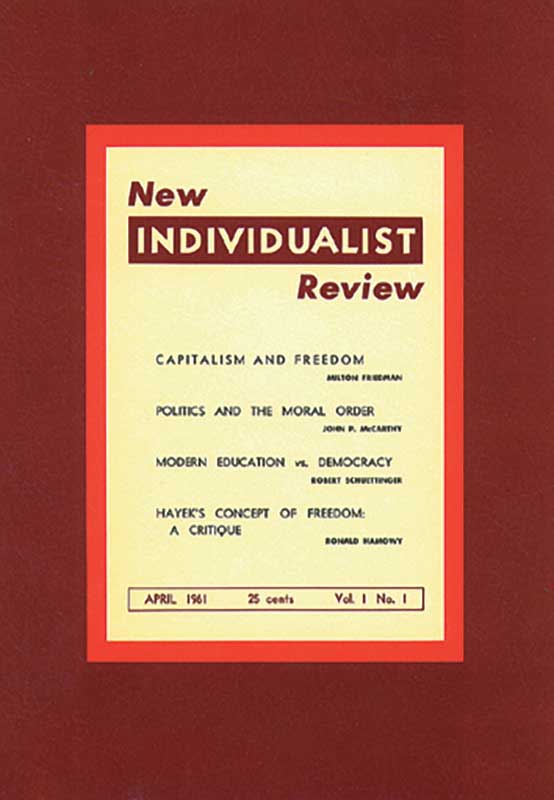
ROBERT L. CUNNINGHAM, Justice, “ Needs, ” and Charity - Ralph Raico, New Individualist Review [1961]Edition used:New Individualist Review, editor-in-chief Ralph Raico, introduction by Milton Friedman (Indianapolis: Liberty Fund, 1981).
About Liberty Fund:Liberty Fund, Inc. is a private, educational foundation established to encourage the study of the ideal of a society of free and responsible individuals. Copyright information:The copyright to this publication is held by Liberty Fund, Inc. The New Individualist Review is prohibited for use in any publication, journal, or periodical without written consent of J. M. Cobb, J. M. S. Powell, or David Levy. Fair use statement:This material is put online to further the educational goals of Liberty Fund, Inc. Unless otherwise stated in the Copyright Information section above, this material may be used freely for educational and academic purposes. It may not be used in any way for profit.
Justice, “Needs,” and Charity
DEFINITIONS ARE generally regarded as the best and most effective means of ensuring that our use of words is exact and clear. The advantages of following the recommendation: Define your terms! are seldom questioned; but to define a term like “justice,” a word that combines a strong eulogistic flavor with a wide ambiguity of meaning, is to engage in a dangerous occupation, for one is implicitly engaged in recommending an ideal, and thus any definition given is inevitably persuasive. There may be no agreement on the application of “justice,” no agreement on the criteria which ought to determine its use, there may be an inconsistency of application which reflects confusion of thought, but there will be unquestioning adherence to the proposition that justice is a good thing. When it proves possible to shift the application of a term like “justice” (or “democracy” or “liberty” or “socialism”) one may very well have won an important battle, for, implicitly, interests are thus redirected, values legislated in or out of existence, and the range of relevant “explanatory” information changed. That such a shift in the application of “justice” has occurred is not really in doubt. “Justice” now usually refers not so much to a moral habit some individuals have and others, more or less, lack, but to a sort of institutional arrangement which it is the goal of political programs to achieve. Part of the load of favorable connotations formerly carried by “charity” (now redefined and carrying somewhat dyslogistic overtones), “love,” and “mercy” have been shifted to “justice.” Commutative justice is “out”; distributive or social justice is “in.” “Social justice” and “universal prosperity” or “happiness” are often used coextensively. I shall attempt to show that if this shift has occurred, it has considerable importance for men of intelligence and good will: for it is an analytical proposition that men of good will and intelligence will strive for justice. A few centuries ago, a somewhat analogous shift occurred—a shift in the meaning of “selfish” which led men to accept as true the proposition: “All action is really selfish”—with the result that many were seduced from attending to their duties; fortunately a Bishop Butler was then available to make the appropriate distinctions and to show that the proposition was true only when “selfish” is used in a trivial and uninteresting sense. JUSTICE HAS traditionally been considered to be a necessary modality of government action. If one says, “that’s unjust,” one has implicity said, “government has no business doing that”; and if one can justifiably say, “doing that will promote or foster justice,” one has given a good (though not necessarily a sufficient) reason for saying, “government ought to do that.” Now, one way of broadening the legitimate range of government activity is to broaden the scope of “justice,” and it does appear true that certain sorts of activity hitherto attached to “charity” (love, sympathy, affability, kindliness, spontaneous likings, friendliness, friendship) are now attributed to “justice”—usually social justice (the very best things these days are characterized as “social”). There are certain advantages to this broadening of “justice.” “Justice” connotes rationality, austerity, rigor, and admits of being pressed into fixed formulae and codes. The virtue of justice counteracts the crude egoism of the individual, but only in a minimal way, for it demands that all men be treated equally—and there are only a limited number of ways in which men are equal. “Charity,” and “mercy” even more so, connotes sentiment, softness, the glorification of instincts and whims, non-rationality. There is this difference too between charity and justice: Justice calls for treating A and B equally, whether A is a friend and B an enemy, or A one’s mother and B one’s mother-in-law. “A judge who respects the person is unjust.” Justice calls for the methodological exclusion of charity; but charity does not call for treating A and B equally. We love what is like ourselves and since some are more like us than others are, we love them more than we love the others. There are gradations of love or charity, but not of justice: We can love one more than we love another, but cannot treat one more justly than we treat another. As Joseph Pieper has written, “If love says: ‘Whatever belongs to me should belong to the one I love, too,’ justice proclaims: ‘To each his own.’ ”1 When strict (commutative) justice is called for by the situation, it must never be overruled or replaced by charity. If I borrow fifty cents from a friend, promising to repay fifty cents the next day, it would be unjust of me not to repay what I owe when it is due: to refuse to do so (when able) is a paradigm of injustice. It would also be morally unreasonable to strike an attitude of generosity and, when the money is due, say: “Here, take the fifty cents: you need it more than I do”; or out of “charity” to say: “I won’t keep the fifty cents, nor will I give it to you; I’ll give it to some poor person who needs it more than either of us.” Nor is it true that the claim to justice and to mercy are of equal weight. “There is,” James Martineau says, “a vast interval between the obligation which I have openly incurred in the face of my neighbor’s conscience and that which is only privately revealed to my own.”2 But if charity be brought under the aegis of social justice, then it may well be that some will argue that social justice ought to overrule commutative justice. The exquisite charity of the saint scarcely permits his justice—hardly different from that of the honest tradesman—to appear; and similarly, scarcely will social justice allow commutative justice to appear. Notice also another limitation on the rectification of “justice” to designate what was traditionally designated by “charity.” Ordinary language is a few paces behind the verbal redistricting that has gone on. “He needs it more than I” justifies giving another charity, but hardly justice; and it makes sense to say, “I owe you $50 for the suit I got from you,” but hardly any sense to say, “I (we) owe you $50 because you are unemployed.” WHY NOT, HOWEVER, broaden the designation of “just” to include much of what was hitherto included under “charitable”? If government will now promote charity, mercy, love—why not? For a very simple reason, indeed: because government has no goods of its own to distribute in charity and mercy. What goods it has it obtained from others who were (implicitly) threatened with violence if they did not pay what they “owe.” There is all the difference in the world between helping the poor by a free gift, and being ready to take away from the rich what he would otherwise unjustly—by the criteria of social justice—retain and then giving this to the poor. “Christ’s bidding to the rich is most imperative. It is necessary to stress that while He urged the rich young man to ‘distribute unto the poor,’ He did not tell the poor to take upon themselves to redistribute by taxation the rich young man’s wealth. While the moral value of the first process is evident, that of the second is not.”3 Though the (individual) moral duty of charity logically presupposes that of strict justice—since even when exercising charity to the highest degree, one can give only what is one’s own—if government is acting as a charitable agent, its charity can now be seen as demanded by social justice. One tends to be struck, over and over again, with the unreal, not-in-this-world atmosphere in which many philosophers tend to discuss justice. The problems that seem important to solve have to do with distribution—there is no discussion of costs. The underlying model seems to be one in which there exists a mountain of goods to which individuals come with claims of various sorts, and government’s job, with the advice and consent of the philosopher, is to judge which and how many of these goods are to be distributed to A, to B, to C. In such a world the only problem is that of a just distribution—how this mountain of goods got there is irrelevant, or at least uninteresting; for this model does not even permit the raising of the issue of whether or not these goods already belong to someone, whether it is private property that is being (re-) distributed. W. K. Frankena, for example, asks us to consider the notion of comparative allotment as central to distributive justice. Suppose, he says, “society” is “alloting” goods to people. Then society may be justified in “giving C a banjo, D a guitar, and E a skin-diving outfit.”4 Note well the paternalistic model: Surely these are the gifts a father would give his children, say at Christmas; and note that the question of how it is that the father raises the money to pay for these goods does not arise. Nor does the question of how it is that one knows just what is good for each child arise; but is it appropriate to use the actions of a wealthy and wise father as a model for government action? MERCY IS AN EVEN more unseemly sort of virtue than charity in our modern world. The man who practices it places himself above his neighbor, who is put in the position of receiving alms, in the position of dependence on an overlord. Can anything less democratic be imagined? Nor is mercy a radical virtue. the merciful man tends to deal with symptoms rather than root-causes, and is guilty, as Aurel Kolnai puts it, of “wishing to relieve the pain of the incurably sick instead of eliminating sickness from the world.” One can see that if the “mercy of the rich and powerful” can be eliminated from the world—by being made unnecessary as a result of the substitution of systematic social justice—the world will have gained in objectivity, rationality, and human dignity. Notice also another advantage of broadening the extension of “justice”: those who receive what they “need” are no longer put in the position of one who receives charity or mercy, but of one who receives his just due. “Means tests” are out, for they were appropriate only when a man could not have been said to “deserve” help. It was argued traditionally that the fact that each person is not due the fulfillment of his “needs” follows directly from the proposition that “neither can it be affirmed a priori that there exists in the external world a sufficiency of goods for the needs of all, nor can it be affirmed a priori that one’s needs constitute a sufficient title to claim from others what belongs to them.”5 Now the “logic” of the word “need” is interesting. If I say “I need X,” there is, by contrast with my saying “I want Y,” a connotation of constancy, absoluteness, definiteness, a suggestion that what I say I need is almost physiologically demanded, and a suggestion that costs are irrelevant; the things I “need” are things that surely benefit me, but what I “want” may not do so. I can compare, for instance, my wife’s telling me, “I want a new rug” with her saying, “We need a new rug.” The connection between “X needs Y” and “X (morally) ought to have Y,” though not an entailment, is not purely contingent; but it makes sense to say “X wants Y, but maybe he (morally) ought not to have it.” In English we speak not of urgent, critical, crying, vital, or essential wants—but of urgent, critical, crying, vital, or essential needs (and this is so even though the noun “want” connotes the stability of “need”—a connotation not at all present in the use of the verb “want”). To speak then of an economy as potentially capable of satisfying all our “needs” is to imply that there is a constant and unchanging set of goods and services called “our needs” and also that a finite amount of wealth will enable us to satisfy these needs. But as economists point out over and over again, the notion of “need” is not an analytically useful one. We are inclined to say that we need too many sorts of things, from more protein in our diet or a longer vacation, to a new car, more highways, more and better teachers, more missiles, more water in California. This is to say that “need,” like “want,” is a vague word, connoting constancy and definiteness but denoting, in many of its uses, nothing more definite than “want.” “I need” is used persuasively to say “I want.” When someone says: “I (or more usual, we) need X,” one should, I think, follow the suggestion made by Alchian and Allen and respond: “You say you need X, but in order to achieve what? At what cost of other goods or ‘needs’? And at whose cost?”6 These questions are obviously relevant when someone says “I want X”; they are no less relevant when someone says “We need X.” The only practical way, of course, of distinguishing “wants” and “needs” is to give some authority the power to define what are to be counted as “needs” and what are to be counted only as “wants”—but this course of action would have some rather obviously undesirable consequences which need not be discussed here. D. D. RAPHAEL ARGUES that unequal treatment can be justicized on the basis of different needs: “We think it right to make special provision for those affected by special needs, through disability, such as mental or physical weakness, or through the slings and arrows of outrageous fortune. . . . Here, it would seem, we go against nature, and think ourselves justified in doing so.”7 Nonetheless, would we not find it strange to say: “He’s a just man because he gave more attention to the poorer students than to the average students”; or to say: “He’s a just man because he helped the child the bigger boys knocked down.” It may be right to give greater attention to poorer students, or to help the injured child—but is it just (that is do we now say that it is “just”)? It may be right “to meet these special needs . . . [by] an attempt to bring such people up to the normal level of satisfactions, or as near to it as we can”—but is it just to spend more on some than on others? Mortimer Adler once argued that if it takes two or even three times as much money to educate the less intelligent to an acceptable norm, the money should be spent. Perhaps; for maybe there are good (possibly utilitarian) reasons for doing so—but are they justicizing reasons? It may be right for a father to spend a great deal of money to send a crippled child to special schools, but if the other children question the justice (or “fairness”) of this procedure, can the father give good justicizing reasons? Though charity never overrules justice, one may—and perhaps the crippled boy’s siblings morally ought to—give up that to which one is justly entitled; but ought government to use the threat of coercion to achieve the same goal? If a man asks for a dollar for a bed for the night, few would say I ought to give it in justice; but if that man votes himself a dollar from me, do I now owe it to him in justice? It is hard to see that the fact that he now has the government at his back to enforce his “claim” makes all the difference between a request for mercy and a demand for justice. There may be a sense in which college professors “deserve” higher pay (everyone might be better off if abler men were attracted to teaching, etc.); it might be right to “work for” higher pay; but is it unjust that people have not chosen to spend a greater amount of their wealth on education? One may well be able to defend the proposition that “private property has a social function”; but is this appropriately interpreted to mean that if you have more property than I, you ought in justice to give me some? This is egalitarianism with a vengeance and, as Kolnai says, “the trouble with the true egalitarian is precisely that he is unable to see a fat person beside a lean one without being tempted to assume that the former must have fattened on the flesh and blood of the latter.”8 It is conceivable that robbing Peter to pay Paul (the model of the welfare state?) may sometimes, in marginal situations, be justified; but never justicized. It is a considerable step from “the pursuit of happiness” to a claim to happiness rationed out by a government which guarantees social justice—aside from the fact that here as in all other cases where scarce goods are rationed, the goods tend to disappear. Is it not odd that people will “fight” to raise social security benefits with all the solemnity proper to the performance of a religious duty? One is reminded of the Marxist prophecy which “required from its disciples no other belief than that in the force of bodily appetites and yet at the same time satisfied their most extravagant hopes.”9 What used to be called “selfishness” is made out to be not only permissible but a moral duty, the motive power behind the achieving of world social justice. “The ‘divine discontent’ that makes me crave for three rooms instead of two and two radios instead of one is a revolutionary force which deserves not only to be acknowledged but venerated.”10 If striving after limited equality is justice, then striving after total equality is striving for the consummation of justice. IT IS NOT, I THINK, irrelevant to note parenthetically that there is good reason to believe that when legislators respond to popular demand for “public services” solely on the basis of “needs” criteria, overinvestment tends to result. This is also the case when government provides “private” goods to individuals without the use of pricing. It is doubtless true, as Kolnai writes, that we may be ready to dispense with “the fine connoisseurship of delicious dukes if in compensation we are relieved from the presence in our midst of illiterates, uncared-for consumptives, and persons ignorant of the use of soap.”11 But the means we choose, whether “just” or not, often fail to achieve their goal. Milton Friedman has argued, successfully I think (pace Galbraith: “Public services have . . . a strong redistributional effect. And this effect is strongly in favor of those with lower incomes.”12 ), that with the exception of direct transfer payments to the poor, all types of social welfare measures have the effect of taxing the poor to help the rich.13 This is to say that there is a net transfer from the poor to the rich when measures such as those making education “free” to the poor are passed (mainly at the higher, but even at lower, educational levels); freeways (not tollways) are built; “public housing” is provided (more housing than is built is first destroyed, and so the average cost of the housing available is raised); areas are “redeveloped”; “medicare” legislation is passed (the very poor are already well taken care of); “social security” is passed (benefits are, partly, paid for by a regressive tax); and legislation is passed to help farmers, only some of whom are poor (but raising the price of food for everyone else); or to help “senior citizens,” only some of whom are poor; etc. The way the poor are dealt with is reminiscent of the way wolf packs are dealt with by the Eskimos. They plant razor-sharp knives clasp down in the ice and rub the blades with a little seal blood. The wolves, attracted by the blood, lick the knives, cutting their tongues. They are greedily delighted by the seemingly unending supply of nourishing blood they can lick off the knives. They stand there licking until they drop in their tracks from the loss of their own blood, then freeze to death in the snow. Gregory Vlastos argues that “since humanity has lived most of its life under conditions of general indigence, we can understand why it has been so slow to connect provision for special need with the notion of justice, and has so often made it a matter of charity; and why ‘to each according to his need’ did not become popularized as a precept of justice until the first giant increase in the productive resources. . . .”14 But is this not a rather odd position? In the past, when we could not satisfy needs adequately, it was the function of charity (sympathy, pity, generosity) to provide help to the needy; today, when most people are not needy, charity is no longer called for, but we must in justice bring the few needy who remain up to par. When there are a great many needy people, pity them; when there are only a few who are not really so needy—in advanced countries, for in most of the world many people are still (biologically) needy—give them justice. Few would want to deny that with the passage of time sensitivity to the demands of justice can increase (or decrease), or that sensitive, pitying awareness of human misery can increase (or decrease). Yet is it not simply obfuscation (though persuasive) to confuse the two verbally, to say what was called for by “charity” on one day is called for by “justice” on another; and that the extent of remediable misery is sufficient to call for the verbal transmutation of “charity” into “justice.” We must give justice to our poor fellow-Americans, but need give only charity to the rest of the world’s poor. Ceteris paribus, all of us would prefer a state of affairs where social rewards, privileges, wealth, power, and prestige were proportional to the individual’s use of his talents. We would like to see reward proportioned to “merit,” not only in heaven, but here and now on earth. What holds people back is the recognition that they lack divine knowledge and power (recalling the old saw of what would heaven be like if God sometimes put people in the wrong mansions?) Most political theorists also feared that some man or group of men might acquire the power to decide what another’s status ought to be, and that therefore freedom would be diminished. ALTHOUGH IN UTOPIA reward should correspond to merit, and not necessarily to performance (which may dedepend on luck), we cannot very well judge merit. We may, however, feel that there are ways to get an idea of motivation; and for anyone influenced by Kant, motivation may be thought to be the near-equivalent of merit. From this viewpoint, it appears that businessmen are inspired mainly by the profit-motive, when we should prefer them to be motivated by a desire to promote the “common good”; but since there is no logically necessary connection between performance and income, we can, by interfering with the market system, attempt to establish some sort of correlation between preferred motivation and high income. This sort of thinking is, however, moralistic, and leads only to confusion between the end of the activity and the end of the actor. Yet certainly what is done should count for more than why something is done: a Torquemada does no less harm for being nobly motivated. Should we no longer interest ourselves in the finality of an activity but only in the finality of the agent, we shall find highly motivated activity driving out highly beneficial activity. “Let us stop talking about people’s motives. I don’t care what people’s motives are. I want to know what they are doing and what the effects are, and which ones are good and which ones are bad. I don’t care why you hold this office or why you run this business. It will always be true, I should think, that people will go into business to make money. What is wrong with that?”15 Is it not better to strive for less than “(re-) distributive justice”—namely, for visible and evident commutative justice which does not directly count the personal effort of a man’s work but only the result—realizing that moral value, while the highest, is not the sole value, and is the least measurable by empirical methods. It is better to give up a dream for the perfectly just society—which, as a matter of fact, the unsuccessful would find more unbearable than now, when chance and fortune so clearly have enormous roles to play and they can blame luck rather than lack of merit for their condition. Given the climate of opinion about the very wealthy—whether based on envy or not—a man is unlikely to choose commerce and industry unless the material rewards are relatively great. The only way a “philistine” has of knowing whether his efforts have any merit is by his profit-and-loss account. If this standard of successful service is scorned, the function of the market in allocating resources to successful producers is destroyed. Running a department store well is not the noblest of all humanly befitting activities, a bonum honestum, and the best people know it. (The Greeks called such activity banausic—“the man at the stove.” The lower the possible “profits,” the less the interest in putting one’s economic life on the line. The losses are as great as ever, and speculative economic investment of the sort that, when successful, means great service to the consumer and so great wealth to the entrepreneur, is stillborn. How far we have departed from the attitudes reflected in Samuel Johnson’s remark that “there are few ways in which a man can be more innocently employed than in getting money”! As long as it appears desirable to raise the general standard of living, if not for oneself then at least for one’s fellows in one’s own country and the rest of the world, one had better make sure that those who engage in productive pursuits are not deprived of sufficient material rewards to encourage them to continue their useful other-serving activity, even though whole-hearted moral approval cannot be given them. The envious man who for “moral” reasons refuses to pay the price asked for the services he demands (“How can any man be worth a million dollars a year?”) will shortly find these services are unavailable. One must not forget, as Hayek reminds us, that in a sense all of us are striving to achieve the status of the “idle rich,” those whose activities are not governed by desires for material gain. What is true of the wealthy with respect to the poor is true also to wealthy nations vis-à-vis poorer nations: One may, by redistribution, kill the proverbial goose. Further, if it is “just” to re-distribute the “profits” of the wealthy to the poor in one’s own country, is it not quite as “just” for people of poorer countries to claim that the goods of the wealthy nations ought to be redistributed among them? Is not “social justice” being violated in a world in which an American auto worker belongs to that two per cent of the earth’s population whose income is highest? [* ] Robert L. Cunningham, professor of philosophy at the University of San Francisco, is a contributor to philosophical journals, and currently engaged on a major work on social justice. [1 ]Justice (New York: Pantheon Books, 1955), p. 58. [2 ]Types of Ethical Theory (New York: Macmillan, 1886), II, p. 122. [3 ] Bertrand de Jouvenal, The Ethics of Redistribution (Cambridge: Cambridge University Press, 1951), p. 14. [4 ] “The Concept of Social Justice,” in R. B. Brandt, ed., Social Justice (Engelwood Cliffs, N.J.: Prentice-Hall, 1962), p. 7. [5 ] Gustavo del Vecchio. Justice (New York: Aldine, 1952), p. 142. [6 ] University Economics (Belmont, Calif.: Wadsworth, 1964), p. 72. [7 ] “Justice and Liberty,” Proceedings of the Aristotelian Society, 1950-51, London, LI, reprinted in M. Minitz, ed., Modern Introduction to Ethics (Urbana, III. University of Illinois Press, 1958), p. 468. [8 ] “The Common Man,” Thomist, XII (1949), 285. [9 ] Michael Polanyi, The Logic of Liberty (Chicago: University of Chicago Press, 1951), p. 105. [10 ] Kolnai, op. cit., p. 303. [11 ]Ibid., p. 295. [12 ] “Let Us Begin: An Invitation to Action on Poverty,” Harpers, March, 1964, p. 24. [13 ] Cf. New York Times Magazine, October 11, 1964; Capitalism and Freedom (Chicago: University of Chicago Press, 1962), Chs. 11, 12. [14 ] “Justice and Equality,” in R. B. Brandt, ed., op. cit., p. 42. [15 ] John Courtney Murray, The Corporation and the Economy (Santa Barbara, Calif.: 1959), p. 43. |

Titles (by Subject)