EconlibThe LibraryOther Sites |
Front Page Titles (by Subject) BENJAMIN A. ROGGE, COMMUNICATION: Note on the Election - New Individualist Review
Return to Title Page for New Individualist ReviewThe Online Library of LibertyA project of Liberty Fund, Inc.Search this Title:Also in the Library:
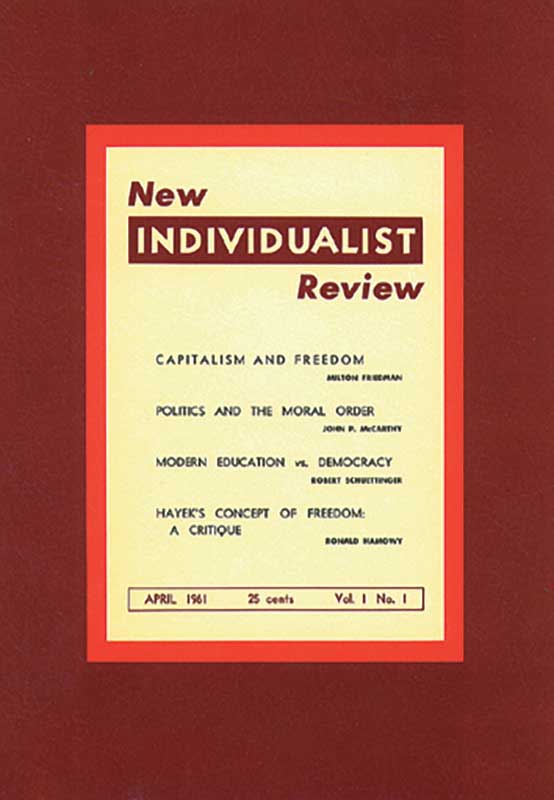
BENJAMIN A. ROGGE, COMMUNICATION: Note on the Election - Ralph Raico, New Individualist Review [1961]Edition used:New Individualist Review, editor-in-chief Ralph Raico, introduction by Milton Friedman (Indianapolis: Liberty Fund, 1981).
About Liberty Fund:Liberty Fund, Inc. is a private, educational foundation established to encourage the study of the ideal of a society of free and responsible individuals. Copyright information:The copyright to this publication is held by Liberty Fund, Inc. The New Individualist Review is prohibited for use in any publication, journal, or periodical without written consent of J. M. Cobb, J. M. S. Powell, or David Levy. Fair use statement:This material is put online to further the educational goals of Liberty Fund, Inc. Unless otherwise stated in the Copyright Information section above, this material may be used freely for educational and academic purposes. It may not be used in any way for profit.
COMMUNICATION:
This communication was written in October before the close of the campaign. THE ELECTION WILL probably be over by the time this reaches print, and conservatism as a potent political force will be dead. A fine man will have suffered a humiliating defeat and the modern-liberals in his party will be planning a ruthless purge of all those who were closely associated with his candidacy. The stage will have been set for the spectre of the “Goldwater debacle” to haunt the candidacy of every conservative for years to come. In the meantime, his most passionate supporters will be using their special journals of opinion to vent their disappointment and bitterness in angry explanations of why it happened. Some will say that the campaign was badly conducted (which it was); some, that Goldwater was sabotaged by the modern-liberals of the press, radio and television (which he was); some, that he was defeated by one of the most effective, ruthless and corrupt politicians of the modern era (which may or may not true). The Minutemen will be laying in more rifles and the head of the John Birch Society will be proving to his own satisfaction that Goldwater’s defeat was engineered by members of his own party, acting as conscious agents of the Communist conspiracy. The truth, I suspect, lies quite elsewhere, and it is this possibility that I wish to explore. My own interpretation of the election can be simply stated: In a democratic society, under normal circumstances, no radical reorientation of social policy can be achieved by simple political organization and political action. Or to put it another way: As a general rule, for groups concerned with ultimate principles, elections just don’t matter! Let me put it still another way: Given the absence of any feeling of crisis in the American society and given the general acceptance of modern-liberalism by most Americans who count, Goldwater was foredoomed to crushing defeat. All of this was perfectly evident long before Goldwater was nominated. The great mistake was made, not during the campaign, but precisely when those conservatives who pride themselves on being activists and on “knowing how to get things done,” decided that conservatism could be brought to America by what would amount to a political coup. Goldwater’s own clear, good sense in thinking that the time was not ripe and that he could serve the cause better by continuing as Senator from Arizona was overpowered by the passion of the leaders of the Draft-Goldwater group and by their assurance that they had the know-how to get the job done.1 This assurance was bolstered by the ease with which the organization swept through the San Francisco Convention. But of course, it is no great task for a well-organized minority to take over a committee (and that is what a political convention most resembles); in fact, it is done every day. Goldwater might have won, had the country been plunged in a deep crisis of some kind at the time of the campaign. The victories of the Erhard “social market economy” in Germany in the late forties and more recently of the conservatives in Brazil were both made possible by the wide-spread sense of impending disaster in the societies involved. As John Maynard Keynes wrote with such excellent foresight in 1936: “At the present moment people are unusually expectant of a more fundamental diagnosis; more particularly ready to receive it; eager to try it out, if it should be even plausible.”2 Certainly the philosophical and political success of the ideas he presented in the book in which these words appear would attest to the significance of timing in attempts at radical change. IN ANY CASE, it was precisely those who pride themselves on their practical wisdom who launched this most impractical and tragic of all modern political actions. The country was simply not yet prepared to accept the conservative position. Goldwater’s campaign could not build on any solid foundation of widely accepted ideas on society, economics, and the state. This became apparent the moment Goldwater made the slightest threatening gesture in the direction of any specific element of the welfare state, e.g., social security. The response was so immediate and frightening that his campaign strategy made an obvious switch, to concentrate on corruption in the Johnson administration and to promise a rather mystical rebirth of honesty and integrity in government and of “morality” in society. As Hayek pointed out to us long ago, honesty and integrity in government are not functions of which party is in power, but of the power over economic decisions possessed by those in government.3 But the people were not ready to reduce the power of government, and Goldwater and his advisors had no place else to go. Nor could much be made out of foreign policy issues. Goldwater’s interventionist posture in foreign affairs was just like Johnson’s, only more so. The Goldwater principles of non-intervention and limited government on the domestic scene seemed to mix poorly with his promise of aggressive, interventionist action on the foreign scene. Whether he was more or less right than Johnson on foreign policy is not at issue. The question is whether there was any fundamental difference between the two in principle, and no such difference could be made to stick (not even the charge that Johnson was “soft on Communism”). Let me repeat: Goldwater lost because those who count in America weren’t prepared to accept his ideas. The lesson would seem to be that the real function of conservatism in America is not to try to win elections but to try to win converts. The real battle is, as always, a battle of ideas. It matters less what name I drop into the ballot box on election day than what ideas I drop into the common pool during my lifetime. Not a single one of the principles of limited government and individual freedom has been proved wrong by the Goldwater defeat (just as not a single one would have been proved right by a Goldwater victory). Nor has a single principle of the interventionist, welfare state been proved right by the Johnson victory. Ideas are still evaluated by a different and more fundamental process, and perhaps it is time that we got back to work on that process. Let us forget for a while all attempts to be clever at political organization. Let us return to our problems of understanding, analysis, and clarity of exposition of the ideas of freedom. If we do our work well, we may some day be rewarded by the only lasting kind of political victory—a situation in which the ideas of freedom are so generally accepted in both parties that it will make little or no difference which one wins. [* ] Benjamin A. Rogge is Professor of Economics at Wabash College and an Editorial Advisor to New Individualist Review. He is co-author of the college textbook Introduction to Economics. [1 ] See William A. Rusher, “Suite 3505: The Inside Story of How, When and Where the Goldwater Candidacy Was Conceived and Launched,” National Review, Aug. 11, 1964, pp. 683-86. [2 ] J. M. Keynes, The General Theory of Employment, Interest and Money (New York: Harcourt, Brace, 1936), p. 383. [3 ] F. A. Hayek, The Road to Serfdom (Chicago: University of Chicago Press, 1944), particularly the chapter on “Why the Worst Rise to the Top.” |

Titles (by Subject)