EconlibThe LibraryOther Sites |
Front Page Titles (by Subject) GEORGE J. STIGLER, Reflections on the Loss of Liberty - New Individualist Review
Return to Title Page for New Individualist ReviewThe Online Library of LibertyA project of Liberty Fund, Inc.Search this Title:Also in the Library:
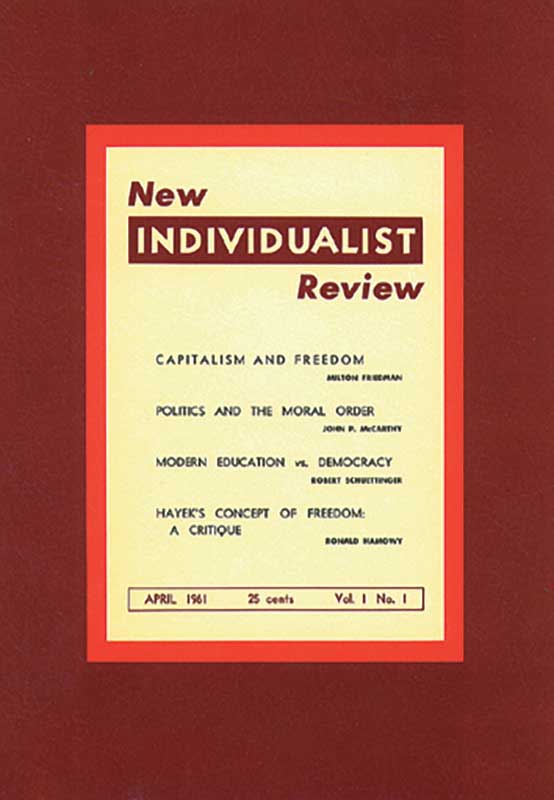
GEORGE J. STIGLER, Reflections on the Loss of Liberty - Ralph Raico, New Individualist Review [1961]Edition used:New Individualist Review, editor-in-chief Ralph Raico, introduction by Milton Friedman (Indianapolis: Liberty Fund, 1981).
About Liberty Fund:Liberty Fund, Inc. is a private, educational foundation established to encourage the study of the ideal of a society of free and responsible individuals. Copyright information:The copyright to this publication is held by Liberty Fund, Inc. The New Individualist Review is prohibited for use in any publication, journal, or periodical without written consent of J. M. Cobb, J. M. S. Powell, or David Levy. Fair use statement:This material is put online to further the educational goals of Liberty Fund, Inc. Unless otherwise stated in the Copyright Information section above, this material may be used freely for educational and academic purposes. It may not be used in any way for profit.
Reflections on the Loss of LibertyTHE CONSERVATIVES have been in high alarm at the encroachments on liberty by the state for at least 30 years. It would be possible to amass a volume of ominous predictions on the disappearance of individual freedom and responsibility, and not by silly people. Yet if we canvass the population we shall find few people who feel that their range of actions is seriously curtailed by the state. This is no proof that the liberties of the individual are unimpaired. The most exploited of individuals probably does not feel the least bit exploited. The Negro lawyer who is refused admission to a select club feels outraged, whereas his grandfather was probably a complaisant slave. But neither is complacency a proof of growing tyranny. So let us look at what liberties, if any, the typical American has lost in the recent decades of growing political control over our lives. Let us face this American as he completes his education and enters the labor force. Of what has he been deprived? Some additional barriers have been put in the way of entrance into various occupations. Some barriers consist of the direct prescription of types of training; for example, to teach in a public school one must take certain pedagogical courses. More often, the state imposes tests—as for doctors and lawyers and barbers and taxi drivers—which in turn require certain types of training in order to be passed. But few people consider such restrictions on occupations to be invasions of personal liberty. The restrictions may be unwise—those for school teachers are generally so viewed by the university world—but since the motive is the protection of users of the service, and since the requirements are directed to competence even when they are inefficient or inappropriate, no question of liberty seems involved. No one, we will be told, has a right to practice barbering or medicine without obtaining the proper training. The freedom of men to choose among occupations is a freedom contingent on the willingness and ability to acquire the necessary competence. The mentally and physically untalented man has no inherent right to pilot a commercial plane, or any other type. For consider: we surely do not say that a man born with weak or clumsy legs has been denied the portion of his liberty consisting of athletic occupations. At most a man is entitled to try to enter those callings which he can discharge at a level of skill which the community establishes. “Which the community establishes.” The obverse of the choice of occupations is the choice of consumers. It can be said that the denial of my right to patronize lawyers or doctors with less preparation than the majority of my fellow citizens deem appropriate is the complementary invasion of my liberty. Why should the community establish the lowest levels of skill and training with which I satisfy my needs? The answer is, of course, that on average, or at least in an appreciable fraction of cases, I am deemed incompetent to perform this task of setting standards of competence. I am, it is said, incapable of distinguishing a good surgeon from a butcher, a good lawyer from a fraud, a competent plumber from a bumbler, and so on. Now one could quarrel with both sides of this position: neither has my own incompetence been well demonstrated (especially when account is taken of my ability to buy gurantees of competence) nor has anyone established the ability of other judges to avoid mistakes or at least crudity of judgment. But these are questions of efficiency much more than of justice, so I put them aside not as unimportant but as temporarily irrelevant. The real point is that the community at large does not think a man should have the right to make large mistakes as a consumer. The man who cannot buy drugs without a prescription does not really rebel at this undubitably expensive requirement. The man who is denied the services of a cheaper and less well trained doctor or teacher does not feel that he has been seriously imposed upon. THE CALL TO the ramparts of freedom is an unmeaning slogan in this area. If we were to press our typical American of age 22, he would tell us that some infringements on his liberties would be intolerable, but they would be political and social rather than economic: free speech should not be threatened—at least by McCarthy—and Negroes should not be discriminated against. No economic regulation of consumers would elicit serious objection, and this younger person would often be prepared to go even farther in regulating consumers in areas such as health and education. We would have to propose policies remote from current discussion, such as compulsory location of families to hasten racial integration, before we should encounter serious resistance to public controls in principle. Governmental expenditures have replaced private expenditures to a substantial degree, and this shift poses a related problem to liberty. The problem seems less pressing because private expenditures have increased in absolute amount even though public spending has risen in this century from perhaps 5 to 25 per cent of income. Yet the shift has been real: we can no longer determine, as individuals, the research activities or dormitory construction of universities, the housing of cities, the operation of employment exchanges, the amount of wheat or tobacco grown, or a hundred other economic activities. But again the typical American finds each of these activities worth while—meaning that he thinks that the activity will not be supported on an adequate scale by private persons. ON A CLOSER VIEW OF THINGS, some restrictions on individuals as workers will strike most Americans as unfair, especially if they are presented as indictments. Complaints will be aroused by a demonstration that political favorites have been enriched by governmental decisions which excluded honest competitors—and of course this can be demonstrated from time to time, or perhaps more often. The complaint, however, will involve equity much more than liberty. This conclusion, that Americans do not think that the state presently or in the near future will impair the liberties that a man has a right to posses is, of course, inevitable. It is merely another way of saying that our franchise is broad, our representatives will not pass laws to which most of us are opposed, or refuse to pass laws which most of us want. We have the political system we want. The conservative, or traditional liberal, or libertarian, or whatever we may call him, will surely concede this proposition in the large. He will say that this is precisely the problem of our times: to educate the typical American to the dangers of gradual loss of liberty. One would think that if liberty is so important that a statue is erected to her, the demonstration that a moderate decline of personal freedom leads with high probability to tyranny would be available in paperback at every drugstore. It is not so easy to find. In fact, it may not exist. That there have been many tyrannies no one will dispute, and indeed it is at least as easy to find them in the twentieth century as in any other. Moreover, the loss of vital liberties does not take place in a single step, so one can truly say that a tyranny is entered by degrees. But one can easily reverse this truism and assert that some decrease in liberties will always lead to more, until basic liberties are lost. Alcoholics presumably increase their drinking gradually, but it is not true that everyone who drinks becomes an alcoholic. THE NEAREST APPROACH to a demonstration that the tendency of state controls to increase beyond the limits consistent with liberty is found in Hayek’s Road to Serfdom. But Hayek makes no attempt to prove that such a tendency exists, although there are allegations to this effect.1 This profound study has two very different purposes:
I may observe, in passing, that this argument seems to me irresistible and I know of no serious attempt to refute it. It will be accepted by almost everyone who realizes the import of comprehensive controls.2
This second theme is not an historical proposition—and no historical evidence was given: it is the analytical proposition that totalitarian systems are an extreme form of, not a different type from, the democratic “welfare” states to whom the book was addressed. Hayek was telling gentlemen drinkers, and especially some Englishmen—who were becoming heavy drinkers, not to become alcoholics. The twenty-five years that have passed since the outbreak of World War II have seen further expansions of political control over economic life in the United States, and in most western European nations except Germany. Yet no serious diminution of liberties deemed important by the mass of educated (or uneducated) opinion has taken place. Another hundred years of governmental expansion at the pace of these recent decades would surely destroy our basic liberties, but what evidence is there that such an expansion will continue? Quite clearly, no such evidence has been assembled. IT IS ONE THING to deny that evidence exists for the persistence of present trends to where they will endanger our liberties, and quite another to deny that such a momentum exists. Or, differently put, where is the evidence that we won’t carry these political controls over economic life to a liberty-destroying stage? This may be an impeccable debating point, but it will carry much less conviction than an empirical demonstration of the difficulty of stopping a trend. When men have projected the tendency of a society to a distant terminus, they have invariably committed two errors. The tendency develops in a larger number of directions than the prophet has discerned: no tendency is as single-minded as its observer believes. And the tendency encounters other and contradictory forces in the society, which eventually give the course of events a wholly different turn. We have no reason to believe that the current prophets are any wiser. SO I CONCLUDE: we should either fish or cut bait. On the subject of liberty the conservative should either become silent, or find something useful to say. I think there is something useful to say, and here is what it is. The proof that there are dangers to the liberty and dignity of the individual in the present institutions must be that such liberties have already been impaired. If it can be shown that in important areas of economic life substantial and unnecessary invasions of personal freedom are already operative, the case for caution and restraint in invoking new political controls will acquire content and conviction. We cannot scare modern man with incantations, but we can frighten him with evidence. The evidence, I think, will take a variety of forms:
I do not know whether justice is more or less important than liberty, or whether they are even fully separable. The standards of justice under political direction of economic life, I conjecture, are deplorably low:
Studies of the types here proposed will, I am reasonably confident, give vitality and content and direction to fears for liberty in our society. But whether the studies confirm the need for reform and vigilance in preserving freedom, or suggest that such fears are premature, they are essential to remove this subject from the category of cliché. It is no service to liberty, or to conservatism, to continue to preach the imminent or eventual disappearance of freedom; let’s learn what we’re talking about. [* ] George J. Stigler, an Editorial Advisor to NEW INDIVIDUALIST REVIEW, is Walgreen Professor of American Institutions at the University of Chicago, and President of the American Economic Association. [1 ] For example: “Although competition can bear some admixture of regulation, it cannot be combined with planning to any extent we like without ceasing to operate as an effective guide to production. Nor is ‘planning’ a medicine which, taken in small doses, can produce the effects for which one might hope from its thoroughgoing application. Both competition and central direction become poor and inefficient tools if they are incomplete; they are alternative principles used to solve the same problem, and a mixture of the two means that neither will really work and that the result will be worse than if either system had been consistently relied upon. Or, to express it differently, planning and competition can be combined only by planning for competition but not by planning against competition.” (p. 42) And again: “Yet agreement that planning is necessary, together with the inability of democratic assemblies to produce a plan, will evoke strong demands that the government or some single individual should be given powers to act on their own responsibility. The belief is becoming more and more widespread that, if things are to get done, the responsible authorities must be freed from the fetters of democratic procedure.” (p. 67) Such passages are, however, warnings of the consequences of comprehensive socialization rather than arguments that it is inevitable. [2 ] For a recent restatement of this view by a person not identified with “conservative” views, see the essay by K. E. Boulding, “The Dimensions of Economic Freedom,” in E. O. Edwards ed., The Nation’s Economic Objectives (Chicago: University of Chicago Press, 1964) esp. pp. 119-20. |

Titles (by Subject)