Econlib

The Library

Other Sites

Front Page arrow Titles (by Subject) arrow ISRAEL M. KIRZNER, On the Premises of Growth Economics - New Individualist Review

Return to Title Page for New Individualist Review

Search this Title:

Also in the Library:

Subject Area: Economics
Subject Area: Political Theory
Subject Area: History
Order this book from Liberty Fund

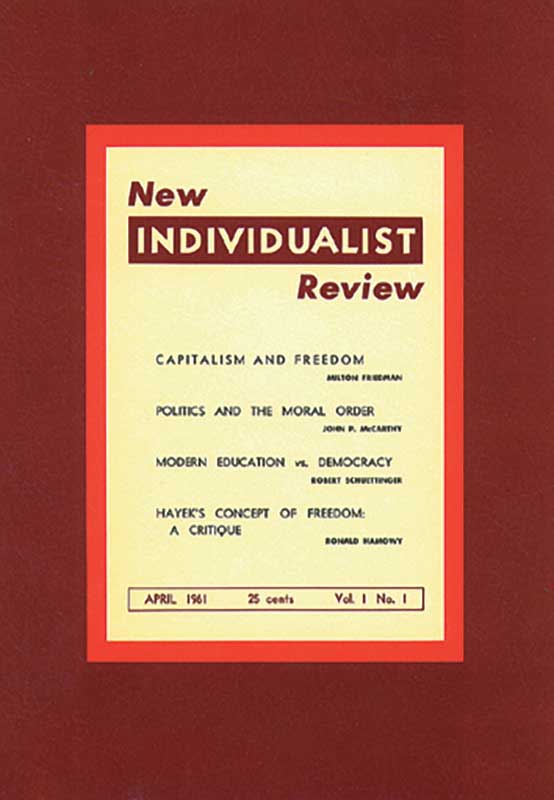
ISRAEL M. KIRZNER, On the Premises of Growth Economics - Ralph Raico, New Individualist Review [1961]

Edition used:

New Individualist Review, editor-in-chief Ralph Raico, introduction by Milton Friedman (Indianapolis: Liberty Fund, 1981).

About Liberty Fund:

Liberty Fund, Inc. is a private, educational foundation established to encourage the study of the ideal of a society of free and responsible individuals.


On the Premises of Growth Economics

THERE ARE FEW topics concerning which economists are currently more able to secure respectful public attention, than that of economic growth. “To foster a more rapid growth rate” has become an almost unquestioned goal of governments throughout the world. A very considerable fraction of the research efforts of economists is, and has been now for several years, directed to the problem of how this goal is to be achieved. The course of political and economic history in recent decades has focused both professional and lay attention upon the problem of growth and development, pushing out of the limelight even such long-time favorites as the problem of economic stability. Elections have revolved around economic growth, commencement day orators, columnists and editorial writers consider the topic suitable grist for their mills, and books on this supposedly esoteric subject have become popularly accepted as fare for the masses.

There are a number of points of view from which this preoccupation with growth and development appears to be based on misconception and misunderstanding. This article is concerned with the dangers which this preoccupation must seem to imply for all who are concerned with the maintenance of individual liberties. We will analyze the growth problem in order to expose those fallacies in popular thinking on the subject that are responsible for the potential dangers to a free society arising out of this preoccupation. Many of these fallacies will be seen to have their counterparts in the writings of economists themselves; this is not entirely a matter for surprise, but in any event makes our task no less pressing.

That the popular growth preoccupation carries with it implications that must seem menacing to the individualist, hardly needs elaborate demonstration. A growth policy invariably means a government policy. A growth or development policy may call, at worst, for a completely socialized economy; at best it implies a degree of regimentation forced upon an otherwise free enterprise system. Those preoccupied with growth generally believe, first, that growth is per se desirable; second, that the spontaneous growth of a market economy is likely to fall short of its full potential; and third, that this full potential may be achieved by appropriate governmental policies. Many even of those who have some understanding of the allocative functions of the price system, and who appreciate the market as an engine of social efficiency, are convinced that for growth purposes it is necessary to resort to governmental direction of economic activity. Like Keynes, they see no reason to suppose that the market seriously misemploys the factors of production which are in use;1 perhaps, unlike Keynes, they see no reason even to believe that the market fails seriously in providing employment for all factors that can be efficiently employed, but they do nonetheless believe that the unhampered market fails to direct economic activity along the channels required for growth.2 It is this belief that leads to the advocacy of programs of government activity that must necessarily impinge more or less heavily upon the range of opportunities open to individuals.

This article will focus critical attention on the analytical underpinnings of these beliefs, and will specifically deal with the following four aspects of the problem:

1) We will examine the view that distinguishes sharply between the current allocation of resources on the one hand, and the task of making provision for future growth on the other. It is this postulated distinction that is responsible for the possibility of a posture of simultaneous acceptance of the short-run allocational capabilities of the market, and distrust of its long-run propensities. At the same time it is to this alleged distinction that must be attributed the uncritical acceptance of growth as a goal appropriate to all situations.

2) We will examine the claim that long-run market-achieved results may be expected to be rendered inadequate because of what the economist calls “externalities” operating over time. We will examine both the claim itself, as well as the corollary drawn from it to the effect that, in consequence, government interference with the market may be desirable.

3) We will examine the uncritical use, in the growth literature, of national income (or related) figures as a means of judging and measuring the extent of achieved desirable growth.

4) We will subject to critical examination the welfare theory that is implicit in much of the current literature and discussion of growth. This theory will be scrutinized and held up for comparison with the more limited welfare propositions that are acceptable to economics seen as a science of human action, and to individualist-minded critics.

As we shall discover, these different aspects are intimately bound up with one another. Fallacies which we will expose in connection with one of these aspects, will be found to have great relevance to others. Nonetheless, for the sake of clarity, it appears expedient to deal with one matter at a time.

WE TURN TO the first aspect: that of the postulated distinction between the goals of short-run allocation, and long-run growth. This distinction is one that is made repeatedly in the economic literature. (It is not met with quite as frequently in lay writings, probably because the allocation problem itself is poorly understood in these writings.) Many textbooks of economics inform students that allocation and the provision of growth are separate functions of economic systems.3 An outstanding British economist has declared that the study of growth, rather than of allocation of scarce resources among competing ends, should be seen as the core of economic science.4 Certain economists suggest that the Soviet economy may not be successful in allocating its resources, but is successful in achieving rapid growth.5 And the list could easily be prolonged.

The rationale of the distinction is a simple one. At any one time an economy finds itself with given resources that set the ceiling on current productive potential. Over time the volume and composition of these resources may change, bringing about corresponding changes in the productive possibilities of the economy. Two separate problems are then distinguished. First, there is the problem of squeezing the greatest possible volume of current output, in value terms, from the currently available body of resources. This is the allocation problem. Second, there is the problem of ensuring that the change over time in the volume of available resources be so arranged as to permit rapid growth.

But the superficiality of the distinction can be shown with equal simplicity. Insofar as the change over time in the volume of resources can be consciously manipulated, this second problem reduces itself immediately to an aspect of the first one. A policy today for tomorrow’s resource availability must mean, if it means anything at all, a choice with respect to current production with today’s resources that will have an impact on the availability of resources tomorrow. Such a choice clearly involves a particular aspect of the general problem of the allocation of today’s resources.

So the writers who profess to have confidence in the ability of the market to allocate resources, but not in the ability of the market to achieve a desirable growth rate, are open to the charge of inconsistency. For the very same price mechanism through which the market system allocates current resources as between the production of shoes and the production of sausages, is available for the allocation of resources as between the production of shoes for today and the production of shoe factories for the future. In fact, the market has developed a wide range of institutions through which intertemporal exchanges can be made between individuals, in this way achieving an allocation of resources over time. There seems no obvious reason to assume the market to be any less efficient in this allocative task than in its others. Writers who wish to express doubts on this score can do so more easily by diverting attention altogether from the intertemporal allocation of resources involved in a growth policy. Their pursuance of this course must appear distinctly dangerous to individualists, if only because this procedure masks the extent to which a governmental growth policy interferes with the pattern of allocation that would emerge from the actions of free individuals acting through the market.6

In particular, the spurious distinction between “allocation” and “growth” must be held largely responsible for the uncritical adoption of growth as a desirable goal in all situations. And here, as elsewhere, it is the duty of the economist to point out the costs associated with an otherwise desirable outcome—costs which may be of such a magnitude as to render the outcome no longer desirable at all. By implying that a growth policy is not at the same time a policy with respect to the allocation of current resources, growth writers are able to create the illusion that growth involves no cost—and is hence unquestionably desirable. By ignoring the costs required for growth, such writers are led to point accusing fingers at the performance of the market, charging that it does not achieve a sufficiently rapid growth rate. As soon as the growth problem is placed in proper perspective as an allocation problem, however, it is no longer at all obvious that growth per se is necessarily desirable. One no longer has the right, then, to condemn the market for not achieving a given rate of growth, when it is by no means clear a priori whether such a rate justifies the costs involved. In fact, the costs may be such that the most desirable goal turns out to be not to grow at all, or even to decline. The propensity to ignore the costs of achieving growth, therefore, can only facilitate government interference with the intertemporal choices of individuals through the market, by concealing this kind of cost of a growth policy altogether.

A MORE SOPHISTICATED rationalization for not relying on the market for growth purposes, is provided by economists concerned with external economies and diseconomies. Externalities have roughly to do: (a) with cases in which an individual is held back from undertaking a project the costs of which would be more than offset by the benefits accruing to the economy, because the project requires that while he shoulder all the costs himself, he share the benefits with many others; (b) with cases in which an individual is induced to undertake a project the costs of which fail to be offset by the accruing benefits, because he is able to escape some of these costs while reaping the full benefit for himself. Such possibilities would constitute instances in which private costs or benefits fail to coincide with “social” costs or benefits. Critics of the market economy have pointed to such cases as instances calling for government intervention to prevent an otherwise faulty allocation of “social resources.”

A special example of the externalities argument occurs where a large project (or series of complementary projects), in which many people would participate jointly in both costs and benefits, would be of net benefit to each of them—but which no single individual wishes to embark upon by himself for fear that he might be left to bear all the costs while sharing the benefits with others. It is this kind of possibility that is frequently implied when the necessity for central direction of a developing economy is advocated. It is argued, that is, that the profitability of investment projects frequently hinges on the simultaneous undertaking by others of complementary investment projects. A railroad will extend a commuter line to the outskirts of a city only if a series of housing projects is expected to be built there; but the housing projects may in turn be contingent on the prospect of the commuter line extension.7 In the words of one recent writer, “an atomistic market provides no means of breaking the deadlock: none of us is willing to invest unilaterally, each of us is prepared to if we all do.”8

Nonetheless it is not clear that externalities and interdependence provide sufficient justification for persuading a society of free men to surrender significant degrees of their liberties. This position is based on two grounds. First, it can be shown that externalities do not render the market as impotent an engine of efficiency as might appear at first blush. Second, it can be argued that even where externalities cannot be overcome by the market process, the situation does not obviously justify coercion as a solution. We take up these two points in order.

Externalities may not seriously impair the efficiency of the market, because the market itself is able to exert forces capable of overcoming many of the obstacles raised by these externalities. The existence of interdependence sets up market forces making for conglomeration. External economies tend to become internalized by mergers of firms into larger units, or by voluntary cooperative activity.9 This can be as true for long range projects as for immediate ones. So long as the size of the proposed projects remains relatively small as compared with the size of the economy as a whole, this process can be carried on without seriously affecting the competitiveness of the system, and provides, in effect, a market alternative to central planning of interrelated projects.

With special regard to intertemporal allocation, too, the market is capable of considerable flexibility in developing institutions to cope with problems of interdependence. The relatively long-range plans of market participants can interact very powerfully through intertemporal markets of all types. Forward markets, bond markets, and securities exchanges are all market institutions through which the diverse expectations of prospective investors can become mutually adjusted.

Fully as important, however, as the recognition of the capabilities of the market in overcoming problems of interdependence is the recognition of the significance of problems of this kind that still remain unresolved. Such a recognition will show that it is far from obvious that discovery of unresolved problems of interdependence constitutes an automatic case for central direction. The fact is that consideration of the hypothetical case of interdependence frequently leads one to appreciate the obvious benefits that would accrue from concerted action, without a full understanding of the associated costs. It is easy to compare one situation in which the possibilities of concerted action are not exploited, with the situation in which they are exploited, and become convinced of the resulting gains. But it is also easy to do so without taking into account the fact that the organization of concerted action involves an unavoidable cost in terms of communication of knowledge, persuasion of individuals to participate, ensuring conformity with the agreement, and so forth. These costs must, in the nature of the problem, be borne if concerted action is to take place. If these costs can be covered by the gains, there is a market basis for expecting that the task of securing concerted action will be undertaken. If the market does not achieve such concerted action, either through merger or co-operative agreement, this is then prima facie evidence that these costs are excessive and render concerted action no longer desirable on a net basis.

Under such conditions, central direction in order to achieve concerted interdependent actions by a group, becomes visible in its true light. Central direction is not a short-cut method of pushing aside the senseless obstacles to progress erected by stubborn externalities. Central direction is seen rather as involving costs of a particular kind, alternative to those other direct costs of achieving concerted action—costs that the market has pronounced to be so high as to make such group action not worthwhile. These particular costs involved in central direction include, of course, the liberties that must be sacrificed in the process. The argument that interdependence problems call for solution by central direction, like other such arguments, rests heavily on forgotten costs. All group action requires some degree of surrender of individual decision-making authority. The members of a golf club have given the club’s governing body the power to make a range of decisions affecting the members. Where the market finds it unprofitable to form such clubs, this means that the costs of persuading potential members to make such a surrender are excessive and not justified by the anticipated result. Central direction does not avoid these costs; it merely substitutes its own. (After all, forcing people to join a club is not necessarily a desirable way of getting recalcitrant potential members to do what is good for them.)

A PIVOTAL POSITION is occupied in the literature on growth, especially that relating to proposals for a centrally-directed growth program, by the measurement of national product, or income, or similar quantities, through such aggregative measures as national income figures. These figures, perhaps adjusted to a per capita basis, are employed to show how slow our “growth rate” has been, and thus how unsuccessful our market economy has been in this respect. It is to be stressed that only because such tools of measurement are available for use, and are widely known (by, among others, journalists), is it that the concept of a “growth rate” has gained popularity. But for the ready availability of these aggregative measures, the growth concept itself might not have been able to have been crystallized sufficiently so as to capture public attention. These aggregative figures are used in growth discussions as reflecting the level of economic well-being of a nation. It will be pointed out in this section that the indiscriminate use of such figures in the growth literature has had harmful results for two distinct reasons: (a) such aggregative measures suffer from serious (and well-recognized) limitations in respect to their ability to serve as measurements of economic well-being; (b) the use of these measures, by ignoring the serious conceptual problems which they involve, helps to create the image of a “national” rate of growth, that corresponds to no rigorous theoretical concept whatsoever.

Gross National Product figures10 measure the annual physical output of an economy valued at market prices. Placed on a per capita basis, historical figures are frequently used to measure achieved growth, which may then be held up for comparison with similar figures for other countries. It will be pointed out here that because national product figures can necessarily measure output defined only in a particular way, their use in this manner in the growth literature—usually as indices of rising standards of economic well-being—may be highly misleading. These limitations11 do not preclude the figures from having great usefulness, properly used. The growth problem, however, is precisely one where these limitations (or at least some of them) become crucial. These figures measure the physical output in value terms, but it is well-known that the resulting figure cannot take into consideration many important items of output that do not flow through the market; and, in addition, the output figure makes no attempt to measure the enjoyment of leisure by the members of the economy. This latter omission is, of course, not open to criticism, in a measure of output as such; but it does render the resulting figure quite misleading as a measure of economic growth, especially for comparative purposes. We are entitled to assume that the concept of economic growth, for the layman certainly, refers broadly to increases in economic well-being, rather than to increases in purely physical output. After all, as one writer has pointed out, an economy specializing in breeding rabbits could reach a very high growth rate, in physical terms.12 But if this is granted, then a figure that reflects nothing of the leisure-dimension of well-being must seem highly distorted. Two economies growing at the same rate, according to these measurements, but which differ in the rate of addition to their leisure time, can surely in no wise be described as keeping pace with one another.13

The fact is that aggregate measures such as Gross National Product must necessarily fail to express sensitively many of the variations and refinements that must be taken into consideration in assessing the increase in over-all economic well-being. The current fashion of measuring growth in Gross National Product terms, and of proceeding to use the resulting calculations in policy contexts, cannot fail to exert powerful constraints on the direction of subsequent individual activities. Insofar as policy is deliberately directed to accelerating growth in terms of GNP, it must necessarily nudge the expansion of economic activity away from those dimensions of progress which find no expression in these aggregates, towards those which do. This may well, for example, encourage rabbit breeding at the expense of leisure, free individual preferences possibly being to the contrary notwithstanding.

Perhaps even more important, however, than the omissions that unavoidably> cloud aggregates such as GNP, is the fact that the widespread use of these figures draws attention completely away from the numerous well-nigh insoluble problems involved in measuring at all the almost incredibly elusive “quantity” which GNP purports to represent, and in distilling “its” rate of growth. The truth is that the “level of economic well-being” and similar entities, during any one period, are vexingly but inescapably multi-dimensional—they involve innumerable heterogeneous goods, valued by innumerable different people. To collapse this concept into a single figure raises theoretical and statistical problems so serious that almost any use of the resulting figure in popular media can hardly fail to mislead. When this use is glibly extended to hatch out a rate-of-growth concept, it is to be feared that economists are permitting this apparently simple measure—their own creature—to foster habits of thought in their own minds and in those of the public, which would perhaps never have emerged had the intrinsic conceptual and measurement problems been borne in mind. There can be few more obtrusive examples of the tissue of fallacies that can emerge from ill-considered aggregation than this GNP-inspired notion of a “national” rate of economic growth—a notion whose appeal to the lay intellect is so suspiciously complete as to propagate an entirely new set of attitudes towards economic affairs.14

WE TURN TO appraise the welfare theory that is implicit in much of the growth literature. Of all the habits of thought embedded in the growth literature, it is this that offers the most serious threat to the free society. There is, in fact, a profound difficulty (from a welfare theory point of view) that seriously affects all discussions of growth “policies,” and especially those relevant to long-range policies for the future. This difficulty arises from the fact that in formulating any such policy, one is necessarily involving the welfare of unborn generations; so that, before even attempting the task of policy formulation, it is necessary to clear up the problem of precisely how the welfare of as yet non-existent people is to be taken into consideration. This problem is crucially relevant to the maintenance of a free society; it is moreover relevant to the “scientific” quality of growth propositions underlying government policy in this context.

The truth of the matter is that economists are incapable of asserting any propositions concerning welfare that do not depend in some way on necessarily arbitrary individual judgments of value. To the extent that economists make welfare propositions, they are either acting in a non-scientific capacity, or they are applying scientific propositions in the context of given dominant arbitrary value judgments.15 All this is true of welfare propositions in general; it is a fortiori true of propositions involving unborn generations (and thus of growth literature) in particular.

To put the matter in a different way, economists are unable to state as a scientific proposition that any given change yields a net benefit to “society.” The reason for this is that ultimately no scientific meaning can be attached to the phrase “the net benefit to society.”16 The economist may be able to assert that acts freely performed by individuals have made them better off; but this does not preclude others from having been made worse off by these acts. And even if a change benefits every single individual (or benefits some without harming others), we have no scientific meaning to attach to the concept of “society’s being better off,” other than the fact that some individuals in society are better off.

“Group decision-making” can in no sense help us escape this impasse. Unless we define the social “good” as that emerging from some specified machinery for group decision-making, like majority rule (thereby making what seems to be a dangerous misuse of language), we cannot hope that any such group decision should “represent” the composite values of its members in a consistent fashion. To demonstrate this was the outstanding contribution of Arrow.17

But if all this is the case, what basis in consistent thought exists for long-range growth policies on the part of the state? We have shown in this essay that such policies can claim to be plans only if the benefits anticipated for the future are weighed against the associated current costs. But even if such a comparison is attempted, one is left facing the problem of how to evaluate the planned future gains. Ordinarily a plan involves a balance of yield against costs. In the growth case, not only are those who will enjoy the benefits different people from those who must bear the cost—these beneficiaries do not yet exist: their value scales are as yet non-existent. How then can cost and benefit be meaningfully compared?

The problem can be restated in terms less skeptical of the possibility of scientific welfare propositions. Let us for the sake of argument concede that due attention to appropriate welfare criteria makes it possible to enunciate such propositions. These propositions are built out of changes in the welfare of individuals. Such changes can be defined only in terms of the value scales of the individuals themselves (so long as we eschew references to an absolute, metaphysical welfare). A person is made better off by a change if he prefers the new situation to the old. But such a preference can be described only against a background of given tastes. Should the change in situation be accompanied by a change in tastes, there may possibly exist no unambiguous meaning to the term “the preferred situation.” Comparisons of benefit and cost are thus ruled out in this scheme of things, even between persons existing simultaneously; between persons not existing simultaneously, it seems hardly possible even to define what such a comparison should mean.18

IT SHOULD BE noticed that the sweeping implications of these considerations for growth “policies” have reference only to those of the state. As far as individuals are concerned, nothing need prevent them from exercising their own arbitrary judgments as to their current choices that might affect future generations. They may wish to consume all their capital and exhaust all the natural resources which they possess, leaving nothing left for posterity. Or they may conserve resources, accumulate capital, to prepare a wealthier environment for the future. It is perfectly in order that these choices be made on a non-scientific basis.

The devastating implications of the above considerations for state growth policies arise precisely from the fact that the state can hope to formulate such policies only as an individual does—that is, on the basis of arbitrary judgments of value. And it is here that the crucial issue for a free society is encountered. The arbitrary choices of the state can hardly fail to conflict with the arbitrary judgment of some of the citizens.

In effect, state growth policies, consciously or otherwise, require that the state set itself apart from the current wishes of its citizens, scan the future history of society, and pass judgment as to the most “desirable” inter-generation allocation of the “nation’s” resources. The state becomes the guardian of the interests of its future citizens, it conserves resources for them, it deprives present citizens in order to accumulate capital for them—all this in a manner that must be arbitrarily different from the allocation pattern desired by at least some of the affected present citizens. Sometimes, indeed, this is explicitly recognized. Pigou deemed it the responsibility of the state to protect the long-run interests of society from the short-sighted selfishness of the current property-holders.19

At issue are some very fundamental questions concerning private property rights, and the proper functions, powers, and responsibilities of government. This is not the place to clarify these questions. Here it is merely desired to point out that government growth programs cannot avoid rigidly circumscribing the concept of property rights. Such programs involve the deliberate acceptance of a stewardship notion of property rights; they involve moreover the notion of a government elected by today’s citizens, that should represent the interests also of future citizens (possibly in directions undesired by many of today’s citizens). The implications of these matters require no elaboration.

A FEW FINAL remarks concerning one further aspect of the fashionable emphasis on governmental growth policies may not be completely out of place. We have referred to the pattern of development that would emerge from freely-made multi-period choices of individual citizens acting through the inter-temporal market. Whether growth or decline, this development may at least express the choices of today’s citizens. (It may clearly be desirable in some contexts to allocate a larger portion of resources to earlier than to later periods). Whatever the pattern of development, it depends for the success with which it reflects the wishes of the people, on the accuracy of the intertemporal market in registering the multi-period value rankings of individuals. And it is here that governmental growth (and other) policies may inhibit the desirable expression of these multi-period value rankings. An atmosphere in which individuals fear such things as chronic inflation, possible eventual abrogation of property rights, confiscatory taxation, and the like, cannot but distort the multi-period plans that individuals would otherwise make. Intervention in the intertemporal markets must, moreover, inevitably prevent them from registering individual multi-period value rankings as sensitively as possible. All this may lead conceivably to a pattern of historical development substantially different from what might have emerged from the free choices of the people working through the free intertemporal market.

New Individualist Review welcomes contributions for publication from its readers. Essays should not exceed 3,000 words, and should be type-written. All manuscripts will receive careful consideration.

[* ] Israel M. Kirzner is an Associate Professor of Economics in the School of Commerce at New York University. His published books are The Economic Point of View and Market-Theory and the Price System, just published by Van Nostrand.

[1 ] See J. M. Keynes, The General Theory of Employment, Interest, and Money (New York: Harcourt, Brace, 1936), p. 379.

[2 ] For some recent examples of this widespread belief, see Karl de Schweinitz, “Free Enterprise in a Growth World,” Southern Economic Journal, October, 1962; Stephen A. Marglin, “The Social Rate of Discount and the Optimal Rate of Investment,” Quarterly Journal of Economics, February, 1963; review by Joan Robinson, Economic Journal, March, 1963, p. 125.

[3 ] For examples see Paul T. Homan, Albert Gailord Hart, and Arnold W. Sametz, The Economic Order (New York: Harcourt, Brace, 1958), p. 10.: George J. Stigler, The Theory of Price (New York: Macmillan, 1952), p. 4; Richard H. Leftwich. The Price System and Resource Allocation (New York: Holt, Rinehart & Winston, 1960), p. 20; see also Frank H. Knight, The Economic Organization (New York: Kelley, 1951), pp. 12-13.

[4 ] Peter J. D. Wiles, Price, Cost and Output (Oxford: Blackwell, 1956).

[5 ] J. M. Montias, “Planning with Material Balances in Soviet-Type Economies.” American Economic Review, December, 1959, p. 982.

[6 ] See, e.g., the paper by de Schweinitz cited above, n. 2, for statements concerning the necessity to abrogate freedom for growth purposes.

[7 ] See J. de V. Graaff, Theoretical Welfare Economics (Cambridge: Cambridge University Press, 1957), p. 104.

[8 ] Marglin, op. cit., p. 103.

[9 ] See Otto A. Davis and Andrew Whinston, “Externalities, Welfare, and the Theory of Games,” Journal of Political Economy, June, 1962.

[10 ] We use Gross National Product (GNP) figures for our purposes here, but other similar figures are open to similar criticism. Of course nothing in these remarks refers to the use of such figures with due awareness of their limitations.

[11 ] See P. T. Bauer and B. S. Yamey, The Economics of Underdeveloped Countries (Chicago: University of Chicago Press, 1957), Chapter II, for an excellent survey.

[12 ] See E. Malinvaud, “An Analogy Between Atemporal and Intertemporal Theories of Resource Allocation,” Review of Economic Studies, June, 1961, pp. 148-150, for a sophisticated critique of the “rate of growth” concept.

[13 ] This, of course, vitiates growth comparisons between the U. S. and the U.S.S.R.

[14 ] Among the more serious theoretical problems raised by the use of GNP figures as indices of growth are: (a) the aggregation of market values which individually reflect only marginal decisions and valuations; (b) the extent to which production for investment should be reflected in these measures. See J. Bonner and D. S. Lees, “Consumption and Investment,” Journal of Political Economy, February, 1963; see also P. A. Samuelson, “The Evaluation of ‘Social Income.’ Capital Formation and Wealth,” in F. A. Lutz and D. C. Hague, eds., The Theory of Capital (New York: St. Martin’s Press, 1961), p. 56.

[15 ] See the large welfare literature on these points, especially Murray N. Rothbard, “Toward a Reconstruction of Utility and Welfare Economics,” in Mary Sennholz, ed., On Freedom and Free Enterprise (Princeton: Van Nostrand, 1956).

[16 ] In the more important realm of metaphysics, things are of course quite different.

[17 ] Kenneth Arrow, Social Choice and Individual Values (New York: John Wiley, 1951).

[18 ] All this is well recognized in the literature. See I. M. D. Little, A Critique of Welfare Economics (Oxford: Clarendon Press, 1957, 2nd edition), p. 85; see also Jerome Rothenberg, The Measurement of Social Welfare (Englewood Cliffs: Prentice-Hall, 1961), pp. 52-58; Richard S. Weckstein, “Welfare Criteria and Changing Tastes,” American Economic Review, March, 1962; Malinvaud, op. cit., pp. 146-147.

[19 ] See citations (and references to other writers) in de Graaff, op. cit., p. 101.