Econlib

The Library

Other Sites

Front Page arrow Titles (by Subject) arrow BRUNO LEONI, Consumer Sovereignty and the Law - New Individualist Review

Return to Title Page for New Individualist Review

Search this Title:

Also in the Library:

Subject Area: Economics
Subject Area: Political Theory
Subject Area: History
Order this book from Liberty Fund

BRUNO LEONI, “ Consumer Sovereignty ” and the Law - Ralph Raico, New Individualist Review [1961]

Edition used:

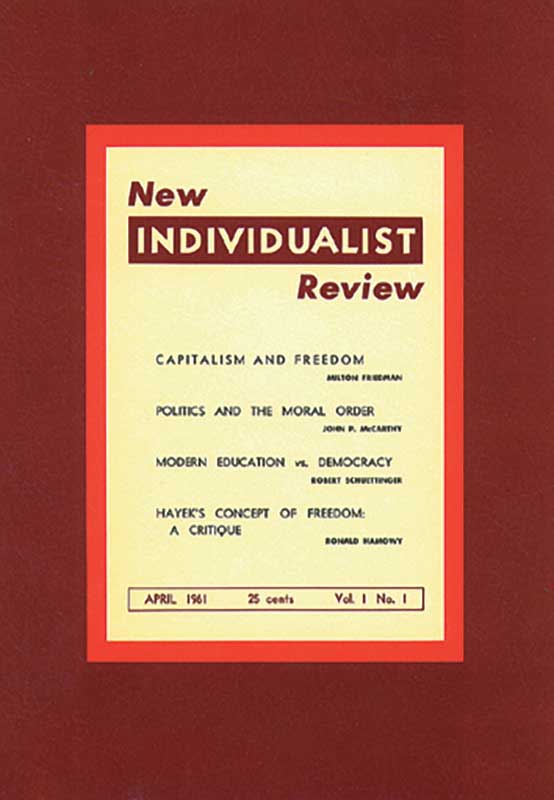
New Individualist Review, editor-in-chief Ralph Raico, introduction by Milton Friedman (Indianapolis: Liberty Fund, 1981).

About Liberty Fund:

Liberty Fund, Inc. is a private, educational foundation established to encourage the study of the ideal of a society of free and responsible individuals.


Consumer Sovereigntyand the Law

CONTEMPORARY TECHNOLOGY has accustomed us to the manufacturing of the most varied things, and not only of things never previously produced or conceived, but also of those which in the not too distant past were produced but not manufactured, as, for instance, pre-fabricated houses, and the famous Liberty Ships which contributed so much to the victory of the Allies in the last war. With the help of technology, long and costly processes of production have been eliminated, costs reduced, and delivery dates accelerated, with increased satisfaction for the consumer, and, naturally, for the producer as well. These technological processes have, as has already been emphasized by many, posed a series of problems in other fields, by bringing about often radical changes in the social environment and even in our ways of thinking.

A widespread commonplace concerning contemporary culture is the position affirmed by—among others—the distinguished American jurist, W. Friedman, in his recent book, Law in a Changing Society:1 namely, that technical progress has necessarily and directly entailed a profound revolution of legal institutions. In this age of space satellites and astronauts, we often hear it asked, how can we possibly limit ourselves to, say, the concepts inherited from the Romans on the subject of property or contractual obligations, and so on? In reality, however, the modifications of legal institutions through the agency of technical innovation are not so numerous nor so important as they seem; in any case, it is very doubtful, and surely at least debatable, that such innovations of themselves entail radical modifications of the institutions and relations which have ruled our societies for thousands of years. While, for example, the private ownership of property admittedly no longer reaches usque ad sidera in any country of the world, nevertheless, it still persists and fulfills its necessary role. In the same way, the word or signature given by telephoto, or any other ultra-modern method, serves the same necessary function that it has had for some millenia. The modern man who communicates by television and travels in jets is of the same flesh and blood as, is psychologically and physically similar to, his distant ancestors who communicated by voice and travelled in chariots and sailing ships.

But notwithstanding the relative stability of legal institutions, at least in the countries of the West, a noteworthy change has arisen during the last 150 years precisely in the way in which people had for centuries, and even millenia, conceived the nature, origin and functions of the law.

The decline of the idea that the law is on the whole independent of the will of the rulers, and that it cannot be identified immediately and completely with the laws and decrees emanating from time to time from the holders of political power, is a most striking development, for its implications no less than for its diffusion in almost all societies in the contemporary period.2 Strangely enough, this development—perhaps through the continuity and gradualness with which it has taken place since the beginning of the last century—has seemed so natural, especially in Europe, that very few scholars up to now have addressed themselves to the task of considering it in its whole import or have dedicated to it the attention, and, I would wish to add, the apprehensiveness, that it deserves.

If only one word had to be used to define this widespread change in the idea of the law, I would say that according to the man on the street the law today is something which must be manufactured, or even pre-fabricated. That is, it is something produced with the minimum of time and effort judged necessary, according to plans prepared in advance, by the “suitable” people in the “suitable” places (the national legislatures), and presented to those who must obey the laws. The latter people (we might say the “consumers,” if the word were not misleading for reasons which we shall shortly see) do not have—or are thought not to have—any other role than that of using the product ready made for them, just as they use the automobile or the washing machine.

The production of the law today by other procedures would seem to many people slow, inadequate and imprecise. Habits, customs, judicial precedents and the opinions of experts in this matter were the classical instruments of the production of the law in classical Rome, in medieval and modern England, in the United States, and, notwithstanding some contrary appearances, in the majority of the countries of Europe until the compilation of the current legal codes, that is, generally speaking, until the beginning of the last century. But these instruments appear today, at least to the superficial glance of many, as outmoded tools of an “artisan” society, inadequate for the needs of a “rapid” civilization on the vast scale that we are familiar with today.

THE ANALOGY BETWEEN juridical “products” and the products of our technical and industrial civilization is not, however, so suitable as it appears at first glance. In fact, considered more attentively, it turns out to be wholly deceptive and false. A fundamental difference exists in the relationship, on the one hand, between the producers and consumers of the goods manufactured with the resources of industrial technique, and, on the other hand, between the “producers” and “consumers” of legal rules manufactured, even mass-produced, by the wielders of political power with the resources of legislative techniques.

In spite of every contrary appearance, the industrial productive process in the countries of the West is still originated and sustained by the initiative of private individuals—that is to say, by individuals who do not have at their disposal the police or the army to constrain the consumers to buy the products which these private individuals put on the market. “One dollar, one vote,” describes very well the nature of that continuous process with which the consumer directs and dominates the conduct of the producers in the free market. While the latter study how to entice the consumer (and sometimes even how to deceive him), they know that in the final analysis they must serve the consumer, satisfy his will, and cater to his whim under penalty of going into the red, and thus having to cease their productive activity.

There is a radically different relation between the “producers” and “consumers” of the legal rules manufactured through the use of legislative technique. The vote of the “consumers” in this case is discontinuous, a circumstance arising from the fact that it can be given only at certain times and under certain conditions, with a meaning almost always empty or equivocal, and with effects not predicted, often unpredictable and frequently unwanted. We may also add that not all “consumers” can vote, whereas on the market even a five year old boy who has ten cents to buy himself an ice cream cone casts his “ballot.” Further, there are always some voters who will find themselves in the minority of any political vote and despite every contrary electoral invention and device are destined purely and simply to waste their votes. To control the production of legislation, in this case, is for the “consumers,” the people for whom the rules themselves are intended, an evidently hopeless job.

It is said that these differences between economic processes and legislative techniques are inevitable, and that it is therefore necessary to know how to resign oneself to them. Our civilization does not allow us to take into consideration the desires of all the electorate on the political level, the argument goes, and consequently political representation is the best substitute that can be offered us for that real “representation” which would otherwise be unfeasible. This position would make sense if the people for whom the laws are intended could control the production of these laws in no other way than through the institution of “representation.” But it is exactly this claim—that there is no other way to produce law than through the institution of representation—which has to be demonstrated, since this technique of production of the law (legislation) reveals its grave inefficiency. It is the problem of defining “law” that must be entirely reconsidered and, in particular, the problem of whether the law, and, especially the above-mentioned private law, can be “manufactured,” as today a washing machine or automobile is manufactured. Might it not be, instead, that the law is something that evades the rules of industrial production and consumption, something not susceptible of being manufactured by a limited number of “entrepreneurs” for the use of everyone else?

One can cite the contemporary experience: the law of today which denies that of yesterday evening, and which will be superseded by that of tomorrow morning; the two thousand laws manufactured every year by 500 men in our own, as in other countries, without the majority of the citizens even knowing of the existence of these laws; the obviously ephemeral character of much legislative activity, owing to the transitory triumph of no less ephemeral majorities in parliaments; the consequent impossibility of the citizens making long-range plans which could take for granted the constancy of juridical rules; the equally serious consequence that the law of today can be the result (as frequently happens) of the oppressive design of a slender majority, or even of an effective minority (the “pressure groups,” as they are called today), who tomorrow will see themselves oppressed in their turn by a new minority in the seats of power. All these are reasons for profound perplexity on the nature and the function of the law “manufactured” by the legislators who produce laws on a vast scale. This process of “production”’ may seem to be equivalent to the techniques evolved for manufacturing industrial items, but, unlike the industrial sector, in the case of law there are actually very few reasons for preferring those techniques to the ancient methods of the “artisans” for the ascertainment and the “production” of the customary and judicial law.

Perhaps one day the common man will understand a truth with which he appeared to be instinctively acquainted in times not far distant from us, although they seem to fade more and more into the past. In reality, the law is something which is not pre-fabricated in some specially-designated place, by some specially-designated producer and with some pre-established technique. In much the same way, no followers of the artificial languages such as Esperanto and Volapuk have yet succeeded in finding a substitute for the language that we speak every day, which also is not pre-fabricated. The law is in the last analysis something which everyone makes every day with his behavior, his spontaneous acceptance and observance of the rules that everyone helps to establish, and finally, even if it seems paradoxical, with the disagreements themselves which eventually arise among the various individuals on the observance of these rules.

The consequences of this old but always valid conception of the law will not necessarily consist in the total abandonment of the “manufacturing” of the law. But certainly our law-factories will have to limit very much their “production,” and renounce sooner or later (if the West is not destined to fall into servitude) many of their “products.” Finally, “law-consumers” will take back their true function of being producers of their own laws or at least of those laws—and they are not few—whose production they would otherwise control but today cannot.

WHAT YOU CAN DO TO HELP NIR . . .

During the past year, the circulation and staff of NEW INDIVIDUALIST REVIEW has been expanding rapidly. This journal is now being sold at many local newsstands and at over 40 colleges and universities. Despite a few dissenting notes, the general reaction of libertarian and conservative leaders has been favorable. The author of “The Conservative Mind,” Prof. Russell Kirk, for instance, has said that NEW INDIVIDUALIST REVIEW is a work of “genuine intellectual power” and the editor of “National Review,” William F. Buckley, Jr. has called it “by far the best student magazine on our side of the fence.” If you agree that this is a useful magazine which ought to be read by more people, there are four things that you can do to further the growth of libertarian-conservative ideas.

(1) You can urge your college library or your local library to subscribe. A library subscription makes an excellent donation since it may introduce the magazine to dozens of people.

(2) You can urge your friends to subscribe or to donate subscriptions to students.

(3) If you are a college student, you can volunteer to act as our representative on your campus.

(4) Our student subscription price ($1.00 a year) does not cover the cost involved; this price is purposely kept low to encourage as wide a readership as possible among undergraduates. Our deficit is made up by voluntary contributions from individuals. Any donation which you might be able to afford at this time would be gratefully received. None of our staff receives any remuneration of any kind.

[* ] Bruno Leoni is a Professor of Jurisprudence at the University of Pavia. He is the author of Freedom and the Law, and the editor of the scholarly journal Il Politico. This essay was translated from the Italian by William Campbell, an American student studying under Professor Leoni at Pavia.

[1 ] W. Friedman, Law in a Changing Society (London: Stevens, 1959).

[2 ] The phenomenon concerns not only the countries of continental Europe (where, as is well-known, the “will of the prince” has been repeatedly regarded as the fount of the law), but also the Anglo-Saxon countries, where it used to be maintained, at least up to the beginning of this century, and still is in part, that the “prince” (today we should say “parliament,” and through it the government, when the parliament delegates to it the necessary powers) is not so much the creator of the law as the guardian of justice, which the judges administer in the prince’s name, but in full independence of his personal will.