EconlibThe LibraryOther Sites |
Front Page Titles (by Subject) BENJAMIN A. ROGGE, New Conservatives and Old Liberals - New Individualist Review
Return to Title Page for New Individualist ReviewThe Online Library of LibertyA project of Liberty Fund, Inc.Search this Title:Also in the Library:
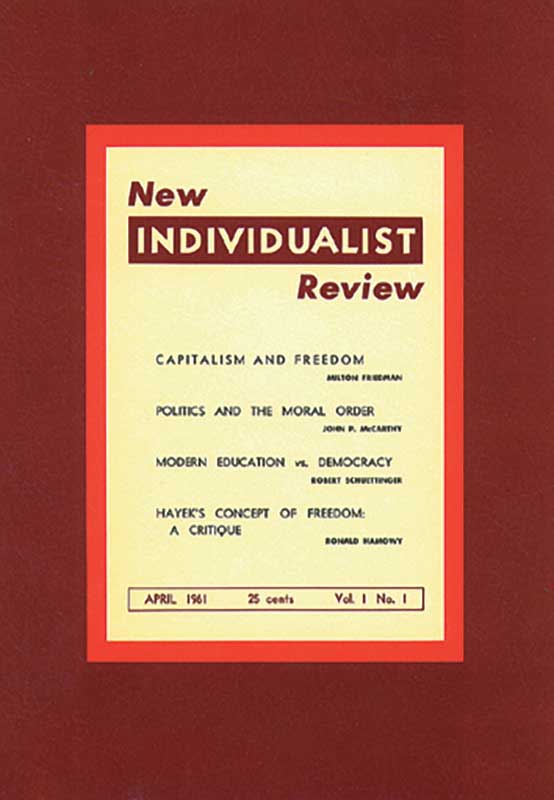
BENJAMIN A. ROGGE, New Conservatives and Old Liberals - Ralph Raico, New Individualist Review [1961]Edition used:New Individualist Review, editor-in-chief Ralph Raico, introduction by Milton Friedman (Indianapolis: Liberty Fund, 1981).
About Liberty Fund:Liberty Fund, Inc. is a private, educational foundation established to encourage the study of the ideal of a society of free and responsible individuals. Copyright information:The copyright to this publication is held by Liberty Fund, Inc. The New Individualist Review is prohibited for use in any publication, journal, or periodical without written consent of J. M. Cobb, J. M. S. Powell, or David Levy. Fair use statement:This material is put online to further the educational goals of Liberty Fund, Inc. Unless otherwise stated in the Copyright Information section above, this material may be used freely for educational and academic purposes. It may not be used in any way for profit.
New Conservatives and Old LiberalsAS MANY OF my readers may know, a college dean is not paid to think—or, at least, to think about matters extraneous to the operation of his college. For him even to continue an interest in his old pre-deaning discipline is thought by many to be evidence of a frivolous approach to administration. In line with this tradition, I have limited myself in recent years to one non-dean-type thought at a time, and I can never predict what that thought will be at a given moment. When I came to jotting down some notes for this essay, I found myself bemused by the new conservatism; thus, I had no choice but to take it as my topic. This choice makes some sense in that I am considered to be a conservative by that embarrassingly small number of people who have thought me worth classifying. Also, there is much talk and writing these days about the new conservatism or the “revival of conservatism,” or, as some would put it, the “recrudescence of conservatism.” So as to remove any element of suspense from this presentation, let me say immediately that, from the vantage point of my particular brand of conservatism, much of the new conservatism is a hindrance rather than an aid to the cause. Or, to put it differently, with some of these people as my friends, I don’t need any enemies. It should be obvious to you now that we are about to play a game of semantics. What is a “conservative”? What is a “liberal”? There is the story of three famous umpires discussing the calling of balls and strikes. The first one says, “I calls them as I sees ’em.” The second one says, “I calls them as they are.” The third one, and my hero, says, “They ain’t nothin’ ’til I calls ’em!” I’m going to play the role of the third umpire and begin by saying that, of course, I am not properly identified when I am called a conservative. Rather, I am a classical (or, if you prefer, a primitive) liberal. The distinguishing characteristics of a classical liberal are: (1) a deep and abiding distrust of government, and (2) a belief that each individual should be free to do and believe and say anything he wishes so long as he is not using force or fraud against some other individual. The political philosophy that follows from these beliefs is one that limits the government to the night-watchman’s role, to preventing one individual from using force or fraud against another. The economic philosophy is basically that of laissez-faire. My intellectual mentors would be such men as Adam Smith, David Ricardo, the early John Stuart Mill, Frederick Bastiat, de Tocqueville, Lord Acton and, among the moderns, Frank Knight and F. A. Hayek. IF THIS BE TRUE LIBERALISM, what then is true conservatism? The distinguishing characteristics of true conservatism are: (1) a deep mistrust of human reason, and (2) a belief that order and continuity are of paramount importance in nurturing and preserving the humane and civilized virtues of human beings in society. The true conservative sees society as always threatened by a return to barbarism, with the only effective restraints on brute man being those of religion, custom, recognition of an aristocracy of birth, etc. Thus an Edmund Burke sees in a French Revolution, not the coming of the new and enlightened Jerusalem, but a break in the pattern of society so violent that only barbarism or tyranny can result from it. Personally, I think it clear that Burke was right, and, in fact, I find much with which I can sympathize in this, the true, conservatism. Modern representatives of this point of view are such men as Peter Viereck and Russell Kirk. However, it is not this kind of sophisticated and philosophical conservatism that is being revived. Nor can I ever forget that over the centuries, in actual operation this true conservative philosophy has brought man, not freedom, but bondage. The prototype of the unfree man has been the one living in a tyranny, supported by religion, administered by an hereditary monarch, and made impotent by the dead-weight of custom. The ancient kingdom of Sparta, a truly conservative state, finally defeated Athens, but it is not a society I would care to see reborn. I realize that that the true conservative would say that Sparta was conservatism exaggerated and made rigid, but this seems often to be the end of true conservatism in practice. However, as I said before, the new conservatism is not the true conservatism. What then is it? It is, in fact, an odd mixture of many conflicting elements. It is, for example, a Robert Welch and a John Birch Society. A Robert Welch would give man his freedom in economic life, as I would. But he would not give man freedom to preach the end of freedom, e.g., to preach Communism, and I would. I do not know Mr. Welch but I do know a number of the members of his society. They are serious, sincere people, who see this nation facing a crafty and terrible enemy, in fact, so crafty that he is able to enlist the conscious or unwitting support of many of our own people. National survival then depends on exposing and defeating this enemy wherever he might be found. I say these people are serious and sincere, but so were the Athenians who sentenced Socrates to death for subverting the youth of the city. So were the men who devised the Spanish Inquisition; so was Martin Luther when he advised the ruler of a German province to shoot down like dogs the German peasants who threatened the stability of the society; so was John Knox, the father of the Presbyterian Church, when he urged that all Catholics in Scotland be put to death; so were the people who gave trouble to my German-born grandfather in World War I, in spite of the fact that he had a son fighting in the AEF; so were the Americans who ordered imprisonment for thousands of Japanese-Americans in World War II. So are they always who, in fright, hope to solve their problems by hunting out the “bad” guys, and eliminating them. Let us remember now the spirit of David Ricardo, the great classical economist of the early 19th century, who, born a Jew, turned Quaker, yet spent part of his personal fortune to end legal discrimination against Catholics in Great Britain, and in Parliament defended a book-seller who had been imprisoned for selling the free thought works of Tom Paine. Freedom of belief and advocacy means exactly that—and for Communist and John Bircher alike. A second much-talked-about element in the new conservatism is campus conservatism, or the phenomenal growth of conservative clubs on college and university campuses. There is much in this that I can find interesting and attractive, but much that I find disturbing as well. Many of the young men and women seem to be concerned with the central issues of the individual vs. the state. But many others seem to be only self-importantly and noisily anti-communist. They seem to see their tasks as those of identifying and exposing the left-wingers on the faculty and protecting the House Committee on Un-American Activities. The super-patriot is never a true friend of individual liberty, nor is he who would advance the cause of liberty by restricting the freedoms of all those who disagree with him. I MUST CONFESS that I can never be very optimistic about the contribution to the cause of freedom of college-age youth. Classical liberalism is essentially an end-of-innocence philosophy. It requires accepting the imperfect nature of man and hence the imperfect nature of all human constructs. It sadly, but firmly, insists that the New Jerusalem is never to be realized. It denies that man can consciously and deliberately plan himself into the good life and the good world. It places its restricted faith in the unpredictable and unplanned consequences of the individual decisions of free men and women. This is a philosophy of the mature human being. It has little real appeal to the confident, hyper-critical mind of the young person. It is the young who believe in the possibility of a heaven on earth brought into being by the conscious exercise of their mighty power of reason—and who are prepared to sweep aside those whose feeble minds or weak wills make them an obstacle to the cause. It is later in life, if ever, that a man reconciles himself to living in an imperfect world in which imperfect people make imperfect decisions—and is willing to let them do so, so long as they do not infringe on his freedom and the freedom of others. In sum, while I am encouraged by the increasing interest of college students in the cause of individual freedom, I must confess that I think much of this interest is about as well-grounded in philosophic commitment as their interest in panty raids and school spirit. If freedom survives in the decades ahead, it will be because age and not youth has had its way. A third element in the new conservatism is reflected in a group of senators, but particularly Representatives in Congress, who belligerently identify themselves as conservatives. Some of these men I find very attractive and indeed some of them seem to be consistent classical liberals. But most of them prove their conservatism by (1) urging the United States to use its military might to crush Communism, (2) supporting all restrictive measures against domestic Communism and fellow-travelers, (3) vigorously upholding the rights of the individual states to deny Negroes equality before the law, and (4) always supporting the “business” interest, whether it be by tariffs, right-to-work laws, fair trade acts, special tax treatment or what have you. In none of this do I find any evidence of a true commitment to the principle of freedom and its corollary, the rule of law. I am no more attracted by government intervention in economic life to give special treatment to business groups than I am to the anti-business interventions supported by the modern liberal. This brings me at last to the other side, the belligerent non-conservatives, the authors of the New Frontier, the Fair Deal, the New Deal—and Modern Republicanism. If I don’t like my fellow conservatives, why don’t I ally myself with those who are called liberals today? THE ANSWER IS that these people are no more truly liberal than my conservative friends. Admittedly, they usually come down on the right (or freedom) side of the fence when the issue relates to freedom of speech or of press or of belief—although some of them are inconsistent even here. But they have absolutely no commitment to economic freedom—nor any recognition of its relationship to all other freedoms. They are the would-be philosopher-kings who are going to protect, guide, manipulate, subsidize and control those who are less blessed with wisdom than they. They are the legal Robin Hoods, who in neverending gallantry, are going to use the coercive power of the state to take from one man and give to another. They are the planners of great plans, whereby this country is going to achieve an annual growth rate of 6.12 per cent, and all the underdeveloped countries of the world are to be brought quickly into the modern world. Their point of view is magnificently represented by Mr. Minow of the Federal Communications Commission, whose complaint against the television industry is that it is giving the viewers what they (the viewers) want. Under this philosophy, workers and farmers are forced by law to do that for which businessmen are sent to jail. Under this philosophy, the blindfolded Goddess of Justice has been permitted—nay encouraged—to peek, and she now says with the jurists of the ancient regime, “First tell me who you are and then I’ll tell you what your rights are.” No, there is no commitment to freedom in this philosophy, nor is there any of that fear of the state, of government, upon which any philosophy of freedom must be grounded. What then is left for a classical liberal? With which side is he to ally himself—the conservative or the modern liberal? In answer and in closing I would like to describe one of my favorite cartoons from The New Yorker. In the picture, a mother is feeding a vegetable to a little girl in a high chair and the little girl is obviously having none of it. In the caption, the mother says, “But dear, it’s broccoli”; to which the little girl replies, “I say it’s spinach and I say the hell with it.” Whether on the one hand it is called patriotism or true Americanism, or anti-communist, or pro-business, or anti-labor; whether on the other hand it is called humanitarianism, liberalism, the wave of the future, economic democracy, the welfare state, the New Frontier or the New Deal, I say it’s spinach and I say the hell with it. [* ] Benjamin A. Rogge, Dean of Wabash College, is co-author of the college textbook Introduction to Economics and is a contributor to professional journals. |

Titles (by Subject)