|
|
Front Page Titles (by Subject) ROBERT SCHUETTINGER, F. J. Johnson's No Substitute for Victory - New Individualist Review
ROBERT SCHUETTINGER, F. J. Johnson’s “ No Substitute for Victory ” - Ralph Raico, New Individualist Review [1961]Edition used:New Individualist Review, editor-in-chief Ralph Raico, introduction by Milton Friedman (Indianapolis: Liberty Fund, 1981).
About Liberty Fund:Liberty Fund, Inc. is a private, educational foundation established to encourage the study of the ideal of a society of free and responsible individuals. Copyright information:The copyright to this publication is held by Liberty Fund, Inc. The New Individualist Review is prohibited for use in any publication, journal, or periodical without written consent of J. M. Cobb, J. M. S. Powell, or David Levy.
Fair use statement:
This material is put online to further the educational goals of Liberty Fund, Inc. Unless otherwise stated in the Copyright Information section above, this material may be used freely for educational and academic purposes. It may not be used in any way for profit.
- Publisher’s Note
- Introduction
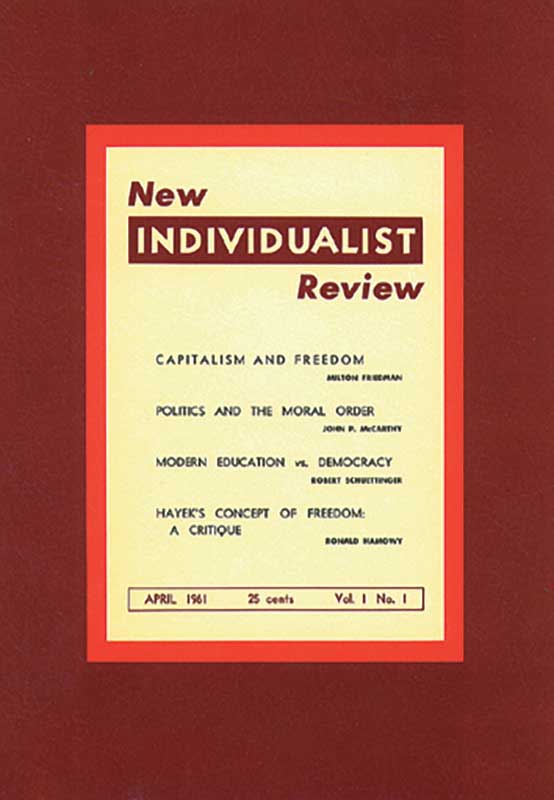
- Volume 1, Number 1, April 1961
- An Editorial …
- Milton Friedman, Capitalism and Freedom
- John P. Mccarthy, Politics and the Moral Order
- John Weicher, Individualism and Politics: the Next Four Years: an Appraisal
- Ralph Raico, Great Individualists of the Past: Wilhelm Von Humboldt
- Robert Schuettinger, Modern Education Vs. Democracy
- Ronald Hamowy: Hayek’s Concept of Freedom: a Critique
- New Books and Articles
- Volume 1, Number 2, Summer 1961
- Murray N. Rothbard, the Fallacy of the “ Public Sector ”
- John Weicher, Individualism and Politics: the Question of Federal Aid to Education
- Robert Schuettinger, Great Individualists of the Past: Tocqueville and the Bland Leviathan
- Tocqueville On Socialism
- Edward C. Facey, Conservatives Or Individualists: Which Are We?
- John Weicher, Mr. Facey’s Article: a Comment
- F. A. Hayek, Communication: Freedom and Coercion: Some Comments and Mr. Hamowy’s Criticism
- John Weicher, Book Review: the Moulding of Communists, By Frank S. Meyer
- New Books and Articles
- Volume 1, Number 3, November 1961
- Ronald Hamowy and William F. Buckley, Jr., “ National Review ”: Criticism and Reply
- Russell Kirk, Ritualistic Liberalism
- Bruce Goldberg: Ayn Rand’s “ For the New Intellectual ”
- Leonard Liggio, Herbert Butterfield: Christian Historian As Creative Critic
- Roger Claus, an Approach For Conservatives
- John P. Mccarthy, John Courtney Murray and the American Proposition
- New Books and Articles
- Volume 1, Number 4, Winter 1962
- Robert M. Hurt, Antitrust and Competition *
- Ralph Raico, Reflections In Berlin
- Eugene Miller, David Hume: Whig Or Tory?
- Martin Glasser, the Judicial Philosophy of Felix Frankfurter
- Wilhelm Roepke, Communication: the Intellectual Collapse of European Socialism
- Murray N. Rothbard, On Freedom and the Law
- J. Edwin Malone, Fertig’s “ Prosperity Through Freedom ”
- New Books and Articles
- Volume 2, Number 1, Spring 1962
- Harry Elmer Barnes, A. J. P. Taylor and the Causes of World War Ii
- James M. O’connell, the New Conservativism
- G. C. Wiegand, Individual Freedom and Economic Security
- Robert M. Hurt, Sin and the Criminal Law
- John P. Mccarthy, the Shortcomings of Right-wing Foreign Policy
- Robert M. Schuchman, J. B. Conant’s “ Slums and Suburbs ”
- Robert Schuettinger, F. J. Johnson’s “ No Substitute For Victory ”
- New Books and Articles
- Volume 2, Number 2, Summer 1962
- Milton Friedman, Is a Free Society Stable?
- Howard Buffett, an Opportunity For the Republican Party
- Murray N. Rothbard, H. L. Mencken: the Joyous Libertarian
- Richard W. Duesenberg, Individualism and Corporations
- John Weicher, Conservatives, Cities, and Mrs. Jacobs
- Sam Peltzman, Housing In Latin America, Public and Private
- New Books and Articles
- Volume 2, Number 3, Autumn 1962
- George J. Stigler, the Intellectual and the Market Place
- Robert M. Hurt, Observations On the Soviet “ Lost Generation ”
- John Van Sickle, Economic Growth Vs. “ Growth ” Economics
- Robert Schuchman, Civil Liberties In the Welfare State
- Benjamin A. Rogge, New Conservatives and Old Liberals
- When America Spoke With One Voice
- Ludwig Von Mises, a New Treatise On Economics (rothbard)
- John Weicher, a “ Fusionist ” Approach to Freedom 1
- New Books and Articles
- Volume 2, Number 4, Spring 1963
- The Regulatory Bureaus:
- Christopher D. Stone, ICC: Some Reminiscences On the Future of American Transportation
- Sam Peltzman, Cab: Freedom From Competition
- Robert M. Hurt, Fcc: Free Speech, “ Public Needs, ” and Mr. Minow
- Otto Von Habsburg, Czecho-slovakia and the Ussr
- Robert Cunningham, the Case Against Coercion
- John P. Mccarthy , Ireland, Victim of Its Own Politicians
- New Books and Articles
- Volume 3, Number 1, Summer 1963
- Robert L. Cunningham, Education: Free and Public?
- Bruno Leoni, “ Consumer Sovereignty ” and the Law
- Israel M. Kirzner, On the Premises of Growth Economics
- Murray N. Rothbard, the Negro Revolution
- Robert Schuettinger, Foreign Aid In Latin America
- Sam Peltzman, “ Economics of the Free Society ”
- New Books and Articles
- Volume 3, Number 2, Winter 1964
- F. A. Hayek, Kinds of Order In Society
- B. R. Shenoy, the Results of Planning In India
- Michael F. Zaremski, Red China’s Great Leap Backward
- Bruce Goldberg, Skinner’s Behaviorist Utopia
- Ralph Raico , Great Individualists of the Past: Benjamin Constant
- New Books and Articles
- Newe Bokes & Articulles
- Volume 3, Number 3, Autumn 1964
- The Conservatism of Richard M. Weaver *
- James Powell, the Foundations of Weaver’s Traditionalism
- Weaver On Society, Past and Present:
- I.: The Southern Tradition
- 2.: The Humanities In a Century of the Common Man
- George J. Stigler, Reflections On the Loss of Liberty
- Ralph Raico, the Fusionists On Liberalism and Tradition
- William H. Nolte, H. L. Mencken and the American Hydra
- New Books and Articles
- Volume 3, Number 4, Spring 1965
- Yale Brozen, the Revival of Traditional Liberalism
- Gordon Tullock, Constitutional Mythology
- Denis V. Cowen, Prospects For South Africa
- Benjamin A. Rogge, Communication: Note On the Election
- William S. Stokes, Economic Liberalism In Post-war Germany
- Robert M. Schuchman, Property Law and Racial Discrimination
- New Books and Articles
- Volume 4, Number 1, Summer 1965
- Benjamin A. Rogge, Financing Higher Education In the United States
- Philip B. Kurland, Trends In the U. S. Supreme Court
- G. Warren Nutter, How Soviet Planning Works
- Edwin Harwood, Collectivism In Social Theory
- Robert L. Cunningham, Justice, “ Needs, ” and Charity
- Communication: the 1964 Election
- William A. Rusher, Rusher On Goldwater:
- Benjamin A. Rogge, Reply to Mr. Rusher:
- Stephen J. Tonsor, the View From London Bridge
- New Books and Articles
- Volume 4, Number 2, Winter 1966
- Murray N. Rothbard, Herbert Clark Hoover: a Reconsideration
- W. H. Hutt, Twelve Thoughts On Inflation
- M. Stanton Evans, Raico On Liberalism and Religion
- Ralph Raico, Reply to Mr. Evans
- Francis Lieber, Anglican and Gallican Liberty
- E. G. West, the Uneasy Case For State Education
- Thomas Molnar, Communication: South Africa Reconsidered
- Stanley G. Long, Review: Alchian and Allen’s “ University Economics ”
- New Books and Articles
- Volume 4, Number 3, Spring 1966
- Karl Brunner, the Triple Revolution: a New Metaphysics
- Henry Hazlitt, Agnosticism and Morality
- Yale Brozen, Wage Rates, Minimum Wage Laws, and Unemployment
- Reed J. Irvine, Economic Development and Free Markets
- Sudha R. Shenoy, the Sources of Monopoly
- Hirschel Kasper, What’s Wrong With Right-to-work Laws
- W. H. Hutt, Communication: “fragile” Constitutions
- Sam Peltzman, Books: Kefauver and Populist Economics
- Sam Peltzman, Books: Freedom Under Lincoln By Dean Sprague
- New Books and Articles
- Volume 4, Number 4, Spring 1967
- Milton Friedman, Why Not a Volunteer Army?
- Richard Flacks, Conscription In a Democratic Society
- Walter Y. Oi , the Real Costs of a Volunteer Military
- Bruce K. Chapman, the Politics of Conscription
- Joe Michael Cobb, Emigration As an Alternative to the Draft
- James Powell, Anti-militarism and Laissez Faire
- The Anti-militarist Tradition: Robert A. Taft, 1940
- The Anti-militarist Tradition: Oswald Garrison Villard, 1916
- The Anti-militarist Tradition: Daniel Webster, 1814
- New Books and Articles
- Volume 5, Number 1, Winter 1968
- W. H. Hutt, the Rhodesian Calumny
- Svetozar Pejovich, Community, Leadership and Progress
- Jay A. Sigler, the Political Thought of Michael Oakeshott
- Ljubo Sirc, Two Decades of Economic Planning In Yugoslavia
- David Levy, Marxism and Alienation
- Armen A. Alchian, the Economic and Social Impact of Free Tuition
- Books
- New Books and Articles
F. J. Johnson’s “No Substitute for Victory”
ROBERT SCHUETTINGER
IN No Substitute for Victory Frank J. Johnson, a former naval intelligence specialist on Soviet affairs, proposes what he believes to be the only strategy by which the United States can be certain of maintaining both peace and freedom. He asks us to deliberately adopt a policy of victory over Communism; only such a policy, he holds, can prevent an atomic holocaust.
By using the phrase “victory over Communism,” Mr. Johnson is not suggesting that we conquer the Soviet Union and make it a United States satellite; what he does propose is that we should pursue “creative initiatives” (to borrow a pet Liberal term). These initiatives will be aggressive in character and will be designed to convince the Soviet rulers that it is in their own interest to terminate the Cold War and to dismantle the world-wide Communist conspiracy. Mr. Johnson believes this can be accomplished if we recognize the fact that “peaceful co-existence,” as propounded by Khrushchev, is a fraud, that the Soviets are willing to negotiate and to trade territory back and forth in the “war zone” (the non-Communist world) but not in the “peace zone” (the Communist world). By using paramilitary warfare, subversion, terror, sabotage, strikes, guerilla techniques and other means short of nuclear war, the United States could carry the Cold War to the Soviet Union by invading the “peace zone” and endangering the security of the Communist rule in the mother country. Our object should be to encourage rebellion in the satellites and thus make Eastern Europe a liability and not an asset to the Russian government. The price for ending these pressures on the Communist bloc will be iron-clad guarantees from the Politburo that they, in turn, will abandon their adventurous foreign policy. Our hope will be that the peoples under Communist rule will eventually achieve their own freedom, either through peaceful means or by force.
The alternative to this policy—appeasement—must ultimately lead to a nuclear war since the Soviet Union will not attack the United States until the greater part of the world has been brought under Communist control by paramilitary means. An appeasement policy by the West will allow this timetable to be carried out; a firm counter-offensive, however, will prevent the Soviets from reaching the take-off stage of their plan for world conquest. Readers of this book will understand that we are not left with only two choices (“Red or dead”). There is a third course, one that will enable us to avoid both war and submission, and Mr. Johnson has outlined that course with clarity. It only remains for Mr. Kennedy to follow it.
No Substitute for Victory is aimed directly at the person who must ultimately be convinced in a democracy: the average voter. This is both a strength and a weakness. It is of necessity plainly written and so contains a number of over-simplifications. The emphasis on the essential un-Americanism of Communism—its European origins—could, for instance, have been easily omitted. Although it must be classed as an introduction to its subject it is a solid and generally reliable work; it contains almost none of the unfortunate vulgarizations perpetrated by so many of the “authorities” on Communism currently cropping up all over the lecture circuit. These half-educated, unthinking popularizers may be well-meaning, but their wild outcries have the effect of obscuring and even discrediting the serious proposals of reputable spokesmen for an anti-Communist strategy. For this and other reasons, they are doing far more harm than good. It is even more unfortunate, however, that most of the West’s intellectuals (who lack the excuse of ignorance) still believe that “peaceful co-existence,” as defined by Khrushchev, is possible with the present governments of the U.S.S.R. and Communist China.
Although the West is weakened in its struggle by the (let us hope) temporary neutrality of so many of its finest minds, we should probably not be too surprised by this phenomenon. After all, the greatest part of Europe’s intellectuals believed, at one time, in the flatness of the earth, just as they once fervently upheld chattle slavery, blood-letting and leeches, witchcraft and the theory that the sun revolves around the earth. History demonstrates, however, that even intellectuals can learn, so we can hope that hard experience will eventually triumph over wishful thinking and that the myth of “co-existence” will someday go the way of the Ptolemaic theory. Mr. Johnson’s book will do much to hasten this process.
Robert Schuettinger is an Associate Editor of New Individualist Review.
No Substitute for Victory, by Frank J. Johnson, with introduction by Admiral Arleigh Burke, (Regnery: Chicago, 1962), 230 pp.
Most readers of this review will be familiar with a more complete work, A Forward Strategy for America, by Strauz-Hupe, Kintner and Possony (Harper, New York, 1961).
|