EconlibThe LibraryOther Sites |
Front Page Titles (by Subject) EUGENE MILLER, David Hume: Whig or Tory? - New Individualist Review
Return to Title Page for New Individualist ReviewThe Online Library of LibertyA project of Liberty Fund, Inc.Search this Title:Also in the Library:
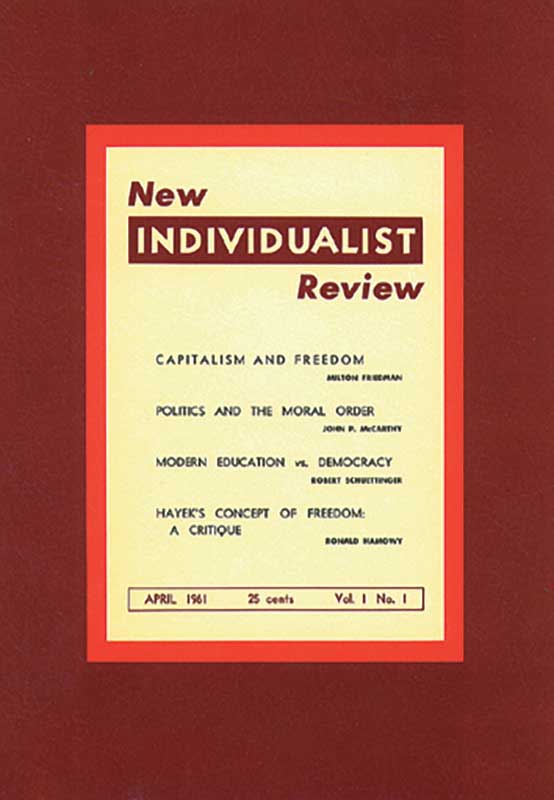
EUGENE MILLER, David Hume: Whig or Tory? - Ralph Raico, New Individualist Review [1961]Edition used:New Individualist Review, editor-in-chief Ralph Raico, introduction by Milton Friedman (Indianapolis: Liberty Fund, 1981).
About Liberty Fund:Liberty Fund, Inc. is a private, educational foundation established to encourage the study of the ideal of a society of free and responsible individuals. Copyright information:The copyright to this publication is held by Liberty Fund, Inc. The New Individualist Review is prohibited for use in any publication, journal, or periodical without written consent of J. M. Cobb, J. M. S. Powell, or David Levy. Fair use statement:This material is put online to further the educational goals of Liberty Fund, Inc. Unless otherwise stated in the Copyright Information section above, this material may be used freely for educational and academic purposes. It may not be used in any way for profit.
David Hume: Whig or Tory?DOES DAVID HUME, the leading English philosopher of the eighteenth century, deserve a place among those great political theorists of the past who valued individual liberty? This question has been debated since Hume’s own century. Interpreters who deny such a place to Hume have viewed him as a Tory, rather than a Whig in the tradition of John Locke, and have insisted that he favored authority and monarchy, not liberty and free government. Russell Kirk echoes this view by describing him as an “ardent High Tory,” who “stood for the Old Cause against Whiggery.”1 An opposing interpretation of Hume’s political theory has come from such writers as F. A. Hayek, who emphasize Hume’s influence on Adam Smith and classical liberalism. Hayek, who chooses Hume as a “constant companion and sage guide” throughout the pages of The Constitution of Liberty, places him in the “Old Whig” political tradition rather than in the Tory or conservative tradition. The dominant interpretation of Hume’s political philosophy places him in the Tory camp. The English Whigs writing during Hume’s lifetime charged that his History of England and political essays favored absolute monarchy and the Tory cause, and Thomas Jefferson branded him “the great apostle of Toryism” and claimed that his writings, along with Blackstone’s, “have done more toward the suppression of the liberties of man, than all the millions of men in arms of Bonaparte.”2 In Jefferson’s eyes, Hume was guilty of rejecting popular government, or government based on consent, and of defending the monarchy of the Stuarts. For this purpose, writes Jefferson, Hume suppressed truths, advanced falsehoods, forged authorities, and falsified records. . . . But so bewitching was his style and manner, that his readers were unwilling to doubt anything, swallowed everything, and all England became Tories by the magic of his art. His pen revolutionized the public sentiment of that country more completely than the standing armies could ever have done, which were so much dreaded and deprecated by the patriots of that day. . . . Hume, with Brodie, should be the last histories of England to be read. If first read, Hume makes an English Tory, from whence it is an easy step to American Toryism.3 It is noteworthy that Jefferson believed Hume, rather than Burke, had been responsible for the growth of conservative sentiment in England during the late eighteenth century. Recent findings concerning Hume’s political theory, however, contradict the widely accepted notion that he was a Tory, and tend to support Hayek’s belief that he was, in fact, an advocate of free government and individual liberty. Ernest Campbell Mossner, Hume’s biographer, has rejected the charge of Jefferson and others that Hume was a “Tory historian.” According to Mossner, Hume was a sceptic who repudiated the dogmas of both the Whig and Tory parties of his time. Mossner does believe that Hume’s political theory contains ideas in common with both the Whig and Tory traditions, which developed in the nineteenth century, and describes Hume as “a Liberal in the large, non-party (and, historically speaking, nineteenth-century) sense.” Nevertheless he finds that Hume’s political theory is “colored by a cautionary skepticism concerning the likelihood of continuous human progress that belongs to what may with equal justice be called the large, non-party, Conservative tradition.”4 The belief that Hume opposed popular government has been undermined by the recent findings of Douglass Adair, who is recognized as an authority on The Federalist.5 Adair seems to have been the first scholar to show that Hume’s political essays served as a main source for James Madison’s conception of republican government. In The Constitution of Liberty, Hayek places Hume and Madison in the same political tradition, but he does not suggest that the English philosopher might have directly influenced “the father of the Constitution.” Adair shows that Hume’s writings helped to transmit this political tradition to Madison. While recent evidence discredits the opinion that Hume was simply a spokesman for the Tory cause, it does not justify the conclusion that he must therefore have been a Whig. The fact remains that Hume often ridiculed the Whig party and Whig beliefs. The practice of viewing Hume in terms of the Whig-Tory dichotomy rests on the dubious assumption that he can best be understood as a member of an eighteenth-century political party or a nineteenth-century political tradition. By the same token, it is not very helpful to ask whether Hume was a “conservative,” a “liberal,” or an “individualist.” These vague concepts came into use after Hume’s time and have little meaning when applied to his thought. How is Hume to be understood, if not as a Whig or a Tory? Hume provided an important clue to the proper interpretation of his political writings by referring to himself as a “philosopher.” As he pointed out, a philosopher looks at political problems differently than a spokesman for a political party. The political philosopher poses such general questions as the nature of the best form of government or the proper goals of political life, and his thinking about specific issues is guided by general principles. Hume’s interpreters have tended to focus on his specific statements about politics, which are often contradictory and obscure, without seeking the general principles which underly them. The debate as to whether Hume was a Whig or a Tory must be settled in light of his over-all political philosophy. But no comprehensive account of that political philosophy has yet been offered. He has been virtually ignored by historians of political thought. His failure to write a systematic treatise on politics has undoubtedly hindered the interpretation of his political theory. His brief political essays often appear contradictory, and it is difficult to formulate a unified view of political life from them. While a full account of Hume’s political philosophy is beyond the scope of a single article, some suggestions are possible as to its main features and their bearing on such issues as the Whig-Tory question, Hume’s attitude toward individual liberty, and his place in the history of political theory. Mossner and Adair have provided suggestions for such an undertaking. Mossner has pointed out that Hume was sceptical of the dogmas of the Whig and Tory parties as well as of the notion of continuous human progress. Adair has called attention to Hume’s emphasis on the dangers from political factions—an emphasis that is carried over into Madison’s writings. These dangers may be said to have provided a starting-point for Hume’s political philosophy. Adair goes on to show the importance of Hume’s neglected essay on the “Idea of a Perfect Commonwealth” in shaping Madison’s thought. This essay, which is crucial for a proper understanding of Hume’s conception of the nature and tasks of political philosophy, indicates the purpose of his political writings. THE DISPUTE as to whether Hume was a Whig or Tory must be settled in terms of his teachings about political factions. Hume regarded the Whigs and Tories as the leading English parties or factions of his time, and he traced their origin to the political struggles of the seventeenth century. For Madison, whose position in this area was greatly influenced by Hume’s essays, factions arising from a common interest or passion are especially dangerous to the stability of popular government. He gave only passing notice, however, to a type of faction which Hume saw as particularly dangerous, i.e., “parties from principle.” Hume writes that “parties from principle, especially abstract speculative principle, are perhaps, the most extraordinary and unaccountable phenomenon that has yet appeared in human affairs.”6 As this passage shows, Hume anticipated the “age of ideology,” in which bitter conflicts between opposing systems of ideas would predominate over moderate conflicts arising from opposed interests. Why had political and religious disputes become more bitter in modern times? Hume placed the blame on modern philosophers and theologians, who had allowed their speculative principles to become involved in factional disputes. Hume viewed the Whigs and Tories as factions from principle. He observed that as no party, in the present age, can well support itself without a philosophical or speculative system of principles annexed to its political or practical one, we accordingly find that each of the factions into which this nation is divided has reared up a fabric of the former kind in order to protect and cover that scheme of actions which it pursues.7 Underlying the Tory defense of monarchy is the principle that “the Deity is the ultimate author of all government.” The Whigs trace government to an “original contract” and conclude that all just or legitimate government rests on the consent of the governed. Each faction insists on the absolute validity of its principle. Hume’s treatment of factions must be understood in terms of his frequent distinction between “philosophers” and “the vulgar.” Factions arise among “the people” or “the vulgar,” and “the people [are] commonly very rude builders, especially in this speculative way.”8 Just as the philosopher’s knowledge transcends ordinary opinions, so is the philosopher above factions. Hume insists that to speak of “philosophers who have embraced a party” or faction is “a contradiction in terms.”9 To ask whether Hume was a Whig or a Tory, therefore, is to miss the crucial point about his political philosophy. Whatever Hume says about the Whigs or the Tories is said not as a partisan but as a philosopher. Hume did not conceive of the philosopher as merely a theorist, who lives apart from public affairs. While the philosopher is “above” factions, he is not indifferent to them. Hume believed that the philosopher is capable of performing certain political tasks for which ordinary citizens and even statesmen are unfitted. One of these tasks is to promote political stability by mediating between opposing factions to assuage the force of their disputes. The danger of factions provided a starting-point for Hume’s political philosophy because he saw the philosopher as the citizen best fitted to mediate between competing factions, especially factions from principle. Hume’s understanding of the task of the philosopher with respect to factions is stated concisely in his essay “Of the Protestant Succession”: It belongs, therefore, to a philosopher alone, who is of neither party, to put all the circumstances in the scale, and assign to each of them its proper poise and influence. . . . If he indulges any passion, it is that of derision against the ignorant multitude, who are always clamorous and dogmatical, even in the nicest questions, of which, from want of temper, perhaps still more than of understanding, they are altogether unfit judges. . . . The following reflections will, I hope, show the temper, if not the understanding of a philosopher.10 Unless we understand this conception of the duty of the philosopher with respect to factions—and Hume does not allow us to forget that he is a philosopher—then we shall be unable to understand those writings in which he treats the English factions and their principles. “Of the Original Contract” is probably the most important of the essays in which Hume discusses the principles of the two parties. He states the Tory doctrine of divine right in a brief passage at the beginning of this essay, but he does not explicitly criticize it. The remainder of this rather long essay is devoted to a vigorous and sarcastic attack on the Whig notions of an “original contract” and government by consent. The style and emphasis of this essay might well give rise to the belief that he was sympathetic to the Tory and entirely opposed to the Whig principle. He ridicules the Whig “speculative system of politics” and claims that their “original contract” doctrine can make men “so much in love with a philosophical origin to government as to imagine all others monstrous and irregular.”11 He insists throughout this essay that the Whig principle is opposed to common sense and political stability: “Were you to preach, in most parts of the world, that political connections are founded altogether on voluntary consent or a mutual promise, the magistrate would soon imprison you as seditious for loosening the ties of obedience, if your friends did not before shut you up as delirious for advancing such absurdities.”12 The passages in this essay that caution against violent innovations, a theoretical approach to politics, and a lack of respect for ancient ways are likely to remind the reader of some of Burke’s statements. It would be erroneous, however, to conclude from the most obtrusive statements in Hume’s essays that he was simply a partisan of the Tories. As we shall see, his “perfect commonwealth,” which provides for the annual election of all officials, is based on an extreme application of the doctrine of consent. The addition of a significant paragraph to the later editions of “Of the Original Contract” makes clear his intention: My intention here is not to exclude the consent of the people from being one just foundation of government. Where it has place, it is surely the best and most sacred of any. I only contend that it has very seldom had place in any degree, and never almost in its full extent, and that, therefore, some other foundation of government must also be admitted.13 Yet if Hume could agree with the Whigs that consent is the best and most sacred basis of government, why would he ridicule and discredit the Whig principle, thereby provoking the suspicion that he was a Tory? The answer is to be found in Hume’s conception of the practical tasks posed for the philosopher by factional disputes. Hume states that one of his purposes in “Of the Original Contract” is “to encourage moderate opinions.” It was to serve this purpose that Hume discredited in the minds of his readers those potentially dangerous political principles urged zealously by the Whig faction. In his attack on the Whigs and his silence concerning the Tories, Hume was guided primarily by practical rather than theoretical considerations. His intention was to say something beneficial, which is not necessarily something true. To consider principles with regard to their social effects is not the same as considering them with regard to their truth. Hume saw as clearly as Burke that a principle can be theoretically true and yet practically harmful. At least part of the difficulty of interpreting Hume’s writings can be explained by his recognition of the difference between true principles and beneficial opinions. The Whig principle of consent as the basis for just government was, from Hume’s viewpoint, not so much philosophically false as practically dangerous. If Hume’s purpose in writing his essays had been simply theoretical, then his sceptical philosophy would have provided him with far more reason to attack the Tory divine-right doctrine than the principle of consent. Hume would have granted that in the past the divine-right doctrine had been used to justify political and religious oppression. By his time, however, there was no longer any likelihood that it would become a widely accepted and politically dangerous doctrine. Hume would appear to have foreseen an increasing acceptance and radicalization of Whig principles, and his attack was aimed more at the propaganda of intemperate Whig spokesmen than at the Lockean principle of consent. It may seem strange to the modern mind that Hume would have thought it necessary to discredit noble principles or to teach opinions which are not simply true. Interpreters in the tradition of Jefferson would no doubt say that such actions reveal Hume’s low opinion of human capacities, but Hume would undoubtedly reply that such critics show a lack of discrimination in failing to distinguish between philosophic men and ordinary citizens. Most citizens are guided by opinions, and what is philosophically true might be a very dangerous political opinion. Thus Hume opposes the Enlightenment belief that all political problems can be solved by making true principles accessible to all men. In a letter to Turgot, Hume politely objects to the French economist’s “agreeable and laudable, if not too sanguine hope, that human society is capable of perpetual progress towards perfection, that the increase of knowledge will still prove favorable to good government, and that since the discovery of printing we need no longer dread the usual returns of barbarism and ignorance. Pray, do not the late events in this country appear a little contrary to your system?”14 Hume’s own view is akin to the classical belief that political society must rest on “noble lies.” Madison appears to agree to this when he refers in the forty-ninth Federalist to the proposition that “all governments rest on opinion.” In addition to attacking the opinions that he regarded as politically dangerous, Hume indicated which opinions are beneficial for citizens and should be protected. He holds that the political order stands or falls on the uncritical acceptance by most citizens of the belief that the existing laws and institutions are good simply because they are ancient and tested. In the very essay in which Hume sets forth his “perfect commonwealth,” he cautions that “the bulk of mankind [is] governed by authority, not reason, and never attribute[s] authority to anything that has not the recommendation of antiquity.”15 The Whig principle of consent suggests that each generation and each individual is competent to judge which laws shall be obeyed. This principle undermines respect for traditional ways, which is a condition of the rule of law. As Jefferson made clear, the doctrine of consent implies that only popular government is just. Jefferson criticized Hume bitterly for suggesting that just power need not be based on majority consent, for Hume’s suggestion implies that there are other legitimate forms of government in addition to the republican form. The reader may decide whether Hume or Jefferson had more foresight as to the ultimate practical consequences of the doctrine of consent. PROFESSOR ADAIR has called attention to the influence of Hume’s essay on the “Idea of a Perfect Commonwealth” in shaping Madison’s view of republican government. This important essay shows that political philosophy, as Hume conceived it, involves broader practical tasks than the mediation of factional disputes. Hume could assert that there are several legitimate forms of government besides the popular forms because he denied that consent is the only basis for legitimate government. Following tradition, he distinguished a variety of “pure” forms of government according to whether rule is by one person, a few men, or the many. In addition to the pure forms of government—monarchy, aristocracy, and democracy—Hume spoke of constitutions which are mixtures of two or more pure forms. He suggested that under certain conditions, any of these forms, including absolute monarchy, might be legitimate. Hume also divided governments according to whether rule is by law or by discretion. In writing about the several forms of government, Hume did not deny, as would later relativism, that one form could be proved better than another. He agreed with the classical tradition in his belief that the forms of government must be ranked according to their merit. He avoided both the ordinary citizen’s error of identifying his own form of government with the best form and the partisan’s error of asserting that there is but one form of government that is best for all situations. Hume’s essay on the “Idea of a Perfect Commonwealth” indicated that he regarded a properly constructed republic as the best of these forms. In contrast to the Whig spokesmen, however, he set an example for the true friends of republican government by advancing his proposals with the utmost caution. His opening paragraphs are devoted to a warning against trying “experiments merely upon the credit of supposed argument and philosophy.” The wise magistrate “will bear a reverence to what carries the marks of age; and though he may attempt some improvements for the public good, yet will he adjust his innovations as much as possible to the ancient fabric and preserve entire the chief pillars and supports of the constitution.” Plato and Aristotle had held that the best regime is rarely if ever possible. By the same token, Hume suggests the possibility but not the likelihood that the best regime might be established: And who knows, if this controversy were fixed by the universal consent of the wise and learned, but, in some future age, an opportunity might be afforded of reducing the theory to practice, either by a dissolution of some old government or the combination of men to form a new one in some distant part of the world? Speculation about the best regime need not depend for its justification, however, on the assumption that the best regime can be instituted: In all cases it must be advantageous to know what is the most perfect in the kind, that we may be able to bring any real constitution or form of government as near it as possible by such gentle alterations and innovations as may not give too great disturbance to society.16 Hume’s purpose in depicting the “best commonwealth” is to help statesmen and founders to formulate new constitutions or to improve old ones. Significantly, Madison refers to Hume as a “lawgiver.” There is no need to enter here into the details of Hume’s ideal commonwealth. He provided, in Madison’s words, “a republican remedy for the diseases most incident to republican government.” Hume believed that the main affliction of popular government in ancient times had been its turbulence, which transformed it into either anarchy or tyranny. Hume’s republic, by contrast to the small republics of former times, is quite large in both territory and population. He held that factional disputes would be less violent and dangerous in a large republic. The large republic is made possible by a system of representation; checks and balances are devised by Hume to insure that the elected representatives will act in the public interest: “A republican and free government would be an obvious absurdity if the particular checks and controls provided by the constitution had really no influence and made it not the interest, even of bad men, to act for the public good.”17 Hume’s reputation as a political economist points to another mainstay of his “perfect commonwealth.” He believed that the large republic could be made stable and prosperous by basing it on a commercial economy. Adam Smith, Hume’s close friend, adopted the view that commerce is favorable to republican liberty and developed it at length in The Wealth of Nations. In that work, Smith describes Hume as the first writer to take notice of the fact that “commerce and manufactures gradually introduced order and good government, and with them, the liberty and security of individuals.”18 Hume’s conception of the tasks of political philosophy closely resembles that of Aristotle and the classical political philosophers. However, he chose a different standard to judge the forms of government. The ancients had taken their bearings by human excellence. They had insisted that in the best regime, wise statesmen would promote moral virtue in the citizens through wise laws, education, and honors. Hume took his bearings by liberty rather than virtue, and he insisted that the best regime is one that promotes the liberty of its subjects. The ancients had believed that good government requires virtuous citizens and virtuous rulers. If liberty rather than excellence is taken as the political standard, the right of political authorities to produce moral virtue through coercive means—a right granted by the ancients—becomes questionable. Hume’s “science of politics” finds a substitute for virtue through the skillful arrangement of political institutions. Thus, he was able to combine good government with minimal coercion. Human excellence was not essentially a political problem for Hume. In Hume’s view, the political problem par excellence is to reconcile liberty which is not licence with authority which is not oppression: “Liberty is the perfection of civil society, but still authority must be acknowledged essential to its very existance.”19 Hume’s contemporary, Rousseau, also insisted that liberty should be the political standard. Rousseau did not, however, agree with Hume, that a large republic was possible. His perfect republic, which was modeled after Sparta, is harsh and austere. It is sustained by courage and other virtues, which require the restraint of the passions and the banishment of luxury. Hume shared Rousseau’s belief that the ancient republics had necessarily been harsh and austere because their existence had depended on virtuous citizens. The modern commercial republic, however, would make possible the enjoyment of republican liberty without the sacrifices necessary in ancient times to sustain it. Indeed, the functioning of a commercial economy depends on the release of the passions rather than their restraint. Hume showed how liberty and luxury could be made compatible. THE PROBLEMS surrounding the interpretation of Hume’s political writings must be seen in the light of the practical purpose of those writings, which is to carry out a broad conception of the tasks of the political philosopher. One of these tasks is to moderate factional disputes. Another task is to depict the best form of government as a guide for legislators and founders of governments. Still another is to give advice on the improvement of existing governments. These tasks are partly in conflict with each other. This conflict, which is reflected in Hume’s writings, is partly responsible for his having been charged with Toryism and inconsistency. Hume’s seemingly contradictory statements about monarchies and republics can be explained by these conflicting tasks. Hume believed firmly that the establishment of the best form of government is seldom possible. The most pressing tasks for the legislator and the political philosopher, therefore, are to improve existing regimes and to decide which forms of government are suitable for existing circumstances. Hume was certain that republican government could not be instituted successfully in England. He believed that limited monarchy, which admittedly is an imperfect form of government, was best for his contemporary England. In his writings, he was confronted with the delicate task of depicting the best form of government without weakening support in England for the existing form. In the “Idea of a Perfect Commonwealth,” therefore, Hume discusses “the chief alterations that could be made on the British government, in order to bring it to the most perfect model of limited monarchy.”20 He does not mention the possibility of bringing England to the most perfect model, i.e., the republican form. While this practical purpose helps to explain Hume’s apparent vacillation between a preference for republican government and a preference for limited monarchy, it does not explain his explicit approval of absolute monarchy, which Locke had called “no form of civil government at all.” As Mossner points out, Hume was sceptical of the notion of continuous human progress. Hume shared the classical position that political systems inevitably decline. He rejected Harrington’s view that the best commonwealth can be so constructed as to escape decay. Thus, he was forced to take into account the possibility that conditions in England might someday be unsuited for even a limited monarchy. He had to prescribe for such an eventuality and to prepare public opinion for it and entered upon these tasks in the essay “Whether the British Government Inclines More to Absolute Monarchy or to a Republic.” In this essay, Hume predicts that the time will come when England will have to choose between absolute monarchy and republican government. Convinced that republican government would be disastrous for England, Hume writes: “I would frankly declare that, though liberty is preferable to slavery in almost every case, yet I should rather wish an absolute monarch than a republic in this Island.”21 In other essays, Hume develops the possibility that even absolute monarchy can be tempered by the rule of law. THE CONFUSION as to whether Hume was a Whig or a Tory as well as other problems in his political writings can be resolved largely in terms of his conception of the practical problems of political philosophy. Hume was faced with the delicate task of setting forth what is best in theory without weakening public acceptance of what was best under particular circumstances. He had to write for the present and the future, for England and other nations, for philosophic men and the vulgar, about topics which are essentially controversial. In order to reconcile Whigs and Tories and to encourage moderate opinions, he was forced to emphasize not what is theoretically true, but what was beneficial under existing conditions. Hume cannot be identified with either faction, for he wrote always as a philosopher and not as a partisan. In order to understand Hume’s writings properly, it is necessary to grasp his conception of the tasks of political philosophy. One reason for the failure of recent interpreters to understand the intention of Hume’s political writings is the change just after his time in the meaning of political philosophy. Adair calls attention to this change when he writes that after the French Revolution, “ ‘philosopher’ would be a smear-word, connoting a fuzzy-minded and dangerous social theorist—one of those impractical Utopians whose foolish attempts to reform society according to a rational plan created the anarchy and social disaster of the Terror.”22 Many of the differences between Hume and Burke can be traced to their differing attitudes toward philosophy. Hume recognized as fully as Burke that imprudent philosophers could be highly dangerous. Yet unlike Burke, Hume saw that practical political activity is ultimately dependent on theoretical guidance. Hume believed that one task of the philosopher is to advise legislators on proper forms of government. It was in this respect that Madison, who calls Hume a “lawgiver,” was influenced by Hume’s writings. Burke’s hostility to theory as such, and not merely misused theory, blinded him to the sense in which constitutions are created rationally. Hume’s praise for the founders of governments contrasts sharply with Burke’s statement that “the very idea of the fabrication of a new government is enough to fill us with disgust and horror.”23 Burke tended to hold that whatever survives historically is best. Philosophy furnished Hume with a trans-historical standard. The practical consequence of this difference is to be seen in the fact that while Burke tended to accept the British Constitution as the model, Hume, by virtue of his theoretical understanding of the nature of the best regime, fully recognized its imperfections. New Individualist Review welcomes contributions for publication from its readers. Essays should not exceed 3,000 words, and should be type-written. All manuscripts will receive careful consideration. [* ] Eugene Miller holds a B.A. degree from Emory University; he is currently a Danforth Fellow studying under Prof. F. A. Hayek on the Committee on Social Thought of the University of Chicago. [1 ] See Kirk’s introduction to Hume’s Enquiry Concerning Human Understanding (Chicago: Henry Regnery Co., 1956), p. vi. [2 ] Quoted by Vernon L. Parrington, Main Currents in American Thought (New York: Harvest Paperbacks, 1954), I. p. 358. [3 ] In The Complete Jefferson, ed., Saul K. Padover (New York: Duell, Sloan & Pearce, 1943), p. 1095. [4 ] “Was Hume a Tory Historian?”, Journal of the History of Ideas, II (April, 1941), pp. 235-36. [5 ] Douglass Adair, “That Politics May Be Reduced to a Science. David Hume, James Madison, and the Tenth Federalist,” Huntington Library Quarterly, XX (August, 1957), pp. 343-360. Gottfried Dietze, in The Federalist (Baltimore: The Johns Hopkins Press, 1960), cites Adair’s findings in support of his own conclusion that “even before independence, there had existed complete accord between Hume and the colonists on the subject of liberty” (p. 316). Hume’s influence on other founders such as Hamilton, and his sympathy for the American cause has long been recognized. The “neo-Burkeans” often refer to Burke’s influence on American thought. Hume’s influence has probably been far greater than Burke’s, at least until the present generation of Americans. [6 ] David Hume, Essays Moral, Political, and Literary, ed., T. H. Green and T. H. Grose (London: Longmans, Green, and Co., 1882), I, p. 130. [7 ]Ibid., p. 443. [8 ]Ibid. [9 ]Ibid., p. 446. [10 ]Ibid., pp. 474-75. [11 ]Ibid., pp. 448-49. [12 ]Ibid., p. 447. [13 ]Ibid., p. 450. [14 ]The Letters of David Hume, ed., J. Y. T. Greig (Oxford: The Clarendon Press, 1932), II. p. 180. [15 ]Essays Moral, Political, and Literary, op. cit., p. 480. [16 ]Ibid., pp. 480-81. [17 ]Ibid., p. 99. [18 ] (New York: The Modern Library, 1937), p. 385. [19 ]Essays Moral, Political, and Literary, op. cit., pp. 116-17. [20 ]Ibid., p. 491. [21 ]Ibid., p. 126. [22 ] Adair, op. cit., p. 344. [23 ]Reilections on the Revolution in France (Chicago: Henry Regnery Co., 1955), p. 50. |

Titles (by Subject)