Econlib

The Library

Other Sites

Front Page arrow Titles (by Subject) arrow JOHN WEICHER, BOOK REVIEW: The Moulding of Communists, by Frank S. Meyer - New Individualist Review

Return to Title Page for New Individualist Review

Search this Title:

Also in the Library:

Subject Area: Economics
Subject Area: Political Theory
Subject Area: History
Order this book from Liberty Fund

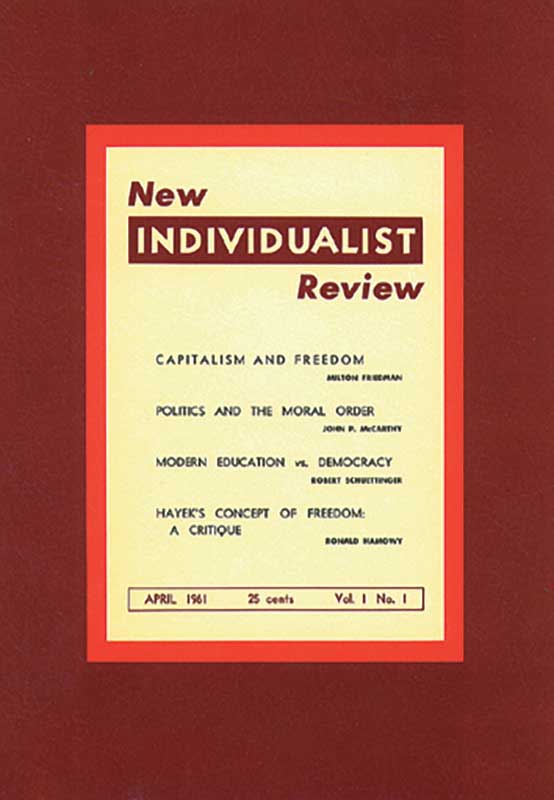
JOHN WEICHER, BOOK REVIEW: The Moulding of Communists, by Frank S. Meyer - Ralph Raico, New Individualist Review [1961]

Edition used:

New Individualist Review, editor-in-chief Ralph Raico, introduction by Milton Friedman (Indianapolis: Liberty Fund, 1981).

About Liberty Fund:

Liberty Fund, Inc. is a private, educational foundation established to encourage the study of the ideal of a society of free and responsible individuals.


BOOK REVIEW:

Seldom does a book appear telling us what it is like to be a Communist. We have had a few biographies, most eloquently Whittaker Chambers’ Witness, which, unfortunately, became a classic before most of the present student generation began to read; Darkness at Noon; the stories of some of the counterspies—Herbert Philbrick, Matt Cvetic—and some of the Soviet defectors, such as Victor Kravchenko. But the emphasis, especially in recent writing, has been on the ism, on the theory, the strategy or the conspiracy, and not on the man. Of the seven books in the Fund for the Republic’s series on Communism in American Life, Frank S. Meyer’s The Moulding of Communists is the first to treat specifically of the Communist as Communist, rather than as believer in Marxism or as worker in some specific subversive activity, for instance.

Unlike Chambers or Koestler, however, Meyer offers an analysis of how a Communist is made. Drawing upon his experience of 15 years in the Communist party, he abstracts the basic elements from the individual cases to present a systematic explanation of the process, in both its theory and practice. It is an infinitely painstaking process, from the recruitment of carefully-chosen specific individuals, through the development of the ideal Communist by intensive training, criticism and discipline. No other political, religious or military institution in Western experience has ever carried out such a continuous forced re-shaping of the personality and philosophy of the individual member. “The emphasis on development and training continues with greater rather than less emphasis in the higher levels of the movement . . . certainly I have found it as high as in National Secretaries of the Western Communist Parties—Browder, Pollitt, Thorez, Pieck . . .”

“The primary elements of the methodology of the Communist training process, then, are these: uncompromising insistence on the scientific character of reality, combined with continuing stress on responsibility, in a milieu where life is training and training is life. But a further element is necessary to fuse the others together.” That element is pressure. Three chapters of the book specifically discuss the forms of pressure brought to bear upon the individual Party member. Training of the cadre, the inner core of elite “Communists in the full sense” of the book’s title, differs from that of the rank-and-file member largely in that, at the cadre level, the pressure is self-imposed.

The pressure is applied in every conceivable situation; the Communist Party counts each small point as critical. “An ‘error’ in work is immediately assigned to ‘theoretical weakness’; or a difference of opinion on even a comparatively minor organizational or technical question is debated with constant appeals to high theoretical principles.” Meyer tells of the national Organizational Secretary of the French Young Communist League, whose “infuriatingly bureaucratic attitude” over a housing problem at an international anti-war conference led within six months to his expulsion from the French Party for “holding a semi-Trotskyist position on the allies of the proletariat.” Incidents such as this, occurring continually on every level of party activity, and forcing all deviations from Marxism-Leninism into the open where they can be destroyed, mould the cadre. The description of the process forcefully brings home to the reader the nature of Communism as studies of theory or strategy cannot.

Meyer is admittedly less successful in explaining the role of theory in the day-to-day life of the Communist. He speaks of the concept of “unity of theory and practice” as central to Communism: “theory is not reducible to practice, but indissolubly united with it in a relationship where neither exists without the other, where each determines the other, permitting independent validity neither to abstract theory nor to empirical practice. It is a strange marriage of rationalism and empiricism, this unity of theory and practice which forms the intellectual mode of existence of the Communist.” “But the unity of theory and practice enables the Communist to identify every act of the organization, even the most wanton exercise of authority over himself, as a necessity of History. His theoretical outlook enables him to ‘recognize’ that necessity. To recognize it is to be free. And this is not a matter of verbal gymnastics. It is simply the closest I can get to expressing in explicit terms the inner rationale which makes it possible for a feeling of independence and the actuality of subservience to exist side by side.”

For a better description of this concept, which Meyer terms “mystical,” we must turn to the imaginative writers. But for an unemotional explanation of the Communizing process and description of the Communist, with notes so full as to constitute a bibliography on the subject, The Moulding of Communists is unequalled. It is basic to any serious study of Communism.

JOHN WEICHER